Zbigniew Twardowski
Sebastian Kostruba
ł
a
Jolanta Wartini-Twardowska
University of Economics in KatowiceUSING PROSUMPTION PARADIGM
ASSUMPTIONS FOR BUSINESS MODEL
DEVELOPMENT OF CONSORG S.A.
Introduction
„[...] Reduction of the costs of technology has enabled people the access to the tools which had been out of their range before; at present, millions of ama-teur fans may record music, produce short movies or design simple software with the similar effect to that reached by professionals” [OsPi10, p. 72].
Prosumption in IT-sector became most remarkable when the WEB 2.0 age came which is totally based on the creativity of Internet users. In the case of business oriented IT solutions (especially DSS) prosumption is seldom men-tioned. However, it does not mean that the phenomenon of prosumption is mar-ginal or useless in this area. On the contrary, when observing the changes in the approach to software development and implementation, it can be said that, pres-ently, nearly all the enterprises have the necessary tools at their disposal which enable the potential of their employees for creating the own IT solutions aimed at supporting their work, to be used.
In this paper the problem of prosumption is considered from the point of view of an IT solution provider. These deliberations focus on the factors which shape the provider’s business model allowing the value to be offered to clients through IT solutions based on the prosumption concept. Such an approach has allowed to formulate the main thesis of the paper, according to which the solu-tion based on prosumpsolu-tion concept will be necessary in order to keep the future competitive position on the market of IT systems aimed at supporting the user’s information and decision related processes. It will enforce the reengineering of
key business processes of IT solution providers which will result in deep innova-tions covering the business models exploited presently. Business model of CONSORG S.A. company which began its activity with business consulting and then supported it with its own IT and the own tools, has been used as an example of business model evolution towards the solution based on the prosumption con-cept. After several years DSS development and implementation became the company’s main business. Nowadays products as well as the company’s business model are using the assumptions of prosumpton paradigm more and more coura-geously and thereby the idea of shaping its clients (prosumers) becomes closer and closer to CONSORG S.A. company. Its activities (oriented towards clients’ training) are helpful in raising their certainty and self-confidence and in winning their confidence to the system. The implementation is not completed at the mo-ment of giving the product to the client but at the momo-ment the client gains the skills required for using the system by himself in the creative work.
1. Foundations of business model
Different theories which can be encountered in the literature of the subject regarding the client’s participation in the process of creating products or services indicate some significant relationships occurring between the enterprise and the clients who co-create the added value. In the consequence of the evolving ap-proach to the client, the manufacturers/service providers have transferred a part of functions upon the consumers according to the prosumption rule, i.e. “do it yourself” [LaMa09, p. 164-166]. As early as in the eighties of last millennium Alvin Toffler announced the inevitable social integration (proposed by the theory of “prosumerism”) aimed at combining the sphere of production with that of consumption and, simultaneously, he foresaw the dissemination of tele-work [UjNa09, p. 297-302];[LaMa09, p. 164-165].
Prosumption has been used by CONSORG S.A., one of the first Polish companies offering IT services including the specialized business consulting and the improvement of management processes through introducing the specialized organizational solutions based on controlling philosophy and supporting the cli-ent’s business key processes by means of a modern IT technology, from the very beginning of its activity.
Business model constitutes the foundation on which business key processes are built and the unit goals are defined and translated into operational activities. Perception of an enterprise’s business model logic allows to identify its key fac-tors determining the added value [Wart12]. CONSORG’s business model is strongly accentuating the value proposal for the client based on knowledge and
experience of the consultants who design business processes along with the fu-ture client treating the IT technology as a significant added value for the pro-posed solutions. Such an approach was of a great influence on the directions of CONSORG’s business model evolution. Initially, consulting was the exclusive activity of the company. However, the optimizing of business processes in a way bringing significant advantages relating to the proposed solutions, has nearly al-ways required the use of IT technology. CONSORG included IT solutions in its offer aimed at supporting the designed business tools. It was decided to develop the tools and applications (in-house) by extending strongly the team of pro-grammers and IT consultants for this purpose. The approach to implementation was not changed. The offer is still based on the activities aimed at optimizing the client’s key processes and the developed tools „support” the consultants in the implementation of the designed business applications. IT in the CONSORG’s business model is oriented towards providing internal services for the consult-ants who design business solutions for the client. Implementation of the systems aimed at supporting the decision-making (operational or strategic ones) requires a high flexibility of IT technology expressed by the possibilities to quickly match the application functionality to the changing needs of users. Thus, it was the task of IT technology to provide CONSORG’s consultants implementing the designed business solutions with a tool platform enabling a quick creation of an application prototype and then to optimize the solution through co-operation with a very exacting client (most frequently with Management Board of large corporations). Implementation was closed as soon as the basic functional re-quirements being the agreement subject had been met and the training had been given to the system users (in this case they were business analysts, financial su-pervisors, IT services) which ensured the independent modification of the appli-cation. At the first stage of the CONSORG’s IT platform development the above mentioned modification of the application by the client lied above all in the in-dependent preparation of reports. For this purpose a great importance was at-tached to the transparent for the future user designing of multidimensional OLAP cubes at the time of implementation. With time the possibilities of user’s intervention in the delivered IT environment increased to such an extent that it is presently possible not only to develop the implemented applications but also the independent creation of applications in the areas that were not foreseen in the implementation agreement. De facto, a well-trained user provided with technical documentation and exploring the environment intensively, is able to reach the level of competence in the area of creating the application which is comparable to that of CONSORG’s business consultants.
In view of the prosumption CONSORG has passed several stages. At the two first stages, i.e. software creation:
− on „turn key” basis according to the design worked out by consultants,
− dedicated to the consultants enabling business solutions to be accomplished by them,
client’s prosumption is limited to the joint work with consultants and to the use of remarks and ideas collected when creating the software. The effect of such a cooperation is a tool matched to client’s needs with a high-level support from substantial consultants. Moreover, the software is developed each time “from the ground up” which means increased costs and implementation time and affects its flexibility. Flexibility is increased after the accomplishment of a later client’s new order when the consultants are able to individually develop the solutions. However, there still remain restrictions related to the cost and accomplishment time from the moment of reporting the idea by the client up to its completion.
Further stages approaching CONSORG to the prosumption idea constitute a significant change for the client. Initially, the client receives the tools allowing the independent build-up of reports and compilations which shorten his working time and diminish expenses on further solutions within the system. At the next stage he receives a full package of software, the same as that being at consult-ants’ disposal, so he can develop the application in any direction. However, the increased system flexibility requires its stability to be ensured. When the tool is transmitted too quickly to the client it is impossible to eliminate the errors gen-erated by the system which significantly brakes the client’s prosumption- -oriented behaviours related to the lack of confidence. Such an approach closes CONSORG by high outlays on R+D department aimed at stabilizing the tools. In spite of a high system flexibility the clients prosumption-oriented activity has its limits determined by the multidimensional model worked out by CONSORG’s consultants at the beginning of the implementation.
2. Corporation business model of Consorg S.A.
The basic business model of CONSORG S.A. company was based on main-taining three main areas of business activities, i.e. the widely understood creat-ing and keepcreat-ing relations with clients, creatcreat-ing product innovations and devel-opment of tool platforms and implementing the business solutions and servicing the implemented applications at the client’s, within one single organizational structure (see Figure 1). The key clients of CONSORG were large industrial corporations acting most frequently within a holding or concern structures*.
ue of the implemented solutions resulted from the knowledge and experience of consultants who designed business solutions and their flexibility in responding to client’s needs. Functionality of the tool platform on which the applications de-signed by consultants were built, was optimized along with business project. Such an approach enabled a flexible co-operation between the consultant and the client. The consultant created a prototype and then, after client’s remarks (i.e. without the aid of IT), he developed the applications. The number of iterations could be very large with such an approach as the time of response to user’s needs was the key parameter of the assessment of co-operation quality. Up to now the fastness of responding to client’s needs has been shaping the competi-tive position of CONSORG on the market of IT services. The most valuable functionalities resulting from identification of client’s new needs have been in-cluded in the tool platform developed by IT department. Thus, on one hand the platform became more and more versatile but on the other hand, which is obvi-ous, the cost of its maintenance and development were growing, mainly due to labour input devoted to ensuring the integrity of its particular components.
Key partners Suppliers of system and tool software (e.g. Microsoft) Key activities 1. Solving the client’s business problems Value proposal for the client
Knowledge and experience of the consultants designing business solutions and their flexibility in responding to the changing needs of the client
Relations with clients 1.Personal support 2.Client’s dedicated customer service Clients’ segments 1.Large economic organizations, capital groups 2.Capital groups quoted on Stock Exchange Key resources 1.Trade relations 2.Business consultants 3.R+D team 4.The own
techno-logical platform
Distribution channels
Own, direct, based on tradesmen employed within a permanent employment agreement Cost structure
1.Costs of business consultants (provision and keep-ing)
2.Cost of implementation related services 3.Costs of research and development
4.Costs of client support and post-implementation services
5.Costs of client acquisition (commercial)
Revenue streams
1.Revenues on consulting services 2.Revenues on the own license fees
3.Revenues on commissions from external licenses 4.Revenues on implementation services and
trainings
5.Revenues on the maintenance of tool platform and applications
Fig. 1. CONSORG S.A. Corporation Business Model
Business model management as presented in Figure 1 lies in mitigating the obvious conflicts between the required scale of sale of license which justifies the IT platform development and the development of business applications aimed at solving the client’s individual problems. Inclusion of further components (func-tions) in the tool environment and their further integration within one single “consultant friendly” platform are justified if there is a chance of their reuse.
The requirement regarding the scale of sale financing the platform devel-opment causes an automatic change in the orientation of commercial activities. Tradesmen must focus on looking for a client whose needs can be served by modifying the platform functionality to the smallest possible extent. In turn, such an approach is opposite to the requirements of business consultants who are in-terested in solving the client’s non-standard problems [TwSt09]. Despite the fact that the client is able to individually build the whole solution, he does not make use of it as the implementation is based on the use of the business applications worked out before by CONSORG Company’s consultants which are matched to client’s business model. The scope of system functionality which has been ex-tended for this purpose causes that, at first the consultants and then the clients, have the possibility to independently extend the multidimensional structures. On the other hand, the number of IT tools used by clients has forced the software manufacturers to search for some new solutions allowing their integration and ensuring the convenience of their use. By going this way CONSORG has pro-vided the access for its clients to the possibility of publishing the analytical ob-jects designed by them (used in client’s business applications) on WEB platform and integrating them with other WEB resources used in the enterprise. From the point of view of prosumption the client has been given the possibility of a free build-up of dashboards integrating the information coming from different sources dedicated for his specific needs. Additionally, a solution running under Microsoft Excel system has been made available for a specific group of employ-ees (accountants, financial analysts, etc.). The application of such an approach does not force the user to change systems or to learn a new interface as it works within one single environment which is matched best to its character. It results from the observation, that the integration of different functionalities has allowed to increase prosumption behaviors among this kind of employees.
3. Towards the build-up of a prosumption business model
Gradual separation of particular activities seems to be the best way of opti-mizing the business model of CONSORG S.A. Redefinition of business activity related to the maintenance and development of OT platform is of a special
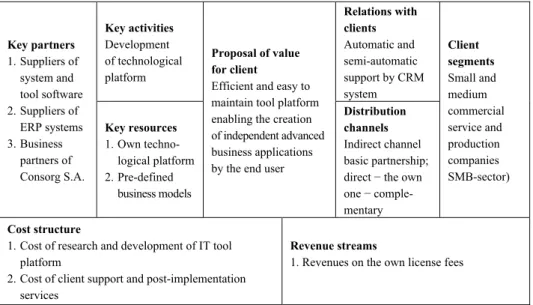
im-portance in this respect. Revenues generated from the sale of license at the level of profitability threshold, at the least, may be achieved in three following ways: firstly, selling the license to other partners (competition); secondly, implement-ing the unique functionalities of the platform within the most famous competi-tive platforms (IBM/Cognos/TM1 or OBI). Thirdly, matching the platform to fi-nal user’s needs who is able to quickly develop his own applications, not only without the support from CONSORG S.A. consultants but also with minimum participation of his own IT. The last approach which gives the fastest effects has become the subject of intensive activities aimed at re-engineering the business processes of CONSORG S.A. The basic assumption of the designed business model for the activities related to the maintenance and development of a tool platform was the change of the definition of the final client. The market for CONSORG platform has been created by both the existing internal client (CONSORG business consultant) and the clients of the leading ERP system sup-pliers, clients of CONSORG business partners and the clients acquired in an in-direct way (see Figure 2).
Key partners 1.Suppliers of system and tool software 2.Suppliers of ERP systems 3.Business partners of Consorg S.A. Key activities Development of technological platform Proposal of value for client
Efficient and easy to maintain tool platform enabling the creation of independent advanced business applications by the end user
Relations with clients Automatic and semi-automatic support by CRM system Client segments Small and medium commercial service and production companies SMB-sector) Key resources 1.Own techno-logical platform 2.Pre-defined business models Distribution channels Indirect channel basic partnership; direct − the own one − comple-mentary
Cost structure
1.Cost of research and development of IT tool platform
2.Cost of client support and post-implementation services
Revenue streams
1. Revenues on the own license fees
Fig. 2. Separated CONSORG S.A. business model for the area of maintenance and development of IT platform
Source: Own elaboration based on the template of business model as proposed by [OsPi10].
The target group of clients and the proposed value added are the first to change along with the modification of business model. The offer is directed to SMB sector by assuming a smaller revenue on a unit transaction, a larger
num-ber of them and decisively lower costs of client’s acquisition and maintenance. The proposal regarding the value changes from solving business problems to the delivery of an efficient tool platform where the end user builds up business ap-plications independently by solving his own specific problems. Relations with the client (acquisition and support) are created in a semi-automatic way by tele-marketing team supported by CRM system which has been worked out especial-ly for that purpose. Platform implementation is limited to software installation and a training for the staff. Apart from having a flexible tool platform, the key factor of success for such an approach is a system of trainings for users based on pre-defined business models received from the best implementation practices of CONSORG (worked out during the accomplishment of large business projects in different branches). Due to that the last barrier has been broken related to the multidimensional data model. The clients are able to independently build up a multidimensional model and to provide it with the data from their own IT sys-tems. Like in the case of business applications, CONSORG company prepares the pre-defined models (based on the most popular ERP systems) which can be extended by the client individually, or the client may create his own models and their resources (supplies).
4. Possible scenarios of prosumption business model
development
Development of network technologies, especially the one enabling the data to be processed within cloud computing, gives an opportunity to analyze the chances and threats for the designed prosumption business model of CONSORG. The first positive effects of installing the own technological platform in an environment which enables the data to be processed within cloud computing are provoking the business part of such an approach to be deeply reconsidered – Figure 3.
It is worthwhile to remember that the build-up of a complete IT solution re-quires a well selected and efficient equipment architecture, apart from the knowledge and tools. Then, the maintenance of equipment and IT tools forces the employment of further specialists. Transfer of the solution into cloud compu-ting simplifies the business model (due to outsourcing of equipment and soft-ware or intuitive tools enabling the individual accomplishment of needs by the client). At the same time the client is transferred to a higher level of prosumption, i.e. he independently modifies and creates IT solutions for himself and matches the computational possibilities of cloud computing (which also means equipment resources) to his current needs.
Key partners Suppliers of environment enabling the processing within cloud computing Key activities Development of technological platform for the needs of cloud computing
Value proposal for the client
Efficient and easy to maintain tool platform available from any location of the user and enabling the creation of independent business application by the end user Relations with clients Automatic and semi-automatic support by CRM Client segments Small and medium commercial service and production companies SMB-sector) Key resources 1.Own technological platform enabling the work within cloud computing Distribution channels Indirect channel basic partner-ship; direct −
the own one −
complementary
Cost structure
1.Cost of research and development of IT tool platform 2.Cost of the use of the environment for cloud computing
Revenue streams
Revenues on the use of tool environment
Fig 3. Separated business model of CONSORG S.A. for the area of maintenance and development of IT platform taking the processing in cloud computing into account
Source: Own elaboration based on the template of business model as proposed by [OsPi10].
From technological point of view CONSORG company has extensive pos-sibilities to use such an approach, due to, inter alia, WEB interface for the tools offered by it and to the components made available for data integration with the user’s transaction systems.
Conclusion
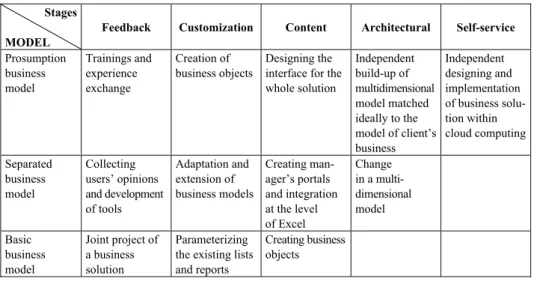
IT companies can manipulate the determined factors by discouraging or by approaching their clients to the prosumption concept. Three factors proposed by R.H. Walker and L.W. Johnson seem to decide about the success of CONSORG, i.e.: personal capacity (ability and self-belief that they can use the prosumption technologies and interfaces successfully), perceived risk (extent to which a pro-sumer believes the software system is reliable and secure) and relative advantage (the extent to which prosumption is believed to be more convenient, faster, more efficient, and more productive than the traditional mode of consumption). The use of prosumption assumptions by clients does not need to mean their total separation from IT solution suppliers. Prosumption in enterprises may be at dif-ferent levels of progress. R. Kitchin, M. Dodge have proposed the prosumption to be divided into 6 types depending on the possibilities offered by the software, i.e.: feedback, customization, content, architectural, market and self-service. With reference to the above mentioned prosumption levels and the presented business model of CONSORG S.A. company, the above specified types may be assigned to subsequent stages of software development, i.e.:
− clients’ participation in designing the solution, reporting remarks and ideas to be taken into account in further versions of the system, i.e. feedback,
− independent extension of business applications within a narrow scope, i.e. customization,
− extension of business applications within any scope – the possibility of creat-ing the whole solution independently, i.e. content,
− extension of multidimensional models, integrating different solutions operat-ing within the enterprise and creatoperat-ing new solutions on their basis (e.g. dashboards), i.e. content and architectural,
− potential possibility of designing and creating the own business solution based on cloud computing which is independent of the company’s equipment infrastructure, i.e. self-service.
The solutions based on prosumption concept aimed at supporting the man-agement processes, especially within the area of decision-making require not only a flexible IT technology in order to constitute the added value, but also an effective business model of the supplier. In Table 1 the development stages have been presented in respect of both technology and organization of CONSORG.
Table 1 Development stages of IT technology and business model of CONSORG S.A.
Stages MODEL
Feedback Customization Content Architectural Self-service
Prosumption business model Trainings and experience exchange Creation of business objects Designing the interface for the whole solution Independent build-up of multidimensional model matched ideally to the model of client’s business Independent designing and implementation of business solu-tion within cloud computing Separated business model Collecting users’ opinions and development of tools Adaptation and extension of business models Creating man-ager’s portals and integration at the level of Excel Change in a multi-dimensional model Basic business model Joint project of a business solution Parameterizing the existing lists and reports
Creating business objects
Apart from technological platform, knowledge transformation procedures sup-porting the end user in matching the applications to the solving of decision-making problems, constitute the key resources of the described business model. It implies the development of technology and the operation mode of the enterprise.
References
[GrMT05] Grudziński J., Majewska A., Twardowski Z.: Controlling jako instrument
sys-temu wczesnego ostrzegania w monitorowaniu strategii wzrostu wartości
or-ganizacji gospodarczych o strukturach koncernowych. Studium przypadku
Po-łudniowego Koncernu Energetycznego S.A. In: E. Urbańczyk (ed.):
Międzynarodowa Konferencja Naukowa: Strategie wzrostu wartości przedsię
-biorstwa. Teoria i praktyka. Uniwersytet Szczeciński, Szczecin 2005.
[KiDo11] Kitchin R., Dodge M.: Code/Space: Software and Everyday Life. MIT Press, 2011.
[LaMa09] Lachiewicz S., Matejuk M.: Konkurencyjność jako determinanta rozwoju
przedsiębiorstwa. Wydawnictwo Politechniki Łódzkiej, Łódź 2009.
[OsPi10] Osterwalder A., Pigneur Y.: Business Model Generation: A Handbook for
Visionaries, Game Changers and Challengers. Wiley, 2010.
[StST07] Stanek S., Sroka H., Twardowski Z.: A Decision Support System in
Diag-nosing the Financial Condition of an Organization. “Journal of Decision Systems” 2007, Vol. 16, No 2.
[TwSt09] Twardowski Z., Stanek S.: W poszukiwaniu źródeł trwałej przewagi.
„Computerworld” 2009, Vol. 46, Raport Specjalny ERP/BI, 12/2009.
[UjNa09] Ujwary-Gil A., Nalepka J.: Organizacje komercyjne i niekomercyjne wobec
wzmożonej konkurencji oraz wzrastających wymagań konsumentów. Wyższa
Szkoła Biznesu – National Louis University, Nowy Sącz 2009.
[WaJo06] Walker R.H., Johnson L.W.: Why Consumers Use and Do Not Use
Technology-enabled Services. “Journal of Services Marketing” 2006, Vol. 20, Iss. 2, pp. 125-135.
[Wart12] Wartini-Twardowska J.: Modele biznesowe formą tworzenia wartości
do-danej w grupach kapitałowych. In: D. Zarzecki (ed.): Zarządzanie
finan-sami, inwestycje, wycena przedsiębiorstw, zarządzanie wartością. Zeszyty
Naukowe No 690, Uniwersytet Szczeciński, Szczecin 2012.
[Wart12] Wartini-Twardowska J.: Model biznesowy jako narzędzie modelowania
wartości w grupie kapitałowej. Article on the V Forum Naukowe
Uniwer-sytetu Ekonomicznego w Katowicach, XI 2012 (in printing).
WYKORZYSTANIE ZA
Ł
O
Ż
E
Ń
PARADYGMATU PROSUMPCJI DO ROZWOJU
MODELU BIZNESOWEGO FIRMY CONSORG S.A.
Streszczenie
W artykule postawiono tezę, w myśl której utrzymanie w przyszłości pozycji
konku-rencyjnej na rynku systemów informatycznych wspierających procesy informacyjno-
-decyzyjne użytkownika będzie wymagać rozwiązań opartych na koncepcji prosumpcji.
Nie ograniczy to działań dostawców rozwiązań IT jedynie do technologicznych zmian
w obrębie swoich produktów, lecz przede wszystkim wymusi reinżynierię kluczowych
procesów biznesowych. Podjęta problematyka została opisana z perspektywy ewolucji