YOUNG CHILDREN’S PERCEPTIONS OF PEER OBESITY IN THE CONTEXT OF OTHER VISIBLE DIFFERENCES
Joanna Sarah Charsley
Submitted in accordance with the requirements for the degree of Doctor of Clinical Psychology (D. Clin. Psychol.)
The University of Leeds School of Medicine
Academic Unit of Psychiatry and Behavioural Sciences
The candidate confirms that the work submitted is her own and that appropriate credit has been given where reference has been made to the work of others. This copy has been supplied on the understanding that it is copyright material and
that no quotation from the thesis may be published without proper acknowledgement.
ACKNOWLEDGEMENTS
Firstly, I would like to thank my supervisor Professor Andrew Hill for his expertise, guidance and encouragement throughout the course of this work. I am also grateful to Dr Sylvie Collins for her help in initiating this research and her continued support. I would also like to thank the Clinical Psychology staff for their time, patience and understanding.
Secondly, I would like to thank the schools who participated. I am grateful to the staff and teachers for their enthusiasm, practical support and for making me feel welcome. I would also like to thank all the children who took part and made the interviewing process a thoroughly positive and fascinating experience.
Finally, I am truly grateful for the unwavering support and encouragement from my parents and my partner. I would also like to thank my cohort for their friendship and support, and for making my time on the course so enjoyable.
ABSTRACT
The increasing prevalence of childhood obesity is of serious concern due to its negative physical health and psychosocial consequences. Overweight and obese children often become the target of negative stereotypes and weight-based
stigmatisation, and it has been suggested that anti-fat attitudes are held by children as young as three years old. This study aimed to address methodological limitations in the current literature by engaging young children in qualitative research to explore their attitudes towards fatness in the context of other visible differences.
85 children aged 4 – 6 took part in a semi-structured interview using a dyadic approach within Kelly’s repertory grid methodology. The children were asked about the visibility and desirability of physical differences in four illustrated characters. They were also asked about their self-image and friendship preferences, and the reasons for their answers. Data from the repertory grids were analysed quantitatively and thematic analysis was used to explore the qualitative data resulting from open-ended interview questions.
The results showed that the majority of children did not consider fatness to be the primary differentiating physical characteristic between peers. They showed a general preference for categorical similarity in their friendship choices and did not demonstrate predominant negativity towards fatness when considering their actual and ideal self-image. There were, however, a minority of children who identified negative characterisations and beliefs, which were reflective of fat stereotypes in the media, and that are evidenced in first hand reports by people with obesity.
The findings indicate that negativity towards fatness amongst this age group have been previously overstated due to the nature of the research methods used. The repertory grid methodology enabled the direction of the study to be guided by the children, which allowed the expression of a few specific anti-fat attitudes within the broader context of negativity towards other ‘not-like-me’ visible differences.
TABLE OF CONTENTS ACKNOWLEDGEMENTS ... 2 ABSTRACT ... 3 TABLE OF CONTENTS ... 4 LIST OF TABLES ... 6 LIST OF FIGURES ... 6 CHAPTER 1: INTRODUCTION ... 7
Prevalence of Childhood Obesity... 10
Physical consequences of childhood obesity ... 10
Psychosocial consequences of childhood obesity ... 11
Weight stereotypes and stigmatisation ... 12
Social rejection ... 14
Gender differences in weight stigmatisation and social rejection ... 17
Development of stereotyping and prejudice ... 18
“Like-me” preferences ... 18
Obesity in relation to other visible differences ... 19
Methodological limitations and gaps in the literature ... 20
Quantitative methodology ... 20
Forced choice methodology ... 21
Use of body-size manipulations ... 22
Overlooking children’s own insights ... 23
Participant age ... 23
An alternative approach to obesity research with very young children ... 24
Using qualitative methodology with very young children ... 24
Personal Construct Theory ... 25
Repertory grid methodology ... 25
Aims of the present study ... 28
CHAPTER 2: METHOD ... 29
Design ... 29
Participants ... 29
Materials ... 30
Understanding of visible differences ... 30
Estimation of body size ... 31
Procedure... 32
Pilot study ... 34
CHAPTER 3: RESULTS ... 36
Do young children use fatness as the primary differentiating physical characteristic between peers when compared with other attributes such as gender, disability and clothing? ... 36
Are young children less likely to select a peer who is overweight than one in a wheelchair or of the opposite gender when making friendship selections? ... 40
Do young children demonstrate more negativity towards fatness than other characteristics, such as gender, disability and clothing, when considering their actual and preferred self-image? ... 42
Actual characteristics ... 42
Preferred characteristics ... 44
What are young children’s reasons for their rejection of peers and their self-image preferences?... 46
Peer rejection ... 47
Physical ... 48
Preferences for self ... 51
Social ... 55
Effect of participant gender ... 56
Children’s body size and their attitudes towards fatness ... 57
CHAPTER 4: DISCUSSION ... 58
Fatness as the most salient characteristic ... 59
Difference and diversity in friendship preferences ... 62
The importance of weight in children’s actual and preferred self-image ... 62
Children’s reasons for friend rejection and self-image aversions ... 64
A focus on fat ... 64
Fat in the context of other differences... 67
Gender differences and body size in children’s attitudes towards fatness ... 68
Strengths and limitations of the present study ... 70
Strengths ... 70
Limitations ... 71
Recommendations for future research ... 72
Practical implications ... 74
Conclusions ... 76
References ... 77
APPENDICES ... 93
Appendix 1: School participation letter ... 93
Appendix 2: Letter to parents/guardians ... 95
Appendix 4: Confirmation of ethical approval ... 98
Appendix 5: Character set for male participants ... 100
Appendix 6: Character set for female participants ... 102
Appendix 7: “You” card... 103
Appendix 8: Repertory grid for male participants ... 105
Appendix 9: Repertory grid for female participants ... 106
Appendix 10: Collins scale (1991) ... 107
Appendix 11: Protocol for gaining assent from children who have parental consent ... 108
Appendix 12: Interview schedule... 109
LIST OF TABLES Table 1: The character chosen as 'most different' from the standard character ... 36
Table 2: The main difference children identified between the standard and their chosen characters ... 38
Table 3: Number of each construct category elicited over three choices ... 38
Table 4: Total frequency of construct categories elicited by male and female participants ... 40
Table 5: Children’s friendship choices when construct relates to ‘Fatness’ ... 41
Table 6: Children’s friendship choices when construct relates to ‘Wheelchair’ ... 41
Table 7: Children’s friendship choices when construct relates to ‘Gender’ ... 41
Table 8: Children’s most similar to- and most different to- character selections ... 42
Table 9: Boys’ and Girls’ most similar to- and most different to- character selections ... 43
Table 10: Number of fatness-related reasons for most similar character selections ... 43
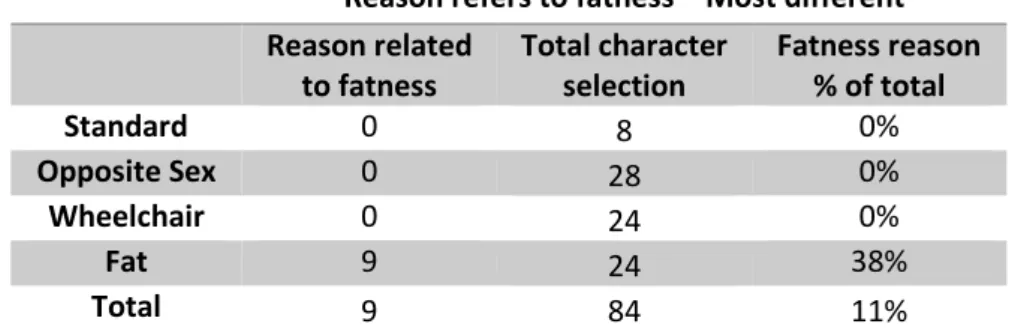
Table 11: Number of fatness-related reasons for most different character selections ... 44
Table 12:Children’s would most like to be- and least like to be- character selections ... 45
Table 13: Boys' and girls' most want to be- and least want to be- character selections ... 45
Table 14: Number of fatness-related reasons for ‘most like to be’ character selections ... 46
Table 15: Number of fatness-related reasons for ‘least like to be’ character selections ... 46
LIST OF FIGURES Figure 1: Proportion of primary vs secondary differences elicited for the three choices ... 37
Figure 2: Frequency of construct categories elicited across the three choices ... 39
Figure 3: Thematic summary of young children’s reasons for rejecting peers who are the opposite gender, fat, or in a wheelchair. ... 48
Figure 4: Thematic summary of young children’s reasons for their selection of the character that they ‘least wanted to be’. ... 52
CHAPTER 1: INTRODUCTION
The rising prevalence of childhood obesity is a global concern and is being increasingly regarded as “one of the most serious public health challenges of the 21st century” (World Health Organisation, 2014). In 2014, the Health Survey for
England, part of the National Child Measurement Programme, found that 31% of children aged between 2 and 15 were classified as overweight or obese (Ng Fat, 2015). Childhood obesity presents a significant threat to physical health, which has been linked with an increase in medical care requirements, days off school and health-related limitations (Wijgaet al, 2010). Obesity in childhood is a strong predictor of obesity in adulthood (Pulgarón, 2013; Rooney, Mathiason & Schauberger, 2011), both of which increase the risk for development of chronic conditions and premature mortality (Reilly & Kelly, 2011).
In addition to difficulties in physical health, obesity in childhood has been associated with reduced psychosocial wellbeing due to the widespread belief in Western societies that “fat is bad” (e.g. Fielden, Sillence & Little, 2011). Children and adolescents who are overweight have been found to be the targets of weight-based stigmatisation, which manifests as bullying and social isolation. This can lead to reduced self-esteem, anxiety and depression, which may persist into adulthood. Despite the increase in the prevalence of childhood obesity, whereby one might expect fatness to become more normalised and accepted, it has been suggested that this stigma has increased over time (Latner & Stunkard, 2003).
Since seminal work in the early 1960s, research has consistently concluded that children like overweight peers less than their healthy-weight counterparts. Overweight children have been found to be less liked than peers with other visible
differences, such as those with physical disabilities or abnormalities (e.g.
Richardson, Goodman, Hastorf & Dornbusch, 1961; Latner & Stunkard, 2003), are more likely to be ascribed negative character traits (Kirkpatrick & Sanders, 1978; Wei & Di Santo, 2011) and are assumed to lack competence across physical, social and academic domains (Penny & Haddock, 2007). This stigmatisation of fatness is suggested to be observable from as young as three years of age (Cramer & Steinwert, 1998; Musher-Eizenmann, Holub, Miller, Goldstein & Edwards-Leeper, 2004).
Much of the research into this area has been primarily quantitative in nature. While these studies have been able to establish the presence of negative attitudes towards fatness, they have been unable to ascertain the reasons for these views or how they may have developed. Furthermore, such research has often made use of forced choice methodologies or has only focussed on fatness, in the absence of other visible differences, which may have led to an overestimation of negative evaluations. Historically, there has been an assumption that children cannot meaningfully engage in qualitative research. However, more recently it has been shown that, with the right support, children are able to provide valuable first-hand accounts of their experiences and beliefs (Scott, 2000).
This study aimed to explore young children’s perceptions of obesity whilst addressing some of the methodological concerns listed above. Of particular interest was whether obesity was a predominant discriminating factor when placed within the context of other visible differences. The terminology in this thesis has been guided by the language used by the children themselves in relation to the visible differences that they noted. Throughout the tasks, the children most often used the term ‘fat’ when describing the image of the overweight character. In line with research which suggests that overweight adults prefer to be described as ‘fat’ or “overweight”
(Thomas, Hyde, Karunaratne, Herbery & Komesaroff, 2008), these terms will be used throughout this thesis. The exception to this is when “obesity” is used to denote a specific medical condition. In addition, when discussing the character with a physical disability, the children focussed on the presence of the wheelchair and therefore reference will be made to ‘the character in the wheelchair’ where appropriate.
A comprehensive literature search was conducted using Scopus and Google Scholar and was last updated in May 2016. The following search terms were used in different combinations : “obesity”, “obese”, “overweight”, “fat”, “fatness”, “weight”, “body size”, “healthy”, “unhealthy”, “stigma”, “stereotype”,
“prejudice”, “anti-fat”, “attitudes”, “understanding”, “perception”, “awareness”, “concerns”, “preschool”, “child”, “children”, “childhood”, “young”,
“adolescent”, “adult”, “gender”, “sex”, “boys”, “girls”, “friend”, “friendship”, “preferences”, “disability”, “wheelchair”, “differences”, “visible” and
“development”. The review below will begin by providing an overview of the current prevalence of childhood obesity and associated risks from a physical and psychosocial perspective. Research into overweight stigma will be reviewed and critically evaluated before considering research into the development of stereotyping and prejudice in childhood. There will be a discussion of the methodological
limitations and gaps in the current literature base, and the ways in which these may be addressed through using a mixture of quantitative and qualitative approaches, in line with developmental considerations for this age group. Finally, the rationale and aims for the present research project will be outlined.
Prevalence of Childhood Obesity
The rising rates of obesity in child populations worldwide are presenting a serious and urgent challenge (World Health Organisation, 2016). In the United Kingdom, recent statistics from the National Child Measurement Programme showed that one fifth of 4 – 5 year olds and one third of 10 – 11 year olds are now classified as overweight or obese (Ng Fat, 2015). These figures varied widely depending on the socioeconomic status of the school’s catchment area. There was a positive correlation between overweight status and level of deprivation, with percentages of overweight and obese children in reception and year 6 ranging between 6 – 12% and 13 -25%, respectively.
Physical consequences of childhood obesity
The most common medical consequences of obesity in childhood include early maturation, diabetes mellitus, hypertension and sleep apnoea (Dietz, 1998; Melidonis, Tournis, Kompoti, Lentzas, Roussou, Iraklianou et al, 2006).
Furthermore, childhood obesity has been linked to a multitude of other physical health sequelae including tooth decay, back pain, iron deficiency, asthma and gastrointestinal problems. However, the lack of prospective studies in this area means that directional relationships cannot be established (Pulgarón, 2013). In addition, such physical health difficulties can lead to pain and discomfort during physical exercise. This may cause the individual to become increasingly sedentary, leading to increased weight and further health problems. There is strong evidence to show that obesity in childhood has a detrimental impact on morbidity and mortality in adulthood (Reilly & Kelly, 2011). A developmental trajectory has been found whereby obesity in adulthood can be tracked back to their early childhood
development (Pulgarón, 2013). This is in agreement with Rooney et al (2011) who found that many obese adults were obese as adolescents and likewise obese
adolescents were overweight and/or obese in childhood.
This research is limited by the earlier ages at which children are being classified as being overweight and/or obese. There is relatively little literature which considers the physical health impact of paediatric obesity in children under the age of 5 (Pulgarón, 2013). To obtain a more comprehensive understanding of the long term physical consequences of childhood obesity, there is a need to focus
investigations on younger populations. Furthermore, prospective measures would be necessary to establish any differences in outcomes following short-term versus chronic obesity.
Psychosocial consequences of childhood obesity
Childhood obesity is not only detrimental to physical health and functional ability but can also have a range of negative psychosocial consequences due to a widespread belief in Western cultures that childhood obesity is socially
unacceptable. Rees, Oliver, Woodman and Thomas (2011) reported that children in Western cultures of healthy weights were considerably more concerned with the social unacceptability of obesity, whilst the risks to physical health appeared mostly irrelevant. Psychosocial sequelae include bullying (Brixval, Rayce, Rasmussen, Holstein & Due, 2012; Griffiths, Wolke, Page & Horwood, 2006; van Geel, Vedder & Tanilon, 2014) and social isolation (Puhl & Latner, 2007). Thus weight-related peer victimisation has been found to be positively related to child-reported depression, anxiety, social physique anxiety, loneliness (Storch, Milsom,
DeBraganza, Lewin, Geffken & Silverstein, 2007) and suicidal ideation (Eisenberg, Neumark-Sztainer & Story, 2003).
There is also evidence that the psychosocial consequences of childhood obesity can lead to mental health difficulties in later life (Wardle & Cooke, 2005). However this research is inconsistent with other studies which found no relationship between childhood obesity and future psychopathology (e.g. Viner & Cole, 2005), particularly if the obesity had abated by adolescence (Mustillo et al, 2003). Weight-related victimisation has been found to be negatively corWeight-related with levels of physical activity (Storch et al, 2007). This may have direct consequences for the body shape and physical health of the overweight child and thus serve to increase victimisation, social isolation and stigmatisation.
Weight stereotypes and stigmatisation
Individuals with obesity often become targets of weight stigmatisation, which is defined by Puhl and Latner as negative weight-related “attitudes and beliefs that are manifested by stereotypes, bias, rejection and prejudice” (2007, p. 558).
Stigmatised people are considered to possess one or more derogatory characteristics causing them to differ from normative expectations and are therefore considered deviant in certain social contexts. Weight stigmatisation is a reportedly common and detrimental experience for individuals who are overweight across the age range (Puhl, Moss-Racusin, Schwartz & Brownell, 2008) and is rarely challenged in Western societies (Puhl & Heuer, 2009). Such stigmatisation has been found to be widespread, in settings such as primary schools (Jansen et al, 2014), high schools (Puhl, Luedicke, & Heuer, 2011), healthcare environments (Foster et al, 2003) and in the workplace (Paul & Townsend, 1995). Obese individuals are often viewed as
impulsive and lacking willpower, motivation and personal control (Puhl & Brownell, 2001).
Such weight-based stereotypes are held across the lifespan, with children tending to assign more negative character traits to overweight than to average- or low-weight individuals. Wei and Di Santo (2011) found that during a story task, young children (aged between 2 years 8 months and 5 years 10 months) would identify the overweight character as being the “mean” one. They justified their choice by saying that the overweight figures were often bullies, selfish and treated others badly. They also suggested that the larger figure looked angrier, despite an absence of facial characteristics on all the figures. Thus, Wei and Di Santo (2011) concluded that the children must have used body size as their cues to predict happiness or anger in each character.
Studies with older primary school aged children have also been found to negatively label overweight characters. Kirkpatrick and Sanders (1978) found that 6 to 9 year olds labelled a fat character as more lazy, sloppy, naughty and dirty than characters of normal weight and in Penny and Haddock’s (2007) study, 5 to 10 year olds considered the overweight character to have lower athletic, academic, social and artistic abilities. Such findings suggest that children who are overweight are
perceived to lack competence across a range of domains by their peers, and are consequently thought to be less likeable and socially acceptable. Children aged 9 to 12 years have also been found to believe that weight is under volitional control (Tiggeman & Ansbury, 2000), leading to apportion of blame on their peers who are overweight. Research with children suggests that from age 3 years old there is a positive relationship between children’s perceptions of controllability and negative
stereotyping, and blame was associated with lower ratings of acceptance (Lehmkuhl, Nabors & Iobst, 2010; Musher-Eizenman et al, 2004; Tiggeman & Anesbury, 2000).
These stereotypes are regularly reflected in the media portrayals of fat characters. Studies have found that overweight characters are less likely to be involved in romantic relationships, more likely to be mocked and had fewer positive interactions and screen time than their healthy-weight counterparts (Greenberg, Eastin, Hofschire, Laclan & Brownell, 2003). Fouts and Burggraf (2000) found a positive relationship between the fatness of female television characters and the number of negative comments made about them. Research has found similar stigmatising representations within children’s media, with fat characters being associated with more negative traits, such as being evil, unattractive and disliked, while those of healthy weight were more likely to be depicted as sociable, popular, attractive and content (Herbozo, Tantleff-Dunn, Gokee-Larose & Thompson, 2004). This finding was relevant to both human and animal characters.
Social rejection
Being overweight is considered to be “one of the most stigmatising and least socially acceptable conditions in childhood” (Schwimmer, Burwinkle & Varni, 2003, p. 1818) and consequently has a substantial impact on children’s emotional well-being (Strauss & Pollack, 2003). Children have been found to hold the belief that ‘fat is bad’ and should be avoided (Fielden et al, 2011), which has detrimental effects on peer relationships and social inclusion. In a review by Rees, Oliver, Woodham and Thomas (2011) they concluded that overweight children were more isolated, less socially accepted and had fewer friends than their peers. Weight-based social discrimination has been found to be common and even viewed as normal
amongst those in early adolescence (Dixey, Sahota, Atwal and Turner, 2001a). Fielden et al (2011) found that both Reception and Year 6 children felt that people who are overweight are bad and an embarrassment to be seen with. Dixey et al (2001a, p. 21) summarised their findings from healthy eating focus groups with the following quote: “it’s not a good image if you are going around with a fat person”.
In an early study, Richardson et al (1961) asked 10-11 year old children to look at six character drawings who were identical except for the presence or absence of various physical disabilities. The characters included a ‘healthy’ child, one on crutches, one in a wheelchair, one with a facial disfigurement, one missing a hand and a child with obesity. The children were asked to rank in order which character they liked best. In their sample of 640 children, they found that the healthy character was ranked most highly whilst the obese character was ranked as least liked. This study has since been replicated by Latner and Stunkard (2003) who concluded that not only did these ranking positions still hold 41 years later but that the obese character was liked significantly less, suggesting that weight stigma has increased. This result was obtained despite the increase of childhood obesity in the intervening years, whereas one might hypothesise such normalisation may reduce the level of negative perceptions (Davison & Birch, 2002).
Not only has research concluded that children like peers who are overweight less than their average-sized counterparts, it has also been shown that they wish to interact with them less (Bell & Morgan, 2000). When primary school aged children are asked to choose a best friend or playmate from a series of characters, they have been found to choose normal weight or thin characters as best friends and playmates significantly more frequently than overweight ones (Goldfield & Chrisler, 1995; Musher-Eizenman et al, 2004; Margulies, Floyd & Hojnoski, 2008). Cramer &
Steinwert (1998) found that children as young as 3 – 5 years old were less likely to select an overweight character as a playmate. They found that while the 3 year olds were unable to articulate why this was the case, the 5 year olds clearly identified weight as the reason behind their choice.
The experience of social rejection has often been reported in the first-hand accounts of overweight people. In the study by Neumark-Sztainer, Story and Faibisch (1998), high-school aged girls who were overweight spoke about their experiences of being treated differently, being targets of hurtful direct and indirect comments and being rejected due to their weight. These accounts most frequently involved peers; however some involved family members, children and even strangers. These experiences were also echoed in Murtagh, Dixey and Rudolf’s (2006) interviews and focus groups with 7 – 15 year old young people with clinical obesity. In Thomas et al’s (2008) study, the majority of adults who reported
struggling with their weight for most of their lives talked about the experience of social stigma and rejection since childhood. This included being socially isolated, bullied, teased and excluded from activities, and this stigma continued to be experienced through adolescence and in adulthood. Of concern, in Rees et al’s (2011) review, it was found that children thought that being treated differently for being fat was to be expected. This notion was illustrated with the following quote: “you hear people calling them fat but that’s just normal isn’t it?” (Murtagh et al, 2006, cited in Rees et al, 2011, p. 6).
There is some research to suggest that as children get older their explicit prejudice against overweight reduces. Sagone and de Caroli (2013) found that older children (8 - 10 years old) expressed considerably more positive attitudes towards overweight characters than their younger counterparts (5 - 7 years old). However,
analyses of their negative implicit attitudes found that these remain constant across the age span. Thus, these observed differences in overweight attitudes could be explained by the impact of social desirability bias in older pupils (e.g. Patel & Holub, 2012), suggesting that despite an awareness that individuals who are overweight should not be stigmatised, the prevailing anti-fat attitudes remained.
Gender and body size differences in weight stigmatisation and social rejection
There have been limited investigations into gender differences in weight stigmatisation amongst children and adolescents, and the results of these studies have been mixed. Latner and Stunkard (2003) and Richardson et al (1961) found that 10 – 11 year old girls showed more anti-fat attitudes than their male counterparts and this pattern has additionally been demonstrated with 4 – 6 year old children (Holub, 2008). Kraig and Keel (2001) also found that 7 – 9 year old boys rated an over-weight character more negatively than an average-over-weight and thin character, whilst the girls rated both the over- and average-weight characters more negatively than the thin one. This suggested that for girls the thin ideal was so salient that even average-weight was undesirable. However, other research looking across similar age ranges has not corroborated these conclusions, finding no significant differences between the genders (Baxter, Collins & Hill, 2015; Cramer & Steinwert, 1998; Patel & Holub, 2012; Tiggeman & Anesbury, 2000).
Similarly, there have been few investigations into the impact of children’s actual body sizes on their anti-fat attitudes. One might hypothesise that those who are overweight themselves may show less weight stigmatising views than their healthy-weight peers. However, the limited studies conducted so far have demonstrated limited (Hill & Silver, 1995) or no impact on children’s anti-fat
attitudes (Davison & Birch, 2004; Holub, 2008; Kornilaki, 2015). In fact, Cramer and Steinwert’s (1998) findings suggested that some preschool aged children who were overweight expressed stronger negative views towards the overweight character than their healthy-weight peers.
Development of stereotyping and prejudice
Categorization is widely assumed to play a key role in the development of social stereotyping and prejudice (Patterson & Bigler, 2006). In early childhood (2 – 4 years of age), children acquire the ability to think symbolically, understand object constancy and view themselves as objects (Demo, 1992). At this stage, children lack the understanding that their own thoughts and feelings differ from those of others and tend to consider themselves in categorical terms such as gender, age and possessions (Piaget, 1962; Keller, Ford & Meacham, 1978). As children get older, they begin to learn that individuals may hold different perspectives to themselves and they develop a hierarchically organised categorical self-concept (Demo, 1992) which they use to understand themselves in relation to others.
“Like-me” preferences
Across the lifespan, it has been found that perceived categorical similarity between two people is linked to levels of interpersonal liking and friendship. It has been suggested that when two people share certain qualities, they are likely to assume that they have similar attributes in other domains (McPherson, Smith-Lovin & Cook, 2001). In school-aged children and adults alike, similarities in attitudes, behaviours, preferences, values and background have been shown to be predictors of initial liking and ensuing friendship (e.g. Duck, 1975; Johnson, 1989; Neimeyer & Mitchell, 1988; Reaves & Roberts, 1983; Urberg, Degirmencioglu & Tolson, 1998).
However, there is a developmental trajectory whereby individual’s priorities of important qualities in a friend change across childhood. In a study of 6 to 14 year old children, Bigelow (1977) found that younger children placed importance on more concrete factors such as common activities and proximity whereas older children suggested more psychological qualities such as loyalty and common interests.
More recent research has suggested that in very young children (5 years and under) similarity is predictor of liking (Fabes, Martin & Hanish, 2003; Fawcett & Markson, 2010; Martin, Eisenbud & Rose, 1995). For example, Martin et al (2013) found that young children selected playmates of the same sex and who demonstrated similar levels of interest in gender-typed activities. Even at this age, not all
dimensions of similarity are equally powerful indicators of initial attraction. Fawcett and Markson (2010) found that other children’s personal preferences and constant physical attributes, such as hair colour, had a stronger impact on attraction, where as temporary (e.g. clothing) or arbitrary attributes (e.g. receiving the same sticker from an adult) had a lesser influence.
Obesity in relation to other visible differences
This understanding that children use a number of different attributes of a character to determine degree of liking has been neglected in childhood overweight stigma research. Studies have predominately explored children’s views of weight independently of other characteristics, meaning that it is difficult to separate children’s opinions of physical difference more generally, as opposed to those specifically around weight. The few studies which have been conducted to include a variety of physical attributes (e.g. Richardson et al, 1961; Latner and Stunkard, 2003; Harrison, Rowlinson & Hill, 2013) suggest that children tend to view obese peers
more negatively than peers with other visible differences. Furthermore, studies focussing on visible differences other than weight have found that children
additionally discriminate against individuals with short stature (Sandberg & Voss, 2002), craniofacial abnormalities (Broder, Smith, & Strauss, 2001) and peers of different races (Aboud, 1988) and gender (Maccoby, 1988). The reality is that
individuals are often similar and dissimilar on a number of dimensions (Demo, 1992) and it is unclear which of these factors might be the most salient for children when selecting their playmate preferences.
Methodological limitations and gaps in the literature
While it appears that there is a general consensus that children think ‘fat is bad’ and should be avoided (Fielden et al, 2011), there are a number of
methodological limitations and gaps in the literature which need to be addressed before conclusive answers can be drawn. Some of these limitations are outlined below.
Quantitative methodology
The majority of the studies have been quantitative in nature. This means that while relationships between variables have been observed, it is not possible to draw conclusions about why these views might be held and how they have developed. Furthermore, in using this approach, the questions that are imposed on the child are determined by what the researcher has deemed to be important to ask, rather than finding out the views of the individul child. This means that some valuable
information about how the child views the different attributes of the character may be lost. To have an understanding at this level would be valuable when considering
how to develop and promote obesity interventions whilst preventing further stigmatisation of individuals who are overweight.
Forced choice methodology
Many of the studies have utilised forced choice methodology which may overestimate negative evaluations and stigmatisation. For example, in Richardson et al’s (1961) and Latner and Stunkard’s (2003) studies, a child was asked to rank each figure from most to least acceptable. One of the figures must therefore be ranked in last position, however it does not necessarily follow that the child believes this character to be unacceptable but rather is less acceptable than the other target figures. Thus, although studies which involve the rank ordering of characters may be
indicative of children’s preferences within a set group, it does little to demonstrate the degree of positive and negative attitudes towards each group member (Harrison et al, 2013).
In an early study by Sigelman, Miller and Whitworth (1986), children were asked to assign positive and negative descriptions to images of seven children, which included children of differing gender, ethnicity, body size and physical ability. Children were found to evaluate the obese figure more negatively than many of the other characters. However, the children were required to allocate all of the
descriptions (both positive and negative) to the images and therefore had to negatively evaluate at least one of the images. Thus “the researcher cannot
determine whether a picture is selected because it is the preferred choice or because it is the closest or only option” (Thomas, Butler, Hare & Green, 2011, p. 226). For example, in Wei and Di Santo’s (2010) study, the children consistently selected the overweight character as being the “mean” one; however we cannot necessarily
assume this means that the young children thought all overweight people are mean. It may be that the children were avoiding making negative evaluations of the characters that they viewed positively, rather than selecting negative evaluations for the
characters that they liked least.
Use of body-size manipulations
Other studies have used Likert scales to rate differently sized images to avoid the forced choice format (e.g. Brylinsky & Moore, 1994; Musher-Eizenman et al., 2004). For example, in a recent study by Durante, Fasolo, Mari and Mazzola (2014), 6 – 11 year old children were shown three cartoon images of either male or female children. Computer software was used to manipulate the series of images for each gender, so that they were all identical to each other except for body size. Children were then asked to answer questions such as “how much would you like him/her as a friend?” on a scale from not at all to very much. The children were found to perceive the overweight character more negatively than the other two; however it is possible that the three differently sized figures could have given clues to the variables of interest. In line with the social desirability bias, the children may have been responding in the way they thought the researcher expected, and therefore such research may have merely identified children’s awareness of weight-based stigma and stereotypes, rather than measuring their own negative attitudes (Jarvie, Lahey, Graziano & Framer, 1983). Furthermore, as discussed previously, individuals vary on a number of different domains. Thus research using figures which vary only one aspect of physical appearance have limited generalisability to real-life social contexts.
Overlooking children’s own insights
Historically in child research, the tendency has been for researchers to ask adult respondents, e.g. parents or health care workers, about their perceptions of children’s experiences (Scott, 2000). The inclusion of children’s experiences from a first person perspective is a relatively recent development. However, despite this change in research approach, Birbeck and Drummond (2005, p. 582) assert that “research with children tends to be a process that is devised by adults, applied to children with results interpreted by adults, generalised and presented as a theory”. In Rees et al’s (2011) review, they found that studies investigating children’s understanding of fatness tended to primarily explore existing theories, and thus suggested that those studies may have been constrained by adult preconceptions of which issues are most salient to the children. They also reported that few studies utilised approaches that “privilege children’s own framing of issues in their lives or started from the position that children themselves may usefully contribute ideas and analyses to help develop theories about their own lives and the questions asked of them” (p. 10). They concluded that these studies may have yielded different results if the children had been allowed to fully present their own insights and perspectives.
Participant age
There is limited available research on very young children compared to those of older primary school age (Harrison et al, 2013). Lanigan (2011) highlighted the importance of exploring children’s understanding at an earlier age, as this is when attitudes and ideas about the world begin to emerge and develop. According to Piaget’s (1954) theory of cognitive development, children enter the concrete-operational stage at about age 7 and this lasts until they are around 11 years old.
During this stage, the child begins to be able to apply logical reasoning to physical objects, becomes less egocentric and better able to complete conservation tasks. They also begin to use inductive reasoning, which is the ability to derive general principles from specific observations. However, it has been found that these age boundaries are flexible and if the tasks are suitably adapted and support is provided, children are able to demonstrate these skills at a younger age. For example, Piaget and Inhelder (1954) found that children under the age of 7 were unable to
successfully complete their ‘three mountains task’ and therefore concluded that children were not capable of non-egocentric thinking before this age. However, Borke (1975) argued that this finding was the product of the task being too difficult and therefore did not make sense to young children. The task was adjusted and it was found that children from the age of 3 were able to demonstrate non-egocentric
thinking using the simplified version of the task. This suggests that with the
appropriate adaptations to the research methods, children from a much younger age should be able to readily engage.
An alternative approach to obesity research with young children
In order to address the above limitations, a different approach to research needs to be taken. In the following section, the possibility of carrying out qualitative methodology influenced by Personal Construct Theory is considered.
Using qualitative methodology with young children
Butler and Green (2007, p. 5) assert that in order to understand the attitudes of children, researchers need to “appreciate and fathom young people from the inside looking out, rather than the outside looking in”. This approach emphasises the benefits of using qualitative methods, such as interviews. Despite previously held
beliefs that children are unable to engage in qualitative research due to the level of cognitive demand and communicative ability required, research indicates that with the right support from researchers, young children are able engage in the interview process and provide detailed, reliable and trustworthy accounts of their views and experiences (Mayall, 2000; Birbeck and Drummond, 2005). Interviews have successfully been used in previous research exploring young children’s perceptions of overweight and weight gain from the age of four years old (e.g. Baxter et al, 2015). Such methods enable researchers to gain an insight into the perspectives that are most pertinent and salient to the children themselves.
Personal Construct Theory
Kelly (1955) argued that reality was subjective and open to interpretation by individuals in an infinite number of ways. This is central to Kelly’s Personal
Construct Theory, which proposes that people actively construct an idiosyncratic and changeable understanding of the world and actions should not be compared against external norms (Hare, Searson & Knowles, 2010). Thus, the only way to understand another person’s perspective is for the researcher to begin from a non-judgemental position, be open to all possibilities and not impose their own views during the exploration of attitudes (Maxwell, 2006).
Repertory grid methodology
Begley and Lewis (1998) suggest that the limitations identified using forced choice, quantitative methodology can be addressed with the use of repertory grids as a means to access the idiosyncratic views of the world that are held by young people. The repertory grid “is an attempt to stand in others’ shoes, to see their world as they see it and to understand their situation and their concerns” (Fransella, Bell &
Bannister, 2003, p. 6). This procedure is often used within Personal Construct Psychology as it allows for the inclusion of views which are perceived as most pertinent to the child, rather than those of the researcher (Oosterwegel &
Oppenheimer, 1993). A benefit of using repertory grids in research with children is that it does not rely as heavily on verbal fluency as other qualitative methods (Burr, King & Butt, 2012) and it can be adapted to allow for diversity in ability and personal preferences (Thomas et al., 2011). The data generated from the repertory grids allow for both qualitative and quantitative analyses to be conducted, which is desirable due to the growing consensus that both types of data are important (Shek, 2012).
The repertory grid was designed by Kelly as a means to understand the personal constructs that an individual holds. A construct in this regard can be defined as “the discriminations that we make between people, events or things in our lives” (Fransella, Bannister & Bell, 2003, p. 18), as we make sense of the world by
simultaneously noticing likenesses and differences. Kelly therefore asserted that all constructs are bipolar, in that we do not affirm something without denying the opposite at the same time. For example, by stating that someone is “assertive” we are saying that they are “not passive” at the same time.
The grids use a series of elements, i.e. “the things or events which are abstracted by a construct” (Kelly, 1955, p. 137) to elicit bipolar constructs from individuals to begin to understand their personal views of the world. The elements to be included in a grid are usually chosen by the grid designer and can be almost anything depending on the context to be explored; such as known or unknown people, places and objects (Fransella, Bannister & Bell, 2003). Equally there is great flexibility in the number of elements to be included in a grid, with fewer elements
resulting in a simpler grid. For example, the elements in Baxter, Jack and Schröder’s (1998) study consisted of eight photos of different vegetables, while Castiglioni, Pepe, Gandino & Veronese’s (2013) elements included the participants’ actual and ideal selves, family members and significant others.
Repertory grids are a well-established tool with children in clinical settings (e.g. Fransella & Bannister, 1977; Butler & Green, 2007), however their use in research has been more limited. Baxter and colleagues have successfully utilised this technique with children aged 8 – 11 years in their studies of food preferences (Baxter et al 1998; Baxter, Schröder & Bower, 1999) while other researchers have found this technique useful in investigating the presence of judgements and negative
evaluations in adult populations (e.g. Blundell, Wittkowski, Wieck & Hare, 2012) and experiences of being overweight in young adulthood (e.g. Castiglioni et al, 2013). Due to the flexibility of this method, it has been suggested that it may be possible to use them with children as young as four years old (Salmon, 1976) on a wide variety of topics of interest (Shek, 2012).
Typically, the way in which the Repertory grid method is used is through ‘triadic elicitation’. This is when the individual is presented with three of the elements on the grid and asked to identify an important way in which two of the elements are alike and therefore different from the third. However, Landfield (1971) found that using dyadic methods, e.g. asking what is different or similar between two elements, are less cognitively challenging and therefore are the preferred method when working with children under 10 years of age (e.g. Fransella & Bannister, 1977).
Aims of the present study
The present study aims to explore how young children construct an understanding of visible differences and how these relate to their own self-image. More specifically, it looks at the salience of different physical features in peers and explored the subsequent inferences that children make about their suitability as a friend. It aims to address the gaps in the present literature by using a mixed methods approach informed by personal construct theory. Gender differences in attitudes were investigated and consideration given to the impact of children’s own body weight on their responses.
The primary research questions were:
1. Do young children use fatness as the primary differentiating physical characteristic between peers when compared with other attributes such as gender, disability and clothing?
2. Are young children less likely to select a peer who is overweight than one in a wheelchair or of the opposite gender when making friendship selections? 3. Do young children demonstrate more negativity towards fatness than other
characteristics, such as gender, disability and clothing, when considering their actual and preferred self-image?
4. What are young children’s reasons for their rejection of peers and their self-image preferences?
CHAPTER 2: METHOD
Design
The study used a semi-structured interview design to ask young children questions about the visibility and desirability of physical differences in their peers and in their own self-image. It utilised a dyadic approach within Kelly’s repertory grid methodology as an interview aid.
Participants
Participants were recruited from two primary schools in Leeds, West Yorkshire. One primary school was an inner-city community state school and the other an academy in a town towards the outskirts of Leeds. Letters were sent to each school to provide information about the study and to make a request to conduct data collection with their pupils (Appendix 1). Following permission from the schools’ respective head teachers, all parents/guardians of children in Reception, Year 1 and Year 2 were sent a letter requesting consent for their child to participate in the research study (Appendix 2 and 3). Approximately 450 information letters were sent out and consent was provided for 90 children. Each of these children was asked to participate by the researcher and assent was provided by all but one. Four interviews were discontinued prematurely due to the task demands being too high for these participants; therefore interview data for 85 children were included in the analysis. The ages of the children ranged between 4 years, 3 months to 7 years, 1 month (mean = 5 years, 8 months, SD = 0.67), with 42 female and 43 male participants. Details of the children’s ethnic backgrounds were provided by the schools’ records:
61% of participants were White, 31% Asian, 5% Black and 3% Other. None of the participants had any visible physical disabilities.
This study was granted ethical approval by the School of Medicine Research Ethics Committee on 8th July 2015 (Ref: SoMREC/14/075) (Appendix 4).
Materials
Understanding of visible differences
Sets of individual illustrated characters were used in this research,
comprising four children who visibly differed on a number of domains including gender, body size, physical ability, clothing and hair (Appendix 5 and 6). The sets were adapted from characters which have been successfully utilised in previous weight-based research projects at the University of Leeds (e.g. Rowlinson, 2011; Baxter et al, 2015). For the purposes of this study, some changes were made to original characters’ hair colours and clothing, in order to make each character more visibly distinct from one another. Two sets of characters were made, one with mostly male characters and the other with mostly female characters. The gender set used in each trial corresponded to the sex of the participant, a method that has successfully been used in previous research with children in order to make the stimuli gender relevant for the child (e.g. Latner & Stunkard, 2003; Lowes & Tiggeman, 2003; Richardson et al., 1961). These sets included one overweight character, one character of the opposite gender, one character in a wheelchair, and one “standard” character who was gender matched to the participant, able-bodied and of healthy-weight. A card simply marked “YOU” was also used to represent the participant (Appendix 7).
In order to structure the interviews, the researcher used a repertory grid template with each character (element) along the top. For the first section of the task, the grid provided space for character selections and three bipolar constructs to be recorded. Given the young ages of the children, the minimum number of constructs necessary were elicited in order to keep the interviews brief. As the four characters in the study represented three primary physical differences (gender, physical ability, weight) it was decided that the elicitation of three bipolar constructs should provide sufficient data. The grids additionally provided four rows for the answers to the second part of the task to be recorded (Appendix 8 and 9).
Estimation of body size
The present study was interested in whether the children’s own body sizes were associated with their perceptions of overweight in peers. Due to the
intrusiveness of taking anthropometric measurements of young children and the potential negative impact on gaining parental consent, the Collins (1991) scale (Appendix 10) was used to estimate the body size of each participant. This is a pictorial scale featuring seven preadolescent figures of increasing body size, ranging from very thin to obese, labelled 1 to 7, respectively. This scale has been used in numerous research studies to investigate differences between young children’s perceived and ideal body sizes (e.g. Holub, 2008). However, research has suggested that young children’s ability to estimate their own body size is often poor (Montoya, Boursaw, Tigges & Lobo, 2016; Saxton, Hill, Chadwick & Wardle, 2009), and the reliability of this measure with children under 6 years of age has not been established (Truby and Paxton, 2002). Thus the body size of each participant was estimated by the researcher after assent was ascertained.
Procedure
The interviews took place between July 2015 and January 2016 in quiet areas of the school or classroom during the usual school day. The researcher was first introduced to each participating class and the teachers explained that some pupils would be asked to take part in a small task with the researcher. The teachers were then provided with a list of children from their class who had been given consent to participate. The teacher selected the first child to take part and the researcher accompanied them to the research area and asked them to sit at the table.
The researcher sat next to the child and checked the child’s name and age. The child’s assent to take part in the study was established using the protocol outlined in Appendix 11. If the child agreed to take part, the researcher thanked them, assigned them a participant number and made a visual estimation of body size using the Collins (1991) scale. The researcher started the audio recording and selected the corresponding gender image set and repertory grid.
The researcher then spread the four character illustrations out on the table in front of the participant; with the “You” card remaining out of sight. The four cards were arranged in the same order that they appeared on the repertory grid to ensure consistency between each trial. The standard character was picked out and placed directly in front of the participant by the researcher. Using the interview schedule outlined in Appendix 12, the child was first asked to select the character which they thought was most different from the character in front of them. Their selection was then placed next to the first image and the two remaining pictures were turned face down, so as not to distract or influence the child. They were then asked why they picked that picture.
If the child provided a number of differences that they noticed, they were prompted to select the most important one. Similarly, if the child only provided one pole of the bipolar construct, the researcher gave a prompt to elicit the other pole. All cards were then turned face down and the child was asked whether they would prefer a friend who possessed either pole of the construct, for example, “Would you prefer to have a friend who is a boy or a girl?”. In accordance with the personal construct approach, the question was asked using the exact wording that the child had used to represent the two construct poles, even if this was not grammatically accurate or used incorrect terminology. They were then asked to provide the reason for their answer.
All pictures were then turned face up again and the standard character was then returned to its original position, so that only the selected ‘most different’ picture remained in front of the child. The participant was then asked to identify which character they thought was most different to the one in front of them, but for a reason other than the one they just gave, e.g. “Which one of these children is most different to this one but not because this one is a girl, another reason?” The previously outlined procedure was then repeated until three sets of bipolar constructs and friendship selections had been recorded.
All pictures were returned face up to their original positions. The researcher placed the “YOU” card in front of the child and explained that this card was being used to represent them. The child was then asked to identify which picture they were most similar/different to, who they would most/least like to be like, and the reasons for their choices. The audio recording was then stopped and the child was allowed to choose a reward sticker to thank them for their participation. The researcher then accompanied them back to the classroom and another child was selected by the
teacher until all children with parental consent had been given the opportunity to participate.
Throughout the interviews, the researcher used the grid to keep a record of the child’s responses, in order to supplement the audio recording. The selected characters were marked on the grid with crosses in the corresponding boxes along the first three blanks row. The two poles of the construct were noted on either side of the row, with the pole referring to the character closer to the left hand side of the grid being noted in the far left hand column and vice versa. The character that the child selected as a preferred friend was additionally marked with an asterisk and notes made about the reasons for their selection. For the latter half of the task, selections and answers were similarly noted in the bottom four rows of the grid.
Pilot study
Due to the lack of published research using the repertory grid method with this age group, particularly in relation to prejudice and stigma, an initial pilot study was conducted. Six trials were undertaken in order to assess the suitability of the method for this research and allow any adaptations to be made as necessary. The children’s ages ranged between 4 years 4 months and 10 years 4 months, with a mixture of male and female participants. All six children were able to complete the task and so the methodology was deemed appropriate and effective. Following a response from one participant who thought the overweight female character was an adult, while the others were children, an additional line was added to the interview schedule to state that “all these children are the same age”. No further changes were made.
Data analysis
All data collected on the repertory grids, including the children’s picture selections, identified bipolar constructs and friend preferences, were entered into a Microsoft Excel spreadsheet. The constructs elicited were organised into one of 7 categories by the researcher to summarise the children’s main reason for their choice. These were then classified as either representing a primary difference (gender, weight, wheelchair) or secondary difference (hair, height, clothes, other). Descriptive statistics and chi-squared tests were conducted on the grid data to establish the frequency and order of children’s picture selections, reason categories and classifications, and whether there were any significant differences in selections and between male and female participants.
The children’s qualitative responses to the interview questions were transcribed verbatim by the researcher and added to the spreadsheet for thematic analysis. The transcripts were read several times, patterns of meaning identified and codes applied to each section of the transcripts pertinent to the research question (Braun & Clark, 2006). These codes were sorted into broader themes, which were clearly defined and named, and examples from the transcripts chosen to illustrate them.
CHAPTER 3: RESULTS
In the following section, the results pertaining to each research question will be addressed in turn. Gender differences in the data set are investigated and discussed throughout the results. Finally, there is a discussion of whether there were any notable relationships between children’s answers and their own body sizes.
Do young children use fatness as the primary differentiating physical characteristic between peers when compared with other attributes such as
gender, disability and clothing?
The children were all asked which character they felt was the most different from the standard character (Table 1). All 85 participants attempted this section of the task; however one child was unable to understand the task requirements and therefore the responses from 84 children have been included in this part of the analyses. There were no significant differences in the frequency of choice of the three characters (χ2 (2) = 2.14, p = 0.90).
Table 1: The character chosen as 'most different' from the standard character
Choice 1 – most different from standard
Fat 29 34.5%
Opposite Gender 26 31.0%
Wheelchair 29 34.5%
Total 84
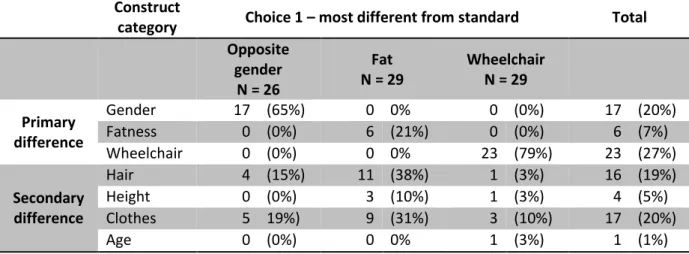
After making their choice, the researcher asked the children to identify what was different between the presented characters. The constructs elicited were subsequently classified as either a primary difference (gender, fatness, wheelchair) or a secondary difference (hair, height, clothes, other).
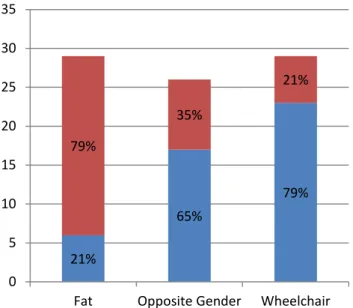
Figure 1 shows that children who chose either the character of the opposite gender or the character in the wheelchair tended to identify the respective primary difference as the reason behind their selection. Interestingly, only 21% (N = 6) of the children who selected the fat character identified fatness as the main difference, with the other 79% citing secondary differences. Thus out of the 85 children who took part in the task, only 7% identified fatness as a construct (Table 2). The children were significantly less likely to identify a primary difference in relation to the fat character than the character of the opposite gender and character in a wheelchair. (χ2 (2) = 21.83, p < 0.005).
Focussing on those who selected the fat character as the most different to the standard character, Table 2 shows that children most often expressed constructs related to hair (38%), followed by differences in clothing (31%). Three of the children additionally noted a perceived difference in height.
21% 65% 79% 79% 35% 21% 0 5 10 15 20 25 30 35
Fat Opposite Gender Wheelchair
Secondary Difference Primary Difference
Figure 1: Proportion of primary vs secondary differences elicited for the three choices
Table 2: The main difference children identified between the standard character and their chosen characters
Construct
category Choice 1 – most different from standard Total
Opposite gender N = 26 Fat N = 29 Wheelchair N = 29 Primary difference Gender 17 (65%) 0 0% 0 (0%) 17 (20%) Fatness 0 (0%) 6 (21%) 0 (0%) 6 (7%) Wheelchair 0 (0%) 0 0% 23 (79%) 23 (27%) Secondary difference Hair 4 (15%) 11 (38%) 1 (3%) 16 (19%) Height 0 (0%) 3 (10%) 1 (3%) 4 (5%) Clothes 5 19%) 9 (31%) 3 (10%) 17 (20%) Age 0 (0%) 0 0% 1 (3%) 1 (1%)
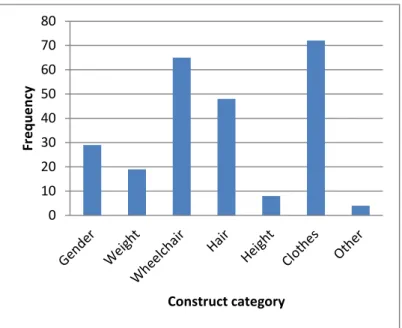
After the children’s constructs describing the most important differences had been elicited, the standard character was then placed with the remaining two characters. The children were asked to select which of the three pictures was most different to the previously selected character for any reason other than the one which they first identified. This process was repeated until three bipolar constructs had been identified. The children’s identified constructs across the three choices can be seen in Table 3 and Figure 2.
Table 3: Number of each construct category elicited over three choices
Construct
Category Choice 1 Choice 2 Choice 3 Total
N (%) N (%) N (%) N (%) Gender 17 (20%) 8 (10%) 4 (5%) 29 (12%) Fatness 6 (7%) 7 (8%) 6 (7%) 19 (8%) Wheelchair 23 (27%) 27 (32%) 15 (18%) 65 (27%) Hair 16 (19%) 14 (17%) 18 (21%) 48 (20%) Height 4 (5%) 2 (1%) 2 (2%) 8 (3%) Clothes 17 (20%) 24 (29%) 31 (37%) 72 (29%) Other 1 (1%) 1 (2%) 2 (2%) 4 (2%) Total 84 83 78 245
Of the 84 children who took part in the first section of the task, one child struggled to repeat the task a second time and was unable to provide a construct. Similarly for the third repetition, a further five children did not provide a construct. Therefore, 83 and 78 constructs were analysed for the second and third repetitions, respectively. Overall, the most frequently identified constructs related to the characters’ clothing (N = 72, 29%), followed by the use of a wheelchair (N = 65, 27%), hairstyle (N = 48, 20%) and then gender (N = 29, 12%).
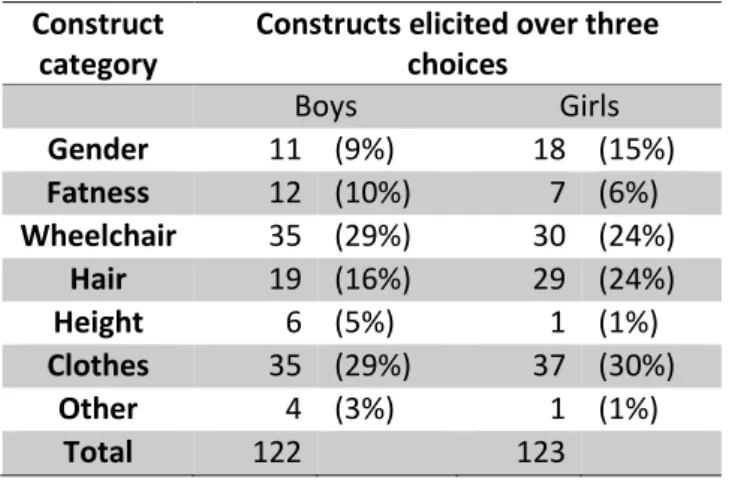
Fatness as a construct was elicited on 19 occasions (8%) across the three choice repetitions, making it the fifth most common construct category of seven. The least frequently identified constructs related to height (3%, N = 8) and ‘other’ characteristics which included one reference to skin colour (“tanned / not tanned”), age (“older / younger”) and two references to specific body parts (“has a chin / doesn’t have a chin”; “bigger head / smaller head”). There was no association between the construct categories identified and the gender of participants (χ2 (6) = 10.90, p = 0.09) (Table 4). 0 10 20 30 40 50 60 70 80 Fr e q u e n cy Construct category
Figure 2: Frequency of construct categories elicited across the three choices
Table 4: Total frequency of construct categories elicited by male and female participants
Construct category
Constructs elicited over three choices Boys Girls Gender 11 (9%) 18 (15%) Fatness 12 (10%) 7 (6%) Wheelchair 35 (29%) 30 (24%) Hair 19 (16%) 29 (24%) Height 6 (5%) 1 (1%) Clothes 35 (29%) 37 (30%) Other 4 (3%) 1 (1%) Total 122 123
It must be noted that one female participant identified fatness as the most important difference on two consecutive occasions, despite prompting to provide an alternative on the last occasion. Thus of the 85 children who took part in this research, only one fifth of the children (21%) identified ‘fatness’ as a construct across the three choices, compared with 34% and 76% for ‘gender’ and ‘wheelchair’, respectively.
Are young children less likely to select a peer who is overweight than one in a wheelchair or of the opposite gender when making friendship selections?
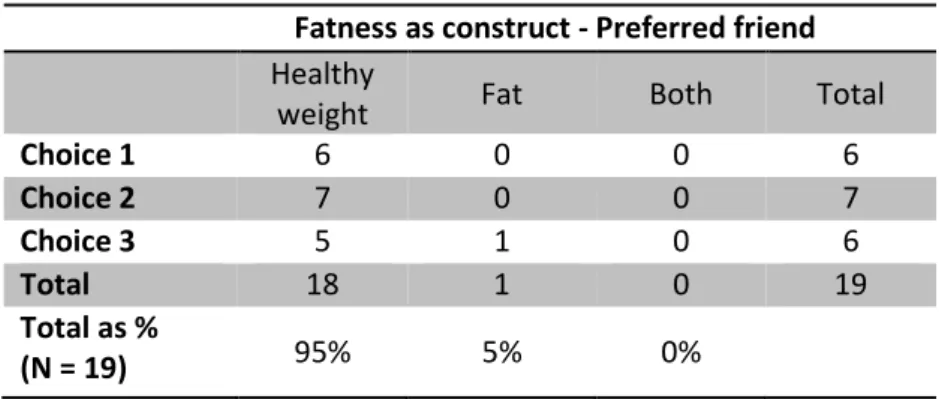
Once the children had provided their bipolar construct (e.g. “he’s in a wheeler, he’s standing up”), they were asked to choose which characteristic they would prefer in a friend. Over the 19 occasions on which fatness was elicited as a construct, only one said they would prefer a friend who was fat (“bigger”) than one who was not (“smaller”) (Table 5). Thus a healthy-weight character was significantly more likely to be selected as the child’s friend than one who is fat (χ2 (1) = 15.211, p < 0.005).
Table 5: Children’s friendship choices when construct relates to ‘Fatness’
Fatness as construct - Preferred friend
Healthy
weight Fat Both Total
Choice 1 6 0 0 6 Choice 2 7 0 0 7 Choice 3 5 1 0 6 Total 18 1 0 19 Total as % (N = 19) 95% 5% 0%
Similarly, children were significantly more likely to select a friend who was not in a wheelchair (χ2 (2) = 56.25, p < 0.005) or one who was of the same gender (χ2 (2) = 19.93, p < 0.005) when the constructs related to ‘Wheelchair’ and ‘Gender’, respectively (Tables 6 and 7). Accordingly, when looking at those children who made a friendship choice (i.e. excluding those who stated they wanted to be friends with both), there was no association between friendship preference and construct (χ2 (2) = 3.34, p = 0.19).
Table 6: Children’s friendship choices when construct relates to ‘Wheelchair’
Wheelchair as construct - Preferred friend
No
Wheelchair Wheelchair Both Total
Choice 1 19 8 0 27 Choice 2 18 4 1 23 Choice 3 12 3 0 15 Total 49 15 1 65 Total as % (N = 65) 75% 23% 2%
Table 7: Children’s friendship choices when construct relates to ‘Gender’
Gender as construct - Preferred friend
Same Gender
Opposite
Gender Both Total
Choice 1 14 2 1 17 Choice 2 6 1 1 8 Choice 3 1 1 2 4 Total 21 4 4 29 Total as % (N = 29) 72% 14% 14%