Errors Analysis of Solving Linear Inequalities among the
Preparatory Year Students at King Saud University.
Mahmoud M. A. El-khateeb
Correspondence: Basic Science Department, King Saud University, Saudi Arabia
Abstract
The purpose of This study aims to investigate the errors classes occurred by the Preparatory year students at King Saud University, through analysis student responses to the items of the study test, and to identify the varieties of the common errors and ratios of common errors that occurred in solving inequalities. In the collection of the data, the researcher employed the open-ended questions test consisted of nine items distributive on three types of inequalities (linear, involve absolute value and fractional). In the data analysis, descriptive analysis method was used. The result showed that some students had some misconceptions and misunderstanding in solving types of inequalities. The greatest common errors ratio was (20%) in solving linear inequality come from the class “Errors in basic algebraic operations and deletion. But the ratio (22%) were the greatest common errors ratio in solving fractional and involving absolute value inequalities come from the class errors in absent meaning of inequality.
Keywords: inequality, Common Errors, Misconception, Mathematics Education.
1. Introduction and theoretical framework
1.1 Introduce the Problem
These days, mathematics becomes a nightmare for many students; also, mathematical inequalities are considered an important mathematical topic as a prerequisite for many subjects such as algebra, trigonometry and analytic geometry. Therefore it falls to the responsibility of educators to identify learning difficulties among students about the topics that should be given to students in the light of these difficulties (Giltas and Tatar, 2011).
The inequality is a mathematical sentence built from expressions using one or more of the symbols( , , ,< > ≤ or≥)to compare two quantities. Inequality solving means finding the value(s) of variable that make the relationship correct order. So inequality occupies an important place in the basic math concepts, and being an important entry point for a lot of mathematical topics such as equations and different kinds of functions (Salas, 1982, Ralph, 1997).
Therefore, the solution of equation(4 2− x =0) is the value that takes the variable (x) and makes the expression(4 2 )− x is equal to zero, while solution of the inequality(4 2− x <0)is all the values of (x) that make the expression( 4−2 )x a negative value.
solving equations and inequalities are consider to be an important topics in studying properties and applications on functions, which require students to be aware and to understand method of finding the solution set different types for each inequality and equation ( linear – non-linear and fractional). Kroll (1986) pointed that the mastering of solving equations and inequalities affecting the students' improving performance of in mathematics. The equations and inequalities are two parts complement to each other, that don’t complete the student knowledge in one part perfectly, but supplementing them.
For example, if the function ( ( )f x =ln(2x−6)) given to students to identify the domain, firstly required, finding a solution set of the inequality (2x− >6 0) .also, studying the properties of the function
2
[ ( )f x =x +x]throughout, determining the increasing intervals required finding the solution set of the inequality (2x+ >1 0)
,and the decreasing intervals required solving the inequality(2x+ <1 0).
The mental processes that are used in solving inequalities depending on the degree of difficulty and type of inequality, where varies between the use of simple calculations to make mathematical operations with difficult level. So there are a lot of students with difficulties in solving inequalities within the various stages of education. It can be due to the confusion between the solution of equation and inequality, and sometimes students can't discriminate between inequality solution procedures and equation, and some students don't take into consideration what happen when inequality multiply by a negative number.
El-Shara' and Al-Abed (2010) See that the category of Common Mistakes When students can be attributed to three sources represented with the nature of the subject, the student himself and the teacher whose responsibility is to reduce the effect of each sources of the school and the student. Tsamir & Reshef (2006) Emphasized that the instruction approach used by teachers may have an effect on the number of how the mistakes and their nature by their students.
increased before they learn mathematical concept. Also, several studies had indicated that the mathematical knowledge is exist in the cognitive structure of the students, and had considered being one of the most important factors affecting learning mathematics in correct way (El-khateeb, 2015). The existence of the common misconceptions among students could lead to a negative effect on the effectiveness of learning. This may be due to the ignoring of the teachers' to the existence of perceptions and alternative interpretations of learners before starting the new learning (shihap and Al-Jondey, 1999).
The Pre-calculus course (Math 140) which is taught to the preparatory year students at King Saud University under the scientific sections includes the topics: linear equations and inequalities in one variable, and quadratic equations, mathematical functions, exponential and logarithmic and trigonometric functions, properties of the operations on them and solving a system of linear equations, matrices and properties of arithmetic operations. It has been observed during teaching “equations and inequalities" in the math course (pre-calculus) which is taught to the preparatory year students as a compulsory requirement. There are some mistakes occurred by some students when they solve different types of equations and inequalities: linear, quadratic and fractional.
Where it is noted that when the students' when multiply the inequality by a negative number don't change direction of the inequality. Also, some students who don't exclude the zeros of denominator from the solution set by solving the fractional inequality. So it must be taken into consideration the importance of errors occurred by the students when teaching the topic of solving linear equations and inequalities, in order to develop their skills and correct their mistakes.
Abu- Guloah (2011) study aimed to identify the common errors at Numbers and Algebra for the eighth graders' included in the international study test TIMSS 2007. The researcher used the descriptive analytical method for the diagnosis of the most common errors of (369) male and female students, including 193 male and 176 female students from primary eighth grade who applied to diagnostic test. The researcher adopted (40%) and more as a ratio for the existence of error. The study revealed the following findings: (21) of the skills emerged within the previous experiences and the school book for the 8th grade encompass in TIMSS 2007. The percentage variation of the prevalent errors between the students in the diagnostic test ranged between 13.5 % and 99.5 %. The skills group includes (15) Algebra and numbers which consider the common error are 40% or more according to the researcher design.
The study of El-Shara and Al-Abed (2010) aimed to diagnose errors that occurred in solving inequalities among mathematics majors at the University of Jordan. For the purpose of the study, one test was developed and administered to 188 male and female students majoring in mathematics who had completed Calculus 101.The results of the study revealed some common errors, such as: misconceptions, confusing an inequality with an equation, using commutative Multiplication in solving inequalities, and changing the direction of inequality when multiplying by a negative number. Some other calculation errors and careless errors were also recorded. The common errors ranged between 5.7% for changing the direction of inequality when multiplying by a negative number, and 22.5% for conceptual errors. The researchers recommended that faculty members should emphasize on the subject of inequalities for fresh students and to administer tests in order to categorize them and develop the appropriate treatment plans.
The purpose of El-khateeb (2015) study was to investigate erroneous perceptions of the Preparatory year students at King Saud University, through analyzing (154) students responses on a study test, and to identify the varieties of the common errors and ratios of common errors about the concept and finding the limit of partial functions at a given point graphically or algebraically. The most important findings of the study by comparing the percentages of common errors classes within the same error class, were the highest percentage 35% in the class error which included “errors in the adoption the value of the function on existence the limit, or non-existent” through finding the limit of function “not defined at the point and the limit exist”, followed by 31% which represents the percentage of error class ratio “Confusion between the right and left of the point when finding the limit”, and the percentage 14% Came less common ratios in the common error class of errors in judging the existence of the limit, or non-existent by finding the limit of the function not defined and the limit does not exist at the point.
The study of Parish & Ludwig (1994) indicated its findings to the existence of errors at the public high school and first year at the university students on the subject of algebra, including the lack of writing equality symbol when solving equations, and their inability to find the square root of the complete square terms or Algebraic Expressions. Students also have some difficulties in using the language of mathematics.
A study Conducted by Bicer, etal (2014) aimed to determine whether pre-service teachers have common difficulties and misconceptions about linear and quadratic inequalities. Two tasks of inequalities open- ended were designed, and given to 57 participants. The study showed that a number of pre-service teachers struggled with representing inequalities solution in number line. They added or excluded values in their solutions by drawing a closed circle on a number line instead of an open circle. Students also made basic arithmetic errors. The most common errors were addition, subtraction, multiplication, division and the distribution property. The results also indicate that not only the first year (pre-service teacher) possesses difficulties and misconception
with linear and quadratic inequalities, but also second, third and fourth year pre-service teachers. The researchers due these misconceptions might be transitional from teachers to their students.
The study of El-Khateeb (2015) aimed to diagnose errors that occurred in Complex Numbers topic Among Students of preparatory year Deanship at the King Saud University. For the purpose of this study, one test was developed and administered to 214 male students in Preparatory year Deanship. The results of the study revealed some common errors, such as: misconceptions in using the operations on complex numbers, using properties of operations on simplifications powers and numerical expressions. Some other calculation errors and careless errors were also recorded. The common errors ranged between 5.3% for conceptual misconceptions (identify real part and imaginary part) and solving linear equations involves complex numbers, and 31% for errors using the relation (
i
2= −
1
) and(i)
to express about the square root of (-1).Ciltas and Tatar (2011) conducted their study on a sample consist of 170 students in 9th grade in four different high schools. The study aimed to diagnose the learning difficulties about the equation and inequality that contain terms with absolute value. The research Data is composed of a knowledge test that contains 10 open-ended questions and interviewing students. The results indicated that students have difficulties in forming a correct solution set and could not fully understand the concept of absolute value. Results also indicated that students experienced difficulties in applying the basic arithmetic operations, and interpreting the interval that is founded correctly in inequality questions.
The teacher Knowledge and understanding of the common error of students help to develop strategies in teaching that address mathematical errors and misunderstandings, on the other hand, the learner benefit from the error, and through verification of assumptions and perceptions formed has started. In other words, we can say that mistakes can raise important issues to discover more in mathematics, because teaching and learning mathematics is built according to the sense of the importance of those errors that cannot be ignored or only corrected.
In light of the above, and through the experience of the researcher, it is clear that knowledge of the common mistakes occurred by students in teaching and learning mathematics is a matter of concern, especially in the first stage of a university education.
After reviewing the educational literature and studies relevant to the inequalities topic, it is clear that few studies have researched in the errors classification of students in solving the inequalities in general at the Arab and local levels. At the local level, no studies have addressed the solution of linear inequalities that include absolute value and diagnosis the common errors, which occurred by the students at the level of school students or college students. So this study was to bridge the gap as much as possible and to address with the first year students at the university.
1.2 The Problem of the Study
In light of the literature review and studies relevant to the solving inequalities, and common mistakes which are located by the students, it is clear that some of these errors are common among school students and university students. this underlines the importance of analyzing errors classes and present them by providing feedback to Teachers of Mathematics, which lead the researcher to study and diagnose the common errors, and classify them among the students enrolled in the program who have completed their preparatory year study mathematics course (Pre-Calculus) at King Saud University in the first semester of the academic year 2016/2017.
Study Questions
The study problem highlights by trying to answer the following questions:
- What are the common errors classes that occurred in solving inequalities among King Saud University Students? - What are the ratio of common errors classes in solving inequalities according to the type of inequality (linear, involve absolute value, fractional)?
Importance of the study
The importance of the current study played a great role as result of the importance of solving inequalities in calculus, and in the development of mathematical thinking among students, which in turn helps them to continue their university studies. It also highlights the importance of the study through its attempt to analysis types of mistakes made by the students when they learn the inequalities. In addition to enriching the studies conducted in this area and through the identification of common errors in the solution of linear Inequalities, and find out its causes in order to develop effective solutions for it.
Objectives of the study
This study aims to investigate the errors classes occurred by the Preparatory year students at King Saud University, through analyzing students responses on the items of the study test, and to identify the varieties of
the common errors and ratios of common errors that occurred by students in solving Inequalities.
Limitations of the Study
The limitations of this research identified by the following:
- The instrument which was developed by the researcher, so the interpretation of the results depends on the instrument's validity and reliability.
- Sample size: The study sample consisted of (154) students distributes at (10) sections, have been selected randomly.
- Limited Sample of students' male in the Deanship of Preparatory Year at King Saud University in the first semester (2015/2016) that has completed studying Equations and Inequalities through pre-calculus course (math-140).
Procedural Definitions:
King Saud University students: male students who have been accepted in the preparatory year program at King Saud University and scientific disciplines, totaling (3682) students who completed the study of Pre-calculus course (Math- 140). In the first semester of the academic year ((2015/2016).
Mathematical inequality: is a mathematical sentence built from expressions using one or more of the symbols ( , , ,< > ≤ or ≥) to compare two quantities.
Solving inequality: means finding the value(s) of variable (x) that make inequality correct sentence.
Common errors: Some studies suggest that a common mistake is a mistake that is repeated appearances in the students' answers. The select some researchers that a common mistake is a mistake that the proportion of its prevalence (15%) (Khalifa, 1983, p. 156) and select others ratio common by students when it is more than (15%). El-Shara’ and Abed (2010) also considered that the class is common - error within item - is the error that appears in the students' answers by more than 10% of the students who tried to answer the item, and select (Abu Guloah, 2011) error rate when the prevalence of students by more than (40%). In the current study, Class common error is considered - within an item - is the error that appears in the students' answers by more than (15%) of the students who tried to answer it.
2. Method and procedures
Descriptive approach and survey has been used to get the data and facts about the nature of the student’s common mistakes and ratios, about solving linear inequality.
2.1 The Study Sample
The study sample consisted of male students (154) of scientific disciplines enrolled in the first semester of the academic year ((2015/2016), to study pre-calculus course (math-140) in the Deanship of the preparatory year at King Saud University, distributed in (10) sections, have been selected randomly.
2.2 The Study Tools
The study tool consisted a test of solving linear inequality, which was built in light of the expected appearance in student responses errors through types of linear inequalities. The test included (9) essay items (open- ended question), three items for each type of Inequality.
2.3 Validity Tests
To check the validity of the test was presented to a group of arbitrators’ three PhD specialists in curriculum and methods of teaching mathematics. And two PhD specialists in Educational Measurement and Evaluation. And (5) teachers of mathematics who have master degrees in mathematics, and who were teaching in the first semester. Each of them was given the test items and a list of common errors that have been prepared, and were asked to express their opinions about the items fitness and suitability of the target group of the preparatory year students at King Saud University. After reviewing the opinions of the arbitrators and suggestions have been modified, to achieve the purpose of the research and investigated the errors classes, the application of tests procedures and instructions require that the student shows the steps resolved in detail, and in which is standing on the strengths and weaknesses in student performance, so the tests in this way can be considered that achieved a standard of validity.
2.4 Reliability
The reliability compute by using test and re-test, by applying the tests on an exploratory sample consisted of (30) students, with an interval of (2) weeks, who completed studying the equation and inequalities in Math-140- pre-course. The Pearson correlation coefficient was (0.89) between the average performance of students in the first time and repetition (Oadeh, 2005; Gronlaund, 1990).
2.5 The Study Procedures
The study included the following actions:
- Review and analysis chapter equations and inequalities, in the Pre-Calculus course (Math 140) studied by students in the preparatory year at King Saud University.
- Select (10) sections from (193) sections randomly, to represent the sample, with totally (154) students.
- The first test application in the period ranged (from 50 to 60) minutes from the time of the lecture, where test consists of nine items given in three types of linear inequality.
- Identify the key answer before starting the process of correction.
- Analyze the errors which appeared. The new errors that appeared have been added to the preliminary list, and continue correcting the same item to the end.
- Consider the error within the errors classes which has ratio more than (15%) as common error.
2.6 Statistical Treatment
Package statistical analysis of Social Sciences (SPSS) was used in the treatment of data. Frequencies and percentages were extracted to answer the first question of the study. Frequencies and percentages was extracted to answer the second question of the study.
3. Discuss the Results and Its Interpretation
The study aimed to diagnose and identify classes of common mistakes occurred by the preparatory year students in King Saud University in solving linear inequalities. The frequencies, percentages calculated through the times number of appearance the error in the students' solutions. It has also been monitoring the frequencies of error class when it appears and follows up the correcting to the student answer on the same item to monitor the other errors. And also the same mistake monitor according to the times of appearance number in solution of the same student or others. The errors classes which had a ratio more than (15%) considered to be as a common error according to the standard that has been adopted to classify the errors classes.
Therefore, it can be classified the common errors among the students in solving inequalities as follows:
- Conceptual errors: represented by understand the inequality concept, it has been shown that in solving inequalities that include absolute values. Also, understanding of (or) means, or what equivalent in solving the compound inequalities, and fractional inequalities.
- Errors Caused by the wrong using and applying of the inequalities rules: This is demonstrated when some students try to solve fractional inequalities. Some students didn't change an inequality's direction when dividing
or multiplying the inequality with a negative number, as shown 2 ( 5 ) 1 x − ≥ changed to 1 1 ( ) 2 5 x − ≥ . In addition some of students didn't take in their consideration the sign of the variable (x) to change the inequality direction.
- Errors in the algebraic operations, simplification and elimination: This appeared when converting inequality during and after applying cross-multiplication property in order to solve the inequality, for example:
5(x −1)≥ 2⇒5x −1≥2 .
- Errors arising from confusion between the solution of the equation and inequality: it was apparent when students solve linear inequalities and fractional. Represented with just finding the values of the variable (x) of
the equation, as 2 5 1 2 4 2 4 2 4 2 2 x o r x x x x x + < ≥ = − = = − =
- Errors arising from using the basic arithmetic operations: This appeared clearly when students solved linear inequalities by addition, subtraction, multiplication, division, and simplifying the algebraic expressions, such as the wrong using of distribution property, and addition inverse.
- Errors due to finding and writing the solution set: some students not able to write their solution on the interval notation through solving fractional inequalities, where as some students think that only one value makes an
inequality true, 1 1 2 2 1 2 1 x x x x x x x − − > ⇒ = ⇒ − = ⇒ > −
and they think solution set can't be an interval or finite set; also, writing the interval closed [−1,∞) instead of open, or reverse the numbers inside the interval, as(∞, −1). Also, some students didn't exclude the zeros of denominator from the solution set.
To achieve the objectives of the present study and to stand on the common errors that occurred by the students in solving linear inequalities. Student responses analyzed, to identify the common errors, through solution ways, and methodology which used by students. So the results will be displayed according to the questions of the
present study.
-The first Question:
- What are the common errors classes that occurred in solving inequalities among King Saud University Students?
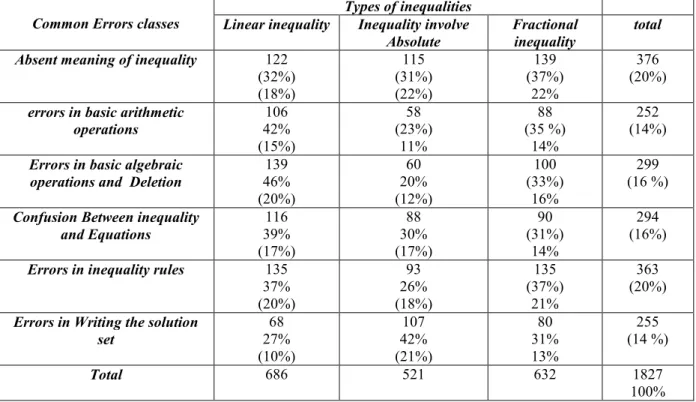
Table (1) shows the errors classes, ratio of common errors according to the inequality type, ratio of common errors within the same class. The integer number indicates to the frequencies of errors class appearance in every type of inequalities. The first percentage indicates (Error class frequency ÷ total frequency of class) to ratio of class errors for every inequality according to the error class, but the second percentage (Error class frequency ÷ sum of frequency of inequality type) refers to the ratio of error class by the inequality type.
Table .1. A Frequency and Percentage of Common Errors classes according to the type of inequality
Types of inequalities
Common Errors classes Fractional total inequality Inequality involve Absolute Linear inequality 376 (20%) 139 (37%) 22% 115 (31%) (22%) 122 (32%) (18%)
Absent meaning of inequality
252 (14%) 88 (35 %) 14% 58 (23%) 11% 106 42% (15%)
errors in basic arithmetic operations 299 (16 %) 100 (33%) 16% 60 20% (12%) 139 46% (20%)
Errors in basic algebraic operations and Deletion
294 (16%) 90 (31%) 14% 88 30% (17%) 116 39% (17%)
Confusion Between inequality and Equations 363 (20%) 135 (37%) 21% 93 26% (18%) 135 37% (20%)
Errors in inequality rules
255 (14 %) 80 31% 13% 107 42% (21%) 68 27% (10%)
Errors in Writing the solution set 1827 100% 632 521 686 Total
Table 1 explains the Frequency and Percentage of Common Errors classes according to the inequality type. Firstly, Linear inequality: the lowest common ratio of error class is (10%) represented with writing the solution set of solving inequality in wrong way, but the ratio (20%) represents the greatest common ratio of error class arising from the basic algebraic operations and deletion, also from the Errors in applying inequality rules. Secondly, "linear Inequality involve Absolute type ": the ratio (11%) represent a lowest ratio comes from the class "errors in basic arithmetic operations", but the ratio (22%) represents the greatest ratio of error class "absent meaning of solving fractional inequality". Thirdly, Fractional inequality type: a lowest ratio is (13%) represented with writing the solution set of solving inequality in wrong way, and the greatest common ratio was (22%) through "absent meaning of solving fractional inequality".
Comparing the common ratios of errors classes among the error class, we find that " errors in basic algebraic operations and deletion" was the greatest ratio (46%), followed by (42%) to represent the lowest ratio " errors in writing the solution set of solving linear inequality". the lowest common ratio through solving linear inequality involving absolute value was (20%) came from "Errors in basic algebraic operations and Deletion", and the greatest ratio was (23%) illustrate from the error class " errors in basic arithmetic operations".
The ratios indicate that there is a weakness and difficulties among solving inequalities. These difficulties due to misunderstand the meaning of linear inequality or they may not know how to read the inequality symbols. In addition, it has been also observed that they experienced difficulties in solving inequality that contain terms with absolute value; and they experienced difficulties in applying: inequality properties (rules); the four basic mathematical operations. Furthermore, it has been found out that they wrongfully showed the solution set or they did not show the solution set as interval. The results of this study conform to the results of the studies (whitcraft, 1980; laursen, 1978; Bicer, etal, 2014).
-The second Question:
- What are the ratio of common errors classes in solving inequalities according to the type of inequality (linear, involve absolute value, fractional)?
Results of this question have been found through analysis of student responses on the test items, which administrated in three types of inequalities (linear, involved absolute value, fractional) where each type consist on three items of the open-ended questions, in order to investigate common mistakes in solving inequalities, where the classification errors that greater than the ratio (15%) to represent the common errors classes for each type of inequalities. In order to facilitate the discussion and interpretation of the results it will be display according to the inequality type:
- The ratios of common errors classes in solving linear inequalities
The test includes three items in order to analyze and detect mistakes that occurred by students in solving linear inequalities. The first item −(x+2)+2x>2(x−3) 3+ x contains on one direction (>), required to solve it using distributive property, combining the terms to reach the solution. The second item 2x +5<1 o r 2+x ≥ 4 includes two linear inequalities connected between them by the logical word (or) (equivalent to union), required to solve each inequality, and then gather the solution by the meaning of (or) as a union of two solution set of inequalities. The third item − <4 4(x +2)−3≤9 includes on two directions required to solve it using distributive property, and combining the expressions.
Table .2.Frequency and Percentage of Common Errors classes according to the linear inequality type.
Error Class Error (1) Error (2) Error (3) Error (4) Error (5) Error (6) frequency of Error Class 122 106 139 116 135 68
Ratio of common Error 18% 15% 20% 17% 20% 10% It is shown in Table 2 that the ratio 20% represent the greatest common errors classes occurred by students in solving linear inequalities were caused by a basic and simplified algebraic operations, and the use of inequalities rules, For example: Students began to solve the inequality through eliminate the bracket, and apply the distributive property, and make combination terms incorrectly. The students' errors were in different aspects such as non-discrimination between similar and un- similar algebraic terms, as shown follow:
( 2 ) 2 2 ( 3 ) 3 2 2 2 3 3 2 2 2 x x x x x x x x x x x − + + > − + − + + > − + + > ⇒ >
In addition, the results indicated that some errors occurred by students, as did not know the procedure and meaning of how to solve compound inequality, distribution property, perform arithmetic operations on two sides of the inequality and ignore the other side; in addition a number of students excluded values in their solution through combined the solution set as one interval incorrectly. Such as:
4 4( 2) 3 9 2 5 1 2 4 4 4 2 3 9 2 1 5 4 2 4 4 1 9 3 6 4 4 8 (3, 6] 1 2 x x or x x x x x x x x solution set x − < + − ≤ + < + ≥ − < + − ≤ < + ≥ + − < − ≤ < ≥ − < ≤ − < ≤
To overcome this difficulty, teachers need to explain and discuss the meaning of the word (or), when writing the solution set, and students should understand how to represent the solution geometrically, also the operations on groups especially that represented in intervals.
Similar findings with the results of the study of each of (Bicer, &capraro, 2013); (EL-Shara’, etal, 2010); (Balanco & Garrote, 2007) and (Ellortan and Clements, 2011) which found that students made basic arithmetic errors because they did not have an adequate mastery of knowledge about inequality rules tending to change direction of inequalities even when they divided inequalities with a negative number.
- The ratios of common errors classes in solving linear inequalities involving absolute value?
The items of this type were analyzed, and monitoring the frequency of errors that occurred by students in solving inequalities involve absolute value, and calculated the ratios of common errors classes.
Table .3. A frequency and Percentage of Common Errors class according to the inequality involves absolute value.
Error Class Error (1) Error (2) Error (3) Error (4) Error (5) Error (6) frequency of Error Class 115 58 60 88 93 107
Ratio of common Error * 22% 11% 12% 17% 18% 21% It is clear from table 3 that the greatest common ratio was (22%) in error class through the inequality type that involves absolute value from the kind don't understand the meaning of solving this type of inequalities. Follow the error class related in writing the solution set of inequalities incorrectly with ratio (21%). But the ratio (11%) represented the lowest common errors ratio which occurred by student through applying the basic arithmetic
operations in solving inequalities that involved absolute value.
The errors which occurred by students focused in different faces: solve one side of the inequality and eliminate the other side, and confusion between the solution of equation and inequality. In addition, errors in using the inequalities rules, especially didn't change direction of inequalities even when they divided or multiply
inequalities with a negative number, such as:
2 4 1 0 2 4 1 0 2 1 4 7 7 x x x x x − < ⇒ − < = ⇒ = ⇒ <
And the errors related to express about the solution set varies between closed the one side of interval as (− ∞, 7 ] or reverse the terms and write great number in the beginning, as ( 7 ,− ∞)
As for the errors that occurred by students in solving inequality involve absolute value, a number of students start the solution by eliminating the absolute value sign, which indicate to misunderstand in the concept and
meaning of absolute value and their rules, as
2x 2 4 2 4 2x 3 x solution set ( 3, )
− − > ⇒ − − > ⇒ − > ⇒ − ∞
and some of them start on dividing the inequality by (-2), but didn't change the inequality direction, and continue the solution, such as:
2 x 2 4 x 1 2 x 1 s o l u t i o n s e t ( 1 , )
− − > ⇒ + > ⇒ > ⇒ ∞
In addition, write the solution set without checking the values that satisfies the inequality. The errors that
occurred by a number of students through solving the inequality 4− 2x ≥ 5 caused about misunderstand the
concept and the symbol (
≥
), add to incorrect using of the absolute value properties, and write the solution set incorrectly, as: 4 2 5 4 2 5 4 2 5 2 1 2 9 1 9 / 2 { 9 / 2 , 1} x x x x x x x s o lu t i o n s e t − ≥ − ≥ − ≤ − − ≥ − ≤ − ≥ − ≤ −- The ratios of common errors classes in solving fractional inequalities.
The frequencies monitored, and ratio of common errors classes calculated in solving the fractional inequalities through the test items, as explain in Table 4.
Table .4. A Frequency and Percentage of Common Errors classes according to the fractional inequality
Error Class Error (1) Error (2) Error (3) Error (4) Error (5) Error (6) frequency of Error Class 139 88 100 90 135 80
Ratio of common Error 22% 14% 16% 14% 21% 13% Table 4 indicates that the greatest common ratio was (22%) in error class through solving the fractional inequalities from the kind misunderstand the concept and properties of solving fractional inequalities. Follow the class with respect to the Errors in inequality rules with ratio (21%). But the ratio (11%) represented the lowest common errors ratio which occurred by student through writing the solution set of inequalities incorrectly. The errors which occurred by students focused in different faces: multiply one side of the inequality to eliminate the variable from the denominator, without take inconsideration the sign of (x), and confusion between the equation and inequality through solve the equation and consider it a solution to inequality, and multiply the two sides by the same compound to cancel the denominator, also student didn't master the rules of inequalities, such as: reverse the inequality to put the variable (x) in the nominator without change the direction of inequalities. In addition the roots of denominator within the solution set.
For example: a number of students start in solving the inequality
4 5 2 x x > +
through multiply the sides of the
fractional inequality by (x), such as
2 4 ( ) 5 ( ) 5 4 2 2 x x x x x x x > + ⇒ > +
and other students multiply by (2x), as
4 2 ( ) 5 ) 2 x x x > +
to convert the inequality to the formx2>10x +8.This error due to misunderstand the inequalities rules, and incorrect using of cancelation law in inequality, but the errors that occurred by students in
solving the inequality
2 5
(x −1) ≥ a number of students start the solution using cross-multiplication of the
inequality sides by the same quantity to eliminate the denominator as, 2 ≥5(x −1) , without take in consideration the sign of (x −1) through the multiplication. Also, Errors in basic algebraic operations and Deletion were appearance through using the distribution property; add to write the solution set incorrectly. For example:
The error that occurred by students through solving the inequality ( 1 ) 2 x x − >
a number of students start solving through change the inequality to equation to simplify the steps of solution without take inconsideration the sign of the variable (x), and write the solution set without verifying from the solution. Such as:
( 1 ) 2 1 2 1 1 ( 1 , ) x x x x x s o l u t i o n s e t x − = ⇒ − = ⇒ = − ⇒ > − ⇒ − ∞ 4. Conclusion and recommendations
Results of the study showed that some of students faced difficulties in solving types of linear inequalities; it has been observed that in properties about inequality; and in applying the four basic mathematical operations on numbers and on the algebraic expressions. So, in light of the importance of this period of preparing for the university entrance a diagnostic test for the preparatory year can be considered as the reason to identify the actual errors that appear in the performance of students in mathematics and then treating these errors as soon as they occur. This result is consistent with the study Ciltas, etal (2010 and 2011), and (El-Shara’, and Al-Abed, 2010).
The results also showed that there is a misunderstanding of some students about the concept of absolute value and properties. Furthermore, it has been observed that they experienced difficulties in solving the fractional inequality; in using commutative multiplication in solving inequalities, and changing the direction of inequality when multiplying by a negative number. These findings support the results of studies conducted by Başturk, (2009), and Ciltas, etal (2010 and 2011).according to the results obtained in this study, teachers should be explained and discuss in the classroom the reason why we change an inequality's direction when dividing or multiplying an inequality with a negative number, and more emphasis on meaning of inequality, through that you can read one inequality more than one way (example: x >1 , means: x is greater than one, (x) is not smaller than 1, (x) is both not smaller than 1 and not equal to 1). This result supports the result of Bicer, etal (2014). In light of the study results can be recommended as follows:
- Perform a diagnostic test for the preparatory year students admitted to the university, and identify the actual errors that appear in the performance of students in mathematics and then treating these errors as soon as they occur.
Need to focus faculty members to master the basic concepts and skills associated with the concept of equations and inequalities and ways of solving, because its importance in understanding the other topics in mathematics, such as the identify domain of functions, applications of derivative (critical number, intervals of increasing and decreasing and intervals of concave up and concave down).
- Further studies involves female students in the field of the common errors analysis of the students about solving inequalities
References
1. Abu Guloah, N. (2011).The Common Mathematical Errors of Eighth Graders In The view of TIMSS 2007
And the Effectiveness of A suggested Remedial program. Master thesis Unpublished, Al-Azhar University, Gaza, and the Arab Republic of Egypt.
2. Balanco, L. and Garrote, M. (2007). Difficulties in learning inequalities in students of the first year of pre-university education in Spain. Eurasia Journal of mathematics, science and technology education, 3(3), 221-229.
3. Bicer, Ali; Capraro, Robert and Capraro, Mary (2014). Pre-service Teachers’ Linear and Quadratic
Inequalities Understandings. International Journal for Mathematics Teaching and Learning.
http://www.cimt.plymouth.ac.uk/journal/default.htm
4. Bicer, A., Capraro, R, & Capraro, M. (2013). Integrating writing into mathematics classroom to increase students’ problem solving skills. International Online Journal of Educational Science, 5(2), 361-369. 5. Başturk, S. (2009). Student teachers’ approaches to student’s mistakes in the case of the absolute value
concept. Necatibey Faculty of Education ElectronicJournal of Science and Mathematics Education, 3(1), 174-194.
6. Ciltas, Alper and Tatar, even. (2011).Diagnosing Learning Difficulties Related to the Equation and
Inequality that Contain Terms with Absolute Value. International Online Journal of Educational Sciences,
3(2)461-473.
7. Ciltas, A., Işık, A. & Kar, T. (2010). The concept of absolute value: Evaluation of procedural and conceptual
knowledge. Journal of Institute of Mathematics and Computer Science, 21(1), 131-139.
8. El-khateeb, M. (2015).perceptions and performance of King Saud University students' about concept and finding Limit of functions graphical and symbolic. Journal of Education and Learning; Vol. 4, No. 4; p. 25-38.
King Saud University. Journal of Educational & Psychological Sciences, University of Bahrain, (accepted to be published).
10. El-Shara’, I. and Al-Abed, A. (2010). Errors Analysis of Solving Inequalities Among Mathematics Majors
at the University of Jordan. Jordan Journal of Educational Science, 6(2), p 93-108.
11. Ellortan, N. F., & Clements, M. A. K. (2011). Prospective middle-school mathematics teachers’ knowledge
of equations and inequalities. In Early Algebraization (pp. 379-408). Springer Berlin, Heidelberg.
12. Giltas, A. and Tatar, E. (2011). Diagnosing Learning Difficulties related to Equation and Inequality that contain terms with absolute value. International Online Journal of Educational Sciences, 3(2), 461-473.
13. Gronlaund, N. and Linn, R. (1990). Measurement and evaluation in teaching. N.Y: Macmillan publishing.
co.Inc
14. Khalifa, K. (1983). Research in Teaching Mathematics. First volume, Dar Alkitab Al Jamie, Cairo, Egypt.
15. Kroll, R. (1986). Meta cognitive analysis of the difficulties caused by interviewing factors in the solution of inequalities. DAI, ATT 8626157, Georgia StateUniversity, Atlanta, Georgia.
16. Laursen, K. (1978). Errors in first- year algebra. Mathematics Teacher, 71, 194-5.
17. Oadeh, A. (2005). Measurement and Evaluation in the teaching process. Dar Al amel publication, third edition, irbid, Jordan.
18. Parish, C. & Ludwig, H. (1994). Language, intellectual structure and common mathematics errors: A call for research. School Science and Mathematics, 94, 235-239.
19. Ralph, J. (1997). Inequality (Mathematics). From: http://encarta.msn.com
20. Salas, S. (1982). Calculus: one and several with analytic geometry variable. 4th ed. Canada. John Wiley and sons.Inc.
21. Shihap, M., and Al-Jondey, O. (1999). Correct alternative perceptions of some scientific concepts to students in the first secondary grade of physics using constructivist learning, shape, and form their attitudes towards it. The Egyptian Association for Scientific Education, Third Scientific Conference, Ain Shams University, Volume II.
22. Tsamir, P. & Reshef, M. (2006). Students' preference when solving quadratic inequalities. Center for Teaching - Learning of Mathematics Gale group, Thompson Corporation Company.
http://findarticles.com/p/articles/mi_m0NVC/is_ 1_ 28/ai_n26986050/
23. Whitcraft, L. (1980). Remedial work in high school mathematics. Mathematics Teacher, 73, 51-60.
.
1)
Solve the following inequalities, and write its solution set in
. ( 2) 2 2( 3) 3 6). 4 2 5 4 2). 2 5 1 2 4 7). 5 2 2 3). 4 4( 2) 3 9 8). interval notatio 5 ( 1) ( 4). 2 4 10 9 . n ) x x x x x x x or x x x x x x
Questions of the T est
− + + > − + − ≥ + < + ≥ > + − < + − ≤ ≥ − − − < 1) 2 5). 2 2 4 x x > − − >