ELECTRICAL ENGINEERING
PSO based optimized fuzzy controllers for decoupled
highly interacted distillation process
Hassen T. Dorrah
a, Ahmed M. El-Garhy
b,*
, Mohamed E. El-Shimy
ca
Department of Electrical Power and Machines, Faculty of Engineering, Cairo University, Giza, Egypt b
Department of Electronics, Communications and Computers, Faculty of Engineering, Helwan University, Helwan, Egypt c
Vice Rectorate for Graduate Studies and Research, King Saud University, Riyadh, Saudi Arabia
Received 22 October 2011; revised 16 February 2012; accepted 2 March 2012 Available online 10 April 2012
KEYWORDS
Two coupled distillation col-umns;
PID controller; Fuzzy Logic Controllers (FLC’s);
Particle Swarm Optimization (PSO)
Abstract Normally, the highly interacted MIMO process – such as two coupled distillation columns – is decoupled into a group of independent loops and a conventional PID controller is assigned to control each loop. Tuning of conventional PID controllers is very difficult. Scientists consider tuning of PID controllers is an art more than science. In this paper, fuzzy PID controllers are proposed to replace the conventional ones. Moreover, the values of the parameters of the pro-posed fuzzy PID controllers are optimized using particle swarm optimization (PSO) technique. Sum square errors (SSEs) – for different loops – are used as fitness functions for PSO. SSEs minimization assures optimal values of different fuzzy PID controllers’ parameters. For the purpose of validation, PSO is also used to optimize the design of conventional PID controllers. The simulation of the pro-posed optimized fuzzy PID controllers proves their excellence in improving the transient and steady state characteristics.
2012 Ain Shams University. Production and hosting by Elsevier B.V. All rights reserved.
1. Introduction
In the highly interacted MIMO process such as two coupled dis-tillation columns, the specifications for top and bottom product purity can be met through keeping the tray temperatures within a specified range around their steady state values. Keeping the temperatures of the different trays constant in the two-coupled distillation columns process is one of the most important con-trol actions in the chemical industries. Recently, many research-ers have devoted much effort in this area. The process of the two-coupled distillation columns can be decoupled into a group of independent loops[1]. Temperature control for each loop can be achieved via conventional PID control law[2]. Traditionally, * Corresponding author. Tel.: +20 10 1408908.
E-mail addresses: [email protected] (H.T. Dorrah), agarhy
[email protected] (A.M. El-Garhy), [email protected] (M.E. El-Shimy).
2090-44792012 Ain Shams University. Production and hosting by Elsevier B.V. All rights reserved.
Peer review under responsibility of Ain Shams University. http://dx.doi.org/10.1016/j.asej.2012.03.002
Production and hosting by Elsevier
Ain Shams University
Ain Shams Engineering Journal
www.elsevier.com/locate/asej www.sciencedirect.com
the parameters of the conventional PID controller, i.e.,Kp,Ti,
and Td are adjustable and should be tuned appropriately
according to the process dynamics. Consequently, the conven-tional PID controller is hardly efficient to control the system while the system is disturbed by unknown factors. Several meth-ods for parameter tuning of non-fixed PID controller were proposed[3–5].
Fuzzy set theory, which was introduced by Zadeh in 1965, provides an effective method of dealing with the problem of knowledge representation in an uncertain and imprecise envi-ronment[6]. The conceptual framework of fuzzy logic is much closer to human thinking than the traditional logic systems. During the past years, fuzzy logic has been successfully applied in chemical process control systems, motor drives systems, robot systems, steam turbines systems, medicine diagnosis, and so on. PID controllers can now be implemented using fuzzy set theory. Particle swarm optimization (PSO) is a population based sto-chastic optimization technique developed by Dr. Eberhart and Dr. Kennedy in 1995, inspired by social behavior of bird flocking or fish schooling[7,8]. PSO shares many similarities with other evolutionary computation techniques such as Genetic Algo-rithms (GAs)[9,10]. Compared to GA, the advantages of PSO are that PSO is easy to implement and there are few parameters to adjust. PSO has successfully applied in many areas such as function optimization, artificial neural network training, fuzzy system control, and other areas where GA can be applied. PSO has already been a new and fast developing research topic[11–14]. The main aim of this research paper is to design optimal fuzzy PID controllers for the decoupled distillation columns process. PSO algorithm is used to determine the optimal parameters’ values of the proposed fuzzy PID controllers. 2. The two-coupled distillation columns process
Distillation units are the most widely used in separation tech-niques for fluid mixtures in chemical and petrochemical indus-tries. Schematically, a distillation column is composed of a cascade of trays between which liquid and vapor phases flow in counter-current directions according to hydrodynamic dia-grams depending on tray model. These interactions lead to a mass transfer so that the less volatile components are recover-able at the lower trays, whereas the lightest are recovered mainly in the upper trays of the column in addition to the condenser which is called distillate.
The main disadvantage of the distillation is its high-energy requirements. Several techniques are used to overcome this problem like integration of the distillation column with the overall process where significant energy savings can be reached, as the use of complex distillation arrangements such as thermally coupled distillation sequences (TCDS), heat inte-grated distillation systems, and the heat pumping techniques. The thermally coupled distillation configurations have received considerable attention because of their efficiency to reduce the energy required for the separation of ternary mixtures. The structure of the TCDS systems offers some control challenges arising from the transfer of vapor (or liquid) streams between the columns[15,16].
The model of a thermally coupled distillation column with side withdrawal and an additional rectifying column that we use for simulation purposes has been derived in[17], where further de-tails about the control of coupled columns can be found.
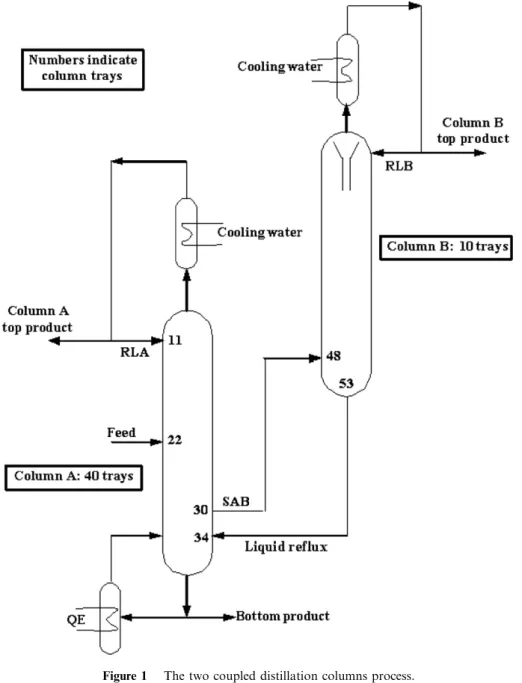
The plant consists of two coupled distillation columns, main column (A) and rectifying column (B), shown inFig. 1, serving for the separation of a ternary mixture of component (I) (the more volatile ‘‘methanol; MeOH’’), component (II) (intermediate volatility ‘‘ethanol; EOH’’) and component (III) (the less volatile ‘‘propanol; POH’’). The main column consists of 42 stages (including boiler and condenser stage). The side withdrawal is located at stage 11, and the feed enters the column at stage 21. The rectifying column consists of 10 stages and an additional condenser stage, where almost pure products can be withdrawn: methanol from the top of the main column, propanol from the bottom of the main column and ethanol from the top of the side column.
The model is derived under some typical assumptions: (a) Chemical and thermal equilibrium on each stage. (b) Constant liquid holdup on all stages.
(c) Negligible vapor holdup.
(d) Perfect mixing with ideal gas phase. (e) Constant pressure throughout the columns.
(f) Total condenser behavior.
(g) Saturated feed and reflux liquid flows.
Thus, for any sequence, the control of the lightest compo-nent of the ternary mixture was manipulated with the top re-flux flow rate, the heaviest component with the re-boiler heat duty and the control of the intermediate component, on the other hand, depended on the reflux flow rate of the side recti-fier. However changes in reflux also affect bottom product composition and component fractions in the top product stream are also affected by changes in heat input.
As described in [18]there are four manipulated variables available for multivariable control as following:
(a) Heat input to the re-boiler (QE).
(b) The vapor flow rate in the vapor transfer line (SAB). (c) The reflux ratio in the main column (RLA).
(d) The reflux ratio in the second column (RLB).
The temperature is measured on each tray of both columns where it responds quickly to disturbances in opposite to con-centration measurements which very often have dead times, and cause further control problems, for these reasons plates temperature are chosen as controlled variables. Thus there are four temperature trays measurement taken as controlled variables (outputs);T11,T30,T34andT48.
3. The control scheme for the two-coupled distillation column process
The manipulated variables of the process areQE,SAB,RLA
andRLB, where
QE: Heat added.
SAB: Steam goes from column A to column B.
RLA: Reflux produced from column A.
RLB: Reflux produced from column B.
While the outputs of the process areT11,T30,T34andT48, where;
T11: Temperature measured for tray 11.
T30: Temperature measured for tray 30.
T34: Temperature measured for tray 34.
T48: Temperature measured for tray 48.
The transfer matrix of the two thermally coupled distilla-tion columns scheme with time constant in hours – given in
[18]– has the form:
HðsÞ ¼ 2:6 1:69sþ1 6:098 3:5sþ1 4:99ð0:2sþ1Þ ð4:5sþ1Þð0:06sþ1Þ 0:071 3:5sþ1 7:32ð1:05sþ1Þ ð10:4sþ1Þð0:14sþ1Þ 1:45 0:4sþ1 1:57ð0:23sþ1Þ ð1:34sþ1Þð0:2sþ1Þ 0:14 1:92sþ1 4:6ð0:53sþ1Þ ð2:78sþ1Þð0:09sþ1Þ 2:37ð0:23sþ1Þ ð2sþ1Þð0:3sþ1Þ 2:7 1:75sþ1 0:36ð0:02sþ1Þ ð2:47sþ1Þð0:04sþ1Þ 2:11 0:92sþ1 2:11ð0:06sþ1Þ ð2:38sþ1Þð0:05sþ1Þ 1:75 2:16sþ1 0:3ð1:89sþ1Þ ð4:35sþ1Þð0:16sþ1Þ 2 6 6 6 6 6 6 4 3 7 7 7 7 7 7 5 ð1Þ Keeping the tray temperaturesT11,T30,T34andT48within a specified range around their steady-state values is essential for specifications of top and bottom product purity. As the transfer function matrix demonstrates the highly interactions
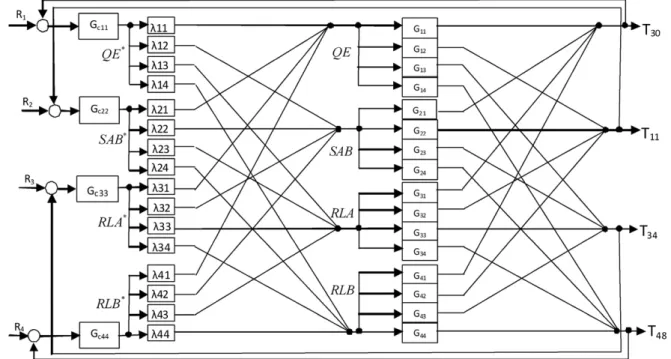
Figure 2 Decoupling scheme for the two coupled distillation column process.
between manipulated variables and outputs. For proper con-trol of the process, decoupling the process into four decoupled loops is necessary. Some researches propose PSO based decou-pling technique[1]. Such technique estimates the optimum val-ues of steady state decoupling compensation matrix that minimize the interactions between each manipulated variable and its unpaired outputs. The decoupling technique yields to four independent decoupled loops; namely loop (QE, T30), loop (SAB, T11), loop (RLA, T34) and loop (RLB, T48).
Fig. 2depicts the decoupling scheme for the two-coupled dis-tillation column process.
Based on the decoupling scheme, the following relations are satisfied in matrix form:
Yout¼HKM ð2Þ
whereYoutis the actual outputs of the process, such that:
Yout¼ Y1 Y2 Y3 Y4 2 6 6 6 4 3 7 7 7 5¼ T11 T30 T34 T48 2 6 6 6 4 3 7 7 7 5 ð3Þ
His process transfer function matrix, given before in Eq.(1).K
is optimum steady state decoupling compensation matrix esti-mated in[1], such that:
K¼ k11 k12 k13 k14 k21 k22 k23 k24 k31 k32 k33 k34 k41 k42 k43 k44 2 6 6 6 4 3 7 7 7 5 ¼ 1 0:1788 0:0608 0:0078 1:9273 1 0:7906 0:4555 2:9263 0:8865 1 0:5466 3:5183 10:9464 0:1548 1 2 6 6 6 4 3 7 7 7 5 ð4Þ
Mis the manipulated inputs, such that:
M¼ M1 M2 M3 M4 2 6 6 6 4 3 7 7 7 5¼ QE SAB RLA RLB 2 6 6 6 4 3 7 7 7 5 ð5Þ
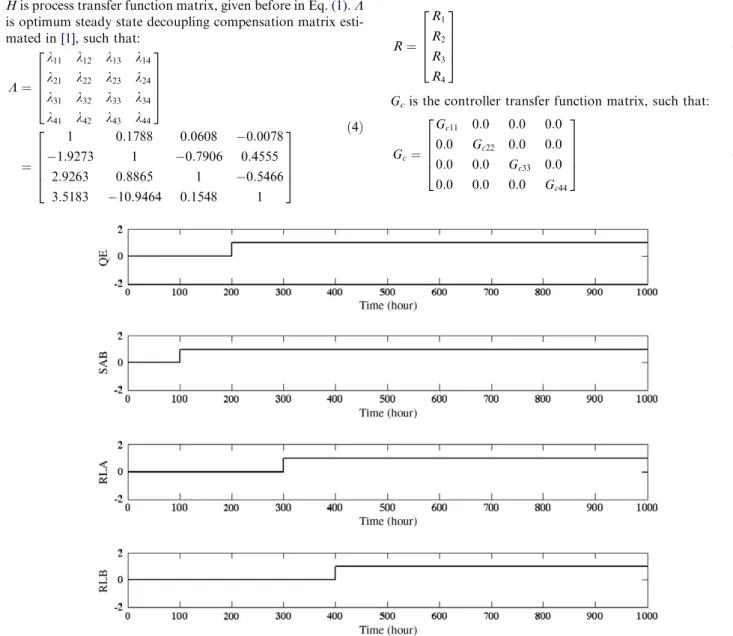
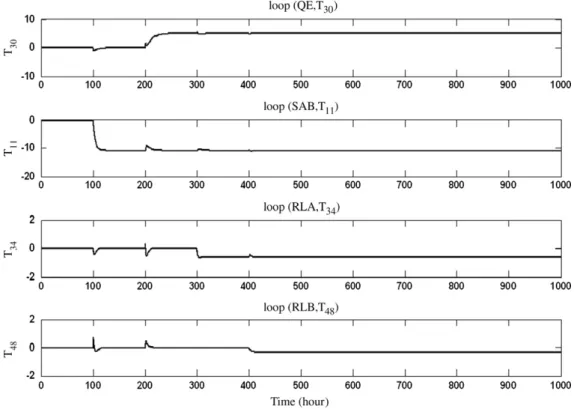
Fig. 3 illustrates the all process inputs subjected to step changes originating at different time instants to check the behavior of the decoupled loops.Fig. 4 exposes the outputs of different decoupled loops in case of no controllers.
Step change in specific manipulated variable causes some small and narrow perturbations (spikes) in its unpaired puts, while; causes direct step response in its own-paired out-put. From this point of view, the decoupling scheme proves its suitability to control the four decoupled loops using four individual controllers.
The following matrix form fulfills the relations of the con-trol scheme:
Yout¼HKGc½RYout ð6Þ
whereRis the reference temperature set values, such that:
R¼ R1 R2 R3 R4 2 6 6 6 4 3 7 7 7 5 ð7Þ
Gcis the controller transfer function matrix, such that:
Gc¼ Gc11 0:0 0:0 0:0 0:0 Gc22 0:0 0:0 0:0 0:0 Gc33 0:0 0:0 0:0 0:0 Gc44 2 6 6 6 4 3 7 7 7 5 ð8Þ
whereGc11,Gc22,Gc33, andGc44are conventional PID
control-lers for the four decoupled loops, such that:
Gc11¼KpðQE;T30Þ 1þ 1 TiðQE;T30Þs þTdðQE;T30Þs ð9-aÞ Gc22¼KpðSAB;T11Þ 1þ 1 TiðSAB;T11Þs þTdðSAB;T11Þs ð9-bÞ Gc33¼KpðRLA;T34Þ 1þ 1 TiðRLA;T34Þs þTdðRLA;T34Þs ð9-cÞ Gc44¼KpðRLB;T48Þ 1þ 1 TiðRLB;T48Þs þTdðRLB;T48Þs ð9-dÞ where KpðQE;T30Þ;TdðQE;T30Þ;TiðQE;T30Þ;. . . ;KpðRLB;T48Þ;TdðRLB;T48Þ;
TiðRLB;T48Þ are the controllers’ tuning parameters for different loops.
Fig. 5presents the detailed complete control scheme of the two-coupled distillation column process. The values of kijs
represent the optimal values of compensation matrix for input-output proper pairing, while; Gijs are the elements of
the process transfer function matrix H.
4. Proposed design of fuzzy PID controller
The tuning of the conventional PID controller is an expert based process. To overcome the difficulties of conventional PID controller various types of modified conventional PID controllers such as auto-tuning and adaptive PID control-lers were developed [19–21]. In addition, a class of non-conventional type of PID controller employing fuzzy logic
has been designed and simulated for this purpose
[22–30].
A fuzzy logic system (FLS) is a rule-base system that imple-ments a nonlinear mapping between its inputs and outputs. FLS is characterized by four modules; namely: Fuzzifier, rule base, fuzzy reasoning, and Defuzzifier. A fuzzy PID controller is a fuzzified proportional- integral- derivative controller. It acts on the same input signals, but the control strategy is for-mulated as fuzzy rules.
Fuzzy PID tuning is no longer a pure knowledge or expert based process and thus has potential to be more convenient to implement. The approach taken here is to exploit fuzzy rules and reasoning to generate controller parameters. The PID con-troller parameters (Kp,Ti,Td) are determined based on the
cur-rent errore(t) and its first differenceDe(t), where
eðtÞ ¼rðtÞ youtðtÞ ð10Þ
DeðtÞ ¼eðtÞ eðtsÞ ð11Þ wheresis the sampling time.
4.1. Fuzzification of e andDe
It is assumed thateandDeare in prescribed ranges [emin,emax]
and [Demin,Demax], respectively. For convenience,eandDeare normalized into the ranges between zero and one by using the following linear transformation:
enðmÞ ¼ eðmÞ emin emaxemin ð12Þ DenðmÞ ¼ DeðmÞ Demin DemaxDemin ð13Þ Finer fuzzy partition with seven terms[31]is used to assign the domain of each linguistic value for actual numerical values ofeandDe. The finer fuzzy partition with seven terms assigns the following linguistic values:
NB: negative big. NM: negative medium. NS: negative small. ZE: zero. PS: positive small. PM: positive medium. PB: positive big.
A triangular membership function is assigned to each lin-guistic value. The base of each triangle specifies the domain of each linguistic value.
4.2. Fuzzification of the controller parameters
It is assumed that Kp and Td are in prescribed ranges
[Kp,min,Kp,max] and [Td,min,Td,max], respectively. For
conve-nience,KpandTdare normalized into the range between zero
and one by the following linear transformation:
Kpn¼ ðKpKp;minÞ ðKp;maxKp;minÞ ð14Þ Tdn¼ ðTdTd;minÞ ðTd;maxTd;minÞ ð15Þ In the proposed scheme, PID parameters are determined based on the current errore(t) and its first differenceDe(t). The inte-gral time constant is determined with constants, i.e.,
Ti¼aTd ð16Þ
The linguistic values forKpnandTdnare assumed to be either
small or big and assigned the following membership functions:
lsmall¼ 1 4 lnðyÞ ð17Þ lbig¼1 4 lnð1yÞ ð18Þ wherey=KpnorTdn
The linguistic values for a are assumed to be either S (small), MS (medium small), M (medium) or B (big). These fuzzy sets are represented in singleton membership functions.
4.3. Rule base, fuzzy reasoning and defuzzification
The normalized gain parametersKpn,Tdnare determined using
set of fuzzy rules having the following form:
Figure 5 Detailed complete control scheme of the decoupled distillation process with all references, outputs and manipulated variables.
Table 1 Fuzzy tuning rules forKpn. Den(i) NB NM NS ZE PS PM PB en(i) NB B B B B B S B NM B B B B S B B NS B B B B B B B ZE B B B B B B B PS B B S B B B B PM B B S B B B B PB B S B B B B B
Table 2 Fuzzy tuning rules forTdn. Den(i) NB NM NS ZE PS PM PB en(i) NB B B B B B B S NM B B B B B B S NS B B B B B S S ZE S S S B S S S PS S S B B B B B PM S B B B B B B PB S B B B B B B
IfenðiÞisA1l and DenðiÞisA2l; then KpnisB1l;TdnisB2l;
and aisB3l:
whereen(i) is theithobservation for normalized error,Den(i) is
theithobservation for normalized first difference in error,A1l
is the fuzzy set for input (1) andlthrule,B1lis the fuzzy set for
output (1) andlthrule,lis the equal to 1, 2, 3,. . .,RandRis the number of rules.
The rule base for the normalized gain parameters are given inTables 1–3.
The truth-value of thelth rule is obtained by using thet -norm as the end connector for antecedent part, as follow:
lAlðxÞ ¼lA
1lðxi1Þ lA2lðxi2Þ ð19Þ
where lAlðxÞ is the resultant membership function of the t-norm,xi1 is theithobservation for input number 1 and equiv-alent toen(i),xi2 is theithobservation for input number 2 and equivalent toDen(i), A1lis the fuzzy set for input number 1 andlthrule, A2lis the fuzzy set for input number 2 andlthrule. Hence, the final expression for the membership function of the fuzzy set by thelth fuzzy rule when an engineering imple-mentation operator is used, will be
lBlðyÞ ¼lBlðyÞ ½lA
1lðxi1Þ lA2lðxi2Þ ð20Þ
wherey: is either the normalized outputKpn,Tdnora,lBlðyÞ
is the membership function for certain output in the conse-quent andlthrule,lBlðyÞis the resultant membership function
of the implication for certain output in the consequent andlth
rule.
Applying Eq.(20)to each rule of the R rules in the rule base yields a fuzzy set output for each one of the rules. These R fuz-zy sets (lBl) need to be connected to generate the total output Table 3 Fuzzy tuning rules fora.
Den(i) NB NM NS ZE PS PM PB en(i) NB S S S S S S S NM MS MS S S S MS MS NS M MS MS S MS MS M ZE B M MS MS MS M B PS M MS MS S MS MS B PM MS MS S S S MS MS PB S S S S S S S
Figure 6 Adjustable parameters of the antecedent membership functions.
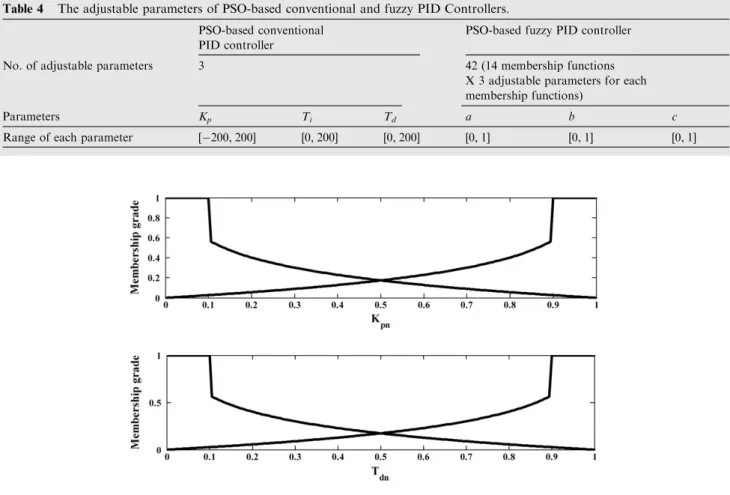
Figure 7a Membership functions forKpnandTdn. Table 4 The adjustable parameters of PSO-based conventional and fuzzy PID Controllers.
PSO-based conventional PID controller
PSO-based fuzzy PID controller
No. of adjustable parameters 3 42 (14 membership functions
X 3 adjustable parameters for each membership functions)
Parameters Kp Ti Td a b c
fuzzy setlY(y). It might seems reasonable to connect the rules
output fuzzy sets using at-conorm, that is to connect them taking the union of the output fuzzy sets. In order to be used in the real world, the fuzzy output needs to be interfaced to the crisp domain by the defuzzifier.
Callingdlis the center of gravity of fuzzy setB l*
output of thelth rule, the output of the center of area (COA) defuzzifier is given by: ydn¼ PR l¼1dllBlðdlÞ PR l¼1lBlðdlÞ ð21Þ whereydnis eitherKpnorTdn.
For notational ease, we can define
n
i¼1ai¼a1a2. . .an ð22Þ
Hence, we rewrite Eq.(21)as follow,
ydnðxiÞ ¼yðxi1;xi2Þ ¼ PR l¼1dl½lBlðdlÞ2 j¼1lAjlðxijÞ PR l¼1½lBlðdlÞ2j¼1lAjlðxijÞ ð23Þ Fuzzy set Ajl is the fuzzy set corresponding to the jth input
variable and for thelth rule. In general, for each input (i.e., lin-guistic variable) the universe of discourse is partitioned into
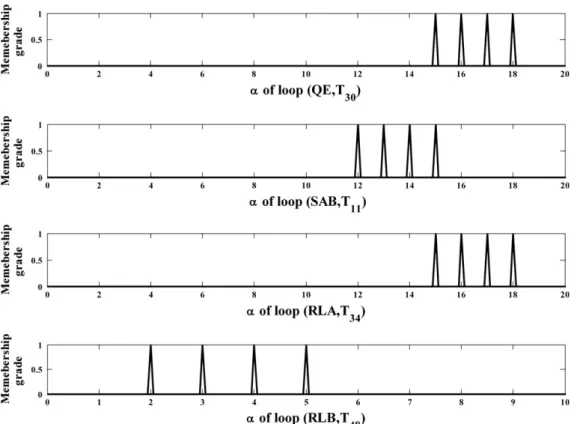
Figure 7c The initial antecedent membership functions for all loops. Figure 7b Different membership functions ofafor all loops.
fuzzy sets (e.g., negative big, negative medium, large, negative small, zero, positive small, positive medium, positive big) that could correspond numeric indices (e.g., respectively 1, 2, 3, 4, 5, 6, 7). This second indexland with values in the set of numbers describing the partition of the input space. In more formal terms, if thejth input is partitioned intokjmembership functions
where each of one uniquely identifiable with an integer between 1 andkjthen the fuzzy set for thejth input in thelth rule should
be Ajk(j,l)wherek(j,l) is a functionk:{1, 2}·{1, 2,. . .,R}fiN,
whereNis the set of integers. More specifically 16k(j,l)6kj.
Moreover, we can ease the notation if we denote bylij(x) the
membership function for Aij. The same discussion holds for
the consequent part of the FLS. In this case, we define
h(l),h:{1, 2,. . .,R}fi{1, 2,. . .,H}, where His the number of membership functions defined for the consequent. Note that the functionk(j,l) andh(l) univocally describe the rule base. With this modified and more precise notation, Eq.(23)becomes:
ydnðxiÞ ¼yðxi1;xi2Þ ¼ PR l¼1dhðlÞ½lBhðlÞðdhðlÞÞ2j¼1lAjkðj;lÞðxijÞ PR l¼1½lBhðlÞðdhðlÞÞ2j¼1lAjkðj;lÞðxijÞ ð24Þ
Figure 8a The final antecedent membership functions for loop (QE,T30).
Once the values of Kpn,Tdn and aare obtained, the PID
controller parameters are calculated from the following equations:
Kp¼ ðKp;maxKp;minÞ KpnþKp;min ð25Þ Td¼ ðTd;maxTd;minÞ TdnþTd;min ð26Þ
Ti¼aTdn ð27Þ
5. Particle swarm optimization technique
Particle swarm optimization (PSO) is a population-based search algorithm initialized with a population of random solutions, called particles. Each particle in PSO has its associated velocity. Particles fly through the search space with velocities, which are dynamically adjusted according to their historical behaviors. Remarkably, in PSO, each individual in
the population has an adaptable velocity (position change), according to which it moves in the search space.
Suppose that the search space is D-dimensional, then the
ith particle of the swarm can be represented by a D-dimen-sional vector Xi= [xi1xi2...xiD]T. The velocity of the particle
can be represented by another D-dimensional vector
Vi= [i1i2...iD]T. The best previously visited position of theith
particle is denoted as Pi= [pi1pi2...piD]T. Defining ‘‘g’’ as the
index of the best particle in the swarm, where thegth particle is the best, and let the superscripts denote the iteration num-ber, then the swarm is manipulated according to the following two equations. zþ1 id ¼w zþ1 i n idþc1r z 1ðp z idx z idÞ þc2r z 2ðp z gdx z idÞ ð28Þ xzþ1 id ¼x z idþ zþ1 id ð29Þ
whered= 1, 2,. . .,D;i= 1, 2,. . .,M, andMis the size of the swarm (i.e. number of particles in the swarm);c1,c2 are
Figure 8c The final antecedent membership functions for loop (RLA,T34).
the positive values, called acceleration constants;r1,r2 are the random numbers uniformly distributed in [0, 1];z= 1, 2,. . .,
Zdetermines the iteration number;Zis the maximal times of iteration;wis the inertia weight function, denoted as:
wz¼ 0:5z
1Zþ
0:40:9Z
1Z ð30Þ
The inertia weight decreases from 0.9 to 0.4 through the run to adjust the global and local searching capability. The large inertia weight facilities global search abilities while the small inertia weight facilities local search abilities.
The PSO algorithm is simple in concept, easy to implement and computational efficient. The original procedure for imple-menting PSO is as follows:
Figure 9a The evolution of different fitness functions for PSO-based conventional PID controller.
Step 1: Initialize a population of particles with random positions and velocities on D dimensions in the problem space.
Step 2: For each particle, evaluate the desired optimization fitness function in D variables.
Step 3: Compare particle’s fitness evaluation with its pbest (best previously visited positions). If current value is better than pbest, then set pbest equal to the current value, andPi
equals to the current locationXiin D-dimensional.
Step 4: Identify the particle in the neighborhood with the best success so far, and assign its index to the variableg. Step 5: Change the velocity and position of the particle using Eqs. (28)–(30).
Step 6: Loop to step (2) until a criterion is met, usually a suf-ficiently good fitness or a maximum number of iterations.
6. Proposed design of PSO-based optimal fuzzy PID controller Optimal design for both conventional and fuzzy PID control-lers can be fulfilled using PSO technique. Based on the PSO
technique, the PID controller can be tuned to some parameters values that minimize a predefined fitness function. Sum Squared Error (SSE) is used as a fitness function in this re-search paper, SSE is given as follows:
SSE¼P
n
i¼1
ðrðiÞ youtðiÞÞ2 ð31Þ
wherer(i) is the step input at sample instanti,yout(i) is the
ac-tual output of the process at sample instanti,nis the number of samples.
For conventional PID controller, fitness function is evalu-ated directly by tuning the parameters Kp, Ti, and Td. For
our proposed fuzzy PID controllers [32,33], tuning ofKp,Ti,
andTdis provided in an indirect way through the adjustment
of membership functions ofenandDen(i.e.: antecedent
mem-bership functions). The adjustable parameters of the anteced-ent triangular membership functions are the canteced-enters and the support as shown inFig. 6.
The mathematical expression of the triangular antecedent function is:
Table 5 The optimal parameters values of PSO-based conventional and fuzzy PID controllers.
Loops PSO-based conventional PID controller PSO-based fuzzy PID controller
Parameters Parameters Kp Ti Td Kp Ti Td Loop (QE,T30) 0.9554 50.0 1.0 0.01001 0.89968 0.085501 Loop (SAB,T11) 1.0 100.0 0.0512 2.5 0.004 25.0 Loop (RLA,T34) 50.0 50.0 0.0001 52.5 0.0250 2.5001 Loop (RLB,T48) 150.0 50.0 0.0001 175.0 0.008 25.0
fðx;a;b;cÞ ¼ 0; x6a xa ba; a6x6b cx cb; b6x6c 0; c6x 8 > > > < > > > : 9 > > > = > > > ; ð32Þ
In terms of antecedent membership function parameterswa
– from all parametersw– and based on the detailed analysis of the proposed design of fuzzy PID controller, the normalized values of controller parameters nominatedydncan be
formu-lated as follows:
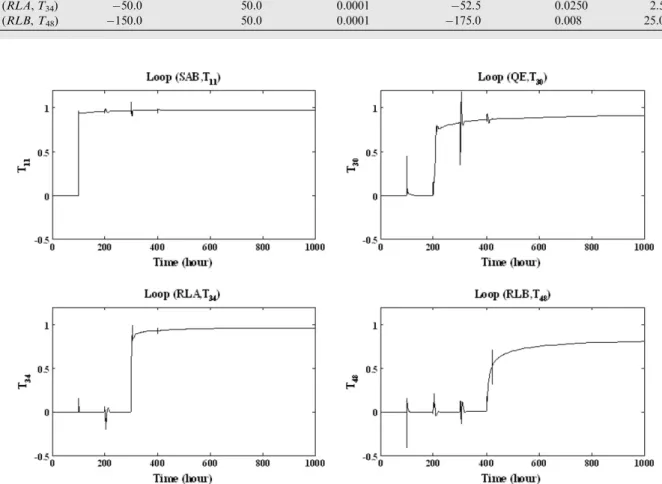
Figure 11 The response of the four decoupled loops using PSO-based conventional PID controllers.
ydnðxi;wÞ ¼yðxi1;xi2;waÞ ¼ PR l¼1dhðlÞ½lBhðlÞððdhðlÞÞnj¼1lAjkðj;lÞðxij;waÞÞ PR l¼1½lBhðlÞðdhðlÞÞjn¼1lAjkðj;lÞðxij;waÞ ð33Þ The output of the processyoutas a function of antecedent
membership function parameters can be calculated at different sampling instants. The SSE fitness function given in Eq.(31)
can be calculated and evaluated by PSO with seeking for its minimum value. In addition to fitness function, the following parameters should be defined to PSO algorithm.
(a) Sampling time. (b) Number of samples.
(c) Dimension (i.e.: number of adjustable parameters in antecedent membership function).
(d) Maximum number of iterations.
(e) Number of particles in the swarm (size of the swarm). (f) Range of variables.
7. Results and discussion
The proposed optimal design of PSO-based fuzzy PID control-ler is simulated and applied on the four decoupled loops of the two-coupled distillation columns process. For validation pur-poses, the optimal design of PSO-based conventional PID con-troller is also simulated and applied on the same process. For all loops; sampling time is 0.1 hour, number of samples is 3001, max number of iterations is 1000, dimension is 3 for conven-tional PID and 42 for fuzzy PID, and number of particles is 20 for conventional PID and 70 for fuzzy PID.
The adjustable parameters of PSO-based conventional and fuzzy PID controllers are given inTable 4.
The consequent parameters of membership functions for
Kpn and Tdn are identical for all loops and presented in
Fig. 7a, while different membership functions for a are as-signed to each loop as scrutinized inFig. 7b.
The parameters of the antecedent membership functions of fuzzy PID controller for all loops are adjustable. The initial antecedent membership functions assigned to all loops are identical and shown inFig. 7c.
Simulation of the proposed technique yields to the final antecedent membership functions for different loops as illustr-sted inFigs. 8a–8d.
The fitness functions (SSE) of different loops are evaluated for both PSO-based conventional and fuzzy PID controllers.
Figs. 9a and 9b evolute the fitness functions in all iterations for the later two cases.
Table 5 lists the optimal values of controllers’ parameters for all loops which achieve minimum SSE in PSO-based con-ventional and fuzzy. The noticed large difference between val-ues of controllers’ parameters in both cases is mainly due to random selection of adjustable parameters in both types of controllers.
Fig. 10 simulates the responses of the four decoupled loops using PSO-based fuzzy PID controllers to the inputs given before inFig. 3.Fig. 11simulates the response in case of PSO-based conventional PID controllers. Fig. 12 focuses on the detailed transient responses at the instants of step in-put changes for both PSO-based fuzzy and conventional PID controllers.
Table 6lists the minimized SSEs for different loops in case of both PSO-based conventional and fuzzy PID controllers.
PSO-based fuzzy PID controllers prove their usefulness over the PSO-based conventional PID ones.Figs. 10 and 11
prove that the performance of PSO-based fuzzy controllers is much better than of PSO-PID ones. Although it gave a slower response compared with PSO-PID due to its large number of adjustable parameters, the perturbations (spikes) occurred in unpaired outputs at the instant of change of specific input are remarkably reduced in case of PSO-fuzzy controllers. Although Fig. 12monitors some oscillations at transient re-sponses at instants of step input changes in PSO-based fuzzy PID controllers, Table 6 clarifies remarkable reduction in SSE for all loops compared to PSO-based conventional PID ones.
8. Conclusion
The problem of controlling the two-coupled distillation col-umns process is addressed in this paper, the before-hand four decoupled loops of the process are studied. Fuzzy PID control-ler is proposed to replace the conventional PID controlcontrol-ler of each loop. A transparent framework systematic approach is suggested to optimize the design of each PID controller. The PSO technique is used to provide optimal values of each fuzzy PID parameters that minimize the SSEs for its loop. The pro-posed PSO-based optimal fuzzy PID controllers are simulated and validated by comparing with PSO-based optimal conven-tional ones. The fuzzy controllers prove their feasibility and superiority.
References
[1] El-Garhy AM, El-Shimy ME. Development of decoupling scheme for high order MIMO process based on PSO technique. Appl Intell 2007;26(3):217–29.
[2] Fossen TI. Guidance and control of ocean vehicles. New York: John Wiley and Sons; 1994.
[3] Ho WK, Hang CC, Zhou J. Self-tuning PID control of a plant with under-damped response with specifications on gain and phase margins. IEEE T Contr Syst T 1997;5(4):446–52. [4] Zhao ZY, Tomizuka M, Isaka S. Fuzzy gain scheduling of PID
controllers. IEEE T Syst Man Cyb. 1993;23(5):1392–8.
[5] Yu K, Hwang RC, Hsieh JG. Fuzzy PID controller gain scheduling by using neural networks back-propagation algorithm. Beijing, China: International Conference on Neural Networks & Brain; 1998, 142–145.
[6] Lee CC. Fuzzy logic in control systems: fuzzy logic control, part I. IEEE T Syst Man Cyb. 1990;20(2):404–18.
Table 6 The minimized SSE for different loops in case of PSO-based conventional and fuzzy PID controllers.
Loop PSO-based conventional PID controller PSO-based fuzzy PID controller SSE SSE (QE,T30) 0.046292 0.007658 (SAB,T11) 0.002498 0.000397 (RLA,T34) 0.003850 0.001307 (RLB,T48) 0.077939 0.035988
[7] Kennedy J, Eberhart RC. Particle swarm optimization. Proc. of IEEE International Conference on Neural Networks (ICNN), Perth, Australia IV; 1995. p. 1942–48.
[8] Kennedy J, Eberhart RC, Shi Y. Swarm intelligence. Morgan Kaufmann; 2001.
[9] Ying Z, Guangjie Z, Feihong Y. Particle swarm optimization-based approach for optical finite impulse response filter design. Appl Opt 2003;42(8):1503–7.
[10] Eberhart RC, Shi Y. Guest editorial. IEEE T Evolut Comput. (Special Issue on Particle Swarm Optimization) 2004;8(3):201–3. [11] Eberhart RC, Shi Y. Particle swarm optimization: development,
applications and resources. In: Proc. congress on evolutionary computation 2001, Seoul, Korea, Piscataway, NJ: IEEE service center; 2001b.
[12] Laskri EC, Parsopoulos KE, Vrahatis MN. Particle swarm optimization for Minimax problem. Proc IEEE Congress Evolut Comput 2002;2:1576–81.
[13] Gao L, Gao H, Zhou C. Particle swarm optimization based algorithm for machining parameter optimization. In: Proc of 5th World congress on, intelligent control and automation; 2004, p. 2867–2871.
[14] Bergh FV, Engelbrecht AP. A cooperative approach to particle swarm optimization. IEEE T Evolut Comput. 2004;8(3):225–39. [15] Douani M, Terkhi S, Ouadjenia F. Distillation of a complex
mixture. Part II: performance analysis of a distillation column using energy. Entropy 2007;9:137–51.
[16] Segovia-Herna´ndez JG, Herna´ndez S, Herna´ndez H. Control properties analysis of thermally coupled distillation schemes. In: 8th International IFAC symposium on dynamics and control of process systems 1, Cancu´n, Mexico, 2007, June 6–8.
[17] Roat SD, Moore CF, Downs JJ. A steady state distillation column control system sensitivity analysis technique. Proc IEEE South-east Con 1988:296–300.
[18] Lang L, Gilles ED. Multivariable control of two-coupled distil-lation columns for multicomponent separation on a pilot scale. IFAC Proc. Symposium DYCORD +’89; 1989. p. 85–92. [19] Astrom KJ. Intelligent tuning. In: Dugard L, M’Saad M, Landau
ID, editors. Adaptive systems in control and signal processing. Oxford, U.K.: Pergaman; 2005. p. 360–70.
[20] Astrom KJ, Hagglund T, Hang CC, Ho WK. Automatic tuning and adaptation for PID controllers – a survey. Contr Eng Pract. 1993;1(4):699–714.
[21] Astrom KJ, Hang CC, Persson P, Ho WK. Toward intelligent PID control. Automatica 1992;28(1):1–9.
[22] Chen G. Conventional and fuzzy PID controllers: an overview. Int J Intelligent Contr Syst 1996;1(2):235–46.
[23] Carvajal J, Chen G, Ogmen H. Fuzzy PID controller: design, performance evaluation, and stability analysis. Inform Sci 2000;123(3–4):249–70.
[24] Li HX. A comparative design and tuning for conventional fuzzy control. IEEE T Syst Man Cyb. 1997;27(5):884–9.
[25] Malki HA, Feigenspan D, Misir D, Chen G. Fuzzy PID control of a flexible-joint robot arm with uncertainties from time-varying loads. IEEE T Contr Syst T. 1997;5(3):371–8.
[26] Malki HA, Li H, Chen G. New design and stability analysis of fuzzy proportional-derivative control systems. IEEE T Fuzzy Syst. 1994;2(4):245–54.
[27] Misir D, Malki HA, Chen G. Design and analysis of a fuzzy
proportional-derivative controller. Fuzzy Set Syst.
1996;79(3):297–314.
[28] Sooraksa P, Chen G. Mathematical modeling and fuzzy control of flexible robot arms. Math Comput Model. 1998;27(6):73–93. [29] Tang WM, Chen G, Lu RD. A modified fuzzy PI controller for
flexible-joint robot arm with uncertainties. Fuzzy Set Syst. 2001;118(1):109–19.
[30] Hu B, Mann GK, Gosine RG. New methodology for analytical and optimal design of fuzzy PID controllers. IEEE T Fuzzy Syst. 1999;7(5):521–39.
[31] Zhao ZY. Fuzzy gain scheduling of PID controllers. IEEE T Syst Man Cyb. 1993;23(5):1392–8.
[32] Esmin AA, Aoki AR, Lambert-Torres G. Fitting fuzzy member-ship functions using particle swarm optimization. In: Proceedings of the sixth ICNNSC – international conference on neural networks and soft computing, June 11–15, Zakopane, Polish; 2002.
[33] Paolo Dadone. Design optimization of fuzzy logic systems. PhD thesis. Faculty of the Virginia Polytechnic Institute and State University, Virginia; 2001 May.
Dr. Hassen T. Dorrahhas received his B. Sc. (with First Class Honour) in Electrical Engi-neering from Cairo University in 1968, and the M. Sc. and Ph. D. Degrees from the University of Calgary, Calgary, Canada, in 1972 and 1975 respectively. From 1975 till 1976, he was with the Department of Electri-cal Engineering, University of New Bruns-wick, Canada. He then joined in 1977 Cairo University, where he worked since 1987 till now as a full Professor of Electrical Engi-neering. From 2007 to 2008, he served as the Head of the Department of Electric Power and Machines Engineering. In 1996, he co-founded SDA Engineering Canada Incorporation, Willowdale, Ontario, Can-ada, where is presently working as its President. He is a registered Professional Engineer in both Ontario and New Brunswick (Canada) and other professional organizations in North America. Dr. Dorrah has published over than 30 Journal Papers, 60 Conference Papers, and over than 100 Technical Reports. He also supervised in the same areas 17 Doctoral and 37 Master dissertations. He is listed in American Marquis Publishing series: Who is Who in The World, Finance and Industry, Science and Engineering and American Education. His main interests are system engineering, automatic control, intelligent systems, water and energy engineering, computer applications in industry, informatics, operations research, and engineering management.
Dr. Ahmed M. El-Garhywas born in Egypt in 1961. He is Associate Professor of Automatic Control in the Electronics, Telecommunica-tions and Computer Engineering Dept., at Faculty of Engineering, Helwan University, Cairo, Egypt. He received the B.Sc. in Elec-tronics and Telecommunications Engineering from Faculty of Engineering, Cairo Univer-sity, Cairo, Egypt, in 1983. He obtained the Diploma of Higher Studies in Automatic Control, from Faculty of Engineering, Cairo University, Cairo, Egypt, in 1990. He obtained his M.Sc. and Ph.D. degrees in Automatic Control from Faculty of Engineering, Cairo University, Cairo, Egypt, in 1995 and 2000. He joined Embry-Riddle Aeronautical University, Daytona Beach, FL, USA in 1994 as a peace fellowship trainee for one academic year, where; he got a certified training program in Computer Based Management Information Sys-tem (MIS). He was a maintenance engineer at National Center for Research and Radiation Technology (NCRRT), Egyptian Atomic Energy Authority (EAEA), Cairo, Egypt, during 1986-1987. He spent fourteen years (1987 to 2001) at the Arab Institute for Advanced Technology (AIAT), Arab Organization for Industrialization (AOI), Cairo, Egypt, his duties include sustainable development of electronics, computers and automatic control labs for training purposes and establishing industrial professional training courses in the fields of electronics and automatic control. In 2002, he joined Helwan Uni-versity, Cairo, Egypt as an Assistant Professor of Automatic Control. In 2007 he became an Associate Professor in Automatic Control. His research interests include control theories, failure detection and
identification, neural fuzzy systems, genetic algorithms, particle swarm optimization techniques, design of intelligent controllers and machine learning.
Dr. Mohamed E. El-Shimywas born in Egypt in 1977. He is Researcher in Vice Rectorate for Graduate Studies and Research, King Saud University, Riyadh, Kingdom of Saudi Arabia. He received the B.Sc. (with very good
with honour) in Electrical Power and
Machines from Faculty of Engineering, Benha
University, Cairo, Egypt, in 1999. He
obtained his M.Sc. and Ph.D. degrees in Automatic Control from Faculty of Engi-neering, Cairo University, Cairo, Egypt, in
2005 and 2011 respectively. He was a demonstrator at Faculty of Engineering, Benha University, Cairo, Egypt, during 2001. He spent four years (2002 to 2006) at the Arab Institute for Advanced Tech-nology (AIAT), Arab Organization for Industrialization (AOI), Cairo, Egypt; his duties include sustainable development of electronics, computers and automatic control labs for training purposes. In 2007, he joined Egyptian Company for Aluminium Products, Cairo, Egypt as an Electrical Maintenance Senior Engineer. In 2008, he joined Technology competency Center, Productivity and Vocational Training Department, Ministry of Trade and Industry, Cairo, Egypt. His research interests include automatic control theories, neural fuzzy systems, genetic algorithms, particle swarm optimization techniques and design of intelligent controllers.