8 CHAPTER II LITERATURE REVIEW A. Textbooks as One of the Teaching Materials
1. Definition of Teaching Material
Teaching materials are one of the most important resources in the learning process since there are knowledge and information that will be taught by the teachers to students inside the teaching material. Without teaching materials, the learning process will not run well. Pranowo (2014: 236) stated that a crucial matter that is often faced by teachers in the teaching and learning activity in the classroom is about teaching materials. Teachers need to consider in choosing or determining the appropriate subject matter or teaching material to achieve the objectives of the learning process since the use of teaching material which is not in accordance with the condition of students, teacher, and the existing facilities itself will lead to the failure of the learning objective.
According to Widodo and Jasmidi (2008: 40), teaching material is a set of learning instrument or tools, methods, limitations, and ways of evaluating that have been systematically and interestingly designed to achieve the intended goals. The purpose intended is competence or sub-competence in all its complexity.
Teaching materials can also be referred to as tools used in the learning process. A tool is something that is used to perform or accomplish a certain task or activity and without this tool, the activity will not run properly. Daryanto and Dwicahyo (2014: 171) stated that teaching
9
material is an information tool and text that teacher need in planning and reviewing the implementation of learning. Teaching materials are all forms of written and unwritten material used by the teacher to teach.
Good teaching materials must be designed according to the learner's goals. Therefore, the teacher will be greatly helped by the existence of the teaching materials so that in this case, the quality of a teaching material will be very influential in the learning. Moreover, in the current teaching and learning activity, the teacher is a facilitator that makes students more independent in getting information and knowledge. The availability of teaching materials will help students to get in touch to the knowledge more easily.
Based on several opinions above, teaching material can be defined as a tool or form of material containing learning materials accompanied by various teaching methods and equipped with evaluation. The materials contained in the teaching materials are arranged systematically adjusting to the conditions of the students and the existing environment. The existence of these teaching materials is expected to help the success of the learning process.
2. Kinds of Teaching Material
The teacher can find teaching materials from many sources. Each teacher may use a different kind of teaching materials for students. The use of those teaching materials is adjusted to the process of learning takes place. According to Pranowo (2014: 247-249), there are several kinds of teaching materials, they are as follows:
10 a. Textbook
Textbooks that have been published by various publishers can be chosen to be used as learning resources. The textbooks used in a single lesson can consist of one subject matter and several supporting material.
b. Research Report
Research reports published by research institutes or by researchers are very useful for obtaining the actual source of teaching material.
c. Journal
The journal which is used as teaching material contains various research results and opinions from experts in their respective fields that have been studied correctly.
d. Expert in the fields of research
Experts or skilled person in their fields of expertise can become consultants about the correctness of teaching materials or materials, scope, depth, sequence, and so on.
e. Professional
Professionals from those who work in their fields can be a source of questions related to the material used for learning.
f. Curriculum Book
The curriculum book is one of the mandatory sources used in learning since it is accompanied by competency standards, basic competencies and the main material of learning material.
11
The publication here refers to an actual newspaper, magazine, or various publications so that it can be used as a source of teaching materials in learning.
h. Internet
Teaching materials found on the internet. The internet source, in this case, must be from an official source in order to obtain reliable information.
i. Media audiovisual (TV,Video, VCD, Auditive Tapes)
Types of audiovisual media that contain various knowledge can also be a source of teaching materials to be used in the learning.
j. Environment (nature, social, art and culture, engineering, idustry, economic)
The real conditions of the environment can be used as a source of teaching material presented by the teacher. Students are guided in the surrounding environment to seek knowledge related to the learning material needed.
From several kinds of teaching materials mentioned above, it can be concluded that the material of teaching can be in the form of written or non-written forms such as audio and video. The use of teaching materials tailored to the needs, purpose and on how it shall be developed.
12 3. Definition of Textbook
a. Textbook
Textbooks are books used in special learning for each subject and level of education. Muslich (2016: 51) stated that textbooks are school books aimed at students at certain levels of education and contain selected material so that it is always related to the field of research or certain subjects that is usually compiled by severe experts in their fields. Textbook is written for specific instructional purposes equipped with learning facilities, arranged systematically to follow certain learning strategies to be assimilated and support learning programs.
There are many definitions of textbooks according to experts. Bacon as cited in Tarigan and Tarigan (2009: 12) states that textbooks are books designed, prepared and compiled by experts in their fields and equipped with appropriate teaching facilities for use in the classroom. This is in line with the opinion of Richards and Schmidt (2002: 550), textbooks are books on special subjects that are used as a guide to teaching and learning, especially in schools or colleges. Textbooks for learning foreign languages are often part of a graded series that includes a variety of skills (listening, writing, reading, speaking) or dealing with one skill (eg reading).
Based on the definition above, it can be concluded that textbooks are compilation of information, sources of knowledge
13
and as a medium of instruction prepared to explore the potential of students.
b. Function of Textbook
Currently, every subject in school requires a textbook. According to Nasution as cited in Prastowo (2011: 169), textbooks have the following functions: a) as reference material or instruction material by students, b) as evaluation material, c) as an aid tool for educators in implementing the curriculum, d) as one the teaching determinants methods or techniques that will be used by educators, and e) it means to improve the students career and position.
Textbooks can affect students, both ways of learning, motivation, and behavior. Although each student does not get the same influence, however, by reading textbooks, students will be motivated to do something according to their personality. Therefore making a textbook that will be given to students is not a simple matter, but it is also not something very difficult.
c. Benefits of Textbook
Textbooks that considered belong the good category can certainly provide many benefits, the following are the benefits of textbooks according to Kurniasih and Berlin (2014; 85-86).
1) Textbooks can provide books according to student needs and demands as technological and curriculum developments.
14
2) Textbooks can encourage teachers to work more creatively in sharing knowledge.
3) Textbooks can encourage teachers to understand and develop science according to the demands of books in the applicable curriculum.
4) Textbooks can support teachers to write books as fulfillment of credit numbers determined by the government.
The benefits of various textbooks make the school obliged to use it. In terms of teachers, students, or the learning process, textbooks can encourage teachers to be more creative in developing a subject matter. For students, textbooks have a role to help easier and faster in understanding the material and foster a sense of curiosity to develop their potential including attitudes education. In the learning process, the textbook is also seen as a tool, since it can be a material that conveys messages (material) from the teacher to students with the same teaching material. Therefore, generally, the textbook can facilitate, support and support a learning process to realize the results of targeted achievements in accordance with the implementation plan of learning.
d. Characteristics of Textbook
Textbooks are books that are used specifically in the learning process of the world of education. Visually, textbooks are almost the same as ordinary scientific books that are used as teaching
15
materials, but textbooks have special features that are different from other scientific books. These characteristics are raised by Muslich (2016: 60-62).
1) Textbook is prepared in accordance with the applicable curriculum. The education curriculum has set out guidelines for learning that must be implemented. The curriculum contains various approaches and strategies that can be used by teachers or teachers in delivering material. Textbooks that are teaching materials for students must be adapted to the existing curriculum.
2) Textbook focuses on one purpose. The contents in the textbook must have a specific purpose. The intended purpose is the results that will be obtained in learning. The objectives to be achieved can be carried out by making a formula in accordance with the regulations in the applicable education curriculum. 3) Textbook provides a certain subject material. Textbooks are
presented with a focus on one subject area and certain classes/ levels of education. Textbooks do not contain mixing subjects that can make students understand. Each class or level of education has a different textbook so that one book cannot be used for all levels.
4) Textbook is oriented on the learning activity of students. Textbooks are presented to students, so the contents inside must also be adapted to the conditions of the students.
16
Although textbooks are also used by the teacher, the main goal is for students to prioritize understanding of students, not teachers.
5) Textbooks can guide teachers in teaching. Textbooks are not only used by students but also teachers in teaching in class. Textbooks must be able to help teachers in teaching a subject area. Although only as one of the teaching materials used as a tool, the textbook can at least suggest related to the steps of teaching.
6) The textbook presentation pattern is adjusted to students' intellectual understanding. The pattern of presentation in a textbook must be in accordance with the intellectual understanding of students. Conformity criteria are based on student knowledge and experience, grounded in the mindset of students, and rests on the power of responding to student language.
7) Textbooks can trigger motivation for students learning creativity. Textbooks must be able to encourage students to do something according to what is in the textbook material. Textbooks are also able to make students want to try and create something with their creativity. Therefore, textbooks are actually almost the same as scientific books, but textbooks pay more attention to the condition of students, curriculum and
17
material that are presented, while scientific books are more universal.
e. Advantages and Disadvantages of Textbook
The use of textbooks in the learning process is important, however, it still has some impacts. The impact of textbooks can occur on students, teachers or something related to learning. Textbooks have advantages and disadvantages in their use. The following is the advantage of using textbooks (Nasutian as cited in Pranowo, 2014: 171).
1) Helping teachers implement the curriculum since it is based on the applicable curriculum.
2) As a basic reference in determining the teaching method. 3) Give opportunities for students to repeat lessons / learn new
lessons.
4) Can be used for the following years and if revised can last for a long time.
5) In its form gives similarities regarding material and teaching standards.
6) Provide learning communities in sequential classes, even if the teacher changes.
7) Providing knowledge and teaching methods that are more stable if the teacher uses them from year to year, so the preparation of textbooks must also pay attention to the language elements related to aspects of readability.
18
Therefore, textbooks are still being used today as a consideration of the benefits of administration. The following is some weaknesses or the disadvantages of textbooks according to Tarigan (2009: 16). 1) Text books pay less attention to differences in individuals. Target
students are considered homogeneous so that the material in the textbook is presented without regard to "upper" students and "lower" students.
2) The design of the textbook is often not in accordance with the design of the education curriculum. As a result, using the textbook, educational programs that have been designed in the curriculum are not achieved.
3) The context and teaching materials contained in the textbooks are often not in accordance with the conditions and environment of the target. If this happens, the textbook will be impressed "forcing" students to learn something that "does not fit" with their condition. 4) Teaching materials contained in textbooks are often biased and
stale. This happens due to the time between the preparation of the text book and the time of its use intermittently. As a result, the information and problems contained in the textbook have "expired", even not in accordance with the students’ actual condition.
Some weaknesses in the textbook are not always detrimental in learning. Textbooks as material to support learning are only necessary to be used while being considered by relevant parties, that is,
19
textbooks are not used without consideration, due to these weaknesses, and teachers are required to be wise in using them.
4. Definition of Text a. Text
According to Halliday and Rukaiyah, as cited in Mahsun (2014:1), the text is a way to understanding language. That is why the text is a language that functions or a language that is carrying out certain tasks in the context situation. All examples of living languages that take certain parts in the context of a situation are called texts. Thus, the text is an expression of verbal activity. Text in Kamus Besar Bahasa Indonesia is interpreted as writing material in the form of basic subject matter to be delivered to students; manuscript in the form of original words from the author.
The text includes a language structure that has a large level of discourse. However, the term discourse often identifies text in context. Slightly different from the text which is more identical to the structures of language such as phonemes, morphemes, words, phrases, clauses, sentences, and paragraphs. The text concretely does not lose the final part. Discourse often loses its final part (Tarigan, 2009: 29).
Text is defined as a unit of language used as an expression of a social activity both verbally and in writing with a complete structure of thinking. The definition above, leads to the characterization of the text whose form can be in the form of language spoken or written, or other forms of means used to state what is being considered, for example, known as label or multimodal text.
20
Text based language learning, English is taught not only as knowledge of language, but as a text that carries out functions to become a source of user self-actualization in the context of academic socio-culture. Text is a unit of language that contains contextual expressions of meaning. Text based English learning is carried out by applying the principle that (a) language must be seen as text, not just a collection of words or linguistic rules; (B) the use of language is the process of choosing linguistic forms to express the meaning; (c) the functional language, namely the use of language that can never be separated from context because the form of language used reflects the ideas, attitudes, values, and ideology of its users; and (d) language is a means of forming human thinking skills. b. Elements of Text
1) Word
Word is the smallest units obtained after a sentence which is divided into parts, and contains an idea. Meanwhile, according to Kushartanti (2005: 151) word is the smallest free unit, or in other words each free unit is a word.
From the opinion above, it can be concluded that the definition of word is a free unit, or the smallest form, able to stand alone, and has meaning. The word consists of two kinds of units namely phonological units and grammatical units. As a phonological unit, the word consists of one or several tribes, and the tribe consists of one or several phonemes. As a grammatical unit, words consist of one or several morphemes.
21
The type of words is stated by some linguists (Linguistics), both in their traditional (old) and structural (new) views. The type of word according to Kridalaksana (2005: 43) is divided into ten types, namely nouns, word conditions, pronouns, verbs, number words, clothing, prepositions, adverbs, conjunctions, and interjection.
2) Phrase
A phrase is a combination of two or more words that are not predicative, the combination can be tight, stretchable (Kridalaksana, 2011: 66). According to Chaer (2012: 222) phrases are commonly identified as grammatical units in the form of a combination of non-predictive words, or commonly called a combination of words that fill one of the syntactic functions in the sentence. According to Ramlan (2001: 139) phrases are grammatical units that consist of two or more words, which do not exceed the clause function limits. The characteristics of phrases are as follows: (a) Consisting of two or more words, the phrase are grammatical units that consist of two or more words. (b) Do not exceed function limits, meaning that the phrase is always contained in one function of the clause element, namely S, V, O, Complement, or adverb. (c) Can be expanded or inserted.
3) Clause
A clause is a grammatical unit consisting of the subject and predicate, accompanied by an object, complement, and description or not (Ramlan, 2001: 79). In short, clauses are S V (O), (complement), (adverb). The brackets indicate that the word located in the brackets is
22
optional, means that the word does not have to be in the sentence. Whereas according to Chaer (2012: 231) clause is a syntactic unit in the form of a sequence of words with predictive constructs, the construction has components in the form of words or phrases that function as predicates and others function as subjects, as objects, and as information.
From the description above, it can be concluded that a clause is a grammatical unit consisting of subjects and predicates, accompanied by objects, appendages, and information. In short, clauses are in the pattern of S V (O), (complement), (adverb). Words arranged in the predicative construction. Clauses usually have elements of O, complement, adverb, which are optional to use. The S element can also be set up so that the basic elements of the clause is V. There are four types of clause characteristics, namely: (a) Consisting of S and V either accompanied by O, complement, adverb or without them. (b) Clause elements in the form of S and V. (c) the main element of the clause is V since S can be applied. (b) Having a formula of (S) (P) (O) (complement).
23 4) Sentence
a. Definition of Sentence
Sentences are a group of words that give complete thought. A sentence must consist of subject and verb (although it may be implied). There is an element of predicate (P) or verb (V), which is an element that states what is done by the element S or what is experienced by the element S. There may be an object element (O), that is, the target element of the action taken by the S element. Then, there might also be an element of Adverb (adv), which is an element that explains about time, place, method, etc., Chaer (2012: 36). He further adds that sentences are syntactic units constructed by basic constituents (usually in the form of clauses), supplemented by conjunctions (if needed), accompanied by final intonation (declarative, interrogative, imperative, or objective).
Based on several definitions or limitations of the sentence above, it can be concluded that the sentence is the smallest unit of language that expresses a complete thought. There are four types of sentence characteristics, they are:
(a) The biggest syntactic construction consists of two or more words.
(b) End with intonation or punctuation.
(c) Sentence is a syntactic construction that contains elements of predication.
24
(d) Consists of elements S and V with or without O, complement, or adverb.
From the above understanding and characteristics, sentences can only consist of at least one word, several phrases, or several clauses; Sentences consist of various functions that form one mind pattern; Sentences have intonation and pauses or punctuation; Sentences are constituents for discourse.
b. Types of Sentences
Based on the number of clauses, sentences are divided into two parts, namely compound sentences and single sentences. Compound sentences are sentences that occur from several free clauses (Kridalaksana, 2008: 105). A single sentence is a sentence consisting of one clause or one SV constituent. Therefore, the core elements of a single sentence are subject and predicate or Verb. Furthermore, according to Alwi, et al., (2003: 313-314) single sentences are sentences that consist of only one clause. That means that the constituents for each element of the sentence, such as the subject and predicate, are only one or it is one.
5) Paragraph
a) Definition of Paragraph
Paragraphs are a group of interrelated sentences and together explain one unit of mind (Wiyanto, 2004: 20). The author arranges paragraph by paragraph to convey the whole subject easily, so that the writer can arrange paragraphs
25
systematically and logically, a number of supporting elements are needed, namely transitions, topic sentences, explanatory sentences and assertive sentences. Although, not all paragraphs contain four elements, only three elements or two elements, even contain only one element. Furthermore, the paragraph is the core of casting thoughts in an essay. In paragraphs, there is one unit of thought which is supported by all the sentences in the paragraph, starting from the introduction sentence, main sentence or topic, explanatory sentences to the closing sentence. These sentence sets are interrelated in a series to form an idea. Paragraphs can also be said to be the shortest/ shortest essays (Nasucha et al., 2009: 33). Based on the two opinions of experts above, it seems that basically they have the same view about paragraph. That is, paragraph always has main ideas/ main concept that are used to build the unity of sentences in a paragraph. In linguistic hierarchies, paragraphs are units that are higher or wider than sentences. Paragraphs are useful for marking the opening of a new topic, separating one main idea from another. Thus, the reader easily understands the contents of the paragraph in its entirety.
b) Types of Paragraph
(1) Opening paragraph. The opening paragraph can be called as the introduction paragraph. Its function is as an introduction to get to the subject matter in the essay. A
26
good writing or essay must have an opening paragraph located at the beginning of more than one opening paragraph, so that the subject matter becomes unclear. Essay paragraph. The number of opening paragraphs must be one and may not be more than one. Short opening is better, which is about four sentences, (Nasucha et al., 2009: 33).
(2) Connecting paragraph. The connecting paragraph is the paragraph between the opening paragraph and the closing paragraph. The connecting paragraph is the content of the problem described in the essay. Therefore, the connecting paragraph is also called the content paragraph. This problem contains the conclusions of the paragraphs that will be described in the connecting paragraph. The connecting paragraph contains the core issues raised. Therefore, quantitatively, this is the longest paragraph, and logically related between paragraphs (Nasucha, et al., 2009: 34).
(3) Closing paragraph. The closing paragraph ends an essay. This paragraph concludes the connecting paragraph. The closing paragraph can also contain a reaffirmation of matters considered important in the connecting paragraph (Nasucha et al., 2009: 35). The closing paragraph that functions to end an essay should not be too long; however,
27
it does not mean that this paragraph can be taken for granted. Therefore, a writer should be able to maintain a comparison between the opening, connecting, and closing paragraphs.
c. Types and Structure of Text
Mahsun (2014: 15-34) stated in general, texts can be classified into single texts/ micro genres and compound texts/ macro genres. Single and compound terms embedded in the concept of single text and multiple text analogous to single and multiple concepts in single sentences and compound sentences. Single sentences are sentences that have one basic sentence basic pattern (PDKI), at least having a subject and predicate for single sentences that are intanitive or have subjects, predicates, and objects for single sentences that are transitive in character. Compound sentences are sentences that have more than one basic sentence pattern. Compound text is a complex text with a larger structure and is segmented into sections that can be chapters, sub-sections, or sub-sections, subsections.
1. Single Text (Genre Micro) a. Literature Text Type
Some literary genre texts which are included in the type of single text are recounted text, narrative, anecdotes, and exemplary
(1) Recount text. This text has a social purpose to retell the events of the past in order to create a kind of entertainment
28
or learning from past experiences for the reader or listener. This text has basic structure of a title: title, introduction/ orientation, and recording of events.
(2) Anecdotes. As one type of text that is included in the genre of stories, anecdotal text has the same social purpose as the story text. It's just that the events shown make participants who experience it feel irritated or ridiculous. This text has a thinking structure: title, introduction/ orientation, crisis/ problem, and reaction.
(3) Eksemplary. This text has social goals to assess behavior or characters in the story. That is why this text has a structure: title, introduction/ orientation, event/ incident, and interpretation.
(4) Narrative. This type of text is the same as the three genres of story texts described previously. However, the pattern of storytelling in this text does not converge into one text structure between problems and problem solving as in the text of recount, anecdotes, and explication. It is separated in a different text structure. That is why this type of text has a structure of thinking: title, introduction/ orientation, problems/ complications, and problem solving.
b. Factual Text Type
There are two examples of factual genre texts, they are: description text and procedure text/ direction text, as follow:
29
(1) Descriptive Text. This type of text has a social purpose to describe something object/ things individually based on its physical characteristics. The description presented in this text must be the specific feature of the object described. Therefore, the description text has a thought structure: a general statement, a description of the parts.
(2) Procedure Text/ Direction. Procedure/ direction text is one of a kind of text which includes the factual genre of procedural subgenres. The social purpose of this text is to direct or teach about the steps that have been determined. Thus, this type of text emphasizes more aspects of how to do something that can be in the form of experiments or observations. That is why this text has a structure of thought of: title, purpose, list of materials (which are needed to achieve the goal), the sequence of stages of implementation, observation, and conclusions.
(3) Announcement text. According to Lavryk as cited in Dzykovych, O (2017) states that an announcement is a short or long message about an event that must happen immediately. This is in line with Mustriana and Kurniawati (2005: 94) states that an announcement is something that is said, written or printed with the aim of telling what has happened or what will happen. Therefore, the Announcement text is the text that contains an official
30
statement or writing that aims to inform the public about something or information. Some types of announcement texts include: missing persons announcements, sad news, advertisements, notices / appeals from the government, etc. (4) Transactional Text. Transactional texts are texts that are used to relate to other people with the aim that we get what we want from the use of the text. The following are some of the functions of transactional texts: ordering / commanding, asking, promising, warning, threatening, rejecting, blaming.
c. Response Text Type
For response genre texts, two texts are presented, they are: exposition text and explanatory text.
(1) Exposition text. In this type of text, it contains exposure to ideas or suggestions for something that is personal. Therefore, this text is often also referred to as a one-sided argument text. The structure of thought which is the content of exposition text is: thesis/ statement of opinion of reason/ argumentation, and restatement of opinion.
(2) Explanatory text. Explanatory text has a social function explaining or analyzing the process of the emergence or occurrence of something. Therefore, this text has a thinking structure: titles, general statements, explanatory lines, and interpretations.
31
2) Compound Text (Genre Macro)
Similar to single texts, compound texts can also be classified into two types, namely factual compound text and fictional plural text. Included in the factual texts are multiple text groups, such as academic texts such as proposals/ research proposals, research reports, theses, post graduate theses, dissertations, papers, scientific articles, books etc, whereas compound text which is fictional is novel.
As mentioned above, that single and compound terms are embedded in single genre concepts and analogous compound genres in single and multiple concepts in single sentences and compound sentences. Compound sentences are sentences that have more than one basic sentence basic pattern (PDKI). The two PDKIs can be derived from the merging of two single sentences or one of the new sentence strictures derived from the expansion of one syntactic function (can be a subject, or object), which in the concept of traditional grammar is called a clause. In the context of multiple/ compound texts, such an analogy is intended as a form of combining several types of single text to fill the entire compound text structure (Mahsun, 2014: 36).
32 d. The Objectives of Text Learning
Material based on text, is a unit of language that performs its linguistic tasks in the context of situations: social, cultural, or context related to (who, when, and where). For example a single pronoun: I, me, or servant from the point of view of referential meaning, the pronoun will experience a change in the offender it refers to. If the pronoun is pronounced by a person named Ali, then the reference meaning refers to an individual named Ali. Next adverb (adverb): yesterday, will experience a change in its referential meaning depending on the narrative. If the word is pronounced on Thursday, the reference word yesterday falls on Wednesday. As for the latter, a word or phrase that points to a place, for example the phrase: here. If the unit here is said by someone who is in the kitchen, then the reference refers to the location of the kitchen where the word is spoken.
In line with the conceptual understanding of text as a language that carries out its functions in certain contexts, the material in the context of language learning should be adapted to the context of the situation of students. Furthermore, in interpreting the unit of language should not be released from the context of its use. Who, when, and where the unit of language is spoken should be the basis for learning language. Therefore, in teaching lexical elements or other language units it should not be released from the context.
33 e. The Benefits of Text Learning
The expressions or words in each language represent all the experiences of human life and nature that surround human life. The expression intended can be an expression for pleasure, hate, longing, revenge, and so on. For this reason, the categories of words usually appear to reflect the mental state of the speaker/ writer.
In language learning based on text learning, it can be integrated between literary materials with linguistic material. For example, in learning with material such as short stories, which are clearly literary material, the teacher can explain linguistic material. For example, the teacher can explain the word/ group question words: who, what, when, and where as a form of question used to multiply data, information, and facts in order to structure "recognition" in the story text. Another thing that is also a benefit in text learning is that students can gain knowledge not only through formal education but can learn from various other sources, such as: media, other people's experiences or themselves, and the environment.
Language learning can also take place from other sources, invective words and so on which are spoken everywhere. Therefore, a child should not be kept away from the reality of the use of real language since text learning is situational in nature.
The form of polite, abusiveness and other forms of language are the forms that compete in the reality of human life. Learning should not isolate students from the reality of language that is real in
34
life. Therefore, learning should be done to explain the diversity of forms of language that arise in life according to the development of students so that they have the opportunity to choose, select the appropriate form of language based on consideration of the context of the situation of use. Exercise in adjusting the selection of language forms according to the context of the situation of use is one of the growth of critical attitudes in students. The existence of various forms of expression will stimulate students to think creatively in choosing choices for certain forms according to the context and situation.
B. Readability of Text
1. Definition of Text Readability
Every text in a textbook is expected to be able to be understood by the reader. One thing that needs to be considered in the delivery of reading texts is information that is captured, and understood by the reader. This is deemed necessary because important and useful information will be useless if it cannot be understood by the reader. As a reading, the level of ease of understanding vocabulary and meaning is the initial requirement that needs to be considered. This level of understanding in reading is referred to as readability.
Readability of text is related to the difficulty of a text to be read. Readability is declared easy if it is understood by the reader and is said to be difficult if the reader does not understand the message conveyed. Muchlish (2016: 85) state that readability level is the level of ease of text or discourse to be understood by reader. A high level of readability will
35
add to the ability of readers in terms of understanding, learning, receiving information, the ability to remember, and speed of reading.
Readability in the textbook affects the success of the reader in understanding the material they are reading. Readability becomes a measure of the suitability of reading material with the reader in terms of the level of difficulty and the ease of the reading text. Furthermore, Janan and David (2012: 1) define the concept of readability which emphasizes more on the elements in the text that are associated with the understanding of the reader. These elements, namely, understanding of the words and expressions or ideas in the reading. Part of the concept also refers to a student's ability to read certain texts at optimal speed. This makes the concept of legibility also uses motivational factors that influence readers' interest in reading texts.
Readability is a measure of the text in the reading indeed raises various other definitions including according to Pikulski as cited in Balakrishnan (2016) stated that readability level is the level of ease or difficulty of the text material in a reading so that it can be understood by the reader and reading depends on many characteristics of a text and reader.
Furthermore, a text can be seen at an easy or difficult level after going through testing or measurement. After the measurement results are known, the textbook can be classified into categories according to the level of education or not. As expressed by Janan and David (2012; 2). The approach to a measure of readability in general does not use interactive
36
definitions. Measurements of commonly used legibility are more involved in objective thinking the difficulty level of reading material that comes from the application of the type of formula that generally take into number the problem of sentences and the difficulty of vocabulary in a reading. Therefore, in accordance to the assessment tool used, it can show the presentation of the reading.
2. The Assessment Technique of Readability Level
The assessment of the level of readability can be done in various ways, among others, namely; Fog Index Readability Formula, Readability Formula Flasch Reading Ease, Dale and Chall Readability Formula, Fry Graph, SMOG, Readability Checklist and Cloze Test procedure. However, the assessment of the readability level in this research will be done by using the Cloze Test procedure.
a. Index Fog Formula
The Fog Index Formula is the readability formulas that can be used to analyze a reading text. The Fog Index Formula also has several other names, namely The Gunning Fog Index, Fog Readability Formula or Fog Index. The inventor of this formula is a fakar named Gunning. He observed reading problems which were located in readings that were difficult to understand.
Gunning has conducted a research long enough to be able to find the Fog Index Formula. In 1944, Gunning established an institution specifically dedicated to measuring and finding readability formulas for reading. The making of this institution is intentionally focused on
37 IF= 0, 4 (A/K + 100S/A)
the problem of readability around it. Gunning conducted a research to help more than 60 well-known newspapers and magazines in America. In addition, Gunning also has the role of helping journalists, editors, and writers, so that their writing can be understood by the reader with the appropriate readability. As expressed by Zamanian, H (2012: 45).
Gunning (1955) has found a readability formula that developed for adults. The Fog Index Formula had become popular because of the ease of use at that time. The use of the Index Fog formula is based on two variables, namely the average sentence length and the number of words that have more than two syllables for every 100 words in a reading text. At the beginning of its discovery, Gunning uses the structure of the English language so that if it is applied in another language that has a different structure, the results will be less accurate. The results of the Gunning research obtained results that readability of a text or reading can be determined through a formula. The following is the formula in Fog Index Formula.
Explanation IF= Index Fog A= Number of words K= Number of sentences S= Number of difficult words
38
Reading Ease = 206,835 – (84,6wl + 1,015 sl) b. Flasch Reading Ease Formula
The Flasch Reading Ease is a readability measure found in 1948 by Rudolph Flasch, a writer, writing consultant and supporter of Plain English Language Movement. This measuring instrument is a formula that uses English.
Formula Flasch Reading Ease is the leading formula in terms of readability. This formula uses Microsoft Office Word which requires computer assistance. After Microsoft Office Word completes spelling and grammar checks, it will get results that display information about the readability level of the reading. Each readability rating is based on the average number of syllables and words per sentence. Flasch Reading Ease gives the text value at 100 points, the higher the value, the younger it is to understand the materials. Most standard sections have around easy to read scores of 60 to 70. (Zamanian, Heydari, 2012: 44). The following is the formula of calculation for Reading Ease Formula:
1. Select systematically the 100 words from the sample text 2. Determine the number of syllables per 100 words
3. Determine the average number of words of the sentence 4. Calculate with the following equation
wl= word length sl= sentence length
39
Reading Ease = 1,599nosw – 1.015sl-31.517
Then, in 1951 Farr, Jenkins and Patterson simplify the formula with the following formula:
Explanation:
nosw = the number of syllable per 100 words sl= the average of sentence length per word
In its invention, this formula has been considered valid enough to become a readability formula that is widely used by US government agencies. However, even though this formula uses Microsoft Office Word, not all languages are available and have sufficient accuracy to measure the level of readability, including for Indonesian text.
c. Dale and Chall Formula
The early invention of the Dale and Chall Formula was pioneered by Rudolph Flesch through the discovery of Flesch Reading Ease Formula so that Edgar Dale and Jeanne Chall revolutionized the way to analyze a reading. This formula was adopted in 1948 in his book "A Formula for Predicting Readability". Dale and Chall proposed this formula for the category of adults and children above grades 4 through 6 as one way for improving the Flesch Reading Ease formula.
Zamanian, H (2012: 45) said that the Dele and Chall Formula uses difficult word counts to determine the level of readability. These difficult words that don’t appear in a list of words that have been specifically designed. These words are adapted to the use of words that are familiar or can be known by most class 4. In this case, Dale
40
and Chall have made 3000 lists of words that are used as references. The following is the Dale and Chall formula:
1. Choose approximately 100 words from the text to be studied 2. Calculate the length of the sentence from the average word (divide
the word number by the number of sentences / X2)
3. Calculate the words percentage that are not in the Dale and Chall word list of 300 easy words (X1)
4. Then, calculate with the following equation Raw Score =0, 1579 (X1) + 0, 0496 (X2) + 3, 6365
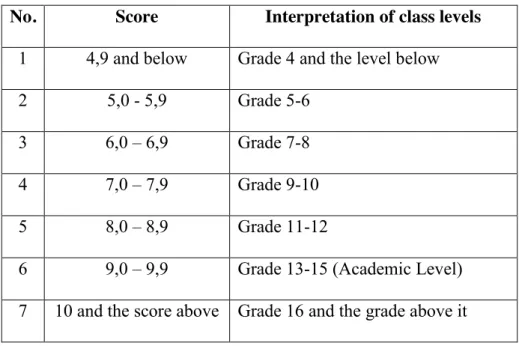
Then, the obtained score is interpreted by the following requirement as on the table below.
Table 1. The Interpretation Score of Dale and Chall Formula No. Score Interpretation of class levels
1 4,9 and below Grade 4 and the level below
2 5,0 - 5,9 Grade 5-6
3 6,0 – 6,9 Grade 7-8
4 7,0 – 7,9 Grade 9-10
5 8,0 – 8,9 Grade 11-12
6 9,0 – 9,9 Grade 13-15 (Academic Level) 7 10 and the score above Grade 16 and the grade above it
With these calculations, this formula uses a formula that is more complex, therefore, it requires a long time.
41 d. Fry Graph
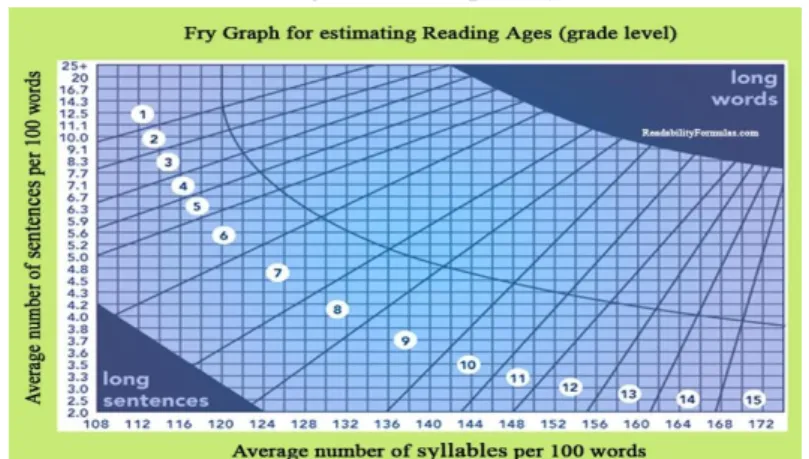
Fry graph is a readability measurement found by Edwar Fry in 1968 and published in 1977 in the magazine "Journal of Reading". Fry graph is a formula that bases calculations on two main factors, namely the number of words and sentences that make up a discourse, Harjasujana & Mulyati (1996) as cited in Nuryani (2016).
Figure 1. Graph Fry
The Fry Graph takes one hundred words in a discourse as a sample without calculating the length of the discourse. So no matter how thick the number of pages of a book or as long as any of a reading readability measurement using Fry Graph only uses one hundred words. This figure is considered representative according to Fry.
The dark areas at the top and bottom of the fry graph indicate the level of invalid reading values. A text is considered invalid if the Fry's legibility formula calculation score falls into the dark area of the graph (long sentences and long word areas). While the slots where numbers 1 to 17+ are found, are the reading level area. The average number of syllables and the average number of sentences per 100 words plotted
42
on the graph to determine grade level. Similar to other formulas, the Fry Graph bases its research on two main factors, namely the length of the short sentence and the level of complexity of the word or the length of the word.
Fry Graph is one of the suitable measurement methods used to determine the level of readability of a discourse without looking at the reader. Grfik Fry also determines the feasibility of a discourse for a certain class level from the point of view of reading. However, the discovery of the Fry Graph was calculated using English so that if it is applied in Indonesian, the number of syllables is multiplied by 0, 6. This number is obtained from the results of the research (simple) which obtained evidence that the comparison between the number of English syllables with the number of syllables the Indonesian word 6:10 (6 syllables in English are approximately the same as 10 syllables in Indonesian).
e. SMOG
This formula was found by MClaoughlin in 1969. SMOG stands for Simple Measure of Gobbledygook. In contrast to other methods that base their calculations on the level of ease of reading between 50% and 70%, this SMOG method is based on 100% understanding of the text being read. The SMOG formula is suitable for children above grade 6.
The SMOG formula is intended to measure the level of readability of a text of teaching material that is adjusted to the age of the reader.
43
Calculations using the SMOG formula can be done in two ways, namely reading categories with an amount of less or equal to 30 sentences and reading categories with an amount of more than 30 sentences.
The SMOG formula according to Crawley and Mountain (1995) 1) Count tenth consecutive sentences at the beginning, middle and
end (total of 30 sentences).
2) Count each word with three or more syllables in 30 sentences, even if the same words appear more than once.
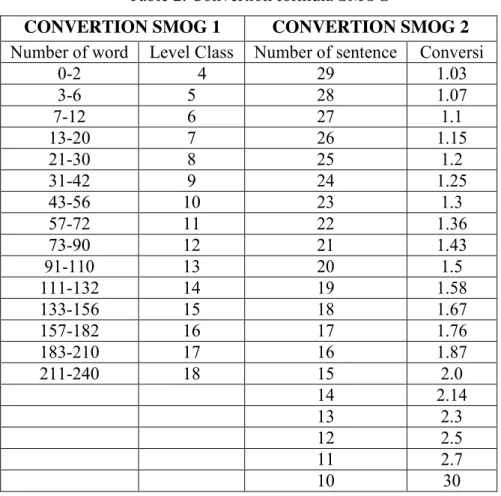
3) Add the calculated number of words. Then, use the table of SMOG Conversion to find grade levels.
4) If the discourse or text is less than 30 sentences but not less than 10 sentences then do the following steps:
a. Count the total number of the sentences in the text reading. b. Count the number of words consist of 3 or more syllables. c. Find the appropriate number of sentences and number of
conversions in the SMOG II Conversion Table.
d. Add up the number of words that consist of 3 or more syllables to the table conversion number. Then, use the number of words to find the correct value level in the Table SMOG Conversion I.
Word Count Rules:
a) Sentences are words that end with a period, exclamation mark, or question mark.
44
b) Words consist of hyphens are counted as a word. c) A proper nouns are counted.
d) Read the numbers out loud to determine the number of syllables.
e) In lenght sentences with colons or semicolons followed by a list, count each part of the list with the initial phrase of the sentence as an individual sentence.
f) Calculate abbreviations as if they were not abbreviated.
g) Don't count verbs ending in "ed" or "es" which make the word have a third syllable
Table 2. Convertion formula SMOG
CONVERTION SMOG 1 CONVERTION SMOG 2 Number of word Level Class Number of sentence Conversi
0-2 4 29 1.03 3-6 5 28 1.07 7-12 6 27 1.1 13-20 7 26 1.15 21-30 8 25 1.2 31-42 9 24 1.25 43-56 10 23 1.3 57-72 11 22 1.36 73-90 12 21 1.43 91-110 13 20 1.5 111-132 14 19 1.58 133-156 15 18 1.67 157-182 16 17 1.76 183-210 17 16 1.87 211-240 18 15 2.0 14 2.14 13 2.3 12 2.5 11 2.7 10 30
45 f. Readability Checklist
The Readability Checklist is a measurement of readability found by Judith Wesphal Irwan and Carol A Davis in 1980. The Readability Checklist is presented with a list of questions about the readability of a book. If the formula and other measuring instruments use the formula and calculation of numbers, this readability measure emphasizes the analysis by filling in the checklist in the table, Vacca and Vacca (1989).
Richard T Vacca and Jo Anne L Vaccation explanation of this readability measure see many factors, namely the teacher who is the party to determine the selection of books that can be understood by students, can be used and interesting. Students who are subject to the level of readability of textbooks are used. Measurements delivered by Richard T Vacca and Jo Anne L Vacca can help the teacher to determine the feasibility of the books used. This measurement is presented in the form of a table that includes the level of understanding (usability), usability (level of usability), and the level of attractiveness (interesibility).
g. Cloze Test
Cloze Test was first introduced by Wilson Taylor (1953) with the name Cloze Procedure. This technique is inspired by a concept in Gestal psychology known as "Clozure", this concept describes the tendency of humans to perfect a pattern that is incomplete mentally into a unified whole; the tendency to fill and complete something that
46
actually exists but appears to be in an incomplete condition; see parts as a whole.
Taylor as cited in De Abreu (2017) defines Cloze procedures as a method of capturing messages from a source (writer or speaker), changing the pattern of language by removing parts, and conveying to recipients (readers and listeners) so they try to perfect overall patterns that produce a number of units of relaxation that can be considered.
Cloze Test is different from the readability formula. In this test, a number of words from a reading material are systematically erased. Disappearance of words from a reading according to Taylor does not have an effect on the level of difficulty of reading, but the use of the number of grains of tests will be able to distinguish between subjects with one another.
1) Procedure of Cloze Test
The text that is superimposed on Cloze Test is the original text of a book. Some words in the text are systematically applied. The imprinted nth word is a test item that must be answered.
Some experts disagree about the rules for ninth word dissolution. Farr and Rosser imprinted the fifth word while the words were done randomly without regard to the distance distance systematic. There are also those who choose to imprint the tenth word and multiples in this measurement. However, there are also those who intentionally impose certain types of words in order to know the readability of these words by the reader (usually done in language
47
class evaluations). Although there are differences, in general Cloze Test is made by referring to existing standard procedures.
Wilson Taylor (1953) as cited in Lisnawati, Y, (2017), proposes a standard procedure for constructing a discourse overlapping, they are:
(1) Choosing a relatively perfect text (discourse) that is a discourse that is not dependent on previous information.
(2) Doing omission/ deleting every word to-n, regardless of the meaning and function of the words that are omitted or deleted. (3) Replacing the omitted parts with certain signs such as
horizontal lines (---) that are the same length.
(4) Giving a copy of all parts reproduced to students/ test takers. (5) Reminding test takers to fill in all the lessons by asking
questions about the discourse, paying attention to the context of the discourse, and paying attention to the remaining words. (6) Providing relatively sufficient time to give students the
opportunity to complete assignments.
John Haskal as cited in Lisnawati, Y (2017) perfects the construction with the following variations:
(1) Choosing a text that is approximately 250 words long. (2) Leaving the first and last sentences intact.
(3) Starting the omission of the second sentence, which is in every fifth word. Discharging is indicated by a straight horizontal line of the same length.
48
(4) If the fifth word is a numeral word, then the stopping is done in the fifth word of the next sentence.
2) Modification of Cloze Test
Cloze test modification is usually used to monitor the progress of a class by concentrating on grammar or vocabulary items. A rational removal system is followed, that is, deletion is determined by the examiner in accordance with the aim of the test. If the aim is to test grammar, then the function words, verb forms, and grammatical aspects are deleted. It has been argued that the modified cloze test has the advantage that it first becomes more practical because it does not require extra time in its use, both results will be easier to interpret because the modified cloze test eliminates the word according to the purpose of the research. Furthermore, the cloze test is modified closer to the post-modern approach or integrative approach to contextual language based testing. The following is an example of a cloze test modified with rational deletion.
“My brother and I sometimes go to a football match. Last Friday, we saw a match————we greatly enjoyed.———— two teams———fast and skilful. The forwards maneuvered——— shot hard and straight ———. Answers: 1) which, 2) the, 3) were, 4) and.”
If we see the words deleted, we can see that everything is a function word.
49
3) Criteria of Readability Level of Text
The level of text readability is obtained from the average readability score of all respondents. The score of the text readability of each respondent was obtained from the proportion of correct answers multiplied by one hundred percent. Quantitative data on the level of readability obtained is converted to criteria for the level of readability of the text. Criteria for the level of readability of the text is discrabing a conclusion from quantitative data measuring the level of readability of text based on certain categories.
Furthermore, the criteria for readability level according to Earl F Rankin and Joseph W Culhane as cited in Viny, C, (2017) as follow: (1) A readability score of less than 40% indicates reading material is
difficult to understand. This reading material is not suitable for the reader.
(2) The readability score of 41-60% indicates that the reading material is at the instructional level. Reading material is suitable for the reader, but needs the help of others to guide the reader in understanding it.
(3) A score of more than 60% indicates reading material is at an independent/ free level. Reading material is easy to understand and can be used independently by the reader.
50 4) Advantages of Cloze Test
Cloze Test is widely used in measuring the readability of a reading because it has advantages. The advantages of Cloze Test according to Harjasujana as cited in Tujiyanto (2000: 52) are: (1) Cloze Test reflects the pattern of interaction between the reader
and the writer.
(2) Measurements are not carried out separately between the text and the reader.
(3) Cloze Test can be used to find out the background of students' abilities in a short time.
(4) Even though the concentration of the researcher is not focused on the word but the effects reached up to the syntactic and pragmatic aspects.
(5) The perspective of readability of text is not the teacher or researcher with the text, like other formulas.
5) Disadvantages of Cloze Test
Cloze Test is a readability formula that is relatively easy to make and use for any reading material. However, there are some disadvantages, namely:
(1) The form of reading must be in the form of continuous prose with a relatively large number.
(2) The background of the reader’s language skills will affect the test results more or less.
51
(3) The application of tests for certain readings (for example for science subjects) must be adjusted / modified because the reading material is relatively difficult for students so the readability score is low.
Based on a number of ways that can be used in measuring the readability of a reading text, then conclusions can be drawn regarding the oversight and lack of readability measuring instruments in the following table:
Table 3. Advantages and Disadvantages of Readability Instrument Instrument Founder Year Advantages Disadvantages Indeks Fog Robert
Gunning
1944 Easy to use Designed for English text. So inaccurate for other languages. Formula ofFlasch Reading Ease Rudolf Flesh
1948 Easy since can be done by using Microsoft Office Word Only for English text Formula of Dale and Chall Edger Dale and Jeane Chall 1948 Accurate for using it in grade 4-6 Its use is limited. This formula uses a more complex formula that
52
requires a long time.
Fry Graph Edwar Fry 1968 Can be used for lower to upper grade of University level
Focus on syllable density text and many sentences.
SMOG G. Harry
Mc Laughlin
1969 Appropriate to be use for grade above 6 Measurements only focus on writing Readability Checklist Irwin dan Davis 1980 Appropriate to be use for all level of grade
Requires a long time in analysis
Cloze Test Wilson Taylor
1953 Accurate for all level of grade
Rather
complicated in analysis
C. Factors Affecting Text Readability
The use of text readability tests performed serves to assist the teacher in preparing or changing reading material to suit the needs of students. This improvement can be done by changing the reading or by increasing / decreasing the readability level.
There are several things that can affect the level of readability of a text (Pranowo, D.D, 2011), they are:
53
1. Paragraph, the number of paragraphs and the number of sentences per paragraph.
2. Sentences, sentence length (average number of words in per sentence), compound sentences, passive sentences, extended sentences, and polemic sentences.
3. Words, number of words per sentence, abstract nouns, unusual words, term terms, absorption words, conjunctions, and compound words.
The higher the percentage of complex, long, and inversion sentences, the more difficult the text is understood. Therefore, between words, sentences and paragraphs in a text or discourse are relevance. This is in line with the opinion of Janan and David (2012) which revealed that readability has a relationship between words, sentences, and ease of reading. The linkages are as follows: 1. The smaller the number of different words, the easier the material is read. 2. The greater the number of words that are unknown or long in a text, the
harder it is for the reader to understand their meaning. 3. The longer the sentence, the harder the text
4. The simpler the sentence, the easier the text. In addition, there are also other factors that can affect the level of readability of the text. These factors according to Gunning as cited in Putra, R. (2013) are as follows: 1) The level of education of the reader so that it correlates with the
vocabulary mastered.
2) The breadth of insight and knowledge of the reader 3) Residence and readership
54
5) Dictation or choice of foreign words by the author that exceeds the standard limits of the ability of the reader.
6) Syllable which is more than 3
7) Sentences in a long discourse (more than seven words per sentences) Therefore, we can conclude that readability of the text can be influenced by many factors including the condition of the reader apart from the type of reading itself. Usability, and level of attractiveness (accessibility).
D. Previous Related Research
The research relevant to this research is Widharyanto.B, et al. (2016). This research is entitled " Keterbacaan wacana buku teks ekspresi diri dan akademik untuk SMK dengan Grafik Fry, Tes Klos, dan SMOG: Studi kasus di SMK N 1 Cilacap dan SMK N 4 Yogyakarta. The objective of this research is to reveal the readability of the text in the textbooks published by the Ministry of Education and Culture of the Republic of Indonesia. However, the difference is in the object of research. This research focuses on the readability of Indonesian textbooks for grade X Vocational High School 2014. While this research focuses on English textbooks for grade X SMA edition revised 2017. Both of these research used the same readability measurement tool namely Cloze Test, Fry Graph and SMOG formula. The results of this research indicate that there are appropriate and less appropriate discourse in the textbook if it given to vocational students. The second relevant research is Maryansyah, Y (2016). This research is entitled "An Analysis on Readability of English Reading Texts for
55
Grade IX Students at MTS N 2 Bengkulu City". This research was a descriptive research using quantitative methods. The results of this research indicate that 54% of 63 texts are in the easy category for students of class IX MTS N 2 Bengkulu City; 27% of 63 texts are difficult; 10% of 63 texts are invalid; and 9% of the 63 texts are appropriate. The similarity with this research is that this research equally reveals the analysis of text readability in textbooks. The difference of this research is the object of research. The object of this research is the textbook used for MTS students while my research used textbooks for Senior High school students. This type of research is the same as my research and this research has several theories that can be used as references by researcher.
The third relevant research is Ariesta Bagus Pramuwibowo (2015). This research is titled “Keterbacaan teks dalam buku “bahasa indonesia wahana pengetahuan ". This research is quantitative-qualitative research methods. The readability measuring instrument used in this research is the Cloze Test and the Fry Graph. The results of this research indicate that First, the level of readability of the text in the book is easy 88% based on the characteristics of effective sentences. Second, the level of readability of the text in the book is difficult 15%, based on the reader's initial knowledge of the topic of the text. Third, the level of readability of the text in the book is suitable for grades 7, 8, and 9. Fourth, the level of readability of the text in the book is difficult 13%, based on vocabulary control that is influenced by the language knowledge of grade VII students.
56
This research is relevant to my research because the theory and method used is same as to my research. Both of these research used Coze Test method and the Fry Graph. The difference is only in the object of research, namely the Readability of English Text in High School Textbooks and the Readability of Indonesian Language Text Books for the first revision (BIWPrp) in the 2013 Curriculum.
E. Theoretical and Conceptual Framework
Readability is a measure of the level of ease / difficulty of a text according to the reader. Readability is different from reading. Krida Laksana as cited in Suladi, et al. (2000: 1) states that reading has a direction on how one understands information through the activity of extracting information from discourse (text). While readability gives direction how a text can be understood by students according to their abilities. Readability is measured using a readability test. The readability procedure / formula that is considered the most successful used to determine the level of readability of a text is the Cloze Test. On the other hand, the researcher will also try to use Fry Graphs and the SMOG Formula as another strategies that will be used by the researcher in measuring the readability level of text and also as a comparison with the result of the Cloze Test. So this research will use a standard cloze test procedure from Wilson Taylor as cited in Lisnawati, Y. (2017), Graph Fry and SMOG Formula.