Copyright by
Samuel Rubin Barrett 2014
The Dissertation Committee for Samuel Rubin Barrett
certifies that this is the approved version of the following dissertation:
Making Friends on the Fly:
Advances in Ad Hoc Teamwork
Committee:
Peter Stone, Supervisor
Raymond Mooney
Risto Miikkulainen
Kristen Grauman
Making Friends on the Fly:
Advances in Ad Hoc Teamwork
by
Samuel Rubin Barrett, B.S.
Dissertation
Presented to the Faculty of the Graduate School of The University of Texas at Austin
in Partial Fulfillment of the Requirements
for the Degree of
Doctor of Philosophy
The University of Texas at Austin
In loving memory of my mother, Ellen Lee Rubinstein Barrett
Acknowledgments
Despite what the title page implies, completing a Ph.D. is far from a solitary task. I have many people to thank for making this work possible. First and foremost, I want to thank my advisor Peter Stone, whose advice has guided me through the difficulties of research and graduate school. His guidance has helped me to explore exciting ideas and avoid going down too many wrong paths while also helping me to grow as a researcher. Without his ongoing help, my Ph.D. would have taken a substantially longer time, if it were completed at all. I also want to thank my committee: Ray Mooney, Risto Miikkulainen, Kristen Grauman, and Sarit Kraus.
I have collaborated with a number of brilliant collaborators. I especially thank my coauthors on the papers that introduced the work described in this thesis: Noa Agmon, Noam Hazon, Sarit Kraus, and Avi Rosenfeld. I have had many useful and informative conversations with them that have guided my research.
In addition, I have to thank many of my fellow members of the Learning Agents Research Group (LARG), with whom I have had many conversations, trav-eled, played board games, gone rock climbing, played racquetball, and ran many miles. They have helped me when I was stuck, listened when I needed to com-plain, and given me support when I needed it. They include Noa Agmon, Tsz-Chiu Au, Doran Chakraborty, Katie Genter, Matthew Hausknecht, Todd Hester, Tobias Jung, Shivaram Kalyanakrishnan, Piyush Khandelwal, Brad Knox, Juhyun Lee, Matteo Leonetti, Elad Liebman, Patrick MacAlpine, Jacob Menashe, Sanmit
Narvekar, Michael Quinlan, Adam Setapen, and Daniel Urieli. I especially thank my fellow SPL RoboCup team members from over the years for their tireless efforts and aid in dealing with complexities of robotic competitions. In addition, I would like to thank the other computer science graduate students that I have spent countless hours talking with, numbering too many to be named here.
I also want to thank Sarit Kraus for allowing me to visit her lab at Bar-Ilan University to continue my research in the fall of 2012. All of the people I met there made great efforts to help me adapt to living and working in Israel. I especially want to thank Noam Peled for helping me find a place to live, his advice, and for showing me around. I want to thank Moshe Bitan for his friendship and interesting conversations. Also, I want to thank Noa Agmon and Noam Hazon for their many productive conversations. In addition, Noa Agmon lending me a bicycle made my life much easier.
I would like to thank my undergraduate research advisor, Jeffrey V. Nicker-son, for his help in teaching me to be a researcher. In addition, my advisor at an NSF REU, Xiaojun Qi, helped me to become the researcher I am today.
I would also like to thank the UTCS staff members that have helped me over the years. I would especially like to thank Stacy Miller for her help countless times, especially with figuring out travel rules to attend conferences. In addition, I would like to thank Lydia Griffith for helping me navigate the bureaucracy of graduate school. Furthermore, I appreciate the staff members’ help with the condor, maintaining machines, and building the robot soccer field.
I want to thank my family for their continued support. My mother’s con-stant encouragement for me to explore ideas that interested me has been invaluable throughout my life. I want to thank my father for his continuing advice and en-thusiasm. In addition, the support of my siblings and their spouses has helped me become who I am. I would like to thank my flatmate, Wenke Li, for putting up
with me for longer than he should have. Finally, I would like to thank my girlfriend, Maya Liu, for her support and patience while I worked on this thesis.
Samuel Rubin Barrett
The University of Texas at Austin December 2014
Making Friends on the Fly:
Advances in Ad Hoc Teamwork
Samuel Rubin Barrett, Ph.D. The University of Texas at Austin, 2014
Supervisor: Peter Stone
Given the continuing improvements in design and manufacturing processes in addition to improvements in artificial intelligence, robots are being deployed in an increasing variety of environments for longer periods of time. As the number of robots grows, it is expected that they will encounter and interact with other robots. Additionally, the number of companies and research laboratories producing these robots is increasing, leading to the situation where these robots may not share a common communication or coordination protocol. While standards for coordination and communication may be created, we expect that any standards will lag behind the state-of-the-art protocols and robots will need to additionally reason intelligently about their teammates with limited information. This problem motivates the area of ad hoc teamwork in which an agent may potentially cooperate with a variety of
teammates in order to achieve a shared goal. We argue that agents that effectively reason about ad hoc teamwork need to exhibit three capabilities: 1) robustness to teammate variety, 2) robustness to diverse tasks, and 3) fast adaptation. This thesis focuses on addressing all three of these challenges. In particular, this thesis intro-duces algorithms for quickly adapting to unknown teammates that enable agents to react to new teammates without extensive observations.
The majority of existing multiagent algorithms focus on scenarios where all agents share coordination and communication protocols. While previous research on ad hoc teamwork considers some of these three challenges, this thesis introduces a new algorithm, PLASTIC, that is the first to address all three challenges in a single algorithm. PLASTIC adapts quickly to unknown teammates by reusing knowledge it learns about previous teammates and exploiting any expert knowledge available. Given this knowledge, PLASTIC selects which previous teammates are most similar to the current ones online and uses this information to adapt to their behaviors. This thesis introduces two instantiations of PLASTIC. The first is a model-based approach, PLASTIC–Model, that builds models of previous teammates’ behaviors and plans online to determine the best course of action. The second uses a policy-based approach, PLASTIC–Policy, in which it learns policies for cooperating with past teammates and selects from among these policies online. Furthermore, we introduce a new transfer learning algorithm, TwoStageTransfer, that allows trans-ferring knowledge from many past teammates while considering how similar each teammate is to the current ones.
We theoretically analyze the computational tractability of PLASTIC–Model in a number of scenarios with unknown teammates. Additionally, we empirically evaluate PLASTIC in three domains that cover a spread of possible settings. Our evaluations show that PLASTIC can learn to communicate with unknown team-mates using a limited set of messages, coordinate withexternally-created teammates
that do not reason about ad hoc teams, and act intelligently in domains with continu-ous states and actions. Furthermore, these evaluations show that TwoStageTransfer outperforms existing transfer learning algorithms and enables PLASTIC to adapt even better to new teammates. We also identify three dimensions that we argue best describe ad hoc teamwork scenarios. We hypothesize that these dimensions are useful for analyzing similarities among domains and determining which can be tackled by similar algorithms in addition to identifying avenues for future research. The work presented in this thesis represents an important step towards enabling agents to adapt to unknown teammates in the real world. PLASTIC significantly broadens the robustness of robots to their teammates and allows them to quickly adapt to new teammates by reusing previously learned knowledge.
Contents
Acknowledgments v
Abstract viii
List of Tables xiv
List of Figures xv Chapter 1 Introduction 1 1.1 Research Question . . . 5 1.2 Algorithm Overview . . . 7 1.3 Contributions . . . 9 1.4 Dissertation Overview . . . 11
Chapter 2 Problem Description 15 2.1 Ad Hoc Teamwork . . . 15
2.2 Evaluation Framework . . . 20
2.3 Dimensions of Ad Hoc Team Problems . . . 22
Chapter 3 Background 33
3.1 Background . . . 33
3.2 Domain Descriptions . . . 45
3.3 Chapter Summary . . . 64
Chapter 4 Related Work 65 4.1 Multiagent Coordination . . . 65
4.2 Opponent Modeling . . . 68
4.3 Experimental Domains . . . 72
4.4 Ad Hoc Teamwork . . . 78
4.5 Summary . . . 96
Chapter 5 The PLASTIC Algorithms 97 5.1 Overview . . . 98
5.2 PLASTIC–Model . . . 100
5.3 PLASTIC–Policy . . . 108
5.4 Chapter Summary . . . 114
Chapter 6 Theoretical Analysis of PLASTIC 115 6.1 Model and Notation . . . 117
6.2 Known Teammates and Arms . . . 119
6.3 Teammates from a Finite Set . . . 119
6.4 Teammates from a Continuous Set . . . 121
6.5 Unknown Arms . . . 124
6.6 Chapter Summary . . . 125
7.1 Multi-armed Bandits . . . 129
7.2 Pursuit . . . 137
7.3 Half Field Offense . . . 156
7.4 Chapter Summary . . . 168
Chapter 8 Discussion and Conclusion 169 8.1 Summary . . . 170
8.2 Contributions . . . 172
8.3 Discussion . . . 175
8.4 Future Work . . . 177
8.5 Conclusion . . . 189
Appendix A Hand-Coded Pursuit Teammates 190
List of Tables
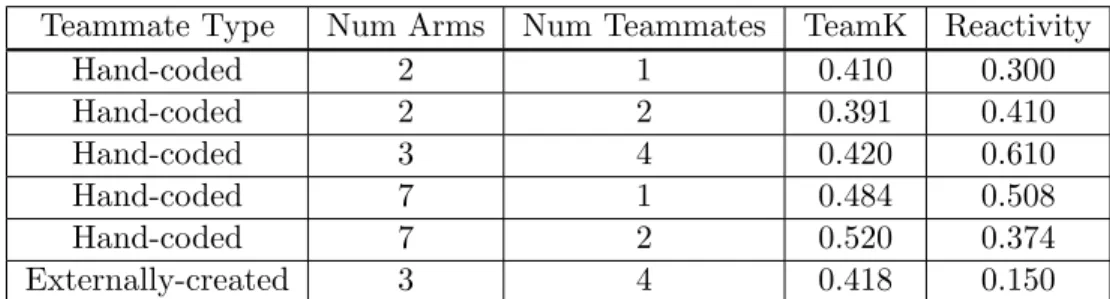
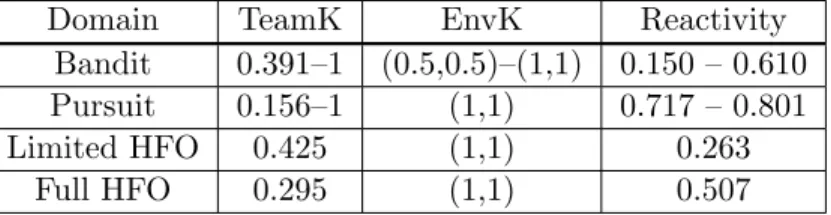
3.1 Example of play in the bandit domain. . . 49 3.2 TeamK and Reactivity for various settings in the bandit domain. . . 53 3.3 TeamK and Reactivity for various settings in the pursuit domain. . . 57 3.4 Overview of the dimensions of the 3 domains used in this thesis. . . 64 4.1 Overview of related ad hoc teamwork research. . . 79 6.1 Summary of the theoretical analysis of the bandit domain. . . 117 7.1 Overview of empirical analysis of PLASTIC. . . 128 7.2 Features used to predict a teammate’s actions in the pursuit domain. 139
List of Figures
1.1 Foci of agent based research . . . 4
2.1 (Repeat)Foci of agent based research . . . 18
2.2 Algorithm for evaluation ad hoc teamwork . . . 23
3.1 How an RL agent interacts with its environment . . . 35
3.2 The pursuit domain . . . 54
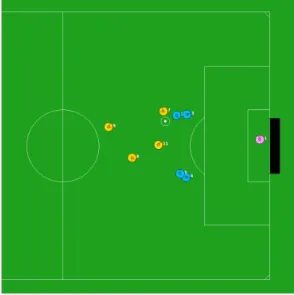
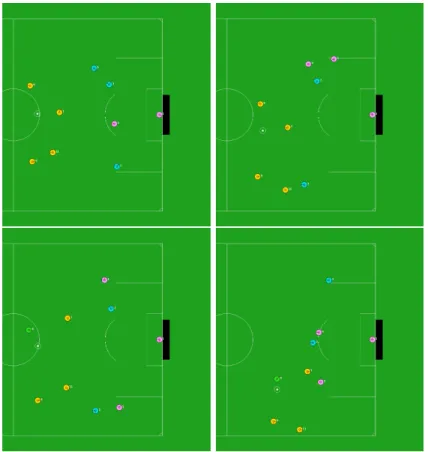
3.3 An overview of the HFO task in the simulated 2D RoboCup domain 59 3.4 Starting positions in the HFO task . . . 60
5.1 Overview of PLASTIC . . . 98
5.2 Overview of PLASTIC–Model . . . 101
5.3 Overview of PLASTIC–Policy . . . 110
7.1 Evaluations in the bandit domain with hand-coded teammates . . . 132
7.2 Evaluations in the bandit domain with externally-created teammates 135 7.3 Evaluations in the bandit domain with unknown arms . . . 136
7.4 Evaluations in the pursuit domain with known hand-coded teammates 142 7.5 Evaluations in the pursuit domain with unknown hand-coded team-mates . . . 144
7.6 Evaluations in the pursuit domain with externally-created teammates
using expert-provided knowledge . . . 147
7.7 Evaluations in the pursuit domain with externally-created teammates using learned models . . . 149
7.8 Out of set evaluations in the pursuit domain with externally-created teammates using learned models . . . 150
7.9 Evaluations of transfer learning in the pursuit domain . . . 153
7.10 Evaluations of TwoStageTransfer with various amounts of target data in the pursuit domain . . . 154
7.11 Features in the HFO domain . . . 160
7.12 Evaluations in the limited HFO task . . . 163
7.13 Beliefs of PLASTIC–Policy in the limited HFO task . . . 164
7.14 Evaluations in the full HFO task . . . 166
7.15 Beliefs of PLASTIC–Policy in the full HFO task . . . 166
Chapter 1
Introduction
Robots are becoming cheaper and more durable as manufacturing processes im-prove, and they are becoming useful for an increasing number of tasks as artificial intelligence improves. These improvements are leading to robots being deployed in more environments for longer periods of time, and we believe that this trend will only grow. As this robotic proliferation continues, it is expected that robots will encounter and interact with a growing variety of other types of robots. In many cases, these interacting robots may share a set of common goals, in which case it will be desirable for them to cooperate with each other. However, existing research into getting multiagent teams to accomplish shared goals assumes that all of these robots share common communication and coordination protocols, an assumption that becomes increasingly unlikely given the rapidly growing number of companies and laboratories designing robots. It is possible that some standards for coordina-tion or communicacoordina-tion will be created for all robots to support. We believe that given the speed of changes in artificial intelligence and robotics, if these standards are created, they will lag behind the state-of-the-art protocols and agents will need
to intelligently reason about their teammates in addition to the information that these protocols provide. Therefore, in order to effectively cooperate with these new teammates, it is desirable for these robots to observe and adapt to their teammates to accomplish their shared goals.
For example, after a disaster, it is helpful to use robots to search the site and rescue survivors. However, the robots may come from a variety of sources and may not be designed to cooperate with each other, such as in the response to the 2011 Tohoku earthquake and tsunami [69, 99, 100, 107]. If these robots are not pre-programmed to cooperate, they may not share information about which areas have been searched; or worse, they may unintentionally impede their teammates’ efforts to rescue survivors. Therefore, it is desirable for robots to be designed to observe their teammates and adapt to them, forming a cohesive team that quickly searches the area and rescues the survivors.
This idea epitomizes the spirit of ad hoc teamwork. In ad hoc teamwork settings, agents encounter a variety of teammates and try to cooperate in order to accomplish a shared goal. In ad hoc teamwork research, researchers focus on designing a single agent or subset of agents that can cooperate with a variety of teammates. The desire is for agents designed for ad hoc teamwork to quickly learn about these teammates and determine how they should act on this new team to achieve their shared goals. Agents that reason about ad hoc teamwork will be robust to changes in teammates in addition to changes in the environment.
In this thesis, the word “agent” refers to an entity that repeatedly senses its environment and takes actions that affect this environment, shown visually in Figure 1.1a. As a shorthand, the terms ad hoc team agent and ad hoc agent are used in this thesis to refer to an agent that reasons about ad hoc teamwork. The
environment includes the dynamics of the world the agent interacts with, as well as defining the observations received by the agent. We treat the other agents in the domain as teammates because they share a set of common goals; they are fully cooperative in the terminology of game theory.
Previous research has investigated multiagent teams and introduced a num-ber of algorithms for coordinating teams [41, 58, 118, 124]. This view of multiagent teams is shown in Figure 1.1b. However, these approaches require that all agents in the team have shared coordination and communication protocols, so these ap-proaches do not apply in all scenarios. Another approach is to treat other agents as part of the environment. This approach permits the agent to apply single agent learning algorithms to adapt to these teammates, as shown in Figure 1.1a. How-ever, this view may prevent the team from completing tasks that require explicit coordination, where performing only part of a coordinated action results in a poor performance for the team. In addition, explicitly reasoning about the dynamics of these other agents allows the ad hoc agent to factor the domain, significantly reducing the complexity of the environment.
Rather than adopting either of these approaches, this thesis focuses on creat-ing a screat-ingle agent or small subset of agents that cooperate with teammates comcreat-ing from a variety of sources without directly altering the behavior of these teammates, as shown in Figure 1.1c. This approach explicitly models that there are other intel-ligent agents operating in the domain. In addition, rather than focusing on a single task, these agents may face a variety of tasks.
This chapter presents the motivation and objectives for this thesis as well as an overview of the entire thesis. Given the preceding motivation for this thesis, we present the central research question in Section 1.1. Next, we present an overview
Agent
Environment
Action State Reward
(a) A view of a single agent interacting with its environment used by many rein-forcement learning algorithms.
Environment Joint Action State Reward Agent Agent Agent Team
(b) A standard view of a unified team in-teracting with the environment.
(c) The ad hoc teamwork setting in which an agent cooperates with an ad hoc team of agents to accomplish shared goals on a given environment where the teammates and the environment are each drawn from diverse sets at the beginning of an episode.
of the algorithm, PLASTIC, that we propose for solving this problem in Section 1.2. In Section 1.3, we explain the six contributions of this thesis. Finally, Section 1.4 previews the remaining chapters of this thesis and gives a roadmap to reading this thesis.
1.1
Research Question
In order to be responsive to different teammates and environments, a fully general ad hoc agent needs two general classes of capabilities: 1) the ability to learn about the environment and calculate the actions necessary to achieve its goal, and 2) the ability to reason about teamwork and learn about its teammates. Previous work in reinforcement learning has largely focused on how an agent should learn about the dynamics of the environment, e.g. [76, 123]. Therefore, this thesis leverages such past research about 1) and expand this work in the new direction of 2), reasoning about the team and social knowledge required for effective teamwork. To this end, this thesis identifies three classes of capabilities needed by ad hoc team agents:
1. Robustness to teammate variety. Ad hoc team agents should be able to
cooperate with a wide variety of teammates following unknown behaviors. To this end, ad hoc agents should learn about their teammates and adapt to their behaviors.
2. Robustness to diverse tasks. Ad hoc team agents should be able to
cooper-ate with the teammcooper-ates to accomplish an array of diverse tasks. An algorithm for ad hoc teamwork that is only applicable to a single task is insufficient for a fully general ad hoc team agent. To be robust, an ad hoc team agent should be able to adapt to new tasks, while additionally deciding when to take actions
to explore its teammates’ behaviors.
3. Fast adaptation. Ad hoc team agents should be adaptive without lengthy
observations of the current teammates or tasks; they should be able to quickly adapt to these new problems and perform effectively with few interactions. In real world settings, robots are unable to interact with their teammates in the given environment for extended periods of time before attempting their task. Therefore, ad hoc agents must be sample efficient, learning to cooperate in few interactions with their teammates. Ideally, ad hoc agents should also exploit any information they have learned about previous teammates and en-vironments to speed up the learning process. This means that ad hoc agents may not achieve optimal performance; instead they may need to compromise by quickly converging to well-performing but suboptimal behaviors.
With these three capabilities in mind, the key question that this thesis ad-dresses is:
How can an agent cooperate with teammates of uncertain types on a variety of tasks?
Fully answering this question is a long-term challenge beyond the scope of a single thesis. However, this thesis moves towards answering this question. Specifically, we introduce an algorithm, PLASTIC, that satisfies the three desired capabilities above. PLASTIC allows ad hoc agents to quickly adapt to a variety of unknown teammates, and our analysis shows that PLASTIC is effective on 3 very different domains, including a complex simulation of robot soccer.
1.2
Algorithm Overview
The primary algorithmic contribution of this thesis is the Planning and Learning to Adapt Swiftly to Teammates to Improve Cooperation (PLASTIC) algorithm to ad-dress the research question posed in the previous section. Rather than trying to “fit in” with its team by copying their behavior, PLASTIC employs learning algorithms that allow an ad hoc agent to improve over its teammates’ potentially subopti-mal behaviors. However, learning about each teammate as if it is completely new severely limits the speed that the ad hoc agent can adapt to its teammates. There-fore, PLASTIC speeds up this learning by reusing information it has learned about previous teammates. In addition, PLASTIC allows developers to provide expert knowledge about potential teammates in order to speed up adaptation. PLASTIC then tries to see which of the past teammates and expert-provided information best represents the new teammates that it encounters. This approach allows PLASTIC to quickly adapt to unknown teammates in a variety of domains. The full PLASTIC algorithm is introduced in full detail in Section 5.1.
This thesis presents two instantiations of the general PLASTIC algorithm: PLASTIC–Model and PLASTIC–Policy. When learning about previous teammates, PLASTIC–Model represents its knowledge as models that map current world states to its teammates’ actions, where one model is learned for each past teammate. Ex-pert knowledge is similarly represented by models of potential teammates’ behav-iors. When it encounters new teammates, PLASTIC–Model maintains its beliefs over which model best represents these new teammates. Using its belief distribu-tion over these models, PLASTIC–Model can plan the best acdistribu-tions to cooperate with its teammates. In this thesis, we use decision trees to learn models of past teammates [104], update the probabilities of models using the polynomial weights
algorithm [25], and plan using Upper Confidence bounds for Trees (UCT) [82]. We present the full PLASTIC–Model algorithm in Section 5.2.
When the ad hoc agent has a limited number observations of its new team-mates, it can also build new models of their behaviors while reusing information about past teammates. Specifically, we introduce a new transfer learning algorithm, TwoStageTransfer, that allows PLASTIC–Model to reuse information about many previous teammates to create a model of the new teammates, exploiting the fact that some teammates are more similar to the new teammates than others. TwoStage-Transferis completely specified in Section 5.2.4.
In complex domains, planning algorithms may run into problems due to inaccuracies in their models or due to limitations in computational power. There-fore, directly learning policies for cooperating with various teammates may be more effective. PLASTIC–Policy employs this approach, where knowledge about past teammates is represented as the policies that are used to cooperate with these teammates. Similar to PLASTIC–Model, one policy is learned for each past team-mate. In PLASTIC–Policy, experts can provide policies for cooperating with other teammates if they are available. Then, PLASTIC–Policy combines these policies, determines which policies enable it to best cooperate with the current teammates, and selects the actions specified by the most likely policy. In this thesis, we use fitted Q iteration (FQI) [44] to learn policies for past teammates. To update the probabilities of different teammate types, we build a nearest neighbor model of the teammates’ behaviors using the samples collected for FQI and update the probabil-ities of different teammate types using the polynomial weights algorithm [25]. We present the complete PLASTIC–Policy algorithm in Section 5.3.
1.3
Contributions
This thesis provides the following six major contributions to the field:
1. PLASTIC: As described above, this thesis introduces the general PLASTIC algorithm and its two instantiations: PLASTIC–Model and PLASTIC–Policy. These algorithms are the first generally applicable algorithms that permit ad hoc team agents to quickly adapt to a variety of unknown teammates in many domains. These algorithms combine knowledge learned from past teammates with any available expert knowledge to adapt to new teammates much more quickly than existing approaches. PLASTIC is presented in full detail in Chapter 5.
2. Theoretical Analysis: This thesis proves that PLASTIC–Model is computa-tionally tractable in a number of scenarios in the bandit domain. We show that the problem can be modeled as a POMDP and bound the complexity of learning the ε-policy in several versions of the domain that vary in the prior knowledge available to PLASTIC–Model. This theoretical analysis is presented in Chapter 6.
3. Reasoning about Communication: The majority of prior work in ad hoc team-work considers cases where communication is not available. However, as the connectivity of devices grows, so does the chances of ad hoc team agents being able to communicate some information with their teammates, though they may not know how these teammates will interpret these messages. Therefore, this thesis addresses this gap by considering a scenario in which communication is available, namely the bandit domain described in Section 3.2.1. Theoretical analysis of the bandit domain with communication are presented in Chapter 6,
and empirical analysis of it are given in Section 7.1.
4. TwoStageTransfer: This thesis introduces a new transfer learning algorithm, TwoStageTransfer. TwoStageTransfer can efficiently incorporate knowledge coming from many sources to the target setting, exploiting the knowledge that some sources are more similar to the target than others. TwoStageTrans-fer is a general transTwoStageTrans-fer learning algorithm, but we only apply it to ad hoc teamwork settings in this thesis. We empirically evaluate TwoStageTrans-fer for quickly learning models of new teammates given observations of past teammates. TwoStageTransfer is presented in full detail in Section 5.2.4, and empirical results of it are presented in Section 7.2.7.
5. Empirical Evaluation: This thesis empirically evaluates PLASTIC in 3 differ-ent domains, with varying amounts of knowledge about its teammates. This evaluation considers scenarios not covered in the theoretical analysis. Specif-ically, we focus on externally-created teammates, which are created by other developers without considering ad hoc teamwork. Notably, this evaluation also includes a complex ad hoc teamwork problem in the form of the half field offense task in the 2D simulated soccer domain. All empirical results are presented in Chapter 7.
6. Taxonomy of Ad Hoc Teamwork: This thesis identifies three dimensions that we believe are the most informative for analyzing ad hoc teamwork domains and teammates. We believe that domains with similar values along these dimensions will be tractable for similar algorithms, while domains with signif-icantly different values are more likely to be solved using different approaches. These dimensions are presented in full detail in Section 2.3. In that section,
we also discuss how these dimensions describe the three domains used in this thesis. In addition, we use these dimensions to analyze the related ad hoc team research in Section 4.4.4.
These contributions are described in detail throughout the remainder of this thesis.
1.4
Dissertation Overview
The remainder of this thesis is organized as follows.
Chapter 2: This chapter motivates and describes the problem studied in this
thesis, namely the problem of ad hoc teamwork. Then, the chapter presents the framework we use to evaluate ad hoc teamwork agents. Finally, the chapter specifies three dimensions of ad hoc teamwork problems that are useful for analyzing the similarity of problems as well as which algorithms apply to the problems. These dimensions serve as the basis for Contribution 6.
Chapter 3: In this chapter, we present the background information required to
understand the remainder of the thesis. Specifically, we present an overview of Markov Decision Processes (MDPs), Partially Observable Markov Decision Processes (POMDPs), and the algorithms used to solve them in addition to an overview of transfer learning. Then, the chapter describes the 3 domains used to evaluate PLASTIC: the multi-armed bandit domain, the pursuit domain, and the half field offense task in the simulated 2D robot soccer domain. In addition, the chapter discusses the teammates used in these three domains, including theexternally-created teammates which were created by other developers. The bandit domain is used to investigate communication (Contribution 3) and in the theoretical analysis for Contribution 2. All three domains are used in the
Chapter 4: This chapter situates PLASTIC in the literature. We begin by dis-cussing past work on multiagent coordination, where developers can control the entire team instead of a single agent on the team. Then, we look at research on opponent modeling, where agents learn to adapt to their opponents instead of teammates. We follow this by an overview of some of the most relevant research in each domain used in our evaluations. Finally, we discuss the current state of the art research into ad hoc teamwork and describe how these papers relate to the work presented in this thesis. We use the three dimensions of ad hoc teamwork to analyze the related literature as part of Contribution 6.
Chapter 5: In this chapter, we specify the general PLASTIC algorithm and the two
instantiations of it used in this thesis: PLASTIC–Model and PLASTIC–Policy. PLASTIC enables an ad hoc agent to quickly adapt to unknown teammates on several domains. To accomplish this task, PLASTIC learns about previous teammates and combines this knowledge with any expert knowledge the devel-oper can encode about potential teammates. When encountering new team-mates, PLASTIC determines which of the past teammates are most similar to the current ones and reuses the information learned about them. Differ-ent learning and action selection algorithms can be used depending on the do-mains, but the general architecture remains the same. PLASTIC–Model adopts a model-based approach that uses planning to discover effective actions, while PLASTIC–Policy uses a policy-based approach and selects between these poli-cies. This chapter also specifies our new transfer learning algorithm, TwoStage-Transfer, that can aid PLASTIC in adapting to new teammates by combining information coming from many past teammates, some of which are more sim-ilar to the new teammates than others. This chapter presents PLASTIC for
Contribution 1 in addition to TwoStageTransfer for Contribution 4.
Chapter 6: This chapter presents a theoretical analysis of PLASTIC–Model.
Specifically, it analyzes the complexity of applying PLASTIC–Model to the bandit domain. We model the bandit problem as a POMDP and investigate the computational tractability of calculating the ε-optimal behavior in the re-sulting POMDP. We consider several variations of the bandit domain, varying in the knowledge the ad hoc agent has about its teammates and its environ-ment. The theoretical analysis in this chapter is Contribution 2 as well as part of Contribution 3.
Chapter 7: We present the empirical analyses of PLASTIC in this chapter. These
analyses cover the 3 domains described in Chapter 3: the bandit, pursuit, and half field offense domains. Our tests evaluate both PLASTIC–Model and PLASTIC–Policy on a range of tasks, varying the prior knowledge of the ad hoc agent as well as the teammates it encounters. The results of these tests show the effectiveness of PLASTIC for enabling ad hoc team agents to quickly adapt to a variety of unknown teammates. This chapter presents the results that form Contribution 5. In addition, this chapter looks at the empirical usefulness of communication in the bandit domain as part of Contribution 3.
Chapter 8: This chapter summarizes the contributions of this thesis. In addition,
it identifies areas for future research into ad hoc teamwork.
Appendix A: This appendix presents the full behaviors of the hand-coded
preda-tors used in the pursuit domain described in Section 3.2.2. The results using these predators as teammates are presented in Section 7.2.
While this thesis is written to be read from start to finish, some sections can be omitted if only interested in a specific aspect of the work. Specifically, it is
possible to isolate the theoretical analyses from the empirical ones and to understand the related work without reading most of the thesis. To understand the theoretical analyses in Chapter 6, it is useful to understand the PLASTIC algorithm presented in Chapter 5 as well as the problem definition in Chapter 2 as well as the discussion of POMDPs in Section 3.1.5 and the bandit problem described in Section 3.2.1. The empirical analyses in Chapter 7 depend on the reader understanding the PLASTIC algorithm from Chapter 5 in addition to the problem definition (Chapter 2) and the background (Chapter 3). The discussion of related work in Chapter 4 is largely self-contained, but it does help to understand the problem definition and dimensions that describe ad hoc teamwork presented in Chapter 2.
Chapter 2
Problem Description
This chapter describes the problem setting investigated in this thesis. Rather than considering unified teams of agents designed by a single designer, we consider con-trolling a single agent on a newly created team. The following sections describe the problem in more depth as well as the evaluation framework used to measure performance on this problem. In addition, this chapter investigates an approach for describing the different dimensions of ad hoc team problems.
2.1
Ad Hoc Teamwork
Robots are becoming cheaper and more durable and are therefore being deployed in more environments for longer periods of time. As robots continue to prolifer-ate in this way, many of them will encounter and interact with a variety of other kinds of robots. In many cases, these interacting robots will share a set of common goals, in which case it will be desirable for them to cooperate with each other. In order to effectively perform in new environments and with changing teammates,
1
they should observe their teammates and adapt to achieve their shared goals. For example, after a disaster, it is helpful to use robots to search the site and rescue survivors. However, the robots may come from a variety of sources and may not be designed to cooperate with each other, such as in the response to the 2011 Tohoku earthquake and tsunami [69, 99, 100, 107]. These robots were used to investigate the Fukushima Daiichi Nuclear Power Station, clear a fishing port, and find victims trapped underwater. These robots were remotely controlled and therefore derived any cooperation from their human operators. Robots that operate autonomously will have to be designed for cooperation as they will not have human operators providing cooperation. If these autonomous robots are not pre-programmed to co-operate, they may not share information about which areas have been searched; or worse, they may unintentionally impede their teammates’ efforts to rescue survivors. Therefore, in the future, it is desirable for robots to be designed to observe their teammates and adapt to them, forming a cohesive team that quickly searches the area and rescues the survivors.
This idea epitomizes the spirit of ad hoc teamwork. In ad hoc teamwork settings, agents encounter a variety of teammates and try to accomplish a shared goal. Ideally, agents designed for ad hoc teamwork try to quickly learn about their teammates and figure out how they should try to fit into the team. Agents that reason about ad hoc teamwork will be robust to changes in teammates and the environment. They must be adaptive and resourceful, learning how to accomplish the team’s goals.
In this thesis, the word “agent” refers to an entity that repeatedly senses its environment and takes actions that affect this environment. Robots are examples of agents, as are software agents that bid for advertisements. As a shorthand, the
terms ad hoc team agent and ad hoc agent are used in this thesis to refer to an agent that reasons about ad hoc teamwork. The environment includes the dynamics of the world the agent interacts with, as well as defining the observations received by the agent. In addition, the ad hoc agent will have to interact with teammate agents that are attempting to accomplish the same goals as the ad hoc agent. This thesis considers ad hoc agents that explicitly reason about the behaviors of their teammates separately from the environment because this factoring significantly reduces the complexity of the learning problem. Previous work has largely assumed that all agents in the domain will act as a unified team and are designed to work with their specific teammates [41, 58, 118, 124]. On the other hand, this thesis will focus on creating a single agent that cooperates with teammates coming from a variety of sources without directly altering the behavior of these teammates. This agent will need to adapt to these different teammates and learn to cooperate with them on the fly.
The differences of this thesis from prior work are presented visually in Fig-ure 2.1. One existing area of research into how agents should behave is reinforcement learning (RL). Generally, RL problems revolve around a single agent learning by in-teracting with its environment. In RL problems, agents receive sparse feedback about the quality of sequences of actions. Generally, RL algorithms model other agents as part of the environment and try to learn the best policy for the single agent given this environment. In addition, RL algorithms usually learn from scratch in each new environment, ignoring information coming from previous environments. However, there is a growing body of work on applying transfer learning to RL to allow agents to reuse prior experiences [126]. Figure 2.1a shows the standard RL view of an agent interacting with its environment. Figure 2.1b represents a
com-Agent
Environment Action State Reward
(a) A view of a single agent interacting with its environment used by many rein-forcement learning algorithms.
Environment Joint Action State Reward Agent Agent Agent Team
(b) A standard view of a unified team in-teracting with the environment.
(c) The ad hoc teamwork setting in which an agent cooperates with an ad hoc team of agents to accomplish shared goals in a given environment where the teammates and the environment are each drawn from diverse sets at the beginning of an episode.
mon multiagent view of a unified team interacting with the environment where the agents model their teammates as being separate from the environment. In this case, the team is designed before being deployed to cooperate with these specific agents to interact with a fixed environment. However, these agents rely on knowing their teammates and usually require an explicit communication and/or coordination pro-tocol to be shared among the whole team [85, 135]. On the other hand, this thesis will focus on ad hoc teams drawn from a set of possible teammates, where the team tackles a variety of possible environments as shown in Figure 2.1c. In this case, the teammates are not programmed to cooperate with this specific ad hoc agent, and they must be treated as fixed and given. Instead, this research focuses on enabling the ad hoc agent to cooperate with a variety of teammates in a range of possible environments.
In order to be responsive to different teammates and environments, a fully general ad hoc agent needs two general classes of capabilities: 1) the ability to learn how to act in an environment to maximize reward, and 2) the ability to reason about teamwork and learn about its teammates. Previous work in reinforcement learning has largely focused on how an agent should learn about the dynamics of the environment [76, 123]. Therefore, this thesis will leverage such past research about 1) and expand this work in the new direction of 2), reasoning about the team and social knowledge required for effective teamwork.
Ad hoc teamwork problems can be encountered in a variety of real world scenarios. As described in the example above, in search and rescue scenarios, robots from different developers need to cooperate quickly. Furthermore, as more robots enter society, their interactions will increase. In the near future, personal assistant robots may need to interact with other service robots to accomplish their tasks. In
addition, the introduction of autonomous cars opens up an interesting area for ad hoc teamwork: cooperating with human drivers. Cars on the road have the shared goal of reaching their destinations quickly and safely, and they need to cooperate with the other cars in order to accomplish these goals. These agents have very limited observations of the other cars, and therefore must adapt quickly.
Another area where ad hoc teamwork comes into play is when robots need to accomplish tasks in workplace settings with human teammates. These settings include manufacturing jobs, where new robots are now able to work more closely with humans, and using robots in warehouses for moving products. The robots are likely to interact with a variety of humans, and therefore need to adapt quickly to these new teammates. While the robots and humans share a common goal, communication between them is limited; humans cannot quickly and fully specify their intentions to the level used in existing multiagent coordination algorithms. Therefore, it is desirable for the robots to reason about ad hoc teamwork.
Another interesting application of ad hoc teamwork is in the area of games. Game-playing agents interact with humans and need to adapt to them with only limited observations. These interactions are incredibly complex, and existing ap-proaches rely heavily on heuristic apap-proaches with only limited adaptations [98, 113, 32]. Reasoning about ad hoc teamwork would allow virtual agents in video games to adapt to their human teammates.
2.2
Evaluation Framework
In an ad hoc team, agents need to be able to cooperate with a variety of previously unseen teammates. Rather than developing protocols for coordinating an entire team, ad hoc team research focuses on developing agents that cooperate with
team-mates in the absence of such explicit protocols. Therefore, we consider a single agent cooperating with teammates that may or may not adapt to its behavior. In this scenario, we can only develop algorithms for the ad hoc team agent, without having any direct control over the other teammates.
However, directly measuring teamwork is difficult. In many cases, the only easily measurable aspect is the overall performance of the team, which makes it difficult to assign credit to each agent. By placing an agent on a variety of teams and measuring those teams’ performances, we can estimate how good the agent is at teamwork.
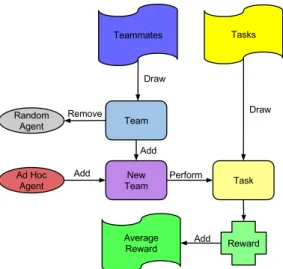
Therefore, we introduce an algorithm that evaluates an ad hoc team agent while considering the teammates and domains it may encounter. This framework is specified in Algorithm 1. According to this framework, the performance of the ad hoc team agent a depends on the distribution of problem domains D and the distribution of possible teammates A that it will cooperate with. For the team
B cooperating to execute the task d, s(B, d) is a scalar score representing their effectiveness, where higher scores indicate better performance. The algorithm takes a sampling approach to average the agent’s performance across a range of possible tasks and teammates to capture the idea that a good ad hoc team player ought to be robust to a wide variety of teamwork scenarios. We use smin as a minimum acceptable reward for the team to be evaluated, because the ad hoc team agent may be unable to accomplish a task if its teammates are too ineffective, regardless of its own abilities. It is mainly used to reduce the number of samples required to evaluate the ad hoc agents and reduces the noise in the comparisons. Metrics other than the sum of the rewards can be used depending on the domain, such as the worst-case performance.
Algorithm 1 Ad hoc agent evaluation
1: function Evaluate:
inputs:
a . the ad hoc agent
A . the set of possible teammate agents
D . the set of possible domains
outputs: r
n . the average performance (reward)
params:
smin . the minimal acceptable performance of a team
n .the number of iterations
2: Initialize: r = 0
3: for i= 1 to ndo
4: Sample a taskdfrom D
5: Randomly draw a subset of agentsB, fromAsuch thatE[s(B, d)]≥smin
6: Randomly select one agentb∈B
7: Create the new teamC ={a} ∪B\{b} 8: r=r+s(C, d)
9: return nr
10: If Evaluate(a0, A, D) >Evaluate(a1, A, D) and the difference is significant, we
can conclude that a0 is a better ad hoc team agent than a1 in domain d over
the set of possible teammates A.
2.3
Dimensions of Ad Hoc Team Problems
Section 2.2 specified the framework for evaluating ad hoc team agents, but this evaluation depends on the specific domain and teammates that the ad hoc agent may encounter. This section identifies three dimensions of ad hoc teamwork set-tings that can be used to describe these domains and teammates. We hypothesize that domains with similar values along these dimensions can be tackled by similar algorithms, while domains with very different values will need different algorithms for good performance. For this thesis, we use these dimensions as a way as classify-ing problems, but a promisclassify-ing area for future work is to apply these dimensions to
Figure 2.2: A visual representation of the evaluation algorithm given in Algorithm 1.
predict which algorithms will be effective on different problems.
There are many possible ways that ad hoc team domains can vary, such as the size of the task’s state space and the stochasticity of the domain. But, for differentiating among the algorithms in the existing literature, we find the following three to be the most informative.
1. Team Knowledge: Does the ad hoc agent know what its teammates’ actions
will be for a given state, before interacting with them?
2. Environment Knowledge: Does the ad hoc agent know the transition and
reward distribution given a joint action and state before interacting with the environment?
3. Reactivity of teammates: How much does the ad hoc agent’s actions affect
those of its teammates?
an ad hoc agent has good knowledge, it can plan without considering exploration, but when it has incomplete knowledge, it must reason about the cost and benefits of exploration. The exploration-exploitation problem has been studied previously, but adding in the need to explore the teammates’ behaviors and the ability to affect them considerably alters this tradeoff. Sections 2.3.1–2.3.3 provide further details about each of these dimensions, how they are measured, and why they are important for ad hoc teamwork.
To better illustrate the dimensions, we introduce a simple domain to evaluate across each of the dimensions. The domain is described here, and it will be revisited in the discussion of each dimension.
MatchActions: This domain is a typical coordination game with two agents,
each of which has two actions. If they select the same action, both receive a reward of ri, where ri is randomly selected from {0.5,0.75,1.0} for i ∈ 1,2, but fixed for the episode. On the other hand, if both of the agents select different actions, they receive a reward of 0. In addition, both agents can observe their teammates’ previous actions. The ad hoc agent knows that its teammate is following one of two behaviors:
• FirstAction: the teammate always chooses the first action
• BestResponse: the teammate chooses the same action as the ad hoc agent
did previously
Therefore, the state can be represented as the previous action taken by the ad hoc agent, called s0 if the ad hoc agent chose the first action, and s1 otherwise.
2.3.1 Team Knowledge
The ad hoc agent’s knowledge about its teammates’ behaviors gives insight into the difficulty of planning in the domain. The agent’s knowledge can range from
knowing the complete behaviors of its teammates to knowing nothing about them. Settings with partial information are especially relevant, because in many real world problems, the exact behavior of a teammate may not be known, but some reasonable guidelines of their behaviors exist. For example, when playing soccer, one can usually assume that a teammate will not intentionally pass to the other team or shoot at the wrong goal. If the behaviors are completely known, the agent can reason fully about the team’s actions, while if the behaviors are unknown, the agent must learn about them and adapt to find a good behavior.
To estimate the ad hoc agent’s knowledge about its teammates’ behaviors, we compare the actions the ad hoc agent expects them to take and the ground truth of what actions they take. Specifically, we compare the expected distribution of teammate actions to the true distribution that the teammates follow. To compute the difference between the distributions, we use the Jensen-Shannon divergence mea-sure, which was chosen because it is a smoothed, symmetric variant of the popular Kullback-Leibler divergence measure. Specifically, we denote the Jensen-Shannon divergence by JS where
JS(P, Q) = 1
2(KL(P, M) + KL(Q, M)) and M = 12(P+Q). The Kullback-Leibler divergence is given by
KL(P, Q) =X
i
P(i) logP(i)
Qi
When the ad hoc agent has no information about a teammate’s action, we assume that it uses the uniform distribution to represent its actions. Therefore, we
define the knowledge measure as K(T, P) = 1 if JS(T, P) = 0 1−JS(T, P) JS(T, U) if JS(T, P)<JS(T, U) − JS(P, U) JS(U,Point) otherwise (2.1)
whereT is the true distribution,Pis the predicted distribution,U is the uniform dis-tribution, and Point is a distribution with all weight on one point (e.g. [1,0,0, . . .]). By this definition, K(T, T) = 1, so the knowledge is complete if the ad hoc agent knows the true distribution. K(T, U) = 0, representing when the ad hoc agent has no knowledge and relies on the uniform distribution. Finally, if the predicted dis-tribution is less accurate than the uniform disdis-tribution, then K(T, P) is negative, with a minimum value of -1. This measure captures the range [0,1] smoothly, but can still be used for the range [-1,0].1 However, we generally expect the prediction to be a higher entropy distribution than the true distribution as the ad hoc agent ought to correctly model its uncertainty in its teammates’ behaviors rather than being confident and wrong, which keeps the measure in the range [0,1].
We define the ad hoc agent’s knowledge about its teammates’ behaviors as the average over the teammates and world states, specifically
TeamK = n X s=1 k X t=1 K(TrueActiont(s),PredActiont(s)) nk
where 1≤s≤nis the state, 1≤t≤kspecifies a teammate, TrueActiont(s) is the
ground truth action distribution for teammate t for state s, and PredActiont(s) is
1
One slight anomaly of this measure is that when T is the uniform distribution (e.g. [.5,.5]), K is either 1 when P is exactly correct at [.5 .5] or negative. For all other values of T, K smoothly spans the range [-1,1].
the action distribution that the ad hoc agent predicts teammatetto select for state
s. Thus, if the ad hoc agent has better information about its teammates’ behaviors, the distance between the distributions will be smaller and TeamK will be higher.
Let us now calculate the TeamK for the MatchActions domain. The ad hoc agent has uniform beliefs over its teammate following either the FirstAction or BestResponse behaviors. However, the teammate is actually following the Be-stResponse behavior. With these beliefs, in s0, the ad hoc agent expects that its
teammate will always chose a0, so PredActions0 = [1,0]. In s1, the ad hoc agent thinks that the teammate will choosea0with probability 0.5 anda1 with probability
0.5, while it actually chooses a1 with probability 1. Thus,
TeamK = K([1,0],[1,0]) +K([0,1],[ 1 2, 1 2]) 2 = 0 + 1 2 = 0.5
This value indicates that the ad hoc agent is somewhat knowledgeable about its teammate’s actions as it predicts its teammate’s actions half the time better than random guessing.
2.3.2 Environmental Knowledge
Another informative dimension is how much knowledge the ad hoc agent has about the effects of a joint action given a state, for example the transition and reward functions. If the ad hoc agent has complete knowledge about the environment, it can plan about what actions it should select more simply than if it must also consider unknown effects of actions. However, if it has incomplete knowledge, it must explore its actions and face the standard problem of balancing exploring the environment versus exploiting its current knowledge.
knowledge about the environment’s transitions as TransK = 1 nm n X s=1 m X j=1 K(TrueTrans(s, j),PredTrans(s, j))
where 1 ≤ s ≤ n is the state, 1 ≤ j ≤ m is a joint action, K is taken from Equation (2.1), TrueTrans(s, j) is the ground truth transition distribution from statesgiven joint actionj, and PredTrans is the ad hoc agent’s expected transition distribution. If the agent has no information about the transitions, we assume that PredTrans(s, j) is the uniform distribution. Intuitively, if the ad hoc agent knows more about the transition function, then the distance between TrueTrans and PredTrans will be smaller and as a result TransK will be higher. We define the agent’s knowledge about the environmental rewards similarly
RewardK = 1 nm n X s=1 m X j=1 K(TrueReward(s, j),PredReward(s, j))
We define the environmental knowledge as a 2-dimensional value given by EnvK = (TransK,RewardK).
Revisiting the MatchActions domain, the ad hoc agent knows the true transi-tion functransi-tion, as it only depends on the ad hoc agent’s previous actransi-tion, so TransK = 1. However, it only knows that the payoff for each action is uniformly drawn from
{0.5, 0.75, 1.0} and the reward is 0 if the agents’ actions do not match. There are 8 possible cases to count over, coming from 2 states, 2 actions for the ad hoc agent, and 2 for its teammate, but the cases fall into 2 sets based on whether the actions match, each set covering 4 cases. In addition, it does not matter which value each matched action actually takes, so we can simplify the calculation. If the agents take the different actions, the reward is correctly known to be 0. Note that there are four
reward values possible: {0, 0.5, 0.75, 1.0}. Therefore, the knowledge in this case is
K([1,0,0,0],[1,0,0,0]) = 1. On the other hand, if they take the same actions, the ad hoc agent is unsure which of the three rewards {0.5,0.75,1.0} it will receive, so the knowledge in this case isK([0,1,0,0],[0,13,13,13]) = 0.164. This leads to
RewardK = 4∗K([1,0,0,0],[1,0,0,0]) + 4∗K([0,1,0,0],[0, 1 3, 1 3, 1 3]) 8 = 4∗1 + 4∗0.164 8 = 0.582
Thus, EnvK = (1,0.582). As the agent observes these payoffs, it can refine its knowl-edge, but we are evaluating these properties prior to the ad hoc agent interacting with its environment.
2.3.3 Teammate Reactivity
The optimal behavior for the ad hoc agent also depends on how much its teammates react to its actions. If its teammates’ actions do not depend on the ad hoc agent at all, the ad hoc agent can simply choose its actions to maximize the team reward, as if it were a single agent problem. Considering the actions of its teammates separately from that of the environment may still help computation by factoring the domain. However, if the teammates’ actions depend strongly on the ad hoc agent’s actions, the ad hoc agent’s reasoning should consider what its teammates’ reactions will be. If the ad hoc agent is modeling its teammates and its teammates are modeling the ad hoc agent, the problem can become recursive, as is directly addressed by Vidal and Durfee’s Recursive Modeling Method [130].
We measure the distance between the resulting distributions of the teammate joint actions, using the pairwise Jensen-Shannon divergence measures. However, it is desirable for the distance to be 1 when the distributions have no overlap, so we use a normalizing constant of log 2. Thus, we define the reactivity of a domain in state
sas Reactivity(s) = 1 m(m−1) log 2 m X a=1 m X a0=1 JS(T(s, a), T(s, a0))
where JS is the Jensen-Shannon divergence measure, 1 ≤ a, a0 ≤ m is the actions available to the ad hoc agent, andT(s, a) is the distribution of the teammates’ joint actions given the state s and the ad hoc agent’s action, a. We use m−1 in the denominator because we exclude the case where a = a0; in the numerator, the JS measure will be 0 in this case. For the overall reactivity of the domain, we average over the states, resulting in Reactivity = 1nPn
s=1Reactivity(s). It is possible to
consider how an action affects the teammates’ actions further in the future, but we restrict our focus to one step reactivity for this thesis. Note that all of the sums in this formulation can be converted to integrals for continuous states or actions. This formulation is similar to the empowerment measure used by Jung et al. [74], but we consider the ad hoc agent’s ability to change the actions of its teammates rather than the environment state.
Let us once again explore this dimension in the context of the MatchAc-tions domain. Although the ad hoc agent is unsure of its teammate’s behavior, the teammate is truly playing the BestResponse behavior. Thus, its actions are entirely dependent on the ad hoc agent’s actions, so Reactivity = 1. If instead the teammate played BestResponse with probability 109 and FirstAction with probability 101, then
we would get Reactivity = JS([1,0],[ 1 10, 9 10]) + JS([ 1 10, 9 10],[1,0]) 2 log 2 = 0.758
Therefore, we can conclude that the agent would still be very reactive, though not as reactive as the BestResponse agent.
2.3.4 Applying the Dimensions
In theory, calculating the dimensions over every possible state is a promising ap-proach. However, as the size of the state space grows, this approach rapidly be-comes computationally ineffective. Therefore, it is desirable to approximate the values along each dimension. Specifically, we approximate these values by randomly sampling states and teammates and summing over these samples to calculate ap-proximate values for each of the dimensions. In addition, in continuous state spaces, the summations in the dimension definitions become integrals in the continuous case, but we continue to sample states in these scenarios. Furthermore, the distributions become continuous, but the JS measure can operate over continuous distributions. Specifically, we approximate the JS measure using Monte Carlo sampling in this the-sis. The domains used in this thesis are described in Section 3.2, where we discuss the values of each domain along these dimensions.
2.4
Chapter Summary
This chapter introduces the type of situations this thesis focuses on: ad hoc team
problems. In ad hoc teams, agents must adapt to new and unknown teammates without prior coordination, possibly without any explicit communication channels.
In addition, this chapter introduces the evaluation framework used to evaluate ad hoc agents. This evaluation framework relies on sampling teams and tasks and then replacing an agent on the team with the ad hoc agent. The resulting team performs the task and receives a reward based on its performance, which is combined with results with other teams and tasks. Finally, this chapter describes 3 dimensions for categorizing ad hoc team problems that indicate which approaches are expected to be effective. These dimensions are: 1) team knowledge, 2) environment knowledge, and 3) team reactivity. This chapter provides the framework for how the rest of the thesis investigates ad hoc teamwork scenarios. The next chapter will provide an introduction to the algorithms that this thesis builds upon as well as a description of the domains used to evaluate the proposed algorithm.
Chapter 3
Background
While the previous chapter describes the general problem investigated in this thesis, this chapter describes the mathematical model used to analyze this problem. In addition, this chapter presents the existing algorithms that our approach builds upon. Then, the chapter grounds the general ad hoc teamwork problem in a number of domains that the remainder of the thesis uses to evaluate the proposed approach. Using the dimensions described in Section 2.3, we can analyze these domains as well as the teammates that the ad hoc agent may encounter. Informally, we find that similar algorithms are effective on problems with similar values, but we do not use these values for further algorithm design or selection in this thesis.
3.1
Background
This section defines the models, Markov Decision Processes (MDPs) and Partially Observable Markov Decision Processes (POMDPs) we use as the mathematical frameworks for modeling ad hoc team problems. Then, this section presents several existing algorithms used to learn how to act in MDPs. This section concludes with
a discussion of transfer learning algorithms, which can be used to efficiently learn models of the teammates’ behaviors.
3.1.1 Markov Decision Process
In order to plan and learn in various ad hoc teamwork scenarios, it is helpful to pick a way to model the problem. Agents that need to cooperate in ad hoc teams need to handle sequential decision making problems; therefore, we choose to model these problems as a Markov Decision Process. The Markov Decision Process (MDP) is a standard formalism in reinforcement learning [123], generally used to describe an agent interacting with its environment. A summary of this interaction is given in Figure 3.1. An MDP is 4-tuple (S, A, P, R), where S is a set of states, A is a set of actions,P(s0|s, a) is the probability of transitioning from state stos0 when after taking action a, andR(s, a) is a scalar reward given to the agent for taking action
a in state s. In the pursuit domain, s∈ S corresponds to the current positions of every agent anda∈ A is the action that the ad hoc agent chooses (i.e. left, right, up, down, or staying still). In this framework, a policy π is a mapping from states to actions, which defines an agent’s behavior for every state. The agent’s goal is to find the policy that maximizes its long term expected rewards. The long term expected value from taking actionafrom statesis the value of the state-action and is denoted Q(s, a). For every state-action pair, Q∗(s, a) represents the maximum long term reward that can be obtained from (s, a) and is defined by the Bellman equation Q∗(s, a) =R(s, a) +γX s0 P(s0|s, a) max a0 Q ∗(s0, a0)
where 0 < γ < 1 is the discount factor representing how much more immediate rewards are worth compared to delayed rewards. The optimal policy π∗ can then
be derived by choosing the action a that maximizes Q∗(s, a) for every s∈S. The goal of most reinforcement learning algorithms is to find this optimal policy.
Agent
Environment
Action State Reward
Figure 3.1: A single agent interacting with the environment in reinforcement learning
3.1.2 Value Iteration
Once we model a problem as an MDP, it becomes clear what the agent’s objective is: to maximize long term expected reward. In our setting this translates into the ad hoc agent optimally cooperating with its teammates to accomplish their shared goals. One way to calculate the optimal policy is by using Value Iteration (VI) [123]. VI requires a complete model of the environment, specifically the full transition and reward functions. Given these models, VI can calculate the optimal value function
Q∗(s, a) and therefore the optimal policy π∗. Value iteration relies on dynamic programming to solve for the optimal state-action values for all state-action pairs. VI initializes the state-action values arbitrarily, and then improves these estimates using an update version of the Bellman optimality equation given in Equation 3.1.1. These updates are repeated iteratively until convergence, and the final calculated state-action values are guaranteed to be optimal.
While VI provably converges to the optimal policy, this convergence may take a substantial amount of time. VI has difficulties in scaling to large domains as it requires visiting each state-action over many iterations. In ad hoc teamwork
scenarios, this problem is especially costly as the number of agents greatly increases the state space. In many problems, the team’s state space becomes exponential in the size of the domain, with a power proportional to the number of agents, (# positions)(# agents). Given the symmetries of a specific problem, it is sometimes possible to reduce the number of possible states, but the scaling is still poor. For example, in initial tests into ad hoc teamwork in the pursuit domain (described in Section 3.2.2), VI on a 5x5 world took approximately 12 hours on the University of Texas Mastodon computing cluster. In a 5x5 world, there are 255 ≈ 1e7 states to consider ignoring symmetries, given that there are 5 agents moving around the 25 world positions. Scaling up to a larger problem of a 20x20 world, there are 4005 ≈1e13 states of the entire team. Thus, there are more than a million times more states than the 5x5 world, leading to this problem to be computationally infeasible. Due to the exponential blowup of the size of the state space, many ad hoc teamwork problems are not suitable for VI, even if the teammates’ behaviors are fully known and the problem can be described as an MDP.
3.1.3 Monte Carlo Tree Search
Value Iteration is one approach for solving MDPs, and it would allow an ad hoc agent to optimally cooperate with its teammates if were it to have a complete model of its teammates and the environment. However, VI is often infeasible to run in a reasonable time and requires a complex model. Rather than calculating the exact optimal value of every state-action, it is much more computationally tractable to instead learn an approximately optimal value for relevant state-actions. When the state space is large and only small sections of it are relevant to the agent, it can be advantageous to use a sample-based approach to approximating the values of
actions, such as Monte Carlo Tree Search (MCTS). Specifically, the MCTS algorithm called Upper Confidence bounds for Trees (UCT) [82] is used as a starting point for creating the primary planning algorithm used in this thesis.
MCTS does not require a complete model of the environment. Rather than knowing the full probability distribution of next states and rewards resulting from the transition and reward functions, MCTS only needs a model that allows sampling these next states and rewards. Furthermore, rather than treating all of the state-actions as equally likely, UCT focuses on only calculating the values for relevant state-actions. UCT does so by performing a number of playouts at each step, starting at the current state and sampling actions and the environment until the end of the episode. It then uses these playouts to estimate the values of the sampled state-action pairs. Also, it maintains a count of its visits to various state actions, and estimates the upper confidence bound of the values to balance exploration and exploitation. When selecting actions, UCT greedily chooses the action with the highest upper confidence bound. UCT has been shown to be effective on domains with a high branching factor, such as Go [50] and large POMDPs [111], so it should be able to handle the branching factor caused by the number of agents.
In this thesis, UCT is modified to use eligibility traces and remove the depth index to help speed up learning. The pseudocode of the algorithm can be seen in Algorithm 2, with s being the current state. Similar modifications were made by Silver et al., with good success in Go [112]. In addition, work by Hester and Stone [64] show good results in a number of other reinforcement learning domains.
Algorithm 2 The modified version of UCT used in this thesis
1: function UCTSelect:
inputs:
s .the current state
outputs:
a .action selected by UCT
params:
γ . discount factor, parameter of the MDP
NumPlayouts . number of Monte Carlo playouts to perform
c . weight given to the confidence bound
λ .eligibility trace parameter - affects amount of backup simulateAction(s, a) . an environment model that samples next states
2: for i= 1 to NumPlayoutsdo
3: Search(s)
4: return a= argmaxa Q(s, a)
5: function Search(s):
6: a= bestAction(s)
7: while sis not terminaldo
8: (s0, r) = simulateAction(s, a)
9: a0= bestAction(s0)
10: e(s, a) = 1
.Update the Q-values
11: δ=r+γQ(s0, a0)−Q(s, a) 12: for alls∗, a∗ do 13: Q(s∗, a∗) =Q(s∗, a∗) +e(s∗, a∗)∗ δ visits(s∗,a∗) 14: e(s∗, a∗) =λe(s∗, a∗) 15: s=s0;a=a0; 16: function bestAction(s): 17: return argmaxaQ(s, a) +c s ln visits(s) visits(s, a)