Making Data Storage Efficient in the Era of Cloud Computing Yang Tang
Submitted in partial fulfillment of the requirements for the degree of
Doctor of Philosophy
in the Graduate School of Arts and Sciences COLUMBIA UNIVERSITY
© 2020 Yang Tang All Rights Reserved
ABSTRACT
Making Data Storage Efficient in the Era of Cloud Computing Yang Tang
We enter the era of cloud computing in the last decade, as many paradigm shifts are happening on how people write and deploy applications. Despite the advancement of cloud computing, data storage abstractions have not evolved much, causing inefficiencies in performance, cost, and security.
This dissertation proposes a novel approach to make data storage efficient in the era of cloud computing by building new storage abstractions and systems that bridge the gap between cloud computing and data storage and simplify development. We build four systems to address four data inefficiencies in cloud computing.
The first system, Grandet, solves the data storage inefficiency caused by the paradigm shift from upfront provisioning to a variety of pay-as-you-go cloud services. Grandet is an extensible storage system that significantly reduces storage costs for web applications deployed in the cloud. Under the hood, it supports multiple heterogeneous stores and unifies them by placing each data object at the store deemed most economical. Our results show that Grandet reduces their costs by an average of 42.4%, and it is fast, scalable, and easy to use.
The second system, unic, solves the data inefficiency caused by the paradigm shift from single-tenancy to multi-tenancy. unic securely deduplicates general computations. It exports a cache service that allows cloud applications running on behalf of mutually distrusting users to memoize and reuse computation results, thereby improving
perfor-mance. unic achieves both integrity and secrecy through a novel use of code attestation, and it provides a simple yet expressive API that enables applications to deduplicate their own rich computations. Our results show that unic is easy to use, speeds up applications by an average of 7.58×, and with little storage overhead.
The third system, Lambdata, solves the data inefficiency caused by the paradigm shift to serverless computing, where developers only write core business logic, and cloud ser-vice providers maintain all the infrastructure. Lambdata is a novel serverless computing system that enables developers to declare a cloud function’s data intents, including both data read and data written. Once data intents are made explicit, Lambdata performs a variety of optimizations to improve speed, including caching data locally and schedul-ing functions based on code and data locality. Our results show that Lambdata achieves an average speedup of 1.51×on the turnaround time of practical workloads and reduces monetary cost by 16.5%.
The fourth system, CleanOS, solves the data inefficiency caused by the paradigm shift from desktop computers to smartphones always connected to the cloud. CleanOS is a new Android-based operating system that manages sensitive data rigorously and main-tains a clean environment at all times. It identifies and tracks sensitive data, encrypts it with a key, and evicts that key to the cloud when the data is not in active use on the device. Our results show that CleanOS limits sensitive-data exposure drastically while incurring acceptable overheads on mobile networks.
Contents
List of Figures iv
List of Tables ix
Acknowledgments xi
Chapter 1 Introduction 1
1.1 Paradigm Shifts in the Era of Cloud Computing . . . 1
1.2 Challenges and Opportunities . . . 4
1.3 Hypothesis . . . 5
1.4 Overview of Contributions . . . 6
1.5 Dissertation Organization . . . 9
Chapter 2 A Unified, Economical Object Store for Web Applications 11 2.1 Background: Cloud Storage Services . . . 15
2.2 Extended Motivation and Example . . . 18
2.3 Architecture . . . 21
2.4 Deciding Data Object Placement . . . 27
2.6 Implementation and System Extensibility . . . 32
2.7 Evaluation . . . 35
2.8 Discussion . . . 47
2.9 Related Work . . . 48
2.10 Summary . . . 50
Chapter 3 Secure Deduplication of General Computations 52 3.1 Security Model and Design . . . 57
3.2 unic API and Usage . . . 61
3.3 Leveraging Storage Deduplication . . . 66
3.4 Implementation . . . 67
3.5 Evaluation . . . 70
3.6 Discussion and Limitations . . . 81
3.7 Related Work . . . 83
3.8 Summary . . . 84
Chapter 4 Optimizing Serverless Computing by Making Data Intents Ex-plicit 85 4.1 Background: Serverless Computing . . . 88
4.2 A Motivating Example . . . 91
4.3 Lambdata Overview . . . 100
4.4 Data-Aware Scheduling . . . 104
4.5 Optimization: Direct File Access . . . 107
4.7 Discussion . . . 118
4.8 Related Work . . . 120
4.9 Summary . . . 121
Chapter 5 Limiting Mobile Data Exposure with Cloud-based Idle Eviction 122 5.1 Case Study: Data Exposure on Android . . . 126
5.2 Goals and Assumptions . . . 131
5.3 The CleanOS Architecture . . . 134
5.4 Prototype Implementation . . . 143
5.5 Applications . . . 149
5.6 Evaluation . . . 152
5.7 Security Discussion and Limitations . . . 163
5.8 Related Work . . . 165
5.9 Summary . . . 168
Chapter 6 Conclusion 169
List of Figures
Figure 2.1 Monthly cost with (a) variable object size and (b) variable number of requests. Each line corresponds to a storage service. Assuming (a) has fixed 100GETrequests and (b) has fixed 1MB object size. Each request counts as one EBS I/O. . . 18 Figure 2.2 CDF of file size for Piwigo. . . . 19 Figure 2.3 Grandet deployment scenarios. . . . 22 Figure 2.4 Grandet components. Components with a plug-in symbol mean that
developers can easily extend them. . . 23 Figure 2.5 An example of PUTrequest and response. . . . 24 Figure 2.6 Grandet’s PHP SDK and usage examples. . . . 27 Figure 2.7 Implementation of Grandet’s file system interface. Solid arrows are the
data flow. Dashed arrow shows the logical relationship between the file structure and its content. . . 31 Figure 2.8 Grandet’sActorclass. . . . 33 Figure 2.9 Comparing the cost of different backends and Grandet. All costs are
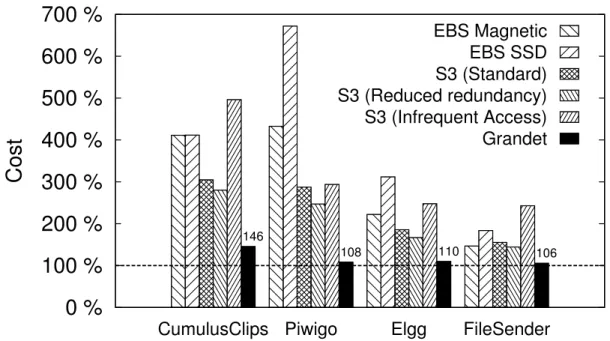
normalized to the optimal cost. . . 38 Figure 2.10 Number of objects at each backend over time. . . . 40
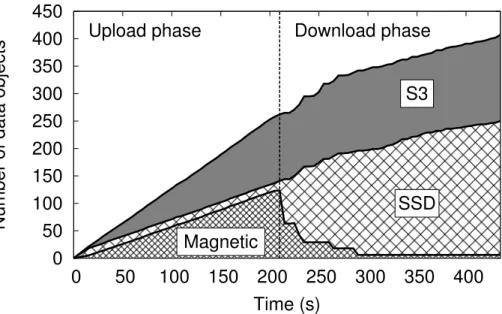
Figure 2.11 Performance of Grandet backend. Evaluated with 4KB and 1MB
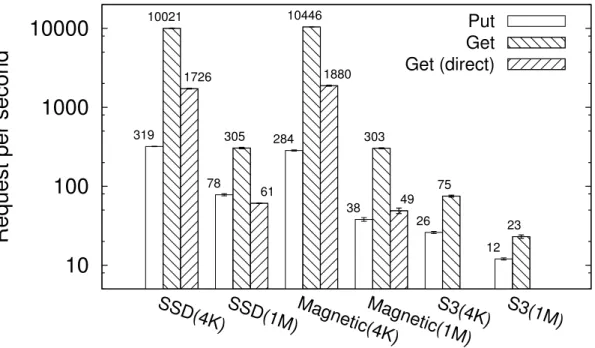
re-quests. Error bar is standard deviation. . . 42
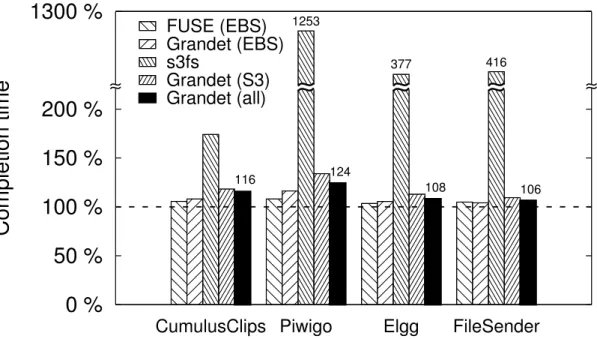
Figure 2.12 Grandet’s end-to-end performance. Time is normalized to the baseline which uses EBS directly. . . 43
Figure 2.13 Scalability of Grandet when using single S3 storage. Evaluated with requests of 4KB in size. The error bar is the standard deviation. . . 45
Figure 2.14 End-to-end scalability. Evaluated on the FileSender application with real workload. . . 45
Figure 3.1 unic protocol. We use||as the concatenation operator. . . 60
Figure 3.2 A simple virus scanning application. . . . 62
Figure 3.3 First step: memoize the computation result. . . . 63
Figure 3.4 Final version: use filesystem metadata to further reduce I/O operations.. 64
Figure 3.5 unic architecture. Additional hosts each have the same architecture as Host 1, and are omitted here due to limited space. . . 67
Figure 3.6 Misalignment between line and chunk boundaries in grep. Shaded re-gion is the adjusted chunk for computation. . . 72
Figure 3.7 Throughput of put() and get() operations. Thex-axis is the size of memoized result. The y-axis is the total time in performing 10,000 put()(solid line) andget()(dashed line) operations. . . 74
Figure 3.8 Relative running time of applications. They-axis is the running time
rel-ative to the original application. For each cluster, the first bar is cache-miss execution without FS deduplication, the second bar is cache-hit execution without FS deduplication, the third bar is cache-miss execu-tion with FS deduplicaexecu-tion, and the fourth bar is cache-hit execuexecu-tion with FS deduplication. The dashed line at 100% shows the running time for the original application. . . 76 Figure 3.9 Effectiveness of memoization with evolving data. Solid line is the
origi-nalgrepwithout memoization. Dashed line has the result cache pop-ulated with v3.0. Dotted line has the result cache poppop-ulated with the immediate previous version. . . 78 Figure 3.10 Effectiveness of memoization across users. For each cluster, the first bar
is the original application, and the second bar is the application mod-ified to use UNIC. Each bar shows the breakdown of running time on each group, the number on top showing the total time. . . 79
Figure 4.1 Example of specifying data intent for a cloud function that generates the thumbnail of an image. It reads input frompic/1.jpgand writes out-put tothumb/1.jpg. . . 86 Figure 4.2 Overview of serverless architecture. . . . 89 Figure 4.3 A photo-sharing application example. Solid arrows indicate triggers.
Dashed arrows represent data flows. . . 91 Figure 4.4 Example code with four cloud functions. . . . 92
Figure 4.5 Data flow of handling user upload. . . . 93
Figure 4.6 Data flow of making collage.. . . 93
Figure 4.7 Inefficient scheduling on OpenWhisk. . . . 96
Figure 4.8 Dependency betweencollageandthumbnail. . . . 99
Figure 4.9 Overlapping functions in a pipeline. . . . 99
Figure 4.10 A rare case of overlapping functions in a pipeline. . . . 99
Figure 4.11 Optimized scheduling with Lambdata. . . . 100
Figure 4.12 Example annotations for an invocation of collage. . . . 102
Figure 4.13 Lambdata’s architecture. Components with italic font are Lambdata-specific. . . 103
Figure 4.14 Microbenchmark: median time to get and put objects of various sizes to Amazon S3. Lower is better. . . 109
Figure 4.15 Time breakdown and speedup of the thumbnail function for various im-age sizes. . . . 114
Figure 4.16 Timeline for two representative workloads. . . . 116
Figure 5.1 The CleanOS Architecture. Key components are highlighted in grey. We add or modify in some way all of the boxed components (except for FS and kernel). . . 135
Figure 5.2 The CleanOS SDO API and device-cloud protocol. . . . 138
Figure 5.3 CleanOS Taint Tag Structure. We impose a structure on TaintDroid taints to support arbitrary numbers of taints. . . 145
Figure 5.5 Audit precision. Each bar shows the average probability over time that tainted data was actually exposed, given that the audit log shows its SDO as exposed. . . 155 Figure 5.6 Micro-operation Performance (milliseconds). CleanOS Java object field
access times compared with Android, TaintDroid. Times for non-sensitive and non-sensitive fields for various eviction states. Averages over 1,000 accesses. . . 156 Figure 5.7 Application Performance. Performance of various popular app
activ-ities under Android, TaintDroid, and CleanOS for various eviction states and configurations. Results are averages over 40 runs, in mil-liseconds. . . 157 Figure 5.8 Energy Consumption. Hourly energy consumption attributed by
Pow-erTutor to the three apps when running a long-term synthetic work-load for at least 3 hours over Wi-Fi. Numbers on top of each bar show energy overhead over default Android in percent. . . 161 Figure 5.9 Network Traffic Patterns of Apps vs. CleanOS. CleanOS traffic vs. app
traffic for a one-hour trace. The Y axis is in log scale. In our cases, the phone has background traffic, which is included in both app and CleanOS lines. . . 163
List of Tables
Table 2.1 Overview of AWS storage services (May 2016). . . . 16 Table 2.2 Approximate monthly price (US dollars) for select AWS storage services
(May 2016). †S3 infrequent access charges a minimum of 128KB storage for smaller objects. . . 17 Table 2.3 List of studied web applications. . . . 19 Table 2.4 Lines of code of Grandet’s components. . . . 32
Table 3.1 Lines of code changed for each application. Parenthesis indicates whether the adaptation uses file-level or block-level memoization. The numbers forgccare based onccache. . . 71 Table 3.2 Storage overhead. Columns are: (a) the number of input files, (b) total
size of input files, (c) number of entries in the result cache, (d) size of the Redis dump file, and (e) relative storage overhead. . . 81
Table 4.1 Inputs and outputs of each function. . . . 94 Table 4.2 Time spent on each phase of the functions, in milliseconds. The last
col-umn shows the percentage of time spent on getting the data from the cloud storage. . . 97
Table 4.3 List of all functions and the parameters used in the experiment. . . . 111
Table 4.4 Breakdown of the phases in each function. All times are in milliseconds. The last column shows the speedup with cached data. . . 113
Table 4.5 Description of two representative workflows. . . . 115
Table 4.6 Monetary cost. Numbers are in×10−6dollars. . . 118
Table 5.1 CleanOS Modifications to Android, TaintDroid. . . . 125
Table 5.2 Examples of captured sensitive data. . . . 127
Table 5.3 Exposure of cleartext sensitive data across all 14 apps. A ‘Y’ indicates that we obtained cleartext copies from RAM/DB. A ‘-’ does not mean that the data is not on the device, but just that we did not find it in cleartext; the data could exist in some encrypted form. . . 128
Table 5.4 Examples of when hoarded sensitive data is being actually used by the apps.129 Table 5.5 Sensitive data exposure period. Numbers are the fraction of time in which sensitive data was exposed. . . 153
Table 5.6 Sensitive data lifetime. Numbers are the maximum sensitive data reten-tion period. . . 154
Acknowledgments
The work presented in this dissertation would not have been possible without the help and support of many people.
In particular, I express my greatest gratitude to my advisor, Professor Junfeng Yang, for his advice and guidance over the past nine years. I would not have been able to complete this work without his support, encouragement, and inspiration.
I thank Professor Roxana Geambasu for her useful suggestions on the projects I worked on and the presentations I gave at conferences.
I thank Professor Vishal Misra for his helpful comments on my thesis proposal. I thank Petros Maniatis and Xi Wang for their valuable feedback on parts of the work that contributed to this dissertation.
Last but not least, I thank my colleague students Phillip Ames, Sravan Bhamidipati, Ashish Bijlani, Heming Cui, Gang Hu, Nikhil Sarda, Lingmei Weng, Jingyue Wu, and Xinhao Yuan, who helped me solve lots of technical issues and proofread many of my manuscripts.
This dissertation is dedicated to my wife, Yuan Du, for her constant love and unconditional support, to my daughter, Karen Tang, for all the joy she brings, and to my
Chapter 1
Introduction
1.1 Paradigm Shifts in the Era of Cloud Computing
We enter the era of cloud computing in the last decade, when people are changing ways to write and deploy web applications. Four major paradigm shifts are happening in terms of cost, resource-sharing, management, and mobility. They bring many benefits to the developers.1.1.1 Cost
Traditionally, developers have to provision and pay for all resources they intend to use upfront, including computing instances, data storage, and network infrastructures. It is hard to estimate the right amount of resources, causing over- or under-provisioning. Over-provisioning wastes money, and under-provisioning may lead to service outage or degradations. Worse, if the workload changes dynamically, the developer has to provision for the peak scenario, letting resources idle at other times.
In the era of cloud computing, developers can choose from a variety of cloud offer-ings, paying only for what they use. This pay-as-you-go model brings great flexibility to the developers and eases their burden of upfront costs. They can scale up or down
dynamically based on the current workload.
As a result, many companies are adopting cloud computing to cut costs. A 2016 survey of 500 business and IT executives reports that over 40% of companies say the benefit of cutting costs outweighs all other benefits of cloud computing [33]. Goldman Sachs reports that by moving to the cloud, it has increased productive capacity by 580% while reducing the total costs by 20% [24].
1.1.2 Sharing resources
Traditionally, developers keep all infrastructures on-premises. They own and control all the computing and storage resources, and do not share them with other parties.
In the era of cloud computing, resources are shifting from single-tenancy to multi-tenancy. Mutually distrusting cloud users are now running computations on shared in-stances and storing data on shared storage. It improves resource utilization and reduces redundancy. For example, a 2009 study on 162TB disks shows that sharing data can reduce storage consumption by 68% [92]. Microsoft reports that sharing computation results can eliminate 35,000 hours of redundant computations per day [69].
1.1.3 Management
Traditionally, developers not only program their business logic, but also have to manage their infrastructures, including both software (e.g., operating systems and libraries) and hardware (e.g., machines, disks, and network infrastructures).
shifts to cloud providers. The paradigm first shifts to Infrastructure-as-a-Service, where cloud providers manage the hardware and developers manage the software. In recent years, serverless computing emerges as a new paradigm to build cloud applications. De-velopers write small functions that react to cloud infrastructure events, while the cloud provider maintains all resources and schedules the functions in containers. Thus, devel-opers only focus on their core business logic, and leave server management and scaling to the cloud providers.
As a result, many companies, including Netflix, Coca-Cola, and the New York Times, are adopting serverless computing [35]. A 2018 survey of 600 IT decision-makers shows that 61% of respondents are already using or plan to use serverless computing by 2020 [57].
1.1.4 Mobility
Traditionally, desktops and servers are the primary computing platforms. They are immo-bile and connected via wired networks. Moimmo-bile phones have few functionalities besides making phone calls.
In the era of cloud computing, mobile technology is developing at the same time. Smartphones are replacing desktops as the primary personal computing platform. Net-work connectivity becomes ubiquitous so that smartphones are always connected to the cloud.
Some 2017 statistics show that mobile devices generate 67% of all web visits in the United States [50]. As a result, many developers in the era of cloud computing adopt a mobile-first strategy.
1.2 Challenges and Opportunities
Although cloud computing brings many benefits, one big challenge is that data storage abstractions have not changed much for many decades. The conventional way of handling data in the era of cloud computing is inefficient. The lack of evolution in data storage abstractions turns each benefit of cloud computing in §1.1 into great challenges.
First, instead of upfront provisioning, cloud providers offer a variety of cloud stor-age services in a pay-as-you-go manner. Unfortunately, these services have incompatible interfaces, such as filesystems and key-value stores. They also have different durability, availability, and latency guarantees. Worse, their complex pricing schemes make reason-ing about storage costs difficult. Developers face great challenges in choosreason-ing from so many cloud storage options. Many developers store their data inefficiently on the cloud, causing poor performance and large bills. This challenge gives us an opportunity to build a unified and economical cloud data storage.
Second, the multi-tenancy nature of cloud computing means that a significant portion of the data is redundant. Data deduplication can hugely save storage and simplify man-agement. However, not only is the data redundant, but the computations on top of the data are also redundant. Unfortunately, cloud users do not trust one other. It is challeng-ing for cloud users to share computations with other cloud users that they do not trust. Traditional deduplication techniques fail to work because they only focus on trusted data. This challenge gives us an opportunity to deduplicate computations for mutually distrust-ing cloud users.
busi-ness logic as cloud functions, while the cloud provider maintains all the infrastructure. However, cloud functions are ephemeral, with no persistent storage at all. It is chal-lenging to share data efficiently across cloud functions in serverless computing. Most developers resort to cloud storage systems for persisting states. However, this practice is an inefficient compromise suffering from long latency and high cost, because cloud storage systems are not designed with serverless computing in mind, and their evolution lags behind this paradigm shift. Specifically, cloud functions are blind to which data they read or write, therefore missing potentially huge optimizations. This challenge gives us an opportunity to design a new data option for serverless computing.
Fourth, smartphones are replacing desktop computers as people’s primary comput-ing platform. They are prone to losses, yet people store enormous sensitive data there, such as credit card numbers and private communications. How to manage sensitive data on mobile devices remains challenging because their operating systems are ported from desktop computers and are not designed with physical insecurity in mind. If the device is stolen or lost, all sensitive data are at risk. This challenge gives us an opportunity to evict idle sensitive data to the cloud since smartphones are almost always connected.
1.3 Hypothesis
The paradigm shift to cloud computing brings many benefits, but the lack of evolution in data storage abstractions causes many inefficiencies:
1. It is difficult to choose from too many cloud storage options.
3. Cloud functions cannot share data directly. 4. Mobile devices mismanage sensitive data.
Therefore, we propose the following research hypothesis: we can make data storage efficient in the era of cloud computing by building new storage abstractions and systems that bridge the gap between modern cloud computing techniques and legacy data storage solutions, and in the meantime, simplify development.
1.4 Overview of Contributions
In order to address the challenges presented in §1.2 and solve the inefficiencies defined in §1.3, we have built four systems, forming the four main contributions of this dissertation:
1. Grandet: a unified, economical object store for web applications. 2. unic: secure deduplication of general computations.
3. Lambdata: optimizing serverless computing by making data intents explicit. 4. CleanOS: limiting mobile data exposure with cloud-based idle eviction.
We now briefly overview each system.
1.4.1 Grandet
Our first contribution, Grandet, solves the data storage inefficiency caused by the paradigm shift from upfront provisioning to a variety of pay-as-you-go cloud services.
Grandet is a novel, extensible storage system that significantly reduces storage costs for web applications deployed in the cloud. It serves as a layer between web applications
and cloud storage. Grandet provides both a file system interface and an S3-like key-value interface, supporting a broad spectrum of web applications. Under the hood, Grandet supports multiple heterogeneous stores and unifies them by placing each data object at the store deemed most economical. Specifically, for each supported store, Grandet main-tains a profile capturing the store’s pricing model, availability, durability, and consistency guarantees, and performance such as latency. It updates the performance part of this profile by periodically running itsprofiler, and the other parts based on crawling or user-supplied configurations. Given a data object, Grandet runs itspredictor to predict the future workload on the object, and itsdecider to determine, on a fine-grained, per-object basis, the most economical store that meets the default or developer-specified quality of service (QoS) requirements—even the default is better than the typical web practice. Grandet preserves the availability, durability, and consistency that the cloud stores pro-vide. When the workloads or pricing models change, Grandet migrates data objects automatically as needed to reduce costs. We explicitly designed Grandet to be extensi-ble so that developers can add new stores easily.
1.4.2 unic
Our second contribution, unic, solves the data inefficiency caused by the paradigm shift from single-tenancy to multi-tenancy.
unic is a novel system that securely deduplicates general computations. It serves as a memoization layer that allows applications running on behalf of mutually distrusting users to memoize and reuse computation results, thereby improving performance.
unic achieves both integrity and secrecy through a novel use of code attestation, a classic primitive to attest what code is running to a (remote) party [125, 124]. To insert or query the result cache that unic maintains, unic generates a secure, non-forgeable key that attests to both the application code and the input data. This key strongly isolates applications from each other in the result cache.
unic provides a simple yet expressive API that enables applications to deduplicate their own rich computations. From a high level, this API supports an application to (1) insert input → result to the result cache unic maintains, and (2) query the cache with
inputand get back the cachedresultif any.
1.4.3 Lambdata
Our third contribution, Lambdata, solves the data inefficiency caused by the paradigm shift to serverless computing, where developers only write core business logic, and cloud service providers maintain all the infrastructure.
Lambdata is a novel serverless computing system that adds a cache layer between cloud functions and cloud storage, enabling developers to declare a cloud function’s data intents, including both data read and data written. Once data intents are made explicit, Lambdata performs a variety of optimizations to improve performance and reduce costs. Operationally, Lambdata works as follows. It leverages Grandet or existing cloud object storage (e.g., AWS S3) to store data. Lambdata adds a caching layer, where each computing node has its own object cache. Lambdata schedules cloud functions based on both code and data locality. It tends to schedule multiple function invocations working
on the same data on the same computing node, so they can reuse cached data.
1.4.4 CleanOS
Our fourth contribution, CleanOS, solves the data inefficiency caused by the paradigm shift from desktop computers to smartphones always connected to the cloud.
CleanOS is a new Android-based mobile operating system, which adds to the mobile device a cloud-based data management layer that manages sensitive data rigorously and maintains a clean environment at all times in anticipation of device theft. The crucial insight in CleanOS is to leverage the tight integration of today’s mobile applications with trusted cloud-based services in order to evict sensitive in-memory and on-disk data to those services whenever it is not needed on the device. CleanOS identifies and tracks sensitive data in memory and on stable storage, encrypts it with a key, and evicts that key to trusted cloud storage when the data is not in active use on the device. CleanOS thus ensures that the minimal amount of sensitive data is exposed on the vulnerable device at any time.
1.5 Dissertation Organization
The remainder of this dissertation is organized as follows. Chapter 2 presents Grandet, a unified economical object store for web applications. Chapter 3 presents unic, a system that securely deduplicates general computations. Chapter 4 presents Lambdata, a server-less computing system optimized by making data intents explicit. Chapter 5 presents CleanOS, a mobile operating system that limits data exposure with cloud-based idle
Chapter 2
A Unified, Economical Object Store for Web Applications
Web applications are getting more ubiquitous every day because they offer many useful services to consumers and businesses. Examples include Instagram and Flickr for hosting, processing, and sharing images; YouTube and Vimeo for videos; Pandora and Spotify for music; and Dropbox and Google Drive for files.
Many of these web applications can become quite storage-intensive. At the initial deployment of these applications, a single server might be enough to host the data from their limited number of users. However, as they become more successful, hosting images, videos, files, and other data objects from millions of users, their storage needs increase dramatically. For instance, Facebook has over 500 million users with 260 billion images, totaling 20PB [17]. Dropbox has over 50 million users, storing 500 million files daily [41]. Cloud computing provides an attractive, economical choice for meeting the storage (and computational) needs of web applications. Besides the usual benefits of elastic scal-ing and no hardware (over-)provisionscal-ing, each cloud platform typically supports a range of storage options with different performance, durability, and price characteristics. For in-stance, Amazon Web Services (AWS) supports non-persistent virtual disks (instance store), persistent virtual disks (elastic block store, or EBS), and key-value object store (simple stor-age service, or S3). Each of these options typically has more sub-options, such as EBS on
SSD or magnetic disks, and S3 with reduced redundancy or infrequent access. This rich set of choices gives developers the flexibility to pick the best one that meets their appli-cations’ needs. Unsurprisingly, most web startups today choose to deploy their apps in the cloud, so that they can focus their scarce manpower and funding on features of their applications [8].
Unfortunately, despite all these storage options, it remains quite challenging for de-velopers to best leverage them to minimize cost. For simplicity in programming, it is common practice for a developer to pick a store she thinks is the best and places all ob-jects of the same data collection (e.g., all images) within the store. However, at its core, minimizing cost requires developers to make fine-grained decisions onwhichstore is the best forwhich object. The reason is that the pricing models of different stores are quite complex and subtle, depending on such factors as the size of the object, the number of various types of access requests, and the direction and amount of network transfers. Two objects in the same data collection may differ hugely regarding these factors, and there-fore should be placed at different stores. Consider two AWS stores, EBS on SSD, which charges a high price for storage and nothing for requests, and S3, which charges a moder-ate price for both storage and requests. A large but cold (i.e., few read and write requests) object should be stored in S3, whereas a small but hot object should be stored in EBS. It is both non-intuitive and impractical to require developers, especially those at startups with scarce manpower and funding, to make such fine-grained placement decisions on a per-object basis.
In addition, many of the factors affecting price are highly dynamic, frequently requir-ing data objects to be migrated from one store to another to minimize cost. For instance,
the hotness of an object varies over time; so the best store for the object now may be the worst fit in the future. Even the pricing models change over time due to technology im-provements [25] and competitions [15]. It is impractical to require developers to predict these changes accurately or migrate data objects manually.
Lastly, different stores provide heterogeneous interfaces, and a web application writ-ten against one storage interface (e.g., the file system interface) may not be able to use another more economical storage option easily or at all. Many popular web applications, such as MediaWiki (the most popular wiki app) and WordPress (the most popular blog-ging app), still store data objects such as images in file systems. To run these applications in the cloud without significant modifications, developers have to store the data objects, however large they are, in a file system on top of EBS, an option potentially much more expensive than storing the objects in S3. While newer web applications tend to adopt S3, they may still manipulate the data objects using existing utilities that require the file sys-tem interface. Examples include a photo gallery usingImageMagickto process images or generate thumbnails, a video sharing application usingffmpegto convert video formats, and a file sharing application using bzip2 to compress files. Thus, developers have to move the objects explicitly between S3 and the file system. These movements, if frequent, are not only complex to program but also expensive to execute, because S3 charges for both requests and network transfers.
Because of these reasons, it is difficult for developers to place objects optimally for minimizing cost. The cost of misplacement can be quite high. At a micro level, eachPUT
request on S3 costs as much money as storing 5MB of data for a day; so it is extremely costly to store frequently accessed data objects on S3. The storage cost on EBS is up to 8×
as much as on S3; so putting an infrequently-accessed large object on EBS is expensive, too. At a macro level, our experiments show that misplacement costs up to 572% more.
We present Grandet, an extensible storage system that significantly reduces storage costs for web applications deployed in the cloud. Grandet provides both a file system interface and an S3-like key-value interface, supporting a broad spectrum of web appli-cations. Under the hood, Grandet supports multiple heterogeneous stores and unifies them by placing each data object at the store deemed most economical. Specifically, for each supported store, Grandet maintains a profile capturing the store’s pricing model, availability, durability, and consistency guarantees, and performance such as latency. It updates the performance part of this profile by periodically running its profiler, and the other parts based on crawling or user-supplied configurations. Given a data object, Grandet runs itspredictorto predict the future workload on the object, and itsdeciderto determine, on a fine-grained, per-object basis, the most economical store that meets the default or developer-specified quality of service (QoS) requirements—even the default is better than the typical web practice. Grandet preserves the availability, durability, and consistency that the cloud stores provide. When the workloads or pricing models change, Grandet migrates data objects automatically as needed to reduce cost. We explicitly de-signed Grandet to be extensible so that developers can add new stores easily.
We implemented Grandet in AWS and evaluated Grandet on a diverse set of four popular open-source web applications, namely CumulusClips, Piwigo, Elgg, and File-Sender. Our results show that:
average, Grandet reduces the storage costs by 42.4%.
2. Grandet has little overhead. It can be deployed with little impact on application performance.
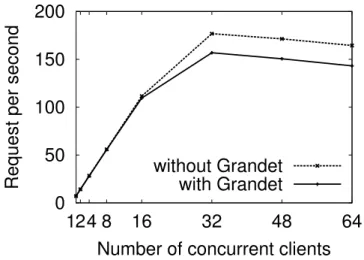
3. Grandet scales well when the workload increases.
4. Web applications can use Grandet to save cost with no modification at all, and several lines of changes would reduce the cost even further.
The remainder of this chapter is organized as follows. The next section introduces the background of cloud storage services. §2.2 extends our motivation with a study and an example. §2.3 describes Grandet’s architecture. §2.4 shows the data placement strategy. §2.5 presents the file system interface. §2.6 describes the implementation. §2.7 shows evaluation results. §2.8 discusses some design implications, §2.9 presents related work, and §2.10 summarizes this chapter.
2.1 Background: Cloud Storage Services
The variety of cloud storage options can be mainly divided into two categories: file storage and blob storage. File storage generally provides a disk or file system interface. Appli-cations can mount it and manipulate data using file system operations such asopen(),
read(), and write(). Examples of file storage are Amazon elastic block store (EBS), Microsoft Azure file storage, and Google compute engine persistent disks. On the other hand, blob storage generally provides a minimal key-value interface, such asPUT, GET, andDELETE. A blob is normally treated as a whole, and operations such as partially
up-Storage service Type Durability Availability Latency Instance store file ephemeral 99.95% lowest EBS (SSD) file 99.8-98.9% 99.999% lowest EBS (magnetic) file 99.8-98.9% 99.999% low S3 (standard) blob 1−10−11 99.99% medium
S3 (reduced) blob 99.99% 99.99% medium
S3 (infrequent) blob 1−10−11 99.9% medium
Glacier blob 1−10−11 n/a high
Table 2.1: Overview of AWS storage services (May 2016).
dating a blob are absent. Examples of blob storage are Amazon simple storage service (S3), Microsoft Azure blob storage, and Google cloud storage.
Even more options are available for each category of cloud storage. For instance, Amazon Web Services (AWS) supports four types of stores (see Table 2.1). Instance store
provides free, non-persistent virtual disks to an AWS elastic compute cloud (EC2) instance. These virtual disks are non-persistent because they are stored in the physical disks of the host machine that happens to run the EC2 instance. Elastic block store (EBS) provides persistent virtual disks, based on either SSD or magnetic. Simple storage service (S3) is a key-value store for objects, with standard, reduced-redundancy, or infrequent-access options. Glacieris a backup store with an extremely low cost and long read latency (3–5 hours).
Not only do these storage options have different service levels, but they also have complex and diverse pricing models. A typical pricing model depends on the total stor-age size, the number of each type of request, and the direction and amount of network data transfer. Table 2.2 shows a snippet of the pricing scheme for AWS storage services. Although they have the same data transfer cost, the discrepancies in storage pricing are
Storage Request (/million) Transfer (/GB)
Storage service (/GB) PUT GET In Out
EBS (SSD) 0.1 0 0 0 0.09 EBS (magnetic) 0.05 0.05 0.05 0 0.09 S3 (standard) 0.03 5 0.4 0 0.09 S3 (reduced) 0.024 5 0.4 0 0.09 S3 (infrequent) 0.0125† 10 1 0 0.09 Glacier 0.007 50 50 0 0.09
Table 2.2: Approximate monthly price (US dollars) for select AWS storage services (May 2016). †S3 infrequent access charges a minimum of 128KB storage for smaller objects.
up to an order of magnitude, and those in request pricing can be as large as three orders of magnitude. No option is cheaper across all dimensions. For example, EBS (SSD) does not charge for I/O requests, but its storage price is more than three times as high as S3. By contrast, S3, despite charging less for storage, has high per-request cost.
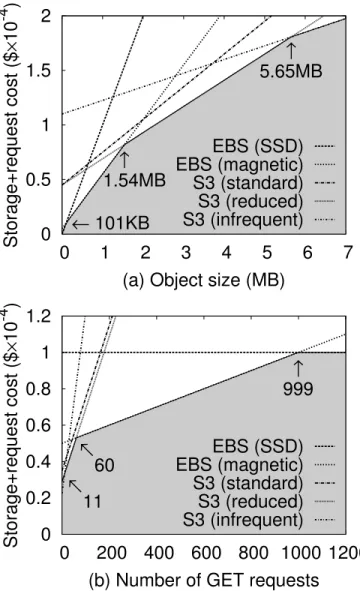
To further illustrate the pricing discrepancies, let us study how much money it costs to put one data object on each of these storage services. Figure 2.1 shows the cost with (a) variable object size and (b) variable number of requests. We exclude data transfer cost in the figures for better clarity because it is the same for all these services. In each figure, the optimal choice is the minimum of all lines (shaded), and the threshold points are marked. We can see that the optimal choice depends on both object size and the number of requests, let alone each choice also has different durability, availability, and latency.
Thus, the heterogeneity of service levels and pricing schemes lead to extremely tough decisions that web applications should make when using cloud storage services. Misplac-ing data at non-optimal storage locations may not only cause service degradation but also cost a lot of money, negating the benefits that the cloud brings.
0 0.5 1 1.5 2 0 1 2 3 4 5 6 7 Storage+request cost ($ × 10 -4 )
(a) Object size (MB) EBS (SSD) EBS (magnetic) S3 (standard) S3 (reduced) S3 (infrequent) ← 101KB ↑ 1.54MB ↑ 5.65MB 0 0.2 0.4 0.6 0.8 1 1.2 0 200 400 600 800 1000 1200 Storage+request cost ($ × 10 -4 )
(b) Number of GET requests EBS (SSD) EBS (magnetic) S3 (standard) S3 (reduced) S3 (infrequent) ← 11 ← 60 ↑ 999
Figure 2.1: Monthly cost with (a) variable object size and (b) variable number of requests.
Each line corresponds to a storage service. Assuming (a) has fixed 100GETrequests and (b) has fixed 1MB object size. Each request counts as one EBS I/O.
2.2 Extended Motivation and Example
We motivated the design of Grandet by studying 19 popular open-source web applica-tions of various kinds, including file sharing, photo and video sharing, shopping, blogging, news-reading, social networking, wiki, and content management systems (see Table 2.3 for the list). We observed two insights from our study.
Web application Category Web application Category
FileSender file sharing selfoss RSS reader
Piwigo photo sharing Tiny Tiny RSS RSS reader
OpenPhoto photo sharing Elgg social network
CumulusClips video sharing MediaWiki wiki
OpenCart shopping LionWiki wiki
PrestaShop shopping Wikka wiki
Zen Cart shopping Drupal CMS
Wordpress blog October CMS
NibbleBlog blog Anchor CMS
Chyrp blog
Table 2.3: List of studied web applications.
0 0.2 0.4 0.6 0.8 1 10 100 1 k 10 k 100 k 1 M 10 M 100 M CDF of file size File size ↑ original images large thumbnails ↓ small thumbnails ↓ temporary files (generated php, js, css…) ↓
Figure 2.2: CDF of file size for Piwigo.
Our first insight is that data files have diverse yet clustered sizes and access patterns. For example, the original photo or video files are large, while the thumbnails are small. Additionally, some files are frequently read, such as a celebrity’s photo, while other files stay cold after they are stored, and the access pattern of files may change over time. For example, Figure 2.2 shows the distribution of file size for the Piwigo photo sharing appli-cation from our evaluation workload based on real-world statistics (see §2.7 for workload details). About 30% of all files are original images (7–12MB), 13% are large thumbnails
(600–800KB), 30% are small thumbnails (90–160KB), and the rest are temporary files. The reason that there are fewer large thumbnails is that Piwigo generates them lazily, and many photos are not accessed yet. This diversity creates a great opportunity for optimiza-tion, because file size and access pattern are two dominating factors on storage costs, as we have shown in §2.1.
Our second insight is that, despite their complexity, all the 19 applications manipu-late data files only in simple ways. Each file corresponds to a logical data object, such as a photo or a video. These files are written sequentially and free of sub-file updates. Therefore, both file storage and blob storage are capable of storing these data objects.
Because of these two insights, we design Grandet as a transparent gateway for a variety of heterogeneous storage services. Data objects are always stored at the optimal service based on the characteristics of the data and workload as well as the pricing and network condition. They are also automatically migrated among the storage services when the workload, pricing, or network condition changes. Next, we present a motivating example about how the CumulusClips video sharing application [39] stores and uses data, to illustrate how Grandet can help it reduce storage cost.
When a user uploads a video file, CumulusClips stores it to the file system and calls an external program,ffmpeg, to convert the file to multiple formats, such as a high-definition version for broadband connections and a low-definition version for mobile devices. It also generates a static thumbnail of the video. All these derived files are stored in the file system, too. Later, viewers of the CumulusClips website see a list of thumbnails. When the viewer clicks on a thumbnail, based on her platform, one of the converted videos is played.
Grandet helps CumulusClips by transparently handling the storage for all files. De-spite internally storing data as key-value objects, Grandet is mounted to CumulusClips’s
uploadsdirectory as a file system, and no modification to CumulusClips’s source code is required. Whenever CumulusClips wants to write a file to the directory, Grandet puts the file to its optimal storage service based on its prediction of the file’s workload. For example, it would put a small thumbnail on EBS if it predicts that the file would frequently be read but put a large high-definition video on S3. Grandet also migrates data over time to reflect latest conditions. For example, if an unknown video on S3 suddenly becomes a sensation (the “slashdot effect”), then Grandet would move it to EBS for cheaper request cost.
2.3 Architecture
We now give an overview of Grandet’s deployment scenarios and present the architec-ture of Grandet.
2.3.1 Overview
Grandet unifies multiple heterogeneous cloud storage into a single service. Its primary goal is to reduce storage costs for web applications. Thus, instead of running as standalone servers that would incur additional cost, Grandet leverages piggyback deployment.
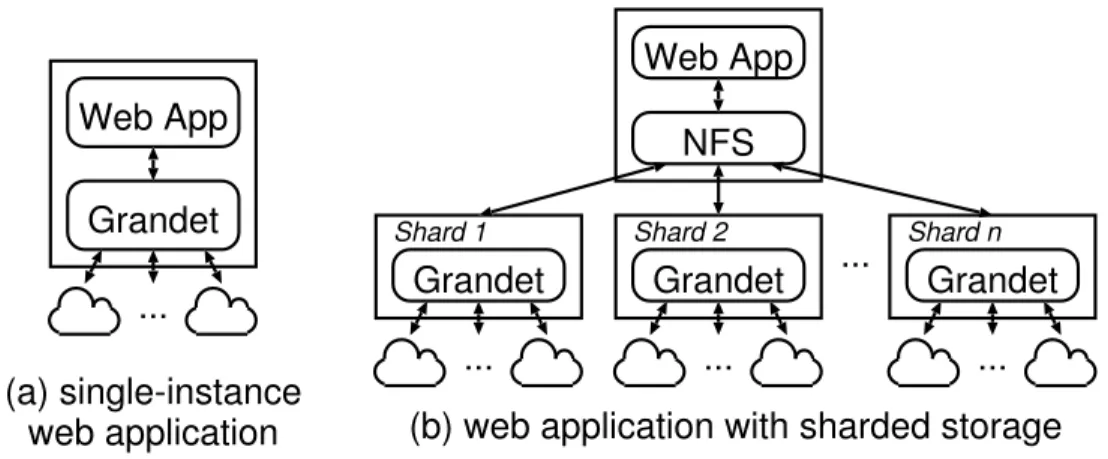
Figure 2.3 shows two typical deployment scenarios. For single-instance web applica-tions, the Grandet service simply co-locates on the same machine with the application (Figure 2.3(a)). Large-scale web applications (e.g., MediaWiki [143]) typically shard their
Web App Grandet Grandet Shard 1 Grandet Shard 2 ... Grandet Shard n (a) single-instance
web application (b) web application with sharded storage
...
... ... ...
Web App NFS
Figure 2.3: Grandet deployment scenarios.
files into multiple storage servers, each storing a disjoint subset of the files, and mount them via a distributed file system (e.g., NFS). In this case, each shard independently runs a Grandet service on it (Figure 2.3(b)). Because the files stored on each shard are disjoint, Grandet need not worry about consistency among shards.
Grandet does not introduce new availability, durability, or consistency concerns due to two reasons. First, each object is stored on exactly one cloud storage; so the availability, durability, and consistency of Grandet’s storage are as good as the underlying cloud storage. The application developer can specify the minimum availability, durability, and consistency requirement on a per-object basis (see §2.3.3). Second, since the Grandet service itself resides on the same server as the web application or the storage shard, they share the same availability.
2.3.2 Grandet components
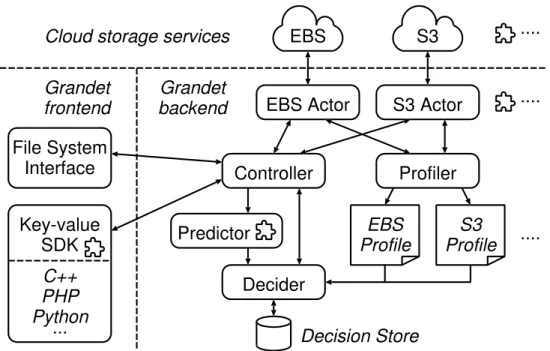
Figure 2.4 shows the components of the Grandet service. Grandet’s frontend exports a key-value SDK for various programming languages and a general file system interface
Controller File System
Interface
Key-value SDK
EBS Actor S3 Actor
Decider Profiler Predictor EBS S3 EBS Profile S3 Profile Cloud storage services
Grandet backend C++ PHP Python .... .... .... Decision Store Grandet frontend ...
Figure 2.4: Grandet components. Components with a plug-in symbol mean that develop-ers can easily extend them.
to the web application or storage shards. The frontend and the backend communicate via Unix domain socket IPC.
The Grandet backend stores data as key-value objects. It consists of five compo-nents. The Controller handles all requests from the frontend and coordinates all the other backend components. A set of Actors executes storage actions on a variety of stor-age backends. TheProfilerperiodically probes the current pricing model and network conditions for each storage backend, and stores them asprofiles. ThePredictorkeeps track of the frequency of allPUT,GET, and DELETErequests, and predicts future request patterns. The Deciderdecides upon the best storage option based on the application’s requirements, the predicted request pattern, and the storage profiles. Decisions are kept on thedecision storein Redis [116] and further persisted on EBS or S3.
Frontend
Controller Request
type : PUT
key : alice:wedding:photo1 value: <image object>
requirements: { min_availability = 99.99% min_durability = 99.99% min_consistency = eventual max_latency = 300ms }
hints: {user=alice, album=wedding}
Response
status: OK
FS or SDK
Backend
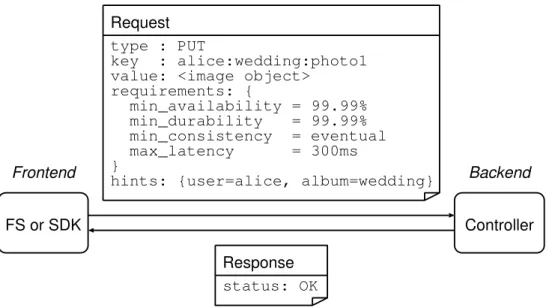
Figure 2.5: An example of PUTrequest and response.
new stores, support new languages, or change the prediction algorithm (see §2.6).
2.3.3 Grandet workflow
All communications start with the application¹ sending a request to theControllerby using either the key-value SDK or the file system interface, where the latter internally represents files as key-value objects (see §2.5). Regardless of frontend, the request is one of the following:
PUT.The application requests to store a data object to Grandet’s storage (Figure 2.5). The application should assign a uniquekeyto the data object based on its own needs. For example, a photo sharing application may assign the image file that Alice uploads to her Wedding album the keyalice:wedding:photo1. Thevalueof the data object can be an arbitrary length of binary content.
¹If deployed with sharded storage, it is actually the shard that sends the request. However, there is no difference from Grandet’s view.
Along with thePUTrequest the application can specify itsrequirementson the storage service for this particular data object. The requirements include the minimum availability, durability, and consistency required, as well as the maximum latency allowed. Only the services that meet these requirements are considered as candidates for storing this data object (see Table 2.1 for an overview of storage services). Requirements are optional. If the application does not specify requirements, then Grandet assumes all non-ephemeral (i.e., not the EC2 instance store) and moderate-latency (i.e., not Glacier) services can be chosen. It is worth mentioning that even this default assumption provides better guarantees than a typical application’s setup, since both EBS and S3 are at least 20× more reliable than typical commodity disks [6].
The application can also givehintsto Grandet for a better placement decision. Hints are also optional, and we have implemented two default hints. §2.4 discusses the place-ment strategy and default hints in detail.
Upon receiving the request, theControllerfirst asks theDeciderfor the placement decision, which in turn looks at the current profile for each storage service and asks the
Predictorfor the predicted future request pattern. Based on this, theDeciderfinds the most cost-effective storage choice that satisfies all the application’s requirements, memo-rizes the choice at the decision store, and returns the choice to theControllerThen the
Controllertells the correspondingActorto store the data object to the actual storage and notifies thePredictorto bookkeep this action. Finally, it tells the application that thePUThas completed.
Controllerasks theDeciderto recall the previous placement decision from the decision store and then asks the correspondingActorto retrieve the data object from the actual storage. TheControlleralso asks the decider to check if the optimal placement decision would change because the current workload, pricing scheme, and network conditions may have changed. If not, it notifies thePredictorto bookkeep this action and returns the data object to the application. Otherwise, it also migrates the data object to the new storage service and deletes the old copy.
DELETE.The application requests to delete a data object from Grandet’s storage. The
Controllerasks theDeciderto recall the previous placement decision from the decision store and then asks the corresponding Actor to delete the data object from the actual storage. It also notifies thePredictorto bookkeep this action.
2.3.4 Frontend interface
Grandet has two types of frontend interface. The key-value SDK provides bindings for these requests for various programming languages such as C++, PHP, and Python. For instance, Figure 2.6 shows Grandet’s PHP interface and examples of putting and get-ting an image. The interface is similar to current cloud blob storage services such as S3. Therefore, web applications that are already aware of S3-like blob storage can just switch to Grandet’s SDK and seamlessly get all the cost-savings that Grandet brings.
For applications that only work with file systems, Grandet also provides a file system interface using fuse, which applications can mount to their data directory directly. §2.5 describes it in detail.
// PHP SDK interface
function put($key, $value, $requirements=[], $hints=[]) function get($key)
function del($key)
// Example: PUT an image with requirements and hints. require_once 'grandet.phar';
grandet\put('alice:wedding:photo1', $uploaded_image, ['min_availability_required' => 99.99,
'min_durability_required' => 99.99,
'min_consistency_required' => 'eventual',
'max_latency_required' => 300], ['user' => 'alice', 'album' => 'wedding']); // Example: PUT with no requirements and default hints. grandet\put('alice:wedding:photo2', $another_image); // Example: GET an image.
$image = grandet\get('alice:wedding:photo1');
Figure 2.6: Grandet’s PHP SDK and usage examples.
2.4 Deciding Data Object Placement
The cornerstone of Grandet is the decision engine for placing each data object onto the optimal storage service. It makes a decision each time the applicationPUTs orGETs a data object. The decision engine closely follows the pricing model of all storage options. As mentioned in §2.1, a typical pricing model consists of three factors: storage (data size and lifetime), request (type and amount), and data transfer. The data size is known, and trans-fer prices are usually the same for all services within the same cloud region. Therefore, the key to making placement decision is predicting the future access pattern of the data object.
2.4.1 Prediction of access pattern
Grandet provides a framework that allows developers to use any algorithm to predict access patterns (see §2.6.2). It also provides a default predictor, which we now describe.
For each request for a certain object, the predictor uses the request’s metadata to classify the object into the class of objects similar to this object. The metadata includes the object size, the object name, the requirements of the request, and other hints (see §2.4.3) provided by the developer.
For each class, the predictor keeps track of the number ofGETandPUTrequests issued on the objects in this class recently, and it also records the number of recently accessed objects and the average lifetime of the objects in this class. Each record is kept for r
seconds (typically a day or a week).
Suppose that for the class the current object belongs to, there areдGETrequests and
p PUTrequests recently, and there aren objects accessed in this class, then the predictor
would predict that in the following t seconds, there would be дnrt GET requests and pt nr
PUTrequests for this object. It would also predict the object’s lifetime to be the average object lifetime in its class. Note that even for objects in the same class, their final storage decisions may differ, because the numbers (д,p,n) are dynamic and other factors such as
object size may be different.
This default predictor is simple yet effective in our evaluation (see §2.7). We believe that recent machine learning techniques may empower even better algorithms, which can be easily plugged into Grandet (detailed in §2.6.2).
2.4.2 Decision making
Grandet’s decider works with the predictor to decide where to place the object. It uses the object size and the predicted access pattern to make the decision. For each backend, Grandet’s decider uses its pricing model to calculate the storage cost of the object in its predicted lifetime and chooses the backend with the lowest cost.
The optimal placement decision for an object may change over time because of changed workload, pricing scheme, or network condition. A migration happens on a
PUTorGETrequest when the extra cost for migration is less than the cost savings at the new storage service.
The extra cost for aGET-triggered migration is the total cost of an additional PUT re-quest, aDELELTErequest, and data transfer cost, while aPUT-triggered migration does not need the extraPUTrequest. For migration within the same Amazon cloud region, such as from S3 to EBS, data transfer is free, andDELETErequests are also free.
2.4.3 Hints
The application can give additional hints to Grandet for better prediction. A hint is an arbitrary set of key-value pairs. For example, a photo sharing application can provide the hint{user=alice, album=wedding}when storing an image file. The predictor will predict the workload of this file by considering files with similar hints, such as images uploaded by the same user in the same album. Hints are optional, and we have imple-mented two types of default hints if the application does not provide any hint. For the file system interface (see §2.5), the default hint is the directory hierarchy. For example,
if the photo sharing application stores a file atalice/wedding/photo1.jpg, the default hints would be{hint1=alice, hint2=wedding}. For the SDK interface (see §2.3.4), the default hints are the object’s key split by colons. We evaluate the effect of hints in §2.7.5.
2.5 File System Interface
Providing POSIX-like file system semantics is arguably the best way to support the widest range of legacy web applications seamlessly because it does not require modifications to their source code. Hence, Grandet also implements a file system interface using fuse. It can be directly mounted to the web application’s data directory.
The design of Grandet’s file system interface follows our insight that most files are accessed wholly and sequentially by web applications, such as photo and video files. So, it is best to store each file as one object, as opposed to dividing files into blocks. Besides, web applications often need to rename files, such as moving a temporary file to its fi-nal directory. So, it is essential to support fast renaming, although S3 does not support renaming objects other than a copy followed by a delete. Last but not least, some web applications generate many intermediate files when doing backend processing, and re-move them soon. So, it is desirable to skip putting these intermediate files to the backend storage.
Figure 2.7 shows the implementation of Grandet’s file system interface. At the back-end, it stores each file as a UUID-keyed object and puts the actual file name in its metadata. At the frontend, it maintains acache of file contents on a RAM drive and keeps thefile structurehierarchy and metadata (e.g., UUID, file size) in Redis. Therefore, renaming a file
Cache
Grandet
Controller
async-upload queue
/a.jpg: uuid=0a46dde1... size=11,793,094 mtime=1427400000 ... /thumb/a-th.jpg: uuid=a84e468c... size=145,751 ... ...File structures
File 0a46dde1... (11,793,094 bytes)... ...
close() open()GET
PUT
Redis
RAM drive
Frontend
Backend
Figure 2.7: Implementation of Grandet’s file system interface. Solid arrows are the data flow. Dashed arrow shows the logical relationship between the file structure and its con-tent.
only touches its metadata.
We next describe the file operations. Oncreat(), we create a file in the cache and pass the file descriptor to the application. Onopen(), weGETthe file data from the back-end storage if it does not exist in the cache, then open the cached file and return the file descriptor. For file manipulations such as read, write, and truncate, we pass them through to the corresponding file system operations of the cache. We also update our file structure for the new file size and modification time. Onclose(), if the file content has been mod-ified, we append it into anasync-upload queueso that the file will bePUTto the backend storage, and we block onfsync()until thePUTis completed.
Our implementationPUTs file contents to the backend storage asynchronously. It has two benefits. First, it skips intermediate temporary files if they are deleted before the actualPUThappens. Second, it allows an application to specify hints as extended attributes (xattr) efficiently after a file has been closed, which is useful when the creation of the
Component LoC Component LoC Component LoC
S3 Actor 120 EBS Actor 236 Decider 230
Predictor 356 Controller 1401 Profiler 235
C++ SDK 159 PHP SDK 168 Python SDK 69
FS interface 1979 Console 349 Misc 1191
Total : 6493
Table 2.4: Lines of code of Grandet’s components.
file is beyond the application’s control, such as files generated externally. For example, the CumulusClips video sharing application executes ffmpegto convert a video file to another format. It can setxattrof the converted file after that.
Since Grandet’s backend makes the decision on the optimal storage location based on each file’s predicted usage pattern, the replacement algorithm on the cache is not critical. A simple LRU algorithm works well in practice.
2.6 Implementation and System Extensibility
We designed Grandet as an extensible framework where each component, such as the storage services, the prediction algorithm, or the frontend SDK, can be easily replaced or extended. We implemented the Grandet backend in C++14, the file system interface with fuse [58], and key-value SDK in various languages. We modified libaws [9] to com-municate with Amazon Web Services. Table 2.4 shows the numbers of lines of Grandet’s components. Metadata such as placement decisions are stored in Redis [116]. All compo-nents can be easily extended by plugging in a new subclass, or customized by changing a configuration file. This section describes some implementation details.
class Actor { public:
virtual void ~Actor()=default;
// cloud storage operations
virtual void put(const string& key, shared ptr<Value> val)=0; virtual shared ptr<Value> get(const string& key)=0;
virtual void del(const string& key)=0;
// updates pricing model, latency, availability, durability, etc.
virtual void profile(shared ptr<Profile> profile)=0; };
Figure 2.8: Grandet’sActorclass.
2.6.1 Adding a storage service
Grandet’sActorexecutes actions, such asPUT,GET, andDELETE, on the storage service. We implementedActors for EBS (SSD and magnetic) and S3 (standard, reduced redun-dancy, and infrequent access). Supporting a new storage service just requires adding a new subclass of Actorand implementing its interface methods.
Figure 2.8 shows the interface of theActorclass. The put(),get(), anddel()are cloud storage operations. Theprofile()method, when called by Grandet’sProfiler, updates the cloud service’sProfile, which includes pricing model and service conditions such as latency, availability, durability, and consistency.
The Profiler is a cron job that periodically runs. When triggered, it calls every
Actor’sprofile()method to update its profile. We implemented crawlers in our EBS and S3Actors to fetch and parse the pricing information from the Amazon Web Services website. Profiles are stored as JSON files so that users can also manually configure the pricing model or service levels.
2.6.2 Adding a prediction algorithm
We implemented the prediction algorithm as described in §2.4. Plugging a new prediction algorithm into Grandet just requires subclassing thePredictorclass.
ThePredictorhas three listener functions, namely notify_put(),notify_get(), andnotify_del(), which are called whenever there is aPUT,GETorDELETErequest. The
Predictorthus keeps track of the current workload. When making a decision, the de-cider calls thePredictor’spredict_put(),predict_get(), andpredict_lifetime()
functions to get the predicted future request frequency and expected lifetime.
2.6.3 Protocol and SDK
Grandet’s frontend and backend communicate through Unix domain socket IPC, and all messages are serialized in Protocol Buffers [66]. Grandet defines two types of protocol messages: RequestandResponse. ARequestmessage is one of three types: PUT,GET, and DELETE. It also includes the key and value of the data object, the application’s re-quirements such as minimum durability and maximum latency, and optionally hints for workload prediction and other metadata. TheResponsemessage contains a status code, and optionally the data object’s value if it is the response to aGETrequest.
Therefore, the SDK for a programming language is just a wrapper over Protocol Buffer and socket programming. We have implemented the SDK for C++, PHP, and Python, with 70–170 lines of code each. We believe that supporting a new language would similarly require little programming effort.
2.6.4 Optimization
To further improve performance, we also implemented two optimizations to Grandet’s basic design.
Shortcut for file access. WhenPUTting a file object that is already on disk, the request payload only includes the file name instead of the file content, and the Grandet backend reads the file directly from disk. Therefore, it avoids sending the entire file from frontend to backend.
S3 authenticated URL.An application oftenGETs a data object from Grandet only to send it verbatim to the user without any processing. For example, when a user clicks “download original image” on the Piwigo photo sharing application, Piwigo simply re-trieves the data object for that original image and send it back to the user. Thus, if the data object is stored on S3, Grandet incurs unnecessary overhead by acting as a proxy for the data transfer. In order to optimize for this scenario, the application can specify a special requirement in itsGETrequest in the form of {url=true, expire=600s}; so the Grandet backend sends the application a pre-authenticated URL for the S3 object with the specified expiration time (600s here). The application can thus redirect the user to download the image from the authenticated URL directly.
2.7 Evaluation
We evaluated Grandet on four popular open source web applications: CumulusClips (video sharing) [39], Piwigo (photo sharing) [109], Elgg (social network) [46], and
File-Sender (file sharing) [54]. We modeled the usage data for each application according to the most popular website of its type, namely YouTube, Flickr, Facebook, and Dropbox. Section 2.7.1 details how we modeled the usage data. To make cost evaluations manage-able, we scaled down the usage to 100 users in one month, while preserving real-world workload characteristics. We ran all experiments on EC2m3.largeinstances with EBS and S3 in the US East region, using Ubuntu Linux 14.04 and Redis with per-second fsync.
Our experiments aim to answer four questions:
§2.7.2 Does Grandet reduce cost? §2.7.3 Is Grandet fast?
§2.7.4 Is Grandet scalable? §2.7.5 Is Grandet easy to use?
2.7.1 Workload modeling
We first describe our workload modeling for each app.
CumulusClips. We modeled the usage data of CumulusClips according to YouTube [146], where a billion users upload 300 hours of video per minute [147] and an aver-age video has four minutes [98, 34]. So a user uploads 0.19 videos a month on averaver-age. Each month, an average user views 76 videos [34]. The average video size is 8MB [28]. On YouTube’s website, 20 recommendations appear with each video; so in our model, for each video viewed, 20 thumbnails are also viewed. A typical thumbnail has 400×300 pixels.
Piwigo. We modeled the usage data of Piwigo according to Flickr [56], where 87 million users upload 3.5 million images daily [80]. An average photo has 20 views [84]. On the Flickr website, an album shows 27 thumbnails. Large thumbnails have 1600×1000 pixels, and small ones have 640×400 pixels. A typical photo has 5120×3840 pixels.
Elgg. We modeled the usage data of Elgg according to Facebook [51], where 500 million users upload 120 million photos daily [17]. The average photo size is 60KB [17]. On Facebook’s website, a pop-up photo has 960×960 pixels and a thumbnail in the timeline has 300×300 pixels. Each day, 10 billion photos are viewed, and the ratio of views between thumbnails and original photos is 95% to 5% [17]. In our model, we distribute a user’s views among her friends following a Pareto distribution withα =1.5.
FileSender. We modeled the usage data of FileSender according to Dropbox [40], where 50 million users upload 500 million files daily [41]. We use the average size of files from file sharing servers, 153KB [135]. The popularity of the shared files follows a Zipf distribution withα =0.4[137].
2.7.2 Cost savings
For the monetary cost, we evaluated each application’s end-to-end cost reduction, ana-lyzed Grandet’s operational cost, and tested its ability to handle dynamic workloads.
End-to-end cost savings
The overarching goal of Grandet is to reduce cost used by web applications. Figure 2.9 shows a comparison of total storage costs of evaluated web applications with different