Victorian Auditor-General’s Report
November 2012
2012-13:16
Prison Capacity Planning
Prison Capacity Planning
20
12
-1
3:1
6
No
ve
m
b
er 2
01
2
Level 24 35 Collins Street Melbourne Vic. 3000 Telephone 61 3 8601 7000 Facsimile 61 3 8601 7010 www.audit.vic.gov.auV I C T O R I A
Victorian
Auditor-General
Prison Capacity
Planning
Ordered to be printed VICTORIAN GOVERNMENT PRINTER November 2012 PP No 201, Session 2010–12ISBN 978 1 922044 34 1
This report has been produced to ISO14001 environmental standards. It is printed on FSC® certified Titan Satin paper. The print supplier, Blue Star PRINT has initiated an EMS promoting minimisation of environmental impact through the deployment of efficient technology, rigorous quality management procedures and a philosophy of reduce, re-use and recycle.
The Hon. Bruce Atkinson MLC The Hon. Ken Smith MP
President Speaker
Legislative Council Legislative Assembly
Parliament House Parliament House
Melbourne Melbourne
Dear Presiding Officers
Under the provisions of section 16AB of the Audit Act 1994, I transmit my report on the audit Prison Capacity Planning.
Yours faithfully
D D R PEARSON Auditor-General 28 November 2012
Contents
Glossary ... vii
Audit summary ... ix
Conclusions ... ix Findings ... xi Recommendations ... xivSubmissions and comments received ... xiv
1. Background ... 1
1.1 Prisoner population ... 1
1.2 Prisons in Victoria ... 1
1.3 Corrections Victoria ... 3
1.4 Prison capacity planning ... 3
1.5 Previous reviews ... 4
1.6 Audit objective and scope ... 5
1.7 Audit method and cost ... 5
1.8 Structure of the report ... 5
2. Managing demand pressures ... 7
2.1 Introduction... 8
2.2 Conclusion... 8
2.3 Prison utilisation ... 9
2.4 Police cells ... 11
2.5 Prison infrastructure ... 13
2.6 Prisoner support services ... 18
3. Prison capacity planning ... 21
3.1 Introduction... 22
3.2 Conclusion... 22
3.3 Long-term strategy ... 23
3.4 Contingency planning ... 26
3.5 Forecasting prisoner numbers... 27
Contents
vi Prison Capacity Planning Victorian Auditor-General’s Report
Appendix A. Modelling options ... 39
Appendix B.
Audit Act 1994
section 16—submissions and comments ... 41
Glossary
Current supported capacity
The current total number of beds a facility has the infrastructure to support.
Double bunks
Single beds which have been converted to two-person bunk beds.
Funded capacity
The total number of prison beds funded by the government.
Health beds
Beds used to treat prisoners for either mental or physical health issues.
Management beds
Beds used to accommodate prisoners who require segregation due to poor behaviour within prison.
Offending behaviour programs
Programs aimed at changing offenders’ behaviour which are administered in prison.
Operational capacity
The total number of available prison beds. At any given time some funded beds may not be available due to routine maintenance.
Original design capacity
The capacity of a facility when it first opened.
Police cells
Cells managed by Victoria Police including those in police stations and the Melbourne Custody Centre. Cells usually contain at least three beds.
Prisoner support services
Services provided to prisoners such as health services, and rehabilitation and education programs.
Glossary
viii Prison Capacity Planning Victorian Auditor-General’s Report
Temporary beds
Beds intended to be used only for a limited period of time. Temporary beds may be double bunks or accommodation in the form of relocatable buildings, for example.
Utilisation rate
Audit summary
Corrections Victoria (CV) is a service agency within the Department of Justice (DOJ) that is responsible for directing, managing and operating Victoria’s corrections system. As in other correctional jurisdictions, DOJ has set operating parameters for CV to manage the prisoner population to within 90 to 95 per cent utilisation of the prison system’s operational capacity. This is currently equivalent to 5 318 prison beds. These parameters are necessary to maximise the efficiency of the system while allowing CV flexibility to adequately manage the rehabilitation, human rights and welfare of prisoners.
CV is required to plan for and forecast the impact of any future growth, and take appropriate steps so that the system is capable of accommodating and providing services to future prisoner populations. In doing so, CV must factor in the long lead time required to construct new prisons and expand existing facilities.
Planning for future prison capacity has been made more complex by the large growth in prisoner numbers, which increased by 38 per cent or 1 344 prisoners between 30 June 2002 and 30 June 2012. There were 5 024 prisoners in the prison system as at 30 September 2012. While long-term planning is important, this large growth in prisoner numbers and the periodic spikes in these numbers require the implementation of short-term measures—such as use of temporary beds—to quickly respond to capacity constraints.
This audit focused on the prison infrastructure and support services—it has not examined the human resource implications arising from additional prisoner numbers.
Conclusions
CV forecasts indicate that by 2016 the male and female prison systems will not have sufficient capacity to meet increases in prisoner numbers.
The male prisoner population is growing beyond the capacity of existing infrastructure. The average prison utilisation rates have remained close to or above the
nationally-accepted limit of 95 per cent since May 2011. As a result, the capacity of the male prison system to cope with the increase in prisoners is becoming unsustainable. These existing capacity difficulties are compounded by the four- to six-year lead time to construct a major prison facility and also by changes, for example to sentencing policy, that are likely to increase the rate of imprisonment.
Audit summary
x Prison Capacity Planning Victorian Auditor-General’s Report
In the male system there is a heavy reliance on temporary beds and double bunking, which has resulted in male prisons containing 22 per cent more beds than the infrastructure can currently support. In addition, up to 34 per cent of the total prisoner population may currently be housed in accommodation that does not comply with CV's standards, which recommend single cell accommodation. As a result, opportunities to continue to increase prison capacity through temporary beds and double bunking in the future are severely limited by prison infrastructure constraints.
Further, prisoner support programs and health services have not kept pace with the growth in prisoner numbers, primarily because funding for temporary beds prior to 2009–10 has not included allocations for these services.
A substantial rise in the rate of serious prisoner incidents has occurred at the same time as prison capacity pressures have increased.
There is also evidence that prison capacity constraints are having adverse impacts outside the prison system. Difficulties in accommodating the increased number of male prisoners have contributed to the number of prisoners in police cells in 2012 reaching the highest levels since 2002. Police cells are not designed as a substitute for
long-term accommodation and prisoners do not receive rehabilitative support. The high numbers of CV prisoners in police cells is well beyond what Victoria Police and CV deem to be satisfactory. It creates unacceptable health and safety risks for the prisoners, compromises rehabilitative outcomes and places an additional strain on police operations.
By comparison, there is currently spare capacity in the women’s system. This is despite experiencing a similar overcrowding crisis in 2009–10 when the utilisation rate reached 103.2 per cent. However, this spare capacity reflects an over-reliance on temporary beds. Prior to the recent opening of an 84 permanent bed unit, the ability to continue to add temporary beds to the primary women's prison—the Dame Phyllis Frost Centre—was nearing its limit.
Despite the current state of the prison system, CV, and by extension DOJ, has been active over the past 10 years in planning for growing prisoner populations. CV has developed long-term diversion strategies to reduce prison demand and meet future demand. CV’s long-term planning has included initiatives that would have alleviated the current overcrowding problems. However the funding of additional prison
infrastructure has had to compete with other important areas requiring public funding. This has resulted in a shortfall between funding requested and funding received.
Audit summary
Findings
Demand pressures on the prison system
The capacity of the male prison system to accommodate growing prisoner numbers has been a longstanding problem. Current indications are that the system is reaching levels that are unsustainable. The male prison system has been operating at close to or above its operational capacity of 95 per cent since May 2011. As at
30 September 2012, the male prison system was operating at 95.8 per cent of its operational capacity (4 893 beds).
This pressure is likely to significantly increase with CV forecasting, in a 2012–13 funding submission, that the male prisoner population will grow by nearly 2 000 between June 2011 and June 2016. This forecast growth is due to projected general population growth and the implementation of proposed new sentencing and bail reforms. CV estimated this would result in a shortfall of over 1 400 prison beds by June 2016. Even with the additional 895 beds funded in the 2012–13 Budget and allowing for some inaccuracy in CV's forecasting, there will be a significant shortfall in beds within the foreseeable future.
The female prison system is currently operating well within its target utilisation rate at 87.3 per cent. Given the small numbers of female prisoners, the women’s system is susceptible to large percentage variations in prisoner numbers. It is therefore prudent to maintain the utilisation rate at below 90–95 per cent.
The demand pressures facing the prison system are summarised in Figure A. Figure A
Prison capacity headline indicators The prison system faces the following demand pressures:
The prisoner population has grown by 38 per cent since 2002.
Male prisoner population is projected to grow by 44.7 per cent from June 2011 to June 2016.
There are more prisoners being held in police cells than at any point in the past 10 years.
Prison expansions have increased capacity by 53 per cent more than the prison system was originally design for.
Prisons currently hold 22 per cent more beds than their current supported capacity.
Temporary prison beds make up 19 per cent of the total number of beds in the prison system.
Audit summary
xii Prison Capacity Planning Victorian Auditor-General’s Report
Increase in police cell numbers
The high male prison utilisation rate has contributed to considerable pressure on police cells in 2012. On 24 August 2012 the number of prisoners held in police cells was 251. This is the highest level in 10 years and exceeds the 225 upper limit that Victoria Police has stated it can hold before compromising operational capabilities. The current numbers substantially exceed DOJ's and CV's commitment since 2006 that police cell numbers will be kept below 100. This commitment has since been revised, with DOJ informing Victoria Police that from June 2012 the number of prisoners held in police cells would range between 150 to 200 per day based on forecast prisoner numbers.
Limitations on expansion of existing facilities
CV has had to rely on a combination of additional permanent beds to existing prisons, and using temporary beds and double bunks to service the increased prisoner demand. Temporary beds represent over 1 000 beds or 19 per cent of the total funded capacity.
For the men’s system there are just over 1 600 more funded beds than the
infrastructure was originally designed to support. The women’s system contains an additional 240 funded beds.
CV has made modifications to nine of 14 prison facilities to increase the capacity that these facilities can support. As a result, there are around an additional 960 beds above the prison system's design capacity.
These additional beds are all located at medium and maximum security prisons where the greatest demand pressures are. In addition, DOJ and CV do not consider that the physical condition of the main women's prison, the Dame Phyllis Frost Centre, is suitable to meet future forecast growth. As a result, in DOJ’s Women's Correctional Masterplan (2010), DOJ and CV have proposed to build a new multipurpose precinct to house 550 women offenders and to seek to either close, rebuild or refurbish the Dame Phyllis Frost Centre.
Increased prison incidents
The increase in prisoner numbers and overcrowding within prisons and management cells has coincided with an increase in prisoner incidents over the past six years. The rate of serious incidents per prisoner, such as assaults, attempted suicides and self-mutilation, has almost doubled over this time.
Impact on provision of prison services
The provision of services and rehabilitation programs has not kept pace with the increasing prison population, despite actions from CV to remedy the situation. CV did not receive additional funding for services when providing extra temporary beds to meet increased demand. However, for most of its programs, CV is unable to demonstrate the precise shortfall in service provision due to increasing prisoner numbers.
Audit summary
In contrast, CV sought and received additional funding to address unmet demand in the sex offender and education programs.
Prison system planning
Long-term strategy
Since 2001, DOJ and CV have responded to emerging demand pressures in male prisons and the forecast increases in male prisoner numbers by developing two long-term strategies. They are in the process of developing a third. These strategies have incorporated a multi-faceted approach that has combined infrastructure investment to address forecast prisoner increases, and demand management initiatives that aim to reduce the growth in prisoner numbers.
The Corrections Long Term Management Strategy was developed in 2001 and led to the introduction of two new prisons by 2006. As a result, in 2006 the average weekly number of prisoners held in police cells fell consistently below 100 for the first time since 2002. The utilisation rate decreased from 95.1 per cent at 30 June 2005 to a more manageable 92.3 per cent at 30 June 2006.
The effectiveness of the Prison Facilities Master Plan (2007) was compromised by delays in the construction of the Hopkins Correctional Centre and the new prison not being funded until 2012–13. These delays have resulted in additional capacity pressures.
Contingency planning
CV acted promptly to introduce short-term strategies to respond to demand pressures, such as deploying temporary beds and implementing management efficiencies. However, these can only be seen as interim measures, and their effectiveness has been limited due to the already high levels of occupancy and the lead time to build additional infrastructure.
Forecasting prisoner numbers
While acknowledging that forecasting prisoner numbers is complex, CV could improve and strengthen its forecasting approach. CV uses two models to forecast future prisoner numbers—a primary model and a secondary model. The accuracy and robustness of forecasting models are critical, as results from this process underpin DOJ's business cases for seeking additional infrastructure funding.
While CV's models are able to forecast demand for the men's prison system reasonably accurately for up to three years, they are less accurate for the women's prison system. Accuracy diminishes the further ahead forecasts are made. Forecasting 4–5 years in advance is less accurate and tends to understate the actual growth in prisoner numbers.
Audit summary
xiv Prison Capacity Planning Victorian Auditor-General’s Report
Given that the forecasting error rates are higher for the female prison system due largely to the smaller prisoner population, the female system is particularly vulnerable to stress when sudden unforeseen spikes in prisoner population occur. Adopting the recommendations in this report will provide greater confidence that the forecasts of prisoner numbers and capacity are robust and reliable. Greater transparency of prisoner forecasts will also provide increased public confidence that capacity is being appropriately managed.
CV has comprehensively briefed government and DOJ’s senior management on trends in prison capacity, the implications of increased prisoner numbers and system-wide risks. CV has advised government that if the forecast trends continue, further
substantial investment in prison infrastructure will be required to meet future demand.
Recommendations
Number Recommendation Page
Corrections Victoria should:
1. determine whether its targeted offending behaviour programs have sufficient places to meet demand and, if necessary, incorporate this assessment in future funding submissions
20
2. update and improve the primary model in areas such as the use of demographic data, and the way in which stakeholder-provided information is quantified
37
3. conduct regular external reviews of the primary forecasting model
37
4. use the secondary model in a limited capacity only, due to shortcomings in the model
37
5. develop a new forecasting model based on contemporary practice, and then establish a consolidated multi-forecast system that incorporates the outputs from all the models
38
6. publish its forecasts pending the completion of Recommendation 2.
38
Submissions and comments received
In addition to progressive engagement during the course of the audit, in accordance with section 16(3) of the Audit Act 1994 a copy of this report, or relevant extracts from the report, was provided to the Department of Justice, Victoria Police, the Department of Education and Early Childhood Development, the Department of Premier and Cabinet and the Department of Treasury and Finance with a request for submissions or comments.
Agency views have been considered in reaching our audit conclusions and are represented to the extent relevant and warranted in preparing this report. Their full section 16(3) submissions and comments are included in Appendix B.
1
Background
1.1
Prisoner population
Victoria’s prisoner population has grown by 38 per cent in the past decade. The male population grew by 1 258 prisoners—from 3 286 to 4 544 prisoners—between 30 June 2002 and 30 June 2012.The female population increased by 86 during the same period, from 254 to 340—an increase of 34 per cent. There were 5 024 prisoners in the prison system as at 30 September 2012, comprising of 4 688 male prisoners and 336 female prisoners.
1.2
Prisons in Victoria
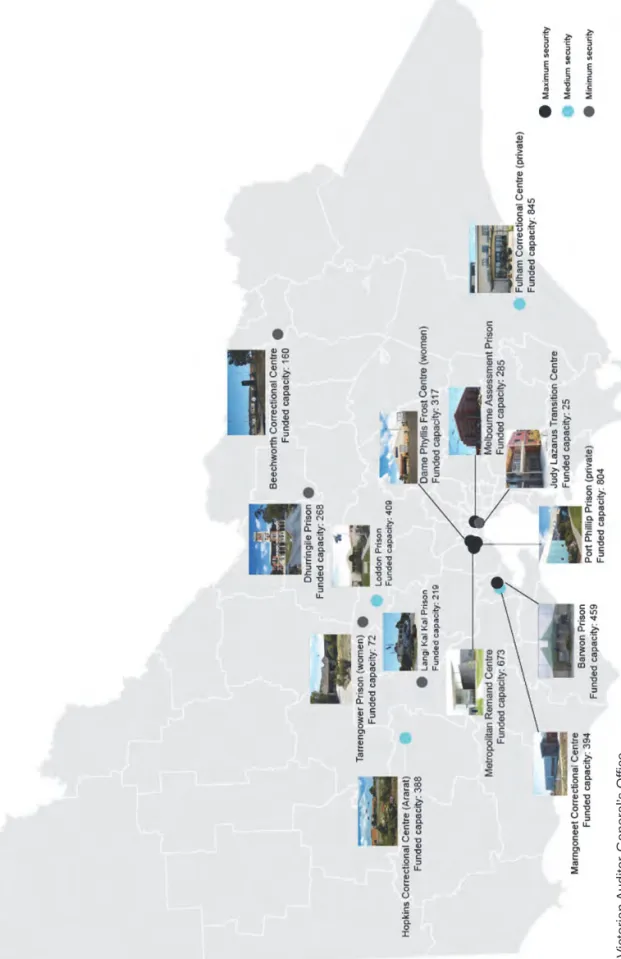
The prison system currently has a total funded capacity of 5 318 beds based on the premise that it will operate at between 90 and 95 per cent utilisation of operational capacity. At any given time beds will be unavailable for various reasons such as regular scheduled maintenance, which may reduce the operational capacity below total funded capacity. Two of Victoria's prisons are operated by private companies—Fulham Correctional Centre and Port Phillip Prison. Figure 1A summarises the prison system as at September 2012.
2
Prison Capacity Planning Victorian Auditor-General’s Report Background Figure 1A V ictoria’ s pri sons a t September 20 12 Source: V ictorian A udito r-General’ s Of fice.Background
1.2.1
Police cells
In addition to prisons, prisoners can be held in police cells. Although police cells are not counted in the prison capacity figures, they do serve an important role within the prison system. Victoria Police operates cells where people may be detained by police to await an interview, a bail hearing or to enter into the prison system.
However, keeping prisoners in police cells presents increased health and safety risks as police cells are not designed for long-stay detention and typically contain three beds per cell. Prisoners cannot be held in police cells beyond 14 days, except at the Mildura Police Station, which is able to hold prisoners for 30 days.
While in police custody prisoners do not receive access to offender rehabilitation or transition support programs they would receive if they were held in the prison system. At September 2012, there were a total of 373 beds consisting of 268 men’s beds and 105 women’s beds in police cells.
1.3
Corrections Victoria
Corrections Victoria (CV) is a service agency within the Department of Justice (DOJ). It is responsible for directing, managing and operating Victoria’s corrections system, including prisons and community correctional services. In 2012–13, the corrections system has a budget of $814.3 million.
CV’s stated purpose is to ‘contribute to safer communities by delivering a safe, secure and humane correction system'. It aims to do this through its…‘offender management practices, actively engaging with offenders and the community to promote positive behavioural change and address social disadvantage'.
1.3.1
Legislation
The primary legislation under which CV operates is the Corrections Act 1986. The purpose of the legislation is to provide for:
the establishment, management and security of prisons, and the welfare of prisoners
the administration of services related to community corrections and offender welfare
other correctional services.
1.4
Prison capacity planning
In addition to managing facilities, CV is responsible for providing sufficient prisoner support services and infrastructure to satisfy future demand. Prison capacity planning involves:
forecasting future trends
developing long-term strategies to meet forecast demand
Background
4
Prison Capacity Planning Victorian Auditor-General’s Report
1.4.1
Prisoner characteristics and subgroups
The nature of the prisoner population is a complexity which planners need to consider. Consequently, the security classification mix of prisoners will inform the infrastructure and services prison administrators require in finding a balance between order, deterrence, punishment and rehabilitation.
The prison population is composed predominantly of men, with women making up only 7 per cent of the total population at 30 June 2012. Many prisoners have served sentences in the past—48 per cent of men and 35 per cent of women in prison at 30 June 2012 had previously been imprisoned under sentence. The levels of education among prisoners tend to be lower than in the general community, with only 5 per cent of prisoners at 30 June 2012 having completed secondary, trade or tertiary
qualifications prior to their imprisonment.
Older prisoners
While the prison population as a whole increased by 38 per cent between June 2002 and June 2012 the number of prisoners aged 50 years and over increased by 95 per cent.
Indigenous prisoners
Indigenous people are over-represented in Victorian prisons. In 2011–12, Indigenous people were 10 times more likely to be imprisoned than non-Indigenous people.
Intellectual disability and acquired brain injuries
Studies published by CV show that the prevalence of acquired brain injuries (ABI) and intellectual disability in the Victorian prison system is significantly higher than in the general community. A 2011 study published by CV found that of the 117 prisoners assessed, 42 per cent of male and 33 per cent of female prisoners had an ABI, compared to an estimated 2 per cent of the general population. Prisoners with either an intellectual disability or an ABI may require specialised treatment both during incarceration and after release to maximise the chances of rehabilitation and prevent recidivism.
1.5
Previous reviews
In May 1999 VAGO published a special report titled Victoria’s Prison System: Community Protection and Prisoner Welfare. While the scope of the report was broader than the current audit, there were several findings related to prison capacity planning.
In particular, the report found that DOJ needed to adopt more effective long-term planning strategies for the prison system, and that a lack of capacity planning in the past had restricted the department’s ability to effectively manage prisoners.
Background
Further, it found that the lack of forecasting for prisoners with particular profiles had impinged upon the DOJ’s ability to manage prisoner subgroups, and that there had been a critical shortage of beds for female and protection prisoners. However, it recognised that the department had recently implemented structural changes to improve its strategic planning.
In July 2006 the Victorian Ombudsman tabled a report titled Conditions for Persons in Custody. The report found that prisoner complaints to the Ombudsman had increased by 86 per cent over 10 years to 2006. It found there were substandard conditions, overcrowding, inappropriate incarceration, insufficient staffing and limited health and mental health services available for prisoners in police and prison cells.
1.6
Audit objective and scope
The audit objective was to assess the effectiveness of DOJ's prison capacity planning, specifically whether DOJ is:
reliably forecasting prison demand
effectively planning for prison capacity.
The audit examined the prison capacity planning functions of CV, and the use of Victoria Police’s cells to manage periods of short-term high demand.
The audit focused primarily on prison infrastructure and support services. It did not examine human resource implications arising from additional prisoner numbers.
1.7
Audit method and cost
The audit was performed in accordance with section 15 of the Audit Act 1994 and the Australian Auditing and Assurance Standards. The total cost of the audit was
$310 000.
1.8
Structure of the report
The report is structured as follows:
Part 2 examines the adequacy of the infrastructure and prisoner support services within the prison system.
Part 3 examines CV and DOJ's planning and modelling for adequate prison capacity into the future.
2
Managing demand
pressures
At a glance
Background
Each year the prison system has held a greater number of prisoners, with a 38 per cent increase over the past 10 years. For the prison system to be effective it must not only be able to accommodate this increase but do so in a safe and secure environment that encourages rehabilitative outcomes.
Conclusion
Prison infrastructure has not kept pace with the increases in prisoner numbers over the past 10 years. As a consequence, the male prison system is under considerable pressure that is unlikely to be resolved in the near future.
Findings
The male prison system has been operating at close to or above 95 per cent of its operational capacity since May 2011.
The female prison system is currently operating well within its operational capacity.
There are currently more prisoners being held in police cells than is considered operationally prudent.
The expansion of prison capacity, through temporary beds and double bunks, without adding supporting infrastructure has increased the overcrowding of prisons and reduced access to services.
The provision of services and rehabilitation programs has not kept pace with the increasing prisoner population, despite actions from Corrections Victoria to remedy the situation.
Based on current projections, there is likely to be insufficient prison infrastructure to meet forecast demand in the next few years.
Recommendation
Corrections Victoria should determine whether its targeted offending behaviour programs have sufficient places to meet demand and, if necessary, incorporate this assessment in future funding submissions.
Managing demand pressures
8
Prison Capacity Planning Victorian Auditor-General’s Report
2.1
Introduction
Each year the prison system is required to hold a greater number of prisoners, with a 38 per cent increase over the past 10 years. For the prison system to be effective it should not only be able to accommodate the growing numbers but do so in a safe and secure environment. Prisoners should also be provided with support services that improve their rehabilitation outcomes.
This Part reviews the current state of the prison system by analysing prison utilisation rates, the number of prisoners in police cells, the suitability of prison infrastructure used, and the demand for prisoner support services.
2.2
Conclusion
Prison infrastructure has not kept pace with the increases in prisoner numbers over the past 10 years. Given the present infrastructure, the current rate of growth in male prisoner numbers is unsustainable in the immediate future. This is reflected in the high utilisation rate, which has remained close to or above the nationally-accepted limit of 95 per cent since May 2011.
The high demand pressure in the male prison system is driving up the number of prisoners held in police cells, which is compromising Victoria Police's operational capabilities and is well beyond the 100 prisoners that Corrections Victoria (CV) had previously committed to, and at times in 2012, beyond the revised target of 150 to 200 prisoners.
CV's projected increase in male prisoner numbers, contained in a 2012–13 Budget submission, shows that infrastructure will not be able to cope with future demand—with the male system running out of beds from May 2014, and a shortfall of over 1 400 beds by June 2016. Even allowing for some inaccuracy in CV's forecasts, it is apparent that there will be a significant shortfall in beds in the next few years.
By comparison, there is spare capacity in the women’s system. However, CV has heavily relied on modifying existing infrastructure and installing temporary beds to meet increasing demand. The ability to continue to add beds to the female system without building a new facility is nearing its limit due to space constraints and the poor quality of the existing infrastructure.
In addition to the physical infrastructure, the provision of services and rehabilitation programs has not kept pace with the increasing prisoner population, despite the efforts of CV to remedy the situation.
Managing demand pressures
2.3
Prison utilisation
As at 30 September 2012, the prison system had a funded capacity of 5 318 beds. At any given time some beds may be unavailable due to routine maintenance. This reduced bed total is called the operational capacity. CV aims to operate the prison system at between 90 per cent and 95 per cent of the operational capacity. The 95 per cent prison utilisation rate is the nationally-accepted limit for the safe and efficient operation of the prison system. This allows prison management the flexibility to adequately manage the rehabilitation, human rights and welfare of prisoners. Operating above 95 per cent utilisation compromises the ability of prison management to safely and humanely manage prisoners. If a prison is operating at or close to 100 per cent utilisation, prison authorities are limited in how they respond to prison incidents as there is less flexibility to move and separate prisoners.
With prisoner numbers increasing by 38 per cent since 2002, prison utilisation rates provide an indication of how well the prison system has kept pace with growing demand.
Male prison system
As Figure 2A shows, the utilisation rate for the male prison system has been above 95 per cent in a number of years. This is a result of not adding enough beds to meet the growth in prisoner numbers for those years. The male prison system reached its peak of 97.6 per cent in August 2007.
Decreases in the utilisation rate have generally reflected more prison beds being added to the male prison system. However, in 2003–04 additional beds were not added to the system—the decline in the utilisation rate reflected increased resourcing for diversionary programs.
Figure 2A
Victoria’s male prison utilisation rate, 2002 to 2012
Note: All figures at 30 June.
Source: Victorian Auditor-General’s Office. 85 90 95 100 2002 2003 2004 2005 2006 2007 2008 2009 2010 2011 2012 Per cent Male prisoners
Managing demand pressures
10
Prison Capacity Planning Victorian Auditor-General’s Report
As Figure 2B shows, the male prison system has been operating at close to or above its operational capacity of 95 per cent since May 2011. As at 30 September 2012, the male prison system was operating at 95.8 per cent of its operational capacity
(4 893 beds).
Figure 2B
Male prison utilisation rates, January 2011 to September 2012
Source: Victorian Auditor-General’s Office.
Female prison system
The female prison system is currently operating below its 90–95 per cent operational capacity range.
As at 30 September 2012, the women’s prison system was operating at 87.3 per cent of its operational capacity of 385 beds.
Figure 2C shows the year-on-year utilisation rates for the women's prisons system as at 30 June. The initial decrease in the utilisation rate at 30 June 2003 was due to the addition of 102 beds at the Dame Phyllis Frost Centre in 2001–02 and 2002–03. Otherwise, the increases and decreases reflect changes in the number of female prisoners.
The large increases in the utilisation rate in 2009 and 2010 appear to have been driven by Victoria Police's operations targeting drug crime. As CV did not forecast this
increase in prisoner numbers, the number of prison beds did not increase sufficiently to hold the additional prisoners.
As a consequence, CV used temporary accommodation that went beyond the funded capacity to house the women's prisoners—such as temporary beds in interview rooms. This resulted in the women's prison system reaching its peak of 103.2 per cent in March 2010. This issue is explored further in Part 3.
90 91 92 93 94 95 96 97 98 99 100 Per cent Male prisoners
Managing demand pressures
Given the small numbers of female prisoners, the women’s system is susceptible to large variations in prisoner numbers as occurred in 2009. It is therefore prudent to maintain the utilisation rate below 90–95 per cent operational level.
Figure 2C
Victoria's female prison utilisation rates, 2002 to 2012
Note: All figures at 30 June.
Source: Victorian Auditor-General’s Office.
2.4
Police cells
Police cell numbers are influenced by both police activity and the amount of spare capacity in the prison system. When the prison system is operating at, or close to 95 per cent utilisation, CV is less able to move prisoners from police cells into prisons unless a corresponding number of prisoners are released from prisons.
The high male prison utilisation rate has placed considerable pressure on police cells. There are currently more prisoners being held in police cells than is operationally prudent and there has been a considerable escalation of prisoner numbers in 2012.
2.4.1
Police cell capacity
There are a total of 373 police cell beds consisting of 268 men’s beds and
105 women’s beds. However, police cells cannot operate at 100 per cent capacity for two reasons.
First, Victoria Police requires spare police cell capacity to hold newly arrested prisoners.
Second, there are generally three beds in each police cell. When a woman, minor or protection prisoner is housed in a cell, the remaining beds in that cell cannot be used unless there is the equivalent number of women and minors of the same sex. This means that at any particular time the number of available beds may be greatly reduced, depending on the prisoners being held.
75 80 85 90 95 100 2002 2003 2004 2005 2006 2007 2008 2009 2010 2011 2012 Per cent Female prisoners
Managing demand pressures
12
Prison Capacity Planning Victorian Auditor-General’s Report
In a May 2012 report, Victoria Police modelled the maximum number of CV prisoners that can be held in police cells before its operations are compromised. The model showed that Victoria Police can provide up to 217 beds for CV prisoners—or, at a higher level of risk, 225 beds—and generally still have enough capacity for police prisoners.
However, the report acknowledges that these maximum numbers are based on a number of ideal assumptions that are unlikely to occur in reality, as they:
do not account for the fact that, while over half of the police stations with police cells are in regional areas, over 70 per cent of prisoners are held in metropolitan cells
do not allow for scenarios such as if there is one female in a police cell, the remaining two beds cannot be used to accommodate male prisoners.
As a consequence, the maximum number of prisoners that can be held in police cells before Victoria Police's operations are compromised is likely to be below 200.
Conditions in police cells
Keeping CV prisoners in police cells presents increased health and safety risks as police cells are not designed for long-stay detention. Prisoners in police cells do not have access to rehabilitation and education programs available in prisons.
The high numbers of CV prisoners in police cells in 2012 is well beyond what the Department of Justice (DOJ) and CV deem to be satisfactory. In funding submissions and briefings to government since 2006, DOJ has advised that, given the risks
associated with keeping prisoners in police cells, CV is committed to maintaining fewer than 100 prisoners in police cells. In June 2012, the Department of Justice advised Victoria Police that the number of prisoners held in police cells would range between an estimated 150 and 200 prisoners per day, based on forecast prisoner numbers.
2.4.2
Prisoners in police cells
As Figure 2D shows, between July 2006 and January 2012, the monthly average number of prisoners held in police cells has generally averaged below CV's previously committed limit of 100 per day.
In 2006, the Marngoneet Correctional Centre and the Metropolitan Remand Centre were opened, creating an increase of 913 prison beds. This allowed CV to move additional prisoners into the prison system, reducing the number of prisoners being held in police cells.
However, as the prison utilisation rate has remained close to or above the 95 per cent upper limit since May 2011, the pressure on police cells has again increased. The number of prisoners being held in police cells has been above 100 every day since late January 2012, peaking at 251 prisoners on 24 August—the highest figure since September 2002. In May 2006, the number of prisoners held in police cells reached 240 but decreased to around 100 prisoners per day following the opening of the Metropolitan Remand Centre.
Managing demand pressures
Figure 2D
Weekly average prisoners held in police cells at 7am daily
Source: Victorian Auditor-General's Office.
2.5
Prison infrastructure
2.5.1
Increases to prison infrastructure
DOJ and CV have not always received requested funding for long-term infrastructure, such as a new prison, to meet increasing prisoner demand. Instead DOJ and CV have had to rely on a combination of adding permanent beds to existing prisons, and using temporary beds and double bunks to meet growing demand.
While adding permanent or temporary beds to existing infrastructure is a less costly option to address increasing demand than building a new prison, there is a limit to how far a prison can be expanded within existing walls and property boundaries. In
addition, installing extra permanent or temporary beds without adding to a prison's amenities increases the pressure on central services such as prisoner reception areas, education and health facilities, industries, laundries and kitchens.
As a result, the expansion of prison capacity without adding supporting infrastructure increases the overcrowding of prisons and reduces access to services.
Original design capacity
As at 30 September 2012, all 14 prison facilities—aside from the Judy Lazarus Transition Centre—contained more beds than their original design capacity. This is an extra 1 842 beds, or 53 per cent more than original design capacity.
For the men’s system there are 1 602 (48 per cent) more funded beds than the infrastructure was originally designed to support. The women’s system contains 240 funded beds (161 per cent) more than the original design capacity.
0 50 100 150 200 250 300
Managing demand pressures
14
Prison Capacity Planning Victorian Auditor-General’s Report
Current supported capacity
CV has made infrastructure improvements to increase the supported capacity of nine of the 14 prison facilities. Figure 2E shows the original design capacity, the current supported capacity and the funded capacity of each prison facility.
Figure 2E
Original, current supported and funded capacity of each prison at 30 September 2012 Prison Security level Original design capacity Current supported capacity Funded capacity
Men's prison system
Melbourne Assessment Prison Maximum 229 229 285
Port Philip Prison Maximum 577 670 804
Barwon Prison Maximum 250 325 459
Metropolitan Remand Centre Maximum 613 613 673
Marngoneet Correctional Centre Medium 300 300 394
Hopkins Correctional Centre Medium 200 330 388
Fulham Correctional Centre Medium 590 658 845
Loddon Prison Medium 250 250 409
Beechworth Correctional Centre Minimum 120 160 160
Dhurringile Prison Minimum 96 268 268
Langi Kal Kal Prison Minimum 77 199 219
Judy Lazarus Transition Centre Minimum 25 25 25
Men's prison system 3 327 4 027 4 929
Women's prison system
Dame Phyllis Frost Centre Maximum 125 260 317
Tarrengower Prison Minimum 24 72 72
Women's prison system 149 332 389
Prison system
Total 3 476 4 359 5 318
Source: Victorian Auditor-General's Office.
Despite these modifications, nine male prisons have a funded capacity greater than their infrastructure is designed to support, totalling an additional 959 funded beds (22 per cent) above the current supported capacity. These are all medium or maximum security prisons, while the minimum security facilities hold funded capacity equal to their current supported capacity. This indicates that there are greater infrastructure pressures on the prisons with a higher security classification.
Modifications to the men's system have meant that male prisons can support an additional 700 beds. This reduces the pressure on existing supporting amenities; however, the male system is still holding an additional 902 beds (22 per cent) over the current supported capacity of the infrastructure.
Managing demand pressures
The women’s system has also been modified considerably, reducing the number of prisoners above the current supported capacity to 57 beds (17 per cent). Most of these modifications have been made to the Dame Phyllis Frost Centre, where the capacity has been increased from the original 125 beds to 260.
However, there is a limit to how far the existing infrastructure can be expanded. In DOJ’s Women's Correctional Masterplan (2010), DOJ and CV have proposed to build a new multipurpose precinct to house 550 women offenders and to seek to either close, rebuild or refurbish the Dame Phyllis Frost Centre. This decision was based on the poor design and poor infrastructure of the Dame Phyllis Frost Centre, which has resulted in 'overcrowding and allocation of unsuitable accommodation'.
Temporary beds and double bunking
Reliance on temporary beds and double bunking in the long term is contrary to CV’s standards, which recommend the use of single cells to maintain higher health, safety and rehabilitation outcomes. CV's standards are designed to comply with national guidelines, national principles and Victorian legislation.
CV has introduced 1 036 temporary beds into the prison system, representing 19 per cent of the total funded capacity. Of these beds, 873 have been placed in the male system and 163 into the female system, representing 18 per cent and 42 per cent of total funded capacity respectively.
As at June 2012 across the prison system there were:
583 double bunks (which potentially equates to 1 166 prisoners sharing a cell)
79 dual occupancy cells (158 prisoners)
80 temporary dual occupancy cells (160 prisoners)
67 triple occupancy cells (201 prisoners).
As a consequence, of the 5 024 prisoners in the prison system on 30 September 2012, a total of 1 685 prisoners, or 34 per cent, could potentially be housed in
accommodation that does not comply with CV's recommended single cell standards. While 359 of the 1 685 prisoners could be held in cells that were designed to hold multiple occupants, and therefore have more space, the multiple occupancy cells do not comply with CV's single cell standards.
2.5.2
Management and high security beds
In the day-to-day operations of prisons, prison authorities use management and high security beds to isolate prisoners from the rest of the prison population for the purpose of managing behaviour or protecting prisoners from other prisoners. A very high utilisation rate in these beds reduces prison authorities’ flexibility to respond to emerging prison incidents by moving and separating prisoners.
The modifications that have taken place in prisons have not included management and high security beds as the number of these cells in prisons has not been increased since 2007 and has not kept up with increasing prisoner numbers.
Managing demand pressures
16
Prison Capacity Planning Victorian Auditor-General’s Report
As at 30 September 2012 there were 137 management and high security beds in male prisons. As Figure 2F shows, the average daily utilisation rate for these beds was 97 per cent, and three of the units, Melaleuca (Barwon), Exford (Metropolitan Remand Centre) and Charlotte (Port Philip Prison), averaged 100 per cent utilisation. By comparison, in June 2008 the daily utilisation rate for management and high security beds in male prisons was 49 per cent.
Figure 2F
Average daily utilisation rates of prison management and high security beds, June 2008 to June 2012
Prison—unit per cent 2008 per cent 2009 per cent 2010 per cent 2011 per cent 2012
Men's prison system
Barwon—Acacia 46 46 29 50 88
Barwon—Banksia 63 84 87 89 97
Barwon—Melaleuca 78 74 70 81 100
Metropolitan Remand Centre— Exford
85 85 85 92 100
Port Philip Prison—Charlotte N/A 89 74 94 100
Men's prison system 49 77 70 82 97
Women's prison system
Dame Phyllis Frost Centre— Swan 2
N/A N/A N/A 40 65
Women's prison system N/A N/A N/A 40 65
Note: All figures at 30 June.
Source: Victorian Auditor-General’s Office.
Prisoner incidents
As Figure 2G shows, the rate of serious incidents, such as assaults, attempted suicides and self-mutilation, nearly doubled over the past six years. This has coincided with an increase in the prisoner numbers and overcrowding within prisons and
management and high security beds.
Managing demand pressures
Figure 2G
Rate of serious incidents per prisoner per quarter, July 2005 to June 2012
Source: Victorian Auditor-General's Office.
2.5.3
Health beds
Prisoner populations typically have worse overall health than the general public. Prisoners are more like to present with mental illness, health problems associated with substance abuse, blood-borne viruses and acquired brain injuries. The ageing prisoner population creates further demands on the prisoner health system.
DOJ is responsible for providing health services for prisoners. The male prison system has 76 prison health beds out of a total of 4 929 beds. Funding for prison beds also includes a funding component for per prisoner primary health services.
CV's Prison Facilities Master Plan identified a shortage of health beds in 2007. The master plan states that the health bed capacity was established in 1996–97 for a prison population of approximately 2 300 prisoners and a ratio of one health bed per 30 prisoners. However, when the master plan was developed, the prisoner population was 4 000 prisoners and a ratio of one health bed per 52.6 prisoners. This placed the prison health system under considerable strain with:
100 per cent occupancy in these units
prisoners requiring urgent mental health care placed in non-medical accommodation with sub-optimal support.
There have been no additional health beds added to the male prison system since 1996–97 despite the prison population doubling in this time. The patient-to-bed ratio is now one bed for every 61.7 prisoners.
Hopkins Correctional Centre's expansion will include five health beds and the new prison at Ravenhall is expected to include 75 mental health beds. Until these additional beds are added to the male prison system in 2014 and 2017 respectively, prisoner health beds will continue to be under-resourced.
0 0.01 0.02 0.03 0.04 0.05 0.06 0.07 0.08 0.09 0.1
Managing demand pressures
18
Prison Capacity Planning Victorian Auditor-General’s Report
2.5.4
Future demand
Male prison system
DOJ and CV’s 2012–13 successful funding submission for additional prison beds included forecasts that the male prisoner population will grow by 44.7 per cent between June 2011 and June 2016 to 6 391 prisoners—an increase of
1 974 prisoners. DOJ and CV attributed the growth to projected general population growth and the implementation of proposed new sentencing and bail reforms, which include:
abolition of suspended sentences
abolition of home detention
bail reforms
baseline sentences for certain serious offences.
In the submission, CV stated that, regardless of the sentencing reforms, 'the male prison system will run out of beds by May 2014'. CV estimated the shortfall would increase to 1 444 prison beds by June 2016. While Part 3 of this report indicates that there is a margin for error in CV's forecast increases, there is a tendency for these forecasts to understate the actual prisoner population when forecasting prisoner numbers in four to five years' time.
Even with the additional 895 beds funded in the 2012–13 Budget, there will still be insufficient prison infrastructure to meet forecast male prisoner demand in
2016–particularly as the new 500-bed prison in Ravenhall is not due for completion until 2017.
Female prison system
The poor condition of the Dame Phyllis Frost Centre, which holds 317 of the 389 beds (81 per cent) in the female system, leaves the women's system vulnerable to meet future demand. In its 2010 Women's Correctional Masterplan, DOJ and CV stated that the women's 'prisons are beyond full design capacity and the revised projections for women's prisoner numbers cannot be accommodated in the current women's system'. An additional 84 permanent beds was opened at Dame Phyllis Frost Centre in
October 2012 and 57 temporary beds will be taken offline and kept in reserve as surge capacity.
2.6
Prisoner support services
CV provides prisoners with a variety of support services including health services, rehabilitation and education programs.
The provision of services and rehabilitation programs has not kept pace with the increasing prison population, despite actions from CV to remedy the situation.
Managing demand pressures
2.6.1
Support services funding
Prior to 2009–10, when CV needed additional temporary beds to meet short-term demand for that financial year, it requested funding for the infrastructure and custodial staff only and not for support services such as health services and rehabilitative programs. This is because CV did not expect the temporary beds to remain in the system for the long term. This created a shortfall in the provision of some services as prisons had to cope with a greater number of prisoners within existing funding arrangements.
A decrease in the number of prisoners accessing support services has the potential to limit the success of rehabilitation and increase the risk of reoffending.
CV has taken action to address the funding deficiency by making sure that future funding requests for temporary beds include the costs of providing support services. However, there is a residual shortfall because this additional funding does not provide a support services allocation for the temporary beds already in the prison system.
2.6.2
Support service delivery
CV provides a range of rehabilitative programs for offenders based on identified needs and risk of reoffending. These programs are therapeutic interventions aimed at changing offenders' behaviour and are administered across the following streams:
drug and alcohol
violence
sex offending
problem solving.
Due to deficiencies in the performance measurement and reporting of its offending behaviour programs, CV does not know how extensive the shortfall in some services has been. In 2012, CV implemented a new performance measurement framework to address this issue. In contrast, where CV has been able to measure a service shortfall covering in-prison treatment for sex offenders and vocational education and training (VET), it has addressed the shortfall by developing a business case and receiving additional funding to service the increased demand.
Sex offender programs
Prior to a funding increase in the 2012–13 Budget, the in-prison sex offender treatment program was unable to meet the increasing prison demand. Sex offender programs had been allocated 60 program placements per financial year at Marngoneet
Correctional Centre, regardless of demand. Since 2008, demand for the sex offender programs exceeded CV’s capacity to provide them. From 2008–09 to 2011–12 there was a demand for 433 treatment places with capacity to service only 240 treatment places.
Managing demand pressures
20
Prison Capacity Planning Victorian Auditor-General’s Report
As a consequence, a backlog of eligible offenders has developed. Due to delays in beginning a sex offender program, in 2011–12 only 33 per cent of prisoners starting treatment completed their program prior to their earliest eligible release date compared to 81 per cent in 2009–10. From 2012–13, sex offender programs are funded to provide 110 places annually. CV anticipates that the backlog will be reduced within 12 months. It should be noted that CV does have a program that focuses on the assessment and treatment of all sex offenders post-sentence.
Education
Education is an important component of a prisoner's rehabilitation and has been shown to lead to decreases in reoffending.
Prior to January 2012, Skills Victoria was responsible for funding VET for prisoners. From 1995 to 2009, the funding allocation for VET was increased in line with the Consumer Price Index only, despite prisoner numbers increasing by 76 per cent from June 1995 to June 2009. As a consequence, the opportunity for prisoners to complete VET programs decreased.
This is reflected in VET participation rates, which decreased from 36.1 per cent in 2004–05 to 32.5 per cent in 2008–09. In a 2010 agreement with Skills Victoria, responsibility for VET was transferred to CV together with an increase in funding. CV was also able to build funding for VET into its ‘per prisoner per day’ funding
arrangements. It currently has a participation target of 40 per cent of all prisoners in 2012–13.
Recommendation
1. Corrections Victoria should determine whether its targeted offending behaviour programs have sufficient places to meet demand and, if necessary, incorporate this assessment in future funding submissions.
3
Prison capacity planning
At a glance
Background
Prison authorities need to forecast future growth trends and make plans so that the prison system is capable of accommodating future prisoner populations. This planning usually involves developing a combination of long-term strategies such as providing additional infrastructure and using short-term measures.
Conclusion
In the past 10 years, the Department of Justice (DOJ) and Corrections Victoria (CV) have taken reasonable steps to manage prison capacity, but with some areas capable of improvement. The success of DOJ and CV's long-term strategies has depended on the timeliness of the approval and implementation of major prison infrastructure projects. Delays in funding approval and implementation have contributed to existing prison capacity pressures in the male prison system. Given this, CV has actively addressed capacity shortages by implementing a number of short-term measures such as temporary beds. However, CV could improve the forecasting component of its prison capacity planning.
Findings
DOJ and CV's long-term strategies have incorporated a multi-faceted approach to address prison demand.
While CV's models are able to forecast male prisoner numbers reasonably accurately for up to three years, there are deficiencies in the models that reduce their accuracy over time. However, given the complexities of the prison and broader justice system, no model will be completely accurate.
Recommendations
Corrections Victoria should:
update and improve the primary forecasting model
conduct regular external reviews of the primary forecasting model
use the secondary model in a limited capacity only
develop a new forecasting model and then establish a consolidated multi-forecast system
Prison capacity planning
22
Prison Capacity Planning Victorian Auditor-General’s Report
3.1
Introduction
Prison authorities are required to forecast future growth trends and plan appropriately so that the system is capable of accommodating future prisoner populations. This is made difficult by the long lead time required to construct new prisons and expand existing facilities, and by the complexities of accurately forecasting the effect of policy initiatives.
While long-term planning is important, the large growth in prisoner numbers over the past 10 years and the periodic peaks in these numbers mean that authorities need to act quickly to address capacity shortages.
Corrections Victoria (CV) must achieve this within budgetary constraints. With limited resources at their disposal, governments and central agencies are required to balance corrections funding priorities with other competing areas such as health, education and transport each year.
This Part assesses the Department of Justice (DOJ) and CV's long-term prison capacity planning, their contingency planning and their briefing to management and government on issues and options. The methods CV uses to forecast future prisoner numbers are also reviewed.
3.2
Conclusion
In the past 10 years, DOJ and CV have taken reasonable steps to manage prison capacity, with some areas for improvement.
DOJ and CV have developed two comprehensive long-term strategies for the male prison system that have formed the basis of funding additional prisoner infrastructure. However, the success of the two strategies has been contingent on the timeliness of both the funding approval and the implementation of major infrastructure projects. The delays to the construction of the Hopkins Correctional Centre expansion and the funding of a new male prison have compromised the success of the Prison Facilities Master Plan and resulted in additional capacity pressures on the male prison system. Given this, CV has responded promptly by introducing a number of contingency measures, such as temporary beds, which were able to take effect relatively quickly. However, CV could improve the forecasting component of its prison capacity planning. While the models have accurately predicted the broad trend of rapidly growing prisoner populations, there is an increasing margin of error for each additional year the model is forecasting. The models should also be externally reviewed and refreshed more regularly.
Given that the forecasting error rates are higher for the female prison system due largely to the smaller prisoner population, the female system is vulnerable to stress when sudden unforeseen spikes in prisoner population occur.
Prison capacity planning
DOJ and CV have kept senior management and government comprehensively informed of emerging trends, risks and issues. Business cases have provided government with sufficient information to make informed funding decisions.
3.3
Long-term strategy
Since 2001, DOJ and CV have responded to emerging male prison demand pressures and the forecast increases in male prisoner numbers by developing two long-term strategies. They are in the process of developing a third.
These strategies have incorporated a multi-faceted approach that combines infrastructure investment to address forecast increases in demand, and demand management initiatives that aim to reduce the growth in prisoner numbers.
3.3.1
Corrections Long Term Management Strategy
(2001)
In 2001, as a response to the 29 per cent growth (713 prisoners) in prisoner numbers in the four years prior to June 2000, CV developed the Corrections Long Term
Management Strategy. The strategy comprised two key elements—a range of
diversion and rehabilitative initiatives designed to reduce demand growth, and an infrastructure initiative. The diversion strategies included:
diverting low-level offenders to the community corrections system or home detention instead of prison
offering pre- and post-release support programs for prisoners and offenders in the community.
The 10 Year Facilities Master Plan for the Victorian Prison System 2001–2010 included the infrastructure component of the Corrections Long Term Management Strategy. The major elements of the master plan were funded in the 2001–02 Budget. These major projects include the Beechworth Correctional Centre, Marngoneet Correctional Centre, the Metropolitan Remand Centre and the Judy Lazarus Transition Centre, all opened between 2005 and 2007.
Effectiveness
The opening of the new prisons had a positive effect on the number of CV prisoners in police cells. By July 2006, the weekly average number of CV prisoners in police cells was consistently around or below 100, which had not been the case since 2002. The figures then remained consistently below 100 until the present spike in numbers began in August 2011.
The new prisons had less impact on prison utilisation rates, although there was a drop in the rate of utilisation in the men's system from 95.1 per cent at 30 June 2005 to 92.3 per cent at 30 June 2006. There were several reasons for this:
CV closed several prisons and removed a number of temporary beds during the same period, meaning that operational capacity increased by 280 beds only between June 2004 and June 2006.
Prison capacity planning
24
Prison Capacity Planning Victorian Auditor-General’s Report
3.3.2
Prison Facilities Master Plan
(2007)
In 2007, CV developed the Prison Facilities Master Plan, which aimed to set out the maintenance, upgrade and renewal of the male prison system for 2007–12 and to provide a 10-year outlook to 2017. The objective of the strategy was to increase the capacity of the system to respond to the growing demand pressures which saw an increase of 517 male prisoners, or 15 per cent, between March 2006 and June 2007. As a response to the pressure on the prison system, in 2006–07 CV secured funding for 219 temporary beds for one year. In 2007–08, CV received single-year funding for 687 temporary beds, and then ongoing funding in 2008–09. These beds are now a permanent part of the system. The two significant infrastructure projects proposed within this strategy were the 350-bed expansion of the Hopkins Correctional Centre and the new 600-bed male prison, with additional beds added across the existing prison system.
Effectiveness
The effectiveness of the plan was compromised by delays in the construction of the Hopkins Correctional Centre and the new male prison not being funded until 2012–13. These delays have resulted in additional capacity pressures.
The plan originally aimed to have the two facilities operational by 2012. However, the Hopkins Correctional Centre expansion will not be available until 2014 and the new male prison until 2017.
As a consequence of these delays, DOJ and CV have had to rely on a combination of adding additional permanent beds to existing prisons and using temporary beds to meet growing demand.
Hopkins Correctional Centre
The Hopkins Correctional Centre expansion was funded in 2008–09 and was originally planned to be operational by December 2012. However, due to difficulties with the construction, its completion has been delayed to 2014. Examining issues that contributed to these delays is beyond the scope of this audit.
New prison
As part of the budgetary process, departments develop business cases for new asset and non-asset expenditure. These business cases are assessed by the Department of Premier and Cabinet (DPC) and the Department of Treasury and Finance (DTF), which then provide advice to government on whether or not they support the proposal. DOJ and CV submitted funding applications for a new male prison as part of the 2008–09, 2009–10 and 2010–11 Budget processes. However, these were not supported by DPC or DTF.
With limited resources at their disposal, governments are required to balance
corrections funding priorities with other competing areas such as health, education and transport each year.
Prison capacity planning
In weighing up competing budgetary priorities and advising against the bid in 2010–11, DPC and DTF maintained that as the male prison system had been operating above the nationally accepted utilisation rate of 95 per cent, the system could operate at up to 98 per cent capacity in the short term.
This advice explicitly acknowledged the following adverse impacts of overcrowding:
a possible breach of the Victorian Charter of Human Rights
an increase in the number of serious prison incidents
continued diversion of police resources away from community policing roles to watch over prisoners in police cells.
Ultimately the government did not support DOJ's funding applications for a new male prison in the 2008–09, 2009–10 and 2010–11 Budgets.
As stated in Part 2 of this report, the male prison system has been operating at close to or above 95 per cent utilisation, resulting in increased pressure on the prison system with:
decreased flexibility for prison authorities to move prisoners
unsustainable prisoner numbers in police cells
increased risk of prisoner incidents
greater pressure on prison facilities
greater pressure on prisoner services such as health and rehabilitation.
Operating the male system at a utilisation rate of 98 per cent will put the system under unsustainable stress, with each of these pressures likely to worsen as the utilisation rate increases above 95 per cent.
In taking competing priorities into account, DPC and DTF took the position that the new male prison was not as critical as the other DOJ and CV proposals, particularly those relating to the expansion of the female prison system. In late 2009 when this advice was given, the women's prison system was operating at 100 per cent capacity. DPC and DTF considered that the female capacity required more urgent action and should be the priority for the 2010–11 Budget, given the higher utilisation rate and limited budget capacity.
As part of the 2012–13 Budget, DOJ and CV sought funding for a new 1 000 bed male prison instead of 600 beds, with an expected completion date of 2017. This submission took into account the growth in demand that had occurred since the development of the master plan and forecast future demand.
The funding submission was approved by government with the decision to support a 500-bed prison at Ravenhall, with scope to expand to 1 000 beds at a later date. DOJ was allocated $670.4 million in the 2012–13 Budget to build the new medium-security prison and an additional 395 new beds within existing prison infrastructure, due for completion in 2014.