Requirements for a Practical
Network Event Recognition Language
Karthikeyan Bhargavan University of Pennsylvania [email protected] Carl A. Gunter University of Pennsylvania [email protected] Abstract
Weproposearun-timemonitoring andcheckingarchitecturefornetwork protocols
calledNetworkEventRecognition. Ourframeworkisbasedonpassivelymonitoring
thepackettrace producedbyaprotocolimplementationandcheckingitfor
proper-tieswritteninaformalspecicationlanguage,NERL.Inthispaper,wedescribethe
design requirements for NERL. We show howthe unique requirements of network
protocol monitoring impact design and implementation options. Finally we
out-lineourprototypeimplementationofNERLanddiscusstwocase studies: checking
the correctness of network protocol simulationsand privacyissues inpacket-mode
surveillance.
1 Introduction
Runtime monitoring enables a monitor M to observe events created by a
programP andcheckpropertiesoftheseeventsastheprogramexecutes. Ifthe
programP can beinstrumented tocreateaprogramP 0
that generates events
internalto P and reports them in aconvenient form toM, then the monitor
M can besimpliedto take advantage of this \whitebox" event recognition.
In some circumstances,it isdesirableoressentialto avoidmodicationof the
original program by the monitor and make do with \black box" analysis of
the events produced by the monitored program. In this case the ability to
choosewhat events are monitoredfallsmuch morecompletelyonthe monitor
M, which must now recognize the events it aims to monitor from possibly
incomplete and low-level events observable fromP.
Theaimofthispaperistodescribesomekeyrequirementsforevent
recog-nitionforblackboxmonitoringofpacket-modecommunicationprotocols,
par-ticularlyprotocolsbuiltontheInternetProtocol(IP).Suchprotocolsproduce
Thisisapreliminaryversion. Thenalversionwill bepublishedin
packets as low-level events but analysis typically focuses on properties
de-rived from collections of packets that are amalgamatedto produce high-level
events. We argue that a new language is appropriate for this task and
de-scribe a collection of requirements for the language. Many of the ideas from
runtime monitoring languages can be applied,but our experience shows that
new techniques can substantially improve convenience, clarity, and eÆciency.
Black box network monitoring is already a popular technique to study
protocolbehaviorafterdeployment. Sofar,ithasbeenusedinprimarilythree
ways: performancetesting,intrusiondetection,andsurveillance. Performance
testinginvolvesplacingmonitoringagentsatvariouspointsinthenetworkthat
collect statistics on the packets that pass through them. These statistics are
thencorrelatedtotriggeralarmsorproducereportswhenunexpectedbehavior
is encountered. Intrusion detection systems reconstructprotocolsessions and
matchthemagainstalibrary of \attacksignatures", tosee ifamalicioususer
isexploitingknownsecurityholesinthenetwork. Finally,surveillancesystems
capture protocol sessions and simply record the emails or les sent between
parties, if they match one of several triggeringkey-phrases.
Weproposetoaddafourthruntimevericationaspecttonetwork
monitor-ing, which we call Network Event Recognition (NER).Forinstance, consider
the SMTP [Pos82] protocol that transfers emails across the internet. Every
email has a \From" address that the sender lls in. In addition, SMTP
re-quires a mail envelope that also contains a \MailFrom" eld, which usually
has the same address asthe From eld. Suppose we want tocheck that these
elds do indeed have the same address for all emails in our local network.
Then the event thatwe are interested inisFromMismatch,which istriggered
whenever an email's From and the SMTP MailFrom do not match. In an
eventdenition language, suchasMEDL [LKK +
99],this would bewrittenas
event FromMismatch = EmailSeen when
(EmailSeen.Header.From != EmailSeen.Envelope.MailFr om)
Then, we can compile such adenition toa runtime monitorthat analyzes a
packet trace and produces FromMismatch alarms whenever such an email is
seen.
Clearly the above denition still leaves a number of open questions. For
example, how is EmailSeen dened? How are the packets inthe packet trace
read into the monitor, and how are emails reconstructued from individual
packets? Is it feasible to run such ananalysis onall emails in a network? In
this paper, we shall discuss what would be required to write such an event
denition, and then what would berequired for it torun eÆciently.
The paper is presented in eight sections. In the second section we dene
the conceptofNetworkEventRecognition,includingacharacterization ofthe
kinds of events that need to be monitored. In the third section we describe
four principal requirements for a practical implementation of NER. In the
the fth section we describe our prototype design and implementation based
onthe Network Event Recognition Language(NERL).The sixthand seventh
sectionsprovidecasestudiesbasedonnetworksimulationanalysisand
packet-mode surveillancerespectively. The eighth sectionconcludes.
2 NER Model
Ourmonitoringmodelisbasedonpassive,black-boxnetworkmonitoring. We
place one monitoringmachine onthe samebroadcast LAN asthe hosts being
monitored. Themonitorcanseeonlythemessagessentbetweenhosts,notthe
state at each host. We assume that allthe interesting IP traÆc on the LAN
can be captured and fed into an analysis engine. This capture and analysis
may be done either on-line, using a packet capture library (such as libpcap),
or o-line, where the captured packets are storedin a trace leas isthe case
in network simulations.
The goal of a protocol monitor is to recognize protocol events. At the
lowest layer, a protocol event is as simple as a packet P has been sent from
A to B. Higher layer data like emails, however, are broken up into several
packets, and some of them may be resent for reliability. So at higher layers,
recognizing complex events like an email E has been sent from U to V may
involvecapturinga numberofpackets, correlatingthem andputtingthe data
in these packets together. We call this hierarchical process of recognizing
protocolevents at dierent layers Network Event Recognition (NER).
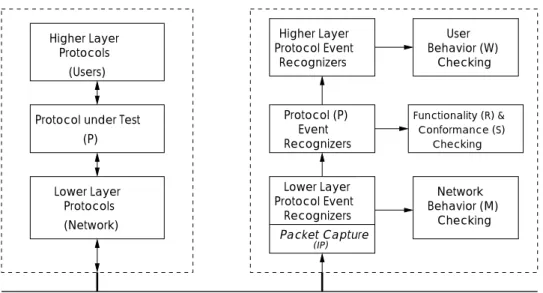
The NERframeworkcan bevisualized asinFigure 1. The gure is
anno-tated with terms from the WRSPM software artifact model [GGJZ00]. The
`World' W is the operationalenvironment, which includesendpointactivities
that spawn network events. The `Requirements' R are properties expected
of the system, such asthe requirement that a routing protocolnds paths to
destinations. The `Specication' S denotes the software specication, suchas
an IETF RFC. The `Program' P denotes the implementation of the system.
The `Machine'M istheprogrammingplatform. Theseare relatedbythe idea
that P is built on M to satisfy S, and S is chosen to ensure R given the
operational assumptionsin W.
AtthebottominFigure1istheinterfacewiththeprotocolimplementation
undertest,whichisrunningonadevice(DUT).InthecasethatNERisbeing
usedtomonitoralivenetwork,thisinterfaceisthe`wire'onwhichthemonitor
is `sniÆng' (listening) for interesting packets. On the other hand,when NER
isusedtoanalyzenetworksimulationsthen theinterfacebetweenthe monitor
and the implementationis the simulationtrace le.
Foreachprimitiveeventinterface,weneedaprimitiveeventcapture
mod-ulethatcanconvertnetworkorsimulationtraceeventsintoaformat thatcan
be understood by the event recognizers. In Figure 1, the IP packet capture
modulecarriesoutthis task,whileinsimulationanalysisatrace-to-event
recogniz-Lower Layer
Protocols
(Network)
Higher Layer
Protocols
(Users)
Protocol under Test
(P)
Device Under Test
Shared Network (Ethernet)
Behavior (M)
Recognizers
Event
Protocol (P)
Checking
Functionality (R) &
Conformance (S)
Higher Layer
Protocol Event
Recognizers
Network
Checking
Behavior (W)
Checking
User
Lower Layer
Protocol Event
Recognizers
Packet Capture
(IP)
Passive Monitor
Fig.1. Live MonitoringusingNetwork Event Recognition
ers carry out the actual analysisof the stream,and check for themonitorable
properties of interest for the protocol. Finally, some events are classied as
alarms, and must be delivered to the appropriate authorities. For instance,
when an intrusion event is recognized, the administrator may need tobe
no-tied. Event delivery can range from writing to a log, sending email to an
administrator, orsending correctivemessages tothe device under test itself.
Thereare two kinds of primitiveevents of interest:
Primitive Network Events These are identied and delivered by the
cap-ture module. For instance, libpcap (tcpdump.org ) is an open source tool
thatcapturesIP packets fromEthernetwiresandpresentsthem to
request-ing programs, and can be used for live network testing (as the IP packet
capture tool inFigure 1).
Timer Events Another kind of primitive event is the tick generated by a
systemclock. Manyprotocolshavespecicationsandrequirementsthatare
time-bound. This makes it necessary for NER to keep track of the system
clocktorecognizeeventssuchastimeoutsthatareoftennecessary tosignify
the absence of anevent.
Forhigher-layerevents(alsocalledmeta-events),therearefourmain
recog-nition techniques. Some of these have been studiedbefore[LF98] in the
con-text of event managementsystems.
Filtering Eventshaveattributes. Filteringrecognizeseventswhoseattributes
satisfy a predicate. For instance, recognize all email-related packets, and
throwaway the rest.
one of the two has occurred and so on. For instance, recognizing that a
TCP packet contains data Das well asack A.
Aggregation Recognizing that a sequence (or pattern) of events has
oc-curred. For instance, a typical SMTP session involves naming the sender
S,namingtherecipient R,andsendingthe emailE.These threeevents can
be aggregated intoanEmailSentevent containing allthe informationsent.
Abstraction Abstraction is the onlytechnique that reduces the information
content of events, by enablingthe recognition of more general events from
particular ones. For instance, having recognized an email E that contains
a virus, as event VirusEmail(from,to,E), we may want to abstract away
the contents of the email to protect the privacy of the sender, and only
propagate the alarm VirusSent(from,to).
When put together, these techniques allow us to mimic the protocol stack,
and recognize events layer-by-layer up to the protocol of interest. Note that
Aggregationrequiresthatwemaintainsomestate,inordertorecordthatpart
of the sequence (or pattern) that has been recognized.
3 Requirements
In this sectionwe consider the problemof programmingnetwork event
recog-nizers. Forinstance, tocarry out anNERanalysis forSMTP, wewould write
a monitoringprogramthat analyzes capturedSMTP packet tracesand raises
alarms whenever a desired property is violated. This monitoring program
may bewritten ina generalpurpose programming language,such as C, orin
a domainspecic languagethat wechoose todesign. Ineither case, what are
the programming constructs that we would need to describe the monitoring
program? Are there any additional constraints that guide the way we write
and implement the monitoring specication?
First, let us consider some general requirements for writing an event
rec-ognizer. A network event recognizer analyzes a trace of primitive packet
eventsandreconstructshigher-levelprotocolevents,raisingalarmeventswhen
anomaliesinprotocolbehavioraredetected. Theimplementationofthe event
mechanismmaybeassophisticatedasmethodinvocationinanobject-oriented
language, or as simple as setting a boolean ag in a language like C. For
in-stance, SMTP packets are dened as TCP packets at port 25. One way to
dene this is
event SMTP_Pkt = TCP_Pkt when
(TCP_Pkt.srcport == 25) ||
(TCP_Pkt.dstport == 25)
This denition may be compiled in terms of a boolean variable SMTP_Pkt
whichis set totrueexactlywhen the conditiononthe righthand side istrue:
25.
In addition, any monitoring language must keep state about the pattern
of events seen so far. A protocol specication, such as SMTP, often comes
with detailedstate machine descriptionthat eachparticipantmust follow. So
programming an SMTP monitoring program, for instance, involves coding a
chunkofthis statemachine,wherethe transitionsare triggeredbyeventsand
thestateisstoredinvariables. Thismeans,forinstance,thatapurelogicsuch
as LTL is probably not well suited to NER, while an EFSM based language
such asPromela is better suited.
Apart from programmability, another essential requirement for practical
networkeventrecognitionisfastexecution. WhenNERisusedforlivenetwork
monitoring, it has to keep up with real network speeds, which can involve
data transfer of 100Mbps or more. If we assume that most packets are a
few kilobytesin size, NER still needs toprocess tens of thousands of packets
(primitive events) every second. This makes a fast execution environment
necessary. Forinstance, in[BGK +
02],wefoundthatourJavaimplementation
of Verisim, while adequate for monitoring 5 nodes atthe same time, was too
slowforanalyzingthe largeamountoftraÆc generatedby a50node network
simulation.
The above requirements demand a basic level of expressiveness and
eÆ-ciency that would be required in many monitoring contexts. In the
follow-ing sub-sections we describe requirements particular to the network protocol
monitoringdomain. Theserequirementswillguideourchoiceofprogramming
language and executionenvironment for NER.
3.1 Packet Format Representation
Inthenetworkmonitoringcontext, theinterfacebetweenthedeviceundertest
and the monitor is interms of packet events. Packets on the network have a
numberof elds, such as the sourceand destination, and the format of these
elds is particular tothe protocolunderanalysis. For instance, the format of
an IP packet is given by the followingPacketTypes [MC00 ] description.
nybble := bit[4]; short := bit[16]; long := bit[32]; ipaddress := byte[4]; ipoptions := bytestring; IP_PDU := { nybble version; nybble ihl; byte tos; short totallength; short identification; bit morefrags;
bit dontfrag; bit unused; bit frag_off[13]; byte ttl; byte protocol; short cksum; ipaddress src; ipaddress dest; ipoptions options; bytestring payload; } where { version#value = 0x04; options#numbytes = ihl#value * 4 - 20;
payload#numbytes = totallength#value - ihl#value * 4;
}
A TCP packet is an IP Packet in which the payload eld is overlayed
(replaced) by another record with elds corresponding to the TCP header
and theTCPdata. Inturn,andSMTP packetisaTCPpacketwiththe TCP
data overlayed by the SMTP format, and so on.
Therefore, in order to extract and reconstruct the messages sent and
re-ceived by a protocol, a network event recognizer must rst capture and
un-derstand packetevents. Foranaturalrepresentation ofpacketevents, aNER
languagemust alloweach event tohaveattachedwith ita recordof attribute
eldsthat mimicsthe packetformat,suchasintheaboveIP_PDUdescription.
This requirement is specic to protocol monitoring; typical runtime
verica-tion do not need todeal with such low-level structures and formats.
Suppose a NER language did not allow complexevent attributes. In such
a language, we would have to dene the single IP packet event as multiple
eventscorrespondingto eacheld of interest:
event IP_Pkt;
event IP_Pkt_protocol;
event IP_Pkt_src;
event IP_Pkt_dest;
event IP_Pkt_payload;
In addition, every meta-event that is constructed from these events would
have torepresent the attributes inan articialway asinthe following,where
the attributes are represented as parameters.
event TCP_Pkt[src][dst] = IP_Pkt when
(src == IP_Pkt_src) &&
(dst == IP_Pkt_dest) &&
(IP_Pkt_protocol == TCP)
Inthecasethatsrcanddstcanrangeover50nodeseach,theabovedenition
event attributes can seriously aect the performance of the event recognizer,
as was shown inthe Verisim case study [BGK +
02].
We advocate that events be allowed to have attached attributes with a
C-struct-like format. Even structs, however, are often not adequate since
packet formats can only be expressed in very powerful type systems such as
PacketTypes[MC00 ]. ItwouldbedesirableforaNERlanguagetoallowevents
tohaveattributeswhosetypescanbedescribedbyPacketTypesspecications.
3.2 Layering and Modularity
An important characteristic of network protocols is layering. For instance,
mailuserssendemails,whichare brokenup intoSMTPcommands,whichare
in turn transmitted as TCP segments in IP packets which are sent over the
wire. The monitor captures the IP packets; but then it needs to reconstruct
TCPstreams,andthentoextractSMTPemailsfromthesestreams. Anevent
recognizer thusconsists ofseveral layers ofprotocolanalysiswith oneormore
layers for each protocol itself. This layering makes itself felt in the order in
which events are recognized. Forinstance, if wewrite
event SMTP_Pkt = TCP_Pkt when
(TCP_Pkt.srcport == 25) ||
(TCP_Pkt.dstport == 25)
event SMTP_Command = SMTP_Pkt when
(TCP_Pkt.dstport == 25)
then the dependencyof the secondevent uponthe rst denes ane layering
between them, even though both are protocol events for the same protocol.
The more pronouncedlayers correspond tothe TCP and SMTP protocols,as
isimpliedbytheSMTP_Pkt event,whichcannotbeexecuteduntiltheTCP_Pkt
event has been identied.
The layering between and inside protocols may be expressed simply in
terms of event dependencies as shown above. However, this would imply
that each monitoring programbea large, at collection of event descriptions
containing events from several protocols. A cleaner way to deal with this
would betowriteseparate monitoringmodulesforeachprotocol, whichcould
bestacked one above another inthe appropriate order.
There is another reason to wish for a modular structure: we will need to
write many versions ofmonitoringspecications foreachprotocolandwewill
want to swapone for another.
3.3 Library Compatibility
A network event recognizer must interface with low-level infrastructure that
capturesandpresentspackettracestoit. Therefore,amorepragmatic
require-ment for an NER language is that it must be compatible with these support
In the case of live network monitoring, packets need tobe captured from
the network interface, they must be ltered and sent to the appropriate
rec-ognizers, and sometimes IP packets and TCP streamsmust be reconstructed.
All these functions are available in the form of C libraries, such as
libp-cap (tcpdump.org ) and tcpow (www.circlemud.org/
jelson/software/tcpow ).
In addition, any support libraries that we write: for reading packet traces,
parsing packet formats, maintaining network data structures, and
construct-ing NERevents, must be writtenon top of these librariesin C.
Inthecaseofnetworksimulations,suchasthosecarriedoutinNS(www.isi.
edu/nsnam/ns),theprotocolanalysiscodeiswritteninC++,andonexecution
produces a simulation trace le that has a format specic to NS. We have
written support libraries that parse the NS trace format to construct NER
events. This formof texttraceanalysis isfastest inalanguagelikePerl orC.
Similar libraries will have to be written for every possible front-end that we
wish to apply NER on.
Therefore, any implementation of a NER language must interface with
these support libraries. In general, there must be a mechanism for tying
to-getherlibrary calls withthe event recognizerprogram, whateverlanguagethe
programiswrittenin. Clearly,itwouldbebest ifthemonitorstobeexecuted
were writteninC and linked with these librariesduring compilation. Indeed,
wehavefoundthatthe executionspeed dropsmarkedlyifthemonitoring
pro-gram is writtenin Javaand the library interface consists of text les, ortext
sockets [BGK +
02].
3.4 Model Checking
The previous requirements all serve to increase the complexity of network
event recognizers. Unlike formulae in simple monitoring logics whose
mean-ing isimmediatelyapparent, network event recognizers willconsist of several
layers of large state machines with complex events, written with an eye to
execution speed and C-library compatibility. It will be a challenge to write
these recognizer modules correctly, and to understand whatthey mean.
For instance, to recognize emails sent on a network, we might need
mod-ules for IP, TCP, SMTP, and Internet Mail, layered above each other and
passing reconstructed events between them. If the TCP module does not
re-construct text streamsas expected by SMTP, then the entire analysis at the
InternetMaillayermaybeincorrect. Inadditiontoincompatibilitiesbetween
modules, there may be bugs in the individual modules. While many simple
errors can be avoidedby strong type checking, when complex state machines
need tobe encoded subtle errors may creep in. We advocate model-checking
the recognizer stack to guard against module bugs and layer
incompatibil-ities. For instance, a model-checker would take the recognizer modules for
IP, TCP, SMTP, and Internet Mail, models for mail senders and receivers,
receivers are (correctly) agged by the Internet Mail module. While
model-checking for a general pupose programming language like C is very diÆcult,
therehavebeenattemptstomodel-checkstylized programsinsubsetsofthese
languages[Hol00]. WebelieveitwouldbesimplertouseaNERlanguagethat
already has amodel-checker for it,or translateour recognizers to such a
lan-guage.
3.5 Transformations
Monitoringaprotocolimplementationrequiresthat the complete andcorrect
trace of inputs and outputs to the protocolbe available. Often, however, the
trace available (or observed) is incomplete and inaccurate, because packets
get dropped and re-ordered between the device under test and the
moni-tor [BCMG01]. Suppose a TCP module assumes that it will see all the IP
packets between S andR.If infactsomepackets are being dropped, and
oth-ers are not in the right order, the TCP module will be unable to correctly
reconstruct the data stream. However, since packets that reach R will cause
an acknowledgment to be sent back toS, when this acknowledgment is seen,
the monitorcanguess that itmissedapacket. Inthis manner, itmay beable
to reconstruct portions of the data stream, which might be adequate to nd
errors atthe SMTP layer. Sointhe presence of packet trace inaccuracies,we
would like to transform the TCP module to use additional informationfrom
the traceto dothe best it can in reconstructing data streams.
In [BCMG01] we have identied several classes of protocols and
moni-torable properties for which such transformations are possible and proposed
transformation algorithms. So we require that a NER language allow us to
perform such transformations,taking recognizer modules and producing new
recognizer modulesthat can beplugged intheirplace. We notethat carrying
out transformations ona general purpose programminglanguage, such as C,
wouldbequitediÆcult,becausethetransformationneedstotakeintoaccount
the powerful features and idiosyncrasies of the language.
3.6 Examples
In the previous sections we have described what we reqquire from a network
event recognition language. Nowlet us look atsome examples of events that
wewillwanttoexpressinsuchalanguage. Eachofthese eventsisformulated
as a failureof adesired property.
Request-Response An SMTP command C was followed by an incorrect
response R . This means that the mail server is not following the protocol
correctly.
Safety Three nodes running a routing protocol have formed a forwarding
loop N 1 ! N 2 ! N 3 ! N 1
. Such loops in routing protocols are highly
computing resources, while being diÆcultto detect.
Intrusion A host H has sent a sequence of packets < p
1 ;:::;p
n
> that
matches the signature of a well known attack on a Linux rewall. Such
attack signatures are widely and eectively used in network intrusion
de-tectionsystems.
On the other hand, there are several kinds of events that we will not
consider. Whilesome ofthesemaytechnicallybewithinthescopeofNetwork
Event Recognition we do not require our system to be optimized for them.
Examples of such events are
Quality of service ThenumberofTCP packets seenbetween thehost-port
pairs (S;SP) and (D;DP) in the last T seconds is more than N. Such
congestion events are importantfor network management.
Anomaly ThepackettraÆcsentbyhostHisdierentfromyesterday. These
are used in anomaly-basedintrusiondetection.
Performance In the network simulation of a mobile wireless network less
than half the packets sent were successfully delivered totheir destinations.
This mightindicatepoorperformance of the routing protocol.
Whilethesekindsofnetworkeventsare usefulinexpressingand detecting
un-expectederrorsinprotocolimplementations,ourprimaryfocusisondetecting
protocolevents that can be explicitlyand formallyspeced.
4 Related Work
Event recognition and analysis has sbeen studied extensively in several
con-texts, includingnetwork monitoring. The earliest referenceto runtime
veri-cationfornetworkprotocolswasintheOverseerproject[PF76]thatdescribed
a monitoring system for a pre-Internet network. The SCANproposal[SFG +
]
extended the Overseer idea forActivenetworks, but was never implemented.
More recently, Network Intrusion Detection Systems [Gro01], that check
for malicious user activity in the network, are gaining popularity. Intrusion
detection languages, such as Bro [Pax99] are good candidates for network
event recognition since they already have eÆcient implementations and can
monitor packet traÆc at high speeds. On the other hand, protocol
speci-cation languages, such as Promela [Hol91] are very expressive: they allowus
to dene protocol events and state machines with ease, and often have
so-phisticated analysis tools. Protocol implementations, however, are typically
writteninprogramminglanguages, suchasC,orinspecializedlanguagessuch
as Prolac [KKM99].
An alternative is to look at network event recognition as a testing
prob-lem. Our network simulation analysis can be seen as a form of test trace
analysis, which is traditionally carried out by specialized languages such as
addition, there are several runtime verication logics and languages, such as
MEDL [LKK +
99], which are geared towards testing programs atrun-time.
To pick one of the above languages for NER, we must rst consider each
of the requirements that we haveput forward inthe previoussection:
In which languages can we easily express protocolstate machines?
Promela,C, Prolac,Perl, MEDL
Whichlanguages can be compiledtoexecutable monitors?
Bro, C, Prolac, GIL, Perl, MEDL
Whichlanguages have supporttohandle packet formats?
Bro, C, Prolac, (primitivesupport inPromela, Perl)
In which languages is iteasy to express modularity and layering?
Promela,C, Prolac(to some extentin Perl, MEDL)
WhichlanguagesarecompatiblewiththeClibrariesfornetworkmonitoring
and simulation analysis?
Bro (forlibpcap), C, Perl(through Cinterface)
Whichlanguages lend themselves toeasy analysis and transformation?
Promela,GIL, MEDL
WenotethatwhileCseemstosatisfyalmostalltherequirements,itisonly
to a certain extent. For instance, one can see that C can be used to express
state machines,but itmaynot beveryeasy towritethem. Similarly,whileC
functions can be used as modules, the interfaces between them are not very
clean. Moreover, C programs are not strongly typed and so are susceptible
to simple errors. However, a number of these limitations may be addressed
by providinglibraries and programminginterfaces. Indeed, C is said tohave
goodlibrarycompatibilityand packetformat representationonlybecausethe
supportlibrariesfor monitoringare already writteninC. Thesame would be
trueforBroandProlaciflibrariesweremadeavailableforthem. Infact,anyof
thesethreelanguagescouldbechosenandenhancedwithpre-processors,
type-checkers andlibrariestobeeectivemonitoringlanguages. However, carrying
out analysesand transformationson these languages willnot be easy.
Ontheotherhand,thereare thelogic-based,analyzablelanguages suchas
MEDLand Promela,whichare easytowriteandread. Wecouldextendthese
languages with eÆcient compilers, and packetformat support. The key issue
toconsideristheeortinvolvedinmodifyingtheselanguagesforourpurpose,
comparedtotheeortrequiredtodesignanewdomainspeciclanguagewith
its own compiler and analysis tools.
5 Prototype Implementation
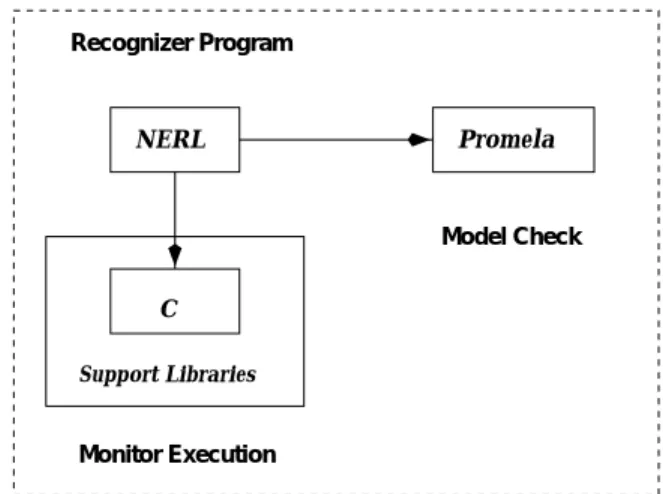
Our prototype implementation consists of a domain specic Network Event
RecognitionLanguage,NERL.NERLprogramsaretranslatedtoC,andthenare
In addition,NERLprograms canbetranslatedtoPromelamodelsand
model-checked for desired properties using SPIN [Hol91]. The architecture of the
implementation isas shown in Figure2.
Promela
NERL
C
Recognizer Program
Model Check
Support Libraries
Monitor Execution
Fig.2. NERLImplementation
The language NERL is inspired by the runtime verication logic MEDL.
MEDL is an event denition language that allows simple state variables to
store the patternof events seen so far. To satisfy our requirements, we need
to make several extensions to the language. In NERL, events are allowed to
havepacket-likeattributes,whichcan bedenedusingC-structdenitions. A
NERL recognizer consists of multiple, layered monitoring modules that
com-municatethrough events. Eachmodule runsastate machinethat istriggered
byinput events andproduces higher-layereventsoralarms. Toexpress state,
we includeadditionaldatastructures suchastables,records, and bytestrings.
In thisway,NERLisdesigned tobemodularandexpressiveenoughtohandle
protocolstate machines and packet events.
Moreover, several transformationsand analysescan becarriedout on
pro-grams in this specialized language. NERL is strongly typed, and has a
type-checker that can check for simple mistakes. In addition, NERL modules can
be translated to Promela and model-checked for simple errors. Finally, we
argue that it will be much easier to dene transformation functions on this
restricted language,rather than a full-edgedprogramminglanguage.
The NERLcompilerconsists ofa parser,type-checker and translator
writ-ten in OCaml. It parses an event recognizer written using the NERL syntax,
type-checks it, and then translates it into a reactive C program that is
trig-gered by input events and prints out output events as they occur. Since the
targetofthecompilerisC, thisprogramcan accessthesupportlibraries,such
as libpcap, satisfying the library interface requirement. The choice of Cas a
monitoringenvironmentalsogivesusaperformanceboostincomparisonwith
6 Verifying Routing Protocol Simulations
Verisim is a tool that was designed for the formal analysis of network
sim-ulations [BGK +
02]. The rst version of the tool used MEDL as the event
processing engine. The current version, Verisim v2, uses NERL for the event
recognition instead.
The case study that we describe in this section is the simulation of the
wireless routing protocol AODV. Suppose there are a number of nodes
(lap-tops) with wirelessconnections ina largeconvention hall. The wirelessrange
of each node is limited, so a node A may not be able to exchange data with
node B. However, if there is a node C between them that is willing to route
(forward) data between A and B, then A and B can establish a connection.
In general, therecould be more than one node in the path between A and B.
The aimof the AODV routing protocol is toenable such paths to be formed
and maintained between nodes that are not within eachother's range.
The simulation scenario we shall consider for AODV is from the CMU
Monarchgroup(monarch.cs.cmu.edu). Considerasiteofsize1500300meters
with 50 nodes constantly moving at 20 meters per second. There are 150
data connections transmitting four 64 byte packets every second. Each of
the nodes runs AODV, and the protocol attempts to provide paths for all
these connections. The simulation is run on the network simulator NS. The
simulation and our subsequent analyses were carried out ona dual
Pentium-III 550Mhz Xeon processors machine with one gigabyte of memory. The OS
was Red Hat Linux 7.2 with the 2.4.9-13 SMP Kernel. We used NS version
2.1b6, and the simulationitselfrequired about 5220seconds to complete and
generated 6,446,316 packetevents.
We haveearlier tried toanalyze this trace using MEDL [BGK +
02], which
implementseventrecognizers inJava. Anaiveeorttouse MEDL tocheck a
relativelysimplepropertyonthistracewasprohibitivelytime-consuming. We
estimate that the time required to check this property, at each node and for
each destination (2500 relations), aftereach of the 6,446,316 input events, is
morethan100daysbasedonextrapolatinga4-dayrunoftheMEDLanalysis.
After using a number of optimizations, such as using grep to specialize the
trace to only 5 nodes (25 relations), we could bring the analysis time for
Monotone Sequence Numbers down to 51 seconds. We failed to carry out
the analysis for all 50 nodes together, but we estimate that we could have
carried out several 5-node analyses to check the complete trace in around
50,000 seconds. This kindof piecemeal analysis would not, however, workfor
more complex properties where more than 5 nodes may interact to cause an
output event.
AcentralreasonforourinabilitytocarryouttheMEDLanalysisforall50
nodes wasthe lackofanaturalrepresentationforpacketeventsinMEDL.For
instance, the Routeinfo event which signies that a packet has some AODV
event Routeinfo[at][dst] = Pkt when
((value(atnode,0)==at) &&
(value(src,0)==dst) &&
(value(pktty,0) > 0))
This event denition is expanded for every value of at and dst (50 each) to
2500event denitions. Thisisbecausecomplexeventattributeswerenoteasy
to assign. In NERL, the same event is expressed as the following single event
denition.
event Routeinfo = Pkt OccurredWhen
(Pkt.pktty > 0)
WithAttributes {
Routeinfo.at := Pkt.atnode;
Routeinfo.dst := Pkt.src;
};
A second reason for the performance limitation of the MEDL analysis is
that MEDL is written in Java and is meant to interact with a running Java
program through a socket interface. Instead, we were using it to interact
with anetwork simulationwritteninC++,through a largetrace le(around
1GB). The support librariesfor readingand parsingthe simulation trace are
bestwritteninC.TheNERLrecognizerforAODViscompiledtoaCfunction
whichinterfaceswith this Csupport library. This librarycompatibility,along
with the Cvs. Javaspeedup, increases the monitorperformance signicantly.
Were-ranNERLonthe trace, andwecould processthe complete tracefor
all 50 nodes, for all the AODV properties in 675 seconds. We found 708,727
errors. These errors were due to 3 signicant (known) bugs in the simulator
code, which were causing nodes to update their routingtables incorrectly.
7 Privacy Issues in Packet-mode Surveillance
When monitoring is used to reconstruct high-level network events, such as
emailsandwebsessions,anumberofprivacyissuescropup. Thisisevenmore
sointhecaseofsurveillancesystems,suchastheFBI'sCarnivore[SCHP +
00],
whoseprimary purpose istocapture data,suchasemailand web sessions,
as-sociatedwithasuspect forwhomawarranthas beenissued. Theexpectation
of privacy for users of the network is typically expressed in terms of a
mon-itoring policy or warrant that denes what kinds of data are allowed to be
captured.
However, it isdebatable (and oftencontroversial) whether a closedsource
monitoring system actually respects the monitoring policy. Moreover, even if
it doesnot intentionallyviolate user privacy, anincorrectlyencoded protocol
monitor may inadvertently collect private data. To address this problem,
we haveproposed OpenWarrants [BG02]: anopen sourcesurveillance system
that istobecollected,calledawarrant,the OpenWarrantssystem usesNERL
recognizers to lter a packet stream and deliver exactly the warranted data.
OpenWarrants currently handlesemail warrants. In this section, we describe
the OpenWarrantssystem andshowhowthelayering,modularity,and formal
analysis features in NERLare broughtintoplay.
To execute OpenWarrants, the user must specify an email warrant that
consists of atleast the following information
Aggregation Level: High-level events of interest, such as SMTP messages,
orInternet Message Headers,and NERLmodules torecognize them.
Identication: ANERLrecognizerthat identiesemailscoveredbythe
war-rant.
To aggregate SMTP data, or Internet Message Headers [Cro82], we write
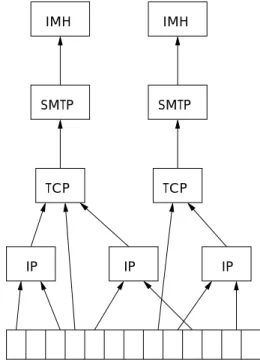
NERL recognizers for these protocols. Because of the layered nature of
net-work protocols, we need to identify protocolevents ateach layeras shown in
Figure 3. Large IP packets in the Internet are sometimes broken down into
IP
IP
IP
TCP
TCP
SMTP
SMTP
IMH
IMH
IP Packet Buffer
IP Fragment Reassembly
TCP Stream Reassembly
SMTP Mail Recognition
Mail Header Recognition
Fig. 3. Aggregation: Recognizing Emails
fragments, whichare reassembled atthe destination. An accurate IP monitor
must therefore implement a state machine that collects and reassembles IP
fragments,togenerate anIP packetevent. TCPmonitorsmust similarlykeep
trackofsequence numbers andacknowledgmentstoreconstructtheTCPdata
sent. The NERL suite already contains recognizer code for the IP and TCP
protocols.
For OpenWarrants, we need to add recognizer modules for SMTP and
InternetMessage Headers (IMH). The SMTP recognizercollects SMTP
recog-nizes successful email transmissions. It then produces high-level events such
as MailAccepted, indicating that an email was successfully delivered. The
IMH modules parse Internet message headers, producing IMHMessage events
that contain header elds asattributes.
Then, the NERL identication module IdentMail species which email
events are covered by the warrant. IdentMail takes as input the events
pro-ducedby theSMTP andIMH recognizers,andproducesthe MailIdentified
event when the corresponding email is covered by the warrant. For instance,
the MailIdentified event may identify [email protected]'s email by looking at
the messageheaderelds andthe SMTPenvelope. The followingruleaccepts
messages [email protected] sends or receives the messageor appears in TO,
CC, orFROM headerelds.
event MailIdentified = (MailAccepted &
IMHMessage) OccurredWhen (MailAccepted.envelope.fro m == "[email protected]") || (MailAccepted.envelope.to == "[email protected]") || (IMHMessage.header.to == "[email protected]") || (IMHMessage.header.cc == "[email protected]") || (IMHMessage.header.from == "[email protected]")
Note howsuch a module denition isan easy-to-read, preciseand executable
representation of the monitoring policy. Compare it with an equivalent C
program that would express this warrant. Moreover, one can see how
aggre-gation and identication reallyvalidate the layering and modularity
require-mentsthatwesetforNERL.TheymakethearchitectureoftheOpenWarrants
system cleanand simpleto implement.
Designing aggregation modules is the subtle part of this kind of
surveil-lance monitor. To study our ability to do this correctly in OpenWarrants
we looked for open source information about SMTP recognizers in Network
IntrusionDetectionSystems(NIDSs). Wewere unabletond rulesfor
recon-structing SMTP messages inSnort (snort.org ), the most popular open source
NIDS.Anothersystem,AltivoreprovideslterruleswritteninCandclaimsto
imitateCarnivore. Wealsotriedtoconjecture thekindofruleusedinaNIDS
like BlackICE, based on survey reports [Gro01] and online documentation.
We coded these in NERL as Recognizers A and N, and our own
OpenWar-rantsversion asRecognizer O.Recognizer Ais atranscriptionof the rulefrom
Altivore for capturing complete emails with no recognition of message
head-ers. Recognizer N is amore sophisticatedstateful analysis likea NIDS might
use. Recognizer O is the corresponding module from OpenWarrants. Each
recognizer analyzes SMTP message events and attempts to identify emails
associated with a suspect.
WetranslatedthesethreeNERLrecognizerstoPromelaandanalyzedthem
SMTP client, an SMTP server, and the translated recognizer. There are two
users in the system: the suspect S and another user U. The client attempts
todeliveranumberofemailstotheserver. Eachemailcan beaddressedfrom
S orU tooneorboth of S andU. Therecognizer attemptstocapture emails
that are sent to or from S. The Linear Temporal Logic (LTL) property we
checked asserted that,forallclient-serverinteractions inSPIN,the recognizer
module never captures emails from U to U. Recognizer A fails and SPIN
produces a counter-example: A captures some emailseven if they are fromU
to U. To nd this error, SPIN analyzed 871 states and 3135 transitions to
produce a counter-example with 12 message exchanges. We then attempted
the same proof for recognizer N. Again SPIN provides a counter-example.
The SPIN counter-example has 16 messages and was found after analyzing
1610 states and 9897 transitions. This does not mean that the NIDS rule is
incorrect since it was designed toprotect the server not the privacy of users.
Finally, we checked the property for the OpenWarrants recognizer O. SPIN
model-checked this recognizer and found no errors; it analyzed 2330 states
and 18,689 transitions toreach this conclusion.
Thisanalysis shows that thereare subtleties inwritingprotocolmonitors,
and not understanding what a module does can result in undesirable
inter-actions, such as a loss of privacy in a surveillance system. We show how
model-checkingisaneectivetechniquetond suchinteractions. Asthe
pro-tocol monitoring task gets more complex, having automated analysis tools
becomesan essential requirement.
8 Conclusion
We have described the concept of Network Event Recognition and four
re-quirementsforconvenient and eÆcient runtime analysis using NER.Wehave
sketched a prototype that addresses the requirements by providing eÆcient
packetformat representations, support for layering and modularity,
compati-bilitywith existing network simulationand monitoring libraries,and support
for formal analysis and automated transformations. The need for these
fea-tures and the ways in which they have been addressed are illustrated by two
case studies, one involvingsimulation analysis of routing protocols using the
Verisim system, and one involving privacy in packet-mode surveillance using
the OpenWarrants system. These studies show the importance of the
re-quirements and the existence of feasible approaches for addressing them in
signicant and non-trivialapplications.
References
[BCMG01]KarthikeyanBhargavan,SatishChandra,PeterJ.McCann,andCarlA.
ProceedingsoftheSymposiumon Principlesof Programming Languages
(POPL'01),pages 206{219. ACMPress, January 2001.
[BG02]KarthikeyanBhargavanandCarlA.Gunter. Networkeventrecognition
forpacket-mode surveillance. Submittedforpublication,2002.
[BGK +
02]K.Bhargavan,C.A.Gunter,M.Kim,I.Lee,D.Obradovic,O.Sokolsky,
and M.Viswanathan. Verisim:Formalanalysisofnetwork simulations.
IEEE Transactions on Software Engineering, 28(2):129{145, February
2002.
[Cro82]D.Crocker. StandardfortheFormatofARPA InternetTextMessages.
Technical ReportRFC 822,IETF, 1982.
[GGJZ00]Carl A. Gunter, Elsa L. Gunter, Michael Jackson, and Pamela Zave.
A reference model forrequirementsand specications. IEEE Software,
17(3):37{43, May 2000.
[Gro01]NSSGroup. Intrusion detection systems- group test,December2001.
[Hol91]Gerard J. Holzmann. Design and Validation of Computer Protocols.
Prentice Hall, 1991. http://cm.bell-labs.com/cm/cs/what/spin/Doc/
Book91.html.
[Hol00]G.J. Holzmann. Logic verication of ANSI-C code with SPIN. pages
131{147. Springer Verlag/ LNCS1885, Sep. 2000.
[KKM99]Eddie Kohler, M. Frans Kaashoek, and David R. Montgomery. A
readable TCP in the Prolac protocol language. In Proceedings
of the ACM SIGCOMM '99 Conference: Applications, Technologies,
Architectures,andProtocolsfor ComputerCommunication,pages3{13,
Cambridge, Massachusetts, August 1999.
[LF98]David C. Luckham and Brian Frasca. Complex event processing
in distributed systems. Technical Report CSL-TR-98-754, Stanford
University,1998.
[LKK +
99]I.Lee, S.Kannan,M.Kim,O.Sokolsky,and M.Viswanathan. Runtime
assurance based on formal specications. In Proceedings International
Conference on Parallel and Distributed Processing Techniques and
Applications, 1999.
[MC00]Peter McCann and Satish Chandra. PacketTypes: Abstract
specication of network protocol messages. In ACM Conference of
Special Interest Group on Data Communications (SIGCOMM),August
2000.
[ORD96]T.O. O'Malley, D.J. Richardson, and L.K. Dillon. EÆcient
specication-based test oracles. In Second California Software
[Pax99]V.Paxson. Bro:A systemfordetectingnetworkintrudersinreal-time.
Computer Networks, 31:2435{2463, 14 December 1999. This paper is
a revision of paper that previously appeared in Proc. 7th USENIX
SecuritySymposium,January 1998.
[PF76]J. R. Pickens and D. J. Farber. The Overseer: A powerful
communications attribute for debugging and security in thin-wire
connectedcontrolstructures. InProceedingsof International Computer
Communications Conference, August1976.
[Pos82]Jonathan B. Postel. SimpleMail Transfer Protocol. Technical Report
RFC 821,IETF, 1982.
[SCHP +
00]Stephen P. Smith,J. Allen Crider, Jr. Henry Perrit, Mengfen Shyong,
Harold Krent, Larry L. Reynolds, and Stephen Mencik. Independent
review of the Carnivore system - nal report. Technical report, IIT
Research Institute, December 2000.
[SFG +
]JonathanM.Smith,DavidJ.Farber,CarlA.Gunter,SampathKannan,
InsupLee,andScottM.Nettles. Self-checkingactivenetworks(SCAN).