AC-DC-AC Single Phase Converter with
Reduced Number of Controlled Switches
Dharshana G M 1, Prof. Biji G 2, Prof. Alina C R 3
PG Scholar, Department of EEE, Government Engineering College Barton Hill, Trivandrum, India1
Assistant Professor, Department of EEE, Government Engineering College Barton Hill, Trivandrum, India2
Adhoc Assistant Professor, Department of EEE, Govt. Engineering College Barton Hill, Trivandrum, India3
ABSTRACT: This paper proposes a unidirectional single phase ac-dc-ac converter with reduced number of controlled switches. The proposed system consist of a single phase ac-dc-ac converter which generates stabilized single phase ac voltage using a control algorithm. The intermediate dc stage of the ac-dc-ac converter is utilized by the fly-back converter to generate stabilized dc voltage using a control algorithm. Moreover, the ac-dc-ac converter reduces the Weighted Total Harmonic Distortion (WTHD) of the output ac voltage. The dual output system reduces the cost of installation and also reduces the floor spacing. The proposed system can be used in various biomedical applications including tissue engineering etc. A simulation of the proposed system is modelled and evaluated with desirable results in MATLAB/Simulink.
KEYWORDS: single phase ac-dc-ac converter, fly-back converter, Weighted Harmonic Distortion (WTHD), Total Harmonic Distortion (THD).
I. INTRODUCTION
The use of electric field for measuring cell and tissue properties has a long history. However, the advancement in the use of electric fields in tissue engineering is only very recent. As our population lives longer, there is an increase in the demand for biomedical devices and procedures is expected to grow. With technology advancing and the demand for cutting-edge medical equipment and devices expanding, biomedical engineering is a rapidly growing field.
The unbalance in voltage can be conceptualized as unequal magnitude or phase angle of voltages. The power quality issues of supply voltage like sag, swell, unbalance, flicker, harmonics, etc. are compensated using series compensation and current power quality issues like harmonics, unbalance, reactive current, etc. are compensated using shunt compensation [1]. The distortions in the supply voltage can eventually affect the normal working of the devices. The implementation of ac-dc-ac systems in devices is important as it enables the load to be fed from an ac electric system with desired output voltage and with reduced harmonic distortions.
Harmonics can cause ageing of components, mostly due to overheating of motors, cables etc. Also, due to resonance phenomena, harmonics can cause the destruction of capacitors which are used to compensate reactive power [2]. Ac-dc- ac systems enables the load to be fed from an ac electric system with desired output voltage at all loading conditions
and transients [3]. Jacobina et al. [4] proposed a single phase ac-dc-ac converter having three-leg configuration with
Tissue engineering is another rapidly growing field [5].There is an excellent review of DC electric fields and their role in biological systems. It is therefore no surprise that externally applied DC currents have been found to have many biological effects, and that many cells respond to steady DC electric fields. Such responses include galvanotaxis, which involves cells actively moving to either the cathode or the anode, and electrotropism, which involves the orientation of cells in electric fields [6]. Galvanotaxis and electrotropism could be used in tissue engineering, to guide cells to predefined positions, or orient cells in particular directions (e.g., neurons). Steady DC electric fields are also involved in the maintenance of cell polarity in natural tissues, in particular epithelial cells. There clearly is an opportunity to control cell polarity in artificial tissues using externally applied DC electric fields. AC electric fields across the membrane also decrease with increasing frequency, and thus AC electric fields are preferable for cell manipulation. The interaction between the dipole induced by the electric field and the electric field itself can lead to a variety of effects. These effects include electro-orientation, electro-rotation, dielectrophoresis and electrostretching.
The various fields such as the biomedical applications, tissue engineering, unified charging infrastructure of electric vehicles uses both ac and dc. The proposed ac-dc-ac system is a dual output system which gives stabilized ac output and dc output with reduced harmonics. Thereby the cost of installation of two different sources for ac and dc can be minimized to the cost of installation of a single system. It also reduces the floor spacing. By adopting the proposed system installation of voltage stabilizers in different equipment can also be reduced.
Paper is organized as follows. Section II describes the block diagram and the working of an ac-dc-ac configuration. The proposed system is given in Section III. PWM control strategy and control of the proposed system is given in Section IV and Section V respectively. Section VI describes the simulation results. Finally, Section V presents conclusion.
II. SYSTEM DESCRIPTION
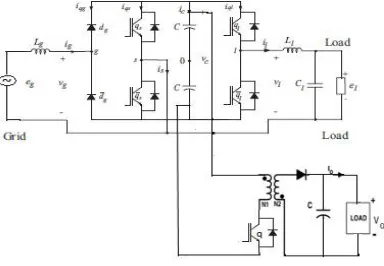
The block diagram of the proposed ac-dc-ac system is shown in Fig. 1(a). The proposed configuration consist of two sections, an ac-dc-ac converter and a fly-back converter. Ac-dc- ac converters gives a stabilized ac output voltage with reduced harmonics, and the fly-back converter gives stabilized dc output voltage by employing the control strategy. The ac-dc-ac converter consist of three legs with four controlled switches and two diodes is shown in Fig. 2. The converter
controlled legs consist of top switches qs and ql and complementary bottom switches
̅
sand
̅
l.
The following equations canbe derived for the output (vl) and input (vg) converter voltages from the system in Fig. 1(b).
eg = rgig + lg + vg (1)
el = -rl il - ll + vl (2)
is = ig – il (3)
vg = vg0 – vs0 (4)
vl = vl0 – vs0 (5)
where rl and rg represent the resistance of inductors Ll and Lg, respectively, ll and lg represent the inductance of inductors
Ll and Lg respectively, and vg0, vs0 and vl0 are the converter pole voltages. Two operation conditions can be highlighted:
Case 1: ig < 0
The diode ̅g conducts, then, vg0 = -
2 (6)
From (4) and (5)
vs0 = - - vg (7)
2 vl0 = vl – vg -
2
From (7) and (8) the pole voltages are within the limits if, –vc < vg < 0 and vg ≤ vl
Case 2: ig ≥ 0
The diode dg conducts, then, vg0 =
2
(8)
From (4) and (5)
vs0 = - vg (10)
2 vl0 = vl – vg +
2
From (10) and (11) the pole voltages are within the limits if, 0 < vg < vc and vg ≥ vl
(a)
b) (11)
(b)
Fig. 1. System description (a) Block diagram of proposed system (b) Ac-Dc-Ac single phase converter
III. PROPOSED SYSTEM
The circuit diagram of the proposed system shown in Fig. 2 consist of an ac-dc-ac converter which consist of a rectifier, and an inverter stage. The proposed configuration consist of four controlled switches in two legs and two diodes in the other leg. By such a configuration the power and the voltage across the switches can be reduced. The ac-dc-ac converter gives stabilized ac output voltage with constant amplitude and frequency even when the input supply ac voltage fluctuates. The harmonic content in the output voltage is also reduced. A feedback control strategy is adopted for voltage stabilization. The intermediate dc stage is given as an input to a fly-back converter. By adopting another control strategy for the fly-back converter it gives stabilized dc output voltage. The proposed system is a dual output system with stabilized ac output voltage with reduced harmonics and a stabilized dc output voltage. Thereby, the fluctuations in the grid voltage and the harmonics will not affect the normal working
of the device.
l
g l0
g g0 s0
g
IV. PWM CONTROL STRATEGY
The reference voltages provided by the controllers are denoted by vg* and v *,
v * = v * – v * (12)
vl * = v * – vs0* (13)
Assuming the previous operating conditions, the reference pole voltages are given by, Case 1: i * < 0
vs0* = -
∗
- v * (14)
2 g
vl0* = v *– v *-
∗ (15)
l g 2
Case 2: i * ≥ 0
vs0* =
∗
- v * (16)
2 g
vl0* = v *– v *+
∗ (17)
The reference pole voltages vs0* and vl0* are compared with high frequency triangular carrier signal to obtain gating
signals.
V. CONTROL OF THE PROPOSED SYSTEM
Sinusoidal Pulse Width Modulation (SPWM) technique is used for switching the ac-dc-ac converter. In the control algorithm the output voltage is compared with a reference value. If the measured ac output voltage is less than the reference voltage then duty ratio of the switching pulse is increased by the control scheme to obtain a stabilized ac output voltage. The Weighted Total Harmonic Distortion (WTHD) of the output voltage is also reduced. The dc output voltage
of the fly-back converter is also compared with another reference value so as to vary the duty ratio of the switching pulse.
VI. SIMULATION RESULTS
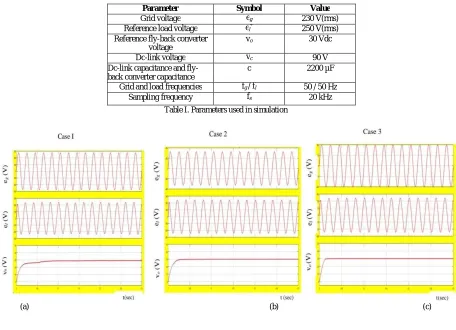
The system is modeled and evaluated in MATLAB/Simulink. The proposed system has been simulated for three different cases:
1. Case 1( Fig. 3.a.) :eg =194 V(rms), el =250 V(rms),vo = 30 Vdc
2. Case 2( Fig. 3.b.) :eg =230 V(rms), el =250 V(rms), vo =30 Vdc
3. Case 3( Fig. 3.c.) :eg =282 V(rms), el =250 V(rms), vo =30 Vdc
An RL load (load resistance and inductance Rl = 100 Ω and Ll = 30 µH, respectively) is used in all the three cases. A non-
Fig. 3 shows the simulation results of all the three cases. The higher order harmonics are not as severe as lower order. Total Harmonic Distortion (THD) does not consider the severity of lower order but treats all harmonics equally. But Weighted Total Harmonic Distortion (WTHD) gives a better measure of harmonic pollution by using the order of each harmonic component as its weight factor. This index gives the severity of lower order harmonics. WTHD of the output voltage generated by the converter is given by
where γ1 and γh are the fundamental voltage amplitude and the corresponding harmonic component amplitude of hthorder,
and Nh is the number of considered harmonics. THD of the output ac voltage is found to be 0.98% relative to the
fundamental. The WTHD of the grid voltage is found to be 0.81% and the WTHD of output ac voltage is found to be 0.0461%.
Parameter Symbol Value
Grid voltage eg 230 V(rms)
Reference load voltage el* 250 V(rms)
Reference fly-back converter voltage
*
vo 30 Vdc
Dc-link voltage vc 90 V
Dc-link capacitance and fly- back converter capacitance
c 2200 µF
Grid and load frequencies fg / fl 50 / 50 Hz
Sampling frequency fs 20 kHz
Table I. Parameters used in simulation
(a) (b) (c)
Fig. 3. Simulation results of proposed system
VII. CONCLUSION
stabilization is performed by using a control strategy which compares the output voltage with a reference value. The proposed topology can be employed in various applications where both ac and dc voltage are used such as in biomedical applications including tissue engineering, unified charging infrastructure for plug-in electric vehicles etc.. The proposed topology also reduces the WTHD of the ac output voltage. Regenerative operation is not feasible due to presence of diode in the proposed topology. The proposed system is simulated for three different cases.
REFERENCES
[1] C. Jacobina, M. Correa, T. Oliveiro, A. Lima, and E. Cabral da Silva, “Current control of unbalanced electrical systems,” IEEE Transactions
on Industrial Electronics, vol. 48, pp. 517–525, Jun 2001.
[2] H. Fujita and H. Akagi, “The unified power quality conditioner: the integration of series and shunt-active filters,” IEEE Transactions on
Power Electronics, vol. 13, pp. 315–322, Mar 1998.
[3] Nayara B. de Freitas, Cursino B. Jacobina, Nustenil S. M. L. Marinus “Ac-Dc-Ac Single-Phase Multilevel Six-Leg Converter with Reduced
Number of Controlled Switches”, IEEE Transactions on Power Electronics, vol. 33, pp. 3023-3033, April 2018.
[4] C. B. Jacobina, N. Rocha, N. S. M. L. Marinus, and E. C. Santos, “Ac-ac single-phase dc-link converter with four controlled switches,” in
2012 Twenty-Seventh Annual IEEE Applied Power Electronics Conference and Exposition (APEC), pp. 1927–1932, Feb 2012.
[5] Pinar Zorlutuna, Nihal Engin Vrana, and Ali Khademhosseini, “The Expanding World of Tissue Engineering: The Building Blocks and New
Applications of Tissue Engineered Constructs,” IEEE reviews in biomedical engineering, vol. 6, 2013.