
N
ETWORK
P
AYLOAD
I
NSPECTION
By
Xiaofei Wang
Submitted in partial fulfilment of the requirements for the Degree of Doctor of Philosophy
Supervisors:
DR. X
IAOJUNWANG AND
PROF. BIN
LIU
S
CHOOL OFE
LECTRONICE
NGINEERINGDUBLIN
C
ITYUNIVERSITY
award of Doctor of Philosophy is entirely my own work, and that I have exercised reasonable care to ensure that the work is original, and does not to the best of my knowledge breach any law of copyright, and has not been taken from the work of others save and to the extent that such work has been cited and acknowledged within the text of my work.
Signed:
ID number: 58124705
T
here are two main drivers for network payload inspection: malicious data, attacks, virus detection in Network Intrusion Detection System (NIDS) and content detection in Data Leakage Prevention System(DLPS) orCopyright Infringe-ment Detection System(CIDS).Network attacks are getting more and more prevalent. Traditional network firewalls can only check the packet header, but fail to detect attacks hidden in the packet payload. Therefore, the NIDS with Deep Packet Inspection (DPI) func-tion has been developed and widely deployed. By checking each byte of a packet against the pattern set, which is called pattern matching, NIDS is able to detect the attack codes hidden in the payload. The pattern set is usually organized as a Deterministic Finite Automata (DFA). The processing time of DFA is propor-tional to the length of the input string, but the memory cost of a DFA is quite large. Meanwhile, the link bandwidth and the traffic of the Internet are rapidly increasing, the size of the attack signature database is also growing larger and larger due to the diversification of the attacks. Consequently, there is a strong demand for high performance and low storage cost NIDS. Traditional software-based and hardware-software-based pattern matching algorithms are have difficulty sat-isfying the processing speed requirement, thus high performance network pay-load inspection methods are needed to enable deep packet inspection at line rate. In this thesis, Stride Finite Automata (StriFA), a novel finite automata family to accelerate both string matching and regular expression matching, is presented. Compared with the conventional finite automata, which scan the entire traffic stream to locate malicious information, the StriFA only needs to scan samples of the traffic stream to find the suspicious information, thus increasing the matching speed and reducing memory requirements.
Technologies such as instant messaging software (Skype, MSN) or BitTorrent file sharing methods, allow convenient sharing of information between man-agers, employees, customers, and partners. This, however, leads to two kinds of major security risks when exchanging data between different people: firstly, leakage of sensitive data from a company and, secondly, distribution of copyright infringing products in Peer to Peer (P2P) networks. Traditional DFA-based DPI solutions cannot be used for inspection of file distribution in P2P networks due to
FA) is proposed to solve this problem. It combines benefits of the following three structures:
1) Skip-FA, which is used to solve the out-of-order data scanning problem; 2) Stride-DFA, which is introduced to reduce the memory usage of Skip-FA; 3) Neighbor-DFA which is based on the characteristics of Stride-DFA to get a low false positive rate at the additional cost of a small increase in memory con-sumption.
Keywords: Network Intrusion Detection Systems, Deep Packet Inspection, Non-deterministic Finite Automaton, Deterministic Finite Automaton, Pattern Matching, File detection
I would like to thank the many people who have contributed to this thesis. With-out them, this work would not have been possible.
First and foremost I want to thank my supervisors, Dr. Xiaojun Wang and Prof. Bin Liu, who have supported me throughout my thesis with their patience and knowledge. Throughout my years in university, they provided encourage-ment, sound advice, good teaching, and lots of good ideas.
I am greatly indebted to Dr. Chengchen Hu and Dr. Yang Xu. Your valuable contributions will always be treasured.
I would also like to thank Dr. Junchen Jiang, Yi Tang and Wei Lin for their assistance and guidance in getting my graduate career started on the right foot and providing me with the foundation for my research work.
Moreover, I would like to offer my sincere gratitude to the people (Huichen Dai, Ting Zhang and Keqiang He) in Tsinghua University and Brendan Cronin in Dublin City University who spend their precious time in reading this thesis.
Finally, and most importantly, I would like to thank my wife Jieyan. Her sup-port, encouragement, quiet patience and unwavering love were undeniably the bedrock that enabled me to reach this point.
Acronyms
NIDS Network Intrusion Detection System
NFA Nondeterministic Finite Automata
DFA Deterministic Finite Automata
regex regular expression
PE file Portable Executable file
FSM finite state machine
LBM Length-based Matching
StriFA Stride-based Deterministic Finite Automata
DFS Depth First Search
ASIC Application-Specific Integrated Circuit
CAM Content Addressable Memories
FPGA Field Programmable Gate Array
ASCII American Standard Code for Information Interchange
TCP Transmission Control Protocol
UDP User Datagram Protocol
SYN Synchronize
IP Internet Protocol
ISP Internet Service Providers
BL Bloom Filter
Paper:
• Xiaofei Wang, Junchen Jiang, Yi Tang, Yi Wang, Bin Liu and Xiaojun Wang, “StriD2FA: Scalable Regular Expression Matching for Deep Packet Inspec-tion”in IEEE International Conference on Communications (ICC 2011), Japan, 2011.
• Xiaofei Wang, Chengchen Hu, Keqiang He, Junchen Jiang, Bin Liu and Xi-aojun Wang, “Measurements on Movie Distribution Behavior in Peer-to-Peer Networks” inIFIP/IEEE International Symposium on Integrated Network Management (IM2011), Dublin, 2011.
• Xiaofei Wang, Chengchen Hu, Yachao Zhou, Xiaojun Wang and Bin Liu, “Efficient Log System for Distribution Behavior Analysis in Peer-to-Peer Networks” inCIICT 2010, Wuhan, 2010.
• Xiaofei Wang, Junchen Jiang, Yi Tang, Bin Liu and Xiaojun Wang, “Extrac-tion of Fingerprint from Regular Expression for Efficient Prefiltering” in IC-CTA 2009, Beijing, 2009.
• Xiaofei Wang, Wei Lin, Yi Tang, Ashwin Lall, Bin Liu and Xiaojun Wang, “A Scalable Bloom Filter based Prefilter and Hardware-oriented Predis-patcher” inINFOCOM 2009 Student Workshop, Brazil, 20 April 2009.
• Junchen Jiang, Xiaofei Wang, Keqiang He and Bin Liu, “Parallel Architec-ture for High Throughput DFA-Based Deep Packet Inspection” inIEEE In-ternational Conference on Communications (ICC 2010), South Africa, 23 May 2010.
ing” in GLOBECOM 2010.
• Wei Lin, Xiaofei Wang, Yi Tang, Derek Pao and Bin Liu, “Compact DFA Structure for Multiple Regular Expression Matching” in IEEE International Conference on Communications (ICC 2009), June 14-18, Dresden, Germany. • Wei Lin, Xiaofei Wang, YaXuan Qi, Derek Pao and Bin Liu, “High-Speed
Memory-Efficient Network Intrusion Detection System” inINFOCOM 2009 Student Workshop, Brazil, 20 April 2009.
• Junchen Jiang,Xiaofei Wang, Yi Tang and Bin Liu, “SPC-DFA: A novel tech-nique for multi-string matching acceleration” inANCS Poster 2009, USA, 19 October 2009.
• Gao xia,Xiaofei Wangand Bin Liu, “SRD-DFA: Achieving Sub-Rule Distin-guishing with Extended DFA Structure” inSCC’09, Sichuan, 2009.
SCI indexed Journals:
• Xiaofei Wang, Chengchen Hu, Yi Tang, Ting Zhang, Chunming Wu, Bin Liu and Xiaojun Wang, “Parallel Length-based Matching Architecture for High Throughput Multi-Pattern Matching” inChinese Journal of Electronics 2011. (Accepted)
• Chengchen Hu, Xiaofei Wang, Xiaojun Wang, Keqiang He and Bin Liu, “Measurements on Movie Distribution Behavior in Peer-to-Peer Networks” inIET Communications2011. (Accepted)
• Yi TANG, Junchen JIANG, Xiaofei Wang, Chengchen HU, Bin LIU and Zhijia CHEN, “Parallel DFA Architecture for Ultra High Throughput DFA-Based Pattern Matching” in IEICE TRANSACTIONS on Information and Systems. VOL.E93CD, NO.12 December 2010.
List of Figures iv
List of Tables vii
List of algorithms viii
1 Introduction 1
1.1 Research Background . . . 1
1.1.1 Intrusion Examples . . . 2
1.1.2 NIDS . . . 3
1.1.3 DPI technology . . . 5
1.1.4 String and Regular Expression Matching . . . 6
1.1.5 NFA and DFA . . . 9
1.1.6 CIDS and DLPS . . . 11
1.2 Problem Statement and Work Description . . . 13
1.3 Thesis Organization . . . 15
2 Pattern Matching Algorithms 16 2.1 Single-character based String Matching Algorithms . . . 16
2.1.1 Aho-Corasick algorithm . . . 17
2.2 Multi-Character Based String Matching Algorithms . . . 20
2.2.1 Transition-distributed Parallel DFA . . . 21
2.2.2 Bloom Filter-based String Matching Algorithm . . . 22
2.2.3 Variable Stride DFA . . . 28
2.3 Regular Expression Matching . . . 31
2.3.2 Multi-Stride DFA . . . 32
2.3.3 Sampled DFA . . . 33
2.4 Comparison of Multi-character Matching Algorithms . . . 35
3 StriDFA: Stride DFA for String Matching 37 3.1 Introduction . . . 38
3.2 Motivation . . . 40
3.2.1 Traditional DFA in Multi-string Matching . . . 41
3.2.2 Stride-based DFA . . . 41
3.2.3 Proof of Correctness . . . 44
3.3 Architecture of StriDFA Matching Engine . . . 45
3.4 Benefits of StriDFA . . . 46
3.4.1 Increased Matching Speed . . . 46
3.4.2 Small Memory Requirement . . . 47
3.4.3 Easily Implemented on Existing Platforms . . . 47
3.5 Challenges . . . 48
3.5.1 Tag Selection . . . 48
3.5.2 Potentially Infinite Alphabet Set . . . 48
3.5.3 Rate of False Alarm . . . 48
3.5.4 Regular Expression Support . . . 49
3.6 Limit Alphabet Set by a Window . . . 49
3.7 Tag Selection Approach . . . 50
3.7.1 How tags “cover” a pattern . . . 52
3.7.2 Greedy algorithm for tag selection . . . 53
3.8 Verification module . . . 54
3.9 Evaluation . . . 55
3.9.1 Experiment setup . . . 55
3.9.2 Memory consumption and speedup . . . 56
3.9.3 Filter rate and false alarm rate . . . 56
3.10 Conclusion . . . 58
4 StriNFA and StriDFA for Regular Expression Matching 59 4.1 Introduction . . . 60
4.2 Problem Statement . . . 63
4.3 Stride Finite Automaton . . . 63
4.3.1 Building StriFA by DFA-based method . . . 63
4.3.2 StriNFA to StriDFA . . . 66
4.4 Stride Finite Automaton . . . 70
4.4.1 Building StriNFA by NFA-based method . . . 70
4.4.2 StriFA-based Matching Architecture . . . 74
4.5 Analysis and Optimization . . . 74
4.5.1 Stride-Neighbor FA . . . 75
4.5.2 Performance of StriFA . . . 76
4.5.3 Conversion Complexity of StriFA . . . 77
4.6 Evaluation . . . 77
4.6.1 Trace characteristics . . . 78
4.6.2 Throughput . . . 79
4.6.3 Memory consumption . . . 80
4.6.4 Speedup . . . 84
4.6.5 Filter rate and false alarm rate . . . 85
4.6.6 Performance on real traces . . . 86
4.7 Conclusion . . . 86
5 S2N-FA: A Hybrid Finite Automaton for File Detection 87 5.1 Introduction . . . 88
5.2 Related Work . . . 90
5.2.1 Fingerprint Extraction . . . 91
5.2.2 File Detection in CIDS and DLPS . . . 91
5.3 Problem Statement . . . 92
5.3.1 Out-of-Order Data Transmission in P2P network . . . 92
5.3.2 Problem Formulation . . . 94
5.4 Building Skip Finite Automata . . . 95
5.4.1 A Basic Model: Skip-FA . . . 95
5.4.2 Problem of Memory Usage . . . 99
5.5 Skip-stride Finite Automaton . . . 99
5.5.1 Building Skip-Stride Finite Automaton . . . 100
5.5.2 Problem of False Positive . . . 101
5.6 Building Skip-Stride-Neighbor Finite Automaton . . . 102
5.6.1 Skip-Stride-Neighbor Finite Automaton . . . 102
5.6.2 Analysis of Stride-Neighbor DFA . . . 104
5.7 Experimental Results . . . 105
5.7.1 Experiment Setup and Test Sets . . . 105
5.7.2 Memory Usage . . . 106
5.7.3 Matching Speed . . . 106
5.8 Conclusion . . . 110
6 Conclusions and Future Work 111 6.1 Summary of thesis work . . . 111
6.1.1 StriFA . . . 112 6.1.2 S2N-FA . . . . 112 6.2 Future work . . . 113 6.2.1 Tag selection . . . 113 6.2.2 Hardware implementation . . . 114 Appendix 115 I Convert Regex to NFA . . . 115
II Restructure Traditional DFA to StriDFA . . . 118
III Regular Expression Syntax . . . 122
1.1 Network Intrusion Detection System. . . 4
1.2 Equivalence of regular expression, NFA and DFA. . . 7
1.3 NFA and DFA of regexa.{n}bc. . . 10
2.1 AC algorithm with pattern set{he, her, him, his}. . . 18
2.2 Extracting bit-level parallelism from the Aho-Corasick algorithm by splitting the state machine into 8 parallel state machines. . . 20
2.3 Transfer character set to the token sequences. . . 21
2.4 An example of TDP-DFA withw=3. . . . 22
2.5 Deploy TDP-DFAs for detection in parallel. . . 22
2.6 Introduction of Bloom filter. . . 23
2.7 Jump-ahead Aho-Corasick NFA (JACK-NFA) . . . 26
2.8 Winnowing sample text. The gray part is covered by the selected fingerprints. . . 28
2.9 Segment Pattern into Head/Core/Tail Blocks (k = 2,w= 4). . . 29
2.10 An example of a VS-DFA. . . 30
2.11 (a) NFA accepting (1)ab.*cdand (2)ac+e; (b) corresponding 2-NFA. . . 31
2.12 MS-DFA for patterns{“AABCDZGHIJ3A2B1C”, “ABCDEFGHIJS-TUVWXYZ”, “0123456789Z”, “6789KLMNOPYZABC”}. . . 33
2.13 Example: the regex ab.*cdis sampled (with θ = 2) to [ab].*[cd] and matched against a text of 16 bytes. . . 34
2.14 Traditional DFA and reverse DFA for patternab*|ba. . . 35
3.1 Traditional DFA of patterns “reference” and “replacement” . 41 3.2 Use tag to convert input stream into SL stream with tag ‘e’. . . 42
3.3 Convert patterns to the corresponding StriDFA. . . 43
3.4 StriDFA of “reference” and “replacement” . . . 44
3.5 The overall structure of StriDFA. . . 45
3.6 The stride length stream with windoww=5. . . . 49
3.7 Frequency of appearance for each characters in Snort and ClamAV rule sets. . . 51
3.8 Overall speedup and memory usage of the StriDFA (P1 and P2) with different window sizes. . . 57
3.9 Overall speedup and memory usage of P3 and P4 with different window sizes. . . 57
3.10 Filter rate and false positive rate of the StriDFA (P1 and P2) with different window sizes. . . 58
4.1 Flow chart describing the steps to convert a regex to a StriFA via DFA. . . 63
4.2 Traditional NFA of regex.*abba.{2}caca. . . 64
4.3 Traditional DFA of regex.*abba.{2}cacaand its corresponding Tag decision FA. . . 65
4.4 StriNFA of the regex.*abba.{2}cacabefore renumbering. . . 68
4.5 StriNFA and StriDFA of regex.*abba.{2}cacawith tag = ‘a’ and w= 3. (The transitions back to state 1, 2 and 3 of the corresponding StriDFA are partly ignored for simplicity). . . 69
4.6 Flow chart represents how to convert regexes to StriNFA/StriDFA via NFA directly. . . 71
4.7 Traditional NFA and StriNFA of.*abba.{2}caca . . . 71
4.8 Explanation of recursive steps. . . 72
4.9 StriNFA of the regex .*abba.{2}caca with tag =‘a’ and w = 3 before renumbering. . . 74
4.10 Architecture of StriFA-based multi-regex matching engine. . . 75
4.11 Stride-Neighbor DFA for P1=“reference” and P2=“replacement” with tag=‘e’ andw=5. . . . 76
4.12 Throughput of three different traces with different finite automaton. 80 4.13 Overall speedup and memory usage of StriFA with different win-dow sizes. . . 84
4.14 Efficiency factor of StriDFA, Stride-Neighbor DFA of different win-dow sizes. . . 85
5.3 The Skip-FA of signatureF. . . 95
5.4 Skip-Stride Finite Automaton ofF with windoww= 5. . . 101
5.5 Skip-Stride-Neighbor finite automaton with tag=‘e’ and window w=5. . . . 102
5.6 Efficiency factor of Skip-FA, Skip-Stride FA of different window sizes. . . 104
5.7 Number of Di-trans with different window sizes and Start State Table (SST) numbers with various thresholdv. . . . 108
5.8 The LO percentage of Skip-Stride FA and S2N-FA in 20 consecutive packets. . . 109
A-1 NFA of.*abba.{2}caca . . . 115
A-2 Original DFA of.*abba.{2}caca. . . . 118
A-3 DFA of.*abba.{2}cacaafter renumbering. . . 118
A-4 Restructure DFA of.*abba.{2}cacaby classifying transitions. . 118
A-5 StriNFA of.*abba.{2}caca. . . 119
A-6 StriDFA of.*abba.{2}cacaafter determination. . . 121 A-7 StriDFA of.*abba.{2}cacaafter renumbering and minimization. 121
1.1 Recent traffic volumes and growth rates on the global Internet. . . . 2 1.2 Regular expressions syntax. . . 8 2.1 Transition table of JACK-NFA. . . 27 2.2 Comparisons of multi-character matching algorithms. . . 36 3.1 Memory consumption between traditional DFA and StriDFA . . . . 47 4.1 An example to show the correctness of StriFA. . . 68 4.2 Worst case comparisons of NFA, DFA [68], StriNFA and StriDFA. . 77 4.3 Real data samples . . . 79 4.4 Comparison between Traditional NFA/DFA, k-DFA and
StriN-FA/StriDFA . . . 82 5.1 Starting State Table of the Skip-FA. . . 97 5.2 Starting State Table of Skip-Stride Finite Automaton. . . 101 5.3 Starting State Table of Skip-Stride-Neighbor finite automaton. . . . 102 5.4 Basic characteristics of test sets . . . 106 A.1 Detailed regular expression syntax. . . 122
1 Algorithm of SL extraction . . . 50 2 Algorithm of tag selection . . . 53 3 Algorithm of transforming Tag decision FA to StriNFA via DFA . . . 67 4 Algorithm of transforming Tag decision FA to StriNFA via NFA . . . 73 5 Building S2N-FA of signatureF =c
Introduction
1.1 Research Background
The Internet, invented in 1965, is probably the most important and revolutionary invention of the last century [1]. Beginning with military purposes, the Internet rapidly evolved into a very complex tool for the purpose of resource sharing and communication among scientists. Now the Internet has become a critical infras-tructure for global communication, information sharing and content publishing.
The Minnesota Internet Traffic Studies (MINTS) project analyses a large set of publicly available data sources and concludes that current traffic volume per month is between 7.5 and 12 exabytes1, while the annual Internet traffic growth rates are in the region of40 ∼ 50percent [2]. The recently released Visual Net-working Index forecast of Cisco Systems shows global IP traffic of 11 exabytes per month, growing at a compound annual growth rate of 40 percent between 2008 and 2011 [3]. The Japanese Internet has been studied by Kenjiro Cho and his colleagues using aggregated data from many local ISPs and they report seeing
Table 1.1:Recent traffic volumes and growth rates on the global Internet.
around 40 percent growth per annum since 2005 for peak traffic rates at domes-tic Internet exchange points [4]. The ATLAS Internet Observatory is a collab-orative research project from Arbor Networks, the University of Michigan and Merit Network. Believed to be the largest Internet monitoring infrastructure in the world, its results represent the first global traffic engineering study of Inter-net evolution[5]. Table 1.1 describes all the above statistics [6], from which the average Internet traffic growth rate can be found to be around 40% per annum.
The Internet brings enormously convenient functionality, however, it also cre-ates the possibilities for hackers to steal secret information and protected data.
1.1.1 Intrusion Examples
Calculations based upon a total number of 250,000 unique samples every day col-lected in recent years, indicate that a new piece of malware is created on average every 1.5 seconds [7].
On May 4, 2000, one mass-mailing worm namedLoveBugwas originally dis-tributed in an email with a subject line “I love you” [8]. The email contained the message “kindly check the attached LOVELETTER from me” and an attached file called LOVE-LETTER-FOR-YOU.TXT.VBS. Once opened, the malicious VBScript contained in the attachment could automatically send to every email address in
the recipient’s address book a copy of the message. LoveBugwent on to affect 45 million computer users worldwide. It was estimated that the so-called LoveBug email virus had caused some $10 billion in losses in as many as 20 countries. As a result of theLoveBugvirus, legislation in the Philippines was changed and some highly effective legislature was established to combat online crime [9].
On August 11, 2003, a computer worm named Blasterspread on computers running Microsoft operating systems: Windows XP and Windows 2000 [10]. The worm could spread without users opening attachments by simply spamming it-self to large number of random IP addresses. Another version was programmed to start a SYN flood [11] to website http://windowsupdate.com, thereby creating a distributed denial of service attack (DDoS) [12]. According to a statistics from Microsoft, over 25 million unique computers were identified as being infected by this worm [13]. So far, damages resulted from theBlasterworm are estimated to be at least $525 million. On August 12, 2007, hackers attacked the United Na-tions’ official website and some webpages on the site were breached [14]. RBS WorldPay, the payment-processing arm of the Royal Bank of Scotland, was com-promised to raise the amount of funds available on the comcom-promised cards and boost their daily withdrawal limits. In 2010, the hacker swindled about $9.5 mil-lion in less than 12 hours [15].
The increasing intrusion attacks not only cause significant productivity and economic losses, but also influence politics and people’s daily life.
1.1.2 NIDS
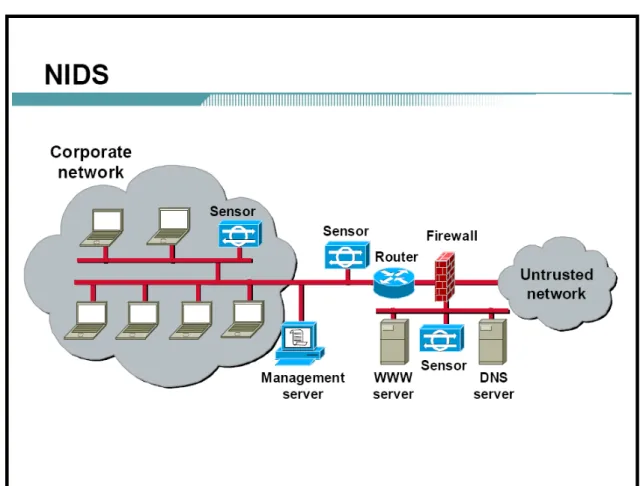
A Network Intrusion Detection System (NIDS) involves the deployment of mon-itoring devices, or Sensors, throughout the network, which capture and analyze the traffic as it traverses the network. The Sensors detect malicious and unautho-rized activities in real time and can take action when required. They also detect distributed denial of service (DDos) attacks, worms, and viruses. Packets that do
Figure 1.1:Network Intrusion Detection System.
not comply with security policies of NIDS will not be allowed into the protected network. Figure 1.1 shows how NIDS devices are configured to detect security threats.
The problem starts from the fact that networks today are becoming faster and faster. The network bandwidth is doubled every six months [16]. As a conse-quence, DPI and NIDS must have high processing throughput so that they will not be the bottleneck of the network [17]. Another important factor of NIDS is the implementation cost. NIDS can be software programs that run on the General Purpose Processor of the inspection machine or a hardware unit that conducts this specific work. In both cases, implementation cost must be as low as possi-ble. The performance of a NIDS is affected by the scalability and flexibility of the matching system. A NIDS is a system that will be constantly updated with new rules to support the detection of new viruses and threats. For this reason, a NIDS
must be scalable and flexible so that when the rules increase, the implementation cost will not grow, and performance will not diminish significantly.
1.1.3 DPI technology
Security has become one of the most serious concerns on the Internet. NIDS has been adopted by enterprises to defend against attacks. There is an increasing demand for network devices that are capable of examining the content of data packets in order to enhance network security and provide application-specific services. A packet is the basic unit of data that is transmitted across an IP net-work, and the technology that inspects those packets beyond the transport header is called Deep Packet Inspection (DPI).
From an IP network’s perspective, a packet is composed of three basic ele-ments.
{IP header [P rotocol header (Content)]}
• IP header: An IP header is the outermost portion of the packet where infor-mation such as the source and destination IP addresses reside (analogous to the address information on a postcard). It also contains other useful infor-mation about the packet, such as the packet length and the priority level on delivery.
• Protocol header: The protocol header describes the type of protocol used to transmit the packet. This header has traditionally been used as a basic firewall filtering method, which is essential for basic Internet security. Vir-tually all home, enterprise, and government networks employ firewalls on their Internet gateways today. Protocol headers are also routinely used in private and public IP networks to help classify network traffic so that each traffic type can be given the performance characteristics it needs.
packet that contains the actual content or data being transmitted. Since there may exist some malicious data in the payload, some network packet payload analysis technologies are used to detect the payload content.
The traditional packet inspection technology only detects the packet header information so as to identify application bytes through the port number. How-ever, illegal applications can use hidden or spoofed port numbers to avoid in-spection and monitoring. By enabling the examination of the entire payload, DPI gives unprecedented “visibility” into deeper levels of network traffic to identify viruses and remedy vulnerabilities like data leakage and unauthorized access.
DPI is a crucial technique in today’s Network Intrusion Detection System. Nearly 70% of processing time is consumed by DPI-based matching engines in NIDS [18]. DPI technologies are widely used in intrusion detection systems for deterring, detecting and stopping malicious attacks over the network. Nearly all intrusion detection systems have the ability to search through packets and iden-tify contents that match known attacks.
1.1.4 String and Regular Expression Matching
A string is a sequence of characters over a finite alphabet Σ [19]. For instance, “reference” is a string overΣ={c, e, f, n, r}. Aregular expression (regex)describes a set of strings. Given a textT and a patternP over some alphabetP, the string-matching problem is to find all occurrences of the patternP in the textT. Classical string searching algorithms are based on character comparisons.
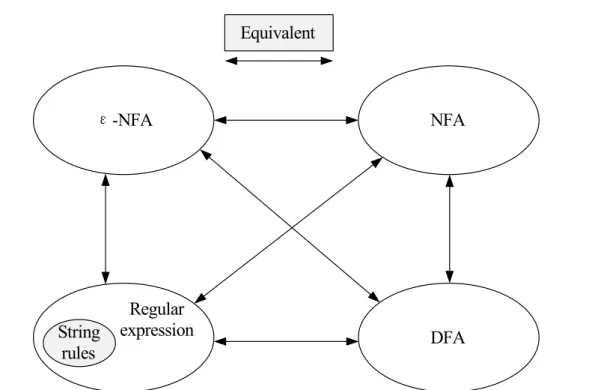
Regular expressions (regexes) can be recognized as an expression that speci-fies a set of strings. Due to their power of description, generalization and flexibil-ity, regexes have been widely used in various aspects of computer science. Typi-cally, regexes are not evaluated directly, but are translated into Nondeterministic Finite Automata (NFAs) or Deterministic Finite Automata (DFAs) for matching. Their translation map is given in Figure 1.2 [20]. A large number of algorithms
DFA NFA ε-NFA String rules Regular expression Equivalent
Figure 1.2:Equivalence of regular expression, NFA and DFA.
have been proposed to construct finite automata from regexes. The work in [21] presents a taxonomy of finite automata construction algorithms. One of the con-struction algorithms was proposed by K. Thompson [22], which is also called “structural induction” in textbooks [20] and considered to be more readable than Thompson’s original paper.
A description of the regular syntax is given below [23].
Regex notation can be used to represent languages. LetΣbe an alphabet.
• ∅is a regex representing the empty language;
• εis a regex representing the language{ε}; • a∈Σis a regex representing the language{a};
ifrandsare regexes representing languagesL(r)andL(s), respectively, then • R1, R2is a regex representingL(R1)L(R2);
• nothing else is a regex.
Operator precedence, from high to low ∗,·,+( or|), can be altered by parenthe-ses.
Examples:
(R1+R2)∗ all strings ofR1’s andR2’s
(R1+R2)∗(R1+R2R2) all strings ofR1’s andR2’s
ending withR1orR2R2
(R1R1)∗(R2R2)∗R2 even number ofR1’s followed
by an odd number ofR2’s
The regex syntax is given in Table A.1.
Table 1.2:Regular expressions syntax.
Symbol Description Example
. Matches any single character except newline a. matches aa, ab, ac * Repeats the previous item zero or more times. a* matches a, aa, aaa,. . .
ˆ Matches beginning of line. ˆa matches ab, ac or aa
$ Matches end of line. a$ matches ba, ca or aa
+ Repeats the previous item once or more. a+ matches a, aa, aaa
? Matcheszeroor more instances of previous item. abc? matches ab or abc | Causes the regex engine to match either the part a|b|c matches a, b or c
on the left side, or the part on the right side.
[ ] Matches a single character that is contained within [abc] matches a, b, or c the brackets.
[ˆ] Matches a single character that is not contained [ˆabc] matches any character
within the brackets. other than a, b, or c
{n} Repeats the previous item exactly n times. a{3}matches aaa
1.1.5 NFA and DFA
Finite automata are are also known as state machines which are the natural for-malism for regexes. As described in the previous subsection, there are two main categories: NFA and DFA.
There exist three major approaches for transforming regular expressions into finite automata. The first approach, due to Thompson [22], is to transform a regex into a ε-NFA. This approach is simple and intuitive, but may generate many ε-transitions. Thus, the resultingε-NFA can be unnecessarily large and the further transformation of it into a DFA can be rather time and space consuming. ε-NFAs have almost the same properties as NFAs, except thatε-NFAs have ε-transitions while NFAs do not. In the rest of this thesis, the terminology “NFAs” is also used to refer toε-NFAs for simplicity. The second approach transforms a regex into a NFA withoutε-transitions. This approach is due to Berry and Sethi [24], whose algorithm is based on Brzozowski’s theory of derivatives [25] and McNaughton and Yamada’s marked expression algorithm. Berry and Sethi’s algorithm has been further improved by Br ¨uggemann-Klein [26], Chang and Paige [27]. The third approach is to transform a regex directly into an equivalent DFA [25, 28]. This approach is very involved and can be replaced by two separate steps: (1) regular expressions to NFA using one of the above approaches and (2) NFA to DFA. Since NFAs tend to be time-inefficient, rate-sensitive applications usually deploy DFA-based implementations for regular expression matching. The most popular algorithm to convert NFAs into DFAs is “subset construction” [20]. The detail steps can be found in Appendix I.
The DFA generated by the subset construction algorithm is usually not state-minimized. For DFAs which accept the same language, there is an equivalent state-minimized DFA. In the process of DFA minimization, states are divided into several equivalent groups; the states within each group are equivalent. There-fore, states in the same group can be merged together into one state so that the
(a) NFA of regexa.{n}bc.
(b) DFA of regexa.{n}bc.
Figure 1.3:NFA and DFA of regexa.{n}bc.
number of states is reduced. Many different DFA minimization algorithms have been proposed [29]. A well-known and easy-to-understand algorithm, which is introduced in almost all textbooks, is the table-filling algorithm [20], with a time complexity ofO(n2). The most efficient minimization algorithm currently known
is Hopcroft’s algorithm, whose time complexity is reduced toO(nlogn)[30]. DFA is fast and has deterministic matching performance but suffers from the memory explosion problem. NFA, on the other hand, requires less memory but suffers from slow and non-deterministic matching performance.
When the NFA is converted into a DFA, it may generate O(Σn) states2. For
example, given regexa.{n}bc, the corresponding NFA is shown in Figure 1.3(a) and DFA is shown in Figure 1.3(b). It is easy to find that the DFA is more com-plicated than the NFA. In fact, the DFA of regexa.{n}bchas about 1000 times states more than its corresponding NFA ifn=40.
Given R, the finite set of regexes, a finite automaton is extended to 5-tuple (Q,Σ, δ, q0, F), where:
• Qis a finite set of states;
• Σis a finite set of input symbols;
• δis a transition function: for a NFA, δis a mappingQ×Σ→2Q, where2Q is
the power set ofQ; for a DFA,δis a mappingQ×Σ→Q; • q0is the single start state;
• F⊆Qis a set of final states.
1.1.6 CIDS and DLPS
Technologies such as instant messaging software (Skype, MSN) or BitTorrent file sharing methods, allow the convenient sharing of information between man-agers, employees, customers and partners. In contrast to traditional client server file sharing mode, each peer acts as a supplier and a consumer at the same time. Peer to Peer (P2P) mode has contributed to a tremendous portion of today’s file sharing traffic. It is claimed that P2P file sharing systems generated as much as 43-70% of the total Internet traffic in each continent around the world during 2008 and 2009 [31].
However, in spite of the convenient file access, file sharing technologies such as P2P applications (BitTorrent, eMule, vuze) and instant messaging tools (Skype, MSN) also create two major potential security problems in today’s networks: the
leakage of personal information or confidential documents and the distribution of copyright infringement files.
It is not a secret that the majority of files being shared over BitTorrent are movies that are likely being shared illegally. Movie producers are now more than ever worried about the potential loss of revenues due to movie files sharing in the P2P networks. Voltage Pictures [32], producers behind the Oscar-winning film, “The Hurt Locker” [33], filed a lawsuit against illegal file sharers. The suit claimed that 5,000 BitTorrent users violated copyright laws and is one of the largest lawsuits filed against individuals, with users receiving letters to pay a $1,500 fee to settle. Considerable efforts have been devoted to investigate tech-nology solutions to reduce content availability in P2P file sharing systems. Movie producers’ wise option is to cooperate with network service providers to control the distribution of movie files and introduce online download services with copy-right. In P2P networks, the illegal sharing of movies, music and software causes significant financial losses. The value of unlicensed software is calculated to have hit $51.4 billion in 2009. Similarly, as a consequence of global piracy of sound recordings, the U.S. economy is estimated to lose $12.5 billion in total output an-nually, and as a result of sound and recordings piracy, the U.S. economy loses 71,060 jobs [34] annually. In fact, the benefits of protecting copyright include ad-ditional jobs, new local revenues, and adad-ditional revenues.
In order to prevent the leakage of sensitive information via the file sharing sys-tem, aData Leakage Prevention System(DLPS) could be applied at the entrance of the enterprise network (e.g., gateway or edge router) to filter the outgoing infor-mation for sensitive content. Similarly a Copyright Infringement Detection System (CIDS) is required to solve the problem of copyright violations by Internet service providers (ISP) and movie producers.
Traditional Deep Packet Inspection (DPI) technologies cannot be used directly in DLPS or CIDS. With the purpose of increasing the speed of distribution of a
re-source file, most P2P systems split the file into fixed-size pieces, except for the last piece, enabling P2P clients to download data from multiple peers simultane-ously [35]. However this advantage leads to a problem for file content detection as the file is transferred in an out-of-order manner. The downloaded file is com-posed of random fragments passing through the gateway. After receiving all the out-of-order packets, the original file can be reassembled by the P2P appli-cation. Traditional DPI works by applying the pattern matching methods to the reassembled payload. Obviously, it is impractical to cache all the packets during the distribution of large-scale files. Therefore, traditional DPI technologies cannot be used to identify the files transmitted via P2P applications.
1.2 Problem Statement and Work Description
Since the rise of widespread broadband Internet access, malicious software and virus applications have been designed to destroy files on hard disks, or to corrupt file systems. Malicious traffic, although only a very small part of the whole traffic in the network, can bring terrible consequences. Traditional network traffic in-spection methods have serious limitations since they only check packets header information without checking payload information.
New applications such as real-time deep packet inspection require high-speed regex matching, since regex has better flexibility in representing attacks than fixed strings. Unfortunately, the number of regexes in pattern rulesets is increasing to several thousands, which requires a memory-efficient solution.
The current NIDSes have the following two challenges:
• There are a wide varieties of attacks. Thus each packet needs to be matched against thousands of attack signatures. For example, SNORT [36] is a pop-ular open-source intrusion detection system, with millions of downloads up to date. It can be configured to perform protocol analysis, and content
searching and matching, on real-time traffic to detect a variety of worms, at-tacks and probes. The SNORT network intrusion detection system has 4356 rules as of v2.9 06 Apr, 2011, and each contains attack signatures.
• The widespread use of regex is due to their expressive power and flexibility for describing protocol patterns. For example, all protocol signatures in the L7-filter [37] are written in regex. Multiple regexes can be combined together into either NFAs or DFAs, which provides a constant time process for checking each byte of a packet payload. A regex is powerful, however, it is time-consuming to generate the corresponding DFA with very significant memory cost, even if a regex can be transformed to a DFA successfully. The requirment of memory storage reaches 15GB after the combination of about 700 rules in Snort NIDS [38].
In order to use DFAs practically in NIDS devices with limited memory re-sources, a large amount of work have been conducted on how to reduce memory consumption [39, 40, 41]. However, there has been much less focus on increasing the matching speed. Only a few studies focused on multi-characters matching algorithms to speed up the matching process.
To accelerate regex matching and enable deep packet inspection at line rate, Stride-based Matching, a novel acceleration scheme for regex matching, is pro-posed in this thesis. It converts the original byte stream into a much shorter in-teger stream. The inin-teger stream is used to make a match to achieve a higher throughput than matching the input stream byte-by-byte. The Stride-based Matching method opens the door for a new class of regex matching accelerating algorithms.
1.3 Thesis Organization
The purpose of this thesis is to give a detailed overview in the area of pattern matching and payload inspection, and more importantly to present the idea of the Stride-based matching algorithm, and finally to illustrate the main outlook of the future work.
In Chapter 2, previous work related to pattern matching is discussed. StriDFA, a novel acceleration scheme, is presented in Chapter 3 for multi-characters string matching. Chapter 4 illustrates how to perform regex matching with StriNFA and StriDFA. In Chapter 5, a hybrid finite automaton called Skip-Stride-Neighbor Finite Automaton (S2N-FA) is proposed to solve the out-of-order data scanning
Pattern Matching Algorithms
String matching algorithms can be classified into either single pattern string matching or multiple pattern string matching algorithms. In single pattern string matching, the packet is searched for a single string at a time. In multiple pattern string matching, the algorithm searches the packet for a set of strings simulta-neously. Single pattern string matching algorithms are inefficient and cannot be used in real NIDS, thus multiple pattern string matching algorithms are discussed in this thesis. The multiple pattern string matching algorithms can be further clas-sified into single-character based string matching algorithms and multi-character based string matching algorithms.
2.1 Single-character based String Matching Algorithms
Two of the most popular algorithms for single-character based string matching algorithms are those published by Aho and Corasick (AC) [42] and Boyer and Moore (BM) [43] almost 30 years ago. The Aho-Corasick algorithm constructs a finite state machine (FSM) for detecting all occurrences of a given set of patternsby processing the input in a single pass, performing a state transition for each input character. The Boyer-Moore algorithm, which is basically a single-pattern matching solution, exploits two heuristics (named “bad character” and “good suffix”) to skip portions of the input stream in order to improve the average per-formance. Concepts similar to Aho-Corasick and Boyer-Moore can be found in many other pattern-matching algorithms, such as the algorithms by Commentz-Walter [44], and more recently, the Aho-Corasick-Boyer-Moore (AC-BM) algo-rithm proposed by Silicon Defense [45] which combines the Boyer-Moore and Aho-Corasick algorithms. Another new algorithm is the Setwise Boyer-Moore-Horspool algorithm by Fisket al. [46], whose average case performance is better than Aho-Corasick and Boyer-Moore. These algorithms greatly improve multi-pattern matching speed. However, it is still below the line rate required for net-work deployment.
2.1.1 Aho-Corasick algorithm
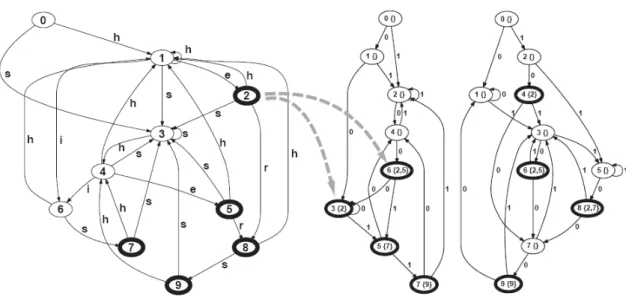
The Aho-Corasick (AC) algorithm [42] is based on finite state automata (FSA). Before the matching process, the string pattern set is complied into an FSA. Then the input steam is scanned byte-by-byte by the FSA to find all the matching string patterns in it. During the preprocessing stage, three functions are generated, which are the “goto” function, the “failure” function and the “output” function. The “goto” function outputs the next state given the current state and input char-acter. The “failure” function outputs the next state when the input character can-not continue to match a string pattern from the current state. The “output” func-tion outputs the pattern ID when one of the string patterns has been matched by the current state. The AC automata built with the string pattern set{he, her, him, his} is shown in Figure 2.1. The matching process of the AC algorithm is: from the initial state 0, one character is fetched from the input stream each time. According to the current state and input character, the next state can be
0 1 h 2 e i 3 4 5 6 r m s he her him his
Figure 2.1:AC algorithm with pattern set{he, her, him, his}.
obtained with the “goto” function or “failure” function. If the returned result of the “output” function of a state is not null, it means a string pattern is matched at this state and the pattern ID can be found. For example, if the input text is “helloher”, the matching process is shown below.
0−→h 1−→e 2→−l 0−→l 0→−o 0−→h 1→−e 2−→r 3(matched by pattern “her”)
The time complexity of the AC algorithm isO(n), where n is the length of the input text. The processing time is unrelated to the number and the length of the strings in the pattern set. Whether string patternP is included in input textT or not, every character inT must be processed by the AC automata. Therefore, the time complexity of the AC algorithm is alwaysO(n)in the best case or the worst case. Considering the preprocessing time, the total time complexity is O(M + n), where M is the total length of all the string patterns. The space complexity (amount of memory required) isO(M).
The Aho-Corasick algorithm is the classic algorithm for searching for mul-tiple patterns simultaneously. Generally speaking, the Aho-Corasick algorithm uses the structure of a finite automaton that accepts all strings in the set. The au-tomaton is structured so that every prefix is represented by only one state, even if the prefix begins multiple patterns. When the next character in the text is not
one of the expected next characters in the pattern, a failure edge is linked to the state representing the longest prefix of a pattern that is also the proper suffix of the current state.
One of the advantages of the Aho-Corasick and Commentz-Walter algorithms is they could match multiple patterns simultaneously. The process time is only related to the length of the input text. They both pre-process the patterns and build a finite automaton which can process the input packet inO(n)time where n is the length of the input text. Although both algorithms are fast, they suffer from an exponential state explosion.
2.1.1.1 AC algorithm based on bitmap compression and path compression Tan et al. proposed a bit-splitting finite state automaton algorithm [47], where each finite state machine (FSM) is split into eight corresponding bit FSMs. Each bit-split FSM processes one bit of the input character. There are only two possible values of the transition conditions which are ‘0’ and ‘1’ from a state to its next state in a bit FSM.
The construction process of bit FSMs is as follows. For an AC automata D, the eight bits of the ASCII code of the input character for each state is used to con-struct the corresponding binary FSMs, which are represented by B0, B1, . . . , B7.
For a bit FSMBi, starting from the initial state of the original AC automata D, the
next states are classified into two categories. The transition condition of Bi is ‘1’
if theith bit of the input character is ‘1’, and the transition condition ofB i is ‘0’
if theith bit of the input character is ‘0’. The new states in B
i will be generated
according to the above two conditions.
For example, for the pattern set {he, she, his, hers}, the original AC automata is shown on the left of Figure 2.2.
The bit FSM B3 representing the fourth (here i=3 and i start from 0) bit of
Figure 2.2:Extracting bit-level parallelism from the Aho-Corasick algorithm by splitting the state machine into 8 parallel state machines.
ASCII code of character ‘h’ is “01101000”, and the ASCII code of character ‘s’ is “01110011”. From the state 0 to state 1 with the transition condition ‘h’ in the original automata D, the corresponding fourth bit of ‘h’ is ‘0’, so a new state is generated in B3, and the transition condition from state 0 to state 1 in B3 is
‘0’. Similarly, the fourth bit of ‘s’ is ‘1’, a new state is generated in B3, and the
transition condition from state 0 to state 2 inB3 is ‘1’. Similarly the other FSMBi
(0≤ i ≤7) can be generated separately. Eachibit of input character will be sent to the corresponding FSMBi to make a match. If allBi can be matched, then this
input character can be matched. Otherwise it cannot be matched if any one of the Bi cannot match the input bit.
2.2 Multi-Character Based String Matching Algorithms
Traditional single-character DFA is a state machine which consists of a finite set of states and directional transitions. Each transition has a specific input character on which a transition can occur from one state to another. Multiple-character DFA also consists of a set of states and transitions; however, the transitions are not limited to a single character.Figure 2.3:Transfer character set to the token sequences.
2.2.1 Transition-distributed Parallel DFA
Luet al.[48] proposed a memory-efficient multiple-character-approaching scheme consisting of multiple parallel deterministic finite automata (DFAs), called transition-distributed parallel DFAs (TDP-DFA). Parallel DFAs with overlapping input win-dows are used to achieve the goal of processing multiple characters in each clock cycle. TDP-DFA meets the size limitation of embedded memory, and can be im-plemented on-chip with current ASIC technology.
In TDP-DFA,wcharacters (eg.,w= 3) are regarded as a token, and then each signature is decomposed into one or more tokens. Note that, as shown in Fig-ure 2.3, the appropriate number of wildcards, i.e., ‘*’s may be padded to make the length of the signature an exact multiple of w. A corresponding NFA can be constructed and converted to a DFA for detecting the token sequences. The DFA structure can be found in Figure 2.4. As in the case of Figure 2.5, the boundary of a single input window may not be aligned with the starting character of the pattern, hencewDFAs need to be deployed for detection in parallel.
The advantage of TDP-DFA is it can process more than one input character at a time so as to achieve a higher matching speed. The disadvantage of TDP-DFA is thatwDFAs are used for matching in parallel which means the requirement of memory cost of the TDP-DFA iswtimes larger than the original one.
transition state matched hit
For simplicity, some transitions are not shown. symbol:
Figure 2.4:An example of TDP-DFA withw=3.
2.2.2 Bloom Filter-based String Matching Algorithm
There are some hardware-based string matching techniques using Bloom filters, which can detect strings in streaming data without degrading network through-put [49, 50].
process w characters per clock cycle
(w=3)
2.2.2.1 Bloom Filter
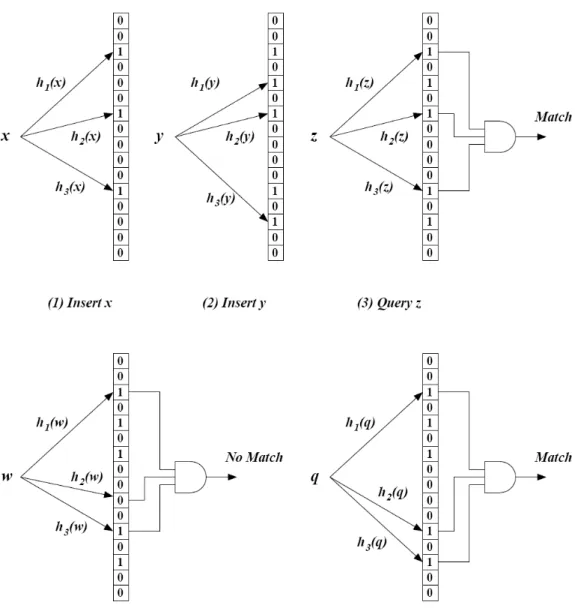
A Bloom filter is a data structure that contains a set of patterns compactly by computing multiple hash functions on each member of the set.
The hash functions in a Bloom filter should be independent and as fast as possible. Figure 2.6 (1) and (2) illustrate Bloom filter programming. Two strings, xandyare programmed in the Bloom filter withk = 3hash functions andm = 16 bits in the array. The bit will be set to 1 at all these positions generated by the hash functions. Note that different strings can have overlapped bit patterns.
k hash values are generated using the same hash functions used to program the filter with the input string s. The bits in the m-bit vector at the locations corresponding to thek hash values are checked. If at least one of thek bits is 0, then the string is declared to be a non-member of the set3 (Figure 2.6(4)). If all the bits are found to be 1, then the string is a potential membership of the set (Figure 2.6(3)). If all thekbits are found to be set andsis not a member ofS, then it is said to be a false positive.
The ambiguity in membership comes from the fact that thekbits in the m-bit vector can be set by any of then members ofS. For instance, in Figure 2.6(5),q maps to all the bits which were set byxandy. Althoughq 6∈S, the filter shows a match which is a false positive. Thus, finding a bit set does not necessarily imply that it was set by the particular string being queried. However, finding a 0 bit certainly implies that the string does not belong to the set; if it were a member, then allk-bits would have been set when the Bloom filter was programmed.
2.2.2.2 False Positive Probability
If m is the number of bit vector. The probability that a random bit of the m-bit vector is not set to 1 by a hash function is simply1− 1
m. The probability that it
is not set to 1 by any of thek hash functions is(1− 1
m)k. Ifnstrings are inserted,
the probability becomes(1− 1
m)nk which a certain bit is still 0. The probability
that this bit is 1 becomes 1−(1− 1
m)nk. For a string to be detected as a possible
member of the set, allk bit locations generated by the hash functions need to be 1. The probability that this happens,f, is given by
f = (1−(1− 1
m)
nk)k
For large values of m, the previous equation reduces to
f ≈(1−e−mnk)k
This probability is independent of the input string and is termed the false positive probability. The false positive probability can be reduced by choosing appropri-ate values formandkfor a given size of the member set,n. It is clear that the size of the bit-vector,m, needs to be much larger than the size of the string set,n. For the given ratio m
n, the false positive probability can be reduced by increasing the
number of hash functions,k. In the optimal case, when false positive probability is minimized with respect tok, the following relationship can be calculated:
k = m n ln 2
In practice, the false positive probability can be adjusted according to different situation. If a low false positive is required, then the parametersk, nand m can be changed by the above theoretical analysis.
2.2.2.3 Jump-ahead Aho-Corasick NFA
S. Dharmapurikaret al. proposed an algorithm called Jump-ahead Aho-Corasick NFA (JACK-NFA) [50]. The basic idea of JACK-NFA is to comparekcharacters at a time.
Figure 2.7:Jump-ahead Aho-Corasick NFA (JACK-NFA)
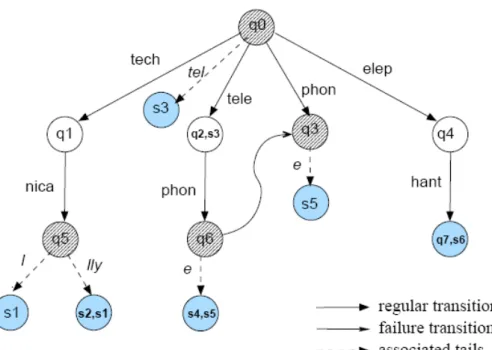
(k = 4 for the purpose of illustration) and the left over portion is called a tail. Each of these k-character segments is treated as a symbol. There are six unique symbols in the given example namely {tech, nica, tele, phon, elep, hant}and the tails associated with these strings are{l, lly, e}. The tails “l” and “lly” are attached to stateq5. However, the tails do not create any state to
which the automaton jumps. Tails simply indicate the completion of a string. To execute pattern matching, the matching engine starts from state q0 and
looks at k characters (bytes) from the text. If this k-character symbol matches with any of the valid symbols associated with the state q0 then a transition is
made to the corresponding state and the nextk characters are scanned. At each state, while thek characters are considered, all the prefixes of thesek characters are checked to see if any of them matches any of the tails associated with that state. If at any state a match is found for a tail then the corresponding string associated with the tail will be reported.
There exists a byte alignment problem which means that for multi-byte scan-ning that every character of the input stream should have the chance to be exam-ined as the first character. This requires duplicate matching modules to return the
correct matching results. For example, given the input string “abctechnical”, the matching engine will detect the string as “abct echn ical”. “abct” can-not be matched by any 4-character segment associated with stateq0, the
automa-ton will never jump to a valid state causing the machine to miss the detection. Similarly next 4-character segment “echn” cannot be matched either. However, there is a transition fromq0toq1by accepting 4-character segment “tech” which
appears in the input string. To avoid the byte alignment problem, 4 matching modules are used to match the input string in parallel. The first matching mod-ule detects “abct echn ical” and the second matching module detects “bcte chni cal”. Similarly, the third machine scans it as “ctec hnic al” and fi-nally the fourth machine scans it as “tech nica l”. The first three matching modules will miss the detection while the final one will report a match.
A hash table is used for representing the JACK-NFA (shown in Table 2.1). Each table entry consists of a pair < state, substring >which corresponds to an edge of this NFA. If the nextk-character segment can be found with the current state in the table, we can jump to next state to keep on processing.
f i l e s h a r i n g s y s t e m
35 34 67 65 57 61 40 29 18 7 27 78 25
Hashing with k=5 gram
34 40 7 25
Fingerprints selected with windows of width w=5:
Figure 2.8:Winnowing sample text. The gray part is covered by the selected fingerprints.
2.2.3 Variable Stride DFA
In [51], Nanet al. presented a variable-stride multi-pattern matching algorithm in which a variable number of bytes from the data stream can be scanned in one step. The winnowing idea [52] is developed for document fingerprinting in a novel manner to develop a variable-stride scheme that increases the system throughput considerably while also decreasing memory usage by an order of magnitude over previously proposed algorithms.
2.2.3.1 Winnowing Algorithm
The winnowing algorithm is a document fingerprinting scheme, which ensures that the matched parts between the files and the input are preserved in the match-ing results of the processed files and input (consistmatch-ing of fmatch-ingerprints). In Fig-ure 2.8, the text is firstly transformed into a sequence of hashes of the k-grams (k = 5in Figure 2.8), so each hash value represents ak-character block. Then by sliding a window of width w (w = 5 in Figure 2.8) from left to right, a specific hash value is selected from each window, e.g., the smallest hash value is selected in each window4. In this example, four fingerprints are selected from a text of length 17 while almost all contents are represented in the fingerprints selected (the gray segment). In general, the gaps between fingerprints can be widened with larger window size w, and it is possible to have more of the contents cov-ered by selecting a fingerprint with largek.
The winnowing algorithm could solve the byte alignment problem (explained
Figure 2.9:Segment Pattern into Head/Core/Tail Blocks (k= 2,w= 4).
in subsection 2.2.2.3) because it has a “self-synchronization” property. This algo-rithm ensures that irrespective of the context in which a pattern appears in the in-put stream, it is always segmented into the same sequence of blocks (with some head and tail pattern exceptions). These unique blocks can be used as atomic units to construct a variant DFA which is called VS-DFA here. The basic idea of VS-DFA is to compare these unique blocks of input string with the corresponding blocks of the pattern.
Pattern segmentation examples are shown in Figure 2.9. If two blocks ent
and ica have been matched consecutively, there is potentially a match to S2.
To verify the match, all the system needs to do is to retrieve the w-byte prefix characters and (w+k −2)-byte suffix characters in the data stream to compare againstS2’s head block and tail blocks.
As shown in Figure 2.10, all the segment strings are used to construct VS-DFA. The key feature of VS-DFA is that its state transitions are based on core blocks rather than individual characters. A VS-DFA pattern matching system consists of two modules: the winnowing module and the state machine module. The incoming data stream (packet payload) is first segmented into variable sized blocks by the winnowing module and pushed into a First-In-First-Out (FIFO) queue. Then the blocks are fetched from the queue and fed into the state machine one by one. The state machine runs the VS-DFA and outputs the matching results.
Figure 2.10:An example of a VS-DFA.
The incoming traffic data will be sent to the same fingerprinting scheme so as to get the correctly sized block of characters. These blocks is used to feed to the VS-DFA. The VS-DFA matching procedure and the fingerprinting operation can be done simultaneously.
VS-DFA could process more than one input characters in a block at a time so as to achieve a higher matching speed. But there are some disadvantages about VS-DFA. It cannot be used for regex matching and not suitable for software im-plementation. This method is sensitive to both rule set and input string, with greatly reduced throughput in the worst cases. A malicious stream can continu-ously produce short strides, leading to degraded matching throughput close to that of the single-character matching solutions; moreover, a large portion of the patterns would be left to be matched by other brute-force matching hardware resources.
1 2 b 3 c d 4 5 c 6 e c * 0 a *
(a)
0 2 ab 3 .c d. 4 5 ac 6 ce,e. cc * 1 .a *(b)
b. cd ce bcFigure 2.11:(a) NFA accepting (1)ab.*cdand (2)ac+e; (b) corresponding 2-NFA.
2.3 Regular Expression Matching
Regular expression matching was initially studied as a topic in automata theory and formal theory in the context of theoretical computer science [20]. To acceler-ate the regex matching in real-world systems, the problem has been intensively studied in practical scenarios in recent years. Vulnerability signatures have re-cently been proposed as an alternative to regex, but a high speed regex matching subsystem [53] is still required.
2.3.1
k
-DFA
Michela Becchi and Patrick Crowley proposed k-NFA and k-DFA [54], meant to process k input characters at a time. Figure 2.11 shows an example of 2-NFA ofab.*cdand ac+e. Their work proposes acceleration techniques that rely on multiplying the amount of bytes (strides) processed per cycle, with the obvious problem of memory blow-up (due to the exponential growth of edge numbers with the stride size).
There are two problems of k-NFA/k-DFA: alphabet set explosion and tran-sition explosion. One problem of k-NFA/k-DFA is the Alphabet set explosion. For the 2-NFA in Figure 2.11 (b), assuming thatPis the ASCII alphabet (256 el-ements), P2 would have 2562, that is 65536 elements. Similarly, if the alphabet
of the original DFA is P, the non-compressed k-DFA will have |P|k outgoing
transitions per state. The other problem is transition explosion. For each state, the possible outgoing transition number is|P|k. Because of the not appropriate
explosion, it is impractical for implementation in real system.
2.3.2 Multi-Stride DFA
Vespa et al. [55] presented a multiple-stride pattern-matching architecture that requires a small storage and non special-purpose hardware. The basic idea is to group DFA states/transitions into three coarse-grained and variable-sized blocks, so that each individual block can employ different-specific methods to optimize storage requirements and performance. The blocks are naturally identified based on basic observations of DFA characteristics: prefix, linear trie and state depen-dencies.
An example of multiple-stride DFA is used to explain the basic idea of Multi-Stride DFA (MS-DFA). If the patterns are {“AABCDZGHIJ3A2B1C”, “ABCDE-FGHIJSTUVWXYZ”, “0123456789Z”, “6789KLMNOPYZABC”}, we can divide the pattern into tree parts according to the relationship among the patterns which is shown in 2.12. These three parts are used to generate as the label of transitions and stored in three different memory blocks.
Matching starts in the primary block at state 0. The primary block stores tran-sitions for the first m bytes of each pattern (here m = 10). If a transition is fol-lowed in the primary block, control point moves to the secondary block. If a secondary block transition fails and a ternary block transition exists for the cur-rent state, then control moves to the ternary block. A matching transition in the ternary block moves control back to the secondary block. Failure in the ternary block moves control back to the primary block [55].
If there is a shared prefix in two patterns, then the first character except for this prefix is stored in the ternary block. Then the remaining bytes of each pattern
Figure 2.12: MS-DFA for patterns {“AABCDZGHIJ3A2B1C”, “ABCDEFGHIJSTU-VWXYZ”, “0123456789Z”, “6789KLMNOPYZABC”}.
are stored in the secondary block. Next, longest prefix match transitions are cre-ated and stored in the secondary and ternary blocks. For example, the substring “6789” appears at the end of pattern “0123456789Z”. At the same time, it is the beginning of the pattern “6789KLMNOP”. The rest substring of “6789KLMNOP” except for the same prefix is “KLMNO”. It will be stored in the secondary block. The rest substring of pattern “0123456789Z” except for the same prefix is “Z” which is stored in the ternary block.
MS-DFA is a memory-based DFA run from software only. Sometimes it is a little hard to find two regexes sharing the same prefix. So MS-DFA cannot work well in regex matching.
2.3.3 Sampled DFA
A recent method [56] introduced sampling techniques to accelerate regex match-ing, which allows skipping a large portion of the input stream, thus processing fewer bytes5. The price to pay is a small probability of false alarms, which re-quire a confirmation stage. Therefore, the author proposed a double-stage
match-Figure 2.13: Example: the regex ab.*cd is sampled (with θ = 2) to [ab].*[cd] and matched against a text of 16 bytes.
ing scheme providing two new different automata (sampled DFA and reverse DFA [57]). The basic idea of sampled DFA is to extract the fixed string of patterns as the new pattern to match the payload text, thus reducing the number of char-acters to be checked. Sampled DFA works as a filter like the other kinds of filter engine, such as Bloom filter. The effectiveness of this method is justified by the fact that in most cases, the first sampled lookup is enough to a classify packets, while every few packets only require a second stage of processing.
Figure 2.13 shows the principles of the matching scheme, with the exam-ple regex ab.*cd. A sampled DFA is used to make the match (that matches [ab].*[cd]) and a regular non-sampled one is used to make the confirmation ([xy] means that both characters ‘x’ and ‘y’ trigger a transition). For example in Fig-ure 2.13 c), the input string “bbcd” will be checked ‘b’ and ‘d’ first withθ = 2. It can be matched by the sampled DFA [ab].*[cd], then the other characters ‘b’ and ‘c’ will be checked. It cannot be matched which means it is a false alarm. The first check is performed on the text by using the sampled DFA; if a match is found, then the second stage is triggered. Whenever the sampled regex is matched, the non-sampled text has to be checked to confirm the match.
a
2
3
a
4
b
1
b
(a) Traditional DFA for pattern ab*|ba.
1
a
2
b
3
b
a
(b) Reverse DFA for patternab*|ba.
Figure 2.14: Traditional DFA and reverse DFA for patternab*|ba.
to scan regular expressions faster. For a given regular expression ab*|ba, the traditional DFA is shown in Figure 2.14 (a). According to the construction method in [57], the corresponding reverse DFA can be found in Figure 2.14 (b). Assuming the input string is “abbb”, it can be matched by the traditional DFA at state 2. The reverse string of “abbb” is “bbba” and the reverse string can also be matched by the reverse DFA (at state 2).
2.4 Comparison of Multi-character Matching
Algo-rithms
JACK-NFA is based on the Bloom filter and VS-FA uses winnowing as its basic function, both of which are not suitable for software implementation. VS-FA is used for string matching, but it cannot be employed for regex matching. MS-FA is software only and cannot be used for regex matching. k-DFA is fast, but has a transition explosion problem.θ-DFA works for constant input bytes and has bad performance for some regexes in worst cases.
StriDFA can be implemented in both software and hardware matching sys-tems. It has no byte alignment problem and can be used for regex matching. In the next chapter, the details of StriDFA will be explained.




![Figure 2.13: Example: the regex ab.*cd is sampled (with θ = 2) to [ab].*[cd] and matched against a text of 16 bytes.](https://thumb-us.123doks.com/thumbv2/123dok_us/9019339.2799765/52.892.249.728.136.392/figure-example-regex-ab-sampled-matched-text-bytes.webp)
