Fuzzy Based Optimal QoS Constraint Services
Composition in Mobile Ad Hoc Networks
P Veeresh
1, R Praveen Sam
2and C Shoba Bindu
313
JNTUA College of Engineering, Anantapuramu, India 2
G. Pulla Reddy Engineering College, Kurnool, India
Abstract: In recent years, computational capability of mobile devices such as Laptops, mobile phones, PDAs, etc., are greatly improved. Implementation of SOA ("Service Oriented Architectures") in mobile ad hoc networks increases the flexibility of using mobile devices. On composing different available services to satisfy end user requirement is a critical challenge in MANETs ("Mobile Ad Hoc Network") due to dynamic topology, Resource heterogeneity, Bandwidth constraint and highly distributed service providers. Existing composition services approaches are not suitable for MANETs due to lack of constraints consideration while choosing services. In this paper, we proposed Fuzzy based optimal QoS constrained Service Composition in MANETs. We consider Energy constraint, hop count, Response time & service throughput as QoS Constraints composing optimal services. We proposed fuzzy logic based system to provide a rating to the services for optimal selection of services. We also considered that each node can provide one or more services. The service composition failure rate will be reduced by selecting optimal services in available services. The simulation result demonstrates that the proposed method outperformed than the traditional AODV in terms of average packet delay, energy constraint, throughput and turnaround time.
Keywords: about Services composition, fuzzy logic, Mobile Ad Hoc Networks, Service rating.
1.
Introduction
MANET is an infrastructure-less, multi-hop, temporary, spontaneous, distributed and dynamic network [15]. Wireless networks are broadly categorized as MANETs and mesh networks which use access points [22]. A node in MANET can act as a node as well as a forwarding capability element like a router. There is no centralized administration. Any node in MANET can join and leave network any time on the fly.
Mobile devices processing capability increased drastically. Implementation of services in MANETs will increase the flexibility of using mobile devices [4]. Services are the implementation of SOA. Services are self-descriptive, loosely coupled, self-encapsulated, machine interaction, dynamic loading, and dynamic discovery components. Services are very popular due to its attractive benefits [18],[13],[8]. Deploying services in MANETs is a critical task because MANETs are unstable networks and services are efficient in a stable network.
In recent years, a wide research conducted on Service Discovery in MANETs, but only a few researchers concentrated on service composition in MANETs. The service discovery architectures are broadly categorized as dictionary-based architecture and dictionary-less architecture[27]. A dictionary is a database which stores the information about services available in the network. The dictionary-based architecture, further classified as centralized
dictionary architecture and distributed dictionary architecture. In the centralized approach, a few dictionaries are maintained to store the available services information. In the distributed approach, a list of nodes is elected as dictionary nodes and all the dictionaries are synchronized to each other. Centralized approach suffers from the bottleneck problems whereas not in case of distributed approach. The distributed approach is suitable for MANETs. In dictionary less architecture, available services are discovered whenever required on-demand basis. In this paper, we used distributed approach to store available services information. It is very difficult to address the complexities of wireless networks by the centralized approaches. MANETs need distributed approaches for service discovery and composition.
Growing needs of users, single service will not satisfy user requirements but complex services will solve this problem. Creating complex services by combining more than one service is called service composition. Most of the existing service composition architectures are designed for wired infrastructures, where the services are assumed to be that reside over the high bandwidth and reliable communication channels. These architectures are centralized and consist of preconfigured composition managers. The composition manager performs services selection, services composition plan, and execution of services as per the composition. Such architectures are not suitable for mobile ad hoc networks. Some of the limitations of MANETs are:
1.Mobility: current service composition architectures have lack of support for mobility due to dynamic network topology.
2.The Central point of failure: Centralized service composition approach suffers from bottleneck problem and more prone to single point of failures.
3.Fault management: mobile nodes faults range from service discovery failures, service execution failures and network link failures.
Service Composition architectures for MANETs need to withstand such failures. Service composition is categorized as static and dynamic service composition [17]. In static service composition, everything will be decided before the composition and more manual intervention is needed. Dynamic service composition will do everything automatically at runtime without or little manual intervention. Fully dynamic service composition approach is generally achieved by using AI ("Artificial Intelligence") techniques [20],[14].
consider QoS metrics for both nodes and Services in MANETs. Throughput & response time are the metrics considered for service and energy constraint and hop count are the metrics considered for nodes. Service composition process success rate depends on degree of service discovery and optimal selection of services based on QoS parameters. Fuzzy based solution for optimal selection of services is presented in this paper. Based on metrics, a rating criterion is proposed for a service in a node to select max rated services for composition. Thus more realistic services are considered for composition thereby reducing the failure rate of service composition.
To counter the problems of existing approaches, the proposed method has the following features.
1. A distributed approach is proposed to maintain services information in a node.
2. Max rated services are selected for composition path which satisfies QoS constraints
3. Multiple services are considered in a single node.
4. Fully automated dynamic service composition based on fuzzy logic solution
The paper organized as follows. Section 2 specifies related work. Section 3 describes system model and section 4 represents Fuzzy interference system to calculate rating of a service. Section 5 describes QoS constraint service discovery and service composition. In section 6 presents Simulation results and section 7 presents Conclusion and Future work.
2.
Related work
In [7] a dictionary based service discovery protocol is proposed which uses Dezert-Smarandache Theory (DSmT) to calculate trust value of a node by the neighbor node, based on behavior of a node. Evidential theory DSmT is used to handle uncertainty information about a node by taking data from different sources. A trusted node is defaulted if a faulty neighbor provides wrong information about a node. In [6] BeeAdHocServiceDiscovery protocol is proposed on the intelligent behavior of bee metaphor which uses swarm intelligence. Authors consider only the generalized QoS parameters. Specific QoS parameters related to MANETs like bandwidth, mobility, energy and resource constraints are not considered.
In [3] considers user preferences to select top k services in composition based on fuzzy sets. A complex query rewriting algorithm RDF is used to select relevant services for composition. The services are ranked based on Pareto dominance fuzzification. Ranks are computed for entire service composition path. Highest scored path is selected for service composition. This process is not suitable for MANETs.
In [16] proposed a QoS aware service discovery, composition and execution in SSON ("Service Specific Overlay Networks"). MPs ("Media Ports") are organized in SSON according to service type, node stability and quality level of a service. Central point of failure is eliminated by decentralized SSON composition algorithm. Further service discovery is enhanced through fuzzy system.
In [10] an ontology based framework is designed for service composition based on functional and non functional aspects of QoS services. Services are clustered using HCA ("Hierarchical Clustering Algorithm") based on functionalities of services. A bipartite graph is used to
discover services semantically. The discovered services are selected using Fuzzy topis for services composition.
In [12] a distributed approach is proposed to find services composition path by using path filtering and path combination. These two methods controls forwarding messages and reduce the searching efficiency. In [1] distributed architecture is proposed for peer-to-peer MANETs for service composition. Table update messages are used for service discovery. The composition process load is distributed among the network for balancing. The problem with this approach is, a new architecture is implemented at every node which leads to great changes in MANET.
In [5] Distributed broker mechanism protocol and distributed service discovery is proposed for dynamic service composition. A distributed composition manager (CM) is elected based on device specific potential values and QoS Parameters. Each composition request is independently assigned to CM. It works on the principle of single composition manager for single composition request. In [2] hierarchical graph based service composition architecture is proposed, where a node represent logical service and edge represent data flow between corresponding nodes.
In [21] a trust based approach and MOO ("Multiple Objective Optimization") is used to select services which maximizes the QoS and minimize the service cost for solving service composition problem. For high user satisfaction, competence and integrity trust parameters are proposed for services composition.
In [24], the trust based service composition in MANETs is proposed. Where the service requesters requesting of services and providers providing services. In case of multiple services are requested, service composition has to be done from multiple service providers. The proposed method finds the trustworthy service composition path to minimise the total energy and time.
In [25] proposes agent based self evolving service composition approach. Five stages of composition process are combined together and consider all phases as a single process. It is a decentralized self evolving approach and studies service relation modification and service migration. This approach is suitable for wired network, but not suitable for MANETs because an integrated five phases of services composition process in one node become in-cumbrance in MANET which contains limited computational capability nodes. In MANETs, maintaining of agents is critical task due to dynamic movement of nodes.
In [26], dynamic service composition is proposed for pervasive environments. In MANETs, each time the environment is changed the service composition process has to be started again from the beginning, which depletion of the system resources and network capacity. The proposed method uses the dynamic and distributed approach to resuming service composition. It deals spatial, temporal constraints and a heuristic method is used for service composition restoration. The drawback with this approach is services are available in hop distance, but in real environments the services are available in multi-hop nature.
3.
System model
metrics for a node and Response time and throughput considered as QoS metrics for services.
Figure 1. Fuzzy inference model to calculate rating of a service
Composition initiator issues the complex request and in turn splits into atomic services. Atomic services request is forwarded to local Service Registry Node. The local registry node gives the response to the initiator and forwards the request to other registry node. The service request packet keeps forwarding from one registry node to another registry node till the TTL value reaches to zero. The response packet contains energy and hop count metrics about a node and response time and throughput metrics about a service. All these information is collected by composition initiator. These metrics are considered as inputs to fuzzy inference system to calculate rating of services as shown in Figure 1. Using fuzzification and defuzzification methods, rating is evaluated for the available services which are used in service composition.
After receiving responses from multiple registry nodes, the initiator node runs the QoS constraint Service Composition Algorithm to trace out maximum rated service providers. After completion of composition execution, the results are to be transmitted to service composition initiator.
3.1 Service QoS Constraints
Service performance is defined as how fast a service request can be completed. According to the W3C service performance is defined in terms of execution time, latency, response time, execution time and transaction time.
In this paper we consider two parameters response time and throughput to define service performance.
3.1.1 Response time
Response time is, the time duration between sending of request to and receiving of response. Further, it is divided into service processing time, Network processing time, time consumed for compression and decompression of data, time consumed for encryption and decryption of data and time for data traversing through the protocol stack of source, intermediate and destination nodes.
Response time is represented as:
(1)response task stack transport cd ed
t s t s t s t s t s t s
Where
tresponse(S) – Response time of a service
ttask(S) – Task processing time
tstack(S) – Time consumed for processing of data in protocol stacks of source, intermediate and destination nodes
ttransport(S)– Network transport time
tcd(S) –Time required for compression and decompression of data
ted(S) – Time required for encryption and decryption
3.1.2 Throughput
Throughput is defined as "Number of requests or packets processed per second by a service". We define the throughput of a service as follows:
time requests Throughput # (2)
3.2 Node QoS constraints
In this paper we consider two parameters Energy and hop-count to define node performance.
3.2.1 Evaluation of energy consumption of a Node
Energy consumption of a node is defined in terms of numbers of packet transmitted from one node to another node. E(p, na) is the energy necessary to transmit a packet (p) from node na to node nb is
( , a) tx( , a) rx( , b) ( 1) o( , )i (3)
E p n E p n E p n N E p n
Where
Etxis the amount of energy necessary to transmit from node na
Erxis the amount of energy necessary to receive a packet
Eois the amount of energy necessary to overhear the packet. The average number of neighboring nodes is
N that are affected by the transmission from node na Energy consumed by each node is calculated as
4
1
(4)
Node ack Ei
i
E
E
Cost
( ,
a)
(5)
ack
E p n
E
n
Where
n - Number of control packets
Ei-{Node Movement, Band Width, Resources, Service Discovery}
Eack - Time consumed for processing of data in protocol stacks of source, intermediate and destination nodes
CostEi - Cost incurred for various mobility constraints
3.2.2 Hop count
Hop count is defined as "the number of hops or links between the source and destination nodes". Average hop count is considered for overall communicating nodes in MANET. Multi-hop connectivity matrix is used to compute average shortest path hop-count at each point in time [11].
1
1
(6)
T
i i
T
i i
hops
h
paths
Where
T is the number of multi-hop matrices hopsi is the total number of hops at time i
pathsi is the number of cells at time i that contain a non-zero entry
4.
Fuzzy Interference System to calculate
rating of a service
Rating of a service is evaluated using fuzzy Interference system which considers the node hop-count and energy and service throughput & response time as input parameters.
4.1 Procedure for calculating rating of a service
4.1.1 Fuzzification
Fuzzification is a method, which compares input values with membership functions for obtaining the membership values from the past history and converts into linguistic labels. In the proposed methodology, we consider QoS metrics Energy, Hop Count, Throughput & Response Time as fuzzy input crisp variables, and the rating of a service as the fuzzy output variable.
Figure 2. Phases of calculating rating of a service
4.1.2 Fuzzy membership functions
As shown in Figure 2, the crisp fuzzy input variables, Energy, Hop-count, Response time & Throughput are divided into five fuzzy sets as, Very low, low, moderate, high, very high. The output crisp values are generated by the same fuzzy functions. Here we considered triangular membership to calculate rating of the service [9] as shown in Figure 3.
(a)Membership Function for Energy
(b)Membership Function for Hop Count
(c)Membership Function for Response Time
(d)Membership Function for Throughput
(e)Membership functions for rating
Figure 3. Fuzzy Membership Functions
4.1.3 Fuzzy Rule Base
Fuzzy rule base is a database of rules, which is formed by the combinations of fuzzy input sets. Each rule is represented by “IF-THEN”. Here the fuzzy input variables are 5 sets, so the fuzzy rule base contains maximum of 625(5X5X5X5) rules. Only a few of the rules are presented in table1
Table 1. Fuzzy Rules
Energy Hop Count
Response Time
Throughput Rating
Table 2. Fuzzy sets of QoS parameters
QoS Parameters
Very
Low Low
Mode
rate High
Very High
Energy(J) 0 -15 0 - 30 10 - 40
20 - 50 30- 60 Hop Count 0 - 3 0 - 6 3 - 9 5 - 12 9 - 15 Response
Time(ms)
1000 - 2000
2000 - 3000
3000 - 4000
3000 - 5000
4000 - 5000 Throughput 5 - 10 5 - 15 10 -
20
20 - 25 25- 30
4.1.4 Fuzzy Inference System to evaluate rating of a service
In the fuzzification process, the max-min rule is used to combine crisp input values (response time, energy, throughput and hop count). In the Figure 4, we applied two fuzzy rules for fuzzification and the fuzzy set intervals are discussed in the table2.
Fuzzy Rules
1. Rule 1: If(Energy is Very Low, Hop-count is Very Low, Throughput is Very High, and Response time is Very Low) then (Rating is Very High)
2. Rule 2: If(Energy is Moderate, Hop-count is Moderate, Throughput is High, and Response Time is Moderate) then (Rating is Moderate)
(a) Rule1
(b) Rule2
Figure 4. Defuzzification evaluation of service rating Let the input crisp values of energy, hop-count, throughput, and response time of an application are like 5 J, 1.57, 24.2 and 1.52e + 03 respectively as shown in Figure 4(a). In each rule, find the degree of membership value of every input value (i.e. intersecting point of corresponding fuzzy set triangular wave). Identify the minimum degree of membership value of all input values and consider corresponding shaded portion in the output fuzzy set. Union all output fuzzy set's shaded portion and apply Center of Gravity defuzzification method to evaluate crisp node and service rating. Similarly rule 2 is represented as shown in Figure 4(b).
4.1.5 Defuzzification
The output fuzzy set value is converted into crisp output value in defuzzification process. Center of gravity is one of the popular defuzzification methods as shown in equation (7) and for the example shown in Figure 4(a), the output crisp value of rating is 0.904.
1 0 () 1 0 ()
dt t
tdt t COG
(7)
4.2 Node Architecture of a Service in MANET
A new node model, where a node may contain more than one service reducing the involvement of number of nodes in the service composition is proposed in this section.
A node in ad hoc network can be defined in view of services as
N = (Nid, {S1, S2, … Sn},ENode) (8) Where
Nid Node ID, Node can be identified uniquely ie., IP Address of a node.
{S1, S2, ...Sn} Services present in a node
Each service Sj = (Sid, Sip, Sop, SRes, SThr ,C)
Sid Service ID, service can be identified uniquely
Sip Service Input
Sop Service output
SRes Service response time
SThrService Throughput
C Other Constraints
ENode Node Energy
Figure 5, shows nodes with multiple services.
Figure 5. Nodes in MANET with multiple services
5.
QoS Constraint Service Discovery and
Service Composition
5.1 Service Discovery
The service discovery in the MANET is done by categorizing the nodes participating as Service Registry, Service Providers, Service Request Nodes and intermediate nodes. The topology contains the nodes belonging to one of the categories as stated above. The discovery process is executed repeatedly whenever a new node gets into the network or else an existing one leaves or expires.
5.2. QoS Constraint Service Composition
In this section, we propose service composition by considering the node constraints as well service constraints. After service discovery process, Composition requester will get all the required services. Composition initiator will get all Nodes Energy Index value ENode and hop-count h distance from the composition initiator to service provider. Composition initiator also gets response time & throughput of all related services. These QoS constraints are normalized by fuzzy logic and a matrix is established between nodes and its services which specifies rating of a service R as shown below.
mn m m m n n nR
R
R
R
R
R
R
R
R
R
R
R
R
R
R
R
...
...
...
...
...
...
...
...
...
3 2 1 3 33 32 31 2 23 22 21 1 13 12 11Each row specifies a set of similar services provided by the different nodes with different rating values. Each column specifies a set of services provided by a node.
The QoS constraint service composition algorithm generates composition path by considering the optimal atomic services provided by the outsourced service providers. First it lists out all the required maximum fuzzy normalized rated services
S1, S2, S3 ,... Sn. After that a service composition path and service composition execution plan established. For example composition initiator sends request to service S1 present in node N1. After processing of service S1, S1 handover the composition plan to S2 present in node N2.
Using AODV (“Ad Hoc on Demand Distance Vector Routing Protocol”) routing protocol S1 find out route for N2 where the service S2 is present. This process continues until completion of Service composition. Finally the service composition results are to be transferred to composition initiator. Empirically it has been found that the algorithm devised here has shown profound result in finding a QoS Constraint optimal service composition path. The methodology used over here takes the parameters of the service into consideration and filters the nodes list obtaining the list of nodes that are able to provide the requested service. Unlike any other mechanism this approach has lead a way to serve a complex service request in an efficient way.
Algorithm 1: Service Composition Algorithm(Rating, m, n)
Procedure ServiceCompositionAlgorithm(N, m, n)
//Rating[1 : m; 1 : n] is the rating of the services
//MaxRating[i; j] maximum rated services
//n is number of nodes in composition
//m is the number of services
for i ← 1 to m
{
MaxRating[i]→0;
forj ← 1 to n {
ifRating[j, i] > MaxRating[i]then
MaxRating[i] ← j; }
}
Composition path is MaxRating[1 : m];
fori ← 1 to m -1
{
Execute Service(MaxRating[i]);
Append Input Output;
Create Composition Request Packet to MaxRating[i+1] Service;
Hand Over Composition Request(MaxRating[i+1]);
}
Transfer Composition Results to Initiator;
For example, matrix consists of rating of each service.
54
.
0
75
.
0
90
.
0
62
.
0
80
.
0
75
.
0
64
.
0
48
.
0
84
.
0
58
.
0
As shown in Figure 6, Node N1 contains three services S1, S2,
S3. Node N2 contains two services S1, S4. Node N3 contains two services S2, S4. Node N4 contains two services S1, S2. Node N5 contains only one service S1. Among these nodes, for Service S1 node N2 selected because maximum fuzzy rated services, for Service S2 node N3 selected, for Service S3 node N1 selected, for Service S4 node N2 selected. The optimal service composition path as shown in Figure 7 is
Figure 6. Nodes with multiple services and fuzzy rating values
Figure 7. Service Composition Path
6.
Simulation Results
The number of services involved in composition verses Average packet delay, throughput, energy and turnaround time is discussed in this section. The network size is to be 80 Nodes. Table 3 summarizes the simulation setup.
Table 3. Simulation Setup
Parameter Value
Number of nodes 80 Simulation Time 150 Seconds Wifi standard 802.11b Wifi rate DsssRate1Mbps Transmission range (R) 45m
Routing protocol AODV Number of concrete services 120
Size of composition plan 5 (Abstract Services)
6.1 Average Packet Delay verses Number of services
In Figure 8, shows the average packet delay of proposed method and traditional AODV, it is observed that average packet delay can be decreased when stable nodes are present in transmission path. The proposed method increases life time of the network and decreases average packet delay by considering the least energy constraint services and least hop
count nodes in composition path. As the results shows that decreased average packet delay reduces the failure rate of the services composition process.
Figure 8. Average Packet Delay verses Number of services
6.2 Throughput verses Number of services
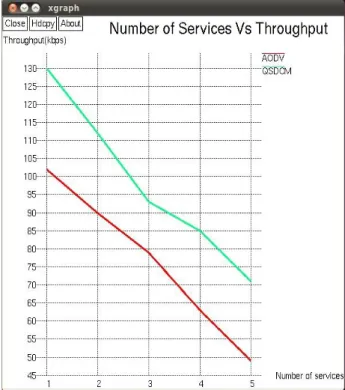
In Figure 9, shows the throughput ("Number of packets delivered per unit of time") of proposed method and traditional AODV, it is observed that throughput decreases as the number of services involved in composition increases. Throughput can be affected by various parameters like, hop count, response time of a service, and number of nodes involved in composition process. The proposed method increases the throughput by considering the least hop count nodes, least response time and considers multiple services in a node. Thus a node can contribute more than one service in composition process. Hence it reduces the packet overhead; it improves overall throughput of a service composition process.
6.3 Energy verses Number of services
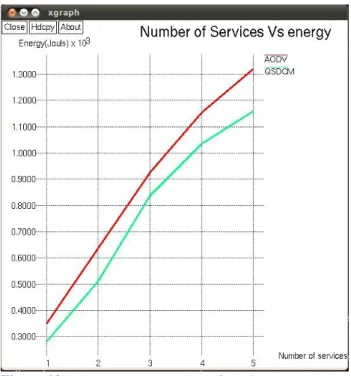
In Figure 10, shows the energy consumed versus number of services. As the results shows that, proposed method will consume less energy for services composition by considering least energy constraint services compared with the traditional AODV. Network life time is increased by considering least energy services; hence the service failure rate is reduced as more live nodes are present in the network.
Figure 10. Energy verses Number of services
6.4 Turnaround time verses Number of services
In Figure 11, shows the turnaround time versus the number of services involved in composition. The proposed method results in better turnaround time compared to the traditional AODV as it selects optimal services by using fuzzy approach.
Figure 11. Turnaround time verses Number of services Our proposed method out performs better than the traditional AODV. In AODV it selects the available services for composition and will not consider any constraint but our
proposed method will consider optimal services with required QoS constraints rated with fuzzy systems.
7. Conclusion and Future Work
Existing service composition approaches in MANET's does not consider QoS constraints both at node and service layer. In this paper a fuzzy based approach for service composition is proposed where we considered QoS metrics energy and hop-count at node and response time and throughput at the service layers and apply fuzzy rules to select maximal optimal service during the service composition. Our approach is scalable and adaptable to highly dynamic networks. Simulation results shows that the proposed approach has better performance compared to AODV. In future work, we plan to consider fault tolerant in service composition in MANETS to minimize the service failure rates.
References
[1] Unai Aguilera and Diego Lopez-de Ipina, “Service composition for mobile ad hoc networks using distributed matching”. In International Conference on Ubiquitous Computing and Ambient Intelligence, pages 290-297, Springer, 2012.
[2] Prithwish Basu, Wang Ke, and Thomas DC Little, “Scalable service composition in mobile ad hoc networks using hierarchical task graphs,” In Proc. 1st Annual Mediterranean Ad Hoc Networking Workshop, 2002.
[3] Karim Benouaret, Djamal Benslimane, Allel Hadjali, Mahmoud Barhamgi, Zakaria Maamar, and Quan Z Sheng, “Web service compositions with fuzzy preferences: A graded dominance relationship-based approach,” ACM Transactions on Internet Technology (TOIT), 13(4):12, 2014.
[4] David Booth, Hugo Haas, Francis McCabe, Eric Newcomer, Michael Champion, Chris Ferris, and David Orchard, “Web services architecture,” 2004.
[5] Dipanjan Chakraborty, Anupam Joshi, Tim Finin, and Yelena Yesha, “Service composition for mobile environments,” Mobile Networks and Applications, 10(4):435-451, 2005. [6] Filomena de Santis and Delfina Malandrino, “Qos-based web
service discovery in mobile ad hoc networks using swarm strategies,” Journal of Computer Networks and Communications, 2014.
[7] R. Deepa and S. Swamynathan, “A Trust Model for Directory-Based Service Discovery in Mobile Ad Hoc Networks,” pages 115-126, Springer Berlin Heidelberg, Berlin, Heidelberg, 2014.
[8] N. F. D. Filho and E. F. Barbosa, “A contribution to the establishment of reference architectures for mobile learning environments,” IEEE Revista Iberoamericana de Tecnologias del Aprendizaje, 10(4):234-241, Nov 2015.
[9] Tzung-Pei Hong and Chai-Ying Lee, “Induction of fuzzy rules and membership functions from training examples,” Fuzzy Sets Syst., 84(1):33-47, November 1996.
[10] D. Darling Jemima and G. R. Karpagam, “Conceptual framework for semantic web service composition,” In 2016 International Conference on Recent Trends in Information Technology (ICRTIT), pages 1-6, April 2016.
[11] Stuart Kurkowski, Tracy Camp, and William Navidi, “Two standards for rigorous manet routing protocol evaluation,” In Mobile Adhoc and Sensor Systems (MASS), 2006 IEEE International Conference on, pages 256-266, IEEE, 2006. [12] Chenyang Liu, Jian Cao, and Frederic Le Mouel, “A
Symposium on Applied Computing, SAC '14, pages 509-511, New York, USA, 2014.
[13] H. Luthria and F. A. Rabhi, “Service-oriented architectures: Myth or reality?,” IEEE Software, 29(4):46-52, July 2012. [14] A. Malki, M. Barhamgi, S. M. Benslimane, D. Benslimane,
and M. Malki, “Composing data services with uncertain semantics,” IEEE Transactions on Knowledge and Data Engineering, 27(4):936-949, April 2015.
[15] Ram Ramanathan, Jason Redi, et al, “A brief overview of ad hoc networks: challenges and directions,” IEEE communications Magazine, 40(5):20-22, 2002.
[16] Y. Al Ridhawi and A. Karmouch, “Qos-based composition of service specific overlay networks,” IEEE Transactions on Computers, 64(3):832-846, March 2015.
[17] Biplav Srivastava and Jana Koehler, “Web service composition-current solutions and open problems,” In ICAPS 2003 workshop on Planning for Web Services, volume 35, pages 28-35, 2003.
[18] R. Varadan, K. Channabasavaiah, S. Simpson, K. Holley, and A. Allam, “Increasing business flexibility and soa adoption through effective soa governance,” IBM Systems Journal, 47(3):473-488, 2008.
[19] Veeresh Poola, Praveen Sam and Shaba Bindu C, “Energy constraint service discovery and composition in mobile ad hoc networks,” Proceedings of the Second International Conference on Computational Intelligence and Informatics. Springer India, 2017.
[20] P. Wang, Z. Ding, C. Jiang, M. Zhou, and Y. Zheng, “Automatic web service composition based on uncertainty execution effects,” IEEE Transactions on Services Computing, 9(4):551-565, July 2016.
[21] Yating Wang, Ray Chen, Jin-Hee Cho, Ananthram Swami, and Kevin Chan, “Trust-based service composition and binding with multiple objective optimization in service-oriented mobile ad hoc networks,” IEEE Transactions on Services Computing, 2017.
[22] Gurram, Vijaya Kumar, and C. Shoba Bindu. "A New Method of User Association in Wireless Mesh Networks," International Journal of Communication Networks and Information Security (IJCNIS) 9.1 (2017).
[23] Sirisala Nageswararao, and C. Shoba Bindu. "Recommendations Based QoS Trust Aggregation and Routing in Mobile Adhoc Networks," International Journal of Communication Networks and Information Security 8.3 (2016): 215.
[24] Y.Wang, I. R. Chen, J. H. Cho and J. J. P. Tsai, “Trust-Based Task Assignment With Multiobjective Optimization in Service-Oriented Ad Hoc Networks,” IEEE Transactions on Network and Service Management, Vol.14, no.1,(2017), pp. 217-232.
[25] Ye, Dayong, et al. "An Agent-based Integrated Self-evolving Service Composition Approach in Networked Environments," IEEE Transactions on Services Computing (2016).
[26] F. Cervantes; F. Ramos; L. F. Gutiérrez; M. Occello; J. P. Jamont, "A New Approach for the Composition of Adaptive Pervasive Systems," in IEEE Systems Journal , vol.PP, no.99, pp.1-13 doi: 10.1109/JSYST.2017.2655031.