Abstract
There is high demand in clinical research and forensic toxicology for comprehensive, specific and transferable techniques that overcome the well-known limitations of current GC-MS, LC-UV/DAD and immunoassay solutions. Liquid chromatography-tandem mass spectrometry (LC-MS) combined with library searching is an emerging screening solution for toxicology research.
Here we describe a robust and automated research based screening solution for the detection and identification of drugs and drugs of abuse in biological specimens. The workflow was tested with regard to method- and result-transferability from lab to lab.
Authors
Jürgen Kempf, Laura Huppertz, Susanne Vogt
Institut für Rechtsmedizin, Universitätsklinikum Freiburg, Germany
Markus Meyer, Sebastian Götz, Birgit Schneider Bruker Daltonik GmbH, Bremen, Germany
B
ru
ke
r D
al
to
ni
cs i
s c
on
tin
ua
lly i
m
pr
ov
in
g i
ts p
ro
du
ct
s a
nd r
es
er
ve
s t
he r
ig
ht
to
c
ha
ng
e sp
ec
ifi
ca
tion
s w
ithout
no
tic
e.
© B
ru
ke
r D
al
to
ni
cs 0
4
-2
01
4, L
C
M
S
-9
2, 1
82
8
6
32
Application Note # LCMS-92
Interlaboratory Tests Demonstrate the Robustness and
Transferability of the Toxtyper™ Workflow
Keywords Instrumentation and Software
Library Search amaZon speed
Toxicology Screening Research Compass OpenAccess 1.4 Drug Screening Research DA 4.1
Drugs of Abuse Research Ion Trap
Application Note # LCMS-92
To demonstrate the transferability of the Toxtyper workflow and to compare the overall performance of different LC-MS ion trap systems, three spiked serum samples and one blank serum sample were sent to five different labs and analyzed using seven different LC-MS systems.
Experimental
Sample preparationThree mixtures of toxicologically relevant substances were spiked into blank human serum at different concentrations. Additionally, a blank human serum sample was extracted. Sample preparation was carried out using the following liquid-liquid extraction (LLE) protocol. Serum (1 mL) was spiked with 50 ng of D5-diazepam as an internal standard and then mixed with 0.5 mL borate buffer (pH 9) and 1.5 mL 1-chlorobutane. After a 3 min mixing step, the solution was centrifuged at 4000 × g for 5 min. The organic phase was separated, aliquoted, and evaporated at 40°C with N2. These aliquots were forwarded to the 5 participating labs, where the residues were redissolved in 25 µL solvent A/B (50:50; v/v; see Table 1).
LC-MSn conditions
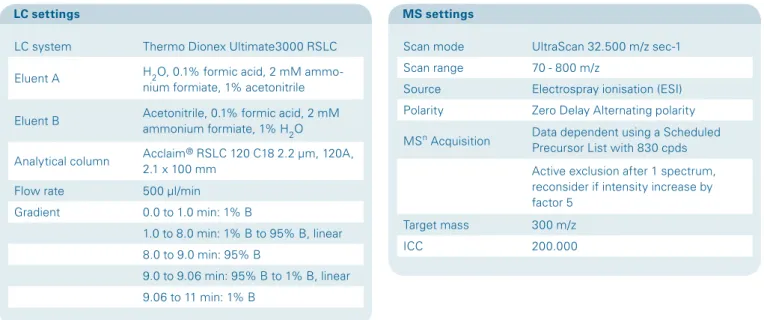
Two microliters of the redissolved samples was separated on an Ultimate3000 RSLC system using the settings described in Table 1. Seven different amaZon speed ion trap systems were used for generation of MS and MSn spectra
in continuous polarity switching mode (for details refer to Table 2). Data were acquired using a data-dependent scheduled precursor list approach.
Introduction
LC-MS/MS is an emerging identification solution for clinical research and forensic toxicology. This method is far more specific than immunoassays and provides more information and higher identification rates than LC-UV/DAD detection (Application Note LCMS-72).
Compared to GC-MS, LC-MS promises to cover a more comprehensive range of analytes. Due to the availability of large spectral libraries (see Ref. 1) and a high degree of transferability of results from lab to lab, GC-MS is currently regarded as the gold standard in toxicology research. However, the disadvantages of GC-MS – such as the need for derivatization and its incompatibility with thermolabile and polar substances – mean that LC-MS is being increasingly used.
A central feature of the ion trap LC-MSn solution described
here is the unique, patented SmartFrag™ technology, which provides transferability and reproducibility of results from instrument to instrument and from lab to lab. Using SmartFrag provides the highest possible transferability by virtually eliminating variation and tuning from the MS/MS process. This approach identifies substances by retention time and MS2/MS3 spectra combined with a library search,
and represents a robust and automated solution for the detection and identification of common drugs, drugs of abuse, and metabolites. A fast LC-gradient for separation, the auto-MSn capability of the amaZon speed™ ion trap for
detection of analytes, and a fully automated script for fast and user-friendly data analysis and reporting provide results in the shortest time possible.
LC settings
LC system Thermo Dionex Ultimate3000 RSLC Eluent A H2O, 0.1% formic acid, 2 mM
ammo-nium formiate, 1% acetonitrile Eluent B Acetonitrile, 0.1% formic acid, 2 mM
ammonium formiate, 1% H2O
Analytical column Acclaim® RSLC 120 C18 2.2 µm, 120A, 2.1 x 100 mm
Flow rate 500 µl/min
Gradient 0.0 to 1.0 min: 1% B
1.0 to 8.0 min: 1% B to 95% B, linear 8.0 to 9.0 min: 95% B
9.0 to 9.06 min: 95% B to 1% B, linear 9.06 to 11 min: 1% B
Table 1: HPLC conditions used for the Toxtyper workflow
MS settings
Scan mode UltraScan 32.500 m/z sec-1 Scan range 70 - 800 m/z
Source Electrospray ionisation (ESI) Polarity Zero Delay Alternating polarity MSn Acquisition Data dependent using a Scheduled
Precursor List with 830 cpds Active exclusion after 1 spectrum, reconsider if intensity increase by factor 5
Target mass 300 m/z
ICC 200.000
Library search and reporting
The data sets were post-processed using DataAnalysis (DA) 4.1 and the processed spectra were submitted to the DA 4.1 library search module. The whole process, up to final report generation and visualization of results in the web-based Compass OpenAccess interface, was driven by a predefined Toxtyper automation script. The automatically generated reports from the different labs were evaluated and used for generation of the final result tables.
Results
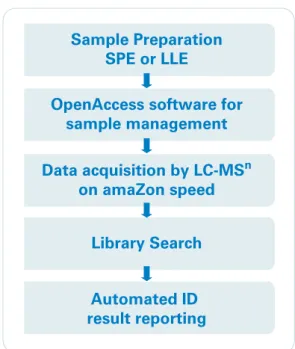
The goal of this study was to test the Toxtyper workflow (see Figure 1) with regard to its transferability and the reproducibility of results from lab to lab. The toxicologically relevant substances present in the three mixtures
are routinely found in forensic toxicology (personal communication, Forensic Institute, Freiburg) and were chosen without regard to their retention times or molecular masses. The compounds were spiked into blank human serum at different concentrations (see Table 1).
The spectral library, which consists of more than 830 compounds of clinical research and forensic toxicology interest, was generated in close collaboration with the Forensic Institute in Freiburg, Germany (see Bruker Application Note 72). All samples in the interlaboratory test were processed in a completely automated manner using Compass OpenAccess. After completion of a run, the user received a PDF report of the LC-MSn results; either by
logging onto the web based COA system or by email. The automatically generated reports from the different labs were evaluated to demonstrate transferability of the Toxtyper solution and compare the overall performance of the different LC-MS ion trap systems. If a substance was not identified, the respective raw data file was inspected manually to find the cause.
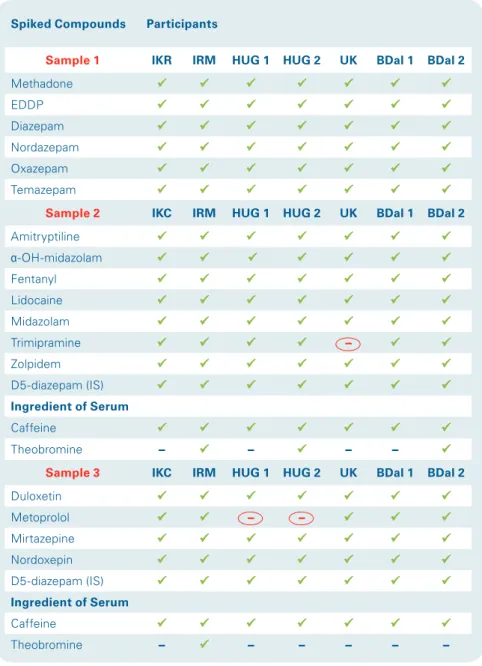
All compounds spiked into sample 1 could be identified by all participating labs. The identification results demonstrate the high sensitivity of the procedure. The results of the automatic reports are summarized in Table 4. Trimipramine was not identified by one lab. Inspection of the raw data revealed that in this lab, extensive coelution of matrix led to a mixed MS2 spectrum and therefore to a score value
below the cut-off for ID reporting. Metoprolol from sample 3 was not identified by two systems at HUG 1 and HUG 2. This was due to coelution with Mirtazapine, which led to a mixed MS2 spectrum and subsequently to a score
value below the cut-off for ID reporting. It should be noted that Metoprolol and Mirtazapine not only have very similar retention times, but also differ only slightly in mass (2 Da). This problematic combination of characteristics can be regarded as a very rare case.
Figure 1: Schematic of the Toxtyper library-based workflow.
Sample Preparation
SPE or LLE
OpenAccess software for
sample management
Data acquisition by LC-MS
non amaZon speed
Library Search
Automated ID
result reporting
Sample 1 Sample 2 Sample 3
Methadone (250) Trimipramine (100) Duloxetin (600) EDDP (50) Amitryptiline (100) Nordoxepin (300) Diazepam (100) Zolpidem (500) Mirtazepine (50) Nordazepam
(500) Midazolam (150) Metoprolol (200) Oxazepam (200) α-OH-midazolam
(50) Temazepam (100) Fentanyl (3)
Lidocaine (200)
Table 3: Compounds spiked in human blank serum to test the lab-to-lab transferability of the identification workflow
Given in brackets are the respective spiked concentrations in ng/mL
Common false positives were identified in the blank serum sample and the other samples, but these could be easily excluded after manual inspection of the reports and the respective raw data files. For example, a common false positive was benzododecinium. This compound is used as skin disinfectant during blood withdrawal and is present in the sample as a contaminant.
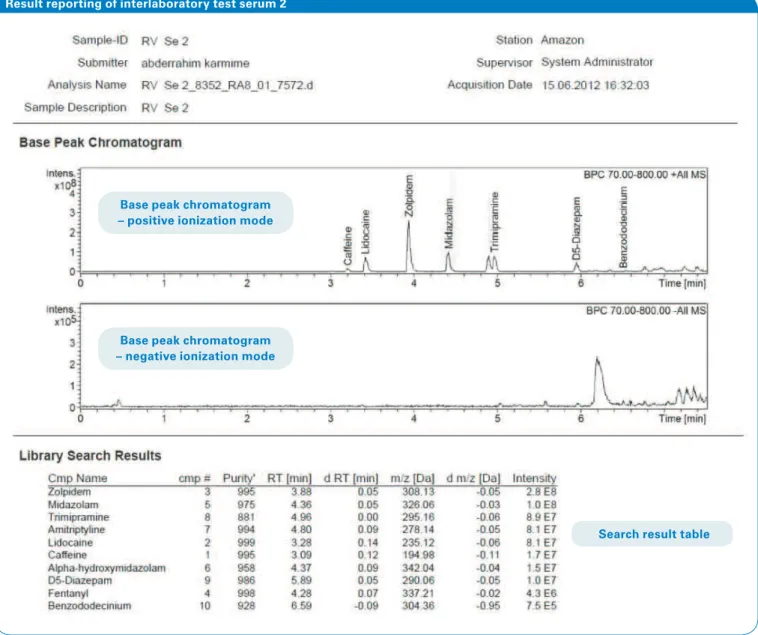
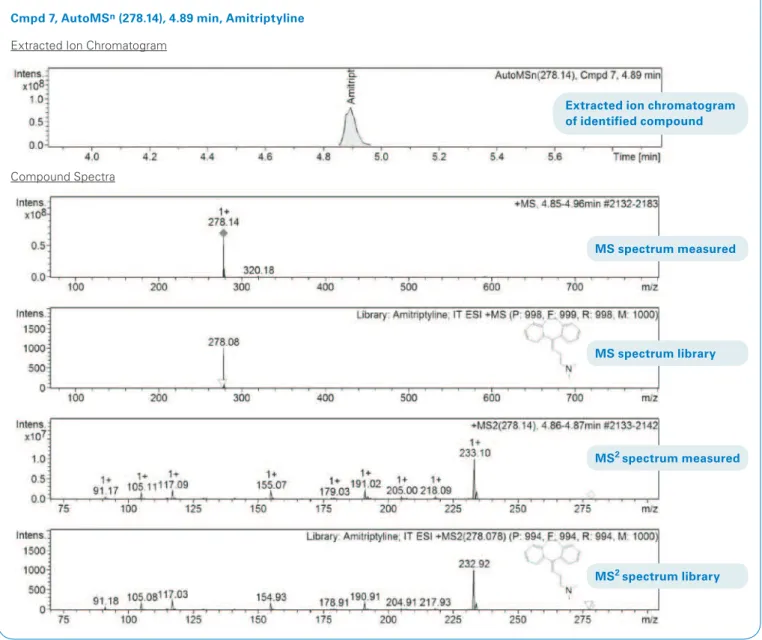
The first page of the result report is shown in Figure 2. This page shows an overview of the results; consisting of base peak chromatograms (positive and negative ionization mode) and a table that summarizes the identification results using purity score, intensity, and mass/retention time shifts. A separate report page – which displays the extracted ion chromatogram of the substance as well as its
Spiked Compounds Participants
Sample 1 IKR IRM HUG 1 HUG 2 UK BDal 1 BDal 2
Methadone
EDDP
Diazepam
Nordazepam
Oxazepam
Temazepam
Sample 2 IKC IRM HUG 1 HUG 2 UK BDal 1 BDal 2
Amitryptiline
α-OH-midazolam
Fentanyl
Lidocaine
Midazolam
Trimipramine −
Zolpidem
D5-diazepam (IS)
Ingredient of Serum
Caffeine
Theobromine − − − −
Sample 3 IKC IRM HUG 1 HUG 2 UK BDal 1 BDal 2
Duloxetin
Metoprolol − −
Mirtazepine
Nordoxepin
D5-diazepam (IS)
Ingredient of Serum
Caffeine
Theobromine − − − − − −
Table 4: Results from the interlaboratory test
MS, MS2, and if acquired, MS3 spectrum – is generated
for each identified compound (see Figure 3). This enables potentially critical IDs – for example false positives – to be ruled out very quickly.
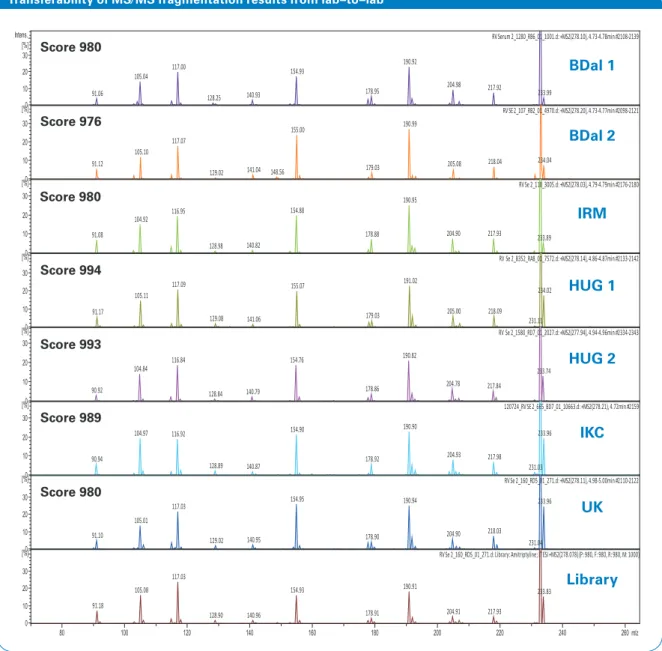
The transferability and robustness of the fragmentation process on different Toxtyper systems is demonstrated by comparing the fragmentation reproducibility of spiked compounds. Figure 4 shows the MS2 spectra
of Amitriptyline recorded from spiked serum extracts of all participants and the respective library spectrum. SmartFrag technology provides reproducible fragmentation results that lead to the highest level of lab-to-lab
Result reporting of interlaboratory test serum 2
Figure 2: Result reports can be accessed by the web or sent by e-mail. Base peak chromatogram
– positive ionization mode
Base peak chromatogram – negative ionization mode
Detailed MS and MS2 spectra results of the Toxtyper reporting for Amitryptilin
Figure 3: Result reports can be accessed by the web or sent by e-mail. Cmpd 7, AutoMSn (278.14), 4.89 min, Amitriptyline
Extracted Ion Chromatogram
Compound Spectra
Extracted ion chromatogram of identified compound
MS spectrum measured
MS spectrum library
MS2 spectrum measured
Transferability of MS∕MS fragmentation results from lab–to–lab
Figure 4: Shown are the MS2 spectra of Amitryptilin measured on 7 different amaZon speed systems during the
interlaboratory test.
Summary and Conclusion
The Toxtyper workflow offers a fast and robust identifi-cation tool for clinical research and forensic toxicology analysis. The combination of MS2/MS3 spectral information
and the respective retention time meets common criteria for identification of analytes. The results of the interlaboratory test demonstrated the efficiency and transferability of the complete workflow over seven independent systems in different research labs. The high rate of substances correctly identified in different
laboratories reflects the superior performance of this approach. The high degree of automation offered by Compass OpenAccess is ideally suited for the transfer of this solution to diverse laboratories. The use of additional libraries to solve specific questions offers further
possibilities; for example, high-throughput identification of certain substance classes, for Forensic applications.
91.06 105.04 117.00 128.25 140.93 154.93 178.95 190.92 204.98 217.92 233.99
RV Serum 2_1280_RB6_01_1001.d: +MS2(278.10), 4.73-4.78min #2108-2139
91.12 105.10
117.07
129.02 141.04 148.56 155.00
179.03 190.99
205.08 218.04 234.04
RV SE 2_107_RB2_01_4970.d: +MS2(278.20), 4.73-4.77min #2098-2121
91.08 104.92 116.95 128.98 140.82 154.88 178.88 190.95
204.90 217.93 233.89
RV Se 2_110_3005.d: +MS2(278.03), 4.79-4.79min #2176-2180
91.17 105.11 117.09 129.08 141.06 155.07 179.03 191.02 205.00 218.09 231.11 234.02
RV Se 2_8352_RA8_01_7572.d: +MS2(278.14), 4.86-4.87min #2133-2142
90.92 104.84 116.84 128.84 140.79 154.76 178.86 190.82 204.78 217.84 233.74
RV Se 2_1580_RD7_01_2027.d: +MS2(277.94), 4.94-4.96min #2334-2343
90.94 104.97 116.92 128.89 140.87 154.90 178.92 190.90 204.93 217.98 231.03 233.96
120724_RV SE 2_665_BD7_01_10663.d: +MS2(278.21), 4.72min #2159
91.10 105.01 117.03 129.02 140.95 154.95 178.90 190.94 204.90 218.03 231.04 233.96
RV Se 2_160_RD5_01_271.d: +MS2(278.11), 4.98-5.00min #2110-2122
91.18 105.08 117.03 128.90 140.96 154.93 178.91 190.91 204.91 217.93 233.83
RV Se 2_160_RD5_01_271.d: Library: Amitriptyline; IT ESI +MS2(278.078) (P: 980, F: 980, R: 980, M: 1000) 0 10 20 30 Intens. [%] 0 10 20 30 [%] 0 10 20 30 [%] 0 10 20 30 [%] 0 10 20 30 [%] 0 10 20 30 [%] 0 10 20 30 [%] 0 10 20 30 [%]
80 100 120 140 160 180 200 220 240 260 m/z
Score 980 Score 976 Score 994 Score 993 Score 980 Score 989 Score 980
BDal 1
BDal 2
IRM
HUG 1
HUG 2
IKC
UK
Library
B
ru
ke
r D
al
to
ni
cs i
s c
on
tin
ua
lly i
m
pr
ov
in
g i
ts p
ro
du
ct
s a
nd r
es
er
ve
s t
he r
ig
ht
to
c
ha
ng
e sp
ec
ifi
ca
tion
s w
ithout
no
tic
e.
© B
ru
ke
r D
al
to
ni
cs 0
4
-2
01
4, L
C
M
S
-9
2, 1
82
8
6
32
Bruker Daltonik GmbH
Bremen · Germany Phone +49 (0)421-2205-0 Fax +49 (0)421-2205-103 [email protected]
Bruker Daltonics Inc.
Billerica, MA · USA Phone +1 (978) 663-3660 Fax +1 (978) 667-5993 [email protected]
Fremont, CA · USA Phone +1 (510) 683-4300 Fax +1 (510) 490-6586 [email protected]
www.bruker.com/ms
For research use only. Not for use in diagnostic procedures.
Not available in every country. Please contact your local sales representative for more information.
References
[1] Hans H. Maurer, Karl Pfleger, Armin A. Weber:
Mass Spectral and GC Data of Drugs, Poisons, Pesticides, Pollutants and Their Metabolites (2011)
[2] Birgit Schneider, Carsten Baessmann, Sebastian Götz, Arnd Ingendoh (2009): “Zero Dealy” Polarity Switching for Ultra-fast MS/MS Screening Applications;
Bruker Application Note LCMS-51 #264574 [3] Jürgen Kempf, Laura Huppertz, Susanne Vogt
(Universitätsklinikum Freiburg, Germany), Markus Meyer, Sebastian Götz, Birgit Schneider (Bruker DaltoniK GmbH, Germany): Toxtyper™ – a Comprehensive LC-MSn
application for Clinical Research and Forensic Toxicology; Bruker Application Note LCMS-91, 1828629