Proceedings of the
Second International Workshop on
Bidirectional Transformations
(BX 2013)
Edit languages for information trees
Martin Hofmann and Benjamin C. Pierce and Daniel Wagner
14 pages
Guest Editors: Perdita Stevens, James F. Terwilliger
Managing Editors: Tiziana Margaria, Julia Padberg, Gabriele Taentzer
Edit languages for information trees
Martin Hofmann and Benjamin C. Pierce and Daniel Wagner
Ludwig-Maximilians-Universit¨at and University of Pennsylvania
Abstract: We consider a simple set of edit operations for unordered, edge-labeled trees, calledinformation treesby Dal Zilioet al[DLM04]. We definetree languages
using thesheaves automatafrom [FPS07] which in turn are based on [DLM04] and provide an algorithm for deciding whether a complex edit preserves membership in a tree language. This allows us to view sheaves automata and subsets of tree edits
asedit languages in the sense of [HPW12]. They can then be used to instantiate
the framework ofedit lensesbetween such languages and model concrete examples such as synchronisation between different file systems or address directories.
Keywords:Bidirectional programming, lens, edit, information tree
1
Introduction
Semantic models of bidirectional transformations are generally presented as transformations be-tween thestatesof replicas. For example, the familiar framework of asymmetric lenses defines a lens between replicas of typesAandBas a pair of agetfunction fromAtoBand aput func-tion fromA×BtoA. An implementation directly based on this semantics would pass to theput
function the entire states of the originalAand updatedBreplicas.
Though pleasingly simple, this treatment falls short of telling a full story in at least two impor-tant ways. First, it does not explain how the lens shouldalignthe parts of the oldAand the new
Bso that the parts ofAthat are “hidden” in theBview retain their positions in the result. For example, ifAandBare both lists of people where each element ofAincludes a name, address, and email while the corresponding elements ofBgive only a name and address, the user will rea-sonably expect that inserting a new element at the head of theBreplica will lead to an updatedA
replica where each existing name keeps its associated email. And second, the simple “classical” form of asymmetric lenses fails to capture the reasonable expectation that a small change to the
Breplica can be transformed into a change to theAreplica using time and space proportional to the size of the change, not to the sizes of the replicas.
One way to address at least the first concern is to enrich the basic structure of a state-based lens with a new input to the putfunction, a data structure that explicitly represents the align-ment between the original and updated B replicas; this idea forms the basis for dictionary
lenses[BFP+08],matching lenses[BCF+10], andsymmetric[DXC+11b] andasymmetric delta
lenses[DXC11a] (based on [Ste07]). Another approach is to annotate theBstructures themselves
In earlier work [HPW12], we proposed going a step further and defining lenses that work exclusively with edits. We defined a semantic model callededit lensesin which the sets of source and target replicasAandBare enriched with monoids ofeditsand a lens’sgetandputfunctions map edits to edits. This work was carried out in an abstract algebraic setting where the actual data structures being transformed and the exact shapes of edits to them were left unspecified; in this setting, we showed how a number of familiar constructions on lenses—products, sums, etc.—could be carried out.
The present paper takes a first step toward instantiating this abstract semantic model with concrete data structures and a concrete notion of edits. The data model we choose is a very common and expressive one: unordered, edge-labeled trees—called information trees by Dal Zilioet al[DLM04]. These can encode a variety of data formats, including XML-style trees, their original application. Such trees can also be used to represent graphs [BDHS96,HHI+10] by unrolling up to bisimulation. This paper thus makes a first step towards general edit languages for trees. Our edit operations include, in particular, insertion and deletion of subtrees and renaming of edges; we show how these give rise to edit languages on tree languages and can thus be used to instantiate the framework of edit lenses so as to yield bidirectional synchronization between information trees.
Our main technical result is that weakest preconditions of our edits can be effectively com-puted for sets of information trees specified by sheaves automata. This allows for effective “type checking” of edits and thus permits automatic checks that an edit language for trees presented as sequences of atomic edits does indeed preserve acceptance by a given sheaves automaton.
The present work is thus a first step; we hope that the introduction of tree automata into the world of editing and synchronization will also lead to high-level support for constructing edit lenses themselves and for checking their soundness, but this remains future work.
2
Examples
As a running example, we will use a simplified model of a filesystem. In our filesystem, there are three kinds of objects: directories, files, and bit strings. In our simple model, we will identify files by a name that starts with a lower case letter; files will contain bit strings. For example, here’s a simple file named “greeting”:
{|greeting7→0110100001101001|}.
We will identify directories by a name that starts with an upper case letter; directories contain filesystems. A filesystem is a collection of files and directories. For example, here is a simple filesystem:
{|Etc7→ {|passwd7→0110
,alternatives7→010|}
,foo7→1010110|} |}
In addition to modeling the current state of a file system, we will want to model file system operations like creating, deleting, and moving files and directories. To do so, we will define a collection of edits and an operation that applies edits to filesystems. To create new files and directories at the top level, we define theinsertoperation, which takes a filesystem to merge into the existing one. For example, to create a “/home/john” directory (with no files or directories inside) in our example filesystem, we would use:
insert({|Home7→ {|John7→ {||}|}|})·E= {| Etc7→ {|passwd7→0110
,alternatives7→010|}
,Home7→ {|John7→ {||}|}
, foo7→1010110|} |}
For simplicity, we will say that any name clashes result in failure; for example, trying to apply the editinsert({|Etc7→ {||}|})toEwould be undefined.
To allow the creation of files in other places than at the root, we will define another edit operation,at(n,e), which applies editeto the subpart of the filesystem rooted atn. For example, to add the “/etc/dbus” file to our example filesystem, we would
at(Etc,insert({|dbus7→10101|}))·E
which would result in
{| Etc7→ {|passwd7→0110
,alternatives7→010
,dbus7→10101|}
,Home7→ {|John7→ {||}|}|}
, foo7→1010110|}
|}.
To support moving files and directories around the filesystem, we define two more kinds of edits, hoist and plunge, which float and sink entire subtrees one level. For example, if we wanted to move the file “/foo” into “/home/john”, we might first move it into “/home” with
plunge(Home,foo), then move it into “/home/john” withat(Home,plunge(John,foo)).
To round out our operations, we also definedeleteandrename operations, whose behaviors are predictable from their names. Besides renaming files and directories in-place,renamehas a more subtle use. Consider the following filesystem:
{|Bin7→ {|cat7→0000|}
,Usr7→ {||}
,Opt7→ {|Bin7→ {|coq7→1111|}|}|}
we can avoid this is to temporarily renameBinto a secret name which definitely will not clash:
at(Usr,rename(#Bin,Bin))·
plunge(Usr,#Bin)·hoist(Opt,#Bin)·
at(Opt,rename(Bin,#Bin))·E0
This sequence of edits is now quite robust: it will work in any filesystem that has both “/opt/bin” and “/usr” but no “/usr/bin”. On the other hand, notice that this sequence of edits temporarily breaks some of the invariants of filesystems: for a time, there are subtrees that are not bit strings, directories, or files. For a more interesting examples where invariants need to be temporarily broken consider that in the spirit of B-trees we impose maximum and minimum numbers of files to be held by any one non-root directory. Then, in order to insert a file, it may be necessary to split a directory into two using a long sequence of basic edits only at the end of which the invariant will be restored.
During our exploration of filesystems and how to represent edits, we have briefly seen several ways that edits can “go wrong”. There are three failure classes of interest:
1. It may be clear that a particular edit can never apply to a valid filesystem; e.g. the edit
delete(#foo)that tries to delete a file with an invalid name.
2. An edit may be applicable to some filesystems but break filesystem invariants and never properly restore them. We would like to prevent this without ruling out edits whichdo
properly restore invariants.
3. There may be edits that apply to some filesystems correctly but fail on others; e.g. the edit
insert({|Foo7→ {||}|})that inserts a new directory works on any filesystem that does not yet
have a “/foo” directory.
In this paper, we discuss a way to detect the first two classes of failures.
3
Trees and sheaves automata
This section introduces some notations and definitions that we need in the sequel. Some of the descriptions are taken from [FPS07].
3.1 Trees
We assume a finite alphabetΣand consider unordered trees whose edges are labeled byΣ∗. We write trees with a pair of braces{||}for each node; each subtree is writtenn7→t, wherennames the edge that leads to the subtreet. To reduce clutter, we abbreviate the tree{|n7→ {||}|}to justn
when no confusion arises. For example, here is an explicit tree with two children labeled “home” and “etc”. . .
. . . and its abbreviated form:
{|Home7→John,Etc7→passwd|}
We writet(n)↓to indicate that treethas childn,t(n)↑to indicate that treetdoes not have child
n, andt(n)for the child under the edge labeledn. We writedom(t) ={n|n∈Σ∗∧t(n)↓}. The expressiont[n7→t0]describes the tree that agrees witht everywhere, except that its child under labelnist0. The expressiont\ {n1,n2, . . . ,nk}describes the tree that is undefined atn1,n2, . . . ,nk
but agrees withteverywhere else. When context makes it clear thatnis a name, we writet\nto meant\ {n}. To simplify the definition of partial functions, we take an expression liket[n7→E]
whenE is undefined to be undefined itself.
3.2 Tree edits
The set ofatomic tree editsis defined as follows1(whereeranges over edits,tover trees, andm
andnover names):
e ::= insert(t) | hoist(m,n) | delete(m) | rename(m,n) | at(n,e)
The application of an atomic edite to a treetis either undefined (⊥) or a new tree defined as follows:
insert(t0)·t=t∪t0 ifdom(t)∩dom(t0) = /0
hoist(m,n)·t=t[m7→t(m)\n,n7→t(m)(n)] ift(m)(n)↓ ∧ t(n)↑
delete(n)·t=t\n ift(n) ={||}2
rename(n,n0)·t= (t\n)[n07→t(n)] ift(n)↓ ∧ t(n0)↑
at(n,e)·t=t[n7→e·t(n)] ift(n)↓
e·t=⊥ in all other cases
Tree edits are sequences of atomic edits. We overload·as tree edit application, which is the natural lifting of atomic edit application to sequences:
hi ·t=t
ha1, . . . ,ani ·t=ha1, . . . ,an−1i ·(an·t)
3.3 Sheaves formulae and automata
Conceptually, asheaves automatonconsists of a set of states, each associated with a sheaves
formula; each sheaves formula describes a set of trees by specifying which names may occur
1The edits presented here are fairly simple. One might wonder whether more complicated edits—for example, ones
that allowed recursion or tree queries—could also be supported in this framework. For the moment, we take the stance that these more complicated edits might be provided by some external editing tool, but that they should then be “compiled down” to sequences of atomic edits. This is a point that deserves further consideration.
2Ourdeleteoperation deletes a single, explicitly named leaf node, but this is not a fundamental restriction. Operators
as immediate child edges and, for each one, an automaton state that describes the subtree found beneath it.
To describe sheaves automata more formally, we must first fix a formalism for writing down arithmetic constraints. We use Presburger arithmetic—the decidable first-order theory of the naturals with addition but without multiplication—for this purpose.3 Expressions in Presburger arithmetic include constants, variables, and sums, and formulae include equalities between ex-pressions, boolean combinations of formulae, and quantified formulae:
m::=0|1|2| · · ·
v::=m|xm|v+v
φ::=v=v|φ∨φ|φ∧φ| ¬φ| ∃φ
We use a de Bruijn representation—a variablexj within the scope ofkquantifiers represents the
(j−k)th free variable if j≥k, and otherwise is bound by the jth enclosing quantifier, counting from the inside-out.
The semantics of a Presburger formula is the set of vectors of naturals that satisfy it. We write ¯
cφ for formula satisfaction, substitutingciforxi, andfv(φ)for the set of free variables inφ.
Next, a sheaves automaton comprises a finite set of states together with a mappingΓ from states tosheaves formulae. The transition behavior from a state is given by the sheaves formula associated with it inΓ. Each sheaves formula has three components—a Presburger formulaφ, a
list of regular languages ¯r, and a list of successor states ¯s. The pair of a regular languageri and
the successor statesiat the corresponding index is called anelement. The operation of a sheaves
automaton is like a bottom-up regular tree automaton. Lett be a tree ands be an automaton state withΓ(s) = (φ,hr0, . . . ,rki,hs0, . . . ,ski). For eachiin the range 0 tok, letcibe the number
of childrenn∈dom(t)for which n∈ri andt(n) is accepted bysi. Thent is accepted bys iff
(c0, . . . ,ck)|=φ.
Note that the integers that represent variables in de Bruijn notation give the correspondence between free variables inφ and elements—the constraint onxi controls the number of children
whose name matchesri with subtrees accepted bysi.
In the following, it will sometimes be convenient to treat elements (and the corresponding Presburger variables in the sheaves formula) as if they were indexed by some set with more structure than the natural numbers. This is perfectly reasonable, provided there is an injective mapping from the structured set to the naturals. When it is clear that such an injective mapping
f exists (and in particular especially when the structured set is finite) we will leave the mapping unspecified and simply use values from the structured set as subscripts to the collections ¯rand ¯s
as well as any Presburger variables, understandingrv to stand forrf(v).
Sheaves automata and sheaves formulae are subject to some well-formedness conditions. A sheaves formula (φ,r¯,s)¯ with |¯r|=k is well-formed iff |s¯|=k; the free variables of φ are
{x0, . . . ,xk−1}; the elements are pairwise disjoint—i.e., if there exists a tree accepted by both
si andsj, then the regular languages denoted by ri and rj are disjoint; and the elements are
generating—i.e., for every treetand labeln∈dom(t)there is anisuch thatn∈riandt(n)is
ac-cepted bysi. A list of elements obeying these conditions is called abasis. A sheaves automaton is
3 Here we follow the lead of [FPS07] and [DLM04]. Presburger arithmetic is quite an expressive logic, and it is
well-formed iff every sheaves formula in the range ofΓis well-formed. These well-formedness conditions guarantee two properties. First, because the elements are non-overlapping, every tree has a unique decomposition over the basis, which means that the semantics of a sheaves au-tomaton is well-defined. Second, because the elements generate the set of all tree slices, certain constructions are simple. For example,(φ,r¯,s)¯ and(¬φ,r¯,s)¯ accept complementary sets of trees.
One of the simplest automata is the one that accepts any tree. It has a single state, which we will name>, and whose transition relation is given by Γ(>) = (0=0,[Σ∗],[>]). In fact, having such a state is so convenient that we will assume in the remainder of the paper that every automaton has a state named >that accepts all trees (and consequently omit the definition of Γ(>)). As a more exciting example, the set of trees
{{||},{|a,b|}}
is described by the automaton states, whereΓ(s)is:
((x0=0∧x1=0)∨(x0=1∧x1=1))∧(x2=0),
[a,b,{a,b}],
[>,>,>]
To see this, observe that the constraints onx0andx1force the number of children described by the elements(a,>)and(b,>)to both be 0 or both be 1, and that the constraint onx2forces the number of children belonging to the final element to be 0, that is, there are no edge labels other thanaorb.
The relation A,s`t tells when automatonAaccepts treet when started at states. We often write sheaves automata asA= (S,s0,Γ), wheres0is a distinguished initial state. We then write
Atto meanA,s0`t. We also writeL(A) ={t|At}for the language accepted by automaton
A.
4
Weakest preconditions of edits
So far, we have reviewed a definition for trees and a notion of type-checking for trees, namely, sheaves automata. We have also given a definition for tree edits; what remains is to give a notion of type-checking for tree edits. The type of a tree edit will have two tree types, one describing source trees and one describing target trees. Below, we will show how to take a target tree type
T and an atomic editeand infer a typeSfor which applyingeto anStree produces aT tree; we will argue that thisSis maximal and therefore checking thatehas a given typeS0→T amounts to checking thatS0is a subtype ofS.
LetA,Bbe sheaves automata andebe a tree edit. We writee:A→Bto mean that whenever
Atande·tis defined we haveBe·t.
We now define for each atomic edite and automatonAa new automatone·Asuch thatt∈
L(e·A) iffe·t∈L(A) whenevere·t is defined, that is, e·Ais an automaton representing the weakest precondition that ensures that applying editewill result in a tree of typeA. Formally:
decidable [DLM04], this then implies a decision procedure for e:A→Band in particular for deciding whether a given tree edit belongs toA→A.
Theorem 1 Let A= (S,s0,Γ)be a sheaves automaton and e be an atomic edit. There exists
a sheaves automaton e·A= (S0,s00,Γ0)such that t∈L(e·A)iff e·t is undefined or e·t∈L(A).
Moreover, e·A can be effectively obtained from e and A.
Proof. The construction proceeds in two stages. First, we define for each edite a sheaves
au-tomatonDe such thatL(De) ={t|e·t↑}.
Then, for each edit e, we construct a sheaves automaton e?A such that for allt with e·t↓ one hase?At ⇐⇒ Ae·t. We then define the desired automatone·Aso that L(e·A) = L(De)∪L(e?A)using the union construction from [DLM04].
Given this strategy, the remaining definitions are essentially a programming exercise.
• e=insert(t0). For De we need to check that some top-level label fromt0 is present. If
the top-level labels are, say,r0. . .rnandrn+1isΣ∗\ {r0, . . . ,rn}then the sheaves formula
(06=∑ni=0xi,r¯,>¯)achieves the purpose when attached to the initial state ofDe.
To builde?Awe add a fresh state s00 that is just likes0 except that it has already “seen” the subtreet0. That is, ifΓ(s0) = (φ,r¯,s)¯ andciis the number of labelsn∈ri∩dom(t0)for
whichA,si`t0(n), then we define
S0=S∪ {s00}
φ0=φ[xi+ci/xi]
Γ0=Γ[s007→(φ0,r¯,s)]¯
whereφ[e/x]is the formulaφ with expressionesubstituted for variablex.
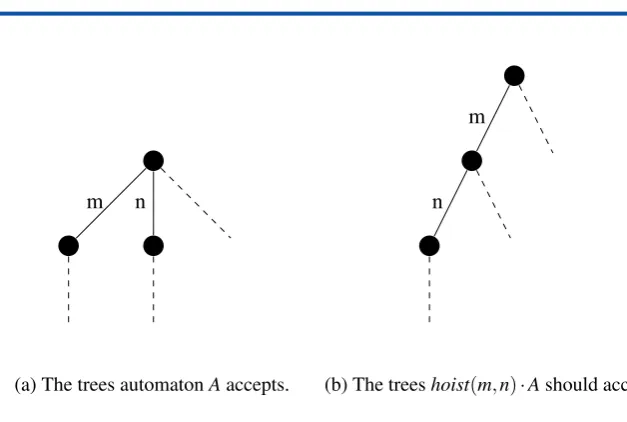
• e=hoist(m,n). SupposeΓ(s0) = (φ,r¯,s)¯ . The high-level plan fore?Ais to add some
new states for each state that them-branch could be accepted under that tell which state then-branch was accepted under. To this end, define setsImandInso thatm∈riiffi∈Im
and likewisen∈riiffi∈In. We now perform the following modifications:
– Add a fresh states00, making it the initial state, and letting it initially be a copy ofs0.
– Remove theIm languages (and their associated successor states) from the sheaves
formula associated withs00.
– For each(i,j)∈Im×In, add a new regular language which is a copy of the original
ri and whose successor state is a copy of the automaton that accepts the language
of trees that can be split into annpart accepted bysj and a remainder accepted by
si. Name the indices of the regular languages and successor states added by this
operationki j.
– Modify the Presburger formula associated withs00to reflect the changes above: for eachi∈Im, replace occurrences ofxiwith∑jxki j, and for each j∈In, replace
occur-rences ofxjwith∑ixki j. (Ifi∈Im∩Infor somei, then these two operations coincide,
m n
(a) The trees automatonAaccepts.
n m
(b) The treeshoist(m,n)·Ashould accept.
Figure 1: thehoistoperation
ForDe, we must check that the treethast(m)(n)↑ort(n)↓; this is easily done by defining
De= ({>,s,n,n¯},s,Γ)where
Γ(s) = (x0=0∨x16=0∨x26=0,[{m}[n],{m}[n]¯,{n}[>],{m,n}[>]]) Γ(n) = (x06=0,[{n}[>],{n}[>]])
Γ(n) = (x¯ 0=0,[{n}[>],{n}[>]]).
• e=delete(n). The automaton that accepts exactly the tree{|n7→ {||}|}is easy to construct;
call this automatonA0. We then defineDe=¬(>+A0)using the constructions described
in [FPS07]. Fore?A, removenfrom each of theri. Then add an extra condition guarded
byn. Place no constraint on the corresponding cardinality. Leave the other cardinalities as they were.
• e=rename(n,n0). SupposeΓ(s0) = (φ,r¯,s)¯. Choose a freshs00and define
ri0=
r0i∪ {n} n0∈r0i r0i\ {n} n0∈/r0i S0=S∪ {s0}
Γ0=Γ[s007→(φ,r0,s)]¯
Then this new automata counts anyn-rooted subtree as if it were ann0-rooted one instead. We should briefly argue that the sheaves formula given fors00 is generating and pairwise disjoint. It is generating: take any treetand namen00∈dom(t), and apply the definition of “generating” to the original sheaves formula using the tree[n07→t(n00)]ifn00=nor using the tree[n007→t(n00)]if not. It is pairwise disjoint: considerr0i[si]andr0j[sj]for which both
formula is pairwise disjoint, at most one ofri andrj containn0 (resp. n00), hence at most
one ofr0iandr0jcontainn00.
ForDewe use the automaton({>,s},s,Γ)where:
Γ(s) = (x0=0∨x1=6 0,[{n}[>],{n0}[>],Σ∗\ {n,n0}[>]])
• e=at(n,e0). SupposeΓ(s0) = (φ,r¯,s)¯. Define the set I so that n∈ri iffi∈I. We will
apply the editeto each of the automata that start atsisuch thati∈I, and use these modified
automata as the new states associated with these regular languages. Define (recursively):
˜
Ai=e·(S,si,Γ)
Later, we will want to ensure that the ˜Aiautomata are disjoint in the sense that they accept
no common trees. This is mostly true of these ˜Ai: since the statessi accept disjoint trees,
the trees which arrive at statesiafter being edited byeare also disjoint sets. However, these
˜
Aimay also accept trees for which the editedoes not apply. Since we don’t care what our
final automata does with such trees (as we will be dealing with this situation inDe), this
subtlety is not important, so we will define it away. The language difference operation can be implemented on automata, so we defineAi= (Si,ai,Γi) =A˜i\Ai−1\ · · · \A0.
Additionally, there are standard constructors for defining an automatonA−1= (S−1,a−1,Γ−1) which accepts exactly when none of the automataAi fori∈I do. Without loss of
gener-ality, we may assume theSiare pairwise disjoint and disjoint fromS. (If not, just rename
them: this does not change the behavior of the automata.)
We are now ready to begin constructing the new automaton(S0,s00,Γ0). Its state set is the disjoint union
S0={s00} ∪S∪S−1∪ [
i∈I
Si
withs00chosen afresh. The transition functionΓ0 on the last three components is as in the automataA,Ai,A−1above,
Γ0(s) =Γ(s) s∈S
Γ0(s) =Γ−1(s) s∈S−1
Γ0(s) =Γi(s) s∈Si,
so that these automata appear as subcomponents. The interesting bit isΓ0(s00). Its compo-nents are indexed by the following set, where the unions are assumed disjoint.
J={edited(i)|i∈I} ∪ {unedited(i)|0≤i<|¯r|} ∪ {illtyped}
unaffected by the edit. The last sheaves formula indexed byilltypedcovers those children that would be edited but for which the edit would not be defined. We now put
Γ0(s00) = (φ0,r0,s0)
wherer0= (r0j)j∈J ands0= (s0j)j∈Jand
redited(0 i)={n}
r0unedited(i)=ri\ {n}
r0illtyped={n}
s0edited(i)=ai
s0unedited(i)=si
s0illtyped=a−1
ρ(xi) =xedited(i)+xunedited(i) i∈I
ρ(xi) =xunedited(i) i∈/I
φ0=ρ φ∧xilltyped=0
One might worry about whether the states associated with the regular language{n}above are disjoint and generating. They are generating because of the addition of the catch-all states0illtyped, and are disjoint because theAi are disjoint as automata.
To buildDe, we first recursively buildDe0= (S,s0,Γ), then create some fresh statess0
0and ¬s0. The new automaton will check whether either there is nonchild or there is one, but it’s accepted byD0e:
S0=S∪ {s00,¬s0}
Γ0(s00) = (x06=0∨x1=0,[{n}[s0],{n}[¬s0],Σ∗\ {n}[>]])
Γ0(¬s0) = (¬φ,e) whereΓ(s0) = (φ,e)
Γ0(s) =Γ(s) s∈S
De= (S0,s00,Γ0)
We lift the operation that computes weakest preconditions for atomic edits to tree edits in the obvious way.
Lemma 1 Language inclusion of sheaves automata is decidable.
Proof. Given sheaves automataAandB, to tell whetherL(A)⊆L(B), build an automatonCsuch
thatL(C) =L(A)\L(B)using the algorithms for intersection and complement given in [DLM04].
Then check whether or notL(C) = /0.
Corollary 1 Given sheaves automata A and B and tree edit e it is decidable whether e:A→B.
5
Edit languages and lenses
In previous work [HPW12] we defined an edit languageE as a set E (or |E|) of elements, a monoid∂Eof edit operations and a partial action·:∂E×E→E. Given a sheaves automatonA, we can thus form an edit languageEA, thefull tree edit language over A, whose set of elements
isL(A)and whose monoid of edits∂EA is{e|e:A→A}. We have seen that membership in
∂EAis effectively decidable.
Continuing the file system example from Section2, the automaton below checks that a tree is a valid filesystem; it has the five states{f,d,f,d,>}, corresponding to files, directories, trees that claim to be files but have an error in them, trees that claim to be directories but have an error in them, and other miscellaneous errors. The transition relation is fairly straightforward; success states demand that there are no included error states, and error states demand the negation of the success states.
Γ(d) = (φd,sd) Γ(d) = (¬φd,sd)
Γ(f) = (φf,sf) Γ(f) = (¬φf,sf)
φd= (x1=x3=x4=0) sd= [rd[d],rd[d],rf[f],rf[f],rd∪rf[>]]
φf = (x0=1∧x1=0) sf = [{0,1}∗[>],{0,1}∗[>]]
rd={A,· · ·,Z}Σ∗ rf ={a,· · ·,z}Σ∗
Our framework then lets you effectively check that edits like
at(p1,at(. . . ,at(pn,at(f,e)). . .))
which modify the contents of the file “/p1/· · ·/pn/f” in the filesystem are in the (full) edit monoid
that comprises those sequences of atomic edits that preserve the file system structure. On the other hand, an edit like at(f,delete(c))which deletes the contents c of file f but neglects to delete the file itself will be rejected.
Also recall from [HPW12] that an edit lens between two edit languagesEandE0comprises • a complement setC
• a consistency relationK⊂ |E| ×C× |E0| • a rightward translationV∈∂E×C→∂E0×C
• a leftward translationW∈∂E0×C→∂E×C
such that
• consistency and typing are preserved, that is,
(a,c,b)∈K e∈∂E e·a↓ V(e,c) = (e0,c0)
(e·a,c0,e0·b)∈K e0∈∂E0 e0·b↓
• composition of edits is respected, that is,
V(e1,c) = (e01,c0) V(e2,c0) = (e02,c00)
V(e2e1,c) = (e02e01,c00)
and similarly forW.
It is now possible to design lenses between full tree edit languages of the formEAfor a sheaves
automatonA, but we believe that this is not necessarily the best way of proceeding, since the edit transformation embodied in the lens might need to get some intensional information about the intended semantics of the edit to be translated. We are thus led to define atree edit languageto be an edit language whose set of elements is of the form|E|=L(A)for some sheaves automaton
Aand whose monoid of edits ∂E comes with a monoid morphism f :∂E → {e|e:A→A}.
Thus, every edit is “implemented” as a sequence of atomic edits and, thus, assuming that∂E
is finitely generated, we can check well typedness by checking whether f(g):A→Aholds for every generatorg.
It is then possible to design tree edit lenses that synchronise between different file systems and file structures, for example one having nested subdirectories and the other one being essentially flat. In such a case, the complement will store alignment information in the form of a bijection between files and directories.
6
Conclusion
We have defined a simple set of edits for information trees comprising insertions, deletions, relo-cations, and renamings of subtrees. Our main technical result states that tree languages defined by sheaves automata [DLM04] are effectively closed under weakest preconditions for these edits and that therefore, typechecking of edits against tree types defined by sheaves automata [FPS07] is algorithmically tractable.
We see this result as a first step towards an automata-based high-level formalism for tree synchronisation; in particular we would like to investigate to what extent complements and con-sistency relations can be defined by automata and how the tree types from [FPS07] and the as-sociated term formers can be lifted to edit lenses. More speculative goals include the automatic discovery of tree edits (“tree diffing”) and the extension to graphs.
Bibliography
[BCF+10] D. M. J. Barbosa, J. Cretin, N. Foster, M. Greenberg, B. C. Pierce. Matching Lenses: Alignment and View Update. InACM SIGPLAN International Conference
on Functional Programming (ICFP), Baltimore, Maryland. Sept. 2010.
[BFP+08] A. Bohannon, J. N. Foster, B. C. Pierce, A. Pilkiewicz, A. Schmitt. Boomerang: Resourceful Lenses for String Data. In ACM SIGPLAN–SIGACT Symposium on
Principles of Programming Languages (POPL), San Francisco, California. Jan.
2008.
[DLM04] S. Dal Zilio, D. Lugiez, C. Meyssonnier. A Logic You Can Count On. In ACM SIGPLAN–SIGACT Symposium on Principles of Programming Languages (POPL),
Venice, Italy. Pp. 135–146. ACM Press, Jan. 2004.
[DXC11a] Z. Diskin, Y. Xiong, K. Czarnecki. From State- to Delta-Based Bidirectional Model Transformations: the Asymmetric Case.Journal of Object Technology10:6:1–25, 2011.
[DXC+11b] Z. Diskin, Y. Xiong, K. Czarnecki, H. Ehrig, F. Hermann, F. Orejas. From State- to Delta-based Bidirectional Model Transformations: The Symmetric Case. Technical report GSDLAB-TR 2011-05-03, University of Waterloo, May 2011.
[FPS07] J. N. Foster, B. C. Pierce, A. Schmitt. A Logic Your Typechecker Can Count On: Unordered Tree Types in Practice. InWorkshop on Programming Language
Tech-nologies for XML (PLAN-X), informal proceedings. Jan. 2007.
[HHI+10] S. Hidaka, Z. Hu, K. Inaba, H. Kato, K. Matsuda, K. Nakano. Bidirectionaliz-ing Graph Transformations. InACM SIGPLAN International Conference on
Func-tional Programming (ICFP), Baltimore, Maryland. Sept. 2010.
[HPW12] M. Hofmann, B. C. Pierce, D. Wagner. Edit Lenses. In ACM SIGPLAN–SIGACT Symposium on Principles of Programming Languages (POPL), Philadelphia,
Pennsylvania. Jan. 2012.
[Ste07] P. Stevens. Bidirectional Model Transformations in QVT: Semantic Issues and Open Questions. InInternational Conference on Model Driven Engineering
Lan-guages and Systems (MoDELS), Nashville, TN. Lecture Notes in Computer
Sci-ence 4735, pp. 1–15. Springer-Verlag, 2007.
[XLH+07] Y. Xiong, D. Liu, Z. Hu, H. Zhao, M. Takeichi, H. Mei. Towards automatic model synchronization from model transformations. InIEEE/ACM International