ARTIGO ORIGINAL
Single Centre Prospective Study of Systematic Pain
Evaluation in Portuguese Patients with Metastatic
Prostate Cancer
Estudo Unicêntrico Prospetivo de Avaliação Sistemática
da Dor em Doentes Portugueses com Cancro da
Próstata Metastizado
1. Serviço de Oncologia Médica. Instituto Português de Oncologia do Porto Francisco Gentil. Porto. Portugal. 2. Enfermagem. Instituto Português de Oncologia do Porto Francisco Gentil. Porto. Portugal.
3. MEDCIDS/CINTESIS - Departamento de Medicina da Comunidade, Informação e Decisão em Saúde. Faculdade de Medicina. Universidade do Porto. Porto. Portugal.
Autor correspondente: Maria Inês Sequeira. [email protected]
Recebido: 29 de fevereiro de 2017 - Aceite: 24 de julho de 2017 | Copyright © Ordem dos Médicos 2017
Maria Inês SEQUEIRA1, Nuno SOUSA1, Maria FRAGOSO1, Alexandra SILVA2, Filipa PEREIRA1, Luís AZEVEDO3
Acta Med Port 2017 Nov;30(11):796-804 ▪ https://doi.org/10.20344/amp.8820
RESUMO
Introdução: A dor é o sintoma que mais frequentemente afeta a qualidade de vida de doentes com cancro. A utilização de ferramentas padronizadas para avaliação da dor pode diminuir a variabilidade associada à sua avaliação e aumentar o sucesso das intervenções terapêuticas. Em Portugal, o cancro da próstata é a neoplasia masculina mais frequente. Avaliamos o impacto clínico da aplicação sistemática de um questionário padronizado de avaliação da dor em doentes com cancro da próstata metastizado.
Material e Métodos: Coorte prospetiva, unicêntrica, com amostragem consecutiva de doentes com cancro da próstata metastizado que, antes de uma consulta programada, responderam ao questionário Brief Pain Inventory-Short Form. Aos doentes que reportaram dor, o questionário foi aplicado, telefonicamente, uma semana depois. Para avaliar o impacto desta ferramenta na prática clínica constituímos dois grupos, sequenciais, em função da disponibilização dos resultados do questionário.
Resultados: Nos 207 doentes incluídos, 60% apresentavam dor. A consulta de oncologia médica esteve associada a uma diminuição significativa da intensidade média de dor (3,95 vs 3,01; p < 0,001). A redução da dor no grupo de exposição foi superior à verificada no grupo controlo, embora sem significado estatístico (p = 0,227). A probabilidade de controlo de dor com a disponibilização do questionário foi de 43,5% vs 30,9% no grupo controlo (p = 0,193).
Discussão: A prevalência de dor encontrada foi superior à descrita literatura, provavelmente pela nossa amostra ser menos selecionada do que a dos ensaios clínicos publicados. Após a realização da consulta, verificou-se uma redução estatisticamente significativa da intensidade média de dor, mas a utilização explícita do questionário não esteve associada a uma redução estatisticamente significativa. Conclusão: Em doentes com cancro da próstata metastizado a prevalência de dor é elevada. A sua avaliação e tratamento por oncologistas associam-se à redução da intensidade média de dor. A utilização sistemática do Brief Pain Inventory-Short Form associou-se a um aumento não significativo do benefício terapêutico.
Palavras-chave: Avaliação da Dor; Dor; Metástase Neoplásica; Neoplasias da Próstata ABSTRACT
Introduction: Pain is one of the most common symptoms reported by cancer patients and is associated with decreased quality of life. Assessment of pain with standardized questionnaires reduces variability in its interpretation and may increase effectiveness of medical interventions. Prostate cancer is the most frequent male neoplasm in Portugal. We designed this study to evaluate the impact of a standardized pain questionnaire on pain management in patients with metastatic prostate cancer.
Material and Methods: Single centre prospective observational study of patients with metastatic prostate cancer. The study was designed to evaluate the benefit of systematically evaluating pain with Brief Pain Inventory-Short Form prior to a scheduled medical oncology consult. Patients reporting pain were reassessed one week later by telephone. To assess the benefit two consecutive cohorts were established based on communication of questionnaire results to the treating physician.
Results: We recruited 207 patients of which 60% reported pain. Statistically significant decrease in mean pain intensity one week after the scheduled appointment was noted (3.95 vs 3.01; p < 0.001). Patients whose Brief Pain Inventory-Short Form was provided to their oncologist experienced greater reduction in pain, which was non-significant (p = 0.227). Using Brief Pain Inventory-Short Form assessment resulted in a higher probability of pain control (43.5% vs 30.9%; p = 0.193).
Discussion: The prevalence of pain founded was higher than described in the literature, probably because our sample was less selected than the published in clinical trials. After the scheduled appointment, there was a statistically significant reduction in mean pain intensity, but the explicit use of this questionnaire was not associated with a statistically significant reduction of pain.
Conclusion: Patients with metastatic prostate cancer have a high prevalence of pain. Evaluation and treatment by medical oncologists is associated with a reduction of mean pain intensity. The use of Brief Pain Inventory-Short Form was associated with a non-significant increased reduction of pain.
Keywords: Neoplasm Metastasis; Pain; Pain Measurement; Prostatic Neoplasms
INTRODUCTION
Pain has been defined as “an unpleasant sensory and emotional experience associated with an actual or potential tissue damage or described in terms of an injury”.1,2 Pain is
a common symptom in patients with cancer, with a major impact on quality of life of both patients and their families.3
ARTIGO ORIGINAL cancer presented with pain and that moderate to severe
pain was described by more than one third of these pa-tients.4 Even though relieved pain may be achieved in 90% of the patients, suboptimal pain management is often un-recognized by healthcare professionals.5 One of the major causes for this is the discrepancy between the pain de-scribed by the patient and the awareness of pain intensity among physicians. Pain self-assessment scales are con-sidered as gold-standard due to the subjective nature of the symptom.3
Uni and multidimensional pain assessment scales have been developed, with wide inter-individual variability.6
De-spite these limitations, pain assessment through the appli-cation of standardized and validated questionnaires may bring benefits as these are tools allowing for a standard evaluation and for an easier communication between pa-tients and healthcare professionals.7 The Brief Pain
Inven-tory-Short Form (BPI-SF) scale is a measurement tool for the assessment of chronic pain in terms of severity and lo-cation, as well as in terms of the interference with activities of daily living (ADL), relation with others and response to analgesia, which has already been translated and validated for the Portuguese language.8,9,10 This questionnaire was selected due to its multidimensional, widespread, easy-to-use and easy-to-user-friendly characteristics.
Prostate carcinoma is the most frequently found cancer disease in Portuguese male patients and, due to a tropism to bone tissue, is frequently associated with bone metasta-ses with a high potential to cause pain.11 Pain prevalence in
patients with advanced prostate carcinoma found in clinical trials ranges between 2 and 46%.12-17 However, prevalence is probably underestimated due to a patient selection ori-ented by the inclusion criteria into clinical trials, therefore preventing from obtaining a clear definition of pain preva-lence and severity in non-selected patients.18
This study aimed at the assessment of the clinical im-pact of the application of the BPI-SF questionnaire into the clinical approach to patients with advanced prostate cancer, the identification of pain prevalence and its impact on the quality of life of these patients.
MATERIAL AND METHODS
This was a prospective study involving a consecutive sampling of patients with metastatic prostate cancer attend-ing a scheduled Medical Oncology appointment at the Insti-tuto Português de Oncologia do Porto (IPO Porto). Patients having accepted to participate in the study were asked to complete the BPI-SF survey, with the help of the nursing staff, when necessary. At first, the results of the question-naire were not shared with the treating physician (control group). Upon the conclusion of the control group recruit-ment, patients were selected for an interventional group and the questionnaire results were shared with the treating physician before the appointment. No pain management protocol nor any standard therapy recommendation were implemented, leaving pain management entirely to the
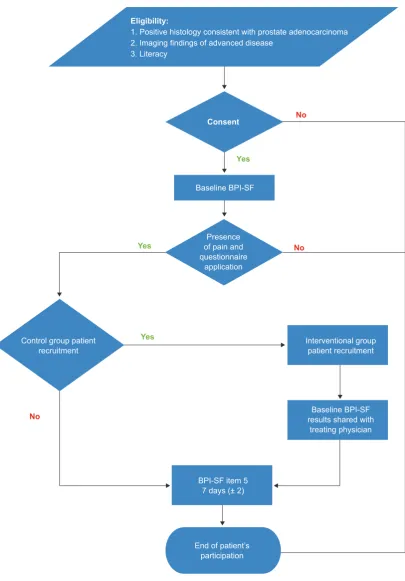
on-cologist’s own judgement. Patients having described the presence of pain were contacted by phone within one week upon the appointment (± 2 days) in order to assess mean pain severity. The study design is shown in Fig. 1.
The study was previously approved by the Ethics Com-mittee of the IPO Porto and authorisation for data collection and electronic data handling was given by the Comissão Nacional de Proteção de Dados.
Inclusion / exclusion criteria
Literate patients, not followed by the first author, with a positive histology consistent with prostate adenocarcinoma, imaging findings of metastatic disease and having accepted to participate were included in the study. Patients who had not described any pain in response to the item 1 of the BPI-SF questionnaire, patients attending a specialist chronic pain clinic and patients having attended a non-scheduled appointment at the IPO Porto on the subsequent week to the Medical Oncology scheduled appointment were exclud-ed from the study in order to allow for the assessment of the impact of the systematic use of the BPI-SF questionnaire in patients with painful disease.
A total of 207 patients with metastatic prostate cancer were selected from March through October 2016, 87 from which were excluded due to noncompliance with the inclu-sion criteria or to presenting with excluinclu-sion criteria (Fig. 2). Collected data
The BPI-SF questionnaire allows for the assessment of an experience of pain by using two pain-related constructs, namely pain intensity and interference with ADL as well as response to analgesia.10 This is a 11-item tool (4 items re-garding the assessment of pain intensity and 7 rere-garding the assessment of the impact on quality of life) with responses obtained by using a numeric scale ranging from 0 to 10, in which the higher the score the higher the pain intensity or the more relevant the interference with ADL. The question-naire has been applied immediately before the Medical On-cology appointment. The item 5 (mean pain within the week previous to the application of the BPI-SF questionnaire) has been repeated by phone and carried out within 7 days (+/- 2 days) from the date of study inclusion.
Each patient’s medical, pathological and therapeutic in-formation has been obtained from medical records by us-ing a standard data collection spreadsheet. The collected information regarding the issue 7 of the questionnaire (pain management) was supplemented by the information ob-tained from patient’s medical record, whenever suitable. Outcome measures
ARTIGO ORIGINAL
Statistical analysis
This study was designed so that a mean reduction of at least one point in mean pain severity was identified by the Student’s t-test in the interventional vs. control group. A 1.5 standard deviation of the difference has been assumed, as well as a 95% confidence interval and an 80% power; at least 37 participants were required for each group. At least
45 patients were selected for each group in order to com-pensate for any losses to follow-up.
Descriptive statistics methods were used for the analy-sis of clinical, pathological and therapeutic variables, ac-cording with what is appropriate for each variable. Mean and 95% confidence interval, as well as median and in-terquartile range were calculated regarding the items that Figure 1 – Study design
Eligibility:
1. Positive histology consistent with prostate adenocarcinoma 2. Imaging findings of advanced disease
3. Literacy
Consent
Baseline BPI-SF
Presence of pain and questionnaire
application
Control group patient
recruitment Interventional group patient recruitment
Baseline BPI-SF results shared with
treating physician
BPI-SF item 5 7 days (± 2)
End of patient’s participation
No
No
No
Yes
Yes
ARTIGO ORIGINAL
were assessed by the BPI-SF questionnaire. In addition, pain severity was assessed by a three-point verbal scale [mild (1-3), moderate (4-6) and severe pain (≥ 7)], which was converted from the numeric scale.19 Mean scores in the
seven items regarding the dimension of pain interference with ADL were calculated whenever valid responses had been given to at least four of these seven items. In addition, the percentage of patients having reached a properly man-aged pain was estimated in an independent way for both groups, as well as 95% confidence intervals.
All patients having complete the study procedures were considered for the assessment of primary outcome meas-ure. The impact of the Medical Oncology appointment has been assessed by comparing the distribution of mean pain intensity before vs. upon the appointment. The impact on pain intensity of sharing the result of the BPI-SF
question-naire with the treating physician was assessed with an in-dependent group Student´s t-test for the mean difference between mean pain score before vs. upon the appointment in each group. The impact of the use of the BPI-SF ques-tionnaire through the application of a chi-square test has been considered for the assessment of properly managed pain variable upon a scheduled Medical Oncology appoint-ment. Multivariate regression models have been used for estimating the impact of potential confounding factors on the measure of the impact of a medical appointment and having shared the results of the questionnaire with the treat-ing physician. A reduction in pain score between the initial and the subsequent assessment (linear regression) and the presence of properly managed pain between the initial vs. the subsequent assessment (logistic regression) were considered as dependent variables. Castration-resistant Figure 2 – Flowchart of patient’s selection criteria
Eligible population n = 207
Patient recruitment n = 205
Sample n = 120
Control group
n = 55 Interventional groupn = 46
Exclusions: - 1 due to illiteracy
- 1 due to participation refusal
Exclusions: - 82 no pain
- 3 Non-scheduled appointment on the subsequent week
ARTIGO ORIGINAL disease, previous docetaxel and antalgic radiation therapy, previous bone surgery, presence of pathological fracture, zoledronic acid therapy and history of chronic non-cancer related pain were considered as confounding factors. A 5% type I error has been assumed for all the comparisons. No corrections for multiple comparisons were made, given the exploratory nature of the study.
All the patients having accepted to participate in the study were considered for the assessment of pain preva-lence in patients with metastatic prostate cancer.
RESULTS
Our group of patients, mostly presenting with an ECOG (Eastern Cooperative Oncology Group) performance status of 0 or 1 (83%) had a median age of 71 years and mostly presented with metastatic bone disease (83.7%). The main characteristics of the patients, including those lost to follow-up are shown in Table 1.
Pain prevalence and characteristics
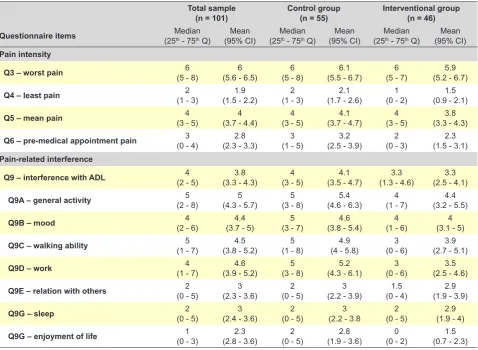
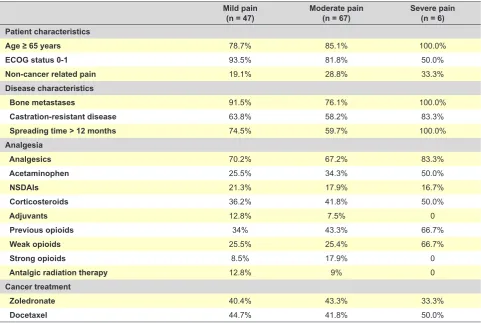
A 60% pain prevalence (95% CI: 53.3 – 66.7) has been found. A mean pain intensity score of 4.0 on the week previous to the medical appointment was found (95% CI: 3.7 – 4.4; 75th percentile: 5.0). As regards maximum and minimum pain on the week previous to the appointment, a mean score of 6.0 (75th percentile: 8.0) and 1.9 (75th per-centile: 3.0) were obtained, respectively (Table 2). Limbs (52%), spine (27.6%) and pelvic girdle (22.8%) were most frequently affected. When pain was analysed in terms of subgroups of intensity, most patients have described mod-erate or severe pain (60%, n = 73), even though only 5% of these patients have described a severe pain, half from these presented with ECOG status ≥ 2 and these were more frequently diagnosed with non-cancer related pain by the treating physician (one in three), caused by non
cancer-related benign pathologies. Lower scores of non-cancer re-lated pain were found in patients with mild and moderate pain (19.1% and 28.8%, respectively) (Table 3).
A mean score of 3.8 was found in this group of patients, regarding pain’s interference with ADL (95% CI: 3.3 – 4.3; 75th percentile: 5.0). General activity, walking ability and work were the most affected domains (mean 5.0; 4.5; 4.6 respectively, Table 2).
Characteristics of analgesia
Around one third of the patients (30.8%, n = 37) were not prescribed with any analgesics, despite having described the presence of pain. A total of 22 of these patients (59.5%) presented with moderate pain and only one patient with severe pain (2.7%). A percentage of 46.8% of the patients with mild pain were on nonsteroidal anti-inflammatory drugs (NSAIDs) and acetaminophen and 34% on opioids, while 52.2% of the patients with moderate pain were on NSAIDs and acetaminophen and 43.3% on opioids and, in patients with severe pain, 66.7% were on NSAIDs and acetami-nophen and also 66.7% on opioids. Patients in the sub-group with moderate pain were more frequently on strong opioids, even though none of the patients with severe pain was on these previous to the medical appointment (Table 3).
An increase in prescribed NSAIDs and acetaminophen, as well as opioids (mainly weak opioids), has been found in both groups upon the medical appointment. A higher per-centage of patients on opioids has been found in the control group vs. interventional group (Table 4). The percentage of patients with severe pain on weak opioids was changed from 66.7 to 83.3% upon the Medical Oncology appoint-ment, even though none of these patients was prescribed with strong opioids.
Table 1 - Characteristics of our group of patients with painful metastatic prostate cancer Control group
(n = 55) Interventional group(n = 46) Lost to follow-up (n = 19) Patient characteristics
Median age (years) 71 (range: 52 - 90) 70 (range: 47 - 92) 77 (range: 60 - 83)
ECOG status 0 - 1 87.0% 82.6% 83.3%
ECOG status ≥ 2 13.0% 17.4% 16.7%
Non-cancer related pain 20.4% 28.3% 31.6%
Disease characteristics Gleason ≥ 8
Gleason 7 Gleason ≤ 6
54.7% 35.8% 9.4%
50.0% 22.7% 27.3%
56.3% 37.5% 6.3%
Metachronous metastases 65.5% 47.8% 47.4%
Time since spreading (median) 20 months 23.5 months 20 months
Bone spreading 92.7% 80.4% 63.2%
Extra-bone spreading 47.3% 41.3% 57.9%
Castration-resistant disease 78.2% 47.8% 47.4%
ARTIGO ORIGINAL
Impact of the medical appointment and the use of the BPI-SF questionnaire
Mean pain score upon the Medical Oncology appoint-ment was reduced from 3.95 to 3.01 in the 101 patients having complete all the study evaluations, with a statisti-cally significant mean difference (0.94; p < 0.001). Mean pain score reduction in the interventional group (1.15; 95% CI: 0.71 – 1.60) was higher when compared to the control group (0.76; 95% CI: 0.31 – 1.22) even though with a statis-tically non-significant difference (0.39; 95% CI: -0.25 – 1.02; p = 0.227). The difference was changed to 0.17 (95% CI: -0.55 – 0.88; p = 0.646) when adjusted for potential con-founding variables by using a multivariate linear regression model.
A 43.5% likelihood of reaching a properly managed pain when sharing the results of the BPI-SF questionnaire with the treating physician was found vs. 30.9% in the control group, even though this benefit was not statistically signifi-cant (OR = 1.72; p = 0.193). The adjustment for confound-ing factors in a multivariate logistic regression model was associated with a reduction in the association between the BPI-SF questionnaire and a properly managed pain (OR = 1.51; p = 0.368). A severe pain was described by 8.1% (n = 3), moderate by 73% (n = 27) and mild by 18.9% (n = 7) of the 37 patients with properly managed pain (reduction ≥ 2 points). A 57.5% likelihood of reaching a properly managed
pain was found in the six patients having described maxi-mum pain ≥ 7, with a statistically significant difference when compared to patients with pain < 7.
DISCUSSION
Pain is frequently described by patients with advanced prostate cancer and pain management should be among the top priorities for the oncologist. Our group of patients was selected due to the propensity for the development of pain in metastatic prostate cancer, particularly with bone spreading. A higher pain prevalence was found in our study when compared to a phase-III clinical trial in patients diag-nosed with this pathology and in different stages of the dis-ease. This difference is probably due to the fact that a less selective group of patients has been used, when compared to those that were used in the major clinical trials.12-17 To the best of authors’ knowledge, this is the first study allow-ing for the identification of pain prevalence in patients with metastatic prostate cancer in the Portuguese population. Even though representing a single reference oncological centre, which may have overestimated pain prevalence due to a referral bias, a low risk has been considered, due to the fact that patients presenting at all stages of the disease were admitted and followed at this institution, where ap-proximately 37% of the patients living in the Northern region have been admitted and 13% of the Portuguese patients Table 2 - Results of the pre-appointment applied BPI-SF
Total sample
(n = 101) Control group(n = 55) Interventional group(n = 46) Questionnaire items (25Medianth - 75th Q)
Mean
(95% CI) (25Medianth - 75th Q)
Mean
(95% CI) (25Medianth - 75th Q)
Mean (95% CI) Pain intensity
Q3 – worst pain (5 - 8)6 (5.6 - 6.5)6 (5 - 8)6 (5.5 - 6.7)6.1 (5 - 7)6 (5.2 - 6.7)5.9
Q4 – least pain (1 - 3)2 (1.5 - 2.2)1.9 (1 - 3)2 (1.7 - 2.6)2.1 (0 - 2)1 (0.9 - 2.1)1.5
Q5 – mean pain (3 - 5)4 (3.7 - 4.4)4 (3 - 5)4 (3.7 - 4.7)4.1 (3 - 5)4 (3.3 - 4.3)3.8
Q6 – pre-medical appointment pain (0 - 4)3 (2.3 - 3.3)2.8 (1 - 5)3 (2.5 - 3.9)3.2 (0 - 3)2 (1.5 - 3.1)2.3 Pain-related interference
Q9 – interference with ADL (2 - 5)4 (3.3 - 4.3)3.8 (3 - 5)4 (3.5 - 4.7)4.1 (1.3 - 4.6)3.3 (2.5 - 4.1)3.3
Q9A – general activity (2 - 8)5 (4.3 - 5.7)5 (3 - 8)5 (4.6 - 6.3)5.4 (1 - 7)4 (3.2 - 5.5)4.4
Q9B – mood (2 - 6)4 (3.7 - 5)4.4 (3 - 7)5 (3.8 - 5.4)4.6 (1 - 6)4 (3.1 - 5)4
Q9C – walking ability (1 - 7)5 (3.8 - 5.2)4.5 (1 - 8)5 (4 - 5.8)4.9 (0 - 6)3 (2.7 - 5.1)3.9
Q9D – work (1 - 7)4 (3.9 - 5.2)4.6 (3 - 8)5 (4.3 - 6.1)5.2 (0 - 6)3 (2.5 - 4.6)3.5
Q9E – relation with others (0 - 5)2 (2.3 - 3.6)3 (0 - 5)2 (2.2 - 3.9)3 (0 - 4)1.5 (1.9 - 3.9)2.9
Q9G – sleep (0 - 5)2 (2.4 - 3.6)3 (0 - 5)2 (2.2 - 3.83 (0 - 5)2 (1.9 - 4)2.9
ARTIGO ORIGINAL
were diagnosed with prostate cancer.20-22
The use of standardized tools for pain assessment allows for a better knowledge on the subjective experience associ-ated with pain. Most patients presented with pain locassoci-ated to the appendicular skeleton, which is less frequently affected by advanced prostate cancer. This may be explained by the frequency of non-cancer related pain syndromes. Larger number of patients with severe pain were diagnosed with non-cancer related pain by the treating physician, show-ing how relevant is the contribution of non-cancer related pathologies to pain in our group of patients. A mean pain score of 3.95 was found on the week before the medical ap-pointment and moderate pain was described by most of the patients. Having attended a chronic pain outpatient clinic or a non-scheduled appointment on the following week to the
completion of the questionnaire were considered as exclu-sion criteria so that nothing except the treating physician’s clinical judgement would interfere with therapy; therefore, patients with potentially more severe pain were excluded from the study, which may have underestimated pain inten-sity in our study. In addition, the performance dimensions associated with mobility were those that were most signifi-cantly interfered by pain. This pattern of mobility-associated pain is also frequently associated with non-cancer related pathologies, which should be taken into consideration in view of the median age of our group of patients. The fact that mean score of interference with ADL was higher than mean pain score is worth mentioning, as it raises the issue of a potential patient’s poorer self-evaluation.
As regards analgesia, a high use of corticosteroids is Table 3 - Patient characteristics regarding nominal scales
Mild pain
(n = 47) Moderate pain(n = 67) Severe pain(n = 6) Patient characteristics
Age ≥ 65 years 78.7% 85.1% 100.0%
ECOG status 0-1 93.5% 81.8% 50.0%
Non-cancer related pain 19.1% 28.8% 33.3%
Disease characteristics
Bone metastases 91.5% 76.1% 100.0%
Castration-resistant disease 63.8% 58.2% 83.3%
Spreading time > 12 months 74.5% 59.7% 100.0%
Analgesia
Analgesics 70.2% 67.2% 83.3%
Acetaminophen 25.5% 34.3% 50.0%
NSDAIs 21.3% 17.9% 16.7%
Corticosteroids 36.2% 41.8% 50.0%
Adjuvants 12.8% 7.5% 0
Previous opioids 34% 43.3% 66.7%
Weak opioids 25.5% 25.4% 66.7%
Strong opioids 8.5% 17.9% 0
Antalgic radiation therapy 12.8% 9% 0
Cancer treatment
Zoledronate 40.4% 43.3% 33.3%
Docetaxel 44.7% 41.8% 50.0%
Table 4 - Analgesia medication
Analgesia Control group (n = 55) Interventional group (n = 46)
Before After Before After
Acetaminophen 35.9% 39.1% 26.8% 32.1%
NSDAIs 18.8% 20.3% 19.6% 19.6%
Strong opioids 15.6% 15.6% 10.7% 10.7%
Weak opioids 34.4% 45.3% 19.6% 26.8%
Adjuvants 12.5% 12.5% 5.4% 8.9%
Corticosteroids 48.4% 48.4% 30.4% 30.4%
ARTIGO ORIGINAL worth mentioning as, even though these are well-known
anti-inflammatory drugs used in advanced prostate cancer, this drug class is also used together with cancer treatment, making the assessment of their contribution to properly managed pain more difficult.
None of the patients with severe pain was on opioids and the fact that not only patients assessed in subsequent appointments but also patients assessed for the first time were included in the study is worth mentioning, as second or third-step analgesics drug-naïve patients were included. This study was aimed at the identification of the clinical benefit of a systematic pain assessment with the BPI-SF questionnaire in patients with metastatic prostate cancer. Even though with a non-experimental design, the clinical characteristics of the patients included in each group were well balanced and typically represented this population of patients. Upon a medical appointment, a statistically sig-nificant 0.94-point reduction in mean pain intensity score has been found, even though the explicit use of the BPI-SF questionnaire was not associated with a significant reduction in mean pain intensity (0.39 points; p = 0.227). The study has been designed with an 80% power for the identification of a 1-point difference in mean pain intensity score. Considering that a clinically significant difference would correspond to a mean 1.5-2-point reduction and that the correction of the measure of association for potential confounding factors was associated with a reduction, the isolated use of this tool would unlikely correspond to any benefit for the patients, would not other empowering meas-ures for higher clinical efficacy had been used. One of the possible measures would be the systematic use of this tool, particularly upon an adequate medical training in order to value each of the dimensions of the BPI-SF questionnaire. In addition, its routine use would make awareness among patients easier, giving support to the clinical usefulness of the systematic and continuous pain assessment by using the questionnaire when associated with a medical pain management education program.
CONCLUSION
The use of the BPI-SF questionnaire in medical routine is feasible. A systematic pain assessment provides treating physicians with a better knowledge on pain and therefore on better pain management, even though with a statistically non-significant impact. This tool was useful for pain assess-ment, due to the associated systematisation and standardi-sation. The implementation of training programs in chronic pain management and the continuous use of this tool will allow for a better enhancement of each of the dimensions and subsequent improvement in the quality of pain man-agement and quality of life in patients with advanced pros-tate cancer. This group of patients represented a population with no standard and systematic pain assessment aimed at a tailored analgesia.
ACKNOWLEDGEMENTS
The authors wish to acknowledge the nursing team for their contribution to the application of the BPI-SF question-naire (Isabel Vieira, José Silva, Manuela Vilhena) as well as to the registrar physicians for their contribution to the information collection (Ana Simas, Sofia Patrão).
HUMAN AND ANIMAL PROTECTION
The authors declare that the followed procedures were according to regulations established by the Ethics and Clini-cal Research Committee of the IPO Porto and according to the Helsinki Declaration of the World Medical Association. DATA CONFIDENTIALITY
The authors declare that they have followed the proto-cols of their work centre on the publication of patient data. CONFLICTS OF INTEREST
The authors declare that there were no conflicts of inter-est in writing this manuscript.
FINANCIAL SUPPORT
The authors declare that there was no financial support in writing this manuscript.
REFERENCES
1. Swarm RA, Abernethy AP, Anghelescu DL, Benedetti C, Buga S, Cleeland C, et al. National Comprehensive Cancer Network – Adult cancer pain. J Natl Compr Canc Netw. 2013;11:992-1022.
2. Merskey H, Bogduk N. Classification of chronic pain- Descriptions of chronic pain syndromes and definitions of pain terms. 2nd ed. Seattle:
International Association of Study of Pain Press; 1994.
3. Lesage P, Portenoy RK. Trends in cancer pain management. Cancer Control. 1999;6:136-45
4. Van den Beuken-van Everdingen MH, de Rijke JM, Kessels AG, Schouten HC, van Kleef M, Patijn J. Prevalence of pain in patients with cancer: a systematic review of the past 40 years. Ann Oncol. 2007;18:1437-49.
5. Portenoy RK. Epidemiology and syndromes of cancer pain. Cancer. 1989:2298-307
6. Farrar JT. Advances in clinical research methodology for pain clinical trials. Nat Med. 2010;16:1284-93.
7. Cleeland CS, Gonin R, Hatfield AK, Edmonson JH, Blum RH, Stewart
JA, et al. Pain and its treatment in outpatients with metastatic cancer. N Engl J Med. 1994;330:592–6.
8. Keller S, Bann CM, Dodd SL, Schein J, Mendoza TR, Cleeland CS. Validity of the brief pain inventory for use in documenting the outcomes of patients with noncancer pain. Clin J Pain. 2004;20:309-18.
9. De Andrés Ares J, Cruces Prado LM, Canos Verdecho MA, Penide Villanueva L, Del Valle Hoyos M, Herdman M, et al; Validation of the short form of the brief pain inventory (BPI-SF) in Spanish patients with non-cancer-related pain. Pain Pract. 2015;15:643-53.
10. Azevedo LF, Pereira AC, Dias C, Agualusa L, Lemos L, Romão J, Castro-Lopes JM. Translation, cultural adaptation and multicentric validation study of chronic pain screening and impact assessment instruments. Dor. 2007:6-56.
ARTIGO ORIGINAL
12. De Bono JS, Oudard S, Ozguroglu M, Hansen S, Machiels JP, Kocak I, et al. Prednisone plus cabazitaxel or mitoxantrone for metastatic castration-resistant prostate cancer progressing after docetaxel treatment: a randomised open-label trial. Lancet. 2010;376:1147-54. 13. Scher HI, Fizazi K, Saad F, Taplin ME, Sternberg CN, Miller K, et
al. Increased survival with enzalutamide in prostate cancer after chemotherapy. N Engl J Med. 2012;367:1187-97.
14. Petrylak DP, Tangen CM, Hussain MH, Lara PN Jr, Jones JA, Taplin ME, et al. Docetaxel and estramustine compared with mitoxantrone and prednisone for advanced refractory prostate cancer. N Engl J Med. 2004;351:1513-20.
15. Tannock IF, de Wit R, Berry WR, Horti J, Pluzanska A, Chi KN, et al. Docetaxel plus prednisone or mitoxantrone plus prednisone for advanced prostate cancer. N Engl J Med. 2004;351:1502-12.
16. Ryan CJ, Smith MR, de Bono JS, Molina A, Logothetis CJ, de Souza P, et al. Abiraterone in metastatic prostate cancer without previous
chemotherapy. N Engl J Med. 2013;368:138-48.
17. Fizazi K, Scher HI, Molina A, Logothetis CJ, Chi KN, Jones RJ, et al. Abiraterone acetate for treatment of metastatic castration-resistant prostate cancer: final overall survival analysis of the COU-AA-301 randomised, double-blind, placebo-controlled phase 3 study. Lancet Oncol. 2012;13:983-92.
18. Breivik H, Cherny N, Collett B, de Conno F, Filbet M, Foubert AJ, et al. Cancer-related pain: a pan-European survey of prevalence, treatment, and patient attitudes. Ann Oncol. 2009;20:1420-33.
19. Breivik H, Borchgrevink PC, Allen SM, Rosseland LA, Romundstad L, Hals EK, et al. Assessment of pain. Br J Anaesth. 2008;101:17-24. 20. RORENO. Registo Oncológico Regional do Norte 2010. Porto: IPO;
2015.
21. RORENO. Registo Oncológico Nacional 2016. Porto: IPO; 2016. 22. Registo Oncológico 2010. Instituto Português de Oncologia do Porto