ARTIGO ORIGINAL
Hansen Neuropathy: Still a Possible Diagnosis
in the Investigation of a Peripheral Neuropathy
Neuropatia da Doença de Hansen: Um Diagnóstico a Considerar na
Investigação da Neuropatia Periférica
1. Serviço de Neurologia. Centro Hospitalar de Trás os Montes e Alto Douro. Vila Real. Portugal. 2. Unidade de Neuropatologia. Centro Hospitalar do Porto. Porto. Portugal.
Autor correspondente: Andreia Veiga. [email protected]
Recebido: 04 de Outubro de 2014 - Aceite: 11 de Maio de 2015 | Copyright © Ordem dos Médicos 2015
Andreia VEIGA1, Alexandre COSTA1, Ricardo TAIPA2, António GUIMARÃES2, Manuel Melo PIRES2
Acta Med Port 2015 May-Jun;28(3):329-332
RESUMO
Introdução: A lepra continua a ser uma das causas mais frequentes de neuropatia periférica. Apesar de tida como erradicada em Portugal, ainda se documenta no estudo neuropatológico de doentes com clínica de neuropatia periférica sem diagnóstico etiológico definido.
Material e Métodos: Revisão dos casos neuropatia por doença de Hansen diagnosticados na Unidade de Neuropatologia do Centro Hospitalar do Porto no período de 1978 e 2013 atendendo ao género, idade, manifestações clínicas e achados neuropatológicos.
Resultados: Foram identificados 21 doentes com diagnóstico neuropatológico de neuropatia por doença de Hansen, com predomínio do sexo masculino. A idade média ao diagnóstico foi de 52 anos, sendo a sintomatologia sensitiva predominante. O intervalo entre sintomatologia e diagnóstico oscilou entre 1 a 38 anos. Na maioria foi identificada forma tuberculoide em biópsia de nervo e detetados bacilos em pele e nervo em 44% dos casos.
Discussão: A mononeurite é a forma mais comum de apresentação de hanseníase, podendo cursar com outras manifestações clíni-cas incluindo lesões cutâneas. A infeção pelo M. leprae lesiona fibras mielinizadas e não mielinizadas, com substituição do tecido nervoso por colagénio resultando em fibrose. O diagnóstico da lepra é apenas conseguido por estudo neuropatológico das lesões cutâneas e/ou nervo periférico, adjuvado pela identificação do bacilo.
Conclusão: A doença de Hansen continua a ser um problema de saúde pública em áreas tropicais e, apesar de rara, ainda descrita em países ocidentais, devendo ser considerada como uma hipótese de diagnóstico na investigação de neuropatia periférica.
Palavras-chave: Doenças do Sistema Nervoso Periférico; Lepra; Portugal.
ABSTRACT
Introduction: Leprosy is still one of the most frequent causes of peripheral neuropathy. Although regarded as eradicated in Portugal, is still documented in neuropathological study of patients with clinical peripheral neuropathy without proper diagnosis.
Material and Methods: Review of the cases of Hansen disease neuropathy diagnosed in Neuropathology Unit of Centro Hospitalar do Porto between 1978 and 2013, atending to gender, age, clinical manifestations and neuropathological findings.
Results: Twenty one patients were identified with neuropathological diagnosis of Hansen’s disease neuropathy, predominantly male. The mean age at diagnosis was 52 years, and sensory symptoms predominate as neurological manifestation of disease. Interval between symptoms and diagnosis was 1-38 years. In most nerve samples tuberculoid type of disease was identified. Bacilli were detected in skin and nerve in 44% of cases.
Discussion: Mononeuritis is the most common presentation of leprosy but other clinical manifestations are possible, including skin lesions. Infection with M. leprae injures myelinated and unmyelinated fibres, with replacement of nerve tissue by collagen fibrosis. The diagnosis of leprosy is only achieved by neuropathological study of skin lesions and / or peripheral nerve, supported by the identification of the bacillus.
Conclusion: Hansen disease remains a public health problem in tropical areas and, although rare, still described in Western countries reason why should still be considered as a diagnostic possibility in the investigation of peripheral neuropathy.
Keywords: Leprosy; Peripheral Nervous System Diseases; Portugal.
INTRODUCTION
Leprosy (or Hansen’s disease) is a chronic infection caused by the bacteria Mycobacterium leprae. Identified in 1874 by H. Hansen, it remains one of the most prevalent causes of peripheral neuropathy.1,2 The diagnosis is achieved
through examination of skin lesions or in the presence of multiple mono-neuropathies, sensory and motor peripheral neuropathy, requiring histological confirmation.
Despite a seemingly decreased number of patients, the World Health Organization estimates an annual incidence of 500,000 to 700,000 new patients. The autochthonous Hansen’s disease was considered extinct by 2000 in most European countries, except in the South of Italy, Portugal,
Spain and Greece.3
ARTIGO ORIGINAL
330
Revista Científica da Ordem dos Médicos www.actamedicaportuguesa.com Veiga A, et al. Hansen neuropathy, Acta Med Port 2015 May-Jun;28(3):329-332
MATERIAL AND METHODS
The patients with leprosy-related neuropathy diagnosed at the Neuropathology Unit from the Hospital Santo António, Centro Hospitalar do Porto were analysed, in the light of this infrequent condition. This was a retrospective and observational study performed through database and clinical record analysis, considering the patient’s age, area of residence, symptoms, duration of disease and neuropathological review of nerve, muscle and/or skin biopsies including a description of the pathological findings.
RESULTS
In total, 21 patients were diagnosed between 1978 and 2013 with leprosy-related neuropathy (13 males). As regards the patient’s place of residence, five were from the Trás-os-Montes region, three from Minho and 13 from the Douro Litoral. The patient’s average age at the time of diagnosis was 52 (18 - 76) and in four cases data was unavailable. In the remaining 17 patients, there was on average a 10-year timeframe (1-38 10-years) between the beginning of symptoms and a definitive diagnosis. In total, 13 cases were diagnosed in the eighties and over the subsequent years a progressive decrease occurred and an event-free 15-year period when no cases were notified (1997 to 2012). Only two patients were identified in 2012 and 2013, both with a previous residence in an endemic country (Brazil). One of these had been treated 20 years before for skin leprosy. In the other 15 patients, only one patient had lived in an endemic country.
Sensory impairment was the symptom more frequently described by 14 patients and four patients had simultaneous motor neuropathy symptoms. Five patients presented with skin lesions.
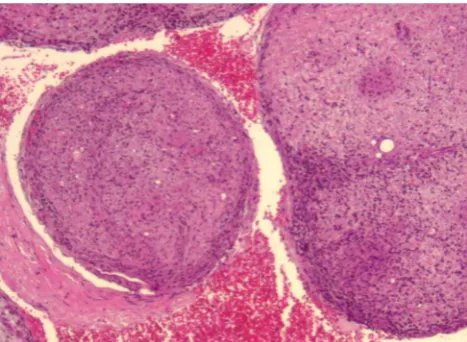
Glove and stock hypoesthesia was the most frequent finding in the neurological examination (n = 14), with distal motor deficit in four patients. Tuberculoid leprosy was identified by the nerve neuropathological examination in 20 patients (Fig.s 1 and 2) and the lepromatous form was identified in only one patient. Leprosy-suggestive lesions
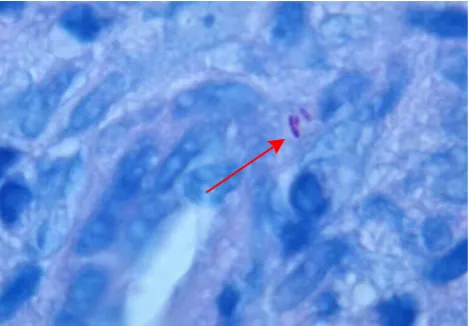
were found in five of the skin biopsies (n = 12), as well as in four of muscle’s biopsies (n = 5). The presence of Hansen’s bacilli (with the Ziehl-Neelsen’s staining technique) was found in the nerve biopsy in 13 patients and four in the skin (44% of nerve and 42% of skin biopsies) and one skin sample was macroscopically normal. Bacilli from the case diagnosed in 2012 were detected with a Fite Faraco stain (Fig. 3).
DISCUSSION
Mononeuritis is the most common presentation of Hansen’s disease1,4 and upper limb nerves are the most
frequently affected. Skin involvement progresses with disfiguring lesions, responsible for the stigmatizing nature of this disease. Despite the aetiological agent - Mycobacterium leprae – having been identified more than a century ago, little is known about the underlying pathophysiological mechanism responsible for the nerve lesion.5 The main
limitation to research in this area regards obtaining tissue samples to be studied, as a result of its multifocal presentation and wide lesion-free areas of skin.5 Infection
with Mycobacterium leprae damages myelinated and unmyelinated fibres. The bacillus invades the nerve during the infection process with subsequent nerve destruction, producing an immune response promoted by Schwann cells with resulting demyelination, axonal degeneration and subsequent regeneration with fibrosis, enlarged nerves, as a result of which these are usually palpable. Treatment itself may produce an exacerbated inflammatory response with nerve destruction.6 The type of immune response,
mediated by type-II HLA genes will determine whether leprosy will be lepromatous or tuberculoid. In the first form, macrophages do not have the capacity to eliminate the bacilli while in the second the cellular response is so intense that it induces a granulomatous reaction. In the tuberculoid form, the multifocal pattern of dissemination is most common.6 In lepromatous form, the histological
pattern is symmetrical, presenting as a pseudo-polyneuritis, progressing with the typical skin lesions or as an isolated
Figure 1 - HE staining. Sural nerve. Total absence of myelinated fibres. The presence of nerve enlargement with granuloma on the three nerve fascicles.
ARTIGO ORIGINAL
small-fibre neuropathy (10% of the patients).6 The initial
nerve damage is usually a small-fibre neuropathy and subsequently involves wider fibres. The pure motor involvement is a rare manifestation of the disease. The less frequent polyneuropathy involvement mainly progresses to a hypoesthesia for pain and temperature, with deep sensory sparing. This form of presentation, characteristic of the initial stages of the disease, is similar to the diabetic or amyloid polyneuropathy, although tendon reflex preservation in leprous polyneuropathy and the nerve enlargement that occurs in approximately 60% of the patients, marks the distinction from those two other entities (as well as from chronic demyelinating inflammatory polyneuropathy). The nerve block or compression syndromes are more difficult to differentiate clinically, as in the case of elbow ulnar neuropathy.5 The association with autonomic dysfunction
has also been described (impairment in sudomotor and vasomotor function). 4
Leprosy is only diagnosed through the neuropathological examination of skin and/or peripheral nerve lesions. The morphological changes induced by the immune response to the infection can be identified by simple staining methods and subsequent bacilli identification through the Fite Faraco or Ziehl-Neelsen methods.7
Despite these procedures, the low rate of bacilli detection in the tuberculoid form is explained by the absence of an efficient in vitro culture method2 and as such it relies solely
on a direct staining method. An average 25% percentage of bacilli detection (lower than in our group of patients) and the tuberculoid form (in which bacilli are rarer) is usually the most frequently found in literature. The fact that bacilli can be identified in a macroscopically normal skin sample enhances the importance of clinical suspicion regarding Hansen’s disease at the time of the clinical examination and the need for a neuropathological examination of different tissues. The diversity of clinical manifestations may even explain the reason why, on average, there is a 10-year gap between initial symptoms and the definitive diagnosis.
From the patients that were identified, at least to the author’s knowledge, only the second-to-last patient represented a relapse. It occurred in a female patient presenting with a neuropathy, considered in remission after having undergone treatment for leprous skin disease 20 years before. As this patient had a tuberculoid form in which the bacillus was identified, it cannot be considered a late relapse as this relates to lepromatous leprosy and to an immune pathological mechanism in reaction to the bacillus’ antigen. In general, relapse is frequently associated to non-compliance or even to resistance to treatment, the possibility of re-infection remaining an open-ended question.4
Leprous neuropathy is the most frequent cause of treatable neuropathy worldwide.1 Treatment initially used
– dapsone monotherapy – progressed with antibiotic resistance that in some countries reached up to 40%. 6
Its association with rifampicin or clofazimine has shown more successful cure rates. Since 1981 the WHO has recommended that multiple therapy should be adequate to eradicate the disease and that the recommended regimen should include dapsone associated to daily clofazimine and monthly single doses of rifampicin for one year in multibacillary forms (more than five skin lesions) or for six months in paucibacillary forms (less than five skin lesions). The association of ofloxacin or minocycline may be successful in resistant cases. Treatment may have to be continued for up to 24 months, depending on clinical severity. Relapse rates are high, between 16 and 39%5 and
may be explained not only by the antibiotic resistance but also by the difficulty in complying with such a long treatment, in the absence of an efficient vaccine to prevent spread of disease.
CONCLUSIONS
Hansen’s disease is still a public health issue in tropical regions and, although rare, is still described in Western countries. This clinical series is a reminder that this disease, although being considered as eradicated, is still diagnosed in Portugal and should be recognized as a diagnostic possibility in a patient with a peripheral neuropathy.
DATA CONFIDENTIALITY
The authors declare that they have followed the protocols of their work centre on the publication of patient data.
CONFLICTS OF INTEREST
The authors declare that there were no conflicts of interest in writing this manuscript.
FINANCIAL SUPPORT
The authors declare that there was no financial support in writing this manuscript.
Figure 3 - Fite Faraco staining. Identification of Mycobacterium
ARTIGO ORIGINAL
332
Revista Científica da Ordem dos Médicos www.actamedicaportuguesa.com Veiga A, et al. Hansen neuropathy, Acta Med Port 2015 May-Jun;28(3):329-332
REFERENCES
1. Nascimento O. Leprosy neuropathy: clinical presentations. Arq Neurop-siquiatr. 2013;71:661-6.
2. Matsuo E. Leprosy as a challenge to science on the ability to encode this enigma. Jpn J Infect Dis. 2005;58:59-64.
3. Sequeira J, Martins C, Marques C, Machado A, Batista AP. Hanseníase: estudo comparativo entre doentes antigos e recentes. Act Med Port. 2000;13:13-7.
4. Nascimento O, Freitas M, Escada T, Marques Junior W, Cardoso F, Pupe C, et al. Leprosy late-onset neuropathy: an uncommon
presenta-tion of leprosy. Arq Neuropsiquiatr. 2012;70:404-6.
5. Sharma R, Lahiri R, Scollard D, Pena M, Williams DL, Adams LB, et al. The armadillo: a model for the neuropathy of leprosy and potentially other neurodegenerative diseases. Dis Model Mech. 2013;6:19-24. 6. Freitas MR, Said G. Leprous neuropathy. Handb Clin Neurol.
2013;115:499-514.
Andreia VEIGA, Alexandre COSTA, Ricardo TAIPA, António GUIMARÃES, Manuel Melo PIRES