ARTIGO ORIGINAL
Bone Fractures in a Neonatal Intensive Care
Unit
Fraturas Ósseas em uma Unidade de Cuidados Intensivos Neonatais
1. Serviço de Neonatologia. Hospital Pediátrico Integrado. Centro Hospitalar de São João E.P.E. Porto. Portugal. 2. Serviço de Medicina Física e Reabilitação. Centro Hospitalar de São João E.P.E. Porto. Portugal.
3. Serviço de Ortopedia. Centro Hospitalar de São João E.P.E. Porto. Portugal.
4. Departamento de Ortopedia. Faculdade de Medicina. Universidade do Porto. Porto. Portugal. 5. Departamento de Pediatria. Faculdade de Medicina. Universidade do Porto. Porto. Portugal. Recebido: 29 de Julho de 2014 - Aceite: 16 de Fevereiro de 2015 | Copyright © Ordem dos Médicos 2015
Ângela MACHADO1, Gustavo ROCHA1, Ana Isabel SILVA2, Nuno ALEGRETE3,4, Hercília GUIMARÃES2,5
Acta Med Port 2015 Mar-Apr;28(2):204-208
RESUMO
Introdução: As fraturas ósseas são raras durante o período neonatal. Algumas das fraturas, sobretudo as de ossos longos, podem ocorrer durante o parto. Por outro lado, os recém-nascidos internados em Unidades de Cuidados Intensivos Neonatais têm um risco aumentado de fraturas ósseas por várias razões.
Objetivo: Avaliar a incidência e caracterizar as fraturas ósseas nos recém-nascidos internados numa Unidade de Cuidados Intensivos Neonatais nível III.
Material e Métodos: Análise retrospetiva dos recém-nascidos internados na Unidade de Cuidados Intensivos Neonatais com o diag-nóstico na alta de uma ou mais fraturas ósseas, entre janeiro de 1996 a junho de 2013.
Resultados: Oitenta recém-nascidos apresentaram uma ou mais fraturas ósseas. Em 76 (95%) recém-nascidos, as fraturas foram atribuídas a traumatismo do parto. A fratura mais comum foi da clavícula em 60 (79%) recém-nascidos, seguida da fratura craniana em 6 (8%) recém-nascidos. Em dois (2,5%) recém-nascidos, prematuros de extremo baixo peso, as fraturas foram interpretadas como decorrentes de osteopenia da prematuridade. Ambos apresentaram fraturas múltiplas, um dos quais de várias costelas.
Conclusão: Uma mudança das práticas obstétricas, aliada à melhoria dos cuidados prestados ao recém-nascido prematuro con-tribuíram para a diminuição da incidência de fraturas ósseas no período neonatal. Contudo nos recém-nascidos prematuros o seu diagnóstico pode estar subestimado, dado o elevado risco de desenvolvimento de fratura que estes recém-nascidos apresentam.
Palavras-chave: Fracturas Ósseas/epidemiologia; Portugal; Recém-Nascido; Unidades de Cuidados Intensivos Neonatais.
ABSTRACT
Introduction: Fractures during the neonatal period are rare. Some fractures, especially long bones, may occur during birth. Moreover, neonates hospitalized in the Neonatal Intensive Care Unit have an increased risk of fractures for several reasons.
Objective: To evaluate the incidence and characterize fractures in newborns admitted in a tertiary Neonatal Intensive Care Unit.
Material and Methods: A retrospective analysis of the newborns admitted to the Neonatal Intensive Care Unit with a diagnosis at discharge of one or more bone fractures from January 1996 to June 2013.
Results: Eighty neonates had one or more fractures. In 76 (95%) infants the fractures were attributed to birth injury. The most common fracture was the clavicle fracture in 60 (79%) neonates, followed by skull fracture in 6 (8%). In two (2.5%) neonates, extremely low birth weight infants, fractures were interpreted as resulting from osteopenia of prematurity. Both had multiple fractures, and one of them with several ribs.
Conclusion: A change in obstetric practices allied to improvement premature neonate’s care contributed to the decreased incidence of fractures in neonatal period. But in premature infants the diagnosis may be underestimated, given the high risk of fracture that these infants present.
Keywords: Fractures, Bone/epidemiology; Infant, Newborn; Intensive Care Units, Neonatal; Portugal.
INTRODUCTION
Bone fractures are a rare event in the neonatal period.1
However, birth-related long-bone fractures namely of the clavicle, associated to shoulder dystocia and skull fractures mostly related to the use of forceps or ventouse have been known to occur.2 In addition, newborns (NB) admitted to
Neonatal Intensive Care Units (NICU) have an increased risk of bone fractures due to several reasons including prematurity, low-birth weight, malnutrition, as well as medical and drug-related trauma.1-5 Fracture specific cause
is generally difficult to determine in premature NB and is often attributed to osteopenia of prematurity.1 Most cases
are incidentally diagnosed in X-rays performed for other reasons and therefore the exact incidence of fractures in premature NB is unknown.2 According to the few published
studies, the incidence of fractures is very variable, between 1.2 and 10.5%, being higher in very low birth weight (VLBW) infants.1,6
ARTIGO ORIGINAL MATERIAL AND METHODS
This was a retrospective study based on clinical records of all NB admitted to our NICU and diagnosed at discharge with one or more bone fractures, from January 1996 to June 2013. The following variables were analysed: gestational age; birth weight; gender, delivery type; reason for admission; neonatal complications, including hyaline membrane disease (HMD), bronchopulmonary dysplasia (BPD), nosocomial sepsis, necrotizing enterocolitis (NEC), patent arterial duct (PAD), intraventricular haemorrhage (IVH), periventricular leukomalacia (PVL) and retinopathy of prematurity (ROP) and therapy, including postnatal steroids and surfactant replacement therapy, diuretics, invasive mechanical ventilation, phototherapy and sedation.
RESULTS
In total, 7,364 patients were admitted to our Department over the study period. From these, 80 NB were diagnosed with one of more bone fractures, corresponding to a 1.1% prevalence.
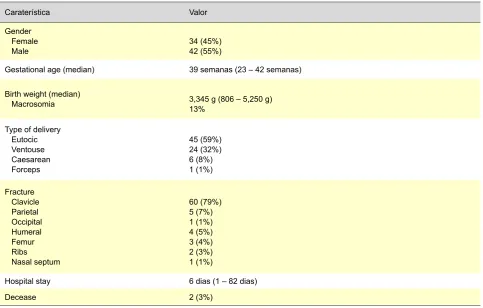
Fractures were related to birth trauma in 76 (95%) NB (Table 1). Clavicle fracture was the most frequent, found in 60 (79%) NB. Vaginal delivery was mostly used (97%) and ventouse was applied in 31%. An injury to the brachial plexus was found in 20% of NB, with a 100% full recovery. However, none of these newborns was admitted for a clavicle fracture. The reason for admission to the NICU was variable: birth defect (including cardiac) (n = 15), infectious pathology (n = 14), pulmonary pathology (n = 8), surgical
pathology (n = 6), perinatal asphyxia (n = 5), jaundice (n = 3) and others (n = 9).
The second most observed birth trauma-related fracture was a fracture to the skull, found in 6 (8%) NB. Most (n = 5) of these were born by ventouse; caesarean was required in one case, due to unsuccessful foetal extraction attempt. All of these five NB except the one who was born by caesarean presented with subdural or subarachnoid haemorrhage. One was admitted in hypotensive shock with metabolic acidosis quickly progressing to multi-organ failure and finally died. Another NB started with seizures on the first hours of life and progressed with brain paralysis. The remaining had a full recovery.
As regards NB with other birth trauma-related fractures there was one 34-week premature NB with hypoxic-ischaemic encephalopathy due to multi-organ failure who died and in whom a post-partum humeral fracture was found.
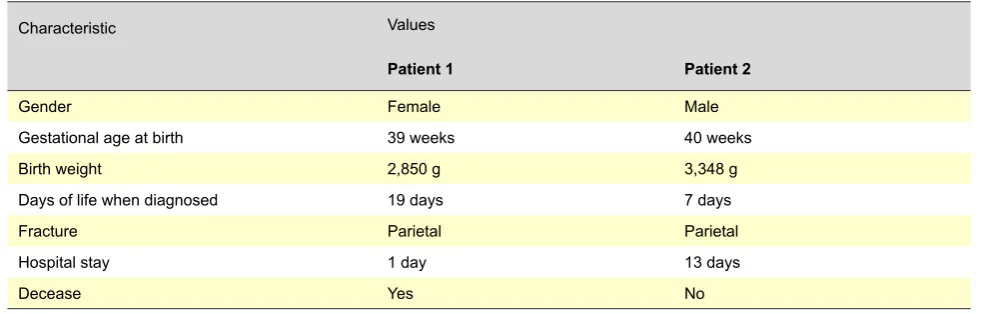
Two (2.5%) NB were admitted with brain fracture related to head injury after a fall at home (Table 2). One of these (patient 1, Table 2) presented with extensive subarachnoid haemorrhage quickly progressing to hypovolemic shock and died. The other patient (patient 2, Table 2) presented with subdural haemorrhage, started with seizures three days after the head injury with a subsequent diagnosis of cerebral palsy.
Fractures were interpreted as associated to osteopenia of prematurity in the remaining two (2.5%) NB – extremely low birth weight (ELBW) premature NB (Table 3). One of
Table 1 – Birth trauma-related fractures (n = 76)
Caraterística Valor
Gender Female
Male 34 (45%)42 (55%)
Gestational age (median) 39 semanas (23 – 42 semanas)
Birth weight (median) Macrosomia
3,345 g (806 – 5,250 g) 13%
Type of delivery Eutocic Ventouse Caesarean Forceps
45 (59%) 24 (32%) 6 (8%) 1 (1%)
Fracture Clavicle Parietal Occipital Humeral Femur Ribs Nasal septum
60 (79%) 5 (7%) 1 (1%) 4 (5%) 3 (4%) 2 (3%) 1 (1%)
Hospital stay 6 dias (1 – 82 dias)
ARTIGO ORIGINAL
these (patient 1, Table 3) was diagnosed on D103 of life with a femur fracture due to the presence of a swelling on the left thigh and subsequently several fractured ribs diagnosed on skeletal x-ray. The other patient (patient 2, Table 3) was diagnosed on D57 of life with bilateral femur, left humerus and radius fractures and, on D144 of life with right humerus fracture visible in an x-ray obtained due to an infectious complication. At the time when these fractures were diagnosed, both NB presented with elevated alkaline phosphatase (AP) (patient 1: 775 U/L; patient 2: 456 U/L) and a low phosphate (patient 1: 3.4 mg/dL; patient 2: 2.5 mg/dL). The calcium serum levels were normal. In patient 2, parathyroid hormone (PTH) level was also found to be elevated (320 pg/mL) with a normal vitamin D (21.6 ng/mL).
DISCUSSION
Most diagnosed fractures were related to birth trauma. The clavicle fracture was the most frequent, occurring spontaneously in approximately 0.4 – 10% of vaginal deliveries and rarely in caesarean deliveries, in line with previous studies.7,8 The most consistent risk factor was
the presence of high birth weight, particularly when above 4,000 g.8,9 Other associated risk factors include more than
52 cm in length, long second stage of labour,7 instrumental
deliveries7,8 and higher maternal age.8 This type of fracture
is also associated to shoulder dystocia, 4,7-9 which was found
in just two (3%) of our NB.
The incidence of clavicle fracture was very high in our group of patients; nevertheless, these were NB admitted to the unit due to other reasons and this fracture is not usually observed in NICU. NB with this type of fracture rarely present with symptoms and usually progress to long-term full recovery. We found a simultaneous injury to the brachial plexus in 20% of the patients in our study, a figure higher than the expected 9% frequency that has been described.7
Humeral fractures are the second most frequent long-bone fractures in NB,10 as found in our study. This type of
fracture, as well as femur fractures are often associated to caesarean deliveries during delivery of the limbs.10-13 In
our series only one patient born by caesarean delivery with fracture to the humerus was found, while the remaining
three were born by eutocic delivery, the latter considered “as difficult”. The same occurred in NB with femur fractures; only one from three NB was born by caesarean section. As regards fractures to the skull, a 7.5% incidence was found in our group of patients (n = 6) and this was the most frequent birth-related bone fracture after clavicle fracture. Instrumental delivery is a major risk factor to this type of injury, as well as increase in the incidence of intracranial haemorrhage,4,14,15 as found in our results. Ventouse
was applied to five (83%) NB with fracture to the skull and four (67%) presented with subdural or subarachnoid haemorrhage. The incidence of this type of trauma has been reduced due to changes in obstetric procedures.16
A 5% prevalence of fractures to the skull was found in a retrospective study involving skull X-ray imaging in every ventouse application.17 However, all were linear fractures in
asymptomatic NB. It is interesting to mention that four of our patients were diagnosed during the last semester of the study.
Neonatal skull fractures may arise from trauma with another aetiology, exemplified by the two (2.5%) NB admitted to our NICU upon a fall at home. Around 1 to 3% of small falls may produce a skull fracture and very rarely this fracture may be related to a subdural haemorrhage.18 In this
type of fracture, progression and long-term outcome mainly depend on direct trauma-related brain damage, regardless of the aetiology.14
Rib fractures in NB, especially to the posterior ribs, are rare and very indicative of non-accidental injuries.1,2 These
are even more rarely associated to birth trauma and found in the context of “difficult” deliveries of heavy NB.1,19 Two
(2.5%) NB with birth trauma-related rib fractures were surprisingly found in our group of patients, one related to the use of ventouse and one to forceps. None of these was submitted to CPR (cardiopulmonary resuscitation) manoeuvres, which is another extremely rare cause for rib fractures in this age group, although frequent in the adult.1,19
Neonatal fractures may be associated to other aetiologies, mainly in premature NB admitted to the NICU. Around 80% of bone mineralization occurs during the third trimester of pregnancy and therefore premature NB have
Table 2 – Head injury-related fractures (n = 2)
Characteristic Values
Patient 1 Patient 2
Gender Female Male
Gestational age at birth 39 weeks 40 weeks
Birth weight 2,850 g 3,348 g
Days of life when diagnosed 19 days 7 days
Fracture Parietal Parietal
Hospital stay 1 day 13 days
ARTIGO ORIGINAL
an increased risk of osteopenia,3 particularly those born
before the 28th week of gestation, with low birth weight and/ or a complicated immediate neonatal period, with the need for extended parenteral nutrition, necrotizing enterocolitis, conjugated hyperbilirubinemia, bronchopulmonary dysplasia and the use of furosemide.2,3
Metabolic bone disease (MBD) of prematurity occurs in around 23% of very-low birth weight (VLBW) and in 55-60% of extremely-low birth weight (ELBW) NB.4,6 There is no
metabolite considered as a single marker to MBD.4 Calcium
and phosphate levels may be normal despite low reserve levels, due to the effect of PTH.4,6 PA elevation is the most
widely accepted marker of MBD; however, cut-off values vary widely between studies, from 300 IU/L (maximum level considered as normal in NB) to 900 IU/L.1,5 Less than
10% incidence of fractures in ELBW NB are expected to occur.6 Only two ELBW NB with MBD-related fractures
were identified in our group. Multiple, mainly rib, fractures are more frequent in this group of patients,1 as found in
our group, in which two patients presented with multiple fractures, one of them with several rib fractures.
The reduction in the incidence of fractures in this group is mainly due to improved healthcare delivery to premature NB.2 An adequate Ca and P supply in parenteral nutrition, as
well as minimizing its duration, stronger breast milk, the use of specific premature formulas, the reduction in the use of steroids and diuretics, early vitamin D supplementation and limb mobilization are increasingly implemented attitudes in NICU, aimed at promoting bone mass increase.
CONCLUSION
Despite the reduction in the incidence of birth-related trauma, due to improved obstetric procedures, bone fractures, mainly to the clavicle, are still a frequent cause of neonatal morbidity. However, long-bone, birth trauma-related fracture outcome is usually favourable.
Premature newborns, mainly ELBW, have an increased risk for multiple fractures with a usually multi-factorial aetiology. However, the incidence of fractures was reduced in this group due to improved healthcare delivery to these NB. The incidence may be underestimated, as most fractures are asymptomatic and incidentally diagnosed in premature NB. In our study, the low incidence of fractures in this group of NB may also be explained by its retrospective nature. We conclude that prevention and early detection of MBD is fundamental, in order to determine treatment and therefore fracture prevention.
Tabela 3 – Fractures related to osteopenia of prematurity (n = 2)
Characteristic Values
Patient 1 Patient 2
Gender Male Male
Gestational age 28 weeks 31 weeks
Birth weight 880 g 506 g
SGA No Yes
HMD Severe Mild
Surfactant 3 doses 1 dosis
BPD Yes Yes
Postnatal steroids (duration) 12 days 13 days
Diuretics (duration) 69 days 7 days
Invasive MV (duration) 185 days 147 days
Nosocomial sepsis (positive blood culture) Yes Yes
NEC ≥ 2nd week No No
Symptomatic PAD Yes No
IVH ≥ III ± infarction No Yes
PVL No No
ROP grade ≥ 2 No No
Phototherapy (duration) 6 days 7 days
Sedation (duration) 38 days 32 days
Hospital stay 184 days 147 days
Decease Yes Yes
ARTIGO ORIGINAL CONFLICTS OF INTEREST The authors declare that there were no conflicts of
interest in writing this manuscript.
FINANCIAL SUPPORT
The authors declare that there was no financial support in writing this manuscript.
REFERENCES
1. Wei C, Stevens J, Harrison S, Mott A, Warner J. Fractures in a tertiary neonatal intensive care unit in Wales. Acta Paediatr. 2012;101:587-90. 2. Bishop N, Sprigg A, Dalton A. Unexplained fractures in infancy: looking
for fragile bones. Arch Dis Child. 2007;92:251-6.
3. Herald AL, Butler S, Mactier H, McDevitt H, Young D, Ahmed SF. Prevalence and characteristics of rib fractures in ex-preterm infants. Pediatrics. 2012;130:1116-9.
4. Aloy JF, Álvarez-Domínguez E, Pérez-Fernández JM, Moretones-Suñol G, Vidal-Sicart S, Botet-Mussons F. Metabolic bone disease and bone mineral density in very preterm infants. J Pediatr. 2014;164:499-504. 5. Vachharajani AJ, Mathur AM, Rao R. Metabolic bone disease of
prematurity. NeoReviews. 2009;10:402-11.
6. Gomella TL, Cunningham MD, Eyal FG. Neonatology: management, procedures, on-call problems, diseases, and drugs. 6th ed. Philadelphia: McGraw-Hill Companies; 2009.
7. Mavrogenis A, Mitsiokapa EA, Kanellopoulos AD, Ruggieri P, Papagelopoulos PJ. Birth fracture of the clavicle. Adv Neonatal Care. 2011;11:328-31.
8. Zdener TO, Engin-ustun Y, Aktulay A, Turkcapar F, Oguz S, Yapareyi EG, et al.Clavicular fracture: its prevalence and predisposing factors in term uncomplicated pregnancy. Eur Rev Med Pharmacol Sci. 2013;17:1269-72.
9. Hsu TY, Hung FC, Lu YJ, Ou CY, Roan CJ, Kung FT, et al. Neonatal clavicular fractures: clinical analysis on incidence, predisposing factors,
diagnosis, and outcome. Am J Perinatol. 2002;19:17-21.
10. Sherr-Lurie N, Bialik GM, Ganel AG, Schindler A, Givon U. Fractures of the humerus in the neonatal period. Isr Med Assoc J. 2011;13:363-6. 11. Sabat D, Maini L, Gautam VK. Neonatal separation of distal humeral
epiphysis during caesarean section: a case report. J Orthop Surg. 2011;19:376-8.
12. Basha A, Amarin Z, Abu-Hassan F. Birth-associated long-bone fractures. Int J Gynaecol Obstet. 2013;123:127-30.
13. Givon U, Sherr-Lurie N, Schindler A, Blankstein A, Ganel A. Treatment of femoral fractures in neonates. Isr Med Assoc J. 2007;9:28-9. 14. Doumouchtsis SK, Arulkumaran S. Head injuries after instrumental
vaginal deliveries. Curr Opin Obstet Gynecol. 2006;18:129-34. 15. Doumouchtsis SK, Arulkumaran S. Head trauma after instrumental
births. Clin Perinatol. 2008;35:69-83.
16. Wegner E, Bernstein IM. Operative vaginal delivery. UptoDate 2014; [consultado 2014 Jun 2]. Disponível em: www.uptodate.com.
17. Simonson C, Barlow P, Dehennin N, Sphel M, Toppet V, Murillo D, et al. Neonatal complications of vacuum-assisted delivery. Obstet Gynecol. 2007;109:626-33.
18. Case ME. Accidental traumatic head injury in infants and young children. Brain Pathol.2008;18:583-9.