Reference & User Services Quarterly, vol. 58, no. 3, pp. 162–176
© 2019 American Library Association. All rights reserved.
Permission granted to reproduce for nonprofit, educational use.
How can academic librarians improve ref-erence services for marginalized students? How can research into such questions center students’ ideas and experiences? This study uses Photovoice, a participa-tory method that combines photography, interviews, and group discussion to create change regarding an issue. Eleven univer-sity students from historically marginal-ized backgrounds were asked to document how they seek information in their every-day activities, and the resulting themes and recommendations were considered in light of potential implications for the design of reference services. Notable find-ings include participants’ preference for in-person support regarding questions about their academic work, the use of visual information such as pictures and screenshots to aid information seeking, and a desire for the library to improve the ease of accessing articles. Many additional ideas for improving various aspects of the library were shared by participants. The study’s process and findings underscored the uniqueness of participants’ experiences and information practices, suggesting that universal models concerning different user populations can overly simplify experi-ences and are less useful than a contextual approach to working with learners.
S
tudents in higher education are likely to struggle with many issues in their academic work and everyday lives. Prevalent and systemic forces such as racism, sexism, heterosexism, ableism, and classism that are embedded in society shape the experiences of all students, and especially students of marginal-ized backgrounds. Together these sys-tems contribute to the maintenance of a dominant culture that often goes unacknowledged or unrecognized, and is thus accepted.1 Libraries are part ofthis dominant culture. Libraries rein-force cultural norms through many factors, as Dallas Long states, including “the languages of the signage, catalogs, databases, and especially of the book collections; the level of noise that is tolerated by the library staff and other students; the types of activities that are encouraged and facilitated by the library staff, such as study, exploration, and group work; and the demeanor of library staff.”2 Reference services
repre-sent another facet of libraries that often-times perpetuates the same barriers stu-dents experience in other areas of life.
This research seeks to improve reference services for marginalized
Eamon Tewell
Eamon Tewell is Head of Research Support and Outreach at the Science, Engineering, and Social Sciences Libraries at Columbia University; e-mail: [email protected].
Reframing Reference for Marginalized
Students
university students. Students of color, LGBTQ students, first-generation students, and students with disabilities are infrequently considered in library and information research. This study sought direct input from students at the author’s former workplace, Long Island University’s Brooklyn cam-pus, through Photovoice, a participatory methodology. Pho-tovoice is a qualitative method that combines visuals and narratives in exploring community issues. Participants take photos in response to a prompt, and generally the researcher conducts interviews or focus groups with the photos as a focus and way of eliciting responses. Participant interpreta-tion of their own photography aspires to reveal their percep-tions and experiences, and to facilitate the telling of their stories. Writing about the method in the context of higher education, Fern Walter Goodhart notes that Photovoice “provides a process and resources for students to amplify their voices in order to influence and gain power to shape the university policies.”3 Through applying this method to
reference services, the author hoped that a similar effect might be achieved.
This project explores how marginalized students seek information in their everyday activities to inform the development or redesign of reference services. By directly soliciting student opinions using visual methods, this study considers what students with marginalized identi-ties value in their information-seeking processes. Notable findings include participants’ preference for in-person sup-port regarding questions about their academic work, the use of visual information such as pictures and screenshots to aid information seeking, and a desire for the library to improve the ease of accessing articles. While few direct recommendations for reference assistance were suggested, participants had many ideas for improving other aspects of the library, which included extended hours at night and on the weekends, more space for group study, obtaining copies of textbooks, printing from laptops, updating hardware in the computer labs, and reducing the noise level. In addi-tion to these implicaaddi-tions for reference and other academic library services, this study advances a promising research method for further adoption by library and information stud-ies researchers—one that encourages a participant-driven approach to address the complexities of library use and the situatedness of information practices.
LITERATURE REVIEW
Reference services and the reference desk in particular have been the topic of a great deal of commentary in the past two decades, often being subjected to elimination, deemed irrel-evant, or pronounced dead.4 Calls to do away with reference
on account of new information technologies and the preva-lence of directional questions, or because reference work could be conducted by non-librarians, are common. These calls commonly conceive of reference as a mechanism for fact-disposal and position cost-effectiveness and efficiency
as paramount concerns,5 yet librarians have been
pursu-ing alternative models of reference services for many years prior to defending reference on the grounds of productivity. Taking different modes of reference into consideration is important, since as Stephen Buss states, “Far-reaching calls to adopt one model or abandon another, such as the tradi-tional reference desk, are off target given that each library must adapt to its own local situation and determine how best to serve its constituents.”6 Dennis Miles argues that
traditional reference, defined as “a professional librarian sit-ting at a reference desk waisit-ting for patrons to approach and when a question is asked, providing assistance,” is a model cited as outmoded, and yet, “for many librarians . . . hard to give up.” What makes that so? Miles points to the “human contact value, the personal, one-to-one interaction that goes on at the reference desk.”7
As the presence and value of reference services has been the topic of ongoing debate, researchers have studied provid-ing reference for, and the information practices of, patrons of different marginalized identities. This research includes a wide variety of user studies, including the influence of race and ethnicity on librarian approachability and library use,8 the effectiveness of reference service to international
students,9 differing levels of online reference support
pro-vided to various perceived ethnic groups,10 Latino students’
perceptions of their university library,11 and the information
behaviors of first-generation students, including a critical appraisal of how the library literature often positions first-generation students as deficient.12 Developing reference
services that meet the needs of LGBTQ patrons has been discussed in several works.13 Other studies consider how
cultural backgrounds may impact one’s information seek-ing at the reference desk and how cross-cultural differences might be accounted for in reference services, especially in regard to international students.14 No research on reference
in academic libraries and students from marginalized back-grounds appears to have directly involved research partici-pants in developing reference services.
A number of recent studies have contributed necessary complexity to discussions of reference, and in particular, to identifying the forms of power present in reference inter-actions. Efforts have been made to question and reframe the language of reference, including the tendency of the “user-centered” discourse to more often serve the needs of the information system than the user, and of replacing the “reference interview” terminology with “reference dialogue” to emphasize its student-driven, conversational nature, wherein the librarian is also likely to learn something new.15
Most recently, the history, theory, and practice of reference librarianship and social justice work has been addressed in the collection Reference Librarianship and Justice: History, Practice and Praxis.16
recently been considered by April Hathcock and Stephanie Sendaula, and by Annie Pho and Rose L. Chou.17 Freeda
Brook, Dave Ellenwood, and Althea Lazzaro argue that racism is “reflected in the traditional tenets of reference service delivery, including approachability, responsiveness, and objectivity,” and as a result of an objective or neutral approach librarians are encouraged to take, “the current model of reference service delivery may unjustly underserve patrons of color.”18 In a study of intercultural aspects of the
reference interview, R. Errol Lam asks librarians to take “the initiative to understand, empathize, and deal more effec-tively with black students during the reference interview.”19
Pnina Shachaf and Sarah Horowitz demonstrate the racial-ized biases present in virtual reference services, showing through the use of fictitious users posing queries via e-mail that patrons of color may receive reference service unequal to that of white patrons.20
To contend with these systemic inequalities in librar-ies, some studies seek alternative ways to conceptualize or provide reference services that acknowledge and account for asymmetrical distributions of power. Loriene Roy and Merinda Kaye Hensley focus on the reference librarian’s teaching identity in LIS education, asking LIS students to “(a) adopt a deep understanding of critical pedagogy and its impact on patron learning; (b) explore learning styles through the lens of diverse cultures and; (c) implement a critical reflective practice before, during, and after the ref-erence conversation.”21 Madelynn Dickerson considers how
reference services could be offered in a more malleable and flexible way using the model of beta spaces.22 James
Elm-borg argues for reference as a potentially powerful place for teaching, and calls for a pedagogy of the reference desk.23
Most significant to the study at hand, Brook, Ellenwood, and Lazzaro write that librarians must “relinquish the notion of total control over space and instead empower students, faculty, and community members to take ownership of academic libraries and use them as sites of social justice.”24
With this aspiration of shared ownership over the library in mind, the study will turn toward this research’s primary interests and methods.
METHODOLOGY
Areas of Interest
This study sought to address two areas of interest. The pri-mary intent was to find ways to improve reference services for undergraduates from backgrounds that are marginalized within and by higher education and libraries. This focus con-siders how reference might be revised or rethought, based on the ideas and experiences of undergraduates at the author’s former institution. Second, the author wished to consider how research into library services might center users’ ideas and experiences methodologically, and to evaluate the use of Photovoice for this purpose.
It is important to note that the term marginalized is not without its problems, as its nonspecific use tends to ignore the different degrees and different histories of marginaliza-tion based on race, ethnicity, gender, sexual orientamarginaliza-tion, ability, class, and the overlapping experiences among them. The students who participated in this project all described instances of marginalization based on their identities, and the term is used to draw a distinction between dominant and nondominant perspectives.
This study’s intent is to provide insight into the follow-ing questions:
1. How can academic librarians improve reference services for marginalized students?
2. How can research into library services center students’ ideas and experiences?
Method
Photovoice combines photography and narratives in explor-ing community issues. Initially developed by public-health researchers working with women in rural China, the meth-od’s theoretical basis combines the participatory educa-tional strategies of Paulo Freire, feminist theory’s emphasis on giving voice to subordinated people, and documentary photography’s representation of social issues and realities.25
Through this orientation to participant involvement and the subject of study, Photovoice emphasizes the potential for results that lead to specific changes, particularly as they affect participants’ lives, through applying insights gained from the research process. This action-research approach extends to involvement in the data collection, selection, and analysis processes, facilitating much greater participant decision-making and input compared to many conven-tional research methods. This in turn can lead to results determined by the community studied instead of solely the researcher.26
In their examination of visual methods within informa-tion research, Alison Hicks and Annemaree Lloyd found that the use of photographs in data collection contributes to the ease of describing information sources and activities, clarifying and exploring concepts, and providing access to alternative viewpoints. Ultimately, “one of the key benefits of participatory visual research methods is to empower participants to represent their own understandings of what information means to them.”27 Shailoo Bedi and Jenaya
Webb also found photographic methods an optimal way to learn about users’ lived experiences and create a more col-laborative approach to library user research.28 Photovoice
has been used and described in several studies in LIS, with the method being adopted to better understand the informa-tion practices of refugees in Australia29 and undergraduate
student worldviews.30 Photovoice has been applied in library
settings to better understand patrons’ research processes and preferences31 as well as patrons’ approach to and use
Data Collection
The study was reviewed by and received approval from the Institutional Research Board of Long Island University. In the fall 2017 semester, flyers seeking study participants were posted in different locations on campus, offering the incen-tive of a thirty-dollar gift card in exchange for participation. Eleven undergraduates contacted the author to indicate their interest. The participant demographics included nine participants who identified as female and two as male, and eight participants ages eighteen to twenty-three, two ages twenty-four to twenty-nine, and one ages thirty to thirty-five. Participants’ majors reflected the institution’s enrollment and included pharmaceutical sciences (3), nursing (3), biology (2), business (1), communications (1), and dual major in Eng-lish and physics (1). Levels of study included sophomore (3), senior (3), junior (3), and first-year (2). Participants indicated their races or ethnicities as African American (3), East Asian or Asian American (3), South Asian or Indian American (3), Latino (1), and Pacific Islander (1). When invited to provide additional information about their identity that they felt was relevant to how they perceived the world, participants wrote “impaired mobility,” “new citizen,” “immigrant,” “queer woman of color,” and “first one in my family to study at uni-versity.” Student names included in this study were changed to protect their privacy.
Each participant first met individually with the author, wherein the study’s goals and process was described, a letter of informed consent was signed, and participants filled out a form indicating their gender, race or ethnicity, age, level of study, and area of study. Also during this initial meeting participants were apprised of the ethics and potential risks involved in taking photos, verbally and with a handout summarizing the information. The handout is provided as appendix A. Photovoice necessitates that participants have an understanding of the study’s intent and the safety, privacy, and ethical concerns involved in the act of taking pictures in public or of other people.
Participants were given two weeks to take twenty photo-graphs to document times when they looked for information. The author emphasized that information seeking unrelated to academic purposes was welcomed and of interest. After two weeks, each participant and the author met for inter-views. One hour was allotted for participants to add captions to the photos they took, to select five photos to discuss in depth, and to discuss these photos along with ideas for how reference services and the library could improve. The full interview guide is provided as appendix B. The interviews took place in October and November 2017.
In the spring 2018 semester, a focus group session was held with the eight participants who were able to attend. During this one and a half hour session each participant selected two photos to share with the group and describe. Based on these photos and the ensuing conversation on what these photos expressed or had in common, the participants and author determined the major themes together. The
thematic development that took place is described further in the following section.
Data Analysis
The data were analyzed by both the participants and the author at various stages. Prior to interviews, all photos from each participant were reviewed by the author to gain a bet-ter understanding of potential themes among photo sets and across participants. Interviews generally were limited to a discussion of five photos, but occasionally a participant wished to discuss an additional image. The most significant point of analysis was the focus-group session. The author facilitated a discussion on participant photos and developed a list of potential and then finalized themes based on partici-pant input and the connections the author drew attention to during the session, using a whiteboard to keep track of and revise the ideas being offered. The major themes and sub-themes were all suggested by participants and agreed on by the group of eight, and they were not changed by the author, so they reflect the opinions of the participants to the fullest.
FINDINGS
Based on the group discussion that took place, the partici-pants chose to frame their information practices primarily in terms of time and timing, in addition to a stand-alone theme that addressed academic efforts. The primary themes and associated sub-themes are as follows:
Academic Work
z Keeping up in class z Studying with friends z Help from professors
Information in the Moment
z Getting around
z Connecting with loved ones
Gathering Information for Later
z Parsing complex information z Personal interests
Academic Work
Keeping Up in Class
Participants used abundant strategies to succeed in their classes, study for tests, and engage in other academic activi-ties. Key elements mentioned in this sub-theme were tak-ing pictures as note-taktak-ing, findtak-ing ways around purchas-ing textbooks, and uspurchas-ing Wikipedia for basic information. Several participants noted their use of photos as a way to take visual notes in class, sometimes later transcribing the whiteboard content into their own collection of notes to study from. When discussing how she seeks help, Yu Yan, an international student from China majoring in English and physics, described photos as a way to keep pace with class content and clarify information later on:
Yu Yan: Or if I go to [my professors’] office hours, and they’re going over a problem I didn’t understand in the homework, then I take a picture so I don’t have to try to listen and write. It’s hard. The picture captures it quickly.
Interviewer: Oh, interesting, good idea. So kind of like a memory-jogging device.
Yu Yan: Yeah, so I can remember.
One such picture the student used to clarify class content was taken in her thermodynamics class.
Several participants avoided buying textbooks required for their classes due to cost or to perceived lack of useful-ness. Oftentimes students mentioned other essentials they would spend money on instead of textbooks, including a flight home during winter break and putting money toward paying rent or tuition. Rosa, a Latinx nursing student, said she was unable to justify buying expensive textbooks because her professors’ PowerPoints had similar content.
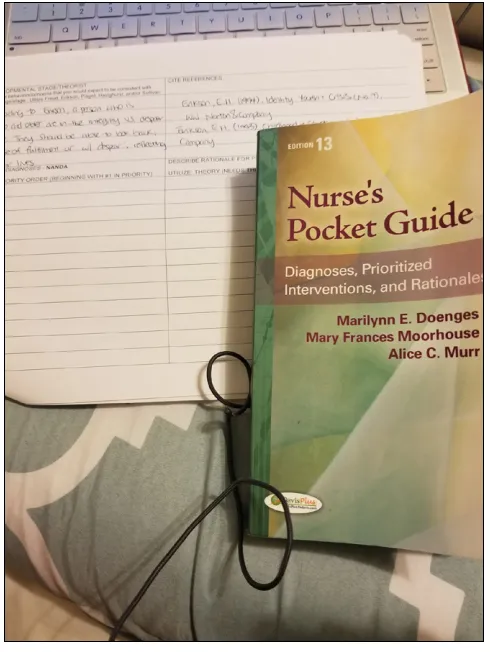
Rosa did decide to buy one nursing diagnosis text after weighing factors like price and usefulness in class, and ultimately purchased it because she expected she would consistently refer to it in her job after earning her degree. She described the book as follows, referring to the picture included as image 2: “Usually I actually don’t really use the textbook that was recommended on the syllabus, just because I feel like a lot of professors already have their own PowerPoints and it’s just a condensed form of the textbook.” Because she felt the content was addressed elsewhere and the book represented an exorbitant cost, Rosa, as well as several other students, chose to forego purchasing some or many books.
Wikipedia was a common topic regarding coursework and subjects that students had little or no familiarity with. Despite being referenced by two-thirds of the participants during interviews and arising as a topic during the focus group, students often apologized or expressed some guilt for relying on the website. When it was discussed in the focus group, all but one student said they used it. Despite its popularity, there were mixed feelings on Wikipedia’s reli-ability and a couple statements that “it’s not the best source, but I use it anyway.” When asked why, participants said their teachers warned them against using it. André, an African American pharmacy student in his senior year, described its trustworthiness:
Figure 2. “Using textbook that was listed in my course syllabus.”
Interviewer: So what were you working on, do you remember? For this particular thing?
André: Yes, I do. I was just reviewing a patient’s chart, and then a medication just came up. And it was a medi-cation that I learned and was familiar, but I forgot the adverse effects or the side effects that that medication can have. And I just went to Wikipedia really quick just to have a refresher on like, oh yes, what are the side effects of taking this kind of medication.
Interviewer: Right, exactly. So, do you find it usually has info you’re looking for?
André: It does, yeah. But sometimes it’s also unclear. Sometimes it can have contradictions, and I’ll look on to other sites.
Studying with Friends
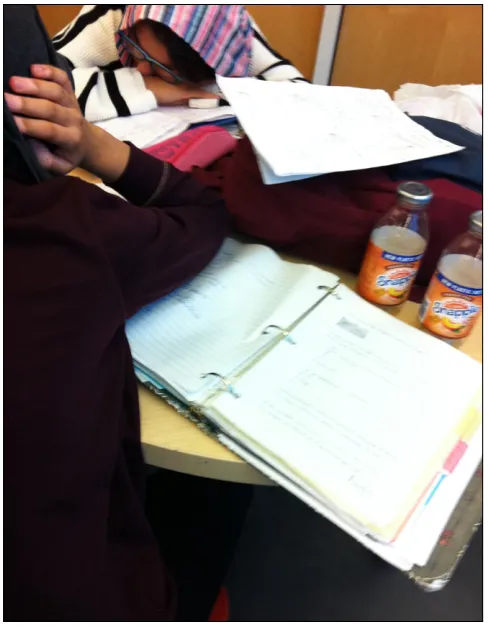
While note-taking strategies, textbooks, and popular resources such as Wikipedia were discussed, studying was brought up as a separate topic related to academic work. Approximately one-third of participants used the library as a place to study, while the remainder used other buildings on campus, their homes, or their neighborhood public library
branch. These decisions were largely based on convenience for one’s schedule or location, but several students also described the need to find somewhere quiet and away from distractions for successful studying. Participants expressed the need for only a few essentials, including access to elec-trical outlets, sufficient space to spread out, and minimal distractions. In the words of one student, “As long as there’s an outlet and I’ve got my headphones in, I’m good.”
Syeda, a first-generation Bangladeshi student in nursing, said she rarely used the library and instead studied with her friends at the public library branch in her neighborhood. The location was more convenient to where they lived, and the library was a quiet, free place they could meet up and study. Syeda describes her reasons for using the public library for studying as such:
Interviewer: So do you go [to the public library branch] for any particular reason, like more convenient location?
Syeda: It’s just a quiet environment, and all my friends live near the library so we all meet up there.
Interviewer: That makes a lot of sense, yeah. Do you find it usually has what you need for studying? Like space and quiet?
Syeda: Yeah. Figure 3. “Using Wikipedia for school-related assignments. Bad
Help from Professors
Students’ professors were a frequent resource for answer-ing questions and test preparation. Several participants expressed a strong preference to meet with their professors in person during office hours for the clarifications they required. Sophia, a first-generation student from Brooklyn majoring in biology, explained her choice of a photo depict-ing a professor’s office:
Sophia: That’s my organic chemistry teacher’s office. I go to him often when I need help with homework or when I’m studying for a test.
Interviewer: Yeah, definitely. So a good source for information. And do you usually try and go during drop-in hours, like, open office hours?
Sophia: Yeah, he has open office hours before class, so I often go there.
Interviewer: OK, good. So you can just go before class. Do you try getting in touch over e-mail or is it more of an in-person thing?
Sophia: In person.
These sub-themes concerning participants’ academic work show the multifaceted ways they keep up in class, the environments they prefer to study in, and how they tend to seek help from their instructors. The following theme sheds light on how participants’ information practices, distinct from but often intertwined with their studies, were mani-fested in their everyday lives.
Information in the Moment
In order to gain a broad understanding of how participants sought information and the potential implications for refer-ence services, students were encouraged to consider infor-mation seeking outside university-related activities. Their photos and discussions led to the theme “information in the moment,” wherein participants sought to meet an informa-tion need instantly or in the immediate future. Oftentimes information seeking related to this theme would be caused by something unexpected.
Getting Around
making during the weekend, which resulted in the need to reroute his travels using a shuttle bus and the complicated information that involves.
Other participants shared screenshots of their phones from times they were getting directions from one place to another, typically for jobs they held. The sheer volume of different responsibilities students were balancing was made apparent, as they traveled all times of day to meet various family, work, and school obligations.
Occasionally, seeking information on the go was unsuc-cessful. Michelle, a sophomore studying communications, described a months-long effort to have her work-study reap-proved after the initial funds ran out:
Interviewer: So this first [photo] here is from . . .
Michelle: The work-study office.
Interviewer: Ah, work-study, right. So is this some-where you go often?
Michelle: I went there to give them what I had to, my work-study information. And then I go every time I run out of money so I can get the paper work.
Interviewer: Oh, right.
Michelle: I have to do it through them first, and then go to financial aid, and they send my work-study money.
Interviewer: So it’s kind of like a regular errand that you have to do.
Michelle: Yeah.
This process involved many trips to the work-study and financial offices that had to be made during regular business hours. Like other students with their professors, in-person communication was the preferred method to obtain informa-tion and make sure something was understood.
Connecting with Loved Ones
More often than navigating their surroundings, information practices under this theme related to personal life and keep-ing in touch with family, friends, and significant others. To find time in the day to spend together, one participant, Yu Yan, would check her boyfriend’s daily schedule so that they would not have to text back and forth and knew when they would have opportunities to spend time together.
Yu Yan: [Pointing to a photo] This is my boyfriend’s home. And this is his schedule. So for the day he’ll start the day at six sharp. And this gives me an idea of his schedule. So everything needs to be done and then we can cuddle, or we can watch something.
Interviewer: Right, OK.
Yu Yan: So this is where I get my information. Because before it was “now I’m going to do this, now I’m going to do this,” bothering each other.
Interviewer: Right, so this way you just know what’s going on for that day.
Other participants described checking in with family using FaceTime or Skype, messaging classmates via Face-book groups they created for classes, and connecting with friends through Snapchat or Instagram. These activities were often spontaneous and frequent, in contrast to the more deliberate information practices in the following theme.
Gathering Information for Later
Many participants shared examples of when they selectively gathered information to be used or referred to at a later date. Information seeking of this type was occasionally school related but more often concerned personal interests and planning for events in the future, whether the following day or later that year.
Parsing Complex Information
As with some examples related to directional information seeking under the theme “information in the moment,” tak-ing photos was a method used to parse complex information. While speaking with her supervisor at work, Syeda noticed an organizational chart in the office that would be useful for an upcoming assignment. A quick snapshot of the chart, image 10, gave her the information she needed to incorporate it into her assignment later in the semester.
Personal Interests
Participants’ personal interests were extremely varied and were reflected in many of the photos they selected for dis-cussion. A common thread was comparing prices and pur-suing their interests while being conscientious of cost. As one example, Jasmine, a first-generation student who enjoys cooking, compares prices found at small grocers, Trader Joe’s, and Whole Foods to determine which food she should buy where to save money. She keeps a spreadsheet of items she buys often and uses the photos to update the spreadsheet periodically. She explains her process as such:
Jasmine: I like to compare prices between different stores. And I actually found some prices at this store. And so the food products are put outside. So you can see the prices when you pass by. And I say, “Wow, that’s much less than Whole Foods or Trader Joe’s.” So much cheaper.
Interviewer: That’s a good—will you take photos to remind you of the price, or do you just memorize about what it is?
Jasmine: Yeah, I take the photos. I don’t try to memo-rize, that’s very hard.
Interviewer: Yeah, that’s a lot of memorizing.
Jasmine: So I put an excel sheet of Trader Joe’s, and I put like eggs in one column. I should show you that, but I didn’t take a picture. Eggs in one section but with different stores.
In this way, Jasmine is able to save money while finding the food products she needs to participate in her interest of cooking new meals for herself and sometimes her family. Image 8. “Financial aid office for one-on-one sessions.”
Similarly, at the time of the interviews, Rayna, an inter-national student, was searching for affordable flights to the Philippines. She was trying to decide whether to take classes over winter break or visit family, and she described the dif-ferent competing factors at play, including saving money, seeing family members, and getting closer to completing her studies. The interests of other participants, including keeping up with the news, shopping for clothes, and seeing theatrical productions, were oftentimes discussed in relation to cost and financial decision-making.
Recommendations
Separately from the themes discussed, several students shared recommendations for library services. Many of these recommendations arose when, during interviews, par-ticipants were asked, “What are the key things you would change to improve LIU Brooklyn Library?” Various ideas were shared, including extended hours at night and on the weekends, more space for group study, getting copies of textbooks, printing from laptops, updating hardware in the computer labs, and reducing the noise level.
One recommendation shared by multiple participants and discussed again at the focus-group session was improv-ing the ease of gainimprov-ing full-text access to articles. One student, Tyrese, expressed frustration with being sent to
external sites and being asked to submit log-in credentials:
Tyrese: So, sometimes when I do use the library web-site to look for scholarly journals, it will bring me to another site. Like research journals or something.
Interviewer: Oh, yeah.
Tyrese: And so I have to make an account, and I was like, wait! I thought I have the LIU account and I can just link it somehow. I wish there was more links, so it doesn’t like . . .
Interviewer: Yeah, so the link resolver . . .
Tyrese: Yeah, linking into new websites. That would be easier to get to the journal. It makes me go in circles trying to get it, for free or not, and if not, then it says I have to pay, and it’s like what?!
To solve this problem, Tyrese suggested the library find a way to have affiliates log in only once to be recognized across different databases to avoid the complexity of searching for full-text of articles using the link resolver. Similarly, Michelle described her issues obtaining relevant articles, particularly in relation to database subscriptions:
Interviewer: So is it, you find you have problems find-ing articles on your topic, or the full-text of articles, or both?
Michelle: Both.
Interviewer: Yeah, fair enough [laughter].
Michelle: I thought like, some of the affiliation data-bases, that we would be affiliated, but we’re not. And that was a surprise to me. Because I did—because this is my second bachelor’s. My first bachelor’s was at NYU, and obviously the databases are a lot bigger.
Interviewer: Oh, OK, yeah.
Michelle: And that’s why I was just gathering things so easy.
Interviewer: That makes a lot of sense.
Michelle: But when I came to here I was just like, oh, the things that I thought I would have information on—
Interviewer: That you were used to having access to—
Michelle: Yeah. And then when I tried to look for articles on Google. And then I thought that we would have affiliation with, to that site, but we didn’t.
Michelle expressed the difference in resource availability between her previous institution and her current institution, finding that she had access to fewer databases and thus fewer articles. These observations regarding full-text access and other aspects of the library that could be improved will be discussed further in the following section, with particular attention to the impact on reference services.
DISCUSSION
Based on the findings, some implications for reference services can be generalized from participants’ stated infor-mation-seeking preferences, as well as their reactions to reference specifically. These implications inferred from par-ticipants’ contributions include a desire for in-person assis-tance for certain information needs, as well as the influence of visual prompts such as photos and screenshots on saving information or conveying it to another person.
During both individual interviews and group discussion, the students expressed a significant preference for in-person support in certain circumstances. Their interest in this type of assistance, as opposed to seeking information through a source such as YouTube, Wikipedia, or Google, was pri-marily in clarifying questions and concepts related to their coursework. Applied to reference services, this suggests
there may be a possibility for librarians to be more involved in course content. This would require close relationships with teaching faculty and an embedded approach to working with classes, but if pursued with success, this could lead to librarians becoming trusted go-to sources for more than just accessing relevant resources. The author has a strong rela-tionship with one program that reflects this goal, wherein all media arts masters students completing their thesis visit the library for an instruction session, schedule one-on-one or small-group consultations, and receive direct input on the direction of their topic and research strategies, as a result of the trust established between the program coordinator and author.
Pictures, screenshots, and other visual aids were a recurrent theme with implications for reference. Though the prevalence of photos is partially a result of the study’s methodology, it was clear that saving visual information for later use was a common and preferred practice among participants. Many reference librarians, for instance, likely have spoken with a patron who showed them a photo or screenshot of a book cover, catalog record, article title, or other piece of information on which they wish to follow up. This scenario is one among many described that involved visual information practices. Concerning reference services, there are many potential opportunities to take advantage of visual media. For example, chat reference software might allow patrons to upload pictures or share screenshots to show a problem they are experiencing with a resource. The author has incorporated this practice into virtual reference interac-tions by suggesting that patrons send a screenshot of a page if it’s easier for them than explaining an issue or question by written text, and doing the same when applicable, including sending screenshots of databases with relevant keywords or results lists as well as written text.
When asked specifically about recommendations for ref-erence services at their library, no participants shared ideas for changes to make, and, in general, they simply did not feel strongly about reference assistance or how it was provided. Several participants had used reference services in the past, and several others knew they could receive help from a librarian but had not felt the need to ask a question. The lack of specific recommendations regarding reference is due in part to the study’s design, which sought a participant-driven approach and kept the scope open to finding information more generally, rather than solely assistance from a librar-ian. Some of the students indeed sought information from librarians, but that represented one source among many.
were technology related, including easier ways to print and updated computers in the labs. In all cases, participants were fully aware of what resources would make their academic lives easier and were very forthcoming with that informa-tion. This underscores the point that if librarians wish to determine how to best support students, there is no better way to find out than to ask directly. While these changes have not been made due to various roadblocks, the findings provide a source of data for making a case for increased resources—whether staffing, funding, or otherwise—to administrators.
The results did not provide immediate insight into the study’s first area of interest, “How can academic librarians improve reference services for marginalized students?” but the project was successful in considering how research into library services can center students’ ideas and experiences. By adopting the Photovoice method, there was a high degree of involvement in the study, which meant results determined by the participants along with the author. Participants did not determine the photo-taking prompt, but they chose the photos they took and which photos they discussed with the author and focus-group participants. In this way, the method allowed for a process that gave participants some latitude to define what was significant or important to them within the scope of the study’s interests.
Though this flexibility in the study resulted in fewer direct implications for reference services than the author had hoped, this openness in considering how information was sought and the conditions it was done under led to a broader understanding of these processes. In this way, Photovoice and other participatory visual methods hold the potential to widen how we as librarians think of information and its use—not just limited to the textual or verbal but also visual, social, embodied, and often deeply personal.
CONCLUSION
This study used Photovoice, a participatory visual method, to learn more about undergraduates’ information practices and help-seeking preferences, and to attempt to identify pos-sibilities for reference services to be redesigned according to participants’ stated needs. Themes were developed through in-depth interviews and determined at a focus-group discus-sion; the themes include “academic work,” “information in the moment,” and “gathering information for later.” While no ideas for improving reference assistance were suggested specifically, participants offered many recommendations for improving library resources and services. These ideas ranged from making the full-text of articles easier to locate to hav-ing updated computers available for use, and they illustrate the wide variety of needs that students have to accomplish their academic work.
The author will be planning an on-campus exhibition of selected photos from the project in the coming academic year, keeping with Photovoice’s intent to create an exchange
that goes beyond the usual confines of a study. Captions and explanatory text from the participants who wish to be part of the exhibition will accompany the photographs. This will act as a formal ending to the project and also as a way to broaden and continue conversations about our informa-tion environments, the overlap between academic work and personal life, and how students can be better supported in achieving their goals.
The participants’ responses and involvement under-scored one major point: people’s experiences and informa-tion practices are unique and shaped by their diverse life experiences. The uniqueness of information seeking brings into question universal models and generalizations about different populations of users. It is essential to better under-stand how to support library users, but it is perhaps just as vital to not make broad overgeneralizations and instead treat reference and our work with patrons as the contextual, ever-changing practice that it is.
References
1. Michael H. Harris, “State, Class, and Cultural Reproduction: Towards a Theory of Library Services in the United States,” in
Advances in Librarianship, vol. 14, ed. W. Simonton (New York: Academic Press, 1986), 574.
2. Dallas Long, “Latino Students’ Perceptions of the Academic
Library,” Journal of Academic Librarianship 37, no. 6 (2011): 505.
3. Fern Walter Goodhart, Joanne Hsu, Ji H. Baek, Adrienne L. Coleman, Francesca M. Maresca, and Marilyn B. Miller, “A View through a Different Lens: Photovoice as a Tool for Student
Advo-cacy,” Journal of American College Health 55, no. 1 (2006): 53.
4. Aditi Bandyopadhyay and Mary Kate Boyd-Byrnes, “Is the Need for Mediated Reference Service in Academic Libraries Fading
Away in the Digital Environment?” Reference Services Review
44, no. 4 (2016): 596–626; Scott Carlson, “Are Reference Desks Dying Out? Librarians Struggle to Redefine—and in Some
Cases Eliminate—the Venerable Institution,” Reference Librarian
48, no. 2 (2007): 25–30; Keith Ewing and Robert Hauptman,
“Is Traditional Reference Service Obsolete?” Journal of Academic
Librarianship 21, no. 1 (1995): 3–6; David W. Lewis, “Traditional Reference Is Dead, Now Let’s Move on to Important
Ques-tions,” Journal of Academic Librarianship 21, no. 1 (1995): 10–12;
Timothy Peters, “Taking Librarians Off the Desk: One Library
Changes Its Reference Desk Staffing Model,” Performance
Mea-surement and Metrics 16, no. 1 (2015): 18–27.
5. David S. Nolen, “Reforming or Rejecting the Reference Desk:
Conflict and Continuity in the Concept of Reference,” Library
Philosophy and Practice (2010), retrieved from https://digital commons.unl.edu/libphilprac/361/; Susan M. Ryan, “Reference Transactions Analysis: The Cost-Effectiveness of Staffing a
Tra-ditional Academic Reference Desk,” Journal of Academic
Librari-anship 34, no. 5 (2008): 389–99.
6. Stephen P. Buss, “Do We Still Need Reference Services in the
Age of Google and Wikipedia?” Reference Librarian 57, no. 4
(2016): 265.
7. Dennis B. Miles, “Shall We Get Rid of the Reference Desk?”
Ref-erence & User Services Quarterly 52, no. 4 (2013): 321.
8. Jennifer L. Bonnet and Benjamin McAlexander, “Structural Diversity in Academic Libraries: A Study of Librarian
Approach-ability,” Journal of Academic Librarianship 38, no. 5 (2012):
277–86; Ethelene Whitmire, “Cultural Diversity and
Under-graduates’ Academic Library Use,” Journal of Academic
Campus Racial Climate and Undergraduates’ Perceptions of
the Academic Library,” Portal: Libraries and the Academy 4, no.
3 (2004): 363–78.
9. Olugbengo Ademodi, “Reference Service in Academic Libraries:
Accommodation of International Students,” Library Philosophy &
Practice (2011): 1–10; Yvonne DeSouza, “Reference Work with International Students: Making the Most Use of the Neutral
Question,” Reference Services Review 24, no. 4 (1996): 41–48;
Ann Curry and Deborah Copeman, “Reference Service to
Inter-national Students: A Field Stimulation Research Study,” Journal
of Academic Librarianship 31, no. 5 (2005): 409–20.
10. Pnina Shachaf and Sarah Horowitz, “Are Virtual Reference
Ser-vices Color Blind?” Library & Information Science Research 28, no.
4 (2007): 501–20.
11. Denice Adkins and Lisa Hussey, “The Library in the Lives of
Latino College Students,” Library Quarterly 76, no. 4 (2006):
456–80; Long, “Latino Students’ Perceptions of the Academic Library,” 504–11.
12. Elizabeth Pickard and Firouzeh Logan, “The Research Process and the Library: First-Generation College Seniors vs.
Fresh-men,” College & Research Libraries 74, no. 4 (2013): 399–415;
Darren Ilett, “A Critical Review of LIS Literature on
First-Generation Students,” Portal: Libraries and the Academy 19, no.
1 (2019): 177–96.
13. Ann Curry, “If I Ask, Will They Answer? Evaluating Public
Library Reference Service to Gay and Lesbian Youth,” Reference
& User Services Quarterly 45, no. 2 (2005): 65–75; Bharat Mehra and Donna Braquet, “Progressive LGBTQ Reference: Coming
Out in the 21st Century,” Reference Services Review 39, no. 3
(2011): 401–22; Susann Schaller, “Information Needs of LGBTQ
College Students,” Libri 61, no. 2 (2011): 100–115.
14. Ignacio J. Ferrer-Vinent, “For English, Press 1: International
Students’ Language Preference at the Reference Desk,” Reference
Librarian 51, no. 3 (2010): 189–201; Suhasini L. Kumar and Raghini S. Suresh, “Strategies for Providing Effective Reference
Services for International Adult Learners,” Reference Librarian
33, no. 69/70 (2000): 327–36; Mengxiong Liu and Bernice Red-fern, “Information-Seeking Behavior of Multicultural Students:
A Case Study at San Jose State University,” College & Research
Libraries 58, no. 4 (1997): 348–54; Jian Wang and Donald G. Frank, “Cross-Cultural Communication: Implications for
Effec-tive Information Services in Academic Libraries,” Portal:
Librar-ies and the Academy 2, no. 2 (2002): 207–16.
15. Kimmo Tuominen, “User-Centered Discourse: An Analysis of
the Subject Positions of the User and the Librarian,” Library
Quarterly 67, no. 4 (1997): 350–71; Kate Adler, “Radical Pur-pose: The Critical Reference Dialogue at a Progressive Urban
College,” Urban Library Journal 19, no. 1 (2013): 1–8; John J.
Doherty, “Reference Interview or Reference Dialogue?” Internet
Reference Services Quarterly 11, no. 3 (2006): 97–109.
16. Kate Adler, Ian Beilin, and Eamon Tewell, Reference Librarianship
& Justice: History, Practice & Praxis (Library Juice Press, 2018). 17. April Hathcock and Stephanie Sendaula, “Mapping Whiteness
at the Reference Desk,” in The Feminist Reference Desk: Concepts,
Critiques, and Conversations, ed. Maria T. Accardi (Sacramento, CA: Library Juice Press, 2017); Annie Pho and Rose L. Chou, “Intersectionality at the Reference Desk: Lived Experiences of
Women of Color Librarians,” in The Feminist Reference Desk:
Concepts, Critiques, and Conversations, ed. Maria T. Accardi (Sac-ramento, CA: Library Juice Press, 2017).
18. Freeda Brook, Dave Ellenwood, and Althea Eannace Lazzaro, “In Pursuit of Antiracist Social Justice: Denaturalizing Whiteness
in the Academic Library,” Library Trends 64, no. 2 (2015): 269.
19. R. Errol Lam, “The Reference Interview: Some Intercultural
Considerations,” RQ 27, no. 3 (1988): 392.
20. Shachaf and Horowitz, “Are Virtual Reference Services Color Blind?”
21. Loriene Roy and Merinda Kaye Hensley, “Helping LIS Students
Understand the Reference Librarian’s Teacher Identity,”
Refer-ence Librarian 57, no. 4 (2016): 336–40.
22. Madelynn Dickerson, “Beta Spaces as a Model for
Recontextual-izing Reference Services in Libraries,” In the Library with the Lead
Pipe (2016), retrieved from http://www.inthelibrarywiththelead
pipe.org/2016/reference-as-beta-space/.
23. James K. Elmborg, “Teaching at the Desk: Toward a Reference
Pedagogy,” Portal: Libraries and the Academy 2, no. 3 (2002):
455–64.
24. Brook, Ellenwood, and Lazzaro, “In Pursuit of Antiracist Social Justice,” 261.
25. Lisa M. Given, Anna Opryshko, Heidi Julien, and Jorden Smith, “Photovoice: A Participatory Method for Information Science,”
Proceedings of the Association for Information Science and
Technol-ogy 48, no. 1 (2012): 1–3; Caroline Wang and Mary Ann Burris,
“Photovoice: Concept, Methodology, and Use for Participatory
Needs Assessment,” Health Education & Behavior 24, no. 3
(1997): 369–87.
26. Lili Luo, “Photovoice: A Creative Method to Engage Library User
Community,” Library Hi Tech 35, no. 1 (2017): 179–85.
27. Alison Hicks and Annemaree Lloyd, “Seeing Information: Visual
Methods as Entry Points to Information Practices,” Journal of
Librarianship and Information Science 50, no. 3 (2018): 229–38. 28. Shailoo Bedi and Jenaya Webb, “Participant-Driven
Photo-Elici-tation in Library Settings: A Methodological Discussion,” Library
and Information Research 41, no. 125 (2017): 81–103.
29. Safirotu Khoir, Jia Tina Du, and Andy Koronios, “Everyday Information Behaviour of Asian Immigrants in South Australia:
A Mixed-Methods Exploration,” Information Research 20, no. 3
(2015), https://doi.org/10.9776/14316; Annemaree Lloyd and Jane Wilkinson, “Tapping into the Information Landscape: Refugee Youth Enactment of Information Literacy in
Every-day Spaces,” Journal of Library and Information Science 51, no.
1 (2017): 252–59, https://doi.org/10.1177/0961000617709058. 30. Heidi Julien, Lisa M. Given, and Anna Opryshko, “Photovoice: A
Promising Method for Studies of Individuals’ Information
Prac-tices,” Library & Information Science Research 35, no. 4 (2013):
257–63.
31. Stefanie Buck, “In Their Own Voices: Study Habits of Distance
Education Students,” Journal of Library & Information Services in
Distance Learning 10, no 3/4 (2016): 137–73; Amanda B. Click, “‘Taking Something That Is Not Your Right’: Egyptian Students’
Perceptions of Academic Integrity,” Libri 64, no. 2 (2014):
109–23.
32. Shailoo Bedi and Jenaya Webb, “Through the Students’ Lens:
Photographic Methods for Research in Library Spaces,”
Evi-dence Based Library and Information Practice 12, no. 2 (2017): 15–35; Valerie Haberl and Beth Wortman, “Getting the Picture: Interviews and Photo Elicitation at Edmonton Public Library,”
Libres 22, no. 2 (2012): 1–20; Yi-Chu Lin and Ming-Hsin Chiu, “A Study of College Students’ Preference of Servicescape in
Academic Libraries,” Journal of Educational Media & Library
Sci-ences 49, no. 4 (2012): 609–36; Karen A. Neurohr and Lucy E. Bailey, “Using Photo-Elicitation with Native American Students
to Explore Perceptions of the Physical Library,” Evidence Based
Library and Information Practice 11, no. 2 (2016): 56–73; Nara L. Newcomer, David Lindahl, and Stephanie A. Harriman, “Picture the Music: Performing Arts Library Planning with Photo
APPENDIX A. MEETING 1 HANDOUT
Research Study: Re-Evaluating Research
Assistance through Participatory Photography
Meeting 1 with Prof. Eamon Tewell
[Email address] [Room number]
Thank you for participating in this study! I am investigating how undergraduate students find information. This is where you come in. I need your input! I am interested in learning why you choose the sources you do, and what you like about them, in order to improve research-assistance services at LIU Brooklyn Library. Please keep this handout after we meet so you can refer to it later if needed.
About This Study
Your participation will involve two half-hour meetings with me: one to describe the study and one to interview you. In between the meetings you will be asked to take approxi-mately 20 photographs on your phone. You will email these photos to me, and then choose five of the photos that are most important or meaningful to you. We will discuss these photos at our second meeting, where I will ask you for more information about them and record our conversation.
For your participation in this study, you will receive an Amazon gift card for $30. This project is based on a research method called Photovoice, which uses photography to share participants’ individual perspectives and lived experiences, and as a prompt to discuss issues of importance and inform actions to be taken. Through this project, I hope to learn more about where and why students seek information in order to make improvements to the assistance provided at LIU Brooklyn Library.
About Photo-Taking
Taking photos is a powerful way of learning and demon-strating (they say “a picture is worth a thousand words” for
a reason!), but there are also some important ethical and privacy concerns regarding taking pictures in public. Please think of the following before taking photographs:
z Be respectful (be polite when approaching others, do not invade the private space of others).
z Don’t do anything you wouldn’t usually do (e.g., take a photograph while driving or taking a photograph in a location that puts you in danger).
z Be aware of your surroundings.
z Be mindful of other people’s privacy and space. You must receive consent if you are taking a picture of an individual or in a private organization. If you aren’t sure if you should take a photo, don’t.
Other Info
If you have any questions or concerns, don’t hesitate to con-tact me at [e-mail address] or [phone number]. Addition-ally, if you have any questions concerning your rights as a research participant, you may contact the IRB Administrator, [name], at [e-mail].
APPENDIX B. INTERVIEWER’S GUIDE
The interviewer will thank the student again for participating in the study and briefly review the following:
z Purpose of the study
z The participant’s role in the study
z The participant’s consent, withdrawal options, and com-pensation
z The ways the data will be stored and used, including privacy protections
z The length of the interview (approximately 30 minutes) z The intended outcome of the project
Sample statement to begin with:
This project is interested in where students go for information and why, in order to improve research-assistance options at LIU Brooklyn Library. We’ll be talking about five of the photographs you took the last couple weeks. I will be audio-recording this session, so that I can refer to our conversation later.
of 20 photographs. Questions will be open-ended and will seek to elicit descriptions related to understanding the actions of participants and how they sought information. The P.H.O.T.O. method will be used to stimulate discussion:
P: Describe your photo.
H: What is happening in your picture? O: Why did you take a picture of this?
T: What does this picture tell us?
O: How can this picture provide opportunities for the library to improve?
Once all the photographs have been discussed, the inter-viewer will ask the following questions:
1. Prior to this project, how often had you used the LIU Brooklyn Library?
2. Have you sought help at the Ask a Librarian desk, on the 3rd floor?
3. What are the key things you would change to improve LIU Brooklyn Library?
4. Do you have any other suggestions, thoughts, or ques-tions?