*Correspondence to Author:
Vrince Vimal
Department of Electronics and Communication Engineering, Indian Institute of Technology, Roorkee, Uttarakhand, India
How to cite this article:
Vrince Vimal and Madhav J Nigam. Enhancing Networks Lifetime Using Two-Step Uniform Clustering Algo-rithm (TSUC). American Journal of Computer Engineering, 2018; 1:3.
eSciPub LLC, Houston, TX USA. Website: http://escipub.com/
Vrince Vimal and Madhav J Nigam, AJCE, 2018; 1:3
American Journal of Computer Engineering
(AJCE)
Research Article AJCE (2018) 1:3
Enhancing Networks Lifetime Using Two-Step Uniform Clustering
Algorithm (TSUC)
Wireless sensor networks have enticed lot of spotlight from re-searchers all around globe, owing to its wide applications in in-dustrial, military and agricultural fields. Energy conservation and node deployment strategies play a paramount role for effective execution of Wireless Sensor Networks. Clustering of nodes in the wireless sensor networks is an approach commenced to achieve energy efficiency in the network. Clustering algorithm, if not executed properly can reduce life of the network. In this pa-per, a Two -Step Uniform Clustering (TSUC) algorithm has been proposed with the aim to provide connectivity to the nodes in every part of the network. This algorithm increases networks life-time and throughput by re-clustering isolated nodes rather than providing them connectivity by already connected node. Results obtained after simulation showed that proposed TSUC algorithm performed better than the other existing clustering algorithm.
Keywords: WSN, Clustering Algorithm, TSUC, Networks lifetime
Vrince Vimal and Madhav J Nigam
Department of Electronics and Communication Engineering, Indian Institute of Technology, Roorkee, Uttarakhand, India
ABSTRACT
http://escipub.com/american-journal-of-computer-engineering/ 1
Introduction
Wireless Sensor networks are associated with much uncertainty and various imprecision are endemic to it. Last couple of decades were decades of augmentation in field of WSN. Despite various challenges and stochastic processes such as escalating number of access points, constantly changing environment, sudden variations in network etc., WSN finds applicability in industrial, military, and agricultural applications, such as transportation traffic monitoring, environmental monitoring, smart offices, and battlefield surveillance1,2 and
so on.
WSN incorporate enormous quantity of petite sensor nodes, which use the radio communication, for the purpose of collaboratively sensing, collecting and propelling the information to the sink node3.
Effective consummation of WSN is widely influenced by collaborative communication of sensor nodes4. This need of conjoint transmittal of information discern by individual node to the sink node via secure routing5–12 in a way to competently exploit energy7,813 presents several snags for researchers in WSN. To reconcile the contention of secure routing and energy conservation node deployment strategies plays a paramount role9. In last couple of decades, lot of researchers focused on node deployment issues of WSN. The statistical survey of numerous studies carried out on node deployment has been presented in10. The deployment of sensors can be deterministic11
(e.g. positioning sensors to monitor environmental conditions) or non-deterministic12 (e.g. dropping sensors by aircraft to impassable area). Figure 1 high-lights the types of deployments. Regular and planned approaches of deployment of sensors fall under deterministic scheme. Stagnant sensors are deployed under these schemes to bear out the intention of chock-full coverage. Deterministic methods entail less number of sensors to upsurge the sensing efficacy of coverage14. Although, this
point-to-point strategy is apposite for positioning of sensors for small-scale deployments15,16.
Figure 1
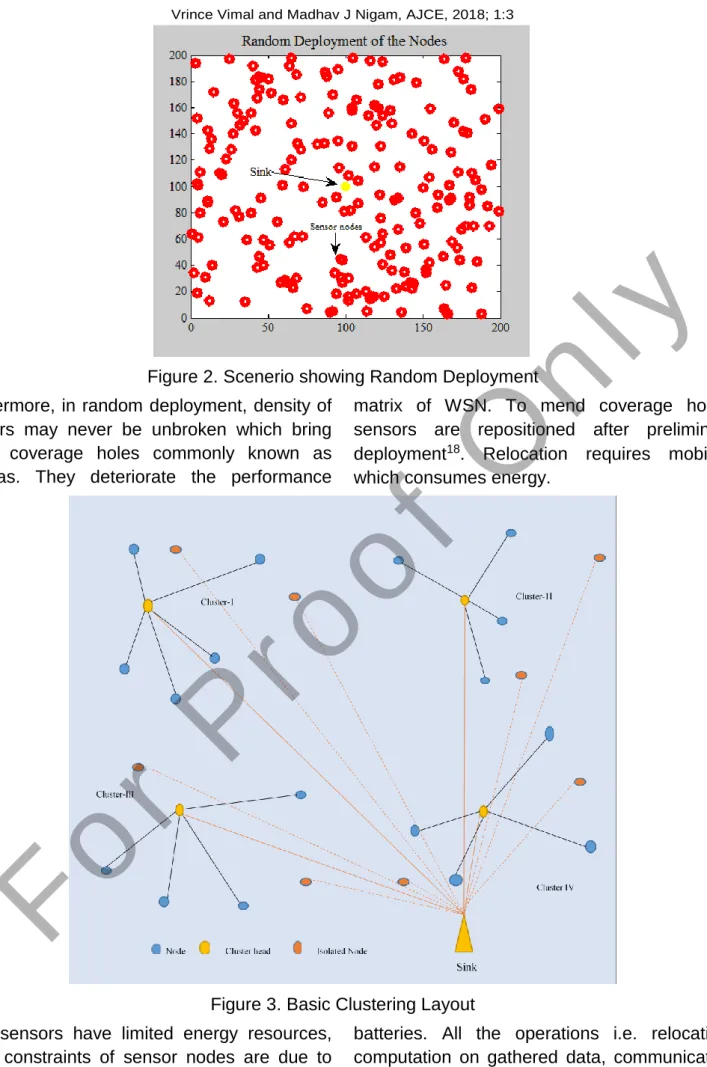
In Non-deterministic techniques or Random strategies sensors are usually scattered (e.g. launched by launcher) as shown in Figure 2. This leads to random deployment of sensors; their density can be controlled but up to certain degree17. This technique is the best apposite for
the applications where ROI (Region of Interest) is inaccessible e.g. war zones. Random deployment is palpable and only solution for deployment in hostile isolated regions, but it suffers many shortcomings.
For occasion, if sensors are airdropped, a priori, it is demanding to know the network topology. It is impossible to foresee which two sensors are going to be the neighbors, which makes it unfeasible to establish encryption amid neighbors. It is perplexing to design the key distributing algorithm along with the flexible WSN architecture to steadily de-liver encryption keys in real time.
For other case when sensors are launched in re-mote or hostile environments such as war zones. Here, the nodes cannot be sheltered from somatic attacks both by enemy and animals. The latter may damage node physically but former case adversary could familiarize his own malicious nodes inside the network or can have access to critical information saved in node, which is highly detrimental. It is again stimulating to design robust security protocols, so that even if node is com-promised critical information stowed on the node cannot be retrieved.
Vrince Vimal and Madhav J Nigam, AJCE, 2018; 1:3
Figure 2. Scenerio showing Random Deployment
Furthermore, in random deployment, density of sensors may never be unbroken which bring about coverage holes commonly known as coronas. They deteriorate the performance
matrix of WSN. To mend coverage holes, sensors are repositioned after preliminary deployment18. Relocation requires mobility,
which consumes energy.
Figure 3. Basic Clustering Layout
Most sensors have limited energy resources, these constraints of sensor nodes are due to their mi-nor physical size, and generally they are battery driven19. WSN when deployed in remote
or hostile environments, it is unrealistic to switch
sensors is a foremost concern20, which, if not
used in optimal mode would
reduce networks lifetime.
This has lead various researchers across the globe to develop numerous energy-efficient schemes for WSN. Clustering of the nodes in the wireless sensor networks is an approach commenced to achieve energy efficiency in the network21,22Figure 3. Clustering is predominantly suited for relay based sensor networks that is accountable for thousands of nodes. Cluster one- node is designated as cluster head (CH) with rest of nodes as cluster members. Data logged by sensors is piled up at CH and propelled to remote sink after fixed duration of time. While re-clustering, nodes energy levels are assessed and nodes with higher energy is designated as next cluster head. Though cluster formation and CH designation is additional over-head, these schemes increase network lifetime using performance data aggregation23 22.
In this paper, we propose new Two -Step Uni-form Clustering Algorithm (TSUC) that ensures the uniform distribution of cluster in each round and prolongs networks lifetime by re-clustering isolated nodes rather than providing them connectivity through already connected nodes.
Method
This is simulation study. The virtual scenario has been deployed to check the viability of proposed scheme. The simulation study was done using MATLAB 2017a.
Related Work
In24, author proposed a radially optimized zone divided energy-aware WSN protocol using bat algorithm. Proposed scheme considered distance from the BS, along with the angle at which the WSN develops. By considering the angle at which the WSN develops, this protocol enables like chances for each node in WSN to have enough fields for communicating and its routing operations.
Low Energy Adaptive Clustering Hierarchy25 is
novel schemes which was proposed by Heinzelman et al. in 2005. LEACH is another
cluster based self-organizing adaptive protocol. Here, CH are nominated on probability ascertained a priori, left over nodes link to the cluster of which, CH is nearest to them. In LEACH, node can be designated CH more than once, thus exhausting more energy as compared to other nodes. Moreover, CH selection in LEACH is random, therefore uniform distribution of CH is not guaranteed, which some-times lead to unbalanced energy consumption in WSN.
Authors in9, HEED, intend to form effectual
clusters to exploit network lifetime. They deliberated nodes residual energy and one of the secondary parameter like node proximity or node degree to elect the CH.
Qing et al. develop a clustering scheme entitled Distributed Energy Efficient Clustering (DEEC) in26 to improved energy efficiency for WSN. In DEEC, Residual energy of node was taken into consideration. Then the ratio between the residual energy of a sensor node and the average energy of the network was evaluated. Nodes having higher residual energy ratio had higher probability of being designated as CH.
In27, author proposed MEDIC-Medium contention based Energy-efficient distributed clustering scheme, which is self-organized energy efficient clustering scheme. Sensor make decision whether to bid or not to bid for cluster head selection.
In28, authors proposed a Regional Energy Aware Clustering scheme with Isolated Nodes (REAC-IN) for WSN. Here, CH are designated based on the weights of sensor nodes. Weights are evaluated taking into consideration the residual energy of sensor nodes along with the regional average energy of the cluster to which node belongs. This again suffers from disadvantage of same node being opted as CH reducing networks lifetime.
Vrince Vimal and Madhav J Nigam, AJCE, 2018; 1:3
the self-organization of sensor nodes, a rotation of cluster head based on centroid of nodes and a scheme to plummet the consumption of energy for communication over long distance.
A grid based clustering algorithm with network load is presented in30. Authors estimated the load of the network and prepared the load model. They deduced that number of packets carried in every platform is directly connected with the length of the grid. Finally, after calculating the optimal grid length they network is partitioned into unequal grids
depending upon optimum cluster and all and node of grid are made to join clusters.
To summarize following observations were made in studies till date.
a. Uniform distribution of cluster head was not taken care of for maximal coverage.
b. No endeavor was made to group isolated nodes to save energy. The studies have considered routing efficiency for the isolated nodes by proving them connectivity with the already connected members rather than grouping them independently to further ensure the reduced energy consumption. We propose a novel algorithm in which clustering would be done in two phases. First phase would contemplate clustering of the member nodes ac-cording to rules laid down in traditional clustering protocols such as LEACH (with different cluster head selection method). Whilst the second phase will consider the clustering of the isolated nodes to ensure their reduced energy consumption and to achieve greater coverage. This would surpass the performance of existing algorithms, as the isolated nodes would exhaust their energy in minimal fashion there by increasing networks lifetime.
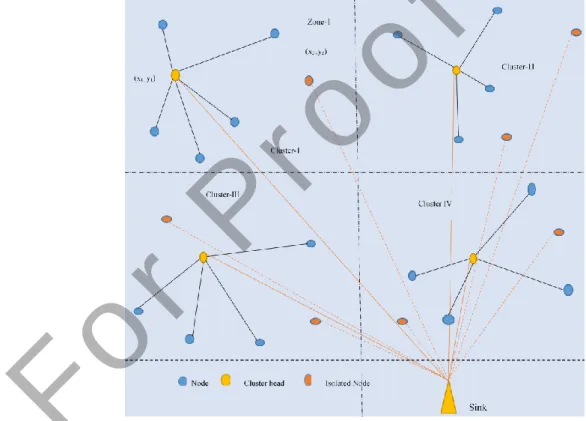
Figure 4. Clusters in Zones with Isolated nodes Problem Formulation
Mobility, Sensing and communicating with neighbors and sink nodes, is the operations which exhaust the energy of sensor node. Most of the clustering algorithms propose that each node must generate a random number which must be less than threshold value for the selection of cluster heads in the network. This
some nodes may become isolated as cluster heads are selected randomly, as shown in Figure 4. If isolated node is situated at a high distance from sink node, isolated node is bound to exhaust its energy leading uncompleted coverage thereby reducing networks lifetime. To increase the network’s lifetime, TSUC uses the concept of division of network into zones, and to ensure that nodes in every zone are connected to some cluster. All the isolated nodes undergo second step clustering process. So, if the isolated nodes are in communicating range they can form a small cluster and designate cluster head depending upon equation (3), thus reducing the energy consumption and increasing network’s lifetime.
Proposed Scheme
This section presents niceties of the TSUC protocol. This protocol aims at providing connectivity to the nodes in every part of the network, since non-deterministic deployment leads to un-even density of the nodes in the network. If the cluster formation approach is to go by the rules of the traditional protocols such as LEACH or REAC-IN, it would predetermine the number of cluster heads required in the network and then the nodes can opt for the
cluster head selection procedure irrespective of their location.
Energy Model
The energy spent by the sensor nodes would be in accordance with the radio energy dissipation model, in order to achieve an acceptable, Signal-to-noise ratio (SNR) in transmitting an L bit message over a distance d, energy expanded by the radio is given by
E = L × (Eelectronics + Eamp × Di2) (1) Network Model
Suppose there are ‘N’ sensors randomly scattered in X-Y plane with X = {x1, x2, . . . , xn}
and Y = {y1, y2, . . . , yn} representing their X and
Y coordinates. Let ’R’ be the communication range of any node, ni∈N. Nodei is said to be neighbor of Nodej if and only if Di,j<= R. These nodes are one hop neighboring nodes. Suppose Nei= {µ1, µ2, . . . . , µp} represents the neighbor
set of the nodes. Since the network is divided into ‘k’ number of zones and ‘Mk’ be the set
representing number of nodes in each zone ‘k’, such that
P
ii
=k=1 M(i) = N . Table 1 defines some main
variables used in this study.
Vrince Vimal and Madhav J Nigam, AJCE, 2018; 1:3 Cluster head Selection
To provide uniformity to the cluster head election, each zone is required to have at least one cluster head. This would mean out of N nodes, ‘k’ num-ber of nodes would act as cluster heads, such that CH = {CH1, CH2, . . . , CHk}. Number of
nodes that would be cluster members would be
N-k or For election of cluster heads, ev-ery node in set Mk would compute fitness function based on zonal energy and zonal degree of connec-tivity. Suppose Fitm,k = {F1,
F2, . . . . , Fm,k} be the fitness set for each node
M in kth zone. For any node, n ∈ M
k, max {Fm,k}
implies n ∈CH, such that Pn = k All the nodes with the highest fitness function would be cluster heads. In TSUC, the residual energy and zonal average residual energy (ZEav) of all sensors in
each cluster along with the zonal aver-age degree of connectivity (ZDOC) are considered to
designate Cluster heads.
• Zonal average residual energy
• Zonal average degree of connectivity
For all nodes n ∈CH, an ADV packet is sent in the range ’R’ to the nodes in the neighbor set. Nodes that would receive the ADV packet would join the cluster head to form the cluster. Such set of nodes would be,δ = {δ1, δ2, .., δσ} such that 1
< σ < N − k .
Degree of a node Connectivity
The proposed TSUC will begin with base station sending HELLO packets to every node in the net-work so that a node can know of its zone. The Hello packet would contain Id of zone and nodes lying withing the zone. Every node can calcu-late distance from Received signal strength of the Hello packet as follows,
dbu = 10[(P0−Fm−Pr−10×n×log10(f)+30×n−32.44)/10×n] , (4)
where, Fm = fade margin, n= path loss exponent, P0 = zero distance signal power,
Pr= signal power, f= signal frequency in MHz.
Suppose (xb, yb) are coordinates of the base
sta-tion which is known in the network. And (xu, yu)
are coordinates of unknown node in the network. Base station can act as beacon node to help find coordinates of every node in the network.
To have better accuracy subtracting first one and squaring, we get,
−2 (xi + xN ) x−2 (yi + yN ) y +2B = di2 +dN2− (Fi +
FN), (6)
where, B and Fican be formulated as,
B = x2 + y2, Ei = xi2 + yi2 (i = 1, 2..., N), (7)
denoting equation (6) as AX=b, where A, X and B can be expressed as,
X=(AT A)−1AT B. (8)
the error is, so more shall be the weight. So the weight of unknown node c can be set as,
Constructing the weight matrix
so, solution shall be,
X=(ATWTWA)1ATWTWb (11) from equation (11) we get (x, y) and B
B=x2+y2. (12)
(x, y) are location coordinates of unknown sensor,
a(lthough x1and y1 are given by,
FInally, we get,
Once coordinates are found as in equation (14),
every node can compute its distance from every other node in the network using Euclidean distance formula. All those distance values for particular node which are less than communication range of a node, will act as its neighbors. The number of neighbors for a particular node would be its degree of connectivity in the network
Second step Clustering
Nodes that do not receive any ADV message would belong to set ς = {ς1, ς2, ..., ςϕ} would be
isolated
nodes, such that
For all the nodes belonging to set ς, if D (ςi,i+1) <
R , then they must form clusters using latter clus-tering algorithm.
Say,’γ’ represent the number of nodes that would form’ λ’ clusters out of ’ϕ’number of isolated nodes, such that ϕ = γ+λ+µ . Where’µ’
is nodes which are still isolated after second step clustering. This step will ensure that, even if some of the nodes have been devoid of clusters formed initially, their clustering would reduce their energy consumption while interacting with the base station.
Now in the final isolated nodes set µ = (Pi k
=1(M
1)) − σ − γ – λ number of nodes remain. These nodes would directly communication with base station.
The objective function would be to minimize
Subroutine for Second Clustering
The isolated nodes of each zone would for cluster in accordance with following algorithm.
If
Start cluster formation
Choose to cluster head with the highest fitness function
Communicate with base station via CH
Else
{
Vrince Vimal and Madhav J Nigam, AJCE, 2018; 1:3 Communicate with base station directly}}
End
Proposed Algorithm
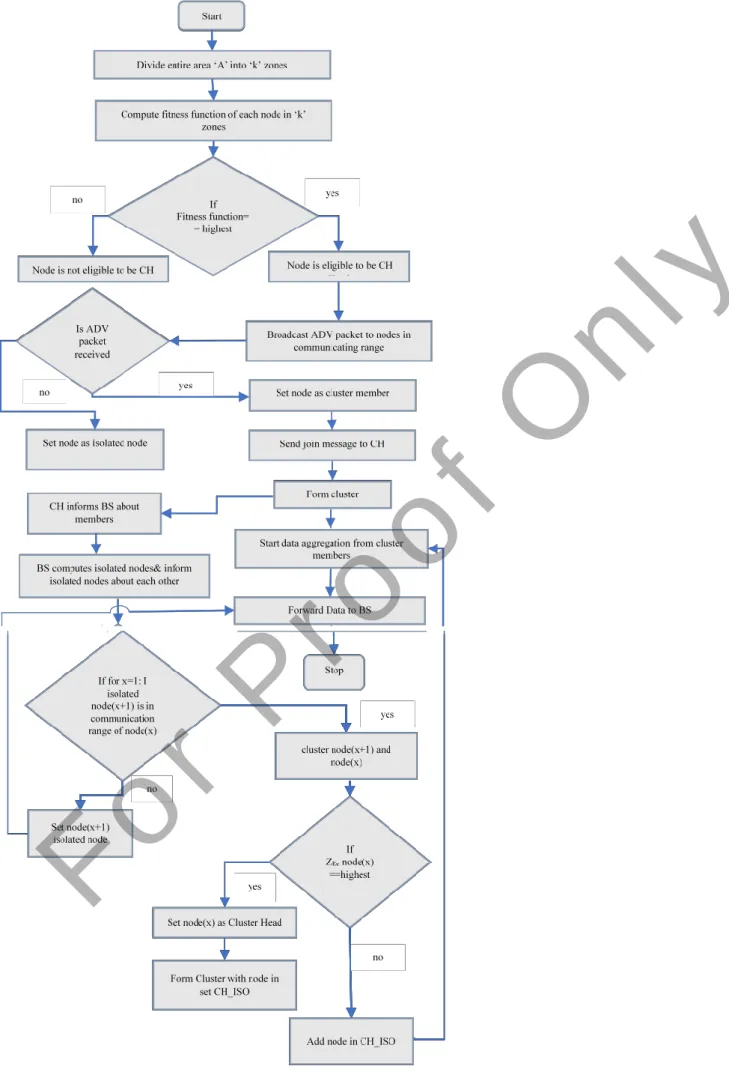
As discussed above initially network is divided into virtual zones and in first step CH is selected for every cluster depending upon equation (3). Now in second step, isolated nodes if in range of each other will form second cluster. The entire scheme is summarized in below algorithm.
A= network area
n=number of nodes
k = number of zones
m=number of node in zone
µ= number of isolated nodes
for i=1:k
for j=1:M
fitness node(i,j)=Wd× (DOC (i,j) / ZDOC) + We ×
(Ei,j / ZEav)
if Fitness node(i,j)== highest
Set node(i,j)= Cluster head
else
node(i,j)cluster head end
end
CH sends hello message to nodes inn
communica-tion range
if message received ==true
set status as cluster member
else
Set status as isolated node ϕ + +
end
CH send member information to base station
end
for x = 1 : ϕ
base station informs all isolated node(x) about other isolate nodes
call subroutine for second clustering.
end
end
FlowChart Of Proposed Scheme
The step by step execution of proposed scheme is shown below with the help of flowchart.
Results and Discussion
In this section the performance of the proposed TSUC algorithm has been discussed. The simulation was carried out using MATLAB 2017a. The network size and environmental parameters used in our simulations are kept same as in28
and31, for
performance comparison and are listed in Table 2. Base station was supposed to be at the center of network for uniformity.
The performances of algorithm proposed in REAC-IN28 and NEAHC31 were compared with
proposed
TSUC algorithm. In the previously proposed scheme like LEACH predetermined probability was accounted for selection of CH. In HEED, periodical selection depending on residual energy and node degree etc. were accounted for CH selection. Finally, REAC-
IN evaluated regional average energy for CH se-lection. In TSUC both zonal average energy and zonal average degree of connectivity were accounted for CH selection, and isolated nodes were clustered to escalate energy efficiency.
We compared the TSUC performance with REAC-IN, as REAC-IN performed better than typical clustering algorithms LEACH, HEED and DEEC28.
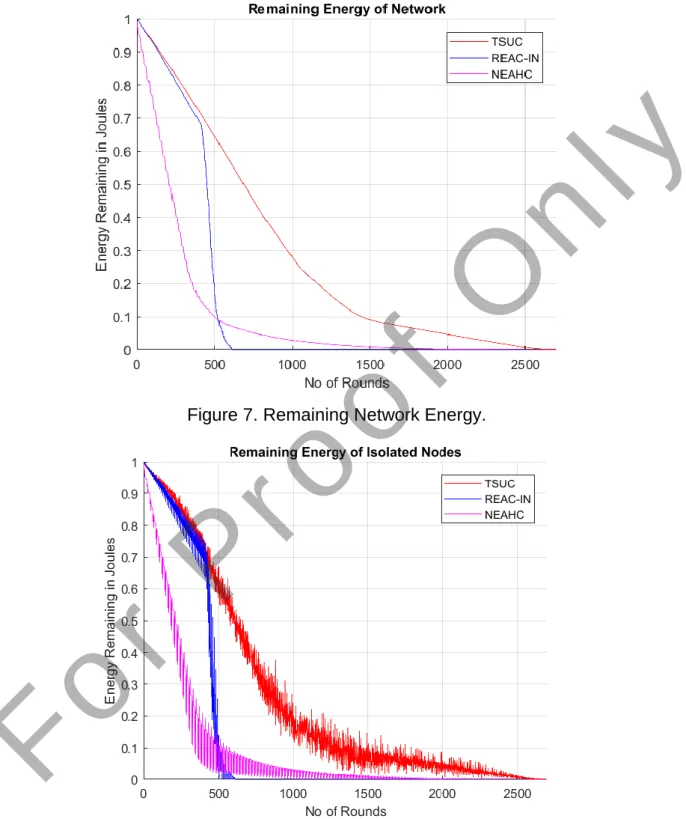
Comparisons were made on four parameters namely remaining energy of the network, number of alive nodes, through put, remaining energy of the isolated nodes and number of isolated nodes in the network.
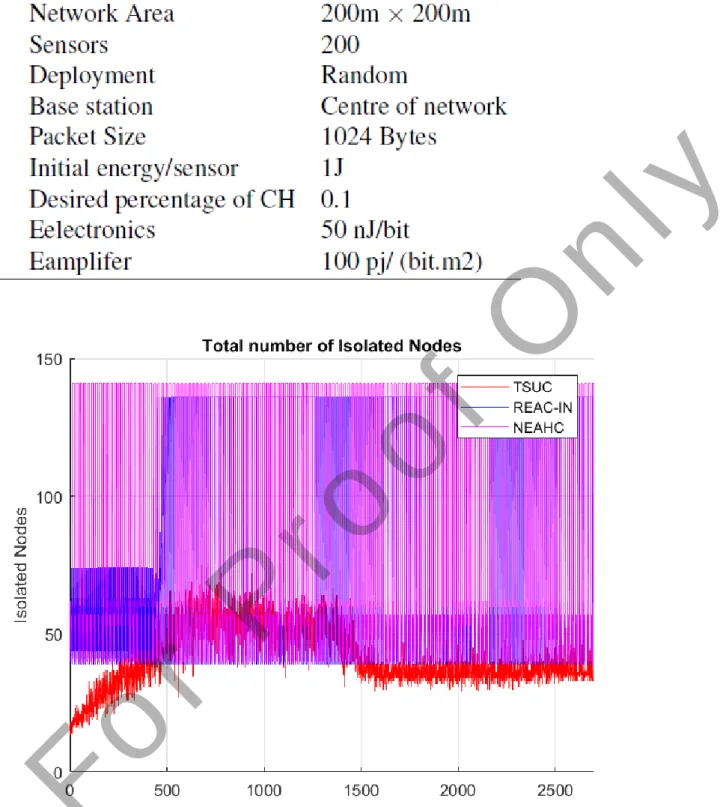
Figure 6 compares the number of isolated nodes for each of three schemes simulated in MATLAB. Since none of the two existing algorithms, (REAC-IN and NEAHC) give focus on reducing the num-ber of isolated nodes, therefore this parameter shows much higher value than the proposed TSUC scheme.
Figure 5. Flowchart Of Scheme
Vrince Vimal and Madhav J Nigam, AJCE, 2018; 1:3
Figure 6. Isolated Nodes
In TSUC, the formation of zones and selection of cluster heads from each zone allows uniform net-work coverage. And furthermore, two-step clus-tering conjoint with zonal clustering has helped to reduce number of isolated nodes. It can be seen that number of isolated nodes are
approximately 49 % less in TSUC (when average over total num-ber of rounds) as compared to other two schemes This would mean that these nodes are not directly communicating to base station, instead their data
is being transferred to base station by means of cluster head. Since the distance between the node and their cluster head is significantly less that dis-tance between node and base station. This helps us to infer that energy consumed will
also be less, since energy is proportional to square of distance between the communicating nodes, This supports the graph of energy remaining in the network Fig-ure 7 as well as energy remaining of the isolated nodes Figure 8.
Figure 7. Remaining Network Energy.
Figure 8. Remaining Energy of Isolated Nodes
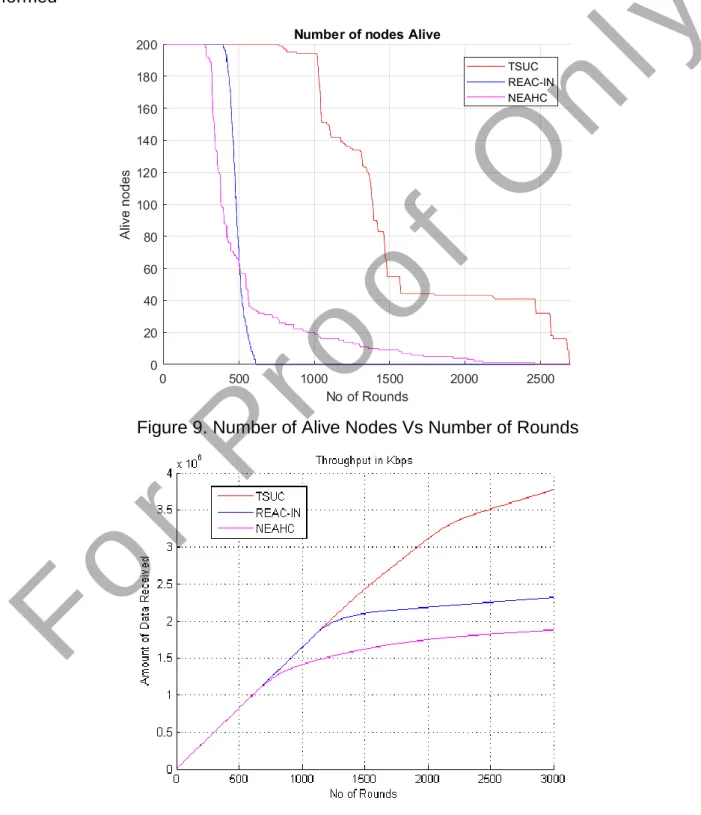
Since energy consumed is lesser for TSUC than other schemes, this will also improve the lifetime of the network which is adequately proven from the graph of number of alive nodes in the network-Figure 9. As is apparent from the graph
Vrince Vimal and Madhav J Nigam, AJCE, 2018; 1:3
die early. That consumption of energy is uniform as CH is des-ignated in every zone which allows Network goes completely dead at around 2700 rounds for TSUC. REAC-IN however, performs slightly better than NEAHC in context with number of alive nodes and remaining energy of the network Figure 7, this
is because REAC-IN allows the isolated nodes to transfer the data to base station via cluster heads (those cluster heads to which these nodes had formed
clusters in the previous rounds). There is no such provision for isolated nodes to transfer the data to the base station via cluster heads in NEAHC. This leads to more energy consumed in the net-work by the isolated nodes for NEAHC and con-sequently they die out soon. Since NEAHC also allows for sleep mode of few nodes to be on at every round, such nodes might lead to expanded lifetime as compared to REAC-IN as they com-municate less in the network
Figure 9. Number of Alive Nodes Vs Number of Rounds
Figure 10. Throughput
The throughput has been plotted as cumulative through-put for the successive rounds Figure 10. Each node sends a packet for 1024 bytes to its respective cluster head or to base station directly in case of isolated nodes. As number of alive nodes keep getting less, the value of throughput starts becoming constant in the network.
CONCLUSION
Effective consummation of WSN is predisposed on the fact that how efficiently energy has been exploited, which in turn prolongs the network’s lifetime. TSUC ensures the uniform placement of cluster heads and resolves isolated nodes is-sue by clustering them which in turn add to efficient consumption of energy. The simulation results showed that the TSUC exploits energy efficiently and prolongs networks lifetime. The re-duction in number of isolated nodes very well fulfills objective of the reducing coronas in addition to providing the energy and throughput gains. Since
the coronas have been reduced, it would ensure that data is sensed from every part of the network region under observation, thus providing a real help to the networks deployed for sensitive military applications and many more.
List Of Abbreviation
TSUC- Two Step Uniform Clustering.
CH-Cluster Head.
WSN-Wireless Sensor network.
ROI-Region Of Interest.
LEACH- Low Energy Adaptive Clustering Hierarchy.
HEED-Hybrid Energy Efficient Distributed Clustering.
DEEC-Distributed Energy Efficient Clustering. MEDIC-Medium Contention Based Energy Effiient Distributed Clustering.
REAC-IN- Regional Energy Aware
ClusteringScheme with Isolated Nodes.
EECRP-Efficient Centroid Based Routing Protocol.
References
1. Shih FY, Wu YT, undefined J L Chen. A Smart Sensor Network for Object Detection, Classification and Recognition Frank,. JOURNAL OF INFORMATION SCIENCE AND ENGINEERING 23, 1955-1969 (2007). 2005;23:1955–1969.
2. Krysander M, Frisk E. Sensor Placement for Fault Diagnosis,. IEEE Trans Systems, Man Cybernetics Part A Systems and Hu-mans. 2008;38(6):1398–1410.
3. Rawat HCP, Bonnin JM. Wireless Sensor Networks: A Survey on Recent Develop-ments and Potential Synergies,. The Journal of Supercomputing. 2014;68(1):1–48.
4. Gola´nski M, Schoeneich RO, Zgid D, Fran-ciszkiewicz M, Kucharski M. RBCP-WSN: The Reliable Biderectional Control Proto-col for Wireless Sensor Networks,. Int Journal Electronics of Telecommunications. 2017;63(2):201–207.
5. He YGYP. A Comprehensive Survey on the Reliability of Mobile Wireless Sensor Net-works: Taxonomy, Challenges, and Future Directions,. Information Fusion. 2018;.
6. Newman MHR. Adaptive routing in wireless sensor networks: QoS optimisation for en-hanced application performance,. Inf Fusion. 2015;22:3– 15.
7. Xu CCZ, Guan X. Joint Clustering and Rout-ing Design for Reliable and Efficient Data Collection in Large-Scale Wireless Sensor Networks,. IEEE Internet of Things Journal. 2016;3(4):520–532. 8. Vimal V, Nigam MJ. Ensuring Uni-form Energy
Consumption in Non- Deter-ministic Wireless Sensor Network to Pro-tract Networks Lifetime,. Int Journal of Electronics and Communication Engineering. 2017;11(9):966–970.
9. Lin CH, Tsai MJ. A Comment on ‘HEED: A Hybrid, Energy-Efficient, Distributed clus-tering approach for ad hoc sensor net-works,’. IEEE Trans Mobile Computing. 2006;5(10):1471–1472.
10. Barboni L, Valle M. “Wireless Sensor Net-works Power-Aware Deployment,”. In: 2008 Second International Conference on Sensor Technologies and Applications (SENSOR-COMM 2008); 2008. p. 252–257.
11. Aznoli F, Navimipour NJ. Deployment Strategies in the Wireless Sensor Networks: Systematic Literature Review, Classification, and Current Trends,. Wireless Personal Com-munications. 2017;95(2):819–846.
12. A Wireless Sensor Networks’ Analytics Sys-tem for Predicting Performance in On-Demand Deployments,. IEEE Systems Jour-nal. 2015;9(4):1344–1353.
13. Cherepanov A, Tyshchenko I, Popova M, Vakhnin D. Building Energy Efficient Wire-less Sensor Networks,. International Jour-nal of Electronics and Telecommunications. 2017;63(1):45–49. 14. Luo RC, Chen O. Mobile Sensor Node
Deployment and Asynchronous Power
Vrince Vimal and Madhav J Nigam, AJCE, 2018; 1:3
agement for Wireless Sensor Networks,. IEEE Transactions on Industrial Electronics. 2012;59(5):2377–2385.
15. Abo-Zahhad M, Sabor N, Sasaki S, Ahmed SM. A Centralized Immune-Voronoi Deploy-ment Algorithm for Coverage Maximization and Energy Conservation in Mobile Wire-less Sensor Networks,. Information Fusion. 2016;30:36–51. 16. Xu CCZ, Guan X. Joint Clustering and Rout-ing
Design for Reliable and Efficient Data Collection in Large-Scale Wireless Sensor Networks,. IEEE Internet of Things Journal. 2016;3(4):520–532. 17. Sanz D. Wireless Sensor Networks for Plan-etary
Exploration: Experimental Assessment of Communication and Deployment,. Ad-vances in Space Research. 2013;52(6):1029– 1046. 18. Sweidan HI, Havens TC. Coverage Optimiza-tion
in a Terrain-Aware Wireless Sensor Net-work,. In: 2016 IEEE Congress on Evolution-ary Computation (CEC); 2016. p. 3687–3694
19. Putra EH, Hidayat R, undefined Widyawan, undefined I W Mustika. Energy-Efficient Routing Based on Dynamic Programming for Wireless Multimedia Sensor Networks (WM-SNs),. International Journal of Electronics and Telecommunications. 2017;63(3):279– 283. 20. Sivathasan S, O′Brien D. Hybrid Radio and
Optical Communications for Energy-efficient Wireless Sensor Networks,. IETE Journal of Research. 2011;57(5):399.
21. Du T, Qu S, Liu F, undefined Q Wang. An en-ergy efficiency semi-static routing algorithm for WSNs based on HAC clustering method,. Information Fusion. 2015;21(1):18–29.
22. Energy-Effective Relay Selection by Utilizing Spacial Diversity For Random Wireless Sen-sor Networks,. IEEE Communication Letters. 2013;17(10):1972–1975.
23. Javaid N. An energy-efficient distributed clus-tering algorithm for heterogeneous WSNs,. Eurasip Journal of Wireless Commutation and Network. 2015;2015(1).
24. Kaur SP, Sharma M. Radially Optimized Zone-Divided Energy-Aware Wireless Sensor Networks (WSN) Protocol Using BA (Bat Algorithm),. IETE Journal of Research. 2015;61(2):170–179. 25. Heinzelman ACWR, Balakrishnan H.
Energy-Efficient Communication Protocol for Wireless Microsensor Networks,. In: Proceedings of the 33rd Hawaii International Conference on System Sciences - 2000. vol. 0; 2000. p. 3005–3014. 26. Qing QZL, Wang M. Design of a Distributed
Energy-Efficient Clustering Al-gorithm for Heterogeneous Wireless Sen-sor Networks,. Computer Communication. 2006;29(12):2230– 2237.
27. Zhao L, Liang Q. Medium-Contention Based Energy-Efficient Distributed Cluster-ing (MEDIC) for Wireless Sensor Networks,. International Journal of Distributed Sensor Networks, 3: 347– 369, 2007. 2007;3(4):347– 369.
28. Leu MCYJS, Su KW. Energy Efficient Clustering Scheme for Prolonging the life-time of Wireless Sensor Network with Iso-lated Nodes,. IEEE
Communication Letters. 2015;19(2):259–262. 29. An Efficient Centroid-Based Routing Proto-col for
Energy Management in WSN-Assisted IoT,. IEEE Access. 2017;5:18469–18479.
30. Zhang XFJ, Liu Z. A Grid-based Clus-tering Algorithm via Load Analysis for In-dustrial Internet of Things,. IEEE Access. 2018;6:13117–13128. 31. Energy Aware Hierarchical Cluster-Based
Routing Protocol for WSNs,. J China Univ Posts Telecommun. 2016;23(4):46–52.