191
STUDIES ON THE CHEMICAL AND SENSORIAL COMPOSITION OF THE
GRAPE MARC NARURAL DISTILLATES
STOICA FELICIA1*, MUNTEAN CAMELIA1*,BĂDUCĂ C1*
1*University of Craiova, Faculty of Horticulture, Craiova
* Correspondence author. E-mail:[email protected]
Keywords: chemichal composition, sensory analysis, grape marc, distillates
ABSTRACT
In order to investigate the possible relationships, the composition of the volatile aromatic compound of 4 grape distillates obtained from four varieties was correlated with the sensory scores for the basic properties (clarity, odor and taste) obtained by sensory testing. Monoterpenes were confirmed to be responsible for a typical Muscat aroma, as well as for descriptors such as flowery, rose, citrus and spicy/menthol in distillates made from Muscat varieties. Indications were found that vegetative odours of C6-alcohols may act as suppressants of Muscat aroma.
INTRODUCTION
The distillates obtained from the fermentation of fruits and marc grape have a much more complex chemical composition than the fruits from which they came. The advances made lately in
the analytical technique and the
equipments of the laboratories have allowed a better knowledge of the biochemical constituents of the tuica and the natural spirits.
The grape marc is a complex of solid parts resulting from vinification of grapes and separated from must (must),
containing in different proportions
bunches, skins and seeds, depending on the variety of grapes vinified and the technology used (Gheorghiţă M. et al., 2002 ).
Distillates produced by grapes marc are distinguished from other similar products and appreciated by consumers owing to an added value in the form of information about the specific production technology, strongly linked with the history and tradition of a particular country or geo-graphical region (Lukic I. et al., 2011).
The production of marc distillates involves a series of specific processes during several production stages, which
impact their chemical composition and sen-sory attributes (Luckic I. et al., 2010). Following the pressing of grape pomace in the production of wine, the obtained marc is ensiled and subjected to alcoholic fermentation, during which the most important volatile aroma compounds, such as alcohols, acids, esters, and
aldehydes are synthesized. After
completion of fermentation, the ethanol produced and the relatively high amounts of volatiles are recovered from the fermented marc by the process of distillation (Silva, M. L. and Malcata, F. X, 1999).
In contrast to modern and
automated distillation facilities with
rectification columns and trays, traditional distillation is performed using basic equipment that includes copper pot stills called alembics (Léauté, R. 1990).
Previous works have offered some insights into the distillation behaviour of the major volatile compounds such as methanol, higher alcohols, major esters, and acetaldehyde (Silva, M. L. and Malcata, F. X., 1998; Hernández-Gómez, L et al., 2005).
192
most important volatile compounds in the different fractions of grape marc distillates made from Sauvignon, Muscat Ottonel, Muscat de Hamburg and Cabernet
Sauvignon by traditional alembic
distillation and, also, sensorial analysis. Two Muscat varieties were chosen because of their abun-dance in both varietal and fermentation aromas (Di Stefano, R. and Borsa, D., 2006; Lukic I. et al., 2011).
MATERIAL AND METHOD
The purpose of this study was to determine the chemical composition of some distilled beverages obtained from fermented marcs of several varieties of semi-aromatic and aromatic white grapes (Sauvignon, Muscat Ottonel) and black grapes (Muscat from Hamburg and Cabernet Sauvignon) distilled with a traditional still. Since, these alcoholic beverages are not delicacies in Romania, this study proposes a research of the distillates obtained from fermented marcs of certain grapes varieties used for this purpose.
Grape samples. For this study two
varieties of semi-aromatic white grapes Sauvignon and aromatic Muscat Ottonel were used and two varieties of black
grapes Muscat De hamburg and
Cabernet Sauvignon. Each variety was used for the production of distillates, in Romania, especially in the Oltenia region (southwest of the country).
Alcoholic fermentation of grapes
marcs. The grapes harvested from the
hill area of Oltenia (Dragasani, Valcea), were transported to the Faculty of Horticulture in Craiova, the Department of Horticulture and Food Science. All the grapes were vinified separately and the resulting grapefruit after crushing and pressing was placed in vessels with a capacity of 40 L each. The vessels were filled up to 70% by volume. Fermentation was spontaneous with native yeasts at 20 ° C ± 1 ° C. Monitoring of the fermentation was performed daily and the fermentation lasted until the sugar concentration dropped to 4 ° Brix.
Distillation. The fermented grapes
marcs were distilled in a traditional copper still with shaker and without deflegmator. Before distillation began, the still was sealed to prevent any vapor leakage.
Heating the still was made by direct fire, with natural gas as a heating source. The distillation was induced by strong heating, which was continued for a short time after the condensate distillate began to leak, in order to prevent the discontinuation of the distillation process.
During the distillation, the obtained flow rate was kept constant by the
gradual increase of the heating
temperature, due to a decrease in the ethanol / water ratio in the boiler and in the vapors. The water from the cooling tank was maintained between 20 and 22 ° C throughout the process. The alcohol content of the distillates was monitored during the distillation process by an aerometer.
The head fraction consisted of the first 200 ml portions. The heart fraction was the next distillate, and was collected until the alcohol content of the operating distillate fell below 30% by volume. After collecting the heart (middle) fraction, 100 ml portions of the tail fraction were collected, until the alcohol content of the operating distillate decreased to 20% by volume, by the end of the distillation. The determinations regarding the chemical composition of the distillates were made only on the middle fraction, which is consumed.
The distilled fractions were stored in dark bottles, soaked at 20 ° C for three months, and then analyzed.
All 5 samples (for each variety) were analyzed using gas chromatography and following the method used by the
laboratory of the Department of
Horticulture and Food Science and the laboratory of the National Institute for Cryogenic and Isotopic Technologies (I.C.S.I. Rm. Valcea).
Content of terpenes (monoterpenes
and diterpenes) methanol, hexanol,
3-methyl-1-193
butanol, 1-henthanol and 1-octanol), ethyl esters, ethyl acetate, hydroxy and dicarboxylic acid esters, acetaldehyde and furan compounds were determined using a gas chromatography system, VARIAN 450 gas chromatograph GC-FID detector (flame ionization detection).
RESULTS AND DISCUSSIONS
The composition of volatile aromatic compounds is a determining factor of the sensory quality of the distilled grape marc and is essential for the consumers'
perception. Although the chemical
composition of volatile substances in such products has been the subject of research for decades, only a few works have linked it to sensory properties (Diéguez, S. C et al., 2005; Cortés, S. et al. , 2009, Lukic I. et al., 2012), so very little information on the impact of volatile composition on organoleptic quality brand distillates is available. Instead, there have
been many achievements in wine
research through various methodologies
approaches. The odor perception
thresholds of aromatic compounds were determined and the odor activity concept (OAV) was introduced.
This study is an attempt to explain the connection between the composition of volatile compounds and the sensory
quality of grape marc distillates.
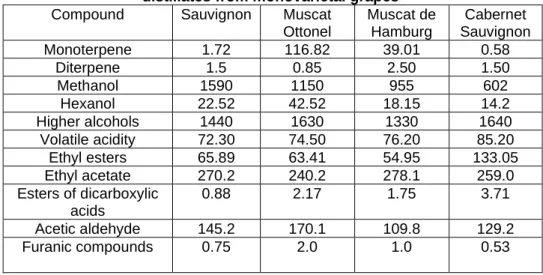
Specifically, the study tried to determine which volatile groups of compounds have a greater influence, both positive and negative, on the sensory perception of the properties of the distillates, namely the clarity, smell and taste; which may be related to certain sensory notes perceived and subsequently, sensory descriptors have been agreed upon.The main chemical composition parameters of the natural distillates from Tescovina are presented in Table 1.
As previously reported (Lukić, I. et al., 2010), distillates obtained from the aromas of the aromatic varieties were abundant in monoterpenes compared to the others.
White grape distillate distillates were richer in methanol and C6 alcohols, while
Cabernet Sauvignonan red grape
distillates contained the largest quantities of most fermentation alcohols, acids and esters (Lukić, I. et al., 2011) .
Regarding the content of higher alcohols, the highest value is registered in the Cabernet Sauvignon variety - 1640 mg/L and in Muscat Ottonel with 1630 mg/L, which gives them a spicier aroma. The lowest alcohol content was recorded in Muscat of Hamburg - 1330 mg/L.
The volatile acidity gives a
perception of acid, sharp if it exceeds the allowed values. In this case, the highest value of volatile acidity is at Cabernet Sauvignon (85.2 mg /L) and the lowest at Sauvignon - 72.3 mg/L. The aroma obtained from the aromas of the aromatic varieties is at intermediate values, Muscat Ottonel with 74.5 mg/L and Hamburg Muscat with 76.2 mg/L.
Ethyl esters together with ethyl acetate, the main ester in this group, give distilled beverages an fruity aroma of apples, strawberries, blackberries. The highest values of ethyl acetate are recorded in Muscat de Hamburg 278.1 mg/L and Sauvignon - 270.2 mg/L and the lowest value appears in Muscat Ottonel with 240.2 mg/L. Regarding the content of other ethyl esters, the highest value is presented by the Cabernet Sauvignon distillate - 133.05 mg/L, the rest registering values of this compound between 55-65 mg/L.
Acetic aldehyde and furanic
compounds, in admissible quantities, can enhance the distillate aroma of dried fruits, fried almonds. From this point of view, the white varieties and especially Muscat Ottonel have the highest value of 170.1 mg/L, respectively 2 mg/L for furfurol., And the red varieties the lowest values.
The results of the sensory testing of the distillate samples are presented in
Tables 2. and 3. As with the
concentrations, a remarkable variability in taste quality was observed, although a serious defect was detected only in a
single Cabernet Sauvignon sample.
194
excluded from further data processing to avoid misleading conclusions.
Distillates classified with higher scores were mainly described by positive attributes such as fruits, flowers, nuts, spices, etc., while those of lower quality were related to unpleasant odors such as mold, oil, gasoline, cooked vegetables, mushrooms, earthy, oily. It is interesting to note that distillates were described by
a larger number of descriptors,
suggesting the complexity of sensory aroma profiles.
Due to the different interactions, synergistic and complementary, and on the other hand the effects of masking and
suppressing between hundreds of
compounds present in grape distillates, it is not reasonable to expect that the origin of each descriptor could be attributed to a
certain group of flavors. volatile.
However, some relationships have been explained experimentally.
All samples were described as alcoholic, which can be attributed to the impact of the high volume fraction of ethanol. Although higher concentrations of alcoholic isoamyl alcohol far exceeded the threshold odor perception of 65 mg/L (De Rosa, T., Castagner, R., 1994) in all investigated samples (Table 1), no odors were detected. distinct from amyl or solvents. This implies that it consisted of the influence of the higher alcohols, their contribution to the general alcoholic character and to the complexity of the general aroma of the distillates. Similar observations were noted by Guichard et al. (Guichard, H. et al, 2003), who did not find any sensory descriptors that could be related to the relatively high levels of higher alcohols.
It is clear that the muscat character of Muscat Ottonel and Muscat De Hamburg distillates comes from the
presence of large amounts of
monoterpenes (Table 1), mainly from most monoterpenes such as linalool, a-terpineol, citronellol, nerol and geraniol, so as previously established (Lukić, I. et al., 2010). A similar assumption could be drawn for descriptors such as florals
(linalool, a-terpineol, nerol and geraniol), rose (linalool, nerol and geraniol), citrus (citronellol, limonene) and spicy / menthol (b-pinen and eucalyptol), for which typical Muscat distillates were also found (Lukić, I. et al., 2010).
It is interesting to note that the mentioned "Muscat" descriptors, were perceived mainly in distillates of Muscat Ottonel and Muscat de Hamburg, of superior quality, but were not limited to the retro nasal perception. This could not be explained solely on the basis of monoterpene content, as there is no
significant correlation between their
concentration and the frequency of Muscat descriptors perceived by the tasters. Suppressing the vegetable odors of C6 alcohols is one of the probable
causes. In fact, several aromatic
distillates, despite the positive aromas of
bites, with high concentrations of
monoterpenes, have been characterized by vegetative character, which may be given by C6 alcohol.
CONCLUSIONS
The results obtained in this study
showed that it was possible to
significantly affect the concentrations of many important volatile compounds in the distilled fruits, choosing the appropriate separation points of the fraction during the traditional distillation, confirming the results of other researchers. This refers to a number of positively contributing aroma classes, such as esters and higher alcohols, which have been confirmed to be characteristic for head and first middle fractions.
In this study, the interesting
relationships are between the volatile aroma of marc distillates and the basic sensory properties, such as clarity, smell and taste.
195
However, during the qualitative descriptive sensory analysis the tasters
highlighted many other specific
descriptors whose origin could not be
attributed to a certain group of
compounds.
It is assumed that the observed attributes could be the result of the interactions of the different compounds studied, in which different groups of
odorants and produced new smells.
Also, the unexplained sensory
descriptors can be attributed to the presence of other compounds that have not been researched. The present study showed that even a detailed knowledge
of volatile aromatic compounds is
insufficient to predict the aroma of a whole distillate.
However, these results make a valuable contribution to the current understanding of aromas of grape marc distillates.
BIBLIOGRAPHY
1. Cortés, S., Gil, M. L. and
Fernández, E., 2009 - Chemical
affinities between the major volatile compounds present in a grape po-mace distillate. J. Sci. Food Agric., 89, 1221-1226.
2. De Rosa, T.; Castagner, R., 1994 -
Tecnologia delle grappe e dei distillati d'uva. Padova: Edagricola, 416p.
3. Diéguez, S. C., de la Peña, M. L.
G., and Gómez, E.F., 2005 -
Volatile composition and sensory characters of commercial Galician Orujo Spirits, J. Agric. Food Chem. 53, 6759–6765.
4. Di Stefano, R., Borsa, D., 2006
-Composti aromatici varietali di grappe e distillati d’uva da monovitigno, Riv. Vitic. Enol., 37-56.
5. Gheorghiţă M., Camelia
Muntean, Băducă Cîmpeanu C.,
2002 - Oenologie 2. Ed. Sitech,
Craiova.
6. Guichard H.; Lemesle S:,
Ledauphin J.; Barillier D.;
Picoche B., 2003 - Chemical
sensorial aroma characterization of
freshly distilled cavaldos. 1.
Evaluation of quality and defects on the basis of keys odorants by Olfactometry and sensory analysis. J. Agric. Food Chem. 51, 424-432.
7. Hernández-Gómez, L. F.,
Úbeda-Iranzo, J., García-Romero, E.,
Briones-Pérez, A., 2005
-Comparative production of
different melon distillates:
Chemical and sensory analyses. Food Chem., 90, 115-125.
8. Léauté, R.,1990 - Distillation in
alambic. Am. J. Enol. Vitic., 41,90-103.
9. Lukić, I., Miličević, B., Banović,
M., Tomas, S., Radeka, S. and
Peršurić, Đ., 2010 -
Characterization and differentiation
of monovarietal grape marc
distillates on the basis of varietal aroma com-pound composition. J. Agric. Food Chem., 58, 7351-7360.
10. Lukić, I., Tomas, S., Miličević, B.,
Radeka, S., Peršurić, Đ., 2011,
Behaviour of Volatile Compounds
During Traditional Alembic
Distillation of Fermented Muscat Blanc and Muškat Ruža Porečki Grape Marcs, J. Inst. Brew. 117(3), 440–450
11. Silva, M. L., Malcata, F. X., 1998 -
Relationships between storage
conditions of grape pomace and
volatile composition of spirits
obtained there from. Am. J. Enol. Vitic., 49, 56-64.
12. Silva, M. L., Malcata, F. X., 1999 -
196
Table 1. Concentration (mg / l) of the main volatile aromatic compounds in marc
distillates from monovarietal grapes
Compound Sauvignon Muscat Ottonel
Muscat de Hamburg
Cabernet Sauvignon
Monoterpene 1.72 116.82 39.01 0.58
Diterpene 1.5 0.85 2.50 1.50
Methanol 1590 1150 955 602
Hexanol 22.52 42.52 18.15 14.2
Higher alcohols 1440 1630 1330 1640
Volatile acidity 72.30 74.50 76.20 85.20
Ethyl esters 65.89 63.41 54.95 133.05
Ethyl acetate 270.2 240.2 278.1 259.0
Esters of dicarboxylic acids
0.88 2.17 1.75 3.71
Acetic aldehyde 145.2 170.1 109.8 129.2
Furanic compounds 0.75 2.0 1.0 0.53
Table 2. The main aroma descriptors of the groups of volatile aromatic compounds
from the natural distillates from the Tescovina grape variety
Compound Smell descriptors
Monoterpene muscat, flowers, citrus, rose, menthol, pine wood
Diterpene wood, spicy, sweet, floral, cloves, oily, fresh Methanol alcoholic, repellent, sour cabbage, sour
Hexanol grass, vegetative
Higher alcohols alcoholic, amylic, solvent, spicy, fruity Volatile acidity acid, sharp, vinegar
Ethyl esters fruits, apples, strawberries, bananas, blackberries, fruit, green apples, pears
Ethyl acetate fruit, solvent
Esters of dicarboxylic acids melted butter, yeast, wet bread, melon, wine
Acetic aldehyde fruit, nut, apple
Furanic compounds dried fruits, almonds, fried almonds
Table 3. Sensory descriptors of monovarietal grape marc distillates agreed on the
basis of descriptive sensory analysis Sensory
descriptors
Sauvignon Muscat Ottonel
Muscat de Hamburg
Cabernet Sauvignon The main
descriptors
Alcoholic Green fruits
apples nuts Dried figs
Alcoholic muscat
citrus Floral Honey
Alcoholic muscat
Floral Rose Spicy / menthol
Alcoholic Spicy
nuts
Other descriptors
nuts Dried figs
Boiled vegetables Asparagus Dried plums
Wood melon
Wood Melon Honey Spicy Tropical fruits
Hay
citrus Oily violet Wormwood
Dried figs Tobacco
Marc Earth
Wood Tobacco
Fennel Coffee Menthol
Boiled vegetables