An Assessment of Machine Learning
Methods for Robotic Discovery
Ivan Bratko
Faculty of Computer and Information Science, University of Ljubljana, Slovenia
In this paper we consider autonomous robot discovery through experimentation in the robot’s environment. We analyse the applicability of machine learning(ML) methods with respect to various levels of robot discovery tasks, from extracting simple laws among the observed variables, to discovering completely new notions that were never mentioned in the data directly. We first present some illustrative experiments in robot learning in the XPERO European project. Then we formulate a systematic list of types of learning or discovery tasks, and discuss the suitability of chosen ML methods for these tasks.
Keywords: machine learning, robotic discovery, au-tonomous learning, gaining insights
1. Introduction
In this paper we analyse the applicability of ma-chine learning(ML) methods in various robot discovery tasks, in particular in the light of the experience in the XPERO project. We first in-troduce the XPERO project. Then we formulate a list of types of XPERO learning or discovery tasks, and of applicable ML methods, and we discuss the suitability of one against the other. XPERO is a Sixth Framework European project with full title Learning by Experimentation
(www.xpero.org). The scientific goal of XPERO is to investigate the mechanisms of autonomous discovery through experiments in an agent’s en-vironment. In XPERO, the experimental do-main is the robot’s physical world, and the sub-ject of discovery are various, quantitative or qualitative laws in this world. Discovery of such laws of (possibly naive) physics would enable the robot to make predictions about the results of its actions, and thus enable the robot to construct plans that would achieve the robot’s goals.
In addition to discovering laws that directly en-able predictions, XPERO aspires to advance the understanding of the mechanisms that enable new insights. In XPERO, an “insight” means something conceptually more general than a law. One possible definition of an insight in the spirit of XPERO is the following: an insight is a new piece of knowledge that makes it possi-ble to simplify the current agent’s theory about its environment. Examples of insights are the discoveries of notions like absolute coordinate system, arithmetic operations, notion of grav-ity, notion of support between objects, etc. An insight would thus ideally be a new concept that makes the current domain theory more flexi-ble and enaflexi-bles more efficient reasoning about the domain. Thus, insights should also make further learning in this domain easier and more effective.
We are interested in minimizing such “innate knowledge” because we would like to demon-strate how discovery and gaining insights come about from only a minimal set of “first princi-ples”. In addition, as our aim is gaining insights, not all machine learning methods are appropri-ate. Our aim requires that the induced insights can be interpreted and understood, and are not only useful for making predictions. Therefore, new insights have to be represented in explicit symbolic form. This requirement largely rules out some otherwise effective machine learning methods, such as neural networks and support vector machines.
It is envisaged that gaining insights will re-quire sophisticated mechanisms, such as itera-tive completion of the “experimental loop”. Ex-perimental loop comprises the following activ-ities: determining next goals, planning experi-ments that serve attaining these goals, collecting measurement data from these experiments, and analysis of experimental data. Data analysis will typically involve methods of data mining and machine learning, which will also give rise to the formation of new hypotheses.
It is expected that standard techniques of ma-chine learning(ML)and data mining will have to be adapted to the specific needs of discov-ery in XPERO. However, we investigate in this paper what can be expected to be achieved, in terms of above stated robot discovery, from straightforward application of standard machine learning techniques to experimental data col-lected by the robot. In the sequel, we first de-scribe some initial experiments and give some illustrative results. Then we specify more sys-tematically a number of generic discovery tasks in XPERO, a repertoire of ML approaches, and analyze these approaches according to their ad-vantages and shortcomings with respect to the tasks.
2. Setup in Initial Experiments
In initial ML experiments in XPERO, we used a simple experimental setup, called “movability”. This setup consisted of a mobile robot moving in the plane with just one additional object, a red block or ball. The robot, equipped with stereo vision capability, could detect the area in
the image belonging to the object, robot’s dis-tance from the object and the angle between the current orientation of the robot and the angle at which the object was observed. These data were sampled in time at discrete time steps. Also, the robot was aware of its actions, that is moves, expressed as the step distance in the forward direction (i.e. its current orientation), and the “step angle”, that is the change of the robot’s orientation. Figure 1 illustrates these parame-ters.
Figure 1. Movability experiments: relations between the robot and the object, and between the current and the
next robot’s positions. The arrows show the robot’s orientation, that is the current direction of robot’s
movement.
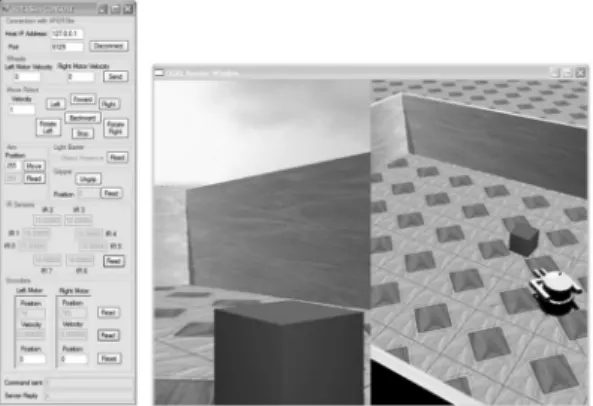
Figure 2.A snapshot of the XPERsim simulation of Khepera II robot.
platforms. One of these platforms is the Khep-era II robot from the K-TEAM Switzerland, used in some experiments in this paper.
Pioneer D2X robot was used to run the movabil-ity experiments physically [4]. The robot was equipped with odometry, eight sonar sensors and a stereo vision system. The single object used in the experimental setup was a red ball
(radius 50mm). Another camera from the top of the scene was used to provide a separate set of data using “world’s coordinate system” which was only meant to be used for verification and evaluation of learning methods and not for ma-chine learning. According to the philosophy of using a minimal set of “first principles”, these experiments always assume that the robot is not aware of the absolute coordinate system. The “observation vector” of the robot at some time point consists of the following variables
(see Figure 1):
1. object Dist, the distance to the object 2. object Angle, the angle of the object w.r.t.
current robot’s orientation
3. object Area, the perceived size of the ob-ject as it appears in the image from robot’s camera
4. step Dist, the distance traveled in the last time step (zero, if the robot is turning in place)
5. step Angle, the change of angle in the last step (zero, if the robot is moving along straight line)
In the learning experiments we learned both “static” and “dynamic” relations. A static re-lation defines the rere-lation between the variable values at the same time point. An example of a static relation is the function that maps ob-ject Dist and object Angle into object Area, where all these variable values are taken at the same time point t. The corresponding learn-ing problem is to induce, from the given data, a function f for prediction of perceived object area in the camera image from the distance and angle to the object:
object Area=f(object Dist, object Angle)
In this learning problem, in the usual terminol-ogy of ML, object Dist and object Angle are called the attributes, and object Area is called
the class. Dynamic relations are useful to make predictions about variable values at the next time pointt+1(assuming that time points are indexed by integers) from the given variable values at time t and robot’s actions at time t. An example of learning dynamic relations is to induce a function g that predicts object Area at timet+1:
object Area(t+1) =
g(object Dist(t), object Angle(t), step Dist(t), step Angle(t))
3. Machine Learning Techniques Used
We experimented with a number of different ML techniques chosen so that they constitute a rep-resentative sample of ML approaches. For rea-sons explained in the introduction, our choice of ML techniques was limited to those that in-duce concept descriptions in explicit symbolic form. The chosen techniques range from the well known ones to the less widely known. The wellknown techniques used were: induction of decision trees, regression trees, and induction of if-then rules. The less known methods include the learning of equations (system GoldHorn)
and the learning of qualitative models(systems QUIN and Pad´e). Most of the implementa-tions of these techniques that we used in the experiments are integrated in the Orange ML environment [6]. In the following paragraphs, we briefly describe these techniques and their implementations.
Rule learning using CN2. CN2 is a rule in-duction algorithm that can cope with noisy data
[5]. We experimented with the implementation of CN2 in Orange. The output of this algorithm is an ordered set of if-then rules, also known as “decision lists”.
example, the classification takes the form of a probability distribution over all possible classes. In classification trees, the class is discrete. Re-gression trees are similar to classification trees, except that the class variable is real-valued. Re-gression tree learning is more directly applied in our domain where all the variables are con-tinuous. However, classification tree learning is also relevant after discretizing a continuous class variable into intervals. We used the Or-ange implementation of classification and re-gression tree induction.
Equation induction with GoldHorn.
Gold-Horn [8,9] is a machine learning system in-tended to discover empirical laws, in the form of algebraic equations, that govern the behavior of dynamic systems. Given a behavior of the system, e.g. a sampled execution trace, Gold-Horn attempts to find a set of ordinary differen-tial equations that describe the dynamics of the system. GoldHorn does not simply fit the pa-rameters of equations of given forms, but it also constructs new forms of equations. The signif-icance of an equation is judged by the degree of fit with the data(correlation coefficient and normalized squared error). It should be noted that, as a result, GoldHorn not only finds differ-ential equations of some predefined forms, but also does structuralsynthesis of new forms of equations.
Learning qualitative models with QUIN.
QUIN(Qualitative Induction[12])is a learning program that looks for qualitative patterns in nu-merical data. QUIN expresses such qualitative patterns by qualitative trees that are similar to decision trees, but have monotonic qualitative constraints in the leaves. Monotonic qualitative constraints (MQCs)are a kind of monotonicity constraints that are widely used in the field of qualitative reasoning and are a generalization of monotonic function constraint used in QSIM
[10]. For example, the MQCZ = M+,−(X,Y)
says thatZis monotonically increasing inXand monotonically decreasing in Y. If both X and Y increase, then according to this constraint,Z may increase, decrease or stay unchanged. In such a case, an MQC cannot make an unam-biguous prediction of the qualitative change in Z.
Learning qualitative models with Pad´e. Pad´e
[14]is a set of methods for estimating quantita-tive or qualitaquantita-tive partial derivaquantita-tives for points in an attribute space when given a set of learn-ing examples in this space. The name Pad´e is
an acronym for “partial derivative” (and also the name of a famous French mathematician). Once qualitative derivatives are extracted with Pad´e, one can use arbitrary machine learning al-gorithms(e.g. C4.5, CN2, Na¨ıve Bayes, SVM etc.) to induce a corresponding qualitative pre-diction model.
The Orange environment. Orange[6]is a li-brary of C++core objects and routines that in-cludes a large variety of machine learning and data mining algorithms, plus routines for data input and manipulation. It is a collection of Python-based modules that sit over the core li-brary and offer a versatile environment for de-velopers, researchers and data mining practi-tioners. Orange also comprises a set of graph-ical widgets that use methods from the core li-brary and Orange modules and provide a nice user interface. All these make Orange a compre-hensive, component-based framework for ma-chine learning and data mining which is con-stantly growing by adding more and more ma-chine learning methods and algorithms while at the same time improving the existing ones.
4. Some Experimental Results
Among many results in learning various static and dynamic relations in the movability sce-nario with different ML techniques, we here select some examples to highlight some posi-tive and negaposi-tive points. In general, more in-teresting results were obtained with the learn-ing of qualitative models, both with QUIN and Pad´e, and with HYPER with respect to discov-ery of new concepts (effectively extending the description language).
Here is a qualitative tree, written as a nested if-then rule, for the class variable’sobject Area qualitative dependence on object Dist and ob-ject Angle, induced by QUIN from the XPER-Sim Khepera traces:
ifobject Angle≤2.6769
then ifobject Angle≤ −13.76
thenM+,−(object Angle, object Dist)
elseM−(object Dist)
else ifobject Angle≤8.4
thenM−(object Dist)
When the robot is facing away from the object, the object is not visible, and the area is always zero. The tree above was induced only from ex-amples where the object is visible. The middle two leaves of the tree that apply when the robot is facing the object(angle between−13.76 and 8.4 degrees), say that the area decreases with increasing distance. This is what one would ex-pect, as the perceived object becomes smaller when we move away. The leftmost leaf and the rightmost leaf describe similar decreasing de-pendence of area on object distance, but some-thing else is also going on there: the disappear-ing of the object from the camera view when the robot is turning away from the object. The induced qualitative tree gives a good qual-itative explanation of how the area changes with object distance and object angle. Non-symmetry in the angular thresholds in the left and right sub-trees is a blemish due to statisti-cal asymmetry in the data between positive and negative angles. This qualitative tree could be viewed as a first simple discovery. It however falls short of being an insight in the particular ambitious sense of XPERO discussed in Section 1.
The same data was used for learning with Gold-Horn. In this case, when static relations were considered only, GoldHorn generated algebraic equations (not differential). The first problem is that GoldHorn induces hundreds of equations and many of them, even those with the high-est rank, are useless or meaningless. Typically, such equations are the result of spurious corre-lations between the variables and numerical er-rors. One such spurious and meaningless equa-tion is equaequa-tion 3 below. The highest ranked equations according to the squared error were:
(1) object Area * object Dist= 99.19+11.48 object Area
(2) object Area2* object Dist=
−463.49+299.99 object Area
(3) object Area2=
−62.04+19.98 object Area
(4) object Area * object Dist2=
6232.31−6.37 object Angle2
(5) object Area3=
−470.17+19.37 object Area2
The first three equations do not mention object angle and obviously cannot serve as valid mod-els. The third equation and the fifth equation are meaningless. The only interesting equation is the fourth equation that can be rewritten as:
object Area=
(6232.31−6.37 object Angle2) /object Dist2
Similar to the above qualitative tree, it says that the area decreases with object distance. Ac-tually, this equation says more – it correctly states that the area decreases with the square of distance. The equation also indicates the de-creasing of the area when a part of the object is disappearing from the camera. However, this is not correct for small object angles, i.e. when the whole object is visible by the camera. The learning with Pad´e also produced sensible results, of similar form as those by QUIN. The experiments with the learning of dynamic relations showed several ways of the learning systems going astray, and were overall quite disappointing. This is surprising and no obvi-ous explanation for this was found. Therefore, I suspect that different reformulations of the dy-namics learning prolem could be more success-ful.
are not approximately equal;add(X, Y, Z), mean-ing Z≈X+Y. These relations are defined as approximations because of noise in numerical data. It should be noted that neither the ob-servations nor the prior knowledge contain the concept of mobility, or any mention of it. There are no examples given of movable and not mov-able objects. The ILP program HYPER[2]was used on this learning problem to induce a theory of moving in this world(that is learn predicate move/4). The induced theory by HYPER was stated in logic by the following Prolog clauses:
move(Obj,Pos,Dist,Pos):-not p(Obj).
move(Ob,Pos1,Dist,Pos2):-add(Pos1,Dist,Pos2), p(Obj).
p(Obj):-at(Obj,T1,Pos2), at(Obj,T2,Pos2), different(Pos1,Pos2).
In the clauses above, the variables were renamed for easier understanding. The first clause deals with unmovable objects (after the move com-mand, the position of the object remains un-changed). The second clause handles movable objects. The point of interest is that HYPER invented a new predicate, p(Object) which is true for objects that can be moved. The defini-tion above says that an object is movable if it has been observed at two different positions in time. Thus the robot has come up with a new concept never mentioned in the data or problem definition. The new concept p(Object)enabled the learning system to divide the problem in the two cases.
5. Robot Discovery Tasks and Learning Paradigms
Now we formulate a more comprehensive set of XPERO types of learning and discovery tasks that go beyond the illustrations in the previous section:
(1)Learning static functional relations. Given a set of observations, all taken at the same time t, find relations between them. This usually consists of finding mappings from
a subset of observations into other observa-tions. Examples in the movability scenario were discussed in the previous section, such as object area being a function of distance and angle. It should be noted, however, that in this example setting, this relation is only functional for the cases when the angle is determined for all possible orientations of the robot. This may not be the case for example when the distance is determined through stereo vision(and not by proximity sensors).
(2)Learning dynamic relations (learning the dynamics of the robot’s world). These re-lations between observations, states and ac-tions may be expressed in many ways, such as:
• Obs(t+ 1) =f(Obs(t),Act(t)) (this as-sumes that current observations are suffi-cient to determine complete consequences of any action and next observations
• State(t+1) =f(State(t),Act(t)), Obs(t)
=g(State(t))This assumes that the state of the system is given
• Same as above, but the state of the sys-tem is not known, or given(observable), but has to be discovered e.g. as State(t) = f(History(t))where History(t) = (Obs(t−
1), Act(t−1), Obs(t−2), Act(t−2),. . .). The learning also needs to discover a suit-able length of History. This may give rise to some insights, such as: (a) discovery of the concept of state, and(b)given that the robot assumes the concept of state, it then has to discover its definition in terms of its relation(f above)with observations and actions.
(3)Discovering useful notions in the physical worldof the robot, such as: movable(Object), obstacle(Object, Robot, Intention), contain-ment, force, gravity, friction, support, touch, push,. . .
(4)Discovering aggregates: for example stack of blocks, “train” of blocks
(5)Discovering notions of cooperationof sev-eral agents, e.g. two robots jointly pushing a long block
Machine learning paradigms considered in this analysis include the following:
(1)Attribute-value learning, such as learning if-then rules, decision trees, regression trees and regression rules.
(2)Induction of equations from numerical data
(programs like Goldhorn and Lagramge[7]).
(3)Qualitative learning, like programs QUIN and Pad´e. Hypothesis languages in this learning paradigm express qualitative rela-tions in terms of qualitative proportionali-ties or monotonicity constraints among vari-ables in the system.
(4)Q2learning(also called qualitatively
faith-ful quantitative learning [13]) possibly re-alised as a combination of qualitative learn-ing with QUIN or Pad´e, and qualitatively constrained regression e.g. with Qfilter or QCgrid. This is a non-standard approach to attribute-value learning with numerical class variable whereby the induced regres-sion model respects the qualitative proper-ties detected in the learning data.
(5)Inductive logic programming (ILP) with programs like HYPER, Progol and Aleph. In addition to the learning of logical the-ories with ILP, we here consider also the learning of dynamic qualitative models [3] of QSIM-type since such models can be nat-urally represented by logic clauses, as well as simulated by logic programs.
6. Applicability of Learning Methods to Discovery Tasks
The learning paradigms above are roughly or-dered according to the power of representation languages, and, correspondingly, according to increasing computational complexity. So the range of applicability of these paradigms is on the one hand limited by expressiveness of hy-pothesis languages, and on the other hand by computational complexity. Another limiting factor is the interpretability(understandability)
of induced descriptions. This ability we con-sider as necessary in XPERO with respect to the gaining of insights. For this reason, we do not seriously consider the use of some other ML approaches, such as neural networks, support vector machines, and reinforcement learning in its usual form.
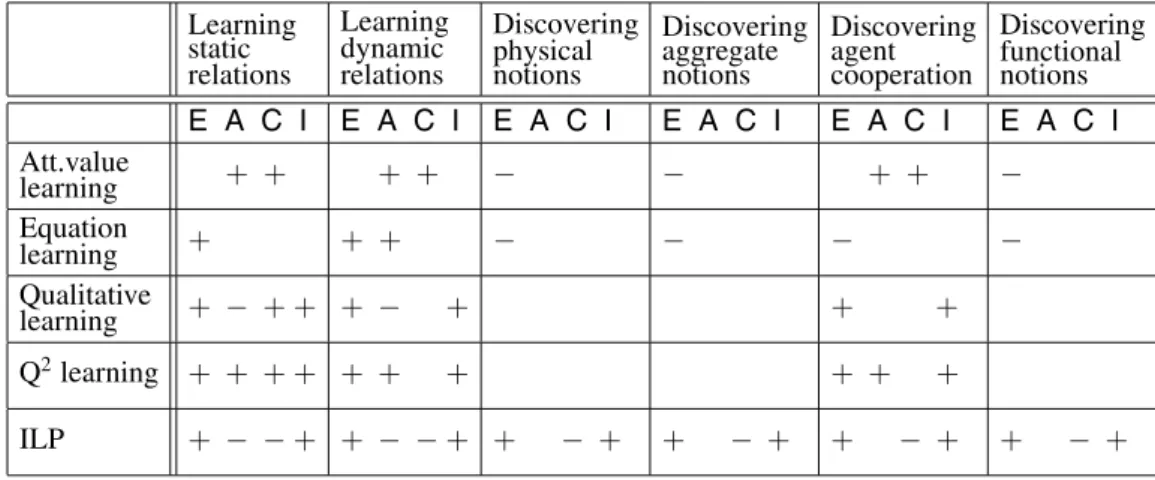
Table 1 summarises the suitability of the consid-ered ML approaches for various types of learn-ing/discovery tasks in XPERO. The applicabil-ity is assessed in terms of four criteria:
1. Expressiveness(E)of the ML method’s hy-pothesis language(representation)
2. Predictive accuracy(A)of induced theories; this is to be understood as rough estimate that also takes into account the ability to cope with noise, precision in numerical prediction etc.
3. Computational complexity(C)
Learning static relations
Learning dynamic relations
Discovering physical notions
Discovering aggregate notions
Discovering agent cooperation
Discovering functional notions
E A C I E A C I E A C I E A C I E A C I E A C I
Att.value
learning + + + + − − + + −
Equation
learning + + + − − − −
Qualitative
learning + − + + + − + + +
Q2learning + + + + + + + + + +
ILP + − −+ + − −+ + − + + − + + − + + − +
Table 1.Tentative assessment of applicability of ML aproaches to types of task. Criteria: E=expressiveness, A=accuracy, C=complexity, I=interpretability. “+” means above average, “−“ means below average, blank
4. Interpretability (I) of induced hypotheses; how easy or difficult it is for the user to fig-ure out the meaning of a hypothesis, and possibly use it for reasoning about the do-main.
It should be emphasised that Table 1 only gives some general ideas of the comparative advan-tages of the potentials of the methods consid-ered, and should not be understood as a defi-nite ranking of the methods that applies to all cases and all situations. Several entries in the table are only tentative, and a more firm as-sessment would require very substantial further work. Hopefully, further work in XPERO will help to clarify some of these judgements.
Acknowledgments
The research described in this paper was sup-ported by the European Commission, 6th Frame-work project XPERO, and the Slovenian re-search agency ARRS, Rere-search program Arti-ficial Intelligence and Intelligent Systems. The work described in the section “Initial experi-ments in XPERO” was carried out by a number of people, including the co-authors of paper[4].
References
[1] I. AWAAD ANDB. LEON(2006). XPERSim:
Simu-lation of the robotic experimenter.XPERO Report on R&D 1.September 2006.
[2] I. BRATKO (2001) Prolog Programming for
Arti-ficial Intelligence, 3rd edition, Addison-Wesley / Pearson.
[3] I. BRATKO ANDD.SˇUC(2003 Learning qualitative models. AI Magazine, Vol. 24 (2003), no. 4, pp. 107–119.
[4] I. BRATKO, D. SˇUC, I. AWAAD, J. DEMSARˇ , P. GEMEINER, M. GUID, B. LEON, M. MESTNIK, J.
PRANKL, E. PRASSLER, M. VINCZE, J. ZˇABKAR
(2007) Initial experiments in robot discovery in XPERO, ICRA’07 Workshop Concept Learning for Embodied Agents, Rome, april 2007.
[5] P. CLARK AND T. NIBLETT (1989) The CN2
in-duction algorithm.Machine Learning, Vol. 3, pp. 262–284.
[6] J. DEMˇSAR ANDB. ZUPAN (2006). Orange: Data Mining Fruitful & Fun – From Experimental Machine Learning to Interactive Data Mining. http://www.ailab.si/orange.
[7] S. DZEROSKI ANDˇ L. TODOROVSKI(1993).
Discov-ering dynamics. InProceedings of the 10th Interna-tional Conference on Machine Learning, 97–103. Morgan Kaufmann.
[8] V. KRIZMANˇ , S. DZEROSKI ANDˇ B. KOMPARE(1995). Discovering dynamics from measured data. Elec-trotechnical Review, 62:191–198.
[9] V. KRIZMANˇ (1998). Automatic Discovery of the
Structure of Dynamic System Models. PhD The-sis, Faculty of Computer and Information Sciences, University of Ljubljana.
[10] B. KUIPERS(1994).Qualitative Reasoning:
Mod-eling and Simulation with Incomplete Knowledge, MIT Press.
[11] D. SˇUC (2001). Machine reconstruction of hu-man control strategies, Ph.D. Thesis, Faculty of Computer and Information Science, University of Ljubljana, Slovenia.
[12] D.SˇUC(2003). Machine Reconstruction of Human Control Strategies, in: Frontiers Artificial Intelli-gence Appl., vol. 99, IOS Press, Amsterdam.
[13] D.SˇUC, D. VLADUSIˇC ANDˇ I. BRATKO(2004). Qual-itatively Faithful Quantitative Prediction,Artificial Intelligence, 158:2, pp. 190–219.
[14] J. ZˇABKAR, I. BRATKO ANDJ. DEMSARˇ , Learning qualitative models through partial derivatives by Pad´e. QR07, 21st International Workshop on Quali-tative Reasoning, 2007, Aberystwyth, Wales, U.K., pp. 193–202.
Received:June, 2008
Accepted:September, 2008
Contact address:
Ivan Bratko University of Ljubljana Faculty of Computer and Info. Sc. Trzaˇ ˇska 25, 1000 Ljubljana, Slovenia e-mail:[email protected]