The Effect of Cinnamomi aetheroleum
on Colonization of the
Gastrointestinal Tract by Lactobacillus sp.
and Enterococcus sp. at Broilers
Daniela Liptaiová, Mária Angelovi
č
ová
Slovak University of Agriculture in Nitra, Faculty of Biotechnology and Food Sciences, 949 76-Nitra, Tr. Andreja Hlinku,2, Slovakia
Abstract
We used broiler chickens in our realized experiment. We monitored the effect of different portions of Cinnamomi aetheroleum on the colonization of broilers’ gastrointestinal tract. The samples of caecal chyme were taken within
every group and following indicators were monitored: the number of CFU Enterococcus sp. and the number of CFU Lactobacillus sp. We determined, that the number of Enterococcus sp. was 6.70 log CFU/gat the 0.1% portionof Cinnamomi aetheroleum, 6.90 log CFU/gat the 0.05% portion of Cinnamomi aetheroleum and 6.74 log CFU/gat the
0.025% portion of Cinnamomi aetheroleum. The number of Lactobacillus sp. was 6.76 log CFU/g at the 0.1%
portion of Cinnamomi aetheroleum, 7.09 log CFU/gat the 0.05% portion of Cinnamomi aetheroleum and 6.61 log
CFU/gat the 0.025% portion of Cinnamomi aetheroleum. The increase effect of the 0.05% portion of Cinnamomi aetheroleum was proved in relationship to the colonization by Lactobacillus sp. and Enterococcus sp. in
gastrointestinal tract of broilers.
Keywords: broiler, Cinnamomi aetheroleum, Enterococcus sp., gastrointestinal tract, Lactobacillus sp.
1. Introduction
The use of all growth stimulating antibiotics for animals in European Union has been prohibited since 2006. The essential oils are an adequate alternative to the feed antibiotics. The interest in their use increased in recent years, because of increased consumer’s concerns as well as potentially harmful synthetic preparations. The significant characteristic of essential oils is their antimicrobial and antioxidant activity against wide scale on pathogens and their use is focused on intestinal system support by growth inhibition of unfavourable microbes.
The ability of genes transmission resistant to antibiotics through commensal microflora of animals or through contaminated food was the reason for non-antibiotic alternative seeking.
*Corresponding author: Daniela Liptaiová E-mail: [email protected]
Practical alternative to prophylactic use are phytogenic feed additives. Essential oils used as the antibiotics could have a positive effect on feed intake, body weight increase, nutritive utilization and improvement of intestinal microbial fermentation [1].
In recent years, the interest in medical and aromatic plants use increased, because products acquired from them are safe and without side effects [2].
Aromatic plants, such as cinnamon and thyme and essential oils acquired from these plants, were used as alternatives to antibiotics, which are important for their antimicrobial effects and stimulative effects on digestive system [3].
Supporting and medical effects of cinnamon are known for a long time [4].
The maximal antifungal activity was shown at Cymbopogon martini, Cymbopogon citratus, Eucalyptus globulus, Cinnamomum zeylanicum [7].
Important information, found out by Bansod and Rai [2] was, that essential oil acquired from Cinnamomum zeylanicum showed strong fungicidal effects against Aspergillus niger and Aspergillus fumigatus.
Antifungal effects of Cinnamomi aetheroleum acquired from bark are known, because of cinnamaldehyde presence [8].
Cinnamon (Cinnamomum cassia) is known as a taste and digests stimulator. Cinnamomi aetheroleum is significant for its antimicrobial behaviour, which is related to cinnamaldehyde content, followed by eugenol and carvacrol content [9].
Cinnamomi aetheroleum and compounds (cinnamaldehyde and eugenol) have antibacterial activity against wide scale of bacteria Escherichia coli, Pseudomonas aeruginosa, Enterococcus faecalis, Staphylococcus aureus, Staphylococcus epidermis, Salmonella sp. and Vibrio parahaemolyticus [10], have inhibitive behaviour against Aspergillus flavus [11] and antioxidant behaviour [12].
Essential oil from the bark of Cinnamomum zeylanicum is abundant in cinnamaldehyde with antimicrobial effects against animal and plant pathogens [13].
The object of this study was to evaluate the results of an experiment with broiler chickens. We monitored the effect of different portions of Cinnamomi aetheroleum as an alternative to feed antibiotics.
2. Materials and methods
We used broiler chickens Ross 308 in our realized experiment, kept on deep litter on poultry farm, using the Liptaiová breeding technology [14]. Table 1 showed the arrangement of experiment. The experiment lasted for 40 days and consisted of control and trial groups.
Feed mixtures of the control group did not contain Cinnamomi aetheroleum. We used Cinnamomi aetheroleum premix in feed mixtures of trial groups. Essential oil is made of cinnamon bark (Cinnamomi cortex) of Ceylon cinnamon
(Cinnamonum zeylonicum) of the insoluble part in alcohol, according to the procedure specified by the Slovak Pharmaceutical Code [15]. Characteristics and structure of Cinnamomi aetheroleum were found out by gas chromatography, Varian 3900 type of chromatograph, Saturn 2100T GC/MS. The type of used column was Factor four capillary column VF 5ms, the column length was 30 m and the column range was 0.25 mm. The quantity of liquid sample 10.0 μl was dosed through injector into the carrier gas flow (helium). The sample was heat up in injector and was moved together with carrier gas into the column. The mixture compounds separation was realized in the column according to the affinity of each compound to the stationary phase. First compound emerged from column had the lowest affinity (was held by stationary phase at least. Last compound emerged from column had the highest affinity to stationary phase (held in column at longest). The outcome of separated compounds was recorded by detector. Electric signal, which appeared from detector was processed and evaluated by software program MS – Work station toolbar (SP2) version 6.41. The final outcome was the chromatographic record (chromatogram), which contained peaks appertaining to each mixture compounds. The position of the peak on the time bar of the chromatogram (the x bar) is the quality criterion of the compound (compound identification), eugenol in our Cinnamomi aetheroleum sample.
Antioxidant activity of Cinnamomi aetheroleum We prepared an elementary dilution: 5.0 g of homogenized sample at the temperature of 60°C. The extract was filled in to the volume of 50.0 ml with methanol after filtration. We determined an antioxidant activity in prepared extract.
We used modified DPPH· method according to Brand-Williams et al. [16] and Sánchez-Moreno et al. [17]. The principle of the method is a reduction of fixed radical 2.2-diphenyl-1-pikrylhydrazyl (DPPH·) in dilution of methanol at antioxidants presence, which is expressed in absorbance decline at 515.6 nm. The decline was recorded in defined time periods, until the reaction balance was achieved by spectrophotometer Shimadzu 1601 UV-VIS. The efficiency of Cinnamomi aetheroleum was calculated according to formula:
AC0 is a control absorbance in time t = 0 min
(DPPH· dilution),
AAt is an absorbance at antioxidant presence in
time t min.
We pipetted 3.9 ml DPPH· (0.025 g/dm3
2.2-diphenyl-1-pikrylhydrazyl in methanol) into the measuring cuvette, deducted the value of absorbance (AC0) on UV/VIS spectrophotometer
(UV-1601, Shimadzu, Tokyo, Japan).
We added 0.1 ml of the sample and recorded the dependency (relation):
A = f (t), at 515.6 nm.
In the experiments, the following indicators were monitored:
The number of CFU (colony forming units) Enterococcus sp. on Slanetz-Bartley agar after the incubation, which took from 48 to 72 hours at the temperature of 37˚C. The number of CFU Lactobacillus sp. on MRS agar after the incubation, which took from 48 to 72 hours at the temperature of 37˚C. We used the plate dilution method for results evaluation.
Elementary dilution consists of: 1 g of chyme + 99 ml of saline (0.85% NaCl) by decimal dilution system. Elementary dilution (10-1) was prepared
by mixing 5 g of sample and 45 ml saline or 10 g of sample and 90 ml of normal saline. The elementary dilution was further prepared by decimal dilution system. Samples have finished vaccine, or embedded. We cultivated inoculated Petri dishes in an incubator bottom up. Temperature and time was adjusted according to the group of cultivated microorganisms. After the cultivation, we counted colonies on the dishes. To calculate CFU/g (Colony Forming Units), we used the following formula (which takes into account the bowls of two consecutive dilutions):
N = ∑C / [(n1 + 0.1 n2). D]; ∑C - the sum of characteristic colonies on selected dishes n1 - number of dishes of 1 dilution used to calculate; n2 - number of dishes of 2 dilution used to calculate; d - dilution factor is identical to the 1st dilution used [18].
For the inoculation we used dilutions 10-4, 10-5
and 10-6. The results were evaluated according to basic statistical characteristics.
Table 1. Scheme of experiment
Type of broilers Feed mixture (Phase of feeding) Group The experimental active substance in feed mixture
Ross 308
starter (day 1 - 18) grower (day 19 - 31) finisher (day 32 - 40)
control trial 1 trial 2 trial 3
-
0.1% of Cinnamomi aetheroleum
0.05% of Cinnamomi aetheroleum
0.025% of Cinnamomi aetheroleum
3. Results and discussion
The most literary information is about biological activity of essential oils, about their antioxidant and antimicrobial behaviour [19, 20, 21, 22].
A lot of essential oils are known, but only few of them are effective against Gram-positive and Gram-negative microorganisms. Cinnamomi aetheroleum belongs in these kinds of essential oils [23, 24, 25].
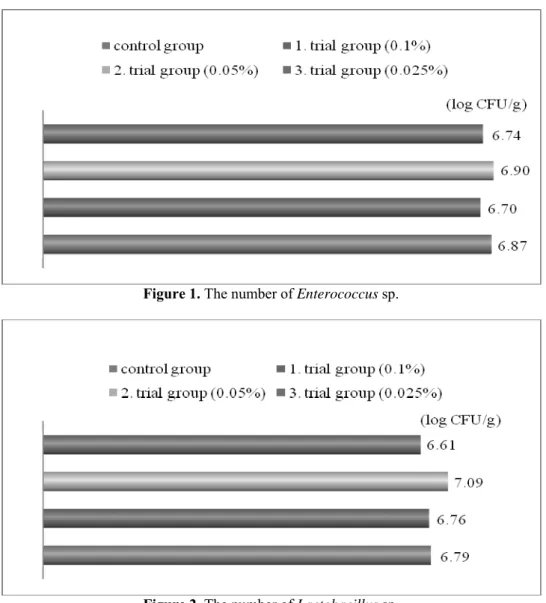
The average number of Enterococcus sp. in caecal chyme of broiler chicken was 6.70 log CFU/g at the 0.1% portion of Cinnamomi aetheroleum, 6.90 log CFU/g at the 0.05% portion of Cinnamomi aetheroleum and 6.74 log CFU/g at the 0.025% portion (Figure 1). The average number of Enterococcus sp. in caecal chyme of broiler chicken was 6.87 log CFU/g in the control group. The average number of Lactobacillus sp. in caecal chyme of broiler chicken was 6.76 log CFU/g at the 0.1% portion of Cinnamomi aetheroleum, 7.09
log CFU/g at the 0.05% portion of Cinnamomi aetheroleum and 6.61 log CFU/g at the 0.025% portion. The average number of Lactobacillus sp. in caecal chyme of broiler chicken was 6.79 log CFU/g in the control group (Figure 2).
Our results correspond with results of Jamroz et al. [26], who determined, based on the experiments, that essential oils used in feedstuff increased the number of Lactobacillus sp. in small intestine of broiler chicken.
of antimicrobial behaviour of essential oils is not examined enough. Some literary information indicates that their lipophile characteristics [28] and chemical structure [29] could have significant physiological function.
Antimicrobial behaviour of essential oils is explained by Gabert a Sauer [30], Sikkema et al. [31], Roth a Kirchgessner [32] by the pervasion
through bacterial ectoplasm, disintegration of membrane structures and by changes in permeability for H+ and K+ cations.
Antimicrobial behaviour is also explained by Helander et al. [33] a Greathead [34] by lipophile characteristics of essential oils, which disintegrate bacterial ectoplasm structure and integrity through inactivation of extracellular enzyme.
Figure 1. The number of Enterococcus sp.
Figure 2. The number of Lactobacillus sp.
According to Windisch et al. [22] a primary way of essential oils activity is a positive effect on gastrointestinal microflora ecosystem. Due to the bigger stabilization of intestinal microflora, broiler chicken are less exposed to ineligible microbial
metabolites, so the conditions of intestinal chyme for nutrition availability and their utilization could be improved. As a result, a production of broiler chicken within their genetical potential could be improved.
4. Conclusions
At the present time, there are a lot of proposals, scientific projects about natural based alternatives for feed antibiotics. Preservation of broiler chicken has an important position at animal origin foodstuff production. Nutritional values of chicken meat are the reason, which consumers are looking for, especially for its dietetic characteristics and high content of nutrition.
According to mentioned before, we focused on Cinnamomi aetheroleum as an alternative to feed antibiotics. We monitored and evaluated different portions of Cinnamomi aetheroleum in feed mixtures, related to the colonization of intestinal microflora by Lactobacillus sp. and Enterococcus sp. at broilers.
We achieved the results, that the lowest number of Lactobacillus sp. in caecal chyme was 6.61 log CFU/g at the 0.1% portion of Cinnamomi aetheroleum, the highest number of 7.09 log CFU/g was at the 0.05% portion of Cinnamomi aetheroleum and 6.79 log CFU/g in the control group. The lowest number of Enterococcus sp. in caecal chyme was 6.74 log CFU/g at the 0.1% portion of Cinnamomi aetheroleum, the highest number of 6.90 log CFU/g was at the 0.05% portion of Cinnamomi aetheroleum and 6.87 log CFU/g in the control group. Based on our experiment, we can allege, that the 0.05 % portion of Cinnamomi aetheroleum had a positive effect on gastrointestinal microflora ecosystem Lactobacillus sp. and Enterococcus sp. at broilers.
Acknowledgements
This work was supported by Scientific Grant Agency under the contract No. VEGA 1/0007/11.
References
1. Amrik, B., Bilkei, G., Influence of farm application of oregano on performances of sows, Canadian Veterinary, 2004, 45, 674-677
2. Bansod, S., Rai, M., Antifungal Activity of Essential Oils from Indian Medicinal Plants Against Human Pathogenic Aspergillus fumigatus and A. niger, World
Journal of Medical Sciences,2008, 3, 2, 81-88. ISSN 1817-3055
3. Osman, N., Talat, G., Mehmet, C., Bestami, D., Simsek, G., The effect of an essential oil mix derived from oregano, clove and aniseed on broiler performance, International Journal of Poultry Science, 2005, 4, 879-884
4. Yu, H. S., Lee, S. Y., Jang, C. G., Involvement of 5-HT1A and GABAA receptors in the anxiolytic-like effects of Cinnamomum cassia in mice, Pharmacology
Biochemistry and Behavior, 2007, 87, 164-170
5. Morris, J. A., Khettry, A., Seitz, E. W., Antimicrobial activity of aroma chemicals and essential oils, Journal of the American Oil Chemists’ Society,
1979, 56, 595-603
6. Lis-Balchin, M., Deans, S. G., Bioactivity of selected plant essential oils against Listeria monocytogenes,
Journal of Applied Bacteriology,1997, 82, 759-762 7. Aggarwal, K. K., Ahmad, A., Kumar, T. R. S., Jain, N., Gupta, V. K., Kumar, S., Khanuja, S. P. S., Antimicrobial activity spectra of Pelargonium graveolens L. and Cymbopogon winterianus Jowitt. oil
constituents and acyl derivatives, Journal of Medicinal and Aromatic Plant Sciences, 2000, 22, 544-548 8. Viollon, C., Chaumont, J. P., Antifungal properties of essential oils and their main components upon
Cryptococcus neoformens, Mycopathologia,1994,128,
151-153
9. Taback, M., Armon, R., Neeman, I., Cinnamon extracts inhibitory effect on Helicobater pylori,
Journal of Ethnophamacology, 67, 1999, 269-277 10. Chang, S. T., Chen, P. F., Chang, S. C., Antibacterial activity of leaf essential oils and their constituents from Cinnamomun osmophloeum. Journal
of Ethnopharmacology, 2001,77, 123-127
11. Montes-Belmont, R., Carvajal, M., Control of
Aspergillus flavus in maize with plant essential oils and
their components, Journal of Food Protection, 1998, 61, 616-619
12. Gurdip, S., Sumitra, M., Delampasona, M. P., Cesar, A. N. C., A comparison of chemical, antioxidant and antimicrobial studies of cinnamon leaf and bark volatile oils, oleoresins and their constituents, Food and Chemical Toxicology, 2007, 45, 1650-1661
13.Mastura, M., Azah, M., Khozirah, S., MAWARDI, R., Manaf, A. A., Anticandidal and antidermatophytic activity of Cinnamomum species essential oils, Cytobios, 1999, 98, 17-23
14. Liptaiová, D. 2011. The modeling of feedstuff efficiency with Cinnamomi aetheroleum for broilers :
PhD thesis. Nitra : SPU, 2011. pp. 138
15. Slovak Pharmaceutical Code, Ed. 1. Bratislava: Herba, 1997, pp. 37-39, ISBN 80-967020-3-3
16. Brand-Wiliams, W., Cuvelier, M. E., Berset, C., Use of a free radical method to evaluate antioxidant activity, Lebensmittel Wissenschaft und Technologie, 1995, 28, pp. 25-30
17. Sánchez-Moreno, C., Larrauri, J., Saura-Calixto, F., A procedure to measure the antiradical efficiency of polyphenols, Journal of the Science of Food and Agriculture, 1998, 76, 270-276
mikroorganizmov. Metóda počítania kolónií kultivovaných pri 30°C
19. Lambert, R. J. W., Skandamis, P. N., Coote, P. J., Nychas, G. J. E., A study of the minimun inhibitory concentration and mode of action of oregano essential oil, thymol and carvacrol, Journal of Applied Microbiology, 2001, 91, 453-462
20. Ruberto, G., Barrata, M. T., Sari, M., Kaabehe, M., Chemical composition and antioxidant activity of
essential oils from Algerian Origanum
Glandulosum Desf., Flavour and Fragrance Journal,
2002, 17, 251-254
21. Burt, S., Essential oils: their antibacterial properties and potential applications in Foods: a review. International Journal of Food Microbiology,2004, 94, 223-253
22. Windisch, W. M., Schedle, K., Plitzner, C., Kroismayr, A., Use of phytogenic products as feed additives for swine and poultry, Journal of Animal Science,2008, 86, 140-148
23. Kim, J., Marshall, M. R., Wei, C., Antimicrobial activity of some essential oil components against five food borne pathogens, Journal of Agricultural and Food Chemistry, 1995, 43, 2839-2845
24. Sivropoulou, A., Papanikolaou, E., Nikolaou, C., Kokkini, S., Lanaras, T., Arsenakis, M., Antimicrobial and cytotoxic activities of Origanum essential oils, Journal of Agricultural and Food Chemistry, 1996, 44, 1202-1205
25. Skandamis, P., Tsigarida, E., Nychas, G. J. E., The effect of oregano essential oil on survival/death of
Salmonella typhimurium in meat stored at 5 1C under
aerobic, VP/MAP conditions, Food Microbiology, 2002, 19, 97-103
26. Jamroz, D., Wiliczkiewicz, A., Wertelecki, T., Orda, J., Sukorupinska, J., Use of active substances of plant origin in chicken diets based on maize and locally
grown cereals, British Poultry Science, 2005, 46, 485-493
27. Si, W., Gong, J., Tsao, R., Zhou, T., Yu, H., Poppe, C., Johnson, R., Du, Z., Antimicrobial activity of essential oils and structurally related synthetic food additives towards selected pathogenic and beneficial gut bacteria, Journal of Applied Microbiology, 2006, 100, 296-305
28. Conner, D. E., Naturally occurring compounds. In Davidson, P., Branen, A. L.,Antimicrobials in Foods.
Ed. New York :Marcel Dekker, 1993, 441-468 29. Farag, R. S., Badei, A. Z., Hewedi, F. M., El-Baroty, G. S., Antioxidant activity of some spice essential oils on linoleic acid oxidation in aqueous media, Journal of the American Oils Chemists` Society, 1989, 66, 792-799
30. Gabert, V. M., Sauer, W. C., The effect of supplementing diets for weanling pigs with organic acids, Journal of Animal and Feed Sciences, 1994, 3, 73-87
31. Sikkema, J., De Bont, J. A. M., Poolman, B., Interactions of cyclic hydrocarbons biological membranes, Journal of Biological Chemistry,1994, 11, 8022-8028
32. Roth, F. X., Kirchgessner, M., Organic acids as feed additives for young pigs: nutritional and gastrointestinal effects, Journal of Animal and Feed Sciences, 1998, 8, 25-33
33. Helander, I. M., Alakomi, H. L., Latva-Kala, K., Mattila-Sandholm, T., Pol, I., Smid, E. J., Gorris, L. G. M., Von Wright, A., Characterization of the action of selected essential oil components on Gram-negative bacteria, Journal of Agricultural and Food Chemistry, 1998, 46, 3590-3595