Sharif University of Technology
Scientia IranicaTransactions E: Industrial Engineering www.scientiairanica.com
Framework for prioritizing and allocating six sigma
projects using fuzzy TOPSIS and fuzzy expert system
A. Jafarian
a;, M. Shaei Nikabadi
band M. Amiri
aa. Department of Industrial Management, Faculty of Management, Allameh Tabataba'i University Business School (ATUBS), Tehran, Iran.
b. Department of Business Management, Faculty of Economics and Management, Semnan University, Semnan, Iran. Received 5 January 2012; received in revised form 15 December 2012; accepted 25 January 2014
KEYWORDS Six sigma; Six sigma project selection;
Fuzzy TOPSIS; Projects allocation; MCDM;
Fuzzy expert system.
Abstract. The project selection process can be recognized as the most important action in the success of six sigma projects. In this way, ranking and assigning projects to implementation teams is considered the most important step in this process. Copious research has been undertaken into Six Sigma Project Selection (SSPS), none of which, however, has been focused on selecting and allocating projects as a coherent process, simultaneously. In this regard, this article presents a framework for decision making, selecting and assigning the six sigma projects to implementation teams. First, the most important criteria in the SSPS process are selected. Subsequently, after identifying six sigma potential projects in the organization, the fuzzy TOPSIS methodology is utilized to prioritize them. Afterwards, the Impact and Eort indexes for each project are calculated. Then, the Takagi-Sugeno-Kang (TSK) Fuzzy Expert System is used to allocate the projects to six sigma specialists. Finally, a case study in the automobile industry is presented and the framework is discussed to illustrate its developed application.
© 2014 Sharif University of Technology. All rights reserved.
1. Introduction
Technology dominates current industry, paving the way for construction of dynamic environments. Meanwhile, organizations require constant change in order to sur-vive erce competition, at the mercy of quality im-provement and cost reduction. In this regard, six sigma is considered one of the most popular tools for waste elimination, cost reduction and quality improvement throughout organizations [1]. In order to implement six sigma projects, a ve-step process, named DMAIC (Dene, Measure, Analyze, Improve and Control), is considered the key to achieving project goals [2], and
*. Corresponding author. Mobile: +98 912 2375897; Fax: +98 21 88623412
E-mail addresses: [email protected] (A. Jafarian); [email protected] (M. Shaei Nikabadi); mg [email protected] (M. Amiri)
to continuously dene and solve any problems [3,4]. Results and improvements in time are considered manifest features of this approach [5,6]. Six sigma clearly relates technical activities to strategic activities. Consequently, a developed six sigma project can be compatible with international results-oriented quality awards, such as the European Quality Award, the Malcolm Baldrige National Quality Award (MBNQA), Canada Awards for Excellence and Quality Awards-Australian [7]. Przekop showed, by comparison be-tween MBNQA and six sigma programs, that both are focused on method, customers, collaboration, data-oriented management and strategic plans [8]. There-fore, quality award criteria can be known as project selection criteria in the success of six sigma projects. Although this topic has been generally attended to by researchers, few are related to Six Sigma Project Selection (SSPS).
issue of SSPS. These include Snee (2002) and Dickman (2003) who have worked on six sigma criteria identi-cation and developed a multi-criteria decision making model for ranking six sigma projects [9,10]. Su and Chia (2008) systematically studied the identication and creation of SSPS criteria and considered the ranking of six sigma projects using a fuzzy Analytic Hierarchy Process (AHP) [5]. Kumar et al. (2007) provided a Data Envelopment Analysis (DEA) model using identication of the input and output of projects for six sigma project performance evaluation [11]. Kahraman and Buyukzkan (2008) presented a weighted additive fuzzy goal programming methodology by the AHP method for the best suitable six sigma project portfolio [12]. Yang and Hsieh (2008) developed a Fuzzy AHP decision making model for evaluating and selecting six sigma projects [13]. Saghaei and Didehkhani (2010) presented a fuzzy goal programming model and Adaptive Neuro-Fuzzy Inference Systems (ANFIS) for evaluating and selecting six sigma pro-jcts [1].
It is clear that the prioritizing of six sigma projects is discussed in research, but there has been no model developed for allocating projects to executive teams and six sigma experts. In addition, there is no model which prioritizes and selects six sigma projects, and also allocates them to related specialists, simultaneously. Therefore, this paper is innovative in endeavouring to develop a comprehensive framework, presenting a step by step process to identify poten-tial six sigma projects throughout an organization, to prioritize potential projects using fuzzy TOPSIS, and allocate them to specialists, according to their prociencies, through a fuzzy expert system method, at the same time.
The rest of the paper has the following structure. The next section is related to research literature in which, six sigma methodology, six sigma potential project identication, fuzzy TOPSIS, and the method of project allocation have been studied. The model includes introduction of the research methodology, and the presented model in this study is explained in Section 3. Section 4 states implementation of the presented framework as a case study, and, nally, Section 5 is devoted to conclusions and suggestion for future research.
2. Literature review
2.1. Six sigma and SSPS criteria
Six sigma was rst developed by Motorola in 1987 and was commonly utilized by General Electric in early 1995 [14]. Its purpose was to produce long-term defect levels, below 3.4 Defects Per Million Opportunities (DPMO) [15,16]. Six sigma can be called an invention for producing high level results, improving operational
processes, enhancing employee skills and encouraging changes [17].
From the perspective of experts, six sigma is dened as an ecient and data-oriented approach for analyzing business problems and their root causes in order to solve them. Consequently, this methodology is known to be one of the most eective methods among the plethora of ways to improve businesses [18]. Six sigma has been used throughout the world and many companies have conrmed its pivotal role in their success [19]. This approach focuses on reducing vari-ations in processes, such as manufacturing processes, administrative processes, etc. [20]. Six sigma is a technical tool for creating value, with the purpose of attaining operational advantages that pave the ground for achieving business success [7]. If six sigma projects are wrongly selected from the beginning, they will be inecient and lead to a loss in time and costs [5]. Therefore, one of the most essential and critical stages in the process of six sigma is project selection [9]. According to studies carried out in this area, a set of potential criteria that can be utilized in selecting important six sigma projects are known and presented as follows:
- Direct relations with strategic objectives [10,21];
- Customer satisfaction [21];
- Financial eciency-increasing prots [21,22];
- The organization's key processes [21];
- Investment returns [23,24];
- Ability to access information [21];
- Special need to improve [10] measurability [25];
- Needed time [26,27];
- Resource availability (including manpower) [21];
- Employee satisfaction from projects [21];
- Project scope [10].
2.2. Identifying the six sigma potential projects
A collection of information from various accessible sources can be used in potential project identica-tion [9]. In this regard, the most important and relevant sources are:
(i) Customer satisfaction evaluation results: Cus-tomers are the rst beneciaries of reduced dam-age [5];
(ii) Voice Of Customers (VOC): Telephone services, correspondence services, internet services and focused groups are considered major sources for collecting VOC [10];
(iii) Suppliers: an overall look at the processes causes a belief that suppliers are also considered a part of
the process. Ignoring the supplier and consumer generates some problems for the project selection process [9];
(iv) Employees: The organization's employees are potential project identication resources [15];
(v) Previous projects: On hand projects or done projects can present some proposals for identify-ing potential projects (future projects should not conict with current projects or intervene in their aairs);
(vi) Competitor analysis: This action can lead to improvement in competitive advantages and in-crease the competitions power, especially in com-petitive environments [3];
(vii) Waste identication: Studying seven types of waste, i.e. waiting, inventory, defects, over-processing, overproduction, unnecessary trans-portation and motion, can be an encouragement and operate as an informative source of potential project identication [28];
(viii) Cost Of Quality (COQ) reports [29], also, the role of income opportunities related to capacity and sale, and strategic goal reconsideration [4,30] should not be simply overlooked.
Finally, six sigma potential projects can be iden-tied in each company by collecting information from the aforementioned sources and brainstorming meet-ings [6].
2.3. Fuzzy TOPSIS
The TOPSIS model is one of the Multiple Attribute Decision Making (MADM) models that have been used for choosing the best alternative, as the other methods in MADM. The TOPSIS model was proposed by Hwang and Yoon [31] in 1981 and is one of the most widely used models of MADM [32-34]. TOPSIS oers the point, as the solution, that is, simultaneously, the farthest distance from the negation ideal and the near-est distance to the positive ideal [35]. In addition, when assessments are qualitative and linguistic variables are used, fuzzy TOPSIS can be suitable. In this regard, as in a realistic approach, we may use linguistic evaluation rather than numerical values, this technique can be used for six sigma project selection [36]. The TOPSIS method is considered a major MADM technique in comparison with other related techniques like AHP and ELECTRE [35,37,38]:
(i) It can include an unrestricted range of criteria and performance attributes;
(ii) It paves the way for explicit trade-os and in-teractions among attributes. In other words, changes in one attribute can be neutralized by other attributes, in a direct or indirect manner;
(iii) It not only provides us with preferential ranking of alternatives, but also calculates a numerical value for each alternative for a better understand-ing of the dierences and similarities between alternatives, while other MADM techniques (like ELECTRE) only determine the rank of alterna-tive;
(iv) It avoids pair wise comparisons required by meth-ods such as AHP. This method is especially useful when dealing with a large number of alternatives and criteria;
(v) It provides us with a systematic procedure, streamlined with a relatively simple computation process.
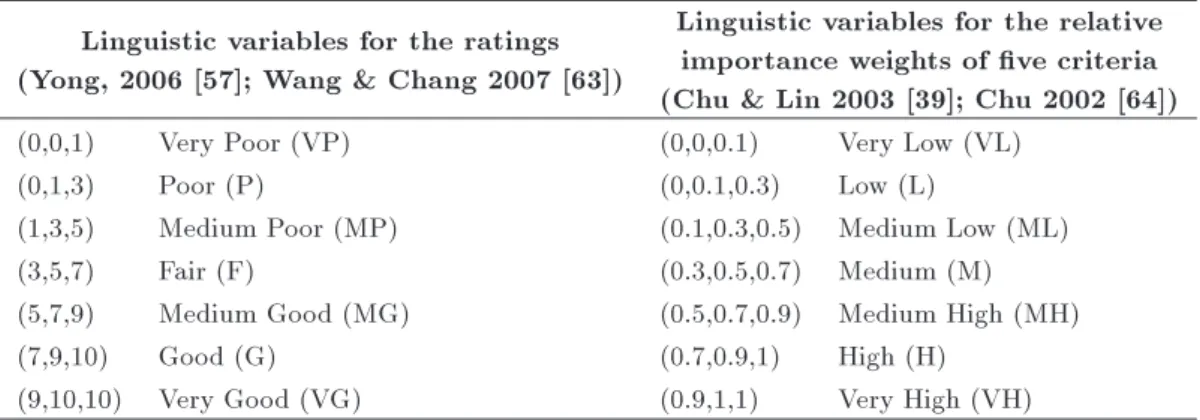
In this decision making method, it is assumed that K decision makers valuate m decision options or alternatives evaluated by n criteria [39]. The existing criteria are divided into two kinds, i.e. benet (should be more) and cost (should be less) criteria [40]. Since most researchers that apply the Fuzzy TOPSIS method in their investigations use triangular fuzzy numbers [40,41], this paper has recognized its suitabil-ity, too. A triangular fuzzy number, ~A, dened by a triplet, ~A = (a; b; c), and its membership function, are shown in Figure 1. For a more detailed and complete review of fuzzy set denitions, readers are referred to [31,41]. In this paper, as the problem has very complex, or not well dened conditions [41], we use the linguistic variables as dened in Table 1.
2.4. Allocating the six sigma projects
Six sigma projects are allocated to the relevant spe-cialists, including black belts and green belts. Each project is assigned to a relevant expert, according to its importance and diculty, and this stage is an important step in the success of six sigma projects [3,9]. Consequently, in this step, it is desired to allocate projects to qualied specialists, by considering the amount of eort (diculty) and the impact of potential projects (important), that are allowed in order to postpone some projects.
2.4.1. Fuzzy expert system
From the previous decade, the use of expert systems (or knowledge-based systems) has extensively been
Figure 1. Triangular fuzzy number and the membership function [8].
Table 1. Linguistic variables and their corresponding triangular fuzzy numbers. Linguistic variables for the ratings
(Yong, 2006 [57]; Wang & Chang 2007 [63])
Linguistic variables for the relative importance weights of ve criteria (Chu & Lin 2003 [39]; Chu 2002 [64])
(0,0,1) Very Poor (VP) (0,0,0.1) Very Low (VL)
(0,1,3) Poor (P) (0,0.1,0.3) Low (L)
(1,3,5) Medium Poor (MP) (0.1,0.3,0.5) Medium Low (ML)
(3,5,7) Fair (F) (0.3,0.5,0.7) Medium (M)
(5,7,9) Medium Good (MG) (0.5,0.7,0.9) Medium High (MH)
(7,9,10) Good (G) (0.7,0.9,1) High (H)
(9,10,10) Very Good (VG) (0.9,1,1) Very High (VH) increased [42]. The main dierence between expert
systems and other software is that expert systems process knowledge, but other software processes data or information [43]. Expert systems provide a powerful, exible method to solve various problems that cannot be solved by conventional methods [42]. The fuzzy expert decision support system is a type of expert system that uses fuzzy logic instead of Boolean logic (a complete system for logical operations). In other words, it uses fuzzy logic in its knowledge-base and deduces conclusions from user input and fuzzy inference processes [44]. Therefore, fuzzy rules and membership functions construct a knowledge-based system [42]. This means that a \fuzzy If-Then" rule is an \If-Then" rule, where some of its terms are denoted by continuous functions [45].
Fuzzy expert systems have been successfully ap-plied to various real world applications, such as indus-trial process control, complex systems modelling and developing fuzzy inference systems [46,47]. Due to the widespread use of these systems, fuzzy inference systems are also known as fuzzy rule-based systems, fuzzy expert systems, fuzzy associative memories and fuzzy systems. All in all, a fuzzy system is composed of ve components [48]:
Fuzzier: Converts the crisp inputs into degrees of match with linguistic values;
Dictionary: Membership functions of the fuzzy sets used in the fuzzy rules are dened;
Fuzzy rule base: Includes fuzzy If-Then rules with the dictionary and also the knowledge base of the fuzzy system;
Decision maker: Performs inference operations on the rules;
Defuzzier: Transforms the fuzzy results of infer-ence into a crisp output.
An expert system includes the following sections [42]:
a) Fuzzy inference engine: It is a program that analyzes the knowledge and rules aggregated in the
database, and through this way, it nds the logical result. There are dierent choices for the fuzzy inference engine that depend on the aggregation, implication and the operators used for s-norm and t-norm [49].
b) User interface: The users of expert systems are organizational decision makers that log the real value of all linguistic variables by user interface. In addition, user interface exhibits index E for each six sigma project and uses MATLAB user interface to provide this aim in the designed system [42].
c) Fuzzy rule base: The fuzzy rule base provides a mechanism for building up the fuzzy rules which are conditional statements that can generally be represented by:
If x is Xi and y is Yi and Then o is Oi; (1)
where x and y are linguistic input variables, and linguistic values of Xiand Yiare dened as possible
linguistic values for x and y, respectively. Similarly, the decision variable or output, o, is a linguistic variable modelled as a fuzzy set with a possible value, Oi [42,50]. The knowledge representation in
the form of rules, due to having a high modularity degree, paves the way for us to remove, add or amend easily [50].
Generally speaking, a fuzzy rule is an implication statement displayed with an If-Then rule in which the premise and the conclusion are fuzzy sets. The \If" part is the basic component, referring to the antecedent, and comes in initially. Subsequently, the \Then" part is usually mentioned (as, if antecedent, then, consequent) [48]. The antecedent can be a combination of a single condition or a set of conditions combined by a conjunction operator like \AND" and \OR". The rules have been settled once. In the next step, the matching degree of inputs with respect to fuzzy rules is determined for performing the inference process. If the problem includes multiple inputs, a conjunction operator will be used to combine the
matching degree of the fuzzy inputs utilizing \max", \min", or \product" [51,52].
Several types of fuzzy system have been developed based on dierent tastes for the major blocks of a fuzzy system and various kinds of applications to which fuzzy systems are applied. Two types of fuzzy system that are commonly used are Mamdani fuzzy systems and Takagi-Sugeno-Kang (TSK) fuzzy systems [51,52]. They are applied in special elds due to their dierent abilities in dierent ways of knowledge representation. Mamdani fuzzy systems and TSK fuzzy systems are the same in some aspects, such as making fuzzy inputs and fuzzy operators. But, the main dierence between these two methods is that the output of the TSK method is a member of functions that can be linear or constant, while, in the Mamdani inference, we expect the output to be a member of fuzzy sets [53]. In the design of the considered system in this paper, the TSK method is used based on expected results, although other types of fuzzy system, such as Tsukamoto fuzzy systems [54], ANFIS [55,56] etc., have their own par-ticular applications. A comprehensive review on fuzzy systems can be found in [48,51,53].
3. Proposed framework for allocating and selecting the six sigma projects
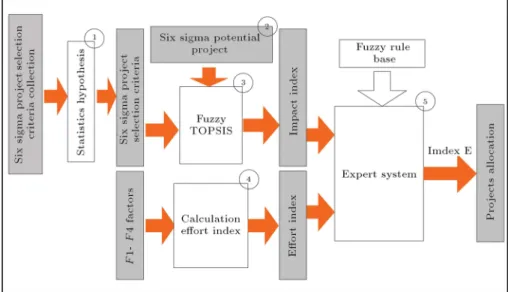
The main purpose of this paper is to provide a framework for prioritizing and allocating the six sigma projects for implementing in industrial units. The steps of the presented framework are illustrated in Figure 2. Step 1. Selecting the most importance criteria: This step should be performed, as the selection processes of six sigma project criteria are incomparable, and these criteria dier in various industrial units. In this step, those criteria that are more important than others in
an industrial unit are prioritized and selected by the hypothesis test of the criteria mean for entering the third step. Hence, a survey is done from the viewpoint of six sigma implementation specialists, quality con-trol personnel, quality assurance engineers, industrial specialists and experienced personnel of other depart-ments of the organization who have a comprehensive perspective of their industrial units. It is better to equally select persons from dierent departments of an industrial unit; otherwise, selected criteria will tend towards the activities of a particular department. Step 2. Review of potential projects in the studied industrial units: This step requires formation of a quality group in the organization. In this section, potential projects in industrial units are identied using criteria which have been examined in the literature. Step 3. Projects prioritization using fuzzy TOPSIS and determining the impact index for each project: The inputs of this stage are potential projects (output stage 2) and important criteria in the industrial units (output stage 1). Project prioritization and nal weight are named \Impact index", and are calculated by fuzzy TOPSIS. The utilized fuzzy TOPSIS method is proposed by Chen et al. [41] and Yong [57], and its assumptions are as follows:
A committee of k decision-makers, E = fD1; D2;
; Dkg;
A set consists of m alternative, A = fA1; A2;
; Amg;
A set consists of n criteria, C = fC1; C2; ; Cng,
that measures the performance of alternatives;
A set consists of the alternatives rating, Ai(i =
1; 2; ; m), with respect to criteria, Cj(j =
1; 2; ; n), that is, X = fXij; i = 1; 2; m; j =
1; 2; ng:
In this section, it is assumed that we have K makers and the fuzzy rating of any decision-maker, Dk(k = 1; 2; ; K), can be exhibited by
triangular fuzzy numbers, ~Rk(k = 1; 2; ; K), with
the membership function, R~k(x). In other words, the
fuzzy rating of all decision-makers is dened as: ~
R = (a; b; c); k = 1; 2; 3; ; K; (2) where, a = min
k fakg, b = 1 k
k
P
k=1bk, and c = maxk fckg,
and also fuzzy weight, ( ~wj), of each criterion can be
dened as follows: ~
wj = (wj1; wj2; wj3);
so that:
wj1= mink fwjk1g; wj2=k1 K
X
k=1
wjk2;
wj3= maxk fwjk3g: (3)
In general, a Multiple Criteria Decision Making (MCDM) problem can be expressed in the matrix format as follows:
~
W = [ ~w1; ~w2; ; ~wn] ;
D = 2 6 6 6 4
~x11 ~x12 ~x1n
~x21 ~x22 ~x2n
... ... ... ... ~xm1 ~xm2 ~xmn
3 7 7 7
5: (4)
To avoid the complexity of mathematical operations in the decision making process, a linear transformation is used to ensure compatibility between the fuzzy evalua-tion values of all criteria, which must be converted into a compatible scale (into dimensionless indices). The criteria can be classied into benet and cost criteria. Therefore, a normalized fuzzy-decision matrix can be expressed as R = [~rij]mn. In this equation, B and C
are benet and cost criteria, respectively. ~rij =
aj
cij;
aj
bij;
aj
aij
j 2 C; aj = mini aij; (5)
~rij = acij j ; bij c j ; cij c j !
j 2 B; c
j = maxi cij: (6)
Considering the dierent importance of each criterion, a weighted normalized fuzzy-decision matrix is created as:
~
V = [~vij]mn; i = 1; 2; ; m;
j = 1; 2; ; m; (7)
where ~ij = ~rij: ~wj, and ~wj is the weight of the jth
attribute or criterion. The Positive Ideal Solution (PIS) (A) and Negative Ideal Solution (NIS) (A ) can be
dened as: A= (~v
1; ~v2; ; ~vn) ; (8)
A = ~v1; ~v2; ; ~vn: (9)
If ~m = (m1; m2; m3) and ~n = (n1; n2; n3) are two
tri-angular fuzzy numbers, the distance between them can be calculated using the maximum height as follows [41]:
dv( ~m; ~n)
= r
1 3 h
(m1 n1)2+(m2 n2)2+(m3 n3)2
i : (10) Consequently, the distance of each alternative from A
and A is calculated, respectively, as follows: d
i = n
X
j=1
dv ~vij; ~vj
; i = 1; 2; ; m; (11)
di =
n
X
j=1
dv ~vij; ~vj
; i = 1; 2; ; m: (12) At the end, relative closeness is used for ranking the alternatives. This index considers PIS and NIS simultaneously. Consequently, an alternative should be chosen that is closer to PIS and farther from NIS.
CCi= ddi
i + di ; (13)
i = 1; 2; ; m; 0 CCi 1:
The alternatives are ranked according to the relative closeness. The best alternatives are those that have higher value.
Step 4. Calculating the eort index of projects: To determine criteria that have the Eort concept for the projects, the eight six sigma experts (graduates having 5 years experience in six sigma projects) are asked to introduce those factors that have the Eort concept for the six sigma projects. After sending and receiving the questionnaire three times, four criteria, i.e. project scope, F1, availability of resources, F2, needed time, F3,
and ability to access information, F4, were selected.
F2 and F4 criteria have a positive context and
F1 and F3are negative criteria. Positive criteria mean
that a higher value is better, while negative criteria are vice versa. The purpose of Eort index determination is evaluation of the eort required for implementing six sigma projects. Therefore, the Eort index can be considered a negative concept. In this regard, if
a project needs less eort, it will be allocated to less expert persons, i.e. green belts, and if a project requires more eort, it will be allocated to more expert persons, i.e. black belts.
For converting F2and F4criteria that are positive
criteria, Table 1 is used for the fuzzy values. Also, the fuzzy values of F1 and F3 criteria that are negative
criteria are obtained as VL = (0,0,1), L = (0,1,3), ML = (1,3,5), (3, 5,7) = M, MH = (5,7,9), H = (7,9,10) and VH = (9,10,10). The normalized value of numbers can be expressed as:
R = [~rij]mn: (14)
In this regard, B and C are the benet and cost criteria in order, and can be obtained as:
~rij= aCij j;
bij
C j;
Cij
C j
!
j 2 B; C
j = maxi Cij;
(15) ~rij= 10 CC ij
j ;
10 bij
C j ;
10 aij
C j
!
j 2 C; C
j = maxi Cij: (16)
Then, after normalizing the criteria, the `Eort index' is calculated, according to Eq. (17). In this equation, the weights of criteria are considered dierently. In addition, if their weights are considered equal, the Eort index can be evaluated from Eq. (18):
Eort index = P4
j=1wifi
P4
j=1wi
; X4
j=14wi= 1; (17)
Eort index = P4
j=1fi
4 : (18)
Finally, after calculating the Eort index, it should be defuzzied into a crisp value for input to a fuzzy expert system, and can be obtained as:
Eort index = (a; b; c) defuzzy!(a + 4b + c)6 : (19) Step 5. Allocation of six sigma projects using fuzzy expert system: The TSK fuzzy system was developed as a systematic approach for generating fuzzy rules from a given input-output data set [48]. The rules of this fuzzy system are dened as [48,52]:
If x1 is A1 AND/OR x2 is A2 then y =f(x1; x2);
(20) where A1 and A2 are fuzzy sets and y is a function
(usually linear) of crisp variables. In order to perform
inference operations, the output of each rule should be weighted. For instance, the jth rule is calculated as:
Rj: If x1 is Aj AND x2 is Bj then yj=fj(x1; x2):
(21) The weight, wj, is calculated as wj=AND method
(Aj(X1); Bj(X2)), and where Aj(:) and Bj(:) are
considered membership functions of Ajand Bj,
respec-tively, and the AND method is an operation dened by the AND operator that is usually the \min" operation. In this regard, if we consider the eect of rules to be the same, wj will be equal to one for all the
rules. The nal output of the system will be calculated as [48]:
Final output =X
j
wjyj=
X
j
wj: (22)
Fuzzy systems make decisions and generate output values based on knowledge that were provided by the designer in the form of If-Then rules [14]. The rule base qualitatively species how the output parameter of the six sigma project is determined for various instances of the input factors. The principles of the following rules were extracted from the research of Snee (2002) [9], Dickman & Doran (2003) [10], and Yang & Heshin (2009) [13]. These principles are stabilized on the basis of projects being selected and prioritized according to their importance to the company [1,58], and whichever projects are too dicult should be allocated to more qualied specialists [3]. Subsequently, the rules are dened as:
1. If (Impact index is VL) and (Eort index is VL) then (Index ES is VL);
2. If (Impact index is VL) and (Eort index is L) then (Index ES is VL);
3. If (Impact index is VL) and (Eort index is M) then (Index ES is VL);
4. If (Impact index is VL) and (Eort index is H) then (Index ES is L);
5. If (Impact index is VL) and (Eort index is VH) then (Index ES is L);
6. If (Impact index is L) and (Eort index is VL) then (Index ES is L);
7. If (Impact index is L) and (Eort index is L) then (Index ES is L);
8. If (Impact index is L) and (Eort index is M) then (Index ES is L);
9. If (Impact index is L) and (Eort index is H) then (Index ES is VL);
10. If (Impact index is L) and (Eort index is VH) then (Index ES is VL);
11. If (Impact index is M) and (Eort index is VL) then (Index ES is M);
12. If (Impact index is M) and (Eort index is L) then (Index ES is M);
13. If (Impact index is M) and (Eort index is M) then (Index ES is M);
14. If (Impact index is M) and (Eort index is H) then (Index ES is H);
15. If (Impact index is M) and (Eort index is VH) then (Index ES is H);
16. If (Impact index is H) and (Eort index is VL) then (Index ES is M);
17. If (Impact index is H) and (Eort index is L) then (Index ES is M);
18. If (Impact index is H) and (Eort index is M) then (Index ES is M);
19. If (Impact index is H) and (Eort index is H) then (Index ES is H);
20. If (Impact index is H) and (Eort index is VH) then (Index ES is VH);
21. If (Impact index is VH) and (Eort index is VL) then (Index ES is M);
22. If (Impact index is VH) and (Eort index is L) then (Index ES is M);
23. If (Impact index is VH) and (Eort index is M) then (Index ES is M);
24. If (Impact index is VH) and (Eort index is H) then (Index ES is H);
25. If (Impact index is VH) and (Eort index is VH) then (Index ES is VH) .
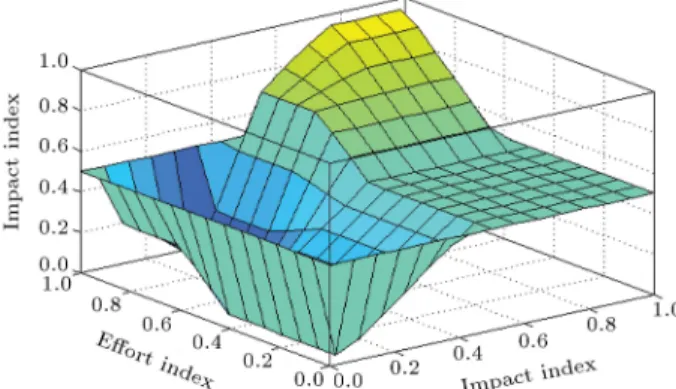
Sensitive analysis of a fuzzy expert system for six sigma project allocation is illustrated in Figure 3.
Expert system output (ES index) is a crisp value with a range between 0 and 1, and is used for deci-sion making about project allocation, as illustrated in Figure 4. This range is divided into three segments:
Figure 3. The sensitive analysis of fuzzy expert system for six sigma project allocation.
Figure 4. The ranges of index ES and decision making about its dierent values.
i) Projects whose ES index is less than a will either be given up or postponed for consideration in future projects;
ii) Projects whose ES index is between and will be allocated to green belts;
iii) Projects whose ES index is more than will be allocated to black belts.
The deterministic value of a and are not the same for all companies; some factors, such as the expertise level of six sigma professionals, the experience of the company in six sigma project implementation, the number of six sigma professionals etc. are all eective in determination of the values of a and . Consequently, these parameters should be specied in each company depending on its situation. It is clear that the implementation sequence of projects is on the basis of fuzzy TOPSIS ranking. The projects that are not executable at this step are sent to the second step for review.
Finally, by allocating projects to specialists, the work begins with the project charter (project descrip-tion) [6,59,60], and, by using the framework presented in this paper, one can be condent of eective and ecient project implementation by the appropriate six sigma specialists.
4. Case study
This company is one of the top suppliers of Iran Khodro Co. (IKCo). In the rst step of the presented frame-work, the most important criteria were considered in this industrial unit. In this regard, a questionnaire was distributed among 40 employees (engineers, managers of production units, six sigma specialists including Green Belts and Black Belts, quality assurance spe-cialists and quality control experts). The response rate was 80 percent. The validity of the questionnaire, according to criteria, such as, availability of resources, direct relationship with strategic objectives, project scope etc., which were obtained from literature, were investigated and conrmed. The questions of the questionnaire are on the basis of the Likert Scale (a ve options range). The reliability of the questionnaire was calculated using Cronbach's alpha ( = 0:754).
Owing to the fact that the criteria whose impor-tance is greater than average are considered, relation (H0 : i 3; H1 : i > 3) is used for selecting the
criteria with above-average importance.
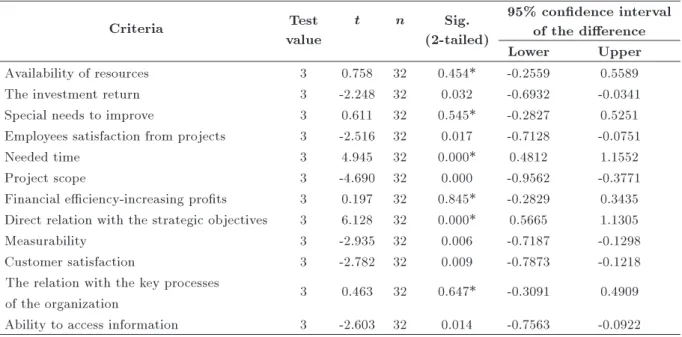
In the test of hypothesis about the mean, a t-test at the level of signicance 0.05, with Degree Of
Table 2. Statistical test results.
Criteria Test
value
t n Sig.
(2-tailed)
95% condence interval of the dierence
Lower Upper
Availability of resources 3 0.758 32 0.454* -0.2559 0.5589
The investment return 3 -2.248 32 0.032 -0.6932 -0.0341
Special needs to improve 3 0.611 32 0.545* -0.2827 0.5251
Employees satisfaction from projects 3 -2.516 32 0.017 -0.7128 -0.0751
Needed time 3 4.945 32 0.000* 0.4812 1.1552
Project scope 3 -4.690 32 0.000 -0.9562 -0.3771
Financial eciency-increasing prots 3 0.197 32 0.845* -0.2829 0.3435 Direct relation with the strategic objectives 3 6.128 32 0.000* 0.5665 1.1305
Measurability 3 -2.935 32 0.006 -0.7187 -0.1298
Customer satisfaction 3 -2.782 32 0.009 -0.7873 -0.1218
The relation with the key processes
of the organization 3 0.463 32 0.647* -0.3091 0.4909
Ability to access information 3 -2.603 32 0.014 -0.7563 -0.0922 Freedom n 1, is investigated. This test was done on
each question of the questionnaire and the results are shown in Table 2. Decision making about the statistical assumptions in SPSS16 software is on the basis of value Sig. (Signicance or P-value). Also, in these tests of hypothesis, if the value of Sig. is more than 0.05, H0
is not rejected [61].
Totally, for the six criteria that are more impor-tant than others, as cited by the respondents in this industrial unit, a statistical calculation was performed, including availability of resources, special needs to improve, and nancial eciency-increasing prots, and the relation with the key processes of the organization, i.e. needed time and direct relation with the strategic objectives (owing to the fact that both lower and upper limits of these criteria are positive, and their averages are certainly more than 3 [62]). These criteria will be used for prioritizing the six sigma project by the fuzzy TOPSIS method.
4.1. Selecting the six sigma potential projects At this step, for selecting the six sigma potential projects, the projects initial study is discussed in the studied company. In this context, at rst, potential projects, which have been extracted from assessment reports of customer satisfaction, employee suggestions, competitor analysis, the amount of waste costs and the results of Cost Of Quality (COQ), are supercially considered by quality control and quality assurance personnel of the company. After preliminary screening, six sigma projects; A1 (reduce internal PPM (Part Per
Million) of rocker arm), A2 (power steering system
structural problems), A3 (low-quality of Peugeot 405
tappet), A4(power steering system losses from external
logistics), A5(long process of responding to non
confor-mity of SAPCO (the only customer of the company)) and A6(reduce cycle time of raw material preparation),
are chosen for further evaluation.
4.2. Ranking the six sigma projects using fuzzy TOPSIS
Six potential projects (A1, A2, A3, A4, A5and A6) have
been selected for prioritization. These projects each have some strengths and weaknesses. For prioritizing the six sigma projects, six criteria are: Direct relation with the strategic objectives are (C1), the relation
with the key processes of the organization (C2),
-nancial eciency-increasing prots (C3), special needs
to improve (C4), needed time (C5), and availability of
resources (C6). The C1, C2, C3, C4and C6are benet
criteria and C5 is cost criteria. The benet criterion
means that a higher value is better, while, for the cost criterion, the opposite is valid. A committee of three decision-makers, D1, D2and D3, who are experienced
and experts in quality control, and six sigma projects (having graduate degrees and over 5 years experience in six sigma implementation) are used to assess the importance of the criteria, as shown in Table 3.
Table 3. The importance weight of the criteria. Criteria Decision makers Average of
weights D1 D2 D3
C1 ML ML M (0.03, 0.17, 0.37)
C2 H H H (0.50, 0.70, 0.90)
C3 VH VH H (0.63, 0.83, 0.97)
C4 L ML L (0.00, 0.03, 0.17)
C5 VH MH H (0.50, 0.70, 0.87)
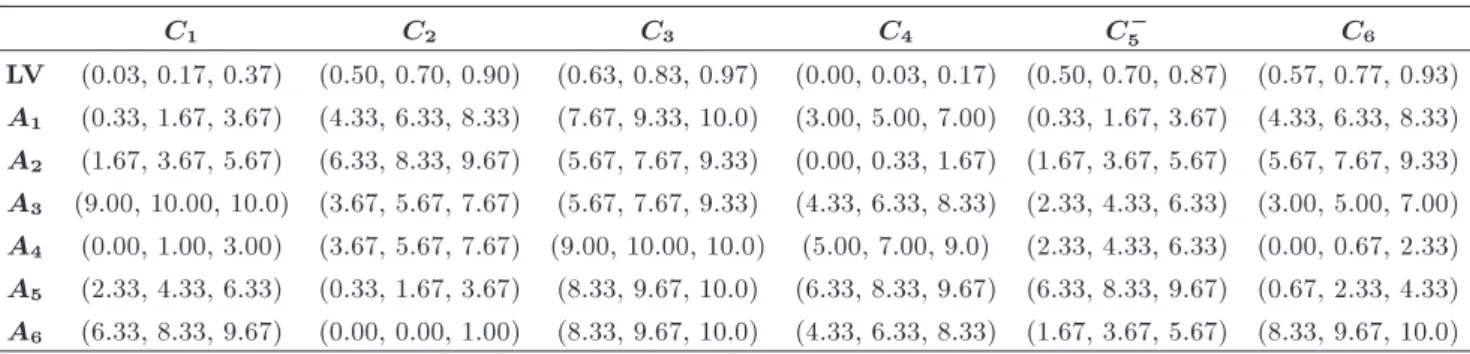
Table 4. Fuzzy decision making matrix and their fuzzy weights.
C1 C2 C3 C4 C5 C6
LV (0.03, 0.17, 0.37) (0.50, 0.70, 0.90) (0.63, 0.83, 0.97) (0.00, 0.03, 0.17) (0.50, 0.70, 0.87) (0.57, 0.77, 0.93) A1 (0.33, 1.67, 3.67) (4.33, 6.33, 8.33) (7.67, 9.33, 10.0) (3.00, 5.00, 7.00) (0.33, 1.67, 3.67) (4.33, 6.33, 8.33)
A2 (1.67, 3.67, 5.67) (6.33, 8.33, 9.67) (5.67, 7.67, 9.33) (0.00, 0.33, 1.67) (1.67, 3.67, 5.67) (5.67, 7.67, 9.33)
A3 (9.00, 10.00, 10.0) (3.67, 5.67, 7.67) (5.67, 7.67, 9.33) (4.33, 6.33, 8.33) (2.33, 4.33, 6.33) (3.00, 5.00, 7.00)
A4 (0.00, 1.00, 3.00) (3.67, 5.67, 7.67) (9.00, 10.00, 10.0) (5.00, 7.00, 9.0) (2.33, 4.33, 6.33) (0.00, 0.67, 2.33)
A5 (2.33, 4.33, 6.33) (0.33, 1.67, 3.67) (8.33, 9.67, 10.0) (6.33, 8.33, 9.67) (6.33, 8.33, 9.67) (0.67, 2.33, 4.33)
A6 (6.33, 8.33, 9.67) (0.00, 0.00, 1.00) (8.33, 9.67, 10.0) (4.33, 6.33, 8.33) (1.67, 3.67, 5.67) (8.33, 9.67, 10.0)
Table 5. Weighted normalized fuzzy-decision matrix.
C1 C2 C3 C4 C5 C6
A1 (0.00, 0.03, 0.13) (0.22, 0.46, 0.78) (0.49, 0.78, 0.97) (0.00, 0.02, 0.12) (0.05, 0.14, 0.08) (0.25, 0.49, 0.78)
A2 (0.01, 0.06, 0.21) (0.33, 0.60, 0.90) (0.36, 0.64, 0.90) (0.00, 0.00, 0.03) (0.03, 0.06, 0.05) (0.32, 0.59, 0.87)
A3 (0.03, 0.17, 0.37) (0.19, 0.41, 0.71) (0.36, 0.64, 0.90) (0.00, 0.02, 0.14) (0.03, 0.05, 0.05) (0.17, 0.38, 0.65)
A4 (0.00, 0.02, 0.11) (0.19, 0.41, 0.71) (0.57, 0.83, 0.97) (0.00, 0.02, 0.16) (0.03, 0.05, 0.05) (0.00, 0.05, 0.22)
A5 (0.01, 0.07, 0.23) (0.02, 0.12, 0.34) (0.53, 0.81, 0.97) (0.00, 0.03, 0.17) (0.02, 0.03, 0.03) (0.04, 0.18, 0.40)
A6 (0.02, 0.14, 0.35) (0.00, 0.00, 0.09) (0.53, 0.81, 0.97) (0.00, 0.02, 0.14) (0.03, 0.06, 0.05) (0.47, 0.74, 0.93)
Table 6. Positive and negative ideal solutions.
C1 C2 C3 C4 C5 C6
A (0.37, 0.37, 0.37) (0.90, 0.90, 0.90) (0.97, 0.97, 0.97) (0.17, 0.17, 0.17) (0.14, 0.14, 0.14) (0.93, 0.93, 0.93)
A (0.00, 0.00, 0.00) (0.02, 0.02, 0.02) (0.36, 0.36, 0.36) (0.00, 0.00, 0.00) (0.02, 0.02, 0.02) (0.00, 0.00, 0.00) Also, the decision-makers use the linguistic
weighting variables (as shown Table 1) to assess the importance of the criteria. The decision-makers ratings regarding all criteria to alternatives were collected in the form of linguistic variables and changed to fuzzy numbers with an average of rating, as shown in Table 4. The needed time criterion is a cost criterion, so it is vice versa to other criteria. Linguistic variables for the importance weight of this cost criterion is considered as VL = (0,0,1), L = (0,1,3), ML = (1,3,5), M = (3,5,7), MH = (5,7,9), H = (7,9,10) and VH = (9,10,10) [41].
The decision matrix is normalized and then is calculated by the product weight of criteria, according to Eq. (7), and the results are presented in Table 5. Then, positive and negative ideal solutions are calcu-lated according to Eqs. (8) and (9), and the results are illustrated in Table 6. In the next step, the distances from the positive and negative ideal solutions of each alternative, using Eqs. (10), (11) and (12), are calculated and the results have been illustrated in Table 7.
Finally, for ranking the projects, the relative closeness as mentioned in Eq. (13) is used to calculate the nal weights. The results are calculated and reported in Table 7. Alternative prioritization based on their weight is as A2> A1> A3> A6> A4> A5.
Table 7. The distance of the alternatives from the positive and negative ideals, their nal weights and ranks.
Alternatives d+ d d++ d Final
weight Rank A1 1.77 1.747 3.514 0.497 2
A2 1.72 1.816 3.535 0.514 1
A3 1.93 1.633 3.563 0.458 3
A4 2.15 1.260 3.414 0.369 5
A5 2.28 1.159 3.443 0.337 6
A6 1.89 1.578 3.467 0.455 4
4.3. Allocating the projects
At this stage, in order to allocate the projects to six sigma professionals, two index, impact and eort, are used, respectively, which are the calculated weights from the output of the TAPSIS method and required attempts for each project, and they are calculated as follows.
In this regard, three experts, D1, D2 and D3,
were considered six projects on the basis of four criteria (project scope F1, availability of resources F2,
needed time F3 and ability to access information F4).
Their ideas were collected with linguistic variables and changed to fuzzy numbers, and their nal ideas are the mean of their ideas normalized, according to
Table 8. Make decision normalized matrix.
F1 F2 F3 F4
A1 (0.23, 0.43, 0.63) (0.17, 0.37, 0.57) (0.03, 0.17, 0.37) (0.77, 0.93, 1.00)
A2 (0.77, 0.93, 1.00) (0.07, 0.23, 0.43) (0.17, 0.37, 0.57) (0.63, 0.83, 0.97)
A3 (0.77, 0.93, 1.00) (0.30, 0.50, 0.70) (0.23, 0.43, 0.63) (0.00, 0.03, 0.17)
A4 (0.07, 0.23, 0.43) (0.77, 0.93, 1.00) (0.23, 0.43, 0.63) (0.17, 0.37, 0.57)
A5 (0.00, 0.03, 0.17) (0.57, 0.77, 0.93) (0.63, 0.83, 0.97) (0.00, 0.03, 0.17)
A6 (0.23, 0.43, 0.63) (0.00, 0.03,0.17) (0.17, 0.37,0.57) (0.30, 0.50,0.70)
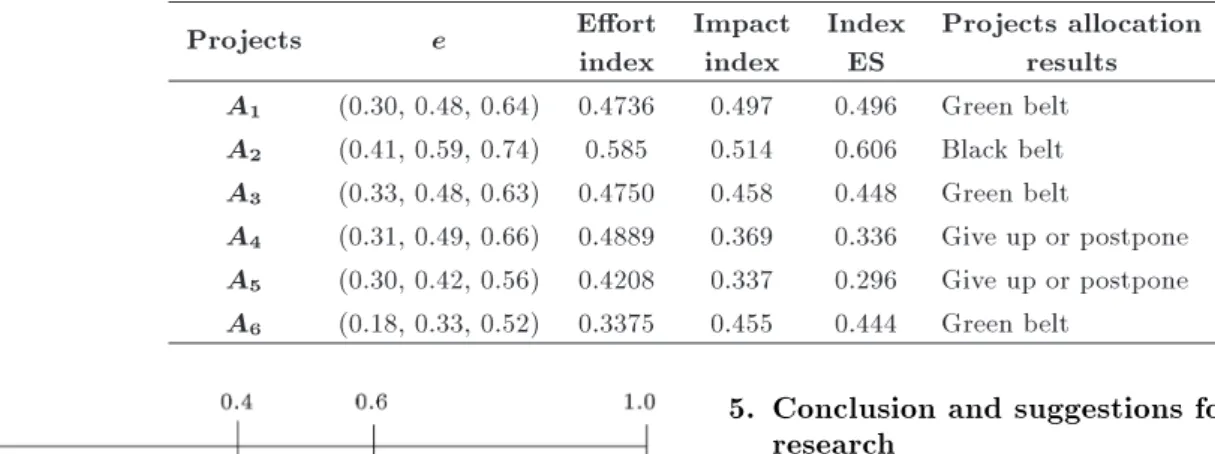
Table 9. The value of impact and eort for each alternative.
Projects e Eort
index
Impact index
Index ES
Projects allocation results A1 (0.30, 0.48, 0.64) 0.4736 0.497 0.496 Green belt
A2 (0.41, 0.59, 0.74) 0.585 0.514 0.606 Black belt
A3 (0.33, 0.48, 0.63) 0.4750 0.458 0.448 Green belt
A4 (0.31, 0.49, 0.66) 0.4889 0.369 0.336 Give up or postpone
A5 (0.30, 0.42, 0.56) 0.4208 0.337 0.296 Give up or postpone
A6 (0.18, 0.33, 0.52) 0.3375 0.455 0.444 Green belt
Figure 5. The ranges of index ES in case study.
Eq. (5), and the results are illustrated in Table 8. In this section, all the criteria have been converted to a negative concept.
Now, the fuzzy value of eort index (e) can be calculated using Eq. (18) whose results are presented in Table 9. Finally, the crisp values of the eort index are defuzzied, using Eq. (19), and illustrated in Table 9, with the respective impact indexes that are outputs of fuzzy TOPSIS.
The ranges of decision making on expert system output, in this instance, according to quality control ex-perts of the company and previous successful projects, are illustrated in Figure 5.
In addition, the two indexes, obtained (Error index and Impact index) are the inputs of the fuzzy expert system, and the output results (index ES) of that with decision making, regarding the allocation of each project, are illustrated in Table 9. According to that, the A2 project is allocated to more experienced
specialists called Black Belts. Projects A6, A1 and A3
are assigned to the Green Belts. Also, Projects A4
and A5, due to their low impact for the company, will
not be undertaken or will be delayed until they are checked with other projects the next time. Of course, this step is for allocating projects to specialists, and the implementation sequence of the projects are according to the output of the TOPSIS method, namely A2 >
A1> A3> A6> A4> A5.
5. Conclusion and suggestions for future research
Six sigma is considered a quality improvement ap-proach including waste reduction and income earning. One of the most important stages in implementing a six sigma project is the SSPS stage. The purpose of this paper is to develop a new model for identifying eective projects in an organization and allocating them to project specialists. In this paper, using a step by step model, rstly, all the criteria for six sigma project allocation are considered and the most important are identied. Then, the impact index, which is the output of the TOPSIS method, and the eort index are calculated. In addition, using a fuzzy expert system, the six sigma projects are allocated to the relevant specialist. So, it can be claimed that two indexes, Impact and Eort, are used for allocating the six sigma potential projects to a six sigma specialist.
To calculate the impact index, the important cri-teria are: availability of resources, needed time, direct relation with strategic objectives, the relation with the key processes of the organization, nancial eciency-increasing prots, and special needs to improve. In the presented case study, the direct relation with the strategic objective criterion was identied as being the most important. Availability of resources, needed time, project scope and ability to access information are criteria that are used for calculation of the Eort index. In the case study, these criteria are considered with the assumption of equal weight. Of course, these criteria have dierent importance, according to the terms. According to the implemented survey in
the case study, the direct relation with the strategic objectives, nancial eciency-increasing prots and needed time are the most important criteria in six sigma project selection and prioritization. The Impact index and the Eort index, respectively, are eective on the prioritization and allocation of six sigma projects. Of course, the Impact index has more importance in decision making owing to a lack of some project imple-mentations. Further work can focus on determination of and in the expert system output. Also, this framework can be used as a basic pattern for developing new models in other industries, and the most important criteria in the prioritization and allocation of six sigma projects can be identied in these industries.
References
1. Saghaei, A. and Didehkhani, H. \Developing an inte-grated model for the evaluation and selection of six sigma projects based on ANFIS and fuzzy goal pro-gramming", Expert Systems with Applications, 38(1), pp. 721-728 (2011).
2. Zu, X., Fredendall, L.D. and Douglas, T.J. \The
evolving theory of quality management: the role of six sigma", Journal of Operations Management, 26(5), pp. 630-650 (2008).
3. Truscott, W., Six Sigma: Continual Improvement for Businesses, Butterworth-Heinemann Oxford (2003).
4. de Mast, J. and Lokkerbol, J. \An analysis of the Six Sigma DMAIC method from the perspective of problem solving", International Journal of Production Economics (2012).
5. Su, C.T. and Chou, C.J. \A systematic methodology for the creation of six sigma projects: A case study of semiconductor foundry", Expert Systems with Applica-tions, 34(4), pp. 2693-2703 (2008).
6. Adams, C.W., Gupta, P. and Wilson, C., Six Sigma
Deployment, Butterworth-Heinemann (2003).
7. Klefsjo, B., Wiklund, H. and Edgeman, R.L. \Six
sigma seen as a methodology for total quality manage-ment", Measuring Business Excellence, 5(1), pp. 31-35 (2001).
8. Przekop, P., Six Sigma for Business Excellence: A Manager's Guide to Supervising Six Sigma Projects and Teams, McGraw-Hill Companies (2005).
9. Snee, R.D. \Six sigma project selection process", Quality Progress, ASQ (American Society for Quality) (2002).
10. Dickman, D. and Doran, C. \Selecting six
sigma project a new approach", Available in www.palomaconsulting.com (2003).
11. Kumar, U.D., Saranga, H., Ramrez-Marquez, J.E. and Nowicki, D. \Six sigma project selection using data envelopment analysis", The TQM Magazine, 19(5), pp. 419-441 (2007).
12. Kahraman, C. and Buyukozkan, G. \A combined
fuzzy AHP and fuzzy goal programming approach for eective six-sigma project selection", Journal of Multiple-Valued Logic and Soft Computing, 14(6), pp. 599-615 (2008).
13. Yang, T. and Hsieh, C.H. \Six-sigma project selection using national quality award criteria and fuzzy multi-ple criteria decision-making method", IEEE, Wireless Communications, Networking and Mobile Computing, 2008. WiCOM 08. 4th International Conference on, pp. 1-4 (2008).
14. Slater, R., Jack Welch and the GE Way: Management Insights and Leadership Secrets of the Legendary CEO, McGraw-Hill Companies (1999).
15. Barney, M., Motorola's Second Generation, American Society for Quality(ASQ), 1(3), pp. 13-16 (2002).
16. Folaron, J. and Morgan, J. \The evolution of six sigma", Six Sigma Forum Magazine, 2(4), pp. 38-44 (2003).
17. Godfrey, A.B. \The Honeywell edge", Six Sigma Fo-rum Magazine, 1(2), pp. 14-17 (2002).
18. Blakeslee, J.A. \Implementing the six sigma solution how to achieve quantum leaps in quality and compet-itiveness", Quality Progress, 32(7), pp. 77-85 (1999).
19. Hutchins, D. \The power of six sigma in practice", Measuring Business Excellence, 4(2), pp. 26-33 (2000).
20. Eckes, G. \Six sigma execution", New York: McGraw-Hill. Edgeman, RL (2000). New voices of quality, 21, pp. 31-39 (2006).
21. Yang, T. and Hsieh, C.H. \Six-sigma project selection using national quality award criteria and Delphi fuzzy multiple criteria decision-making method", Expert Sys-tems with Applications, 36(4), pp. 7594-7603 (2009).
22. Huang, X. \Optimal project selection with random fuzzy parameters", International Journal of Produc-tion Economics, 106(2), pp. 513-522 (2007).
23. Schroeder, R.G., Linderman, K., Liedtke, C. and
Choo, A.S. \Six sigma: Denition and underlying theory", Journal of Operations Management, 26(4), pp. 536-554 (2008).
24. Ghorbani, S. and Rabbani, M. \A new multi-objective algorithm for a project selection problem", Advances in Engineering Software, 40(1), pp. 9-14 (2009).
25. Academy, S.S., The Black Belt Memory Jogger: A
Pocket Guide for Six Sigma Success, GOAL/QPC (2002).
26. Halouani, N., Chabchoub, H. and Martel, J.M.
\PROMETHEE-MD-2T method for project selec-tion", European Journal of Operational Research, 195(3), pp. 841-849 (2009).
27. Daniel, H.Z., Hempel, D.J. and Srinivasan, N. \Project selection: A process analysis", Industrial Marketing Management, 32(1), pp. 39-54 (2003).
Com-plete Guide to Just-In-Time Manufacturing: Volume 2-Waste and the 5S's, 2, CRC (2009).
29. Campanella, J., Principles of Quality Costs: Princi-ples, Implementation and Use, American Society for Qualit (1999).
30. Amorim, J.A., de-Siqueira, J.M. and Martnez-Saez, A. \Large scale multimedia production management: from strategic planning to six sigma", Procedia-Social and Behavioral Sciences, 46, pp. 1430-1434 (2012).
31. Hwang, C.L. and Yoon, K., Multiple Attribute Decision Making: Methods and Applications: A State-of-the-Art Survey, 13, Springer-Verlag New York (1981).
32. Rao, R.V., Decision Making in the Manufacturing
Environment: Using Graph Theory and Fuzzy Multiple Attribute Decision Making Methods, Springer Verlag (2007).
33. Rouhani, S., Ghazanfari, M. and Jafari, M. \Eval-uation model of business intelligence for enterprise systems using fuzzy TOPSIS", Expert Systems with Applications (2011).
34. Torlak, G. et al. \Analyzing business competition by using fuzzy TOPSIS method: An example of Turkish domestic airline industry", Expert Systems with Appli-cations, 38(4), pp. 3396-3406 (2011).
35. Govindan, K., Khodaverdi, R. and Jafarian, A. \A fuzzy multi criteria approach for measuring sustain-ability performance of a supplier based on triple bottom line approach", Journal of Cleaner Production (2012).
36. Chen, M.F. and Tzeng, G.H. \Combining grey rela-tion and TOPSIS concepts for selecting an expatriate host country", Mathematical and Computer Modelling, 40(13), pp. 1473-1490 (2004).
37. Shanian, A. and Savadogo, O. \TOPSIS
multiple-criteria decision support analysis for material selection of metallic bipolar plates for polymer electrolyte fuel cell", Journal of Power Sources, 159(2), pp. 1095-1104 (2006).
38. Shih, H.S., Shyur, H.J. and Lee, E.S. \An extension of TOPSIS for group decision making", Mathematical and Computer Modelling, 45(7-8), pp. 801-813 (2007).
39. Chu, T.C. and Lin, Y.C. \A fuzzy TOPSIS method
for robot selection", The International Journal of Advanced Manufacturing Technology, 21(4), pp. 284-290 (2003).
40. Krohling, R.A. and Campanharo, V.C. \Fuzzy
TOP-SIS for group decision making: A case study for accidents with oil spill in the sea", Expert Systems with Applications, 38(4), pp. 4190-4197 (2011).
41. Chen, S.J.J. et al., Fuzzy Multiple Attribute Decision Making: Methods and Applications, Springer-Verlag New York, Inc. (1992).
42. Fasanghari, M. and Montazer, G.A. \Design and im-plementation of fuzzy expert system for Tehran stock exchange portfolio recommendation", Expert Systems with Applications, 37(9), pp. 6138-6147 (2010).
43. Darlington, K., The Essence of Expert Systems, Pear-son Education India (2000).
44. Kandel, A., Fuzzy Expert Systems, CRC (1992).
45. Wang, L.X., A Course in Fuzzy Systems and Control, Prentice-Hall, Inc. (1996).
46. Lin, C.T. and Chen, C.T. \New product
go/no-go evaluation at the front end: A fuzzy linguistic approach", Engineering Management, IEEE Transac-tions on, 51(2), pp. 197-207 (2004).
47. Machacha, L.L. and Bhattacharya, P. \A fuzzy-logic-based approach to project selection", Engineering Management, IEEE Transactions on, 47(1), pp. 65-73 (2000).
48. Haji, A. and Assadi, M. \Fuzzy expert systems and challenge of new product pricing", Computers & In-dustrial Engineering, 56(2), pp. 616-630 (2009).
49. Wang, L.X., A Course in Fuzzy Systems and Control, 203, Prentice Hall PTR Upper Saddle River, NJ, USA (1997).
50. Matthews, C. \A formal specication for a fuzzy expert system* 1", Information and Software Technology, 45(7), pp. 419-429 (2003).
51. Klir, G.J. and Yuan, B., Fuzzy Sets and Fuzzy Logic: Theory and Applications, Prentice Hall PTR New Jersey (1995).
52. Zimmermann, H., Fuzzy Set Theory and Its Applica-tions, 1991 (1996).
53. Sugeno, M., Industrial Applications of Fuzzy Control, North-Holland (1985).
54. Tsukamoto, Y. \An approach to fuzzy reasoning
method", Advances in Fuzzy Set Theory and Appli-cations, pp. 137-149 (1979).
55. Jang, J.S.R. \ANFIS: Adaptive-network-based fuzzy inference system", Systems, Man and Cybernetics, IEEE Transactions on, 23(3), pp. 665-685 (1993).
56. Jang, J.S.R. and Sun, C.T. \Neuro-fuzzy modeling and control", Proceedings of the IEEE, 83(3), pp. 378-406 (1995).
57. Yong, D. \Plant location selection based on fuzzy TOPSIS", The International Journal of Advanced Manufacturing Technology, 28(7), pp. 839-844 (2006).
58. Buyukozkan, G. and Ozturkcan, D. \An integrated analytic approach for six sigma project selection", Expert Systems with Applications, 37(8), pp. 5835-5847 (2010).
59. Park, S.H. and Organization, A.P. \Six sigma for qual-ity and productivqual-ity promotion", Asian Productivqual-ity Organization (2003).
60. Pande, P.S., Neuman, R.P. and Cavanagh, R.R. \The six sigma way", Das Summa Summarum des Manage-ment, pp. 299-308 (2007).
61. Pallant, J., SPSS Survival Manual (2007).
62. Pallant, J., SPSS Survival Manual: A Step by Step to Data Analysis Using SPSS for Windows (Version 12), Maidenhead, Open University Press (2004).
63. Wang, T.C. and Chang, T.H. \Application of TOPSIS in evaluating initial training aircraft under a fuzzy en-vironment", Expert Systems with Applications, 33(4), pp. 870-880 (2007).
64. Chu, T.C. \Facility location selection using fuzzy TOPSIS under group decisions", Int Journal of Un-certainty, Fuzziness and Knowledge-Based Systems, 10(6), pp. 687-701 (2002)
Biographies
Ahmad Jafarian was born in Tehran, Iran, in 1984. He obtained his BS degree in Industrial Engineering from the Islamic Azad University, South Tehran, Iran, and his MS degree in Industrial Management from Allameh Tabataba'i University, Tehran, Iran. His research interests include supply chain management, sustainability, closed-loop supply chain network, vehi-cle routing problem, articial intelligence, six sigma and simulation-based optimization, and his research work has been published in international journals such as the European Journal of Operational Re-search, the International Journal of Production Eco-nomics, and the International Journal of Production Research.
Mohsen Shaei Nikabadi received his PhD de-gree from the Department of Industrial Management, at Allameh Tabataba'i University Business School (ATUBS), Tehran, Iran, and is currently Assistant Professor of Industrial Management in the Faculty of Economics and Management at Semnan University, Iran. He is also member of the Editorial Board of the Journal of Advances in Economics, the Greener Journal of Business and Management Studies, and the Journal of Basic and Applied Scientic Research. His research interests include the elds of logistics, supply chain management, quality and maintenance management, knowledge management, and e-business model development.
Maghsoud Amiri received MS and PhD degrees in Industrial Engineering from Sharif University of Tech-nology, Tehran, Iran, in 2003 and 2007, respectively, and is currently Associate Professor in the Department of Industrial Management at Allameh Tabataba'i Uni-versity, Tehran, Iran. His research interests include reliability analysis, inspection and maintenance opti-mization models, design of experiments and response surface methodology. Dr Amiri is a member of the Ed-itorial Board of the International Journal of Advanced Manufacturing Technology.
![Figure 1. Triangular fuzzy number and the membership function [8].](https://thumb-us.123doks.com/thumbv2/123dok_us/8387826.2228662/3.892.484.815.991.1112/figure-triangular-fuzzy-number-membership-function.webp)