Development of an academic identity
through PhD supervisionan issue for
debate
Murphy, NA and Wibberley, C
http://dx.doi.org/10.1016/j.nepr.2016.12.002
Title
Development of an academic identity through PhD supervisionan issue
for debate
Authors
Murphy, NA and Wibberley, C
Type
Article
URL
This version is available at: http://usir.salford.ac.uk/41055/
Published Date
2017
USIR is a digital collection of the research output of the University of Salford. Where copyright
permits, full text material held in the repository is made freely available online and can be read,
downloaded and copied for noncommercial private study or research purposes. Please check the
manuscript for any further copyright restrictions.
Abstract
This paper provides reflection on the journey of completing a PhD by using emergent themes that occurred in supervision sessions as recorded in a reflective journal. The paper highlights the need to reflect and accept decisions that can be challenging. The paper also indicates examples where past understandings are questioned and newer insights have to be explored. A conclusion related to accepting responsibility for what happens as a consequence of supervision sessions is debated. Finally a new insight into identity is arrived at.
Key Words
Supervision, alternative perspectives, responsibility, self-direction, academic identity, professional development.
Introduction
A PhD is often considered to be a journey (McCulloch 2013), a journey that builds new knowledge and extends existing knowledge by use of original approaches and ways of writing (Trafford & Leshem 2009; Wellington 2010). It is a journey undertaken by a candidate for a PhD – a candidate who requires a sponsor in the form of a supervisor (and co-traveller). The knowledge gained over the journey depends on the route taken, and to what extent this is: predetermined; whether detours and other changes are allowed; and ultimately on how decisions are made and by whom, about schedules and routes. In this case we recount a journey undertaken which reframed original thoughts emergent through supervision, and identified factors that aided the development of academic identity. We aim to present over the next few pages an account of our experiences, hopefully to inform others (supervisees’ and supervisors’) understanding of the ebb and flow of influences experienced by both a supervisee and a supervisor in the development of the student, and their thesis by use of supervision; thus providing a form of vicarious experience of such a journey. The use of ‘I’ refers to the first author in the following pages.
Reflective debate
either considering embarking on the journey that I had just completed, or that may be struggling with a transition to doctoral level ways of working.
Over many years I have used both supervision and reflection in clinical nursing practice and my academic career. I have come to know that I am generally self-sufficient and don’t lack drive, and am pragmatic in my approach to most things. I consider supervision as a process where dominant ideas are candidly challenged, and reflection used as a tool to unpack thoughts associated with ideas that seem to have no simple solution. I hope that readers will reflect on our commentary and be able to learn from it, as we did whilst experiencing it. The lessons I learned from reflecting on supervision were a catalyst for personal and professional development. It made me focus on my identity, and led to me developing an understanding of the personal, relational and contextual factors involved in creating an academic identity (see Lieff et al. 2012), whilst engaging in supervision.
A PhD is a journey, and one that I feel changes people. Looking back from the start and comparing my thoughts to now, I am a different person with a developing new academic identity. I came to see that Snyder (1997) was correct in asserting that the development of an academic identity is probably a career long process, but probably influenced by the supervision I received. Looking back, I was not fully aware of the breadth and depth of understanding that I was going to develop and the level of hard work that gaining such an understanding would entail. I hadn’t realised perhaps how much I knew about a few specific areas of healthcare and life, and the false confidence that this gave me. I can now see that I was aware of how as an academic, at this stage of my life, I had come ‘to be’ (academic ontology, Quigley 2011) but had a faulty awareness of how as an academic I would come to know (academic epistemology, Quigley 2011). As Watson and Thompson (2006) suggested, knowledge is often seen as a product of a technical process rather than intellectual work; and up to this point in my career, I had immersed myself in the technical aspects of health and care, seeing things as a third party. Reflecting on these practices and technical aspects with a fresh insight started the development of an understanding of my identity (see Wenger 1998) as it was to emerge.
many sessions using various approaches. We agreed that supervision needed to be fluid and responsive to both the supervisee’s and supervisor’s current circumstances. Essentially, through supervision, fixed thoughts were questioned and were sensitively explored by looking at alternate viewpoints. I can see that care was taken not to overly guide me too much in the way of the supervisor’s view, but to try to make me decide on the path to follow. I had to accept responsibility for any decisions made from the supervision. Initially this checked my self-confidence, as I arrived at the start of the study with specific coping strategies, probably linked to past experiences of being a student under supervision. Such past experiences, I can see, were probably quite paternalistic, with past supervisors being seen as experts. The challenge made on me from supervision was that I was to be the expert at some point and that I would need to demonstrate this to others. I came to see that my supervision led to what Mackinnon (2004) had discussed; developing the right conditions for the creation of good quality scholarship and scholars (p397).
In many ways I feel that good scholarship is linked to outputs. Supervision did focus on ‘outputs’. This was both in the form of publications but also on the impact my studies had on health care and on who and what I taught. An important point that I learned was to relook at what I presently did and to identify gaps in the evidence that I was using for my teaching, research and practice. This relooking at what I did seemed a simple task, yet I hadn’t realised that pedagogically I was focusing on a narrow range of sources of evidence. These sources of evidence were all similar in nature; and reinforced rather than questioned my viewpoint. In many ways I discovered that supervision presents challenges not only from a supervisor, but also from your own reflections of the themes emergent from supervision.
Supervision sessions were not only a one to one event, occasionally it was a team approach with my associate supervisor also attending. Here, at times, conflicts happened, with debates and discussions related to the best way forward in relation to the style and manner of research approach. My supervisors would adopt differing viewpoints, perhaps playing Devil’s advocate, but presenting me with the decision on how to proceed. It would have been easy to just go along with one or the other, but this was my research and I understood that both were correct, yet both incorrect for me. I had to come to terms with accepting the responsibility for not falling into one camp or another. I didn’t have to sit on the fence. Much of what would need to be done hinged on my view and my personal philosophy. However, it was following one such meeting that I followed one of the
research and create something that I finally believed was different and novel. It became clear that supervision was a narrative that I had to interpret; and act on what I felt best fitted my viewpoint.
Such advice led me to see the utility of a mixture of methods in the same study, but for it not to be a ‘mixed methods design’ (as the level of integration from stages was limited – see Tashakkori and Creswell 2007). It also enabled me to understand how the bringing together of differing sorts of evidence (see Wibberley 2012) and the deliberate layering of information (see Rambo Ronai 1995) could be used. This emergent perspective enabled me to consider threading different types of research into an understandable practical whole. At this time I was unaware of other PhD students that had done this in their theses; thus without exemplars, this seemed to me at the time to be risky, as I was putting my faith in a methodology that was new to me and seemed to have limited evidence for its utility for doctoral study. It is at such points in time that an element of trust between
supervisee and supervisor is required, that the journey will end at an acceptable destination – trust that perhaps is easier to engender if the supervisor is known to have undertaken such journeys before.
Exploring emergent methodology in supervision was something where disagreement ensued, but with an air of accepting responsibility. I personally feel that without such open debates and disagreements, I would neither have developed my own academic identity nor developed such an understanding of research and practice as I finally did. Without the debate potentially a rather sterile and unfulfilling thesis would have emerged, although perhaps more rapidly. The resolution of these disagreements also allowed the emergence of different pieces of work; so one of my supervisors wrote a piece with me based more on his interpretation, rather than my own (Wibberley & Murphy 2016). This in itself was enlightening for both of us, and helped to establish and resolve issues around intellectual ownership and academic responsibility.
I started to see that the role I played in supervision, was one where I made decisions about my own work; and that required me to be more active in driving my thesis forward. There was also a role in considering and prioritising papers for publication; and in so doing encouraging not only myself to read more widely, but also my supervisors. One of the major outcomes of the later stages of
learning made later on the journey of supervision. This highlighted the development of each of us, and my growing ability to identify different perspectives and different ways to present findings. This awareness of presenting evidence in various ways was undoubtedly influenced by the use of co-authorship with my supervisors through doctoral supervision. Such co-co-authorship is seen as enabling and crafting PhD students in the scholarly art of publishing, and a means to enhance the robustness and know-how of emergent scholars (Kamler 2008, p283).
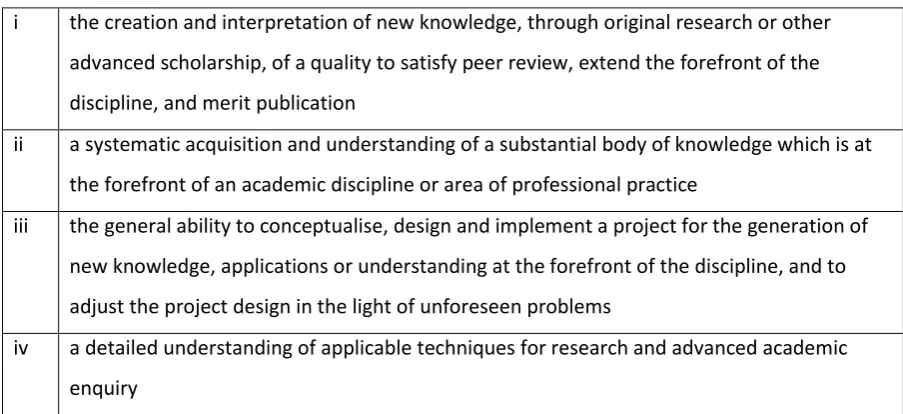
Reflecting further, the development of my own academic identity through PhD supervision was, in my view, probably a consequence of being exposed to divergent views on research; and being supported to explore different avenues of investigation, including less conventional pathways. In so doing it enabled me to fully understand the demands of a PhD and all four of the QAA criteria for doctoral level study (see Table 1). It also enabled me to produce a thesis that reflected my personal pragmatic philosophy, in line with Dewey’s (1933) and Rorty’s (1979) naturalistic philosophy. Importantly it re-emphasised the way that the combination of supervision, reflection and the use of texts, reinforced my understanding of philosophy and the need for questions to drive practice research forward.
Supervision led to me taking further risks. Although I was confident that if I was driving myself into a cul-de-sac, my supervisors would have mentioned something, I now had to be true to my emergent methodology and reflect on how I had ‘come to be’ (Barnett 2007). Encouragement to look at my experiences and to write about them in an auto-ethnographic way began to enable me to tie loose ends together; and so to better understand how I was changing as a person, and to help remove imposed ‘blinkers’, focusing on myself in order to widen my view (see Ellis 2004). This led to self-questioning of my personal philosophy and the realisation that I was developing as an academic, not being manufactured into one. I also became aware I was learning a valuable lesson as a potential future supervisor: as Pearson & Brew (2002) noted “it is important that … supervisors expand their repertoire of skills … enabling supervisors to become adaptable … supervisors have to extend their understanding of the nature of research and supervisory practice in order to deal with variations in … learning and career goals of different students” (Pearson & Brew 2002 p 143).
Conclusion
Secondly supervision needs to generate debate and at times allow conflict to occur. Such conflicts need to have a constructive basis; importantly no party should feel disempowered by such debate. Ultimately there is a need for trust on all sides and an understanding of genuineness in regard to motives. The decision on how to move forward, having taken account of differing perspectives lies with the supervisee and responsibility to reflect and generate subsequent actions is their own responsibility – a responsibility that should be accepted not only by the supervisee, but also the supervisor(s). This requires a degree of academic maturity in all those involved; and it is growing into such academic maturity that is in our view a major part of the doctoral journey.
My identity has shifted as a result of the supervision sessions. Besides having a new insight into research processes and methodologies, I can see that I have had to become more self-reliant and organised. I have become more questioning of colleagues and more confident in standing my ground about something I feel is important. I feel people see me for the parts I can play in research rather than a role I can adopt. I have come to see that research projects can benefit from my contribution rather than me benefiting from the research project.
A final thing that I feel I need to share is that to the student the PhD feels like it is your life; however, it is not. Everything and everyone continue around you and deserve attention and respect. This includes the work you do and the relationships you have. Talking to others, I am aware that a supervisor relationship can be a fragile thing that can go horribly wrong for some, but I feel that it is up to the supervisee to identify this early on and be strong enough to either change the relationship or the manner of the relationship before it creates a negative influence.
References
Barnett, R. (2007) A will to learn: being a student in an age of uncertainty. Maidenhead, The Research in Higher Education and Open University Press.
Dewey, J. (1933) How we think. Buffalo, New York, Prometheus.
Ellis, C. (2004) The ethnographic I: A methodological novel about autoethnography. Walnut Creek, CA, Alta Mira Press.
Hesse Biber, S.N. & Leavy, P. (2010) Handbook of Emergent Methods. New York, Guilford Press. Kamler, B. (2008) Rethinking doctoral publication practices: writing from and beyond the thesis.
Lieff, S., Baker, L., Moori, B., Egan-Lee, E., Chin, K & Reeves, S. (2012) Who an I? Key Influences on the Formation of Academic Identity Within a Faculty Development Program. Medical Teacher.
34, e208-e215.
Mackinnon, J. (2004) Academic Supervision: Seeking Metaphors and Models for Quality. Journal of Further and Higher Education. 28(4), 395-405.
Manchester Metropolitan University (2009) Guidelines for research supervisors. https://www2.mmu.ac.uk/media/mmuacuk/content/documents/graduate-school/regulations-procedures/Guidelines-for-Research-Supervisors.pdf Accessed 24/09/2010.
McCulloch, A., 2013. The quest for the PhD: a better metaphor for doctoral education. International
Journal for Researcher Development. 4, 55–66.
Pearson, M. & Brew, A. (2002) Research Training and Supervision Development. Studies in Higher
Education. 27,135-150.
Murphy, N. Fatoye, F. Wibberley C. (2013) "The changing face of newspaper representations of the mentally ill", Journal of Mental Health. 22(3) pp271-282.
Quigley, S.A. (2011) Academic Identity: A Modern Perspective. Educate. 11(1), 20-30. Rambo Ronai, C. (1995). Multiple reflections of child sex abuse. Journal of Contemporary
Ethnography. 23(4), 395–426.
Rorty, R. (1979) Philosophy and the Mirror of Nature. Princeton, New Jersey, Princeton University Press.
Snyder, W. (1997) Communities of Practice: Combining Organisational Learning and Strategy Insights
to Create a Bridge to the 21st Century.
http://www.co-i-l.com/coil/knowledge-garden/cop/cols.shtml Accessed 26/10/2014.
Tashakkori, A., & Creswell, J.W. (2007). Editorial: The New Era of Mixed Methods. Journal of Mixed Methods
Research. 1, 3–7.
Trafford, V., & Leshem, S. (2009). Doctorateness as a threshold concept. Innovations in Education
and Teaching International. 46 (3), 305–316.
Watson, R. & Thompson, D.R. (2006) Professors of Nursing: What do they Profess? Nurse Education
in Practice. 6, 123-126.
Wellington, J.J. (2010) Making Supervision Work for You: A Student Guide. London, Sage.
Wenger, E. (1998) Communities of Practice: Learning, Meaning and Identity. Cambridge, Cambridge University Press.
Table 1: Descriptor for qualifications at Doctoral (D) level: Doctoral degree [Quality Assurance
Agency - The Framework for Higher Education Qualifications in England, Wales and Northern Ireland (FHEQ) (second edition, revised August 2008)]
i the creation and interpretation of new knowledge, through original research or other advanced scholarship, of a quality to satisfy peer review, extend the forefront of the discipline, and merit publication
ii a systematic acquisition and understanding of a substantial body of knowledge which is at the forefront of an academic discipline or area of professional practice
iii the general ability to conceptualise, design and implement a project for the generation of new knowledge, applications or understanding at the forefront of the discipline, and to adjust the project design in the light of unforeseen problems