
A single-solution method for the determination of soluble phosphate in sea water
6
0
0
Full text
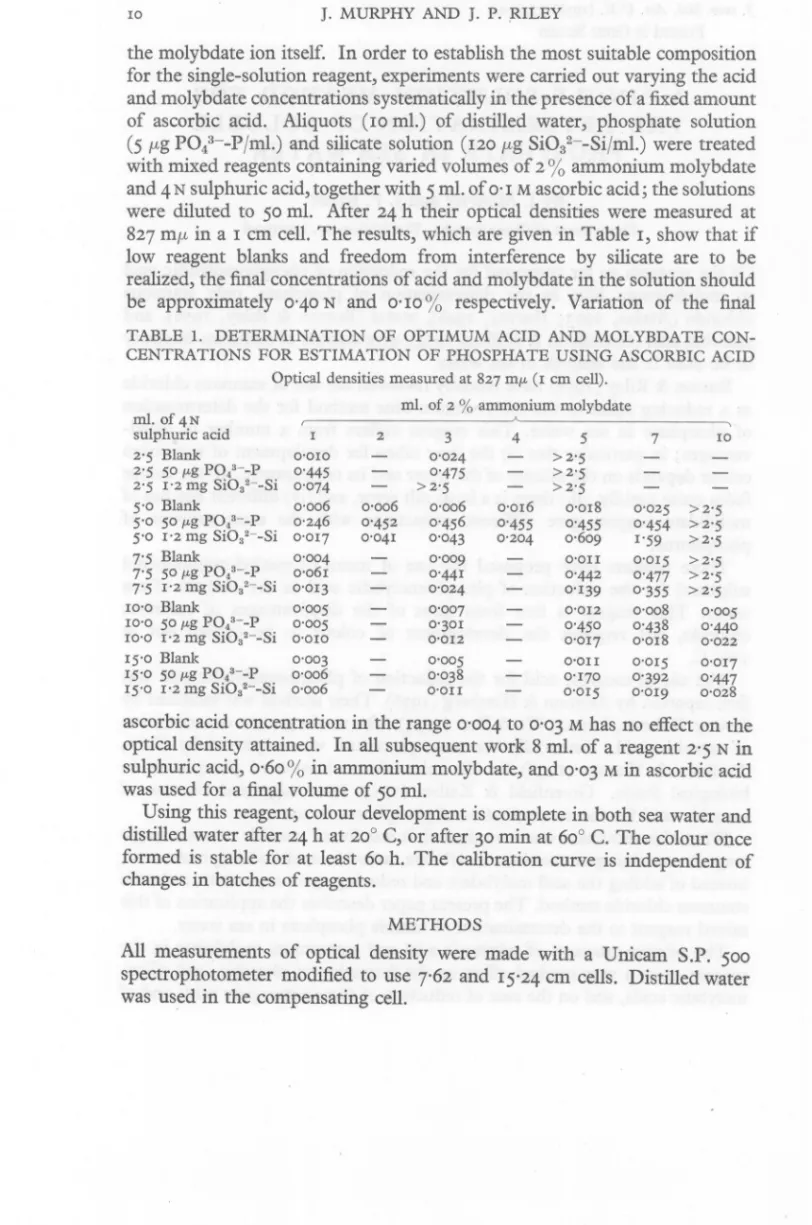
(2) 032--Si 3-_P acid ml, of 4N. 10. J, MURPHY. AND J, p, RILEY. the molybdate ion itself. In order to establish the most suitable composition for the single-solution reagent, experiments were carried out varying the acid and molybdate concentrations systematically in the presence of a fixed amount of ascorbic acid. Aliquots (10 ml.) of distilled water, phosphate solution (5 fLg P043--P/ml.) and silicate solution (120 fLg Si032--Si/ml.) were treated with mixed reagents containing varied volumes of 2 % ammonium molybdate and 4 N sulphuric acid, together with 5 ml. of 0' I M ascorbic acid; the solutions were diluted to 50 ml. After 24 h their optical densities were measured at 827 mfL in a I cm cell. The results, which are given in Table I, show that if low reagent blanks and freedom from interference by silicate are to be realized, the final concentrations of acid and molybdate in the solution should be approximately 0'40 Nand O'IO% respectively. Variation of the final. -- -. ,. 0'012 0'011 O'OIl 10 241. 0'024 0'009 0'441 0'301 0'038 0'475 0'442 0'139 0'007 0'450 0'017 0'005 0'170 0'015 0'028 0'008 30'452 0'018 0'010 50'454 7 DETERMINATION 0'455 0'043 I 0'016 0'006 0'477 0'022 0'061 0'010 0'006 >2'5 0'438 0'019 0'204 0'041 0'355 0'447 0'392 0'609 TABLE>2'5 >2'5 0'015 0'017 0'006 OF OPTIMUM ACID AND MOLYBDATE 0'456 0'004 0'440 0'074 0'445 0'246 1'59 0'017 0'013 0'455 0'025 0'005 0'005 0'003 CENTRATIONS FOR ESTIMATION OF PHOSPHATE USING Optical densities measured at 827 m/k (I cm cell), ASCORBIC ml. of 2 % ammonium molybdate. CONACID. ascorbic acid concentration in the range 0'004 to 0'03 M has no effect on the optical density attained. In all subsequent work 8 ml. of a reagent 2'5 N in sulphuric acid, 0,60 % in ammonium molybdate, and 0'03 M in ascorbic acid was used for a final volume of 50 ml. Using this reagent, colour development is complete in both sea water and distilled water after 24 hat 20° C, or after 30 min at 60° C. The colour once formed is stable for at least 60 h. The calibration curve is independent of changes in batches of reagents. METHODS All measurements of optical density were made with a Unicam S.P. 500 spectrophotometer modified to use 7'62 and 15'24 cm cells. Distilled water was used in the compensating cell..
(3) DETERMINATION. OF SOLUBLE PHOSPHATE IN SEA WATER. II. Reagents Sulphuric acid 5N. Dilute 70 mi. of concentrated sulphuric acid to 500 mi. Ammonium molybdate (4 %). Dissolve 20 g of ammonium molybdate A.R. in distilled water and dilute to 500 mi. Store the solution in a Pyrex glass reagent bottle. Ascorbic acid O'IM. Prepare a solution of 1'76 g of ascorbic acid in 100 mi. of distilled water. It is preferable to prepare this solution on the day it is needed, but if this is not possible, the solution may be preserved for about 10 days at 0° C. Mixed reagent. Mix thoroughly 125 m1. of 5N sulphuric acid and 37'5 mi. of 4 % ammonium molybdate solution. Add 75 mi. of ascorbic acid solution and dilute to 250 m1. The mixed reagent does not keep well and should be prepared within an hour of using. Standard. solutions. Stock phosphate solution. Dissolve 0'1757 g of potassium dihydrogen phosphate in distilled water and dilute to 11. This solution, which contains 40 mg P043-P/1., should be preserved in a dark glass bottle. Dilute phosphate solution. Prepare, by dilution of the stock phosphate solution, a solution containing 0'2 mg P043--P/1. This standard solution should be prepared daily. Treatment. of apparatus. Allow apparatus, which is to be used in the determination, to stand overnight filled with concentrated sulphuric acid, and then rinse thoroughly. It is preferable to keep a set of graduated flasks to be used only for the determination of phosphate; after use, they should be washed well and kept filled with distilled water until required again . •If this is done, the treatment with sulphuric acid is only required occasionally. Determination. of phosphate. Pipette 40 m1. of the sea-water sample into a 50 mi. graduated flask, add 8 mi. of the mixed reagent from a tilt measure and dilute to volume. Allow the colour to develop for 24 h at room temperature (20° C). Measure the optical density of the solution at 827 mfL. Determine the reagent blank in the same manner using freshly distilled water. Calibrate the method using 5, 10 and 20 mi. aliquots of the dilute standard phosphate (I, 2 and 4 fLg.P043--P respectively). To correct the calibration curve for use with sea water multiply the observed optical densities by the appropriate salt error factor (Table 3). The calibration curve remains constant and is independent of changes in the batches of reagents. The colour development may be carried out more rapidly at 60° C if desired. Transfer the solution to a loosely stoppered Pyrex flask (treated as described above) and heat it in a water bath at 60° C for 30 min. Mter cooling, measure the optical density of the solution at 827 mfL. Beer's law and reproducibility. Calibration runs distilled water. The the optical densities length. The results,. were carried out using 1-25 fLgPOl--P in 40 mI. of colour was developed for 24 h at room temperature and were then measured at 827 mfL in cells of appropriate which are given in Table 2, show a satisfactory repro-.
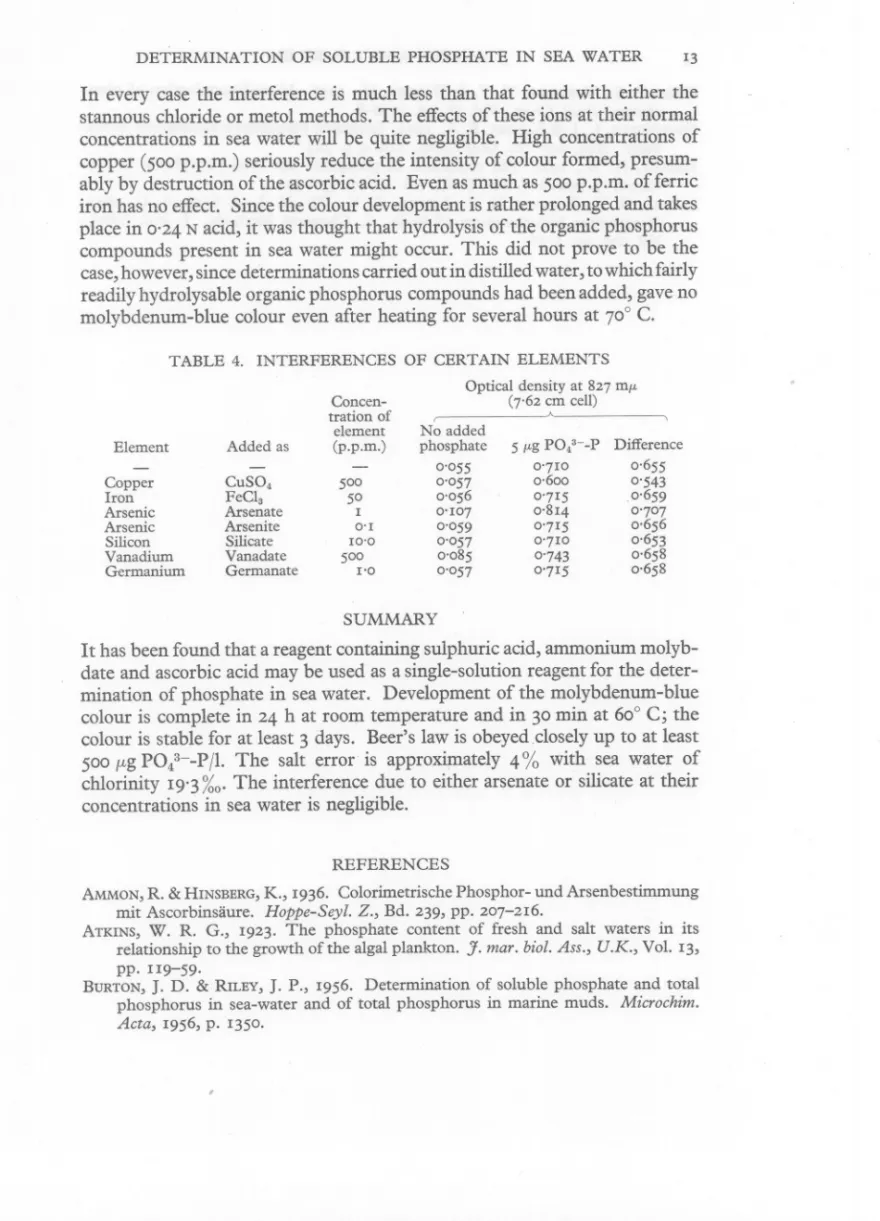
(4) 12. J, MURPHY. AND J, p, RILEY. ducibility and show that Beer's law is obeyed up to a concentration of at least 0'5 p.p.m. P043--P. Similar figures were obtained when the colour was developed at 60° or 90° C. TABLE. PO.3-_p /l-g. I. 2. 3 4. 5 10 15. 20. 25. 2, DETERMINATION. OF PHOSPHORUS. No, of determinations. Mean optical density* (7,62 cm cell). Mean deviation (%). Deviation from linearity (%). 4 4 4 4 3 3 3 3 3. 0'134 0'267 0'403 0'534. 0,6 0'5 0'3 0'5 0'5 0'2 0'3 0'3 0'3. +0'1. o'671t. 1'342t 2'019t 2'667t 3'330t. -0'3 +0'3 -0'3. +0'2 +0'2 +0'5. -0'4 -0'5. * Less reagent blank, t Measured in I cm cell and calculated for 7'62 cm cell, TABLE. 3, SALT ERROR. 0 0'437. Sea water, CI %0 Mean optical density for 25 /l-g, PO.3-_P* Salt error, % Correction factor. 0 1'00 *. I cm. CORRECTIONS. 5 0'424. 10 0'420. 15 0'417. 19'3 0'419. -2'9 0'970. -3'9 0'961. -4,6 0'954. -4'1 0'959. cell.. SALT ERROR The effect of the salts of sea water on the intensity of the molybdenum-blue colour, developed by the mixed reagent, has been studied. Filtered sea water, low in phosphate, was diluted with distilled water to give sea waters having chlorinities of 5,10,15 and 19'3 %0' Duplicate phosphate determinations were made on 40 ml. portions of these waters and on 40 ml. aliquots which had been enriched with 25 p,g POl--P. Colour development was carried out at room temperature. The results, which are summarized in Table 3, indicate that, as with the metol method, the salt error is not a linear function of chlorinity. For oceanic waters it is small compared with the salt error of the stannous chloride procedure (ca. 20%). INTERFERENCES The interference of several ions, known to interfere in molybdenum-blue methods for the determination of phosphorus, has been investigated using the ascorbic acid reagent. Experiments were performed using 40 ml. aliquots of distilled water containing these ions, both alone, and in the presence of 5 p,g of P043--P. The results (Table 4) indicate that of the elements capable of forming molybdenum-blue complexes, only arsenic interferes appreciably..
(5) e. DETERMINATION. OF SOLUBLE. PHOSPHATE. IN SEA WATER. 13. In every case the interference is much less than that found with either the stannous chloride or metol methods. The effects of these ions at their normal concentrations in sea water will be quite negligible. High concentrations of copper (500 p.p.m.) seriously reduce the intensity of colour formed, presumably by destruction of the ascorbic acid. Even as much as 500 p.p.m. offerric iron has no effect. Since the colour development is rather prolonged and takes place in 0'24 N acid, it was thought that hydrolysis of the organic phosphorus compounds present in sea water might occur. This did not prove to be the case, however, since determinations carried out in distilled water, to which fairly readily hydrolysable organic phosphorus compounds had been added, gave no molybdenum-blue colour even after heating for several hours at 70° C. TABLE element trationasConcenof Added 0'055. 4. INTERFERENCES OF CERTAIN ELEMENTS 0,600 1'0 0'085 0.658 0'107 0,814 I 0'057 1 0'0 0'1 0'056 0'057 0'715 No added , 0'059 0'710 0·653 0.656 0'659 Difference 0,655 0'057 (7,62 cm cell) 500 0'707 phosphate 50'743 ",g (p.p.m.) Optical density at 827 m", 0'543 500 5PO.3-_P 0. Element Copper Iron Arsenic Arsenic Silicon Vanadium Germanium. SUMMARY. It has been found that a reagent containing sulphuric acid, ammonium molybdate and ascorbic acid may be used as a single-solution reagent for the determination of phosphate in sea water. Development of the molybdenum-blue colour is complete in 24 h at room temperature and in 30 min at 60° C; the colour is stable for at least 3 days. Beer's law is obeyed closely up to at least 500 fLg POl--P/l. The salt error is approximately 4 % with sea water of chlorinity 19'3 %0' The interference due to either arsenate or silicate at their concentrations in sea water is negligible. REFERENCES. AMMON,R. & HINSBERG,K., 1936. Colorimetrische Phosphor- und Arsenbestimmung mit Ascorbinsiiure. Hoppe-Seyl. Z., Bd. 239, pp. 207-216. ATKINS,W. R. G., 1923. The phosphate content of fresh and salt waters in its relationship to the growth of the algal plankton. J. mar. biol. Ass., U.K., Vol. 13, pp. I19-59· BURTON,J. D. & RILEY, J. P., 1956. Determination of soluble phosphate and total phosphorus in sea-water and of total phosphorus in marine muds. Microchim. Acta, 1956, p. 1350..
(6) 14. J. MURPHY AND J. P. RILEY. CHEN, P. S., TORIBARA, T. Y. & WARNER, H., 1956. Microdetermination of phosphorus. Anal. Chern., Vol. 28, pp. 1756-8. in seaGREENFIELD,L. J. & KALBER, F. A., 1954. Inorganic phosphate measurement water. Bull. mar. Sci. Gulf Carib., Vol. 4, p. 323. HARVEY, H. W., 1948. The estimation of phosphate and total phosphorus in seawaters. J. mar. bioi. Ass. U.K., Vol. 27, pp. 337-59· LOWRY, O. H., ROBERTS, N. R., LEINER, K. Y., Wu, M. L. & FARR, A. L., 1954· Quantitative histochemistry of brain. 1. Chemical Methods. J. bioi. Chern., Vol. 207, pp. 1-16..
(7)
Figure
Related documents
In order to ensure the integrity and availability of data in Cloud and enforce the quality of cloud storage service, efficient methods that enable on-demand data
Subsequently, we tested cofactor specificity for TubD activity, and LC– MS analysis showed that TubD reaction with NADH as cofactor could not give rise to the target IMP [M + H]
After this period of time, at the readings performed at 120 hours, the differences concerning the germination capacity between the experimental variants and the untreated
In this article, we investigate the meromorphic solutions of certain non-linear difference equations using Tumura-Clunie theorem and also provide examples which satisfy our
All synthesized compounds (6a1-a6 to 6d1-d6) were tested for anti-TB activity, compounds 6a1, 6a2, 6a3, 6c1, 6c6 and 6d1 have shown promising antitubercular activity since
The solution that we propose to the issue of Roaming in wireless community networks is done in two parts: (1) the proposal of a Protocol (RRP) enabling an LDAP server to behave as
Medical image fusion takes palace to combine the information of a variety of images with computer-based image processing method.. Present research is going to be used for
