Sharif University of Technology
Scientia IranicaTransactions A: Civil Engineering www.scientiairanica.com
Research Note
Optimum two-dimensional crack modeling in discrete
least-squares meshless method by charged system
search algorithm
H. Arzani
a, A. Kaveh
b;and M. Taheri Taromsari
aa. Department of Civil Engineering, Shahid Rajaee Teacher Training University, Tehran, P.O. Box 16785-136, Iran.
b. Centre of Excellence for Fundamental Studies in Structural Engineering, Iran University of Science and Technology, Narmak, Tehran, P.O. Box 16846-13114, Iran.
Received 14 March 2015; received in revised form 23 August 2015; accepted 21 December 2015
KEYWORDS Discrete least-squares meshless method; Crack;
Error estimator; Adaptive rearrangement; Charged system search.
Abstract. In this paper, a node adaptive rearrangement is presented based on the estimated error in various domains for some problems in the fracture mechanics by Discrete Least-Squares Meshless method (DLSM). This method is one of the approximate methods recently introduced and used in the various elds. The method is based on minimization of the least-squares functional with respect to the nodal parameters, and it uses moving least-squares method for calculating the shape functions. Due to the natural process of problem solving, after calculating the shape functions, the residuals are calculated and their values are considered as an objective function for rearrangement of the nodes. There are three popular methods for constructing shape functions in discontinuous domains, and here, the transparency method is utilized. Similar to other numerical methods, there are dierent procedures for renement and improvement of the results; however, adaptive rearrangement can be employed without increasing the computational cost. In this paper, the Charged System Search (CSS) algorithm is used as a tool for adaptive rearrangement or repositioning process. Eciency and eectiveness of the proposed adaptive rearrangement technique is tested by some benchmark two-dimensional crack examples with available analytical solution around crack tips.
© 2017 Sharif University of Technology. All rights reserved.
1. Introduction
Finite Element Method (FEM) has been successfully used as a solution to a broad range of problems over the last decades. The method, however, encounters some diculties when dealing with problems involving moving boundaries, crack propagation, or extremely large deformation due to their need for remeshing of the corresponding domains. These problems are still not fully resolved even with using renement or
*. Corresponding author.
E-mail address: [email protected] (A. Kaveh)
rearrangement procedures. Therefore, researchers have proposed a new method that uses some nodal points instead of meshing the problem domain [1-2]. Meshless methods are generally divided into two categories: the methods using weak form of dierential equation and those utilizing strong form. One of the newest meshless methods that is based on strong form is discrete least-squares meshless method [3]. Among many advantages of this method, no-need-for integration, symmetry of the coecients matrix, and simplicity of application can be mentioned. This method and its variants have already been used to solve many problems in dierent elds [4-6]. It should be noted that for
determining the nodes in the main node subdomain around discontinuous areas, it is necessary to consider some processes. There are three popular methods to do this [7-8], and each of them, considering some equations, introduces a way for including the nodes on other side of discontinuities. Due to the simplicity and eective transparency method, this procedure is used here.
There are many ecient and advanced mesh-free techniques which have been applied to complex dis-continuous problems [9-12]. To improve the results of the numerical methods, including those of the DLSM, some renement techniques are used. These methods are also divided into three categories: methods that increase the number of nodal points or make meshing ner (h-adaptivity); methods that increase degree of polynomial used for the shape functions (p-adaptivity); and those which use both prior methods simultaneously (hp-adaptivity). Adaptive methods can be found in the work of Afshar et al. [13] and Ebrahimnejad et al. [14]. In this paper, charged system search algorithm is used as a tool for node adaptive rearrangement in some problems related to fracture mechanics. This algorithm was developed by Kaveh and Talatahari [15] based on electrostatic and Newtonian mechanics laws. In CSS algorithm, some charged particles based on the objective function can attract or repeal each other. CSS has been used to optimize many problems in various elds such as optimum truss design [16], grillage system design [17], frame design [18], and problems in other elds of civil engineering [19-21], among others.
The aim of this paper is to present a simple and ecient way for node adaptive rearrangement in Discrete Least-Squares Meshless (DLSM) method for the problems that have high gradient answers in some domains. In Sections 2 and 4, the fundamental concepts of DLSM method and CSS algorithm are presented, respectively. In Section 3, transparency method is presented. In Section 5, error estimator and how to apply the CSS algorithm are discussed. In Sec-tion 6, to demonstrate the eectiveness of the proposed techniques, some two-dimensional crack examples with analytical solution around crack tip are investigated, and also reduction of the residual in various domains is evaluated. Finally, some concluding remarks are presented in Section 7.
2. Least-squares meshless
2.1. Moving least-squares shape functions Among the available meshless approximation schemes, the Moving Least-Squares (MLS) method [22] is gen-erally considered to be one of the best methods to in-terpolate random data with a reasonable accuracy due to its completeness, robustness, and continuity [23,24]. With the MLS interpolation, unknown function, (x),
is approximated by: (x) =
m
X
i=1
Pi(x):(x); (1)
where P (x) is a polynomial basis in the space coor-dinates, and m is the total number of the terms in the basis. For a 2D problem, we can specify P (X) = [1 x y x2 xy y2] for m = 6. Here, (x) is the vector
of coecients and can be obtained by minimizing a weighted discrete L2 norm as follows:
J =
n
X
i=1
W (x xj):PT:(x) ~uj2; (2)
where n is the number of nodes in the domain and ~uj
is the nodal value of the function to be approximated at point xj. Weight function W (x xj) is usually
built in such a way that it has the following proper-ties:
W (x xj) > 0 within the support domain;
W (x xj) = 0 outside the support domain;
W (x xj) monotonically decreases from the point
of interest at x;
W (x xj) is suciently smooth, especially on the
boundary of j.
Here, the cubic spline weight function is employed for a better performance in meshless method as follows:
W (x xj) = w( d)
= 8 > < > :
2
3 4 d2+4 d3 for d 12 4
3 4 d + d2 43d3 for 12 < d 1
0 fot d > 1 (3) where d = (x xj)=dw, and dw is the size of inuence
domain of point xj. Minimization of Eq. (2) with
respect to coecient (x) leads to:
(x) = PT(x)A 1(x)B(x)h; (4)
where: A(x) =
n
X
i=1
w(x xj):P (xj)PT(xj); (5)
and:
B(x) =w(x x1)P (x1); w(x x2)P (x2); :::;
w(x xn)P (xn): (6)
Eq. (4) can be written in the following compact form: (x) =Xn
i=1
NT
i (x)i(x) = NT(x)h; (7)
leading to the denition of MLS shape function dened as:
NT(x) = PT(x)A 1B(x); (8)
where NT(x) contains the shape functions of nodes at
point x which are called Moving Least-Squares (MLS) shape functions.
2.2. Discrete Least-Squares Meshless (DLSM) method
Consider the following partial dierential equation: 8
> < > :
L() + f = 0 in B() t= 0 in t
= 0 in u
(9)
where L and B are partial dierential operators; and t are vectors of prescribed displacements and tractions on the Dirichlet and Neumann boundaries, respectively; is the considered domain; uand tare
the displacement and traction boundaries, respectively; f is the vector of external force or source term on the problem domain.
Suppose that the value of the estimating function at a point, such as xk, is denoted as follows:
(xk) = m
X
i=1
Ni(xk)i: (10)
According to the discretization of the problem domain and its boundaries using Eq. (4), the residual of partial dierential equation at point xk is dened as
follows:
R(xk) = L ((xk)) + f(xk); k = 1; :::; Md: (11)
The residual of Neumann boundary condition at point xk on the Neumann boundary can also be presented
as:
Rt(xk) = B ((xk)) t(xk); k = 1; :::; Mt: (12)
Finally, the residual of Dirichlet boundary condition at point xk on the Dirichlet boundary can be written
as:
Ru(xk) = (xk); k = 1; :::; Mu; (13)
where Md is the number of internal points, Mt
is the number of points on the Neumann bound-ary, Mu is the number of points on the Dirichlet
boundary, and M is the total number of points. A penalty approach can now be used to form the least-squares functional of the residuals dened as:
J =12 "M
d
X
k=1
R2
(xk)+: Mt
X
k=1
R2
t(xk)+: Mu
X
k=1
R2 u(xk)
# ;
(14)
where and are the penalty coecients for the Importance of Neumann and Dirichlet boundary con-ditions, respectively. Minimization of the func-tional with respect to nodal parameters (i; i =
1; 2; :::; n) leads to the following system of equa-tions:
K = F; (15)
where:
Kij= Md
X
k=1
[L(N)]Tk [L(N)]k+
Mt
X
k=1
[B(N)]Tk [B(N)]k
+
Mu
X
k=1
NT kNK;
(16)
Ft= Md
X
k=1
[L(N)]Tk [L(N)]kfk+ Mt
X
k=1
[B(N)]Tk tk
+
Mu
X
k=1
[N]t
kk: (17)
Stiness matrix K in Eq. (15) is square, symmet-ric, and positive denite. Therefore, the nal sys-tem of equations can be solved directly via ecient solvers.
3. Treatment of discontinuity in meshless methods
Many engineering problems involve multi-connected domains and various kinds of discontinuities. For example, in elastostatics, for problems involving two materials, the coecients in the partial dierential equations are discontinuous across the interface be-tween the materials. This results in solutions with discontinuous derivatives at the interface. When the approximation is a smooth function, such as the moving least-square approximation, the discontinuity in the derivative introduces spurious oscillations. Similarly, when a crack is modeled on a body, the dependent variable, i.e. the displacement, must be discontinuous across the crack. The introduction of discontinuity also requires special treatment in meshless methods [7]. Here, we introduce Transparency method for modeling discontinuities in DLSM.
3.1. Transparency method
In the transparency method [25], the shape function is smoothed around the tip of a discontinuity by endowing the surface, or line, of discontinuity with a varying degree of transparency. At the tip, the line of discontinuity is considered completely transparent, and the transparency diminishes as we move away
Figure 1. Schematic illustration of the transparency method for a node near a crack tip.
from the tip of the discontinuity. When a ray from evaluation point x to node xI intersects with a line of
discontinuity, parameter s is modied (lengthened) by:
S(x) = S0(x) + Smax
SC(x)
SC
; 2; (18)
where S0(x) is the distance between x and xI, Smax
is the radius of the nodal support, and Sc(x) is the
distance from the crack tip to the intersection point (Figure 1). The parameter SC sets the intersection
distance at which the discontinuity line is completely opaque. Care should be exercised because, for nodes very close to a boundary, the angle enclosed by the crack and the ray from the node to the crack tip are very small, causing a sharp gradient in the weight functions. Therefore, all the nodes should have a minimum distance from the crack surface [8].
4. Charged system search
The charged system search has been developed by Kaveh and Talatahari [15] and applied successfully to many optimization problems. This method uses the electrostatics law of physics and Newtonian laws of mechanics. This method is a multi-agent optimization with agents being charged spheres. The Coulomb and Gauss laws provide the magnitude of the electric eld at a point inside and outside a charged sphere, respectively, as follows:
Eij=
(k
eqi
a3 rij if rij< a
keqi
r2
ij rij if rij a
(19)
where keis a constant known as the Coulomb constant;
rij is the separation of the centre of sphere and the
selected point; iq is the magnitude of the charge, and a is the radius of the charged sphere. Using the superposition principle, the resulting electric force due to N charged spheres is equal to [15]:
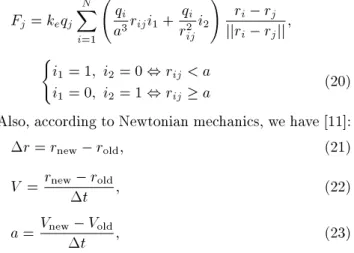
Fj = keqj N
X
i=1
qi
a3riji1+
qi
r2 iji2
!
ri rj
jjri rjjj;
(
i1= 1; i2= 0 , rij< a
i1= 0; i2= 1 , rij a (20)
Also, according to Newtonian mechanics, we have [11]: r = rnew rold; (21)
V =rnewtrold; (22)
a =VnewtVold; (23) where roldand rnew are the initial and nal positions of
a particle, respectively; v is the velocity of the particle; and a is the acceleration of the particle. Combining the above equations and using Newton's second law, the displacement of any object as a function of time is obtained as:
rnew =12mF:t2+ Vold:t + rold: (24)
Inspired by the above electrostatics and Newtonian mechanics laws, the pseudo-code of the CSS algorithm is presented as follows [15]:
Level 1: Initialization
- Step 1. Initialization. Initialize the parameters of the CSS algorithm. Initialize an array of Charged Particles (CPs) with random positions. The initial velocities of the CPs are taken as zero. Each CP has a charge of magnitude q dened considering the quality of its solution as:
qi=fitbest fitworstfit(i) fitworst ; i = 1; 2; :::; N; (25)
where fitbest and fitworst are the best and the worst tness of all the particles, and fit(i) represents the tness of agent i. Separation distance rijbetween
two charged particles is dened as: rij= jjXi Xjjj
jjXi+Xj
2 Xbestjj + "
; (26)
where Xi and Xj are the positions of ith and jth
CPs, respectively; Xbest is the position of the best
current C; and " is a small positive number used to avoid singularities;
- Step 2. CP ranking. Evaluate the values of the tness function for the CPs, compare them with each other, and sort them in an increasing order;
- Step 3. CM creation. Store the number of the rst CPs equal to Charged Memory Size (CMS) and their related values of the tness functions in the Charged Memory (CM).
Level 2: Search
- Step 1. Attracting force determination. Determine the probability of moving each CP toward the others considering the following probability function:
Pij=
(
1 fit(i) fitbestfit(i) fit(j) > rand W fit(j)>fit(i)
0 else (27)
and calculate the attracting force vector for each CP as follows:
Fj= qj N
X
i;i6=j
qi
a3rij:i1+
qi
r2 ij:i2
!
pij(Xj Xi)
8 > < > :
j = 1; 2; :::; N
i1= 1; i2= 0 , rij < a
i1= 0; i2= 1 , rij a
(28)
where Fj is the resultant force aecting jth CP.
- Step 2. Solution construction. Move each CP to the new position and nd its velocity using the following equations:
Xj;new=randj1:ka:mFj j:t
2+ rand
j2:kv:Vold:t
+ Xj;old; (29)
Vj;new=Xj;newtXj;old; (30)
where randj1 and randj2 are two random numbers
uniformly distributed in range (0,1). mj is the
mass of the CPs, which is equal to qj in this paper.
The mass concept may be useful for developing a multi-objective CSS. t is the time step, and it is set to 1. ka is the acceleration coecient, and kv
is the velocity coecient to control the inuence of the previous velocity.
- Step 3. CP position correction. If each CP exits from the allowable search space, correct its position using the HS-based handling approach as described for the HPSACO algorithm [24,26].
- Step 4. CP ranking. Evaluate and compare the values of the tness function for the new CPs and sort them in an increasing order.
- Step 5. CM updating. If some new CP vectors are better than the worst ones in the CM in terms of their objective function values, then include the better vectors in the CM and exclude the worst ones from the CM.
Level 3: Controlling the terminating criterion Repeat the search level steps until a terminating criterion is satised.
5. Error indicator and adaptive rearrangement by CSS
In the discrete least-squares meshless method for each nodal point, there are some nodes in its subdomain. The subdomains can be circular or rectangular (Fig-ure 2). According to the value of shape function and using interpolation, the amount of residual for each node is calculated in both x and y directions. Then, by summing residual cube in x and y directions and getting square of it, the value of the total residual is calculated for each node and its subdomain nodes. Hence, for each node, a set of residuals will be attained for all subdomain nodes. The aim of this process is to reduce the residual related to main node, which this helps to reduce the amount of residual in various domains in the overall process.
General plane stress equations and the residuals are as follow:
@x
@x +@@yxy+Fx=0
) @N
@xx+@N@yxy+Fx=ex @xy
@y +@@yy+Fy=0
) @N
@yy+@N@xxy+Fy=ey
9 > > > > > = > > > > > ;
! e=qe2 x+e2y;
(31)
which they can be written in the matrix form as follows: "
@N
@x 0 @N@y
0 @N @y @N@x
#
2 4xyx
y
3 5 +Fx
FY
=
ex
eY
: (32)
To apply CSS algorithm, the main node and its subdomains node and the normalized value of residual are considered as CPs and their charges, respectively, as follows:
qi=eej emin
max emin; (33)
where ejis the value of residual for jth CP or jth node,
and emin and emax are the minimum and maximum
values of residuals in the subdomain. Thus, the objective function for each node and its subdomain can be written as follows:
Minimize objective function =
N
X
i=1
Residual (i): (34) It should be noted that all of the programming pro-cesses are as identical to those mentioned in the CSS
Figure 2. Nodes in the circular and rectangular subdomains.
section; the only dierence is considering mass factor for CPs which can be dierent due to the example type and value of the random parameters. In the examples discussed in this article, appropriate results are achieved with less than ten iterations. In addition, even by choosing a proper mass factor, this number can be reduced to 2 or 3 iterations.
6. Numerical example
In this section, three examples of dierent crack status are presented for which the analytical solutions are available around the crack tip [27-31]. These examples are in the plane stress state. A comparison between the results before and after the rearrangement and also investigations of the residual reduction in various do-mains show the eectiveness of the presented method. The rst example is an edge crack, and the second and third ones are central and inclined crack, respectively, where uniaxial tension stress is applied to all of them. 6.1. A plate with an edge crack
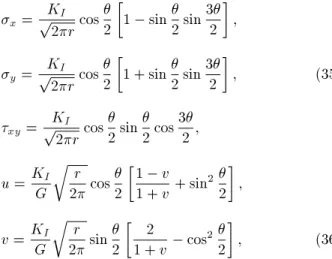
This example is a plate with an edge crack under a uniaxial tension in the plane stress condition. The plate dimensions are 52 20 mm, and the crack length is 4 mm (Figure 3). The analytical solutions to this exam-ple and the next and [27-28] are obtained by the same Eqs. (35)-(38), but the only dierence is stress factor that species which one is edge crack or central crack:
x=pKI
2rcos 2
1 sin2sin32
;
y =pK2rI cos2
1 + sin 2sin
3 2
; (35)
xy= pKI
2rcos 2sin
2cos
3 2 ;
u = KGI r
r 2cos
2
1 v 1 + v+ sin2
2
;
v =KGI r
r 2sin
2
2
1 + v cos2 2
; (36)
where G is the shear module, v representing the Poisson's ratio and kI is the stress factor, which can
Figure 3. Edge crack examples boundary condition.
Figure 4. Initial nodes distribution and of contour.
Figure 5. Nodes distribution and x contour after
adaptive rearrangement by CSS.
be dened as:
KI = Cpa; (37)
where a is the crack length, and C can dene by as follows:
C = 1:12 0:231 a2b+ 10:55 a2b2 21:72 a2b3 + 30:39 a2b4: (38) Here, 2b is the Plane width. The process of simulation of this example begins with initial distribution of 314 nodes. The arrangements of nodes before and after the rearrangement are shown in Figures 4 and 5, respec-tively. After running CSS algorithm and comparing the obtained results for x along crack length, an
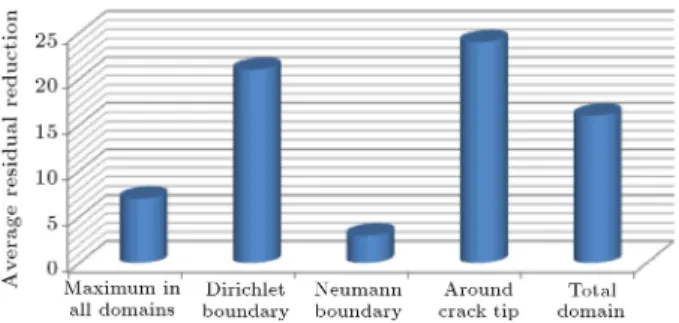
improvement can be seen in the results. Average reduction in the residuals from ten successful runs in various problem domains is shown in Figures 6 and 7. 6.2. Plate with a central crack
As a second example, a plate with dimensions of 3214 mm is loaded under uniform axial load, as shown
Figure 6. Normal stress x along crack.
Figure 7. Average residual reduction from ten successful runs.
Figure 8. Central crack examples boundary conditions.
in Figure 8. Analytical solution to this can be dened by Eqs. (35)-(38) with a dierence that the stress factor is obtained as [30]:
KI =
2b atan
a 2b
1 2
; (39)
where 2b and 2a are the plate width and crack length, respectively.
This problem is solved with the initial cong-uration of 1418 nodal points (Figure 9). Then, by using CSS algorithm based on the value of residual in various problem domains, the nodes move toward the directions that the amount of error is more, and next, the problem is solved again by DLSM. This process is continued until the desired answer is achieved. Results show a good reduction in the residuals and also a good convergence with analytical solution around crack tip, as shown in Figures 10 and 11. The average residual re-duction from ten successful runs is shown in Figure 12.
Figure 9. Initial nodes distribution and x contour.
Figure 10. Nodes distribution and xcontour after
adaptive rearrangement by CSS.
Figure 11. Normal stress x along crack.
Figure 12. Average residual reduction from ten successful runs.
6.3. Plate with an inclined crack
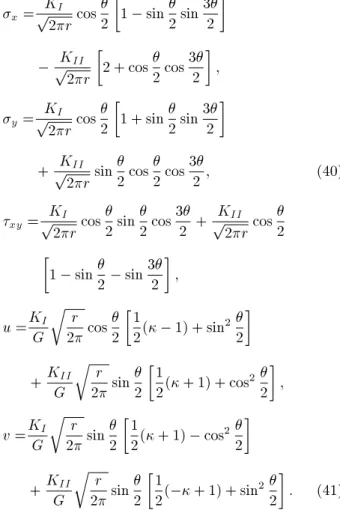
Previous examples are related to the rst fracture mode means opening, but in the present example, combined fractured mode is investigated which involves opening and shear modes. Plate dimensions are similar to the second example and boundary conditions, as shown in Figure 13. Analytical solution for around crack tip is obtained as [30-31]:
x=pKI
2rcos 2
1 sin2sin32
KII
p 2r
2 + cos2cos32
;
y =pK2rI cos2
1 + sin2sin32
+pKII 2rsin
2cos
2cos
3
2 ; (40)
xy=pKI
2rcos 2sin
2cos
3 2 +
KII
p 2rcos
2
1 sin2 sin32
;
u =KGI r
r 2cos
2
1
2( 1) + sin2 2
+KGII r
r 2sin
2
1
2( + 1) + cos2 2
;
v =KGI r
r 2sin
2
1
2( + 1) cos2 2
+KII G
r r 2sin
2
1
2( + 1) + sin2 2
: (41) Here, G is the shear modulus and k = (3 v)=(1 + v) with v representing the Poisson's ratio. is the angle of crack line with y axis; and KI and KII are the
stress factors for opening and shear modes based on crack angled, which can be dened as:
KI = pa sin2; (42)
KII = pa sin2 cos : (43)
Figure 13. Inclined crack examples boundary conditions.
Figure 14. Initial nodes distribution.
Figure 15. Nodes distribution after adaptive rearrangement by CSS.
Figure 16. Normal stress x along crack.
The conguration begins with 752 nodal points (Figure 14), and then by using CSS algorithm, the nodes move adaptively (Figure 15). By comparing the x stress along crack before and after the
rearrangement and also by investigating the residual reduction in problem domains, one can say adaptive rearrangement by these techniques has good inuence on residual reduction and convergence with analytical solution (Figures 16 and 17).
7. Conclusion
In this paper, in order to obtain more accurate answers in discrete least-squares meshless method for solving problems in the eld of fracture mechanics (two-dimensional cracks), the CSS algorithm is used. Also, for determining the nodes with higher error, an error estimator is used. The amount of residual in each node and its subdomain nodes is considered as the charge of the CP, and then based on the CSS algorithm, the
Figure 17. Average residuals reduction from ten successful runs.
nodes are moved in the direction where the amount of residual is higher. The results show the ability of the proposed method for solving problems in the eld of fracture mechanics.
References
1. Pan, X.F., Sze, K.Y. and Zhang, X. \An assessment of the meshless weighted least-squares method", Acta Mechanica Solida Sinica, 17(3), pp. 270-282 (2004).
2. Liu, Y., Zhang, X. and Lu, M.W. \A meshless method based on least-squares approach for steady-and unsteady-state heat conduction problems", Nu-merical Heat Transfer, Part B, 47(3), pp. 257-275 (2005).
3. Afshar, M.H. and Arzani, H. \Solving Poisson`s equa-tions by the discrete least squares meshless method", WIT Transaction on Modelling and Simulation, 42, pp. 23-32 (2004).
4. Firoozjaee, A. \Method for elasticity problems", In-ternational Journal of Civil Engineering, 7, pp. 9-18 (2009).
5. Afshar, M.H., Lashckarbolok, M. and Shobeyri, G. \Collocated discrete least squares meshless (CDLSM) method for the solution of transient and steady-state hyperbolic problems", International Journal for Nu-merical Methods in Fluids, 60, pp. 1055-1078 (2009).
6. Chen, Y., Lee, J.D. and Eskandarian, A., Meshless Methods in Solid Mechanic, Springer Science & Busi-ness Media, Inc (2006).
7. Liu, G.R., Mesh, R. and Afshar, M.H. \Discrete least squares meshless method with sampling points for the solution of elliptic partial dierential equations", Engineering Analysis with Boundary Elements, 33(1), pp. 83-92 (2009).
8. Naisipour, M., Afshar, M.H., Hassani, B. and Firooz-jaee, A.R., Collocation Discrete Least Square (CDLS) Free Methods Moving Beyond the Finite Element Method, CRC Press (2003).
9. Rabczuk, T., Zi, G., Bordas, S. and Nguyen-Xuan, H. \A simple and robust three dimensional cracking-particle method without enrichment", Com-puter Methods in Applied Mechanics and Engineering, 199(37-40), pp. 2437-2455 (2010).
10. Rabczuk, T. and Belytschko, T. \Cracking particles: a simplied meshfree method for arbitrary evolving cracks", International Journal for Numerical Methods in Engineering, 61(13), pp. 2316-2343 (2004).
11. Rabczuk, T. and Zi, G. \A meshfree method based on the local partition of unity for cohesive cracks", Computational Mechanics, 39(6), pp. 743-760 (2007).
12. Rabczuk, T., Zi, G., Bordas, S. and Nguyen-Xuan, H. \A geometrically non-linear three dimensional cohesive crack method for reinforced concrete structures", En-gineering Fracture Mechanics, 75(16), pp. 4740-4758 (2008).
13. Afshar, M.H., Amani, J. and Naisipour, M. \A node enrichment adaptive renement in discrete least squares meshless method for solution of elasticity prob-lems", Engineering Analysis with Boundary Elements, 36(3), pp. 385-393 (2012).
14. Ebrahimnejad, M., Fallah, N. and Khoei, A.R. \Adap-tive renement in the meshless nite volume method for elasticity problems", Computers and Mathematics with Applications, 69(12), pp. 1420-1443 (2015).
15. Kaveh, A. and Talatahari, S. \A novel heuristic optimization method: charged system search", Acta Mechanica, 213(3-4), pp. 267-286 (2010).
16. Kaveh, A. and Zolghadr, A. \Truss optimization with natural frequency constraints using a hybridized CSS-BBBC algorithm with trap recognition capability", Computers and Structures, 102-103, pp. 14-27 (2012).
17. Kaveh, A. and Talatahari, S. \Charged system search for optimum grillage system design using the LRFD-AISC code", Journal of Constructional Steel Research, 66, pp. 767-771 (2010).
18. Kaveh, A. and Talatahari, S. \Charged system search for optimal design of frame structures", Applied Soft Computing, 12, pp. 382-393 (2012).
19. Arzani, H., Kaveh, A. and Dehghan, M. \Adaptive node moving renement in discrete least squares mesh-less method using charged system search", Scientia Iranica, 21(5), pp. 1529-1538 (2014).
20. OAzyon, S., Temurtas, H., Durmus, B. and Kuvat, G. \Charged system search algorithm for emission con-strained economic power dispatch problem", Energy, 46, pp. 420-430 (2012).
21. Kaveh, A. and Behnam, A.F. \Cost optimization of a composite oor system, one-way wae slab, and concrete slab formwork using charged system search al-gorithm", Scientia Iranica, 19(3), pp. 410-416 (2012).
22. Lancaster, P. and Salkauskas, K. \Surfaces generated by moving least squares method", Mathematics of Computation, 37, pp. 141-158 (1981).
23. Onate, E., Perazzo, F. and Miquel, J. \A nite point method for elasticity problems", Computers and Structures, 79, pp. 2151-2163 (2001).
24. Atluri, S.N. \The meshless local Petrov-Galerkin (MLPG) method for domain and boundary discretiza-tions", Tech. Science Press (2004).
25. Organ, D., Fleming, M., Terry, T. and Belytschko, T. \Continuous meshless approximations for nonconvex
bodies by diraction and transparency", Computa-tional Mechanics, 18, pp. 225-235 (1996).
26. Halliday, D., Resnick, R. and Walker, J. \Fundamen-tals of Physics", 8th Ed., John Wiley and Sons (2008).
27. Kaveh, A. and Talatahari, S. \Particle swarm opti-mizer, ant colony strategy and harmony search scheme hybridized for optimization of truss structures", Com-puters and Structures, 87(5-6), pp. 267-283 (2009).
28. Kaveh, A. and Talatahari, S. \A Particle swarm ant colony optimization algorithm for truss structures with discrete variables", Journal of Constructional Steel Research, 65(8-9), pp. 1558-1568 (2009).
29. Tada, H., Paris, P.C. and Irwin, G.R., The Stress Analysis of Crack Handbook, 3rd Ed., ASME Press (2000).
30. Sun, C.T. and Jin, Z.H., Fracture Mechanics, Aca-demic Press (2012).
31. Miller, K.J. and McDowell, D.L. \Mixed-mode crack behavior", ASTM (1999).
Biographies
Hamed Arzani was born in 1969 in Amol, Iran. He obtained his BS, MS, and PhD degrees in Civil Engineering in University of Science and Technology in 1992, 1994, and 2006, respectively. He then joined
the University of Shahid Rajaee Teacher Training University in Tehran, where he is presently an Assistant Professor of Structural Engineering. Arzani is the author of 3 papers published in international journals and 5 papers presented at international conferences. Ali Kaveh was born in 1948 in Tabriz, Iran. After graduation from the Department of Civil Engineering in the University of Tabriz in 1969, he continued his studies on Structures at Imperial College of Science and Technology at London University and received his MS, DIC and PhD degrees in 1970 and 1974, respectively. He then joined the Iran University of Science and Technology in Tehran where he is presently a Professor of Structural Engineering. Professor Kaveh is the author of 485 papers published in international journals and 145 papers presented at international conferences. He has authored 23 books in Farsi and 7 books in English published by Wiley, the American Mechanical Society, Research Studies Press, and Springer.
Mojtaba Taheri Taramsari was born in 1988 in Rasht, Iran. He obtained his BS degree in Civil Engineering in Guilan University in 2011 and his MS degree in Structural Engineering at Shahid Rajaee Teacher Training University in 2014.