Int. J. Food System Dynamics 3 (3), 2012, 214‐227
The Implementation of a Quality Management Standard in a
Food SME: A Network Learning Perspective
Zam
‐
Zam
Abdirahman
and
Loïc
Sauvée
Institut Polytechnique LaSalle Beauvais
BP 30313, Rue Pierre‐Waguet, 60000 Beauvais, France
zam‐zam.abdirahman@lasalle‐beauvais.fr; loic.sauvee@lasalle‐beauvais.fr
Received November 2012, accepted December 2012, available online February 2013
ABSTRACT
In the modern agrifood economies, the development of quality management standards is crucial, and food small and medium enterprises (SMEs) usually face difficulties in implementing them. In this context, the aim of the article is two‐fold. Firstly it is to craft an original analytical framework in line with the literature on innovation networks and related learning effects specifically devoted to the study of quality management standards implementation. Secondly the objective of the article is to apply this framework to a specific food SME case in order to test it and to identify the key network learning effects that occur during the implementation of a quality management standard, namely the ISO 22000 standard for food safety. From this research, the practical output will be to propose tools to enhance food SMEs’ innovative capacity, through an improvement of their insertion in active formal and/or informal innovation networks. These specific tools will be especially targeted towards the strengthening of learning processes between the SME and the partners involved in the implementation.
Keywords: food SME, innovation, learning, network, quality management standard
1
Introduction
The contemporary agrifood sectors have witnessed a rapid increase in the use of intangibles, i.e. inputs built
upon information, knowledge and communication assets. Consequently firms, in their move towards
competitiveness, try to innovate in line with these trends. Innovations in agrifood sectors were traditionally
focused around new products and new technologies, and often seen as incremental. Organizational
innovations, mainly based upon intangibles, need a broader view of what is innovation, especially in the
context of food SMEs. Indeed food SMEs, which roles in the structuration and the dynamism of the food
economy in Europe is crucial, have at the same time difficulties and limitations in their innovativeness capacity.
The main objective of the communication is to better understand the conditions and processes of such
innovations from a learning perspective at the micro analytical point of view, centered on small and medium
enterprises. The research is focused on one type of organizational innovation, the food quality management
standards.
The article is structured as follows. In a first part (2) we characterize such innovations in food sectors around
two core features: the identification of what is at stake, in terms of resources, competences and structures,
when a company adopts such an innovation; and the identification of consequences such an innovation will
have in terms of behavior of this company towards its environment. In a second part we suggest addressing
this question through a specific approach, thus a syncretic analytical framework is proposed (3). Then this
standard of quality management systems for food safety) within a regional initiative in France (4). Discussion
and concluding comments follow (5).
2
Organizational innovations in food SMEs
The development of food quality management standards is a major trend in the modern economy and can be
explained by several key drivers like the need for control and the complexity of coordination mechanisms. The
consequences in terms of implementation, for food SMEs, are contrasted: it brings both opportunities and
threats, but in any case the innovative capacity of food SMEs is involved, especially when one considers the
standard as a key dimension of competitiveness (2‐1). Consequently we suggest considering the complexity of
this issue of innovation adoption thanks to a focus on the network partners and on the interactions between
the firms and these partners (2‐2).
2.1 Food quality management standards as organizational innovations: context and trends
Organizational innovations are usually defined in opposition with product and process innovations. An
organizational innovation is considered as the implementation of new organizational or new managerial
practices. Avermeate and Viaene (2002) consider that organizational innovations usually take place when
innovation is increasingly generated in networks or collaborative relationships. Science‐based knowledge and
technology may be involved but are not the main drivers of such innovations (Avermeate and Viaene, 2002;
Hatanaka et al. 2005).
The development of quality management standards is one of the major trends of organizational innovations in
agrifood sectors (Henson and Reardon, 2005). The main drivers of these tremendous changes are well known
and can be summarized by a few key features: the need for control along the chain, the complexity of
coordination problems between actors, and the changing roles between public and private institutions in all
the regulatory aspects of the economy (Henson and Humphrey, 2009; Nadvi and Wältring, 2004).
The changes can be categorized in four categories. First of all, the need for a better control over food safety
and other types of attributes is directly related to the increased concerns of consumers about these issues.
Several major food crises have undermined its confidence (Henson and Humphrey, 2009). It is interesting to
note that at the same time the competitive pressure between firms has created a lot of opportunities for the
development of new attributes, i.e. for environment, ethics, and nutritional aspects. The extension of
exchanges on such complex attributes is also a driver for more sophisticated food standards. Consequently, this
is not only the recognition of what is good and safe for human consumption, but instead the identification of a
complete spectrum of attributes, from search to experience and credence attributes, that is to be considered.
A second feature that explains the rise of food quality standards is the need for a better coordination between
firms (Schiefer, 2003). The need for coordination is also linked to a context of globalization. Exchanges have
progressively moved from local to national levels. Nowadays exchanges are facilitated by modern
communication and transportation means and technologies. Consequently a wide range of heterogeneous and
diverse connections from all across the world is brought together in business relations. The need for
standardization and its recognition in different parts of the world are thus necessary.
A third feature is directly related to institutional aspects of food safety issues. As argued by researchers such as
Hatanaka, Bain and Busch (2005, 2006), the literature in food quality management usually emphasizes the
operational aspects. In fact we will see that a complete understanding of quality management and quality
management standard adoption issues necessitates a broader view including organizational/institutional
(Ménard and Valceschini, 2005) as well as interpersonal aspects.
Several research works have shown that barriers, such as a lack of trust in food safety and food quality
requirements, an insufficient connection with enforcement officers, a deficient information system, may affect
the process of adoption (Gellynck, Vermeire and Viaene, 2007). Another category of factors may limit
innovation adoption and prevent compliance: individual factors such as a lack of motivation or a lack of
knowledge in food safety requirements. From this situation of food SMEs we suggest an interpretation of the
process of innovation in terms of network and network effects. As we will see, this network dimension is a key
recurrent lack of resources and competences related to the context and to the practical implementation of the
innovation.
2.2 The structural network dimension in organizational innovations: types and roles of partners in the creation, adoption and implementation of food quality management standards
The first step in the analysis of organizational innovations from a structural network perspective is the
identification of the main partners, both at organizational and at individual levels. The network effects must be
identified for these two separate levels as they refer to specific phenomena, to be investigated by the analysis.
We will consider here the main organizational partners (Henson and Humphrey, 2009; Westphal et al., 1997).
Thus we will describe the situation in the situation of organizational innovations. The main partners usually
involved in food quality management standard innovations are: standardization organizations, consulting firms,
other SMEs, third‐party certifiers. Let us consider their status and roles in the process of innovation:
‐ The main organization, at the international level, devoted to food standards is ISO: International Organization
for Standardization. This organization has affiliated national organizations that will represent it. In France this
organization is called AFNOR (“Association française de normalisation”, French Association for Standardization),
created in 1926. In 1947 AFNOR took an active role in the creation of ISO. Today the AFNOR group is organized
around several strategic business units, including standardization sensu stricto, training, consulting, auditing
etc.
‐ Consultancy firms have a leading role in the development of food standards. This is a major consequence of
the adoption of food standards by SMEs: the need for external stakeholders due to a lack of in‐house resources
and competences. These consultancy firms are usually small companies and with a high degree of expertise
specialization (on technical aspects, human resource management, organization and strategy etc.).
‐ Other (food) SMEs. The adoption of innovations is also part of a global social phenomenon, where
competitive pressure, rivalry, mimetic behavior, opinion leadership have important effects. This is especially
true at local and regional levels: family‐owned companies are part of social communities of business leaders
with participation in clubs, forums and other sporadic social events. One can include also suppliers and
customers as they will influence the process of innovation and can be important drivers for change.
‐ Third party certifiers. Third party certification is an audit mechanism by which independent auditors ensure
compliance with standards. The roles and situations of third party certifiers are an active dimension of the
innovation process: indeed previous research (see for instance Hatanaka, Bain and Busch, 2005, 2006) have
shown that auditors can be used strategically by actors and are not neutral agents.
‐ Regional and professional institutions: Public/professional bodies have developed, in most countries,
innovation policies in order to promote and help SMEs in their innovation projects. In France, institutions such
as regional innovation agencies or Chambers of Commerce and Industry (CCI) support financially and
institutionally a wide range of practical initiatives around innovation issues.
But how will these different partners affect innovation processes? What are their roles on one of the key
feature of any innovation process, namely learning aspects? The complexity of network effects which affect
strongly the way organizational innovations and learning aspects have increased. Then the question of tools
and concepts useful to better understand these processes is raised.
3
Network learning effects in the process of organizational innovation: proposal of an
analytical framework
We will briefly present the core principle of this analysis and its basic concepts and tools (3.1). A second part
details the interests of such an approach for the study of network learning effects in the process of quality
management standard implementation (3.2). Then, from these theoretical backgrounds, an analytical
framework is proposed (3.3).
3.1 Innovation through networking: some principles
The structural analysis of networks is devoted to the study of networks as a combination of actors (or nodes)
and relations (or edges or ties). The basic assumption of these researches (Borgatti et al., 2009) is that actors
are not independent but rather influence each other. Thus the network structure, or in other words its
structural properties, makes sense and must be studied as a whole. For Borgatti (Borgatti and Li, 2009), one of
matters (…). For examples, teams with the same composition of member skills can perform very differently
depending on the patterns of relationships among members. Similarly, at the level of the individual node, a
node’s outcomes and future characteristics depend in part on its position in the network structure. Whereas
traditional social research explained an individual’s outcomes or characteristics as a function of other
characteristics of the same individual (e. g. income as a function of education or gender), social network
researchers look to the individual’s social environment for explanations, whether through influence processes
or leveraging processes” (Borgatti, Mehra, Brass, LaBianca, 2009:893‐894). Consequently a key task of social
network analysis has been to identify structural characteristics (such as the density and cohesion or
connectedness of the structure).
Thus it is important to acknowledge the fact that the network approach can encompass any types of nodes
(actors) or ties (links). In usual typologies of ties studied in such approaches, ties can be continuous (e. g.
similarities) or discrete (e.g. money flows). These categories of ties can be applied to the two main categories
of nodes, e. g. firm and individual. Ties can be directed (direction matters, such as in flows) or undirected
(direction is not relevant or useless), weighted (i.e. measured) or unweighted (Wasserman and Faust, 1994).
There has been an impressive amount of research on innovation using the network approach, but without any
theoretical integration (Conway et al., 2001; Conway and Steward, 2009; Pittaway et al., 2004). It is important
to recognize that the network perspective is not a theory per se (even if it produces important concepts and
notions) but a methodological approach that helps to understand complex network phenomena. This
methodology can (should) be combined with other methodologies such as case study research.
Coulon (2005) proposed a survey of researches on innovation using the network perspective with a
classification of networks in four categories, according to the characteristics of ties. Most of the research is
done with unweighted ties. This is not surprising since “measures involving unweighted ties are easier to
calculate and it is simpler to encode and visualize dichotomous ties, whereas weighted ties need more complex
formulas. Moreover, directed ties are required if one wants to talk about flows of something, such as flows of
knowledge” (Coulon; 2005). Coulon suggests that “when case studies are not able to capture the degree of
complexity of the causal mechanisms under investigation because of the large number and diversity of the
actors involved, (…) it is preferable to use a combination of case study and network analysis. It is possible that
in the narrative giving a deep socio‐historical understanding of the inner forces within the actors or nodes
under the study the researcher misses some important relations/ties between actors. In combination with
network analysis and other sources of data, it is possible that these ties could be detected much more easily,
especially in large‐scale networks” (Coulon, 2005).
3.2 Interests of the network approach and its implication for the study of learning effects
The network approach applied to the study of innovation has many advantages, especially when it deals with
network structure and actor’s behavior (Conway and Steward, 2009). Innovation is a very complex and
multifaceted phenomenon, involving different sets of actors, different flows of information and knowledge
(Lam and Lundvall, 2007; Cross et al., 2003; Conway and Steward, 1998, 2009).
The interests of the structural network approach in innovation research can be summarized in a few points.
First of all, it allows the simultaneous combination of several types of ties directly or indirectly linked to the
innovation processes (flows of information, money, knowledge etc). Secondly, this approach adopts a multi
level perspective of actors (nodes) in networks (i.e. personal/organizational nodes), and connects these
different levels of analysis through the method of the “linked design” (Lazega et al., 2007). Each level is not
seen in isolation but instead in terms of interactions between levels. A third interest is that, through
computation and formal methods, the approach will avoid too vague and imprecise comments. Instead it
compares structural characteristics with formal methods (centrality, betweenness etc. are usually summarized
by numbers or formal indicators) linked to the results of the innovation process (success, failure, adoption rate
etc., notions that can also be measured by quantitative criteria).
As shown in several research works (see for instance Giuliani and Bell, 2004; Cantner and Graf, 2006; Chan and
Liebovitz, 2006; Tsai, 2001) a network perspective could also help identifying different types of cognitive roles,
i. e. specific roles of actors (individuals and/or organizations) in the innovation process: technological
gatekeepers, strong mutual exchangers, weak mutual exchangers, external stars, champions. These typologies
are built through the main structural characteristics of networks, network positions, and power in networks.
In the research on innovation applied to quality management standard implementation, there are two
supplementary points of major interests that can be investigated complementarily:
‐ The acquisition and development of new knowledge (for innovation): this can be done through internal and
external resources. This is more a question for early adopters but this is an important point in understanding
how food SMEs innovate, where does it happen and why does an innovation start etc. This is a complex issue,
mainly because this is related to the question of knowledge (difficult to study) and to the transformation of
knowledge in real innovations. But the network perspective is of particular interest for obvious reasons: the
fact that knowledge flows, that mainly come from outside the firm, must be tracked and studied as part of an
‘innovation ecosystem’. It is also necessary to identify the absorptive capacity of firms towards new knowledge,
and thus identify nodes’ attributes (Freeman, 2004).
‐ The diffusion of innovations, mainly between firms and individuals, reflects the fact that innovation learning is
frequently done through mimetic behaviors. Firms, because of competitive pressure, will decide to innovate
and to copy what is done on the market or by competitors. An important body of literature is about this
question of mimetic behaviors or follower behaviors (see for instance Cantner and Graf, 2006; Giuliani and Bell,
2004). It is an important driver of innovation for food SMEs. These adoptions are mainly done through different
types of networking activity which can be very helpful in tracking these phenomena.
Following the seminal work of Argyris and Schön (1996) on organizational learning, the role of networks and
networking activity for learning has been widely acknowledged (Crossan et al., 1999; Kleysen and Dyck, 2001).
More specifically, Crossan, Lane and White (1999) identify three levels of learning: individual, group and
organization, with subsequent learning processes. These authors emphasize the fact that these processes are
usually, in organizational innovations, a double‐loop or second‐order form of learning, meaning that radical and
complex changes are involved (Argyris and Schön, 1996). Other works (Lundvall, 2010; Lam and Lundvall, 2007)
identify the different forms of learning under the categories of learning by doing, by using, by interacting, by
spillovers effects. Learning related to the issue of innovation can also be viewed in a holistic manner. This is the
perspective adopted by authors such as Berthon et al. (2007). These authors show that learning is not an
isolated phenomenon. Instead, its strength is to be found in the complementarity of the network relationships
seen as a stable structure, and the interacting processes that occur (mainly) at the inter‐individual level. Thus
emerges a view of the ‘networking activity’ where the relationship between network and organizational
learning is a “channel for learning but, recursively, that the network is transformed by the learning taking place.
In other words, the network is, at least partially, constructed by the learning processes dynamically,
deliberately and in an emergent manner” (Berthon et al, 2007:23).
Finally, the roles of contextual factors such as proximity, either geographical or organizational, are also
emphasized by authors such as Torre (2006), Boschma (2005), Bouba‐Olga and Grossetti (2007, 2008), and
Grossetti (2004). The roles of these factors are ambiguous. The status of knowledge, tacit or explicit, is one of
the factors that could explain the effect of proximity in the success of learning. For Bouba‐Olga and Grossetti
(2007, 2008), the answer to that question is to be found in a precise delineation of coordination mechanisms
and mediation resources. These resources being in some cases localized, the spatial proximity of innovation
processes will be favored, while in other cases innovation processes will be independent from spatial
dimensions. In any case it is necessary to integrate to some extent these elements in the analysis of learning
phenomena for innovation.
3.3 An analytical framework of the implementation of quality management standards
Considering our approach based upon the structural characteristics of networks in the innovation process, we
will consider two specific features that are of particular interests in disentangling the innovation process: the
phase of innovation and the diversity of partners involved. The adoption of quality standards encompasses
different functions, from creation to wide diffusion across firms. While following an ego‐network (i. e. centered
on one company) approach, it is nevertheless necessary to identify what are these main functions. The specific
situation of a company will then be related to these general functions, and more importantly, to the type of
partner(s) that is (are) involved.
According to the literature in food quality management (Henson and Humphrey, 2009) there are five different
phases that can be distinguished:
‐ Phase 1: the standard‐setting: in other word this is the phase of creation of the standard, where the rules,
‐ Phase 2: the adoption per se: an entity decides to adopt a standard, usually a firm. This decision is of course
the central and discriminating phase of the process, even if this phase is short in time, with a wide diversity of
contrasted situations.
‐ Phase 3: implementation: the rule is practically implemented in one company, with the development of new
competences and creation/adaptation of (new) resources. This phase is usually identified as the operational
phase and could last several years in case of complex standards that will necessitate important changes. ‐ Phase 4: conformity assessment: this is the phase that will bring compliance with the standards, the respect of
procedures, rules, and lists of specification. The conformity can be assessed by many means, and from a
network perspective this is important to acknowledge the extreme diversity of organizational configurations.
Usually there are two broad means of assessing conformity: self‐assessment and by a third party. But inside
these two categories the roles, statutes and functions may differ.
‐ Phase 5: enforcement: this phase will define the means and procedures that allow the execution of
engagement, either through sanctions or through incentives. The enforcement phase can be implemented by
the firm itself but also other organizations, specialized or not in this role. The State can also be an enforcer for
mandatory rules.
While considering simultaneously these five functions and the main categories of food standards, it appears
that the distinction between public and private on the one hand, and mandatory and voluntary on the other
hand, becomes clearer. This distinction must be emphasized because of its implication for a network approach
of food standard adoption.
The diversity of partners and relationships (nodes and ties) are also to be considered. Indeed, as we have seen
above, the diversity and the heterogeneity of partners involved come along with the diversity of functions. This
heterogeneity is mainly linked to the complexity of the innovation process at stake when the adoption is not
based on a short term innovation such as market innovation or when partners are mainly homogeneous
entities (such as research centers) as in product innovation. For the implementation of a quality standard, the
innovation process is (or can be) both long in time and conducted with diverse entities. In parallel with this
diversity, the content of ties can cover the complete spectrum of possibilities: money and information
exchanges, knowledge transfers, social interactions and social exchanges.
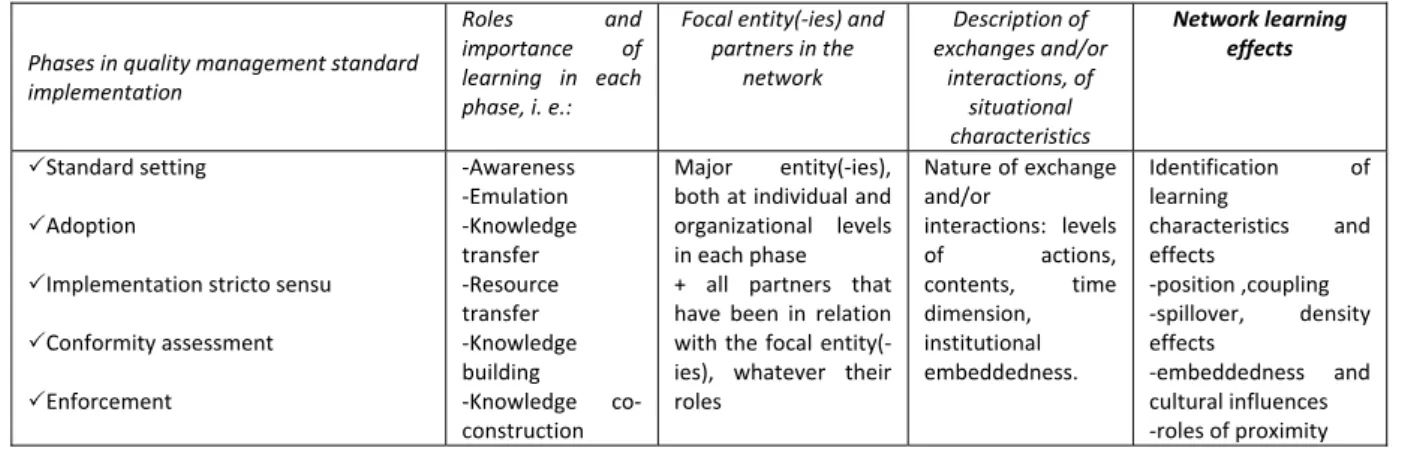
In considering these two components, we propose the following analytical framework (table 1), crossing the
phases with the type of partners involved. In crossing the two dimensions (phases and types of partners
involved in the implementation process), the analysis will emphasize the specific learning effects that could be
related to the concrete situation of the company. Indeed, for each innovation phase the network
characteristics of the process are detailed, in terms of focal entity and network partners (i. e. nodes), network
relationships (i. e. type of ties), and their consequences in terms of learning effects.
Following the seminal work of Argyris and Schön (1996), we will consider the learning phenomena as the
knowledge that is created, assimilated and distributed by the companies in order to facilitate innovation
(Crossan et al., 1999; Kleysen and Dyck, 2001). For Lam and Lundvall (2007) and Lundvall (2010), innovation
learning can be characterized by a few key features (see table 1). Considering effects, the position, coupling,
density and spillover effects are related to the structural aspects, mainly determined by the global structure of
the network (Conway and Steward, 2009). The roles of champions (or of other categories of specific members,
as in Giuliani and Bell, 2004) refer to the differentiation of members’ roles within innovation networks. A last
category of effects are the contextual effects (mainly proximity, with its different forms) and has been widely
acknowledged in the stream of thought ‘socio economics of proximity’ (Torre, 2006).
Table 1
Phases of innovation and partners in quality management standard implementation: Emphasizing network learning effects
Phases in quality management standard
implementation
Roles and importance of learning in each phase, i. e.:
Focal entity(‐ies) and partners in the
network
Description of exchanges and/or
interactions, of situational characteristics
Network learning
effects
Standard setting
Adoption
Implementation stricto sensu
Conformity assessment
Enforcement
‐Awareness
‐Emulation ‐Knowledge
transfer ‐Resource
transfer ‐Knowledge
building ‐Knowledge co‐
construction
Major entity(‐ies),
both at individual and
organizational levels
in each phase
+ all partners that
have been in relation
with the focal entity(‐
ies), whatever their
roles
Nature of exchange
and/or
interactions: levels
of actions,
contents, time
dimension,
institutional
embeddedness.
Identification of
learning
characteristics and
effects
‐position ,coupling ‐spillover, density
effects
‐embeddedness and
cultural influences ‐roles of proximity
4
A case study of a food SME implementing a quality management standard
After a presentation of the general principles of the case study research, followed by a synthetic presentation
of the Paris Caramel company and of ISO 22000 standard (4.1), the framework is applied to this case in
considering globally the network effects at the two levels: individuals and organizations (4.2) and then the time
dimension, i. e. the impact of innovation phases (4.3).
4.1 Methodology of case study approach, research protocol and description of the context and of the Paris Caramel case
The methodology is developed is the spirit of Yin’s (2003) case study approach. Following Yin, the selection of
the case study is done with an objective of an analytic generalization. This approach of analytic generalization is
relevant when “a previously developed theory is used as a template with which to compare the empirical result
of the study” (Yin, 2003).
Methodology of the case study approach
The research protocol in such an approach is based on interviews, which is according to Eisenhardt and
Graebner (2007) a rich source of information well adapted when the phenomenon is complex or unknown.
Thus several face‐to‐face interviews with quality management services, CEOs and consultants have been
conducted. This information has been completed by secondary data about the environment, the quality
procedures and the market characteristics relevant to the case study.
Founded in 1957, Paris Caramel is a food SME in the Picardie region in Northern France which belongs to the
chocolate and confectionery industry. The company manufactures three main types of products of the highest
quality: caramel, fruit pulp and chocolate, for a turnover of 900 000 Euros a year. The customers are pastry
confectioners, delicatessen and shops selling local products. The company has forty employees, mainly makers
of caramels, fruit jellies and chocolate candies. In year 2000, the company decided to develop the certification
of various stages of the production process, started with HACCP. As a small family‐owned company with mostly
self‐educated staff, Paris Caramel is very cost‐efficient with a short decision process. Another important
characteristic of the company is its human dimension: human capital is more important than financial returns,
and the managers put more emphasis on training their employees and on maintaining employment than on
profits.
Context of ISO 22000, the case description of ISO 22000 initiative, and of Paris Caramel company
ISO and its member countries used the quality management system approach and tailored it to apply to food
safety requirements, incorporating the widely used and proven HACCP principles into the quality management
system. The resulting standard is ISO 22000. In September 2005, the standard was officially launched. Thanks
to this new standard, HACCP and ISO 9001 are combined in an integrative manner, from upstream to
management system when an organization in the food chain needs to demonstrate its ability to control food
safety hazards in order to ensure that food is safe at the time of human consumption. It is applicable to all
organizations, regardless of size, which are involved in any aspects of the food chain and want to implement
systems that consistently provide safe products. The means of meeting the requirements can be accomplished
through the use of internal and/or external resources. More specifically, the ISO 22000 standard has the
following objectives: to plan, operate, and maintain the quality management standard; to demonstrate
compliance with requirements; to evaluate and assess customer requirements; to communicate food safety
issues to the relevant interested parties; to demonstrate such conformity, and to seek certification.
In spring 2007, the Chamber of Commerce and Industry (CCI) decided to launch, for ten regional food
companies (including Paris Caramel) an informal ‘ISO 22000 club’, a regional program to support ISO 22000
standards. This ISO 22000 program has consisted in a business leader coaching along with accompanying
collective actions for all participating companies. The Paris Caramel’s management decided to embark on the
process of certification because of new customers’ requirements and changes in the business environment.
The certification was not an absolute necessity for this healthy company but appears as a possible
supplementary marketing asset in accordance with the policy of sustainable customer satisfaction ensuring the
safety of products sold. It would also eliminate the different and heterogeneous customers’ specifications and
create differentiation towards competitors. Finally Paris Caramel got the certification for ISO 22000 standard in
October 2008.
4.2 The implementation of ISO 22000 standard: network learning effects at organizational and individual levels
The global configuration of network ties and of their learning effects are summarized in table 2 and 3. The
tables show a well balanced distribution of ties, between the four classical categories of ties identified at two
analytical levels, organizations (companies) and individuals (people). Let us consider successively the two
levels, and summarize the main network learning effects.
Organizational level
Continuous ties such spatial (the location in the Picardie region, the role of the Regional Council) and cultural
ties have been acknowledged by the company as important features, as they provide trust and easy
communication. The tacit knowledge dimension of the standard is also to be considered: for that type of
knowledge, considered as soft information, organizational proximity is sufficient. For the responsible in charge
of the implementation at Paris Caramel, the institutional embeddedness of the initiative, promoted both by
AFNOR and by the Chamber of Commerce, has played a crucial function in providing seriousness and credibility.
The congruence of goals between all the stakeholders of the initiative, creating a specific relationship and a
sense of responsibility, provided the ground for mechanism such as emulation, mimicry. Indeed these effects
can be considered as learning effects as well, in reinforcing/auto promoting the exchange of skills and
information.
Table 2
Network learning effects at organizational level in the case study
Type of ties Content Learning effects
Continuous Similarities Location in the Picardie
region
Joint membership in HACCP
club
Spatial proximity
Cultural proximity
Relations Competition and rivalry with
other food SMEs
Mutual commitment in
associations
Emulation
Cultural proximity,
congruence of goals
Discrete Interactions Interactions with consultancy
firms
Commercial relations with
customers
Learning by doing (initiation)
Learning by exchanging
Flows Knowledge transfer from
AFNOR
Money transfer from CCI
Learning by exchanging
The learning by doing effects have been identified mainly between the consultancy firm and Paris Caramel: the
role at that organizational level is significant at the initiation stage (establishment of a first contact and of a
formal tripartite contract between the CCI, the consultancy firm and the company), but the main interaction
effects have occurred at the individual level (cf. below).
Individual level
The inter individual aspects of the network learning effects are more difficult to evaluate for confidentiality
reasons, nevertheless there is a clear complementarity of the continuous ties between the two levels, leading
to strong coupling effects. The managers from Paris Caramel (the CEO, the quality responsible) are part of a
coherent community of leaders in the Picardie region and everybody knows each other quite well. This fact has
played an important role in the decision to adopt, as we will see in 4.3. But the individual level is also of
tremendous importance for learning in terms of discrete ties: interactions (mainly with the consultant, but also
with other food managers during the period of the CCI initiative as well as with some customers).
Table 3
Network learning effects at individual level in the case study
Type of ties Contents Learning effects
Continuous Similarities Antecedents of contacts with
business leaders
Comparison with other food
business leaders
Cultural influence
Personal emulation
Relations Informal exchanges with
other managers
Informal relationships with
professionals about quality
management
Learning by mimicry
Learning by interacting
Discrete Interactions Interactions with consultants
Personal interactions with
buyers
Personal interactions with
public bodies
Learning by individual
exchanges
Learning by interacting
Learning by interacting
Flows Flow of information from
competitors
Flow of information from the
environment
Informal exchanges
Learning by inter individual
influences
According to our analytical framework, the learning effects can be identifyed at the two levels, organizational
and individual. At organizational level, the roles of contextual factors are determinant: indeed, continuous ties
form the basis of a global proximiy that has facilitated greatly the implementation process. Discrete ties (both
interactions and flows) create a complete range of learning by interacting effects (Lundvall, 2010), where
probably the coupling of the organizational level with the individual level has an important role, still to be
understood more deeply. For the individual level, we emphasize the importance of interindividual emulation
and of mimetic behaviors, observed mainly within the strong community of leaders that has been created
through the ISO 22000 initiative.
4.3 The implementation of ISO 22000: network learning effects over innovation phases Organizations
Organizations involved in the process of standard adoption are: AFNOR, CCI, consultancy firms, other SMEs.
‐ AFNOR, the French ISO affiliated organization, has a central role in the definition of ISO 22000 standards. But
this role can be qualified as highly differentiated, according to the phase of innovation. In the initial phase of
creation, AFNOR has a leading role, but it is interesting to notice that Paris Caramel is not involved at all. In the
phase of initiation, AFNOR has played a more contrasted role: thanks to its leadership and size, AFNOR always
plays a central role in awareness of companies. But its actions are mainly oriented towards large companies. In
the adoption phase AFNOR has no specific role. During the implementation phase, AFNOR provides its
‐ The CCI (Chamber of Commerce and Industry) had no role in the definition phase. Its action is crucial in the
adoption phase: the organization has acted as a pivotal organization between AFNOR, consultancy firms and
SMEs, through the program funding and the set up of the tripartite contracts.
‐ Consultancy firms: Protechnic, a consulting firm had a central role in the adoption stricto sensu phase. It is
difficult to separate its role as a company and as a person. Indeed the manager of the company has been
largely convinced by the consultant to adopt the standard. But the company has also a very good experience
and reputation at working with SMEs. The specific expertise is at the basis of the successful interaction process. ‐ ISO 22000 club for SMEs: this club is the heir of another previous club devoted to HACCP. Its role has been to
connect companies from different industries (thus not in competition) to exchange views and questions about
the standard and its consequences. Its role is both formal (membership) and informal (interpersonal relations,
cf. below).
‐ Third party certifier: the certification body Veritas has conducted the certification process and has been the
main player, with Paris Caramel, during the conformity assessment phase.
Individuals
The roles held by individuals are more difficult to acknowledge. Informal contacts and exchanges may occur at
any time and for confidentiality and privacy reasons interviewees are reluctant to answer. Nevertheless
interpersonal contacts between Mr. and Ms C. from Paris Caramel seem to play an important role especially
with one consultant Ms N. and with all the managers from the ISO 22000 group.
‐ Consultant: Ms N., through its experience, played mainly a role of coaching. Ms N. put in evidence the interest
of a certification and convinced the managers: the standard will improve the customer satisfaction and will
enhance the customer confidence with better food safety conformity.
‐ SME managers within the ISO 22000 club: 10 managers from different companies seem to have played a
crucial role in exchange and in creating a mutual emulation between the business leaders.
According to the analytical framework, the learning effects are different from one phase to another, as shown
in table 4. We will consider successively the five main phases, namely standard setting (antecedents), decision
of adoption, implementation stricto sensu, conformity assesment (certification), enforcement (post
certification).
During the standard setting phase, only limited network learning phenomena occurred, at the individual level,
in the form of previous personal experiences of the quality manager of Paris Caramel in similar fields. Indeed,
no formal contacts between the company and AFNOR has existed, showing that during its definition, the ISO
22000 standard does not include all potential users such food SMEs.
The adoption decision is done thanks to contact between the company and CCI: the learning effect can be
defined as the rise of awareness of the company leaders involved in the initiative in the development of the
standard and soft information exchange for the establishment of the tripartite contract.
The implementation phase is obviously the period of time (almost 2 years) that has witnessed important
learning phenomena. The most important learning phenomena has occurred at the interindividual level, in the
form of a strong interaction between the quality manager and the consultant in charge of the program. The
formal explicit knowledge included in the ISO standard specifications necessitates adpatations and translations
in the real world of the Paris Caramel specificities. On the contrary, formal contacts between organizations are
limited during this period of time. Another significant network learning effects are the permanent contacts
between the food managers involved in the initiative, in terms on comparisons, informal exchange and
emulation.
The conformity assessment phase is more formal: this is the recognition of the compliance with specification,
done through a certification audit. The process of learning is done through an exchange of explicit information
(such as files, information control procedures etc.) between the company and the certifying body.
The enforcement phase is the post certification period of continous improvement. Learning effects occur
mainly in‐house, with the practical involvement of the employees. Nevertheless, the informal contact
established during the implementation phase with other managers remain active, in the form of informal
meetings, cross auditing practices and informal exchanges.
The learning effects that have been identifed over time are probably more difficult to characterize and will
stages of the implementation process, the learning effects do not extend outside the AFNOR organization,
showing a very limited interactions with the food SMEs (including Paris Caramel). These effects occur more
clearly during the implementation phase, and we found here the results of the previous tables 2 and 3, in fact
mainly focused on this stage. The dynamic approach shows an interesting phenomena: in the latter phases of
the implementation process (i. e. conformity and assessment phases), new types of partners emerge and their
roles are of tremendous importance for the success of the ISO 22000 adoption. It suggests that the
position/relationships of the individual companies vis à vis these partners during that period of time must be
clearly emphasized as a key component of the success of the initiative.
Table 4
Network learning effects over innovation phases in the case study
Innovation phases in
quality management standard
implementation
Characteristics / Network learning effects
Content Partners of Paris Caramel in the implementation process
Main type of exchanges and/or interactions
Main network learning
effects
Standard setting
Adoption
Implementation
stricto sensu
Conformity
assessment
Enforcement
Definition of ISO 22000
Decision to adopt the
standard
Acquisition of resources
and competences,
definition of procedures,
adaptation of explicit
knowledge to current
conditions
Verification of the
compliance with rules
and procedures for ISO
22000
Set up of means and
systems (incentives,
motivations, controls) in
order to insure the
maintenance in the long
run
‐AFNOR
‐CCI (creation of
informal club)
‐Consultancy firm ‐Other food SMEs
‐Certifying body
‐Other food SMEs
‐None
‐Direct formal contact and
money transfer
‐Knowledge transfer ‐Interpersonal
interactions
‐Information transfer
‐In‐house knowledge
transfer ‐Interpersonal
interactions
No learning effects
except personal
experience of Ms C.
Individual decision
through formal
agreement
Learning by inter
individual interacting
Learning by doing
Learning by using
Learning by explicit
information exchange
Inter individual in‐
house learning
Intercompany
interaction : learning by
mimicry
5
Discussion and concluding comments
The objective of the article is twofold: (i) to propose an original framework for the analysis of one type of
organizational innovation, i. e. the implementation of the ISO 22000 standard, in using a network learning
perspective; (ii) to apply this framework to a specific food SME in order to identify concrete learning
phenomena at the network level. The major motivation is the fact that the implementation of a quality
management standard is a long and complex process strongly related to its organizational and individual
context. Quality management standards are immaterial in nature and difficult to implement: food SMEs and
their managers will inevitably rely heavily upon their partners, stakeholders, and institutional environment to
adopt it.
Preliminary results, still to be confirmed and extended to other cases, could have interesting managerial
implications for food SMEs. First of all, the collective (i. e. network) dimension of the process is shown. No food
SMEs in this initiative could have decided in isolation to set up ISO 22000 standards. Instead the food company
of the case study is strongly embedded in a web of partners, defining a networking activity for innovation.
Within this network, the process of learning is doubly collective: at the institutional level, where institutions
(Chamber of Commerce and Industry), consultancy firms and AFNOR have worked together to promote the
initiative; at a micro analytic level, with the SME (i. e. Paris Caramel) building a strong relationship with a
consultancy firm and at the same time of a community of food business leaders, with its own dynamics,
objectives and social interaction mechanisms.
A second idea is that of resources. The critical success factor, in the quality management standard
implementation in Paris Caramel seems not to be financial resources, but instead cognitive resources, i.e. the
ability to connect and to be connected through a web of relationships to the relevant people and organizations.
Learning phenomena appear to be complex, multifaceted and done through several mechanisms and
mediation. Consequently an important managerial implication of the research, to be validated by other
situations, would be to enhance these cognitive resources and mechanisms, to identify more precisely their
nature, the partners involved and their roles for learning in relation with the requirements of the different
phases of innovation.
The limitations of the research are to be found in the contingency of the approach, devoted to only one case
study and one type of initiative. Further researches have to be conducted with an objective of replication of
cases and in different institutional/international settings with the same analytical framework. Consequently the
identification and understanding of the roles of network structure and network characteristics in the global
innovation learning phenomena could thus be developed.
Acknowledgement: This research is part of the project “Enhancing the innovativeness of food SME’s through
the management of strategic network behavior and network learning performance” coordinated by Ghent
university and has received funding from the European Union Seventh Framework Programme (FP7/2007‐
2013) under grant agreement n° 245301 (NetGrow project website: www.netgrow.eu). The information in this
document reflects only the authors’ views and the European Community is not liable for any use that may be
made of the information contained therein.
References
Argyris, C., Schön, D. A. (1996). Organizational Learning II. Theory, Method, and Practice. Addison‐Wesley:
Reading, MA.
Avermeate, T., Viaene, J. (2002). On innovation and meeting regulation: the case of the Belgian food industry
Paper presented at the DRUID Summer conference, Copenhagen, 6‐8 June: 22 p.
Berthon, B., Charreire‐Petit, S., and Huault, I. (2007). Réseaux sociaux et processus d’apprentissage, une
relation complexe et ambivalente. Communication à la XVIème Conférence Internationale de Management
Stratégique AIMS, Montréal, 6‐9 juin:30 p.
Borgatti, S. P., Mehra, A., Brass D. J.,and LaBianca, G. (2009). Network analysis in the social sciences, Science 13,
Vol. 323: 892‐895.
Borgatti, S. P., Li, X. (2009). On social network analysis in a supply chain context, Journal of Supply Chain
Management, 45 (2): 5‐22.
Boschma, R. A. (2005). Proximity and Innovation: A Critical Assessment, Regional Studies, 39 (1), 61‐74.
Bouba‐Olga, O., Grossetti, M. (2007). Why are there still proximity effects in innovation processes? Working
paper CRIET T2007‐2.
Bouba‐Olga, O., Grossetti, M. (2008). Socio‐économie de la proximité, Revue d’Economie Régionale et Urbaine,
n°3, 311‐328.
Cantner, U., Graf, H. (2006). The network of innovators in Jena: an application of social network analysis
Research Policy, 34 (5): 463‐480.
Chan, K., Liebovitz, J. (2006). The synergy of social network analysis and knowledge mapping: a case study
International Journal of Management and Decision Making, 7 (1): 19‐35.
Conway, S., Steward, F. (1998). Mapping innovation networks, International Journal of Innovation
Management, 2 (2): 223‐254.
Conway, S., Jones, O., and Steward, F. (2001). Realizing The Potential Of The Network Perspective, In Social
Interaction and Organizational Change: Aston Perspectives on Innovation Networks’, Jones, O. Conway, S.,
Steward, F. (eds.), Imperial College Press.
Conway, S., Steward, F. (2009). Managing and Shaping Innovation. Oxford University Press, 504 p.
Coulon, F. (2005). The use of social network analysis in innovation research: a literature review. Working paper,
Cross, R., Parker, A., and Sasson, L. (Eds) (2003). Networks in the Knowledge Economy. Oxford University Press,
New York, NY.
Crossan, M. M., Lane, H. W., and White, R. E. (1999). An organizational learning framework: from intuition to
institution. Academy of Management Review, 24 (3): 522‐537.
Eisenhardt, K., Graebner, M.E. (2007). Theory building from cases: opportunities and challenges. Academy of
Management Journal, 30: 25‐32.
Freeman, L. C. (2004). The Development of Social Network Analysis. A Study in the sociology of Science.
Empirical Press, Vancouver, BC, Canada.
Gellynck, X., Vermeire, B., and Viaene, J. (2007). Innovation in food firms: contribution of regional networks
within the international business context. Entrepreneurship & Regional Development, 19 (May): 209‐226.
Giuliani, E., Bell, M. (2004). When micro shapes the meso: learning networks in a Chilean wine cluster. SEWPS,
SPRU Electronic Working Paper Series, April, paper n° 115.
Grossetti, M. (2004) Concentration d’entreprises et innovation: Esquisse d’une typologie des systèmes
productifs locaux, Géographie Economies Sociétés, 6 (2) : 163‐177.
Hatanaka, M., Bain, C., and Busch, L. (2005). Third‐party certification in the global agrifood system. Food Policy, 30: 354‐369.
Hatanaka, M., Bain, C., Busch, L. (2006). Differentiated standardization and Standardized differentiation: the
Complexity of the Global Agrifood System. In Between the Local and the Global. Confronting Complexity in
the Contemporary Agrifood sector, Research in Rural Sociology and Development, Marsden T. and
Murdoch J. (Eds), Elsevier: 39‐68.
Henson, S., Reardon, T. (2005). Private agrifood standards: implications for food policy and the agrifood system.
Food Policy, 30: 241‐253.
Henson, S., Humphrey, J. (2009). The impacts of private food safety standards on the food chain and on public
standard‐setting processes. Report Codex Alimentarius commission, May, 51 p.
Jones, O., Conway, S., and Steward, F. (1999). Social interaction and organizational change: an analytical review
of innovation networks. Working paper, The Aston Business School Research Institute, Aston university, 36
p.
Kleysen, R., Dyck, B. (2001). Cumulating knowledge: an elaboration and extension of Crossan, Lane & White’s
framework for organizational learning. In M. Crossan and F. Olivera (Eds). Organizational learning and
knowledge management: new directions (4th international proceedings) pp 383‐394. Richard Ivey School of
Business, London, June 1‐4.
Lam, A., Lundvall, B‐A. (2007). The learning organization and national systems of competence building and
innovation, In N. Lorenz and B‐A Lundvall (Eds). How Europe's Economies Learn: Coordinating Competing
Models, Oxford University Press: 110‐139.
Lazega, E., Jourda, M.‐T., Mounier, L., and Stofer, R. (2007). Des poissons et des mares : l’analyse de réseaux
multi‐niveaux. Revue Française de Sociologie, 48 : 93‐131.
Lundvall, B.‐A. (2010). National Systems of innovation: Toward a Theory of Innovation and Interactive Learning.
Anthem Press, 404 p.
Ménard, C., Valceschini, E. (2005). New institutions for governing the agrifood industry. European Review of
Agricultural Economics, 32:421‐440.
Nadvi, K., Wältring, F. (2004). Making sense of global standards. In Local Enterprises in the Global Economy.
Issues of Governance and Upgrading, H. Schmitz (ed.) Edward Elgar: 53‐94.
Pittaway, L., Robertson, M., Munir, K., Denyer, D, and Neely, A. (2004). Networking and innovation: a
systematic review of the evidence. International Journal of Management Reviews, 5/6 (3/4): 137‐168.
Schiefer, G. (2003). From enterprise activity quality management to sector initiative quality assurance:
development, situation and perspectives. Monograph series, IFAS, University of Florida.
Torre, A. (2006). Clusters et systèmes locaux d’innovation. Un retour critique sur les hypothèses naturalistes de
la transmission des connaissances à l’aide des catégories de l’économie de la proximité. Régions et
Développement, 24: 15‐44.
Tsai, W. (2001). Knowledge transfer in Intraorganizational Networks: Effects of Network Position and
Absorptive capacity on Business Unit innovation and performance. The Academy of Management Journal, 44 (5): 996‐1004.
Wasserman, S., Faust, K., (1994). Social Network Analysis: Methods and Applications, Cambridge University
Press, New York, NY.
Westphal, J. D., Gulati, R., and Shortell, S. M. (1997). Customization or conformity. An institutional and network
perspective on the content and consequences of TQM adoption. Administrative Science Quarterly, 42: 366‐
394.
Yin R.K. (2003). Case Study Research. 3rd ed., Sage Publications.
Web sites:
www.22000‐tools.com/default.html
www.afnor.org
www.paris‐caramels.com