Data Resource Profile
Data Resource Profile: The Russia Longitudinal
Monitoring Survey—Higher School of
Economics (RLMS-HSE) Phase II: Monitoring
the Economic and Health Situation in Russia,
1994–2013
Polina Kozyreva,
1Mikhail Kosolapov
2and Barry M Popkin
3*
1
Center for Longitudinal Studies, National Research University Higher School of Economics and
Institute of Sociology, Russian Academy of Sciences, Moscow, Russia,
2Institute of Sociology, Russian
Academy of Sciences and Independent Research Center “Demoscope”, and National Research
University Higher School of Economics, Moscow, Russia and
3Carolina Population Center and Gillings
School of Global Public Health, University of North Carolina, Chapel Hill, NC, USA
*Corresponding author. Carolina Population Center, University of North Carolina, 137 East Franklin St, Chapel Hill, NC 27516, USA. E-mail: [email protected]
Accepted 9 December 2015
Why was the data resource set up?
The Russian Longitudinal Monitoring Survey (RLMS) was initially created by the G-7 countries in 1992 as a way to obtain objective nationally representative data on the so-cial, health and economic situation in Russia. It was estab-lished to mirror a multipurpose survey—the China Health and Nutrition Survey1—and provide in-depth reliable raw
data on Russia, accessible for the first time to both Russian and global scholars and institutions. This was instituted in the period following January 1992, when the Russian Federation introduced a series of sweeping economic re-forms, including eliminating most food and reducing fuel and other subsidies, using freely fluctuating market prices, privatizing many state enterprises and working to create a growing private sector with private land ownership.
The RLMS was created because the existing data, includ-ing a Family Budget Survey, were deemed unreliable, and adequate dietary, anthropometric and various other health-related behaviours were not measured in a nationally repre-sentative manner. These problems led to the initial Phase I
survey of four rounds (I–IV) which was discontinued and is described inSupplement 1(available asSupplementary data
atIJEonline). This was the first nationally representative random sample of economic and health data ever collected in Russia, with all earlier sampling based on quotas from en-terprises and other organizations.
The ongoing longitudinal survey began in 1994 with the Phase II survey. In 2010, the Higher School of Economics (HSE) brought a number of the senior RLMS scholars onto its faculty and began to provide funding for the RLMS. Supplementary funding for subsequent nutrition and health-related data came from the University of North Carolina. At this time a decision was made to change the name to the RLMS-HSE.
Data resource basics for the phase II survey
Sample design Phase II
The target sample size was set at 4 000 households. A multistage probability sample of households was
VCThe Author 2016; all rights reserved. Published by Oxford University Press on behalf of the International Epidemiological Association 395
employed to get a nationally representative sample for the Russian Federation. First, a list of 1850 consolidated raions (administrative-territorial districts), containing 95.6% of the population, was created to serve as primary sampling units (PSUs). These were allocated into 38 strata based largely on geographical factors and level of urban-ization, but also based on ethnicity where there was sali-ent variability. Three very large population units were selected with certainty: Moscow city, Moscow Oblast and St Petersburg city constituted self-representing (SR) strata. The remaining non self-representing raions (NSR) were allocated to 35 equal-sized strata. The total of 98 PSUs were selected: 63 PSUs in three self-representing strata and 35 PSUs in the rest non-representative strata. In urban areas of the selected PSUs, secondary sampling units (SSUs) were defined by the boundaries of census enumeration districts. In rural areas, villages were com-piled to serve as SSUs.
This was designed as an annual survey. Two years were missed, 1997 and 1999, due to funding lapses between 1994 and 2014. The sample is described in more detail in
Supplement 2, Phase II (available asSupplementary dataat
IJEonline) and on the RLMS-HSE websites [http://www. cpc.unc.edu/projects/rlms-hse/project/sampling].
In both urban and rural substrata, interviewers were required to visit each selected dwelling up to three times to secure the interviews. They were not allowed to make sub-stitutions of any sort. ‘Household’ was defined as a group of people who live together in a given domicile and share common income and expenditures. Households were also
defined to include unmarried children, 18 years of age or younger, who were temporarily residing outside the domi-cile at the time of the survey.
The interviewer then conducted individual interviews with as many household members aged 14 and older as possible, acquiring data about their individual activities and health. Data for children aged 13 and younger were obtained from adults in the household. This provided a probability sample of Russian individuals without special weighting at baseline.
Nationally representative sample
The sample frame was essentially based on dwellings. In conducting rounds VI–XXII, interviewers in both urban and rural areas attempted to conduct interviews in the same dwellings that fell into the first round of Phase II, round V sample. They returned to each round V dwelling even if the household had refused to participate during pre-vious rounds, and even if they found out that the house-hold whom they interviewed in previous rounds had moved to a new dwelling before the interview. In Moscow and St Petersburg, where the greatest non-response and ac-cordingly the greatest attrition rates of the sample were observed, the sample was replenished several times and this was undertaken once in a few other cities.Figure 1
provides the dynamics of sample sizes of Phase II and de-scribes the series of replenishments that occurred over time to get to the final RLMS-HSE sample size from the round XXII in 2013.
0 10 20
1994 1995 1996 1998 2000 2001 2002 2003 2004 2005 2006 2007 2008 2009 2010 2011 2012 2013
Sample size
K
N of Individuals in Total Sample*
N of Households in National representative Sample****
N of Households in Total Sample***
N of individuals in National representative Sample**
# #
# #
Figure 1. The dynamics of sample sizes Phase II RLMS-HSE2001. The nationally representative sample is followed by interviewing households and individuals residing at the addresses of 1994 sample and addresses of replenishments. The total sample includes in addition the movers (households or individuals who moved to new units for any reason, and were followed). #Replenishments: 2000, replenishment samples in Moscow and St Petersburg, 2003: replenishment of the region within a stratum in 2003 (Novosibirsk region instead of Khanty-Mansiisk region); 2006, replenishment to 1994 sample in most regions;2010, a 50% increase in sample size following an identical sample selection approach.
Longitudinal cohort
The original sampling plan did not call for households to be followed if they moved from the round V (1994) sample dwelling unit. Likewise, individual household members who moved away were not to be followed. After round VII (1996), all individuals and households were followed when they moved out of the household units (families, separated, children got married, and so on) to live in the same second-ary sampling unit (SSU) or move into one of the PSUs in the sample. This created the current longitudinal cohort. We attempted to find households who moved in the 1994– 96 period also.
Multilevel design
An array of contextual economic, demographic, social and built environment infrastructure and related data are col-lected for each of the smallest sampling units or local com-munities (essentially SSUs or villages).
In all rounds of Phase II, questionnaires were obtained from over 97% of the individuals listed on the household rosters. The distribution of household size in the sample, within both rural and urban localities, corresponds well to the figures from the Russian census during all rounds of the survey (Supplement 2, Table 3, available as
Supplementary dataatIJEonline). Bear in mind that sin-gle-member households are excluded from the comparison because the census includes many institutionalized people,
whereas our sample explicitly excludes them. Thus, there is no valid basis for comparison.
The multivariate distribution of the sample by sex, age, education and urban-rural location compares quite well with the corresponding multivariate distributions of the nearest census data (Supplement 2,Tables 4and5, avail-able asSupplementary dataatIJEonline). There are usu-ally the differences of only 1–2 percentage points between these distributions. The ethnic composition of the sample throughout all rounds also corresponds to the census fig-ures, having about 86% of Russians, 2.4% of Tatars and 10% of other nationalities.
Response rates
The household response rate in round V (which was the first round of Phase II) exceeded 87.6% (for more detail see
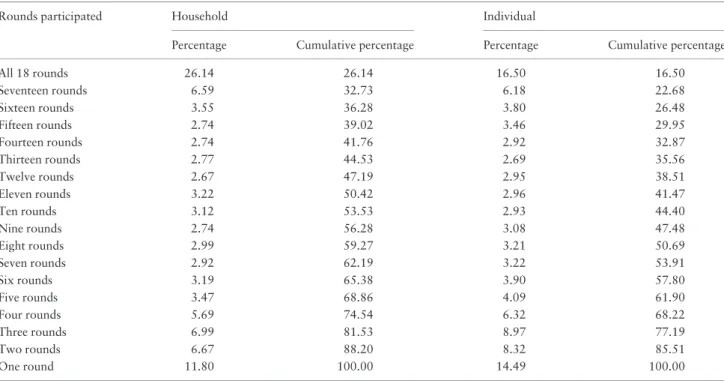
Supplement 2,Tables 6and7, available asSupplementary data atIJE online). Table 1 shows that over half of the households participated in 10 rounds of RLMS-HSE, and for individuals about half participated in eight rounds. This creates a good basis for longitudinal analysis.
The response rates varied across PSUs, depending on the proportion of households in rural areas. Obviously, in Moscow and St Petersburg, respondents and household re-sponse rates are substantially lower than in the Russian Federation as a whole and, of course, the whole of Russia without these two cities (Supplement 2,Tables 6 and 7). However, since this situation was expected and has been
Table 1.The duration of participation in the survey (participation rate) for 1994 households and individuals (including separated
or moved out) 1994–2013
Rounds participated Household Individual
Percentage Cumulative percentage Percentage Cumulative percentage
All 18 rounds 26.14 26.14 16.50 16.50
Seventeen rounds 6.59 32.73 6.18 22.68
Sixteen rounds 3.55 36.28 3.80 26.48
Fifteen rounds 2.74 39.02 3.46 29.95
Fourteen rounds 2.74 41.76 2.92 32.87
Thirteen rounds 2.77 44.53 2.69 35.56
Twelve rounds 2.67 47.19 2.95 38.51
Eleven rounds 3.22 50.42 2.96 41.47
Ten rounds 3.12 53.53 2.93 44.40
Nine rounds 2.74 56.28 3.08 47.48
Eight rounds 2.99 59.27 3.21 50.69
Seven rounds 2.92 62.19 3.22 53.91
Six rounds 3.19 65.38 3.90 57.80
Five rounds 3.47 68.86 4.09 61.90
Four rounds 5.69 74.54 6.32 68.22
Three rounds 6.99 81.53 8.97 77.19
Two rounds 6.67 88.20 8.32 85.51
adjusted in oversampling procedures, the actual proportion of completed household interviews compares well to the proportion of the population in each stratum.
Since the highest non-response rate occurred in Moscow and St Petersburg, the duration of participation in the survey in these two cities was the lowest (Supplement 2, Tables 8–11, available as Supplementary data at IJE
online).
Attrition rates
One of the most important questions is: ‘How misleading would it be to conduct pure panel analysis of households and individuals observed in any set of consecutive rounds?’ The obvious problem is that, by definition, pure panel ana-lysis can include only those who continue to reside in the original sample dwelling units and participate in this set of consecutive rounds. To evaluate the possibility of such analysis, it is necessary to calculate attrition rates for any such sequence of rounds. As an example, we present calcu-lations for two most popular types of attrition rates (Supplement 2,Tables 12–14, available asSupplementary dataatIJEonline), namely wave-to-wave and baseline-on-wave attrition rates for individuals and households. For all 18 rounds, only about 29% of households and 19% of in-dividuals continued to participate (1994–2014) but, if we look at the first 10 years, the results were about 60% and 51%, respectively (rounds 1–9) (Supplementary Table 12).
Table 2presents death rates for the initial 1994 partici-pants. Overall, 12.8% have passed away.
Data collected
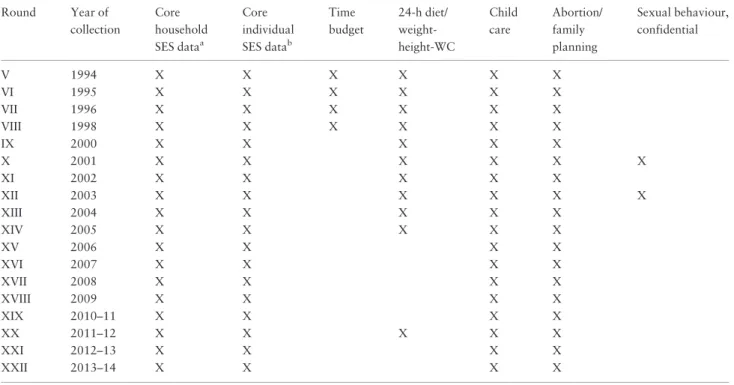
Throughout the entire set of surveys, very detailed basic household and individual data have been collected.Table 3
details this set of economic, labour force, demographic, education, and related socioeconomic data. The full set of English and Russian survey instruments are available on the two RLMS-HSE websites. The household and individ-ual core socioeconomic data are extremely detailed. They contain classic income and expenditures data on all catego-ries, from weekly food purchases to consumer durables. The demographic data provide a classic triangle of the rela-tionships of each person with each other within the house-hold. The asset data include all sorts of details on household and other assets. The employment information
is in-depth for multiple jobs with detail on type of employ-ment, earnings, hours and ownership status (public, pri-vate, joint) and provides the four-digit International Labour Organization occupation code. Both actual and perceived quality of life questions are interspersed.
Health data: for each wave, detailed data on alcohol and smoking were obtained. Health service use data are also collected but not in great detail. For selected rounds, direct measurement of weight, height and waist circumfer-ence were obtained (rounds V–XIV and XX). Also one-day 24-h recall dietary data were obtained in these rounds. In only one round were replicates of a second day collected for the sample.2,3Nutrient intake levels are reported;
how-ever, actual detailed dietary data are not available as the food composition table and data are controlled by a collab-orator and were not made available.
There have been attempts to obtain biomarkers; unfortu-nately, fasting blood or blood spot collection has been im-possible as blood samples in any form cannot be taken out of Russia, and it has not been possible to find a laboratory equipped to handle full blood spot assays at reasonable cost and reliability. These data have yet to be collected.
Spatial coordinates
For some time we attempted to use global positioning tech-nology and collect coordinates for all major social and eco-nomic and transport and health-related infrastructure as well as household coordinates. Politically this was not feas-ible until recently, and funding has not been obtained to undertake this collection. However, the survey team is able to provide (at cost) linkages of external data sets to the RLMS-HSE contextual data by using deductive disclosure controls to ensure anonymity of the identification of communities.
Data resource use
Hundreds of English-language publications have arisen from the RLMS-HSE data, authored by scholars globally. In addition, there are thousands of Russian-language publi-cations which are not accessible to most scholars globally. Most of the focus has been on the poverty, economic, so-cial and demographic data. These dietary and socioeco-nomic data were used to create the Russian poverty line, which established the pension level such that few
Table 2.Percentages of 1994 participants who died between 1994 and 2013
1995 1996 1998 2000 2001 2002 2003 2004 2005 2006 2007 2008 2009 2010 2011 2012 2013 Total
pensioners in Russia are in poverty4,5and almost none
suf-fer weight loss due to a lack of income.6 Related to the poverty line has been extensive research on poverty by the World Bank and many scholars globally.5,7,8
Alcohol intake has been subject to serious examination by a vast number of scholars.9One of the more interesting issues is the skewed distribution with a small proportion of men of all ages consuming about a half-litre of actual alco-hol per day.10–12The data showed a decreasing prevalence
of drinking during this period but an increase in the amount of alcohol consumed by some members of this population, and important cohort effects with older Russians more likely to be drinking excessively.13 Partly
because of the high alcohol intake levels and the stresses of the economic transformation, overall health, life expect-ancy and mortality have been studied extensively.14–17 A third topic is abortion, for which the RLMS-HSE results produced much lower estimates than previous research.18 According to RLMS-HSE data, the abortion rate in 1994 was 56 per 1000 women aged 15–44, with a 95% confi-dence interval of 612 per 1000, an estimate that varies from that advanced by official sources and other studies.
Part of the reason for this difference is that the government listed all miscarriages as induced abortions. In addition, we used the advice of demographers who had studied this issue for years (Professor Barbara Anderson, University of Michigan, and others) to create confidential interviews on this component.
Strengths and weaknesses
The major strengths of the RLMS-HSE are the national representativeness, collection of very high quality sociode-mographic and economic data, and the long follow-up. The biggest weaknesses from the health side are the lack of biomarkers and erratic collection of dietary and body com-position data based on outside funding availability. And as in all longitudinal surveys the attrition over time should be considered while analyzing the data.
Data resource access
The bulk of the RLMS-HSE data are completely free and available on the RLMS websites in English [http://www.
Table 3.RLMS-HSE survey components
Round Year of
collection
Core household SES dataa
Core individual SES datab
Time budget
24-h diet/ weight-height-WC
Child care
Abortion/ family planning
Sexual behaviour, confidential
V 1994 X X X X X X
VI 1995 X X X X X X
VII 1996 X X X X X X
VIII 1998 X X X X X X
IX 2000 X X X X X
X 2001 X X X X X X
XI 2002 X X X X X
XII 2003 X X X X X X
XIII 2004 X X X X X
XIV 2005 X X X X X
XV 2006 X X X X
XVI 2007 X X X X
XVII 2008 X X X X
XVIII 2009 X X X X
XIX 2010–11 X X X X
XX 2011–12 X X X X X
XXI 2012–13 X X X X
XXII 2013–14 X X X X
WC, waist circumference.
aThe core household data collected each year include: household composition/relationships; housing (structure, amenities, privatization, ownership); possession
of consumer durables; raising food on private plots; in-depth food, clothes and consumer durables during 3 months, savings, transfer payments, gifts to others, utilities and many other expenditures; income from all wage and non-wage sources by public and private sector status, including transfer payments, gifts, stock market, and drawing down savings; and details on non-payment of wages and losses due to bank closures.
bThe core individual data (questions on children age<14, answered by parents): these include place of birth, some migration, language, marital status; work
cpc.unc.edu/projects/rlms-hse/] and Russian and English [www.hse.ru/rlms]. The sexual behaviour data are highly confidential, as are spatial locations of sample recipients. Institutional Review Board approval for each survey has been provided by both the institutional review boards of the University of North Carolina and the Higher School of Economics. Contextual data require also special applica-tions. To link other contextual measures to the RLMS-HSE data, this must be done at cost by contacting the Carolina Population Center.
Supplementary data
Supplementary dataare available atIJEonline.
Acknowledgments
Our deepest debt goes to the late Dr Michael Swafford for his col-laboration during the 1991–2001 period. Key collaborators of the authors in this survey are: NamvarZohoori, Barbara Entwisle and Lenore Kohlmeier, USA; Alexander Ivanov and Igor Dmitrichev, Goskomstat; Svetlana Shalnova and Alexander Deev, RCPM; Alexander Baturin and Arseni Martinchik, Institute of Nutrition, Russian Academy of Medical Sciences. Leslie Kish and Steve Heeringa of the University of Michigan were the senior US sampling researchers for Phase II, and William Kalsbeek, University of North Carolina at Chapel Hill, was the leading sampling scholar for Phase I. Steve Heeringa has met with us four times since the beginning of Phase II, to review the sampling with the US and Russian teams, and decided on replenishment and expansion strategies to keep the sam-ple statistically representative of the Russian Federation. Consultants on various phases of the survey design work have included Michael Berbaum of the University of Alabama, who was instrumental (along with Michael Swafford) in adopting the initial English design into Russian. Other survey researchers who have pro-vided questionnaire design consultation include: Cynthia Kaplan (University of California, Santa Barbara), Vladimir Treml (Duke University) and Marina Mozhina (Institute of Socioeconomic Problems of Population, Russian Academy of Sciences). A scientific panel provided project advice for round V (the second phase of the survey and start of the true longitudinal and nationally representa-tive panels) and four subsequent rounds. Members of the panel were: Barbara Anderson (University of Michigan), Donna Bahry
(Penn State University), Ward Kingkade (US Census Bureau) and Vladimir Treml (Duke University). The entire group of laboratories, headed by Polina Kozyreva and Michael Kosolopov and many staff and doctoral students at CPC-UNC, has led a series of redesigns of the survey. Phil Bardsley at UNC and a set of programmers at Demoscope have created and continued the Web support for the sur-vey, with no funding for data dissemination.
Funding
The first decade of funding was complex. Initially the G-7 team and the Russian Federation concurred in organizing this survey, and the World Bank was the lead agency to fund all aspects of the work. Phase I, round 1, was funded by the World Bank, whereas Phase I, rounds 2–4, were funded by both the World Bank and USAID. For Phase II, rounds V–VIII obtained USAID funding with supplementary support from NIH (R01-HD38700) and NSF (SBR-9223326). Throughout, support came from the University of North Carolina, Carolina Population Center (CPC) (5 R24 HD050924), and in later years the Government of Sweden (Stockholm Institute of Transition Economics), the Ford Foundation, the MacArthur Foundation, the Pension Fund of the Russian Federation, along with some supplemen-tary NIH funding. Most recently, since 2010 the National Research University Higher School of Economics has provided core survey sup-port. A variety of sources have funded ancillary surveys (e.g. the diet-ary and body composition data in 2011 funded by CPC).
Conflict of interest:None declared.
References
1. Popkin BM, Du S, Zhai F, Zhang B. Cohort Profile: The China Health and Nutrition Survey—monitoring and understanding Profile in a nutshell
• The RLMS-HSE was established to create a
nation-ally representative survey to monitor the economic
and health impact of the massive set of reforms in
the Russian Federation.
• Established in 1992 (Phase I) and, for Phase II
(dis-cussed in depth here) in 1994, this annual survey is
both nationally representative plus has a
longitu-dinal component. Both collect multipurpose health
and economic studies with in-depth individual,
household and community contextual data collected
in all rounds.
• The 1994 and 2013 samples collected the data from
11 290 and 21 753 individuals and 3975 and 8149
households, respectively. A multistage sample with
98 primary sampling units (Moscow city, Moscow
Oblast and St Petersburg are self-representing) was
designed to represent the Russian Federation.
• The major data components are: economic (detailed
income, labour force behaviour and expenditures
data); demographic/sociological (household structure
and age-gender composition, background, education
and school behaviour); and health (24-h dietary
re-call, smoking, drinking activity, body mass index
dir-ect measurement).
• Data can be linked to other contextual datasets.
• The bulk of the RLMS-HSE data are completely free
and available on the UNC-CPC websites in English
[http://www.cpc.unc.edu/projects/rlms-hse/] and the
RLMS-HSE website in Russian and in English [http://
www.hse.ru/rlms/]. Selected confidentiality forms are
required for selected data such as sexual behaviour
socio-economic and health change in China, 1989-2011.Int J Epidemiol2010;39:1435–40.
2. Jahns L, Arab L, Carriquiry A, Popkin BM. The use of external within-person variance estimates to adjust nutrient intake distri-butions over time and across populations.Public Health Nutr
2005;8:69–76.
3. Jahns L, Carriquiry A, Arab L, Mroz TA, Popkin BM. Within-and between-person variation in nutrient intakes of Russian and US children differs by sex and age. J Nutr 2004;134:
3114–20.
4. Lokshin M, Harris KM, Popkin BM. Single mothers in Russia: household strategies for coping with poverty. World Dev
2000;28:2183–98.
5. Lokshin M, Popkin BM. The emerging underclass in the Russian Federation: income dynamics. Econ Dev Cult Change 1999;
47:803–29.
6. Stookey JD, Zohoori N, Popkin BM. Nutrition of elderly people in China.Asia Pac J Clin Nutr2000;9:243–51.
7. Lokshin M, Ravallion M. Welfare impacts of the 1998 financial crisis in Russia and the response to the public safety net.Econ Transit2000;8:269–95.
8. Ravallion M, Lokshin M. Who wants to redistribute Russia’s tunnel effect in the 1990s?J Public Econ2000;76:87–104. 9. Zohoori N, Mroz TA, Popkin Bet al. Monitoring the economic
transition in the Russian Federation and its implications for the
demographic crisis—The Russian Longitudinal Monitoring Survey.World Dev1998;26:1977–93.
10. Baltagi BH, Geishecker I. Rational alcohol addiction: evidence from the Russian Longitudinal Monitoring Survey.Health Econ
2006;15:893–914.
11. Tapilina VS. How much does Russia drink: volume, dynamics and differentiation of alcohol consumption.Russian Soc Sci Rev
2007;48:79–94.
12. Tekin E. Employment, wages, and alcohol consumption in Russia.South Econ J2004;71:397–417.
13. Zohoori N. Recent patterns of alcohol consumption in the Russian elderly, 1992-1996.Am J Clin Nutr1997;66:810–14. 14. Andreev EM, McKee M, Shkolnikov VM. Health expectancy in
the Russian Federation: a new perspective on the health divide in Europe.Bull World Health Organ2003;81:778–87.
15. Cockerham WC. Health lifestyles in Russia.Soc Sci Med2000;
51:1313–24.
16. Perlman F, Bobak M. Socioeconomic and behavioral determin-ants of mortality in posttransition Russia: a prospective popula-tion study.Ann Epidemiol2008;18:92–100.
17. Shkolnikov VM, Andreev EM, Anson J, Mesle F. The peculiar pattern of mortality of Jews in Moscow, 1993–95.Popul Stud
2004;58:311–29.