The Patchwork Governance of Corpse Repatriation Within the EU
Sofie Senecal
Senior Honors Thesis Contemporary European Studies University of North Carolina at Chapel Hill
April 2019
Despite the freedom of movement and establishment enshrined as fundamental rights by the
European Union, there is no clear system governing the transport of citizens’ bodies across
national borders after death. The patchwork of legislation that forms the current framework was
created by many actors — including governments, international public health organizations, the
European Union, and various European non-governmental organizations — over more than
eighty years, and tracing its evolution provides a window into the development of international,
then supranational governance across the 21st century. Using primary sources, this paper
investigates the absence of EU legislation on the issue, identifying several key problems and
unearthing the underlying issue: a disorganized understanding of corpse repatriation as a subject.
Ultimately, the question of the transport of citizens’ mortal remains between EU member states
Introduction 1
Part I 6
Governments and International Treaties 6
Arrangement Concerning the Conveyance of Corpses 6
Agreement on the Transfer of Corpses 11
The European Union: 17
European Union Comments and Legislation on this Issue 18
International Public Health Non-Governmental Organizations 33
OISP 33
WHO 34
European Non-Governmental Organizations 36
CEN 36
EFFS 38
Part II 42
The Patchwork, Summarized 42
Problems 44
Information 45
Urgency 45
Priorities 45
Cooperation 46
Scale 46
Authority 46
The fundamental issue 47
Conclusion 48
Introduction
“The dead body matters, everywhere and across time, as well as in particular times and
particular places.” The treatment of human remains has been imbued with significance since the 1
beginning of the human record. Yet, in the past hundred years, the world has seen an
extraordinary shift. The contemporary world is a time of unprecedented, increasing
transnationalism, and dead bodies have become transnational as their late inhabitants have. Every
day, the dead are shipped across continents — and around the world — to be buried in their
homeland or reunited with their families. The EU, the innovator of supranational governance,
guarantees citizens the right to live and work anywhere within its borders, and has facilitated the
dissolution of national border checks. Yet, despite the contemporary, interconnected, highly
mobile Europe, there is no clear, EU-wide legislation governing the repatriation of human
remains between member states. What explains this gap in governance?
The choice of the corpse as subject of a thesis on transnational, multilevel governance is
unconventional, albeit surprisingly fitting. I stumbled upon the question at the intersection of two
grand themes. One is transnationalism, globalization, and their effects on differential social
groups, on individuals, and on the way humans conduct their lives in the new,
ambiguously-bordered world; the other is the creation and formation of systems of multilevel governance, the
negotiations between and within those levels, and the relationships governments have with other
actors, particularly citizens and non-governmental organizations.
Corpses provide an opportunity to investigate the challenges of transnational governance
and European integration. The treatment of the dead is highly important, yet the bodies
Thomas W. Laqueur, The Work of the Dead: a Cultural History of Mortal Remains, (Princeton, New Jersey:
1
themselves are ambiguous and difficult to classify: the international movement of the deceased is
not quite immigration, nor trade— yet also both. At the same time, mortal remains invite difficult
questions for governments, such as: at death, does person cease being a citizen? Are they no
longer entitled to the rights of citizenship? What rights do they have?
Governance is complicated by cultural notions of the dead as dangerous, both as a
physical source of disease and pollution and as a symbol of mortality, death, and disorder. This 2
aversion and revulsion to the dead increased after nineteenth century European pathologists
pointed to corpses as carriers of disease, relegating the care of the dead to experts in a departure
from the traditional home funeral. This persistent fear of the dead, coupled with the cultural and
religious significance of their good treatment, make the issue particularly complicated to
navigate from a regulatory standpoint.
The freedom of movement enshrined in the EU makes the absence of contemporary
international legislation particularly puzzling from both a logical and practical perspective.
However, the European Union’s dual history of enlargement and integration forms a particularly
rich backdrop for the investigation of the transnational transport of the dead in a broader sense as
well. The ambiguous classification of the issue of the transfer of corpses allows insight into the
way authority and competence is negotiated between the EU and member states as well as the
way it is understood by the Commission and the Parliament. The patchwork of legislation that
forms the current framework was created by many actors over more than eighty years, and
tracing its evolution provides a window into the development of international, then supranational
governance across the 21st century.
Glennys Howarth, Death & Dying: A Sociological Introduction, (Polity Press, 2007), 185-186.
There exists a great deal of academic research on death, particularly within the disciplines
of anthropology, history, and sociology. Unfortunately, all of these exclude some crucial aspect
of the question underlying this paper: the former two exclude its contemporary time frame, and
neither anthropological nor sociological research focuses on Europeans as a broad group.
Similarly, while there is a wealth of research on the ritual aspects of burial and mourning, the
steps before and around these rituals are excluded from the discussion. 3
Some research adjacent to this topic exists in relatively niche fields. For example, there is
some mention of the transport of human remains in Abeyratne’s study of civil aviation, and a 4
mention of the repatriation of human remains in an article in the Journal of Travel Medicine. 5
Both note the complexity of the process and identify the topic's only two international treaties.
There is a book on migrant death and healthcare which emphasizes the difficulty and cost of
international repatriation from Europe globally. There is a series of studies on the body disposal 6
of unauthorized migrants to the EU, which highlight the complexity of national and local
legislation and testify to the difficulty of obtaining individual-level data. While these studies 7 8
all contain small insights into international repatriation, none specifically focus on the EU, the
development of the current system, or the international governance of transport of corpses.
I consulted the UNC database as well as google scholar using search terms detailed on the next page. 3
Ruwantissa Abeyratne, Convention on International Civil Aviation: A Commentary, (Springer, 2014).
4
Ruairi Connolly et. al., “Repatriation of human remains following death in international travellers,” Journal of
5
travel medicine 24,(2017).
Yasmin Gunaratnam, Death and the Migrant: Bodies, Borders, and Care, (Bloomsbury, 2013), 10-12.
6
Tamara Last, Giorgia Mirto, Orçun Ulusoy, Ignaci, et al., “Deaths at the borders database: evidence of deceased 7
migrants’ bodies found along the southern external borders of the European Union,” https://www.tandfonline.com/ doi/full/10.1080/1369183X.2016.1276825.
Iosif Kovras and Simon Robbins, “Death as the border: Managing missing migrants and unidentified bodies at the 8
EU's Mediterranean frontier,” Political Geography, Vol. 55 (November 2016), 40-49 https://doi.org/10.1016/
The ambiguous, difficult-to-classify nature of the transportation of corpses is echoed in
the academic literature, resulting in a lack of research that mirrors the lack of contemporary
European legislation. 9
Therefore, the research in this paper is rooted almost exclusively in primary sources.
International organizations fortunately have excellent archives, and the European Union’s master
database, EU-Lex, includes an abundance of documents. This paper’s discussion of EU-specific
developments in legislation is centered around three major types of primary sources: first,
European Union directives and regulations, which are binding pieces of international law; 10
second, European Parliamentary resolutions, which are non-binding expressions of the
Parliament’s opinion, often used to pressure the Commission or member states to take action on
an issue; and third, Written Questions from Members of Parliament to the Commission and the 11
Commission’s responses.12
This paper is divided into two parts. Part I details the strategies different actors have
taken to approach the governance of the intra-EU transfer of citizens’ mortal remains. These
actors include governments, international public health organizations, the European Union, and
various European non-governmental organizations. Private companies and citizens, of course, are
involved in the debate, however, they do not create regulations and are therefore not directly
I declare this lack of academic investigation after the utilizing various combinations and versions of these key 9
words: human remains, mortal remains, corpses, dead bodies, post-mortem; transport, transfer, repatriation; European Union, EU, Schengen, European.
EU Regulations are immediately binding, whereas directives set out the goal, and member states are allowed to 10
manage the specifics of their own legislation themselves.
Legislative power in the EU is split between the European Parliament and the Council (whose formal title is “the 11
Council of the EU,” not to be confused with the European Council -- which consists of the heads of state — or the Council of Europe, which is discussed on page 11). However, neither legislative body has the power to propose laws. Legislative initiative rests with the Commission, who also executes the law and manages the bureaucracy.
discussed. Part II synthesizes, analyzes, and hypothesizes about the narrative given in Part I,
advancing an argument for the reason there is no successful, direct, EU-wide legislature
Part I
This section outlines the complexity of the current system of cross-border corpse transfer
in Europe. It begins by tracing developments at the international and supranational level, looking
first at treaties signed between governments and later at the actions of the European Union.
Following that is a discussion of the role four non-governmental organizations have played in
this issue. The chronological examination of each actors’s interactions with this issue is
necessary in order to fully grasp the patchwork system of governance that rules the contemporary
international space for corpse transfer in Europe, which is then necessary to understand the
underlying reason for the lack of EU legislation.
Governments and International Treaties
Arrangement Concerning the Conveyance of Corpses 13
The framework for the contemporary system of international corpse transport arose far
prior to the creation of the EU. The first formal treaty, the International Arrangement Concerning
the Conveyance of Corpses, was signed 12 February 1937 in Berlin and continues to be in 14
force. The Berlin Arrangement is a multilateral agreement whose central clause promises the
mutual acceptance of the transfer of corpses between and through signatory states. Created under
the purview of the League of Nations, its eleven initial signatories are mostly European powers,
“Arrangement Concerning the Conveyance of Corpses,” opened for signature 12 February 1937, League of
13
Nations Treaty Series, 189, no. 4391 (1938), 315-325, https://treaties.un.org/pages/Content.aspx?path=DB/ LoNOnline/pageIntro_Table_en.xml.
Representatives of Germany, Belgium, Chile, Denmark, France, Italy, Switzerland, Czechoslovakia, and Turkey 14
signed the Arrangement on this date, while the representatives from the Netherlands and Egypt did not sign until
May 28th and July 28th 1937, respectively. It is unclear why the signatories were this eclectic group of countries, as
with the exceptions being Chile, Egypt, and Turkey. By reports of the World Health
Organization, Mexico and Romania ratify the treaty at an unspecified point between 1937 and
1949. 15
The Arrangement begins with a brief preamble, which includes a statement explaining the
authors’ twofold intent in creating the treaty. They are motivated first by a desire to “[avoid] the
difficulties resulting from differences in the regulations concerning the conveyance of corpses,”
and second, by a consideration of “the convenience of laying down uniform regulations in the
matter.” These motivations are similar, but oriented differently — the former towards resolving
existing problems, the latter towards actively creating a better system.
Following the preamble are nine articles which establish regulations around four major
themes: documentation, encoffining, special rules regarding quarantinable diseases, and special
rules for each method of transport: air, motor, sea, and rail.
The Arrangement’s first article establishes its most longstanding contribution to
international law through its creation of the laissez-passer for a corpse, a clear document which must at least include the full name of the deceased and the date, place, and cause of their death. though the Berlin Arrangement provides a more detailed example (Figure 1). The laissez-passer for a corpse must be issued by “the competent authority” in the sending country, though the Arrangement contains no further specification on who this authority is or should be for any
signatory country.
The authors of the Arrangement created the laissez-passer for a corpse to be the only document required for a corpse to travel between countries; however, the Arrangement stipulates
Executive Board, 3rd Session, “Transportation of corpses: paper submitted by Dr C. Van den Berg,” World Health
15
that a certified copy of the official death certificate is also sufficient documentation [Article 2].
The laissez-passer for a corpse may also be replaced by an official certificate “to the effect that conveyance of the corpse is not open to objection from the point of view of health or from the
medico-legal point of view, and that the corpse has been placed in a coffin in accordance with the
regulations laid down in the present arrangement” [Article 2.2] — meaning there are no legal or
public health objections to the transportation of this corpse, and that its coffining was carried out
in line with the stipulations of the Berlin Arrangement.
Figure 1. Laissez-Passer for a Corpse 16
The most strict, specific section of Berlin Arrangement is Article 3, which establishes the
regulations for encoffining a corpse. A body must be placed on a 5 cm thick layer of absorbent
material with the addition of some antiseptic substance, then hermetically sealed within a metal
coffin. The soldered metal coffin must be then placed into a watertight wooden coffin that is at
least 3 cm thick, which in turn must be secured with metal hoops and screws placed no more
than 20 cm apart from each other.
“Arrangement Concerning the Conveyance of Corpses,” League of Nations Treaty Series, 325.
The entire document has a public-health undertone, but there are two articles which
address disease outright. The first stipulates an extra layer of protection if the deceased was
afflicted with a contagious disease: a shroud soaked in antiseptic solution, wrapped around the
corpse [Article 3]. The second bans transportation of a corpse within a year of a death from
“plague, cholera, small-pox or typhus” [Article 4] — after that point, transport is permissible.
The Berlin Arrangement names four transportation methods it deems acceptable to carry
a corpse and outlines additional regulations for each method. In all cases, the Arrangement 17
forbids the transport of anything except for “wreaths, bunches of flowers and the like” with the
corpse. If traveling by car, the corpse must be transported in either a hearse or a closed van. If by
rail, the coffin must be in a closed wagon (moving to and from the station in a closed hearse) and
“dispatched by the speediest route possible,” though the Arrangement allows each country to set
its own limits on how long a corpse may be held upon arrival. The coffin does not need to be
accompanied as long as transportation for the corpse upon arrival is secured. If by sea, the
wooden coffin must be placed in an additional wooden case packed to minimize movement, and
must not create an “inconvenience” to passengers or come into contact with foodstuffs. If
traveling by air, the coffin must be placed “either in an aircraft specially and solely used for the
purpose or in a special compartment solely reserved for the purpose in an ordinary aircraft.”
The final two articles of the Arrangement clarify the treaty’s place in international law.
Article 10 notes that the Berlin Arrangement embodies the “maximum requirements” and that
each country has the right to “grant greater facilities, either by means of bilateral arrangements or
by decisions in particular cases arrived at by common accord.” This article takes on particular
significance as time passes and the treaty remains in force. Article 11, meanwhile, reiterates the
Arrangement’s scope, noting that it only applies to only the transport of corpses immediately
following death or exhumation. Its regulations specifically exclude the international transport of
ashes and, per this article, the treaty is not intended to affect any domestic regulations on burial
or exhumation.
The pre-1937 regime for the transport of corpses is unclear in the historical record. Thus,
the International Arrangement on the Conveyance of Corpses marked a significant improvement
on the status quo. It was clear and concise, and it established, for the first time, a system to
address a growing logistical issue in an increasingly interconnected world. It is unclear whether
its restrictions are intended as security measures, efficiency measures, public health measures, or
a combination of the three, but, overall, they seemed reasonable, effective, and uncontroversial.
Unfortunately, chaos on the continent interrupted any true test of their success.
Ratification of the Berlin Arrangement required copies to be delivered to the German
Government and the Office International d'Hygine Publique (OHIP) [Articles 13-16], which
proved impossible shortly after the treaty was signed. That, coupled with the dissolution of the
OHIP after the war, halted further ratifications. The dissolution of the League of Nations
removed the original forum for its creation, which additionally impeded any post-war
resurrection of the Arrangement. There was not another intergovernmental effort to address this
Agreement on the Transfer of Corpses 18
Between 1937 and 1973, much had changed in Europe. The Second World War had been
won and lost, the Berlin wall had been erected as a physical manifestation of the ideological
divide that split the continent, and the EEC, Euratom, and the ECSC had become the European
Community. The world was increasingly interconnected. In Europe, the tourism industry was
booming, and the practice of hiring foreign workers was becoming ever more common.
Alongside these changes came improvements in technology, such as better embalming practices
and jet engines, that necessitated an update to the legislation on corpse repatriation. Thus, the 19
Council of Europe embarked upon the process of drafting a more contemporary treaty. The
Committee of Ministers assigned the task of drafting a new policy to the European Public Health
Committee, who consulted both the European Federation of Funeral Directors (Brussels) and the
European Funeral Directors Association (Vienna) for expert opinion throughout the drafting of
the document. The end result was the Agreement on the Transfer of Corpses, which was signed
in Strasbourg in 1973. 20
According to the Council of Europe, there was initially significant resistance to creating
another treaty due to the existence of the Berlin Arrangement (which continued to remain in
"Agreement on the Transfer of Corpses,” opened for signature on 26 October 1973, Council of Europe, European
18
Treaty Series, no. 80, https://rm.coe.int/168007617d.
"Explanatory Report to the Agreement on the Transfer of Corpses,” Council of Europe,European Treaty Series,
19
no. 80,https://rm.coe.int/CoERMPublicCommonSearchServices/DisplayDCTMContent?
documentId=09000016800c96c9.
The Council of Europe is easily confused with, yet entirely separate from the European Union. Founded in 1949, 20
force) both because some states felt an additional treaty was superfluous and because it was
unclear how the two treaties could coexist under international law. Both treaties claim to
establish the “maximum requirements” for transport [Article 10 of Berlin Arrangement; Article 2
of Strasbourg Agreement]. To solve this dilemma, the Council of Europe drafted a protocol
clause [Article 9] which allows a state who is a party to both treaties to abide by the regulations
of the Berlin Arrangement when engaged in a transport with a country who is a party to the
Berlin Arrangement only. This workaround apparently satiated the concerned diplomats,
indicates that countries were more concerned with having a modernized agreement than the
logical consistency of having two conflicting treaties.
Despite the difficult negotiations concerning their relationship, the core substance of this
treaty does not diverge much from its predecessor. Its goal remains the same: to facilitate the
transfer of corpses between signatory countries by establishing maximum requirements. It
upholds the precedent of the laissez-passer for a corpse being the only document required for transfer, “with the exception of the documents required under international conventions and
agreements relating to transport in general.” In a minor change, it does stipulate that the 21
laissez-passer should be written in two languages: one of the official languages of the departure
state and one of the official languages of the Council of Europe.
The laissez-passer for a corpse must be issued by the competent authority in each member state, which is decided by each state, after it confirms that (a) all of the legal,
The explanatory report offers more information on this clause: “This article is complementary to Article 3; it is 21
administrative, medical, and health requirements established by the State of departure’s laws
have been complied with, (b) the remains have been placed in a coffin that complies with the
stipulations of the Strasbourg Agreement, and (c) the coffin only contains the body of the
deceased for which the laissez-passer was written as well as any personal effects they are to be
buried with.
The designation of who exactly holds the power to issue the laissez-passer, and the
process by which they will determine if the aforementioned conditions are met, is entirely left up
to the signatory states. Each state, after ratifying the Agreement, notified the Council of Europe
of their choice of “competent authority” — and the choice varied widely. Most countries 22 23
relegated the duty to the national public health administration, though a substantial group 24
variously assigned the job to a combination of local government, local health authorities,
regional government authorities, or authorized doctors at hospitals. A handful of others assigned
shared competence between the police and health authorities, and the remaining countries’ 25
competent authorities vary widely. 26
The requirements for the coffin that the Strasbourg Agreement lays out are slightly less
strict than those established in Berlin thirty years prior. The coffin must be impervious with an
“Reservations and Declarations for Treaty No.080 - Agreement on the Transfer of Corpses,” Council of Europe, 22
accessed 13 March 2019, https://www.coe.int/en/web/conventions/full-list/-/conventions/treaty/080/declarations? p_auth=60OhEALs.
Belgium, Cyprus, Czech Republic, Latvia, Lithuania, Luxembourg, Moldova, Slovenia, and Switzerland. 23
Austria, Finland, France, Greece, Iceland, the Netherlands, and Turkey. In Slovakia, competence belongs to the 24
regional public health office except when an autopsy was needed, in which case competence is shared with the department of forensic medicine.
Norway, Andorra, and Portugal. 25
In Spain, competence belongs to the local health authority in the place where corpse underwent customs 26
inner absorbent layer, and either an outer wood coffin at least 2 cm thick with a hermetically
sealed inner coffin made of zinc, or a single wood coffin with sides of at least 3 cm thick lined
with a sheet of zinc. 27
It stipulates that, if the coffin is traveling as normal cargo, the coffin must be packaged so
that is no longer resembles a coffin. Unlike the Berlin Arrangement, it does not name specific
means of transport except for airplane, saying that, if the coffin is transported by air, it “shall be
provided with a purifying device or, failing this, present such guarantees of resistance as are
recognized to be adequate by the competent authority.”
Regarding special public health considerations, it notes, in the preamble, that corpses do
not present a considerable health risk: “bearing in mind that the transfer of corpses does not
create a risk to health even if death was due to a communicable disease provided that appropriate
measures are taken, in particular with regard to the imperviousness of the coffin.” However, if a
person did die from a contagious disease, the Strasbourg Agreement, exactly like the Berlin
Arrangement, mandates that the corpse be wrapped in a shroud soaked in antiseptic solution.
The Agreement notes that zinc can be replaced with “any other material which is self-destroying.” Lead is the only 27
Figure 2. Laissez-Passer for a Corpse, Strasbourg Agreement28
“Agreement on the Transfer of Corpses,” European Treaty Series, no. 80.
The Strasbourg Agreement marked a significant improvement in the international system
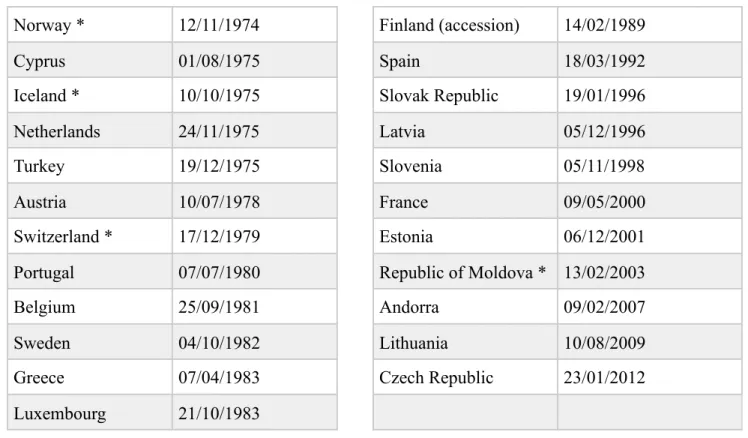
for the transport of human remains. It continued to be signed and ratified for quite some time 29
after its creation by the Council of Europe — the latest entry into force was in Lithuania in 2009.
Figure 3. Ratifications of Strasbourg Agreement, by date30 31
-To this day, these two documents are the only pieces of international legislation
governing the cross-border transport of dead bodies in a multilateral capacity, despite the
improvements in technology and the continued growth of international travel since 1973.
Notably, Germany signed the treaty in 1974 but has not ratified it — the only country to do such a thing. 29
“Chart of signatures and ratifications of Treaty 080 - Agreement on the Transfer of Corpses,” Council of Europe, 30
accessed 13 March 2019, https://www.coe.int/en/web/conventions/full-list/-/conventions/treaty/080/signatures? p_auth=60OhEALs.
Countries with asterisks are members of the Council of Europe but not of the EU. 31
Finland (accession) 14/02/1989
Spain 18/03/1992
Slovak Republic 19/01/1996
Latvia 05/12/1996
Slovenia 05/11/1998
France 09/05/2000
Estonia 06/12/2001
Republic of Moldova * 13/02/2003
Andorra 09/02/2007
Lithuania 10/08/2009
Czech Republic 23/01/2012
Norway * 12/11/1974
Cyprus 01/08/1975
Iceland * 10/10/1975
Netherlands 24/11/1975
Turkey 19/12/1975
Austria 10/07/1978
Switzerland * 17/12/1979
Portugal 07/07/1980
Belgium 25/09/1981
Sweden 04/10/1982
Greece 07/04/1983
The European Union:
The EU began as an economic entity to incentivize peace and cooperation on the
continent. Yet, hand-in-hand with trade liberalization came an unprecedented social
interconnectedness between Member States. This has led to a great deal of movement, first
because of increased business travel and tourism, and then due to the establishment of the right
to work and live anywhere within the EU. Though the EU maintains no data on the number of 32
EU citizens who die while exercising this right, the data that does exists suggests a sizable
number of EU nationals do die outside of their country of origin. The average crude death rate
within the EU-28 is 10 per 1,000 people — and roughly 11.8 million EU nationals work 33
outside of their country of nationality, which does not include pensioners, exchange students, 34 35
and business and leisure travelers.
While a total of 28 countries signed one or both treaties, this number excludes a sizable
chunk of EU countries. Furthermore, as stated earlier, the EU itself has no clear, coordinated 36
policy on the repatriation of mortal remains between member states — a perplexing gap in
policy, a practical conundrum, and a glaring omission in our contemporary notion of a united,
borderless Europe. This section examines, in chronological order, each time this issue was
brought to the attention of the European Union’s constituent bodies, and what — if any — steps
“Workers - Residence Rights,” European Union, accessed 13 March 2019, https://europa.eu/youreurope/citizens/ 32
residence/residence-rights/workers/index_en.htm.
Eurostat, "Deaths and crude death rate,” https://ec.europa.eu/eurostat/tgm/table.do? 33
tab=table&init=1&language=en&pcode=tps00029&plugin=1.
Elena Fries-Tersch et.al, “2017 Annual Report on Intra-EU Labour Mobility,” European Commission (2018): 12, 34
https://ec.europa.eu/futurium/en/system/files/ged/2017_report_on_intra-eu_labour_mobility.pdf.
This number includes workers (employed and job-seeking persons) only. The exclusion of retired persons means 35
the actual number is much higher.
were taken in response. The only practical way to understand why no regulations exist is to
examine each initiative or push for legislation and identify the reasons it went nowhere.
European Union Comments and Legislation on this Issue
The first public record of this issue within an EU body dates to 2002. From January to
March, seven different Members of the European Parliament (MEPs) submit written questions to
the Commission asking for clarity on the legislative situation and trying to ascertain if the
Commission has any plans regarding the issue. Six of the MEPs directly mention the unclear 37
relevance of the 1937 and 1973 treaties in the European Union. Cristiana Muscardini notes that
the Berlin Arrangement and Strasbourg Agreement “are based on the assumption that border
checks are carried out and are therefore becoming more difficult to apply as borders are
abolished,” and Nicole Thomas-Mauro more directly argues that the treaties “are no longer 38
applicable, since they were based on the presumption of border controls which no longer exist.” 39
In its response, written by a Mr Bolkestein on the Commission’s behalf, the Commission
plainly states that it does “not envisage any specific initiative for the moment,” citing a lack of
“information or statistics which would provide an overview of a possible problem and its scope;”
the fact that the two treaties already address the issue and remain in force; and the
multidimensional nature of the problem. Bolkestein ultimately concludes that there is no “clear
Community competence” to cover all its various aspects. In a small measure of apparent
Written Questions E-0073/02, E-0087/02, E-0210/02, E-0344/02, E-0346/02, P-0407/02 and E-0679/02. All 37
written questions, with their accompanying answers, are accessible on the European Parliament website.
Written Question E-0087/02. 38
concession to the worries of the people, the Commission does note the sensitivity of the issue
and acknowledge its potential to “cause great suffering for the family involved” — and notes that
Member States are required to uphold case law of the Court of Justice and apply national law in a
non-discriminatory manner. 40
Not discouraged by the Commission’s answer, several MEPs took action. In September
2002, a few months after the Commission’s response, MEP Mary Banotti motions for a draft
resolution on the repatriation of mortal remains, which is forwarded to the European 41
Parliament’s Committee on Citizens’ Freedoms and Rights, Justice and Home Affairs. In October
2003, Michael Cashman, a MEP for the Labour Party and member of said committee, presents 42
an own-initiative report and a draft resolution, which is unanimously approved by the committee
and subsequently adopted by the Parliament.
In the report, Cashman reiterates the major arguments for the creation of a
specifically-EU piece of legislation. The crux of the argument is that the Berlin and Strasbourg Agreements 43
were built on a foundation of hard national borders which are not only incongruous with the
ethos of the EU, but also present significant practical obstacles for citizens, particularly as not all
members of the EU have ratified either or both treaties. However, Cashman’s goes further than
Joint answer to Written Questions E-0073/02, E-0087/02, E-0210/02, E-0344/02, E-0346/02, P-0407/02 and 40
E-0679/02 given by Mr Bolkestein on behalf of the Commission.
“Motion for a Resolution.” European Parliament doc no. B5‑0316/2002. http://www.europarl.europa.eu/sides/ 41
getDoc.do?pubRef=-//EP//TEXT+MOTION+B5-2002-0316+0+DOC+XML+V0//EN&language=EN.
“Michael Cashman,” European Parliament, http://www.europarl.europa.eu/meps/en/4532/ 42
MICHAEL_CASHMAN/history/5#mep-card-content.
Michael Cashman, “Report on the Adoption of Measures Concerning the Repatriation of Mortal Remains,” 43
other critiques, saying: “This constitutes nothing more than a barrier to the free movement of
persons, and on several counts at that.” 44
Cashman cites two pieces of case law to substantiate his argument: the Cowan
judgement, in which the European Court of Justice (ECJ) determined that, “when Community
law guarantees a natural person the freedom to go to another Member State, the protection of that
person from harm in the Member State in question, on the same basis as that of nationals and
persons residing there, is a corollary of that freedom of movement.” On the basis of this idea of 45 corollary, the report argues that the right to repatriation of mortal remains without excessive cost or bureaucracy is a corollary of the right to freedom of movement and establishment within the
common market, “within which borders cannot exist and within which such freedom cannot be
curtailed.” 46
Second, the report cites the Cassis de Dijon judgement, which is explained as having
established that the principal of mutual recognition applies to people as well as to goods, which
means that people who are allowed to be in one-member state are allowed to move
unencumbered in other member states. Cashman argues that the restrictions on corpses — which
vary widely from one country to the next — conflict with this principle, particularly as corpses
do not present a significant public health risk.
In December 2003, Cashman addresses the Parliament, urging them to vote in favor of
the draft resolution presented in the report, a resolution that asks the Commission to “to see that
Cashman, “Report on the Adoption of Measures Concerning the Repatriation of Mortal Remains,” 8. 44
Case 186/87, judgement of 2 February 1989, Cowan v Trésor public, https://eur-lex.europa.eu/legal-content/EN/ 45
TXT/?uri=CELEX%3A61987CJ0186.
the standards and the procedures applied in the cross-border transportation of corpses are
harmonised throughout the EU” and to consider whether the existing system conflicts with
existing EU law. Cashman concluded his speech with the following: “I believe that the right to
move freely only ends when the body is interred. There has been a reluctance within the
Commission to accept this own-initiative report. Be brave. Be courageous. Accept the challenge.
The goodwill is there. I now want the political initiative.” The resolution was adopted. 47
Nothing relevant to the issue of mortal remains transpires for two more years, when the
parliament passes the 2004 Directive on the Right of Citizens of the Union and Their Family
Members to Move and Reside Freely Within the Territory of the Member States. It makes no 48
mention of the transport of mortal remains, but does further enshrine the right to freedom of
movement and establishment — rights which will continue to be relevant to this issue.
In May of 2004, a mention of the transfer of mortal remains does appear in the
Commission’s Fourth Report on Citizenship of the Union. The report recognizes the Parliament’s
2002 resolution calling for a harmonization of standards and procedures governing the transport
of mortal remains at the EU level and deems it “a possible new area for strengthening the right of
“Minutes,” Official Journal of the European Union, C 89E (14 April 2004): 27–163, https://eur-lex.europa.eu/
47
legal-content/EN/TXT/?qid=1552229360646&uri=CELEX:C2004/089E/02.
Directive 2004/38/EC of the European Parliament and the Council of 29 April 2004 on the right of citizens of the 48
free movement.” The commission concludes with a promise to “consider the possible actions 49
needed,” citing Article 18 of the EC Treaty. 50 51
In the 2007 Fifth Report on Citizenship of the Union, the commission mentions the issue
again. The report notes that funeral services are included in the 2006 Directive on Services in the
Internal Market, a directive which lowered the barriers to businesses providing services overseas
and across borders. The commission does explicitly recognize that funeral services’ inclusion in 52
the Services Directive is not a comprehensive solution to the issue of cross-border transport of
mortal remains between EU member states, but argues that this solution is effective enough for
the time being, saying, “while this does not represent an EU-wide provision uniformly governing
the repatriation of mortal remains, it will make it easier for providers to carry out such activities
cross-border.” 53
Also in 2007, the Commission sends a communication to the Parliament, the Council, the
European Economic and Social Committee, and the Committee of the Regions detailing their
2007-2009 Action Plan on effective consular protection in third countries, which mentions the 54
“Fourth Report on Citizenship of the Union: 1 May 2001 - 30 April 2004,” Commission of the European 49
Communities, COM(2004)695 final, (Brussels: 26 October 2004): 7, http://ec.europa.eu/transparency/regdoc/rep/ 1/2004/EN/1-2004-695-EN-F1-1.Pdf.
Ibid, 11. 50
Article 18 of the Treaty Establishing the European Community establishes the right to move and reside freely. 51
Directive 2006/123/EC. See also “Services Directive,” European Commission,
https://ec.europa.eu/growth/single-52
market/services/services-directive_en.
“Fifth Report on Citizenship of the Union: 1 May 2004 - 30 April 2007,” Commission of the European 53
Communities, COM(2008) 85 final, (Brussels: 15 February 2008): 6, http://ec.europa.eu/transparency/regdoc/rep/ 1/2008/EN/1-2008-85-EN-F1-1.Pdf.
"Communication from the Commission to the European Parliament, the Council, the European Economic and 54
difficult process of the repatriation of mortal remains from non-EU countries. Public feedback on
the Green Paper which preceded the action plan had indicated “wide agreement” that the issue
should be addressed. Per the communication, the Commission would first (in 2008) 55
recommend that the twelve member states who have not acceded to the 1973 Agreement do so,
citing “the overall positive experience” signatory countries reported concerning the treaty and the
expediency of having all member states on a common platform. Then, (in 2009), the
Commission would “consider” the best way to simplify the procedures governing the repatriation
of mortal remains from non-EU countries at a multilateral level. During the period in which this
Action Plan is in effect, both Andorra (2007) and Lithuania (2009) would go on to ratify the
Strasbourg Agreement. 56
In March 2008, MEP Proinsias De Rossa submits a written question to the Commission
asking for an update on the status of the 2003 European Parliament resolution on the adoption of
measures concerning the repatriation of mortal remains. In May, Mr McCreevy on behalf of the 57
Commission responds. His answer further explains the Commission’s perspective on the
applicability of the Services Directive, explaining that the Commission believes that some of the
problems referred to in the resolution arise from specific restrictions on the activities of funeral
directors, which the Services Directive should help to solve. However, his answer also clarifies
the fact that the transport of mortal remains is explicitly excluded from the scope of the Services Directive.
Ibid, article 5.2.3. 55
“Chart of signatures and ratifications of Treaty 080,” Council of Europe.
56
McCreevy’s response also argues that the Commission’s steps regarding the repatriation
of mortal remains from third countries, which had been included in its Action Plan for effective
consular protection, may be relevant to the issue of the repatriation of human remains from one
Member State to another. The commission’s attempts to negotiate simplified procedures could be
adapted to the transport of mortal remains within the EU, if needed. Thus, the written answer
concludes: “the Commission will continue to follow these issues, but does not envisage any
specific regulatory initiative for the moment.”
In late 2008 and early 2009, MEP Michael Cashman and Mr Barrot (on behalf of the
Commission) have a brief conversation through written questions. Cashman asks how the 58
Commission intends to address the issue of a deceased person’s organs being removed and
destroyed during autopsy in a member state which was not the deceased’s home, without consent
of the family or the national authorities of the home country. Specifically, he asks how the 59
Commission “can ensure that the repatriation of mortal remains from one Member State to
another includes a fully whole corpse” and reminds the Commission of the Parliament’s 2003
Resolution on the adoption of measures concerning the repatriation of mortal remains.
Mr Barrot bluntly responds that the responsibility for the treatment of a corpse belongs to
member states, saying only: “in the circumstances described, the disposal of the body of a
deceased person and the consequences of the death, including issues relating to the removal of
organs, is one that should be taken up with the national authorities.” It is unclear whether it is the
Written Questions E‑6269/08 and E-0929/09. 58
It is unclear what case — or cases — prompted Mr Cashman to ask this question. There appears to have been a 59
Commission’s opinion that the disposal of a body of a deceased person is always the sole
responsibility of member states, or only under certain circumstances, such as when they suspect a
crime has been committed.
Mr Cashman soon submits another written question in which he expresses concern both
about “unacceptable delays” in repatriation and “instances of organ removal from such bodies in
EU Member States.” In this question, Cashman specifically asks whether the Commission would
be willing to draw up a voluntary Code of Conduct for member states, “in an effort to ensure that
the EU moves forward on this delicate issue.”
Mr Barrot, speaking on behalf of the commission, refers Mr Cashman to the answer to his
previous question. He does clarify the scope of his previous answer, however, through the words
“as regards the general issue of the disposal of the body of a deceased person,” which does
clarify the Commission’s view: member states have authority over the disposal of corpses in all
cases, not only when there is suspicion of crime.
In April 2009, the European Parliament passes a resolution on the application of Directive
2004/38/EC on the right of citizens of the Union and their family members to move and reside
freely within the territory of the Member States. The 2009 resolution cites, again, their 2003
resolution, and, in article 20, “calls on the Commission to bring forward a Code of Conduct to
which Member States could adhere to.” Also, it uses the language of Cashman’s 2002 report,
calling this right “a corollary to the freedom of movement of citizens.” 60
“European Parliament resolution of 2 April 2009 on the application of Directive 2004/38/ 60
EC on the right of citizens of the Union and their family members to move and reside freely
within the territory of the Member States,” (2008/2184(INI). Official Journal C 137E (7 May 2010), p. 6–13.
In December 2010, another MEP, Chris Davies, submits a written question asking if the
Commission is “aware that the principles of free movement across borders of people and goods
within the European Union is not being upheld in the case of the dead?” He reiterates the 61
complaints that the current system is unnecessarily complicated, costly, and distressing to
families. Then, he raises the issue of member states’ conflicting regulations on embalming,
noting that some, for example, ban embalming even in cases of international repatriation, though
he does not specify. Finally, he points out that the coffins some member states use for cross-62
border transport cannot be safely burnt in crematoria due to hazardous emissions.
In a response written by Mr Barnier, the commission refers Davies to its May 2008
answer. With regards to Davie’s penultimate point, Barnier notes that differences in embalming 63
legislation result from “different religious beliefs as well as differing national assessments
regarding the need to protect the health of embalmers,” and that, though the EU has set minimum
standards on workplace safety, it is each employer’s responsibility to moderate employees’ risks
from exposure to dangerous chemicals like those used in embalming. Finally, Barnier argues that
the Strasbourg Agreement’s requirement to use zinc-lined coffins only applies in limited
circumstances, “notably death caused by contagious diseases.” 64
In March 2011, an analysis of the Commission’s 2007-2009 Action Plan on effective
consular protection of nationals in third countries is published. It concludes that “no significant
Written Question E-010619/2010. 61
He does not specify which countries ban embalming, 62
Answer to Written Question E-1264/08. 63
process” has been made regarding the ratification of the Strasbourg Agreement and
re-emphasizes its point that ratification “is a pre-condition to initiate multilateral negotiations in this
area.” From 2007-2009, only two additional countries ratified the Strasbourg Agreement, which 65
makes it only sixteen out of twenty seven member states.
In 2012 and 2013, Parliament and the Council pass two regulations that do not directly
address the issue of the transport of mortal remains, but are instrumental to the progress on the
issue henceforth. The first is the IMI regulation, formally “on administrative cooperation through
the Internal Market Information System.” The IMI System establishes a centralized 66
communications platform to facilitate information sharing between member states. The second is
the Resolution on promoting the free movement of citizens and businesses by simplifying the
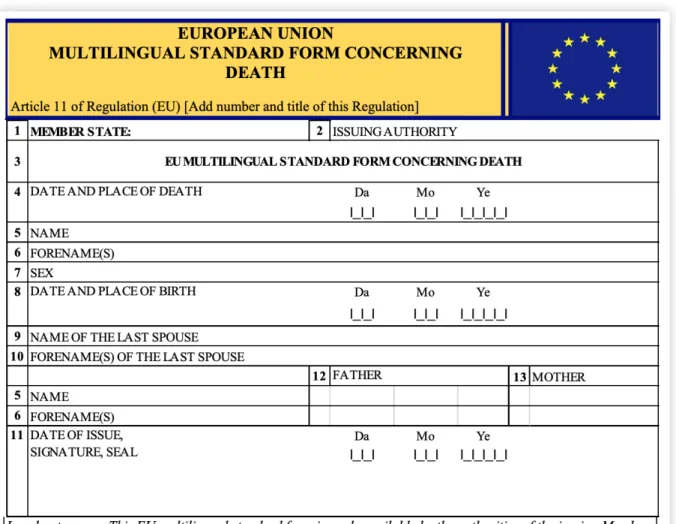
acceptance of certain public documents in the European Union, which amends the IMI
Resolution to, among other things, establish European-Union issued multilingual standard
forms. 67
“Consular protection for EU citizens in third countries: State of play and way forward,” Communication from the 65
Commission to the European Parliament and the Council, COM/2011/0149, https://eur-lex.europa.eu/legal-content/ EN/TXT/?qid=1551284014375&uri=CELEX:52011DC0149.
“Regulation (EU) No 1024/2012 of the European Parliament and of the Council of 25 October 2012 on 66
administrative cooperation through the Internal Market Information System and repealing Commission Decision 2008/49/EC (‘the IMI Regulation’),” https://eur-lex.europa.eu/legal-content/EN/TXT/PDF/?uri=CELEX: 32012R1024&rid=9.
“Proposal for a Regulation of the European Parliament and of the Council on promoting the free movement of 67
Figure 4. Multilingual Standard Form 68
In February 2014, the MEP Alyn Smith asks the commission what rights exist for
families of people who die within another member state in the EU, explaining that they have
been contacted by a Scottish charity called Death Abroad — You’re Not Alone who helps the
bereaved and campaigns for greater support on their behalf. Furthermore, Smith asks whether 69
the Commission agrees “that this is an area in which an extension of EU legislation to ensure a
Resolution on promoting the free movement of citizens and businesses by simplifying the acceptance of certain 68
public documents in the European Union.
minimum and equal level of service from all Member States would be an important step
forward.” Essentially, Smith reiterates the age-old question: does the commission intend to act
regarding the repatriation of mortal remains between EU member states?
Mrs Reding, on behalf of the commission, notes that the Commission, in the 10th report
on Citizenship of the Union, recognized the administrative nightmare that often arose when
citizens attempted to secure the cross-border recognition of civil-status documents and highlights
the Commission’s solution: a proposed resolution that aims to simplify and streamline this
procedure. She also notes the existence of EU multilingual standard forms, which can help
families save on translation costs.
Reding then explains that the repatriation of corpses is governed by the 1937 and 1973
treaties and reiterates that, though the EU requires member states to apply the regulations of
these treaties in a non-discriminatory manner, “Member States are competent for concluding
bilateral agreements in this field.”
Finally, Reding reiterates the requirements enshrined in the Services Directive: that
member states “can only impose requirements on services providers from other Member States if
such requirements are non-discriminatory, based on overriding reasons of general interest (public
policy, public safety, public health and protection of the environment) and proportionate.”
In December 2014, another MEP asks whether the Commission intends to legislate on the
intra-community transfer of corpses. In February 2015, Ms Bie70 ńkowska on behalf of the Commission responds in the negative, reiterating the existence of the 1973 Agreement and the
Services Directive, saying:
Nevertheless, when imposing requirements in the area of funeral services (such as those
concerning technical standards for coffins) Member States may also pursue public
interest objectives like the protection of public health, in which Member States enjoy a
certain margin of discretion under EC law.
Thus, Ms Biénkowska provides a new argument: that Member States have the right to uphold
additional requirements for corpses which are to travel overseas because they have competency
over issues of public health.
In September 2015, MEP Vicky Ford reiterates the argument that the emotional and
financial cost of the transport of mortal remains for family members of the deceased
“significantly increases” when that transport involves the crossing of a national border within the
EU, specifically highlighting “differing legal documents authorizing transport” and “onerous and
inconsistent rules” regarding the coffin and embalming. She asks three questions: (1) If the 71
Commission can provide her with statistics on this issue, (2) if the Commission has taken any
steps to harmonize EU standards on top of or alongside the Strasbourg Agreement, and (3) if the
Commission still believes the transport of bodies lies outside of the scope of the Services
Directive. Ms Bieńkowska responds on behalf of the Commission to say first that the
Commission maintains no statistics on the number of EU citizens that die in another member
state, second that the Commission has taken no steps towards harmonization, and third that, yes,
transport is still excluded from the Services Directive.
On 6 July 2016, the European Parliament and the Council passed a resolution on
promoting the free movement of citizens by simplifying the requirements for presenting certain
public documents, amending the IMI Regulation for the second time. Broadly, this Regulation’s 72
goal is to simplify the paperwork that comes along with living transnationally in the EU, as it had
been administrative nightmare to present official documents from one country to the authorities
in another. It is relevant to this paper because death certificates are included under its scope.
The regulation abolishes the apostille requirement, bans requirements to provide both the
original document and a certified copy at the same time, and bans mandatory translation as long
as the document is written in an official language of the EU or is accompanied by an EU
multilingual standard form. Though the Regulation does reduce the administrative obstacles to 73
have a death certificate recognized, it is important to note that the Regulation addresses the issue
of document’s authenticity, not the substance of the documents or the procedure for their initial
issuance. Nevertheless, a clearer, easier process to obtain death certificates recognized
throughout the EU facilitates the issuance of the laissez-passer for a corpse.
In 2017, the issue of having organs removed while abroad without the consent of the
family of the deceased is brought up again by an MEP in a written question to the commission. 74
Again, the Commission responds that “Providing information on conditions of post mortem
exams, including removal and retention of organs, and on corpse repatriation is Member States'
responsibility.” However, the Commission response does end on a different phrase than it has 75
Regulation (EU) 2016/1191 of the European Parliament and of the Council of 6 July 2016 on promoting the free 72
movement of citizens by simplifying the requirements for presenting certain public documents in the European Union and amending Regulation (EU) No 1024/2012, https://eur-lex.europa.eu/legal-content/EN/TXT/?uri=celex: 32016R1191.
“Summary of Regulation 2016/1191: Simplifying the circulation of certain public documents within the EU,” 73
https://eur-lex.europa.eu/legal-content/EN/LSU/?uri=CELEX:32016R1191.
Written Question E-001449/2017. 74
in the past: “At present the Commission has no concrete plans to act in the area of repatriation of
human remains.” The “concrete” qualifier may indicate the Commission is becoming more open
to the idea of drafting legislation on this subject, though, it is also possible that the
Commissioner writing the response grew tired of “the Commission does not envisage a specific
initiative at the moment.”
In September 2018, the only mention of the repatriation of mortal remains was in a set of
parliamentary written questions referencing the case of Miguel Ángel Martínez, a Spaniard who
was found dead on a beach in Sweden during a trip through Europe. After a post-mortem in 76
Sweden, his body was taken to London, per the wishes outlined in his will. Due to “mix-up of
paperwork when the body arrived,” a second autopsy was performed in the UK, where doctors 77
discovered he was missing his heart and a portion of his liver. The paperwork issue that The Times called a “mix-up” was the lack of the laissez-passer for a corpse required under the Strasbourg Agreement. In the MEP’s joint Written Question, they ask if the Commission
considers the handling of the case by the Swedish and Spanish authorities a breach of the 1973
treaty. Ms Jourová on behalf of the European Commission responds that the Commission cannot
comment on individual cases nor assess compliance with international treaties conducted outside
of the EU. (The 1973 Treaty was created by the Council of Europe.) Finally, the commission
cannot assess Member State’s handling of burial procedures, as that competence belongs to
Member States.
Written Questions E-004474/2018, E-004475/2018, and E-004473/2018. All were submitted on the same day. 76
Simpson, John. "Corpse without Heart Exhumed to End Mystery Scot Region]." The Times, Aug 04, 2018. http://
77
Since that Written Question, there has not been any mention of the intra-Community
transfer of mortal remains within publicly-available documents of either the Commission or the
Parliament.
In 1937 and 1973, national governments, alongside the League of Nations and the
Council of Europe, respectively, spearheaded the push for the two international treaties on corpse
repatriation that do exist. Despite some effort on the part of the European Union, no further
concrete action has been taken. The following two sections examine the role non-governmental
organizations have played in this debate: first, internationally and more historically, and second,
in Europe in contemporary times.
International Public Health Non-Governmental Organizations
OISP
In May 1934, the Office Internationale d'Hygiène Publique (OISP) — the preeminent
international health NGO — adopts an “International Arrangement for the Transport of
Corpses,” a draft convention which would later form the basis of the 1937 Berlin Arrangement. 78
In the 1937 International Arrangement Concerning the Conveyance of Corpses, the OISP is
tasked with keeping records of all ratifications of the treaty [Articles 13 and 14] alongside the
German government.
“International Arrangement for the Transport of Corpses as adopted by the Permanent Committee meeting, May 78
WHO
In 1946, the OISP is dissolved and incorporated into the newly-established World Health
Organization (WHO). As the new international leader in public health recommendations, the
WHO was soon asked for advice on the issue of international corpse transfer by both the
Government of Tunisia and the Government of Israel, who were trying to establish policies 79 80
for the first time.
On February 17th, 1949, Dr. C. van den Berg presents a paper on the transportation of
corpses at the third session of the WHO executive board. He argues that the WHO should
establish an expert committee to discuss the amendment of the 1937 Arrangement Concerning
the Conveyance of Corpses or the creation of a new international instrument, as the Berlin
Arrangement was not ratified by enough countries to be useful, effective, or relevant. He notes 81
that this may have been partially due to the fact that ratification required the deposition of
documents with the German government, which was impossible during the war.
In the fifth meeting of the executive board a few days later, Dr. Van den Berg mentions
that he had learned that many countries had indeed been interested in the arrangement, but had
not had the chance to ratify it, as he had suspected. Then, Dr Biraud, the Director of the WHO 82
Division of Epidemiology, suggests that the matter be assigned to the Committee on
“Suggested Improvement and Proposed Amendments to the Text of the International Sanitary Regulations,” 79
Official Records of the WHO No. 56: Proceedings and Reports Relating to International Quarantine, Geneva: September 1954, page 40.
“Second Annual Report by the Director-General on the Working of the International Sanitary Regulations,” 80
Official Records of the WHO No. 64: Proceedings and Reports Relating to International Quarantine, Geneva: September 1955, page 22.
Dr C. van den Berg, “Transportation of corpses,” paper presented to 3 Session of the Executive Board of the 81
World Health Organization, Gov’t Doc No. EB3/49 (1949), http://www.who.int/iris/handle/10665/113067.
Executive Board, 3. (1949). Minutes of the fifth meeting, Palais des Nations, Geneva, Wednesday, 23 February 82
Epidemiology and Quarantine, who had already been tasked with the development of WHO
regulations on the foundation of the international sanitary conventions. Everyone agrees this is
logical, and the executive board decides in favor of Dr. van den Berg’s motion. 83
In the first report of the Committee on Epidemiology and and Quarantine in 1954, they
ask the Director-General to analyze and compare the Berlin Arrangement with existing national
law. However, in the list of matters they asked the Director-General to investigate, they rank 84
the “study of national legislation relating to the transport of corpses” sixth (and last) in respect to
urgency. 85
The following year, the second report of the Director-General says that the requested
comparative study does not yet exist, but that it “should be made and reported to a future
session.” In 1956, the third report of the Committee on Quarantine reaffirms their decision to 86
ask the Director-General to conduct a study, yet reiterates the lack of urgency. 87
The topic does not reemerge until 1977, when records of the 30th World Health Assembly
note that companies have reached out to the WHO regarding issues regarding the international
transport of human remains. However, the WHO recommends that these firms take their issues 88
up with national public health administrations due to the issue’s political complexity —
World Health Organization. Handbook of Resolutions and Decisions of the World Health Assembly and the
83
Executive Board. Volume 1: 1948-1972. Geneva, 1973. Page 64.
“First Report of the Committee on International Quarantine,” Official Records of the WHO No. 56: Proceedings
84
and Reports Relating to International Quarantine, Geneva: September 1954, page 49.
Ibid, 66-67. 85
“Second Annual Report by the Director-General on the Working of the International Sanitary Regulations,” 86
Official Records of the WHO No. 64 (1955), page 6.
Third Report of the Committee on International Quarantine. https://apps.who.int/iris/bitstream/handle/ 87
10665/104602/WHA9_PB-7_eng.pdf?sequence=1.
“Thirtieth World Health Assembly Geneva, 2-19 May 1977: Part I - Resolutions and Decisions Annexes,” Official
88
involving both state regulations and religious practices — and the absence of a public health
risk. This marks the end of the involvement of international public health organizations in the
question of the transport of mortal remains.
They have, however, remained active in the treatment and disposal of corpses in
humanitarian crises. In 2016, however, the World Health Organization and the International
Committee of the Red Cross and Red Crescent released the second edition of Management of Dead Bodies After Disasters: A Field Manual for First Responders, which explains that corpses are not, in most cases, a public health risk, and that the priority of the management of corpses in
emergency situations is not to safeguard survivors, but rather to (A) treat the dead in a dignified
way, and to (B) preserve any and all evidence that can be used to later identify the bodies. 89
Thus, the involvement of public health NGOs today emphasizes the respectful treatment
of the corpses and prioritizes the feelings of surviving family and friends who are interested in
the timely identification and proper burial of the body. This a stark departure from the infectious
disease concerns of the WHO’s early years, and one that again emphasizes the importance of the
treatment of dead bodies.
European Non-Governmental Organizations
CEN
The Comité Européen de Normalisation (CEN), or the European Committee for
Standardization, is a private international nonprofit organization that creates voluntary standards
Stephen Cordner et. al., eds. Management of Dead Bodies After Disasters: A Field Manual for First Responders.
89
for products and businesses in a vast array of industries. CEN, the European Committee for 90
Electrotechnical Standardization (CENELEC), and the European Telecommunications Standards
Institute (ESTI) are the three standardization organizations officially recognized by the EU and
the European Free Trade Organization. Standards are crucial to the functionality of the internal 91
market. CEN’s creation process involves both consensus and direct participation: standards are
prepared by technical committees comprised of national CEN members, who represent their
country’s point of view, and drafted by working groups comprised of technical experts. All 92
CEN standards are voluntary, but upholding the standards ensures compliance with the
mandatory legal requirements.
In 2005, Technical Committee 448 publishes the first standards on funeral services. 93
Article 3.5.2. governs the transport of the deceased and establishes general rules: information
about the deceased should be documented (a sample laissez-passer for a corpse is annexed), the coffin or casket must be hermetically sealed in cases of death by a contagious disease like
smallpox, cholera, or anthrax, and the appearance of the means of transport must be respectful.
Furthermore, if the corpse is transported within 48 hours of death, no embalming, refrigeration,
or hermetically sealed encoffining is required, except for in cases of “long distance international
transport outside Europe.”
In fact, CEN is responsible for standards in every industry except for those covered by CENELEC
90
(electrotechnology) and ESTI (telecommunications).
Regulation (EU) No 1025/2012 of the European Parliament and of the Council of 25 October 2012 on European 91
standardisation.
“Technical Bodies,” CEN, https://standards.cen.eu/dyn/www/f?p=204:6:0::::FSP_LANG_ID: 92
25&cs=11F6C9A43C0C00A2469F97432CECBF708
"CEN/TC 448 - Funeral services,” CEN, https://standards.cen.eu/dyn/www/f?
93