MAGNETIC ORIENTATION AND NAVIGATION BEHAVIOR OF LOGGERHEAD SEA TURTLE HATCHLINGS (Caretta caretta) DURING THEIR TRANSOCEANIC MIGRATION
Matthew J. Fuxjager
A thesis submitted to the faculty of the University of North Carolina at Chapel Hill in partial fulfillment of the requirements for the degree of Master of Science in the Department of Biology (Evolution, Ecology and Organismal Biology)
Chapel Hill 2007
Approved by
ABSTRACT
Matthew J. Fuxjager
Magnetic orientation and navigation behavior of hatchling loggerhead sea turtles (Caretta caretta) during their transoceanic migration
(Under the direction of Dr. Kenneth J. Lohmann)
Numerous animals embark on long-distance migrations, during which some of these animals can use the Earth’s magnetic field as a cue in orientation and navigation. Here, I study how
ACKNOWLEDGMENTS
I would first like to thank my committee members, Bill Kier, Keith Sockman, Haven Wiley, John Bruno, and Ken Lohmann, for the help and support during my time in the Biology Department at UNC. Particularly, I am indebted to my adviser, Ken Lohmann, for his assistance and
encouragement while I was a student in his lab.
I would also like to thank other members of the department, including but not limited to Lisa Mangiamele, Brian Eastwood, Cathy Lohmann, John Wang, Justin McAlister, and Ted Uyeno, for their training, stimulation, and advice over the years. The field assistants I worked with, Rachel Katz and Grete Dudek, were also very helpful and I appreciate their contribution to my work. Also, in Florida I was grateful for the training and support of Dean Bagley, Llewellyn Ehrhart and the University of Central Florida Sea Turtle Research Team.
TABLE OF CONTENTS
Page
LIST OF TABLES……….viii
LIST OF FIGURES.……….ix
CHAPTER 1 Introduction Long-distance migrations and magnetic orientation……….1
Study system………...4
Thesis objectives………7
CHAPTER 2 Geomagnetic navigation in loggerhead sea turtles: responses to regional magnetic fields along a transoceanic migratory pathway Abstract………8
Introduction………..8
Methods……….10
Animals………10
Orientation tank………..10
Magnetic coil………...11
Testing procedure………..12
Data analysis and statistics………………..13
Results………...14
Discussion……….15
Functional significance of orientation responses……………….16
Magnetic field as navigational waymarks………………..18
Acknowledgments………20
CHAPTER 3 The possible effects of secular variation on magnetic navigation behavior of loggerhead sea turtles Abstract………..21
Introduction………22
Methods……….23
Animals………24
Orientation tank………..24
Magnetic coil………...24
Magnetic fields and their movement as a result of secular variation……….25
Testing procedure………..26
Data analysis and statistics………..27
Results………...27
Discussion……….29
Functional significance of orientation responses………..29
Secular variation and magnetic position-finding………...31
Acknowledgments………33
CHAPTER 4 Effect of the geomagnetic environment in which sea turtle clutches incubate on the hatchlings’ subsequent magnetic orientation behavior Abstract………..34
Introduction……….…..34
Methods……….36
Locating turtle nests………..36
Manipulation of the magnetic field around the eggs……….36
Measurements of the magnetic field distortion…………….37
Orientation arena……….38
Magnetic coil………38
Testing procedure………39
Additional tests of orientation and health………...40
Orientation into waves………41
Orientation toward the sea……….43
Morphometrics……………….44
Results………...44
Discussion……….48
Functional significance of the nest’s magnetic environment………..48
Magnetic imprinting hypothesis………...51
Conservation implications……….52
Acknowledgments………52
CHAPTER 5 Anthropogenic magnetic anomalies caused by metal sea walls might influence hatchling sea turtles’ magnetic orientation behavior Abstract………..53
Introduction………53
Methods……….55
Results………...56
Discussion……….58
Behavioral effects of field distortions………..58
Acknowledgments………60
CHAPTER 6 Concluding Remarks………61
LIST OF TABLES
Table Page
1.1. Information on the different magnetic fields that turtles were exposed to during
experiments………...12 4.1. Results from the wave simulator experiment in which hatchlings from both incubation
LIST OF FIGURES
Figure Page
1.1. Diagram of the Earth’s magnetic field……….……..…..3 1.2. Map of the geomagnetic isolines across the Caribbean Sea……….3 1.3. Diagram of hatchling responses to magnetic fields replicating those from three widely
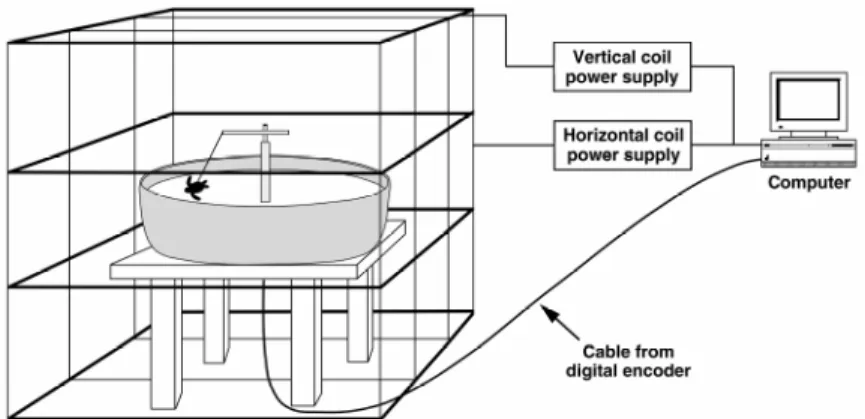
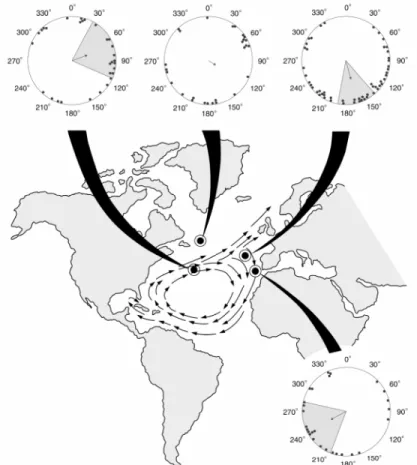
separated geographic locations………...…6 2.1. Schematic of experimental apparatus, including the orientation arena, magnetic coil structure, and data acquisition system………..….12 2.2. Diagram of hatchling orientation responses to magnetic fields that exist at different locations
throughout the North Atlantic Ocean………....15 3.1. Diagram of the experimental apparatus, including the orientation arena, the magnetic coil
system, and the computer that collected data and controlled the power supplies………...….25 3.2. Map showing the location of the two magnetic fields used in this experiment during the past
century as a result of secular variation……….………28 3.3. Hatchling orientation responses elicited by two magnetic fields that currently exist at separate locations along the north Atlantic gyre………..……29 4.1. Diagram of PVC square buried around the nests with either magnets or aluminum bars
attached………..………..……….37 4.2. Diagram of the experimental apparatus and data acquisition system used to monitor the
turtle’s orientation………..………..39 4.3. Mechanical wave simulator used to produce orbital movements of waves similar to those that hatchlings experience while swimming offshore of eastern Florida………..………..42 4.4. Orientation of hatchlings that incubated in either the natural magnetic field or a slightly
distorted magnetic field when exposed to a magnetic field along the northeastern boundary of the north Atlantic gyre………..………..……….45 4.5. Orientation of hatchlings from both magnetic environment treatments during incubation when
placed on the beach that they would normally crawl down to find the sea after
emergence……….47 5.1. Schematic of transect distribution along the beach………..………..55 5.2. Graph of the mean distortion of the total magnetic field intensity in front of each of the three
sea walls, as well as the ambient field………..………57 5.3. Graph of the mean distortion of the magnetic field inclination angle in front of each of the
CHAPTER 1 Introduction
Long-distance migrations and magnetic orientation
Diverse animals undergo spectacular long-distance migrations, the function of which have been discussed extensively (Alerstam et al. 2003; Dingle 1996). Migration is primarily thought to help animals move among environments in order to enhance growth, survival and reproduction (Dingle & Drake 2007). For example, the arctic tern (Sterna paradisaea) migrates between nesting grounds along the Arctic rim of North America and Asia and feeding areas off the shores of Antarctica
(Alerstam et al. 2003). Other examples include wildebeests (Connochaetes taurinus) that seasonally travel in single-file lines across the Serengeti Plains of East Africa, as well as emus (Dromaius novaehollandiae) that move across the arid Australian outback toward foraging grounds recently showered by rainfall (Dingle 1996).
Equally astonishing are the long-distance migrations of various marine vertebrates. Some of these animals can swim thousands of kilometers through the open ocean, such as adult salmon that migrate from regions in the middle of the Gulf of Alaska to estuaries along the southern coast of British Columbia and then up rivers to their natal stream to spawn (Quinn 2005). Some species of seal also travel great distances between feeding areas in the open sea and coastal reproductive grounds (Le Boeuf et al. 2000).
Many animals are capable of sensing the Earth’s magnetic field and using it as a cue for orientation and navigation (Wiltschko & Wiltschko 1995; Wiltschko & Wiltschko 2005). Animals can derive two types of information from the Earth’s magnetic field. The first type of information is directional or compass information, which is characterized by using the magnetic field to maintain a constant heading in a particular direction (Able 2001). Various mammals (Kimchi et al. 2004), birds (Cochran et al. 2004; Viehmann 1979), reptiles (Lohmann 1993; Lohmann & Lohmann 1993), amphibians (Deutschlander et al. 1999), and fishes (Quinn 1980) have all been documented to possess a magnetic compass.
Figure 1.1. Diagram of the Earth’s magnetic field. (a) Geomagnetic field lines emerging from the southern hemisphere and entering into the northern hemisphere. (b) Representation of the geomagnetic field’s parameters that vary across the surface of the Earth. Arrows represent magnetic field vectors. The angle at which each arrow intersects the Earth indicates the field’s inclination angle at the region of the planet, and the length of each arrow indicates the field’s intensity at a given region of the planet, with shorter arrows signifying lower field intensity. The inclination angle is 90° at each magnetic pole and predictably decreases with latitude so that it is 0° at the magnetic equator. Field intensity decreases along a similar latitudinal gradient from the magnetic poles toward the magnetic equator. Taken from Alerstam (2003).
Figure 1.2. Map of the geomagnetic isolines across the Caribbean Sea. Solid lines are isodynamics, or lines of equal field intensity, and dotted lines are isoclinics, or lines of equal inclination angle. Since the isolines are not parallel, each geographic location is associated with a unique magnetic field (i.e. unique combination of intensity and inclination angle) Taken from Alerstam (2003).
one geographic location to another over time. In a hypothetical situation, for example, the Earth’s magnetic field might change over 20 years so that the field that exists at New York City, New York in 2007 might subsequently exist in Philadelphia, Pennsylvania in 2027. Sometimes changes in the Earth’s magnetic field can cause a specific field to no longer exist, or the same field can
simultaneously exist in more than one geographic location. Although the topic has been briefly mentioned and discussed in the past (Alerstam 2003; Courtillot et al. 1997; Freake et al. 2006; Lohmann et al. 1999; Lohmann & Lohmann 2006), the effect of secular variation on magnetic position finding strategies has never been investigated.
Study system
Sea turtles undergo some of the most impressive long-distance migrations known to biologists, crossing vast oceanic regions (Bowen et al. 1995; Papi et al. 1995; Papi et al. 2000). As soon as the hatchlings emerge from their nest and enter the ocean, they establish a heading offshore and swim to the open ocean. Nearly all species of sea turtle then commence a post-hatchling oceanic life history stage, during which individuals inhabit the open ocean for a number of years before breeding later in life (Bolten 2003). Turtles in neritic waters are subject to high levels of predation; thus, there is strong selection for hatchlings and post-hatchlings to leave this zone and inhabit the open ocean, where predation rates are presumably less (Bolten 2003). The flatback sea turtle
(Natator depressus) is the only sea turtle species that does not have a post-hatchling oceanic phase. Hatchling flatbacks are much larger than hatchlings of other sea turtle species, a feature thought to help young flatbacks resist intense predation (Walker & Parmenter 1990).
Eventually juvenile sea turtles inhabiting the open ocean grow larger and undergo an ontogenetic habitat shift, returning to neritic zones near the coast to take up residence. After turtles reach reproductive maturity, they migrate between their foraging grounds and breeding areas to mate and nest (Allard et al. 1994; Bowen et al. 2004; FitzSimmons et al. 1997; Meylan et al. 1990).
Sea (Carr 1987; Hays & Marsh 1997; Lohmann et al. 2001; Lohmann & Lohmann 2006). Young loggerheads remain in the gyre for approximately a decade (Bjorndal et al. 2000) and are frequently found foraging near the Azores, Maderia Islands, and Canary Islands (Bolten 2003; Bolten et al. 1998). Conditions inside the gyre are optimal for turtle growth and maturation (Bjorndal et al. 2000; Bolten 2003; Bolten et al. 1998), whereas conditions outside of the gyre can be fatal. For instance, the oceanic waters that exist to the gyre’s north are lethally cold to sea turtles (Cain et al. 2005; Carr 1987; Hays & Marsh 1997; Lohmann et al. 2001). After their time in the gyre current system,
loggerheads travel back to the southeastern United States and establish feeding grounds along the coast (Musick & Limpus 1997).
Similar to other animals (Dingle 1996; Papi 1992), sea turtles use many environmental cues in orientation and navigation. However, a growing body of research suggests that sea turtles rely on the Earth’s magnetic field as a source of both directional and positional information while navigating in the open ocean (Lohmann et al. 1999; Lohmann & Lohmann 1996b; Lohmann & Lohmann 2006; Luschi et al. 2007). Hatchling loggerheads, for instance, have a magnetic compass sense that is thought to help direct them offshore after first entering the ocean (Irwin & Lohmann 2003; Lohmann 1991; Lohmann 1993).
Once in the open sea, turtles begin their transoceanic migration and can use the
geomagnetic field as a source of positional information to help them do so (Lohmann et al. 2001). Experiments have shown that loggerheads can sense two components of the Earth’s magnetic field that vary predictably across the surface of the globe, inclination angle (Lohmann & Lohmann 1994b) and intensity (Lohmann & Lohmann 1996a). These elements of the geomagnetic field can, in theory, provide young turtles with the necessary information to help them assess their geographic location (Lohmann et al. 1999; Lohmann & Lohmann 2003) in the North Atlantic Ocean.
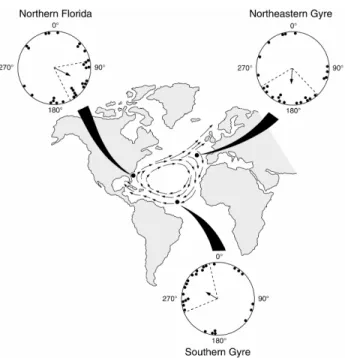
al. (2001) explain, hatchlings exposed to a field like one that is found near northern Florida swim southeastward, a response that likely helps turtles position themselves safely inside the east-veering Gulf Stream current and avoid being ejected from the gyre into the lethally cold waters that exist to the north. Next, hatchling turtles subjected to a field that exists at the northeastern boundary of the gyre orient southward. The current at this region of the gyre divides into two branches, one that flows northward into cold polar waters and another that flows southward into temperate waters. Thus, swimming southward likely decreases the turtles’ likelihood of being swept north and helps them remain where conditions are optimal for their survival (Carr 1987; Hays & Marsh 1997; Lohmann et al. 2001). Finally, hatchlings exposed to a field at the southern border of the gyre orient toward the northeast. This orientation response likely helps keep turtles from drifting too far south of the gyre where they can be carried off course and away from the North American coast where juveniles usually take up residence (Musick & Limpus 1997). Thus, hatchlings appear capable of using a few regional magnetic fields located along their migratory pathway as navigational markers. Moreover, hatchlings are able to do so without having any prior migratory experience.
Figure 1.3. Diagram of hatchling responses to magnetic fields replicating those from three widely separated geographic locations (represented by back dots) along the north Atlantic gyre current system (indicated by the arrows on the map). Turtles exposed to a field like one that exists near the coast of northern Florida were significantly oriented to the southeast. Turtles exposed to a field like one found at the gyre’s northeastern border responded by swimming southward. Finally, turtles subjected to a field like one that occurs at the gyre’s
mean heading of a single turtle, the arrow indicates the mean heading of the group, and the dashed lines signify the 95% confidence intervals for the group. Taken from Lohmann et al. (2001).
Thesis objectives
In this thesis, I examine the magnetic navigation system that hatchling loggerhead sea turtles use to help them migrate around the gyre current system. Previous studies have suggested that hatchling loggerheads are capable of exploiting as navigational markers regional magnetic fields found along their migratory pathway. Yet, much remains unknown about this navigational strategy. Specifically, I investigate: (1) whether several fields found along the northern half of the turtles’ migratory route elicit orientation responses that are consistent with the turtles’ migration, or if turtles respond to only a limited few fields that mark crucial geographic boundaries of the gyre; (2) whether magnetic fields that exist outside the turtles’ normal migratory pathway elicit orientation responses that would help turtles return to the gyre current system; (3) how secular variation might impact the turtles’ magnetic position finding strategy in cases where regional fields have moved locations within the gyre significantly in the recent past; (4) the early ontogeny of the turtles’ magnetic position-finding strategy by exploring how the magnetic environment in which hatchling turtles incubate might
CHAPTER 2
Geomagnetic navigation in loggerhead sea turtles: responses to regional magnetic fields along a transoceanic migratory pathway
Abstract
Hatchling loggerhead sea turtles (Caretta caretta) embark on a long-distance migration around the north Atlantic gyre, a current system that encircles the Sargasso Sea. Previous experiments suggest that hatchling turtles can use regional magnetic fields that exist at widely separated locations along their migratory route as navigational markers. In this study, we exposed hatchlings to several other regional magnetic fields that exist along the northern half of the turtles’ migratory route, and one located north of the gyre, where turtles are unlikely to survive. Hatchlings subjected to fields that occur along their migratory pathway responded by swimming in directions that would, in each case, help them remain inside the gyre current system and advance along their migratory pathway. Turtles exposed to a field that exists north of the gyre were not significantly oriented as a group. These results, combined with those of earlier studies, suggest that loggerhead turtles complete some or all of their first transoceanic migration using a form of magnetic waymark navigation, in which regional magnetic fields trigger directional responses that help steer the turtles along their migratory pathway. Although natural selection has apparently sculpted responses to multiple fields that exist along the migratory route, turtles may fail to respond to fields that exist in locations where they never go.
Introduction
How these animals guide themselves during their first oceanic migration has long been of interest to behavioral biologists.
Young loggerhead sea turtles (Carettacaretta) embark on one of the most spectacular marine migrations. Hatchling turtles from the east coast of Florida, U.S.A. emerge from their nests and swim offshore to the north Atlantic gyre, a current system that encircles the Sargasso Sea (Carr 1987; Lohmann & Lohmann 2003; Musick & Limpus 1997). Turtles typically remain in the gyre for nearly a decade (Bjorndal et al. 2000). During this time, many young loggerheads swim to the eastern side of the Atlantic Ocean, as they have been documented foraging near the Azores, Maderia
Islands, and Canary Islands (Bolten 2003; Bolten et al. 1998) before eventually returning to the southeastern United States to establish feeding grounds (Musick & Limpus 1997).
For migrating loggerheads, conditions along their migratory pathway, and within the north Atlantic gyre, are favorable for survival and growth (Bjorndal et al. 2000; Bolten 2003; Bolten et al. 1998), whereas straying outside of the gyre is often fatal. For example, in the northeastern region of the gyre, the current diverges into two branches, one of which flows northward toward the United Kingdom and Scandinavia, and the other of which flows southward past Portugal and the
northwestern coast of Africa. Loggerheads swept into the north-flowing current likely die from the cold, polar waters that exist in this oceanic region (Cain et al. 2005; Carr 1987; Hays & Marsh 1997; Lohmann & Lohmann 2003; Lohmann & Lohmann 2006). Thus, having the ability to alter swimming direction at appropriate geographic areas in order to remain inside the gyre current system likely has considerable adaptive value.
around the gyre (Lohmann & Lohmann 1996a; Lohmann & Lohmann 2006; Wiltschko & Wiltschko 2005). Additional studies have revealed that when subjected to magnetic fields like those found at three widely separated geographic regions of the gyre, hatchling loggerheads respond by swimming in directions that would, in each case, help them remain inside the gyre current system (Lohmann et al. 2001). These results suggest that young loggerheads are equipped with a magnetic position-finding system in which regional magnetic fields provide information that elicit changes in swimming direction at different geographic areas of the gyre. Here we investigate further this magnetic guidance system by exposing hatchling loggerheads to several additional magnetic fields like those that exist along the northern segment of the turtles’ migratory route, as well as a field like one that exists to the north of the gyre current system, where turtles are unlikely to go or survive.
Methods Animals
Hatchling loggerheads were collected from nests deposited along an 8 km stretch of coastline in Melbourne Beach, Florida, U.S.A. The date each nest was deposited was recorded, as well as the predicted date of emergence. In the late afternoon, a few hours before the turtles would otherwise have emerged naturally, we gently dug into the sand with our hands and removed 15-25 hatchlings. Turtles were immediately placed into a lightproof, Styrofoam container and transported to a nearby lab. Hatchlings were kept in complete darkness until testing and were used only once in an experiment before being released that same night.
Orientation tank
vertical post mounted in the center of the tank. Thus, the lever arm could freely rotate 360° in the horizontal plane so that turtles could swim in any direction without touching either the edge of the tank or the plastic post mounted in the center. The digital encoder inside the plastic post was wired to a laptop computer in a nearby room. Before each trial began, we covered the tank with a black, 1.9 cm-thick plywood lid, as well as four sheets of 6 mm black plastic, to ensure that no light entered.
Magnetic coil
The orientation tank was surrounded by a computer-controlled magnetic coil system (Figure 2.1), which consisted of two orthogonally arranged Merritt-4 coils (Merritt et al. 1983) capable of generating uniform, Earth-strength magnetic fields. The first coil (2.41 m on a side) was aligned along the north-south axis and controlled the horizontal component of the magnetic field. The second coil (2.54m on a side) controlled the vertical component of the field. The current to the coils was
controlled by computer software allowing us to generate any magnetic field that could be found in the Atlantic Ocean in the center of the coil where the turtles swam. This entire coil structure and
orientation tank was located outdoors and more than 15m from where the computer was housed. Prior to locating the magnetic coils, we used a tri-axial fluxgate magnetometer (Applied Physics Systems, Model 520)to determine that the coil’s location was free of magnetic distortions.
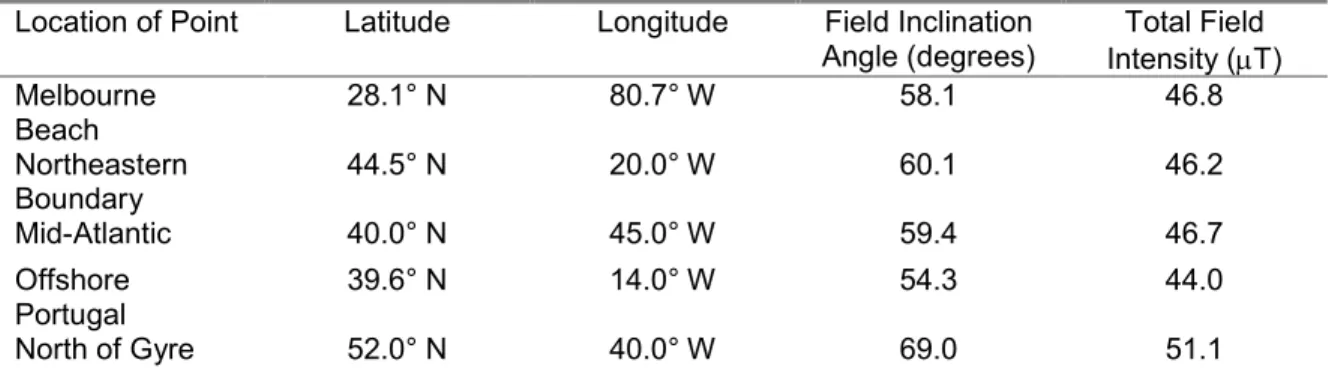
The animals were tested with four different magnetic fields (Table 2.1). The first field, similar to one used in previous experiments (Lohmann et al. 2001), is identical to a field found at the northeastern boundary of the north Atlantic gyre. The second field is comparable to one that occurs approximately in the middle of the north Atlantic, and within the east-flowing currents that comprise the gyre’s northern segment. The third field is like one found offshore from Portugal’s southern coast. Finally, the fourth field replicates one located significantly north of the gyre current system, a location where turtles are unlikely to go or survive.
Table 2.1. Information on the different magnetic fields that turtles were exposed to during experiments. Each point is named based on its general location in the Atlantic Ocean. The exact latitudinal and longitudinal coordinates are provided as well as the magnetic parameters estimated from the IGRF model, 2005 version, for July 1st, 2006.
Location of Point Latitude Longitude Field Inclination Angle (degrees)
Total Field Intensity (µT) Melbourne
Beach 28.1° N 80.7° W 58.1 46.8
Northeastern
Boundary 44.5° N 20.0° W 60.1 46.2
Mid-Atlantic 40.0° N 45.0° W 59.4 46.7
Offshore Portugal
39.6° N 14.0° W 54.3 44.0
North of Gyre 52.0° N 40.0° W 69.0 51.1
The parameters for each field are based on estimates provided by the International
Geomagnetic Reference Field (IGRF) model, version 2005, for July 1, 2006, which corresponds to the approximate months in which experiments were conducted. Using a tri-axial fluxgate magnetometer (Applied Physics Systems, Model 520), we confirmed that the coils produced the field parameters estimated from the IGRF software. Additionally, the measured deviations from perfect field uniformity in the center of the coil where the turtles swam were less than 0.55%.
Testing procedure
Healthy hatchling turtles are known to swim vigorously toward light after emerging from their nest (Lohmann & Lohmann 1994a; Lohmann & Lohmann 1994b; Lohmann & Lohmann 1996a; Salmon & Wyneken 1987); thus, the hatchling’s swimming response after being placed in the tank verified whether the animal was behaviorally competent (Irwin & Lohmann 2003; Irwin & Lohmann 2005; Lohmann & Lohmann 1994a; Lohmann & Lohmann 1994b; Lohmann & Lohmann 1996a). If a turtle failed to maintain a direct course toward the LED in the first minutes of the experiment (less than 5% of turtles), then the trial was terminated and the hatchling was replaced with another individual.
Each turtle was permitted to swim toward the light in the local field for 10 minutes. After this time, the light was turned off and the magnetic coils were simultaneously turned on so that each hatchling was exposed to one of the four different magnetic fields. Turtles were then given 3 minutes to acclimate to swimming in complete darkness in the new field. Once the acclimation period was complete, the hatchling’s heading was recorded every 10 seconds for the next 5 minutes. Each hatchling was only tested once and was released later in the night after all the trials were completed.
The data presented here are from two separately run experiments. The first experiment was conducted from the end of June 2006 to the middle of July 2006. In this experiment, turtles were exposed to either the field resembling one found at the gyre’s northeastern boundary or a field like one that exists at the mid-Atlantic region of the gyre’s northern east-flowing segment (Table 2.1). The second experiment was conducted from mid-July 2006 to late July 2006. In it hatchlings were
exposed to either a field replicating one that exists at the gyre’s northeastern boundary (the same field used in the first experiment), a field similar to one found to the north of the gyre current system, or a field like one that exists offshore from the southern coast of Portugal.
Turtles from the same nest were distributed equally among the four treatments (i.e. fields). However, no more than 3 turtles from the same nest were tested in any single magnetic field. In each experiment, the order in which the different fields were presented to turtles was alternated every night.
After each trial was completed, the turtle’s mean heading was calculated using all the data points recorded during the 5-minute trial period. We then used a Rayleigh test to determine whether hatchlings in each treatment group were significantly oriented in any particular direction (Batschelet 1981). The distributions from the four different treatment groups were compared using a multisample Mardia-Watson-Wheeler test (Batschelet 1981).
Results
In both experiments, hatchlings were subjected to a magnetic field that exists at the gyre’s northeastern boundary, and, in each case, turtles were significantly oriented as a group, with mean headings directed southward. These two distributions are not significantly different (Watson U2; U2=0.089; 0.50>p>0.20). Thus, we combined the data from both experiments, and found that all turtles exposed to the field like one that exists at the gyre’s northeastern boundary were significantly oriented as a group, with a mean angle to the south (Figure 2.2; mean angle=164.7°, n=54 p<0.01).
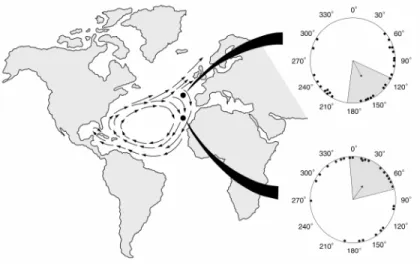
Figure 2.2. Diagram of hatchling orientation responses to magnetic fields that exist at different locations throughout the North Atlantic Ocean (indicated by the black target symbols). The arrows on the map show the direction in which the gyre current flows. In the circular orientation diagrams, each dot represents the mean heading of a single hatchling. The arrow indicates the mean direction of turtles in the group, and the length of the arrow is proportional to the magnitude of the mean vector r(with the radius of the circle corresponding to r=1). The shaded area inside the circle represents the values that fall with the 95% confidence intervals of the distribution. Data are plotted relative to magnetic north, with north indicated by 0°. Hatchlings subjected to a field that exists in the middle of the Atlantic Ocean, and within the northern east-flowing segment of the gyre, were significantly oriented as a group (Rayleigh Test, z=,3.298, r=0.332, n=30, p=0.036), with a mean heading of 70.8°. Hatchlings exposed to a field that exists north of the gyre were statistically indistinguishable from random (Rayleigh Test, z=0.69, r=0.16, n=27, p=0.506). Turtles subjected to a magnetic field that exists at the gyre’s northeast boundary were significantly oriented as a group (Rayleigh Test, z=8.65, r=0.40, n=54, p<0.01), with a mean heading of 164.7°. Hatchlings exposed to a field located offshore from the southern coast of Portugal were significantly oriented as a group (Rayleigh Test, z=3.532, r=0.362, n=27, p=0.028) with a mean angle at 242.0°.
Discussion
Functional significance of orientation responses
Each magnetic field used in our experiment triggers an orientation response that is
functionally significant to the turtles’ migration at the particular field’s given geographic location. For instance, turtles exposed to a field like one that exists at the northeastern boundary of the gyre oriented toward the south. This orientation response is consistent with previously published results, in which hatchlings were subjected to a similar magnetic field (Lohmann et al. 2001). The currents at this region of the gyre divide into two branches, one that flows northward into the polar-waters off of the United Kingdom and Scandinavia, and the other that flows into temperate waters off the coast of Portugal and the northwestern coast of continental Africa. Thus, by swimming south at this location within the gyre the turtles may avoid being swept northward into the lethally cold waters (Carr 1987; Hays & Marsh 1997; Lohmann et al. 2001; Lohmann & Lohmann 2003; Lohmann & Lohmann 2006). This response also likely helps the turtles progress into the temperate waters of the subsequent segment of the migratory pathway.
Next, hatchlings oriented eastward when exposed to a field resembling one that exists approximately in the middle of the North Atlantic Ocean, and within the east-flowing segment of the gyre. This orientation response would likely lead turtles in the same direction as the flow of the current, which probably helps turtles propel themselves through this oceanic area to the next part of their migratory pathway. Additionally, this area of the gyre is characterized by having a high degree of eddy activity and surface current variation (Richardson 1985). Environmental obstacles, such as these, could potentially delay hatchlings in the open ocean so that they are unable to reach important foraging grounds in the eastern North Atlantic (Bolten 2003; Bolten et al. 1998), or perhaps eject hatchlings into the lethally cold waters that exist north of the gyre (Carr 1987; Hays & Marsh 1997; Lohmann et al. 2001). Thus, by actively swimming through this region of the gyre, hatchlings might reduce the likelihood of being caught in eddy currents for prolonged periods or being altogether displaced from the current system.
When hatchlings were subjected to a field like one that exists offshore from southern
Swimming to southwest here might function to guide turtles away from the coastal waters of Europe and Africa, where predators are likely more abundant, and lead them toward the archipelagoes present in the eastern North Atlantic, such as the Azores, Maderia Islands, and Canary Islands. These island chains are located in oceanic areas in which young loggerheads from the southeastern United States are frequently documented foraging (Bjorndal et al. 2000; Bolten 2003; Bolten et al. 1998) before returning to North America (Musick & Limpus 1997).
The magnetic field located off the southern coast of Portugal is unusual in that this same field exists at multiple geographic locations in the Atlantic Ocean. The geomagnetic isolines of inclination angle and total intensity run approximately parallel to each other across much of the North Atlantic Ocean, intersecting at three widely separated geographic locations: offshore from southern Portugal, in the Sargasso Sea, and near the Bahamian Islands. Thus, the same magnetic field marks these three sites. Although young loggerheads migrating in the gyre are known to pass the oceanic region near Portugal (Bjorndal et al. 2000; Bolten 2003; Bolten et al. 1998), and thus presumably encounter this field there, whether the turtles travel through the other geographic areas where this field exists is unknown. If turtles do encounter this field elsewhere in the North Atlantic and respond to it in the same way, the southwesterly orientation might help function in helping steer young turtles back toward the North American coast.
Finally, hatchlings oriented randomly in response to a field like one that exists far to the north of the gyre. This result is consistent with the hypothesis that hatchling loggerheads are not
programmed to respond to regional fields that exist outside of the gyre and in locations where turtles are unlikely to go. Because entering oceanic areas north of the gyre would likely kill hatchlings before they could ever return to their migratory pathway to complete their migration and eventually
reproduce and pass on their genes, natural selection is unlikely to alter the hatchlings’ magnetic guidance system so that they are capable of responding to fields that exist outside their normal range. Testing this hypothesis further will require additional experiments in which hatchlings are exposed to several other magnetic fields that exist outside the gyre currents.
might enhance the magnetic guidance system of young loggerheads, such that after many months or years migrating at sea, turtles would be able to extrapolate their geographic position from magnetic fields that they would not likely experience along their migratory pathway. Such ontogenetic changes in orientation and navigation behavior have been documented previously in migratory animals (Able & Able 1996; Able & Bingman 1987; Rodda & Phillips 1992; Wiltschko & Wiltschko 1985), including sea turtles, which appear to learn the magnetic topography of areas where they live as juveniles
(Lohmann et al. 2004).
Magnetic field as navigational waymarks
Previous studies have found that hatchling loggerheads can distinguish among magnetic fields like those that exist at widely separated geographic boundary points of the gyre where turtles have a high risk of being swept outside of the gyre (Lohmann et al. 2001). Hatchling turtles respond to these fields by swimming in directions that would, in each case, help young turtles remain inside the gyre and progress around the migratory path (Cain et al. 2005; Lohmann et al. 2001; Lohmann & Lohmann 2003; Lohmann & Lohmann 2006; Wiltschko & Wiltschko 2005). Our data are consistent with this past experiment, but suggest that the hatchlings’ ability to use regional magnetic fields as open ocean guideposts is more extensive than previously recognized. Hatchlings have evolved orientation responses to numerous regional fields that occur along their migratory pathway, as opposed to only a few fields that exist at locations where, for instance, the risk of displacement from the gyre is very great.
One possible interpretation of these results is that hatchlings use regional magnetic fields along their migratory pathway as a series of magnetic waymarks (Lohmann & Lohmann 2006). In effect, each magnetic waymark might trigger an orientation response that helps steer a turtle’s movement through a given geographic region and toward the next segment of the migratory pathway. By orienting to multiple, sequential magnetic waymarks located around their migratory pathway, hatchlings might be able to navigate around the entire gyre over the course of many years.
et al. 1998). Additionally, juvenile salmon are thought to learn a series of olfactory waymarks as they migrate down river systems toward the sea, and then retrace these odor waymarks as adults later in life when homing to their natal stream to spawn (Dittman & Quinn 1996). Our data suggests,
however, that the turtles’ ability to use magnetic waymarks differs from how these other animals use visual or olfactory waymarks in one important way. That is, hatchlings do not require migratory experience in order to respond to regional magnetic fields because, as our findings show, fields elicit responses before the turtles ever enter the ocean. Thus, turtles apparently do not have to learn to associate specific magnetic fields with particular geographic regions along the gyre current system prior to migration. This does not, however, preclude the possibility that learned responses might become more important with migratory experience and maturation.
Secular variation and orientation responses
The ability to navigate along a complex migratory pathway using regional magnetic fields as open ocean guideposts or magnetic waymarks is not incompatible with the fact that the Earth’s magnetic field gradually changes over time (Lohmann et al. 2001). This phenomenon is referred to as secular variation (Skiles 1985). Thus, even though the Earth’s field continually changes, strong selective pressure probably acts to maintain an approximate coupling between the turtles’ orientation response and the magnetic fields that exist at various locations along the migratory pathway at any point in time (Lohmann et al. 2001). As Lohmann and Lohmann (2003) suggest, under the present conditions of the North Atlantic, turtles that stray out of the gyre are likely removed from the
population, and selection probably favors those individuals with orientation responses that help keep young turtles inside the gyre current system. As the field that exists at a specific region of the migratory pathway changes, only those turtles that respond to the new field in a manner that allows them to continue their migration will survive and pass on their genes. Thus, it is in this way that orientation responses could evolve with the constantly changing geomagnetic field.
a population of blackcaps (Sylvia atricapilla) from central Europe have revealed that these birds have evolved a new migratory route to the United Kingdom within three decades (Berthold et al. 1992), and it is thought that the directional preference that blackcaps use to guide themselves at the onset of their first migration is controlled by only a few genes (Helbig 1996). Thus, the magnetic navigation strategy used by young loggerheads might have a similar degree of flexibility, which would allow hatchlings to adapt their magnetic orientation mechanisms in concert with secular variation.
Acknowledgements
CHAPTER 3
Possible effects of secular variation on magnetic navigation behavior of loggerhead sea turtles
Abstract
Hatchling loggerhead sea turtles (Caretta caretta) embark on a long-distance migration around the north Atlantic gyre, a current system that encircles the Sargasso Sea. Before they even enter the ocean, hatchlings are programmed to respond to magnetic fields that exist at widely separated geographic regions of the gyre by swimming in directions that, in each case, help them advance along their migratory pathway and stay inside the gyre current system. However, as the geomagnetic field gradually changes over time (referred to as secular variation), magnetic fields that exist at specific areas can move from one location to another. Here we investigated how the
movement of a regional magnetic field within the gyre might impact the turtles’ magnetic navigation system. To do so, we exposed hatchling loggerheads to either a magnetic field that has remained in the same geographic vicinity during the past century, or to a field that has significantly moved locations within the gyre in the recent past. The field that has remains in the same region during the past century elicits a southward orientation response, which would likely have functional significance to the turtles’ migration at nearly all of the locations at which this field existed during the past 100 years. The field that has recently moved locations within the gyre elicits a northeastward orientation response, which is unlikely to be functionally relevant to the turtles’ migration at the location where the field presently exists. However, this orientation response is consistent with the turtles’ migratory route at the region of the gyre where this field previously existed for most of the past century. Our findings suggest that turtles are capable of using regional fields as a source of positional information, but there might be an evolutionary time lag between hatchling orientation responses and the
Introduction
Numerous animals embark on long-distance migrations, including species of mammals (Darling & McSweeney 1985; Le Boeuf et al. 2000; Thompson et al. 1991), birds (Alerstam et al. 2003; Dingle 1996), fish (Block et al. 2001; Quinn 2005), reptiles (Madsen & Shine 1996; Papi et al. 2000), and invertebrates (Brower 1996; James 1993; Rose et al. 1985). Most of the migratory programs of these animals have evolved so that individuals can, in some cases, travel hundreds or thousands of kilometers and inhabit vastly different environments (Alerstam et al. 2003). The evolutionary flexibility of such migratory adaptations has interested biologists for many decades (Berthold & Helbig 1992; Pulido 2007).
One migratory adaptation that has been studied extensively is orientation and navigation, particularly the role that the Earth’s magnetic field plays in helping guide animals during migration. Different elements of the geomagnetic field vary predictably across the globe’s surface so that each geographic region is associated with a unique magnetic field. In theory, if an animal can detect the differences between fields that exist at separate geographic locations, it can then use this information to assess its geographic position. Diverse organisms, such as lobsters (Boles & Lohmann 2003), sea turtles (Lohmann et al. 2001; Lohmann et al. 2004), birds (Beck & Wiltschko 1982), and amphibians (Phillips et al. 2002), have been documented to use the geomagnetic field for positional information.
A potential complication for magnetic position-finding systems is that the Earth’s magnetic field gradually changes over time (Lohmann & Lohmann 2006). This phenomenon is referred to as secular variation (Skiles 1985), in which the pattern of geomagnetic isolines (i.e. lines of equal inclination angle and lines of equal intensity) slowly change with time so that the magnetic field that exists at any particular location is not constant (Lohmann et al. 1999; Lohmann & Lohmann 2006), although the degree to which the magnetic field changes varies among the different regions of the planet. Possible effects of secular variation on magnetic position-finding strategies has been discussed briefly in the literature (Alerstam 2003; Courtillot et al. 1997; Freake et al. 2006; Lohmann et al. 1999; Lohmann & Lohmann 2006), but few experiments have attempted to investigate this topic.
et al. 1999; Lohmann & Lohmann 1996b; Lohmann & Lohmann 2003). Immediately after hatching and entering the ocean, loggerhead sea turtle hatchlings from the east coast of Florida, U.S.A. begin a migration around the north Atlantic gyre, a current system that encircles the Sargasso Sea (Bjorndal et al. 2000; Carr 1987). Turtles spend approximately 10 years migrating around the gyre (Bjorndal et al. 2000) before returning to the southeastern United States to take up residence (Musick & Limpus 1997). Hatchlings can sense both the inclination angle (Lohmann & Lohmann 1994b) and total intensity (Lohmann & Lohmann 1996a) of the Earth’s magnetic field, two components that vary predictably across the Earth and, in theory, could provide turtles with a source of positional
information during their migrations (Lohmann et al. 1999; Lohmann & Lohmann 2003). Additionally, past studies indicate that hatchlings can use regional magnetic fields as navigational markers. In effect, these fields trigger orientation responses that, in each case, help turtles advance along their migratory pathway and stay inside the gyre current system (Lohmann et al. 2001).
The hatchlings exhibiting this behavior have not yet entered the ocean (Lohmann et al. 2001; Lohmann & Lohmann 1994b; Lohmann & Lohmann 1996a), suggesting that turtles emerge from their nest programmed to respond to specific field characteristics that exist along their migratory pathway by swimming in directions that would, in each case, help them advance along their migratory route and stay inside the gyre current system (Lohmann et al. 2001). However, in some cases, secular variation might cause fields to move from one location to another, within and around the gyre current system. In this study, we investigate how such changes in the magnetic field might affect the turtles’ ability to use regional magnetic fields as navigational markers.
Methods Animals
Loggerhead sea turtle hatchlings were obtained from clutches deposited on nesting beaches at Melbourne Beach, Florida. The morning after they were laid, nests were marked and then
transportation back to the lab. Hatchlings were kept in complete darkness and were used only once in an experiment before being released that same night.
Orientation tank
Orientation behavior was tested in a water-filled, circular arena, with a diameter of 91.4 cm (Figure 3.1). The tank’s walls were black. The water temperature was 26.0°C to 28.0°C during the experimental trials. For each trial, a hatchling was placed in a nylon-lycra harness that did not interfere with swimming (Salmon & Wyneken 1987). The harness was attached to a 25.4 cm-long lever arm by 10.2 cm of monofilament line. The lever arm was connected to a digital encoder that was encased by a plastic, vertical post. This post was mounted in the center of the orientation tank. The lever arm was free to rotate 360° in the horizontal plane so that the turtle could swim in any direction. In addition, the animals were neither able to contact the edge of the orientation tank nor the center post. The digital encoder was wired to a computer in an adjacent room. To ensure that no outside light entered the orientation arena during a trial, the top of the tank was covered with a 1.9cm-thick, black plywood lid, as well as an additional four sheets of 6mm black plastic.
Magnetic coil
This orientation arena was placed in the center of a magnetic coil system capable of
Figure 3.1. Diagram of the experimental apparatus, including the orientation arena, the magnetic coil system, and the computer that collected data and controlled the power supplies. Hatchlings were tethered to a lever arm that could rotate 360° along the horizontal plane. The lever arm was attached to a digital encoder which was encased by a vertical post in the center of the arena. The tracker arm recorded the turtle’s heading and sent this information from the encoder to the computer located in a nearby room. The arena was placed inside two orthogonally arranged coil structures capable of replicating magnetic fields found at different locations along the turtle’s migratory route. Modified from (Lohmann & Lohmann 1994b).
Magnetic fields and their movement as a result of secular variation
For this experiment, we programmed the power supplies so that they produced two different magnetic fields identical to ones found at separate locations along the loggerhead sea turtle’s
We used IGRF, version 2000, Applet software (Korhonen 2000) to determine the locations in which these two magnetic fields previously existed during the past century. The Applet software produces maps of specific geomagnetic isolines of inclination angle and intensity at any region of the globe. To pinpoint the location of each magnetic field during a given year, we first programmed the Applet to produce a map of the North Atlantic Ocean that showed only the 60.1° and 41.2° isoclinics (lines of equal inclination angle). Then, we programmed the Applet to produce a map of the North Atlantic that showed only the 46.2µT and 39.3µT isodynamics (lines of equal intensity). We
subsequently transposed these two maps and recorded the latitudinal and longitudinal coordinates of the geographic locations at which the respective isoclinics and isodynamics intersected. The location of each field was determined at 5-year intervals between 1900 and the present. The data were illustrated on a separate map by plotting the locations of these fields over the past century.
Testing procedure
All experiments were conducted between mid to late July 2006, and trials were run between 20:30 and 02:00, which corresponds to the time when loggerhead hatchlings usually emerge from their nest and enter the ocean (Witherington et al. 1990). Prior to each trial, the magnetic coils were turned off, and a light emitting diode (peak =550nm) placed in the east of the orientation tank was turned on. A hatchling was placed into the harness and released in the water. The hatchling’s swimming responses were monitored briefly after being placed in the tank, as healthy hatchlings are known to swim vigorously toward light after emergence from their nest (Lohmann & Lohmann 1994a; Lohmann & Lohmann 1994b; Lohmann & Lohmann 1996a; Salmon & Wyneken 1987; Wyneken et al. 1990). Thus, turtles capable of maintaining a constant course toward the light source were
considered behaviorally competent and healthy (Irwin & Lohmann 2003; Irwin & Lohmann 2005; Lohmann 1991; Salmon & Wyneken 1987). Those turtles unable to maintain a direct course toward the LED in the first minutes of the experiment (less than 5% of turtles) were replaced with other individuals.
the hatchlings to one of the two different magnetic fields discussed above. Turtles were given 3 minutes to adjust to swimming in darkness in the new field. After this initial acclimation, data acquisition began and each hatchling’s heading was recorded every 10 seconds for the next 5 minutes. Turtles were tested once and were subsequently released later that night. No more than three turtles from the same nest were tested in any given magnetic field.
The field to which turtles were exposed was alternated throughout the night as trials were conducted. This experiment was conducted synchronously with another experiment (Chapter 1 of this thesis). Thus, the orientation responses in response to the field at the northeastern gyre boundary reported here were also shown in the first chapter of this thesis.
Data analysis and statistics
After each trial was completed, the data acquisition software calculated the turtle’s mean heading using all the data collected during the 5-minute trial period in which the animal was exposed to one of the two fields. We then used a Rayleigh test to analyze whether all the turtles in each treatment group were significantly oriented (Batschelet 1981). Finally, we compared the two distributions using a Watson U2test (Batschelet 1981).
Results
The movement patterns of the two magnetic fields used in this experiment appear to be different from each other (Figure 3.2). The magnetic field that presently exists at the northeastern boundary of the gyre has remained in this geographic vicinity in the North Atlantic Ocean for much of the past century. In 1900, this field existed south of the Azores, and then from this location the field moved approximately southwestward toward the Sargasso Sea. In 1940, the field then began gradually moving northeastward to its present location.
simultaneously existed offshore from Nicaragua and Morocco. From 1985 to the present, however, the field has only existed offshore from Morocco and not anywhere in the Caribbean Sea.
Figure 3.2. Map showing the location of the two magnetic fields used in this experiment during the past century as a result of secular variation. The asterisks indicate the geographic locations where the two separate fields existed on July 1,2006, and subsequent dots indicate where the field existed at past times, which are noted next to each dot. The red asterisk and dots represent the field used in the experiment from the northeastern boundary of the gyre. The green asterisk and dots represent the field used in this experiment that currently exists off the west coast of North Africa.
Consistent with previous experiments (Lohmann et al. 2001), turtles subjected to a magnetic field like one found at the northeastern boundary of the north Atlantic gyre were significantly oriented as a group (Figure 3.3; Rayleigh test, n=27, r=0.40, p=0.012), with a mean heading of 150.8°. Turtles exposed to a magnetic field like one found off North Africa’s west coast were also significantly
Figure 3.3. Hatchling orientation responses elicited by two magnetic fields that currently exist at separate
locations along the north Atlantic gyre (indicated by the black dots). The arrows on the map indicate the direction in which the gyre current flows. In the two circular orientation diagrams, each dot represents the mean heading of a hatchling. The arrow indicates the mean heading of groups of turtles, and the length of the arrow is
proportional to the magnitude of the mean vector r(with the radius of the circle corresponding to r=1). The shaded areas represent values within the 95% confidence intervals of the respective distributions. The data are plotted relative to magnetic north, with 0° indicating magnetic north and 180° indicating magnetic south. Turtles exposed to a magnetic field like one that exists at the northeast gyre boundary were significantly oriented as a group (Rayleigh Test, z=4.357, r=0.402, n=27, p=0.012), with a mean heading of 150.8°. Hatchlings subjected to a field like one that currently exists off the northwest coast of Africa were significantly oriented as a group (Rayleigh Test, z=3.734, r=0.372, n=27, p=0.022), with a mean heading of 36.2°. These two distributions were significantly different from each other (Watson U2test; U2=0.31, p<0.005).
Discussion
When exposed to the field replicating one that presently exists near the north Atlantic gyre’s northeastern boundary, hatchlings swam approximately southward. Turtles subjected to a field similar to one that currently exists offshore of Morocco swam toward the northeast. Thus, these results show that hatchling loggerheads can distinguish between two magnetic fields that exist at separate
geographic areas of the north Atlantic gyre.
Functional significance of orientation responses
into a north-flowing branch and a south-flowing branch. Thus, swimming south in this area probably helps turtles avoid being swept into the north-flowing currents that presumably carry young turtles into lethally cold waters that exist off the shores of the United Kingdom and Scandinavia (Cain et al. 2005; Lohmann et al. 2001; Lohmann & Lohmann 2006).
However, the orientation response we observed when we subjected turtles to a field like one that presently exists offshore from Morocco does not appear to serve an obvious function in terms of keeping turtles inside the gyre or helping them progress along their migratory pathway. The gyre currents offshore from the northeast coast of Africa flow to the southwest (Batteen et al. 2000; Oberhuber 1993), and thus turtles that swim to the northeast in this region would travel against the current. Based on these and previously published results (Lohmann et al. 2001), we would predict that turtles would swim in the same approximate direction of the currents in order to best progress along the migratory pathway.
When we consider how secular variation has impacted the movement of these two magnetic fields during the past century, a possible interpretation of the results emerges (Figure 3.3). The field that currently exists at the gyre’s northeastern boundary has remained in the same geographic vicinity within the North Atlantic for much of the past 100 years. Swimming southward at any of the locations where this field has previously existed would likely be sufficient to, at the minimum, help young turtles stay inside the gyre where conditions are favorable for survival (Bjorndal et al. 2000; Bolten 2003; Bolten et al. 1998). However, the most important point is that southward orientation at all the locations where the field existed would most likely have not guided young loggerheads in a direction that would either delay or prolong their migration, or lead them outside the gyre current system where they would probably die.
In contrast, the field that currently exists offshore from Morocco has been present at this location during the past 25 years, and previously existed exclusively along the South American coast. Young loggerheads migrating near the northeastern coast of South America where this magnetic field previously existed would presumably be traveling north-northwestward in order to reach the
American coast line and avoid being caught in the waters near the South American shore that have significant eddy activity (Arnault 1987). Thus, it is possible that this orientation response has a functional significance to the turtles’ migratory pathway near the north and northeastern coastline of South America and in the Caribbean Sea, where the field previously existed. Since the field existed in this region of the gyre for much of the past century, the orientation response we observed might have evolved when the field was actually located near the Caribbean, and not offshore from Morocco.
It is important to note that we cannot rule out several other interpretations of these data, such as the possibility that the northeastern orientation response has a functional significance to the turtles’ migration that we cannot determine based on the current knowledge of loggerhead migratory ecology. For example, turtles might swim in the opposite direction of the current so that they can prolong their stay in the oceanic area off the northwestern coast of Africa. These waters are highly productive due to heavy upwelling (Johnson & Stevens 2000), and thus might provide turtles with rich foraging grounds.
One limitation to our analysis of how secular variation has caused these two fields to move geographic locations is that we can only examine each of the fields’ movements during the past century. Our analysis was unlikely to capture how these fields move geographic locations over a more realistic evolutionary time-period. Without such analysis, it is difficult to resolve or conclude exactly where the fields were located when the orientation responses were likely to have evolved. Future analysis should focus on lengthening the time-scale at which the movements of specific magnetic fields are tracked.
Secular variation and magnetic position-finding
cold waters or are swept off course (Cain et al. 2005; Lohmann et al. 2001; Lohmann & Lohmann 2003; Lohmann & Lohmann 2006) and are thus removed from the population. Selection probably favors those hatchlings equipped with orientation mechanisms that help them remain inside the gyre and advance along their migratory course. Moreover, as the field changes with time, turtles that respond to magnetic fields along their migratory route by swimming in directions that increase their likelihood of survival will be selected for (Lohmann & Lohmann 2003). Thus, it is possible that natural selection modifies the hatchlings’ magnetic position-finding strategy as the geomagnetic field
gradually changes over time, which would enable turtles to use regional magnetic fields along their migratory route as navigational markers.
Exceptions may exist, however, in geographic areas where the field has changed significantly in the recent past, such as the field that currently exists offshore from Morocco. Loggerheads are long-lived and reach reproductive maturity around 12-37 years of age (Witherington 2003). Since this particular field has only existed offshore from the African continent for the past 25 years, only
relatively young turtles that recently reached maturity would have experienced this field in this present location while migrating. Thus, the majority of the loggerhead population that is currently
reproductively mature would have only encountered this field near the Caribbean Sea, in a location along their migratory pathway where a northeastern orientation response would have been adaptive. Thus, it is possible that not enough time has transpired for natural selection to modify the orientation response so that it is suitable for guiding young turtles southward, which is in the direction of the Canary Current that flows along the northwestern coast of Africa. In effect, the response that we have observed could be a maladaptation resulting from an evolutionary time lag. Other examples of such maladaptations, albeit not regarding orientation behavior, have been documented in other organisms, such as birds (Hosoi & Rothstein 2000), insects (Spitzer 2006), and funguses (Kaltz et al. 1999).
central Europe has evolved a new migratory route to the United Kingdom within three decades (Berthold et al. 1992), and it is thought that the birds’ directional preference is controlled by only a few genes (Helbig 1996). Thus, whether the magnetic position-finding system of loggerheads can also rapidly evolve is unknown, but simply a similar degree of flexibility would presumably enable the turtles’ navigation system to adjust to the continually changing geomagnetic field.
Since loggerhead sea turtles, as well as many other animals, have maintained their ability to use the Earth’s magnetic field as a source of positional information, the problems that secular
variation might pose for magnetic maps and other magnetic position-finding mechanisms are certainly not insurmountable (Lohmann & Lohmann 2006). Additional empirical, as well as theoretical, studies investigating this fascinating issue would be useful in understanding the evolutionary implications of secular variation and magnetic navigation.
Acknowledgements
CHAPTER 4
Effect of the geomagnetic environment in which sea turtle clutches incubate on the hatchlings’ subsequent magnetic orientation behavior
Abstract
Loggerhead sea turtle hatchlings (Caretta caretta) are capable of using regional magnetic fields as open ocean navigational markers during their transoceanic migrations, yet the early ontogeny of this magnetic orientation behavior is unknown. We studied whether the magnetic environment in which loggerhead sea turtle hatchlings develop affects their subsequent magnetic orientation behavior. Clutches of eggs deposited by nesting females on the beach were permitted to develop in one of two ambient magnetic fields. Half of the clutches were subjected to an altered magnetic field generated by an array of magnets buried around the eggs. The other half of the clutches were treated identically, but surrounded by an array of non-magnetic aluminum bars so that the eggs developed in the natural magnetic field. Hatchling turtles from both groups were subjected to several behavioral assays designed to assess both their orientation behavior and general health. The results indicated that developing in an altered magnetic field affected the way in which hatchlings responded to a regional magnetic field that exists along their migratory route, which is used as an open-sea navigational marker. However, turtles that developed in the altered field did not differ from controls in other assays of orientation behavior and health unrelated to magnetic field perception. To our knowledge, these findings are the first to show that the magnetic environment in which a
vertebrate animal develops can influence its subsequent magnetic orientation behavior and could further impact how individuals navigate throughout their lives.
Introduction
Johnsen & Lohmann 2005; Wiltschko & Wiltschko 2005). Directional, or compass, information is used to help organisms maintain a constant heading (Bingman 1981; Kimchi & Terkel 2001; Lohmann 1993; Quinn 1980; Viehmann 1979), whereas positional information is used to help some animals assess their geographic location (Beck & Wiltschko 1982; Boles & Lohmann 2003; Lohmann et al. 2004; Phillips et al. 2002).
Although magnetic orientation is well documented in diverse animals (Wiltschko & Wiltschko 1995), relatively little is known about the early ontogeny of magnetic orientation behavior. For some animals, environmental cues present during critical periods of development can influence subsequent orientation and navigation, such as young salmon fry that imprint on site-specific odors from their natal stream and later use these odors to help recognize the stream as adults when returning to spawn (Dittman & Quinn 1996; Quinn 2005). However, few experiments have investigated whether magnetic fields encountered during early development have effects on subsequent magnetic orientation behavior.
Loggerhead sea turtles (Caretta caretta) offer a promising system for investigating this issue because much is known about loggerhead magnetic orientation and navigation behavior (Lohmann et al. 1999; Lohmann & Lohmann 2003). For example, immediately after emerging from their nest, hatchling loggerheads have a magnetic compass that is thought to help guide them offshore and toward the Gulf Stream current (Goff et al. 1998; Irwin & Lohmann 2003; Light et al. 1993; Lohmann 1993; Lohmann & Lohmann 1994a). Once they enter this current, young loggerheads begin their transoceanic migration around the north Atlantic gyre, a circular current system that flows around the Sargasso Sea (Bjorndal et al. 2000). Previous experiments have suggested that hatchlings can use magnetic fields from widely separated geographic regions of the gyre as navigation markers
et al. 1999). Thus, it remains unknown whether the magnetic environment that turtles encounter during incubation influences any of these magnetic orientation behaviors.
To study whether the magnetic field that an animal experiences during incubation influences magnetic orientation abilities later in life, we altered the magnetic field in which clutches of loggerhead sea turtle eggs incubated and then tested whether hatchlings from these nests were still able to use magnetic navigational markers to orient in a direction consistent with their migratory pathway. In addition, we subjected hatchlings to additional orientation tests and assays of general health to help determine whether the effects of the altered magnetic field were likely specific to the hatchlings’ magneto-sensory abilities.
Methods
Locating turtle nests
The study was conducted in Melbourne Beach, Florida, USA. Every morning between 06:00 and 09:00, we patrolled a 5km stretch of beach to locate freshly deposited sea turtle nests. At each nest, the female’s tracks were examined to determine the exact location of the clutch. The location of the nest was then marked by placing stakes into the nearby dune and measuring the distance to the clutch.
Manipulation of the magnetic field around the eggs
A square trench was dug around each nest’s egg chamber using gardening trowels. The trench was dug far enough away from the egg chamber so that the eggs were neither exposed nor harmed during this process. A square frame (55.9cm by 55.9cm) made from plastic PVC pipe was placed in the trench so that it was 23cm below the top of the egg chamber, which corresponds to the approximate depth at the center of the egg chamber (Carthy, in press) (Figure 4.1). We then filled the trench with the same moist sand that was previously removed.