1
Growing Together
The Bournville, Weston-super-Mare
Year 1 Evaluation Report
Mat Jones & Hannah Pitt
Cover photo: Growing Together Community Allotment strawberries picked for the For All Healthy Living Centre 10 Year celebration June 2015
Authors
Mat Jones, Associate Professor of Public Health, Public Health and Wellbeing Research Group & WHO Collaborating Centre for Healthy Urban Environments, University of the West of England (UWE) Bristol.
Dr Hannah Pitt, Research Associate, Sustainable Places Research Institute, Cardiff University.
To cite this report: Jones, M. & Pitt, H. (2016) Growing Together Year 1 Evaluation Report, University of the West of England, Bristol.
For further enquiries about this report contact Mat Jones: [email protected]; 01173288769: UWE, Frenchay Campus, Bristol, BS16 1QY
Contents
Executive Summary ... 3
1. Introduction ... 5
2. Growing Together: an overview ... 5
3. Bournville, Weston-super-Mare ... 6
4. Alliance Homes ... 8
5. Community Growing Projects: the research context ... 10
6. Principles Informing Community Development ... 11
7. Evaluation Methods ... 12
8. Growing Together in the First Year ... 13
Overview ... 13
Core Project Activities ... 13
Special Occasions and One-off Events... 16
9. Core Project Activities: profile of participants ... 19
10. Initial Findings from Participants in Core Project Activities ... 20
11. Progress on Project Commitments ... 22
12. Discussion: project achievements, challenges and recommendations ... 24
Project achievements ... 24
Photo: volunteers at the Growing Together Community allotment ... 25
Challenges and Recommendations ... 25
Strengths and Limitations of the evaluation ... 27
13. Conclusion ... 28
Executive Summary
Growing Together is an innovative project that aims to promote access to productive green
spaces on the Bournville estate in Weston-Super-Mare. The project has a focus on delivering
horticultural training and education, food growing, healthy eating, volunteering opportunities
and nature-related activities across three sites on the estate. The social housing association,
Alliance Homes, leads the project alongside the support of local partner agencies. UWE’s
Public Health and Wellbeing Research Group have been commissioned by Alliance Homes to
undertake a mixed methods evaluation of the project. This report focuses on the first year of
the project that has received Big Lottery funding to run until the start of 2018.
Research shows that community garden projects can have a positive impact on mental and
physical health, personal and vocational skills, social cohesion, area renewal and the natural
environment. However there is less evidence on the value that such projects can bring to
areas of high social housing.
Growing Together builds upon a strong track record of community initiatives in
Bournville and was developed in consultation with residents. Evaluation of the first
year of the project shows that it has been highly active in setting up core
group-based activities and skills development training. Sixty five core participants have
taken part in this work, contributing over 970 hours as volunteers and learners on
project activities. Four volunteers gained employment whilst participating in the
project. One volunteer was directly funded by the project to complete a Level 3
Forest School Leaders award and now delivers an outdoor programme for two local
primary schools on the estate. Initial findings from before and after questionnaire
evaluations with participants suggest a positive trend in outcomes using widely
accepted measures of health, wellbeing, skills and self-directed goals.
In addition to the core group activities, in 2015 the Growing Together team supported or led 9
one-off activities. These involved 165 adults and 162 children or young people. These one-off
activities involved collaboration with 19 different local agencies. Growing Together has been
the subject of 10 local press articles and 401 Page Likes on Facebook. The team estimate that
over 4,000 people received information about the project in the first eight months of delivery.
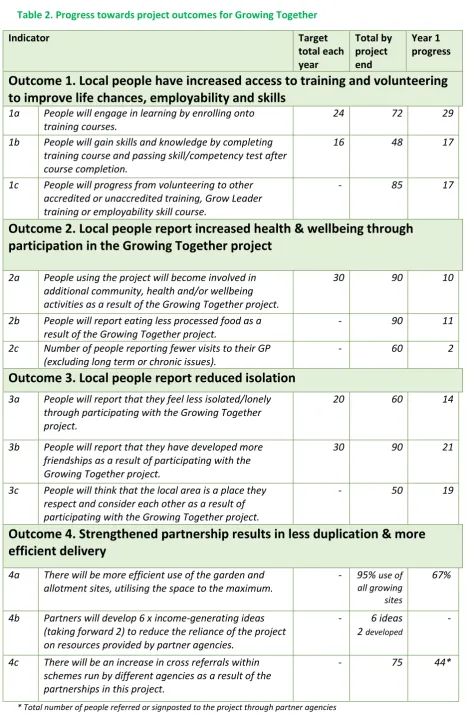
Growing Together is working towards a set of outcomes that are expressed through indicators
and end-of-project targets. The table below shows that for nearly all measures the project is
on course to meet or exceed its funding commitments.
Progress towards project outcomes for Growing Together
Indicator Target
total each year Total by project end Year 1 progress
Outcome 1. Local people have increased access to training and volunteering to improve life chances, employability and skills
1a People will engage in learning by enrolling onto training courses.
24 72 29
1b People will gain skills and knowledge by completing training course and passing skill/competency test after course completion.
16 48 17
1c People will progress from volunteering to other accredited or unaccredited training, Grow Leader training or employability skill course.
- 85 17
Outcome 2. Local people report increased health & wellbeing through participation in the Growing Together project
2a People using the project will become involved in additional community, health and/or wellbeing activities as a result of the Growing Together project.
30 90 10
2b People will report eating less processed food as a result of the Growing Together project.
- 90 11
2c Number of people reporting fewer visits to their GP (excluding long term or chronic issues).
- 60 2
Outcome 3. Local people report reduced isolation
3a People will report that they feel less isolated/lonely through participating with the project.
20 60 14
3b People will report that they have developed more friendships as a result of participating with the Growing Together project.
30 90 21
3c People will think that the local area is a place they respect and consider each other as a result of participating with the Growing Together project.
- 50 19
Outcome 4. Strengthened partnership results in less duplication & more efficient delivery
4a There will be more efficient use of the garden and allotment sites, utilising the space to the maximum.
- 95% use of all growing sites
67%
4b Partners will develop 6 x income-generating ideas (taking forward 2) to reduce the reliance of the project on resources provided by partner agencies.
- 6 ideas 2 developed
-
4c There will be an increase in cross referrals within schemes run by different agencies as a result of the partnerships in this project.
1. Introduction
Growing Together is an innovative project that aims to promote access to productive green spaces on the Bournville Estate in Weston-Super-Mare. The project has a focus on delivering horticultural training and education, food growing, healthy eating, volunteering opportunities and nature-related activities across three sites on the estate.
This is the first evaluation report on Growing Together. Project evaluation led by an external research agency is an important part of good practice when developing new community projects. At its best, evaluation determines impacts, explains processes and informs action. At a time of squeezed public resources, project evaluation can help funders, strategists, service developers, and not least
communities make judgements about progress and investments. In this report we aim to set the scene for the first year of the project, and to review activities and work towards goals. The evaluation will run until the end of the current project funding period in 2018 and it is useful to bear in mind that at this stage there is still substantial further evidence to be collected before a full picture of the project can be presented.
The report starts with an overview of the project, the setting and research context. After a short summary of the evaluation methods, we then provide a review of the delivery of project activities, the emerging impact of participants and evidence of progress towards the funding commitments. The report finishes with key themes - in the form of successes and challenges – and recommendations for the next stages of the project.
2. Growing Together: an overview
Growing Together runs from 2015 to 2018 and is led by Alliance Homes, a community-based social enterprise providing 6500 properties and housing-related support to over 12,000 people in North Somerset. The Big Lottery’s Reaching Communities Programme is the main source of funding for the project (£180k), with additional funding from Alliance Homes and formal partners (£77k). Growing Together started with three formal partners: The For All Healthy Living Company (FAHLC), Avon Wildlife Trust (AWT) and Somerset Skills and Learning. The project works with several other community and voluntary sector, local authority and NHS agencies.
The project is delivered by two members of staff, with additional support from the Alliance Homes Stronger Communities team. Volunteers from the local community bring additional resources to the project and have an important role in developing the initiative through the Growing Together steering group and other forms of consultation. Alliance Homes provide line management for the project staff, staff development support, project delivery advice, office space, and financial and risk management for the project.
Growing Together is delivered through three sites on the Bournville Estate, each of which has been a focus for project work in the past. In preparation Alliance Homes undertook an evaluation of these projects and engaged in extensive consultation with users of the sites, local residents and
Photo: Bournville community consultation 2014 with Alliance Homes and other local partner agencies
3. Bournville, Weston-super-Mare
South Ward in Weston-super-Mare, which includes the areas of Bournville, Coronation, Oldmixon, and the Potteries has a population of approximately 10,400 peoplei. South Ward includes some of the most deprived areas in North Somerset, and indeed nationally: South Ward encompasses areas which are classed within the most deprived 1% in England.
A recent Health Needs and Assets Assessment undertaken by North Somerset Council describes some of the key features of the South Ward area. When viewed through the lens of the deficit model there are many needs within the area including child poverty and poor child health, low aspirations and/or expectations in young people, high prevalence of alcohol and substance misuse, poor mental and dietary health, high unemployment, high smoking prevalence, poor cardiac health and high premature mortality. Unfortunately, the levels of deprivation have risen each time a new Index of Multiple Deprivation has been published in 2004, 2007,2010 and 2015. This has resulted in the North Somerset area now exhibiting the third biggest gap between the most and least deprived communities in one local authority area in England.
Photo: One of the 3 project sites at the start of Growing Together in early 2015
4. Alliance Homes
Alliance Homes is a community based social enterprise providing 6500 properties and housing-related support to over 12,000 people in North Somerset. The group owns and manages 65% of the,
approximately, 2,100 homes in Bournville. Alliance Homes also support and deliver employment, training and volunteering opportunities and a range of other support services for the most vulnerable and disadvantaged in communities. It employs over 300 people and has been awarded the Investors In People Gold Award Standard for its work in staff development and social responsibility.
The commitments of Alliance Homes are set out in its “Stronger Communities pledge”, which are:
“To respect the diversity of the people and communities we work with;
To empower our customers to define and shape services and the communities where they want to live;
To provide care and support services that promote independent living;
To deliver housing management services that respond to customer needs;
To build capacity within our communities through skills and education programmes and employment creation initiatives.”
Alliance Homes has a dedicated team based on the Bournville providing intensive housing
management and developing community initiatives just to this estate (Alliance Homes, 2015b). It has been established to help solve the social and economic challenges found on the estate which are unique in North Somerset. The team share office space with Westonworks, a one-stop skills and job shop and the local Credit Union. These additional services offer local people help with housing, employment, training and finances, all under one roof, and facilitates closer working between these organisations.
As part of its commitment to make the community a better place to live, Alliance Homes works in partnership with other agencies to help local people deal with the challenges they face and create opportunities. This includes working on projects providing financial education to young tenants, a youth arts project, providing apprenticeship posts for young people and an educational programme providing advice on energy conservation for residents. The Alliance Homes Group sets out further details on its vision in the Corporate Plan 2015 available at www.alliancehomes.org.uk.
Growing Together Community Allotment
Bottom left: plastic bottle greenhouse.
The Chocolate Garden
Coleridge Road Allotments
Bottom left: train in background. Bottom right: forest school activities
5. Community Growing Projects: the research context
The terms ‘community garden’ and ‘community growing’ have been applied to a very wide range of place-based horticultural initiatives that include some form of community engagement. Typically the growing activities are directed towards social and environmental improvements, and are not solely commercial or private ventures. The communities in question range from very broadly defined groups, such as residents of a locality, to groups with more specific characteristics, such as people seeking training and skills opportunities. Community garden projects operate in many types of settings including housing estates, schools, children’s centres, and sheltered accommodation for older people. Locations often reflect their lead delivery agencies, although many smaller scale schemes are often run through highly informal voluntary groups. Whilst in the UK allotments usually refer to schemes offering small rental plots to private individuals, many allotment sites host community garden projects or informally mirror them through self-organised activities. Taken together, the UK has a very active community gardening scene that rides the current of cultural fashions and is represented by a number of both popular and niche voluntary sector organisations.
One area where there is quite a lot of research concerns the impacts of therapeutic horticulture. Clatworthy et al 2013 review of ten papers published since 2003 found that all studies reported the positive effects of gardening as a mental health intervention for service users, including reduced symptoms of depression and anxiety. Participants described a range of benefits across emotional, social, vocational, physical and spiritual domains. This research has been linked to the increase in the application of gardening as a mental health intervention. A survey of projects registered with Thrive, a charity that promotes and supports the use of therapeutic horticulture, revealed that the number of UK horticultural projects for vulnerable people (including those experiencing mental health difficulties) had increased dramatically from 45 in the mid-1980s to over 900 by 2005 (Sempik et al. ,
2005).Therapeutic horticulture has been theorised to work through the innate affiliation that humans seek to have with the natural environment (the biophilia hypothesis) and, more prosaically, through the opportunities that gardening provides for people to interact and support one another.
The weight of research on horticultural therapy to some extent obscures research on the other potential benefits of community gardening, especially in cases where the work is only partly directed towards mental health goals. In qualitative studies participants report that gardening-based
interventions can offer a range of benefits, including improved social functioning, improved physical health and opportunities for vocational development. The role of horticultural projects in local area regeneration and economic is under-researched and tends to be dominated by US literature. Similarly the role of local, neighbourhood growing schemes in areas of social housing has not been extensively reported, although they have the prospect of contributing towards both the core housing and wider public mission of social housing agencies.
Despite their widespread appeal, garden-based projects are often low key initiatives that do not have an established place in the local landscape of health, welfare and neighbourhood services.
Commentators such as Hine et al (2008) have called for “green interventions to have a more formal place in the health and social care referral system”, and one opportunity to inform such action is through evaluative research on innovative schemes. The present study therefore aims to reflect this deficit in our understanding through the evaluation of the Growing Together project.
6. Principles Informing Community Development
Community-centred approaches often seek to mobilise the assets within communities, promote equity and increase people’s control over their health and lives. As South’s recent review (2015) points out, there is a diverse range of practical, evidence-based approaches that can be used by service providers, local leaders and commissioners to work with communities. These can grouped into approaches that are concerned with strengthening communities; volunteer and peer roles;
collaborations and partnerships; and access to community resources. Many examples of good practice have been well documented, however the skills and commitments involved in community-centred work are often poorly understood in mainstream service and strategic planning.
Leading commentators such as Laverack and Labonte (2006) have pointed out that authentic
community development work is not a matter of using communities as a means for delivering expert-led objectives. Instead, community development is rooted in principles that are radically different from those of the top-down intervention. Box 1 summarises some important features that
Box 1: Key Principles Informing Community Development Projects
1.
Work ‘with’ people - not ‘on’ people
2.
Understand the priorities of the community
3.
Listen and take time to find out what’s already working
4.
Support local people to take leadership
5.
Ask why? Challenge things as they are
6.
Make the most of collaborations and partnerships
7.
Build and maintain human relationships and networks
8.
Respect and involve those on the outside
9.
Create equitable relationships with external agencies
Source: Adapted from Laverack (2006)
7. Evaluation Methods
UWE’s evaluation of the Growing Together involves both quantitative and qualitative research intended to present a rich picture of the development and impact of the project. The evaluation runs across the course of the project and will lead to a final report in 2018. This report represents the initial stage of the evaluation in the first year of the project’s delivery. The research work has focused on developing a framework to collect information about the experiences of participants, staff and partners on a routine basis. This means that much of the data to support the evaluation is gathered with the assistance of the project team, an approach that makes good use of resources.
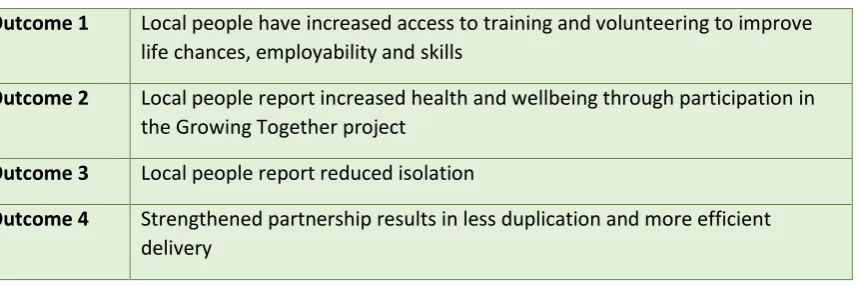
Year 1 of the project has included developing with the team a logic model, a summary key links between resources, activities and intended outcomes. This helped define the contents of standard registration and evaluation questionnaires for use with participants and staff. We have also collaborated with the project team to develop a project database which is used for inputting
[image:12.595.71.501.635.778.2]participant records, project events and staff notes. These records form the evidence for reporting on the main project outcome indicators and other headline achievements. The original project plan summarised these in terms of three outcome areas presented in Table 1. These are referred to later in this report.
Table 1: Growing Together Project Outcomes
Outcome 1 Local people have increased access to training and volunteering to improve life chances, employability and skills
Outcome 2 Local people report increased health and wellbeing through participation in the Growing Together project
Outcome 3 Local people report reduced isolation
In addition to supporting the collection and analysis of the data for the outcome indicators, the evaluation team undertook semi-structured interviews with project staff, participants and staff from partner agencies to help understand progress on setting up and delivering the project, and areas of success and challenge in the first year of the project. In keeping with research ethics principles, all project records analysed by UWE have been anonymised by the project team to protect the identity of participants. Similarly interview data is managed confidentially and reported anonymously or, in cases where it is important to name a specific agency, without reference to staff names.
8. Growing Together in the First Year
Overview
A key theme to come from interviews with participants and staff from the project and partner agencies is that Growing Together has made a highly active start in year 1 of the initiative. This is not simply reflected in the successful recruitment of new staff, the re-development of sites and the launch or revival of project activities, but it is also evident from work that extends beyond the original blue-print for the scheme. Much of this work is due to the shared vision of staff and their skills in adapting to new circumstances that have provided both fresh opportunities and unforeseen challenges. Local people have been at the centre of the project, which has meant that the team have made many adjustments to planned activities to meet the interests of participants. Nevertheless skills linked to growing and, in the words of a team member, ‘raising the horticultural brilliance of the area’ are common threads across the activities.
Core Project Activities
The first year of the project has involved piloting a wide range of learning and engagement activities, to get a better understanding of how to connect and build upon the interests of the community. This work has not, however, come from nowhere. Alliance Homes and partner agencies have a track record of project work on the three growing sites. The Growing Together community allotment, Coleridge Road green space and Chocolate Garden have been considerably refreshed in 2015 both in terms of infrastructure and specific initiatives. This work has led to a steady number of new people attending one-off events, short courses and weekly group activities. Leading examples of core work in 2015 include:
A weekly Friday Session for 50's+ in the Chocolate Garden. A focus on social inclusion for over 50's. Developing a colourful community garden, with ornamental plants and flowers
A six week Tailored Training Course delivered for a group of students with additional needs from Broadoak College. The course helped the students meet their accredited ASDAN personal development qualification. The activities included horticulture, wildlife and forest skills.
Four volunteers funded to take part in Advanced Community Allotment training at Trafford Hall.
Pond Building Training Course at Coleridge Road allotments, in partnership with Avon Wildlife Trust and The Conservation Volunteers
Six Engagement Sessions run for a group of vulnerable single mothers at Margaret House supported accommodation.
and made the link between growing and eating. Volunteers said that they enjoyed the
courses, particularly as it meant meeting people and doing new things. As a structured course, it was relatively straightforward for the two agencies to ask participants to take part on a formal before-and-after evaluation.
Case Study. Volunteer views about the GT Community Allotment
In autumn 2015 a member of the evaluation team spent one afternoon with the group and interviewed four volunteers.The GT Community Allotment is one of the most established community gardening initiatives on the Bournville estate. The group was initially established to work with vulnerable adults and those with mental health issues with the support of the For All Healthy Living Centre’s volunteer coordinator. Subsequent input from Alliance Homes and Avon Wildlife Trust opened the group out to all interested adults. A group meets Monday afternoons to complete gardening activities and maintain the plot, with sessions now supported by the Growing Together team. The group has a core membership of about 8 volunteers, most of whom have been involved for 2-3 years. In 2015 there have been at least 4 new volunteers who have attended more than one session. Participants have also been involved in training and other events, including helping organise the summer celebration day. Volunteers participate in the project steering group to advise on what activities they would like to engage in, and how the programme could evolve.
The vision for this group is that experienced volunteers are supported to take more
responsibility for the project, and develop skills to lead or train less experienced volunteers. So far this has happened through, for example, one volunteer leading a workshop on making Japanese hanging baskets. Otherwise more experienced volunteers support others
informally through advice on gardening.
The regular volunteers are a mix of residents of the Bournville and neighbouring estates. Several came to the project through the Healthy Living Centre, with others learning about it through friends, or being attracted to training sessions and workshops. Three new
volunteers became involved through recommendations at the cooking training course. Attendance has varied through the year, and although new volunteers have participated it has been difficult to attract many more committed people to attend on a regular basis.
A number of the initial volunteer group were already fairly experienced in gardening and had their own allotment plot or home gardens when they became involved. They were attracted to the communal plot to learn more about gardening and work with a group, as well as making something for the community. One noted that volunteering there offers a chance to learn more and to maintain her skills. Another said the additional appeal of “the social thing” alongside learning more about gardening.
One volunteer who joined the project took on an individual allotment plot this year, and has been assisted by the Growing Together team to establish food growing on it. Another new volunteer hopes to do similar. In both cases these volunteers are committed to volunteering with the group as well in order to keep learning and gain the social aspect. Regular
volunteers noted many benefits of being involved in the allotment group, including:
having fun, socialising and meeting people,
doing something to benefit the community,
taking produce home.
Less experienced gardeners said they have learnt how to grow things and will take this knowledge and apply it at home. One volunteer said that participation gave her “a sense of feeling good and feeling healthy” and “a feeling of belonging to the community which gives a sense of wellbeing”. Others described it as a way to relax, whilst one said “I like it, it gets me out the house and stops me getting bored. It’s a way to be with people and do stuff”. One of the longest standing volunteers liked that she could offer something for people on the estate, especially children who do not know about plants or flowers, and those who are likely to live their whole life there. Some have reported that participation has increased their confidence levels. One new volunteer said that she felt instantly welcomed and part of the group, and that the staff do a great job in creating an atmosphere in which “everyone’s welcome”.
Volunteers were asked to identify any changes in their lifestyle as a result of volunteering at the project over the past year. For long-term volunteers there were few changes of note, likewise for those who were already active gardeners at home. For these volunteers the main change was in getting to know some new people who they would not meet otherwise. The vegetable harvest is shared between volunteers so they receive healthy food to eat at home. One volunteer suggested his and his family’s diet had improved as a result of him taking produce home. A majority said they already ate healthily so there was not a significant change in diet. The most significant changes were those directly related to gardening which were learning more about how to grow things and applying this knowledge at home; being encouraged to volunteer with other garden related projects, and being assisted with setting up a new growing space for themselves.
Volunteers suggested that the project was benefiting the wider community in and around the Bournville. One said that it meant a chance for children on the estate to see food growing and know about plants and flowers. Another felt that events on the estate bring people together and are fun, and show people that the area is being worked on. Publicity about these events and the project were said to be good for the estate by countering outsiders’ negative views of the estate. Although volunteers agreed that local people do benefit from the project, they think this is limited by the fact that many people do not get involved. Current volunteers said that the allotment is reasonably well known by local people through posters and the Healthy Living Centre, and that it is now better known than it was in the past. However, they felt it is difficult to get more volunteers and that although many people are aware of the opportunities they do not come and volunteer which means they miss out on the benefits. Suggested reasons for low participation were that some people find it difficult to commit, or to integrate with a group.
Volunteers noted several achievements and highlights from this year such as making a cob oven through a series of workshops and erecting a polytunnel. They also emphasised that having dedicated staff and their regular support has made the project more structured and organised. One noted that without their input events like the end of year celebration would not have been possible, whilst others praised their approach.
All the volunteers said they hope to remain involved in the project over the coming year, and expect it will continue to benefit them. The main development people want to see is for more local people to be involved, benefiting from the project and “feeling part of it”.
Volunteers thought this was likely to happen through the plans the project has, and that having a cob oven will help as people are attracted by events focused on food and eating together. Other suggestions to increase participation were for more workshops on skills people can use at home, for school groups to visit, and to put signs on the allotment site gates to promote what is happening and say how to get involved.
Volunteers are confident that the project will keep going and succeed in benefiting more people, especially with continued staff support which means things are more organised and more groups are brought in.
Special Occasions and One-off Events
In addition to the core group activities, in 2015 the Growing Together team supported or led 9 one-off activities. These involved 165 adults and 162 children or young people. These one-off activities involved collaboration with 19 different local agencies. Growing Together has received local press attention and promotes its work through running "I love The Bournville" Facebook site and Alliance Homes publicity communications. Through the direct contacts, media and social media work the team recorded 402 page likes and a total reach for all posts from June 2015 to January 2016 was 10,005. Some examples of one-off community events delivered in the first year include:
up St Andrews Parade'. It was the project’s most popular post on Facebook, reaching +3500 people, with 99 likes and 13 shares. Feedback from the knitters was overall positive and individuals completed a feedback form.
Photos: Yarn Bombing St Andrew’s Parade in the centre of Bournville
One Man and his Cow: Theatre Production at Coleridge Road Allotments. Event organised by the Growing Together to engage and create new interest of local residents in one of the three Growing Together project sites. Low attendance at the event has helped the team get a better understanding of the types of initiatives that are less appealing to newcomers.
Allotment Polytunnel Celebration. Travis Perkins, the building supplies contractor for Alliance Homes, donated a commercial polytunnel, timber and topsoil for the community allotment and a neighbouring allotment project, through the Carlton Centre, pitched up to help erect the polytunnel. The project lead felt that “It was one of the best days of the whole project so far and the resulting facility will extend the growing season on the allotment site and enable more activities to be planned and delivered. An unexpected and welcome outcome of the
development of this partnership has been volunteers taking up the opportunity of an accredited level 1 horticultural course being offered at the neighbouring project.”
Photo: Putting up the new polytunnel at the Growing Together community allotment
One feature of many of the project activities, both core and one-off events, has been their inventiveness and creativity. As a lead from one partner agency commented
Photo: Growing Together volunteers and staff take part in a community clear up
9. Core Project Activities: profile of participants
Core project activities include the weekly groups and structured training courses delivered throughout the year. Sixty five people registered with one of these activities in 2015, of whom nearly all are residents of the Bournville Estate and over half are tenants of Alliance Homes. The average age of the participants is 38, with a broad spread from 16 to 87 years old alongside a small number of young people aged 9 to 15 years. About 55% of participants are female.
The majority of people learnt about the project through a local agency: FAHLC was the most frequent signposting agency, followed by Chapter 1 (a charity specialising in providing accommodation for vulnerable people), the Public Health team, Broadoak College and other teams at Alliance Homes. In total 44 people were signposted or referred to the project through partner agencies. Of those
attending activities 7 individuals had already engaged with the Monday Group’s allotment site before 2015.
In collaboration with the UWE evaluation team, Growing Together have developed a set of standard questions that cover motivations, goals, training, health, wellbeing and experiences of the project. Where possible these represent validated measures and are intended to help the project show its progress with respect to the BLF outcomes. The questionnaire uses a combination of self-reported change measures (for example, perceptions of change in diet at course completion) alongside standard repeated measures (for example, daily fruit and vegetable consumption asked at both baseline and follow up points). Participants and the project team are also encouraged to make written notes of changes, achievements and contributions.
Over the course of the project the aim is to recruit at least 30 adult participants to complete baseline and follow-up questionnaires. The sample is intended to reflect the diversity of adults participating in core project activities such as the weekly groups and training courses.
In the first year of the project, the Growing Together team collected information from 15 participants on their experiences and progress. Nine of these individuals had taken part in cooking courses which, due to their structured format gave an opportunity to collect beginning and end of course
Photo: Volunteers learn about fruit tree planting with the National Trust at Tyntesfield
10. Initial Findings from Participants in Core Project
Activities
Overall health
Participants are asked to rate their health from poor to excellent on a scale of 1 to 10 in a typical week. Although not statistically significant, there was a positive trend in self-reported overall health with an increased average score from 6.3 to 7.2 (n=15).
GP Visits
There was no significant change in number of visits made to GP services in the past 6 months (Baseline: mean=3.7; follow up: mean = 4.1). Two out of 14 participants reported fewer visits to GP services after taking part in the project.
Changes in diet
The trend for fruit and vegetable consumption is positive, although not statistically significant. The average number of portions that participants reported eating at the beginning of the project was 3.34. At follow-up the average increased to 3.84 portions (n=15). Ten out of 15 participants reported an increase in fruit and vegetable consumption. The baseline figures are similar to reported fruit and vegetable intake by participants in other community-based projects on the Bournville Estate and in the south west of England.
As an average, there was a rise in the number of occasions that participants reported cooking a meals from basic ingredients in the last week, from 3.5 to 4.2 times. Seven out of 15 respondents reported cooking more meals every week from basic ingredients.
In total, 11 out of 15 reported at least one dietary improvement: either in the form of an increase in fruit and vegetable consumption, reduced fast food/ready meal consumption, or an increase in cooking from basic ingredients.
Whilst the number of respondents is too small for the Year 1 evaluation to support a statistical analysis, these changes are reflected in the improved confidence that participants in the cooking course reported with regard to:
- Cooking from fresh ingredients - Following a simple recipe
- Reading nutritional information on food and drink labels - Preparing and cooking healthy meals
Mental wellbeing, social belonging, isolation and friendships
Participants completed the Short Warwick Edinburgh Mental Well-being Scale (Short WEMWBS), a widely used set of questions concerned with feelings of being optimistic, useful, relaxed and good about oneself, as well as decision making, personal closeness, and dealing with problems. SWEMWBS puts these areas of experience together to develop a scale with a maximum score of 35. At baseline the mean score for 15 respondents was 24.1, which is below the adult population average score in England and in the ‘low mental wellbeing’ category (NWPHO, 2009). There was a small positive change at follow up by 1.8 points to 25.9 (SD=4.87; p=0.180).
Experiences of social belonging, isolation and friendship were collected using four questions adapted from the BLF Phase 1 Wellbeing programme (nef, 2008) covering perceptions of relationships, the local community and socialising with friends and relatives. There was little change in the overall score for these measures (baseline mean = 14.1; follow up mean=14.9 out of a possible score of 20, n=15). However the combined information from self and staff reported changes, and the social belonging measures shows that between 14 to 21 individuals gained friendships, felt reduced isolation or engaged more fully with their local area.
Participant as active ‘contributors’, ‘volunteers’ and ‘learners’
The project staff and participants have started to use course questionnaires, logs and feedback sheets to record the contributions that participants make to the project. The following are examples of the ‘assets, skills, capabilities and resources’ that participants contribute (notes edited for clarity and anonymity):
A highly committed individual. Good work ethic and physical capabilities. Punctual. Showing positive signs of leadership and organisation. Supports other volunteers.
Very passionate about the subject. Excellent knowledge of horticulture/nature. Very
committed and organised. Using GT partnership with local primary schools, [volunteer] will be paid to deliver a programme (to be joint funded by GT and local primary partnership)
An asset to the community and volunteers regularly for another gardening group.
Photo: Participants in a Cooking Together course, a partnership project between Growing Together and North Somerset’s Public Health
11. Progress on Project Commitments
Table 2. Progress towards project outcomes for Growing Together
Indicator Target
total each year Total by project end Year 1 progress
Outcome 1. Local people have increased access to training and volunteering
to improve life chances, employability and skills
1a People will engage in learning by enrolling onto training courses.
24 72 29
1b People will gain skills and knowledge by completing training course and passing skill/competency test after course completion.
16 48 17
1c People will progress from volunteering to other accredited or unaccredited training, Grow Leader training or employability skill course.
- 85 17
Outcome 2. Local people report increased health & wellbeing through
participation in the Growing Together project
2a People using the project will become involved in additional community, health and/or wellbeing activities as a result of the Growing Together project.
30 90 10
2b People will report eating less processed food as a result of the Growing Together project.
- 90 11
2c Number of people reporting fewer visits to their GP (excluding long term or chronic issues).
- 60 2
Outcome 3. Local people report reduced isolation
3a People will report that they feel less isolated/lonelythrough participating with the Growing Together project.
20 60 14
3b People will report that they have developed more friendships as a result of participating with the Growing Together project.
30 90 21
3c People will think that the local area is a place they respect and consider each other as a result of participating with the Growing Together project.
- 50 19
Outcome 4. Strengthened partnership results in less duplication & more
efficient delivery
4a There will be more efficient use of the garden and allotment sites, utilising the space to the maximum.
- 95% use of all growing sites
67%
4b Partners will develop 6 x income-generating ideas (taking forward 2) to reduce the reliance of the project on resources provided by partner agencies.
- 6 ideas 2 developed
-
4c There will be an increase in cross referrals within schemes run by different agencies as a result of the partnerships in this project.
- 75 44*
Photo: Growing Together volunteers and staff with the new cob oven
12. Discussion: project achievements, challenges and
recommendations
Project achievements
Over the course of the first year the project has had a number of successes. Several of these do not fit neatly into the formal project outcomes because they are unanticipated or additional to those
planned at the outset. Much of the positive work exemplifies best practice in community
development. The following lists some achievements that were identified by interviewees and have, in most instances, supporting documentation in the project records:
Good involvement by volunteers in the development of project activities and overall direction
A growing number of volunteers who make active contributions to the project.
Longer term volunteers who have made progress in skills for employment, community service and personal confidence.
A high standard of horticultural training and support.
More locally grown fruit and vegetable produce for volunteers and local residents
A significant investment and upgrade to the facilities available at the three project sites
A good reputation with partner agencies and neighbouring allotment holders for well managed project activities
A growing public profile through local celebrations and media channels.
Good networking with agencies both locally and in the region.
Outreach and novel activities that were over-and-above those in the project plan.
An in-house monitoring and evaluation system that successfully captures evidence of impact.
Photo: Volunteer at the Growing Together Community allotment
Challenges and Recommendations
A strength of the project has been the openness of team to feedback and learning through reflection. Some challenges in the first year
The Pace of ‘recruitment’ and ‘throughput’
As is the case for many community development projects, the pace of recruiting of new participants is difficult to predict. The project team are, appropriately, working through local networks and partner agency recommendations as opposed to a top-down referral system. This bodes well for creating sustainable and good quality engagement, but may not produce the volume of participation with respect to some areas such as horticultural skills development and course completion.
Local leadership
roles, some volunteers may want to take part in order to escape from other responsibilities. The concept of training volunteers to become Grow Leaders has been made more difficult due to the lack of appropriate courses available from partner agencies. Whilst it may not be realistic to develop the level of leadership originally aimed for one role for the evaluation will be to capture the significant added value that even small changes can bring to individuals, the project and the local community. Where evidence is available, subsequent evaluation using Social Return on Investment analysis can convey the scale of the value of these changes.
Demonstrating impact on health (and social) care services
Helping to reduce the use of health services by project participants is clearly an important matter for the project. The key indicator is based upon self-reported use of GP services. Partner agencies feel that this is a challenging measure to address – and this is reflected in wider research on the role of community-based healthy living interventions in reducing health care utilisation. At this stage in the project we would recommend setting a lower project-end target for individuals reporting reduced GP-service visits. With participant consent, the project team could make short notes on the circumstances to support economic analysis of the significance of any changes in health service use. Similar
information is important to understand the impact on social care and other public goods and services.
Developing income generating ideas
One scenario for future project revenue, as set out in the initial project plan, is to develop income generating ideas. If such initiatives are to make a meaningful contribution by the point of the current grant, they are likely to require a significant period of research, consultation, development and testing –even if this is only to support individual volunteers to create their own business ideas. This work may therefore need to be given higher priority in the forward plan and clear support from Alliance Homes and local enterprise support agencies. This in turn will have implications for the resources available to deliver on other project commitments.
Developing productive partnerships
The Bournville Estate is the location for a number of projects directed at making social and environmental improvements. The benefit for Growing Together is that this represents a good opportunity to build on existing experience and collaborations. However as a relatively short term project a challenge is to establish a well understood role and to create partnerships that add value all round, as opposed to those that lead to duplication, dissonance or competition for resources. In 2016 early collaboration with umbrella schemes such as the Assets Based Community Development initiative, the Alliance Homes Bournville Strategy and Bournville One could be a route to help define the distinctive role of Growing Together as a longer term initiative.
Capturing the wider impact of Growing Together for the estate and Alliance Homes Tenants
Early indications suggest that the project is already bringing reputational benefits to the Bournville Estate and contributes towards residents overall feeling about their neighbourhood. For Alliance Homes, Growing Together is emerging as a flagship initiative for its community engagement work. A challenge for the project will be to ensure that the evidence of impact connects well with the organisational priorities of the Alliance Homes and the strategic priorities for the area. In 2016 we recommend further mapping of the project outcome indicators against Alliance Homes, local public service and joint partnership targets. Alongside such metrics, narratives of success and learning are essential to build public and partner support.
Planning the next stages of the evaluation
the future funding and commissioning decisions for the project – or an iteration of the project. The timing of this therefore has a bearing on the scale of reporting that is appropriate for an of year 2 evaluation report, given that a final report would be produced not long afterwards.
Strengths and Limitations of the evaluation
One strength of this evaluation is connected to the research process. Often evaluations are conducted towards the final stages of the project. In this instance, the first year evaluation report provides an opportunity to ‘sense check’ the design and priorities of the evaluation and to feed in to the next steps of the project delivery. Further strengths include the use of both qualitative and quantitative data sources to not only present outcome data but to explain whether, how and why the project is addressing its goals.
It should be noted that, due to the limited questionnaire pre-post data it is not possible to present a comprehensive statistical analysis of self-reported changes for participants. This is mainly a reflection of the stage of the evaluation.
Photo: Digging and Jobs at the Growing Together Community Allotment
13. Conclusion
“One of the biggest changes is that the volunteers have become more outward in their perspective” Team member
In Thailand ‘the frog under the coconut shell’ describes a frog that sits under the upside down half shell of a coconut. The frog chooses to stay put and, in time, becomes satisfied in the belief that the entire universe may be found within the dome of the shell. This expression is well applied to many project teams that take little effort to learn from other work along similar lines, the perspective of outsiders or to learn from experience. In the first project year, Growing Together has shown little similarity to the frog in the shell. The team, and volunteers, have gone out of their way to find inspiration from others whilst also building upon local experiences. The evaluation is one part of this process because it seeks to help document, examine and reflect back on the project and in so doing provide another point of view to learn from. To pursue the metaphor it also helps take the world to the frog by providing a chance to showcase the work of the project to others. Such wider connections, alongside depth of local engagement, will have a valuable role in taking forward the next stages of the Growing Together project.
14. References
Alliance Homes Group (2015a) Corporate Plan 2015. www.alliancehomes.org.uk Alliance Homes Group (2015b) Bournville Strategy. Draft for consultation 2015/15
Clatworthy, J., Hinds, J. and M. Camic, P., 2013. Gardening as a mental health intervention: a review. Mental Health Review Journal, 18(4), pp.214-225.
Hine, R., Peacock, J., & Pretty, J. (2008). Care farming in the UK: contexts, benefits and links with therapeutic communities. therapeutic communities, 29(3), 245-260.
Laverack G (2006) Using a ‘domains’ approach to build community empowerment. Community Development Journal Vol 41 No 1 January 2006 pp. 4–12
Parr, H. (2007) Mental health, nature work, and social inclusion, Environment and Planning D-Society & Space, Vol. 25 No. 3, pp. 537-61.
Sempik, J., Aldridge, J. and Becker, S. (2005) Social and Therapeutic Horticulture: Evidence and Messages from Research, Thrive in association with the Centre for Child and Family Research, Loughborough University, Reading.
South J (2015) A Guide to Community-centred approaches to for health and wellbeing. PHE and NHSE.
The local needs assessment builds on Sarah Weld’s report (2015) on the Healthy Connections project delivered by FAHLC.