THE IMPACT OF JULES MASSENET’S OPERAS IN MILAN, 1893–1903
Matthew Martin Franke
A dissertation submitted to the faculty at the University of North Carolina at Chapel Hill in partial fulfillment of the requirements for the degree of Doctor of Philosophy in the Department of Music.
Chapel Hill
2014
Approved by:
John L. Nádas
Anne MacNeil
Severine Neff
David Garcia
ii © 2014
Matthew Martin Franke
iii
ABSTRACT
Matthew Martin Franke: The Impact of Jules Massenet’s Operas in Milan, 1893–1903 Under the direction of John L. Nádas
The reception of French opera in Italy in the late nineteenth century has received little scholarly
attention. This dissertation attempts to fill at least part of that gap through studying the reception of
three operas by Jules Massenet (1842–1912), the most internationally successful French composer of
the fin de siècle, in Milan, the capital of the Italian music publishing industry. Massenet’s Italian reception demonstrates that opera’s relationship to Italian identity politics in the late nineteenth
century was far more complex than has been previously imagined.
Massenet’s operas, performed in Italian translation, occupied an ambiguous middle ground
in Italian identity politics. Italian critics described Massenet’s operas as purely French, as
contributing to Italian musical culture, and as inherently cosmopolitan works. Critics thus translated
Massenet’s operas into Italian culture, whether as role models for or foils to Italian musical
developments. Massenet also participated directly in Italian musical culture, visiting Milan frequently
to supervise productions of his operas and serving as a judge in an Italian competition for new
operas.
Music historians such as Jay Nicolaisen and Alexandra Wilson have long agreed that Italian
opera suffered an identity crisis in the late nineteenth century. Studies by Michele Girardi, Julian
Budden, and Alan Mallach have suggested that young Italian composers in this period struggled to
find a balance between the rival legacies of Giuseppe Verdi (their Italian heritage) and Richard
iv
Without denying the importance of the aesthetic opposition between Italian and German
music, this dissertation seeks to broaden and complicate this discourse by acknowledging French
opera’s equally influential presence on the Italian musical stage. To meet this goal, I examine the
reception of the three operas which were produced most often in Italy—Manon, Werther, and Thaïs— through the lenses of translation theory, of contemporary international relations, and the
competition between the Ricordi and Sonzogno publishing houses. Massenet’s example shows the
ways in which lines between French and Italian opera could be redrawn as needed to make room for
alternative, cosmopolitan constructions of Italian musical and cultural identity.
v
ACKNOWLEDGEMENTS
This dissertation has been shaped by my interactions with many people. I owe my greatest debt to
my adviser, John Nádas, for his constant support, keen insight, and unfailing faith in this project. I
owe the other members of my committee—Anne MacNeil, Severine Neff, David Garcia, and Bryan
Gilliam—a great deal for their constructive feedback on this work. I have also benefitted greatly
from discussions and correspondence with colleagues such as Linda Fairtile, Andreas Giger, Steven
Huebner, Francesco Izzo, Katharine Ellis, Roger Parker, and Jann Pasler, all of whom have been
generous with their time.
My work has been made possible by teaching assistantships and travel funding from the
Department of Music at the University of North Carolina at Chapel Hill, and a Pre-dissertation
Research Fellowship from the Council for European Studies.
Many librarians and archivists have provided me with invaluable assistance, particularly
Diane Steinhaus, Carrie Monette, Shaw Lentz, and Philip Vandermeer of the Music Library at the
University of North Carolina at Chapel Hill; Maria Pia Ferraris at the Archivio storico Ricordi in
Milan; Daria Cantarelli at the Centro Internazionale di Ricerca sui Periodici Musicali in Parma; and
Roberto Gollo at the Mediateca Santa Teresa in Milan.
Finally, thanks are due to my friends, family, and colleagues who saw this work grow into
being and assisted in its birth. Oren Vinogradov, Alessandra Jones, Samuel Brannon, and Patrice
Franke have read drafts of this material and listened to me talk about it at tremendous length. My
warmest thanks and deepest love go to Marina Franke and Alysa Trivett; their encouragement and
vi
TABLE OF CONTENTS
LIST OF TABLES………...viii
LIST OF CHARTS………...ix
LIST OF FIGURES………..x
LIST OF MUSICAL EXAMPLES………...xi
LIST OF ABBREVIATIONS……….xii
INTRODUCTION………...1
Foreign opera in Italy after 1860………1
Contexts for Massenet’s Italian reception………12
Methodology for analyzing Massenet’s Italian reception………..30
Conclusion...46
CHAPTER ONE: MANON AND THE CRITICS: LOCATING FRENCH OPERA WITHIN ITALIAN CULTURE………...52
Before the premiere……….53
The Italian Manon...68
A French opera in an Italian context………....80
Manon’s legacy in Italy………..91
Conclusion...103
CHAPTER TWO: MASSENET, MAESTRO SOVRANNO: WERTHER AT THE TEATRO LIRICO INTERNAZIONALE, 1894………..106
vii
Werther and translation………...122
The Milanese reception of Werther………...141
Conclusions...158
CHAPTER THREE: THAÏS AND THE DIPLOMATIC RECONCILIATION OF THE “LATIN RACES”………..161
Origins of the opera and the Italian libretto………...163
The initial Italian reception of Thaïs………...184
Sex, politics, and race……….201
Conclusions...230
CONCLUSION………233
APPENDIX 1: PRODUCTIONS OF MASSENET’S OPERAS IN MILAN, 1878–1912……...244
APPENDIX 2: PRODUCTIONS OF MANON IN ITALY, 1893–1925………245
APPENDIX 3: PRODUCTIONS OF WERTHER IN ITALY, 1894–1925………251
APPENDIX 4: PRODUCTIONS OF THAÏS IN ITALY, 1903–1925………255
APPENDIX 5: PRODUCTIONS OF MASSENET’S OTHER OPERAS IN ITALY, 1878–1925………257
viii
LIST OF TABLES
Table 1: Early performances of Massenet’s operas in Europe and the Americas………....….6
Table 2: Italian premieres of Massenet’s operas...10
Table 3: A selective list of operas premiered in Paris by Italian composers, 1791–1867...17
Table 4: Foreign world premieres by Italian composers following the unification of Italy...19
Table 5: Italian premieres of select foreign operas promoted by the Casa Sonzogno, 1875–1912...24
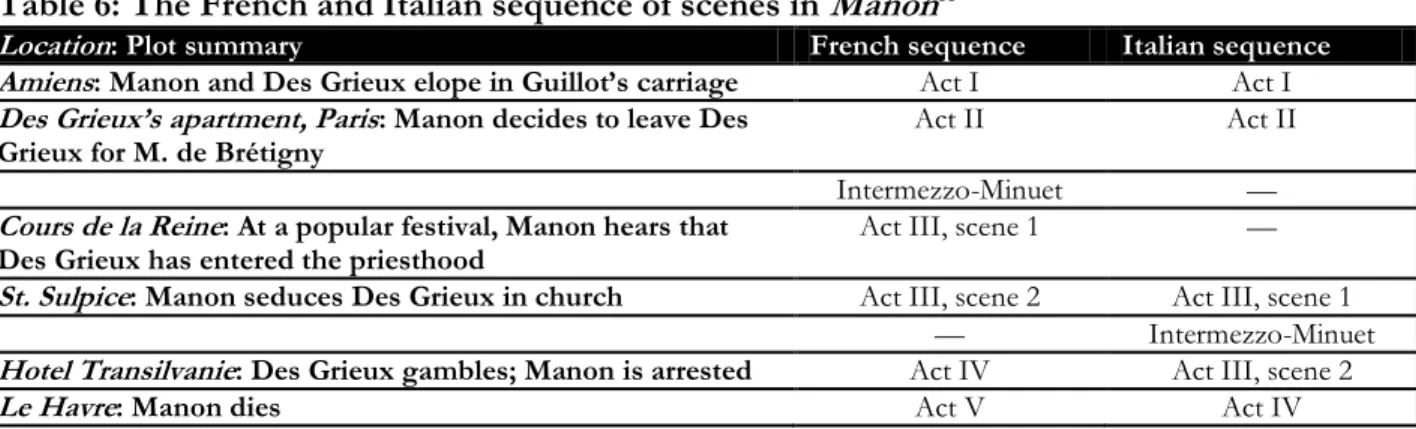
Table 6: The French and Italian sequence of scenes in Manon...70
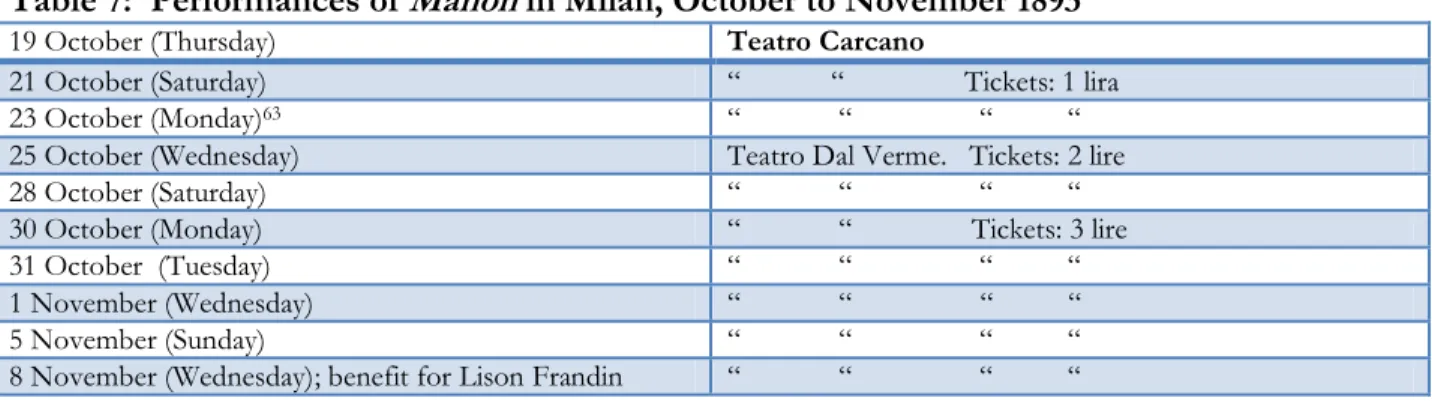
Table 7: Performances of Manon in Milan, October to November 1893...77
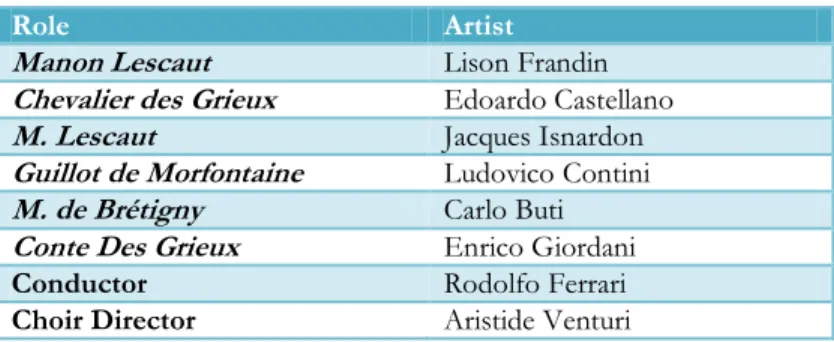
Table 8: The cast of Manon, Teatro Carcano, 19 October 1893...78
Table 9: Productions of Manon in Milan, 1893–1903...94
Table 10: The two Manons in select Italian cities, 1893–1925...101
Table 11: Operas performed at the Teatro alla Scala from 1890–94...109
Table 12: The Fall 1894 season at the Teatro Lirico Internazionale...122
Table 13: Italian operas based on Die Leiden des jungen Werthers...130
Table 14: Werther’s International Progress...131
Table 15: A comparison of the French and Italian texts of Werther’s entrance aria...135
Table 16: Instrumental music in Thaïs, 1894 version...169
Table 17: Comparison of the 1894 and 1898 versions of Thaïs...172
Table 18: Early productions of Thaïs throughout Europe and the Americas...178
Table 19: The Italian Cast of Thaïs...179
Table 20: Massenet, Puccini, and the Italian royals...211
ix
LIST OF CHARTS
Chart 1: Productions of Massenet’s, Wagner’s, and Puccini’s Operas in Milan...9
Chart 2: Average Yearly Productions of Massenet’s Operas throughout Italy...11
x
LIST OF FIGURES
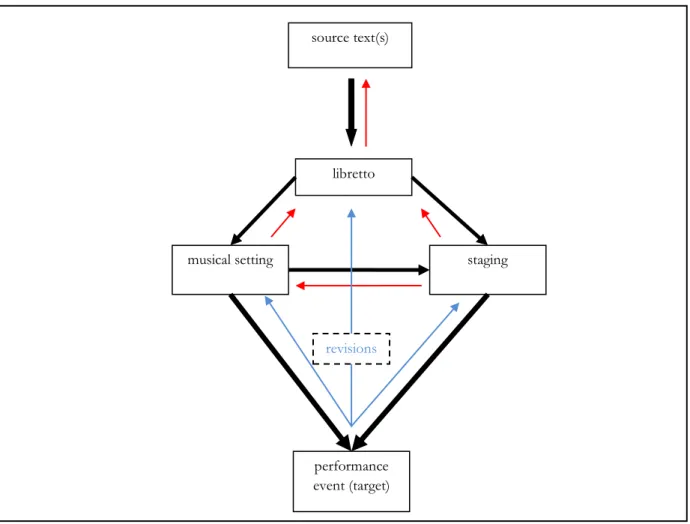
Figure 1: A visual representation of the relationship between source texts
and an operatic performance...40
Figure 2: “Al Carcano” (“At the Carcano”)...76
Figure 3: Brugnoli’s L’origine del teatro...116
Figure 4: A cartoon of a double-chinned Garulli as Werther...133
Figure 5: Lina Cavalieri (center left) in “The Seduction Scene”...203
xi
LIST OF MUSICAL EXAMPLES
Example 1: Werther’s aria “O nature”...137
xii
LIST OF ABBREVIATIONS
Throughout the dissertation, I use the Italian term fine secolo rather than the French fin de siècle. The following abbreviations refer to select periodicals (see bibliography).
CM = Le cronache musicali illustrate, later Le cronache musicali: rivista illustrata or Cronache musicali e drammatiche
CP = Cosmorama, later Cosmorama pittorico
GMM = La gazzetta musicale di Milano
GDT = La gazzetta dei teatri
GTI = Lagazzetta teatrale italiana ILIT = L’illustrazione italiana
IP = L’illustrazione popolare
MA = Ilmondo artistico
RTM = Larivista teatrale melodrammatica
1
INTRODUCTION
I. FOREIGN OPERA IN ITALY AFTER 1860 Background
Opera has long played a central role in discourses of Italian identity. The composer Giuseppe Verdi
(1813–1901), who is generally considered the greatest Italian opera composer, has long been
associated with Italian nationalism, even though his personal involvement in revolutionary activity is
open to debate.1 Similar rhetoric surrounds Giacomo Puccini (1858–1924) “the greatest composer of
Italian opera after Verdi,” whose last opera(Turandot) is considered the “end of the great tradition” of Italian opera.2 Prevailing scholarly narratives suggest a linear stylistic progression leading directly
from Rossini to Puccini.3
Alexandra Wilson’s prize-winning study The Puccini Problem has, however, begun to expose the cracks in this reductive, linear narrative. Puccini’s music baffled, frustrated, and disturbed his
1Philip Gossett argues for the political significance of Verdi’s choruses in “Becoming a Citizen: the Chorus in Risorgimento Opera,” Cambridge Opera Journal 2 no. 1 (1990): 41–61; and “Edizioni distrutte and the Significance of Operatic Choruses during the Risorgimento,” in Victoria Johnson, Jane Fulcher, and Thomas Ertmann (eds.) Opera and Society in Italy and France from Monteverdi to Bourdieu (Cambridge: Cambridge University Press, 2007): 181–242. Roger Parker has argued against this view in: ‘Arpa d’or’: The Verdian Patriotic Chorus in the 1840s (Parma: Istituto nazionale di studi verdiani, 1997); and “Verdi politico: a Wounded Cliché Regroups,” Journal of Modern Italian Studies 17 no. 4 (2012), 427–36. Other notable surveys of the topic include Mary Ann Smart, “Magical Thinking: Reason and Emotion in Some Recent Literature on Verdi and Politics,” Journal of Modern Italian Studies 17 no. 4 (2012), 437–47; John A. Davis, “Opera and Absolutism in Restoration Italy, 1815–1860,” Journal of Interdisciplinary History 34 no. 4 (2006), 569–94; Francesco Izzo, “Comedy between Two Revolutions: Opera Buffa and the Risorgimento, 1831–1848,” The Journal of Musicology 21 no. 1 (2004) 127–74. For coverage of Verdi’s funeral, see Gavin Williams, “Orating Verdi: Death and the Media c. 1901,”
Cambridge Opera Journal 23 no. 3 (2011) 119–43.
2Gabriella Biagi Ravenni and Michele Girardi. “Puccini.” Grove Music Online. Oxford Music Online.Oxford University Press, accessed January 6, 2014,
http://www.oxfordmusiconline.com.libproxy.lib.unc.edu/subscriber/article/grove/music/40280pg5; William Ashbrook and Harold Powers, Puccini’s Turandot: The End of the Great Tradition (Princeton University Press: Princeton, NJ, 1991).
2
early critics; only one of his operas (Manon Lescaut) met with unequivocal critical and commercial success, and several were outright failures (Edgar, Madama Butterfly). Yet even while Verdi was writing his last operas, the Italian press placed Puccini and Pietro Mascagni (1863–1945) in competition for
the role of Verdi’s heir. Thus, Wilson writes, Puccini “was effectively shoehorned…into the role of
national composer before he had a chance to prove himself or consolidate his style.”4 Consequently,
Italian critics attacked Puccini’s operas for a variety of reasons, including their perceived lack of
organic unity, elevation of melodrama to the role of art, overt sentimentality, and openness to
foreign influence. In all these ways, the critics saw Puccini’s operas as inadequate representatives of
contemporary concepts of italianità (Italian identity).
The need for opera to serve a nationalist agenda and the criticism of foreign influence are
striking, as foreign opera played an increasingly important role in Italian culture in the decades
following the unification of Italy (1859–1861). The early deaths of Vincenzo Bellini (1801–1835) and
Gaetano Donizetti (1797–1848) and the lack of new works from Saverio Mercadante (1795–1870)
left Verdi and Errico Petrella (1813–1877) as the only remaining Italian composers of national
stature still producing new operas in the 1850s and 1860s.5 In this context, Italian music publishers,
lacking new works by Italian composers, actively promoted the works of foreign composers in
4Alexandra Wilson, The Puccini Problem: Opera, Nationalism, and Modernity (Cambridge University Press: Cambridge, 2007): 23.
5After Pelagio (1857), Mercadante only premiered one more opera: Virginia (1866), which had been written in 1850. In 1856, he resigned his post as music director at the Teatro San Carlo in Naples; in 1862 he became completely blind. Michael Wittmann, “Mercadante, Saverio,” in Grove Music Online. Oxford Music Online,
http://www.oxfordmusiconline.com/subscriber/article/grove/music/18426 (accessed December 10, 2010). Verdi’s only major rival in this period was Errico Petrella (1813–1877), who scored two major successes in the 1850s (Mario Visconti, 1854; Jone, 1858) and two in the following decade (La contessa d’Amalfi, 1864; I promessi sposi, 1869). “Petrella, Errico,” in Grove Music Online. Oxford Music Online,
3
Italian translation. Between the 1850s and the 1880s, grand operas originally created for Paris, such
as Giacomo Meyerbeer’s Les Huguenots and Fromental Halévy’s La Juive, cemented their place in the Italian repertoire, as did Charles Gounod’s Faust, Ambroise Thomas’s Mignon, and Georges Bizet’s
Carmen. In 1871, the first of Richard Wagner’s operas reached Italy: Lohengrin, which overshadowed all Wagner’s other works in Italy.6
Despite the great amount of French opera to reach Italy, most modern accounts of Italian
opera position Wagner as the chief aesthetic alternative to Verdi in fine secolo musical culture.7 This
perspective, however, exists in a vacuum, having been formed without comparison to the reception
of other foreign composers in Italy during the same period, which has not been studied at a
comparable level of detail.8 While most scholars acknowledge that Wagner’s works did not become
truly popular in Italy until the 1890s (performances of Wagner’s works aside from Lohengrin
6Ute Jung-Kaiser has identified 1217 performances of Wagner’s works in Italy between 1871 to 1895; of these, 861, or 71%, were performances of Lohengrin. Ute Jung [Jung-Kaiser], Die Rezeption der Kunst Richard Wagners in Italien (Regenburg: Bosse, 1974), 185.
7The foundational texts on Wagner’s Italian reception are Ute Jung [Ute Jung-Kaiser], Die Rezeption der Kunst Richard
Wagners in Italien, supplemented by Giancarlo Rostirolla (ed.) Wagner in Italia (Turin: ERI, 1982), featuring essays by a variety of authors, including Agostino Ziino and Friedrich Lippmann.
Numerous studies emphasize Wagner’s influence on Puccini, Mascagni, etc. Alan Mallach, The Autumn of Italian Opera: From Verismo to Modernism, 1890–1915 (Boston: Northeastern University Press, 2007), 76–7, 306–36; Michele Girardi, trans. Laura Basini, Puccini: His International Art (Chicago: University of Chicago Press, 2000), esp. Ch 3, “Manon Lescaut: Wagner and the Eighteenth Century”; Julian Budden, “Wagnerian Tendencies in Italian Opera,” in Nigel Fortune (ed.), Music and Theatre: Essays in Honour of Winton Dean (Cambridge: Cambridge University Press, 1987), 299– 332: esp. 331; Budden, Puccini: His Life and Works (Oxford: Oxford University Press, 2002), 21–22, 28–30, 88–89, 120, 129, 478; Luca Zoppelli (trans. Arthur Groos), “The Twilight of the True Gods: “Cristoforo Colombo”, “I Medici” and the Construction of Italian History,” Cambridge Opera Journal 8 no. 3 (1996), 251–69: 257–60.
8The following is a comprehensive list of modern scholarship on the reception of French opera in Italy. For Bizet’s Italian reception, the chief sources are: Sergio Viglino, La fortuna italiana della “Carmen” di Bizet (1879–1900) (Turin: De Sono Associazione per la Musica, 2003); Hervé Lacombe, “La Réception de l’œuvre dramatique de Bizet en Italie,”
Melanges de l’Ecole Français de Rome 108 no, 1 (1996), 171–201.
4
remained rare in Italy until the early 1900s), no other composer aside from Verdi has received as
much credit as a formative influence on the giovane scuola.9 Although it is almost a truism that other
foreign composers’ works were performed more often than Wagner’s for many years, the
longstanding scholarly interest in Wagner (as opposed to Meyerbeer and Gounod) can leave a false
impression of Wagner’s popularity in terms of actual performances of his work. One example will
have to suffice here: while Ute Jung has identified eight productions of Wagner’s works in all
Milanese theaters from 1871 to 1895, a survey of the same theaters in that period reveals twenty-five
productions of Meyerbeer’s operas and eleven apiece of Gounod’s Faust and Bizet’s Carmen. Whatever Wagner’s aesthetic significance for Italian audiences and musicians (which was certainly
great), the sheer weight of scholarship on his reception and influence in Italy has exaggerated his
importance, while downplaying other composers whose works were performed more often and who
equaled him in their influence on Italian composers.10
9I use giovane scuola (instead of verismo) here as a blanket term for the composers who rose to prominence in the late 1880s and early 1890s: Puccini, Mascagni, Umberto Giordano, Francesco Cilea, Alberto Franchetti, etc. While giovane scuola is a somewhat problematic term (the term is stretched to its limits when one considers the late works of Puccini and Giordano; Puccini, Franchetti, and Mascagni were individual enough that it is odd to consider them a school), it has the benefit of avoiding much of the controversy surrounding verismo, which has served variously (1) as a label for “realist” operas of all kinds (including works by Gustave Charpentier and Leoš Janáček); (2) as a generic label for operas by most Italian composers from the late 1880s through the 1910s; (3) as an aesthetic equivalent to the Italian verismo movement in literature; (4) and as a label for a particular kind of opera centered on love triangles among the South Italian poor. For a variety of modern perspectives on musical verismo, see Arman Schwartz, “Rough Music: Tosca and Verismo
Reconsidered,”19th-Century Music 31 no. 3 (2008), 228–44; Andreas Giger, “Verismo: Origin, Corruption, and
Redemption of an Operatic Term,” Journal of the American Musicological Society 60 no. 2 (2007), 271–316; Adriana Guarneri Corrazol, “Opera and Verismo: Regressive Points of View and the Artifice of Alienation” (trans. R. Parker), Cambridge Opera Journal 5 (1993) 39–53; Matteo Sansone, “Verismo: From Literature to Opera” (Ph.D. diss., University of
Edinburgh, 1987); Stefano Scardovi, L’opera dei bassifondi: il melodrama ‘plebeo’ nel verismo musicale italiano.(Florence: Libreria Musicale Italiana, 1994); Carlo Parmentola, “La giovane scuola,” in Guglielmo Barblan and Alberto Basso (eds.). Storia dell’Opera (Turin: UTET, 1977) Vol. I pt 2, 499–587: 499–503.
5
Massenet in Italy: an overview
By the time that Puccini was being criticized for writing music that revealed overt foreign influence,
foreign opera had established roots in Italy. What, then, was the role of foreign opera within fine secolo Italy? If Italian music critics derided foreign influence in operas written by Italian composers, how then did they react to the performance of actual foreign operas? I propose to address this
question by examining the reception of a foreign composer who staged no less than fourteen operas
in Italy over a period of thirty-five years: Jules Massenet (1842–1912).
Massenet was easily the most successful French composer of his generation; there were
approximately 1,600 performances of his operas in Paris during his lifetime. He enjoyed the singular
honor of having operas play simultaneously at the Opéra and the Opéra Comique in a time when
composers counted themselves lucky to gain a single hearing at either house.11 Massenet was also
successful in Italy; over three hundred productions of his operas were mounted in Italy between
1878 and 1925 (almost forty of them in Milan) (see Appendices). His operas were heard by audiences throughout Europe, North America, and South America (see Table 1), and reached French colonial North Africa and Vietnam.12 Further, Massenet occupied a highly influential role in
French musical culture, as professor of composition at the Paris Conservatoire from 1878 to 1896:
his students included Gustave Charpentier (1860–1956), Alfred Bruneau (1857–1934), Florent
Schmitt (1870–1958), Xavier Leroux (1863–1919), and Reynaldo Hahn (1874–1847).13
11During the years 1893 to 1898 and 1905 to 1914, Massenet’s operas were performed at both the Opéra and the Opéra-Comique. Demar Irvine, Massenet: A Chronicle of His Life and Times (Portland, OR: Amadeus Press, 1994), 316–17.
12Massenet’s operas reached many cities outside Western Europe and the Americas, including Algiers (Hérodiade, 1896;
Cendrillon, 1900), Saigon (La Navarraise, 1900), Constantinople (Manon, 1900), and Tunis (Thaïs, 1902). See Alfred Loewenberg, Annals of Opera, 1597–1940 (3rd ed.) (London: J. Calder, 1978), 1094, 1108, 1174, 1178.
Table 1: Early Performances of Massenet’s Operas in Europe and the Americas, 1877–192814
* = world premiere. All other performances are local premieres.
languages: E = English, F = French, G = German, H = Hungarian, I = Italian, R = Russian
France Monaco Belgium Italy Spain United
Kingdom
Germany Austria-Hungary
Russia United States
Argentina Brazil
Le Roi de Lahore 1877*F 1906F --- 1878I 1880I 1879I 1879G 1879H 1882I 1883F 1879I 1879I
Hérodiade 1883F 1904F 1881*F 1882I 1924I 1904F 1883G 1882H --- 1892F 1907I 1889I
Manon 1884*F 1892F 1884F 1893I 1894I 1885E 1892G 1890G 1885R 1885I 1890F 1920I
Le Cid 1885*F --- --- 1889I --- --- 1887G 1887G --- 1890F --- ---
Esclarmonde 1889*F --- 1889F 1992F --- --- --- --- 1892R 1893F --- ---
Le mage 1891*F --- --- --- --- --- --- --- --- --- --- ---
Werther 1893F 1897F 1893F 1894I 1899I 1894F 1892G 1892*G 1894F 1894F 1897I 1905I
Thaïs 1894*F 1913F 1896F 1903I 1905I 1911F --- --- 1906I 1907F 1908I 1920I
Le portrait de Manon
1894*F --- 1894F 1894I --- --- --- --- --- 1897F --- ---
La Navarraise 1895F 1923F 1894F 1896I --- 1894*F 1895G 1895H 1896I 1895F --- 1898I
Sapho 1897*F --- 1903F 1898I 1919F --- --- --- 1909R 1909F 1899I 1899I
Cendrillon 1899*F --- 1899F 1899I --- 1928E --- --- --- 1902F 1908I ---
Grisélidis 1901*F --- 1902F 1902I --- --- --- --- --- 1910F 1903I ---
Le Jongleur de Notre-Dame
1904F 1902*F 1904F 1905I --- 1906F 1902G 1911G --- 1908F 1911F 1915I
Chérubin 1905F 1905*F 1905F --- --- --- 1908G --- --- --- --- ---
Ariane 1906*F 1907F 1907I --- --- --- --- --- --- 1908I ---
Thérèse 1911F 1907*F 1911F 1911I --- 1919F 1907G --- --- --- --- ---
Bacchus 1909*F --- --- --- --- --- --- --- --- --- --- ---
Don Quichotte 1910F 1910*F 1910F 1928I 1929F 1912F 1911G --- 1910R 1912F --- 1926I
Roma 1912F 1912*F 1913F --- --- --- --- --- --- --- --- ---
14This table does not include operas premiered posthumously, such as Amadis (1913), Panurge (1913), and Cléopâtre (1914). The table is derived chiefly from
Loewenberg, Annals of Opera, withspecial reference to Mario Morini and Piero Ostali Jr., “Cronologia delle opere,” in Morini, Nandi Ostali, and Piero Ostali Jr., Casa Musicale Sonzogno: Cronologie, saggi, testimonianze (Milan: Sonzogno, 1995), Vol. II, 3–867: 586, regarding Esclarmonde’s premiere in Italy in 1992; T. J. Walsh, Monte Carlo Opera 1879–1910 (Dublin: Gill and Macmillan, 1975), 245–82; Walsh, Monte Carlo Opera 1910–1951(Kilkenny: Boethius Press, 1986), 257–398.
7
Despite the frequent productions of Massenet’s operas in Italy, he barely figures in most
accounts of Italian operatic culture in this period: although scholars such as Julian Budden, Michele
Girardi, Mosco Carner, Andrew Davis, and Sylviane Falcinelli have acknowledged his influence on
members of the giovane scuola (particularly Cilea, Puccini, and Giordano), only David Kimbell’s general survey of Italian opera grants Massenet parity with Wagner. To date, there is only one study
on any aspect of Massenet’s reception in Milan: Giuseppe Montemagno’s short essay on the Italian
reception of La Navarraise and Sapho.15 Yet Massenet and his music were clearly popular in Italy, as
my case studies show: his operas usually received great applause from the paying public, regardless
of the critics’ opinions, and the Milanese public treated him like a major celebrity. Further, the
numerous productions of works such as Manon and Werther demonstrate that Massenet’s works were able to enter and remain in the Italian operatic repertory for years after their premieres (see
Appendices 2 and 3). Massenet’s influence on Italian musicians was recognized in his own time by
French and Italian authors alike: the critic Luigi Villanis spoke of “the undeniable influence that
Massenet has exercised and nonetheless continues to exercise on the Franco-Italian giovane scuola,” while Eugène D’Harcourt wrote that contemporary Italian composers “imitate Massenet more than
Verdi.”16
15Girardi, Puccini: His International Art, 15n, 48, 153, 339–40, 361, 396; Mosco Carner, Puccini: A Critical Biography (2nded.) (Old Woking, UK: Duckworth, 1974), 292; Andrew Davis, Il Trittico, Turandot, and Puccini’s Late Style (Bloomington: Indiana University Press, 2010): 28–29; Sylviane Falcinelli, “Massenet et l’Italie: influences croisées,” in Jean-Christophe Branger and Alban Ramaut (eds.), Le Naturalisme sur la scène lyrique (Saint-Étienne: Publications de l’Université de Saint- Étienne , 2004), 95–105; David Kimbell, Italian Opera (Cambridge: Cambridge University Press, 1991) , 576–80; John Rosselli, Music & Musicians in Nineteenth-Century Italy (Portland, OR: Amadeus Press, 1991), 102, 129, 131; Giuseppe Montemagno, “La réception italienne des opéras naturalistes de Massenet et Bruneau: entre critique musicale et art culinaire,” in Branger and Ramaut (eds.), Le Naturalisme sur la scène lyrique, 171–205.
8
Although Massenet’s influence on Italian opera is generally acknowledged, his influence has
never been linked to a detailed study of his Italian reception. This dissertation fills part of that gap
by focusing on Massenet’s reception in Milan, the capital of the Italian music publishing industry,
from 1893 to 1903. As it is impossible to address all the Milanese productions of Massenet’s operas
in detail in this dissertation, I focus here on the Milanese premieres of the three Massenet operas
which were produced most often in Italy: Manon, Werther, and Thaïs. Each of these operas encapsulates a crucial aspect of Massenet’s Italian reception.
What sets Massenet’s reception apart from that of other foreign composers is the extent of
his engagement with Italian operatic culture. Hérodiade (1881), although premiered in French, was written with Italy in mind, and may well have been originally written to an Italian libretto; scholars
generally agree, too, that La Navarraise was Massenet’s reaction to Mascagni’s Cavalleria rusticana.17
Alone among the French composers of his generation, Massenet traveled to Italy numerous times to
supervise the local premieres of his operas (see Table 2).18 Further, Massenet eventually served on
the jury of the fourth opera composition competition sponsored by the Italian publisher Sonzogno
(see Chapter Three). From 1893 to 1912 in Milan, Massenet’s operas saw more productions than
either Wagner’s or Puccini’s (see Chart 1). Massenet and his operas were a major presence in
17Irvine, Massenet, 112–117; James Harding, Massenet (London: Dent, 1970), 69; Julian Budden, The Operas of Verdi (Oxford: Oxford University Press, 1973–81), Vol. III, 275; Montemagno, “La réception italienne des opéras naturalistes de Massenet et Bruneau,” 181–86; Steven Huebner, French Opera at the fin de siècle: Wagnerism, Nationalism, and Style
(Oxford: Oxford University Press, 1999), 39–40, 100.
18The only other French composer of this period to visit Italy as regularly as Massenet was Camille Saint-Saëns, but he only seems to have supervised the premiere of two of his operas in Italy (Henri VIII, December 1895; Phryné, November 1896); the rest of his journeys (1857, 1879, 1891, 1892, 1904, 1905, 1906) were for pleasure or research. See Stephen Studd, Saint-Saëns: A Critical Biography (London: Cygnus Arts, 1995), 34, 125, 144, 161, 187,189, 235, 240, 243; James Harding, Saint-Saëns and his Circle (London: Chapman & Hall, 1965), 176, 181; Jack Winsor Hansen, The Sibyl Sanderson Story: Requiem for a Diva (Pompton Plains, NJ: Amadeus Press, 2005), 274–75; “Foreign Notes,” The Musical Times and Singing Class Circular 37 no. 636 (1 Feb 1896), 101–103.
9
Milanese musical culture in a period which is traditionally viewed as being dominated by the giovane scuola (Puccini, Mascagni, and their contemporaries).
Chart 1: Productions of Massenet’s, Wagner’s, and Puccini’s operas in Milan, 1893–191219
For ease of reference, I have divided Massenet’s Italian reception into several loose periods
(see Table 2). The early period centers on the first operas published in Italy by the Casa Ricordi; the reception and influence of these operas has received far more scholarly attention than any other.20
While Le Cid is the first of Massenet’s operas to be promoted by the Casa Sonzogno, in many ways it represents a transition to the second period proper, the Milanese period, which is the chief focus of this dissertation. From 1893 to 1905, the Casa Sonzogno premiered nine of Massenet’s operas in
19See Appendix 1 and Jung, Die Rezeption der Kunst Richard Wagners in Italien, 91–3; “Rivista milanese. Dal Verme: Puccini, La Boheme e Manon Lescaut,” GMM 52 no. 47 (25 Nov 1897), 678–79; Dieter Schickling, Giacomo Puccini: Catalogue of the Works (Kassel, Germany: Bärenreiter, 2003), 429–436; Gatti, Il teatro alla Scala, 63–67; Valsecchi and Antolini,
“Cronologia sintetica delle rappresentazioni d’opera nei teatri milanesi: 1861–1897,” 43–60.
20Almost all the sources cited in note 14 discuss the reception and influence of Le Roi de Lahore and Hérodiade (both published by Ricordi); only Montemagno addresses Massenet’s reception after 1882. This pattern owes much to the bias in favor of Ricordi in most histories of Italian music, and to Massenet’s own memoirs, in which the Italian premiere of
Le Roi de Lahore receives its own chapter (XII), while Massenet’s numerous later trips to Italy are scattered (non-chronologically) across chapters XX, XXI, and XXIV. Massenet, Mes souvenirs (1848–1912) (Paris: Pierre Lafitte, 1912).
0 1 2 3 4 5
1893 1894 1895 1896 1897 1898 1899 1900 1901 1902 1903 1904 1905 1906 1907 1908 1909 1910 1911 1912
10
Italy, eight of them in Milan. Finally, the late period marks a crucial shift away from Milan as a site for Massenet’s premieres. After Massenet’s death in 1912, the cycle of Italian premieres came to an
abrupt halt. During Massenet’s lifetime, fourteen of his twenty-three operas reached Italy, and from
1878 to 1911, a new Massenet opera appeared, on average, every two-and-a-half years. The 1890s,
however, saw the greatest influx of Massenet’s operas, with six new premieres in that decade alone,
and a rapid spike in the productions of Massenet’s operas throughout Italy (see Chart 2). While Massenet’s greatest popularity occurred in the 1890s, his operas continued to be produced regularly
throughout the 1910s.
Table 2: Italian premieres of Massenet’s operas21
* indicates that Massenet visited Italy for the premiere
Date Period Title City: Theater Italian Publisher
1878: Feb 13* 1882: Feb 23* 1889: Apr 7
Early Le Roi de Lahore Hérodiade Le Cid Turin: Regio Milan: Scala Rome: Costanzi Ricordi Sonzogno 1893: Oct 19
1894: Dec 1* 1894: Dec 15 1896: Feb 6* 1898: Apr 14* 1899: Dec 28* 1902: Nov 25* 1903: Oct 17* 1905: Oct 18
Milanese Manon Werther
Le Portrait de Manon La Navarraise Sapho Cendrillon Grisélidis Thaïs
Le Jongleur de Notre-Dame
Milan: Carcano Milan: Lirico Naples: Mercadante Milan: Scala Milan: Lirico Milan: Lirico Milan: Lirico Milan: Lirico Milan: Lirico Sonzogno
1907: Dec 19* 1911: Nov 28
Late Ariane Thérèse
Turin: Regio Naples: Bellini
Sonzogno
Given the large number of Massenet’s operas to reach Italy, a comprehensive study of their
reception would present an overwhelming amount of work. Consequently, I focus here on the
reception of three Massenet operas (Manon, Werther, and Thaïs) in a single city, Milan. Thus I only refer in passing to the reception of other operas—Le Cid, Sapho, and Grisélidis—that were decent if
21Morini and Piero Ostali Jr., “Cronologia delle opere,” 534–79; Massenet, Souvenirs, 112–119, 130, 242, etc.;
Montemagno, “La réception italienne des opéras naturalistes de Massenet et Bruneau,” 181–86; “Di Teatri in Milano,”
11
not sensational successes (only Le portrait de Manon was a relative failure). La Navarraise and Cendrillon
were anomalies: La Navarraise was withdrawn after a single performance, only to be restaged successfully in later years; Cendrillon achieved an astonishing thirty performances in its first production, but did not remain in the repertoire (see Appendix 5).
Chart 2: Average Yearly Productions of Massenet's Operas throughout Italy, 1878–192522
My criteria for selecting Manon, Werther, and Thaïs as the center of this study are as follows. As the Milanese period saw Massenet’s greatest popularity (in terms of productions of his works) in
Italy and Milan, I have decided to focus on operas that reached Italy in that time (thus excluding Le Roi de Lahore,Hérodiade, Le Cid, Ariane, and Thérèse). From these, I chose works that established themselves in the Italian repertory (at least twenty-five productions in Italy between 1878 and 1925),
that were internationally successful in countries aside from Italy and France, and which (ideally) were
the occasion for one of Massenet’s visits to Milan. Werther and Thaïs fit these parameters exactly.
Manon, as Massenet’s most popular opera worldwide, cannot be ignored; even though the composer
22See Appendices 2–5. 0
12
did not attend the Italian premiere, he did attend a production the following year (see Chapter Two).
Thaïs was, however, the last premiere that Massenet attended in Milan, and thus is a richer site for study than the reception of Le Jongleur de Notre-Dame. Therefore, the three operas studied here represent the highlights of Massenet’s Italian reception.
II. CONTEXTS FOR MASSENET’S ITALIAN RECEPTION
Massenet’s reception in Milan was part of a broader cycle of exchange between French and Italian
musical centers. This cycle of exchange provides historical context both for Massenet’s reception as
a French composer in fine secolo Italy and for the new emphasis on cultural nationalism in Italian music criticism. Here, we will trace Italy’s changing borders throughout the nineteenth century,
explore relationships between French and Italian operatic institutions and cycles of operatic
exchange, and analyze the publishers’ rivalry whose competition fueled the wholesale importation of
French opera to Italy.
Italy in the Nineteenth Century: Geography and Culture
Although nineteenth-century France conformed quite closely to its modern borders, “Italy”
remained an idea rather than a political reality for much of this period. The Italian peninsula was a
scattered collection of independent states for most of the nineteenth century, until eventually
unifying in the second half of the century. For all the rhetoric about how Verdi (and later Puccini)
embodied Italian art and culture, the concept of Italy remained fragile even after Italy was unified.
“Italians” had little sense of national culture before 1860. Historian Enrico Dal Lago has
noted, “…before 1860, Italians were accustomed to think about themselves as Piedmontese,
13
their daily life.”23 After the chaos of the Napoleonic wars had ended, the borders stayed relatively
stable until the wars of independence (the Risorgimento). Much of the north was held, either directly
or as a protectorate, by the Austrian Empire (later renamed Austria-Hungary); the northwest
belonged to the Kingdom of Piedmont-Sardinia, whose capital was at Turin. Much of central Italy
belonged directly to the Pope, while southern Italy and Sicily constituted the Kingdom of the Two
Sicilies, which was ruled from Naples.
Italy only became a unified nation-state between 1859 and 1870. The Second War of
Independence (1859) saw the Austrians expelled from all of northern Italy except for Venetia; the
independent northern states were absorbed by the Kingdom of Piedmont-Sardinia, which soon
styled itself the Kingdom of Italy. This feat was largely accomplished through French military aid
against Austria. Shortly afterward, Giuseppe Garibaldi’s independent revolutionaries overran
southern Italy, overthrowing the Kingdom of the Two Sicilies; the southern provinces soon joined
the Kingdom of Italy. In 1866, Italy joined in the Austro-Prussian War of 1866 on the Prussian side,
gaining Venetia despite a series of defeats. Rome remained an independent city administered by the
papal government and protected by French troops until 1870. The Italian occupation of the city
after the withdrawal of the French garrison gave the Kingdom of Italy a new capital, and opened a
political rift with the Papacy, which refused to recognize the legitimacy of unified Italy until 1929.24
Even after unification, Italy remained a fractured state. Massimo d’Azeglio, a Piedmontese
author and politician who played an important role in the Risorgimento, summed up the new Italian
state’s dilemma: “…unfortunately Italy has been made but without making Italians.”25 Few citizens
23Enrico Dal Lago, “Society, Economy, and Politics in Restoration Italy: Towards a Regional Synthesis,” The Historical
Journal 45 no. 1 (2002), 179–193: 181.
24Lucy Riall, Risorgimento: The History of Italy from Napoleon to Nation-State (New York: Palgrave MacMillan 2009), 31, 35.
14
could speak “proper” Italian: instead most spoke one of the “mutually unintelligible languages
of…Lombardy, the Veneto, Sicily, Naples, and Liguria.”26 There was extensive unrest in the former
Kingdom of the Two Sicilies for years following unification. The division between the northern and
southern provinces grew greater over time, leading many to question (even today) if Italy was indeed
a unified nation.27 Regions with substantial Italian populations, such as the Trentino and Istria,
remained under Austrian control until after World War I, and some fourteen million immigrants left
Italy between 1876 and 1915, creating diasporic communities abroad, especially in the United States
and Argentina.28 The eminent historian of Italian culture R.J.B. Bosworth had these facts in mind
when he asserted: “For those who would investigate Italy’s place in the world since the
Risorgimento, the most basic datum must be that the words ‘Italy’ and ‘Italian’ do not have a single
or consistent meaning.”29 In this context, our focus on Massenet’s reception in a single city—
Milan—makes it easier to place his reception in its political and social context.
found in Massimo d’Azeglio, I miei ricordi (Florence: G. Barbèra Editore, 1867): 7: “…pur troppo s’è fatta l’Italia, ma non si fanno gl’Italiani.”
26Mark I. Choate, “Sending States’ Transnational Interventions in Politics, Culture, and Economics: The Historical Example of Italy,” International Migration Review 41 no. 3 (2007) 728–768: 737.
27Revolts in support of the deposed Neopolitan Bourbons lasted through 1865; afterwards “brigands” and “bandits” remained a major problem in the south. Lucy Riall, “Garibaldi and the South,” in John A. Davis (ed.), Italy in the Nineteenth Century: 1796–1900 (Oxford: Oxford University Press, 2000), 132–53: 147–53; and John Dickie, “A Word at War: The Italian Army and Brigandage 1860–1870,” History Workshop 33 (1992), 1–24. Notable recent studies of the attempt to create a unified Italian culture include Manlio Graziano, The Failure of Italian Nationhood: The Geopolitics of a Troubled Identity, translated by Brian Knowlton (New York: Palgrave MacMillan, 2010); Silvana Patriarca, Italian Vices: Nation and Character from the Risorgimento to the Republic (Cambridge: Cambridge University Press, 2010); Suzanne Stewart-Steinberg, The Pinocchio Effect: On Making Italians (1860–1920) (Chicago: Chicago University Press, 2007).
28Choate, “Sending States”; R. J. B. Bosworth, Italy and the Wider World (London and New York: Routledge, 1996), 114– 36, esp. 115.
15
Exchanges between French and Italian musical cultures
Massenet’s visits to Italy were part of a cycle of exchange between French and Italian musical
centers.30 Broadly put, the exchange flowed from Italy to France for much of the nineteenth century,
with the most talented Italian composers seeking employment in Paris. This trend gradually stopped
after the unification of Italy, and began to reverse itself, with French composers (such as Massenet)
actively traveling to Italy to promote their work. Here, we will explore the long history of musical
and cultural exchanges which made possible Massenet’s engagement with Italian culture.
For much of the nineteenth century, French musical culture was firmly centered on the
capital city of Paris, which attracted the most talented musicians from across Europe.31 In this period
Paris represented the French musical mainstream, embodied in the Conservatoire where the best
musicians were trained, and the theaters such as the Opéra and Opéra Comique, both supported by
government subsidies.
Italian musical culture, while dominated by opera and its institutions, lacked a single cultural
center equivalent to Paris. Although it is common today to consider the Teatro alla Scala in Milan to
be Italy’s preeminent opera house, for much of the nineteenth century, the Teatro San Carlo in
Naples and the Teatro La Fenice in Venice were equally important. Rome was also a major center
for opera in the first and last thirds of the nineteenth century, growing in importance after it became
the capital of unified Italy. Florence and Bologna, finally, were crucial centers for importing operas
30Only recently have such patterns of operatic exchange begun to receive much scholarly attention. See Arnold
Jacobshagen, “A National Genre in an International Context: Opéra-Comique in Nineteenth-Century Europe,” in Lorenzo Frassà (ed.), The Opéra-Comique in the Eighteenth and Nineteenth Centuries (Turnhout, Belgium: Brepols, 2011, 175–190; Jutta Toelle, Bühne der Stadt: Mailand und das Teatro alla Scala zwischen Risorgimento und Fin de Siècle (Vienna: Böhlau Verlag, 2009), 97–105; Roberta Montemorra Marvin and Downing A. Thomas, Operatic Migrations: Transforming Works and Crossing Boundaries (Aldershot, UK: Ashgate, 2006).
16
by Meyerbeer and Wagner, respectively.32 As the century continued, however, Milan came to assume
greater importance, as it was the center of the music publishing industry.33
Music students traveled between France and the Italian states for most of the nineteenth
century. Starting in 1803, French composers regularly visited Italy on Prix de Rome scholarships
granted by the French government. Some of the most famous French musicians to have spent
formative years in Italy included Hector Berlioz (1830), Charles-François Gounod (1839), Georges
Bizet (1857), Jules Massenet (1863), Claude Debussy (1884) and Gustave Charpentier (1887).
Similarly, young Italian composers visited Paris as students, especially in the latter half of the
century. Of these, Arrigo Boito (1862), Alfredo Catalani (1872), and Ruggiero Leoncavallo (1882)
are probably the most famous.
Italian émigrés played a major role in Parisian opera from the 1790s to the 1860s, reflecting
Paris’s role as an international center of musical culture (see Table 3). Both Luigi Cherubini (1760– 1842) and Gaspare Spontini (1774–1851) sought to make permanent careers in Paris, writing no less
than seventeen and eight operas apiece; one of these, Spontini’s Fernand Cortez, is often thought to be the first grand opera.34 Giovanni Paisiello (1740–1816) and Saverio Mercadante (1795–1870) also
visited Paris, each staging one opera there before eventually returning to Italy; Vincenzo Bellini
32In her study of Wagner’s Italian reception, Ute Jung focuses on seven major Italian cities and their operatic scenes: Bologna, Milan, Rome, Turin, Naples, Venice, and Florence. Fiamma Nicolodi, in “Les grands opéras de Meyerbeer en Italie,” focuses exclusively on the great theaters (massimi) of the cities that Jung lists, with the addition of Genoa, Reggio Emilia, Palermo, and Catania. A French account from 1882, on the other hand, lists six major theaters in Italy: “la Scala de Milan, le Regio de Turin, la Fenice de Venise, l’Apollo de Rome, le San Carlo de Naples et le Bellini de Palerme.” “Étranger: Italie,” La Renaissance musicale 2 no. 5 (29 Jan 1882), 38. Massenet identifies eight major Italian theaters in his memoirs (1912): “Avec la Scala de Milan, le San Carlo de Naples, l’Opéra communal de Bologne, l’ancien Apollo de Rome, démoli depuis et remplacé dans la faveur du public par le Costanzi, avec la Pergola de Florence, le Carlo Felice de Gênes et le Fenice de Venise, le beau théâtre de Regio [Turin]…est l’un des plus renommés de l’Italie.” Massenet,
Souvenirs, 112.
33Milan’s economic prominence was obvious to contemporary observers. See D’Harcourt, La musique actuelle en Italie, 37: “Milan est la véritable capitale musicale de l’Italie. C’est là que se traitent toutes les affaires du commerce de la
musique…”
17
Table 3: A selective list of operas premiered in Paris by Italian composers, 1791–186735
Date Composer Title Theater
1791 Luigi Cherubini Lodoïska Feydeau
1797 Luigi Cherubini Médée Feydeau
1803 Giovanni Paisiello Proserpine Opéra
1807 Gaspare Spontini La vestale Opéra
1809 (rev. 1817) Gaspare Spontini Fernand Cortez Opéra
1825 Saverio Mercadante Les noces de Gamache Odéon
1825 Gioachino Rossini Il viaggio a Rheims Théâtre Italien
1826 Gaspare Spontini Olimpie Opéra
1826 Gioachino Rossini Le siège de Corinthe Opéra
1827 Gioachino Rossini Moïse et Pharaon Opéra
1828 Gioachino Rossini Le comte Ory Opéra
1829 Gioachino Rossini Guillaume Tell Opéra
1833 Luigi Cherubini Ali-Baba, ou Les quarante voleurs Opéra
1835 Vincenzo Bellini I puritani Théâtre Italien
1840 Gaetano Donizetti Les martyrs Opéra
1840 Gaetano Donizetti La fille du régiment Opéra Comique
1843 Gaetano Donizetti Don Pasquale Théâtre Italien
1843 Gaetano Donizetti Dom Sébastien, roi de Portugal Opéra
1847 Giuseppe Verdi Jérusalem Opéra
1855 Giuseppe Verdi Les vêpres siciliennes Opéra
1867 Giuseppe Verdi Don Carlos Opéra
(1801–1835) only wrote one work for Paris, I Puritani, before his early death outside Paris.
Gioachino Rossini (1792–1868), on the other hand, moved to Paris at the climax of his international
career. After adapting several of his Italian operas for new, French librettos (Moïse et Pharaon was based on Mosè in Egitto, for example), Rossini began writing new operas in French, culminating in
Guillaume Tell; he spent much of his retirement in Paris. Gaetano Donizetti (1797–1848) wrote works for the three major Parisian theaters, staging works at the Théâtre Italien (1835, 1843), Opéra
Comique (1840), and Opéra (1843). Giuseppe Verdi (1813–1901) focused most of his attention on
the Opéra; he adapted I Lombardi alla prima crociata into Jérusalem (1847), and wrote two original dramas for Paris (Les vêpres siciliennes, 1855; Don Carlos, 1867).36 In addition, Verdi revised Macbeth for
35This list omits many works by Cherubini and Spontini, and does not show the local Parisian premieres of operas already premiered elsewhere. It does, however, list French operas which were based on earlier Italian works, such as Verdi’s Jérusalem, Donizetti’s Les martyrs, etc.
18
its Paris premiere (Théâtre Lyrique, 1865) and traveled to Paris to supervise the French premieres of
his later operas at the Opéra (Aïda, 1876; Otello and Falstaff, 1894).37
In contrast to Italian composers’ regular engagement with Parisian operatic culture, French
composers rarely ventured south of the Alps after their student years, and writing an opera in a
foreign language was seldom a worthwhile career move for most French composers. Most of the
French composers to write Italian operas did so shortly after winning the Prix de Rome; this is true
of Ferdinand Hérold (1792–1833), Victor Massé (1822–1884), and Georges Bizet (Jules Massenet
also attempted an Italian opera at this stage of his career). Another possibility was to write Italian
operas for the Théâtre Italien in Paris; the only well-known French composer to follow this route
was Fromental Halévy (1799–1862).38 There are also few parallels for Charles Gounod’s 1862 trip to
Italy to supervise the Italian premiere of Faust until we come to Massenet’s first Italian trip some sixteen years later.39 Massenet’s numerous visits to Italy for professional purposes at the height of his
career remain unparalleled.
This situation changed with the appearance of a unified Italian nation-state and France’s
defeat in the Franco-Prussian War. Following the unification of Italy, and increasingly after the
37Mary Jane Phillips-Matz, Verdi: A Biography (Oxford: Oxford University Press, 1993) 483–84, 627–30, 725–28. Hervé Gartioux, La réception de Verdi en France: Anthologie de la presse 1845–1894 (Weinsberg, Germany: Musik-Edition Lucie Galland, 2001).
38Hérold won the Prix in 1812 and wrote La gioventù di Enrico quinto in 1814 (premiered at the Teatro Fondo, Naples, 1815); Massé won the Prix in 1844 and wrote La favorita e la schiava around 1845; Bizet won the Prix in 1857, and wrote
Don Procopio in 1859; Massenet won the Prix in 1863 and sketched Valeria in 1865, but apparently abandoned it. The New Grove states that Massenet’s score is lost, but Demar Irvine cites the manuscript in his biography of Massenet, giving the impression that the score consists of sketches only. Irvine, Massenet, 37, 320; Winton Dean, Bizet (3rd ed.)(London: Dent, 1975), 21; Hugh Macdonald, “Halévy, Fromental,” in Grove Music Online. Oxford Music Online,
http://www.oxfordmusiconline.com/subscriber/article/grove/music/12213 (accessed December 10, 2010). For a detailed study of Bizet’s Don Procopio, see Hervé Lacombe, “Don Procopio de Georges Bizet: un opéra italien par un compositeur français,” in Lacombe (ed.), L’opéra en France et Italie, 61–86.
Note that I do not include Giacomo Meyerbeer in this list of French composers to interact with Italian music, despite his prominence in French operatic culture after 1831, as labeling him in this way would discount both his Jewish heritage and German birth. Indeed, Italian critics generally considered Meyerbeer a German composer and not a French one. Marco Capra, “La Casa Editrice Sonzogno tra giornalismo e impresariato,” in Morini, Ostali, and Ostali, Casa Musicale Sonzogno, Vol. 1, 243–90: 261.
19
acquisition of Rome, few Italian composers wrote operas for Paris. Even Verdi, for the first time in
his career, premiered operas outside Italy and France (see Table 4). Although many Italian composers of the generations following Verdi continued to stage their works in France, Paris no
longer seems to have been an option for a world premiere.
Table 4: Foreign world premieres by Italian composers following the unification of Italy40
Date City Composer Title
1862 St. Petersburg Giuseppe Verdi La forza del destino
1865 Trieste (Austria) Filippo Marchetti Romeo e Giulietta
1867 Paris G. Verdi Don Carlos
1869 Paris Federico Ricci Une folie à Rome
1871 Cairo G. Verdi Aida
1872 Paris F. Ricci La docteur Rose, ou la dogaresse
1889 Vienna Antonio Smareglia Il vassalo di Szigeth
1898 Madrid Giacomo Orefice Il gladiatore
1904 Berlin Ruggiero Leoncavallo Der Roland von Berlin
1905 Monte Carlo (Monaco) Pietro Mascagni Amica
1910 New York Giacomo Puccini La fanciulla del west
1911 Buenos Ayres P. Mascagni Isabeau
1912 London R. Leoncavallo Zingari
1913 London R. Leoncavallo Are You There?
1915 New York Umberto Giordano Madame Sans-Gêne
1917 Monte Carlo G. Puccini La rondine
1918 New York G. Puccini Il trittico
Massenet and his Italian publishers
During the Milanese period, Massenet’s operas were promoted by two rival music publishers,
Ricordi and Sonzogno (see Table 2). At this time, the power of independent impresarios was fading, and government support for opera was steadily decreasing.41 Instead of theaters or impresarios
commissioning new works, as in the past, fine secolo Italian music publishers commissioned works themselves, with the expectation of being able to secure performances of these works in theaters
with friendly management. Music publishers tightly controlled an opera’s distribution (piano-vocal
40While the NewGrove lists Leoncavallo as premiering an opera titled La jeunesse de Figaro in New York in 1906, James Greening, who has conducted detailed research into Leoncavallo’s reception in America, notes that “there is no record of such a work ever having been produced, whether in the United States or elsewhere.” Greening, “Ruggero Leoncavallo in New York and Other American Cities: 1906 and 1913,” D.M.A. dissertation, City University of New York, 2011: 7.
20
scores, piano reductions, and arrangements of well-known arias), and increasingly contracted with
impresarios on behalf of their composers.42 Smaller publishing houses were gradually absorbed by
larger ones and publishing firms developed national, and even international, presences. In keeping
with this new power, the publishers even issued their own music journals, through which they
attempted to shape public opinion about the operas, composers, and singers that they promoted.43
The publishers’ control of the music industry, and even of composers’ careers, was so total that
Pietro Mascagni wrote in 1905, “In musical matters in Italy, the author without a publisher does not
exist…The system of operatic performances in our theaters is governed entirely by relationships
between publishers and impresarios.”44
The situation in Italy was markedly different from that in France, in which government
patronage of the great Parisian theaters, the Conservatoire, the Prix de Rome competition, and even
the Academy (of which the most distinguished composers were members), altered the dynamics of
promoting opera. The Opéra and the Opéra-Comique continued to rely on powerful impresarios in
a period in which Italian publishers used impresarios as their puppets; by the 1890s, the Casa
Sonzogno even owned two Italian theaters. Rather than being dominated by two large firms,
Parisian operatic culture supported multiple, competing publishers (Heugel, Choudens, Durand,
Escudier, etc.); the impresarios (such as Léon Carvalho and Albert Carré) of the prestigious
state-sponsored opera houses wielded great power.
Massenet thus entered a very different economic environment when he traveled to Italy to
promote Le Roi de Lahore in 1878. In France, a composer needed tact, patience, and political skill
42D’Harcourt, La musique actuelle en Italie, 40–1.
43Ricordi issued the Gazzetta musicale di Milano (1842–1902), Musica e musicisti (1902–1905), and Ars et labor (1906–1912). Sonzogno issued La musica popolare (1882–1885) and Il teatro illustrato (1880–1892), Il secolo illustrato della domenica (1889– 1908) covered the arts in great detail after Il teatro illustrato was discontinued.
44Pietro Mascagni, Per l’opere dell’ingegno (Rome: Officina Poligrafica Italiana, 1905), trans. Alan Mallach, Pietro Mascagni and
21
simply to secure a performance at the Opéra. Worthy composers who lacked the necessary
connections suffered from this system: some of the best-known French composers waited for years
to achieve a single performance at the Opéra, or premiered their works abroad before bringing them
to Paris.45 And while operas were a form of entertainment, and ticket sales were the best measure of
an opera’s success, ultimately it was the impresario’s responsibility if a work failed to bring in the
necessary receipts. In Italy, all one needed to secure a performance was the patronage of a powerful
publisher. The most famous Italian composer of unified Italy, Giuseppe Verdi, had little need to
cultivate Massenet’s legendary charm and tact; instead, Verdi, secure in his publisher’s economic
power, was free to avoid public appearances and was renowned for his boorish, ‘bear-like’
behavior.46
From the 1870s until the 1910s, the Casa Ricordi was the most powerful Italian music
publisher. Centered in Milan, the firm had been founded in 1808 and the core of its repertory
consisted of the operas of Rossini, Bellini, Donizetti, and Verdi. The firm had an office in Paris as
well, and it was partly through Ricordi’s efforts that Verdi had been able to promote his music in the
French capital. Similarly, Ricordi’s acquisition of the Italian rights to Massenet’s Roi de Lahore and
Hérodiade resulted from the firm’s business activities in Paris.
But it was an unusual move for Ricordi to import French opera, as most foreign opera was
controlled by another firm: the Casa Lucca, centered in Bologna. The Casa Lucca promoted the
45There are many examples of French composers premiering works abroad after 1860. Gounod’s La colombe (1860) and Berlioz’s Béatrice et Bénédict (1862) were both premiered in Baden-Baden, while Saint-Saën’s Samson et Dalila received its first performance in Weimar (1877). The Théâtre de la Monnaie in Brussels premiered a number of new operas by French composers between 1881 and 1903, reflecting the growing conservatism of the Parisian repertory. Some notable examples include: Massenet’s Hérodiade (1881), Ernest Reyer’s Sigurd (1884), Emmanuel Chabrier’s Gwendoline (1886), Benjamin Godard’s Jocelyn (1888), Vincent D’Indy’s Fervaal (1897), and Ernest Chausson’s Le Roi Arthus (1903).
22
works of Meyerbeer, Gounod, Flotow, Gomes, and Wagner. The firm also promoted Italian
composers such as Pacini, Mercadante, Catalani, and Petrella, and owned three Verdi operas (Attila,
I Masnadieri, and Il Corsaro). On May 30th, 1888, however, the Casa Ricordi acquired the Casa Lucca, ending a rivalry that had lasted over thirty years.47 The result was that Ricordi now controlled a
sizeable amount of foreign opera and almost all the canonic works of the Italian opera repertoire.
Consequently, the Casa Ricordi seems to have abused its virtual monopoly of Italian opera: after the
acquisition of the Casa Lucca, the operas of Pacini, Mercadante, and Meyerbeer began to be staged
less often; Alfredo Catalani was convinced that the Casa Ricordi sidelined him in favor of Puccini.48
For reasons that remain unclear, Ricordi released its control of future rights to the Italian
distribution of Massenet’s Manon and Le Cid around this time, a colossal error in light of subsequent events.49
The only lasting opposition to Ricordi’s monopoly came from the Casa Sonzogno, also
centered in Milan. Headed by the media mogul Edoardo Sonzogno (1836–1920), the firm also
published Il secolo, the most widely distributed daily paper in Italy (200,000 copies a day by the 1890s). Sonzogno’s connection to radical (leftist) politicians such as Felice Cavallotti (see Chapter
Two), also influenced the firm’s other activities: the Casa Sonzogno issued numerous cheap editions
of literary classics, and also published a sheet music series called La musica per tutti (Music for Everyone).50 The firm was a late-comer to music publishing, having only entered the industry in
47Stefano Ajani, “Lucca, Francesco,” in Grove Music Online. Oxford Music Online,
http://www.oxfordmusiconline.com/subscriber/article/grove/music/17103 (accessed December 10, 2010); Luke Jensen, Giuseppe Verdi & Giovanni Ricordi with Notes on Francesco Lucca: From Oberto to Traviata (New York: Garland, 1989), 1.
48Nicolaisen, Italian Opera in Transition, 157–58.
49See Chapter One.
23
1874, and consequently lacked Ricordi’s longstanding connections with composers and theater
managements. Sonzogno, however, circumvented these difficulties in novel ways.
Importing foreign works en masse was one strategy: Sonzogno scored a major success with Bizet’s Carmen, which had its Italian premiere in Naples in 1879, and reached Milan the following year, and soon became one of the firm’s warhorses.51 French opera became a mainstay for the firm.
Sonzogno promoted works by Thomas, Saint-Saëns, Delibes, Berlioz, Debussy, and Charpentier, in
addition to works by Gounod, Massenet, and Halévy which had not fallen into other Ricordi’s
hands. Sonzogno also brought in opera from Germany and Eastern Europe, including operas by
Richard Strauss, Modest Musorgsky, and Nicolai Rimsky-Korsakov (see Table 5).
Sponsoring composition competitions to identify talented young Italian composers was
another of Sonzogno’s strategies for overcoming Ricordi’s advantage. Between 1883 and 1903,
Sonzogno sponsored four competitions for one-act operas: and these events led to the discovery of
Pietro Mascagni and Umberto Giordano, two of Sonzogno’s most loyal composers. Sonzogno also
did not hesitate to woo dissatisfied composers away from Ricordi, including Alberto Franchetti and
Ruggiero Leoncavallo (although Franchetti soon went back to Ricordi).52 In this way, Sonzogno
played a central role in the formation of the giovane scuola. Eventually, even Puccini would defect to Sonzogno to publish La rondine.
51Nando Ostali, “Storia della Casa Editrice Sonzogno,” in Morini, Ostali, and Ostali, Casa Musicale Sonzogno, Vol. I, 9–10.