SPECIAL ISSUE/REWARD SYSTEMS, COGNITION,AND EMOTION
The role of the opioid system in decision making and cognitive
control: A review
Henk van Steenbergen1,2
&Marie Eikemo3,4&Siri Leknes4
Published online: 8 April 2019
#The Author(s) 2019
Abstract
The opioid system regulates affective processing, including pain, pleasure, and reward. Restricting the role of this system to hedonic modulation may be an underestimation, however. Opioid receptors are distributed widely in the human brain, including the moreBcognitive^ regions in the frontal and parietal lobes. Nonhuman animal research points to opioid modulation of cognitive and decision-making processes. We review emerging evidence on whether acute opioid drug modulation in healthy humans can influence cognitive function, such as how we choose between actions of different values and how we control our behavior in the face of distracting information. Specifically, we review studies employing opioid agonists or antagonists together with experimental paradigms of reward-based decision making, impulsivity, executive functioning, attention, inhibition, and effort. Although this field is still in its infancy, the emerging picture suggests that the mu-opioid system can influence higher-level cognitive function via modulation of valuation, motivation, and control circuits dense in mu-opioid receptors, including orbitofrontal cortex, basal ganglia, amygdalae, anterior cingulate cortex, and prefrontal cortex. The framework that we put forward proposes that opioids influence decision making and cognitive control by increasing the subjective value of reward and reducing aversive arousal. We highlight potential mechanisms that might underlie the effects of mu-opioid signaling on decision making and cognitive control and provide directions for future research.
Keywords Opioid system . Cognitive control . Decision making . Executive function . Value-based choice . Reward . Drugs . Mu-opioid receptors . Affect . Mood . Morphine . Hedonic states
Introduction
Pleasure and pain are powerful motivators that determine a great deal of our behavior in daily life. Opioid drugs are known to dampen pain and increase pleasure (Kringelbach & Berridge,2009; Leknes & Tracey, 2008). The subjective reports of people taking opioids for pain relief or recreation
(De Quincey,2000) have been corroborated by findings that rodents will work to obtain an opioid but also to avoid opioid blockade (Mucha & Iversen,1984). Accordingly, many influ-ential theories describe the opioid system as the brain’s regu-lator of affective states (Barbano & Cador,2007; Berridge & Kringelbach,2015; Koob & Le Moal,2001).
Opioid drugs are theBgold standard^treatment for periop-erative pain, for example. These drugs also dampen other aversive experiences, such as the sensation of breathlessness (Hayen et al., 2017), psychosocial stress (Bershad, Jaffe, Childs, & de Wit,2015; Bershad, Miller, Norman, & de Wit, 2018), and depressive symptoms (Peciña et al., 2018). Evidence from nonhuman animal studies highlights the im-portance of the opioid system in regulating not just aversive experiences but also motivation andBliking^of food (Baldo, 2016; S. Peciña & Smith, 2010), social contact (Loseth, Ellingsen, & Leknes, 2014), and other rewards (Laurent, Morse, & Balleine,2015). The available human literature is still limited but is suggestive of a similar hedonic regulation by the human opioid system. A recent review of positron
Henk van Steenbergen and Marie Eikemo contributed equally to this work.
* Henk van Steenbergen
1
Cognitive Psychology Unit, Institute of Psychology, Leiden University, Wassenaarseweg 52, 2333 AK Leiden, The Netherlands
2 Leiden Institute for Brain and Cognition, Leiden, The Netherlands
3
Department of Diagnostic Physics, Oslo University Hospital, Oslo, Norway
4 Department of Psychology, University of Oslo, Oslo, Norway
emission tomography (PET) studies with opioid receptor-specific tracers posit a central role of the opioid system for positive affective states (Nummenmaa & Tuominen,2017). Drug studies in both human and nonhuman animals show that blocking opioids reduces food pleasantness and consumption, especially for high-calorie foods (Drewnowski, Krahn, Demitrack, Nairn, & Gosnell,1992; Eikemo et al.,2016; Price, Christou, Backman, Stone, & Schweinhardt,2016; Yeomans,1995; Yeomans & Gray,2002).
For aversive stimuli, blocking opioid signaling can en-hance or maintain responses in aversive learning tasks (Eippert, Bingel, Schoell, Yacubian, & Büchel, 2008; Haaker, Yi, Petrovic, & Olsson,2017). Opioid blockade can also increase the aversiveness of pain (Anderson, Sheth, Bencherif, Frost, & Campbell,2002), although this effect is rarely observed with short-lasting experimental pain stimuli (Berna et al.,2018; Eippert et al.,2008; Grevert & Goldstein, 1977). Very recently, studies indicate that social reward pro-cesses are similarly modulated by opioids in humans. Indeed, opioid agonist and/or antagonist drugs have been reported to modulate the perceived attractiveness and motivation to view faces of beautiful women (Chelnokova et al.,2014), the rela-tive pleasantness of nude images and frustration at missed opportunity to view these (Buchel, Miedl, & Sprenger, 2018), visual exploration of faces (Chelnokova et al.,2016), and perception of faces with emotional expressions (Bershad, Seiden, & de Wit,2016; Loseth et al.,2018; Syal et al.,2015; Wardle, Bershad, & de Wit,2016).
Overall, these findings are in line with the notion that mu-opioid receptor stimulation by endogenous and exogenous opioid peptides causes a shift in valuation along a Bhedonic gradient,^ ranging from displeasure to pleasure. This shift is not limited to the "liking" of stimuli. Learning and motivation typically increase with increased valuation (Berridge, Robinson, & Aldridge,2009). Evidence from nonhuman an-imal studies also shows opioid modulation of learning inde-pendently of Bliking^ responses (Laurent et al., 2015). Moreover, microstimulation with opioid peptides has been shown directly to increase motivation for different reward types in rodents (Mahler & Berridge,2012) through distinct neural mechanisms (Wassum, Ostlund, Maidment, & Balleine,2009a).
In rodents, wanting, liking, and reward learning can be modulated by manipulations of opioid receptors in the ventral and dorsal striatum, ventral pallidum, and the central nucleus and basolateral parts of the amygdala (Berridge & Kringelbach,2015; Wassum, Cely, Balleine, & Maidment, 2011; Wassum, Cely, Maidment, & Balleine, 2009b; Wassum, Ostlund, et al.,2009a). Recently, Bhedonic hot-and coldspots^involved in sweet tasteBliking^responses also were identified in the rat insula and prefrontal cortices (Castro & Berridge,2017). Studies using PET imaging and pharma-cological MRI in humans suggest that opioids may indeed
exert their effects on reward-related behavior through recep-tors in the orbitofrontal cortex, amygdala, thalamus, insular cortices, ventral and dorsal striatum, and cingulate cortices (Hsu et al., 2013; Love, Stohler, & Zubieta,2009; Murray et al.,2014; Nummenmaa et al.,2018; Petrovic et al.,2008; Rabiner et al.,2011). A large meta-analysis of fMRI activation associated with subjective value processes showed that the striatum and ventro-medial prefrontal areas (including the orbitofrontal cortex) are key to the valuation process, whereas a different network comprised of the anterior insula, dorsomedial prefrontal cortex, dorsal and posterior striatum, and thalamus may be recruited in response to arousal or sa-lience during valuation (Bartra, McGuire, & Kable,2013).
Recently, rodent researchers have argued convincingly for opioid involvement in choice behaviors beyond the regulation of reinforcement and aversion (Laurent et al.,2015). Indeed, the widespread distribution of opioid receptors throughout the human brain is consistent with a wider role of this neuromodulator for cognition and behavior (Figures1and2). Opioid activation and inhibition also affects other neurotrans-mitter systems important for cognition, such as dopamine and norepinephrine (Chaijale et al.,2013; Fields & Margolis,2015; Valentino & Van Bockstaele,2015)
Opioid regulation of cognitive control
and decision making?
By altering motivational processing and/or learning, opioid drugs could exert profound effects on cognitive control and reward-based decisions even after a single drug administra-tion. Work in rodents indeed shows opioid-induced impair-ments in some measures of sustained attention and response inhibition (for an up-to-date review see, Jacobson, Wulf, Browne, & Lucki,2018). Despite decades of nonhuman ani-mal research, much less is known about acute opioid modula-tion of cognimodula-tion and decision making in humans. Although a general assumption has been that opioid drugs will impair concentration, human drug studies collecting measures of cognitive control and executive function have typically lacked a strong theoretical motivation for task inclusion.
arousal can be conceptualized as a diagonal in the quadrant that combines high levels of arousal with negative valence (Thayer,1989; Yik, Russell, & Barrett,1999). Aversive arous-al is an integrarous-al affective response in many tasks requiring cognitive control (Inzlicht, Bartholow, & Hirsh, 2015). Recent accounts have suggested that aversive arousal tunes goal-directed behavior (Dreisbach & Fischer, 2015; van Steenbergen, Band, & Hommel, 2009) and can be counteracted by the induction of incidental positive affect (van Steenbergen,2015). Accordingly, it is conceivable that positive affect induced by an opioid drug might downregulate aversive arousal, thereby influencing cognitive control. Such
opioid effects would be consistent with emerging work on the stress-relieving properties of opioids (Valentino & Van Bockstaele,2015).
In the present paper, we present a synthesis of current knowledge of opioid regulation of decision making and the control of goal-directed behavior in the healthy human brain. The studies reviewed have used pharmacological manipula-tions in healthy humans together with decision-making and cognitive-control tasks. Where possible, we also draw on rel-evant evidence from PET imaging. Our primary objective is to gain a better understanding of the mechanisms of acute opioid modulation of cognitive processes. We also discuss the
Fig. 1 Neural circuits involved in decision making (A) and cognitive control (B) based on meta analyses (analysis date 24 May 2018), showing
forward inference maps of statistically significant (false discovery rate,p
< 0.01) activations in Neurosynth (Yarkoni, Poldrack, Nichols, Van
Essen, & Wager,2011). (C) Density of mu-opioid receptor expression
as revealed by [11C]-carfentanil PET (mean nondisplaceable binding potential (BPND) image of 89 PET scans from healthy volunteers; cour-tesy of Dr. Lauri Nummenmaa). The circuits involved in decision making and cognitive control show particular high density of mu-opioid receptors
in the limbic system (including thalamus, basal ganglia, and cingulate cortex) and a moderate density of mu-opioid receptors in cortical regions, such as insular and lateral-prefrontal cortex. Note that mu-opioid recep-tors regulate many functions. As shown above, receprecep-tors are expressed throughout the brain, including in regions less commonly associated with cognition, such as the midbrain (periaqueductal gray), hypothalamus, and cerebellum. These maps and their conjunctions are available at
Neurovault (Gorgolewski et al., 2015): https://neurovault.org/
possible role of the mu-opioid system in indirect modulation of decision-making and cognitive control via changes in af-fective states (Braver et al.,2014; Chiew & Braver, 2011; Dreisbach & Goschke, 2004; Isen & Means, 1983; Notebaert & Braem,2016; van Steenbergen,2015; Vinckier, Rigoux, Oudiette, & Pessiglione,2018) and stress (Shields, Sazma, & Yonelinas, 2016). After a description of the methods used for our literature review, we will briefly sum-marize the main results of the reviewed studies for the do-mains of decision making and cognitive control. This is followed by an integrative discussion of the reviewed litera-ture in which we put forward a framework that aims to caplitera-ture the reviewed findings and generate testable hypotheses for future research. Specifically, we propose that opioids influ-ence decision making and cognitive control by increasing the subjective value of reward and reducing aversive arousal. Other avenues for future research are highlighted before we present some general conclusions.
Literature inclusion
To synthesize the available evidence for acute opioid drug effects on cognition in healthy human volunteers, we searched for studies combining opioid agonist and antagonist drugs with experimental paradigms to investigate decision making, impulsivity, executive functioning, attention, inhibition, and effort. We used Pubmed, Scopus and Google Scholar to search for relevant literature, using a combination of the keyword "opioid" or drug names, such as naltrexone, naloxone, remifentanil, buprenorphine, oxycodone, and morphine and the particular cognitive function (e.g. attention, impulsivity, decision-making). In addition, we included relevant articles cited in recent papers or in earlier reviews by Zacny (1995) and Ersek et al. (2004). Studies were included in this semisystematic review if they were published as an article in a peer-reviewed scientific journal, had tested healthy human volunteers, included a pharmacological manipulation with an
Fig. 2 Left panel: Drugs can affect the opioid system via different receptor subtypes. The opioid system is made up of four different opioid receptor types, the mu-, delta, kappa-, and the nociceptin
receptors (Corbett,2009). Several types of endogenous ligands, such as
endorphins, enkephalins, dynorphins, endomorphins, and nociceptin
ac-tivate these (Calo, Guerrini, Rizzi, Salvadori, & Regoli,2000; Fichna,
Janecka, Costentin, & Do Rego,2007). Drugs, such as morphine and
heroin, are considered mu-opioid agonists, i.e., they act primarily on the
mu-opioid receptor (Pasternak,2001). The drugs that block endogenous
opioid signaling (antagonists, such as naloxone or naltrexone) in humans typically inhibit activity at both mu- and kappa-receptors. To date, the mechanism of action of the mu-opioid receptor is best understood. Both the analgesic and the euphoric effects of opioid drugs are thought to be
mediated by this receptor type (Fields & Margolis,2015). Although
mu-opioid receptors are widely distributed in the brain (and in other parts of the body as well), they are in particular highly expressed in limbic brain areas, such as the basal ganglia, thalamus, and anterior cingulate. They also are expressed to a moderate extent in cortical areas, such as lateral
prefrontal and insular regions (Henriksen & Willoch,2008). Right panel:
Mu-opioid receptors are activated by a large number of different drugs, and they are commonly compared in terms of their efficacy to relieve pain at a particular dose and administration method. Opioid drugs are often given as pills (per oral; PO) but also intravenously (IV), transnasally (TN), subcutaneously (SC), and intramuscularly (IM). We have
calculat-ed a rough estimate ofBmorphine equivalence^on the basis of available
evidence of analgesic effects. This conversion was primarily based on the
values provided in earlier work (Knotkova, Fine, & Portenoy, 2009;
Zacny,1995). It is important to emphasize that dosages with similar
analgesic properties can have different effects on cognitive function, and a simple conversion does not capture the different pharmacokinetics of different drugs. To emphasize that the conversion is coarse for the present purposes, we do not report the exact equianalgesic doses of mor-phine. Instead, we have categorized the dose as a low, medium, or high dose, using 4 mg and 7 mg IV of morphine as the minimal cutoff values for the medium and high dose, respectively. As for the opioid antagonists, these were categorized on the basis of available PET evidence about the proportion of mu-opioid receptors blocked by a given drug dose
(Mayberg & Frost,1990). Doses covering 90-100% of receptors are
con-sidered full antagonists (Weerts et al.,2013). Where doses administered
were much higher or lower than this range, this is specified in the text. In addition to drugs acting primarily as agonists or antagonist to opioid
receptors, the literature also contains several reports fromBmixed
agonists,^i.e., drugs that act simultaneously as agonists and antagonists
at different opioid receptors (Jacob, Michaud, & Tremblay,1979). This
opioid agonist and/or antagonist drug, and included one or more paradigms related to the domains of decision making or cognitive control. Both behavioral results and/or neural effects using EEG or fMRI were included in the review. For reasons of clarity and feasibility, papers published before 1957 and studies that measured the relevant drug effects during pain or in combination with another drug were not considered. Beyond these limitations, we strived to include all relevant studies rather than reviewing a subset. Accordingly, we con-sider our approach a semisystematic review, in the sense that we did not knowingly exclude evidence contrary to (or con-sistent with) our own opinions about the topic at hand. To compare the different drugs and their doses, we calculated a rough estimate ofBmorphine equivalence^ on the basis of available evidence of analgesic effects (Figure2).
A quantitative meta-analysis of effects in the reviewed lit-erature was not possible due to 1) variable drug types, doses, and administration methods used across studies, 2) variable tasks and outcome measures reported, and 3) the failure to report means and variance information for relevant outcomes in much of the (earlier) literature. Note that this literature has typically been statistically underpowered, and for topics where both null and positive effects are reported, we give relatively less weight to null findings identified using frequentist statistics only.
Review of studies on decision-making
Reward-based decision-making
Only a handful of studies have investigated the behavioral, neural, and psychophysiological responses to reward-based decisions following pharmacological manipulation of the opi-oid system in healthy humans. In general, these studies are consistent with the available evidence on opioid modulation of rewards presented outside of a decision context. Petrovic and colleagues (Petrovic et al.,2008) used opioid blockade (10 mg IV naloxone, placebo-controlled) to assess the role of endogenous opioids during a gambling task with rewards and losses in 15 healthy men (within-subject). Following nalox-one, monetary losses were rated as more aversive and the opioid blockade increased activation in regions such as the ACC and anterior insula. Pleasantness ratings of wins were unaltered by opioid blockade, which nevertheless decreased ACC responses to these rewards. Another study reported no clear effects of opioid blockade (50 mg naltrexone) on BOLD responses to monetary wins and losses (Monetary Incentive Delay task) in 35 healthy participants (Nestor et al.,2017). Very recently, a third fMRI study using naloxone and an in-centive delay task with monetary gain and erotic images in 21 healthy men (within-subject) found that compared with place-bo, opioid blockade decreased the relative pleasantness of
both types of high-value rewards but with a significantly stronger effect on erotic images (Buchel et al., 2018). The authors observed reduced BOLD response to erotic images in bilateral striatum, orbitofrontal cortex, the amygdalae, pre-frontal cortex, and hypothalamus but no reduced response to (symbolic) receipt of monetary gains. During the anticipation phase, a small reduction in medial prefrontal cortex and right lateral orbitofrontal cortex activity was observed during cues signaling potential monetary gains (but not erotic images).
Thus, initial evidence of opioid modulation of pleasantness and fMRI responses to rewarded decisions in humans is mod-est but consistent with the evidence that opioids promote the pleasantness of rewards received outside of a decision context (Chelnokova et al., 2014,2016; Drewnowski et al.,1992; Eikemo et al.,2016; Murray et al.,2014; Price et al.,2016; Yeomans, 1995; Yeomans & Gray, 2002). Whether opioid agonist drugs increase the liking of choice outcomes in humans remains to be seen.
Reward learning and motivation in decision making
In summary, the available evidence provides some support for involvement of the endogenous opioid system in value-based decision making, suggesting that blocking opioid recep-tors may reduce, and stimulating receprecep-tors may enhance, the motivational value of and learning about high-value stimuli and choices for these options. However, pharmacological studies in healthy humans are still scarce, and results are not homogenous. So far, the opioid effects on value-based deci-sion making appear broadly consistent with the extensive ev-idence from rodent research (Berridge & Kringelbach,2015; Laurent et al.,2015; Lutz & Kieffer,2013), but more research into this area in humans is needed.
Impulsive choices
Impulsivity is a broad construct related to impulsive choice (as measured by probability discounting, gambling tasks, and de-lay discounting) and impulsive action (e.g., failure to inhibit prepotent responses, seeInhibition and Effort). Correlations between trait impulsivity and performance on tasks measuring impulsive choice or action are low, as are correlations of per-formance between these tasks. Nevertheless, trait impulsivity has been related to opioid receptor binding in a PET study. Specifically, NEO Personality Inventory (Costa & McCrae, 1992) measures related to lack of control over cravings or desires, correlated with receptor-binding potential in medial frontal cortex, nucleus accumbens/ventral pallidum, and the right amygdala in 19 young males (Love et al.,2009).
A handful of opioid drug studies have investigated impul-sive choices using delay discounting tasks where subjects choose between smaller immediate rewards or larger delayed rewards. Two initial studies reported no significant effect of naltrexone (50 mg PO) on impulsive choice ratio in nine (Mitchell, Tavares, Fields, D’Esposito, & Boettiger, 2007) and ten healthy controls (Boettiger, Kelley, Mitchell, D’Esposito, & Fields, 2009). In a larger study by Weber et al. (2016), a trend towards reduced impulsive choice was reported in 40 healthy people receiving naltrexone (50 mg) compared with a placebo group of the same size. Few studies report effects of opioidagonismon impulsivity measures in healthy humans. In Zacny and de Wit (2009), a battery of five tasks measuring aspects of choice and motor impulsivity was administered following three separate doses of oxycodone (5, 10, or 20 mg PO) compared with placebo (within-subject; n = 12). They did not find any significant effect on any of the tasks, including delay discounting, even at the higher oxyco-done doses where participants reported feeling the drug ef-fects. Furthermore, Eikemo et al. (2017) found no credible effects of either 50 mg of naltrexone or 10 mg of morphine on reward-related impulsivity as measured by speed-accuracy trade-off in a probabilistic reward task.
Together, these results indicate that blocking the majority (>90%) of theμ-opioid receptors in the brain using 50 mg of
naltrexone (Weerts et al.,2013) does not cause a large reduc-tion in measures of impulsive reward choices in healthy humans. Rodent work similarly indicates limited or no effects of opioid blockade on tests of impulsive behavior (Kieres et al., 2004; Pattij, Schetters, Janssen, Wiskerke, & Schoffelmeer,2009). For opioid agonism, the preliminary ev-idence in humans is at odds with rodent findings that acute opioid administration increases impulsivity.
Review of studies on cognitive control
Neuropsychological tests of executive functions
The nonhuman animal literature yields minimal information about opioid modulation of executive function. These func-tions are typically impaired in opioid dependence, but this impairment could be related to other factors and mechanisms than opioid receptor functioning. Indeed, working memory training was shown to increase future orientation and decrease delay discounting in opioid-dependent individuals (Bickel, Yi, Landes, Hill, & Baxter,2011). While the little evidence avail-able from opioid antagonist studies do not suggest a central role of the endogenous opioid system in executive function, studies employing acute doses of opioid agonists do report modulation of executive functions.
Most consistent evidence for an impact of opioid drugs on executive function comes from studies implementing the digit symbol substitution task (DSST, also known as the coding task), which requires participants to substitute symbols and digits using a particular key. The DSST is the most commonly included task in opioid administration studies. A speeded sub-test of the Wechsler Adult Intelligence Scale, it is designed to measure functions related toBprocessing speed^ (Wechsler, 2014). However, recent work has shown that the DSST task does not asses basic psychomotor speed, but instead reflects a mixture of executive functioning processes including inhibi-tion, shifting, and updating (Knowles et al.,2015).
panel) shows, most performance impairments have been re-ported in studies using high doses of opioid agonists only, although some studies have observed performance decre-ments at medium doses (e.g., hydrocodone, oxycodone, and partial agonists). This suggests that the effect of opioid ago-nists on coding performance might be dose-related, even though a clear link between plasma concentrations and DSST impairments is currently lacking (Strand, Arnestad, Fjeld, & Mørland,2017).
Another commonly investigated function in the context of opioid drugs is logical reasoning. Effects of opioid agonists on a logical reasoning task were first reported by Evans and Smith (1964) who observed that a low dose of morphine in four participants improved performance on a test assessing logical judgements compared with four placebo-treated peo-ple. However, the majority of subsequent studies in larger samples have failed to replicate this effect with low opioid drug doses (Table2), although some impairments in logical reasoning have been observed with medium and high doses of full and mixed agonists (Figure3, right panel). We are not aware of studies that have reported the effects of opioid an-tagonists on logical reasoning.
Working memory is a central aspect of executive function-ing that is well known to be modulated by catecholamine systems that directly modulate prefrontal brain activity (Robbins & Arnsten,2009). Interestingly, across a wide vari-ety of doses and drugs in 16 studies, opioid agonists and antagonists typically do not affect working memory perfor-mance (Table3). Three studies did observe effects on working memory (Ghoneim, Mewaldt, & Thatcher,1975; Martín del Campo, McMurray, Besser, & Grossman,1992; Székely, Török, Karczag, Tolna, & Till,1986) but showed findings in opposite directions and had small study samples (8 or 10 males per study).
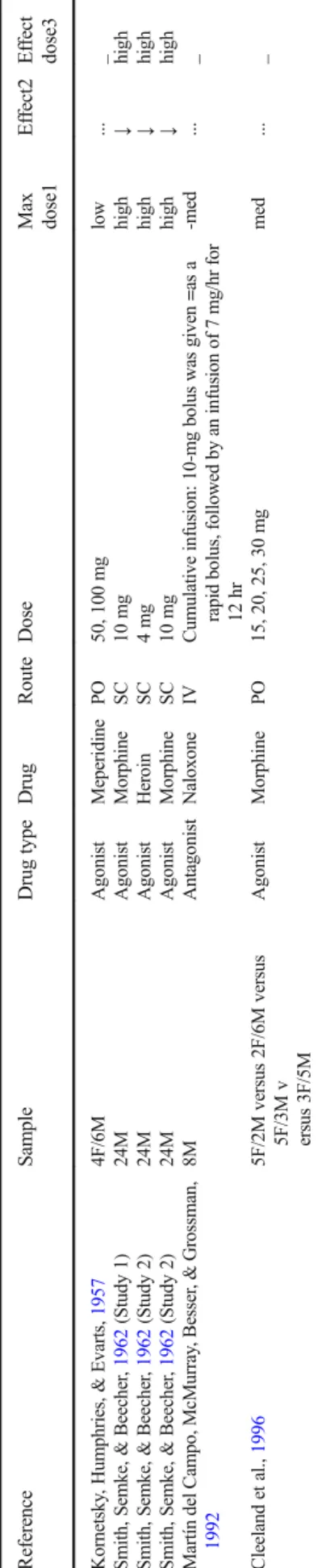
The handful of studies assessing effects of opioid agonist and antagonist treatment on mathematical skills are summa-rized in Table4. The available evidence suggests that high doses of opioids drugs might impair several aspects of math-ematical skills, including the speed at which participants com-plete oral and written addition tasks as reported by Smith and colleagues (Smith, Semke, & Beecher,1962). However, other studies using low or moderate doses of opioid agonists failed to observe effects (Cleeland et al., 1996; Kornetsky, Humphries, & Evarts,1957; Cherrier, Amory, Ersek, Risler, & Shen,2009). Opioid blockade has not been shown to mod-ulate arithmetic skills (Martín del Campo et al.,1992).
Cognitive flexibility, another key aspect of executive func-tion, is rarely investigated in the context of opioid drug stud-ies. In an early study, Primac et al. (1957) did not find an effect of a low dose of the opioid agonist Meperidine administered to ten participants on the Wisconsin Card Sorting Test (WCST). More recently, Quednow and colleagues (Quednow, Csomor, Chmiel, Beck, & Vollenweider, 2008) using a low dose of
10 mg PO of morphine in 18 males did not observe effects on the Stockings of Cambridge tasks or extradimensional set switching. However, their low dose of morphine did reduce the error rate on intradimensional set shifts, suggesting that low doses of opioids might help to improve the application of a task rule within the same perceptual dimension.
The effects of opioid drugs on neuropsychological tests of executive function have most often been investigated in the domains of coding, logical reasoning, and working memory. While a large proportion of studies did observe opioid agonist-induced impairments in coding and logical reasoning, there are no consistent effects of opioid drugs on working memory.
Attention
In an early study, Arnsten et al. (1983,1984) hypothesized that blocking endogenous opioid activity might improve the selectivity of attention. Using a small dose (2 mg IV) of nal-oxone in an EEG study of ten male participants, they indeed observed that naloxone increased a late frontal event-related potential component, which is thought to reflect attention to auditory stimuli. Findings were consistent with their prior findings in animals (Arnsten et al.,1981) and were suggested to be driven by interactions with the locus-coeruleus-norepinephrine system. However, a more recent study testing four females and nine males using a higher dose of the opioid antagonist naltrexone (50 mg PO) to block >90% of mu-opioid receptors observed an effect in a direction opposite to the findings by Arnsten and colleagues (Jääskeläinen et al., 1998). These authors speculated that the observed impairment in selectivity of attention in their study might be due to nausea induced by naltrexone in their participants. Thus, a full opioid blockade (>90%) appears to cause the opposite attentional effect of weak opioid blockade. Other studies using high doses of opioid agonists did not observe clear impairments in divid-ed attention task performance (Saarialho-Kere, 1988; Saarialho-Kere, Mattila, & Seppälä,1989; for procedural de-tails of these studies see Table 1). These null-effects were supported by the finding that a low dose of infused remifentanil (n = 14, within-subjects) impaired attention in a letter detection task only when participants expected that the drug would be administered but not when they did not expect the drug (open vs. hidden administration; Atlas, Wielgosz, Whittington, & Wager,2014).
Table 1 (co n tinued) Referen ce S ample D rug type Drug Route D ose M ax dos e1 Ef fec t2 Ef fec t dos e3 Ago n is t R em ife n ta ni l IV C o n tin uou s in fus ion : 0.7 5 , 1 .5, 3 ng/ ml high ↓ me d Wa lk er & Z ac n y, 19 99 6 F /1 0M Ago n is t H yd ro mor pho ne IV Cu mul ati ve in je ct ions of: .33 , .65 , 1 .3 mg high ↓ hig h Ago n is t M epe ridin e IV C u mul ati v e inje ct ions of: 17. 5, 3 5 , 7 0 mg h igh ↓ hig h Ago n is t M orp h in e IV C u m ul ati v e inje ct ions of: 2 .5 , 5 , 1 0 m g h igh ... _ Hill & Z acny , 20 00 5 F /1 2M Ago n is t H yd ro mor phi ne IV Cu mul ati ve in je ct ions of .33, .65 , 1.3 mg h igh ↓ hig h Ago n is t M orp h in e IV C u mul ati v e inje ct ions of 5 , 10 mg high ... _ Ma rs ch et al. , 20 01 1 8 M A go nis t M o rp hin e IV Thre e inf usio n rate s (2 m in b olus , 1 5 min, an d 60 m in) of 5, 1 0 mg high ↓ hig h W alker , Zacny , Galva, & Lichtor , 20 01 5F/10M Agonis t M orphine IV 2 .5, 5 , 1 0 m g h igh ↓ hig h Mi xe d agon ist B u to rp h an o l IV 0 .5 ,1 ,2 m g m ed ↓ me d Mi xe d agon ist Na lbu phin e IV Cu mul ati ve in je ct ions of 2 .5, 5, 1 0 mg high ↓ hig h Mi xe d agon ist Pen taz oc in e IV 7 .5 , 1 5 m g low ... _ Zac ny & Guti er re z, 200 3 9 F /9 M A go nis t M o rp hin e PO 40 m g med ... _ Ago nis t O xy co don e P O 10 m g, 20 mg, 30 m g high ↓ hig h Zacny , 20 03 9 F /9 M A go nis t Hyd ro co don e P O 5 m g Hyd roc od one /1. 5 mg Hom atr op ine , 10 mg Hydr oc odo ne /3 mg Homa tro p in e, 20 mg Hy dr oc odo ne/ 6 mg Homa tro p in e med ↓ me d Ag on ist M o rph ine P O 4 0 m g m ed .. . _ Zacny & Goldman, 2 004 9 F /9 M A go nis t M o rp hin e PO 40 m g med ... _ Ago nis t P ro pox yph en e n aps yla te PO 50, 100 , 200 mg med ... _ Esch er et al. , 200 7 12 M M ix ed agon ist Bup re nor phi ne IV 0.1 5 mg med ↓ me d Zac ny & Guti er re z, 200 8 8 F /8 M A go nis t Hyd ro co don e P O 5 m g Hyd ro cod one /3 25 mg Ace ta min oph en, 10 mg H y dr oco don e/ 650 mg Ac etam ino p h en med ... _ Ago nis t O xy co don e P O 5 m g Oxy co don e/3 25 m g A ce ta min oph en , 10 mg O xyc odo ne /65 0 mg Ac etam ino p h en med ↓ me d Zacny & Lichtor , 20 08 1 0 F/10M Ago n is t M orp h in e P O 30, 60 mg high ↓ hig h Ago nis t O xy co don e P O 10, 20 mg high ↓ hig h Ch er rie r, A m o ry , E rs ek , R isler , & S h en , 20 09 4 0 F/31M Ago n is t O xy co don e P O 1 0 m g med ↓ me d Zac ny & Guti er re z, 200 9 1 0F/10M Ago nis t H yd ro co don e P O 15 mg H y dr oco don e/ 487 mg Ac eta mi nop hen , 30 mg Hydr oc odo ne /97 5 mg Ac etam ino p h en high ↓ hig h Ago nis t O xy co don e P O 10 mg O x yc odo ne/ 487 mg Ac et ami nop he n, 2 0 m g Oxy cod one /9 75 m g Ac etam inp h en high ↓ me d Zac ny & Guti er re z, 201 1 6 F /8 M A go nis t Oxy co don e P O 1 0 m g med ... _ F = fe mal e; M = m al e p ar tic ipa n ts. St udies us ed wi thin-subject des igns unless otherwise noted. 1Estimated dose for agonis ts based on morphine equivalent of th e m aximum dose o f in the respective study .F o r antagonist drugs, the estimated dose is pr eceded by a m inus. S ee caption of Figure 2 for m or e
details. 2Arrow
one possibility is that the task by Quednow et al. (2008) in-volved increased levels of distress because of the loud audito-ry noise involved in the task. Opioids might help to downreg-ulate stress responses under such conditions, perhaps improv-ing sensorimotor gatimprov-ing relative to placebo. However, as reviewed elsewhere (Jacobson et al.,2018), effects of opioid drugs on prepulse inhibition in rodents are mixed, showing that additional systematic research is needed.
Inhibition and effort
The effects of blocking opioid receptors on response inhibi-tion were investigated by Martin del Campo et al. (1992) using the Stroop task and more recently in a Stroop-like prime-probe task by van Steenbergen et al. (2017). The first study used a cumulative infusion of naloxone in 8 males and the other administered 50 mg naltrexone PO versus placebo in two groups of 26 female participants. Both studies revealed that overall Stroop performance was not affected by the phar-macological manipulation. Likewise, no significant effects were reported by the earlier described study by Zacny and de Wit on impulsive action, which investigated the effect of 5, 10, and 20 mg PO of oxycodone in six females and six males participants on stop-signal performance and go/no-go performance (Zacny & de Wit,2009). The absence of clear findings on overall measures of response inhibition resonates with rodent studies that often find no or mixed effects of opioid manipulations on premature responding (Jacobson et al.,2018).
The study by van Steenbergen and colleagues also ana-lyzed post-error and post-conflict adjustments in behavioral performance (2017), which are thought to reflect short-term adaptive increases in cognitive control triggered by aversive arousal integral to the task at hand (Botvinick, Braver, Barch, Carter, & Cohen,2001; Dreisbach & Fischer,2012; Inzlicht et al.,2015; van Steenbergen,2015). Naltrexone was observed to increase reaction time slowing after participants made an
error. This finding suggests that the aversive arousal associat-ed with conflict and errors can be increasassociat-ed when endogenous opioid activity is blocked, which improves short-term adap-tive cogniadap-tive control. On the other hand, chronic stress and depression is associated with hyperactive neural error moni-toring, impairing post-error accuracy (Pizzagalli, 2011). Recent work in rodents has shown that a kappa-specific an-tagonist can ameliorate stress-induced post-error impairments (Beard et al.,2015). This illustrates that modulation of aver-sive arousal is not restricted to mu-opioid receptors (Valentino & Van Bockstaele,2015).
Two studies have investigated the effect of the opioid sys-tem on perceived task difficulty and required effort. Grossman et al. (1984) reported a study that tested the effect of an opioid blockade (12.2 mg IV of naloxone) in six male participants performing a physical exercise task. This opioid antagonist increased the perceived difficulty of the task. Two further studies reported that opioid blockade abolished exercise-induced mood improvements (Allen & Coen,1987; Daniel, Martin, & Carter,1992), conceivably through increased per-ceived difficulty. Interestingly, a more recent study has ob-served that the opioid agonist oxycodone (10 mg PO) admin-istered to 18 participants did not affect driving performance, whereas they did report increases in required effort while performing the task (Verster, Veldhuijzen, & Volkerts,2006). This finding points to the possibility that compensatory effort (Hockey,1997) might mask opioid-related impairment in per-formance on cognitive control tasks.
Integrative discussion of the reviewed literature
What can be learned from the budding literature on human opioid regulation of cognition and decision making? In light of the moderate to high density of mu-opioid receptors in the brain circuits involved in decision making and cognitive con-trol (Figure1), endogenous or drug modulation of mu-opioid receptors could exert direct modulatory effects on these
Fig. 3 The number of times opioid agonist drug has shown a significant impairment on coding task (DSST) performance and logical reasoning for all type of drugs used in the studies (antagonist drug effects not included,
see details in Tables1and2). Dose refers to the minimal dose needed to
processes. Nevertheless, considering all reviewed evidence together, one striking observation is the abundance of phar-macological studies observing null effects. This is true in par-ticular for the delay-discounting tasks, working memory task and overall measures of planning, switching, and inhibition. However, the majority of these studies have used only small to moderate sample sizes, which usually are only adequately powered to observe medium to high effect sizes. Considering that typical effects sizes in the field of psycholo-gy and affective neuroscience are small to moderate (Lakens & Evers,2014; Poldrack et al., 2017), the majority of the published studies were underpowered to detect such effects. One conclusion that can be drawn is thus that new research in this area must take measures to improve statistical power. In the meantime, we advise caution in the interpretation of these null effects, in particular if the study used low or moderate doses of opioid agonists only.
Null effects reported after full (>90%) blockade of mu-opioid receptors are an intermediate case, since valuable in-formation can indeed be gleaned by observing behaviors un-altered or only partly diminished when opioid signaling is blocked. For instance, it is striking that healthy people display comparable working memory capacity and cognitive flexibil-ity after treatment with opioid agonists, antagonists, and pla-cebo. Similarly, although several studies report reduced re-ward pleasantness after naloxone or naltrexone, healthy humans consistently report substantial enjoyment of rewards when mu-opioid receptors are fully blocked. The clearest pat-terns indicating opioid modulation of performance emerged for value-based learning and decision-making tasks, the DSST, and the logical reasoning task. We will elaborate on these results below and highlight potential neural mechanisms.
Reward-based decision-making
The reviewed evidence from studies of reward-based deci-sion-making in humans is largely consistent with opioid reg-ulation of reward motivation, as measured by effort invested to obtain relatively high-value rewards (Chelnokova et al., 2014; Eikemo et al.,2017; Weber et al., 2016). Extensive evidence from non-human animals indicates a parallel mech-anism (Mahler & Berridge, 2012; S. Peciña & Berridge, 2013). We speculate that the rewarding effects of exerting physical effort during exercise (Allen & Coen,1987; Daniel et al., 1992; Grossman et al., 1984; Hiura et al., 2017; Saanijoki et al.,2018) or cognitive effort (Inzlicht, Shenhav, & Olivola,2018) may be mediated by the opioid system. Note that the existing literature in healthy humans does not allow us to disentangle the decision processes involved in weighing costs, such as effort expenditure, against gains, such as social, monetary, or taste rewards.
Table
2
(co
n
tinued)
Referen
ce
S
ample
D
rug
type
Drug
Route
D
ose
M
ax
dose1
Ef
fec
t2
Ef
fec
t
dose3
Agonis
t
Oxy
codone
PO
5
m
g
O
xycodone/325
mg
Acetaminophen,
10
mg
Oxycodone/650
mg
Acetaminophen
med
↓
med
Z
acny
&
L
ic
h
tor
,
2008
10F/10M
Agonis
t
Morphin
e
PO
30
,
6
0
m
g
h
ig
h
↓
high
Agonis
t
Oxy
codone
PO
10
,
2
0
m
g
h
ig
h
↓
high
Z
acny
&
G
u
tie
rr
ez
,
2009
10F/10M
Agonis
t
Hyd
roco
done
PO
15
mg
H
ydrocodone/487
mg
Acetaminophen,
3
0
mg
Hydrocodone/975m
g
A
cetaminophen
hig
h
↓
med
Agonis
t
Oxy
codone
PO
10
mg
Ox
ycodone/487
mg
Acetaminophen,
20
mg
Oxycodone/975
mg
Acetaminophen
hig
h
↓
med
Z
acny
&
G
u
tie
rr
ez
,
201
1
6F/8M
A
gonis
t
Oxy
codone
PO
10
mg
med
...
_
F
=
fe
mal
e;
M
=
m
al
e
p
ar
tic
ipa
n
ts.
St
udies
us
ed
wi
thin-subject
des
igns
unless
otherwise
noted.
1 Estimated
dose
for
agonis
ts
based
on
morphine
equivalent
of
th
e
m
aximum
dose
o
f
in
the
respective
study
.F
o
r
antagonist
drugs,
the
estimated
dose
is
pr
eceded
by
a
m
inus.
S
ee
caption
of
Figure
2
for
m
or
e
details. 2Arrow
indicates
signi
fi
cant
ly
improve
d
(
↑
),i
m
p
ai
re
d
(
↓
),
m
ixe
d
ef
fe
ct
s
(
↕
)o
rn
u
ll
-e
ff
ec
ts(
…
)
o
n
p
er
for
m
an
ce
rela
tiv
e
to
a
placebo
control
condition.
3Minimum
estimated
dose
at
w
hich
the
indicated
ef
fect
is
significantly
dif
ferent
from
Table 3 P h armacological st udies repo rt ing ef fect on w orking memory Referen ce S ample D rug type Drug Route D ose M ax dos e1 Ef fect 2 Ef fect dose3 Evans & Smith, 196 4 4F/M v er sus 4F/M Agon ist M or ph ine P O 1 6 mg low ... _ Ghonei m, Mewaldt , & Thatcher , 19 75 10 M A gon ist F en ta ny l IV 0 .1, 0 .2 mg high ↓ hig h Agon ist F en ta ny l IV 0 .1, 0 .2 mg high ... _ V o la vka , D or nb ush, Ma llya , & C h o , 19 79 26 M A nta g o n ist N alo xon e IV 10, 2 0 mg -me d ... _ File & S il ve rs tone , 1 981 6F/6M A nta g o n ist N alo xon e IV 0 .8, 1 .6 mg -lo w ... _ Cohe n, Mur p h y, C ohe n, W eing ar tne r, & P ic kar , 19 83 3F/4M A nta g o n ist N alo xon e IV 21, 7 0 , 1 40 m g -hi g h ... _ Sz ék ely , Tö rö k , Kar cza g , T o lna , & T ill, 1 986 8M Agon ist D ihy d ro co de ine S C 2 0 mg low ↑ lo w Saarialho-Kere, M att ila, & Seppälä, 198 8 11 F /M M ix ed ag oni st Pe nta zoc ine IM 30 mg med ... _ Ma cDo n al d, Go ugh , N ic oll , & D ow , 19 89 12 M M ix ed ag oni st Bu pr eno rp hin e IM 0.3 m g high .. . _ Ma rt ín de l C am po, Mc Mur ra y, B es se r, & Gr ossm an , 19 92 8M Anta go nist Nalo xon e IV C u m ula tiv e in fu sion : 10 -mg bol us o f Na loxo ne wa s g iv en as a rap id bo lus, followed b y an inf u sio n of 7 m g/hr fo r 1 2 h r -me d ↓ -m ed Hanks, O ’ Neill, Simpson, W es n es, & A, 199 5 4F/8M A gon ist M or ph ine P O 10, 1 5 mg low ... _ Za cn y, Lich tor , Klaf ta , A le ssi, & A pf elb au m , 19 96a 3F/7M A gon ist C o d ei ne PO 60 mg Cod ein e/6 0 0 m g A ce ta min oph en low ... _ Mix ed ag oni st Bu tor pha no l T N 1, 2 m g high .. . _ Black, Hill, & Z acny , 19 99 2F/8M A gon ist A lfe n ta ni l IV 16, 3 2 , 6 4 n g /ml high ... _ Agon ist R em if en ta nil IV C o n tin uou s inf us ion: 0.7 5 , 1 .5 , 3 ng/ ml high ... _ Zacny & Goldman, 2 004 9F/9M A gon ist M or ph ine P O 4 0 mg med ... _ Agon ist P rop oxy phe ne na psy lat e PO 50, 1 00, 200 mg med ... _ V ers ter , V eldhuijzen, & V o lkerts, 200 6 12 F/6 M Agon ist O xyc od one PO 5 m g O xyc od one /32 5 mg Ac et am inop he n, 10 m g Oxyc od one /65 0 mg Ac etam in op h en med ... _ Fris well et al. , 20 08 9F/9M A gon ist M or ph ine P O 1 0 m g low ... _ Agon ist M or ph ine P O 1 0 mg low ... _ Agon ist O xyc od one PO 5 m g low ... _ Agon ist O xyc od one PO 5 m g low ... _ Que dno w , Cso m or , C h m ie l, Bec k , & V o lle nwe ide r, 2 008 18 M A gon ist M or ph ine P O 1 0 mg h igh ... _ F = fe mal e; M = m al e p ar tic ipa n ts. St udies us ed wi thin-subject des igns unless otherwise noted. 1 Estimated dose for agonis ts based on morphine equivalent of th e m aximum dose o f in the respective study .F o r antagonist drugs, the estimated dose is pr eceded by a m inus. S ee caption of Figure 2 for m or e
details. 2 Arrow
The current literature also points to a modest opioid mod-ulation of the rewarding experience (liking) of high-value stimuli, but so far there is little evidence of a change in the neural response of winning money in healthy humans. One of the studies reviewed also points to opioid modulation of (monetary) reward learning (Efremidze et al.,2017). Overall, however, findings are in line with the notion that mu-opioid receptor stimulation by endogenous and exogenous opioid peptides causes a shift in valuation along aBhedonic gradient^ ranging from unpleasant to pleasurable. As illustrated in Figure4, we suggest that increased enjoyment of and motiva-tion towards rewarding stimuli could underlie the observed changes in decision making. Studies in both rodents and humans indicate that these effects may be most pronounced for highly salient stimuli, such as high-value rewards.
Notably, these studies consistently show that blocking more than 90% of mu-opioid receptors does not obliviate the appreciation of a rewarded choice and only moderately re-duces the pleasantness of rewards in general. Interestingly, while there is strong evidence that opioid drugs enhance food-liking responses in rodents, mu-opioid antagonism di-rectly into Bhedonic hotspots^ did not suppress such
Table 4 P harmacological st udies repo rtin g ef fe ct o n m athe ma tic al ski lls Referen ce S ample D rug type Drug Route D ose M ax do se 1 Ef fec t2 Ef fec t dose3 Kornetsky , Humphries, & Evarts , 195 7 4F/6M A go nist Me pe ri dine PO 5 0 , 1 00 m g lo w ... _ Sm ith, S em ke , & B eec he r, 1 962 (Stu dy 1 ) 2 4 M Ag on is t M or ph in e SC 1 0 m g h ig h ↓ hig h Sm ith, S em ke , & B eec he r, 1 962 (Stud y 2) 24M Ago n ist H er oi n S C 4 mg h igh ↓ hig h Sm ith, S em ke , & B eec he r, 1 962 (Stu dy 2 ) 2 4 M Ag on is t M or ph in e SC 1 0 m g h ig h ↓ hig h M ar tín de l C am p o , M cM ur ra y, Besser , & G ro ssm an , 19 92 8M Ant ago nis t Na loxo ne IV Cum u la tiv e in fu sion : 10 -mg bol us wa s g iv en =as a ra p idb o lu s, fo ll o w edb ya ni n fu si o no f7m g /h rf o r 12 h r -m ed ... _ C lee la nd et al. , 19 96 5F/2M v er sus 2 F/6M v er sus 5F/3M v er sus 3F /5M Ag on is t M or ph in e P O 1 5 , 20 , 2 5 , 30 m g me d .. . _ F = fe mal e; M = m al e p ar tic ipa n ts. St udies us ed wi thin-subject des igns unless otherwise noted. 1 Estimated dose for agonis ts based on morphine equivalent of th e m aximum dose o f in the respective study .F o r antagonist drugs, the estimated dose is pr eceded by a m inus. S ee caption of Figure 2 for m or e
details. 2 Arrow
indicates signi fi cant ly improve d ( ↑ ),i m p ai re d ( ↓ ), m ixe d ef fe ct s ( ↕ )o rn u ll -e ff ec ts( … ) o n p er for m an ce rela tiv e to a placebo control condition. 3Minimum estimated dose at w hich the indicated ef fect is significantly dif ferent from placebo.
Fig. 4 Subjective value as a function of reward and punishment. The gray line plots a typical value function for reward and punishment according to
prospect theory (Kahneman & Tversky,1979). Opioid drugs might
mod-ulate decision making by shifting this value function, such that opioid agonists increase (white line) and opioid antagonists decrease (black line) subjective value for rewards. Similar modulation specifically of high-salience stimuli may occur for punishments (dotted lines), although the available evidence is equivocal and future research is warranted (see
appetite-independentBliking^ (Smith & Berridge, 2007; Wassum et al.,2009b). However, systemic antagonism in ro-dents has been shown to suppress liking of sweet taste (Parker, Maier, Rennie, & Crebolder,1992).
Opioid agonists might similarly attenuate the negative val-ue of punishments, although the exact nature of this modula-tion requires extensive future research. For example, there is some evidence that opioid drugs may modulate large and small punishments to the same extent (Atlas et al.,2014; Gospic et al.,2007; Murray et al., 2014; Petrovic et al., 2008; Price, Harkins, Rafii, & Price,1986; Schoell et al., 2010). Moreover, despite the relief opioid drugs can provide for acute clinical and experimental pain (Wanigasekera et al., 2012), psychosocial stress (Bershad et al.,2015,2018), certain depressive symptoms (Peciña et al.,2018), and feelings of breathlessness (Hayen et al.,2017), opioid blockade does not consistently increase the aversiveness of experimental pain (Anderson et al., 2002; Berna et al., 2018; Eippert et al.,2008; Grevert & Goldstein,1977). Clearly, more well-powered psychopharmacological evidence is needed to under-stand opioid modulation of reward and punishment processes, as well as their integration in the human brain.
Cognitive control
With respect to the cognitive control domain, studies showed the most consistent effects (the highest proportion of signifi-cant effects) for the coding task (DSST). This is also the task that has been most frequently included in opioid drug studies. At moderate and high opioid drug doses, clear impairments on performance have been observed in many studies using this task (Figure3). Although the DSST often is used as a primary measure of psychomotor skills, recent work using a factor-analytic approach suggest that performance on the DSST does not rely on basic psychomotor speed but instead relies on several executive function processes including working mem-ory updating, switching, and inhibition (Knowles et al.,2015). This task might require a delicate coordination and integration of these different control processes. It could be speculated that this has rendered the DSST, and to a lesser extent logical reasoning, the most sensitive measures of cognitive control impairment. On the other hand, no evidence exists that blocking opioids enhances coding or logical reasoning perfor-mance in healthy people, which speaks against involvement of the endogenous opioid system as a key mechanism in execu-tive functions. Indeed, other tasks in the cogniexecu-tive domain, which are typically constructed to tap into a single subtype of control processes, were not associated with strong effects of opioid drugs or blockade. Combined, these results indicate that the effects of opioid drugs at moderate to high doses will be particularly strong for tasks which require the orchestration of multiple cognitive control functions relying on different regions in frontoparietal brain circuits. However, given the
sparse data on cognitive measures other than DSST and logi-cal reasoning, future research is warranted before firm conclu-sions can be drawn regarding the effects of opioids on these measures.
Working hypothesis: Enhanced cognitive
performance after opioid-reduced aversive arousal?
Some evidence suggests that opioid agonist administration relative to placebo can also improve rather than impair perfor-mance. This was for example observed for logical reasoning and DSST performance in early studies by Evans and col-leagues (Evans & Smith,1964; Evans & Witt,1966) as well as in more recent work on intradimensional set shifting and attention (Quednow et al.,2008). These studies have in com-mon that they used low doses of morphine (or codeine). One possible explanation for these findings might be that low doses of opioid agonists could reduce the aversive arousal (Thayer,1989) or distress associated with a task. If the rela-tionship between aversive arousal and cognitive control fol-lows an inverted U-shape, as previous work has proposed (van Steenbergen, Band, & Hommel,2015), low doses of opioid agonist drugs might compensate for arousal-induced impair-ment that occurs in the placebo condition (Figure5). Opioids indeed tend to reduce arousal and can cause sedation at high doses. Even at lower doses, opioid agonists in humans and some other species reduce pupil size (miosis) (Lee & Wang, 1975; Murray, Adler, & Korczyn,1983). In addition, opioid antagonism increases cortisol responses, and this is thought to reflect blockade of a tonic endogenous opioid inhibition of cortisol in humans (Lovallo et al.,2015).
The view that a low opioid drug dose could enhance cog-nitive performance by reducing aversive arousal also dovetails with recent rodent work on stress-alleviating properties of opioids (Valentino & Van Bockstaele,2015). Endogenous opioid brain activation in response to stress might similarly help to prevent stress-induced impairments (Shields et al., 2016), as indeed suggested in some human (Bandura, Cioffi, Taylor, & Brouillard,1988) and animal studies (Laredo et al., 2015). This view agrees with prior work that shows that cog-nitive control tasks elicit affective responses (i.e., integral emotions; Inzlicht et al.,2015), which might drive (mal) adap-tive behavior (Botvinick,2007; van Steenbergen et al.,2009) and which are likely under opioid regulation (van Steenbergen et al.,2017). Another possibility to consider is that cognitive improvements after low doses of opioids are caused by in-creases in appetitive motivation or learning. Such effects are particularly likely when the task itself involves external re-wards (Eikemo et al.,2017) or when performance on tasks is perceived to reflect intelligence or capability. In addition, tasks perceived to be of high relevance might also generate internalBpseudo-rewards^(Holroyd & Yeung,2012; Ribas-Fernandes et al.,2011), in particular when effort is intrinsical-ly valuable (Inzlicht et al.,2018).
Given these considerations, it is plausible that cognitive control, just like decision-making, is modulated by opioids via brain networks involved in valuation, saliency, and moti-vation, shifting the cost-benefit trade-off, which in turn deter-mines allocation of cognitive control (Shenhav, Botvinick, & Cohen,2013). In addition, prefrontal networks involved in maintaining task-goal representations might be modulated di-rectly via binding to its opioid receptors. In line with this suggestion, a recent PET study observed that high mu-opioid signaling (lower binding potential) in a ventral region of the lateral prefrontal cortex was positively related to performance on the Wisconsin Card Sorting Test in a group of patients with major depressive disorder (Light, Bieliauskas, & Zubieta, 2017). A possible mechanism at a neuronal level could be that stimulation of mu-opioid receptors suppresses interneuron spiking and increases glutamate-coded output of prefrontal neurons at multiple projection targets, which in turn might engender disorganized control and decision processes (Baldo,2016).
Directions for future research
The previous section provided some initial insights into the role of the mu-opioid system in higher-level cognitive func-tion. Yet, numerous issues require future investigafunc-tion. One unresolved challenge is that opioids might reduce cortical sig-naling without directly affecting performance in cognitive tasks, because participants use strategies to compensate for these deficits (Hockey,1997). Future studies should include
physiological measures, such as cardiovascular measures (Gendolla, Wright, & Richter, 2011; Kuipers et al., 2017; Spruit, Wilderjans, & van Steenbergen, 2018) and task-evoked pupil dilation (Kahneman,1973; van der Wel & van Steenbergen, 2018) to investigate potential compensatory mechanisms. In addition, behavioral impairments in control tasks might reflect shifts in motivation instead of reflecting a cognitive incapability (Kurzban, Duckworth, Kable, & Myers, 2013; Shenhav et al.,2017). As we alluded to earlier, cogni-tive control shares many processes and brain circuits that also are important for value-based decision making, and future studies are warranted to understand the role of opioids in these processes (Berkman, Hutcherson, Livingston, Kahn, & Inzlicht,2017).
Although opioid agonist drugs do not typically produce strong subjective effects at low doses (Hanks, O’Neill, Simpson, Wesnes,1995), changes in self-reported mood and arousal are typically reported in many of the studies reviewed, most consistently at higher doses. The evidence for mood effects from opioid blockade on the other hand, is much less compelling (Berna et al.,2018; Eippert et al.,2008; Grevert & Goldstein,1977). Interestingly, mood induction tasks appear to modulate endogenous opioid neurotransmission (Koepp et al., 2009; Prossin et al.,2015; Zubieta et al.,2003). One important avenue for future research is to understand the role of affective and motivational states in altered cognitive func-tion. For example, studies might investigate whether variation in receptor binding potential or drug-induced changes in sub-jective state correlate with behavioral outcomes (Light et al., 2017; Weber et al.,2016). Researchers investigating the effect of hedonic states on cognitive control and decision making (Dreisbach & Goschke, 2004; Isen & Means, 1983; van Steenbergen, Band, & Hommel, 2010; Van Steenbergen, Band, Hommel, Rombouts, & Nieuwenhuis,2015) and the influence of motivation on these processes (Botvinick & Braver, 2015; Braver et al.,2014; Pessoa, 2009) could use antagonist drugs to determine the role of endogenous mu-opioid neurotransmission in these effects. On a related note, more broadly defined control processes, such as mental flex-ibility and creativity, often have been related to positive affec-tive states (Ashby, Isen, & Turken,1999). It would be inter-esting to assess the role of the opioid system in these processes as well (Streufert & Gengo,1993; Zacny,1995).
increasing sample sizes) or by employing active placebo treat-ments to ensure that drug conditions are matched on relevant side effects. In addition, future research could draw inspiration from anecdotal evidence that opioids can induce pain asymbolia, i.e., intact detection of pain but without the affective-motivational component (Berthier, Starkstein, & Leiguarda,1988). Studies might therefore implement mea-sures of motivation/detachment to measure the effects of opi-oid drugs on engagement with cognitive and decision-making tasks.
Another unresolved question relates to context and coun-terfactual outcomes. Do opioid drugs modulate high-value reward processes equally in the presence of punishments, such as pain or possible economic loss? As recently observed by Buchel et al. (2018), opioid blockade reduced pleasantness ratings of erotic stimuli significantly more than ratings of monetary wins. It is unclear whether the inclusion of highly salient erotic stimuli reduced the relative value of money dur-ing the experiment. As for tasks includdur-ing punishments as well as rewards, it is possible that mu-opioid stimulation would cause a shift primarily of aversive stimuli but not re-wards, because aversive stimuli are typically more salient (Kahneman & Tversky,1979). Naloxone increased aversive-ness of economic loss but not economic gain in Petrovic et al. (2008). Kut et al. (2011) found effects of naloxone on pain but not on pleasantness ratings of erotic stimuli. Also, two studies have reported decreased pleasantness of opioid drug effects during physical pain (Conley, Toledano, Apfelbaum, & Zacny,1997; Zacny, McKay, et al.,1996b; but see Comer, Sullivan, Vosburg, Kowalczyk, & Houser,2010). Studies in-cluding both positive and negative facial expressions provide mixed evidence, however, with opioid drug effects preferen-tially observed for negative or positive affective stimuli in different studies. (Bershad et al.,2016; Loseth et al.,2018; Syal et al., 2015; Wardle et al., 2016). Moreover, Berna et al. (2018) reported the largest naloxone reduction in pleas-antness of the best possible (yet still painful) outcome, indi-cating that relative relief is opioid-dependent. Well-powered studies, including both rewarding and aversive outcomes, are needed to resolve these inconsistencies. In addition, opioid effects on value-based decision making should also be ad-dressed during ongoing pain (Gandhi, Becker, & Schweinhardt,2013) or other opioid-sensitive aversive states. Although opioid drugs can exert direct effects on mu-opioid receptors expressed in the important hubs of the neural decision-making and cognitive-control networks (Figure1), they can also act indirectly via other neurotransmitters. For example, the canonical disinhibition model of Johnson and North (1992) proposed that opioid drugs induce reward via increased dopamine signaling due to opioid inhibition of GABA interneurons in the ventral tegmental area. More recent work has shown that we are only at an early stage of under-standing the exact role of dopamine signaling for opioid drug
effects (Badiani, Belin, Epstein, Calu, & Shaham,2011; Corre et al., 2018; Nutt, Lingford-Hughes, Erritzoe, & Stokes, 2015). For instance, mu-opioid receptor activation can have a net excitatory or net inhibitory effect on VTA neurons de-pending on a variety of pre- and postsynaptic mechanisms (Fields & Margolis,2015). Furthermore, dopamine modulates cognition via different receptor types and pathways (Bromberg-Martin, Matsumoto, & Hikosaka, 2010; Cools, 2015), making direct comparisons difficult. The available ev-idence renders it unlikely that effects of opioid drugs can simply be explained in terms of dopaminergic modulation alone. Rodent findings that mu-opioids and dopamine play functionally different roles in the hedonic and motivational properties of reward (Berridge,2007) need further examina-tion in humans. For instance, some studies are beginning to manipulate opioids and dopamine pharmacologically using the same tasks (Porchet et al., 2013; Weber et al.,2016) or even combining an agonist for one system with an antagonist for the other (Jayaram-Lindström et al., 2017; Jayaram-Lindström, Wennberg, Hurd, & Franck, 2004; Roche et al., 2017).
The mu-opioid system also interacts with other neurotrans-mitters systems. For example, interactions between opioids and the locus-coeruleus-norepinephrine system are well-documented (Arnsten et al.,1981; Chaijale et al.,2013), and futures studies might investigate whether opioid drugs modu-late cognitive processing via norepinephrine. There is also evidence that the endocannabinoid system interacts with opi-oid mechanisms that support reward (Rowland, Mukherjee, & Robertson,2001; Solinas & Goldberg,2005).
(Barch, Pagliaccio, & Luking, 2015; Treadway, Bossaller, Shelton, & Zald,2012), providing possible new avenues to treat patients with mood disorders.
Conclusions
The present review supports a role for the opioid system in modulating some key aspects of cognitive control and deci-sion-making. We have shown that the effects of reward-based decision-making by opioid drugs might be driven by a shift in valuation processes. At higher doses, opioid agonists can im-pair performance on neuropsychological executive function tasks involving coding and logical reasoning. At lower doses opioids can improve cognitive function, and the working hy-pothesis proposed suggests that these effects are driven by opioid-induced reduction of aversive arousal. We hope that this review provides an initial roadmap for future research to gain a better understanding of how opioids modulate cogni-tion, affect, and their interactions.
Acknowledgements The authors are grateful for helpful discussions with Gernot Ernst and Daniel Castro. They thank Lauri Nummenmaa for providing the binding potential PET image from his lab (shown in
Figure1). They are grateful to Guro Løseth for valuable comments on the
manuscript.
Open Access This article is distributed under the terms of the Creative
C o m m o n s A t t r i b u t i o n 4 . 0 I n t e r n a t i o n a l L i c e n s e ( h t t p : / / creativecommons.org/licenses/by/4.0/), which permits unrestricted use, distribution, and reproduction in any medium, provided you give appro-priate credit to the original author(s) and the source, provide a link to the Creative Commons license, and indicate if changes were made.
References
Allen, M. E., & Coen, D. (1987). Naloxone blooking of running-induced
mood changes.Annals of Sports Medicine,3, 190–195.
Anderson, W. S., Sheth, R. N., Bencherif, B., Frost, J. J., & Campbell, J. N. (2002). Naloxone increases pain induced by topical capsaicin in
healthy human volunteers.Pain,99, 207–216.
Arnsten, A. F. T., Neville, H. J., Hillyard, S. A., Janowsky, D. S., Salk, T.,
Diego, S.,…May, R. (1984). Naloxone selective increases
infor-mation measures processing in humans.Journal of Neuroscience,4,
2912–9.
Arnsten, A. F. T., Segal, D. S., Loughlin, S. E., Roberts, D. C. S., Jolla, L., & Diego, S. (1981). Evidence for an interaction of opioid and nor-adrenergic locus coeruleus systems in the regulation of
environmen-tal stimulus-directed behavior.Brain Research,222, 351–363.
Arnsten, A. F. T., Segal, D. S., Neville, H. J., Hillyard, S. A., Janowsky, D. S., Judd, L. L., & Bloom, F. E. (1983). Naloxone augments
electrophysiological signs of selective attention in man.Nature,
304, 725–727.
Ashby, F. G., Isen, A. M., & Turken, A. U. (1999). A neuropsychological theory of positive affect and its influence on cognition a neuropsy-chological theory of positive affect and its influence on cognition.
Psychological Review,106, 529–550.
Aston-Jones, G., & Cohen, J. D. (2005). An integrative theory of locus coeruleus-norepinephrine function: Adaptive gain and optimal
per-formance.Annual Review of Neuroscience,28, 403–450.
Atlas, L. Y., Wielgosz, J., Whittington, R. A., & Wager, T. D. (2014). Specifying the non-specific factors underlying opioid analgesia:
Expectancy, attention, and affect.Psychopharmacology,231, 813–
823.
Badiani, A., Belin, D., Epstein, D., Calu, D., & Shaham, Y. (2011). Opiate
versus psychostimulant addiction: the differences do matter.Nature
Reviews Neuroscience,12, 685–700.
Baldo, B. A. (2016). Prefrontal cortical opioids and dysregulated
motiva-tion: A network hypothesis.Trends in Neurosciences,39, 366–377.
Bandura, A., Cioffi, D., Taylor, C. B., & Brouillard, M. E. (1988). Perceived self-efficacy in coping with cognitive stressors and opioid
activation.Journal of Personality and Social Psychology,55, 479–
488.
Barbano, M. F., & Cador, M. (2007). Opioids for hedonic experience and
dopamine to get ready for it.Psychopharmacology,191, 497–506.
Barch, D. M., Pagliaccio, D., & Luking, K. (2015). Mechanisms under-lying motivational deficits in psychopathology: similarities and
dif-ferences in depression and schizophrenia. InBehavioral
neurosci-ence of motivation(pp. 411–449). Springer.
Bartra, O., McGuire, J. T., & Kable, J. W. (2013). The valuation system: A coordinate-based meta-analysis of BOLD fMRI experiments
ex-amining neural correlates of subjective value.NeuroImage,76, 412–
427.
Beard, C., Donahue, R. J., Dillon, D. G., Van’t Veer, A., Webber, C., Lee,
J.,…Carroll, F. I. (2015). Abnormal error processing in depressive
states: a translational examination in humans and rats.Translational
Psychiatry,5, e564.
Berkman, E. T., Hutcherson, C. A., Livingston, J. L., Kahn, L. E., &
Inzlicht, M. (2017). Self-control as value-based choice.Current
Directions in Psychological Science, 26,422–428 .
Berna, C., Leknes, S., Ahmad, A. H., Mhuircheartaigh, R. N., Goodwin, G. M., & Tracey, I. (2018). Opioid-independent and
opioid-mediated modes of pain modulation.Journal of Neuroscience,38,
9047–9058.
Berridge, K. C. (2007). The debate over dopamine’s role in reward: the
case for incentive salience.Psychopharmacology,191, 391–431.
Berridge, K. C., & Kringelbach, M. L. (2015). Pleasure systems in the
brain.Neuron,86, 646–664.
Berridge, K. C., Robinson, T. E., & Aldridge, J. W. (2009). Dissecting
components of reward:Bliking^,Bwanting^, and learning.Current
Opinion in Pharmacology,9, 65–73.
Bershad, A. K., Jaffe, J. H., Childs, E., & de Wit, H. (2015). Opioid partial agonist buprenorphine dampens responses to psychosocial stress in
humans.Psychoneuroendocrinology,52, 281–288.
Bershad, A. K., Miller, M. A., Norman, G. J., & de Wit, H. (2018). Effects of opioid-and non-opioid analgesics on responses to psychosocial
stress in humans.Hormones and Behavior,102, 41–47.
Bershad, A. K., Seiden, J. A., & de Wit, H. (2016). Effects of buprenorphine on responses to social stimuli in healthy adults.
Psychoneuroendocrinology,63, 43–49.
Berthier, M., Starkstein, S., & Leiguarda, R. (1988). Asymbolia for pain:
A sensory-limbic disconnection syndrome.Annals of Neurology,24,
41–49.
Bickel, W. K., Yi, R., Landes, R. D., Hill, P. F., & Baxter, C. (2011). Remember the future: Working memory training decreases delay
discounting among stimulant addicts.Biological Psychiatry,69,
260–265.
Black, M. L., Hill, J. L., & Zacny, J. P. (1999). Behavioral and physio-logical effects of remifentanil and alfentanil in healthy volunteers.
Anesthesiology,90, 718–726.
Boettiger, C. A., Kelley, E. A., Mitchell, J. M., D’Esposito, M., & Fields,