Running head: EFFECTS OF TYPE OF CARE ON MULTIPLE DEVELOPMENTAL
OUTCOMES AMONG GIRLS ADOPTED FROM CHINA
Experiencing different types of care preceding adoption: Implications for
the health, development, strengths, competencies and indiscriminate
friendliness of girls adopted from China to the Netherlands
Lisanne P. Marijs (0844594)
Leiden University
July 2014
Research Master Thesis
Developmental Psychopathology in Education and Child Studies
Faculty of Social and Behavioral Sciences
Supervisor: Prof. dr. F. Juffer
2 Acknowledgements
In front of you lays a study on the health and multiple developmental outcomes among Chinese international adoptees who have been adopted from various types of care into the Netherlands. With this research project I finish my Research Master program “Developmental Psychopathology in Education and Child Studies” at Leiden University. It would actually not have been possible to write this Research Master thesis without the help and support of some important individuals. Therefore, I would like to take a moment here to express my gratitude to each one of them.
First of all, I would like to thank Professor Dr. Marian Bakermans-Kranenburg and the Head Student Services Department of the Institute for Education and Child Studies, Drs. Carien Nelissen. Without their help, services and advice, it would not have been possible to start the Research Master program at Leiden University. Besides, I am extremely thankful for the great support and the pleasant collaboration with my two daily supervisors Ms. Nikita Schoemaker and Dr. Marije Stoltenborgh. They have guided me, with a lot of joy and enthusiasm, throughout every single day of my research trajectory. At the same time, I would like to thank my fellow students for their input in the project, the enjoyable teamwork and for making my research master project a lovely and interesting experience. I furthermore would love to express my sincere thanks to my head supervisors Professor Dr. Femmie Juffer and Professor Dr. Lenneke Alink for providing me with support, guidance, and encouragement, and for sharing their extensive knowledge and great scientific attitude with me throughout my
academic career as a Research Master student. Last but not least, I would like to express my gratitude to my family and friends. I would like to thank them all for their dedication, time, flexibility, attention and interest, and also for their unconditional love, care and assistance during both fortunate and less fortunate circumstances within the last couple of years. They have supported and guided me whenever possible and they encouraged me to reach my dreams and goals. I feel really blessed to have so many amazing people around me.
Thank you all!
3 Abstract
The current study investigated and compared the development of Chinese girls adopted from
institutional care, foster care, or from a mixture of both types of care to the Netherlands. The sample consisted of 1106 girls who were between 4 and 18 years of age (mean age 7 years). Parents
completed several questionnaires addressing all kinds of subjects related to the health and development of the adopted children. Results revealed that most girls adopted from China were healthy and experienced few developmental delays. Most girls scored high on individual strengths and competencies as well and they had satisfying relationships with their adoptive parents. Part of the adoptees showed some indiscriminate friendliness. A comparison of the care groups revealed that girls adopted from foster care were in an advantage with regard to their general health and developmental status. Mean differences between the groups, however, were small. Neither a mediating effect of children’s self-regulatory abilities, nor a moderating role of either age at adoption or the parent-child relationship could be established. Some direct effects, however, were found. Children adopted before their first birthday and children who had a very good relationship with their parents showed most developmental gains. Overall, this study provides information regarding the adjustment and
development of female children adopted from various types of care in China that might be useful to adoptive parents and a range of professionals and organizations working with international adoptees.
Keywords: China, international adoption, pre-adoption care, health, development, strengths,
4 Experiencing different types of care preceding adoption: Implications for the health, development, strengths, competencies and indiscriminate friendliness of girls adopted from
China to the Netherlands
Millions of children around the world are abandoned and in need of alternative and supportive living arrangements as their biological parents are not able to provide sufficient food, shelter, care and safety for them (Van IJzendoorn et al., 2011). As a consequence, there are large numbers of international adoptees in North America and Europe nowadays. Each year, approximately 45,000 children
worldwide are adopted among more than 100 sending and receiving countries (Selman, 2009). Before international adoption, however, children are often found to reside in different caregiving
arrangements (Bruce, Tarullo, & Gunnar, 2009). Previous studies therefore have had different focuses as well. Many studies, for example, have compared adopted children to either non-adoptees, domestic adoptees, or to children adopted from institutions (e.g., Bruce et al., 2009; Dobrova-Krol, Van
IJzendoorn, & Juffer, 2010; Juffer & Van IJzendoorn, 2005; Van den Dries, Juffer, Van IJzendoorn, & Bakermans-Kranenbrug, 2010). Placement in foster care before international adoption, however, is a relatively new phenomenon (Zeanah et al., 2003). As a consequence, many adoption studies to date have not differentiated extensively between former foster and post-institutionalized adopted children (but see Miller, Chan, Comfort, & Tirella, 2005; Van den Dries, Juffer, Van IJzendoorn, Bakermans-Kranenburg, & Alink, 2012). This study will focus on the development of Chinese adopted girls in the Netherlands who were adopted from institutional care, foster care, or from a mixture of both types of care.
Chinese Abandoned Children and International Adoption
In the mid-1990s, China entered the field of inter country adoption. Since then, and still nowadays, it is the most important Asian state of origin for most adopted children worldwide (Selman, 2009). In 1998, China became the main country of origin for adoption to the Netherlands as well, responsible for a quarter of all international adoptees (Ministry of Justice, 2000). From that year on, the number of children adopted from China continued to rise with a peak of 800 adoptions in 2004. This rate was more than 60% of the total number of adoptees arriving that year in the Netherlands (Ministry of Justice, 2009).
5
the past decade (Rojewski, Shapiro, & Shapiro, 2000).
As soon as China opened its borders for adoption, and in an effort to relieve some of the pressures associated with institutional care, the Chinese government allowed international adoption of abandoned girls. As such, inter-country adoption was used both as a means of reducing the large number of children who resided in institutions and to meet children’s needs and rights to have a family life (Dowling & Brown, 2009).
From 2005 onwards, however, the number of adoptions from China has begun to decrease drastically in the Netherlands as well as in other countries (Selman, 2009). Reasons for this decline included restrictions on individuals who can adopt from foreign countries, the support of
nongovernmental organizations and local communities in China to develop domestic fostering programs, and the relaxations of China’s one-child policy. Also, after the publication of revealing reports in the mid-1990s (e.g., by Human Rights Watch), significant changes were made in the care provided to abandoned children in China (Dowling & Brown, 2009). China’s ratification of the Hague Adoption Convention in 2005 and its approval of the UN Convention on the Rights of the Child (United Nations, 1989), for example, has led to the development of family care for children within China itself. This resulted in more domestically adopted children (Dowling & Brown, 2009). Although family related care, like domestic adoptions and fostering, continues to be developed nowadays, and as day care arrangements and medical interventions for disabled children are more and more taken care of, it will still take considerable amounts of time and resources for policies and schemes to be operational throughout China (Dowling & Brown, 2009). Therefore, still a lot of children reside in institutions nowadays and international adoptions remain regarded as a valuable alternative for children who otherwise have to be cared for in institutions (Bakermans-Kranenburg et al., 2011).
There have actually been acknowledgements of the successes associated with inter-country adoptions from China. These were for example marked by very few adoptive breakdowns in countries around the world, suggesting that international adoption does not much harm to children (Dowling & Brown, 2009).
Comparing Institutional Care and Foster Care
6
therefore often experienced stunted physical growth, inhibited (motor) exploration, impaired medical health (Cohen, Loikasek, Yaghoub Zadeh, Pugliese, & Kiefer, 2008), and more socio-emotional, behavioral and cognitive impairments (Bruce et al., 2009; Van den Dries et al., 2012) than family-reared peers (Van IJzendoorn et al., 2011).
From the mid-1990s on, however, as the care system in China underwent some drastic changes, the quality of institutional care improved and some abandoned children were given the opportunity to stay in foster care before their adoptive placement (Meng & Kai, 2009). Foster care families are marked by a family environment that usually provides children with one stable caregiver providing consistent and responsive individualized care for at least part of their lives. Foster care is therefore often perceived as less detrimental for children’s development than institutional care (Bakermans-Kranenburg et al., 2011; Bruce et al., 2009; Pears, Bruce, Fisher, & Kim, 2010; Van den Dries et al., 2012).
Several studies have indeed revealed that foster care leads to better developmental outcomes than institutional care (e.g. Meng & Kai, 2009; Smyke, Zeanah, Fox, Nelson, & Guthrie, 2010; Van den Dries et al., 2010). A review of the literature on the long-term effects of foster care, for example, found that children who stayed in foster families generally had a tendency to function better as adults than children who spent at least some part of their early lives in residential care (Barth, 2002). Perhaps the most notorious study to date having compared institutional care and foster care is the Bucharest Early Intervention Project (BEIP) (Nelson, Zeanah, Fox, Marshall, Smyke, & Guthrie,
2007). Results from this study revealed that institutional care is detrimental for child development, whereas foster care placements effectively reduce the negative effects of early institutionalization and simultaneously result in significant developmental gains (Smyke et al., (2010).
It should be noted, however, that some studies have also revealed that even children who resided in foster care preceding international adoption showed delayed growth and development (Miller et al., 2005). This indicates that foster care might not always be an ideal living environment either and that foster care arrangements are likely to provide less enriched and supportive
environments than later adoptive homes. Furthermore, some children might have experienced multiple foster placements before adoption (Miller et al., 2005), and some adopted children may have
experienced a mixture of both foster and institutional care (Tieman, Gast, & Juffer, 2009). These multiple shifts might hinder optimal development even further (Barth, 2002; Juffer & Van IJzendoorn, 2005; Pears et al., 2010). There is, however, evidence that children who experienced a stable,
harmonious home environment prior to being placed into residential care (i.e. because of political, economic, or personal circumstances ultimately prevented the birth family from continuing to care for their child), experienced fewer emotional, behavioral, and scholastic difficulties at adoption than children who experienced family disruption and subsequent residential care at birth (Gunnar et al., 2000).
7
(Dobrova-Krol et al., 2008). As a consequence, Gunnar (2000) identified three levels of privation within an institution that should be considered in the examination of children’s developmental outcomes: (1) institutions with global privation of health, nutrition, stimulation, and relationship needs; (2) institutions with adequate health and nutrition support, but privation of stimulation and relationship needs; and (3) institutions that meet all needs except for stable, long-term relationships with consistent caregivers.
It seems very difficult to entangle the degree of privation internationally adopted children encountered prior to adoption. Clear is that provided individualized care may vary and that it may affect children in different ways (Gunnar et al., 2000).
General Development of Adopted Children
Although it is known that Chinese adopted children are usually quite young at the time of adoption, and they therefore seem to have sufficient time to catch-up in their development, most adoptees are found to have already reached an age when non-adopted children mostly have achieved critical developmental milestones on several domains (Cohen et al., 2008). Because of their early life experiences, many adopted children arrive in their adoptive families in poor medical health, with stunted physical growth, and with varying degrees of developmental delays (Gunnar et al., 2000). Besides, several meta-analyses have revealed that many adopted children continued to show developmental delays and difficulties after the adoption procedure (Cohen et al., 2008).
Despite these impairments, researchers have often found that many adopted children make excellent progress after adoption as well (Cohen et al., 2008; Juffer & Van IJzendoorn, 2005). Adoption namely concerns a phenomenon which usually offers improved medical, physical, educational, and psychological opportunities for children who were formerly abandoned or
institutionalized. Actually, adoptive families are often marked by having a high motivation to raise children and having ample opportunities to invest in children’s development because of their relatively high socioeconomic status (Gunnar et al., 2000; Juffer & Van IJzendoorn, 2005). These enhanced conditions within a family environment have often led to substantial recovery rates among children who have experienced early deprivation (Rutter, 1998). Findings converge with other studies on international adoptees stating that the majority of the adopted children are well-adjusted within for example socio-emotional and cognitive domains (Juffer & Van IJzendoorn, 2005; Rojewski et al., 2000; Van IJzendoorn & Juffer, 2006).
Although discrepancies in research findings do exist, social deprivation and different types of care preceding international adoption may be associated with impairments across a range of
8 Indiscriminate Friendliness
What is evident is that early maternal separation and institutional rearing, like orphanages, have some implications for mental health outcomes in children (Rutter, 1998). Post institutionalized children, for example, are often found to demonstrate socio-emotional difficulties which are marked by an unusual lack of social reserve with unfamiliar adults. This behavior is often referred to as indiscriminate friendliness, or disinhibited attachment behavior (Bruce et al., 2009; Olsavsky et al., 2013).
Usually, the early human environment comprises one or two caregivers who will typically remain present (Bakermans-Kranenburg et al., 2011). This consistent caregiver presence is a necessary and expected humanitarian environmental condition which initiates a developmental learning process whereby infants learn to show preference for that specific caregiver over and above all other adults (Olsavsky et al., 2013). Indiscriminate friendliness, on the other hand, has been hypothesized to result from a lack of consistent and responsive caregiving. So, if the presence of a stable caregiver is
required for the development of typical attachment-related behaviors, including the discrimination between mothers and strangers, then it seems not very surprising that post-institutionalized and former foster children are at increased risk for developing indiscriminate behaviors (Olsavsky et al., 2013). So far, indiscriminate friendliness has been investigated extensively in post-institutionalized children (Bruce et al., 2009; Chisholm, 1998). Much less is known, however, about this behavior in (former) foster children (Pears et al., 2010). Nevertheless, one study actually did compare disinhibited social behavior among post-institutionalized and former foster children and found that both groups of children displayed more disinhibited behavior than non-adopted children (Bruce et al., 2009). Yet another study found no differences in this behavior among children adopted from either foster care or institutions either (Van den Dries et al., 2012). Evidence, however, is not decisive yet. As institutional care and foster care differ greatly in terms of provided individualized and consistent care, children adopted from different caregiving arrangements might differ in their development of attachment-related behaviors (Garvin, Tarullo, van Ryzin, & Gunnar, 2012; Gunnar et al., 2000).
Self-control
Self-control concerns a person’s capacity to exercise restraint or control over one’s feelings, emotions, thoughts, behaviors, and reactions and it is thought to result from consistent and responsive caregiving as well (Pears et al., 2010). It has indeed been found that children adopted from institutions and children who have experienced caregiving disruptions during their early lives are likely to develop attention regulation problems, resembling difficulties in focused attention and effortful control (Garvin et al., 2012). More specifically, a consistent state of abandonment, deprivation, and neglect of basic emotional needs, especially among former institutionalized children, may create a sense of instability and a lack of control among adopted children. Besides, the clear daily routines, rigid schedules, no personal attention, and no private possession of goods within an institution may hinder the
9
hand, as a consequence of uncontrollable changes in the environment, early deprived children might be placed in a position where they actually learn to take care of their own emotional needs and behaviors. This might result in better self-regulatory abilities (Gindis, 2005). Clear is that early separations from biological parents may influence children’s socio-emotional development, which subsequently may impact later development (Garvin et al., 2012).
Positive Parenting
It has been suggested that post-adoptive parenting may exert a beneficial influence on child development. This indicates that adoptive parents can moderate or ameliorate the effects of early deprivation (Garvin et al., 2012). Again the quality of care, which includes the sensitivity, availability, acceptance, and a sense of belonging from the caregiver, seems to be important
(Bakermans-Kranenburg et al., 2011).
Several studies have indeed revealed that increased parental sensitivity, or positive caregiving, may reverse the adverse effects of early circumstances experienced by abandoned children (Dobrova-Krol et al., 2010). For example, a study among internationally adopted children from institutions or foster care revealed that more sensitive mothers had children who showed less indiscriminate friendliness behavior. Besides, it was found that adopted children showed a significant increase in their eagerness and ability to respond to a new attachment figure over time, but this was only the case for children with a sensitive mother and most pronounced for children who were already familiar with a family setting, like former foster children (Van den Dries et al., 2012). Furthermore, some studies among institution-reared Romanian toddlers and children reported that observed caregiving quality was more predictive of child developmental outcomes than the percentage of time a child had resided in an institution (Bruce et al., 2009; O’Connor, Bredenkamp, Rutter, & the English and Romanian Adoptees Study Team, 1999). These results indicate that the caregiving environment in which a child develops is more predictive of his or her development than the pure effects of a certain type of care arrangement (Johnson et al., 2006). Tracing changes in adopted children’s behavior after a positive transition to an enriched environment therefore might reveal some impressive outcomes.
Timing of Placement
10
their first birthday usually display most developmental gains (Van IJzendoorn & Juffer, 2006). Some opposing findings, however, have been reported as well. A meta-analysis on behavior problems and mental health referrals of international adoptees, for example, revealed that age at adoption was not important for the development of behavioral problems (Juffer & Van IJzendoorn, 2005). Furthermore, a study investigating parental perceptions of their adopted children’s behaviors revealed that both internalizing and externalizing behaviors, like aggression and anxiety, could not significantly be predicted by the age at which children were adopted from China (Rojewski et al., 2002).
Because many factors seem to influence the duration of a child’s institutional stay, it might be difficult to ascertain whether age at adoption actually influences a child’s recovery and (maladaptive) development (Gunnar et al., 2000). Nevertheless, depriving children of relevant stimulation during a period when they are most susceptible to certain experiences may impair their subsequent
development, leading to less developmental gains compared to children who are raised without any experiences of privation (Cohen et al., 2008). Time at adoptive placement might therefore help to shed light on sensitive periods during (infant) development.
Current Study
The aim of the current study is twofold. First of all, the study intends to examine the physical growth, functioning, and development of Chinese girls among multiple areas of functioning, including general health, development, strengths, competencies and relationships, self-control and indiscriminate
friendliness after adoption in the Netherlands. The second purpose is to investigate whether the type of pre-adoption care arrangement influences those developmental domains of the children within the adoptive family. Time of placement preceding adoption will be taken into account as this might lead to the discovery of possible dose-response relationships. Furthermore, possible mediating influences of children’s self-control, or self-regulatory abilities, and moderating effects of a positive parent-child relationship on the strengths and competencies of the children and accompanying rates of
indiscriminate friendliness will be investigated as these might lead to suggestions for future research promoting a healthy development of children within adoptive families.
This study will contribute to the existing literature about adoption since China is currently the main country of origin for adoption worldwide, and because few studies to date have focused
exclusively on the development of adopted girls from China (Selman, 2009). Besides, although studies have examined the catch-up of adopted children in general, hardly any study has examined the
11
result in better health and developmental outcomes for children without biological parents, a direct comparison of the development of adopted children who received either foster care, institutional care, or a combination of both types of care during their early years has, as far as we know, not previously been reported. These three groups of children therefore provide an opportunity for studying the effects of a circumscribed period of deprivation and the potential for recovery following a dramatic change in context; adapting to life in a new and consistent family environment. As such, the included mixed-care group can be seen as a new aspect compared to former studies because the effects of multiple shifts between caregiving arrangements preceding adoption can be investigated in this way. Taken together, this study may provide essential information regarding the post-adoptive adjustment and development of female children adopted from various types of care in China that might be useful to parents and a range of professionals and organizations.
Research Question and Hypotheses
It will be expected that, on average, Chinese adopted girls will experience a reasonable overall health and few developmental delays at the time of adoption. Among the children who are found to
12 Method
Study Background
The current study is part of a larger study investigating the development of internationally adopted children from China in the Netherlands. Starting in 2005, Leiden University approached all three adoption agencies in the Netherlands involved in adoptions from China – Wereldkinderen, Meiling and Stichting Kind en Toekomst – to recruit participants. The organizations agreed upon participation and were willing to approach all families with children adopted from China aged between 4 and 16 years. This finally resulted in a sample of 1233 children (1130 girls (92%); 103 boys (8%)) adopted from China (response rate: 55.4%) (Juffer, & Tieman, 2009).
Parents who agreed upon participation were asked to fill out several questionnaires addressing all kinds of subjects related to the adoption procedure and to the adopted children. Next, all returned questionnaires were analyzed at Leiden University and preliminary results have been published in scientific articles, internal reports and informative brochures for the adoptive parents (e.g., Juffer & Tieman, 2009; Tieman et al., 2009).
Participants
Based on an inspection of the dataset, it turned out that the majority of the adopted children from China were female (N = 1130; 92%). For the performance of subsequent analyses, and for ease of interpretation of the results, it was decided to only include girls in the present study. As such, the
initial sample consisted of 1130 girls who were between 4 and 18 years of age (M = 7.03 years, SD = 2.66) at the time of the original study. On average, children had resided with their adoptive families
for approximately 5½ years (M = 5 years and 7 months) then.
It were mostly adoptive mothers who filled out the questionnaires (n = 1032; 93%), but also some fathers (n = 69; 6%) and step-parents (n = 4; 1%) completed them. Most children had parents who were still married with the same partner as at the time of adoption (n = 1050; 95%). In 32 families (3 %) however, parents were found to be divorced when the study was conducted, and in
approximately 1% of the cases (n = 9), adoptive parents were only living together. The remainder of the parents were either single, widow, or married with another partner as at the time of adoption (n = 13; 1%). Adoptive parents were on average 43 years old (SD = 4.26, range = 34-56 years) at the time of the study and 37 years (SD = 3.40, range = 28 – 46) upon arrival of their adopted child. Most adoptive parents were employed (n = 831; 74%) and most of them were also highly educated (n = 511, 46%). The remainder of the parents either completed high school (n = 429; 38%) or they were poorly educated (n = 181; 16%). With regard to the living arrangements, half of the families lived in cities (n = 559; 50%), whereas 476 families (43%) resided in villages and 83 families (7%) in rural areas.
As the purpose of this study was to compare the development of children who received
13
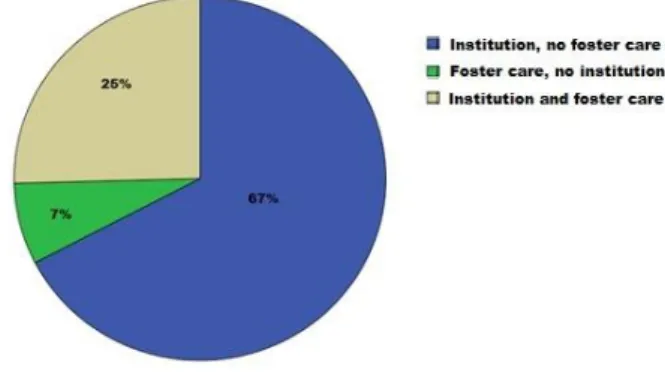
care, and a mixture of both of these types of care. Accordingly, three different groups were created and used for subsequent analyses. Information about the place where the children resided before the adoption procedure was available for 1106 of the 1130 adopted girls (98%). From this group of children, 67 % (n = 745) resided exclusively in institutions, 7% (n = 80) in foster care families, and 25% (n = 281) of all adopted children had experienced a mixture of both types of care during their early lives (Figure 1).
Exclusion Criteria
As relatively few boys were adopted from China, (n = 103; 8%) it was decided to exclude all male children from further analyses. Besides, as the main focus of interest of the study was to compare Chinese children adopted from foster care with children adopted from institutions and with children who had experienced a mixture of both types of care preceding adoption, it was decided to exclude all children for whom pre-adoption care information was not available and children who were adopted from their biological families. It was decided, however, not to exclude children with special needs and/or children who were maltreated, neglected, malnourished and/or disabled. This in order to keep the sample as intact as possible and to be better able to generalize the results to all adopted children from China.
Final Sample
The final sample for the current study consisted of 1106 females adopted from China who were on average 1 year old at adoptive placement (SD = 1.06, range = 0-5 years) and approximately 7 years at the time of the study (SD = 2.52, range = 4-16 years). Adoptive parents were on average 43 years old then (SD = 4.26, range = 34-56). Most of the parents were employed (n = 803; 74%) and a high percentage of the parents were either highly educated (n = 501; 46%) or they completed high school (n = 423; 39%). Most of the families lived in cities (n = 549; 50%), whereas 464 families (42%) resided in villages and 83 families (8%) in rural areas.
14 Procedure
The dataset of the larger study on the development of internationally adopted children has been investigated further and analyzed in somewhat more detail. The variables of interest for this particular study were selected, some new variables were created and a new dataset was constructed to facilitate further analyses. In order to investigate if the time spent in foster care, institutional care or a mixture of both types of care preceding adoption would influence the developmental outcomes of the children, age at arrival was included as covariate in all subsequent analyses. Furthermore, a dichotomous time variable was created in order to investigate possible dose-response relations using moderation
analyses. All female participants were accordingly classified as having been adopted either before (n = 485; 44%) or after their first birthday (n = 621; 56%).
Measures
Children’s general health at placement
Inspection of the dataset revealed that there was only one question which retrospectively addressed the general health status of the adopted children upon arrival in the family. Parents could indicate on a four-point rating scale if their adopted child either (1) enjoyed a good health; (2) experienced unexpected but light health related problems; (3) dealt with unexpected and severe health related problems; or (4) experienced expected health related problems. The variable actually contained two dimensions. One related to the expected-unexpected health related problems dimension and the other implied the light-severe health related problems dimension. An inspection of the answers provided by the parents suggested to create a variable which would indicate if children either (1) experienced health related problems (expected and unexpected), or (2) enjoyed a good overall health at the time of the adoptive placement. Thereupon, the variable was recoded and a new variable representing this dimension was created.
Developmental status
15
indicated if children either experienced no developmental delays (0) or developmental delays (1).
Children’s strengths and competencies
Children’s strengths and competencies were assessed with the Behavioral and Emotional Rating Scale (2nd Edition): Youth Rating Scale (BERS-2). This questionnaire emerged in 1998 as a strength-based measure in the U.S. and it became a widely used standardized and norm-referenced instrument to assess children’s emotional and behavioral strengths (Epstein & Sharma, 1998). The used
questionnaire for the current study contained 52 items which were rated by the parent on a scale of 0 to 3 (0 = not at all like the child; 1 = not much like the child; 2 = like the child; 3 = very much like the child). The scale successively provided both an overall Strengths Index (52 items; α = .83), which represented a single summary score of the adopted children’s strengths, and five subscales:
interpersonal strengths, family involvement, intrapersonal strength, school functioning, and affective strength (Cronbach’s alpha α > .75 for all subscales). The BERS-2 has been widely adopted
throughout the U.S. and it has been used and validated in several studies among children with and without disabilities (Buckley, Ryser, Reid, & Epstein, 2006; Uhing, Mooney, & Ryser, 2005). No studies to date have actually validated the instrument in the Netherlands.
Self-control/self-regulatory abilities
In order to create a self-control variable, or a variable indicating children’s self-regulatory abilities, the items of the above described BERS-2 scales were investigated in somewhat more detail. This
inspection yielded a composite variable similar to the interpersonal strengths scale of the BERS-2 questionnaire. The variable actually contained items regarding the regulation of both emotions and behaviors, like sharing, being aware of the consequences of own behavior, and regulating anger. Therefore, it was decided to use the ‘interpersonal strengths scale’ of the BERS-2 as an index for ‘self-control’ in subsequent analyses (14 items, α = .90). Just as with the other scales of the BERS-2, parents could rate each item on a scale of 0 to 3 (0 = not at all like the child; 1 = not much like the child; 2 = like the child; 3 = very much like the child). As some of the intended analyses required this variable to be dichotomous, the variable was further recoded in a two-categorical response variable with a value of 1 indicating low self-regulatory abilities and a value of 2 for high self-regulatory abilities.
Indiscriminate friendliness
16
item therefore did probably not correspond to the overall scale either. As a consequence, it was decided to only include the variables “children’s reactions towards new adults” and “how friendly is the child with new adults” in the composite variable of indiscriminate friendliness behavior. The variables needed to be recoded first for use in subsequent analyses and in order to correspond to an interpretable overall scale. As such, the answer categories of the included variables were recoded in such a way that a score of (1) indicated indiscriminate friendliness behavior and a score of (0)
indicated no indiscriminate friendliness behavior. After the recoding procedure, the composite variable turned out be a reliable indicator of indiscriminate friendliness behavior (Cronbach’s alpha α = .82). Parent-child relationship
It was also decided to create a composite variable of the questions “how well does the parent get along with the adopted child”, “communication between parent and child”, “does the parent trust the adopted child”, “does the parent feel respected by the child” and “does the parent feel closely connected to the child” to reflect a positive parent-child relationship (Juffer, Geerars, Jansen, & Taalman, 2005). As most of these questions turned out to contain four different response categories, it was decided to create a composite variable with four equal answer categories indicating whether parents rated the relationship with their child either as (1) = bad, (2) = not very well, (3) = ok, (4) = very well. Inspection of the items indicated that this variable was a reliable indicator of a positive parent-child relationship (5 items; α =.78). Furthermore, as some of the analyses required this variable to be dichotomous, a two-categorical response variable was constructed as well with a value of (1)
indicating a less positive parent-child relationship and a value of (2) indicating a positive parent-child relationship. As such, the composite variable could be used in subsequent analyses to test possible moderating effects.
Statistical Analyses
All analyses were conducted using IBM SPSS statistics (version 21). Before the main analyses were carried out, data inspection was performed in order to check the assumption of normality.
Furthermore, the data was inspected for outliers and missing values. Participants with missing values on the testing variable were excluded from further analyses. Participants with missing values on the outcome variables were only excluded from those analyses in which they were included. As such, missing data was pairwise deleted. Significant outliers were winsorized by replacing their value with the value of the closest observation (Tabachnick & Fidel, 2007).
The three included groups were subsequently compared on all outcome measures by performing one ANOVA and multiple Analysis of Covariance (ANCOVA) tests for the BERS-2 scales and by using chi square analyses for the included dichotomous and categorical outcome
measures. Age at arrival was included as a covariate in all analyses. Gabriel’s procedure was used as a post-hoc test for the AN(C)OVAs as this test allows for unequal sample sizes (Field, 2013).
17
factorial analysis of variance in SPSS. With regard to the chi-square analyses, standardized residuals were computed and clustered bar charts were plotted in order to visualize exact differences between the groups and in order to determine which groups differed significantly from each other.
Next, Pearson correlations were calculated in order to assess the relation between the predictors and the outcome variables. Hereupon, mediation analysis was used to assess whether the relation between type of care preceding the adoption procedure and the overall strengths and competencies of the Chinese adopted girls would be mediated by the self-control, or self-regulatory abilities, of the children. First, dummy variables were created of the categorical independent testing variable “Type of care” in order make this categorical variable suitable for a regression analysis. The institutional care group was thereby chosen as the reference category. The mediation analysis next was performed in four steps. First, a regression analysis was performed with the dummy variables of placement status preceding adoption as the predictor variables and the overall BERS-2 scale as the dependent variable. This relation assessed the effect of type of placement before adoption on the adopted children’s overall strengths and competencies. Second, a regression analysis was carried out with children’s self-regulatory abilities as the dependent variable and the dummy variables of the pre-adoptive care arrangement as the predictor. This step investigated whether there existed a relation between the predictor variable and the possible mediator. In a possible, but not necessary third step (e.g., if no significant effect is found in the former step), a regression analysis was conducted with self-control rates as the predictor and the overall BERS-2 scale as the dependent variable, controlled for type of care preceding adoption. If all former steps turned out to be significant, a fourth and final regression analysis was carried out with care arrangement as the predictor, children’s overall strengths and competencies as the dependent variable, controlling for self-control rates. Evidence for a
mediation effect was found if the first three steps were significant, and the fourth step was attenuated. If a mediation effect was found, this effect would be tested using the Sobel test (Sobel, 1982):
2 2 2 2 2 2 b a b a
ab b s a s s s ab SE ab z
Next, the mediating effect of children’s self-regulatory abilities on the relation between type of care arrangement preceding adoption and rates of indiscriminate friendliness behavior of the Chinese adopted girls was investigated. For this purpose, the same steps as outlined above were carried out, but a chi-square analysis was performed first by means of exploring possible relations between the
dependent and the independent variables. Next, a logistic regression analysis for testing mediation effects would possibly be performed instead of a linear regression analysis as the dependent variable concerned a dichotomous variable in this case.
18
different for children adopted either before or after their first birthday. Besides, it was assessed whether the relation between type of care preceding adoption and all outcome measures would be different for children experiencing different qualitative relationships with their parents. Two-way ANOVAs were hereby performed for the overall BERS-scale outcomes and logistic regression analyses were carried out for the dichotomous outcome measures. Dummy variables were created for all categorical variables and continuous variables were centered in order to prevent possible
multicollinearity and in order to make the interpretation of effect sizes easier. In logistic regression analyses, the institutional care group was again chosen as the reference category. Since this study dealt with unequal sample sizes, means were weighted according to their sample size using the Type II model for the factorial analysis of variance in SPSS.
19 Results
Descriptives and Preliminary Analyses
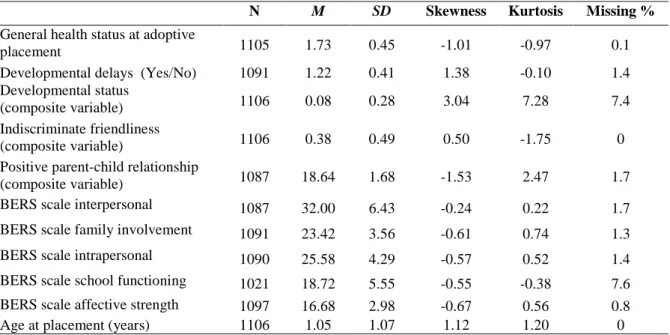
Table 1 displays the means, standard deviations, and the skewness and kurtosis statistics of all
variables. The assumption of normality was met for all variables, except for the variables parent-child relationship and developmental status. There was one participant with an extreme value (7) on the
parent-child relationship variable. This participant caused the distribution to be highly skewed. It was therefore decided to winsorize this extreme value by replacing its value with the value of the closest observation. The winsorized variable turned out to be normally distributed (see Table 1). The
composite variable developmental status was highly skewed as well. A logarithmic transformation of this variable caused the distribution to become less skewed (skewness: -1.88, kurtosis: 3.38). It was therefore decided to include the log-transformed variable in subsequent analyses.
Table 1. Descriptive statistics of all variables
Missing data analysis revealed that the overall missing data percentage was rather low (see Table 1) and that missing data was missing completely at random. As data imputation may influence results, it was per analysis decided to exclude those participants with missing values on the concerning outcome variable. Sample sizes therefore differed per analysis and results should be interpreted with care and with this known fact in mind.
Comparing the Different Types of Care Arrangements
Most of the adopted girls were found to be healthy at the time of placement in their adoptive families (n = 802; 73%) and most of them experienced neither overall developmental delays (n = 855; 79%) nor the more specific developmental delays as investigated in this particular study (n = 1015; 92%). Furthermore, a high percentage of the adopted girls enjoyed a very good relationship with their
N M SD Skewness Kurtosis Missing %
General health status at adoptive
placement 1105 1.73 0.45 -1.01 -0.97 0.1
Developmental delays (Yes/No) 1091 1.22 0.41 1.38 -0.10 1.4
Developmental status
(composite variable) 1106 0.08 0.28 3.04 7.28 7.4
Indiscriminate friendliness
(composite variable) 1106 0.38 0.49 0.50 -1.75 0
Positive parent-child relationship
(composite variable) 1087 18.64 1.68 -1.53 2.47 1.7
BERS scale interpersonal 1087 32.00 6.43 -0.24 0.22 1.7
BERS scale family involvement 1091 23.42 3.56 -0.61 0.74 1.3
BERS scale intrapersonal 1090 25.58 4.29 -0.57 0.52 1.4
BERS scale school functioning 1021 18.72 5.55 -0.55 -0.38 7.6
BERS scale affective strength 1097 16.68 2.98 -0.67 0.56 0.8
20
adoptive parents (n = 962; 89%). Although a lot of children did not demonstrate any signs of indiscriminate friendliness (n = 418; 38%), still almost two third (n =688; 62%) of the adopted children actually showed some signs of this behavioral pattern. With regard to the investigated
strengths and competencies of the Chinese adopted girls, mean scores on all five subscales were found to be rather high: interpersonal strengths: M = 32.00 (range = 7.00 – 45.00); family involvement: M = 23.42 (range = 7.00 – 30.00); intrapersonal strengths: M = 25.58 (range = 5.00 – 33.00); school
functioning: M = 18.72 (range = 1.00 – 27.00); affective strengths: M = 16.68 (range = 4.00 – 21.00). While comparing the three different groups on all relevant outcomes measured on a
continuous scale, none of the performed ANCOVA’s did reveal any significant effects. That is, controlled for age at placement, none of the main effects of type of care on any developmental outcome reached significance (see Appendix A). Children adopted from institutional care, from foster care, or from a mixture of both types of care clearly did not differ on levels of interpersonal strengths, family involvement, intrapersonal strengths, school functioning, affective strengths, and on their overall strength and competency levels. Bootstrapping, a procedure which investigates whether results can be generalized to the population, and at the same time accounts for differences in sample sizes among the included groups, revealed similar results and thereby confirmed the findings. Controlling for sample size, no significant differences between the foster care group, the institutionalized group and the mixed care group were found either for rates of indiscriminate
21
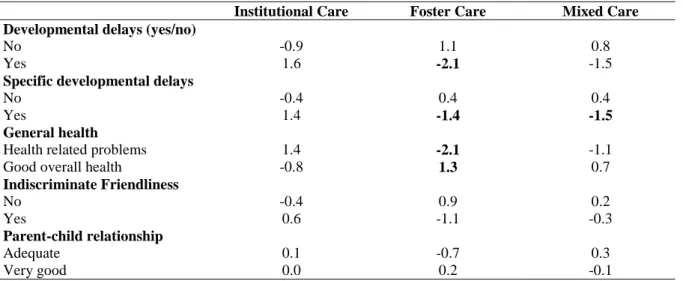
less often unexpected and expected health related problems, and they enjoyed more often a good overall health, than the girls in the other two care groups. Children in the mixed care group were in turn found to experience less health related problems and a better general health than children adopted from institutions. Mean differences on all outcome measures, however, were rather small.
Institutional Care Foster Care Mixed Care
Developmental delays (yes/no)
No Yes -0.9 1.6 1.1 -2.1 0.8 -1.5
Specific developmental delays
No Yes -0.4 1.4 0.4 -1.4 0.4 -1.5 General health
Health related problems Good overall health
1.4 -0.8 -2.1 1.3 -1.1 0.7 Indiscriminate Friendliness No Yes -0.4 0.6 0.9 -1.1 0.2 -0.3 Parent-child relationship Adequate Very good 0.1 0.0 -0.7 0.2 0.3 -0.1
The correlations between all variables, including the independent test variable and the dependent outcome variables, are presented in Table 3.
Mediating Role of Children’s Self-Regulatory Abilities
To investigate whether type of care preceding adoption was able to predict children’s strengths and competencies, a linear regression analysis using dummy variables for the categorical dependent variable was performed. Results confirmed the findings of the earlier performed ANCOVA’s and revealed that differences in care did not predict children’s overall strengths and competencies F(2, 904) = 0.47, p = .63. As no direct effect was found, it was investigated whether there possibly existed
Figure 2. General health at adoptive placement
22
an indirect effect of children’s self-regulatory abilities. The intended mediation model is depicted in Figure 3.
As the main effect included in the first step of the mediation analysis was not significant, a regression analysis with type of care as the independent variable and children’s self-regulatory abilities as the dependent variable was performed in the second step. This relation turned not out to be significant either (F(2, 1086) = 0.66, p = .52), indicating that a mediating effect of children’s self- control, or self-regulatory abilities did not exist.
Figure 3. Mediating role of children’s self-regulatory abilities on the relation between type of care and children’s overall strengths and competencies
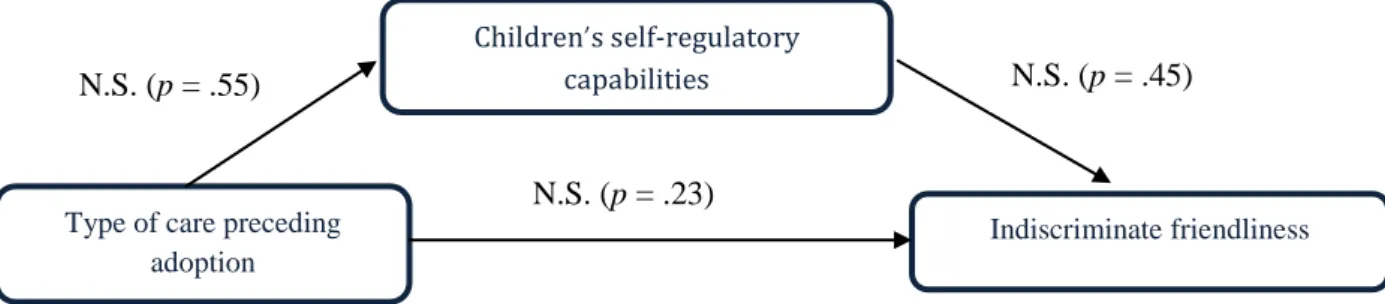
To test a mediating effect of children’s self-regulatory behaviors in the relation between type of care preceding adoption and rates of indiscriminate friendliness, a similar mediation model was intended to be investigated using logistic regression analysis for dichotomous dependent variables. The model is depicted in Figure 4.
Figure 4. Mediating role of children’s self-regulatory abilities on the relation between type of care and rates of indiscriminate friendliness behavior
As the dependent variable concerned a dichotomous variable, chi-square analyses were performed first in order to establish possible relations between the dependent and the independent variables. Results confirmed previous reported findings and revealed that type of care was not related to indiscriminate friendliness (χ2(2, N = 1106) = 2.73, p = .23). Children’s self-control rates were not related to
indiscriminate friendliness either (χ2(1, n = 1087) = 0.60, p = .45). Furthermore, type of care was also not significantly related to children’s self-regulatory abilities (χ2
(2, n = 1087) = 1.20, p = .55). As both independent variables were not related to the dependent variable, no mediation was possible and a logistic regression analysis was therefore not performed.
Type of care preceding adoption
Children’s self-regulatory capabilities
Overall BERS2 scales N.S. (p = .63)
Type of care preceding adoption
Children’s self-regulatory
capabilities
Indiscriminate friendliness N.S. (p = .23)
N.S. (p = .52)
23
TypeC Devdel Genhea ComDevd IndisFr ParChild Placemst Zelfv BERSInte BERS-FI BERSIntr BERS-SF BERS-AS OVBERS2 Ageplace
TypeC
Devdel -.08**
Genhea .07* -.21*
ComDevd -.10* .70* -.23**
IndisFr -.03 .04 -.00 .01
ParChild .00 -.12** .05 -.13** -.08**
Placemst .02 .15** -.01 .15** .08* -.04
Zelfv .01 -.20** .01 -.22** .08** .19** .02
BERSInter -.01 -.10** .04 -.13** .02 .33** -.01 .27**
BERS-FI -.01 -.09** .02 -.14** -.01 .31** -.05 .24** .68**
BERSIntra .01 -.15** .01 -.18** .08** .30** .01 .40** .70** .66**
BERS-SF .02 -.18** -.02 -.20** -.09** .09** .02 .13** .40** .32** .43**
BERS-AS .01 -.10** .03 -.13** .07* .31** -.01 .32** .68** .69** .75** .27**
OVBERS2 .00 -.16** .00 -.18** .01 .33** -.01 .31** .89** .80** .87** .66** .80**
Ageplacem .02 .18** -.02 .14** .08** -.03 .72** .03 .01 -.07* .00 .02 -.03 -.02 TypeC = Type of care preceding adoption
Devdel = Developmental delays at time of adoption (yes/no) Genhea = General health status at time of adoption
ComDevd = Composite variable developmental delays (log variable) IndisFr = Indiscriminatie Friendliness behavior (yes/no)
ParChild = Composite variable parent-child relationship (recoded) Placemst = Placement status (adopted before or after 1 year) Zelfv = Self-confidence
BERSInte = BERS Interpersonal strength scale BERS-FI = BERS Family Involvement scale BERS-Intra = BERS Intrapersonal strength scale BERS-SF = BERS School functioning BERS-AS = BERS Affective strength scale OVBERS2 = Overall BERS scale
Ageplacem = Age in years at adoptive placement Table 3. Correlations between all variables
Moderating Influences
Age at adoption
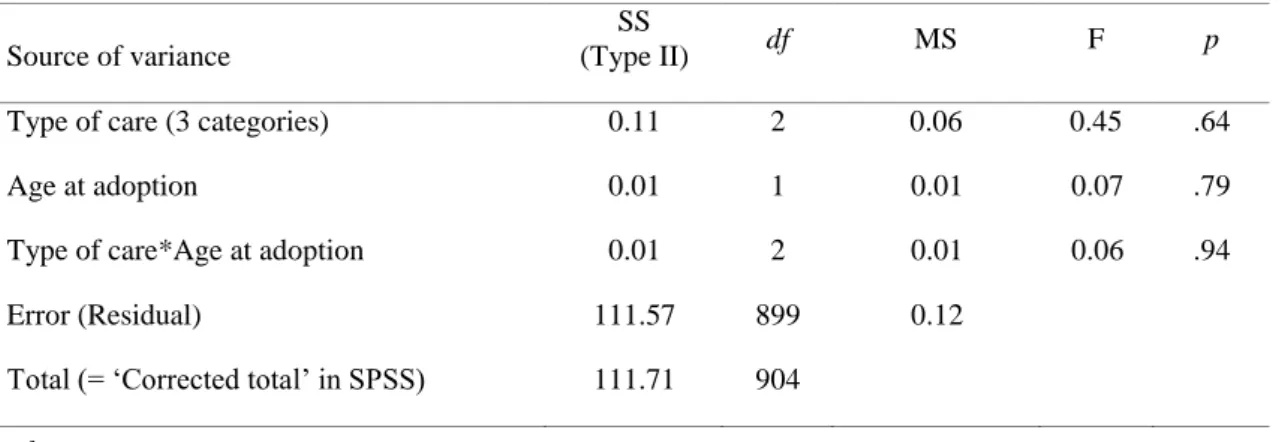
Initially, moderation analyses were carried out in order to examine whether early adoptive placements would reverse the (negative) effects of early deprivation. All assumptions for a two-way analysis of variance were met. Results revealed that the age of the children at adoptive placement did not moderate the relation between type of care and children’s overall strengths and competencies (Table 4). For children adopted either before or after their first birthday, the effect of having been adopted from different types of care on children’s overall strengths and competencies was similar.
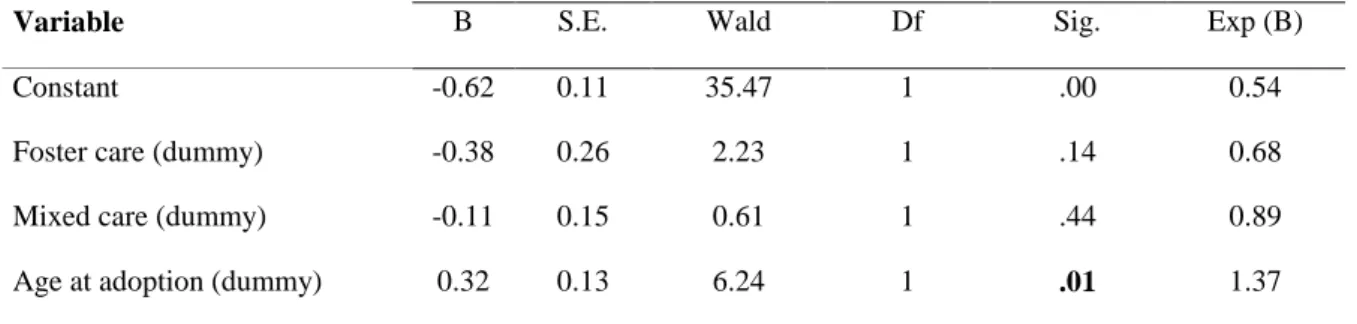
Next, several moderation analyses were performed with the dichotomous outcome variables ‘indiscriminate friendliness’, ‘developmental status’, and ‘children’s general health status’ as the dependent variables. With regard to children’s indiscriminate friendliness, logistic regression analyses revealed that the logistic model with both main and interaction terms included (Model 2) was not statistically significant for indiscriminate friendliness (χ2(5) = 9.52, p = .09). Both interaction terms were not significant either (Wald = 0.00, p = .93; Wald = 0.43, p = .51), indicating that no moderating effect of age at adoption was found for indiscriminate friendliness. For children adopted either before or after their first birthday, the effect of having been adopted from different types of care on the chance of developing indiscriminate friendliness was the same. A main effect, however, was found. Results are presented in Table 5. In terms of overall model fit, Model 1, with only main effects included, was found to be superior to the model with also the interaction terms included (Model 2) as the percentages correctly classified cases did not change from Model 1 to Model 2. Furthermore, there was no significant reduction in the log-likelihood ratio statistic (-2LL) from Model 1 to Model 2 (p >.05). Besides, the Hosmer and Lemeshow statistic was not significant in the first model (p =.94) and Model 1 with only the main effects included turned out to be significant (χ2(3)= 9.08, p =.03). These latter findings indicate that this model suited the data better than a model with only the constant included. Results revealed that age at adoption made a significant contribution to the prediction of indiscriminate friendliness (Table 5). All children adopted after their first birthday had a higher chance Source of variance
SS
(Type II) df MS F p
Type of care (3 categories) 0.11 2 0.06 0.45 .64
Age at adoption 0.01 1 0.01 0.07 .79
Type of care*Age at adoption 0.01 2 0.01 0.06 .94
Error (Residual) 111.57 899 0.12
Total (= ‘Corrected total’ in SPSS) 111.71 904
R2 =.00
Table 4. The effects of age at adoption on children’s overall strengths and competencies
25
of showing this behavior than children adopted before their first birthday. The variance explained by this model was 1% (Nagelkerke’s R2).
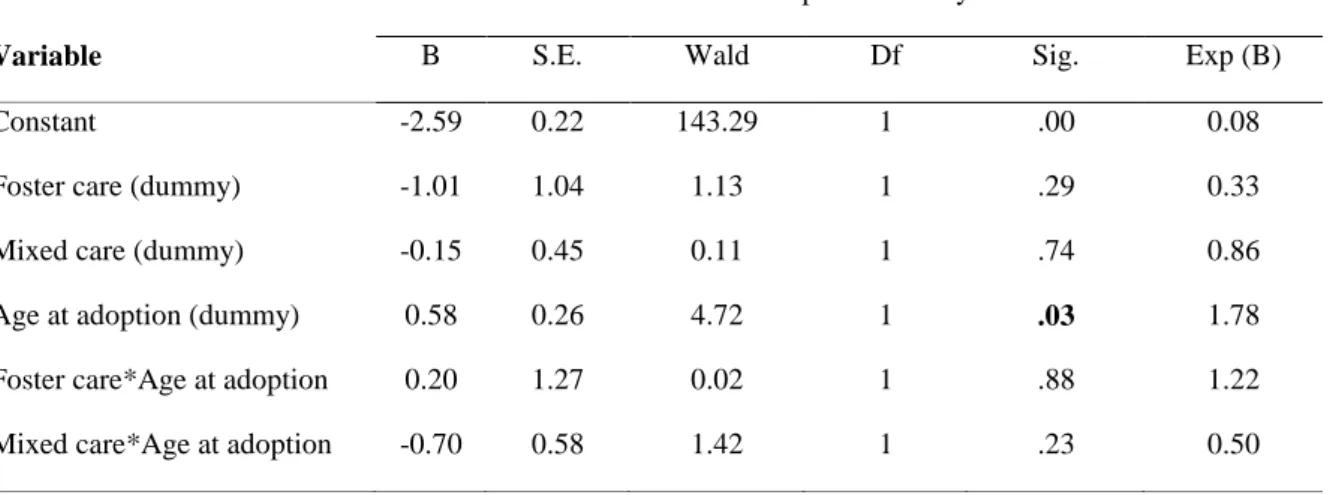
With regard to children’s developmental status, the second logistic regression model, with all main and interaction effects included, turned out to be significant (χ2(5) = 12.64, p < .03). There was a significant reduction in the -2LL statistic from Model 1 to Model 2 (p = .03). Besides, the Hosmer and Lemeshow test was not significant in the second model (p =1.00), indicating that this model suited the data well. The model explained 2.6% (Nagelkerke’s R2) of the total variance in children’s
developmental status. No significant interaction effects were found (Table 6), indicating that no moderating effect was found. For children adopted either before or after their first birthday, the effect of having been adopted from different types of care on experiencing developmental delays was similar. A significant main effect of age at adoption, however, was found (Table 6). Age at adoption thus significantly contributed to the prediction of children’s developmental delays. The positive B-value indicated that children adopted after their first birthday had a higher chance of experiencing developmental delays than children adopted before their first birthday.
With regard to children’s general health status at adoptive placement, the logistic regression model with both the main and the interaction terms included (Model 2) turned out to be significant (χ2(5) = 14.25, p = .01), indicating that this model suited the data better than a model without any predictors included.Furthermore, there was a significant reduction in the -2LL statistic from Model 1, with only main effects included, to Model 2 (p = .01) and the Hosmer and Lemeshow test was not significant in the second model (p = 1.00). The second model apparently suited the data well. The model explained 1.9% (Nagelkerke’s R2
) of the total variance in children’s general health status. No significant interaction effects were found (Table 7). This indicates that for children adopted either before or after their first birthday, the effects of having been adopted from different type of care on children’s general health status were similar.
Indiscriminate friendliness
Variable B S.E. Wald Df Sig. Exp (B)
Constant -0.62 0.11 35.47 1 .00 0.54
Foster care (dummy) -0.38 0.26 2.23 1 .14 0.68
Mixed care (dummy) -0.11 0.15 0.61 1 .44 0.89
Age at adoption (dummy) 0.32 0.13 6.24 1 .01 1.37
26
A significant main effect of the mixed care group, however, was found (Table 7). This care group contributed to the prediction of the general health status of the adopted children in such a way that children adopted from a mixture of both types of care preceding adoption had a higher chance of enjoying a good overall health at adoption than children adopted from institutional care.
Parent-child relationship
To assess whether the relation between type of care preceding adoption and children’s overall strengths and competencies would be different for children experiencing a different qualitative relationship with their parents, a two-way analysis of variance was performed. All assumptions were met. Results of the analysis are presented in Table 8.
The interaction between type of care and the parent-child relationship was not significant. Developmental delays
Variable B S.E. Wald Df Sig. Exp (B)
Constant -2.59 0.22 143.29 1 .00 0.08
Foster care (dummy) -1.01 1.04 1.13 1 .29 0.33
Mixed care (dummy) -0.15 0.45 0.11 1 .74 0.86
Age at adoption (dummy) 0.58 0.26 4.72 1 .03 1.78
Foster care*Age at adoption 0.20 1.27 0.02 1 .88 1.22
Mixed care*Age at adoption -0.70 0.58 1.42 1 .23 0.50
General health status
Variable B S.E. Wald Df Sig. Exp (B)
Constant 0.81 0.12 46.40 1 .00 2.26
Foster care (dummy) 0.77 0.43 3.15 1 .08 2.15
Mixed care (dummy) 0.63 0.27 5.58 1 .02 1.87
Age at adoption (dummy) 0.05 0.16 0.11 1 .74 1.06
Foster care*Age at adoption 0.28 0.65 0.19 1 .67 1.33
Mixed care*Age at adoption -0.51 0.34 2.35 1 .13 0.60
Table 6. Goodness of fit statistics for type of care and age at adoption in predicting children’s developmental status (Model 2: main and interaction effects)
27
Therefore, no moderating effect of the parent-child relationship on the relation between type of care and children’s overall strengths and competencies was found.
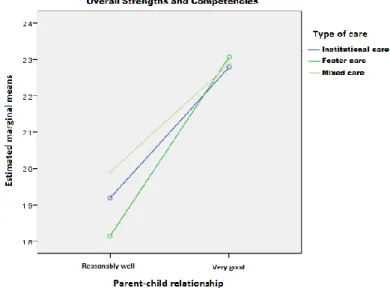
There was, however, a significant main effect of the parent-child relationship, indicating that only the parent-child relationship exerted a direct influence on the strengths and competencies of the Chinese adopted girls. The direct effect is depicted in Figure 5. Controlling for type of care, adopted children who enjoyed a good relationship with their adoptive parents apparently scored better on overall strength and competency levels than children who experienced a parent-child relationship of somewhat lower quality.
Next, logistic regression analyses were performed with the dichotomous outcome variables ‘indiscriminate friendliness’ and ‘children’s developmental status’ as the dependent variables. No moderating effect of the parent-child relationship on children’s general health status was investigated as this outcome variable concerned children’s health status at adoptive placement. Source of variance
SS
(Type II) df MS F p
Type of care (3 categories) 0.05 2 0.03 0.26 .77
Parent-child relationship 11.32 1 11.32 107.21 .00
Type of care*Parent-child relationship 0.19 2 0.09 0.88 .42
Error (Residual) 93.25 883 0.11
Total (= ‘Corrected total’ in SPSS) 104.83 888
Figure 5. Effect of the parent-child relationship on children’s overall strength’s and competencies
R2 =.11
28
With regard to children’s indiscriminate friendliness, logistic regression analyses revealed that the logistic model with both the main and interaction terms included (Model 2) was not statistically significant for indiscriminate friendliness (χ2(5) = 4.80, p = .44). The logistic model with only the main effects included (Model 1) was not significant either (χ2(5) = 4.68, p = .20). This indicates that adding the predictors to the model did not significantly improve the model with only the constant included and that the predictors did not have a significant effect on indiscriminate friendliness. The model was therefore not analysed any further.
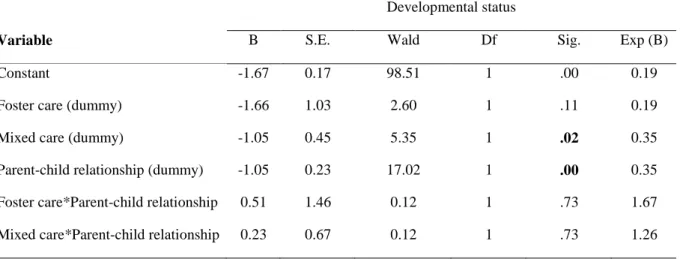
Regarding children’s developmental status, the logistic regression model with all main and interaction effects included (Model 2) turned out to be significant (χ2(5) = 33.05, p = .00). As the log-likelihood ratio statistics from Model 1, with only main effects included, and Model 2 did not differ much (558.654 and 558.426 respectively), the Hosmer and Lemeshow test was similar and
insignificant in both models (p = 1.00) and as the percentage correctly classified cases did not differ between Model 1 and Model 2 (92.3%), both models were found to suit the data well. They explained 7.1% (Nagelkerke’s R2) of the total variance in children’s developmental status. Because possible moderation effects were examined, the second model was decided to be analysed in somewhat more detail. Results are depicted in Table 9. No significant interaction effects were found, indicating that there was no moderating effect of the parent-child relationship on the developmental status of the children. For children with either a very good relationship or a relationship of somewhat lower quality with their parents, the effects of type of care on experiencing developmental delays was similar. Significant main effects of parenting and of the mixed care group, however, were found (Table 9). The negative B-value of the parent-childrelationship variable indicated that all adoptees who enjoyed a very good relationship with their parents had a lower chance of experiencing developmental delays. Furthermore, compared to children adopted from institutions, children adopted from the mixed care group were found to have a lower chance of experiencing developmental delays.
Developmental status
Variable B S.E. Wald Df Sig. Exp (B)
Constant -1.67 0.17 98.51 1 .00 0.19
Foster care (dummy) -1.66 1.03 2.60 1 .11 0.19
Mixed care (dummy) -1.05 0.45 5.35 1 .02 0.35
Parent-child relationship (dummy) -1.05 0.23 17.02 1 .00 0.35
Foster care*Parent-child relationship 0.51 1.46 0.12 1 .73 1.67
Mixed care*Parent-child relationship 0.23 0.67 0.12 1 .73 1.26
29 Discussion
The current study investigated the health, development, strengths, competencies, relationships and indiscriminate friendliness behaviors of 1106 girls adopted from China (mean age at arrival = 1.05 years; mean age at the time of the study = 7.18 years) approximately six years after their adoption to the Netherlands. Age at adoption was taken into account to investigate whether early adoptive
placements would possibly reverse the (negative) effects of early deprivation. Furthermore, the role of children’s self-regulation and the effects of a positive parent-child relationship on all children’s behaviors and developmental outcomes were examined. A comparison was made between girls adopted from institutions, from foster care and from a mixture of both types of care. This paper thereby expands upon previous adoption studies as it is the first study that included a mixed-care group as comparison group and it is one of the first studies that focused exclusively on adopted girls from China.
Results revealed that most Chinese adopted girls were functioning well. They were healthy and experienced no or few developmental delays. Most girls scored also high on individual strengths and competency rates and they had close and mutually satisfying relationships with their adoptive parents. Three thirds of the adoptees were found to show some indiscriminate behaviors. Furthermore, a comparison of the three care groups revealed that girls adopted from foster care were in an advantage with regard to their general health and developmental status. Children adopted from institutions held the least favorable position for these outcomes, and the mixed care group scored in between. Mean differences, however, were small. Neither a mediating role of children’s self-regulatory abilities, nor a moderating role of either age at adoption or the parent-child relationship could be established. Some direct effects of age at adoption and of the parent-child relationship, however, were found. These results were in the expected direction with children adopted before their first birthday and children who had a very good relationship with their parents showing the best outcomes.
General Outcomes
30
2009; Meng & Kai, 2009). Furthermore, adoptive parents who were informed about the quality of the experienced pre-adoption care arrangements of their adopted children indicated that early provided care was mostly of good quality. It should however be noted that this study lacked the appropriate information to determine the actual degree of privation the Chinese adopted children encountered prior to adoption (Gunnar et al., 2000). Results should therefore be interpreted with care.
As expected, almost two-third of the children were found to show behavioral patterns resembling some indiscriminate friendliness. This finding confirms previous research findings, indicating that inconsistent caregiving and early maternal deprivation are often associated with disturbed attachment-related patterns in children (Bruce et al., 2009; Pears et al., 2010). Although the assessment of indiscriminate friendliness in this study consisted of only two items, and as such does not fully capture the whole construct as it was intended by Chisholm (1998), it seems that results of this study can be compared with other studies assessing this behavior.
Comparison of the Different Types of Care Arrangements
Somewhat contrary to the expectations, a comparison of the three groups of adopted children showed that children adopted from institutional care, from foster care, and from a mixture of both types of care did not differ on levels of interpersonal strengths, family involvement, intrapersonal strengths, school functioning, affective strengths, and on their overall strength and competency skills. Furthermore, no significant differences were found for rates of indiscriminate friendliness behavior and for the
experience of a positive parent-child relationship with the adoptive parent. An explanation for this lack in difference between the care groups might be that all those outcomes were measured at later ages, six years post-adoption. Older children reside already longer with their adoptive family and they have reached another developmental stage than younger children. The age and developmental status of the children might therefore have accounted for the reasonably high scores on the outcomes and they might have erased possible earlier developmental delays.
In line with the hypotheses, however, children in the foster care group were found to
experience fewer overall developmental delays at the time of adoption than children in the other two care groups. Children in the institutional care group experienced most overall developmental delays. Furthermore, children adopted from institutions showed more specific developmental delays like delays in fine motor skills, delays in gross motor skills, delays in language development, delays in social development, bed-wetting, uncleanliness, being continuously fearful/anxious, being
31
After their adoptive placement, all adopted children underwent a screening by pediatricians using standardized protocols. As a consequence, adoptive parents might have had a rather accurate notion of the health and developmental status of their adopted children upon arrival in the Netherlands, which possibly contributed to the differential outcomes in the groups with different pre-adoption arrangements. An explanation for the different outcomes might be that the quality and levels of privation have differed among the three included pre-adoption care arrangements. Research has shown that children who resided in foster care have enjoyed more favorable circumstances before adoption and that they show better outcomes than children who experienced institutional care (Van den Dries et al., 2010, 2012; see also Van Schaik et al., 2009). It is, however, only possible to speculate about the current findings as no exact information about the early care environments in China was available.
Children’s Self-Regulatory Abilities
Contrasting with the hypothesis, no mediating role of children’s self-regulatory abilities on the relation between type of care preceding adoption and children’s overall strengths and competencies was found. Furthermore, no mediating effect of children’s self-regulatory behaviors on the relation between type of care preceding adoption and rates of indiscriminate friendliness behavior was found either. It might be that the constructed composite variable of children’s self-regulatory abilities in this study contained some variables which after all did not reflect children’s self-regulatory abilities as it was intended in the literature (Garvin et al., 2012; Gindis, 2005). Besides, some other factors might have accounted for the measured developmental outcomes of the adopted children, such as intelligence and social support. As the outcome measures were assessed several years post-adoption, it is also possible that children’s self-regulatory abilities have exerted an influence during earlier years, but that they do not play such an important role during later years anymore.
The function of disinhibited social behavior after adoption remains somewhat unclear as well. The finding that indiscriminate friendliness is associated with attention regulation and effortful control (Bruce et al., 2009) could not be replicated in this study. As the three groups of adopted children in this study showed similar rates of this behavior, it might be that previous adversity during early lives has resulted in some kind of biological programming which in turn may have caused disturbed attachment-related patterns (Rutter, 1998). The exact explanation for this relation, however, demands further research.
Age at Adoption