A MIXED METHODS STUDY OF THE IMPACT OF SELF-EFFICACY, BELIEFS, AND MATHEMATICAL KNOWLEDGE FOR TEACHING THROUGH PROFESSIONAL
DEVELOPMENT ON STUDENT THINKING
Rhonda Faye Sinquefield
A dissertation submitted to the faculty at the University of North Carolina at Chapel Hill in partial fulfillment of the requirements for the degree of EDD in the School of Education.
Chapel Hill 2016
© 2016
ABSTRACT
Rhonda Faye Sinquefield: A Mixed Methods Study of the Impact on Self-Efficacy, Beliefs, and Mathematical Knowledge for Teaching Through Professional Development on Student Thinking
(Under the direction of Janice Anderson)
The purpose of this mixed method study was to explore the relationship among self-efficacy/beliefs, mathematical knowledge for teaching and student thinking. The study included 20 teachers who took a survey comprised of the Self-Efficacy for Teaching Mathematics
Instrument (McGee, 2012) as well as the Mathematics Beliefs Scale (Fennema, Carpenter, & Loef, 1990). From this group, five teachers participated in a study that included professional development and coaching on the use of student thinking to guide instructional decisions. These five were also interviewed to further explore their efficacy and beliefs regarding teaching mathematics.
In order to determine changes in classroom practice, observational data were collected using a Talk Moves Checklist (Chapin, O’Connor, & Anderson, 2009), the Levels of Engagement
With Children’s Mathematical Thinking Scale (Franke, Carpenter, Levi, & Fennema, 2001), as
well as the Math Talk Community Scale (Hufferd-Ackles, Fuson, & Sherin, 2004). These data were coded so that they were included with other quantitative data from the survey and some parts of the interview. All quantitative data were collected before professional development began and than again when the professional development ended.
Data from the surveys did not show significant changes in teachers’ self-efficacy and beliefs as a result of participation in the professional development and coaching. However, other quantitative data as well as qualitative data did show changes in beliefs and classroom practice as a result of participation in the professional development and coaching portion of the study. Qualitative data also supported the idea that changes in practice, which were directly related to participation in professional development, occurred because of realized student success.
This study offers information related to changes in teachers’ beliefs and classroom practice when coaching follows professional development. In addition, this study provides insight into changes in teachers’ beliefs and classroom practice when teachers see their students being successful with information learned in professional development.
This dissertation is dedicated to my family. To my husband Duane, thank you for always being my cheerleader, even when times were bleak (and there were lots of those times). You never gave up on me and for that I am eternally grateful. To my children and their spouses, thank you for sticking with me all these years. You were always positive and understanding when I had to do work instead of spending time with you. To my beautiful grandchildren Lex and Vera, I tried to at least find time for you through this process. However, I cannot wait until we can spend time
together when my mind is not preoccupied with schoolwork. To my mother, Edith Simpson, thank you for instilling in me a strong work ethic and the capacity to persevere when times get tough. I promise to come see you more! I hope you all know that I could not have accomplished
ACKNOWLEDGEMENTS
This dissertation would not have been possible without the support of many individuals. I would like to thank my dissertation committee: Dr. Janice Anderson, Dr. Susan Friel, Dr. Micha Jeffries, Dr. Rita O’Sullivan, and Dr. Lynda Stone. Dr. Anderson, you happily took me on, even though I was a “math” person. I appreciate your guidance and the many opportunities you gave me to practice working with qualitative data. As my chair, you always tried to lead me in the right direction to accomplish my dream of completing this journey. Dr. Friel, thank you for your passion for mathematics. I appreciate your guidance and for pushing me to present the
mathematics accurately and thoroughly. Dr. Jeffries, thank you for agreeing to be on my committee since you are on faculty at another university. You were always so positive and willing to talk me “off the ledge”. I appreciate the care and concern you always showed me. Dr. O’Sullivan, thank you for sharing your methodology and quantitative expertise. I am not sure I would have gotten through this process without you – especially in Chapter 3 and 4! I greatly appreciate your willingness to meet and talk through the process any time I asked. Dr. Stone, thank you for filling in when my fifth committee member had an emergency during my proposal. You stepped in and immediately had valuable input. I appreciate your agreeing to see this
through and serve again at my defense. You are always willing to do whatever it takes to help the students in Peabody succeed.
thank you for allowing me to use your staff with this study! You never questioned me when I needed to take time off to “write”. You supported the project by literally buying in to the professional development and saw it all as an investment in your teachers. Thank you is not enough to tell you how much I appreciate the leap of faith you took with me on this journey.
A special thank you also goes to my school family. You all so graciously agreed to be a part of my study. Truly, I could not have completed this project without everyone doing the surveys and that special group of 5 for completing the project with me. Everyone was so eager to support my dream and I cannot thank you enough for the time and effort you all invested in this work.
TABLE OF CONTENTS
Page
LIST OF TABLES……….………..xiii
LIST OF FIGURES………..…xiv
CHAPTER 1: INTRODUCTION……….………...…1
Statement of the Problem……….1
Rationale for the Study………2
Study Overview………...3
Significance of the Study……….5
Research Questions………..5
Definition of Key Terms………..6
Conclusion………...…8
CHAPTER 2: LITERATURE REVIEW………...……….9
Introduction……….9
Teacher Efficacy………11
Social Cognitive Theory………12
Teacher Efficacy in Mathematics………..17
Teacher Efficacy Models………...18
Beliefs About Teaching and Learning (Mathematics)……….………..21
Philosophical Views on Beliefs……….21
Challenges of Researching Beliefs………24
Mismatches Between Belief and Practice……….25
Belief System Model……….25
Impact of Beliefs on Instruction………29
So What Does All This Mean………30
Mathematics Knowledge for Teaching (Subject-Matter Knowledge)………...30
Common Content Knowledge (CCK)………...33
Specialized Content Knowledge………35
Pedagogical Content Knowledge………...39
Knowledge of Content and Students (KCS)………..39
Student Thinking………40
Research on Cognitively Guided Instruction……….……40
Knowledge of Content and Teaching………49
Classroom Impact………..53
Summary of Literature………..57
CHAPTER 3: METHODOLOGY………..……….60
Participants………62
Professional Development………...………63
Data Collection………..65
Survey Instruments………65
Self-Efficacy for Teaching Mathematics Instrument (SETMI)……….67
SETMI Reliability………..67
Mathematical Beliefs Scale (MBS)………...68
MBS Reliability……….69
Demographic Survey……….70
Permission………..70
Interview Instrument………..71
Observation Protocol……….71
Time Line of Study………....73
Data Analysis……….……74
Self-Efficacy for Teaching Mathematics Instrument………...74
Mathematics Beliefs Scale……….74
Demographic Survey Data……….75
Interviews………...75
Observation Data………...76
Coaching Notes………..76
Summary………77
CHAPTER 4: FINDINGS OF THE STUDY………..……….78
Participants………78
Research Questions………82
Quantitative Data………...83
Qualitative Data……….96
Putting it all Together………..……102
CHAPTER 5: DISCUSSION, CONCLUSIONS, AND IMPLICATIONS…………...………..104
Limitations of the Study………...108
Implications for Professional Development……….109
Implications for Future Research……….110
APPENDIX A: SELF-EFFICACY FOR TEACHING MATHEMATICS INSTRUMENT (SETMI)………113
APPENDIX B: MATHEMATICAL BELIEF SCALE (MBS)……… …….115
APPENDIX C: DEMOGRAPHIC SURVEY………...………...118
APPENDIX D: SURVEY INFORMATION AND DIRECTIONS………..………..120
APPENDIX E: INTERVIEW PROTOCOL………..………..122
APPENDIX F: LEVELS OF ENGAGEMENT WITH CHILDREN’S MATHEMATICAL THINKING………...125
APPENDIX G: LEVELS OF MATH TALK LEARNING COMMUNITY…………..……….126
APPENDIX H: OBSERVATION PROTOCOL LEVEL ASSIGNMENT………..…...128
APPENDIX I: TALK MOVES COACHING/OBSERVATION CHECKLIST………..……...129
LIST OF TABLES
Table Page
2.1 Listing of Self-Efficacy Instruments………..16
2.2 8 Mathematical Practices………42
2.3 Levels of Math-Talk Learning Community Components………..46
2.4 Talk Moves Goals, Moves and Questions………..47
2.5 Synthesis of Information Regarding CGI Story Problems……….50
3.1 Research Crosswalk………....61
3.2 9-Grid Groupings………....63
3.3 Sources and Purpose for Each Part of the Survey Instrument………....66
3.4 Reliability and Descriptive Statistics of the Constructs………...68
3.5 Data Collection and Timeline……….73
4.1 SETMI and MBS 9-Grid of School Participants………....79
4.2 Demographic Analysis of Sub Groups in 9-Grid………....81
4.3 Pre and Post Teacher Self-Assessment of Teaching Mathematics……….84
4.4 Results of Independent t-test………...85
4.5 Results of Pre and Post SETMI scores………...86
4.6 Teacher changes from Pre to Post on SETMI and MBS………87
4.7 Study Participants Pre and Post Survey 9-Grid Comparison on SETMI and MBS………...88
4.8 Felt Board Activity Pre and Post Mean Scores………..89
4.9 Talk Moves Observation Data………91
4.10 Differences in Observation Scales from Pre to Post……….93
4.11 Teacher Quotes About Using Student Thinking for Making Instructional Decisions……..96
LIST OF FIGURES
Figure Page
1.1 The Cyclical Interplay among MKT, Student’s Thinking and Self-Efficacy/Beliefs………..4
2.1 The Cyclical Nature of Teacher Efficacy………...19
2.2 Transmittal/Absolutist Relationship……….…..23
2.3 Constructivist Relationships……….……..23
2.4 Wilkins Theoretical Model Relating Content Knowledge, Attitudes, Instructional Beliefs and Practice………...26
2.5 The Sensible Web-of-Beliefs Model………..28
2.6 Domains of Mathematical Knowledge for Teaching……….…….34
CHAPTER 1: INTRODUCTION Statement of the Problem
It has been well documented in research literature that self-efficacy for teaching
mathematics matters in the classroom (Allinder, 1994; Bandura, 1986; Guskey, 1988; Henson, 2001; Jerald, 2007; Stein & Wang, 1988; Tschannen-Moran & Woolfolk Hoy, 2007). Directly tied to teachers’ self-efficacy is their belief system. According to Pajares (1992), many teachers’ beliefs about teaching and learning come from their own experiences as students of mathematics. For this reason, belief systems are often static and very difficult to change. In fact, Handal & Herrigton (2003) suggest teaching practices will unlikely change without significant changes in teachers’ belief systems.
The Principle and Standards for School Mathematics (2000) document outlines the
complexity of teaching mathematics well and discusses the intricacies of effective mathematics teaching. Teaching mathematics well, according to the standards, involves a deep knowledge and understanding of mathematics as well as a deep knowledge of children as mathematicians. Thus, it is not enough for teachers to be “good at math”. They must also have a well-developed
learned mathematics when they were in elementary school. Therefore, changing teacher belief systems and efficacy by developing their understanding and use of student thinking then continues as an important area of research.
There are other views on how to bring about changes in teacher belief systems. One view comes from the work of Guskey (1986) who presented a model for change that was predicated on the belief that “significant change in teachers’ beliefs and attitudes is likely to take place only
after changes in student outcomes are evidenced” (p.7). This notion is not only tied to beliefs but
also self-efficacy for teaching mathematics. His proposition was that teachers will alter their related beliefs when student success comes from an implemented instructional strategy. More research is needed to determine if the use of student thinking to guide instruction can show enough gains in student achievement to change teachers’ self-efficacy for and therefore beliefs and practices regarding mathematics teaching and learning.
Rationale for the Study
Improving mathematics teaching and learning continues to be a concern for the United States for several reasons. Student performance still lags behind other nations on international assessments and there is a growing need to create a workforce with skills in science, mathematics and technology (Ball, 2008; Lips & McNeil, 2009). To further this, Johnson (2011) states that mathematics is a crucial subject directly impacting job readiness and economic competitiveness. President Obama (2013) also weighed in on the importance of improving mathematics education in his State of the Union Address by pledging support for new initiatives aimed at better
new curriculum entitled Common Core Standards (Initiative, 2012). Implementation of the standards and consequently improvement in mathematics education was deemed dependent on the classroom teacher. Kevin Baird, Co-Founder and Chairman of the Common Core Institute, outlined the difficulty associated with this idea by stating,
The biggest challenge coming from the Common Core Standards is not the content itself, it’s the notion of a learning target, or level of cognitive demand and critical thinking, attached to a content standard. These are overlays that demand changes in instructional practice. And, frankly, this change is revolutionary. It will cause a big change in how you do your job as a teacher (Achieve 3000, 2012, p.1).
These changes in instructional practice include the idea of using students’ thinking as a guide for instructional decision-making. The National Research Council (2001), called for teachers to engage in inquiry into student thinking. Several scholars in mathematics education confirm that knowledge of student thinking is a major aspect of pedagogical content knowledge for teaching mathematics (An, Kulm, & Wu, 2004; Ball, Thames & Phelps, 2008; Shulman, 1986).
Study Overview
the teaching and learning of mathematics. Additionally, the study will look for any relationship between student success and teacher changes in practices and beliefs.
Figure 1.1: The cyclical interplay among MKT, student thinking and self-efficacy/beliefs.
Adapted from Susan Friel, Comps Defense Meeting, October 8, 2015
Figure 1.1 illustrates this proposed interplay between mathematical knowledge for teaching (MKT), attending to student thinking, and teachers’ self-efficacy and beliefs about teaching mathematics. Through professional development in Cognitively Guided Instruction (CGI), teachers will introduce different types of story problems in their math instruction and incorporate “talk moves” to foster students’ sharing of their mathematical thinking. Job-embedded coaching will accompany the professional development to provide feedback to teachers on using CGI problems, talk moves, and intentional attending to students’ strategies in order to shape instruction.
Mathema.cal
Knowledge for
Teaching (MKT)
An outside CGI consultant was used to provide both the professional development and the coaching components of the study. Teachers in the study consisted of a first grade team of 5 teachers from the same urban elementary school. It was the goal of the study to determine if teacher beliefs, instructional practices, and self-efficacy with respect to teaching mathematics, could be impacted by professional development on student thinking followed by job-embedded coaching. An additional goal was to determine if teachers’ experiencing student success in mathematics learning based on their increased knowledge and understanding of student thinking impacted the teachers’ efficacy, beliefs and practices regarding the teaching of mathematics. Significance of Study
Ultimately, the goal of education is to support student learning. Teachers are at the heart of this goal. Guskey (1986) posited that the likelihood of change in beliefs and thus teacher behaviors is directly related to experienced successes in student outcomes. The work of Carpenter et.al (2015) on Cognitively Guided Instruction (CGI) highlights the importance of attending to student thinking to guide instructional decision-making and ultimately increase student achievement.
In this study, attending to student thinking and its use to guide instruction has potential for shedding light on a teachers’ self-efficacy for teaching mathematics as student success is realized through the implementation of new instructional strategies. In addition, information regarding the changes in teachers’ beliefs and in instructional practices as a direct link to student success will also be explored.
Research Questions
The following research questions guided this study:
2) What is the likelihood of teachers’ attending to student thinking to shape their instruction if student success is realized?
3) What role, if any, do self-efficacy and beliefsplay in teachers’ use of student thinking to guide instruction?
4) A. What role, if any, does professional development on attending to student thinking play in…
A: increasing teachers’ use of student thinking for making instructional decisions? B: changing teachers’ beliefs and practicesabout mathematics instruction?
C: increasing teacher efficacy about teaching mathematics? Definition of Key Terms
The terms listed in this section appear frequently throughout each chapter of this
dissertation, particularly the literature review. The definitions given in this section are intended to aid the reader in better understanding the meaning of the terms as they relate to the study discussed in this document.
of students’ thinking, and e) how professional development can impact knowledge, beliefs and practices of teachers (Carpenter et.al, 2015).
3) A Constructivist View of Mathematics is teacher’s orientation to see mathematics as an unfinished product with results open to revision. Teachers with this philosophy adhere to a problem-solving view of mathematics (Ernest, 1989).
4) Job-embedded professional development is learning that is grounded in daily teaching practice and is designed to enhance and support teachers’ instructional practices related to content-specific teaching with the specific intent of improving student learning (Darling-Hammond & McLaughlin, 1995).
5) Mathematical Knowledge for Teaching (MKT) is subject-matter knowledge that includes common content knowledge (CCK) of mathematics but also specialized content
knowledge (SCK) (math knowledge not used by the average adult but that which is
unique to teaching mathematics) (Ball, Thames, & Phelps, 2008).
6) Mathematics self-efficacy is a teacher’s confidence in their own ability to solve mathematical problems (Betz & Hackett, 1983). This term was later expanded to include not only the teacher’s own mathematical ability confidence but also confidence for teaching mathematics (Kranzler & Pajares, 1997).
7) Pedagogical Content Knowledge (PCK) is a combination of knowledge that includes
knowledge of content and students (KCS) and knowledge of content and teaching (KCT).
This type of knowledge has to do with how subject-matter is made comprehensible to others (Ball, Thames, & Phelps, 2008).
9) Teaching efficacy is a teacher’s judgment of his/her own ability to promote desired outcomes of student learning (Tschannen-Moran & Woolfolk Hoy, 2007).
Conclusion
This is a mixed-methods study organized in five chapters. Chapter 1 is an introduction to the study. This chapter provides a statement of the problem, rationale, study overview,
CHAPTER 2: LITERATURE REVIEW Introduction
For over four decades, research has been delving into what constitutes good teaching and how this teaching impacts instruction and student learning. As a result of perceived failures to various reform efforts, along with the call for a more skilled workforce that is strong in science, technology, and mathematics, researchers have taken a keen interest in mathematics instruction. The most recent mathematics curriculum reform brought about by Common Core State
Standards (National Governors Association Center for Best Practices & Council of Chief State School Officers, 2010) requires teachers to possess greater skills than ever before. Progressive innovations such as this bring certain burdens and discomforts to the teaching situation because progressive approaches are more difficult to teach than traditional math approaches (Handal & Herrington, 2003).
The “Teaching Principle” outlined in the Principles and Standards for School
Mathematics (National Council of Teachers of Mathematics, 2000) specifies the scope of
knowledge needed by teachers. This includes knowledge of mathematics, students, and math pedagogy. The complexity of what is needed to teach mathematics well is acknowledged in the
Standards document. This complexity is one of the reasons researchers have struggled to reliably
characteristics involving teacher efficacy and beliefs along with knowledge of math content, pedagogy and students provide the greatest insight into teacher practice (Ball, 1991; Ernest, 1989; Shulman, 1986).
This chapter provides a literature review that traces evolving research over the last four decades on self-efficacy and beliefs for teaching math, mathematical knowledge for teaching, and the use of student thinking on classroom practice. Teacher self-efficacy alone has well over a half million articles and mathematical knowledge for teaching has more than 2 million. To narrow the search only scholarly and peer reviewed journals, articles, and dissertations were considered along with some published books. Additionally, articles focusing on just pre-service teachers were weeded out for the most part. Finally, articles related to teacher efficacy in other countries were limited in use since the focus of this study was teachers in the United States.
To narrow the findings on self-efficacy and beliefs, mathematical knowledge for teaching, and the use of student thinking for instruction, key words were used during each search. For articles related to self-efficacy, key words such as self-efficacy, teacher beliefs and measurement instruments were used. To narrow the search further, elementary mathematics was included. This brought the information into a more manageable collection for extensive reading on self-efficacy. To search for articles on mathematical knowledge for teaching, the key words of teacher knowledge and pedagogical content knowledge were used, again reducing the number of articles significantly. For student thinking, the key words of student thinking, elementary
Articles used in this literature review came from numerous sources, however, a few specific journals proved to be exceptionally useful. The Elementary School Journal, the Journal
for Research in Mathematics Education, the Handbook of Research in Mathematics and the
Handbook of Research on Mathematics Teaching and Learning provided extensive collections
related to the topics for this literature review. Math Solutions and Heinemann were most often the publishers for books found related to the topics for this review.
After a broad reading on each topic, leading scholars began to emerge as authorities in their perspective fields. For example, Bandura, Woolfolk-Hoy, Tschannen-Moran and Pajares appeared to be leaders in the area of self-efficacy. Shulman and Ball emerged as leaders in the area of mathematical knowledge for teaching while Ernest and Ball arose as authorities in the area of pedagogical knowledge for teaching. Finally, Carpenter, Fennema, Franke, Levi and Empson provided extensive publications on the use of student thinking as a guide for
instructional decision-making. All the previously mentioned names were by no means the only ones cited in this literature review; however, they did provide a theoretical foundation for weeding through the plethora of information that was generated during the early stages of this study.
Teacher Efficacy
To begin understanding teacher-efficacy one must understand its theoretical roots.
in theory people are not products of one determinant but rather the dynamic interplay between the internal, external, as well as current and past behavior.
Central to Bandura’s work is the idea of self-efficacy, which he defined as “beliefs in one’s capabilities to organize and execute the courses of action required to produce given attainments” (Bandrua, 1997, p.3). Thus, human action, motivation and perseverance are guided by people’s beliefs in their efficacy. Self-efficacy then is a powerful predictor of behavior. The research suggests that the basic principles that frame Bandura’s self-efficacy work are very closely related to teacher efficacy.
Teacher efficacy is described as a teacher’s judgment of their ability to promote desired outcomes of student learning (Henson, 2001; Hoy, 2000; Protheroe, 2008; Tschannen-Moran & Woolkfolk Hoy, 2007; Woolfolk Hoy & Burke-Spero, 2005). Building on the work of Bandura, a great deal of research has been spent on the concept of teacher efficacy and its affect on teacher behavior in the classroom. Bandura’s self-efficacy theory is supported by empirical evidence that found teachers’ behaviors are related to their self-efficacy beliefs (Tschannen-Moran &
Woolfolk Hoy, 2007). However, one obstacle in research has been in identifying the sources of these beliefs because it is difficult to measure beliefs.
Social Cognitive Theory
the teaching performance a failure, then teacher efficacy is lowered. Unfortunately, because of these perceptions, self-efficacy beliefs can become self-fulfilling prophecies validating either capacity or incapacity to teach effectively (Tschannen-Moran & Woolfolk Hoy, 2007). According to social cognitive theory, this happens because the proposed belief in one’s own ability is a driving force that influences motivation to act, extend effort, and persist in the face of setbacks (Bandura, 1977).
According to Bandura (1986, 1977) verbal persuasion is another source of teacher efficacy. In schools, this might manifest itself in the form of professional development that touts persuasive claims of a topic’s usefulness (Tschannen-More & McMaster, 2009). Another form of verbal persuasion comes from feedback or encouragement from a colleague or supervisor
designed to convince the teacher that they can implement a new strategy. Although verbal persuasion in isolation may not significantly boost self-efficacy, when combined with other sources it can prove beneficial in helping teachers expend more effort or persist when attempting to strengthen their teaching skills.
Vicarious experiences as explained by Bandura (1997) help teachers analyze their own capabilities in relation to others. In this regard, the target skill is modeled by another teacher. These observations of a modeled performance impact self-efficacy beliefs in several ways. If the observer identifies with a model that performs well, then the observer’s self-efficacy is
attempting the task. However, if the observer sees a failed attempt, then self-efficacy is negatively impacted because the task seems out of reach.
Physiological experiences are another source of teacher self-efficacy. Bandura (1997) stated that people rely on information from physiological and emotional states when judging their own abilities. Arousal, as identified by an elevated heart rate or trembling hands can have debilitating effects on self-efficacy. Anxiety can cripple a teacher’s ability to even try a new strategy. However, these emotions are not always bad. Self-efficacy depends on whether the teacher sees the situation as a challenge or a threat. Tschannen-Moran and McMaster (2009) found that fear associated with these physiological and emotional stressors can be reduced if teachers are provided with support, encouragement and assistance.
The sources of self-efficacy (as outlined by Bandura) for teaching have been extensively explored in research literature. Various studies over the last three decades have documented the impact of these sources in relation to helping or hurting teachers’ efficacy (Henson, 2001;
Protheroe, 2008; Stein & Wang, 1988; Tschannen-Moran & McMaster, 2009; Tschannen-Moran & Woolfolk Hoy, 2007; Tschannen-Moran, Woolfolk Hoy, & Hoy, 1998; Woolfolk Hoy & Burke-Spero, 2005).
classes on standardized tests. Compelling findings in almost every study indicated that teacher efficacy matters in the classroom.
Self-Efficacy Instruments
Obtaining acknowledgement by the research community that teacher efficacy matters has been much easier than developing a reliable and valid instrument to measure it. Specifically, the research of self-efficacy has struggled over the years due to debates over measuring self-efficacy in context and with construct validity (Henson, 2001). Over 30 years ago, the RAND corporation research brought the idea of measuring teacher efficacy to the forefront with two questions that led to powerful results (Protheroe, 2008). The RAND study was based on the theoretical framework of Rotter’s (1966) social learning theory. The two questions in the study were constructed to determine whether a teacher believed that student motivation and learning were under the teacher’s control (Henson, 2001). This orientation for questioning guided the majority of teacher efficacy research throughout the 70s and 80s. However, concerns over construct validity and reliability with only two items led researchers to develop stronger instruments that included not only more questions but different types of questions aimed at getting to the heart of measuring teacher efficacy. Table 2.1 provides a listing of self-efficacy instruments used in research over the last 40 years. When looking at the theoretical frameworks of these instruments it is clear that the earlier studies grew out of Rotter’s locus of control theory while later
instruments were based on Bandura’s social cognitive theory.
Table 2.1
Listing of Self-Efficacy Instruments
Author Title Theoretical basis Sample Items
Armor et al. (1976)
Berman, McLaughlin, Bass, Pauly,
and Zellman (1977)
RAND study Rotter’s social learning theory (locus of control of reinforcement)
If I try really hard, I can get through to even the most difficult or unmotivated students.
Rose and Medway
(1981) Teacher Locus of Control (TLC) Questionnaire
Rotter’s social learning theory (locus of control of reinforcement)
When the grades of your students improve, it is more likely a. because you found ways to motivate the students, or b. because your students were trying harder to do well. Guskey (1981) Responsibility
for Student Achievement (RSA) questionnaire
Rotter’s social learning theory (locus of control of reinforcement)
If a student does well in your class, would if probably be a. because that student had the natural ability to do well, or b. because of the encouragement you offered.
Ashton, Olejnik, Crocker, and McAuliffe (1982)
Webb Efficacy Scale Rotter’s social learning theory (locus of control of reinforcement)
a. A teacher should not be expected to reach every child; some students are not going to make academic progress. b. Every child is reachable. It is a teacher’s obligation to see to it that every child makes academic progress.
Circle 1:
1. I agree mostly with “a”. 2. I agree mostly with “b”. Ashton et al. (1982) Ashton Efficacy
Vignettes Bandura’s theory of self-efficacy from social cognitive theory One of your students misbehaves frequently in your class and is often disruptive and hostile. Today in class, he began roughhousing with a friend in the back of the class. You tell him firmly to take his seat and quiet down. He turns away from you, says something in a belligerent tone that you can’t hear and swaggers to his seat. The class laughs and then looks to see what you are going to do. How effective would you be in responding to this student in a way that would win the respect of the class? (Likert-type scale from l “extremely ineffective” to 7”extremely effective”).
Betz and Hackett
(1983) Mathematics Self- Efficacy Scale (MSES)
Bandura’s theory of self-efficacy
from social cognitive theory Add two large numbers (e.g., 5,739 + 62,543) in your head. (Likert-type scale from 0 “no confidence at all” to 9 “complete confidence”).
Gibson and Dembo
(1984) Teacher Efficacy Scale (TES) Bandura’s theory of self-efficacy from social cognitive theory When a student does better than usual, many times it is because I exert a little extra effort. (Likert-type scale from 1 “strongly agree” to 6 “strongly disagree”).
Riggs and Enochs (1990)
Science Teaching Efficacy Belief Instrument (STEBI)
Bandura’s theory of self-efficacy from social cognitive theory with items taken from the TES
When a student does better than usual in science, it is often because the teacher exerted a little extra effort. (Likert-type scale from “strongly agree” to “strongly disagree”). Bandura (1997) Teacher Self-
Efficacy Scale (TSS)
Bandura’s theory of self-efficacy
from social cognitive theory How much can yo do to keep students on task on difficult assignments? (Likert-type scale from l “nothing” to 9 “a great deal”).
Kranzler and Pajares
(1997) MSES-Revised (MSES-R) Bandura’s theory of self-efficacy from social cognitive theory Same as the MSES with a Likerty-type scale from 1 to 5. Enochs, Smith, and
Huinker (2000) Mathematics Teaching Efficacy Belief Instrument (MTEBI)
The STEBI modified to be math- specific.
Bandura’s theory of self-efficacy from social cognitive theory with items taken from the TES
When a student does better than usual in mathematics, it is often because the teacher exerted a little extra effort. (Likert-type scale from “strongly agree” to “strongly disagree”).
Tschannen-Moran and Woolfolk Hoy (2001)
Teacher’s Sense of Efficacy Scale (TSES) formerly The Ohio State TES
Bandura’s theory of self-efficacy from social cognitive theory with Likert-type scale from the TSS.
How much can you do to get through to the most difficult students? (Likert-type scale from 1 “nothing” to 9 “a great deal”)
Dellinger et al.
(2008) TEBS- Self Bandura’s theory of self-efficacy from social cognitive theory Right now in my present teaching situation, the strength of my personal beliefs in my capabilities to….1. Plan activities that accommodate the range of individual differences among my students… (Likert-type scale from 1 “weak beliefs in my capabilities” to 4 “very strong beliefs in my capabilities”)
Gibson and Dembo (1984) developed the Teacher Efficacy Scale (TES) which built on the RAND questions but used Bandura’s social learning theory of self-efficacy to interpret the results. Bandura (1997) followed this work with his own Teacher Self-Efficacy Scale. His work clarified the distinction between self-efficacy and locus of control with data showing that beliefs about producing a certain action (perceived self-efficacy) were not the same as beliefs about ability to affect outcomes (locus of control). He concluded that there is little to no empirical relationship between self-efficacy and locus of control. His findings showed that locus of control is a weak predictor of behavior, whereas perceived self-efficacy seems to be a strong predictor of behavior (Bandura, 1997). Thus, Bandura’s Teacher Self-Efficacy Scale (TSS) provided a more multifaceted picture of teachers’ beliefs encompassing efficacy in the classroom but in the greater school community as well. The teacher efficacy instruments continued to change even after the development of the Bandura instrument as illustrated in Table 2.1. To date, the most widely used and accepted scale for measuring general teacher self-efficacy is the Teacher’s Sense of Efficacy Scale (TSES) developed by Tschannen-Moran and Woolfolk Hoy (2007). Teacher Efficacy in Mathematics
Building on the work of Gibson and Dembo’s Teacher Efficacy Scale (TES) along with Bandura’s Teacher Self-Efficacy Scale (TSS), researchers began to look more closely into the idea that self-efficacy of teachers is not uniform across different tasks and subject-matter
(McGee & Wang, 2014). Data suggested some inequalities in teacher efficaciousness with regard to teaching particular subjects (Tschannen-Moran et al., 1998). Thus, teacher efficacy came to be viewed as both context and subject-matter specific. To illustrate, a teacher may have high
Teacher Efficacy Models
Tschannen-Moran et al. (1998) proposed an integrated model to look at teacher efficacy that deals with the teaching task and its context but also the teacher’s self-perception of teaching competence. Their model takes a more cyclical approach to teacher efficacy as demonstrated in Figure 2.1. Analysis of the task looks at the importance of factors that make the specific teaching difficult or what the constraints of the task may be and weighs this against an assessment of available resources to facilitate learning. On the other hand, assessment of personal teaching competence looks at how the teacher judges their personal abilities such as knowledge, skills, strategies, or personality against personal weaknesses in a particular teaching context. Looking at these two components along with the teachers’ already established efficacy sources and cognitive processing leads to a measure of self-efficacy for the specific teaching task at hand (Tschannen-Moran et al., 1998). Based on the consequences of teacher efficacy and the actual teaching experience (performance), new sources of efficacy are assimilated into existing efficacy. As the notion of self-efficacy being tied to specific contexts, situations, and content grew, so did the instruments for measuring content-specific efficacy (see Table 2.1). Again, these instruments were not without problems due to the continued inability of researchers to clearly define the constructs in literature (Pajares, 1997).
The Mathematics Self-Efficacy Scale (MSES) was created to measure teachers’
neither of these instruments reliably measured the second construct, self-efficacy for teaching math.
Figure 2.1: The cyclical nature of teacher efficacy
Adapted from Tschannen-Moran, Woolfolk Hoy and Hoy (1998)
The Mathematics Teaching Efficacy Beliefs Instrument (MTEBI) developed by Enochs, Smith and Huinker (2000) was created to specifically measure a teacher’s belief about his or her ability to teach mathematics (self-efficacy for teaching math). The MTEBI is the most widely used instrument that specifically looks at self-efficacy for teaching mathematics (Uswatte, 2013). While the MSES, MSES-R, and the MTEBI had provided a good starting point for looking at the
Sources(of(Efficacy( Informa1on(
(
Verbal(Persuasion( Vicarious(Experience( Physiological(Arousal( Mastery(Experience(
(
*******************( New(Sources(of( Efficacy(Informa1on(
Cogni1ve(( Processing(
Analysis(of( Teaching(Task(
( ( (
Assessment(of( Personal( Teaching( Competence(
Teacher(( Efficacy(
Consequences(of( Teacher(Efficacy((
(
validity and reliability. In fact, Swackhamer (2010) stated that even though context-specific teacher self-efficacy has been attempted, the measures currently in use are not completely valid. Although theoretical confusion continues regarding self-efficacy instruments and the work on validity of content- and context-specific instruments has slowed; the work for creating a viable instrument has not stopped.
The Self-Efficacy for Teaching Mathematics Instrument (SETMI) (McGee, 2012) was developed in response to the need for a more valid and reliable measurement of mathematics teacher self-efficacy (McGee, 2012). The SETMI (McGee, 2012) aligns with Bandura’s social cognitive theory and further explores the complex nature surrounding teachers’ mathematical belief system. According to McGee and Wang (2014) the SETMI shows evidence of validity and reliability on two aspects of self-efficacy: Part 1 measures efficacy for pedagogy in mathematics
(EPM) and Part 2 measures efficacy for teaching mathematical content (ETMC). The original instrument was revised to improve reliability. Both versions of the SETMI (McGee, 2012) were examined using Cronbach’s alpha and yielded reliability coefficients of .86 for EPM (on both version one and two) and .91 and .93 reliability for ETMC on version one and two respectively (McGee & Wang, 2014).
Beliefs About Teaching and Learning (Mathematics)
Teachers’ self-efficacy is tied directly to their belief systems. In mathematics this is an important idea since belief systems are thought to be “composed mainly of episodically-stored material derived from personal experience or from cultural or institutional sources of knowledge transmission” (Nespor 1987, p. 320). In other words, belief systems include specific memories of personal experience and feelings that are often not open to outside evaluation or examination. So many teachers’ beliefs about teaching and learning come from their own experiences as students of mathematics. For this reason, belief systems are often relatively static and less malleable than knowledge systems. This is further complicated by the emotional aspect associated with beliefs that determines rightness and wrongness (Pajares, 1992). Some research suggests that teaching practices will unlikely change without significant changes in teachers’ values and beliefs (Handal & Herrington, 2003).
However, some research literature suggests that “belief systems are dynamic, permeable mental structures, susceptible to change in light of experience” (Thompson 1992, p. 140). Other research supports this notion of a dynamic interplay between knowledge and beliefs. Campbell and Malkus (2014) describe a model of looking at beliefs that combines both knowledge and beliefs along with classroom conditions and interactions as the impetus of instructional practices. The affective and emotional aspects of beliefs influence the ways in which memories are
indexed, retrieved, reconstructed and recalled. These ideas about beliefs have important implications for teacher learning and how this learning is used.
Philosophical Views on Beliefs
observable in mathematics classrooms. The first philosophy according to Ernest (1989) is the problem-solving view of mathematics. Teachers with this orientation see mathematics as an unfinished product with results open to revision. The second view, the Platonist view, sees math as static, with a unified body of knowledge, along with interconnected structures and truths. In this view, math is seen as a monolith, a static product, discovered, not created (Ernest, 1989). The final view, the instrumentalist view, sees math as a useful (but unrelated) collection of skills, rules, and facts.
Figure 2.2: Transmittal/Absolutist Relationship
Adapted from Stemhagen (2011)
Figure 2.3: Constructivist Relationships
Adapted from Stemhagen (2011)
Nature'of' Math'
Absolu0st' r=.66'
r=.35' r=.30'
Transmi;al' Teaching'
Prac0ce' Transmi;al!
Pedagogy'
Nature'of' Math' Construc0vist'
r=.51' r=.17'
r=.36'
Construc0vist' Teaching'
Prac0ce' Construc0vist'
Challenges of Researching Beliefs
Few would disagree that the beliefs held by teachers influence their perceptions, judgments and ultimately classroom behavior, yet, as a global construct, the concept of belief does not lend itself very easily to empirical study (Pajares, 1992). For this reason, a clearly defined meaning of “belief” in research literature is necessary. The confusion is generally connected to the distinction between knowledge and beliefs. Pajares (1992) explained that unclear definitions of belief and knowledge have continued to make it difficult for researchers to determine where knowledge ends and belief begins. The work of Ernest (1989) has shed some light on this issue. His study showed that teachers with similar mathematical knowledge may teach in very different ways. Therefore, he concluded that the effect of beliefs is much more useful in predicting and understanding teacher decision-making than content knowledge (Ernest, 1989). Ball (1991) expressed a similar belief. She found that teachers with similar amounts of knowledge often teach differently because of their beliefs about what represents effective mathematics instruction.
Mismatches Between Belief and Practice
The complexity of defining belief constructs has led to a reported mismatch between teacher beliefs and actual classroom practice in some research. Case studies in mathematics have shown great disparity between espoused models of teaching and learning as compared to the realized models of teaching practices (Brown, 1986; Cooney, 1985; Thompson, 1984). According to Ernest (1989) these mismatches occur for numerous reasons: depth of espoused beliefs, teachers’ consciousness of their beliefs, and social context. Often these mismatches in beliefs and action are the result of “weightier” beliefs in specific areas.
Similarly, Handal and Herrington’s (2003) research specifically called into question espoused philosophy as compared to philosophy (beliefs) in use. In their study, teachers agreed philosophically with the principles laid out in the Principles and Standards for School
Mathematics (NCTM, 2000) yet did not implement them. Teachers in their study accredited this
mismatch to insufficient training and issues with behavior management. Leatham (2006) argued that mismatches between belief and practice were more likely the result of incorrectly assuming that teachers can articulate their beliefs, and that there exists a one-to-one correspondence between what a teacher says and the researcher’s interpretation of these utterances. Leatham’s theoretical framework opened the door for looking at teacher beliefs as complex interactions of various beliefs and contexts.
Belief System Models
whereas knowledge is defined as things we “more than believe- we know” (Leatham, 2006). One underlying assumption of this framework is “what one believes influences what one does” (Leatham, 2006, p. 92). The work of this study presents teachers as complex, sensible people who make instructional decisions based on a variety of reasons, including but not limited to their beliefs.
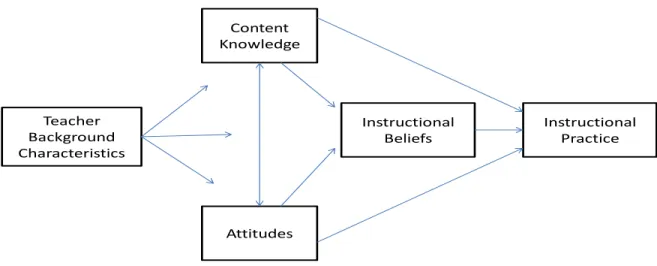
Wilkins’ (2008) belief model in Figure 2.4 demonstrated that background knowledge and experiences come before content knowledge and attitudes. Content knowledge and attitudes come before instructional beliefs, which ultimately influence practice. In his research, Wilkins’ (2008) study of 481 in-service mathematics teachers found that beliefs have the strongest relationship to instructional practices and that they also serve as a mediator for attitudes
Teacher Background Characteristics
Attitudes Content Knowledge
Instructional
Beliefs Instructional Practice
Figure 2.4: Wilkins Theoretical Model Relating Content Knowledge, Attitudes, Instructional Beliefs and Practice
and knowledge related to mathematics teaching and learning. Although the majority of teachers in the study had a match between their beliefs and classroom practice; beliefs and practice did not always align.
Nearly all teachers reported a belief in the effectiveness of inquiry-based instructional methods; however, there was discrepancy in how many teachers were actually using inquiry-based instructional practices. Of interest were the belief distinctions between grade bands. Upper elementary teachers (those teaching grades 3-5) showed greater mathematics content knowledge and a more positive attitude toward mathematics in general than primary (K-2) teachers. Yet upper elementary teachers’ instructional practices were categorized as traditional as opposed to inquiry-based. On the other hand, K-2 teachers, categorized as contemporary, had less content knowledge than the 3-5 teachers but were more likely to use inquiry-based instructional strategies and manipulatives.
traditional style. Thus, teachers with more of these classes would then have been exposed to more traditional teaching methods as models of good instruction.
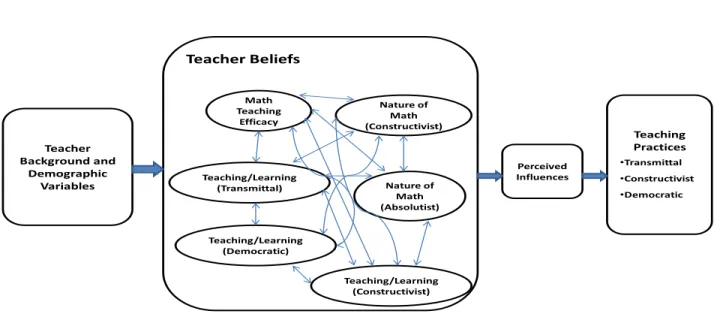
Stemhagen’s (2011) Sensible Web-of-Beliefs Model as illustrated in Figure 2.5 built on the work of Wilkins. Stemhagen’s model includes the tenet that beliefs do not correlate with practice in the mathematics classroom in the absence of an individual’s other beliefs. His model also accounts for perceived influences (external factors) that may potentially impact practice such as administration pressure to teach a particular way. The Web-of-Beliefs model accounts for the interrelationships of beliefs and influences that eventually affect practice. It is important to note that this study specifically excluded teacher content knowledge to focus on the web of teacher beliefs.
Teacher Background and
Demographic Variables
Teacher Beliefs
Perceived Influences
Teaching Practices
•Transmittal
•Constructivist
•Democratic
Math Teaching
Efficacy
Teaching/Learning (Transmittal)
Teaching/Learning (Democratic)
Teaching/Learning (Constructivist)
Nature of Math (Absolutist) Nature of
Math (Constructivist)
Stemhagen (2011) stated, “The single most obvious and important outcome of this study is support for the idea that beliefs do, in fact, seem to matter” (p. 9). In his research, philosophical beliefs correlated with pedagogical beliefs as well as reported practice. His study also revealed that teachers’ view of the nature of mathematics was highly correlated with their pedagogical orientation. This philosophy was also fairly highly correlated with instructional practices. Although a correlation existed between pedagogical orientation and reported practices, the strength of the relationship was slightly weaker.
Impact of Beliefs on Instruction
The extent to which new curriculum movements take hold and transfer to instructional practice are directly linked to teachers’ philosophical beliefs and attitudes about teaching and learning mathematics. Ernest (1989) stated that the acquisition of a belief and thus model of teaching mathematics occur through models of instruction experienced and observed.
Beswick (2007) confirmed this line of thinking by stating teachers’ experiences in mathematics teaching (actual teaching and observing peers) influence their beliefs regarding mathematics schooling and thought processes associated with performing mathematical tasks. Thus, a teacher’s attitude in teaching mathematics is a direct reaction to his or her experiences.
In summary, teacher beliefs matter in the mathematics classroom and are powerful indicators of teacher behavior. The research literature suggests that beliefs formed early tend to perpetuate, even against contradictions based on time, reason, increased knowledge and
Fancella’s (2010) review of instructional practices related to the implementation of Cognitively Guided Instruction (CGI) at three elementary schools. He stated that changes in teachers’ practice was noticed for a period of time but more often than not, teachers eventually went back to their original practice. This supports the idea that beliefs serve as a filter for how new
knowledge is interpreted and ultimately acted upon (Pajares, 1992). Hence, beliefs and
knowledge are inextricably intertwined and serve as a strong predictor of teacher behavior in the classroom.
So What Does All This Mean?
To sum it up, Pajares (1992) suggested that researchers often shy away from looking at teacher beliefs because of the messy constructs. This is due in part to the fact that the educational research community has not adopted a specific working definition for “beliefs” (Pajares, 1992). But definitions do exist in literature. Dewey (1933) stated that belief covers all of which we have no sure knowledge of but accept as true and are confident of to act upon. Along that same line, Sigel (1985) stated that beliefs are mental constructions of experience, grouped into schemas, generally held to be true and guides to behavior. According to Pajares, (1992) definitions such as these could be used to clear up and conceptualize key assumptions as well as develop precise construct meanings for researching the relationship between beliefs and mathematical practices. When the constructs of beliefs are correctly defined, assessed and investigated, beliefs can serve as the single most important construct of research in education.
Mathematics Knowledge for Teaching (Subject-Matter Knowledge)
from various European and Asian countries (National Center for Educational Statistics [NCES], 2010). In addition there is a growing need for establishing a workforce with skills in
mathematics, science and technology (Ball, 2008). If student mathematics achievement is a priority, then understanding the complex knowledge systems of the mathematics teacher is incredibly important (McGee & Wang, 2014).
Much like other areas of research on teaching and learning, mathematical content knowledge is still in need of a clear definition. Shulman’s (1986) work brought to light the “missing paradigm” in the research of the day – teacher knowledge of specific subject-matter content and how that knowledge impacts instruction (1986). He developed seven typologies or categories of teacher knowledge. The first four deal with general teacher knowledge and were not the focus of his work although he acknowledged that they were crucial for effective teaching. His main focus was on three specific categories: content knowledge, curricular knowledge, and
pedagogical content knowledge (Ball, Thames, & Phelps, 2008). Shulman’s use of the
pedagogical content knowledge referred to the kind of “content knowledge unique to teaching- a
kind of subject-matter-specific professional knowledge” (Ball et al., 2008, p. 389).
The research work that followed Shulman’s important initial work sought to more fully explore the special nature of subject-specific knowledge for teaching. Yet little progress had been made in developing a coherent framework for investigating content-specific knowledge for teaching (Ball et al., 2008). The need for such a framework and a clearer definition was greatly needed in mathematics since very little research was looking at knowledge for mathematics teaching specifically.
Ball et al. (2008) designed such a study focused on all the different elements needed to carry out the teaching of mathematics. They sought to determine exactly what knowledge is needed to support student learning in mathematics. Their research showed that the demands are substantial. Teachers’ knowledge for teaching needs to be multidimensional, in that, general mathematics knowledge will not suffice in meeting the demands of teaching even elementary mathematics. They found that teachers must know more mathematics, but also different mathematics than what is necessary for everyday functioning (Ball et al., 2008).
In order to teach mathematics, teachers need to understand basic mathematical procedures, which is the mathematics needed by all adults in their everyday lives. However, teachers must also know why procedures work and why students make the errors they make in performing them (Ball et al., 2008). In addition, teachers must know how to choose appropriate representations and tasks that allow for generalizations in mathematics. They must be able to determine the validity of a student’s mathematical argument based on a deep understanding of mathematics. Therefore, mathematical knowledge for teaching demands much more than just being able to do math well (Ball, 2008; Ball, Thames, & Phelps, 2008; Shulman, 1986).
In an effort to build upon, not replace, the construct of Shulman’s (1986) pedagogical
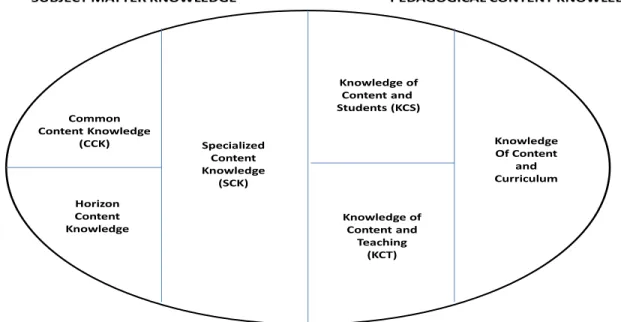
mathematical knowledge so that distinctions could be made between mathematics content knowledge in general and mathematics knowledge for teaching. Her model illustrates the various categories of knowledge that seem to be a part of the overall concept of mathematical knowledge for teaching (MKT). However, as noted in Figure 2.6, mathematical knowledge for teaching falls into two domains: subject matter knowledge and pedagogical content knowledge.
It seems pertinent then, to analyze the literature with regard to both of these domains separately. This separation does not mean to suggest that these types of knowledge work
independently of each other in the teaching situation. Rather, it serves as a means for thoroughly investigating the complexity of each specific type of knowledge teachers must possess for teaching and learning mathematics.
In addition, due to the broad use of the term, mathematical knowledge for teaching
(MKT) in literature, it is often difficult to separate MKT and PCK. For the purpose of this paper, Ball’s domain, subject-matter knowledge will be referred to as mathematical knowledge for
teaching (MKT). The following sections will focus on two aspects of MKT listed in Figure 2.6 –
common content knowledge (CCK) and specialized content knowledge (SCK).
Common Content Knowledge (CCK)
The most obvious type of knowledge needed by mathematics teachers is common content
knowledge (CCK). Many research studies reveal that U.S. teachers (experienced, preservice,
elementary, and secondary) have a very shallow conceptual understanding of mathematics. These studies have brought about public cries for “smarter” teachers. Teacher certification has also upped the ante on requirements by requiring content-specific exams such as the PRAXIS: Core Academic Skill for Educations: Mathematics (North Carolina Department of Public
Common Content Knowledge
(CCK)
Horizon Content Knowledge
Specialized Content Knowledge
(SCK)
Knowledge of Content and Students (KCS)
Knowledge of Content and
Teaching (KCT)
Knowledge Of Content
and Curriculum
SUBJECT MATTER KNOWLEDGE PEDAGOGICAL CONTENT KNOWLEDGE
Figure 2.6: Domains of Mathematical Knowledge for Teaching Adapted from Ball, Thames, and Phelps (2008)
examination of released items from tests such as the PRAXIS indicates there is still a lack of agreement about what mathematics teachers need to know for teaching since the majority of the test problems are computational as opposed to knowledge use (Hill, Schilling, & Ball, 2004).
teacher effectiveness (content-specific certification exams and increasing subject-matter coursework) do not ensure that teachers have strong enough mathematical knowledge for teaching.
A study with elementary teachers in the California Mathematics Professional
Development Institute (MPDI) found that content knowledge for teaching includes more than just knowing mathematics (Hill et al., 2004). While a strong mathematical knowledge base was found to be important, of more importance was the way in which an individual teacher holds and uses that knowledge in the classroom setting. Ding (2007) agreed by stating that content
knowledge alone cannot ensure quality teaching because it is how teachers use this knowledge in a teaching context that makes the difference.
Specialized Content Knowledge
The research suggests that how teachers use content knowledge is what sets them apart from content experts (Hoover, 2014). Specialized Content Knowledge (SCK) then is
mathematical knowledge and skills unique to teaching (Ball et al., 2008). Shulman (1986) argued this point by stating teachers must know more than just the facts and ideas of a subject. He stated that they must also know the structure and organizing principles for the subject, which would lead them to not only know that something is so but also know why it is so.
While SCK does include mathematical content knowledge it is knowledge not typically used by adults in everyday life. Teachers with SCK are not only able to calculate and correctly solve problems (as other educated adults can) they are also able to analyze student errors, use nonstandard approaches to a problem, effectively use mathematical vocabulary, explain and justify mathematical ideas as well as determine the advantages/disadvantages of various
than teaching. Thus, teachers need a decompressed mathematical knowledge that allows them to hold unpacked mathematics content until it is needed to be made visible and attainable by students (Ball et al., 2008).
To further the idea of SCK, Ball et al. (2008) stated that the focus of teacher knowledge is not so much involved with the content knowledge of mathematics but rather knowledge about
mathematics. In other words, teachers need an understanding of the nature of mathematics – the knowing and doing of mathematics specifically with regard to teaching and student learning. This type of knowledge does not come from studying advanced mathematics or just general teaching experience (pedagogy). This knowledge is what Ma (1999) calls “knowledge packages” and involves an interweaving of content knowledge and mathematical pedagogy that produces effective teachers of mathematics.
It is no wonder that researchers have had a difficult time quantifying mathematical
content knowledge for teaching. In fact very little empirical data have been available to articulate or validate the specific type of knowledge needed for teaching of mathematics (Hill et al., 2004). There is a reason for this. SCK is complex and requires that teachers know content in a
multifaceted way. Knowing mathematics content deeply is a given, however, in addition, teachers must know it conceptually, know it connectedly, know representations of and
difficulties with specific ideas (Ball, Lubienski, & Mewborn, 2001). In other words, it is not enough for teachers to do well in mathematics courses. They must be able to use their
Ding’s (2007) research found that teachers with higher SCK were able to predict and analyze student difficulties in a learning goal in advance and therefore were able to provide more time for actual student work toward their learning goal. In contrast, teachers without this skill spent most of their instructional time working on prior knowledge resulting in lower student gains on specified learning goals. Therefore, the research suggests that common content knowledge (CCK) must be paired with a professional knowledge that includes knowledge of student thinking about mathematics.
Other research confirmed that these two types of knowledge are related but not necessarily equivalent; nor can they stand on their own (Hill, Blunk, Charalambous, Lewis, Phelps, Sleep, & Ball, 2008). They found that teachers may have strong content knowledge but lack the specialized knowledge for teaching mathematics. Conversely, some teachers have strong knowledge of students but lack content knowledge to effectively connect their knowledge of students as it applies to teaching mathematics. The knowledge needed for teaching mathematics to elementary students is not only complex and multidimensional but also quite extensive.
Ding’s (2007) research found this complex nature of teaching to be one reason why CCK does not always transfer to SCK. Simply knowing well will not transfer to teaching well due to the various contexts that occur in the classroom setting. Although teachers may try to predict student thinking ahead of time, the irregularities and uncertainties of the real classroom environment often leave teachers ill-equipped to realistically predict student thinking. One of these classroom realities has to do with trying to monitor the thinking of 20 to 30 students at one time.
which includes mathematics content that has been “unpacked” coupled with strong connections to effectively activate content or student information in the spur of the moment (Ding, 2007). According to Ma, (1999) only teachers with a “profound understanding of mathematics (PUFM), can teach in such a flexible and deep way.
Therefore, mathematical knowledge for teaching (MKT) is not an either or type of knowledge. Rather it is a combination of what Ball et al. (2008) calls Common Content
Knowledge (CCK) and Specialized Content Knowledge (SCK). According to Hill et al. (2005) MKT is knowledge of mathematics content combined with knowledge of how to teach that particular content in context. Research indicates that this type of knowledge is critical to effective teaching and learning of mathematics in elementary classrooms. The complexity of what makes up MKT is the reason why researchers have struggled to produce adequate instruments to measure it.
Pedagogical Content Knowledge
As Figure 2.6 shows, the other domain of knowledge for teaching mathematics involves pedagogical content knowledge (PCK). This domain is comprised of knowledge of content and
students (KCS) and knowledge of content and teaching (KCT). Shulman (1986) spoke of PCK to
address the ways in which teachers make subject-matter comprehensible to others. This includes but is not limited to what makes a particular topic easy or difficult as well as what conceptions or misconceptions students bring to the learning. This line of thinking aligns with Dewey’s (1902) admonition for teachers to “psychologize” their subject matter. Dewey said that teachers should draw on their subject-matter and student knowledge to choose appropriate topics and
representations of material to be learned. This idea of focusing on subject-matter representations along with student conceptions/misconceptions, suggests that pedagogical content knowledge is more than just mathematics content knowledge or knowledge of general pedagogy but rather a unique blending of the two.
Knowledge of Content and Students (KCS)
Knowledge of Content and Students (KCS) is one component of PCK. It combines