Introduction
Industrial applications of artificial intelligence, which generally involve large and complex knowledge-bases, are often expensive in terms of time and cost to develop and maintain 1. These
knowledge-bases typically consist of rules, each rule encoding a valuable and reusable piece of domain knowledge or expertise. Although knowledge representation mechanisms other than rules exist – e.g., cognitive maps, Bayesian networks etc. – this article is only concerned with rule-bases. The effectiveness of these real-life systems depends on the nature and contents of these rule-bases.
Knowledge-based systems follow a special development life-cycle that is distinct from typical software
development models and historically they have been more expensive to develop and maintain.1 There is no simple
explanation for this nor is there a simple solution to the problem of rule-based system quality2. This article explores rule structures and complexities by proposing alternate (but related) rule classifications from different points of view. We propose a thesis, and illustrate through examples, that a rule belonging to a specific and single class is simple and easy to understand while conversely, a rule that cannot be classified cleanly is difficult to understand and maintain. We also present simple programming guidelines for each rule class, that identify some
similarity of appearance, interfaces, use, style and that assist each rule’s
comprehension. We use Prolog as the rule-language, although this general approach is usable by other rule-base engines.
Classification of Rules
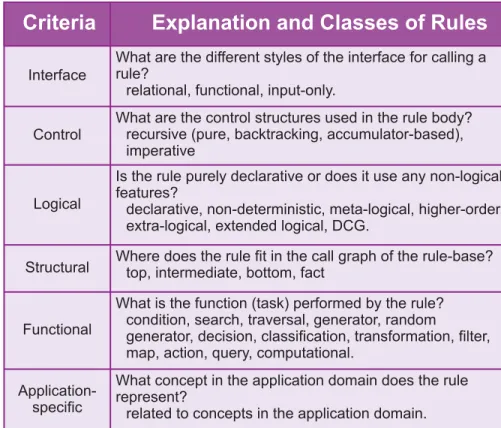
It is possible to classify Rules in a Prolog program from various points ofview (Table 1). Although many of these classes are already described in the literature 3, 4 and are known to
individual Prolog programmers, there are advantages to classifying each rule in a given rule-based system application. We first identify simple programming guidelines for each rule class, ensuring that each rule in a class has some similarity in appearance, interface, use
Criteria
Explanation and Classes of Rules
Interface
What are the different styles of the interface for calling a rule?
relational, functional, input-only.
Control What are the control structures used in the rule body?recursive (pure, backtracking, accumulator-based), imperative
Logical
Is the rule purely declarative or does it use any non-logical features?
declarative, non-deterministic, meta-logical, higher-order, extra-logical, extended logical, DCG.
Structural Where does the rule fit in the call graph of the rule-base?top, intermediate, bottom, fact
Functional
What is the function (task) performed by the rule? condition, search, traversal, generator, random
generator, decision, classification, transformation, filter, map, action, query, computational.
Application-specific
What concept in the application domain does the rule represent?
related to concepts in the application domain.
by Girish Keshav Palshikar
By Girish Keshav Palshikar
Improving Rule Base Quality
with Rule Classification:
Prolog Classification
Example
Table 1. Criteria for classification of rules and the associated rule-classes.
Improving Rule Base Quality
with Rule Classification:
and style, to help in its comprehension. Next, understanding the rule structure in a rule-based system facilitates the rule writing (or even re-writing, if necessary) so that each rule (ideally) falls in a single class (when viewed from a specific point of view). This reduces or eliminates the complex and often useless entangling of rules between different classes, thereby simplifying the program’s structure and maintenance.
Classification Using Rule
Interface
Based on a rules input/output interface or the nature of its parameters there are several distinct rule classes. It is possible to classify each parameter in a Prolog rule by its mode as an input parameter, an output parameter or an input-output parameter. An input parameter X, denoted as +X, must be instantiated when calling the rule. An output parameter X, denoted as -X, has the following behavior:
if Xis un-instantiated when calling the rule then it is instantiated by the rule when it finishes successfully; if Xis instantiated, the rule succeeds
only when the computed value of X
matches that given.
An input-output parameter X, denoted as ?X, may or may not be instantiated when calling the rule. However, if it is un-instantiated when calling the rule, it must be instantiated by the rule when it finishes successfully (i.e., when a call to the rule succeeds). A common
convention, only using the input/output parameter in those rules that successively return possible values on backtracking, declares the parameter as output if the rule fails on backtracking. A well-defined rule has a unique mode declaration. In a mode declaration for a rule, every parameter to the rule is identified as an input, output or input/output even when there are multiple clauses that define the rule. Some examples of mode declarations are:
length(+L,-Len) Len- length of the given list L.
member(?X, +L) Successively return elements Xfrom the given list L. sublist(+SubL,+L) SubL- sublist of the
given list L.
Most practical rules fall into specific classes based on mode
declarations: relational, functional, input-only etc. (see the Interface Criteria in the table). Since rules in a class should have similar mode declarations, if the mode declaration does not fall into a common class, then the rule should be either re-written to bring it into one specific class or its mode declaration should be justified more rigorously.
Relational Rules A relational rule
is a predicate (or Prolog Function) that describes an n-ary or possible multiple relationship between its
parameters. For example, Prolog
implements the rule that “two persons are siblings if they have a common parent”, as a binary relation between two persons X
and Y(given as the rule’s parameters). Note that these rule parameters are input-output. A Prolog rule-base often contains a database of given facts, which are rules without any bodies. For example, consider rules that define relationships such as sibling, uncle, grandfather etc. A fact-base for such a rule-base may contain examples of people and their parents and the rules could be called to derive additional relationships between the people mentioned in the fact-base. The rule siblingsuccessively extracts siblings over a fact-base consisting of parents records such as parents(Meyer, Rita, Robin)where Meyeris the father, Ritais the mother, and Robinis the daughter.
% sibling(?Person, ?Person)
sibling(X, Y) :- parents(F, M, X), parents(F, M, Y), X \= Y. sibling(X, Y) :- parents(F, M1, X),
parents(F, M2, Y), X \= Y, M1 \= M2.
sibling(X, Y) :- parents(F1, M, X), parents(F2, M, Y), X \= Y, F1 \= F2.
Most relational rules allow back-tracking so the Prolog predicate cut
should, in general, be avoided since it stops backtracking. A relational rule typically has separate mutually exclusive sub-rules, each indicating a special condition. A common mistake in writing these relational rules, allowing multiple solutions for the same set of input parameters, enables the invocation of multiple sub-rules upon backtracking. This must be prevented either by the appropriate use of cut or by strengthening the logical conditions in each sub-rule so that they are mutually exclusive.
One problem that occurs in writing relational rules is when un-instantiated parameters are passed when calling; e.g.,
depending on the order in which the variables in the rule get instantiated.
Functional Rules
A functional rulehas one or more input parameters and returns a specific value in an output parameter. For example, a functional rule might return the number of siblings a person has. The following functional rule returns the number of elements in a list.
% length(+List, -NumberOfElements)
length([],0) :- !.
length([H|T], Len) :- length(T,N1), Len is N1 + 1, !.
This recursive function takes a list and removes the head(H) or left most item in the list and calls itself with the tail(T) as the new input parameter. When the list becomes empty, the top rule succeeds and the functions each complete, one at a time, incrementing Lenas they succeed. A functional rule must have at least one input parameter and at least one
(preferably exactly one) output (or input-output) parameter. As a matter of style and uniformity, group the input parameters towards the beginning of the parameter list and the output parameters towards the end. Since most functional rules compute the output value only once, a functional rule should use the cut
for efficiency and must fail on backtracking.
Other Types of Rules
Sometimes rules are neither relational nor functional. For instance, an input-only rule has all input parameters and succeeds if the given values satisfy a specific condition; e.g., the rule
sublist(+SubL,+L).
Such rules often fail on
backtracking. Similarly, an output-only rule has all output parameters and succeeds by computing the values for output parameters that satisfy a specific condition; e.g., the
rule
count_parents(-NumParents)
computes and returns the number of parents facts in a fact-base.
Classification using Control
Structures
Ideally, logic programs are devoid of any control for program execution. Prolog supplies a default top-down left-to-right depth-first execution strategy. However, most Prolog programs take advantage of Prolog’s procedural semantics and have a dual declarative as well as procedural nature. To augment the procedural semantics, Prolog offers several control mechanisms: recursion, search and backtracking, !and fail, looping and all solutions predicates such as findalletc. We can classify Prolog rules based on the control structures that they use.
A recursive rule makes explicit use of recursion. A purely recursiverule does not use any other control structure; the above examples, lengthand member, are examples of purely recursive rules. An
accumulator-based recursionrule makes use of an auxiliary parameter to accumulate intermediate results during recursion; e.g., a rule sumlistthat computes the sum of an integer list is an accumulator-based recursive rule. Rules can also bemutually recursive; such rules are often difficult to understand and maintain. Two rules A and B are mutually recursive if A calls B and B also calls A.
Backtracking is an indirect and auxiliary control mechanism and an important criterion in rule classification. A backtracking rulesuccessively returns solutions, which satisfy the given inputs to the rule. In this sense, backtracking is a control mechanism akin to systematic search and is often used with other www.lpa.co.uk [email protected]
Phone: + 44 (0)20 8871 2016 Fax: + 44 (0)20 8874 0449 US Toll free: 1 800 949 7567 LPA products feature:
●Robust and reliable run-time performance
●Support for DLLs, DDE, OLE, ODBC, TCP/IP, HTML standards
●Graphical tools and debugging aids
●Choice of delivery environment (VB, Java, Web, Delphi)
LPA’s integrated suite of advanced software tools enables you to build intelligent applications both rapidly and safetly.
Modules include:
LPA Prolog for Windows - leading Prolog compiler system Flex - popular hybrid expert system toolkit
Agent - distributed agent toolkit DataMite - powerful data mining algorithm Flint - fuzzy and probabilistic reasoning
Prolog References
Numerous books and articles have been written on Prolog. Here are a few web sites that provide basic Prolog information.
Prolog Programming a First Course – an html course intended for those who have some programming experience or have written a few programs in Prolog.
http://cbl.leeds.ac.uk/~paul/prologbook
Prolog Tutorial -- Intended to be used to help learn the essential, basic concepts of Prolog with sample programs chosen to assist promote the use of Prolog programming in an artificial intelligence course.
http://www.csupomona.edu/~jrfisher/www/prolog_tutorial/pt_framer.html Standard Prolog Source Code for list processing from references 3 and 4 of this article:
[3] Clocksin and Mellish, Programming in Prolog, 3/e, Springer-Verlag, 1984. [4] Sterling L., Shapiro E., The Art of Prolog, 2/e, Prentice-Hall, 1994.
control mechanisms. For example,
memberand appendare recursive rules which also allow backtracking, referred to as recursive-backtracking rules. Other rules such as the rule siblingabove, is a non-recursive backtrackingrule.
An imperativerule computes output results and answers using non-logical control looping structures such as repeat,
findalletc. or assignment to intermediate variables or counters – e.g. using assert
and retracton temporary facts. Although, strictly speaking expression evaluation using the isbuilt-in predicate is an imperative feature of Prolog, we do not consider simple rules containingisas imperative. Specifically, we do not consider recursion as an imperative control structure. Since imperative program often causes side effects; e.g., by using input/output facilities or by changing the fact-bases, their side effects should be clearly identified.
Ideally, each Prolog program should use only one control structure; e.g., a rule should not use both a repeatloop and recursion. Since imperative rules are generally hard to read and test, only use them if absolutely necessary. An imperative rule is often sensitive to the type of input parameters e.g., whether it
is an integer, float, atom, string or structure. Such rules should verify that the instantiated inputs have the correct types. An imperative rule using intermediate facts should abolish them before and after the loop to prevent their accidental reuse.
Classification using Logical
Contents
We can classify a rule based on the nature and structure of the logical facilities it uses. From this point of view, there are several classes of Prolog rules.
A declarative rule, one written in pure
Prolog without using any non-logical features, is purely declarative if the rules meaning (i.e., the answers it generates) does not depend on Prolog’s operational semantics. This includes ordering of clauses in a file, ordering of conditions within a clause, depth-first search strategy, and so on. Otherwise, it is a procedural-declarativerule since its meaning depends on Prolog’s procedural semantics. For example, the meaning of a pure
declarative rule remains unchanged even if the order of the logical conditions on the right hand side changes. A pure declarative rule is considered the ideal and one must strive to write as many pure
declarative rules as possible – a notoriously difficult task.
A non-deterministic rulehas more than one rule head so that for a particular input, it is not always clear which rule head should be used. Only when the computation terminates, do we know the correct choice.
A meta-logical ruleis essentially a rule governing other rules and typically uses Prolog’s meta-logical facilities; e.g., var,
nonvar, =.., arg, functor, and clause
facilities. Meta-logical rules are powerful and implement different logical systems in Prolog (e.g., fuzzy logic) or complex special-purpose artificial intelligence techniques (e.g., implementation of different search strategies bread-first or best-first, mean-end analysis etc.). Use meta-logical rules sparingly, if at all, and document them well, along with examples of their uses.
A DCG ruleis a production rule in Prolog’s Definite Clause Grammar (DCG) notation The DCG notation allows context-free grammar (production) rules to be written in Prolog. A higher-order rule uses Prolog’s higher-higher-order facilities; e.g., the callprimitive and predicates as arguments to rules. An
extended logic ruleuses additional facilities closer to first order logic; e.g., the not
primitive, the ifthenelse primitive etc. An
extra-logical ruleuses the extra-logical facilities in Prolog; e.g., input/output. Prolog provides a small subset of logic connectives such as AND, OR, IF-THEN. However, most Prolog systems provide an additional set of extended logic facilities, such as if-then-else, for more powerful logical formulation of the rule. Extra-logical facilities allow Prolog programs to perform things outside the logical framework, such as read files and write to the terminal.
Classification using
Functionality
Classifying rules, based on the tasks they perform, enables classification on fairly common rule functionality.
A condition ruleverifies a condition that the given state or data is expected to satisfy; succeeding if the conditions are satisfied and failing otherwise. For example, rules to check whether a list is empty or a singleton, whether two lists are equal are examples of condition rules. Most condition rules fail on backtracking.
backtracking so that successive values are returned. Most often the search strategy is depth-first top-down, which is Prolog’s default search strategy. However, many applications implement more complex search mechanisms such as breadth-first search, best-first search or heuristic search (e.g., A* or AO*). For example, the memberpredicate systematically searches a specified list and returns trueif the specified item is a member of the list and falseif it is not a member.
Traversal rules, a class of rules related to search rules, implements a systematic search, which visits each “state” in a “state-space” exactly once. The traversal is often performed with some purpose, often producing a result at its
completion.
A generator rule, which is a kind of search rule, systematically and successively generates (often via backtracking) a value that satisfies specific restrictions. The generated value returns as the rules output parameter;
memberand appendare examples of generator rules. Generator rules allow backtracking and use a search mechanism to generate the values. A
random generator rule, which typically uses a random number generator to generate output values, is not considered a search rule.
A classification rule,which analyzes given information (e.g., in fact-bases), succeeds if the information meets specified criteria. For example, one may classify a graph as tree, path, circuit, Hamiltonian path, regular, complete, bipartite etc. For each class, one would write a predicate, which succeeds if the given graph satisfies the required conditions. A graph may belong to more than one class and one
classification predicate is not aware of other classes. Therefore, the set of classes is not fixed a priori so that other classification predicates may be added later, without changing those that exist. Most classification rules fail on
backtracking. Related classification rules are often collected into groups.
Classification rules may appear similar to conditional rules; a distinction that is particularly unclear when the
classification is binary (e.g., when a list is empty or non-empty).
A decision(or selection) rule returns a value from a given (or fixed and known) set of values, based on specific criteria. The output parameter typically returns the output value. For instance, a decision
Rule with mode
Interface Control
Functional
islist(+L) input-only ¬R, ¬B, ¬I classification
member(?X,+L) relational R, B, ¬I search
append(?L1,?L2,?L3) relational R, B, ¬I generator
is_prefix(+Prefix,+List) input-only R, B, ¬I condition
is_suffix(+Suffix,+List) input-only R, B, ¬I condition
sublist(+L1,+L2) input-only R, ¬B, ¬I condition
last(+L,-X) functional R, ¬B, ¬I computational
reverse(+List,-ReversedList) functional R, ¬B, ¬I transformation
has_dup(+L) input-only R, ¬B, ¬I classification
remdup(+L,-NewL) functional RA, ¬B, ¬I filter
list_subtract(+L,+ItemL,-NewL) functional R, ¬B, ¬I transformation
list_antisubtract(+L,+ItemL,-NewL)
functional R, ¬B, ¬I transformation
emptyL(+L) input-only ¬R, ¬B, ¬I classification
list_length(+List,-Len) functional R, ¬B, ¬I computational
list_equal(+L1,+L2) input-only ¬R, ¬B, ¬I condition
list_subset(+L1,+L2) input-only ¬R, ¬B, ¬I condition
listL_append(+ListOfLists,-L) functional R, ¬B, ¬I transformation
list_adjacent(?X,?Y,+L) relational ¬R, B, ¬I search
list_get_element(+L,+Index,-Element)
functional R, ¬B, ¬I computational
list_tail(+List,-Tail) functional ¬R, ¬B, ¬I filter
list_front(+List,-Front) functional R, ¬B, ¬I filter
delete(+List,+Element,-NewList) functional R, ¬B, ¬I filter
ordered(+List) input-only R, ¬B, ¬I classification
sumlist(+List,?Sum) functional RA, ¬B, ¬I computational
inner_product(+L1,+L2,-IP) functional RA, ¬B, ¬I computational
maxlist(+List,-Max) functional RA, ¬B, ¬I computational
int_range(+M, +N,-List) functional R, ¬B, ¬I computational
flatten(+L1,-L2) functional R, ¬B, ¬I transformation
list_union(+L1,+L2,-L3) functional R, ¬B, ¬I transformation
list_intersection(+L1,+L2,-L3) functional R, ¬B, ¬I transformation
maplist(+PredName,+L1,-L2) functional R, ¬B, ¬I map
applist(+PredName,+L) functional R, ¬B, ¬I map
R:recursive
RA:recursive-accumulator
B:backtracking I:imperative
rule may select a likely disease from a diseases list. In a program to solve the 8-queen’s puzzle, a rule may select the queens next square to try. In a graph search algorithm, a decision rule may select the next vertex to visit. A selection rule, which is different from a
classification rule, selects and returns a chosen value from a fixed set of possible values — fixed and known a priori. A classification rule, which simply succeeds if the given data meets certain criteria, is independent of other class rules.
A transformation ruleconverts the input to create an output. For example, one transformation rule may remove all parallel edges and self-loops from a given graph and transform it into a simple graph. Another transformation rule might construct another graph — the union of the two given graphs. A third transformation rule might flatten a list if it contains other lists as elements.
Filter rules and map rules are special types of transformation rules. A filter rulegenerates the output by removing some parts (based on specific criteria) from the inputs. For example, a rule that returns the front of a given list (all elements except the last) is a filter rule. A map ruleobtains its output from a one-to-one correspondence to the inputs. For example, a rule whose output list squares the input list (e.g., [1,2,3,4] maps to [1,4,9,16]) is a map rule. Another map rule might replace all pronouns in the given list of words by appropriate nouns.
An action ruleis one that causes side effects; e.g., changes in the fact-bases using assertand retract. Typically an action rule has the following structure where Conditionis a pure Prolog fragment and
Actionis a Prolog code causing side effects.
R :- Condition, Action.
In a well-written action rule, the Actionpart is not expected to fail after the Conditionis satisfied. It is a good idea to ensure that action rules follow this structure. Using a cut between Conditionand Action
often improves efficiency and prevents unexpected back-tracking upon the failure of the Actionpart.
R :- Condition, !, Action.
Many times the action rules are not expected to backtrack and hence a cut should be inserted after the Action part.
R :- Condition, !, Action, !.
Further functional rules classes are defined as follows.
A query ruleperforms queries on fact-bases. For example, a query rule might compute the number of siblings a person has from the
parentsfact-base. A computation rulecomputes, which is typically arithmetic in nature, returns a result from the given information and usually fails on backtracking.
Classifications Using Structures
Call-tree analysis of a rule-base can classify rules based on their level in this tree. A factis a fact in fact-base. A bottom rule does not call any other rule and should therefore be as efficient as possible, since it is potentially used by many rules. A top ruleis not called by any other rule. An intermediate ruleis neither a top rule nor a bottom rule and its use should be minimized, since these rules are often the most unclear. An interface rule, which interfaces the rule-base with some external systems e.g., datarule-base, should be a bottom rule, if possible. A library ruleis not specific to anything in the rule-base and is safely reused in other rule-rule-based systems.
Classification Using Application
Concepts
It is beneficial to group a program’s rules together based on how they are related to a single concept in the application domain. For example, in a credit evaluation system, the rules could be grouped into the classes of rules related to collateral, project feasibility, company profile, loan history, banking and finance etc. One should clearly identify the application rule classes in a particular application. Each rule in a rule-based system should belong to one application class only, except intermediate or library rules related to common
computations.
Conclusions
This article has defined a comprehensive rule classification for a rule-based system from different perspectives. Ideally, each rule should fall in a single class. Otherwise, the rule may be difficult to understand or maintain. We have also
presented simple guidelines for writing rules in a specific class.
Adding additional rule classes as well as more
classifications enhance our classification framework. We have focused primarily on single-rule classifications. However, this approach can be extended to collecting rules in groups and classifying the groups as well. Finally, our approach can be easily used to build automated tools that assist in the classification process and improve the quality of the rules in the rule-base.
Acknowledgements
I appreciate the support and guidance of Prof. Mathai Joseph. Thanks also to Dr. C. Anantaram and Dr. V. K. Rai. I sincerely thank Dr. Manasee Palshikar for her tireless support and encouragement.
References
[1] X. Li, What’s So Bad About Rule-based Programming, IEEE Software, Sep. 1991, pp. 103-105.
[2] G. Guida, G. Mauri, Evaluating Performance and Quality of Knowledge-based Systems: Foundations and Methodology, IEEE Trans. Knowledge and Data Engg., vol. 5, no. 2, April 1993, pp. 204-224.
[3] Clocksin and Mellish, Programming in Prolog, 3/e, Springer-Verlag, 1984.
[4] Sterling L., Shapiro E., The Art of Prolog, 2/e, Prentice-Hall, 1994.