Multimedia based CD-ROM for teaching
remote sensing applied to environmental
studies using LBA examples
Nelson Wellausen Dias Getulio Teixeira Batista
Departamento de Ciências Agrárias Universidade de Taubaté
Evlyn Moraes Leão Novo Thelma Krug
Divisão de Sensoriamento Remoto Instituto Nacional de Pesquisas Espaciais
Paul Mausel Dennis Skelton Vijay Lulla
Indiana State University Department of Geography
A
BSTRACTA multimedia based CD-ROM set entitled “Sensoriamento Remoto: Aplicações para a Preserva-ção, Conservação e Desenvolvimento Sustentável da Amazônia” was developed by INPE and Indiana State University with support from NASA LBA-Ecology Program and the Brazilian Institute for Space Research (INPE) and is currently available for Brazilian college and high school education. Similar products devoted to technology transfer of remote sensing and its applications have been developed under sponsorship of NASA for several years. The CD set includes the following content: CD1 with three main sessions; (1) Introduction to Remote Sensing; (2) Preservation and Conservation Principles; and (3) Amazon Case Studies – LBA (Large Scale Biosphere-Atmosphere Experiment in Amazônia) Examples; and CD2 that provides six remote sensing and GIS datasets from different Brazilian environments for students to conduct hands-on analysis using INPE’s proprietary software called SPRING (both image processing and GIS package). The content is presented in short texts that are illustrated by more than 800 figures and animations. Narration of the text is also available by linked audio files. Navigation of the CDs is simple and done through a series of menus and a main index page controlled by a database. Teachers can select portions of the content for their students to use in a given course. A CD linked website sponsored by INPE offers additional reading and updated information to registered users. Ever
expanding computer facilities in Brazilian universities and schools that take advantage of the Internet have offered new possibilities for delivering instructional materials using digital media.
K
EY-
WORDSRemote sensing. Technology transfer. Distance education. LBA. Amazon.
I
NTRODUCTIONThe expansion of computer facilities in universities and schools and the advances in Internet related technologies have offered new opportunities to delivering instructional materials using digital media. These benefits are related to the use of animations and simulations for material development as well as interactivity with the material through hands-on activities and quizzes (BEN-ARI, 1999; CROWN, 2001; WU; KRAJCIK; SOLOWAY, 2001). The introduction of multimedia materials in the classroom is changing the classroom experience in many schools and universities (JASON; TAYLOR; KENNEDY, 2001; JONES et al., 2002; SANKARAN; BUI; SANKARAN, 2000). Several studies emphasize that a teacher’s role, when implementing multimedia problem-based materials, should be more as facilitator rather than traditional lecturer (GRASHA; YANGARBER-HICKS, 2000; JONES et al., 2002; HERREID, 1998). A good teacher who is overloaded with instructional tasks, on the other hand, can take advantage of multimedia materials by making them
more widely available to students without requiring additional time or staff, while assuring that students get a good educational experience (CROWN, 2001).
Brazil has a large demand for college programs demonstrated by the increasing number of students starting college studies and the growing number of private universities in the last decades. There is an increasing interest in quality computer-based learning at both undergraduate and graduate levels. Public universities, although in crisis, still manage to keep most of their well-prepared and creative faculty necessary to generate quality distance education (DE) programs that are in demand.
A set of CDs for teaching remote sensing and its applications to conservation and preservation at the college level in Brazil was developed by a joint effort of INPE/MCT, NASA and ISU with the contribution of several other education institutions in Brazil. On these
CDs there are three main sections: (1) an introduction to preservation, conservation and sustainable development, (2) an introduction to remote sensing and satellite image processing, and (3) LBA-related case studies applying remote sensing to Amazon environmental applications.
R
EMOTES
ENSINGS
ESSIONOne of the sections of the CD covers the principles of remote sensing and the techniques involved in image processing and information extraction (Figure 1). Topics presented on this section are shown on Table 1. The remote sensing topics provide a general overview of this technology and cover its basic principles. It also provides the basic knowledge to understanding how images are generated, how they can be analyzed and what value can be obtained from the information generated.
The principle of spectral response of features is explained using graphics and audio clips that explain the difference between the spectral responses of different features.
Figure 1. Example of content material showing remote sensing principles and image interpretation techniques.
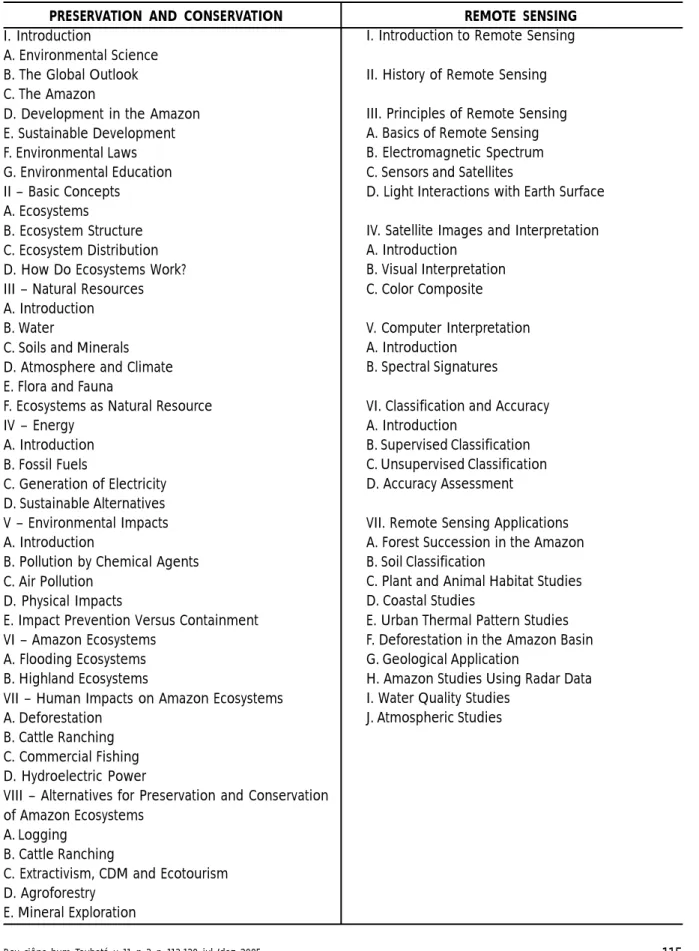
Table 1. List of content included in the first CD of this educational multimedia set.
I. Introduction
A. Environmental Science B. The Global Outlook C. The Amazon
D. Development in the Amazon E. Sustainable Development F. Environmental Laws G. Environmental Education II – Basic Concepts A. Ecosystems B. Ecosystem Structure C. Ecosystem Distribution D. How Do Ecosystems Work? III – Natural Resources A. Introduction B. Water
C. Soils and Minerals D. Atmosphere and Climate E. Flora and Fauna
F. Ecosystems as Natural Resource IV – Energy A. Introduction B. Fossil Fuels C. Generation of Electricity D. Sustainable Alternatives V – Environmental Impacts A. Introduction
B. Pollution by Chemical Agents C. Air Pollution
D. Physical Impacts
E. Impact Prevention Versus Containment VI – Amazon Ecosystems
A. Flooding Ecosystems B. Highland Ecosystems
VII – Human Impacts on Amazon Ecosystems A. Deforestation
B. Cattle Ranching C. Commercial Fishing D. Hydroelectric Power
VIII – Alternatives for Preservation and Conservation of Amazon Ecosystems
A. Logging B. Cattle Ranching
C. Extractivism, CDM and Ecotourism D. Agroforestry
E. Mineral Exploration
I. Introduction to Remote Sensing II. History of Remote Sensing III. Principles of Remote Sensing A. Basics of Remote Sensing B. Electromagnetic Spectrum C. Sensors and Satellites
D. Light Interactions with Earth Surface IV. Satellite Images and Interpretation A. Introduction B. Visual Interpretation C. Color Composite V. Computer Interpretation A. Introduction B. Spectral Signatures
VI. Classification and Accuracy A. Introduction
B. Supervised Classification C. Unsupervised Classification D. Accuracy Assessment
VII. Remote Sensing Applications A. Forest Succession in the Amazon B. Soil Classification
C. Plant and Animal Habitat Studies D. Coastal Studies
E. Urban Thermal Pattern Studies F. Deforestation in the Amazon Basin G. Geological Application
H. Amazon Studies Using Radar Data I. Water Quality Studies
J. Atmospheric Studies
P
RINCIPLESOFP
RESERVATION ANDC
ONSERVATIONS
ESSIONThis section is devoted to teaching principles and concepts of conservation and preservation focusing on Amazon environments and related issues. Topics presented on this section are also shown on Table 1. The first three topics (Introduction, Basic Concepts, and Natural Resources) provide an overview of environmental science concepts and principles while relating them with human activities and natural
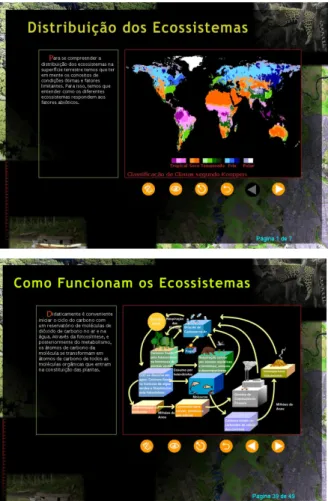
pro-cesses in the Amazon. The next two topics (Energy and Environmental Impacts) discuss influence that human activities have had in altering the natural environment and provide some alternative approaches to deal with these issues. The last three topics provide a closer examination of the issues related to traditional development activities versus alternative approaches to achieving sustainable development in the Amazon. Figure 2 presents three examples of the interface used in this session.
Figure 2. Examples of content material focusing on preservation and conservation.
In order to understand the processes associated with natural phenomena and how they are interconnected, environmental principles and concepts are presented in an interactive learning environment. Topics include food-web, energy flow, biogeochemical cycles and Amazon specific issues.
A
PPLICATION OFR
EMOTES
ENSINGE
XAMPLESThe remote sensing examples selected for this educational CD-ROM show the use and importance of remote sensing in real world problems such as the human impacts on the rainforests of the Amazon in Brazil. The use of several satellite data such as GOES and TRMM in the weather example presented demonstrates how various techniques are used to
create models which help to understand natural and human induced phenomena.
N
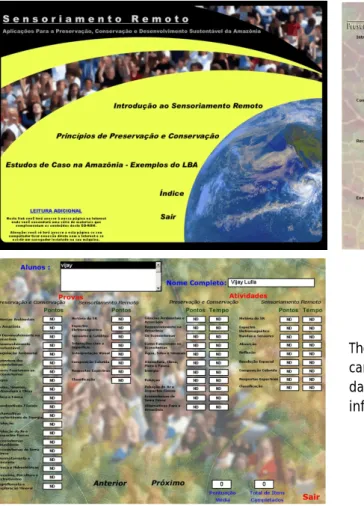
AVIGATION AND DATABASEFigure 3 presents some of the navigation and student progress tools used for structuring these CDs. Users can easily move across the material through
the menus, sub-menus and the index page. From the index page they can access any topic available to them and also check their total score obtained up to that point in the quizzes and activities completed. Only teachers have access to the database interface shown in the figure where individual student quiz and activity
scores as well as elapsed time in each activity is presented. Teachers can also select specific topics that would or would not become available to their students in each menu and in the index page, therefore, restricting student access to only those topics that are the focus of a class or a lesson.
The navigation in the CD is done through menus which can be customized by the instructor. A background database monitors the progress of students which information can
be accessed by the instructor.
The navigation in the CD is done through menus which can be customized by the instructor. A background database monitors the progress of students which information can be accessed by the instructor.
Figure 3. Example of the navigation tools (menu and index) used for easily navigating through the material and the database interface, which only the teacher has access to.
LBA C
ASES
TUDIESS
ESSIONIn this last session of CD1 examples of LBA research that uses remote sensing as a major source of information to generate the research results are presented. Selected examples cover several issues associated with the Amazon, such as the influence of farming practices on deforestation and secondary succession recovery rate, quantitative measurement of annual deforestation rates, the impact of roads on land use patterns, and the impact of logging on land
cover change. These examples are formatted in a way that the student will get the impression that he or she is actually doing the analysis performed by the researcher, but all the steps are guided in a controlled multimedia environment in a way that no mistake can be made in any step of the process (see Figure 4). The goal of these examples is to integrate the concepts and principles of preservation, conservation, and remote sensing provided in the previous two sessions with real world applications of them.
Figure 4. Example of LBA case study screens showing a sequence of land use change (deforestation mainly) between 1970 and 1985 along a portion of the Transamazon Highway.
Example of a LBA case study where farm level multitemporal analysis helped detect trends on land use activities even in settlements that started at different times.
T
ARGETA
UDIENCE ANDD
ISTRIBUTIONThe target audience of these CD-ROMs include public and private universities and colleges throughout Brazil. Since the topics covered in the CD vary from broad preservation and conservation concepts to Amazon issues and remote sensing principles, a wide range of undergraduate courses can take advantage of this material. The CD is being distributed free of charge to Brazilian institutions.
Additional support and updated material are available on-line through a linked website sponsored by INPE. There are plans for expanding the family of products related to the research developed by INPE and making this knowledge available to most undergraduate students in Brazil. Two possible areas of future product development include: (1) more specific remote sensing applications in different Brazilian environments using different kinds of
application; and (2) integrated remote sensing and GIS applications in which GIS would be the main focus with expanded content material on GIS concepts and principles.
F
INALR
EMARKSThe careful selection of content material along with intensive production of graphics, illustrations, animations and audio components made possible to generate an educational product with no similar quality that is widely available and affordable by every undergraduate student in Brazil.
The expansion of computer facilities in universities and schools and the advance in Internet technologies have offered new opportunities to delivering instructional materials using digital media. The structure and strategy used for developing this material can be replicated to conveying similar content via the web as distance education materials.
The approach used for creating these CDs has the embedded intention of smoothing the understanding of science topics by Brazilian students and, therefore, support efforts to democratize scientific knowledge by disseminating easily understandable and conceptualized science materials, with, in this case, using real research results from the Large-Scale Biosphere-Atmosphere Experiment in Amazonia (LBA).
CD-ROM
BASEADO EM MULTIMÍDIA PARA O ENSINO REMOTO APLICADO AOS ESTUDOS AMBIENTAIS USANDO EXEMPLOS DELBA
R
ESUMOO CD-ROM duplo intitulado “Sensoriamento Remoto: Aplicações para a Preservação, Conservação e Desen-volvimento Sustentável da Amazônia” baseado em multimídia foi desenvolvido pelo INPE e pela Indiana State University com financiamento do Programa LBA-Ecologia da NASA e está disponível para os ensinos médio e superior no Brasil. Produtos similares destina-dos à transferência da tecnologia de sensoriamento remoto e suas aplicações têm sido desenvolvidos atra-vés de recursos disponibilizados pela NASA há vários anos. Este CD duplo inclui os seguintes tópicos: o CD1 com três capítulos, (1) Introdução ao Sensoriamento Remoto, (2) Princípios de Preservação e Conservação e (3) Estudos de Caso da Amazônia - Exemplos do LBA; o CD2 possui seis conjuntos de imagens e bancos de dados em SIG de diferentes ambientes brasileiros para que os estudantes possam realizar tarefas práticas uti-lizando o software SPRING de propriedade do INPE (um programa para processamento de imagens e aná-lise espacial). O conteúdo é apresentado em textos curtos que são ilustrados com mais de 800 figuras e animações. Também há áudio narrando os textos atra-vés de arquivos ligados a cada página. A navegação dos CDs é simples e feita através de de uma série de menus e uma página índice todos controlados por um banco de dados. Os professores podem selecio-nar partes do conteúdo para que seus alunos utilizem em um determinado curso ou disciplina. Um página na Internet mantidfa pelo INPE está ligada ao CD onde os alunos que se registrarem podem obter leituras adicionais e informações atualizadas. A expansão da infra-estrutura computacional nas universidades e es-colas brasileiras ligadas à Internet oferece novas alter-nativas para a disponibilização de material didático que utilize a mídia digital.
P
ALAVRAS-
CHAVESensoriamento remoto. Transferência de tecnologia. Educação a distância. LBA. Amazônia.
R
EFERENCESBEN-ARI, E. T. Electronic publishing: past, present, and future. BioScience, v. 49, n.3, p. 229-234, 1999. CROWN, S. W. Improving visualization skills of engineering graphics students using simple JavaScript Web Based Games. Journal of Engineering Education, v. 90, n. 3, p. 347-355, 2001.
GRASHA, A. F.; YANGARBER-HICKS, N. Integrating teaching styles and learning styles with instructional technology. College Teaching, v. 48, n. 1, p. 2-10, 2000. HERREID, C. F. Why isn’t cooperative learning used to teach science? Bioscience, v. 48, n. 7, p. 553-559, 1998. JASON, L. A.; TAYLOR, R. R.; KENNEDY, C. L. Development and evaluation of a Web-Based Classroom. Journal of Instructional Psychology, v. 28, n. 3, p. 155-160, 2001. JONES, B. F. et al. Plugging In: choosing and using educational technology. Washington: Council for Educational Development and Research, 2002. SANKARAN, S. R.; BUI, T.X.; SANKARAN, D. Effect of student attitude of course format on learning performance: an empirical study in Web vs. Lecture Instruction. Journal of Instructional Psychology, v. 27, n. 1, p. 66-73, 2000.
WU, H. K.; KRAJCIK, J. S.; SOLOWAY E. Student’s use of a chemistry visualization tool. Journal of Research in Science Teaching, v. 38, n. 7, p. 821-842, 2001.
Nelson Wellausen Dias
Departamento de Ciências Agrárias da Universidade de Taubaté. Estrada Municipal José Luis Cembranelli, 5000
Taubaté, SP
e-mail: [email protected]
Getulio Teixeira Batista
Departamento de Ciências Agrárias da Universidade de Taubaté. e-mail: [email protected]
Evlyn M.L.M.
Divisão de Sensoriamento Remoto do Instituto Nacional de Pesquisas Espaciais.
e-mail: [email protected]
Thelma Krug
Divisão de Sensoriamento Remoto do Instituto Nacional de Pesquisas Espaciais.
e-mail: [email protected]
Paul Mausel
Department of Geography, Geology and Anthropology of Indiana State University.
e-mail: [email protected]
Dennis Skelton
Department of Geography, Geology and Anthropology of Indiana State University.
Vijay Lulla
Department of Geography, Geology and Anthropology of Indiana State University.
e-mail: [email protected]
T
RAMITAÇÃOArtigo recebido em: 17/09/2004 Aceito para publicação: 16/06/2005