Corresponding Author: Bharanidharan Shanmugam, Advanced Informatics School, Universiti Teknologi Malaysia, 54100
A Survey on Parallel and Distributed Techniques for Improving the Performance of
Signature -Based Network Intrusion Detection Systems
Farzane Izak Shiri, Bharanidharan Shanmugam, Norbik Bashah Idris and Ganthan
Narayana Samy
Advanced Informatics School, Universiti Teknologi Malaysia, 54100 Kuala Lumpur,
Malaysia.
Abstract: Nowadays, organizations discover that it is essential to protect their information, and adopt several approaches in protecting their valuable information and internal resources from unauthorized access. Network Intrusion Detection System is one type of tools that computer security administrators may use to perform network monitoring, and analyze whether there are any security breaches or not. To promote the performance of it, and reduce the processing time of the traffic, present studies on the network intrusion detection system for high-speed network focus on parallel and distributed techniques as an alternative. When new researchers try to have research on this specified topic, they have to waste a lot of their time and effort to bring them all together. This paper, however, reduces those anxieties to a certain extent. We discuss almost all the noticeable approaches proposed, and provide a survey of what other researchers have done in this area.
Key words: Network Intrusion Detection system; Signature-based NIDS; Parallel and Distributed Techniques.
INTRODUCTION
With regard to the rapid growth of the internet, it is obvious that those days of the early internet are long gone. Many business and government organizations use the internet as a means of providing public access to public records and information. Undoubtedly, in this network world, the needs for security and proper systems of control are obvious. The area of study audit and intrusion detection has become an important part of computer and network security. These technologies perform the goals of security by providing detection capabilities and monitoring trustworthiness of other security mechanisms in the system. As computer and communication networks have been easily accessible, a variety of security threats from internal and external sources have become predominant. Currently, security solutions are relying on the intrusion detection system in order to act appropriately against the attacks. The strong characteristics of NIDS are that it can make a difference between normal and acceptable system’s behavior from the abnormal or harmful behavior, and it can recognize the known attack, too.
There are two approaches that can carry out NIDS; first is anomaly detection and second is misuse detec-tion. Anomaly detection can detect new attacks or potential attacks but the problem of accuracy is still open to research. It generates a lot of false positive alarms. Signature detection (misuse detection) that has been used for detecting the known attacks; has the higher level of security than anomaly detection, but the major problem of signature-based NIDS is that every attack signature should have an entry in the database in order to compare with the arrived packets; therefore, the process will be time-consuming and will slow down the throughput of the NIDS.
The majority of main commercial intrusion detection systems primarily use signature-based NIDS, so the progress of signature based intrusion detection system is vital. One of the prominent factors to achieve this goal is improving the performance of Signature based Network Intrusion Detection Systems in order to able process more traffic in less time, hence the speed of the processors should be increased. Several efforts have been done in this area such as improving the content matching algorithms, hardware acceleration, and parallel process that we are going to explain briefly in the following sections.
MATERIALS AND METHODS
Content Matching Algorithms:
multiple Patterns simultaneously in text, but it requires a significant amount of memory for the state machine. Several improvements have been presented in (Commentz-Walter, B., 1979; Kim, S. and Y. Kim, 1999; Wu, S and U. Manber, 1994).
The most widely used algorithm is proposed by Boyer and Moore (1977). This algorithm is a single pattern matching algorithm that compares the string with the input starting from the rightmost character of the string. It provides the best performance when searching for a single signature, but scales poorly. Sun Wu and Udi Manber (1994) proposed their multi pattern matching algorithm. It mainly uses the bad character heuristic of Boy-er-Moore algorithm, and requires less memory than Aho-Corasick and provides a better average case perfor-mance. Sun Kim and Yangon Kim (1999) proposed their encoding and hashing based multi pattern matching algorithm, which is possible to encode the characters with fewer bits. It is the same idea as compression algo-rithms. These algorithms are the most important between others, so we can conclude that the performance of signature based NIDS has been proven to be related by the speed of the string matching algorithms used to compare packets with signatures (Fisk, M. and G. Varghese, 2002). Implementing a different algorithm some-times causes an increase in performance up to 500 percent for snort 2.0; a widely used open source NIDS (Bak-er, Z.K. and V.K. Prasanna, 2004).
Hardware Acceleration:
There are several works that have been done by some researchers to increase the performance of NIDS by using hardware optimized techniques such as work in (Boyer, R. and J. Moore, 1977) that Atul Mahajan used multiple finite state machines (FSMs) which each of these FSMs searched for a portion of rules on a suspected packet and accordingly marked it as benign or malicious. Other works such as (Baker, Z.K. and V.K. Prasanna, 2004; Bu, L. and J.A. Chand, 2004; Dharmapurikar, S., et al., Piyachon, P. and Y. Luo, 2006; Aldwairi, M., et al., 2005) have been proposed in this area. Since the scope of this paper is related to the parallel and distributed techniques, it is impossible to explain more detail.
Parallelism:
One of the most important weaknesses of the network intrusion detection system is that processing the whole traffic is so time-consuming. As network speeds continue to increase, it is crucial that efficient approach-es will be developed until network intrusion detection systems can procapproach-ess more traffic in lapproach-ess time. To solve this problem several nodes can be used to process the network traffic concurrently and in parallel, so each node is only responsible for processing one part of the traffic, hence by arranging several sensors to deal with the traffic in parallel, the network intrusion detection system’s speed can be significantly increased. Culler and Singh (Culler, D.E. and J.P. Singh, 1999) defined two types of parallelism, data parallelism and function paral-lelism. The first one refers to division of data to several parts that should be processed across processing sen-sors. The second; function parallelism, describes the occurrence of completely distinct calculations that may be performed concurrently on either the same or different data.
Levels of Parallelism:
Wheeler (2007) categorized the most common levels of parallelism into the node level, component level, and sub-component level. We are gathering several works that have been utilized these parallelism levels in or-der to reduce the time of packet processing and consequently, increase the performance of signature based net-work intrusion detection system. In this paper, some of the most important researches on using parallelism and distributed techniques in NIDS will be discussed in the next subsection to show how parallelism has been suc-cessfully used in NIDS. It suggested by (Kruegaland, C. and F. Valeur, 2002) for the first time.
Node Level:
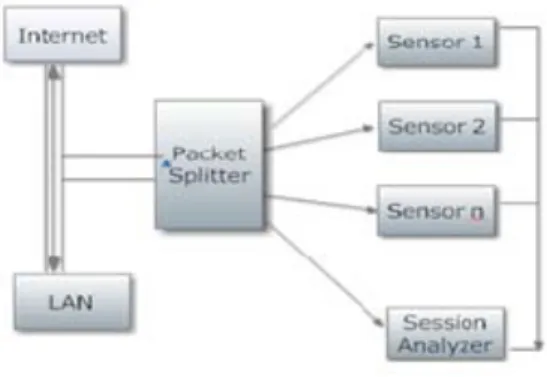
At node level parallelism, there are several nodes (systems) that packets are transferred to these nodes using traffic duplicator or maybe a traffic splitter, and each node operates in data or function parallel. At node level data parallelism, each node should have complete set of rules, and a round-robin-like algorithm is used to split the network traffic (packets) among the nodes, also a session analyzer should be used to maintain integrity due to packet reassembly.
One major advantage of this approach is that each packet is processed only once. On the contrary, in the node level function parallelism, a set of rule groups will be allocated to each node. If a traffic duplicator is used, all packets will be processed by all nodes. In another method, each node has a complete set of rules that by using a packet duplicator, every packet will be sent to every node, if the node doesn’t have the related rule to that packet, it will be dropped. Figure 1 shows the node level data parallelism. The Following researches were con-ducted based on this level of parallelism.
the necessary things to detect a specific attack, hence the sensor to sensor interactions was not necessary. Their goal was to serve stateful packet inspection and load-balancing, and it was a kind of functioning node level data parallelism, in the way that each sensor is autonomous, and is responsible for the detection of a subset of the signatures and each traffic slice is processed by a subset of sensors. They used one scatter, three slices, and four reassembles with one sensor per stream. It was necessary to send all packets of a given session to the same data parallel node. A result of their work indicated increased throughput by using node parallel approach.
Shishi and his friends (Liu, S., et al., 2003) divided the IP packet sniffed into different parts and sent to dif-ferent sensors where the packets were processed in parallel, hence the performance, stability, and scalability of the system increased. They designed and implemented application layer IDS which reassembled the IP packets captured by the sniffer, rebuilt the TCP session and provided plug-in mechanisms to process the data of different application layer protocols. They concluded that their system worked well with little packet loss rate (< 0.1%).
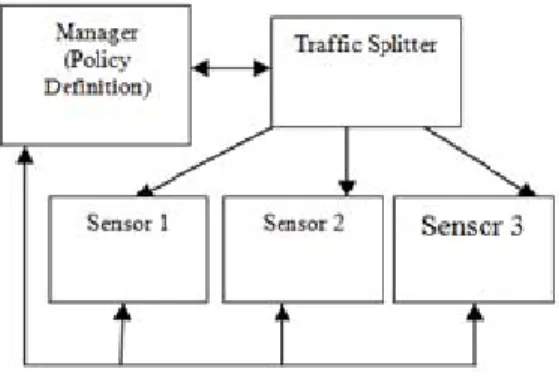
Shoaib and his friends proposed an approach (Zhao, X. and J. Sun, 2003) to use multi sensor network intru-sion detection systems with a mechanism to split the traffic into different sensors. They used several policies on the splitter in order to manage splitting the traffic by the management console. They utilized reloading policies in order to forward Packets belonging to the same attack to the same sensor; otherwise the attack cannot be de-tected. In their model, all the sensors have a common rule-set, and the packet will be forwarded to a sensor ac-cording to the defined policy.
Fig. 1: Node Level Parallelism Architecture
Shoaib and his friends determined the policy in the way the user can define any Boolean combination of traffic parameters such as source and destination port, source and destination IP, and protocol type as the policy which was used as a pre-processing mechanism to reduce the amount of traffic to be analyzed by sensor. The results show that the disparity of load among sensors is well catered by using their technique. Figure 2 shows their architecture.
Salour and Su determined a dynamic two-layer signature-based NIDS with two unequal databases (ShoaibAlam, M., et al., 2004). They proposed a node level parallelism using distributing the signature database between two nodes. When an intrusion detection system (signature based NIDS) encounter with a huge amount of network traffic, it cannot keep up with it, and consequently, it will drop the packets, hence potential attacks may be missed. With regard to this point that small signature database can improve the throughput of signature-based NIDS in the way a packet needs to match with fewer numbers of signatures; Salour and Su used two databases with unequal size. The primary NIDS had a smaller size with the most attacks that happen frequently and the secondary NIDS had a bigger size to find the unlikely attacks. They developed a program as a detection engine which updates the primary NIDS to remove signatures that are related to attacks, which no longer occurring frequently and any signature in secondary NIDS that occurs frequent should be added to primary NIDS. Their experiments proved a significant decrease in the packet drop rate and increasing the performance of signature based network intrusion detection system.
Fig. 2: Load Balancing Architecture
All the sensors run only rules set dedicated to the depicted packets. When an attack is detected, the sensor will be executed an appropriate policy and send an alarm. In order to demonstrate their model, they did an accu-rate comparison between four scenarios. First, they utilized only one sensor with all the snort’s rules. Second they used seven sensors that each sensor had only a part of the rule set according to the destination port. Third, they applied seven sensors that each one had the entire snort’s rule set, but responsible for processing a fragment of traffic. Finally, their model based on seven sensors that each processed a part of the traffic and had a part of rule set. After running these scenarios the minimum and maximum processing time are kept. By using a switch that divided the traffic and load balancing approach among several sensors, they proved that their architecture had flexibility more than centralized architecture, and it is 10 times quicker than it. It is a kind of function node level parallelism.
Component Level:
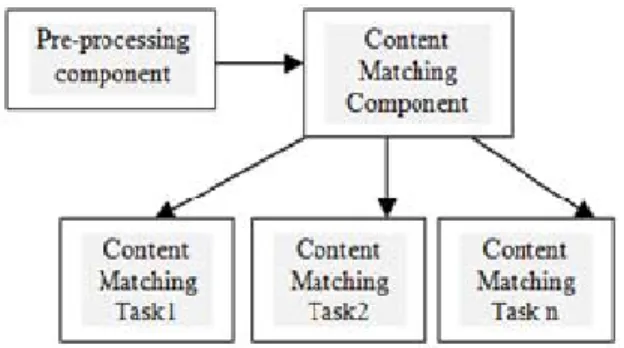
Component level parallelism is a kind of function parallelism that individual components of the NIDS ar-chitecture are isolated and given their own processing elements such as pre-processing and multi pattern match-ing. Consider, three sensors that the first one read the packet, reassemble it, the second one process the packet, and the third one detect the attack and start passive or active action. Figure 3 shows the component level paral-lelism architecture. The following researchers used this kind of paralparal-lelism in their researches. The work which has been done in (Anagnostakis, C.K. and E. Markatos, 2003) tried to ease the workload by integrating a cluster into NIDS, allowing tasks to be executed in parallel in the cluster. According to them, performance will increase even under hostile loads and enables efficient intrusion detection in high-speed networks. They concluded that their parallel scheme can improve the performance parameters of NIDS greatly.
Fig. 3:Component Level Parallelism Architecture
to one of the sensors. Using a hash function on the packet headers for load distribution is necessary. Their expe-rimental results have been shown 19.8% improving the system performance.
In a study by Kopek, Fulp, and Wheeler (Salour, M. and X. Su, 2007), a distributed data parallel technique for content matching intrusion detection system defined. In their model, portions of a packet payload distribute across some processors; Divided Data Parallel (DDP), so each of the processors is responsible for analyzing a smaller amount of the whole packet payload. It uses a match bit which is used when a processor wants to indi-cate finding a match for a given packet to other processors, so others can trigger processing another packet. In their new data parallel method, the packet payload is divided to several fragments, and in order to prevent false negative it uses overlapping. As a result of their experiments, this system let pipelining because processors may process fragments from different packets. In comparison with previous work that could obtain a speed-up of .75 n (n is the number of processors) it speed-up of 1.25n.
According to Zhuang (Faschini, L., et al., 2008), using multi core processor is another way for ensuring that an NIDS performs well in the high-speed network environment. They suggested that by operating on a computer system equipped with multi core processor, content matching computation is boosted by executing detection tasks in parallel, so they introduced an abstract NIDS model on multi core platform which their system’s archi-tecture consisted of a network monitor, a frame decoder, a scheduler, a set of buffers and a set of sensors. In their model, the network monitor component captured traffic on a network link, after that the frame decoder should analyze the encapsulation of each coming frame and extract the basic component such as the network layer protocol, next the scheduler sent packets to buffers according to their network layer protocol which each buffer is connected to one or more sensors where the known attacks are recognized. Their experimental result proved the robustness of the parallel model in most cases.
Sub-Component Level:
Sub-component level parallelism is related to the parallelization of individual component of the intrusion detection system. Parallelization of Content matching component of network intrusion detection system is a good example that may be use function or data parallelism. The combination of component level and sub-component level parallelism is one of the most effective ways for improving the performance of signa-ture-based NIDS.
Yu and Li (Zhuang, Z., et al., 2008) proposed a parallel NIDS pattern matching engine to reduce the con-tent matching time. According to them, the pattern matching task should be efficient enough, otherwise the network intrusion detection system will drop packets, and consequently the attacks will be missed. They used the parallel AC algorithm, and several processors to build a pattern matching cluster. Whenever a packet is ob-tained, the load balance unit is responsible to divide it to n parts (n is the number of processors) and send them to pattern matching unit which all of them use AC algorithm to do pattern matching. They used a load balance policy to have a same processing time for each pattern matching unit. They implemented on Intel‘s NP (LXP2850). Their results showed how it is beneficial when eight processors are used, so the pattern matching time will be reduced, but more work is needed for determining better load balance policy and improving the performance of AC algorithm.
Fig. 4: Component & Sub-component Parallelism in Content Matching
re-duce the traffic on a high-speed link, and all the slices had a manageable size, also they used several parallel sensors. In their architecture, all the parallel sensors are communicated with each other and send feedback in order to synchronize their scanning processes. They used a kind of sub-component level parallelism in their ar-chitecture and proved that by making the rule matching process in parallel, the scalable implementation of a stateful, network-based intrusion detection system is easily achievable.
Conlusion And Future Work:
Network Intrusion Detection Systems (NIDS) are one of the latest developments in security. As we de-scribed before, in order to improve the processing time of the traffic several approaches have been proposed such as using an efficient string matching algorithm since an underperforming passive system drops many pack-ets and misses many attacks or using several parallel NIDS on the network traffic for processing the whole traf-fic concurrently; hence the whole system can achieve a higher throughput.
This paper tries to review what the researchers had been done in the parallel and distributed techniques in NIDS area. It is good to mention that not all researchers deal with parallel NIDS issue the same way. Some of them just reduce the processing time of the traffic using early filtering, where a portion of the packets is processed on the splitter instead of the sensors. Locality buffering is used to increase the system performance or using cluster in order to allow tasks to be executed in parallel in the cluster, while the others study distributed NIDS architecture and using parallelism at the sub-component level. Hence we believe that parallelization is needed to reduce the processing time of the traffic. Finally, the IDS researchers still keep digging to find the most suitable way to increase the performance of the IDS.
According to Wheeler (2007) the combination of component level and sub-component level parallelism is one of the most effective ways to increase the performance of NIDS, consequently, decrease the processing time of the traffic, so we plan to further investigate about it. Future work will include a more thorough study of the parallel model which network traffic is partitioned into flows based on the protocol type particularly involving the investigation running on a real-world hardware environment to improve the efficiency of network intrusion detection task.
ACKNOWLEDGMENT
The authors would like to thank Research Management Centre (RMC), Universiti Teknologi Malaysia (UTM) for funding this research through the Foreign Academic Visitor Fund (FAVF) via vote number R.K130000.7738.4D066.
REFERENCES
“Snort.org,” http://www.snort.org/
Aho, A. and M. Corasick, 1975. Fast pattern matching: an aid to bibliographic search Common, ACM, 18(6): 333.340.
Aldwairi, M., T. Conte and P. Franzon, 2005.Configurable string matching hardware for speeding up intru-sion detection,” SIGARCH Comput.Archit.News, 33(1): 99-107.
Anagnostakis, C.K. and E. Markatos, 2003. An Active Traffic Splitter Architecture for Intrusion Detec-tion,11th IEEE/ACM International symposium on Digital Object Identifier.2003. Hellas: IEEE, 238-241.
Baker, Z.K. and V.K. Prasanna, 2004. Time and area efficient pattern matching on fpgas,” In FPGA '04: Proceedings of the 2004 ACM/SIGDA 12th international symposium on Field programmable gate arrays, pp. 223-232, New York, NY, USA,ACM Press.
Bellovin, S.M. and W. Cheswick, 1994. Network Firewall, IEEE Communications Magazine, pp: 50-57. Boyer, R. and J. Moore, 1977. A fast string searching algorithm.Commun,” ACM, 20(10): 762-772. Bu, L. and J.A. Chand, 2004. FPGA based network intrusion detection using content addressable memories, In FCCM '04: Proceedings of the 12th Annual IEEE Symposium on Field-Programmable Custom Computing Machines, pp. 316-317, Washington, DC, USA, IEEE Computer Society.
Commentz-Walter, B., 1979. A string matching algorithm fast on the average, In Proceedings of ICALP'79: 118-132.
Culler, D.E. and J.P. Singh, 1999. Parallel Computer Architecture, A Hardware/Software Approach. Mor-gan Kaufman.
Dharmapurikar, S., P. Krishnamurthy, T.S. Sproull and J.W. Lockwood, 2004. Deep packet inspection us-ing parallel bloom filters, Micro, IEEE, 24(1): 52-61.
Faschini, L., A. Thapliyal, L. Cavallaro, C. Kruegel and G. Vigna, 2008. A Parallel Architecture for State-ful, High-Speed Intrusion Detection, Santa Barbara.
Kim, S and Y. Kim, 1999. A Fast Multiple String Pattern Matching Algorithm, Proc of 17th AoM/IAoM Conference on Computer Science.
Kim, S. and Y. Kim, 1999. A fast multiple string pattern matching algorithm, In Proceedings of 17th AoM/IAoM Conference on Computer Science.
Kopek, C.V., E.W. Fulp and P.S. Wheeler, 2008. Distributed Data Parallel Techniques For Content-Matching Intrusion Detection Systems,” Military Communication Conference. 2007. Orland, Fl, USA: IEEE. 1-7.
Kruegaland, C. and F. Valeur, 2002. Stateful Intrusion Detection for High-Speed Networks,” IEEE Sympo-sium on Security and Privacy (S&P.02),Santa Barbara: IEEE.1-9.
Liu, S., J. Sun, X. Zhao and Z. Wei, 2003. A general purpose application layer IDS,Tianjin :2003. Piyachon, P. and Y. Luo, 2006. Efficient memory utilization on network processors for deep packet in-spection,In ANCS '06: Proceedings of the 2006 ACM/IEEE Symposium on Architecture for Networking and Communications Systems, pp: 71-80, New York, NY, USA, ACM Press.
Rehman, R.U., 2003. Intrusion Detection Systems with Snort Advanced IDS Techniques Using Snort, Apache, MySQL, PHP, and ACID. Newjercy: Prentice Hall PTR.
Salour, M. and X. Su, 2007. Dynamic Two-Layer Signature-Based IDS with Unequal Databases, Interna-tional Conference on Information Technology (ITNG'07). 2007. San Jose State: IEEE.
Scallay, H., K.A. Alshalfan and O.B. Fredj, 2009. A scalable distributed IDS Architecture for High speed Networks, IJCSNS International Journal of Computer Science and Network Security, 9(8): Riyadh, - Saudi Arabia: IEEE.
ShoaibAlam, M., Q. Javad, R.U. Rehman, B. Anwer and M. Adaptive, 2004. Load Balancing Architecture for SNORT,” Pakistan .
Wheeler, P. and E.W. Fulp, 2007. A taxonomy of parallel techniques for intrusion detection, ACMSE 2007. Wu, S and U. Manber, 1994. A fast algorithm for multi-pattern searching, Technical Report TR-94-17, University of Arizona.
Yu, J. and J.A. Li, 2005. Parallel NIDS Pattern Matching Engine and Its Implementation on Network Pro-cessor,”International Conference on Security and Management. 2005. Beijing, China: IEEE.1-7.
Zhao, X. and J. Sun, 2003.A Parallel Scheme for IDS,” Second International Conference on Machine Learning and Cybernetics, Wan, 2-5.
Zhuang, Z., Y. Luo, M. Li and C. Weng, 2008. A Resource Scheduling Strategy for Intrusion Detection on Multi-core Platform,IFIP International Conference on Network and Parallel Computing.China.