Quantum Chosen-Ciphertext Attacks against
Feistel Ciphers
?Gembu Ito1, Akinori Hosoyamada1,2, Ryutaroh Matsumoto1,3, Yu Sasaki2, and Tetsu Iwata1
1
Nagoya University, Nagoya, Japan
g [email protected],[email protected], [email protected]
2
NTT Secure Platform Laboratories, Tokyo, Japan [email protected],[email protected]
3
Aalborg University, Aalborg, Denmark
Abstract. Seminal results by Luby and Rackoff show that the 3-round Feistel cipher is secure against chosen-plaintext attacks (CPAs), and the 4-round version is secure against chosen-ciphertext attacks (CCAs). However, the security significantly changes when we consider attacks in the quantum setting, where the adversary can make superposition queries. By using Simon’s algorithm that detects a secret cycle-period in polynomial-time, Kuwakado and Morii showed that the 3-round version is insecure against quantum CPA by presenting a polynomial-time dis-tinguisher. Since then, Simon’s algorithm has been heavily used against various symmetric-key constructions. However, its applications are still not fully explored.
In this paper, based on Simon’s algorithm, we first formalize a sufficient condition of a quantum distinguisher against block ciphers so that it works even if there are multiple collisions other than the real period. This distinguisher is similar to the one proposed by Santoli and Schaffner, and it does not recover the period. Instead, we focus on the dimension of the space obtained from Simon’s quantum circuit. This eliminates the need to evaluate the probability of collisions, which was needed in the work by Kaplan et al. at CRYPTO 2016. Based on this, we continue the investigation of the security of Feistel ciphers in the quantum setting. We show a quantum CCA distinguisher against the 4-round Feistel cipher. This extends the result of Kuwakado and Morii by one round, and follows the intuition of the result by Luby and Rackoff where the CCA setting can extend the number of rounds by one. We also consider more practical cases where the round functions are composed of a public function and XORing the subkeys. We show the results of both distinguishing and key recovery attacks against these constructions.
Keywords: Feistel cipher · Quantum chosen-ciphertext attacks · Si-mon’s algorithm
?
1
Introduction
A block cipher is an important cryptographic primitive that is widely adopted in various secure communication protocols and security products. A block cipher is a pseudo-random permutation (PRP), i.e. it takes a key as input and provides distinct permutations that cannot be distinguished from a random permutation for distinct key inputs.
Designing an efficient block cipher is a long-term challenge in symmetric-key cryptography. One of the most popular approaches is to use the Feistel network, in which ann-bit state is divided inton/2-bit halves denoted byai andbi, and the state is updated by iteratively applying the following two operations;
bi+1←ai⊕FKi(bi), ai+1←bi,
where FKi is a keyed function taking a subkeyKi as input. The construction
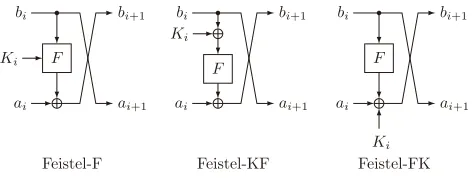
is known as the Luby-Rackoff construction. In this paper, we call it Feistel-F to make the name consistent with other constructions. The diagram of the construction is drawn in the left of Fig. 1. Luby and Rackoff [18] proved that when FKi is a pseudo-random function (PRF), 3-round and 4-round Feistel ciphers
are PRPs up to O(2n/4) queries against chosen-plaintext attacks (CPAs) and chosen-ciphertext attacks (CCAs), respectively. Luby and Rackoff also showed the tightness of the number of rounds by demonstrating efficient attacks against 2 and 3 rounds in the corresponding attack models.
While the provable security bounds derived by Luby and Rackoff are attrac-tive, using a PRF for FKi requires significant implementation costs, and this
is often practically infeasible. To design a block cipher for practical usage, the subkey space is often limited to{0,1}n/2, andF
Ki(bi) is defined as
bi+1←ai⊕F(Ki⊕bi), ai+1←bi,
whereF is a public function. In this paper, we call this constructionFeistel-KF. See the middle figure of Fig. 1. Feistel-KF includes a lot of practical designs, e.g. DES [19] and Camellia [1], where the functionx7→F(Ki⊕x) is not a PRF, and generic attacks on this construction have been widely studied, e.g. impossible differential attacks [14], meet-in-the-middle attacks [12,10], dissection attacks [5] and division property [23].
It is also possible to inject a subkeyKi∈ {0,1}n/2outside theF function as
bi+1←ai⊕F(bi)⊕Ki, ai+1←bi.
We call this construction Feistel-FK, which is illustrated on the right of Fig. 1. This construction provides implementation advantages and can be seen in several lightweight designs e.g. Piccolo [21], Simon [2] and Simeck [24].
F
Feistel-F Feistel-KF Feistel-FK
F Ki
Ki
Ki F
ai
bi
ai+1
bi+1
ai
bi
ai+1
bi+1
ai
bi
ai+1
bi+1
Fig. 1.Our target constructions.
to resist the exhaustive key search by Grover’s algorithm [9] is sufficient to pro-tect symmetric-key schemes from quantum computers. However, Kuwakado and Morii [15] demonstrated that, by exploiting Simon’s algorithm [22], the Feistel ci-phers can be distinguished from a random permutation only in polynomial-time of the output size under the assumption that the adversary can make quantum superposition queries. Since then, many polynomial-time attacks using Simon’s algorithm have been proposed e.g. key recovery against Even-Mansour construc-tion [16], forgery on various CBC-like MACs [13], and cryptanalysis of AEZ [3]. Moreover, Leander and May [17] showed a clever method to combine Grover’s and Simon’s algorithms to recover the key against the FX construction. See also [20].
The attack model that adversaries can make quantum queries is worth inves-tigating. This model is a natural extension of the classical attack models, and theoretically interesting. Any symmetric scheme broken in this model should not be implemented on a quantum computer. Moreover, the threat of this attack model becomes significant if an adversary has access to its white-box implemen-tation. Because arbitrary classical circuit can be converted into quantum one, the adversary can construct a quantum circuit from the classical source code given by the white-box implementation.
There are several attacks on Feistel ciphers in the quantum setting. Besides the first work in [15], a meet-in-the-middle attack in the quantum setting was discussed in [11] and appending key-recovery rounds by applying the algorithm by Leander and May [17] was discussed in [11,8,7]. However, the following im-portant issues have not been discussed by the previous work.
– Discussion on practical constructions is missing. Although the Luby-Rackoff construction is a good object to study theoretical aspects of the Feistel ci-phers, in general, it cannot be implemented efficiently in practice. Therefore, the analyses of practical constructions like Feistel-KF and Feistel-FK are needed. Again, we are interested in general constructions that do not rely on a specific key scheduling function.
Our Contributions. In this paper, we further investigate the security of the Feistel ciphers against quantum adversaries. In particular, we show CCA distin-guishers that can distinguish more rounds than the previous CPA distindistin-guishers. In addition, we extend the distinguishers to key recovery attacks for the practical constructions, i.e. Feistel-KF and Feistel-FK.
We start with several fundamental observations about Simon’s algorithm that detects a secret cycle-period in polynomial-time. The usage of Simon’s algorithm in the previous work can be classified into two types; the first type uses Simon’s algorithm for key recovery attacks, namely, the recovered secret cycle-period corresponds to the key of the construction such as [16] and [13], whereas the second type uses Simon’s algorithm for distinguishers, e.g. to distinguish the construction from an ideal one [15,20] or to distinguish the right key guess from wrong key guesses [17,11,8,7].
We observe that, for the second type, recovering the secret cycle-period is not necessary as long as a non-ideal behavior is detected. If we follow [13] to recover the secret cycle-period by using Simon’s algorithm, one has to derive the upper bound on the probability of a collision other than the period. However, there are cases where obtaining the upper bound is non-obvious, and it may be difficult to prove it in attacks on complicated constructions. This motivates us to relax the requirement of recovering the period in Simon’s algorithm. Technically, we focus on the property that the dimension of the space spanned by the vectors in Simon’s algorithm, instead of the exact period s. Namely, the dimension of the space is at most`−1 if the target function has a periods, where{0,1}` is the domain of the function evaluated by Simon’s algorithm. This modification eliminates the need to derive the upper bound on the probability of a collision other than the periods. Note that Santoli and Schaffner pointed out a similar observation [20], and we are dealing with a general class of block ciphers, and we also formalize a sufficient condition so that the distinguisher works.
Table 1. Comparison of the number of attacked rounds in various settings. “Dist.” and “KR” denote distinguisher and key recovery attack, respectively. Superscript P denotes that the attack complexity is only a polynomial of the function’s output size, while the others require exponential complexity.
ConstructionClassic-CPA Classic-CCA Quantum-CPA Quantum-CCA Dist. KR Dist. KR Dist. KR Dist. KR Feistel-F 2 [18] - 3 [18] - 3P [15] - 4P Ours
-Feistel-KF 5 [10] 6 [10] 5 [10] 6 [10] 5 [11]6 [11] 4P Ours 7 Ours 3P [15]
Feistel-FK - - - - 5P Ours 8 Ours 6P Ours 9 Ours
9n/2-bit key with O(23n/4) complexity. In addition, the CPA distinguisher is extended to 5 rounds and we obtain 8-round key recovery attacks that recover 8n/2-bit key withO(23n/4) complexity. A comparison of the number of attacked rounds is given in Table 1. Note that Table 1 focuses on attacks with complexity at most O(2n), and it does not include attacks with higher complexities. Also, we consider only general constructions, so it does not include attacks against constructions with a particular key scheduling function such as [6,4].
Paper Outline. This paper is organized as follows. Section 2 describes prelimi-naries. Section 3 introduces previous works. Section 4 explains the formalization of a distinguishing technique that relaxes Simon’s algorithm. Section 5 presents our CCA distinguisher against the 4-round Feistel-F constructions. The attack is then applied to chosen-ciphertext key-recovery attacks on Feistel-KF con-structions in Sect. 6. Section 7 explains distinguishing and key-recovery attacks against Feistel-FK constructions in both CCA and CPA settings. We conclude the paper in Sect. 8.
2
Preliminaries
2.1 Notation
For a positive integern, let{0,1}nbe the set of alln-bit strings. Let Perm(n) be the set of all permutations on{0,1}n, and let Func(n) be the set of all functions from{0,1}nto{0,1}n. For bit stringsaandb,akbdenotes their concatenation. We also regard aand b as binary vectors, and let |a| be the dimension of the vectora. When|a|=|b|, we denote their inner product asa·b. In this paper,e denotes Napier’s number. For a finite setX, we writeX $
← X for the process of sampling an element uniformly fromX and assigning the result toX.
2.2 Simon’s Algorithm
about quantum computation. Simon’s algorithm can solve the following problem.
Problem 1. Given a function f :{0,1}n
→ {0,1}n, assume that there exists a periods∈ {0,1}n
\{0n
} such that for any distinctx, x0 ∈ {0,1}n, it holds that f(x) =f(x0)⇔x0 =x⊕s. The goal is to find the periods.
We assume that Simon’s algorithm has access to the quantum oracleUf, which is defined asUf|xi |zi=|xi |z⊕f(x)i. We use the Hadamard transformH⊗nthat is applied on n-qubit state |xi and gives H⊗n
|xi= √1 2n
P
y∈{0,1}n(−1)x·y|yi.
Simon proposed a circuitSf that computes vectors that are orthogonal tosby using the quantum oracle Uf.Sf is described as (H⊗n⊗In)·Uf ·(H⊗n⊗In) and works as follows:
1. We first apply the Hadamard transformH⊗non the firstnqubits of 2n-qubit state|0n
i |0n
ito obtain the state √1
2n P
x|xi |0ni.
2. Then, we apply the unitary operatorUfto obtain the state√12n
P
x|xi |f(x)i. 3. Finally, we apply the Hadamard transform H⊗n on the first n qubits to
obtain the state
1 2n
X
x,y
(−1)x·y
|yi |f(x)i. (1)
As we assume that f satisfies f(x) =f(x0)⇔x0 =x⊕s, we have |yi |f(x)i=
|yi |f(x⊕s)ifor eachy andx. Therefore, equation (1) is described as
1 2n
X
x∈V,y
(−1)x·y+ (−1)(x⊕s)·y
|yi |f(x)i,
whereV is a linear subspace of{0,1}n of dimensionn
−1 that partitions{0,1}n into cosets V andV +s. The vector y such that y·s≡1 (mod 2) will satisfy (−1)x·y + (−1)(x⊕s)·y = 0. Thus, we will obtain a random vector y such that y·s≡0 (mod 2) by measuring the firstnqubits. By repeating this routine that obtains a random vector y for O(n) times, with a high probability, we obtain n−1 linearly independent such vectors, and then the periodscan be recovered by solving the system of linear equations.
We note that, in Simon’s algorithm, we assume that the function f has a periods. In latter sections, we will use the circuitSf to a functionf that may not have any period, or may have multiple periods.
2.3 Kaplan et al.’s Observation
To apply Simon’s algorithm, the function f has to satisfyf(x) =f(x0)⇔x0=
seven iff has partial periods, where the partial period is defined ast6=ssuch that f(x) =f(x⊕t) holds for some x[13].
More precisely, suppose that a function f :{0,1}` → {0,1}m satisfies only the condition thatf(x) =f(x0)⇐x0 =x⊕sfor any distinctx, x0∈ {0,1}`. Since now the counter conditionf(x) =f(x0)⇒x0 =x⊕sdoes not always hold, there
may exist partial periods of f. Intuitively, if there exist many partial periods t1, t2, . . . which are very close to complete periods (i.e., Prx[f(x) =f(x⊕tj)] is close to 1 for each j), then it becomes hard to recover s. To describe this intuition formally, Kaplan et al. introduced the parameter (f, s) defined as
(f, s) = max
t∈{0,1}`\{0`,s}Prx [f(x) =f(x⊕t)]. (2)
This shows the maximum probability of partial periods off. Notice that iff is a constant function, then (f, s) = 1 and s cannot be recovered. On the other hand, if f satisfies Simon’s promise, then (f, s) = 0. The following theorem about the success probability of Kaplan et al.’s observation was proved.
Theorem 1 ([13]). If(f, s)≤p0 for some positive numberp0<1, the proba-bility that Simon’s algorithm returnssafterc`queries is at least1−(2(1+2p0)c)`.
This theorem shows that we still obtain swith O(`) quantum queries and the complexity does not increase significantly.
3
Previous Works
3.1 Quantum Distinguisher against the 3-Round Feistel Cipher
Here we review the distinguishing algorithm of the 3-round Feistel cipher by Kuwakado and Morii [15]. Kuwakado and Morii considered the case where FKi
in Fig. 1 is a random permutation, and we writePi forFKi.
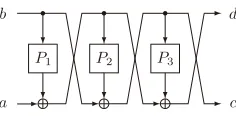
Let FP3denote the encryption algorithm of the 3-round Feistel cipher, where random permutations P1, P2, P3 $
← Perm(n/2) are used as internal functions. FP3 takes a plaintext (a, b) ∈ ({0,1}n/2)2 as input and outputs a ciphertext (c, d)∈({0,1}n/2)2, where
c=b⊕P2(a⊕P1(b)),
d=a⊕P1(b)⊕P3(b⊕P2(a⊕P1(b))).
Figure 2 illustrates FP3.
Kuwakado and Morii considered the following problem.
Problem 2. Let O :{0,1}n
→ {0,1}n be either FP
3 or a random permutation Π $
Fig. 2. The 3-round Feistel cipher withPi
$
← Perm(n/2) being used as the internal function.
x α0/α1
Fig. 3. FP3(x, αβ) and the lower half cof
the ciphertext.
x α0/α1
Fig. 4.P2(x⊕P1(αβ)).
Let α0, α1 ∈ {0,1}n/2 be arbitrary distinct constants. For β
∈ {0,1} and x∈ {0,1}n, Kuwakado and Morii used (x, αβ) as the plaintext (a, b). When
O
is FP3, the lower halfc of the ciphertext is described as
c=αβ⊕P2(x⊕P1(αβ)).
Figure 3 illustrates c. Then, we see thatc⊕αβ =P2(x⊕P1(αβ)) holds, which is illustrated in Fig. 4. If we change the value of β, i.e., if we let β to β⊕1, we see that the input value of P2 remains the same value by changing x to x⊕P1(α0)⊕P1(α1). Thus, we can construct a functionfO(βkx) that has the
period 1kP1(α0)⊕P1(α1) by definingfO as
fO :{0,1} × {0,1}n/2→ {0,1}n/2
(βkx)7→c⊕αβ, where (c, d) =O(x, αβ). (3)
Note thatfO can also be evaluated in quantum superpositions. We can realize
the unitary operatorUfO :|xi |yi 7→ |xi |y⊕fO(x)iwhich makesO(1) quantum
queries toUO. IfOis FP3, then the functionfO is described as
fO(β kx) =αβ⊕P2(x⊕P1(αβ))⊕αβ =P2(x⊕P1(αβ)),
and the following lemma holds.
Lemma 1. If O is FP3, the function fO satisfiesfO(β kx) =fO(β0 kx0)⇔ β0 k x0 = (β k x)⊕(1 k P1(α0)⊕P1(α1)) for any x, x0 ∈ {0,1}n/2 such that x6=x0. That is, fO has the periods= 1k(P1(α0)⊕P1(α1)).
Lemma 1 guarantees that the functionfO defined in equation (3) satisfies
Simon’s promise ifOis FP3, and we can recover the periodsby applying Simon’s algorithm to fO. Define a unitary operator S
fO bySfO = (H⊗n/2+1⊗In/2)·
UfO ·(H⊗n/2+1⊗In/2). The quantum distinguisher by Kuwakado and Morii
works as follows.
1. Measure the first n/2 + 1 qubits of SfO|0n+1i to obtain the vector y ∈
{0,1}n/2+1.
2. Repeat Step 1 until we obtainn/2 linearly independent vectors. If obtained, computesby solving the system of linear equations.
3. Choose β∈ {0,1} andz∈ {0,1}n/2 randomly, and computefO(βkz) and
fO((β k z)⊕s). IffO(β k z) =fO((β kz)⊕s), then output “O is FP
3,” otherwise output “OisΠ.”
IfOis FP3, we obtain the periodsin Step 2 with a high probability and it passes the test in Step 3. On the other hand, according to [15], ifO isΠ, with a high probability, Simon’s algorithm returns a random string s0, and the probability
that fO(β k z) = fO((β kz)⊕s0) is about 2−n/2. Therefore, the distinguisher above returns a correct answer by makingO(n) quantum queries.
Remark 1. We need to truncate outputs ofO for constructing the functionfO,
since we use only the lower n/2 bits of the output of O. However, the oracle may return outputs of which the lower and upper parts are entangled, and it is not trivial to truncate such outputs without destroying the entanglement, as pointed out by Kaplan et al. [13]. To solve this problem, Hosoyamada and Sasaki showed how to simulate truncation of outputs of the oracles without destroying quantum entanglements [11], and the same technique can be used in our case.
3.2 Key Recovery Attacks against the Feistel-KF Construction
Next, we introduce the idea of the key recovery attacks against the Feistel-KF construction by Hosoyamada and Sasaki [11], and Dong and Wang [8]. They com-bined the quantum distinguisher against the 3-round Feistel cipher (see Sect. 3.1) with the Grover search. The attack is a quantum chosen-plaintext attack, and recovers the keys of the r-round Feistel cipher in time ˜O(2(r−3)n/4).
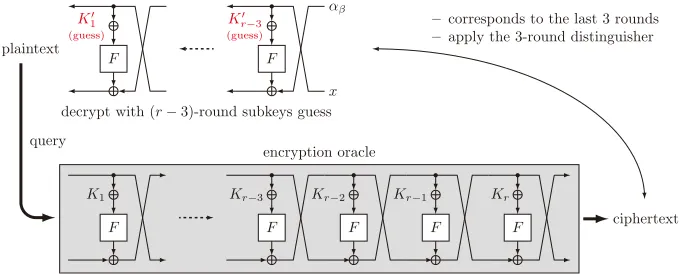
Attack Idea. Given the quantum encryption oracle of the r-round Feistel-KF construction, run the following procedures (on a quantum circuit).
1. Implement a quantum circuit which
– takes the intermediate state value after the first (r−3) rounds and the subkeys for the first (r−3) rounds as input,
– computes the plaintext by decrypting the first (r−3) rounds,
– makes a quantum query of the computed plaintext to the oracle,
– and returns the oracle output.
(guess)
K1 Kr−3 Kr−2 Kr−1 Kr
αβ
x
plaintext
query
encryption oracle
– corresponds to the last 3 rounds
– apply the 3-round distinguisher
F
Kr−3
F
K1
(guess)
F F F F F ciphertext
decrypt with (r−3)-round subkeys guess
Fig. 5. Construction of E in the key recovery attack against the r-round Feistel-KF construction. The ciphertext corresponds to the output of the 3-round Feistel-KF con-struction which takes (Kr−2, Kr−1, Kr) as subkeys and (x, αβ) as input.
2. Guess the subkeys of the first (r−3) rounds.
3. For each guess, check its correctness with the following procedure. (a) Apply the 3-round distinguisher to E.
(b) If the distinguisher returns that “this is a random permutation”, then judge that the guess is wrong. Otherwise judge that the guess is correct.
Attack Complexity. The total length of the subkeys of the first (r−3) rounds is ((r−3)n/2) bits. Thus the exhaustive search of the first (r−3) rounds can be done in time O(√2(r−3)n/2) by using the Grover search. Moreover, the 3-round distinguisher in the third step runs in time O(n) for each subkeys guess. The running time of the attack isO(√2(r−3)n/2)×O(poly(n)) = ˜O(2(r−3)n/4).
Although how to formally combine the Grover search and the 3-round dis-tinguisher is non-trivial, the technique developed by Leander and May [17] guar-antees that those can be combined. See the previous papers [11,8] for details.
4
Relaxing Simon’s Algorithm
This section presents quantum distinguishers that are based on the relaxed ver-sion of Simon’s algorithm [22]. In a nutshell, we discuss that it is enough to obtain several vectors that are orthogonal to the period, and thus we eliminate the need to recover the actual period. This is similar to the one by Santoli and Schaffner [20], while we are dealing with a general class of block ciphers, and we also formalize a sufficient condition so that the distinguisher works.
orthogonal to the periods. On the other hand, as we prove in Theorem 2 below, if the functionf does not have any period, the dimension of the space spanned by the vectors y1, y2, . . . can reach|s| with a high probability. In other words, we can distinguish f by checking the dimension of the space spanned by the vectors y1, y2, . . . without computing the actual period s. Thus, there will not be a problem if there are several partial periods or periods other thansbecause our distinguisher does not need the periods.
Note that this technique works only if we do not need the value ofs. This technique cannot be applied to the key recovery attacks on Even-Mansour con-struction and forgery attacks on authentication and authenticated encryption schemes since the goal of these attacks needss[13].
Below we formally explain how our distinguisher works. LetO : {0,1}n
→ {0,1}n be either an encryption scheme E
K or a random permutation Π $
←
Perm(n), and suppose that the quantum oracles ofO and O−1 are given. Our goal is to distinguish whether O =EK or O = Π. In what follows, when we use the symbolπfor a permutation, we consider that πis a fixed (or constant) permutation.
Settings. Our distinguisher can be applied when there is a function family{fπ :
{0,1}`→ {0,1}m}
π∈Perm(n)that satisfies the following conditions:
1. There is a (classical) algorithm A that makes black-box access to π, π−1, and computesfπ. That is, for each permutation π,Aπ,π−1
computesfπ(x) ifx is given as input. We assume that A makes O(1) queries and runs in timeO(poly(`, m)).
2. For the encryption scheme E and any key K, fEK has a period, i.e., there
existss∈ {0,1}`such that fEK(x⊕s) =fEK(x) holds for all x(note that
sdepends onK).
Moreover, informally we expect thatfΠ has no period with a high probability whenΠ is a random permutation. Note that the first condition implies that we can make a quantum circuit that realizes the unitary operator UfO :|xi |zi 7→
|xi |z⊕fO(x)iby making O(1) quantum queries to OandO−1, since any clas-sical deterministic algorithm can be converted to a corresponding quantum al-gorithm.
Description of the Distinguisher. LetSfO be the unitary operator that is defined
as in Sect. 2. Recall thatSfO = (H⊗`⊗Im)·UfO·(H⊗`⊗Im). Our distinguisher
is described in Algorithm 1.
Algorithm 1Distinguisher without recovering the period
1. Prepare an empty setY. 2. For 1≤i≤η, do:
3. Measure the first`qubits ofSfO|0`+miand add the obtained vectorytoY. 4. End For
5. Calculate the dimensiondof the vector space spanned byY. 6. Ifd=`, then output “OisΠ.” Ifd < `, output “OisEK.”
The failure probability increases if the distribution of y in Step 3 is highly biased. Moreover, we obtain a vector y which is orthogonal to a partial period t of fΠ with a high probability in Step 3 if Prx
fΠ(x) =fΠ(x
⊕t)
is large (i.e.,tis close to a complete period) by definition ofSfO. To capture how much
the distribution of yis biased under the condition that random permutationΠ matches a fixed permutationπ, we introduce a parameterπ
f defined as πf = max
t∈{0,1}`\{0`}Prx [f
π(x) =fπ(x
⊕t)]. (4)
We expect that, if πis chosen uniformly at random, this parameterπ
f is small on average.
Now take a small constant 0≤δ <1 arbitrarily and say that a permutation πis irregular ifπ
f >1−δ, i.e., πf is relatively large. In addition, define the set of irregular permutationsirrδf as
irrδf ={π∈Perm(n)|πf >1−δ}. (5)
Our intuition is that the failure probability becomes small if PrΠ[Π ∈ irrδf] is sufficiently small, and actually the following theorem holds.
Theorem 2. Let ` and m be positive integers that are O(n). Assume that we have a quantum circuit withO(poly(`, m))qubits which computes fO by making O(1)queries toO, and runs in timeT =T(`, m). Then, our distinguisher makes O(η)quantum queries, runs in timeO(ηT+`3), and distinguishesE
K fromΠ with probability at least
1−2`/eδη/2−Pr Π[Π ∈irr
δ
f]. (6)
A proof is presented in Appendix B. This theorem guarantees that we can dis-tinguishEK fromΠ if 2`/eδη/2and PrΠ[Π∈irrδf] are small. In later sections, we apply the above theorem withη= 2`/δ, in which case we have 2`/eδη/2= (2/e)`. If we use the technique by Kaplan et al. (Theorem 1) to analyze a success probability of a distinguisher, we have to upper bound the parameter(fEK, s)
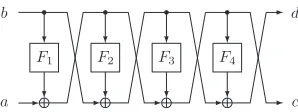
Fig. 6.The 4-round Feistel-F construction.Fi∈Func(n/2).
5
Quantum Distinguishing Attacks against Feistel-F
In this section, we present our distinguisher against the 4-round Feistel-F con-struction with quantum chosen-ciphertext attacks. Based on this, we present in Sect. 6 quantum distinguishing attacks and key recovery attacks against the Feistel-KF construction.
We writeFKi asFi. Note thatFi is still a keyed function and the absence of
Ki does not imply that it is a keyless function. Let FF4 denote the encryption algorithm of the 4-round Feistel-F construction, and FF−41denote its decryption algorithm. Figure 6 illustrates FF4. Let F1, . . . , F4 ∈ Func(n/2) be the round functions of Feistel-F. FF4 takes a plaintext (a, b) ∈ ({0,1}n/2)2 as input and outputs a ciphertext (c, d)∈({0,1}n/2)2, where FF
4: (a, b)7→(c, d) is c=a⊕F1(b)⊕F3(b⊕F2(a⊕F1(b))),
d=b⊕F2(a⊕F1(b))⊕F4a⊕F1(b)⊕F3(b⊕F2(a⊕F1(b))).
The decryption FF−41: (c, d)7→(a, b) is defined as
a=c⊕F3(d⊕F4(c))⊕F1d⊕F4(c)⊕F2(c⊕F3(d⊕F4(c))), b=d⊕F4(c)⊕F2(c⊕F3(d⊕F4(c))).
LetΠ $
←Perm(n) be a random permutation and Π−1 be the inverse per-mutation of Π. Π takes a plaintext (a, b)∈({0,1}n/2)2 as input and outputs a ciphertext (c, d)∈({0,1}n/2)2, and Π−1 takes a ciphertext (c, d) as input and outputs a plaintext (a, b).
Given the quantum oracles of O and O−1, where
O is either the 4-round Feistel-F FF4or a random permutationΠ
$
←Perm(n), our goal is to distinguish the two cases. We now construct the functionfO to use Algorithm 1. We first fix
two arbitrary distinct constants α0, α1 ∈ {0,1}n/2, and we define the function fO as
fO :{0,1} × {0,1}n/2→ {0,1}n/2
(β kx)7→b⊕αβ, where (c, d) =O(x, αβ), (a, b) =O−1(c, d
⊕α0⊕α1).
That is,fOis obtained by first encrypting (x, αβ) to obtain the ciphertext (c, d),
then decrypting (c, d⊕α0⊕α1) to obtain the plaintext (a, b), and we definefO
fO(β x)
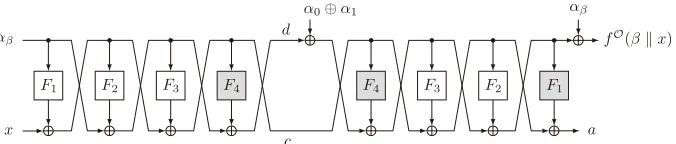
Fig. 7.The functionfOwith FF4and FF−41, whereOis FF4.
Zβ x
fO(β x)
Fig. 8.A circuit that is equivalent tofO.
If O is FF4, then by connecting FF4 and FF−41, our function fO can be illustrated as in Fig. 7. We observe thatF4 has no effect on the computation of fO, andF1in FF−41does not contribute tofO. They are shown in gray in Fig. 7. We see that Fig. 7 is equivalent to Fig. 8, and the functionfO is described as
fO(βkx) =α0⊕α1⊕F2(x⊕F1(αβ))
⊕F2x⊕F1(αβ)⊕F3(αβ⊕F2(x⊕F1(αβ)))
⊕F3(αβ⊕α0⊕α1⊕F2(x⊕F1(αβ)))
. (7)
Our main observation is the following lemma.
Lemma 2. If O = FF4, fO satisfies fO(β k x) = fO(β⊕1 k x⊕F1(α0)⊕ F1(α1)). That is, fO has the periods= 1kF1(α0)⊕F1(α1).
Proof. LetZβkx=x⊕F1(αβ) (See Fig. 8). We prove the lemma based on two claims. The first claim is that Zβkx already has the period s = 1 k F1(α0)⊕ F1(α1), and the second claim is that the subsequent computation offOdoes not depend onβ norx.
First,Zβkxhas the periods, since
Z(βkx)⊕s=x⊕F1(α0)⊕F1(α1)⊕F1(αβ⊕1) =x⊕F1(αβ)
=Zβkx.
We next show that the subsequent computation offO does not depend onβ
norx. If we describefO in equation (7) by usingZ
βkx, then we obtain
⊕F2Zβkx⊕F3(αβ⊕F2(Zβkx))⊕F3(αβ⊕α0⊕α1⊕F2(Zβkx))
.
Now this is equivalent to
fO(β kx) =α0⊕α1⊕F2(Zβkx)
⊕F2Zβkx⊕F3(α0⊕F2(Zβkx))⊕F3(α1⊕F2(Zβkx))
(8)
since{αβ, αβ⊕α0⊕α1}={α0, α1}. We see thatfO depends onZβkxthat has the periods= 1kF1(α0)⊕F1(α1), and hence the lemma follows. ut
Therefore, we can construct a distinguisher against the 4-round Feistel-F construction by using the functionfO. From Theorem 2, the success probability
of the distinguisher with measuring (2n+ 4) times is 1−(2/e)n/2+1−PrΠ[Π ∈ irr1f/2],where we useδ= 1/2 andη= 2n+ 4.
It is clear that PrΠ[Π ∈ irr1f/2] is a small value, since it is highly unlikely that fO obtained from a random permutation has periods. In Appendix C, we
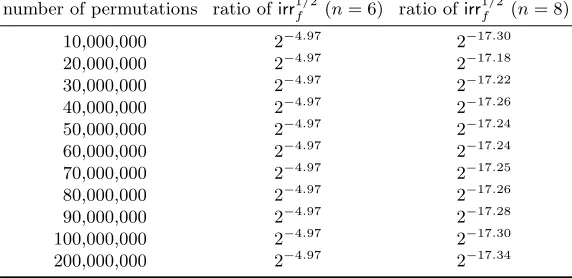
present experimental results for small values of nto show that PrΠ[Π ∈irr1f/2] is indeed a small value.
6
Quantum Attacks against Feistel-KF
The distinguisher in the previous section can obviously be applied to the 4-round Feistel-KF construction, and we can distinguish it from random permutations in polynomial time. Similarly to the previous key recovery attacks against the Feistel-KF [11,8] construction (see Sect. 3.2), our 4-round distinguisher can be combined with the Grover search to develop key recovery attacks. Our new key recovery attack recovers the keys of ther-round Feistel-KF construction in time
˜
O(2(r−4)n/4) in the quantum CCA setting.
Attack Idea. Our attack idea is almost the same as that of the previous at-tacks [11,8], except that our attack uses not only the encryption oracle but also the decryption oracle. Given the quantum encryption and decryption oracles of ther-round Feistel-KF construction, run the following procedures (on a quantum circuit).
1. Implement a quantum circuitE that takes the intermediate state value after the first (r−4) rounds and the subkeys for the first (r−4) rounds as input, and computes the last 4 rounds, in the same way as the first step of the attack idea in Sect. 3.2.
2. Implement a quantum circuit D that computes the inverse of E. That is, implement a quantum circuit which
– takes the ciphertext and the subkeys for the first (r−4) rounds as input,
– computes the intermediate state value after the first (r−4) rounds from the plaintext and the subkeys for the first (r−4) rounds,
– and returns the intermediate state. 3. Guess the subkeys of the first (r−4) rounds.
4. For each guess, check its correctness with the following procedure. (a) Apply the 4-round distinguisher to E andD.
(b) If the distinguisher returns that “this is a random permutation”, then judge that the guess is wrong. Otherwise judge that the guess is correct.
Attack Complexity. The length of the first (r−4)-round subkeys is ((r−4)n/2) bits in total. Thus the exhaustive search on the first (r−4) rounds can be done in time O(√2(r−4)n/2) by using the Grover search. Moreover, the 4-round distinguisher in the fourth step runs in time O(n) for each candidate subkeys. Therefore the running time of the attack becomesO(√2(r−4)n/2)×O(poly(n)) =
˜
O(2(r−4)n/4).
Our new attack reduces the time complexity ˜O(2(r−3)n/4) of the previous attacks to ˜O(2(r−4)n/4), by using our new CCA 4-round distinguisher instead of the previous CPA 3-round distinguisher by Kuwakado and Morii. Our attack is a chosen-ciphertext attack unlike that the previous attacks are chosen-plaintext attacks, since our 4-round distinguisher is a CCA distinguisher.
7
Quantum Attacks against Feistel-FK
In Sect. 7.1, we show a quantum distinguishing attack against Feistel-FK. Based on this, we present in Sect. 7.2 a key recovery attack. The main difference from the previous sections is that the number of the distinguishable rounds increases. In Sect. 7.3, we present a quantum chosen-plaintext attack.
7.1 Distinguishers against Feistel-FK
We present our distinguisher against the 6-round Feistel-FK construction with quantum chosen-ciphertext attacks. This attack is based on the distinguisher against the 4-round Feistel-F construction described in Sect. 5. We increase the number of rounds by adding the first and last rounds, and this is possible because we can compute the output of the first F function and the lastF function in encryption (or decryption) without knowing the subkeys.
Let (a, b)∈({1,0}n/2)2 denote a plaintext and (c, d)
∈({1,0}n/2)2denote a ciphertext. Let FFK6: (a, b)7→(c, d) denote the encryption algorithm of the 6-round Feistel-FK construction, and FFK−61: (c, d)7→(a, b) denote its decryption algorithm. Figure 9 illustrates the 6-round Feistel-FK construction.
Given the quantum oracles ofOandO−1, we define the functionfO as
fO :{0,1} × {0,1}n/2
b
a
K1 K2 K3 K4 K5 K6
F F F F F F
Fig. 9.The 6-round Feistel-FK construction.
b
a K1 K2 K3 K4 K5 K6
αβ⊕K1
K1
K2
K3
K4
K5
K6
d⊕F(c)
d⊕F(c)
F F
F F
F
F F F
F F
F F F
F F
F αβ⊕F(x)
fO(β x)
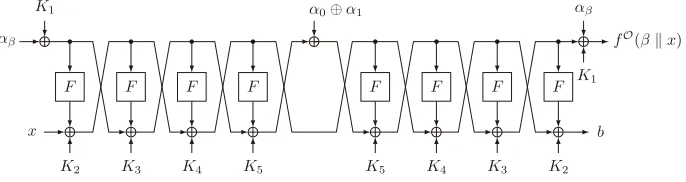
Fig. 10.The functionfOwith FFK6 and FFK−61, whereOis FFK6.c0=c⊕α0⊕α1
andd0=d⊕F(c)⊕F(c⊕α0⊕α1).
(a, b) =O−1(c
⊕α0⊕α1, d⊕F(c)⊕F(c⊕α0⊕α1)).
If O is FFK6, then our function fO can be illustrated as in Fig. 10. We observe that theF functions shown in gray in Fig. 10 and the subkeysK6have no effect on the computation offO. By connecting FFK
6and FFK−61, we obtain Fig. 11 that is equivalent to Fig. 10. If we replaceαβ with αβ⊕K1 andFi(x) withF(x)⊕Ki+1in Fig. 7, we see that Fig. 7 is equivalent to Fig. 11. Therefore, from equation (7) and equation (8), the functionfO is described as
fO(βkx)
=α0⊕α1⊕F(x⊕F(αβ⊕K1)⊕K2)
⊕Fx⊕F(αβ⊕K1)⊕K2⊕F α0⊕F(x⊕F(αβ⊕K1)⊕K2)⊕K3
⊕F α1⊕F(x⊕F(αβ⊕K1)⊕K2)⊕K3
and it has the periods= 1kF(α0⊕K1)⊕F(α1⊕K1).
b
K2
K3
K4
K5
K1
K1
K2 K3 K4 K5
F F F
F F
F F F
fO(β x)
Fig. 11.A circuit that is equivalent to Fig. 10.
of the distinguisher with measuring (2n+ 4) times is 1−(2/e)n/2+1−PrΠ[Π ∈ irr1f/2], where we set δ = 1/2 and η = 2n+ 4. Note that PrΠ[Π ∈ irr1f/2] is a small value, as it is unlikely thatfO obtained from a random permutation has
periods.
7.2 Key Recovery Attacks against Feistel-FK
Similarly to the key recovery attacks against the Feistel-KF construction in Sect. 6, the distinguisher introduced above can be combined with the Grover search to develop key recovery attacks. We can recover keys of the r-round Feistel-FK construction in time ˜O(2(r−6)n/4) in the quantum CCA setting.
Our attack idea follows the attack against the Feistel-KF construction in Sect. 6. Recall that the attack in Sect. 6 guesses the first (r−4)-round subkeys since a 4-round distinguisher is available. On the other hand, as for the Feistel-FK construction, we can use the 6-round distinguisher in Sect. 7.1 instead of the 4-round distinguisher. Hence it is sufficient to guess only the first (r−6)-round subkeys (instead of the first (r−4)-round subkeys) when we attack the Feistel-FK construction. The time complexity of our attack becomes ˜O(2(r−6)n/4), since the Grover search on the first (r−6)-round subkeys ((r−26)n bits in total) requires O(√2(r−6)n/2) =O(2(r−6)n/4) evaluations.
7.3 Quantum CPA Attacks against Feistel-FK
We can also construct a distinguisher and recover the key of the Feistel-FK construction in the quantum CPA setting. As in Sect. 7.1, we can construct a 5-round distinguisher by following the 3-round distinguisher in Sect. 3.1 and by computing the output of the first F function and the last F function in encryption. Specifically, we use (αβ ⊕F(x), x) as the input of the oracle O and use d⊕F(c)⊕αβ as the output of the function fO(β kx), where (c, d) =
8
Concluding Remarks
In this paper, we first formalized a distinguishing algorithm against block ci-phers that does not recover the period. We then considered quantum chosen-ciphertext attacks against Feistel ciphers. We gave a new quantum CCA dis-tinguisher against Feistel ciphers that can distinguish more rounds than the previous CPA distinguishers. Our quantum CCA distinguishers can distinguish the 4-round F and KF constructions, and the 6-round Feistel-FK construction, from random permutations in polynomial-time of the output size. Moreover, we extended the distinguishers to key recovery attacks for the Feistel-KF and Feistel-FK constructions. Our quantum CCA key recovery at-tacks against ther-round Feistel-KF and Feistel-FK constructions recover keys in time ˜O(2(r−4)n/4) and ˜O(2(r−6)n/4), and quantum CPA key recovery attacks against ther-round Feistel-FK constructions recover keys in time ˜O(2(r−5)n/4), respectively.
There are interesting open questions. First, we still do not know the tight bound on the number of rounds that we can distinguish the Feistel-F construc-tion. From the result of Kuwakado and Morii, we know that the 3-round con-struction can be distinguished with quantum CPA, and this paper shows that the 4-round construction can be distinguished with quantum CCA. However, there is a possibility that these rounds can be extended, and deriving the tight number of rounds remains as a challenging question. Improving the complex-ity or extending the number of rounds of the attacks against Feistel-KF and Feistel-FK constructions is also an interesting question.
Acknowledgments. The authors would like to thank participants of Dagstuhl seminar 18021, Symmetric Cryptography, for insightful feedback. We also would like to thank the anonymous reviewers of CT-RSA 2019 for helpful comments.
References
1. Aoki, K., Ichikawa, T., Kanda, M., Matsui, M., Moriai, S., Nakajima, J., Tokita, T.: Camellia: A 128-bit block cipher suitable for multiple platforms - design and analysis. In: Stinson, D.R., Tavares, S.E. (eds.) SAC 2000. LNCS, vol. 2012, pp. 39–56. Springer (2000),https://doi.org/10.1007/3-540-44983-3_4
2. Beaulieu, R., Shors, D., Smith, J., Treatman-Clark, S., Weeks, B., Wingers, L.: The SIMON and SPECK lightweight block ciphers. In: Proceedings of the 52nd Annual Design Automation Conference. pp. 175:1–175:6. ACM (2015), http:// doi.acm.org/10.1145/2744769.2747946
3. Bonnetain, X.: Quantum Key-Recovery on Full AEZ. In: Adams, C., Camenisch, J. (eds.) SAC 2017. LNCS, vol. 10719, pp. 394–406. Springer (2017),https://doi. org/10.1007/978-3-319-72565-9_20
5. Dinur, I., Dunkelman, O., Keller, N., Shamir, A.: New attacks on Feistel struc-tures with improved memory complexities. In: Gennaro, R., Robshaw, M. (eds.) CRYPTO 2015, Part I. LNCS, vol. 9215, pp. 433–454. Springer (2015), https: //doi.org/10.1007/978-3-662-47989-6_21
6. Dong, X., Dong, B., Wang, X.: Quantum attacks on some Feistel block ciphers. IACR Cryptology ePrint Archive2018, 504 (2018),https://eprint.iacr.org/ 2018/504
7. Dong, X., Li, Z., Wang, X.: Quantum cryptanalysis on some generalized Feistel schemes. IACR Cryptology ePrint Archive 2017, 1249 (2017),http://eprint. iacr.org/2017/1249
8. Dong, X., Wang, X.: Quantum key-recovery attack on Feistel structures. IACR Cryptology ePrint Archive 2017, 1199 (2017), http://eprint.iacr.org/2017/ 1199
9. Grover, L.K.: A fast quantum mechanical algorithm for database search. In: Miller, G.L. (ed.) STOC 1996. pp. 212–219. ACM (1996),http://doi.acm.org/10.1145/ 237814.237866
10. Guo, J., Jean, J., Nikolic, I., Sasaki, Y.: Meet-in-the-middle attacks on generic Feistel constructions. In: Sarkar, P., Iwata, T. (eds.) ASIACRYPT 2014, Part I. LNCS, vol. 8873, pp. 458–477. Springer (2014), https://doi.org/10.1007/ 978-3-662-45611-8_24
11. Hosoyamada, A., Sasaki, Y.: Quantum Demiric-Sel¸cuk meet-in-the-middle attacks: Applications to 6-round generic Feistel constructions. In: Catalano, D., Prisco, R.D. (eds.) SCN 2018. LNCS, vol. 11035, pp. 386–403. Springer (2018), https: //doi.org/10.1007/978-3-319-98113-0_21
12. Isobe, T., Shibutani, K.: Generic key recovery attack on Feistel scheme. In: Sako, K., Sarkar, P. (eds.) ASIACRYPT 2013, Part I. LNCS, vol. 8269, pp. 464–485. Springer (2013),https://doi.org/10.1007/978-3-642-42033-7_24
13. Kaplan, M., Leurent, G., Leverrier, A., Naya-Plasencia, M.: Breaking symmetric cryptosystems using quantum period finding. In: Robshaw, M., Katz, J. (eds.) CRYPTO 2016, Part II. LNCS, vol. 9815, pp. 207–237. Springer (2016), https: //doi.org/10.1007/978-3-662-53008-5_8
14. Knudsen, L.R.: The security of Feistel ciphers with six rounds or less. J. Cryptology
15(3), 207–222 (2002),https://doi.org/10.1007/s00145-002-9839-y
15. Kuwakado, H., Morii, M.: Quantum distinguisher between the 3-round Feistel ci-pher and the random permutation. In: ISIT 2010. pp. 2682–2685. IEEE (2010), https://doi.org/10.1109/ISIT.2010.5513654
16. Kuwakado, H., Morii, M.: Security on the quantum-type Even-Mansour cipher. In: ISITA 2012. pp. 312–316. IEEE (2012),http://ieeexplore.ieee.org/document/ 6400943/
17. Leander, G., May, A.: Grover meets Simon - Quantumly attacking the FX-construction. In: Takagi, T., Peyrin, T. (eds.) ASIACRYPT 2017, Part II. LNCS, vol. 10625, pp. 161–178. Springer (2017), https://doi.org/10.1007/ 978-3-319-70697-9_6
18. Luby, M., Rackoff, C.: How to construct pseudorandom permutations from pseu-dorandom functions. SIAM J. Comput.17(2), 373–386 (1988),https://doi.org/ 10.1137/0217022
21. Shibutani, K., Isobe, T., Hiwatari, H., Mitsuda, A., Akishita, T., Shirai, T.: Pic-colo: An ultra-lightweight blockcipher. In: Preneel, B., Takagi, T. (eds.) CHES 2011. LNCS, vol. 6917, pp. 342–357. Springer (2011),https://doi.org/10.1007/ 978-3-642-23951-9_23
22. Simon, D.R.: On the power of quantum computation. SIAM J. Comput. 26(5), 1474–1483 (1997),https://doi.org/10.1137/S0097539796298637
23. Todo, Y.: Structural evaluation by generalized integral property. In: Oswald, E., Fischlin, M. (eds.) EUROCRYPT 2015, Part I. LNCS, vol. 9056, pp. 287–314. Springer (2015),https://doi.org/10.1007/978-3-662-46800-5_12
24. Yang, G., Zhu, B., Suder, V., Aagaard, M.D., Gong, G.: The Simeck fam-ily of lightweight block ciphers. In: G¨uneysu, T., Handschuh, H. (eds.) CHES 2015. LNCS, vol. 9293, pp. 307–329. Springer (2015),https://doi.org/10.1007/ 978-3-662-48324-4_16
A
Proof of Lemma 1
Proof. Suppose thatβ0 =β. Then we have
fO(βkx) =fO(β0kx0)⇔P2(x⊕P1(αβ)) =P2(x0⊕P1(αβ))⇔x=x0
sinceP2 is a permutation. That is, in this case, we haveβkx=β0 kx0. Next, suppose thatβ0=β⊕1. We have
fO(β kx) =fO(β0 kx0)⇔P2(x⊕P1(αβ)) =P2(x0⊕P1(αβ⊕1)) ⇔x0=x⊕P1(αβ)⊕P1(αβ⊕1)
⇔x0=x⊕P1(α0)⊕P1(α1),
where the last equivalence follows from{αβ, αβ⊕α0⊕α1}={α0, α1}. That is, β0 kx0= (βkx)⊕s.
The other direction easily follows as we have
fO((β kx)⊕(1kP1(α0)⊕P1(α1))) =P2(x⊕P1(α0)⊕P1(α1)⊕P1(αβ⊕1)) =P2(x⊕P1(αβ))
=fO(βkx).
Therefore, the lemma follows. ut
B
Proof of Theorem 2
Proof. Remember that our distinguisher fails if and only if O = Π and the dimension of the space spanned byY is less than`. Thus the failure probability equals to
PrhΠ $
←Perm(n),(yi, wi)←(measureSfΠ|0`+mi) for 1≤i≤η:
= PrhΠ ←$ Perm(n),(yi, wi)←(measureSfΠ|0`+mi) for 1≤i≤η:
dim(Span(y1, . . . , yη))≤`−1∧Π /∈irrδfi
+ PrhΠ $
←Perm(n),(yi, wi)←(measureSfΠ|0`+mi) for 1≤i≤η:
dim(Span(y1, . . . , yη))≤`−1∧Π ∈irrδfi
≤PrhΠ $
←Perm(n),(yi, wi)←(measureSfΠ|0`+mi) for 1≤i≤η:
dim(Span(y1, . . . , yη))≤`−1 Π /∈irr
δ f i
+ PrhΠ $
←Perm(n) :Π ∈irrδfi (9)
The first term of the right hand side of equation (9) is upper bounded as
PrhΠ $
←Perm(n),(yi, wi)←(measureSfΠ|0`+mi) for 1≤i≤η:
dim(Span(y1, . . . , yη))≤`−1 Π /∈irr
δ f i
≤PrhΠ←$ Perm(n),(yi, wi)←(measureSfΠ|0`+mi) for 1≤i≤η:
∃t∈ {0,1}`
\{0`}s.t. t⊥y1∧ · · · ∧t⊥yη Π /∈irr
δ f i
≤ X
t∈{0,1}`\{0`}
PrhΠ ←$ Perm(n),(yi, wi)←(measure SfΠ|0`+mi) for 1≤i≤η :
t⊥y1∧ · · · ∧t⊥yη Π /∈irr
δ f i
≤ X
t∈{0,1}`\{0`}
PrhΠ $
←Perm(n),(y, w)←(measureSfΠ|0`+mi) :
t⊥y Π /∈irr
δ f
iη
≤2`· max t∈{0,1}`\{0`}
PrhΠ $
←Perm(n),(y, w)←(measureSfΠ|0`+mi) :
t⊥y Π /∈irr
δ f
iη .
Now we introduce the following lemma, which is proven as a subordinate result in the proof of Theorem 1 in [13].
Lemma 3 (Kaplan et al. [13]).Let f :{0,1}`
→ {0,1}m be a fixed function, andUf :|xi |yi 7→ |xi |y⊕f(x)ibe the corresponding unitary operator. Then,
Pr
(x, y)←(measureSf|0`+mi) :x⊥t
= 1 2
1 + Prhx← {$ 0,1}`:f(x
⊕t) =f(x)i
From the above lemma it follows that
2`· max t∈{0,1}`\{0`}
PrhΠ $
←Perm(n),(y, w)←(measureSfΠ|0`+mi) :
t⊥y Π /∈irr
δ f
iη
= 2`· max t∈{0,1}`\{0`}
1 2
1 + PrhΠ ←$ Perm(n), x← {$ 0,1}`:
fΠ(x⊕t) =fΠ(x) Π /∈irr
δ f
iη
. (10)
In addition, by assumption, for any fixed permutationπ /∈irrδf it holds that
Prhx $
← {0,1}`:fπ(x⊕t) =fπ(x)i=πf ≤1−δ.
Hence the right hand side of equation (10) is upper bounded by 2`·(1
2(1 + (1− δ)))η = 2`−η(2−δ)η
. Moreover, from the fact that (1−x)−1/x ≥ e holds for 0< x <1, we have
2`−η(2−δ)η ≤2`(1−δ/2)−2/δδη/2≤2`·e−δη/2. (11)
Therefore, from equations (9) and (11), the failure probability of our algorithm is upper bounded by
2`
eδη/2+ PrΠ[Π ∈irr δ
f], (12)
which completes the proof. ut
C
Experimental Results on Pr
Π[
Π
∈
irr
1/2
f
]
We present our experimental results about PrΠ[Π ∈irr1f/2] where we usef that is described in Sect. 5. Forn= 4,6,8, we are interested in the number of permu-tations that belong to irr1f/2. Forn = 4, there are (24)!
Table 2.The number of permutations π ∈ Perm(4) and the corresponding value of
Of. PrΠ[Π∈irr
1/2
f ] is about 2
−1.49
. Note that whenn= 4, the number of inputβkx
off is 23 = 8.
number of permutations value ofOf
1,141,521,776,640 1/4 12,311,490,723,840 1/2 3,947,762,810,880 3/4 3,522,014,576,640 1
Table 3.The ratio of the number of permutationsπ∈Perm(6) andπ∈Perm(8) that belong toirr1f/2 withfdescribed in Sect. 5. The left column shows the total number of permutations we generated randomly. The middle and right columns show the ratio of the number of permutations that belong toirr1f/2 to the total number of permutations we generated.
number of permutations ratio ofirr1f/2 (n= 6) ratio ofirr1f/2(n= 8)
10,000,000 2−4.97 2−17.30
20,000,000 2−4.97 2−17.18
30,000,000 2−4.97 2−17.22
40,000,000 2−4.97 2−17.26
50,000,000 2−4.97 2−17.24
60,000,000 2−4.97 2−17.24
70,000,000 2−4.97 2−17.25
80,000,000 2−4.97 2−17.26
90,000,000 2−4.97 2−17.28