ORIGINAL ARTICLE
What corporations do with foresight
Mohamad S. Hammoud&Douglas P. Nash
Received: 7 April 2014 / Accepted: 4 June 2014 / Published online: 21 June 2014 #The Author(s) 2014. This article is published with open access at Springerlink.com
Abstract Foresight involves future-oriented awareness and planning, enabling businesses to respond quickly and effec-tively to future market threats and opportunities. However, knowledge about corporate foresight practices and outcomes is limited. Corporations interested in implementing foresight are unable to identify best practices or anticipate results from foresight activities. Therefore, this qualitative, multiple holis-tic case study was a foundational investigation of foresight phenomenon within contemporary American corporations. A convenience sample of 14 foresight practitioners represented American corporations or American divisions of European corporations actively using foresight. Interview queries aligned with the guiding research questions explored corpo-rate foresight methods and outcomes. Interview data were coded and synthesized for thematic report of common and unique responses; this documented practices used in and outcomes derived from corporate foresight. Foresight practi-tioners revealed specific actions taken by corporations in response to foresight outcomes. Actions included organiza-tional changes, introduction of new products or product var-iations, new research and development projects, and inclusion of foresight project outputs such as reports, presentations, recommendations, in departmental plans. The findings sug-gested standardization of terminology for professional dis-course, education, and practice, would benefit practitioners and corporations. Four tenets emerging from the themes were short-termism, corporate culture, implementation, and feed-back loop; these tenets should guide future use of foresight in the context of for-profit corporations.
Keywords Foresight . For-profit corporations . Best practices . Competitive advantage . Future . Planning
Introduction
In most areas of business, highly accurate, long-range fore-casting is not possible because the level of uncertainty over time is greater than the knowledge available to managers [23]. Commonly available internal and external data are valuable in static market conditions. However, in rapidly changing con-ditions, such data about the past is insufficient to assess the future [16]. Looking in the rear-view mirror, using past data, does not help much when planning [15]. In the related field of Competitive Intelligence (CI), researchers recommend future-oriented methods such as the use of scenario analysis for rapidly changing conditions. Furthermore, corporate planners’ presumptions that the future will merely be a continuation of present circumstances [42] diminish the accuracy of forecast-ing. Such assumptions do not accommodate the chaos, uncer-tainty, and disequilibrium that develop during periods of rapid change [42].
It is common for contemporary businesses to rely on accounting data, competitor sales figures, information from financial statements, market share figures, and consumer research in order to plan for near-term supply needs, pro-duction schedules, or staffing. While these data are accu-rate, authorities in business competitive analysis caution that the past is an unreliable predictor of the future [15]. Furthermore, the constructs of bounded rationality and cognitive limits bring into question the ability of manage-ment to access, analyze, and interpret the available data [19,44]. The current business environment often challenges managerial decision- making due to the rapid pace of change, new technologies, changing competition, and the growth of data in general.
M. S. Hammoud (*)
Walden University, 100 Washington Avenue South, Suite 900, Minneapolis, MN 55401, USA
e-mail: [email protected]
D. P. Nash (*)
Provista, 2108 Antibes Drive, Carrollton, TX 75006, USA e-mail: [email protected]
Foresight is not intended to replace forecasting based on past data. Rather, foresight is useful in managerial planning where the pace of change makes past data an unreliable basis for future action. For some industries, companies measure the lead-time needed for research, development, distribution, and product launch in years; whereas the pace of change is more rapid. Collecting and analyzing past data through forecasting is not sufficient to plan for the future [16].
The use of foresight, or future studies, is well documented in the literature. Foresight is a strategic activity using a set of tools to build a vision of future markets so that management can make decisions today [4]. Nonetheless, specific details about successful methods and the results of foresight activities are hard to find due to the nature of competition in for-profit corporations. Foresight efforts take place behind closed doors in the context of for-profit corporations [10]. These activities can directly influence corpo-rate innovation, marketing, and stcorpo-rategic planning which compa-ny management rarely reveals to competitors [24].
Research purpose research questions
The purpose of this qualitative research was to identify fore-sight methods that forefore-sight practitioners use and to describe the results attainted by for-profit corporations. The studied population of 14 foresight practitioners included consultants and employees at for-profit American corporations or American divisions of European corporations that use fore-sight. Phenomenologically-oriented, semi-structured inter-views were used to construct multiple case studies of foresight activities. The objective of multiple case analyses was to identify novel contributions to the understanding of the phe-nomenon of corporate foresight. This study was unique in the focus on for-profit corporations.
The following research questions were used to guide the research:
Q1. Which foresight methods did foresight practitioners perceive as most successful in for-profit corporations? Q2. What outcomes did foresight practitioners perceive
for-profit corporations derived from foresight activities re-lated to corporate planning?
Research design
We used a holistic case study design due to the exploratory nature of the research. The researchers selected the holistic approach to capture the complete context of corporate foresight efforts, since few logical subunits of analysis were identifiable prior to the study [35]. The primary unit of analysis for this study was the corporation, although the interviews were conducted with
employees or consultants employed by the corporation. The use of a holistic case study availed opportunities to (a) examine the broad context of the cases, (b) present themes with thick descriptions, and (c) document interpretations based on multiple cases of foresight activities [47].
A panel of experts composed of Dr. Peter Bishop and Dr. Dr. Verne Wheelwright validated the interview questions and their alignment with the research questions. Dr. Bishop is an Associate Professor of Strategic Foresight and Coordinator of the graduate program in Futures Studies at the University of Houston. Dr. Verne Wheelwright is an internationally recog-nized professional in the field of foresight and futures studies. Dr. Wheelwright has contributed to the list of resources as well as contacts for the interviewees. Initially, 62 practitioners were identified through attending conferences, in LinkedIn specialized groups, and by referrals (an example of snowball sampling) from other foresight practitioners. Once we contacted these practitioners by email or LinkedIn message, 34 responded to the initial inquiry about participating in the research. Triangulation took place by comparing and contrast-ing existcontrast-ing case study documentation from databases dedi-cated to foresight projects such as the European Foresight Monitoring Network [13] with the data derived from interviews.
Review of the literature
Hermann Kahn developed a model to consider the future as part of his work in military strategy [12]. This method was called scenario planning, and was used to explore multiple, likely states of future events. Leaders at the US Department of Defense were seeking a methodology to develop views of potential futures. Initially, this approach involved analysts developing scenarios for use in simulation games for policy makers and strategists [44]. The approach later evolved for business applications. Up to this point, much of the forward-focused planning involved government or military needs. Employees at the RAND Corporation and Hudson Institute conducted projects to help large corporations and government agencies adjust their technological investments based on an-ticipated future needs [11].
In 1967, employees at Shell developed the Year 2000 Project, wherein they considered the possible outcomes of the 1967 Arab-Israeli war and the potential impact on the global oil market and oil prices [25]. The writers of one scenario described an energy market wherein oil-producing countries formed a consortium, acted in a coordinated manner, and effectively controlled production and pricing. The scenar-io planning for this possibility prompted the development of detailed contingency plans that encompassed transitioning the refining operations away from the processing of heavy fuels in order to focus resources on the refining of lighter fuels. This plan involved investing in refineries that could produce the lighter fuels as supply disruptions did not affect lighter fuels. In addition, staff members at Shell began tracking events in the primary oil-producing countries, especially in Middle Eastern countries [44].
When members of the Organization of Petroleum Exporting Countries (OPEC) coordinated their efforts in response to Western nations’support of Israel, the Arab oil embargo ensued, causing oil supply shortages and escalating oil prices. Leaders at Shell were prepared to respond effectively because of their ongoing tracking and scenario planning. These efforts by the staff enabled Shell to rise from seventh to third as a global oil company [44]. More recently, management at Shell used strate-gic foresight methods to elaborate global scenarios with a time-line of 20 years [40]. Decision-makers use these long-range scenarios to provide a comprehensive analysis of alternatives associated with the ongoing evolution of the energy industry (i.e., oil, gas, and renewable energy sources). Staff members at Shell International actively promote energy scenarios to 2050, which the company makes available online to consumers, part-ners, and competitors [34]. Currently, companies such as BASF, Siemens, Daimler, and Philips use some form of future-oriented planning, or corporate foresight, to deal with uncertainty and respond to industry changes [41]. These corporate planning efforts may involve one or more of the many identified methods for corporate foresight activities [24]. The objective of these activities is anticipation of change early enough to enable the corporation to respond effectively to both challenges and
opportunities. In some cases, the intentions of the foresight practitioners focus mainly on discovering“white spaces”, prod-ucts, or services outside the existing portfolio [31].
In September 2004, leaders at the European Commission (EC) created an international consortium of foresight organi-zations for the purpose of monitoring and disseminating in-formation about foresight activities to a network of practi-tioners, researchers, and policymakers [30]. The staff of the European Foresight Monitoring Network (EFMN) report that foresight is used by public and private organizations to (a) foster innovation, provide input for policy formation, (b) encourage strategic thinking, (c) identify investment opportu-nities, (d) generate visions of the future, (e) anticipate signif-icant challenges, (f) trigger actions, and (g) promote public debate [24]. The staff of EFMN confirmed that foresight exercises project one to two decades into the future. Foresight outputs include policy recommendations based on trend analysis, identification of underlying forces, and gener-ation of likely scenarios [30].
In 2008, researchers examined 152 European companies and documented lengthy corporate experience with foresight [10]. Specifically, one-quarter of the corporate planners sur-veyed had used foresight for up to 3 years, half of the corpo-rate planners had used foresight approximately 10 years, and eight percent of the planners used foresight for more than 30 years. These companies operated in competitive environ-ments and their staff realized that foresight enabled them to achieve tangible objectives. The main characteristics of the foresight activities were long-range planning, early warning systems for management, inputs for innovation, and decreased reaction time dealing with environmental change. Survey respondents reported that successful foresight activities must be of high quality, highly relevant to current strategic issues, and engage a high level of internal participation. Critical foundations for a successful foresight culture included mana-gerial commitment and ongoing internal communications about the foresight processes and outcomes [10].
A number of underlying constructs constitute the basis of foresight. Ideas derived from complexity theory and quantum mechanics are antithetical to the Newtonian view of the world, which looked like the inner workings of a clock [28]. Instead of the causal interconnectedness of the clockwork model, marketplace and consumers operate with a degree of uncer-tainty, complexity, and unpredictability [29]. Herein, the far-from-equilibrium dynamics revealed the complex interaction of agents [37]. Thus, linear, predictable, problem-solving models fail. Further, philosophical questions arise about bounded rationality and the ability of the empirical domain to exhaust the possibilities of human knowledge [17].
linear relationships, wherein the future is a continuation of the present [33]. Instead, the far-from-equilibrium dynamics are indicative of a future that is similar to the present but never exactly the same [23]. Effective decision-making in business requires assessing the potential impact of market and non-market forces on the non-marketplace. Market forces include changes in industry-related technology, customer needs, and industry players such as partners, intermediaries, or competi-tors [39]. Non-market forces can include political, economic, ecological, sociological, and technological changes outside the firm’s industry [3]. Both market and non-market forces are potential sources for disruption, complexity, and change. While these forces may or may not be part of the present marketplace, the realization is that these forces can influence the future viability of the firm [7].
Although not commonly discussed in these terms within the business community, chaos theory, nonlinear dynamics, complexity theory, and the Heisenberg uncertainty principle are theories that converge and influence foresight strategies [28]. Nonetheless, discussions of complexity, chaos, and un-certainty are familiar to companies experiencing marketplace upheaval [38]. Therefore, these theoretical constructs were explored extensively in the foresight research.
Data processing and analysis
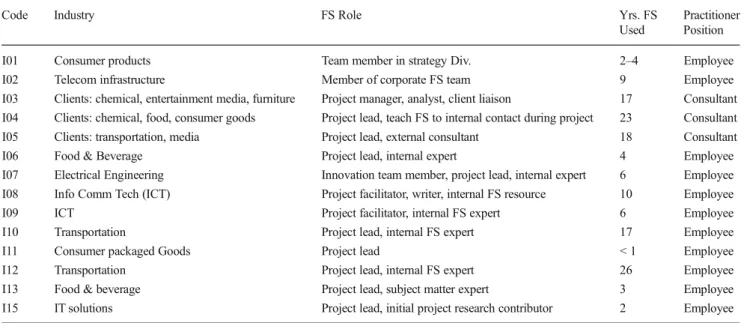
Fourteen practitioners represented discreet cases in diverse industries within American-based divisions of national or mul-tinational for-profit corporations. A brief list of profile queries enabled the researcher to gather data about the corporations represented, as well as the foresight practitioners. The initial focus was developing understanding of the use of foresight at the represented corporations. Table1includes the background data describing the interviewees, their foresight experience, and the use of foresight in their respective corporations.
These 14 interview respondents were employees or consul-tants representing American corporations or American divisions of multinational corporations. Eleven were direct employees of the corporation and three were outside consultants hired by corporations with expertise in foresight to lead or participate in foresight projects. While the employees represented the corpora-tions that employed them, the consultants had a diverse back-ground resulting from experience in several corporations.
Among the interview participants, the consultants had much more experience working with foresight (mean 19.3 years) than the employees (mean 7.9 years). The level of foresight training varied widely among the interview par-ticipants. Of the 14 participants, only five had some level of formal training ranging from attending foresight conferences, a certificate course, and a university degree in foresight. Another four foresight practitioners had some form of work experience or self-education in foresight; the remaining five
participants reported no formal training, limited experience in foresight, or both. In addition to a wide variation in training, participants reported varying allocation of time for foresight activities ranging from 10 to 100 % of their work obligations. We developed the first research question to facilitate the exploration of the methods used by the practitioners at for-profit corporations in America. To address the first research question, we developed multiple interview questions. We developed the interview questions to examine the themes of methods, process steps related to the methods, and process management. We reviewed the interview data for coding, presentation, and synthesis. We used the first interview ques-tion to elicit the practiques-tioners’knowledge about the strategic and/or tactical purpose(s) underlying their corporation’s adop-tion or use of foresight.
What were the strategic and/or tactical purposes
for introducing foresight (or future studies) at this company?
Not surprisingly, almost half of the responses identified inno-vation or competitive advantage as the primary reasons for introducing foresight. Rapidly changing markets wherein (a) product lifecycles are compressed, (b) new products arise frequently, and (c) new competitors are a constant threat, make firms’ existing product portfolio less secure. The resulting need to innovate may involve new products for existing markets, identification of new product opportunities, and un-tapped market geography. Beyond new products and markets, firms also need to explore new business models in order to maintain or create a competitive advantage. Generally, inno-vation and competitive edge were considered both strategic (i.e., enterprise-wide) and tactical (i.e., departmental) motiva-tion for and benefits of foresight practice.
Participants acknowledged the importance of innovation as a division/department’s tactical purpose for foresight, availing the potential for research and development (R&D) projects. A few interview participants talked about looking for the“white spaces” where the company had no current offering. Additionally, the reasons mentioned for using foresight in-cluded the need to (a) create a competitive advantage, (b) influence customer perceptions of the company, and (c) antic-ipate change. The alignment of these factors with the con-structs of corporate foresight, as identified in the review of literature, was explored in the evaluation of findings.
industry can take four or more years to develop, foresight helps management invest only in those projects that are per-ceived as being relevant in the future.
Another practitioner (I06) discussed conflict innovation timelines within one company. Internal consumer research was focused on a short-time horizon (i.e., less than 2 years) and a different research area needed to work on a timeline (i.e., up to 4 years). A practitioner (I11) described the competitive advantage in terms of knowledge, category management ca-pabilities, and consumer insights. This employee stated that insights addressed what consumers will need in the future, rather than what consumers wanted in the past. The terms “white space”(I10) and“opportunity spaces”(I07) were used to described future needs, specifically, product or service areas where no offering currently existed from that corporation or within that industry’s market. Another practitioner viewed “white spaces”as problem areas (I04). Regardless whether respondents perceived white spaces as opportunities or threats, they claimed white spaces require the attention of the company wishing to establish or retain industry position-ing. One foresight consultant (I03) was so successful identi-fying the opportunity areas that a company asked for repeat engagements to generate ongoing insight and access to oppor-tunities and potentials, specifically using foresight as a“ pipe-line for new product R&D.”
What methods are currently or most recently used?
The interview participants noted 24 methods used in for-profit corporations. There were 13 common methods; respondents mentioned 11 of these methods only once. Out of the 33 known foresight methods identified in prior research, five were mentioned most often and used by most participants.
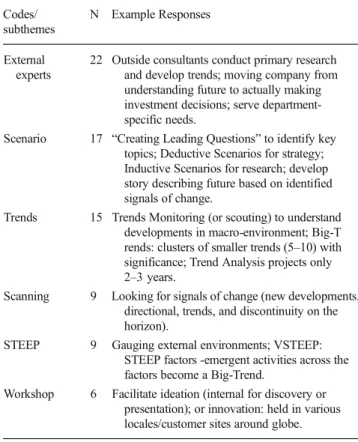
Table 2 includes the top methodologies reported by the practitioners. The most frequently mentioned methods were scenario planning (18.28 %), trend analysis (16.13 %), envi-ronmental scanning (9.68 %), workshops (6.45 %), and looking for weak signals (5.38 %). Practitioners coften used outside firms to conduct research, lead foresight projects, or provide expertise for the project. Some outside firms were research companies, while other firms mentioned represented themselves as experts in foresight or innovation. While all participants were involved in future-focused efforts, the time horizon for foresight activities varied from 1 year to multiple decades. The additional foresight methods used included en-vironmental scanning, foresight workshops, weak signals, forecasts, consumer values, and the STEEP factors.
Rather than a single methodology, the practitioners used STEEP or VSTEEP factors to filter and group the results from any of the foresight processes or methods, into actionable categories. The STEEP factors described the social, techno-logical, environmental, economic, and political (or legal) ele-ments, which might influence the company’s performance positively or negatively. In most literature, the STEEP (also known as PEEST) factors are included as being part of the environmental scanning process[40]. Some practitioners men-tioned STEEP factors as a part of the company’s foresight methods (I01, I07, I12), while others described VSTEEP factors (I05, I10), which added the cultural values component. Both can be used to prioritize and present the findings from the foresight activity.
Finally, the top methods included Workshops [6], which practitioners used to facilitate ideation and advance commu-nication within the corporation, and to address the constructs arising from the top and least used methods, identified in Tables2and3.
Table 1 Participating foresight practitioners and corporation
Code Industry FS Role Yrs. FS Practitioner
Used Position
I01 Consumer products Team member in strategy Div. 2–4 Employee
I02 Telecom infrastructure Member of corporate FS team 9 Employee
I03 Clients: chemical, entertainment media, furniture Project manager, analyst, client liaison 17 Consultant I04 Clients: chemical, food, consumer goods Project lead, teach FS to internal contact during project 23 Consultant I05 Clients: transportation, media Project lead, external consultant 18 Consultant
I06 Food & Beverage Project lead, internal expert 4 Employee
I07 Electrical Engineering Innovation team member, project lead, internal expert 6 Employee I08 Info Comm Tech (ICT) Project facilitator, writer, internal FS resource 10 Employee
I09 ICT Project facilitator, internal FS expert 6 Employee
I10 Transportation Project lead, internal FS expert 17 Employee
I11 Consumer packaged Goods Project lead < 1 Employee
I12 Transportation Project lead, internal FS expert 26 Employee
I13 Food & beverage Project lead, subject matter expert 3 Employee
How does your company track or monitor foresight projects?
Six respondents (27.3 %) reported no tracking at all and other respondents reported only informal tracking efforts. Interviewees felt frustrated when foresight activities only become“a book-on-a-shelf”(I06); several practitioners expressed frustration about such inaction. Of the 22 responses, the majority of the responses (54.5 %) indicated that the foresight team or internal practitioner provides tracking. The second most common response (27.2 %) was that managers did not track foresight results at all. The interviewees were aware of other foresight activities in the cor-poration beyond their own activities; therefore, participants noted more than one method. Practitioners might track some foresight outputs but were aware of others which were not tracked (I07, I10). One consultant (I03) was aware of project outputs they tracked and claimed that the internal foresight unit tracked other project outputs. Another consultant (I04) noted that despite recommending tracking of foresight project outcomes, tracking of foresight was not always part of the consultants’engagement with the corporation.
Are there foresight methods that were used in the past but are no longer used?
Several participants remarked that foresight efforts were so new to the corporation that these corporations had not discarded any
yet. At the time of this study, too little time had passed to assess which foresight methods were ineffective.
Of the methods that were no longer used, the reason for the change varied from the lack of acceptance by the corporate culture, recession-related cost cutting by clients or the company, or methodological conflicts with planning for the future. As previously noted, since forward-focused planning assumes past trends have changed, research methods depending on prior trends continuing uninterrupted are viewed with suspicion.
These terminated approaches included consortium events, the Delphi method, experiential futures, market segmentation, quantitative forecasting, and scenario planning. Respondents described consortium events as client and multi-industry events wherein a foresight consultancy presented multiple industries’research in a setting where foresight prac-titioners could network and discuss. This approach disap-peared due to the recent recession and budget constraints of the organizations. The Delphi method involves a structured group process, usually dealing with complex issues. Herein, experts conduct a series of iterative learning rounds to generate Table 2 Top interview responses for methods
Codes/ subthemes
N Example Responses
External experts
22 Outside consultants conduct primary research and develop trends; moving company from understanding future to actually making investment decisions; serve department-specific needs.
Scenario 17 “Creating Leading Questions”to identify key topics; Deductive Scenarios for strategy; Inductive Scenarios for research; develop story describing future based on identified signals of change.
Trends 15 Trends Monitoring (or scouting) to understand developments in macro-environment; Big-T rends: clusters of smaller trends (5–10) with significance; Trend Analysis projects only 2–3 years.
Scanning 9 Looking for signals of change (new developments, directional, trends, and discontinuity on the horizon).
STEEP 9 Gauging external environments; VSTEEP: STEEP factors -emergent activities across the factors become a Big-Trend.
Workshop 6 Facilitate ideation (internal for discovery or presentation); or innovation: held in various locales/customer sites around globe.
Table 3 Additional interview responses for methods
Codes/ subthemes
N Example responses
Weak signals 5 Futures companies scan daily for“weak signals” in blogs, news groups, external research companies; created daily newsletter
focusing on four signals (14,500+ subscribers). Values 5 Customer Values - psychological perspective
of beliefs, motivations, preferences; little change as adults; clusters of values (Persona); spend money to acquire valued item/view. Forecast 5 Market analysis (how product portfolio affects
landscape or vice versa); extrapolation of historic data: numbers, charts, trend lines; assumes [trends continue] unchanged/ unchallenged.
Backcasting 4 Tests assumptions of future; Steps backwards to spot steps and signals to reach goal; create blueprint for reaching preferred future by monitoring indicators/milestones from prior data.
Games 4 Participatory futures test scenario; iterative scenarios based on consumer group personas and role playing - workshop tool. White spots 3 Opportunity spaces for business, product, or
service that company has no offering today. Interview 2 Consultative: meet with head of project to
discuss leading questions and bring back relevant trends via presentation, printed materials, or workshop for cross-functional audience.
ideas and develop consensus. Respondents described experien-tial futures as an immersion event involving an identified cultural setting. Companies used this approach to explore the potential of future market such as looking first-hand at Chinese consumers’ lifestyles to develop understanding and predict potential recep-tivity or need for product or product changes.
Quantitative forecasting, an approach based on extrapolation from historical data, was another method (I05) no longer used. Such forecasts can look realistic due to the existence of hard numbers, charts, and trend lines. However, these extrapolations assume the continuation of present conditions; the aforemen-tioned validity concerns about this assumption influence the usability of such methodology. Market segmentation also relied on purely historical data to project trends. One practitioner (I10) noted that the results are often an iterative product change, based on what the company already makes. Practitioners no longer used the methods that relied only on historical informa-tion because consumers rarely know what they will want; they only know what they want now. In one case, scenario planning was no longer used as some internal audiences perceived this method as too“far out”to be useful (I12).
Some participants were able to articulate the reasons for the discontinuation of the specific methods. The explanations includ-ed that companies eliminatinclud-ed these approaches because of recession-related internal staffing reductions (I03) or reduced client budgets (I03). The specific approach of future-focused Market Segmentation is problematic since practitioners of this method rely on historic data (I10). Companies eliminated the scenario approach due to a lack of credibility with the internal audience (I12). Since the participants were able to identify methods used and abandoned, we asked them to provide further detail about the methods and processes used.
Please describe, step-by-step, the process/methods used in the majority of your foresight experiences
Only four respondents related specific steps in addition to the methods used. This may result from the fact that most of the interview participants had little or no formal training in fore-sight or future studies. Only three who reported using a systematic process had training or preparation to use foresight practices. This fact, coupled with the lack of a standard no-menclature related to foresight, may explain the mixture of results when asking about foresight methods used and the systematic process commonly used in foresight projects.
Four participants described a formal, structured process they used for foresight projects. The remainder of the partic-ipants described a semi-structured process, relied on an exter-nal consultant to run the project, or a loosely structured process. Three of the four participants (I04, I06, I11) who reported a formal or standardized process were able to de-scribe the outcomes of the process and how corporations used these outcomes. The one participant who used a formal
process, but was unable to describe how the corporation used the results of the process, was a consultant whose involvement ended at the conclusion of the project and had only an indirect knowledge of how the results were used.
All of the four practitioners who described a structured process began byidentifying the specific concern or question that was relevant to the industry or department involved in the foresight activity. This was in line with the literature [18,46] and we identified it as the theme Guiding Questions. Most practitioners established industry-specific focus and timelines (e.g., 5 years–I11) or considered the efforts that were influ-ential or led to success in the past (I13). After identifying the guiding question, the steps described by the interviewees were similar to the constructs outlined in the Generic Foresight Model [43].
The second step was developing anunderstanding of the external environment. For all four companies, this involved both internal and external scanning. The focus of the scanning varied slightly by company and often employed external resources with foresight-specific expertise. Scanning activities most often focused on picking up the early indicators of change (Weak Signals), developing general trends (e.g., mo-bile computing), and trends rated to company-specific topics (e.g., consumer wellness). Specific practices, such as 25 senior executives identifying by consensus six drivers of the future relevant to their industry (I06), helped to offset the more general input drawn from scans conducted by external con-sultants or research companies (I06, I13).
Next, the theme anticipating changereferred to the way practitioners explained how observations create meanings. One interviewee (I06) described this phase as the suspension of debate so project participants could extrapolate what the future changes might mean for the company. In cases where numerous themes of change were identified, another practi-tioner (I03) described clustering related themes in order to identify major trends.
The fourth theme,scenarios: stories of future, referred to the stage wherein practitioners and project participants arrived at a shared vision of one or more preferred future states. The scenarios were based on the previously identified signals of change and major trends, as well as the ways the company might operate in this state.
Three of the four practitioners described a final foresight theme related toshaping the future. They used the scenarios, or preferred futures, to construct actionable steps to address either the identified opportunities or threats uncovered in the foresight project.
When thinking about the foresight process, describe how the process was managed?
the company initiated the projects. This happened even when nobody at the firm was directly involved with foresight activ-ities. The department might include an employee in a foresight role or hiring outside consultants with foresight experience to lead or support the endeavor.
The variations in the process noticed in the interviewees’ responses revealed that a credibility gap sometimes existed between the internal foresight team and the departmental manager. Respondents described this credibility gap as a lack of confidence in the foresight team held by the departmental decision-maker. The department leader was either unaware of internal foresight resources or chose to use external consul-tants who were viewed as having greater expertise. In either case, this was an opportunity for the internal foresight practi-tioner to raise the level of awareness internally and present past successes to the internal audience of decision-makers.
Another finding involved the role of management in the foresight process. One participant (I06) commented that the foresight practitioners“need to be more aware of the internal stakeholders interests”and“need to deliver value ongoing.” For-profit corporations and managers often justify activities based on documentable return-on-investment (ROI) [31]. The outputs of foresight activities (i.e., reports, recommendations, or presentations) may not demonstrate ROI as well as the specific foresight outcomes (i.e., new product introductions, organizational changes, updated marketing programs, or stra-tegic acquisitions) and the sales or profits from these out-comes. Therefore, knowing the critical goals of the depart-ment and demonstrating the outcomes of previous foresight efforts to the department managers can help traverse the perceived credibility gap.
Another participant (I07) noted,“if a senior leader does not support the foresight project, nothing happens.”The context of this and other comments involved getting departmental personnel to support the foresight effort to make certain man-agers and employees utilize the outcomes of the process. Participant I03 commented that there was an inherent“latency between today and the anticipated future”. Even an accurately explained future state may not arrive with any predictability. Senior leaders can assign resources to the foresight project and, at the end of the project, delegate portions of the results for further action. One practitioner (I11) reported that, after a foresight project concluded, the C-Level executive“assigned champions to specific opportunity areas”for further research and implementation.
The participating foresight practitioners were not always the ones initiating foresight projects. The department-level often initiated projects to address specific topics associated with departmental management or customer-related concerns. Depending on the department, the focus of the foresight activity could relate to strategy, new product development, new markets, or a large customer’s needs. In other cases, senior leadership initiated foresight efforts. Foresight
practitioners seemed to favor this approach as these leaders could also secure resources, departmental support, and drive action from the results of the project.
What are the outcomes derived from foresight activities?
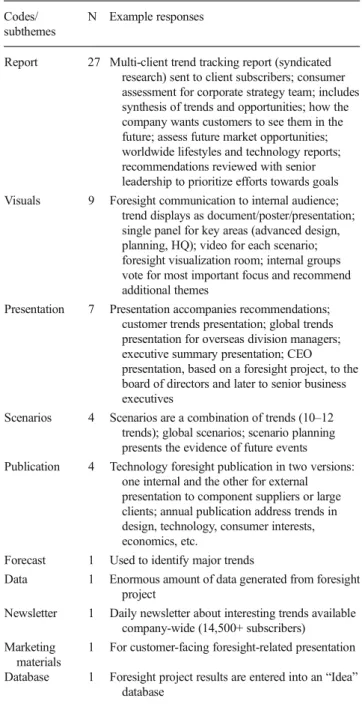
At this point in the interview, the direction of the inquiry changed from methods and processes of foresight to the outcomes or products of the process. Later interview questions addressed how the corporations used these outcomes. The types of outcomes and example responses from the practi-tioners are presented in Table4.
The internal experts, outside consultants, and process par-ticipants completes the foresight activities by synthesizing the results into a report. Practitioners identified communicating the results of the project as a critical aspect of the foresight process because foresight is, ideally, the launching point for other actions by the corporation. Five of the 14 interviewees (I01-6: three employees and two consultants) expressed frus-tration regarding their lack of awareness regarding whether or how foresight outputs were used. These interviewees ex-plained that they would like to know of corporate action on foresight outcomes. For example, they wanted to know when (a) the project question addressed new markets and new products or (b) the ideas and concepts could be translated into marketing, new product development, or acquisition plans, that bring new capabilities to the company. Further, the prac-titioners wanted to learn if the foresight project resulted in novel understandings about future marketplace changes (e.g., new technologies, changing demographics, or consumer pref-erences) that motivated the company to consider taking action to reposition current product offerings, begin developing ap-propriate new products, or change their marketing strategies. The practitioners wanted to know that their efforts were not wasted. All of these activities take time to complete. This was in line with one of the strengths of foresight; specifically, providing the organization and leadership with sufficient time to act on the information.
provide input for departmental planning, strategy groups, and management discussions.
How management or departments use foresight results or outputs?
The interview participants for this study were cautious about revealing too much detail about the plans and actions of their respective corporations. Interview participants I01 and I11 made statements such as“I did not mean to say that much,” confirming that for-profit corporations were reluctant to reveal anything that might inform competing companies.
Tables 5, 6, and 7 include ways corporations use the outputs of foresight. We present the themes in broad terms. The tables include some interview comments because these comments revealed more details about the uses of foresight. Some of the uses of foresight project outputs involved internal and external communication. This enabled the sharing of ideas, examining new business models, and designing prod-ucts with others in the company. Participant I11 commented about the importance of the foresight message, in addition to the outcomes or results of the process. This same practitioner noted that foresight theory, concepts, and processes are some-times too complicated for non-practitioners in the company and need a“corporate language”instead. I11’s advice was to emphasize the outputs of the process and“hide the machin-ery.”This practitioner was equating past success presenting the foresight project message with removing the foresight-specific language related to theoretical constructs, futures concepts, and process titles. This practitioner highlighted the fact that corporate managers do not need to know terms like implications wheel or participatory futures in order to under-stand the impact of change on the organization. Table 5 in-cludes the various ways companies, divisions, or departments addressed foresight outputs internally; and Table6, as external uses of the foresight outputs.
Interview participants noted the use of foresight outcomes in marketing efforts such as advertising decisions, web site content, and marketing collateral. Interviewees mentioned direct customer involvement in the projects as well as using outputs to address, and alter, the perceptions of the company held by customers. Practitioners also used foresight product outputs in conferences, publications, with suppliers, and as influences for deciding company acquisitions.
The top five corporate results practitioners mentioned were (a) ideation, (b) new products or services, (c) managerial planning, (d) marketing, and (e) customers. Practitioners commented about new products and noted that foresight pro-jects were used to build a business case in order to justify expenditures needed to launch new offerings (I09), identify products likely to do well across multiple scenarios (I10), and contributed to products already in production (I07, I10). Interview participants noted that foresight activities supported a positive image with customers (I08). One practitioner reported that after viewing a presentation about the corporation’s foresight efforts, a large customer asked for assistance in conducting their own foresight project (I11). On the other hand, several practitioners complained that reports and recommendations from fore-sight efforts seemed to get “lost in a black-hole” (I02, I03, I04).
The interviewed practitioners reported that the corporation they represented took the following actions, as a direct result of foresight projects:
Table 4 Interview responses for foresight outcomes
Codes/ subthemes
N Example responses
Report 27 Multi-client trend tracking report (syndicated research) sent to client subscribers; consumer assessment for corporate strategy team; includes synthesis of trends and opportunities; how the company wants customers to see them in the future; assess future market opportunities; worldwide lifestyles and technology reports; recommendations reviewed with senior leadership to prioritize efforts towards goals Visuals 9 Foresight communication to internal audience;
trend displays as document/poster/presentation; single panel for key areas (advanced design, planning, HQ); video for each scenario; foresight visualization room; internal groups vote for most important focus and recommend additional themes
Presentation 7 Presentation accompanies recommendations; customer trends presentation; global trends presentation for overseas division managers; executive summary presentation; CEO presentation, based on a foresight project, to the board of directors and later to senior business executives
Scenarios 4 Scenarios are a combination of trends (10–12 trends); global scenarios; scenario planning presents the evidence of future events Publication 4 Technology foresight publication in two versions:
one internal and the other for external presentation to component suppliers or large clients; annual publication address trends in design, technology, consumer interests, economics, etc.
Forecast 1 Used to identify major trends
Data 1 Enormous amount of data generated from foresight project
Newsletter 1 Daily newsletter about interesting trends available company-wide (14,500+ subscribers)
Marketing materials
1 For customer-facing foresight-related presentation
1. Upper management assigned several key opportunity areas to manager/champions for further development and implementation (I11).
2. Internal organizational changes were introduced to en-hance product capabilities (I13).
3. The company introduced new products, product varia-tions, and standardized packaging (I13).
4. The company prioritized results of the project to create a roadmap for growth (I13).
5. Several research and development projects were started (I06).
6. The strategic plans of several business units adopted portions of the foresight project (I07).
7. Upper management was so impressed by the project results that these became part of a presentation to the heads of all the global business units (I06).
8. One company introduced product alterations. Specifically, a foresight project in 2010 identified the need for alternative fuel products in a local market; these products were slated for release overseas in 2012–2013 (I10).
How foresight practices have advanced or benefitted the corporation?
Table 13 includes the comments from the 14 interviewees. Instead of focusing on specific methods or actions, practi-tioners’ focused their attention towards the corporation and foresight practice. As documented in Table 1, 11 of the 14 practitioners interviewed were employees of the corporation Table 5 Interview responses for internal use of outputs
Codes/ subthemes
N Example responses
Ideation 11 Broad input for decision-making for new products or services; an draw a direct line from foresight activities to new product or service; project generated 20–30 concepts which were taken by advanced engineers for further development; business unit was in trouble and commented that the foresight project was a“light in the dark”; already influencing research and development project pipeline decisions
Products/ services
9 Identify which portfolio of products likely to do well across multiple scenarios; build the business case (practical application of foresight activities); products came out of an overseas foresight project which are already in production related to alternative fuels
Planning 6 Executive management used video scenarios in meetings involving where the business is headed and where to invest resources; three opportunity areas assigned to Director-level managers for further research or implementation
Culture 5 Foresight information used to align employees with corporate direction, projects, and brand direction; trend day event makes internal audiences aware of key trends affecting the company; foresight project details positively impacts business unit culture Black-hole 5 Case studies are hard to find or get permission to share
(consultant); foresight group handed-off project to departments or management.“In some cases, I do suspect the information goes into a black-hole”; foresight team focused on social networking (prior to the launch of Facebook). Some attempts made to work in this area but the execution was not there and the attention-span was not there; foresight team handed-off of material at the conclusion of the project. Little direct reporting of actions by management
Workshop 2 Onsite exercise along with collateral including trend cards, posters; activity brings in speakers (one per day) covering buying trends, health trends, etc. Incidental
report
2 Consultant will hear later of a product or service launch by client, which match the results of an earlier foresight project.
Table 6 Interview responses for external use of outputs
Codes/ subthemes
N Example responses
Marketing 6 Press releases on research web site; used in external marketing materials and public relations pieces; based on foresight project the company did not advertise in the Super Bowl and trimmed the use of conventional advertising media. Instead, the firm increased the use of social networking and grass-roots advertising.
Customer 6 Large customers utilized the global foresight map for inspiration and input for their own ideas for new services; foresight activities popular with customers; number of complaints about“your company is not innovative”have almost disappeared
Conference 5 Awards from conferences; creative department contact asked to speak at event
Publication 4 Internal foresight magazine published twice a year and draws from multiple foresight projects; technology publication is an example. Foresight project became the basis for an article in a non-company publication in 2012. External publication/article
Suppliers 3 May participate in ideation sessions; scenarios shared with advertising agencies, culinary specialists, ideation firms, design firms to inform them about company priorities; not all Foresight project information is shared externally or may have proprietary information removed
and had a direct interest in the company doing well operation-ally and financioperation-ally.
The next interview question enabled the researcher to ask about the domain of foresight in the context of for-profit corporations. We asked practitioners to discuss both the ben-efits and deficiencies of foresight practice from their perspec-tive. Participants who were employees answered from their experience within a single corporation, while consultants an-swered from their broad experience across several companies and consulting engagements.
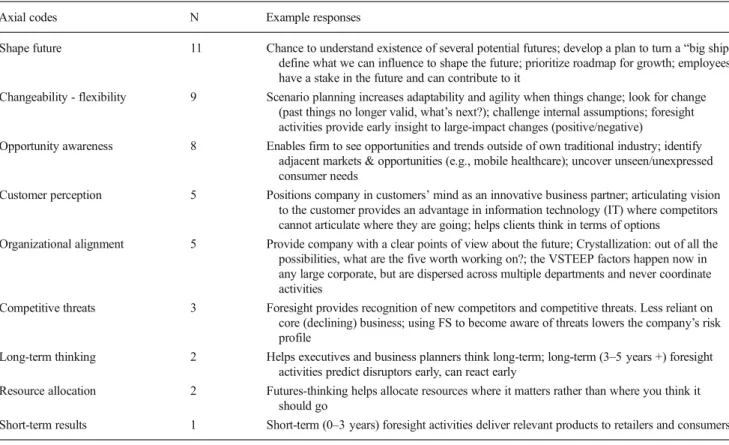
Table7includes the ways interviewees perceived the fore-sight activities as benefitting or advancing the corporations. The top five ways participants mentioned that foresight helped the corporation were in shaping the future, improving corpo-rate changeability or flexibility, enhancing organizational alignment, improving the customers’perception of the com-pany, and creating an awareness of new opportunities. Each of these themes is discussed herein.
Shaping futuresOne participant described corporations as be-ing similar to a large ship, where“turning the big ship”in a new direction requires planning, time, and energy. Several inter-viewees talked about foresight providing a chance to look at an alternate future, defining what management could influence in shaping future direction, determining the right strategy to reach the preferred future, bringing employees to realize how they contribute, and prioritizing the steps along the roadway
towards that future. Participants noted that moving toward a preferred future might require strategic investments to develop the right products and effectively support the future business.
Changeability or flexibility Participants mentioned that fore-sight contributed to the organization by challenging existing assumptions (I03). This enables them to secure (a) early insight regarding impending high-impact changes or (b) pos-itive perspective of change opportunities. One foresight prac-titioner observed that there were no static markets or cus-tomers; therefore, the firms always need to look for what would come next.
Organizational alignment One participant (I10) observed that many contemporary corporations use most of the VSTEEP functions. However, the necessary insights tended to be discon-nected because they are localized within various parts of the organization. For example, the marketing department monitored relevant social trends and values; the information technology (IT) department monitored technological change; legal was aware of political or legal issues; and strategic planning was aware of economic trends that influenced the industry, raw materials, or the firm’s customers. The same participant (I10) observed that there was specific advantage to coordinating the collective in-sights and knowledge gained from foresight activities to consider the future of the company. A different participant (I13) commented about the value of crystallizing, through a foresight Table 7 Interview responses for advances/benefits
Axial codes N Example responses
Shape future 11 Chance to understand existence of several potential futures; develop a plan to turn a“big ship”; define what we can influence to shape the future; prioritize roadmap for growth; employees have a stake in the future and can contribute to it
Changeability - flexibility 9 Scenario planning increases adaptability and agility when things change; look for change (past things no longer valid, what’s next?); challenge internal assumptions; foresight activities provide early insight to large-impact changes (positive/negative)
Opportunity awareness 8 Enables firm to see opportunities and trends outside of own traditional industry; identify adjacent markets & opportunities (e.g., mobile healthcare); uncover unseen/unexpressed consumer needs
Customer perception 5 Positions company in customers’mind as an innovative business partner; articulating vision to the customer provides an advantage in information technology (IT) where competitors cannot articulate where they are going; helps clients think in terms of options
Organizational alignment 5 Provide company with a clear points of view about the future; Crystallization: out of all the possibilities, what are the five worth working on?; the VSTEEP factors happen now in any large corporate, but are dispersed across multiple departments and never coordinate activities
Competitive threats 3 Foresight provides recognition of new competitors and competitive threats. Less reliant on core (declining) business; using FS to become aware of threats lowers the company’s risk profile
Long-term thinking 2 Helps executives and business planners think long-term; long-term (3–5 years +) foresight activities predict disruptors early, can react early
Resource allocation 2 Futures-thinking helps allocate resources where it matters rather than where you think it should go
project, to determine which future directions were most valuable out of all of the identified possibilities.
Customer perceptionOne practitioner (I09) shared that fore-sight activity, when shared with customers, had the potential to position the company in the customers’mind as innovative or forward-looking. This change in perception could create a competitive advantage for the firm.
Opportunity awareness Foresight activities have potential to make the company aware of new business opportunities outside of the current business model. One practitioner mentioned that foresight activities could bring the firm the advantage of being aware of a new opportunity before their competitors. The interviewed foresight practitioners reported that they perceived no downside (i.e., negatives) to foresight activities when used in a corporate setting. These forward-focused activities provided an early insight into upcoming changes, which ensured managers had a better framework for decision-making.
Other emergent themes The interviewed practitioners also provided information about their perceptions of deficiencies related to corporate foresight practices. One practitioner (I07) advised that practitioners should present trends or scenarios in a manner that would make the future more tangible by using visuals (e.g., models, pictures, videos). This would bring employees “on board” faster (I07). Another practitioner (I05) observed that foresight practices relied on too few tools and practitioners too often let current assumptions go unques-tioned. Finally, a foresight consultant (I04) noted that practi-tioners should help managers justify the expense of foresight activities by building more robust value propositions and providing examples of results. The value of this recommen-dation lies in the fact that many corporate decisions are based on a ROI calculation by managers to justify the expense of an activity by projecting the value of the reward for that activity.
Receptivity and organizational culture Several comments from the practitioners addressed the difficulty they experi-enced when attempting to discuss foresight projects or results with internal constituents within their corporation. One inter-view participant (I10) observed that the broad corporate cul-ture did not embrace foresight, despite the fact that his orga-nization introduced forward-focused planning in 2004. While most managers were not openly negative about the foresight projects, unless asked to provide resources for a project, there were few high-level sponsors to support foresight efforts. This practitioner noted that departments have high praise for the results and intelligence foresight brings; however, there were few senior management champions of foresight.
In a different industry, a practitioner (I01) expressed frus-tration regarding the lack managerial response to foresight efforts. This practitioner found previous foresight work,
dating back over 5 years, which had addressed the same areas of concern. Unfortunately, there was no observable action. The overall assessment was expressed when I01 remarked, “I would give us an A or B on reacting to closer-in things [trends] and an F on being able to identify [and deal with] the things that are going to derail the business….”
Finally, an internal practitioner (I07) provided an example of a business unit that did not take the foresight process seriously. Neglecting foresight insights caused many prob-lems. Early in the 2000’s the foresight unit recognized a new technology and a start-up company that might challenge the primary products of a business unit. Leaders in the business unit did not take the threat seriously and responded,“if this technology takes hold, we will buy them.” However, the company also did not track the progress of the technology or the startup company. Later, the effects of the new technology caused a significant decline in sales for the business unit, resulting in numerous layoffs. This example underscores the fact that a lack of cultural and managerial receptivity towards foresight can have outcomes that are not easy to predict.
Respondent verification Following the completion of all inter-views, each respondent received a summary report of their individual comments along with an email inviting reflection and further comment. Six of the 14 participants sent their re-sponses. Any substantive commentary was included in the pri-mary data set and the discussion throughout this data presenta-tion. Later within the data analysis process, all participants re-ceived a Summation of Findings addressing the themes identified within all of the interviews. We asked again the practitioners to provide comments; nine of the 14 interview participants responded. Most of the comments received were general in nature and expressed appreciation for providing them with the summation. However, some interesting observations arose.
One interview participant commented that their consulting work conducting foresight projects relied on the six-step frame-work (i.e., framing, scanning, forecasting, visioning, planning, and acting) developed by Hines and Bishop in 2006. This comment was in contrast to the four-steps (i.e., framing, envi-ronmental scanning, forecast of preferred future, and planning) he had mentioned during the interview. This practitioner noted that there are some projects when not all six steps are used. However, the Hines and Bishop framework is a foundational approach used in his company’s consulting engagements.
Discussion, evaluation of findings, and conclusions
in contemporary for-profit corporations. The responses of the interviewed practitioners form the basis for the qualitative research into the methods and outcomes that these practi-tioners viewed as successful.
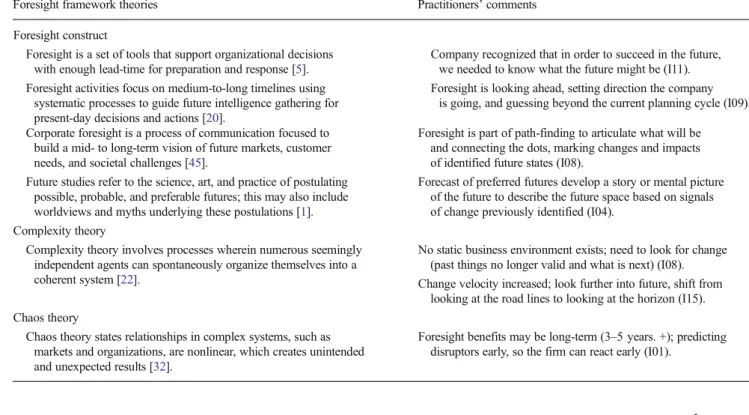
The interview responses from the foresight practitioners did not directly mention specific theories. However, the interviewees related individual experiences and perceptions that conveyed similar constructs. This suggests that the language for discussing foresight is not consistent. The tables represent only the theoret-ical constructs that were identified during the data coding within the discourse with the corporate foresight practitioners.
Table8contains the comments from the foresight practi-tioners that highlighted the foresight construct and the related theoretical framework. Specifically, the interviewed practi-tioners addressed the importance of identifying preferable futures to inform and facilitate decision-making processes. The ideas encompassed by complexity theory and chaos the-ory are evident in the practitioners’comments regarding the accelerating pace of change and the need for leaders to antic-ipate disruptive events as early as possible. While the practi-tioners’comments did not specifically denote the awareness of the theories, the alignment was evident. Table9shifts focus from the construct of foresight and contemporary business conditions towards the theoretical framework for concepts associated with human limitations relevant to corporate fore-sight practice.
Table9contains the practitioners’responses that described the use of foresight to address human limitations that could
affect the corporation and substantiate the use of foresight. Practitioner comments explained how companies used fore-sight processes to make sense out of the complex and often-chaotic fields that are relevant to each firm, its specific indus-try, and departmental needs or concerns. The ability of man-agement to openly explore potential opportunities and exam-ine all the potential influences (sometimes referred to as STEEP/VSTEEP factors) arising globally, enabling a corpo-ration to overcome the typical limits of knowledge. Openness to the massive amount of information, the variable timelines, the relevant belief values, and awareness of risks that influ-ence each component of a corporation’s industry, enable or-ganizations to capitalize on opportunities and prepare for threats. In this context, one can appreciate why corporate leaders would embrace the various foresight methods to attain the desired outcome of becoming a leader in their field.
Purposes for the introduction of foresight
Almost half of the responses identified the need for innovation and competitive advantage as the primary reasons for the introduction of foresight in the corporation. Rapidly changing markets wherein (a) product lifecycles are compressed, (b) new products arise frequently, and (c) new competitors are a constant threat, make firms’ existing product portfolio less secure than in the past. The resulting need to innovate may involve new products for existing markets, identification of
Table 8 Theoretical framework about business conditions evident in interview responses
Foresight framework theories Practitioners’comments
Foresight construct
Foresight is a set of tools that support organizational decisions with enough lead-time for preparation and response [5].
Company recognized that in order to succeed in the future, we needed to know what the future might be (I11). Foresight activities focus on medium-to-long timelines using
systematic processes to guide future intelligence gathering for present-day decisions and actions [20].
Foresight is looking ahead, setting direction the company is going, and guessing beyond the current planning cycle (I09).
Corporate foresight is a process of communication focused to build a mid- to long-term vision of future markets, customer needs, and societal challenges [45].
Foresight is part of path-finding to articulate what will be and connecting the dots, marking changes and impacts of identified future states (I08).
Future studies refer to the science, art, and practice of postulating possible, probable, and preferable futures; this may also include worldviews and myths underlying these postulations [1].
Forecast of preferred futures develop a story or mental picture of the future to describe the future space based on signals of change previously identified (I04).
Complexity theory
Complexity theory involves processes wherein numerous seemingly independent agents can spontaneously organize themselves into a coherent system [22].
No static business environment exists; need to look for change (past things no longer valid and what is next) (I08). Change velocity increased; look further into future, shift from
looking at the road lines to looking at the horizon (I15). Chaos theory
Chaos theory states relationships in complex systems, such as markets and organizations, are nonlinear, which creates unintended and unexpected results [32].
new product opportunities, and untapped market geography. The innovation may take the form of finding new markets (including segments and countries), new products, or a pipeline of R&D projects. A few interview participants discussed looking for the “white spaces” or opportunity identification where the company had no current offering today. Generally, innovation and competitive edge were considered both strategic (i.e., enterprise-wide) and tactical (i.e., departmental) motiva-tions for and benefits of foresight practice. Additionally, partic-ipants mentioned the need to influence customer perceptions of the company and anticipate change as reason they use foresight. Since foresight involves looking into the future, significant variation the time horizon was different for each foresight practitioner. The time horizons for forward focused planning varied by industry and by departmental goals for the foresight activities. Some practitioners noted time horizons of 1–3 years, for example, in consumer products while others mentioned 15–20 year time horizon for vehicles.
Foresight methods and vocabulary used in for-profit corporations
The European Foresight Platform (EFP) provides details about 44 methods used by foresight practitioners worldwide
[13]. The EFP includes foresight activities in government, the military, at think tanks, and in regional non-governmental orga-nizations in addition to corporations. In this research into corpo-rate foresight, the most frequently mentioned methods were scenario planning, trend analysis, environmental scanning, looking for weak signals, and workshops. The practitioners interviewed did not mention many of the methods noted in the EFP report. Surprisingly, companies often use outside firms to conduct research, lead foresight projects, or provide expertise for the project. The wide use of outside foresight expertise may represent the overall lack of training or lack of experience among Western for-profit corporations. Some outside firms mentioned were research companies like Gartner, Forrester, and Frost & Sullivan. Others firms noted in the interview responses represent themselves as experts in foresight or innovation such as The Futures Company, Institute for the Future, or Innovaro.
Several participants mentioned including the STEEP [14] or VSTEEP factors as a way to look at the impact of external forces on the company’s business and cus-tomers. While both factors look at the impact of social, technological, economic, ecological, and political (or legal) forces on business, the VSTEEP approach includes the additional factor of values. The STEEP or VSTEEP fac-tors were mentioned in conjunction with other methods although these factors are usually considered as part of environmental scanning.
Table 9 Theoretical framework about human limitations evident in interview responses
Foresight framework theories Practitioners’comments
Sense-making
Sense-making involves understanding how unique meanings are assigned by different people to the same phenomenon [27], this reduces ambiguity and uncertainty enabling the individual or organizational leader to take action.
Firm had“hit the wall”with severe financial and operational stress…FS helped firm understand what might change the future of their industry’s communications even before contemporary technology was available. (I05)
The limits of knowledge
Bounded rationality implies that humans can absorb a finite amount of information before reaching saturation and becoming overwhelmed [2].
“No such thing as a technology disruption. Rarely does it happen where a new technology comes out of nowhere and just shocks a company unless they’re not doing their foresighting homework at all. It just doesn’t happen that a technology comes along overnight.”(I02)
Temporal myopia
Temporal myopia exists when the pressures of complex decisions lead managers to make decisions, neglecting the future or demonstrating limited understanding of the impact of present decisions on future events [26].
“The fundamental issue is, that the time required to solve a break-through technical problem exceeds the time horizon of our view of what our consumers want.”(I06)
Epistemic blind spots
A stream of warning signals are not heeded because the information does not align with existing beliefs [6].
If a business unit is in bad shape and under pressure, the people in that unit do not care about the long-term; there is too much short-term pressure to think about the future (I07).
Risk denial
Warning signals are discounted or minimized, and corrective action is not taken [6].
Based on the interviews, the domain of foresight is current-ly lacking a standard vocabulary to describe future-focused concepts, methods, or practices. Interview participants rou-tinely interchanged similar constructs using different terms. For instance, participants used terms like scanning, trend watching, trend panels, future forces, mega-trends, and sce-narios to describe related or similar concepts. One participant did not use the term scanning or environmental scanning but did describe trend watching as a similar activity. Another participant stated that the company did not use scenario plan-ning; however, the strategic vision, which the respondent described, sounded quite similar to scenarios. The foresight practitioners reported relatively few successful foresight methods used in corporations; among these are: scenario planning, trend analysis, environmental scanning, workshops, and looking for weak signals.
Foresight methods no longer used
While many participants reported no change in the methods used due to the newness of foresight to the organization, a few reported some methods were no longer in use. These include consortium events, the Delphi method, experiential futures, market segmentation, quantitative forecasting, and scenario planning. Participants described consortium events as a multi-clients and multi-industries event where a foresight consultan-cy presents multi-industries research in a setting where fore-sight practitioners can network and discuss. Interviewees claimed that their companies eliminated this format because of the recent recession. The Delphi method involves a struc-tured group process, usually dealing with complex issues, where experts conduct a series of iterative learning rounds to generate ideas while also building consensus. Experiential futures may involve an immersion event in a cultural setting to explore the potential of future market such as looking first-hand at Chinese consumers and lifestyles in China.
The findings indicated that foresight practitioners rarely used quantitative forecasting; quantitative forecasting is based on extrapolating from historical data. Such forecasts can look “real” due to hard numbers, charts, and trend lines. These extrapolations usually assume the continuation of present conditions. Market segmentation is another method that uti-lizes only historical data to project trends. In some cases, the results are often an iterative product change based on what the company already makes. Some practitioners reported no lon-ger using these methods, which rely only on historical information, because consumers rarely know what they will want; they only know what they want at present. In one case, scenario planning was no longer used as some internal audiences perceived this method as too “far out” to be useful.
Systematic processes used in foresight projects
It is important to note that most of the interview participants had little or no formal training in foresight or future studies. Only three reported any training or preparation to use foresight practices. This fact coupled with the lack of a standard no-menclature related to foresight may explain the mixture of results when asking about foresight methods used and the lack of a systematic process commonly used in foresight projects. Four participants described a formal, structured process they use for foresight projects. The remainder of the participants described a semi-structured process, a loosely structured pro-cess, or relied on an external consultant to run the project. The four practitioners that reported using a structured process described steps or stages which were quite similar to each other. These are described in five steps process involving guiding questions, the external environment, anticipating change, scenarios, and shaping the future.
Guiding questions The main objective in this step is to iden-tify the specific concern or question that was relevant to the company or department involved in the foresight activity.
External environment In this step, practitioners scan activities most often focusing on picking up the early indicators of change (i.e., weak signals), developing general trends (e.g., mobile computing), and identifying trends rated to company-specific topics (e.g., consumer wellness).
Anticipating ch ange o r how o bserva tio ns cre ate meanings This phase is described as the suspension of debate so project participants could extrapolate what the future changes might mean for the company. In cases where numer-ous themes of change are identified, clustering of related themes should be performed in order to identify major trends.
Scenarios or stories of future Practitioners and project partic-ipants arrive at a shared vision of one or more preferred future states based on previously identified signals of change and major trends, as well as the ways the company might operate in that state.
Shaping the future Practitioners construct actionable steps to address identified opportunities or threats, which the foresight project uncovered.
How foresight projects are managed