State level Conference on “Recent Approaches in Environmental Protection & Sustainable Development” 2018
IRJSE © 2018| All right reserved |134 Int. Res. J. of Science & Engineering, 2018; Special Issue A3 :134-138 SJIF Impact Factor 4.11
ISSN: 2322-0015 UGC Approved Journal No. 63628
RESEARCH ARTICLE
OPEN ACCESS
Environmental pollution due to mobile phone radiation,
high voltage powerline radiation and investigating it’s
effects on heart rate and blood pressure
Aghav
1Sakharam Damu, Patil
2Dnyaneshwar Suryakant, Yande
1Jyoti Vijay
1Baburaoji Gholap College, Sangvi, Pune 41127(SPPU), India. 2Aarihant Junior College of Arts, Commerce and Science, Pune Camp, Pune
Email: [email protected].
Manuscript Details ABSTRACT
Available online on http://www.irjse.in ISSN: 2322-0015
Editor: Dr. Arvind Chavhan
Cite this article as:
Aghav Sakharam Damu, Patil Dnyaneshwar Suryakant, YandeJyoti Vijay. Environmental pollution due to mobile phone radiation, high voltage powerline radiation and investigating it’s effects on heart rate and blood pressure, Int. Res. Journal of Science & Engineering, January 2018, Special Issue A3 : 134-138.
© The Author(s). 2018 Open Access This article is distributed under the terms of the Creative Commons Attribution 4.0 International License
(http://creativecommons.org/licenses/by/4.0/), which permits unrestricted use, distribution, and reproduction in any medium, provided you give appropriate credit to the original author(s) and the source, provide a link to the Creative Commons license, and indicate if changes were made.
Pollution due to Electromagnetic Radiation (EMR) is inevitable in today's world and it had affected our lives. Currently we are totally dependant upon the technologies which are the major sources of EMR. In many situations these radiation are more powerful than natural sources of radiation. A study was conducted in Pune city (India) to find out the effect of EMR emitted by Global System for Mobile (GSM) and high voltage powerline (HVPL) on health parameters like blood pressure and heart rate, for 20 healthy volunteers (10 male and 10 female), within age group 18-25 years. In the study, heart rate (HR) and blood pressure along with other health parameters are measured using multiparamonitor (Caddo 19B, Multipara set-up). The transmitter and receiver handset (Moto G 3rd Gen-XT 1550), GSM SIM (AIRCEL), distance between caller and receiver, time of observations and other external parameters are kept fixed. These observations are analyzed using software “students online t test”. Significant effect is observed on heart rate and blood pressure for level p<0.05. In high voltage powerline study, the changes in diastolic or systolic blood pressure and heart rate when volunteers were subjected to electromagnetic radiation due to power line for 30 minutes of time are statistically not significant for groups at level p < 0.05.
Keywords: Electromagnetic radiation (EMR), Mobile tower radiation, radiation pollution, HVPL study
Aghav et al., 2018 135
Int. Res. J. of Science & Engineering, Special Issue A3, January, 2018:
INTRODUCTION
Speedy developments in various fields of science and technology in recent years have exaggerated the human interference into the natural environment. Such interference is linked with physical, biological and ecological systems resulting in various accidental and unwanted negative impacts on environment. With economic, social and scientific development, there is awareness about environmental pollution recent times. Everyday our life is encompassed by man-made EMR: food is heated in microwave ovens, airplanes are guided by radar waves, television sets receive electromagnetic waves transmitted by broadcasting stations, and infrared waves from heaters provide warmth. Infrared waves also are given off and received by automatic self-focusing cameras that electronically measure and set the correct distance to the object to be photographed. During night, incandescent or fluorescent lights are turned on to provide artificial illumination, and cities glow brightly with the colorful fluorescent and neon lamps of advertisement signs. Ultraviolet radiation cannot be seen by eye but its effect is felt like pain from sunburn. Mobile tower, cell phone and HVPL are also pouring radiation in these.
The intensity of man made EMR has become so ubiquitous and it is now increasingly being recognized as a form of unseen and dangerous pollution that might affect life forms in multiple ways [1]. Most of the short-term studies related to the thermal impacts of EMR exposure on biological systems have neither succeeded to discover any statistically significant changes in the biological processes at the background levels of exposures [2]. On the other hand, long-term studies have reported frightening observations, detecting negative consequences on immunity, health, reproductive system, behavior, communication and co-ordinations [3]. The electromagnetic radiations are classified in to radio frequency field (RFF), Intermediate frequency fields (IFF), extremely low frequency field (EFF) and static fields [4].
The consequence of mobile phone radiation and HVPL on human health is the subject of recent interest due to enormous increase in mobile phone usage
throughout the world. Mobile phones use EMR in the microwave range. Some national radiation advisory authorities have suggested actions to diminish exposure to their citizens as a preventive approach. The speedily growing mobile phone technology increased public anxiety about the possibility of associated undesirable health effects. There is some evidence for biological consequences also, which, may be necessarily hazardous for humans [5]. Radiation from mobile base stations (towers) may also have an effect on the local abundance of insects or other invertebrates and thereby indirectly influencing the number of house sparrows. The adult house sparrows are seed-eaters, and need insects and other invertebrates to feed their young, such that it is likely that they will prefer areas with high abundance of invertebrates at the beginning of the breeding period. Several investigators have postulated that the lack of invertebrates might be an important factor in the reported decline of house sparrow populations in urban areas. Short-term exposure of pulsed mobile phone radiation with carrier frequency 900 MHz resulted in a 50-60 % decrease of the reproductive capacity of insects. Similar results were also found with microwave radiation at other frequencies. Some study showed that long-term exposure to low-intensity (pulsed) electromagnetic radiation from base stations may have significant effects on populations of wild birds. When birds are exposed to weak electromagnetic field, they disorient & begin to fly in all directions. This explains migratory birds undermining navigational abilities. Honey bees appear to be very sensitive to EMR [6]. Plant showed responses to high frequency electromagnetic fields [7]. Other wildlife such as amphibians and reptiles also appear to be at high risk with possible interference of EMR. Biological effects due to HVPL on plants, insects and animals, as well as the human body are less harmful when exposed to levels that are below the standardized threshold values. Probable risks from high voltage powerline like leukemia, breast cancer, neuropsychological disorders, decrease in blood sugar and reproductive outcomes have been reported [8,9].
136 | State level Conference on “Recent Approaches in Environmental Protection & Sustainable Development” 2018
ISSN 2322-0015 http://www.irjse.in
METHODOLOGY
Caddo 19B Multipara Monitor with silver/silver chloride ECG disposable electrodes (single use) and ECG paper rolls are used for experiments. Multipara monitor machine is a light weight, compact and easily portable (Fig. 1). Using the machine one can view important signals such as electrocardiogram (ECG), respiratory rate, percentage of saturated oxygen (Sp02), blood pressure and body temperature. These parameters can be easily displayed on monitor. The power switch is on the front side of panel. The charge marker and the power switches are illuminated when the machine is powered on. The alarm display is on the front panel. The alarm indicator shows lights when alarm takes place. The sensors have sockets at the left side and the recorder socket is at the right. Other sockets and power connectors are on the rear panel. The monitor is easy tool to use with functions carried out by a small number of buttons and a rotating switch on the front panel. The multipara monitor has a printer with network arrangement and provision to display patient's very important health parameters on the screen. The data so obtained is used for measurement of various parameters and keeping record for diagnosis and treatment. This data can be stored, printed and transferred. There are four sensors or electrodes, used in multiparameter which is capable of giving information of electrocardiogram and health parameters (Fig. 2).
Fig1:Multiparamonitor Fig 2: Multiparameter electrodes
SAMPLE COLLECTION AND STUDY PLAN
For mobile radiation study, 20 students including males and females within age in between of 18-25 years were selected from urban backgrounds. These volunteers were using cell phones and enrolled in the
Colleges of Pune city. Any individual, employees, guest and servants were excluded from study. College students selected were using cell phone for more than 3 years. The purpose of study was explained to all volunteers and their consents were obtained.
All subjects were informed to avoid drinks like caffeinated drinks. They are also asked not to have unnecessary activities together with physical exercises and aerobatics within 12 hours prior the collecting data. They were also informed not to have food or tea prior to experiments. Volunteers were given information regarding the equipments being used for examining the health parameters, procedure of study and experimentation. Mobile study was completed in a silent, airy and spacious room in seating position. The recording of respiratory rate (RR), saturated oxygen (SpO2) along with systolic blood pressure (SBP), diastolic blood pressure (DBP), pulse rate (PR) and body temperature (Temp) of a volunteer under observation was completed with the help of simple six channel multipara monitor of Scientech Company of Model Caddo 19B.
ECG electrodes are positioned on arms, legs and chest as per standard medical practice or guidelines given in the user’s manual provided by supplier of machine. Recording of ECG generally takes five to ten minutes for a single patient. After recording ECG, the electrodes positioned to body are removed from their locations. An ECG recording is absolutely trouble-free. A volunteer at fixed distance (100 m) was talking continuously on one mobile (Moto G 3rd Gen-XT 1550) with volunteer under experiment using another mobile GSM SIM (AIRCEL). Recording of various health parameters were also noted.
Same methodology was used for HVPL study except that volunteer was asked to sit below high voltage powerline.
RESULTS AND DISCUSSION
All the parameters indicated distinct trend in variations in the data except temperature parameter for mobile radiation emitted due to one hour communication. This was because the change in temperature was very small in magnitude as
Aghav et al., 2018 137
Int. Res. J. of Science & Engineering, Special Issue A3, January, 2018: compared with other parameters. It was observed that
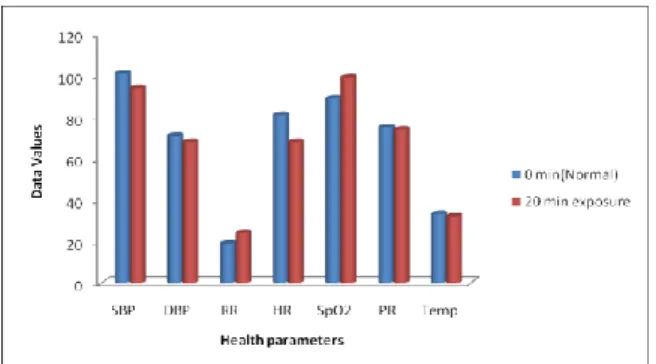
there were significant changes in HR and BP as compared with other health parameters. It had been noticed that after 20 minutes of exposure of cell phone radiation, health parameters under investigation showed a trend in the value of parameter. Hence time of exposure was kept time of 20 minutes for further observations. Figure 3 indicates comparative changes in health parameters after mobile phone radiation exposure of 20 minutes.
Fig 3: Typical variation in health parameter after 20 min of mobile communication of a volunteer
Heart rate is associated with BP. Observations from 20 volunteers were compared with un radiated normal values of health parameters. These values were compared using online “t test calculator”. Hence p values for blood pressure and heart rate are shown in Table 1.
Gender wise comparison of various parameters is shown in Table 1, showed that for male the variation in heart rate was significant at the level of p < 0.05, while in case of female volunteers the change in heart rate was not statistically significant. Similarly, observed variation in diastolic blood pressure is significant for female group.
Same observations were noted by asking volunteer to seat below HVPL. The statistical p values of these observations are indicated in Table 2.
Table 1. Statistical p values for HR and DBP
The analysis carried from Table 2, indicated that the variations in diastolic BP, Systolic BP, HR, pulse rate, respiration rate and SpO2, when a volunteers were subjected to electromagnetic radiation due to powerline for 30 minutes was statistically not significant for groups at level p < 0.05 This results confirmed the study of other investigators [10].
Table 2. Min, Max, and S.D values of studied variables for male students before and after exposure to EMR from HVPL
Variables For male For female
Min. Max. S.D. p value Min. Max. S.D. p value
SBP (a) 105 144 12.50 0.207 95 117 7.86 0.652 SBP (b) 101 121 10.28 110 100 9.38 DBP (a) 61 89 13.41 0.952 60 91 9.62 0.592 DBP(b) 65 96 7.35 59 63 8.37 RR (a) 14 21 2.97 0.931 14 21 1.93 0.267 RR (b) 18 12 2.02 21 11 3.03 HR (a) 65 97 12.06 0.805 70 96 7.67 0.447 HR (b) 73 92 11.35 75 74 7.18 PR (a) 73 104 12.0 0.196 73 94 8.17 0.760 PR (b) 87 86 6.50 78 73 6.13 SpO2(a) 84 99 4.41 0.469 73 98 6.63 0.0923 SpO2(b) 90 98 2.63 95 97 1.25 Gend er ↓ Age year s p value for heart rate for exposure of
p value for
DBP for
exposure of 10 min 20 min 10 min 20
min Male 22± 1.05 0.0273 0.0023 0.504 0.662 Femal e 21.67 ± 2.53 0.6303 0.2321 0.286 0.022
138 | State level Conference on “Recent Approaches in Environmental Protection & Sustainable Development” 2018
ISSN 2322-0015 http://www.irjse.in
CONCLUSION
In the study of continuous communication on the mobile phone reported, it had been observed that the call with a mobile phone changed heart rate of healthy volunteer. Mobile phone radiation affected heart rate variability but the effect of speaking on mobile phone cannot be ignored. The result indicated increase HRV parameters even near to head while taking for 20 minutes. Analysis of the data showed statistical significant effect due to mobile phone exposure of 20 minutes on health parameters. The HVPL study indicates that there is no significant effect of powerline voltage on health parameters measured in heart rate variability. The results due to fact that frequency of powerline is of 50 Hz only, hence it possess low energy. Human body absorbs energy of high frequency field more easily. Cells within body possess bioelectric field due to bioelectric potentials.
REFERENCES
1. Mahajan Ankur et al. Human Health and Electromagnetic Radiations. International Journal of Engineering and Innovative Technology, 2012; 1(6): 95-97.
2. Kapdi M, Hoskote S & Joshi SR. Health hazards of mobile phones: an Indian perspective. JAPI, 2008; 56: 893–97.
3. Levitt BB, Lai, H. Biological effects from exposure to electromagnetic radiation emitted by cell tower base stations and other antenna arrays. Environmental Reviews, 2010; 18: 369–395.
4. Grzegorz Redlarski et al. The Influence of Electromagnetic Pollution on Living Organism: The Historical Trends and Forecasting Changes. Bio Med Research International, 2015:18.
5. Bhargavi K, et al. Mobile Phone Radiation Effects on Human Health. International Journal of Computational Engineering Research, 2013; 3(4):196-203.
6. Balmori, A. Electromagnetic pollution from phone masts. Effects on wildlife. Pathophysiology, 2009; 16:191–199.
7. Alain Vian et. al. Plant responses to high frequency electromagnetic fields. Bio Med Research International, 2016.
8. Ahmadi H et al. Electromagnetic fields near transmission lines – problems and solutions. Iran. J. Environ. Health sci.Eng., 2010;7(2):181-188. 9. DIB Djalel and Mordjaoui Mourad. Study of
Influence High-Voltage Power Lines on Environment and Human Health (Case Study: The Electromagnetic Pollution in Tebessa City, Algeria). Journal of Electrical and Electronic Engineering, 2014; 2(1): 1-8.
10. Anderson LE, Kaune WT. Electric and magnetic fields at extremely low frequencies. WHO. Reg Publ Eur Ser, 1988 ;25: 175-243.