International Journal of Applied Linguistics & English Literature ISSN 2200-3592 (Print), ISSN 2200-3452 (Online) Vol. 5 No. 5; September 2016
Australian International Academic Centre, Australia
Gender Differences and Foreign Language Reading Anxiety of
High School Learners in an Iraqi EFL Context
Ahmed Abdulateef Sabti (Corresponding author) English Department, Universiti Putra Malaysia, Selangor, Malaysia
E-mail: [email protected]
YM Tenku Mazuwana Binti T. Mansor
English Department, Universiti Putra Malaysia, Selangor, Malaysia E-mail: [email protected]
Mohammed Qasim Altikriti
English Department, Universiti Kebangsaan Malaysia, Selangor, Malaysia E-mail: [email protected]
Hussein Fahim Abdalhussein
English Department, Universiti Kebangsaan Malaysia, Selangor, Malaysia E-mail: [email protected]
Saad Sameer Dhari
English Department, Universiti Putra Malaysia, Selangor, Malaysia E-mail: [email protected]
Received: 13-04-2016 Accepted: 25-06-2016 Advance Access Published: July 2016
Published: 01-09-2016 doi:10.7575/aiac.ijalel.v.5n.5p.208 URL: http://dx.doi.org/10.7575/aiac.ijalel.v.5n.5p.208
Abstract
Over the past two decades Investigation of foreign language anxiety generally has progressively caught the attention of numerous investigators in the area of foreign language. Yet, anxiety variable that affects the students’ acquisition of particular language skills for instance, reading specifically have actually seldom been investigated in the context of EFL
Arab learners in particular with Iraqi students. So, the study aimed to investigate the influence of anxiety variable
towards reading comprehension of Iraqi high school learners. This study also sought to examine the gender differences towards reading language anxiety. Quantitative approach was applied in this research, which involved 20 Iraqi students of a high school in Kuala Lumpur, Malaysia. The respondents comprised 10 males and 10 females with ages between 16 years and 18 years. This study made use of Foreign Language Reading Anxiety Scale (FLRAS). The results of the study showed that both male and female participants had a high level of anxiety towards the reading comprehension. Furthermore, the analysis revealed that gender played a slight role in the results of the study. Female students showed a slightly higher level of anxiety towards the reading comprehension than their male counterparts. Iraqi learners need to be exposed to the four skills of English language generally and the reading skill in particular. This exposure makes the learners aware of the four skills (Listening, Reading, Writing and Speaking) that need to be acquired and also to decrease the rate of anxiety variable in addition to its influence on their performance.
Keywords: Gender Differences,High school learners, Foreign language reading anxiety, Iraqi EEL context
1. Introduction
There is a growing problem on the decreasing level of reading comprehension in the academic setting. According to Perie et al. (2005), The National Assessment of Educational Progress observes that there is a decrease in the reading comprehension level in the period between 2003 and 2005. Meanwhile, Siti Hamin (1998) and Sabti (2013) mentioned that many researchers and educators cited anxiety as the major factor to the decline of students’ academic achievement in the EFL/ESL contexts. Brown (2007) also reported that anxiety variable is a major affective factor in the second or foreign language acquisition.
In the meantime, an individual’s literacy level is crucial as it can directly affect his chances in employment and his career progress. The Organization for Economic Cooperation and Development [OECD] (2008) mentioned that a high literacy level would definitely help to increase one’s quality of life as it will open up more career opportunities. Hence, educators strive to increase the literacy level of the learners into the most optimum since there is a close connection
between academic achievement and literacy. Meanwhile as argued by Grove & Hauptfleisch (1982) and Moreillan (2007), literacy now not only refers to the ability to read and write but also the ability to understand and analyse what is being read. Thus, students with reading difficulties are not able to perform in a conventional learning environment, even if they are as capable as their class mates. In most cases, students with reading difficulties are not able to read according to their grade, and they feel de-motivated to read as they feel anxious and depressed because they are not able to perform like their other classmates. Bender (2012) mentioned that these students are labeled as ‘not performing’ and ‘weak’ as they progress into their schooling and are not able to get the sufficient help to resolve their problems as they try to adapt into the conventional classroom.
According to Alexander and Jetton (2000), an important aim for reading instructions in the high school level is to teach comprehension of different text genres. In this level, there is a wide range of materials that the students are expected to read in order to help them gain more knowledge and literacy experiences. Therefore, as argued in Gottfried (1990), Hidi and Harackiewicz (2000), and Wigfield and Guthrie (1997), the level of reading comprehension is significantly related to the reading motivation in the elementary grades. Hence, reading anxiety is examined as a potential catalyst of reading comprehension and its ability to predict the growth of the students’ reading comprehension level over time.
In the learning process, language anxiety is a complex psychological construct which is regarded as an affective variable (Lien, 2011). It is believed that language anxiety is linked to the students’ performance, and it interferes with their language competence. This had been well examined by many studies carried out by (Horwitz, Horwitz, & Cope, 1986; MacIntyre & Gardner, 1989 and Sellers, 2000). Many such researchers have focused on the effects of language anxiety on listening or speaking activities in the language classroom (Horwitz et al., 1986; Phillips, 1992; Price, 1991; Young, 1991). On the hand, other researchers such as (Mohd. Zin & Rafik-Galea, 2010; Saito, Horwitz, & Garza, 1999 and Sellers, 2000), focused on how anxiety can hinder comprehension in reading and listening among foreign language (FL) learners where such affective variables could be the contributing factors for the decline of reading performance. Meanwhile, some researchers (Saito et al., 1999; Capan & Karaca, 2013; Zhao et al., 2013 & Al-Shboul et al., 2013), argued that reading anxiety in FL is different from the general FL anxiety and concluded that students with a higher reading anxiety would have a lower level of reading comprehension and vice versa. Onwuegbuzie et al. (1999) refer to some factors that may cause anxiety in learning a foreign language. These include age, academic achievement, previous experiences in visiting foreign countries, prior high school experiences with foreign languages, expected outcomes of language courses, perceived scholastic competence, and perceived self-worth. Similarly, motivation efforts and the learners’ current English proficiency can also significantly affect one’s level of anxiety (Wu, 2010). In addition, similar to Onwuegbuzie et al., (1999) the study also mentioned factors like age, gender, occupation, experiences in language, and time spent on studying the language outside the classroom. All these factors have fundamental roles in determining the mastery of the language as well as to either increase or decrease the anxiety level.
On the other hand, factors leading to anxiety might slightly differ from one context to another. So, this study aimed to address the gap in the literature to investigated language anxiety in the context of Arab learners, particularly among Iraqi learners. The majority of the Iraqi students do not have a high proficiency in English language (Sabti, 2013). This creates an obstacle leading to numerous difficulties in their studies. Therefore, this group of students keep on experiencing anxiety in reading foreign language texts and suffering from declining in their grades in addition to poor their performance in their studies. Hence, this creates a need for a study to investigate the phenomenon of anxiety in learning a foreign language in the context of Iraqi high school learners. In line with this, this research focused on the relationship between reading comprehension and anxiety to investigate the levels of the Iraqi high school students’ anxiety towards reading comprehension. Plus, this study shed the light on gender differences to identify reading anxiety between male and female participants. Sabti and Chaichan (2014) indicate that gender is a key variable that might influence the findings of a study.
1.2 EFL Reading Anxiety and EFL Reading Performance
Some researchers reported that there is a connection between both EFL reading anxiety variable and EFL reading performance. Precisely, the study of Shi and Liu (2006) revealed that EFL reading anxiety rate was correlated negatively with scores for two tests, namely English test of a large scale and a test of English reading among Chinese EFL learners, in China. Another study by Sellers (2000) disclosed that students with a high anxiety level have the tendency to employ more local strategies. In fact, these students focused more on vocabulary and remembered less passage content than their less anxious counterparts. Instead, some researchers reported that there is no significant connection between EFL reading anxiety and EFL reading performance (Brantmeier, 2005; Mills et al., 2006). Their ambiguous findings revealed that the relationship between reading performance and EFL reading anxiety could be affected by the types of reading tasks and the difficulty level of the reading text. Brantmeier (2005) indicated that there is an insignificant relationship between reading performance and EFL reading anxiety because the students were aware of the tasks in their reading performance. Furthermore, Mills et al. (2006) claimed that the insignificant relationship between reading performance and EFL reading anxiety is due to the simplicity of reading tasks (MacIntyre & Gardner, 1991; Spielberger, 1966).
2. Methodology
Quantitative research is particularly designed to produce accurate and reliable measurements that allow to statistical analysis (Poon, 2005). Figure 1, displays a diagram of the present research design.
Figure 1. Research design of quantitative approach for the FLRASinstrument
2.1 Participants
In the present study, the gender is controlled as a key variable. The sample of study comprised of 20 Iraqi EFL students from an Iraqi public school in Kuala Lumpur-Malaysia. They were all from the last two grades in the school. The students of the two grades were chosen to achieve the study objectives. Among the participants, 10 were males and 10 were females whose ages ranged from 16 years to 18 years. Permission was obtained and granted by the principal of the selected school to conduct the research.
2.2 Instrument
Only one questionnaire instrument used to collect the data in this study is ‘Foreign Language Reading Anxiety Scale’ (FLRAS). Foreign Language Reading Anxiety Scale’ (FLRAS) indicates to the apprehension and frustration feelings of a learner when he fails in comprehending a text in the EFL/ESL contexts. This questionnaire was designed by Saito et al. (1999) and consisted of 20 items and each item is answered on a five-point Likert-type scale. These items were built to measure the anxiety level of students toward reading comprehension. The researchers did not make a pilot application due to the measures indicated a high internal reliability and a high validity across the study of Saito et al., (1999). They reported an alpha coefficient of .86 for internal consistency in the FLRAS.
The rating of FLRAS items is on a five-point Likert scale, ranging from (strongly disagree) to (strongly agree). Yet, the items such as (12, 13, 14, and 18) were worded positively and need an inverse scoring. The overall score is 20 to 100 for the theoretical range. High scores on FLRAS for the participants refer to a high reading anxiety rate and the low scores mean a low reading anxiety rate.
2.3 Procedures
The FLRAS was administered to the participants on one day and as aforementioned the participants came from two different grades. One researcher being a teacher of the participants, distributed the questionnaire to the participants and supervised the application of the questionnaire until the participants finished in case there would be some questions.
2.4 Data analysis
Foreign Language Reading Anxiety Scale (FLRAS) was distributed to disclose the level of the students towards their reading anxiety. Firstly, the statistical Package for Social Sciences (SPSS) software was used to analyze the data which
included the use of Frequency Test to determine the levels of the participants’ anxiety towards their reading
comprehension. In addition, Independent-Sample T-Test was also used to demonstrate the gender differences towards the students’ reading anxiety.
3. Results
3.1 Frequency Test to measure the students’ anxiety level
The results of the Frequency Test revealed that the anxiety level of the respondents. The results showed that the majority of the respondents had a high level of reading anxiety. Twelve respondents had the tendency to choose the scale (agree) with a percentage of (87.3%). The scale “agree” indicates that the respondents feel anxious when they are involved in the reading skills.
Table 1. Level of Anxiety
Frequency Percent Valid Percent
Cumulative Percent
Valid Extremely Disagree
Disagree 0 2 3.2 0 10.0 0 10.0 0
Uncertain 3 4.8 15.0 25.0
Agree 12 87.3 60.0 85.0
Extremely Agree 3 4.8 15.0 100.0
Total 20 100.0 100.0
Quantitative Approach
Figure 2, lists the results of the Frequency Test. Generally, percentage is 87.3%. In fact, the respondents tend to have a high level of anxiety towards reading comprehension. From the figure 2., it can be concluded that the results of the Frequency Test imply that most respondents selected the option ‘agree’.
Figure 2. Anxiety level of the participants
3.2 Independent Samples T-Test to measure the gender differences
The results of Independent Samples T-Test for the gender differences of the respondents with reading anxiety. The relationship between FLRAS and gender analyzed by the independent t-test showed a trivial correlation between the reading anxiety level of the participants and their gender irrespective of their grade level (See Table 2). The Table
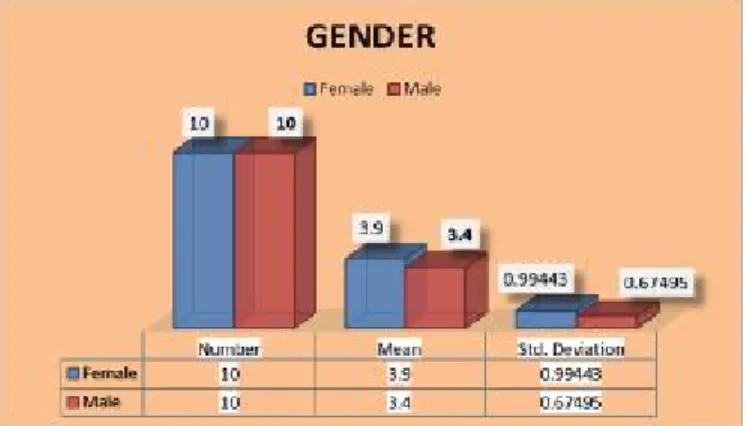
showed that female participants had high anxiety (M=3.90, SD= .994) who scored slightly higher than the male
participants (M=3.40, SD .674). Based on the results of the independent samples t-test, t(18) = -526, p = .605, the
significant value was higher than alpha at .05 level of significance. The results demonstrate that the participants both male and female tended to have a high level of anxiety. However, female participants tended to have a slightly higher anxiety level than their male counterparts. Therefore, it can be concluded that there is a slight difference between female and male participants in relation to the level of anxiety.
Table 2. Foreign Language Reading Anxiety and Gender
GENDER N Mean Std. Deviation t p
LEVEL OF ANXIETY
Female 10 3.9000 .99443 .526 .605
Male 10 3.4000 .67495
These findings indicate that both male and female respondents showed high anxiety, but males were less low anxious (3.4000) towards reading comprehension than their female counterparts (3.9000). Figure 3 refers to the diagram regarding the male participants to be less anxious than the female participants. Consequently, female respondents tended to have a slightly high anxiety than their male counterparts towards reading comprehension. The percentages of male and female participants in the high-anxiety group are close to each other relatively and respectively.
Figure 3. Gender Differences
4. Discussion
participants with more reading anxiety. The participants of both male and female showed a high level of anxiety towards reading comprehension. Thus, the present study is in line with the three studies conducted by Zhao et al. (2013), Al-Shboul et al. (2013), and Capan & Karaca (2013). The study of by Zhao et al. (2013) was conducted on an English-speaking university students learning Chinese as a foreign language (n =114) in the United States. The other two studies were carried out by Al-Shboul et al. (2013) on six Jordanian EFL students at Yarmouk University, Jordan, and Capan & Karaca (2013) on 159 undergraduate students at a university in Turkey. The three studies showed that the participants exhibited a high level of anxiety towards reading comprehension. Therefore, the researchers of these studies elucidated via their findings that the participants suffered a lot due to the anxiety phenomenon. This phenomenon might contribute to affect the students’ performance in their learning process generally and their reading skill in particular. Learners may possibly have a fear of missing some points in the sentences of the writer. That is, it is a misconception that it is necessary to comprehend every single word. In this case, when they miss one or two words or phrases, it could drive them to the feelings of discomfort and fear. The comprehension is therefore inhibited in the reading tasks. This could be that learners are not exposed to or unaware of the four skills of English language. Because Iraqi syllabus does not focus on the four skills. It only focuses on grammar structures and limited with sentences level (Sabti, 2013). Hence, this steers to cause some obstacles for the students to be unacquainted with the reading skill in particular and other skills generally. In addition, teachers do not provide chances to the students to read or practice the English skills (Sabti, 2013). This considers a second hindrance to provoke anxiety variable to the students.
The relationship between FLRAS and gender was analyzed by the independent t-test. The results showed there is a minor correlation between the learners' levels of reading anxiety and their gender. It was found that gender played a trivial role in reading anxiety by displaying female participants with a higher anxiety level compared to their male counterparts. To be more precise, male participants were just a little more courageous than female participants because they had a slightly lower anxiety level. This finding showed an inconsistency with Shariati & Bordbar’s (2011) study by their reporting (2011: 197) that gender did not play a contributing factor in their reading activities. Another study accomplished by Capan & Karaca (2013) also presented different findings to the current study that there is no significant correlation between the participants’ level of reading anxiety to the participants’ gender whereas the present study showed the opposite, yet with a slight difference between the gender.
The present study has declared that the anxiety variable and frustrations in the reading skill may possibly be the result of extreme and unsuitable stress, tension and shyness on superficial errors in spelling and pronouncing English words. Hence, the relationship between anxiety levels and the participants referred to a false-comfort feeling since they have insufficient knowledge regarding the target language. This might be attributed to the lack of practice and experience in the target language. The anxiety levels in this case might probably deteriorate considerably due to the deficiency of practices and experiences with the target language. So, it is a vital role for learners to be good at self-rating their reading anxiety levels and to have the awareness of the great influence of anxiety not only on their performance but also in educational setting. The growth in their ability and raise their familiarity and confidence in the target language could explain the decrease in their reading anxiety levels.
5. Conclusion
To sum up, foreign language reading anxiety had a negative influence on the performance and attitudes of students towards their reading comprehension. Readers with a high anxiety level always show a low confidence level to enjoy the content of the reading texts. While they are involved in the reading skill, they might have an interest to obtain the meanings of unfamiliar and unused words and sentences. It is true that the grasp of the meanings of words or sentences will reduce their anxiety and steer them to feel secured in their reading skill. However, teachers might be a more effective factor in reducing learners’ anxiety, because readers have a high level of confidence and relaxation when they possess the ability to grasp the complete picture of a reading text by the way of guessing or the use of their background knowledge. Therefore, instructors or teachers need to present strategies of holistic reading to develop and foster reading confidence of the students to reduce their anxiety in addition to improve the performance of reading skill and language proficiency of students.
Moreover, gender differences were determined in this study but with a slight difference. EFL female Iraqi learners were at a higher anxiety level than males with a slightly lower anxiety level, rather, females had the tendency with a high anxiety compared to males. Thus, it gives the impression for EFL instructors and teachers to teach more and guide their students specially females to practice in order to reduce their reading anxiety such as analysis of the texts in critical method, trying to guess the meaning of new and unfamiliar words, use of context clues, and background knowledge. Hence, this may probably strengthen and increase the level of confidence of the learners in addition to give them full picture of each text towards their reading skill.
References
Al-Shboul, M. M., Ahmad, I. S., Nordin, M. S., & Rahman, Z. A. (2013). Foreign language reading anxiety in a
Jordanian EFL context: A qualitative study. English Language Teaching, 6(6), 38.
Bender, W., N. (2012). Öğrenme Güçlüğü Olan Bireyler ve Eğitimleri. (Çev. Edt: Hakan Sarı). Ankara: Nobel.
Brantmeier, C. (2005). Anxiety about L2 reading or L2 reading tasks? A study with advanced language
Brown, D. (2007). Principles of Language Learning and Teaching (5th ed.). United States of America: Pearson Longman.
Capan, S. A., & Karaca, M. (2013). A comparative study of listening anxiety and reading anxiety. Procedia-Social and
Behavioral Sciences, 70, 1360-1373.
Gottfried, A. E. (1990). Academic intrinsic motivation in young elementary school children. Journal ofEducational
Psychology, 82(3), 525–538.
Grove, M.C., & Hauptfleisch, H.M.A.M. (1982). Remedial Education in the Primary School. HAUM.
Hidi, S., & Harackiewicz, J. M. (2000). Motivating the academically unmotivated: A critical issue for the 21st
century. Review of educational research, 70(2), 151-179.
Horwitz, E. K., Horwitz, M. B., & Cope, J. (1986). Foreign language classroom anxiety. The Modern language
journal, 70(2), 125-132.http://dx.doi.org/10.1111/j.1540-4781.1991.tb05378.x
Lien, H. Y. (2011). EFL Learnersʼ reading strategy use in relation to reading anxiety. Language Education in Asia, 2(2),
199-212.
MacIntyre, P. D., & Gardner, R. C. (1989). Anxiety and second language learning: Toward a theoretical
clarification. Language learning, 39(2), 251-275.
MacIntyre, P. D., & Gardner, R. C. (1991). Language anxiety: Its relationship to other anxieties and to processing in
native and second languages. Language learning, 41(4), 513-534.
Mills, N., Pajares, F., & Herron, C. (2006). A reevaluation of the role of anxiety: Self‐efficacy, anxiety, and their
relation to reading and listening proficiency. Foreign language annals, 39(2), 276-295.
Mohd. Zin, Z., & Rafik-Galea, S. (2010). Anxiety and academic reading performance among Malay ESL learners.
Journal of Pan-Pacific Association of Applied Linguistics,14(2), 41-58.
Moreillon, J. (2007). Collaborative strategies for teaching reading comprehension: Maximizing your impact. American
Library Association.
Onwuegbuzie, A. J., Bailey, P., & Daley, C. E. (1999). Factors associated with foreign language anxiety. Applied
Psycholinguistics, 20(02), 217-239.
Perie, M., Grigg, W., & Donahue, P. (2005). The Nation's Report Card [TM]: Reading, 2005. NCES
2006-451. National Center for Education Statistics.
Phillips, E. M. (1992). The effects of language anxiety on students' oral test performance and attitudes. The modern
language journal, 76(1), 14-26.
Poon, J. P. (2005). Quantitative methods: not positively positivist. Progress in Human Geography, 29(6), 766.
Price, M. L. (1991). The subjective experience of foreign language anxiety: Interviews with highly anxious
students. Language anxiety: From theory and research to classroom implications, 101-108.
Sabti, A. A. (2013). Investigating Writing Anxiety among Iraqi Post Graduate Students in UKM. National University of
Malaysia, Dissertation.
Sabti, A. A., & Chaichan, R. S. (2014). Saudi high school students’ attitudes and barriers toward the use of computer
technologies in learning English. SpringerPlus, 3(1), 460
Saito, Y., Horwitz, E. K., & Garza, T. J. (1999). Foreign language reading anxiety. The Modern Language Journal,
83(2), 202-218. http://dx.doi.org/10.1111/0026-7902.00016
Sellers, V. D. (2000). Anxiety and reading comprehension in Spanish as a foreign language. Foreign Language
Annals, 33(5), 512-520.http://dx.doi.org/10.1111/j.19449720.2000.tb01995.x
Shariati, M., & Bordbar, A. (2011). Interrelationship among foreign language reading anxiety, reading proficiency and
text feature awareness in the university context. Iranian Journal of Applied Language Studies, 1(2), 179-206.
Shi, Y. Z., & LIU, Z. Q. (2006). Foreign Language Reading Anxiety and Its Relationship to English Achievement and
Gender [J]. Journal of Pla University of Foreign Languages, 2, 013.
Siti Hamin, S. (1998). The Process Approach to ESL Writing. Bangi: Universiti Kebanasaan Malaysia.
Spielberger, C. D. (1966). Theory and research on anxiety. Anxiety and behavior, 1. In C. D. Spielberger (Ed.), Anxiety
and behavior (pp. 3–20). New York: Academic Press.
Wigfield, A., & Guthrie, J. T. (1997). Relations of children's motivation for reading to the amount and breadth or their
reading. Journal of educational psychology, 89(3), 420.
Wu, K. H. (2010). The relationship between language learners’ anxiety and learning strategy in the CLT
classrooms. International Education Studies, 3(1), p174.
Young, D. J. (1991). Creating a Low‐Anxiety Classroom Environment: What Does Language Anxiety Research
Suggest?. The modern language journal, 75(4), 426-437.
Zhao, A., Guo, Y., & Dynia, J. (2013). Foreign language reading anxiety: Chinese as a foreign language in the United
States. The Modern Language Journal, 97(3), 764-778.
Appendix A
Foreign Language Reading Anxiety Scale
(Saito, Horwitz, & Garza, 1999)
Directions: Statements 1 through 20 refer to how you feel about reading English while you are doing extensive reading. For each statement, please indicate whether you (1) strongly agree, (2) agree, (3) neither agree nor disagree, (4) disagree, or (5) strongly disagree by marking the appropriate number on the line following each statement. Please give your first reaction to each statement and mark an answer for each statement.
Value 1 2 3 4 5
Answer Strongly
Disagree Disagree Neutral Agree Strongly Agree
No Statements SD D N A SA
1 I get upset when I'm not sure whether I understand what I am reading in English.
2 When reading English, I often understand the words but still can't quite
understand what the author is saying.
3 When I'm reading English, I get so confused I can't remember what I'm reading
4 I feel intimidated whenever I see a whole page of English in front of me.
5 I am nervous when I am reading a passage in English when I am not familiar
with the topic.
6 I get upset whenever I encounter unknown grammar when reading English.
7 When reading English, I get nervous and confused when I don't understand
every word.
8 It bothers me to encounter words I can't pronounce while reading English.
9 I usually end up translating word by word when I'm reading English.
10 By the time you get past the funny letters and symbols in English, it's hard to remember what you're reading about.
11 I am worried about all the new symbols you [I] have to learn in order to read English.
12 I enjoy reading English.
13 I feel confident when I am reading in English.
14 Once you get used to it, reading English is not so difficult. 15 The hardest part of learning English is learning to read.
16 I would be happy just to learn to speak English rather than having to learn to read as well.
17 I don't mind reading to myself, but I feel very uncomfortable when I have to read English aloud.
18 I am satisfied with the level of reading ability in English that I have achieved so far.
19 English culture and ideas seem very foreign to me