The Chapel Hill Library is located in University Mall while renovations are being
completed on the permanent library building. The paper will discuss the impact of being in a temporary location on library services and patron experiences. A patron survey and
interviews with librarians provide insight into the advantages and disadvantages of moving to a temporary space.
Headings:
Public Libraries
Public Libraries—Space Utilization
Public Libraries—Use Studies
by
Kathryn K. McNamara
A Master’s paper submitted to the faculty of the School of Information and Library Science of the University of North Carolina at Chapel Hill
in partial fulfillment of the requirements for the degree of Master of Science in
LibraryScience.
Chapel Hill, North Carolina
April 2013
Approved by
_______________________________________
Introduction
The Chapel Hill Public Library was founded in 1958. Over the years, it has
moved twice, from West to East Franklin Street, and finally to Pritchard Park, a wooded
area near Estes Drive, about two miles from downtown Chapel Hill.i It is the busiest
public library per capita in North Carolina, and serves about 375,000 people annually,
with more than 1,000 visitors a day. In 2003, Chapel Hill residents voted to approve a
16.23 million dollar library expansion bond.
The expansion added 35,000 square feet to the current building. The new library
includes meeting rooms, event space, and other areas that will promote the library as a
community center. ii (For images of the library before and after the construction, see
Appendix C).
During the renovations, the library was located in University Mall, a smaller
space in a retail setting. This study examines the effects of a temporary move from both
patron and staff perspectives. It looks at how the Mall affected patron use and the work of
the staff to determine the advantages and disadvantages of the Mall location, and what
can be learned from the experience to take back to the new Library.
Literature Review
The literature review focuses on two areas: libraries in nontraditional locations
Library Space
Adam Sofronijevic, a library science scholar from the University of Belgrade, published a
review of libraries in alternative spaces in the August 2011 issue of Infotecha, a European
informatics journal. The article is an excellent introduction to libraries that are branching
out of traditional locations. Sofronijevic writes that alternative space libraries can
“increase usability and widen the range of their target groups.iii One of the libraries
included in the article is the library at Schiphol Amsterdam Airport, which is aimed at
travelers. Although it is not a traditional public library, the Schiphol airport library is a
prime example of a library in an alternative space. The Taiwan aiport opened a similar
library in 2011, but it offers e-books rather than print. Sofronijevic also looks at metro
libraries, focusing on the “bibliometro” in Santiago, Chile. Unlike the airport libraries,
the bibliometro is aimed at general library patrons, not just travelers. Sofronijevic
concludes that these libraries provide a model for focusing on patron needs and branching
out from library services that have been offered in the past. Sofronijevic's observation
does raise a question—with instant services such as metro libraries, will library buildings
still be necessary?
In “The Library as Place: Challenges in the Digital Age,” San Jose State
University professor Kenneth Dowlin presents a historical survey on the development of
library spaces, highlighting several innovative designs from the 1960s to the present. In
his conclusion, he ties these examples together and offers a model for library spaces in
the future. He concludes that “the goal must be the shared vision of the destination which
“Libraries as Places of Invention,” is a case study by the State Library of New
South Wales. The study began in 1995, when the State Library produced four scenarios
presenting different possibilities for the future of library services. Writing in 2010, Annie
Talve analyzes whether these scenarios still apply. She interviewed Australian library
leaders as well as architects specializing in library design. Talve concludes that the
convergence of digital and physical libraries has created a new definition of library
spaces. She describes the Brisbane and Melbourne city libraries as “the dynamic pulse of
their respective precincts.”v Based on her interviews and studies of these two libraries,
she learned that “people like to be with other people in neutral spaces.”vi Although print
materials will no longer be the center of library service, people will continue to gather in
libraries as a center for learning and creativity. According to Talve, the “place” of the
library will become its primary role in the future.
“The Library as a Place,” by Aarhus library director Rolf Hapel, also addresses
the evolving role of library spaces with the advent of digital content. Libraries in
Denmark are changing library design to accommodate electronic media. He lists the
following as key issues facing contemporary libraries: knowledge dissemination,
literature and linguistic development, innovation and growth of knowledge, social growth
and cohesion, and empowerment and culture.vii In recent years, the Danish Digital
Library has experienced success in addressing these needs, raising questions about
whether physical libraries will still be needed in the future. However, Hapel argues that
physical library spaces are still essential to society as they serve the need to “meet others,
to move in publicly accessible spaces, to enter into interim and noncommittal
beings.”viii Hapel asserts that the library space will evolve to be a community center
focused on meeting these needs, and that the physical libraries will continue to grow and
evolve in the next few years.
In “The Third Place: The Library as Collaborative and Community Space in a
Time of Fiscal Restraint,” Rollins College librarian Susan Montgomery echoes the
sentiment that physical libraries are still necessary, especially in times of economic
hardship. Montgomery primarily discusses academic libraries, but her points are
applicable to public libraries as well. She describes the current library setting as a “hybrid
information environment” of print and digital.ix Students can access many library
resources outside the library, on computers or mobile devices. The same is now true for
public libraries as e-books become more widespread. Like Hapel and Talve, Montgomery
argues that physical space is important even with the availability of digital, remote
resources. She cites sociologist Ray Oldenburg's theory of the third place, or “a place
where people choose to go that is outside of their work or home.”x Montgomery asserts
that the library can be a third place. In this new model, the library would be “comforting,
welcoming...and relaxed,” and foster social learning.xi She warns against sticking with
traditional forms of library design, instead embracing a new definition of library as place.
Case studies are useful in examining new ideas of library space in practice. Two
excellent case studies are “An Innovative Approach to Reaching the Non-Learning
Public: The New Idea Stores in London,” by Heather Willis; and “Library and Cultural
Convergence: A Case Study of the City of Wanneroo, Western Australia” by Leith
Robinson. Both case studies describe successful libraries that also function as community
institution located in the center of Wanneroo, a small city near Perth, Australia. In
addition to traditional library services, the cultural center offers a museum, gallery, and
function spaces, and the building also has a cafe and (more surprisingly) a hair salon.
Robinson explores the reasons for creating a multi use library and evaluates the success
of the institution. The result was heightened diversity in the patron base and more
frequent library use. Robinson describes the cultural center as a “community hub.”xii
The Idea Store described by Willis is located in Tower Hamlets, the most
economically deprived borough of London, comprised mostly of Bangladeshi
immigrants. A needs assessment had shown that the residents could find many helpful
resources at the library, but few residents took advantage of the library. The London City
Council commissioned a public library consultation to find out how to encourage
residents to use the library. Based on survey feedback, the committee developed a
strategic plan for building a new library in the neighborhood. 61% of respondents said
that they would use the library more if they could access it as part of daily errands, such
as going to the grocery store. A prototype “idea store” library was opened in the Bow
neighborhood in 2002. The resulting statistics show that the prototype was a success. The
Idea Store is one example of the community center model Montgomery, Hapel, and Talve
discuss.
Rachel Begg, a professor at the Department of Information Studies at University
College London, also discusses the Idea Stores in “Death or Diversification? The use of
space in public library buildings.” She addresses the concern that “the inclusion of
non-book materials and activities illustrates the death of public libraries by the
such as the Idea Store will bring about the revitalization of library services. Incorporating
non-book related spaces, such as computer labs, cafes, and meeting rooms, will entice
growing numbers of patrons to the library. In addition, she notes that “spaces for books
have not been marginalized,”xivand in fact, library spaces have expanded. She concludes
that the Idea Store is a model for future innovative library places.
These reviews of libraries in non-traditional or community spaces informed the
study of the Chapel Hill Library in regards to the affect of being located in proximity to
commercial businesses and other community activities. However, a consideration of the
literature on library renovation and moves was also necessary.
There are two well-rounded guidebooks on library renovations. The first is
Countdown to a New Library by Jeanette Woodward, a practical guide on managing
library building projects. It was published in 2010 and provides up-to-date information on
library construction trends. The other is Building Public Library Buildings by Michael
Dewe, which provides a very in depth review of planning new library construction.
Although I am focusing on the library's temporary location, rather than the construction
occurring at the permanent location, an overview of library renovation and construction
will be useful.
“Relocating a Science Library: How to Cope with Plans Gone Awry” describes a
science research library's move to an interim locations, and the various challenges
encountered during and after the move. The discussion includes layout planning, storage,
and shelving construction. I believe these problems would be similar in a public library.
the issues are still relevant. However, due to the moving date, the article does not include
the possibilities offered by digital resources, which I plan to address in my own study.
“A Survey of Library Practices in Planning and Managing Temporary moves” by
Stephanie Atkins and Jennifer Tepper, both librarians at the University of Illinois
Urbana-Champaign, presents a survey of eighty-five academic libraries that underwent
moves. The study deals primarily with collection moves, with a brief discussion on
staffing issues. The authors offer potential best practices for library moves, but it is
applicable to academic libraries. “Q & A: Moving Libraries” by Quanta Wyatt deals with
a questionnaire that was answered by numerous libraries, but it also focused on academic
libraries. A similar comprehensive study for public libraries has not been conducted.
There have been a few studies of library and archive moves in the past few years,
mostly in smaller or more subject specific journals. Most deal with the moving of the
physical location, rather than changes in service and patron interaction in a different
space. In addition, studies on public library moves are lacking. The Chapel Hill Public
Library is a unique case because of the temporary nature of the move to University Mall,
and the study may provide some insight into the experiences of a public library
undertaking a challenging moving and renovation process.
The Study
The study was comprised of two major parts: A pen-and-paper survey handed out
to patrons, and in-person interviews with several staff members.
The survey consisted of nine questions: three demographic questions, five
multiple choice questions, and one open-ended question. The survey was designed to
discover basic information about the way patrons use the library. The questions addressed
the following issues:
• Demographics:Age, Gender, and Education level.
• Whether patrons had visited the library before it moved to the Mall, and how
often they had visited the library since it moved.
• Which services patrons used while they were in the library.
• How patrons got to the library, and whether they would use a bus stop at the new
library.
• One suggestion for the new location.
The second part of the study was a series of interviews. I was able to speak with two
circulation staff members, two youth services librarians, and one reference librarian. Each
interview was informal and took about twenty minutes. There were five broad questions
about how the staff members’ work had changed in University Mall and what
recommendations they would have for libraries in a temporary location.
There were several limitations to this study. At the time of the study, the library
was in fact moving back to the renovated building. Staff members were busy, sometimes
making it difficult to gather information. A second challenge was choosing a time to hand
out the survey. Unfortunately, the survey was only distributed over the course of one day.
Distributing the survey over different days and times would have yielded a more diverse
allow for a preliminary look at the user base and community needs of the Chapel Hill
Library, and the perceptions of the library during the time in University Mall.
Patron Perceptions: Survey Results
The survey was distributed from 2 PM to 5 PM on a Tuesday afternoon. Tuesday
is a relatively slow day for the library, but there were still a few patrons moving in and
out of the library at all times. There was also a story time at 3:30, when activity picked
up. There were 50 surveys handed out in total, and 47 were returned complete.
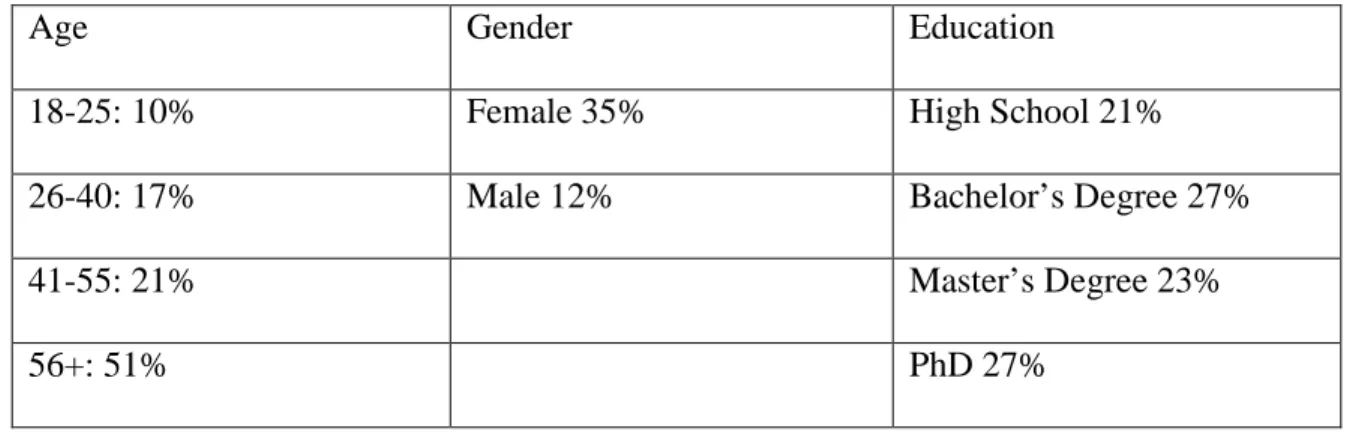
The average patron—at least on a Tuesday afternoon—is a retirement age woman,
and there is a high chance that she has a college degree.
Table 1: Demographic Information
Age Gender Education
18-25: 10% Female 35% High School 21%
26-40: 17% Male 12% Bachelor’s Degree 27%
41-55: 21% Master’s Degree 23%
56+: 51% PhD 27%
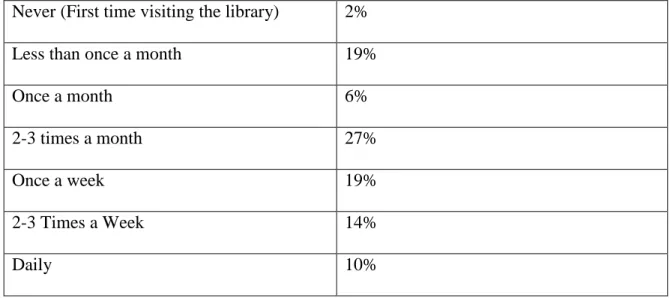
Next, patrons were asked to specify, on average, how often they visited the library while
it was in University Mall. Nearly half the respondents visited the library at least once a
week. Interestingly, all respondents who had not visited the library before it moved
visited at least once a month in the Mall location, with two respondents who had never
Table 2: How often patrons visited the library at University Mall
Never (First time visiting the library) 2%
Less than once a month 19%
Once a month 6%
2-3 times a month 27%
Once a week 19%
2-3 Times a Week 14%
Daily 10%
There were two questions regarding transportation to the library. The University Mall
location has more bus service, and it was expected that more patrons would take the bus
to the library. However, the great majority of patrons still drove to the library. It is
possible that distributing the survey at a different time would yield different results for
this response, depending on the bus schedules.
Table 3: How did you get to the library today?
Walked 2%
Biked none
Drove 91%
Table 4: Would you use a bus stop at the new library?
Yes 12%
No 33%
The responses to whether or not patrons would use a bus stop seem insignificant.
However, a correlation test showed that if a patron visited the library frequently, they
were more likely to answer “yes” to using a bus stop. It may be something important to
regular users of the library, although it is difficult to say with a limited survey.
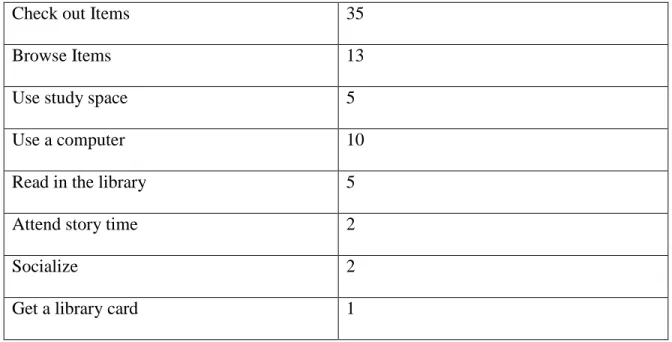
Table 5: What did patrons do in the library?
Check out Items 35
Browse Items 13
Use study space 5
Use a computer 10
Read in the library 5
Attend story time 2
Socialize 2
Get a library card 1
The survey also asked why the patron had visited the library that day. Patrons were
allowed to select more than one response if they were using the library for multiple
reasons. Not all patrons provided more than one answer, so raw numbers rather than
one activity. More than half the respondents checked out items while in the library, while
less people used a study space or socialized. Although the role of the library is changing
and becoming more social, it appears that the majority of patrons in Chapel Hill still use
the library to obtain books, DVDs, and other materials.
The last question on the survey asked patrons to list one or two things they would
like to see in the new library when it opens. The responses fell into five general
categories: materials, social, space, technology, and programming. With seven responses,
the largest number of patrons wanted a change related to space, including more tables and
chairs, a play area for children, and simply “more room.” Five patrons asked for more
materials, such as adding to the audiobook collection. The library’s collection and the
library building itself are both important to the patron community, and the new building
should be able to answer many of those needs. Programming was less important, but a
few patrons did request language classes, programs for homeschoolers, and more classes
for e-readers. The new programming rooms in the library will allow for the space to hold
more events and classes. The spacious setting of the new library will provide a
framework for new and improved interactions, and librarians can take the next steps to
serve patron needs.
Staff Experiences
I interviewed five staff members in total—two circulation assistants, two youth
services librarians, and one reference librarian.
The circulation assistants split their shifts between the workroom and the
items in, manage renewals, and sort carts to be shelved. At the desk, they deal with
patrons, which includes checking materials out, dealing with disputes such as fines and
lost items, and answering basic questions (more advanced questions are sent to the
reference desk). It is a busy environment and circulation assistants get to experience both
the “behind the scenes” and customer service aspects of library work. One circulation
assistant I interviewed did not have an MLS, and the other is currently attending library
school part time. However, both are circulation “experts” and have been working at the
library for several years. One has seen the library move once already, from Franklin
Street to Library Drive.
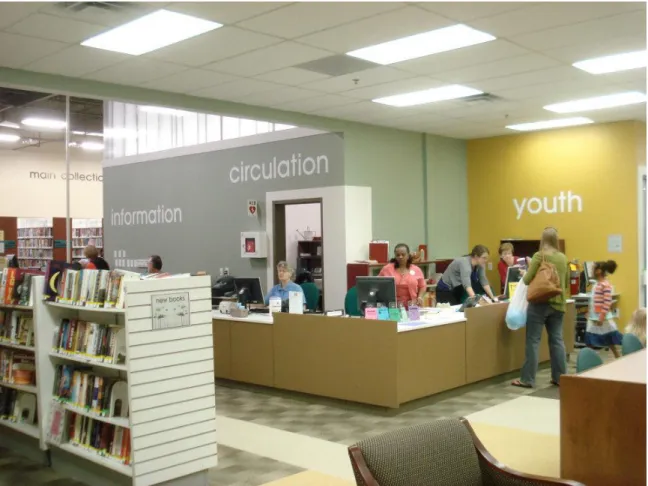
Both circulation assistants agreed that working at a central desk was the most
significant change in their workflow at the University Mall location. Due to space
restrictions, circulation, reference, and youth services staff all sit at one large desk near
the entrance of the library. (For an image of the desk, see Appendix C). One circulation
assistant noted that there had been a “blurring of boundaries” among staff roles—they
have had to answer more reference questions, and deal with more youth patrons. Both
have learned more about the reference and youth services positions, developing on the
job “cross training” skills. They noted that the cross training was personally enjoyable,
but that gaining expertise could also open doors for advancement in the future.
Being in a smaller space offered challenges for the circulation staff as well.
Although the check-in and sorting work was mostly the same at University Mall, having
to do it in a smaller, less organized space made it feel more difficult. The people could
also be less “organized”--for example, there was confusion about which part of the desk
circulation desk was busy. Both circulation assistants agreed that planning the logistics of
the layout when moving is crucial for a smoother transition into a temporary location.
The reference librarian is responsible for answering reference questions, creating
programming, and instructional services. Like the circulation assistants, she enjoyed
working at a single desk and interacting with librarians from other departments. It created
more transparency between departments than had existed at the other location. For
example, all librarians needed to know what events were happening in other departments
because patrons would ask questions about it at any part of the desk.
The reference librarian was surprised at how well the time in University Mall
went, despite the challenges of being in a smaller space. She noted that while there was
some opposition to the move initially, seeing the library in the Mall has led many to
“reimagine library space.” Working in the Mall has also provided the opportunity to try
new approaches to programming, and she plans to continue testing innovative methods in
the new library building.
The youth services librarian, one of whom doubles as an outreach librarian, agree
that being open to trying new things is necessary in a temporary space. Both flexibility
and planning are important in a moving process, and the youth librarians recommend
making do with what you do have in your temporary space, rather than dwelling on what
is lacking.
All staff interviewed noticed a positive reaction from patrons. Patrons enjoyed the
convenience of being close to stores and on a bus line, and the library staff noticed more
patrons coming to the library “on a whim,” rather than a planned visit. The amount of
machines, but certain times were noticeably busier, such as Friday afternoon. The
reference librarian explained that while some regular patrons no longer wanted to visit
the library because it was in the Mall, an equal number began coming to the library more
frequently or for the first time. One circulation assistant reported that despite early
vehement opposition to the Library moving to the Mall, several patrons had changed their
minds by the end of the time in University Mall and did not want the Library to move
back.
Bringing It All Together
Overall, the level of activity, energy, and exposure at the Mall was a positive for
the Library. In the new building, the Library can focus on retaining new patrons, applying
the cross-training that staff picked up at the Mall, and making the best use of space. Even
among the pitfalls of a small, temporary space, patrons remained devoted to the Library,
and in a new, spacious building they will have access to a better range of services.
Moving forward with the lessons from University Mall, the Chapel Hill Public Library
has a bright future ahead at Pritchard Park.
NOTES
i“History of the Library,” Town of Chapel Hill.
http://chapelhillpubliclibrary.org/txp/?s=About+CHPL&c=30.+History+of+CHPL
ii“Library Expansion,” Town of Chapel Hill. http://www.townofchapelhill.org/index.aspx?page=871
iii Sofronijevic, Adam, and Jelena Andovski, “Bringing a Library to Patrons: Libraries at Alternative Spaces,: INFOtheca 12 (2011): 2
iv Dowlin, Kenneth. “The Library as Place: Challenges in the Digital Age.” Libraries as Places: Buildings for the 21st Century: 11
iii. Talve, Annie. “Libraries as Places of Invention.” Library Management 32 (2011): 6 vi Talve, “Libraries as Places of Invention”: 10
ix Montgomery, Susan E., and Johnathan Miller. “The Third Place: The Library as Collaborative and Community Space in a Time of Fiscal Restraint.” Collge and Undergraduate Libraries 18 (20110): 2 x Montgeomery, “The Third Place: The Library as Collaborative and Community Space..:” 5 xi Montgeomery, “The Third Place: The Library as Collaborative and Community Space..:” 6
xii Robinson, Leith. “Library and Cultural Service Convergence: A Case Study of the City of Wanneroo, Western Australia.” APLIS 24 (2011): 160
xiii Begg, Rachel. “Death or Diversification? The Use of Space in Public Library Buildings.” Aslib Proceedings 61 (2009): 2
Bibliography
Atkins, Stephanie S., and Jennifer Hain Teper. “A Survey of Library Practices in Planning and Managing Temporary Moves.” Collection Management 30, no. 4 (2007): 59–84. doi:10.1300/J105v30n04_05.
Begg, Rachel. “Death or Diversification? The Use of Space in Public Library Buildings.” Aslib Proceedings 61, no. 6 (December 2009): 619–635. doi:10.1108/00012530911005553.
Dewe, Michael. Planning Public Library Buildings : Concepts and Issues for the
Librarian. Aldershot, England ;Burlington, VT: Ashgate Pub., 2006.
Dowlin, Kenneth. “The Library as Place: Challenges in the Digital Age.” In Libraries as Places: Buildings for the 21st Century, n.d.
Hackbart-Dean, Pam, Leah Agne, and Julie Mosbo. “History on the Move: Relocating Special Collections and Archives.” Provenance: The Journal of the Society of Georgia Archivists 28 (January 2010): 31–57.
Hapel, Rolf. “The Library as a Place.” Public Library Quarterly 31, no. 1 (2012): 48–55. doi:10.1080/01616846.2012.654737.
History of the Library,” Town of Chapel Hill.
http://chapelhillpubliclibrary.org/txp/?s=About+CHPL&c=30.+History+of+CHP L
Laffoon, Carolyn J., Graham T. Richardson, and Wilton N. Melhorn. “Relocating a Science Library.” Science & Technology Libraries 12, no. 1 (1992): 91–97. doi:10.1300/J122v12n01_09.
“Library Expansion,” Town of Chapel Hill.
http://www.townofchapelhill.org/index.aspx?page=871
Minter, Sydney. “On Your Mark, Get Set, MOVE!” Library Media Connection 25, no. 7 (April 2007): 44–46.
Montgomery, Susan E., and Jonathan Miller. “The Third Place: The Library as
doi:10.1080/10691316.2011.577683.
Pikul, Diane M. “Moving Libraries and Shifting Collections.” Catholic Library World 76, no. 3 (March 2006): 212–215.
Robinson, Leith. “Library and Cultural Service Convergence: A Case Study of the City of Wanneroo, Western Australia.” APLIS 24, no. 4 (December 2011): 160–166.
Sofronijević, Adam, and Jelena Andonovski. “Bringing a Library to Patrons: Libraries at Alternative Spaces.” INFOtheca - Journal of Informatics & Librarianship 12, no. 1 (November 2011): 65–72.
Talvé, Annie. “Libraries as Places of Invention.” Library Management 32, no. 8/9 (October 25, 2011): 493–504. doi:10.1108/01435121111187860.
Tolppanen, Bradley P., and Marlene Slough. “Providing Circulation Services in a Temporary Location.” Journal of Access Services 1, no. 4 (October 2003): 115– 127.
Wills, Heather. “An Innovative Approach to Reaching the Non-learning Public: The New Idea Stores in London.” New Review of Libraries & Lifelong Learning 4, no. 1 (December 2003): 107–120. doi:10.1080/1468994042000240250.
Woodward, Jeannette. Countdown to a New Library : Managing the Building Project. 2nd ed. Chicago: American Library Association, 2010.
Appendix A: Survey
Survey: Library @ UMall
Age 18-25 26-40 41-55
56 and older
Gender Female Male
Transgender/Other
Education High School Bachelor's Degree Master's Degree
PhD
Did you visit the library before it moved to the Mall?
Yes
No
How often have you visited the Library in the Mall? Never
Less than Once a Month Once a Month
Why did you visit the Library today? Check as many as needed. Check out items
Browse items
Ask a question at the information desk Use a computer
Attend story time Read in the library Use study space Socialize
How did you get to the library today? Walk
Car
Bike
Bus
If there was a bus stop at the new library, would you use it?
Yes
No
What is one thing you would like to see at the new library?
Survey Information Sheet
Project Title: Perceptions of the Library at University Mall
Investigator: Kathryn McNamara, Library Science Master’s student at UNC Chapel Hill
Purpose: The survey will investigate patron opinions about the library’s time in University Mall and gather suggestions for the move back to Library Drive. Procedure: You will complete a short paper survey with three demographic
questions and several questions about the Library. No identifying information will be attached to the survey. Your participation is voluntary and you may choose not to fill out any question. You must be 18 years of age or older to complete a survey.
By filling out the survey, I indicate that I understand the information here and agree to participate in the study.
Appendix B: Staff Interview
1. Please describe your role at the library.
2. How has your work changed in the temporary location? 3. Have you noticed a change in patron interactions?
4. What do you wish had been different about the temporary move?
Consent for Participation in Interview Research
I volunteer to participate in a research project conducted by Kathryn McNamara from the University of North Carolina-Chapel Hill. I understand that the project is designed to gather information about my work at the Chapel Hill Public Library. I will be one of approximately 5 people being interviewed for this research.
1. My participation in this project is voluntary. I understand that I will not be paid for my participation. I may withdraw and discontinue participation at any time without penalty.
2. I have the right to decline to answer any question or to end the interview.
3. The interview will last approximately 20 minutes. Notes will be written during the interview. The notes will not be attached to any identifying information.
4. I understand that the researcher will not identify me by name in any reports using information obtained from this interview and that my confidentiality as a participant in this study will remain secure. Subsequent use of records and data will be subject to standard data use policies which protect the anonymity of individuals and institutions.
5. Supervisors from the library will neither be present at the interview nor have access to notes. This precaution will prevent my individual comments from having any negative repercussion.
6. I understand that this research study has been reviewed and approved by the Institutional Review Board (IRB) at the University of North Carolina-Chapel Hill.
For research problems or questions regarding subjects, the Institutional Review Board may be contacted through [email protected], or by phone, 919-966-3113. Please reference study #13-1029.
7. I have read and understand the explanation provided to me. I have had all my questions answered to my satisfaction, and I voluntarily agree to participate in this study.
____________________________ ________________________
My Signature Date
____________________________ ________________________
My Printed Name Signature of the Investigator
For further information, please contact:
Kathryn McNamara
Appendix C: Images of the Library
Figure 1: Desk at Library in University Mall (Facebook)
Figure 3: Interior of library before renovation (GGA Architects)