ABSTRACT
BRIAN CLARK HAWS. An Assessment of Trihalomethane Levels in North Carolina Drinking Water (Under the direction of Dr. Philip C. Singer)
viii
KEY WORDS
DRINKING WATER
TRIHALOMETHANE CHLOROFORM
CHLORINATION
DISINFECTION BY-PRODUCTS HUMICS
IX
ACKNOWLEDGEMENTS
I would like thank Dr. Singer for his time, effort, and patience expended in
serving as my advisor on this project. I am also grateful to Dr. Johnson and Dr. Turner
for their time spent in reviewing this report and for serving as members of my
committee.The collection of data for this report would not have been possible without the
cooperation of the staff at the Public Water Supply Branch of the North Carolina
Department of Human Resources, Division of Health Services, Environmental Health
Section in Raleigh. In particular, I would like to express my appreciation to Mr. Dick
Caspar and Ms. Grace Gunter for their willingness to assist me in locating the
information I needed.
Finally, I would like to thank my family and friends for their constant
encouragement through all the ups and downs of this report and graduate school. I am
especially grateful to Laurie Couture as she was a tremendous help at the end of the
Chapter 1
INTRODUCTION
In the early 1970's, new developments in analytical technology led to the
detection of several trace organic chemicals in drinking water. In response to concerns
about their effects on human health, the United States Environmental Protection Agency,
acting under the authority of the Safe Drinking Water Act (SDWA) of 1976, set national
standards for several organic chemicals. The regulation of additional trace organics is
anticipated in the near future. The SDWA Amendments of 1986 call for the promulgation,
of new standards for 83 contaminants by June of 1989, with 25 more standards to be=
added over the following three years.One class of trace organic chemicals currently regulated under the SDWA is the
trihalomethanes (THMs). Because the formation of THMs in the water treatment process
is largely due to the addition of chlorine, the THMs are referred to as disinfection by¬
products. Chlorine addition has been a standard practice in water treatment in the
United States for many years because of its strong oxidation and disinfection abilities and
its relatively low cost. Because the use of chlorine is so common in water treatment, the
presence of THMs in drinking water is widespead. The extent of THM formation varies
significantly among water systems, depending primarily on chlorine dose and organic
content of the raw water.
The regulation of THMs in drinking water began with an amendment to the
National Interim Primary Drinking Water Standards on November 29, 1979. This was
chloroform, the predominant THM species in drinking water. The maximum contaminant
level (MCL) for THMs in drinking water was set at 0.10 mg/l. A minimum of four
samples must be taken each quarter from the distribution system and analyzed for THMs.
The running annual average, computed from the four most recent consecutive quarters of
data, must not exceed the MCL.
The current THM regulation applies to all water systems serving at least 10,000
persons. In North Carolina, 66 water systems are subject to the regulation, reporting
their THM levels on a quarterly basis to the Public Water Supply Branch of the North
Carolina Department of Human Resources, Division of Health Services, Environmental
Health Section in Raleigh . Once received by the Public Water Supply Branch, the THM
measurements are entered into a computer database before the report sheet is filed with
other correspondence from the water system.
The purpose of this investigation was to provide an overall assessment of THM
concentrations in the drinking water systems of North Carolina. While other
investigations of this kind are based on data from only a portion of North Carolina water
systems, this investigation involved the collection of all existing data from systems in
North Carolina serving at least 10,000 persons. The data was acquired from the
database and document files maintained by the Public Water Supply Branch. A value
representative of the current THM concentration was computed for each system. The
data were evaluated to identify variations in the THM concentrations due to season,
geographic location, and raw water source. In anticipation of a lower MCL for THMs of
50 or 25 p.g/1 in the near future, the impact of such a revision in the standard on
drinking water systems in North Carolina, based on current THM concentrations of these
concentrations in North Carolina water supplies in response to a more stringent MCL are
Chapter 2
REVIEW OF CURRENT LITERATURE
Definition of Trihalomethanes
H
---C---H
H-f
H X
IVIethane Trihalomethane :
X = CI, Br, or I
Figure 2.1
Molecular Structure of Trihalomethanes
Trihalomethanes (THMs) are a group of organic compounds, which are
derivatives of methane (CH4). While methane molecules are composed of a single carbon
surrounded by four hydrogens, THM molecules contain a single carbon, only one
hydrogen, and three halogens. These three halogens may consist of one or any
combination of the following types: chlorine, bromine, or iodine. During the treatment
of water for drinking purposes, THMs are produced by a reaction between free chlorine
and natural organic material in the water. The sum of the concentrations of all the
species of THMs that are measured in the water is commonly referred to as the total THM
bromodlchloromethane (CHBrCl2) are the species of THMs that occur most frequently in
drinking water. Two other species that frequently occur are dibromochloromethane
(CHBr2CI) and tribromomethane, commonly referred to as bromoform (CHBra). These
species usually amount to only a small fraction of the TTHM concentration, except for
cases in which the raw water contains a relatively high concentration of bromide. The
remaining six species, which contain iodine, are of little significance in water treatment
ͣ
since they occur infrequently and at low concentration.
Fornnatlon of THMs
In recent years, a considerable amount of research effort has been devoted to
learning more about the formation of THMs during water treatment. As a result, a much _,
better understanding has been gained about the mechanism of THM formation and
the-extent to which various factors affect the process. Another topic of recent research has
been the development of models for predicting the amount of THMs that will form in a
particular water source.Mechanism of THM Formation
products (Hoehn, et al., 1978; Morris and Baum, 1978; Briley and Williams, 1984). In water treatment, chlorine is usually applied in the form of a gas (CI2). In
most waters, the chlorine gas converts quickly to hypochlorous acid (HOCI). Rapid
formation of chloroform occurs when the hypochlorous acid attacks the reactive sites onthe natural organic material. Humic substances most often provide these reaction sites.
When the bromide ion (Br-) is present in water, the brominated THM species may be formed. Hypobromous acid (HOBr) is produced by a reaction between aqueous chlorine
(HOCI) and the bromide ion. Once hypobromous acid is formed, it reacts with organic
material in a manner similar to hypochlorous acid to form brominated THMs (Minear,
1980; Minear, 1983; Cooper et al, 1985).Factors Influencing THM Formation
Recent research has shown that THM formation can be significantly influenced by several factors. The amount and type of precursor material present in the raw water, the amount of chlorine applied, and the length of time for contact between precursors and chlorine have the greatest effect on the amount of THMs formed. Other factors which may significantly influence THM formation are pH, temperature, and bromide
concentration.
the findings of these and other similar studies, organic content, as reflected by the TOC
(total organic cartx>n) concentration, has been established as a good indicator of the
potential for THM formation.
The results of recent studies by Engerholm and Amy (1983) and Singer (1985)
indicate that the amount of chlorine applied has a significant influence on the amount of
THMs formed. The conclusion of earlier research was that the THM production increased
with increasing chlorine dose until the demand for it was met, with further addition of
chlorine having a minimal effect on THM production. Engerholm and Amy and Singer
concluded from their research that a strong relationship exists between the
chlorine/carbon ratio of the water and the amount of THMs formed.
Since even the most advanced treatment schemes are not capable of complete
removal of THM precursors, the formation of THMs will occur for the entire length of
time that free chlorine is present in the water. The THM levels at different points in the
treatment process and distribution system have been measured during the course of
several studies (Arguello et al., 1979; Glaze and Rawley, 1979, Young and Singer,
1979). This type of data clearly illustrates the upward progression in THM
concentration that occurs with chlorine contact time (Kissinger and Fritz, 1976). THM
formation begins with the first addition of free chlorine to the water and continues until
the supply is depleted.
THM formation occurs more rapidly as temperature is increased, causing more
THMs to form at higher temperature than at lower temperature. This effect was
demonstrated in a laboratory study in which Ohio River water was chlorinated at several
different temperatures (Stevens et al., 1976). Faster reaction kinetics at higher
demand of the water. Several studies have observed seasonal variations in THM levels,
with the highest levels typically occurring during the summer months, and the lowest
levels occurring in the winter months (Arguello et al., 1979; Veenstra and Schnoor,
1980; Schreiber, 1981; Singer et al., 1981). Singer et al. (1981) concluded that the
principal factors contributing to these seasonal variations were temperature and the
natural organic content of the raw water.
The pH of the water can also have an impact on the concentration of THMs
formed. The THM formation process is known to occur in a series of defined steps. The
rate at which the process proceeds is regulated by those steps which advance more
slowly than the others. Since these "slower" steps are catalyzed by the hydroxide ion
(0H-), raising the pH will cause THMs to form more rapidly. This was found to be true
in laboratory studies by Stevens et al. (1976) and other researchers. This effect of a
high finished water pH has resulted in elevated THM levels in treatment plants (Glaze
and Rawley, 1979; Singer, 1988).
The concentration of bromide in the raw water has been shown to influence the
distribution of the various species of THMs as well as the total yield of THMs.
Hypobromous acid is produced by a reaction between aqueous chlorine and bromide.
Organic matter may react exclusively with hypobromous acid to produce bromoform.
More often, though, it reacts with both hypobromous acid and hypochlorous acid to form
the mixed species such as bromodichloromethane and dibromochloromethane. The
findings of several studies have indicated that the total yield of THMs increases with
increasing concentration of bromide in the water (Bunn et al., 1975; Trussel and
Umphres, 1978; Minear, 1980). Lange and Kawczynski (1978) observed that the
bromide concentration of the water. This suggests that bromide may compete more
effectively for reactive sites on the organics than chlorine and that bromine substitution
is a faster reaction than chlorine substitution.Estimating the Extent of THM Formation
One method of estimating the total concentration of THMs which may be formed
after chlorination of a water sample is to determine the THM formation potential
(THMFP). THMFP is defined as the difference between two THM measurements,
Instantaneous THMs and Terminal THMs, which are performed on samples taken from the
same source. Instantaneous THMs (Inst THMs) refer to the concentration of THMs which
already exist in the water at the time of sampling. Terminal THMs'(Term THMs) refer
to the concentration of THMs formed after chlorination of the water sample under
specific conditions. When measuring Term THMs, the chlorine dose, contact time, pH,
temperature, and other conditions are chosen to simulate typical conditions in the actual
treatment process.Since the determination of THMFP involves sophisticated laboratory techniques
as well as a considerable amount of time, researchers have been trying to develop
accurate models to estimate final TTHM levels from simple water quality measurements.
A model developed by Amy and co workers (1987, 1983) predicts TTHM levels from the
parameter TOC»UVABS. TOC is the total organic carbon concentration, while UVABS is
the ultraviolet absorbance measurement. They concluded that this was the best
parameter for estimating TTHMs since TOC is an indicator of precursor content, while
10
considerable accuracy when another source of water is used. This is because the models
rely on overall measurements of organic content such as TOC, which measures all
organic constituents, not all of which are THM precursors. Although TOC is a good
indicator of precursor content, it has not been successfully used to quantitatively predict
TTHMs in samples from a wide range of sources.
Regulation of THM Levels in Drinking Water
The health effects associated with chloroform have been studied much more than
any of the other species of THMs. Because of their similarity in structure, the other
species of THMs are expected to produce health effects similar to chloroform.
Chloroform has been found to be carcinogenic in both rats and mice. Since metabolic
patterns in humans resemble those found in mice, it is probable that chloroform Is also
a human carcinogen (Searle, 1976). According to the most recent studies, the predicted
incremental risk of developing cancer is approximately one in 10,000 for a person
consuming one liter of water each day which contains 0.10 mg/l of chloroform for a
lifetime (National Research Council, 1987). The standard limiting TTHM levels in
drinking water is based on findings of this type.
The development of new analytical technologies in the early 1970's resulted in
the discovery of numerous organic chemicals in drinking water. This discovery caused
national concern over drinking water quality, since many of these organic chemicals
were suspected or known to be carcinogenic. A considerable lack of compliance and
enforcement of the standards recommended by the United States Public Health Service
(USPHS) was brought to the attention of the nation as drinking water quality
investigations began. In an effort to protect the nation's health by insuring the quality of
11
gave the Federal government the authority to establish standards of quality for drinking
water. Previously, this had been the responsibility of the state and local governments.
Soon afterward, the National Interim Primary Drinking Water Regulations (NIPDWR)
were published in the Federal Register. In June of 1977, these regulations went into
effect. On November 29,1979, an amendment was added to the NIPDWR which regulated
THMs in drinking water.
The maximum contaminant level (MCL) for TTHMs was set at 0.10 mg/l by the
1979 amendment to the NIPDWR. The requirements for THM monitoring and for
compliance with the MCL became effective one to four years later, depending on the
number of persons served by the particular system. For utilities serving less than
10,000 persons, the effective dates were left to the discretion of the state or primacy
agency. The regulation requires that each treatment plant take a minimum of four
samples each quarter. All four samples must be taken on the same day, with one-fourth
taken at the extremity of the distribution system and the other three-fourths taken at
points representative of the population distribution. Analysis of the samples must be
done at a certified laboratory, which uses one of the approved methods for the
measurement of THMs. The average TTHM level must be reported to the state or primacy
agency within 30 days. The running annual average is calculated by taking the average of
the quarterly averages of the four most recent quarters. If this running annual average
exceeds the MCL (0.10 mg/l), the plant is out of compliance and is required to notify its
customers of the situation and take corrective action.
Some systems may exhibit THM measurements which are consistently well
12
monitoring requirements. A system qualifies for reduced monitoring if the maximum
total THM potential (MTP) is less than 0.10 mg/l. The MTP is determined by a specific
procedure defined by the EPA, which is similar to the procedure for determining
Terminal THMs. If the criterion is met, the system is required to sample for the MTP a
minimum of once per year at the extremity of the distribution system. If a system is
unable to satisfy the MTP criterion, it may still qualify for reduced sampling if it
demonstrates that TTHM levels are consistently below 0.10 mg/l for a period of one
year. Systems satisfying this criterion are required to sample a minimum of one time
per quarter, with the sample being taken at the extremity of the distribution system.
Thereafter, if a TTHM measurement exceeds the 0.10 mg/l level or if the water source
is modified, the system must return to the regular monitoring scheme.
Due to the fact that the regulation of THMs is relatively new in the U.S., it is
difficult to provide a detailed assessment of its impact on the water treatment industry.
A recent survey conducted by McGuire and Meadow (1988) focused on THMs in the-U.S.
Input for the survey came from a variety of systems throughout the nation, representing
a wide range of capacities, source water types, and treatment process schemes. Although
the survey was not comprehensive, the trends it identified are likely to be accurate. In
general, smaller systems were found to have higher THM levels than larger systems,
with the highest THM levels occurring in systems serving 10,000 to 25,000
customers. The authors suggested that an explanation of this trend might be that smaller
systems typically do not have the personnel and resources to devote to controlling THM
levels that larger systems do. Since groundwater sources are usually low in precursor
content (Symons et al. 1975), it came as no surprise that systems using groundwater as
13
percentage (4.6%) of the systems surveyed reported that they had been out of compliance with the regulation at least once between 1984 and 1986. This is an indication that the current regulation poses few major problems overall. The impact of the regulation on THM levels was shown to be significant, as the survey reported an average reduction in THMs of 40 to 50 percent. Of the systems which had to alter their treatment process to achieve compliance, most of them modified their clarification and disinfection practices. A switch to the use of chloramines was common among those systems which modified their disinfection practices. An interesting finding was that many systems that altered their disinfection practices reported a savings in operation and maintenance costs, l-lowever, the modifications did not take place without problems. Those most commonly reported were taste and odor control, microbiological quality,
corrosion, biofilm control, and color.
The MCL for THMs will almost certainly be lowered in the coming years. It is not yet known, however, what the new standard will be. The authors of one recent article on
the SDWA amendments mentioned that the standard may be lowered to 50 ^.g/l or less in the future (Dyksen et al., 1988). Lowering the standard to that level would bring it
closer to the World Health Organization's recommended MCL of 30 ng/l for chloroform (Sayre, 1988). Under the SDWA Amendments of 1986, new standards for 83
contaminants are due to be promulgated by June of 1989, with 25 more standards added
14
research, recommendations will be made on the best available technology (BAT) for use in complying with each new standard. This type of research is currently in progress with regard to the THM regulation. The final regulations for disinfection by-products are scheduled to be complete by January of 1991, and to become effective in June of
1992 (Dyksen et al., 1988).
Seventy five percent of those water treatment plant representatives that
responded to the recent THM survey by McGuire and Meadow (1988) indicated that they
are opposed to a lower standard for THMs. Many commented that the reduced health risk associated with a lower standard would not justify the complications, expenses, and effort involved. Also, they expressed concern that efforts to comply with a lower standard might interfere with disinfection effectiveness and microbiological quality, which they felt to be the highest priority in water treatment. Finally, the validity of the data used to justify such a revision was questioned. After performing a series of case studies. Singer (1988) concluded that most systems would be unable to maintain a high degree of finished water quality while complying with a 20-50 \ig/\ MCL for THMs using alternative oxidants along with conventional treatment techniques.Techniques for Controiiina THM Levels
Several techniques are currently used to control THM levels in finished drinking water. Most of the techniques reduce or prevent the formation of THMs, while some
remove THMs once they are formed. Prevention of THM formation may be accomplished
by removing the precursors before they have the opportunity to react with free chlorine to form THMs. Coagulation, flocculation, sedimentation, and filtration are used for15
1984; Knocke et al., 1986; Hubel and Edzwald, 1987). Additional precursor removal can be accomplished using granular activated carbon (l\/lcCreary and Snoeyink, 1977;
McCarty et al., 1979; Meijers et al., 1979; Blanck, 1979; Jodellah and Weber, 1985;
Semmens and Staples, 1986). However, because of concerns about its effectiveness and
cost, the use of granular activated carbon for this purpose is currently not widespread. THM formation may also be controlled by minimizing the contact time between free chlorine and precursors. Moving the point of chlorination from near the head of the plant to a location downstream (such as the filter inlet) has been widely used to reduce chlorine contact time. This modification also allows for additional THM precursors to beremoved prior to initial chlorine contact, resulting in reduced THM levels In the
finished water.
One of the most promising technologies for minimizing chlorine contact time is the use of alternative oxidants, such as chlorine dioxide, ozone, chloramines, and potassium permanganate instead of chlorine. A substantial portion of research is being
devoted to the use of alternative oxidants for oxidation and disinfection, which reduces or
16
Techniques for Removing Precursors
The combination of coagulation, flocculation, sedimentation, and filtration is
capable of removing THM precursors to a degree of 50 percent or more (Singer et al.,
1981; Hoehn et al., 1984; Knocke et al., 1986; Hubel and Edzwald, 1987). The organic compounds that are removed most effectively by this series of processes are those of intermediate and high molecular weight (Hoehn et al., 1984; Semmens and Staples, 1986). According to Randke (1988), the portion of organic matter removed by this process is particularly significant Ijecause it is especially high in THMFP. Two controllable variables impacting the removal efficiency are the type of coagulant and pH. Alum is believed to be the best coagulant for the removal of precursors (Hubel and Edzwald, 1987). Hubel and Edzwald also found that the use of coagulant aids does not significantly improve the efficiency of alum for removing THM precursors. The use of a coagulant such as alum is also advantageous because the subsequent chlorine dosage required to maintain a residual is reduced. The pH range for optimal TOC and THM precursor removal by coagulation, flocculation, and sedimentation is 5.5 to 6.0(Babcock and Singer, 1979; Singer, 1983; Edzwald et al., 1983; Oempsey et al.,
1984).17
providing approximately 50 percent removal of precursors, pretreatment also removes particles that would cause rapid clogging of the bed. This results in a longer bed life, which is the length of time over which a bed provides effective removal before it must be replaced with fresh GAC. With many of the higher molecular weight materials removed, the GAC column can then adsorb the materials that are lower in molecular weight and more difficult to coagulate (Semmens and Staples, 1986; Randke, 1988).
Most of the concern about the use of GAC centers on the expense involved in
operating and maintaining the process. The effectiveness and economic feasibility of GAC for the removal of THM precursors are strongly influenced by the empty bed contact time (EBCT). The EBCT is defined as the volume of the empty carbon bed divided by the flowrate through the bed. GAC beds operating at longer EBCTs have demonstrated the highest percentage removals of THM precursors for longer periods of time (Symons et al., 1983). Long bed lives are desirable from an economic standpoint because regeneration of the GAC is an expensive process. However, the EBCT is also limited by economics because EBCT determines the volume of GAC used if the flowrate is constant through the bed. Because the effectiveness of GAC for removing THM precursors also varies according to the composition of the source water, the economic feasibility of the
18
Techniques for Llmmna Chlorine Contact Time
Moving the Point of Chlorination
Probably the most widely used method of reducing THM levels in drinking water
is moving the point of chlorination. This method is simple and it provides almost
Immediate results. Before the discovery and subsequent concern about THMs, pre¬ chlorination, the practice of adding chlorine to the raw water, was used by most treatment plants. Now, most plants that had elevated THM levels have discontinued thepractice of pre-chlorination because it allows THM formation to begin at the earliest
stage of treatment, maximizing contact time of free chlorine with precursors. In order to reduce the amount of contact time and postpone the onset of THM formation, the point of chlorination is often moved to a stage beyond coagulation, flocculation,. and sedimentation. This allows for a significant removal in the amount of precursor material before chlorine is added and THM formation begins.19
Application of Chlorine Dioxide
Chlorine dioxide is a strong oxidant and disinfectant that can be used effectively to control iron and manganese, THM precursors, microorganisms, algal growth, and
organics responsible for undesirable tastes and odors. Its advantage over chlorine is that it forms no THMs (Werdehoff and Singer, 1987). Chlorine dioxide has been successfully applied as a pre-oxidant and disinfectant, eliminating many of the problems that result from moving the point of chlorination to a downstream location. Since no
THMs result from the application of chlorine dioxide, THM formation does not begin until the point at which free chlorine is applied.
The oxidation of THM precursors by chlorine dioxide is believed to provide additional THM control beyond that accomplished by simply moving the point of chlorine
addition. This makes it possible for reductions in THM levels of 50 percent or more to be achieved through the use of chlorine dioxide as a pre-oxidant (Lykins and Griese,
1986; Singer, 1988). Using chlorine dioxide as the sole oxidant and disinfectant
eliminates the use of chlorine entirely, resulting in TTHM levels of essentially zero (Lykins and Griese, 1986; Singer, 1988). Unfortunately, losses in microbiological quality, as indicated by elevated standard plate counts and increased incidence of coiiform
bacteria, have occurred at some systems where this strategy has been applied (Singer,
1988).
20
Because of the potential hazard posed by the inorganic by-products of chlorine
dioxide, there is a practical limit to the amount which may be applied. The products of
chlorine dioxide are chlorite (CIO2-), and chlorate (CIO3-). They are of concern
because Couri et al. (1982) found that the presence of chlorine dioxide, chlorite, and
chlorate residuals in drinking water caused hemolytic anemia in rats and mice, with
chlorate showing the greatest effect. In response, the EPA recommended that the sum of
chlorine dioxide, chlorate, and chlorite residuals in drinking water should not exceed
1.0 mg/l (EPA, 1983). To meet this recommendation, Werdehoff and Singer (1987)
suggested that chlorine dioxide dosage should be less than 2.0 mg/l and probably less
than 1,5 mg/l.
Application of Ozone
Although ozone has disinfection capabilities, it is more useful as an oxidant. Like
other oxidants, ozone may be used for the control of iron, manganese, and color. In
addition, ozone can oxidize THM precursors and is particularly effective in controlling
tastes and odors. Applied in place of chlorine as a pre-oxidant, ozone serves these
purposes and decreases the demand for chlorine. Ozone is an extremely strong viricidal
agent, but its usefulness as a disinfectant is limited because it does not provide a long
lasting residual (Rice et al., 1981; Vogt and Regli, 1981). This may result in problems
with algal growths in treatment basins. Due to the lack of a residual from
pre-ozonation, it is often applied at a second location where oxidative conditions are required,
such as the filter inlet. This practice is called two-stage ozonation. Chang and Singer
(1988) reported that pre-ozonation can improve removal of TOO, but that its effect is
negligible at the dosages applied in practice, which are typically 3.0 mg/l or less. Chang
21
ozone to TOO ratio was in the range of 0.25 to 1.2 mg/mg.
Ozone can improve coagulation and flocculation when applied under the correct
conditions. Oxidation by ozone destabilizes particles in solution, promoting their
aggregation. This results in the formation of larger particles, a phenomenon called
microflocculation. Since larger particles are more readily removed by filtration, the
quality of filtered water is improved and the filter run length is increased. One
parameter which influences the effectiveness of ozone-inducing microflocculation is the
dose applied. Chang and Singer (1988) found that in order for ozone to enhance particle
destabilization, a minimum hardness to TOO ratio must be present. Also, the region of
optimum dosage is significantly influenced by hardness and TOG. Ozone must be carefully
applied because overdosing can cause particles to restabilize. Other parameters which
may affect the process are pH and alkalinity.
Replacing chlorine with ozone as a pre-oxidant, as in the case of chlorine dioxide,
prevents the production of chloroform until chlorine is applied at a later stage in the
process. The benefit in postponing the start of THM formation has been discussed in a
previous section on moving the point of chiorination. However, formation of the
brominated THM species can occur when ozone is applied. Ozone reacts with bromide to
form hypobromous acid, which then can react with organic matter to produce the
brominated species of THMs. Still, however, TTHM levels in the distribution system can
be reduced significantly through pre-ozonation.
Application of ChloramlnesChloramines are a disinfectant that does not promote the formation of THMs
22
1983; Symons et al., 1983). In a few systems, the use of chlorine as a disinfectant can
be eliminated entirely, with chloramines providing adequate primary disinfection while
preventing the formation of THMs in the distribution system. However, only a few
systems will have contact times long enough to achieve primary disinfection with
chloramines. Chloramines can also be used in combination with free chlorine and other
pre-treatment oxidants and disinfectants; the latter provide oxidation and disinfection
during the treatment process, with chloramines providing disinfection in the
distribution system. Chloramines are also referred to as combined chlorine, since they
are produced from free chlorine and ammonia. In water treatment applications,
chloramines most commonly exist as monochloramine {NH2CI), and once formed, they
are relatively stable.
There are some concerns about the use of chloramines in place of free chlorine. A
common occurrence in plants switching to chloramines has been a measurable increase
in finished water color (Singer, 1986; Thompson and Ameno, 1987). The best approach
for achieving acceptable levels of color while minimizing THM production Is to maximize
the removal of the humic material which is responsible for the color prior to the
addition of free chlorine. Coagulation with ferric chloride is one strategy that has been
used successfully to remove color in a plant that applied chloramines (Thompson and
Ameno, 1987). A second strategy involves the oxidation of the color causing material by
strong oxidants such as ozone and chlorine dioxide.
The degree of disinfection is determined by the power and concentration of the
disinfectant used, and the contact time. This is often specified by the CT value, which is
the concentration of the disinfectant multiplied by the contact time. Because
23
concern when they are used in place of chlorine. This may be compensated for by
applying a higher residual of chloramines and by providing contact time with a stronger
disinfectant, such as ozone or free chlorine, prior to the addition of chloramines. The
presence of ammonia also introduces the potential for biological nitrification to occur.
This is a concern because the nitrite produced by the process could react with amines to
form nitrosamines, which are known to be a potent class of carcinogens.
Application of Potassium Permanganate
Potassium permanganate is very effective as a pre-oxidant. When the point of
chlorine addition is moved to reduce THM production, permanganate can be used to
provide oxidative pre-treatment. It may be applied to control iron and manganese, as
well as tastes and odors. The ability of permanganate to control THMs.is limited
(Colthurst and Singer, 1982; Kreft et al., 1985). It has no significant impact on
coagulation, flocculation, and sedimentation of THft^ precursors and it reduces THM
formation only to a small degree. Since its strength of oxidation is limited,
permanganate is not able to satisfy high oxidant demands. In these cases, permanganate
is useful because it can satisfy some of the demand, which decreases the amount of
chlorine required. A decrease in the amount of chlorine applied can translate to lower
THM production. A good disinfectant must be used when applying permanganate, since it
is not an effective disinfectant. Because of its limited abilities, permanganate's
principal use is in suppport of other, more effective methods of THM control (Colthurst
Zk
Technique of Removing THMa
THMs that already exist in the water may be removed by air stripping. Removal
rates as high as 95 percent are attainable (Bilello and Singley, 1986). Although this
technique is capable of removing a substantial portion of the THMs present, it does not
remove precursors. This is particularly significant for high TOC waters which are
likely to contain high levels of precursors after filtration. After air stripping, these
precursors can combine with subsequent chlorine to form additional THMs in the
distribution system. Reformation of THMs can, of course, be minimized through a high
degree of precursor removal by prior processes or by the subsequent use of combined
chlorine. In the future, air stripping may be less practical, since a large portion
(70%) of the halogenated disinfection by-products (soon to be regulated) are non¬
volatile.Incidence of THMs In North Carolina and the Southeast
The water systems of North Carolina and the southeastern United States are
particularly susceptible to elevated THM levels because of raw water quality and
chlorination practices. The National Organics Reconnaissance Survey (1975) found that
southeastern water supplies are relatively high in humic content and TOC. To satisfy the
high oxidant demands of the raw water, many systems in the southeastern United States
practiced prechlorination. High THM precursor content, coupled with the application of
high chlorine dosages beginning early in the treatment process creates a condition which
is highly favorable for THM formation. This has resulted in average THM levels in North
Carolina (Singer et al., 1981) and the southeastern United States that are substantially
25
A lower maximum contaminant level (MCL) for THMs will have a significant
impact on the water systems of North Carolina and the southeast. Since the promulgation
of the initial standard for THMs, several water systems in North Carolina have modified
their treatment process to reduce their THM levels. Many systems have achieved
significant reductions in THM levels by reducing chlorine dosage or by discontinuing
prechlorination. In the event of a lower THM standard, additional systems will require
modification to achieve compliance. Those systems which have already reduced their
chlorine dosage or moved their point of chlorine addition will be forced to employ other
Chapter 3
METHODS
CoHectlon of Data
The primary objective of the data collection was to obtain complete and current
records of THM measurements for every water system serving at least 10,000 persons
in the State of North Carolina. This information was available from the primacy agency,
which is the Public Water Supply Branch of the North Carolina Department of Human
Resources, Division of Health Services, Environmental Health Section in Raleigh.
In North Carolina, THM measurements are performed by state-certified
laboratories. Each quarter, the utilities collect their own samples from the distribution
system, send them to a state-certified laboratory for analysis, and then send their
report of measured THMs to the Public Water Supply Branch in Raleigh. The Public
Water Supply Branch maintains records of most water quality measurements on a
computer database for easy access. Once the information is recorded in the appropriate
THM file of the database, the lab report sheet is stored in a folder with other records and
correspondence for that system. Although some of the data collected for this study were
obtained from the individual lab report sheets, most came from computer printouts of
water system files accessed from the database.
The records collected for this study include all THM reports stored in the
database- before June, 1988. At that time, there were 66 water systems in North
27
of these systems. THM records are not kept for the systems at Gamer and Union County because their water is purchased from larger systems. Records for the Brookwood and Pamlico County systems could not be found in the database. Although the system at Dunn serves less than 10,000 persons, its record was collected for the purpose of evaluating
the use of chlorine dioxide for reducing THM levels.
Additional information for each system was obtained from monthly operating reports and water supply data sheets for the individual utilities, which were also available from the Public Water Supply Branch in Raleigh. Yearly folders of monthly operating reports are maintained for each system. The examination of these records
focused primarily on the type and amount of chemicals added and the volume of water treated. The water supply data sheets provided a general description of each system; they are updated yearly. Information of particular interest on these sheets was the type and location of the raw water source and the types of treatment processes employed. However, the information regarding the treatment processes was often found to be vague and out-of-date. As a result, specific information about each system was acquired from the Regional Director of the Public Water Supply Branch for the district in which the utility was located, or directly from the plant superintendent.
Analysis of Data
Using Microsort Works software, a spreadsheet was created for each water
system to present the complete THM record in an organized fashion. Several computations were performed to reduce the data to a useful form for purposes of making
comparisons.
28
set. The most common types of errors found in the records were groups of duplicate
values. Often, two groups of identical measurements appeared in the record only a few
days apart, indicating that the same measurements had been recorded twice. This was
attributed to an error in reading the date of sampling from the report sheet. This was a
common occurrence in the records, accounting for a majority of the values that were
discarded. Another common error observed was a misplaced decimal point. This error
was often easily detected by observing that one measurement in a group differed from the
others by one or more orders of magnitude.
Before a representative average THM concentration was calculated for each
system, it was necessary to eliminate some questionable measurements from the record.
For example, in some cases, a group of four THM measurements would contain .three
values which were similar in concentration, while the fourth value was close to zero. In
other cases, one measurement was much higher than the other three values. The THM
regulation requires that three samples be taken from representative points in the
distribution system, while the fourth sample is taken at the extremity of the system. All
o7 the water enters the distribution system from the treatment plant at a common point,
with the same THM concentration. THM concentrations vary in the distribution system,
depending on how much chlorine contact time has occurred between the entrance of the
water into the distribution system and the point of sample collection. The three samples
taken at representative points in the distribution system are expected to have similar
THM concentrations because the chlorine contact time is similar. The sample taken at
the extremity of the distribution system will have a higher THM concentration, due to a
longer chlorine contact time. Since there was no practical way to confirm which
29
was adopted to determine which values should be discarded as being non-representative.
The following procedure was established to designate as outliers those
measurements which were deemed not to be representative of the entire group. The data
from each system were grouped by the quarter of the year in which the measurement
appeared in the record. In most cases, this produced a more normal distribution of
values with a smaller variance than would have been possible if the data were analyzed
as a whole. This allowed for extreme values in each quarter to be exposed. The 95
percent confidence interval was calculated for the group of measurements for each
quarter. All measurements which fell outside this interval were designated as outliers
and were discarded. Some system records did not contain enough data to make such an
analysis meaningful. In these cases, no values were discarded.
The following computations were performed on the data set from each system
record.1. Unadjusted Average - average of all measurements taken on a given sampling
date.
2. Adjusted Average - same as Unadjusted Average except that outliers were
excluded from the computation.3. Quarterly Average - average of all the measurements (excluding outliers) taken
during the quarter.
4. Running Annual Average - average of the four most recent quarterly averages.
5. Two-Year Mean - average of the eight most recent quarterly averages.
6. Percentage of Brominated Species - average percentage of brominated species for
30
Because several of the THM records had gaps (quarters for which no data were
recorded), a method of substituting reasonable values for these quarters was necessary
in order to calculate a meaningful Two-Year Mean THM concentration. The value chosen
for substitution was the Quarterly Average from the same quarter of the previous year.
If the Quarterly Average value from the previous year was also missing, the most recent
previous value available for that quarter was used. If no previous value was available, a
subsequent Quarterly Average from the same quarter was used.
The terms "unadjusted" and "adjusted" were used to distinguish between
computations that included outliers and those that did not. With the exception of the
computation of Unadjusted Averages, outliers were excluded from all other calculations.
The purpose of calculating the Two-Year Mean THM concentration was to get an
indication of the utility's current performance with regard to THM production. A period
of two years was chosen as opposed to a one-year period in order to establish confidence
in the value as a true indicator of current system performance. A longer period of time
was not chosen because of a desire for the value to be based on the most current data.
The results of all the computations appear in columns of the spreadsheet. Most of
the computations were performed using spreadsheet functions. These computations were
carried out to two significant figures.
J
Chapter 4
RESULTS AND DISCUSSION
Results
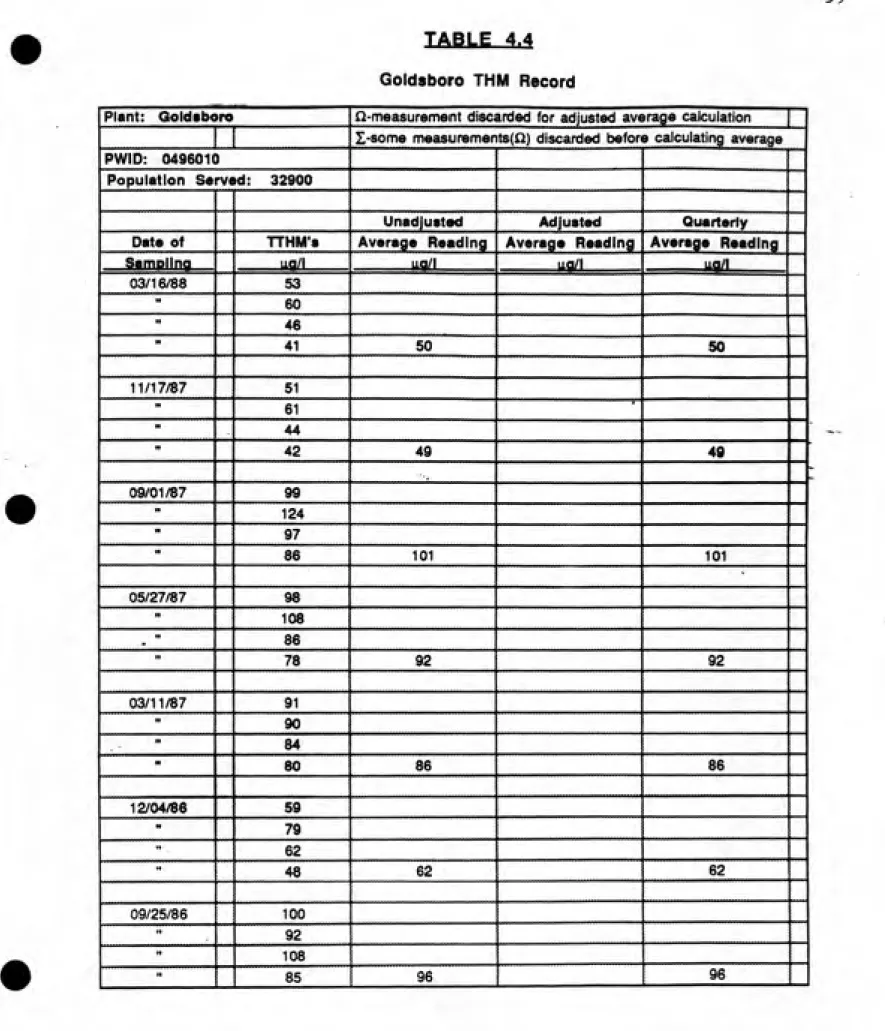
The THM record for each system was organized using a spreadsheet. The format
used for each record is shown in Tables 4.1, 4.2, 4.3 and 4.4, which are the THM
records for the Pasquatank County, Richmond County, Reidsville, and Goldsboro systems.
The name of the plant, the Public Water Supply Branch identification number, and the
number of persons served is indicated in the first few rows of the spreadsheet. The
records are arranged by the sampling date, which appears in the first column, beginning"
with the most recent data entry. The second column is used to designate those
measurements which were discarded, such as outliers, errors, and duplicates. These are
identified by an omega (Q) in the second column. Column 3 contains the individual total
trihalomethane measurements.
In Table 4.1, the first measurement on the 9/25/87 sampling date satisfied the
criteria for classification as an outlier, so it was discarded and an omega appears next to
it. The group of measurements appearing on the 9/1/87 sampling date in Table 4.1
were identified as duplicates, since they were identical to those measurements appearing
on 8/31/87. Accordingly, they were discarded. The same is true for the 6/22/87
entries, which were duplicates of the 6/18/87 entries. With the exception of one
measurement, the 5/7/86 entries are identical to the 2/13/86 entries. Because it is
32
TABLE 4.1
Pasquatank County THM Record
1 Plant: Pasquatank County
i £2-measurement discarded for adjusted average calculation
n
1
I-some measurements(n) discarded before calculating average |
PWID: 0470015
1 Population Served: 13000
1
1
Unadjusted Adjusted Quarterly
Date of TTHM'a Average Reading Average Reading
Average Reading |
SamDilna ... ao/L ---uaa— Ufl/I lUp/l
01/11/88 20
j
1 " 37
—1 **
60
I ** 67 46 46
09/25/87 a 144
1 ** 70
1 " 33
N
30 69 45
09/01/87 a 106
H a 76 • ** a 49 N
a 30 65
-. 08/31/87 30 n 49 ** 106
1 ** 76 65 56 I
06/22/87 a 73
**
a 53
N
a 42
"
a 21 47
—j
06/18/87 21
**
73
1 ** 42
"
53 47
47
—j
10/20/86 29
1 ** 42
1 ** 20
"
137 57
33
TABLE.
UL (cont'd)
Unadiuatad Adjuatad Quartarly
1 Data of
TTHM'a Avaraga Raading1 Avaraga Raading
1 Avaraga Raading1 SamollJ)a__ ug/l iia/1 ua/l UJ/I
r 08/29/86 23
8 70
88 47
07/07/86 30
1 ** 51
1 ** 61
1 ** 75 55 51
05/07/86 a 66
1 ** a 51
1 H a 51
r " a 11 45
02/13/86 11
H
51
1 ** 44
**
66 "43 43
07/26/85 a 14
n
a 48
"
a 50
**
a 87 50
^
07/15/85 48
»
14
**
50
34
TABLE 4.2
Richmond County THM Record
1 Plant: Richmond County
^-measurement discarded for adjusted average calculation f 1
I-some measurements(£2) discarded before calculating average ]
PWID: 0377109
1 Population Served: 13000
Unadjusted Adjusted Quarterly
Date of TTHM'e Average Reading Average Reading Average Reading
Sampllny ug/l atf/l uo/l ua/1
05/12/88 92
"
44 1 ** 51
If
56 61 61
02/18/88 35
*'
24 1 ** 25
1 ** 35 30 30
ͣ
•
12/08/87 59
**
71
**
60
1 M
72 65
10/20/87 45
i ** 73 J
'*
a 147
II
122 97 80 72 s
07/01/87 79
1 II
88
N
103
1 ** 90 90 90
03/31/87 97
1 ** 36
1 It 56
1 ** a 114 76 63 63
IJ
12/10/86 52
1 '* 47
"
84
35
TABLE 4.2 (cont'd)
Unadjusted Adjusted Quarterly
^^
Date of TTHM'e Average Reading Average Reading Average Reading
Sampling Ufl/l lifl/l Ufl/I u^/l
09/16/86 80
I*
101
*'
ci 207
1 " 132 130 104 104 I
1
06/23/86 59
1 *• 71
1 *' a 123
1 ** 65 79 65 65 I
03/21/86 49
1 H
39 H
50
H
77 54 54
12/19/85 67
1 H
49
1 ** 70 .
TABLE 4.3
Reidsviile THM Record36
1 Plant: Reidsviile
£2-measurement discarded for adjusted average calculation { 1
I-some measurements(n) discarded before calculating average j
PWID: 0279020
1 Population Served: 13000
Unadjusted Adjusted Quarterly
Date of TTHM'e
Average Reading
Average Reading
Average Reading1___Sampling___
ug/i ua/l ug/l ua/l03/16/88 30
**
35
-1 ** 34
**
41 35 35
12/08/87 34
ͣ
1 H 34
1 ** 44
**
38 37 37
09/28/87 a 62
1 *• a 65
n
a 75
[... ...
H
a 78 70
09/03/87 62
" *'
65
*'
75
1 *' 78 70
07/31/87 a 76
1 ** a 76 1 ** Q 77
t «f
a 73 75 70
06/04/87 73
1 ** 76
1 " 77
1 ** 76 75 75
03/19/87 36
1 " 28 1 '* 26
TABLg 4.3 (cont'd)
37
Unadjuatad Adjuatad Quart ariy
^^^
Dat* of TTHM'a Avaraga Raading Avaraga Raading Avaraga Raading
Sampling
iifl/1 u^l ua/l U9/I11/25/86 33
1 ** 28
tl
33
I H 32 31 31
08/27/86 43
1 ** 39
[ ** 42
N
49 43 43
05/29/86 46
ft
39
H
52
1 ** 54 48
04/03/86 43
[ ** 52
M
50
1 ** 42 47 47
12/03/85 45 ^
1 ** 55
1 ** 25
1
51 44 4409/03/85 77
1 ** 80
H
89
H
72 79 79
05/21/85 63
1 ** 71
1 ** 70
1 ** 50 63 63
03/19/85 32
1 ** 29 1 *' 42
38
TABUE 4.3 (cont'd)
Unadjuatad Adjuatad Quartarly ~^
Data of TTHM'a Avaraga Raading Avaraga Raading Avaraga Raading
Samollnq Ufl/I uo/l .if/i "^f"
08/02/84 65
**
77
-It
57
1 ** 69 67 67
05/15/84 52
H
48
**
46
1 ** 49 49 49
01/10/84 21
1 ** 32 1 ** 25
M
23 25 25
10/14/83 73
**
101
1 ** 88
1 ** 87 87 87
06/15/83 123
H
140
1 ** 132
1 II
139 133 133
"02/09/83 88 1 ** 79 1 *' a 104
39
TABLE 4.4
Goldsboro THM Record
Plant: Goldsboro
n-measurement discarded for adjusted average calculation | |
Z-some measurements(n) discarded before calculating average
PWID: 0496010 1
Population Served: 32900
Unadjusted Adjusted Quarterly
Date of TTHM'8
Average Reading
Average Reading Average ReadingSumpllna ug/l liO/l ua/l ---ua/l
03/16/88 53
1
H
60
n
46
1 ** 41 SO 50
11/17/87 51
1 ** 61
H
44
1 " 42 49 49
09/01/87 99
H
124
**
97
1 H 86 101 101
-05/27/87 98
H
108
H
86
H
78 92 92
03/11/87 91
n
90
1 ** 84
** 80 86 86
12/04/86 59
**
79
'*
62
1 ** 48 62 62
09/25/86 100
1 ** 92 1 ** 108
TABLE 4.4 (confd)
kO
Unadjuatad Adjuatad Quartarly
^^n
Data of TTHM'a Avaraga Raading Avaraga Raading Avaraga Raading
SamDlIn? iia/l ua/l Ufl/I
}^9'^ 06/03/86 97 If 109 ** 95 "
88 97 97
03/19/86 74 ** 87 H 71 M
68 75 75
12/05/85 a 113
H
65
M
58
1 ** 68 76 64 64
zl
09/20/85 83 •
1 ** 95 t
1 ** 85
H
65 82 82
04/16/85 59
**
92
II
68
1 1*
63 70 70
02/07/85 50
H
58
H
53
1 It 46 52 52
12/18/84 58
1 " 71
M
50
1 H 52 58 58
09/18/84 96
II
112
1 " 94
II
TABLE 4.4 (cont'd)
41
Unadjustad Adluatad Quartarly
Data of TTHM'a Avaraga Raadlng Avaraga Raadlng Avaraga Raadlng
SamplliKf
ua/l ug/l ua/l ii^/l05/03/84 96
"
114
**
73
1 If
88 93 93
03/06/84 100
*'
100
**
100
II
100 100 100
11/22/83 73
**
80
H
75 1 ** 62 1 ** a 73
H
a 80
II
a 75
1 II
a 62 72 72 72
n
06/21/83 50
II
93
H
75
H
84 75 75
03/10/83 124
"
111
ti
116
II
n 162 128 117
- 01/18/83 112
H
142
**
94
H
kZ
7/26/85 entries were identical to the 7/15/85 entries, these were also identified as
duplicates and discarded.
in Table 4.2, outliers were identified on the 10/20/87, 3/31/87, 9/16/86,
and 6/23/86 sampling dates. These measurements, designated by an omega (Q.)
appearing next to them, were discarded.
In Table 4.3, the entries appearing on the 9/28/87 sampling date were discarded
since they were identified as duplicates of the entries appearing on 9/3/87. The entries
appearing on 7/31/87 were also discarded as duplicates because they were identical to
the entries appearing on 6/4/87. One of the entries on the 2/9/83 sampling date
satisfied the criteria for classification as an outlier, so it was discarded.
In Table 4.4, the 12/5/85 and the 3/10/83 sampling dates each had one entry
which was discarded after it was identified as an outlier. Two identical sets of four
entries appear on the 11/22/83 sampling date, so four of the entries were discarded as
duplicates.
The Unadjusted Average, which is the average of all measurements taken on the
indicated sampling date, appears in column 4. The average of measurements taken on a
given sampling date, excluding all discarded measurements, appears in column 5. This
is the Adjusted Average and is computed only for those sampling dates where outliers
have been discarded. For example, on the 1/11/88 sampling date on Table 4.1, no
outliers were discarded, so an Adjusted Average did not have to be computed. An Adjusted
Average is computed for the 9/25/87 sampling date, since one of the values was
discarded as an outlier. A comparison of the Adjusted and Unadjusted Averages gives an
indication of the impact of discarded outliers.
^3
2.9 percent of the total number of entries. The number of low outliers and high outliers
was fairly evenly distributed, with 61 low outliers and 71 high outliers identified.
The Quarterly Average, appearing in column 6, is the average of all
measurements taken in a given quarter, excluding measurements discarded as outliers.
If any measurements taken during the quarter were discarded as outliers, a sigma (Z)
appears in column 7, next to the Quarterly Average. For example, one of the twelve
measurements taken during the third quarter (months 7, 8, and 9) of 1987 in the
Pasquatank County record (Table 4.1) was discarded as an outlier. The Quarterly
Average was computed for the remaining eleven measurements.
The Quarterly Average values were used for further analysis in computing the.
Two-Year Mean THM concentrations for each system and for preparing. graphical
representations of the data. Substitute Quarterly Average values were used for quarters
in which there was no data. The Pasquatank County record can be used to demonstrate the
method of substitution. It can be seen from Table 4.1 that no data exists in the
Pasquatank County record for the fourth quarter of 1987, the first quarter of 1987, and
the fourth quarter of 1985. The second quarter of 1986 was also considered to have no
data since all entries for the quarter were discarded because they were identified as
duplicates. In order to provide a continuous sequence of Quarterly Average values, these
gaps in the record were filled by reasonable substituted values. When these gaps
occurred, the Quarterly Average value for the same quarter of the previous, year was
substituted. For instance, the Quarterly Average from the fourth quarter of 1986 was
substituted for the missing value in the fourth quarter of 1987. Similarly, the gap in
the first quarter of 1987 was filled by the Quarterly Average value from the first
ki^
measurements were discarded as duplicate values. No data from the second quarter of a
previous year was available, so the Quarterly Average from the same quarter of the
following year (second quarter of 1987) was used.
Once the eight values representing the Quarterly Average TTHM concentrations of
the most recent two years of data were assembled, the Two-Year Mean TTHM
concentration was computed by taking the average of the eight values.
A plot of the Quarterly Average TTHM concentrations versus the quarter sampled
for the Pasquatank County water system is shown In Figure 4.1. This graph represents
the adjusted data from Table 4.1. The substituted Quarterly Averages are designated by a
different symbol which appears in the legend. Figure 4.1 indicates that Quarterly
Average values did not vary substantially over the course of the year. By contrast,
Figure 4.2 for the Richmond County system, illustrates a substantial variation in
Quarterly Average TTHM concentrations and a more distinct seasonal pattern to the
variations, with peak values occurring in the third quarter, and minimum values
occurring in the first quarter. The Quarterly Average TTHM concentration plots for the
Reidsville and Goldsboro systems are shown in Figure 4.3 and 4.4.
Speadsheets and graphs of the Quarterly Average TTHM concentrations were
prepared for all 63 of the systems for which TTHM data were available. The
spreadsheets and graphs appear in Appendix A. The Two-Year Mean TTHM concentrations
do not appear on the individual spreadsheets, but are tabulated in Table 4.5 (see below).
Summary of Two-Year Mean TTHM Concentrations
^5
T H M s
ng/i 100.
90_ 80_ 70_ 60_
50. 40.
30. 20.
10.
0
H---1---\---\---1---1---h-3 4 1 2 H---1---\---\---1---1---h-3 4 1
'86 Quarter Sampled
o Quarterly average a Substituted quarterly average
H---\---V
1
'88
Figure 4.1
Quarterly Average TTHM Concentrations for the Pasquatank County System
H iig/l
Quarter Sampled
«Quarterly average a Substituted quarterly average1
'88
Figure 4.2
—smmm^m.
46
T
H M s
150
135_
120
105_ 90_
^g/i 75
60_ 45_ 30_
15
T
H M W/l s
I I I I I I I I I i I I I I I i I I I I I
123412341234123412341
•84 Quarter Sampled '87
o Quarterly average a Substituted quarterly average
Figure 4.3
Record of Quarterly ͣ Average TTHM Concentrations for the Reidsville System
150_ 135_
120
105 90
75 60 45 30 15
0
I I I I I I I I I I I I I I I I I I I I I
123412341234123412341'84 Quarter Sampled '87
o Quarterly average a Substituted quarterly averageFigure 4.4
^7
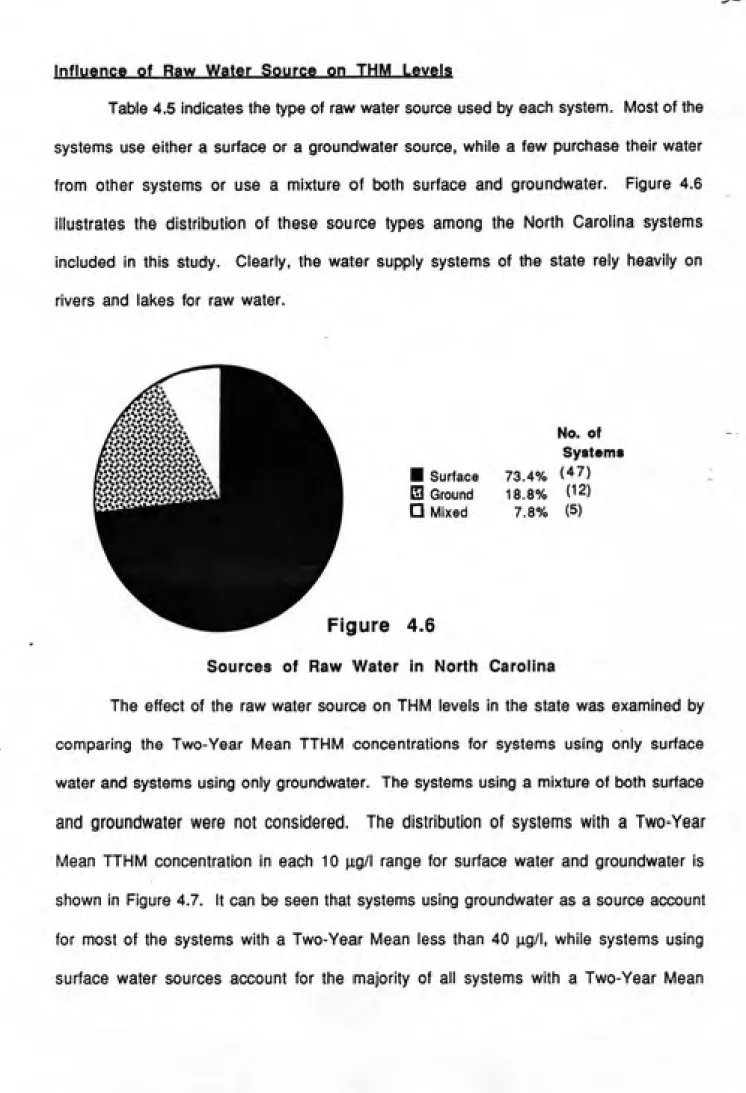
TABLE 4.5
Average TTHIVI Concentrations in North Carolina
Water Systems Two-Year Mean TTHMSystem Location Concentration (aa/M Type of Source
Elizabeth City 314 Surface & Ground
Rocl^y Mount 154 Surface
USMC-Cherry Point 101 Ground
Raleigh 94 Surface
Fayetteville 93 Surface
Southern Pines 93 Surface
Gary 91 Surface & Ground
Wilson 91 Surface
Wilmington 88 Surface
Sanford 87 Surface
Davidson 83 Surface
Goldsboro 82 Surface
King District 81 Surface
Durham 78 Surface
Lexington 78 Surface
Thomasville 78 Surface
CWASA 77 Surface
Asheboro 75 Surface
Roxboro 74 Surface
USMC-New River Air Station 74 Ground
High Point 70 Surface
Richmond County 68 Surface
-Winston-Salem 67 Surface
Anson County 65 Surface
Kannapolis 64 Surface
Monroe 64 Surface
Henderson-Kerr 63 Surface
Belmont 62 Surface
Burlington 62 Surface
Dunn 62 Surface
Morganton 62 Surface
Charlotte 60 Surface
Shelby 59 Surface
Davie County 58 Surface
Tarboro 55 Surface
Greenville 52 Surface & Ground
Albemarle 51 Surface
Greensboro 51
(continued)
48
TABLE 4.5 (cont'd)
Two-Year Mean TTHM
System Location Concentration. (Hfl/Q Tvpe of Source
Reidsville 51 Surface
Concord 50 Surface
Fort Bragg 50 Surface
Pasquatank County 50 Ground
Salisbury 49 Surface
Lenoir 46 Surface
Gastonia 45 Surface
Hickory 45 Surface
Statesville 45 Surface
Eden 44 Surface
Marion 44 Surface
Roanoke Rapids 43 Surface
Cape Fear Water Co. 42 Ground
Hendersonville 42 Surface
Jacksonville 38 Ground
Lumberton 38 Surface & Ground
Asheville 34 Surface
Waynesville 34 Surface
-New Bern 27 Ground
USMC-Hadnot Point (*) 26 Ground
Boone 25 Surface
Robeson County (*) 6 Surface & Ground
Laurinburg 2 Ground
Onslow County 2 Ground
Brookwood 6 Ground
Garner eo Purchased
Kinston 1 Ground
Pamlico County 8 Ground
Union County £ Purchased
(*) - Two Year Mean is basedon less than two years of data. S - Record was not found in the database.
« - Water is purchased from