By Silka Patel
A Master's Paper submitted to the faculty of the University ofNorth Carolina at Chapel Hill
in partial fulfillment of the requirements for the degree of Master of Public Health in
the Public Health Leadership Program.
Obstetrics and Gynecology (Ob/Gyn) is unique among medical specialties in that it offers both comprehensive surgical and outpatient clinical care. As a provider of "health care for women"1 the specialty of Ob/gyn has also been referred to as a primary care specialty, like family medicine, internal medicine and pediatrics. To formally address this focus, curriculum changes to residency training implemented in 1997 mandated six months of primary care training over the four year residency. Programs were given liberty to accomplish this change in a variety of ways. Since this change debate has continued as to what
Obstetrician-Gynecologists consider primary care and if they themselves see the specialty as serving the primary care needs of women.
Since the time of these changes, much work has been done to look at the attitudes and practice patterns of Ob/Gyns in terms of primary care services. What has not been studied is the definition of primary care ascribed by most Ob/Gyn practitioners and the affect this has on their attitudes towards Ob/Gyn as a primary care specialty. This study hopes to address this issue by allowing participants to define the characteristics they feel are important for a primary care specialty and then describe which of these falls within the scope of the obstetric and gynecology specialty. A large factor in the PCP designation is the ability to diagnose and manage common conditions without specialty referral. This study will look at this particular aspect of primary care by assessing practice patterns of participants in detail. Lastly, even if most participants feel that Ob/Gyn is a
primary care specialty, they will be ineffective if they do not have the skills
Introduction
Obstetrics and Gynecology (Ob/Gyn) is unique among medical specialties in that it offers both comprehensive surgical and medical clinical care. As a provider of "health care for women"1 the specialty of ob/gyn has also been referred to as a primary care specialty, like family medicine, internal medicine and pediatrics. This study will focus on the attitudes and knowledge of current ob/gyn residents, fellows and attendings on the designation of ob/gyn as a primary care specialty. The pilot study will be conducted at the University of North Carolina at Chapel Hill, Department of Obstetrics and Gynecology.
Defining
a
Generalist PhysiciansThe definition of primary care given by the executive board of the
American College of Obstetricians and Gynecologists (AGOG) in 1994 as quoted by Vissche~ states:
"A primary care physician is directly accessible to patients for their initial contact. This physician will see patients who have a specific or
undifferentiated complaint or who desire health maintenance through periodic check-ups. The primary-care physician provides continuity of care and is readily available. Such physicians perform initial evaluation and management within their expertise. The primary care physician refers as indicated, and coordinates subsequent and continuing visits to assure the patient of appropriate comprehensive care.2"
context of family and community.3" The latter definition will be used when considering primary care for the remainder of the study as it is 1) closely associated with the definition provided by AGOG; 2) precisely defines each attribute of a physician allowing for measurability and; 3) was created to reflect characteristics of primary care that transcend specialty. This final point is important because it allows for a non-specialty specific definition that can be used to compare across specialties.
In 1994, Rivo from the Council on Graduate Medical Education and colleagues addressed what training competencies would be necessary to train a generalist physician and assessed the effectiveness with which residency
programs currently addressed these topics.4 The study defined primary care as " .. .first-contact care for patients with undifferentiated health concerns; patient centered comprehensive care that is not organ or problem specific; continuous, longitudinal patient care; and coordination of necessary medical, social, mental and other services through appropriate consultation and referral.4" To identify the core competencies, Rivo eta! looked at leading causes of morbidity and
primary care specialties; internal medicine, family medicine, pediatrics and
ob/gyn, were assessed. Of the 60 total components, 57 were deemed applicable to ob/gyn; the care of infants and children and provision of preventive seNices for children were not considered applicable. Fifty-five components were applicable to pediatrics, 56 to internal medicine and 60 to emergency medicine and family medicine4• Of the applicable components in 1994, ob/gyn residency training programs fulfilled only 47%, while family practice residency training fulfilled 95%, pediatrics and internal medicine 91%, and emergency medicine 43%. To train residents adequately as generalists, Rivo et al noted that a residency program should fulfill 90% or more of the applicable components, with a minimum of 50% of the components in each of the seven core competencies, and should devote at least 10% of the time in residency to continuity of care. According to these
criteria, the residency curriculum for obstetrician-gynecologists at the time did not adequately prepare ob/gyns to seNe as generalist physicians.
Training Obstetrician-Gynecologists as Generalists
Obstetrician-Gynecologist and Primary Preventive Health Care which was a guideline for clinicians on periodic health evaluations by age and risk category.3
In 1993 AGOG began the task of revising the training guidelines for ob/gyn residency programs based on the realization that obstetrician/gynecologists were providing large amounts of primary care to patients as demonstrated by Pritzker5. Changes implemented by the Residency Review Committee on January 1, 1996, required programs to provide a minimum of 6 months of primary care training during residency. This requirement could be fulfilled through a variety of
experiences, including rotations in emergency medicine, family practice, and/or internal medicine and geriatrics.6 The mandate did not dictate how each
program was to incorporate these changes. Residency directors have been able to satisfy this requirement at their discretion; leading to a wide variety of primary care experiences for residents in training.
In 1998 Kuffel et al. assessed the reaction of residency directors to the curriculum changes and the effect changes would have on resident education6. A survey was sent to all 272 residency directors in the United States and Puerto
Rico, with a response rate of 92.3%. Of those who responded, 51.4% were university-affiliated programs, 44.6% community-based programs and 4.0% military based programs. Residency directors were asked, "Do you agree with the mandated curriculum changes that require 6 months of training in primary and preventive care?6" Of those that responded, 53.4% said they agreed with the mandate, 43.0% disagreed and 3.6% either declined or were neutral. This
~--E
opinion was not affected by the type of program - university, community or military.
Of those who agreed with the change, 60.4% did not believe educational deficiencies in the specialty would develop and 82.1% considered the length of primary care training to be adequate. This group also did not believe the residency program would need to be extended beyond the current 4 years (76.5%).6 Among the group who disagreed with the mandate, 87% thought educational deficiencies would develop and 74.1% considered the 6 month primary care requirement to be too long. Among this group, there was no clear consensus on a need to lengthen the 4 year residency; 52.8% saw no need to extend training.
One weakness of the study is that it addressed residency directors' attitudes only towards the mandated curriculum change, not towards primary care training for ob/gyn residents. The study was unable to determine if a negative response to the mandate was associated with negative attitudes towards primary care training. It is possible that those residency directors who disagreed with the mandate did so for reasons aside from their belief in the importance of primary care education.
was indicated by the Residency Review Committee as an area that 'should' or 'must' be taught; 2) an adequate number of patients in specific categories, as determined by the Residency Review Committee, were seen by each resident; or 3) competency was achieved by virtue of a specific rotation, for example the signs of depression on a required psychiatry rotation.1
According to Seltzer et al's assessment, the new curriculum fulfilled 54 of the 57 applicable competencies (95%) and in each of the 7 components, the ob/gyn residency curriculum trained their residents in at least 50% of the competencies- fulfilling Rivo et al's guidelines for a generalist physician.1• 4 In comparing the percentages of applicable competencies across specialties, ob/gyn was tied with family medicine at 95% while internal medicine and
pediatrics fulfilled 91% of their applicable competencies 1• This suggests that the requirements created by the Residency Review Committee should prepare ob/gyns to serve as generalist physicians.
It remains unclear, however, to what extent individual residency programs are fulfilling the requirements set forth by the Review Committee or what level of mastery in primary care is attained by individual residents. Since residency education and curriculum is often based on what residency directors consider important, recognition that 43% of residency directors6 did not agree with the mandate may have a strong effect on how these primary care competencies are taught. There is also no data as to how many residents have continued to
Importance of Obstetrician-Gynecologist Serving as Primary Care Physicians Several studies have found that women who saw both an ob/gyn and another primary care physician were likely to receive more preventive care services then those seeing only a family/internal medicine physician.7•9 In 1995, Weisman et al demonstrated that women who saw both a family/internal
medicine practitioner and an obstetrician/gynecologist received the most
preventive services, followed by women who saw only an ob/gyn and lastly those who saw only a family/internal medicine physician.9 The study population
consisted of 2,525 US women who participated in the Women's Health phone survey; 2,447 women responded to questions for this analysis. Of those
participating, 33% saw both a generalist (family/internal medicine) and an ob/gyn, 16% saw only an ob/gyn and 39% saw only a generalist. Women who sought care from a generalist alone were more likely to be past their reproductive years, lack post high school education and live in a rural community. Those who
A major limitation of this study was that it did not assess a wide variety of non-reproductive services such as immunizations and colon cancer screening, which might be provided at a much lower frequency by ob/gyns. The study also did not take into consideration the effect of a particular diagnosis on the
provisions of services although it did account for the number of chronic
conditions among participants. Finally, as a self reported questionnaire there is potential for measurement bias since women with greater interactions with the health care system may have better knowledge of their health status and the types of preventive services they have received.
A similar study conducted by Henderson et al in 2002 also examined preventive services received as a function of provider specialty_? The sample included 509 women in Baltimore who were contacted through the Women's Health Care Experiences Survey using random digit dialing; 58% of the women used two physicians and 14% saw only a generalist (family/internal medicine) physician.7 Again, the use of two physicians was associated with receiving more preventive care services - both reproductive health specific and general
number of topics versus a woman who only sought care from a generalist physician _7
One weakness of this study was that unlike the study by Weisman et al,9 it did not examine the patient characteristics of those women who received care from a generalist versus those who received care from a generalist and an ob/gyn. These characteristics may have accounted for some of the findings, however without further information on their distribution, it is difficult to assess the direction of bias.
These two studies demonstrate some of the variability in preventive care services provided to women in our current health care system. It is not clear how much individual patient characteristics and patient preference plays a role in the unequal distribution of preventive services by provider specialty. These studies do suggest that the provision of care may be a function of both patient and provider factors. The two studies also suggest that obstetrician-gynecologists often provide basic preventive services for patients who do not have access to other providers or obtain care from providers who do not focus on preventive care. These studies also support the need to look at the effects of recent curriculum changes on the delivery of preventive care services by ob/gyns.
Primary Care Designation and Managed Care
The definition of a primary care provider has largely been based on clinical parameters. However, with the rise of managed care in the 1980's the
practice pattern implications as well. As managed care grew in prominence, the role of the PCP expanded to not only include first line care but also to serve as a 'gatekeeper' for other specialist and services.10 In a commentary by Lucy Johns on the managed care market in California, she remarks that " ... selection as a primary care physician becomes a prize. It guarantees a patient base, a flow of revenue, and-sweetest to some- the ability to deprive hospitals and specialist of both.10"
The studies conducted by Weisman et al9 and Henderson et al7 point to a benefit in women having access to an ob/gyn in addition to their generalist
physician. As a result of several forces, in 1995 the 104th Congress resolved that "obstetrician-gynecologists should be designated as primary care providers for women in Federal laws relating to the provision of health care" as stated by Pritzker5• As of 1999, 35 states and the District of Columbia had laws requiring direct access for women to an obstetrician-gynecologist without referral from another primary care provider.11
physician was defined as "one who serves as the first contact for a wide variety of health care needs, provides age-appropriate preventive care, performs the initial evaluation and treatment of most presenting problems, and makes referrals and coordinates care as needed. 8" A gatekeeper was defined as "a physician in a managed care plan, usually selected by the patient from a defined set of physicians, who either provides or authorizes virtually all health services for the patient. 8 Of the 235 physicians queried about their interest in serving as primary care physicians, 37% stated that they had little to no interest, 37% expressed a high level of interest and 26% were neutral. Overall, 45% of physicians did not believe that obstetrician-gynecologist should serve as
gatekeepers.8 Of the managed care organizations that were questioned, 71.4% said that ob/gyns would need extensive training in order to serve as gatekeepers in managed care plans, though only 30% of physicians felt that this level of extra training was necessary. A majority (60%) of physicians believed that the
requirements set forth by the managed care organizations could be addressed through short course training programs.
care providers (39%) did not change after enactment of Senate Bill 814. Ninety-three percent of ob/gyns reported that primary care composed less then half of their current practice, and 61% said it comprised less then a quarter of their practice time. Only 26% had considered obtaining primary care provider status, and of these, only 38% had been successful in achieving this designation.12 It is unclear from the study as to what prevented all providers who desired a primary care status from obtaining such classification.
As a cross-sectional study of practitioners and managed care
organizations' attitudes, this study is limited in its ability to correlate changes in practice patterns with the enactment of new legislation. The difference in the percentage of physicians who self reported providing primary care versus those who sought a primary care designation raises questions as to what factors deterred ob/gyns from pursuing this status and what effect that has on care received by women in Oregon.
Traditionally the role of the ob/gyn was to establish a relationship with a patient through a routine health examination, family planning or pregnancy visit and then continue to provide care while using referrals services for treatment outside the scope of expertise.12 This is very different from a gatekeeper who provides a large set of services, with disincentives for referral to other care providers. Obstetrician-gynecologists may feel that their training does not adequately prepare them for this larger scope of care.12 This latter point
in residency has on practice patterns and attitudes of obstetric and gynecology residents and attendings.
Attitudes and Practice Patterns in Primary Care
Prior Studies
Research addressing obstetrician-gynecologists practice patterns and attitudes towards primary care has been conducted using a variety of study designs including self administered questionnaires, retrospective chart reviews and data obtained from the National Ambulatory Medical Care Survey (NAMCS). Self administered questionnaires to look at ob/gyn's attitudes towards primary care have revealed a range of responses. 8· 12-14 In 1995, the year prior to the enactment of the new primary care requirements by the Residency Review Committee a study by Laube and Ling 13 looked at the attitudes of residents towards primary care and their primary care practice patterns. Eighty-seven percent of the 4099 (94% response rate) residents believed that obstetrics and gynecology should be defined as a primary care specialty.13 This affirmation of obstetrics and gynecology as a primary care specialty varied by year with 90% of first year respondents viewing ob/gyn as a primary care specialty and only 78% of third and fourth year residents agreeing with the statement.13
on topics such as smoking, alcohol and illicit drug use, sexual practices, HIV risks and family planning. In terms of primary care screening services, a majority of residents provided blood pressure screening, annual breast exams, self-breast examination instruction, papanicolaou smear, and mammography referral for over 75% of their patients. However, residents perform important non-gynecological screening such as cholesterol screening and discussion of colonoscopy/stool guiac for less then 25% of their patients. Colonoscopy and stool guaiac was specifically a function of those over the age of 50 while no information was given as to the guidelines used to assess the 'regular intervals' for cholesterol screening.
The difference in practice patterns and attitudes varied between community and university based residents with the former providing more counseling on exercise, diet, work related injuries, cognitive and emotional function and immunizations. Residents of university based programs were more likely, however to provide particular screening services such as papanicolaou screening, mammography and colonoscopy referral.13 This difference may be a function of differences in program aims and resource availability between
community and university based residency programs.
incorporate primary care into their practices; however only a small proportion routinely provide non-gynecological counseling or screening to a majority of their patients. 13
A second study, conducted in 1997 by Higgins, Hall and Laurent,
assessed practice patterns and attitudes of obstetrician-gynecologist in the South Atlantic Association of Obstetricians and Gynecologists (SAAOG).14 Physicians included in the survey were on average 22 years post residency and worked in private practice, therefore, it can be assumed that they would have had little exposure to the recent changes in the residency curriculum. The study included a self administered questionnaire sent to the 277 active fellows of the SAAOG, with a response rate of 82%. The majority of responders practiced mostly gynecology, were generalist (non-fellowship trained) and 20.7% stated that over half of their patients were referrals from other providers. Of those who
responded, 56.4% considered their practice to be a specialty-consultation service and 25.6% considered themselves a primary care specialty.14
Approximately 50% of generalist-ob/gyns and 38% of specialist-ob/gyns provided cholesterol screening routinely. If these five services are viewed as an
assessment of basic preventive services, 54.3% of generalist-ob/gyn and 38.1% of specialists-ob/gyns routinely provided comprehensive services. 14
For women over 40 years, ten services are considered important for comprehensive preventive care according to the ACOG Primary Care Primer. Generalist-ob/gyn physicians provided Papanicolaou smears, pelvic
examinations, blood pressure, breast examinations, mammograms, digital rectal exam (ORE) and head, eye, ear, nose and throat examination more often then specialist-ob/gyns. The difference in the rate of cholesterol screening, testing for stool occult blood and sigmoidoscopy was not statistically different between generalist and ob/gyns. Only 3% of generalist and 6.4% of specialist-ob/gyns routinely provided all ten of the preventive services suggested by the ACOG Primer. 14 There was no information on whether the obstetrician-gynecologist was the sole source of care for these patients and what, if any, preventive care services patients received from other health care providers. If the patients had no other source of care, this study could indicate large gaps in preventive services for older women. Also, there is no data to ascertain the timing of preventive services and if they were completed according to current guidelines.
diseases, and chronic diseases. Of these, generalists consistently provided health maintenance services and referred most patients with trauma, infectious disease or chronic disease.14 The study does not describe if patients felt that their obstetrician-gynecologist should treat these particular disorders or to whom the referral was eventually made. If the presenting condition required specialist care, it would not be expected to fall within the scope of any primary care physician.
This study in many ways parallels our proposed study at the University of North Carolina at Chapel Hill. Higgins, Hall and Laurent14 used the AGOG Primer on Primary Care while our study uses the updated 2003 Primary and Preventive Care: Periodic Assessments Guidelines as a tool to assess the level of care currently recommend for patients. Our study hopes to add res some of the limitations in this study by determining the definition of primary care used by obstetrician-gynecologists and assessing more closely the referral patterns of these physicians. Also, our study will be able to assess any changes in attitudes that may have occurred in the ten years since the 1996 curriculum changes.
Two other studies8• 12have also used self administered questionnaires to assess obstetrician-gynecologists interest and classification as primary care providers. These studies had found that on average 37% of
89% of residents in their sample consider obstetrics and gynecology a primary care specialty.13 This difference in attitudes between practicing physicians and physicians in training is an area that needs further investigation. There may be a different definition of what constitutes primary care among residents and fellows in comparison to practicing physicians. Also, as practitioners move further from the general training of medical school and the start of residency, they may be less comfortable with practicing general medicine and tend to narrow their scope of practice.
Although self administered questionnaires offer a chance to look at physicians attitudes towards primary care practices in obstetrics-gynecology, they are susceptible to measurement bias since they rely on physicians making accurate approximations on patient type and number. Another way to examine practice patterns is through chart reviews of encounters to determine what types of services are actually provided and to whom.
Hendrix, Pierson and McNeelei5 conducted a retrospective chart review of four academic obstetrician-gynecologists between January 1, 1992, and February 1994 at Wayne State University Department of Obstetrics and
management, referral for consultation or referral for primary management. Of the 1032 entries over two years, 87.9% were classified as primary care, with 89.5% of the obstetric care, 88.7% of the gynecologic and 74.6% of the non-obstetric/gynecologic care classified as primary care.15 Ninety-nine percent of obstetric complaints and 98.5% of gynecologic complaints were managed by the ob/gyn. Of the non-obstetric/gynecological problems, 19.7% were referred for management. 15 This study indicates a higher proportion of time spent on primary care issues then was estimated by physician self report in previous studies.12-14
What is not reported in this study is the type of primary care services provided by these physicians. As shown in Higgins, Hall and Laurent14 the majority of primary care offered by the obstetrician-gynecologist appears to be health maintenance services. It is possible that the nearly 20% of
non-obstetric/gynecologic primary care which was referred included most of the cases requiring management of acute and chronic disorders. Our study will attempt to delineate which types of primary care services are referred and importantly to whom the referral is made.
physician. A PSU consists of counties, groups of counties, county equivalents or towns and townships in the United States.16 Physicians are asked to record information on visits made over the course of the designated week.
Demographic information, patient complaint, physician diagnosis,
diagnostic/screening services and procedures, medications, type of health professional and future treatment plans are recorded for each patient on
designated Patient Record forms.17 No information on non-office visit encounters such as telephone calls or hospitalizations are recorded in the NAMCS.18-20
Bartman and Weiss18 used NAMCS data from 1989-1990 to assess differences in care provided by three common sources of health care for women -family physicians, internists and obstetrician-gynecologists. The study
examined all office visits made by women between 15-64 years of age for non-pregnancy related services. Visits to one of these three specialist accounted for approximately 60% of all visits for women of this broad age group. Ob/gyns saw 67.3% of all gynecological disorders, with family practitioners seeing 28.4% and internists seeing 4.1 %. For non-gynecological complaints,
obstetrician-gynecologists provided a smaller percentage of care for patients with asthma, diabetes mellitus, hypertension(2.8%) and upper respiratory infections(3.3%) than family and internal medicine physicians.18 More then half (57.3%) of the general medical exams (GME), ICD9 code V70, were provided by the
opportunity to provide a large number of preventive services. Concerning
services provided during a general medical examination, ob/gyns provide 77% of the pap smears, 94.2% pelvic exams and 86.3% of breast exams. Regarding non-gynecological services, ob/gyns provided only 10.9% of the cholesterol screens and 18.4% of the stool guaiacs that were performed. One factor to consider is that the NAMCS does not capture the number of patients who may have multiple providers who manage different aspects of primary care and preventive services. Therefore, it is unknown if these women received non-gynecologic preventive services through other providers or if they relied solely on their obstetrician-gynecologist.
Scholle et al20 used the NAMCS data to compare the changes in the type of services provided by the three major health care providers for women between 1985 and 1997-1998. Since the measurement tool changed from 1985 to 1997, some comparison data is unavailable. Also, although the study used data post
1996, it is unlikely that physicians captured by the study would have been directly impacted by the new curriculum. The study concluded that the distribution of care and type of services provided by each specialty varied little over the 12 year period.20 The findings were comparable to the study conducted by Bartman and Weiss:18 obstetrician-gynecologists between 1997-1998 had a higher proportion of non-illness visits (40.9%) than family practice physicians (21 %) and internists (17.8%).20
ob/gyns had the highest proportion of all non-illness visits (40.9%), they only described themselves as the primary provider for 20.7% of visits in 1997-1998. Data on the scope of services provided during non-illness visits was only available for 1997-1998. As reported by Bartman and Weiss18 and seen in the findings by Scholle et al20 obstetrician-gynecologists provide more reproductive specific preventive services such as breast and pelvic exams, Papanicolaou smears, and mammograms than internist and family practitioners and fewer non-obstetric-gynecologic services such as cholesterol screening. Blood pressure screening, however, is one non-gynecologic screening that was consistently performed more often by obstetrician-gynecologist during general, non-illness visits then other physicians.18• 20 There appears to have been little change in the distribution of preventive services provided during non-illness, general medical exams by obstetrician-gynecologist compared to other generalist physicians from
1989-199018 to 1997-1998.20
One consideration in looking at primary care services provided by obstetrician-gynecologists is the distinction between those physicians who designate themselves as primary care providers versus those who do not. It could be assumed that ob/gyns who consider themselves to be primary care providers would provide a larger scope of services then those who do not
self-identified as a primary care provider for the GME were less likely to provide breast and pelvic examinations, mammograms, family planning counseling, diet/nutrition and exercise counseling, but more likely to provide blood pressure and cholesterol screening. A potential explanation could be that self-designated primary care providers may have several opportunities to provide preventive services at visits other then those coded specifically as general medical examinations, therefore they do not rely on one visit to address all of these needs.
In 1995, Leader and Perales21 compared information on primary care practices of obstetrician-gynecologists using three national databases. The first was the AGOG 1991 economic survey of fellows. This survey was mailed to a stratified, random sample of 2000 members with a 67% response rate. The second database was the 1989-1990 NAMCS. In this study all visits to a gynecologist, internist, and family physician by women age 15 and older was included if the primary reason for the visit was a general medical examination. A general medical examination is classified by the National Center for Health Statistics as an annual examination, check-up, routine examination, physical examination and history and physical. This category excludes follow-up and progress visits. The third data source was the 1987 Household Survey sample of the National Medical Expenditure Survey. It is a representative sample of the non institutionalized civilian population of the United States in 1987.
identified themselves as primary care physicians. The study also found that, the second most common reason a women visited her obstetrician-gynecologist was for a general medical exam; the most common was routine prenatal care. When women were asked the most important reason for their current
obstetric-gynecology visit 53.4% replied, a general medical examination. This data demonstrates that not only do women present commonly for a GME but that ob/gyns are performing this type of exam on a frequent basis. This poses a great opportunity to discuss issues concerning preventive care and screening. In the sample of women who had at least one GME visit in the past year, 20% saw only an obstetrician-gynecologist21 Although this does not constitute the majority of women, a considerable proportion of patients rely solely on their obstetrician-gynecologist to provide services during their general medical examinations. What is unclear is if these women receive preventive services during non-GME exams from other providers.
exclusively on accurate recording and coding of information from physicians. A physician may counsel at length against a high risk behavior but fail to document either the content or depth of the visit. As a result using only ICD9 codes to determine the depth and quality of physician counseling is flawed. Patient questionnaires as utilized in some studies21 can be helpful in determining counseling practices of physicians however, they can be affected by recall and selection bias.
Proposed Study Aims
The current study aims to address some of the gaps in the current literature concerning ob/gyn attitudes and knowledge in primary care. The two primary outcomes of the study include 1 )Assessing the definition of primary care among obstetrician-gynecologist and their attitudes towards a primary care designation for the specialty and 2)Assessing the practice patterns and
knowledge of general topics in primary care among ob/gyn residents, fellows and attendings.
issue by allowing participants to define the characteristics they feel are important for a primary care specialty and then describe which of these falls within the scope of the ob/gyn specialty. A large factor in the PCP designation is the ability to diagnose and manage common conditions without specialty referral. This study will look at this particular aspect of primary care in detail by assessing practice patterns of participants. Lastly, even if most participants feel that
Ob/Gyn is a primary care specialty, they will be ineffective if they do not have the knowledge need to practice in this capacity. Little work has been done to assess the level of knowledge in primary care since the revision of the curriculum in 1997. By addressing this issue almost ten years later, it can be assumed that
b
r
many of the current junior faculty are products of the revised curriculum and'
therefore the education of junior residents should reflect this change in emphasis and attitude.
Methods
Participants
Request for participation by the Department of Obstetrics and Gynecology at the University of North Carolina at Chapel Hill was obtained from the chair of the department- Dr. Daniel L. Clarke-Pearson. He was informed of the
employees of UNC- Chapel Hill will be eligible for the study. Visiting residents, fellows and faculty members will be excluded.
Questionnaires will be placed in participants designated hospital
mailboxes. Participants will be asked to return completed surveys in self sealed envelopes in covered boxes located near the mailboxes. Consent will be
assumed by completion of the questionnaire. For those residents who are completing rotations outside of UNC Hospital, a self addressed stamped
envelope will be included and surveys will be mailed to the central ob/gyn office at UNC Chapel Hill. Participants will be sent a reminder email one week prior and three days prior to the deadline for returning questionnaires.
Non-responders will be grouped as either attendings/fellows and residents by year of training. Participants will be invited to contact the principal investigator to ask questions about the purpose of the study after completing the questionnaire.
Questionnaire Design
Questionnaire design was initiated with a list of topics addressed in the 2003 Primary and Preventive Care Periodic Assessment Guidelines issued by ACOG22 and competencies determined by Rivo et al4 to be necessary in training a generalist. Topics which were addressed by both sets of guidelines were included in the final survey. Separate questionnaires were created for attendings/fellows (appendix A) and residents (appendix B) for collecting
specifically about how many years had passed since their PGY1 year of
residency as well as their current specialty. The questionnaire was reviewed by a group of rising fourth year medical students to test questions and formatting. Survey was also reviewed by the Odum Institute for Research in Social Science at the University of North Carolina at Chapel Hill for formatting and layout.
The survey contains three sections, section one aims to assess respondents' working definition of primary care. We used the definition of
primary care quoted by Brown3 from the IOM Committee on the Future of Primary Care, "Primary care is the provision of integrated, accessible health care services by clinicians who are accountable for addressing a large majority of personal health care needs, developing a sustained partnership with patients and practicing in the context of family and community.3" A rank order format was used instead of Iikert scales for each component since this would allow us to determine which handful of characteristics were consistently considered important and as such define primary care for this population. A lack of
used as the comparison group when discussing how ob/gyns function in primary care since 1 )they are unarguably a primary care specialty and 2)their training fulfills the same percentage of competencies as does ob/gyns training according to Rivo et al.4· 8 Together these four questions should provide insight into the definition of primary care used by ob/gyns as well as their perspective on how each component of this definition is exemplified by the specialty.
Section two looks at current practice patterns of participants on various primary care topics. These topics were chosen because they fall within the particular areas of competencies as addressed by Rivo et al4 and are addressed by the new curriculum as determined by Seltzer et al.1 These topics were also addressed in the 2003 Primary and Preventive Care Periodic Assessment Guidelines by the ACOG.22 These guidelines were created for non-pregnant women and take into consideration both effectiveness and cost-effectiveness.
making referrals to generalist physicians this may indicate that ob/gyns do not feel adequately trained or compensated to provide this level of primary care.
Section three addresses knowledge of participants about specific primary preventive topics that have been designated by AGOG as part of the routine periodic health examination.22 Since ob/gyns see women routinely for general medical examinations and more so then any other specialty,7· 19• 21 it is important that they be knowledgeable about preventive screenings which could have an enormous effect on a women's overall health. Since many screening tests, such as mammography, can have an increased false positive rate at younger ages, the judicious use of these tools is key. The questions in section three are
Future Investigation
This study will be piloted at the University of North Carolina Department of Obstetrics and Gynecology. The initial analysis will help determine if changes in question format or structure are needed before the study is expanded to other institutions. Institutions will be selected to balance public and private as well as academic and community based programs, beginning with institutions within North Carolina.
All programs will be contacted through the Chairman of the Obstetrics and Gynecology department. Participants will be recruited using the same inclusion and exclusion criteria as used at UNC- Chapel Hill. Questionnaires will be distributed through hospital mailboxes and collected in a similar fashion. If the program structure or hospital system makes this impossible another method of distribution may be necessary, however anonymity of respondents will be maintained. All programs which request follow up information will be given preliminary statistics; all hard copies of questionnaires will be maintained by the principle investigator.
Statistical Analysis
Results
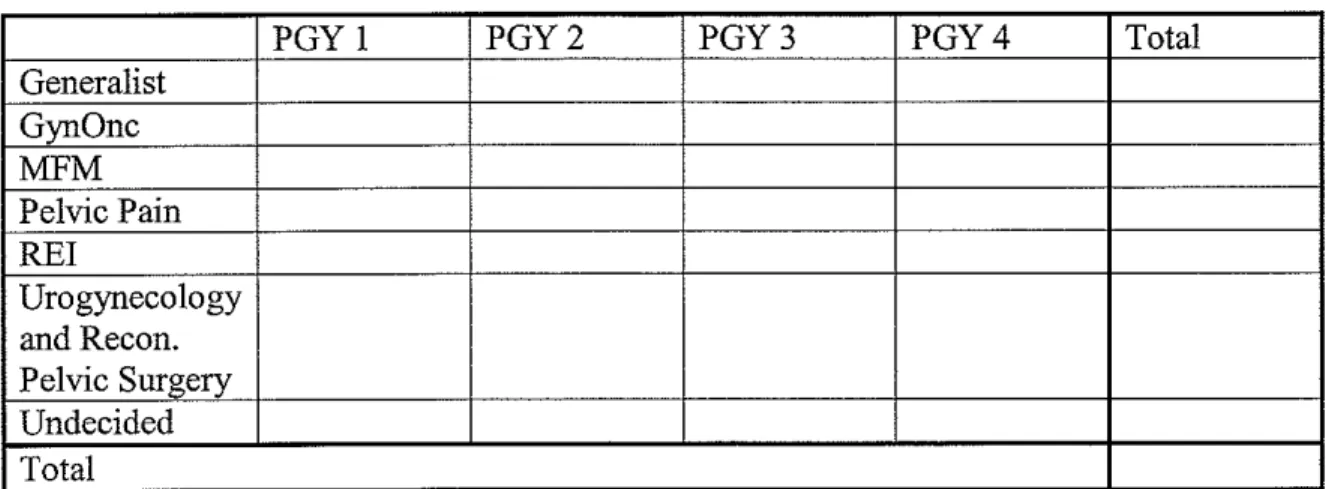
Template tables have been created to illustrate the demographic characteristics as well as the attitudes and practice patterns of residents and attendings/fellows (appendix C). Tables 1 and 2 will include basic demographics of participating residents and attendings. This is followed by tables 3 and 4 which will address participants' views on factors important in defining primary care and their opinion on the scope of obstetrics and gynecology. Table 5 will delineate how particular primary care topics are managed by participants at different levels of training- attendings/fellows versus residents. The final three tables will assess the number of participants who appropriately utilize primary care screening for particular age groups. Appropriateness of use is determined by recommendations set forth in the Primary and Preventive Care Periodic Assessment Guidelines.22
Discussion
Implication of Current Study
given residency program. Those who started as first year residents in 1996, would be approximately 6 years out of residency and therefore, in a position to begin shaping educational practices.
The study will also attempt to define the activities an
obstetrician-gynecologist considers important for a primary care physician and which of these they believe is in their scope of practice. By allowing the physician to provide his/her own definition of primary care, we hope to understand the discrepancy between the number of physicians who consider themselves primary care providers yet do not offer a full scope of services. This study will consider the percentage of practitioners who are not only providing the services listed in the ACOG Primer on Preventive Care22 but are also providing them at the
appropriate intervals.
As a self-administered questionnaire, the ability to correlate practitioners' views on primary care with their actual practice pattern is limited. Also, since we will not be able to confirm the complexity of cases referred for specialist care, it will be unclear if these are outside the scope of a generalist physician or just outside the scope of the obstetrician-gynecologist. Generalizability may be limited, since the study is to be conducted at a large university-based obstetric and gynecology residency program. However, many university-based residents go on to practice in the general community, and their experiences and knowledge can serve as a marker for the attitudes of the youngest generation of
A second step in understanding practice patterns would be to use chart reviews along with self-reported questionnaires to correlate attitudes with
practice patterns of individual physicians. This would allow us to look at both the definition of primary care used by practitioners and their ability to provide
services within this framework. It would also address questions concerning the types of referrals made and if specialist care was warranted.
Primary Care in Obstetrics and Gynecology- The Next Step
Pritzker5 stated the AGOG Task Force on Primary and Preventive Health care's description of the 3 levels of primary care provided by ob/gyns:
1. Ob/Gyn Services: services traditionally provided (prenatal care, gynecologic care, etc.) by the ob/gyn and the sub-specialist thereof
2. Primarv-Preventive Care: a broader role in health maintenance for women which includes health screening and disease prevention. These are presented in age-specific tables that indicate the screening, evaluation and counseling, and immunization services appropriate through the span of a women's life.
3. Extended primarv care: issues of health and disease beyond those that pertain to the reproductive system. Obstetrician-gynecologists who provide such interventions do so on the basis of education and experience.
the Primer on Preventive Services.22 The next step is to consider the goals of the specialty and the expectation of patients who seek care from obstetrician-gynecologists. If the goal of the specialty is to provide care at this third level, it is necessary to determine if the new primary care component of the
curriculum provides adequate training. With regards to patient expectations, it is clear that some women choose to obtain care from both an ob/gyn and a family/internal medicine practitioner. 7• 9 These women may expect much less in terms of primary care services from their ob/gyn then women who seek care only from an obstetrician/gynecologist. For the latter, the ob/gyn may be the primary entry point into the health care system and as such these
physicians should be more attuned to the larger scope of health needs to avoid missed opportunities for preventive care.
One way to avoid such missed opportunities would be to create a dialogue between ob/gyns and women as to the role the ob/gyn will have in their health delivery.2 In this way practitioners can concentrate time and services on women who may not have another source of regular care and may be
overlooked by the health care system. This approach would create questions as to what services should fall under the management of ob/gyns versus other care providers. For instance, diabetes mellitus can have an enormous impact on reproductive health, however it is also a broad disease which affects many other systems of the body. In this situation, would diabetes screening and management be the responsibility of the
As suggested by several studies 18-21 a range of primary care services are provided by ob/gyns, by internists and by family practitioners but little
consistency in quality or comprehensiveness exists. A way to address this inconsistency is to create a certification program for all providers who wish to be considered primary care physicians. A national curriculum would be created which would eventually serve as a benchmark for HMO's in
determining which physicians can serve as gatekeepers. Some would argue that there is no uniform curriculum that can be taught or tested through a certification program that would address the domain of primary care. Also, if this certification does become linked to a gatekeeper role, patients may have a limited pool of physicians to choose from who qualify as first contact care providers.
Another option would be to create a specialty focusing specifically on Women's Primary Health Care, which would be a combination of
family/internal medicine and gynecology. The residency training could
replace the time spent in the traditional ob/gyn residency on surgical skills by the outpatient management of common diseases as seen in internal/family medicine programs. This would decrease the number of physicians a woman would have to use and potentially decrease health care costs overall.
In order to better use the skills of ob/gyns, it may be necessary to add a fellowship for general women's health care in obstetrics and gynecology. A fellowship would enable providers who want to practice at the third level of care the opportunity to obtain the necessary skills to provide appropriate and comprehensive health care. This would also help create a residency
curriculum focusing on graduating residents who are able to function
effectively at the second level of care instead of attempting to cover a much broader scope in only 6 months. As health consumers, patients would be able to decide whether they wanted an ob/gyn that could provide all of their primary care needs or whether they preferred to have two physicians
providing different types of health services. This type of fellowship would not preclude others from gaining the necessary skills to provide comprehensive primary care, but would help those with a specific interest obtain the
necessary learning objectives.
The face of the United States medical system continues to evolve to address not only patient preferences but also emerging technology, resource availability and health policy decisions. The debate over whether or not obstetrician-gynecologists are primary care physicians needs to change into a debate over how to best provide adequate primary care for women. The changes in the curriculum addressed by the 1996 Residency Review Committee are a step towards ensuring that physicians are adequately trained to provide comprehensive services for their patients. The
REFERENCES
1. Seltzer VL. Obstetrician-gynecologists: Women's health care physicians. Obstetrics and Gynecology. 1998;91:1-5.
2. Visscher HC. The role of the obstetrician/gynecologist in primary health care. Clinical Obstetrics and Gynecology. 1995;38:206-212.
3. Brown CV. Primary care for women: The role of the obstetrician-gynecologist. Clinical Obstetrics and Gynecology. 1999;42:306-313.
4. Rivo ML, Saultz JW, Wartman SA, DeWitt TG. Defining the generalist physician's training. JAMA. 1994;271: 1499-1504.
5. Pritzker J. Obstetrician/gynecologist as primary care physician in managed health care. Clinical Obstetrics and Gynecology. 1997;40:402-413.
L
6. Kuffel ME, Stovall DW, Kuffel TS, Zlatnik FJ. Reactions of residency directors to primary care requirements in obstetrics and gynecology training. Obstetrics and Gynecology. 1998;91: 145-148.
7. Henderson JT, Weisman CS, Grason H. Are two doctors better than one? women's physician use and appropriate care. Women's Health issues. 2002;12:138-149.
organization medical directors and obstetrician-gynecologists. Obstetrics and Gynecology. 1997;90:291-295.
9. Weisman CS, Cassard SO, Plichta SB. Types of physicians used by women for regular health care: Implications for services received. Journal of Women's Health [identify the specialties of physicians seen by women for regular care]. 1995;4:407-416. Available from:
http://www.refworks.com.libproxy.lib.unc.edu; http://www.csa.com. Accessed February 19 2006.
10. Johns L. Obstetrics-gynecology as primary care: A market dilemma. Health Aff (Millwood). 1994;13:194-200.
11. Henry J. Kaiser Family Foundation. State policies on access to gynecological care and contraception. Available at:
http://www.kff.org/womenshealth/loader.cfm?url=/commonspot/security/getfile .cfm&Pagel0=13279. Accessed May 21, 2006.
12. Kirk EP, Santa J, Heckler T, Collins M. Obstetrician-gynecologists as primary care physicians: The Oregon experience--early perceptions regarding the effects of legislative action. Am J Obstetrics and Gynecology.
1998;178:1222-1228.
14. Higgins RV, Hall JB, Laurent S. Primary care by obstetricians and
gynecologists: Attitudes of the members of the South Atlantic Association of Obstetricians and Gynecologists. American Journal of Obstetrics and
Gynecology. 1997;177:311-7; discussion 317-8.
15. Hendrix SL, Piereson SD, McNeeley SG. Primary and preventive care in a university obstetrics and gynecology group practice. American Journal of Obstetrics and Gynecology. 1995;172:1719-23; discussion 1723-5.
16. National Center for Health Statistics, Center for Disease Control. NAMCS scope and sample design. Available at:
http://www.cdc.govlnchs/aboutlmajor/ahcd/sampnam.htm. Accessed May 21, 2006.
17. National Center for Health Statistics, Center for Disease Control. NAMCS description. Available at:
http://www.cdc.gov.libproxy.lib.unc.edu/nchs/aboutlmajor/ahcd/namcsdes.htm . Accessed May 21, 2006.
18. Bartman BA, Weiss KB. Women's primary care in the united states: A study of practice variation among physician specialties. Journal of Women's Health [specialty specific variation in ambulatory care visits by women].
19. Scholle SH, Chang J, Harman J, McNeil M. Characteristics of patients seen and services provided in primary care visits in obstetrics/gynecology: Data from NAMCS and NHAMCS. American Journal of Obstetrics and Gynecology. 2004;190:1119-1127.
20. Scholle SH, Chang JC, Harman J, McNeil M. Trends in women's health services by type of physician seen: Data from the 1985 and 1997-98 NAMCS. Women's Health Issues. 2002;12:165-177.
21. LeaderS, Perales PJ. Provision of primary-preventive health care services by obstetrician-gynecologists. Obstetrics and Gynecology. 1995;85:391-395.
Objective: The objective of this survey is to understand the attitudes and practices of Obstetrician(s) and Gynecologist(s) about primary care issues in Ob/Gyn.
1. When thinking of a primary care specialty, which of the following characteristics are the most important? (rank with I as the most important and 7 as the least important characteristic)
_ _ _ Allows for the integration of care among other health care providers
_ _ _ Provides accessible services with few economic, geographical or cultural obstacles _ _ _ Provides health care services that are both treatment and prevention oriented. _ _ _ Services are provided in multiple health care settings
_ _ _ Addresses a large proportion of patient's health care needs including their physical, mental, and social health
_ _ _ Provides for a sustained patient-physician relationship over time _ _ _ Focuses on treatment in the context of the family and community
2. Which of the following, in your opinion, fall within the scope of an Ob/Gyn? (fiJ all that apply)
0
Integrates care among other health care providers0
Provides accessible services with few economic, geographical or cultural obstacles0
Provides health care services that are both treatment and prevention oriented.0
Services are provided in multiple health care settings0
Addresses a large proportion of patient's health care needs including their physical, mental and social health.0
Provides for a sustained patient-physician relationship over time0
Focuses on treatment in the context of family and communityObjective: The objective of this survey is to understand the attitudes and practices of Obstetrician( s) and Gynecologist( s) about primary care issues in Ob/Gyn.
1. When thinking of a primary care specialty, which of the following characteristics are the most important? (rank with 1 as the most important and 7 as the least important characteristic)
_ _ _ Allows for the integration of care among other health care providers
_ _ _ Provides accessible services with few economic, geographical or cultural obstacles _ _ _ Provides health care services that are both treatment and prevention oriented. _ _ _ Services are provided in multiple health care settings
_ _ _ Addresses a large proportion of patient's health care needs including their physical, mental, and social health
_ _ _ Provides for a sustained patient-physician relationship over time _ _ _ Focuses on treatment in the context of the family and community
2. Which of the following, in your opinion, fall within the scope of an Ob/Gyn? (/iJall that apply)
D
Integrates care among other health care providersD
Provides accessible services with few economic, geographical or cultural obstaclesD
Provides health care services that are both treatment and prevention oriented.D
Services are provided in multiple health care settingsD
Addresses a large proportion of patient's health care needs including their physical, mental and social health.D
Provides for a sustained patient -physician relationship over timeD
Focuses on treatment in the context of family and communityStrongly Agree Agree Disagree Strongly Disagree
Obstetricians and
gynecologists can provide a similar scope of services as those provided by Family Medicine Physicians
Obstetrics and gynecology is a primary care specialty.
4. In a non-pregnant patient how do you usually handle the following medical conditions or complaints?
a. Anemia (Please PI which ONE of the following you do MOST OFTEN)
D
Do not routinely perform screening test to diagnose this conditionD
I diagnose this condition but will refer for initial managementWhich ONE of the following would you most often make the referral to?
D
I diagnose and provide the initial treatmentbut will refer for continued care
D
GeneralistD I diagnose, provide initial treatment and will (Family/Internal Medicine) refer to _ _ only with complications or if'---.[__D __ s.:_p_ec_ia_I_is_t..:.(H_em_at_o_lo....:g::_i_st.:_)_j there is no response to initial treatment.
b. Thyroid Disease (Please PI which ONE of the following you do MOST OFTEN)
D
Do not routinely perform screening test to diagnose this conditionD
I diagnose this condition but will refer for initial managementD
I diagnose and provide the initial treatmentbut will refer for continued care - - - + /
D
I diagnose, provide initial treatment and willrefer to _ _ only with complications or if'---1>1 there is no response to initial treatment.
Which ONE of the following would you most often make the referral to?
D
Generalist(Family/Internal Medicine)
to diagnose this condition
0
I diagnose this condition but will refer for initial managementD
I diagnose and provide the initial treatmentbut will refer for continued care - - - . 1
D
I diagnose, provide initial treatment and willrefer to _ _ only with complications or if'---~ there is no response to initial treatment.
Which ONE of the following would you most often make the referral to?
D
Generalist(Family/Internal Medicine)
D
Specialist(Endocrinologist/REI)
d. Non-Insulin Dependent Diabetes Mellitus (Please R!which ONE of the following you do MOST OFTEN)
0
Do not routinely perform screening test to diagnose this conditionWhich ONE of the following
0
I diagnose this condition but will refer would you most often makefor initial management ---1~ the referral to?
0
I diagnose and provide the initial treatmentD
Generalist but will refer for continued care - - - . 1D
I diagnose, provide initial treatment and will (Family/Internal Medicine) refer to _ _ only with complications or ifD
Specialistthere is no response to initial treatment. (Endocrinologist)
e. Depression (Please RJ which ONE of the following you do MOST OFTEN)
0
Do not routinely perform screening testto diagnose this condition
Which ONE of the following
0
I diagnose this condition but will refer would you most often makefor initial management - - - . 1 the referral to?
0
I diagnose and provide the initial treatmentbut will refer for continued care
D
I diagnose, provide initial treatment and willrefer to _ _ only with complications or if'---~ there is no response to initial treatment.
0
Generalist(Family/Internal Medicine)
to diagnose this condition
D
I diagnose this condition but will referfor initial management ---+1
D
I diagnose and provide the initial treatmentbut will refer for continued care - - - + 1
D
I diagnose, provide initial treatment and willrefer to _ _ only with complications or if,_ _ _ _ _ _ ~
there is no response to initial treatment.
Which ONE of the following would you most often make the referral to?
0
Generalist(Family/Internal Medicine)
0
Specialists (Psychiatrist)g. Hypertension (Please PI which ONE of the following you do MOST OFTEN)
D
Do not routinely perform screening test to diagnose this conditionD
I diagnose this condition but will referfor initial management ---~
D
I diagnose and provide the initial treatment but will refer for continued careD
I diagnose, provide initial treatment and willrefer to _ _ only with complications or if'---~
Which ONE of the following would you most often make the referral to?
D
Generalist(Family/Internal Medicine)
D
Specialist (Cardiologist) there is no response to initial treatment. L _ _ _ _ _ _ _ _ _ _ _ _ jh. Hypercholesterolemia (Please PI which ONE of the following you do MOST OFTEN)
D
Do not routinely perform screening test to diagnose this conditionD
I diagnose this condition but will referfor initial management ---~
D
I diagnose and provide the initial treatmentbut will refer for continued care - - - + 1
D
I diagnose, provide initial treatment and willrefer to _ _ only with complications or if _ _ _ _ _ ~ there is no response to initial treatment.
Which ONE of the following would you most often make the referral to?
D
Generalist(Family/Internal Medicine)
Never or Less than About Yz MorethanYz Always or Almost Never Yz tbe time the time Almost always
the time BMI Calculation
Mammography
PAP Smears
Blood Pressure
Lipid Profile
TSH Screening
Colorectal Cancer Screening
Bone Density Screening
6. When seeing a healthy 45 year old, who is new to your clinic, for a routine yearly exam, how often do you recommend the following? (Pleasefi?lthe appropriate box)
Never or Less than Yz About Yz MorethanYz Always or Almost Never the time the time the time Almost always BMI Calculation
Mammography
PAP Smears
Blood Pressure
Lipid Profile
TSH Screening
Colorectal Cancer Screening
Never or Less than Yz About Yz MorethanYz Almost Never the time the time the time BMI Calculation
Mammography
PAP Smears
Blood Pressure
Lipid Profile
TSH Screening
Colorectal Cancer Screening
Bone Density Screening
8. What is your University Affiliation? (please li1 the appropriate box)
DUNe- Chapel Hill D East Carolina University
D Duke University
9. What is your CURRENT year in Residency? (please li1 the appropriate box)
D Year 1 D Year3
D Year2 D Year4
Always or Almost always
10. What field will you most likely specialize in, if any? (please li1 the appropriate box)
D Generalist
0Gynecological Oncology D Maternal Fetal Medicine D Pelvic Pain
D Reproductive Endocrinology and Infertility Durogynecology & Reconstructive Pelvic Surgery Dundecided
11. What is your gender? (please li1 the appropriate box)
Table I: Characteristics of Residents (N = )
Potential Specialty Choices Among Residents
PGY1 PGY2 PGY3 PGY4 Total
Generalist GynOnc MFM Pelvic Pain REI
Urogynecology andRecon. Pelvic Surgery Undecided Total
Table 2: Characteristics of Attendings and Fellows (N= )
Current Practicing Specialty
<10 Years 10-15 16-20 20+ Years Total
Generalist GynOnc MFM Pelvic Pain REI
Residents Attendin s and Fellows
Mean Rank %Who view it Mean Rank %Who view it
within the scope within the scope
ofOb/Gyn ofOb/Gyn
Integration of Care
Accessible Services Focus on Treatment and Prevention Multiple Health Care Settings
Physical, mental and social health
Patient-Physician Relationship
Treatment in context of
Family/Community
Table 4: Views ofOb/Gyn as a Primary Care Specialty by years of training (N= )
Ob/Gyn similar scope as Family % who view Ob/Gyn as
Medicine a Primary Care
%Strongly Agree/Agree Specialty
Residents
%Appropriate Use % Inappropriate Use BMI Calculation
Resident Attending/Fell ow Mammography
Resident Attending/Fellow PAP Smears
Resident Attending/Fellow Blood Pressure
Resident Attending/Fellow Lipid Profile
Resident Attending/Fellow TSH Screening
Resident Attending/Fellow Colorectal Cancer Screening
Resident Attending/Fell ow Bone Density Screening
% Do not screen % Dx and Refer % Dx, provide % Dx, provide for condition for initial mgt. initial mgt. and initial mgt and refer cont. care cont. care - will
refer for complications Anemia
Resident Attending/Fell ow Thyroid Disease
Resident Attending/Fellow Osteoporosis
Resident Attending/Fellow NIDDM
Resident Attending/Fellow Depression
Resident Attending/Fellow Tobacco use
Resident Attending/Fell ow Hypertension
% Appropriate Use % Inappropriate Use BMI Calculation
Resident Attending/Fell ow Mammography
Resident Attending/Fellow PAP Smears
Resident Attending/Fellow Blood Pressure
Resident Attending/Fell ow Lipid Profile
Resident Attending/Fellow TSH Screening
Resident Attending/Fellow Colorectal Cancer Screening
Resident Attending/Fellow Bone Density Screening
%Appropriate Use % Inappropriate Use BMI Calculation
Resident Attending/Fellow Mammography
Resident Attending/Fellow PAP Smears
Resident Attending!F ellow Blood Pressure
Resident Attending/Fellow Lipid Profile
Resident Attending/Fellow TSH Screening
Resident Attending/Fellow Colorectal Cancer Screening
Resident Attending/Fellow Bone Density Screening