Implementation of Hypertension Clinical
Practice Guidelines:
A Systematic Review of Strategies to Change Physician Behavior and Improve Patient Outcomes
By
Kevin Fischer
A Master's Paper submitted to the faculty of the University of North Carolina at Chapel Hill
In partial fulfillment of the requirements for the degree of Master of Public Health in
the Public Health Leadership Program.
Chapel Hill
July, 2005
Abstract
Background: Hypertension remains a major cause of cardiovascular disease
morbidity and mortality worldwide. There is strong evidence that blood pressure
control is associated with significant reduction in morbidity and mortality caused by
cardiovascular events. However, only one-third of Americans with hypertension
have adequate blood pressure control. Clioical practice guidelines have been
established to guide physician treatment of hypertension, yet many physicians do not
follow these guidelines. In response to this problem, there is a growing body of
literature regarding interventions designed to help physicians adhere to hypertension
clinical practice guidelines.
Objectives: To systematically identifY, appraise and synthesize studies of
professional educational or quality assurance interventions designed to improve
I
I physician adherence to hypertension clioical practice guidelines. The effectivenessof various intervention strategies in changing physician behavior and improving
patient outcomes will be evaluated
Research design: I performed a systematic review of studies published in
MEDLINE between 1966 and 2005 describing interventions to improve physician
adherence to hypertension guidelioes in primary care. Randomized controlled trials,
cohort studies, case control studies and time-series analyses describing
physician-targeted educational or quality assurance interventions with objective measures of
physician hypertension management behavior or patient blood pressure outcomes
were included. Data from each study was abstracted io to evidence tables for review
and all studies were assigned a quality grade based (good, fair, poor) based on their
study design and potential for selection bias, measurement bias, and confounding.
Results: The initial Medline search yielded 574 citations of which 32 were included
in this review. Three citations additional were identified through manual searching,
These studies examined the following interventions: educational outreach (n=I2),
local opinion leaders (n=5), audit and feedback (n=l6), decision support (n=5),
reminders (n=ll ), and local consensus development (n=4). Interventions involving
Educational Outreach, especially when combined with Local Opinion Leader and
Audit and Feedback, resulted in moderate changes in prescribing behavior and small
increases in blood pressure control. No studies examined the independent effects of
educational outreach or local opinion leaders, but audit and feedback appeared to
have no effect on its own. Interventions involving Reminders were highly effective
in increasing screening and prescribing, but did not reduce blood pressure; while
decision support was generally ineffective on its own. Local Consensus
Development of Guidelines had moderate to large effects on prescribing behavior
and had mixed results on blood pressure control.
Conclusions: No single educational or quality assurance intervention is superior to
others in improving physician adherence to hypertension guidelines, although several
interventions appear to be ineffective or uotested on their own. Multifaceted
Interventions especially those involving Educational Outreach by Local Opinion
Leaders, Audit and Feedback, Local Consensus Guideline Development and/or
Reminders appear to be the most promising physician oriented interventions to
improve patient blood pressure control.
Introduction:
Hypertension:
Hypertension remains a major cause of cardiovascular disease
morbidity and mortality worldwide. According to the World Health
Organization (WHO), the worldwide prevalence of hypertension is estimated
to be about 1 billion people, accounting for approximately 7.1 million deaths
per year. Suboptimal blood pressure (>115mm hg systolic blood pressure, as
defmed by the WHO) is responsible for 49% of ischemic heart disease and
62% of cerebrovascular disease; and is the number one attributable risk factor
for death throughout the world.1 In the United States, 50 million people have
high blood pressure warranting some form of therapy. 2' 3
There is strong evidence that blood pressure control is associated with
significant reduction in morbidity and mortality caused by cardiovascular
events.4•6 The number of deaths from both ischemic heart disease and stroke
increase progressively and linearly from blood pressure levels as low as 115
mm Hg systolic and 75 mm Hg diastolic upward.7ln clinical trials,
antihypertensive therapy has been associated with a 35 to 40 percent mean
reduction in stroke incidence; a 20 to 25 percent reduction in myocardial
infarction; and more than a 50 percent reduction in heart failure. 6
Epidemiologic data from the National Health and Nutrition Examination
Survey (NHANES) shows that the percentage of hypertensive patients
receiving treatment increased from 31 percent in the period from 1976 to
1980 to 59 percent in the period from 1999-2000. During this time frame the
age-adjusted death rates from stroke and coronary heart disease declined by
approximately 60 percent and 50 percent respectively? It is reasonable to
assume that much of this reduction in the rate of death from stroke and
coronary heart disease can be attributed, at least in part to increasing
treatment of hypertension.
Suboptimal Treatment of Population:
Despite widespread recognition of the high prevalence of
hypertension, the high morbidity and mortality associated with hypertension
and of the strong evidence that reducing blood pressure decreases
cardiovascular morbidity and mortality, recognition and treatment of this
condition remains suboptimal. Among a national sample of hypertensive
patients (BP > 140/90 mm Hg), approximately 30 percent were unaware of
their hypertension, 40 percent were not being treated, and two-thirds were not
being controlled to blood pressure levels less than 140/90? In a study of
hypertensive patients in Veterans Affairs hospitals, 75 percent were not
optimally controlled.8 Furthermore, the prevalence of both congestive heart
failure and end-stage renal disease have increased, due primarily to poor
blood pressure control.7
As a result of poor hypertension control, at least two-thirds of the
estimated 50 million Americans with hypertension are at increased risk for
vascular complications.9 It has been estimated that control of hypertension to
below 140/90 mmHg could prevent 19 percent of coronary heart disease
events in men and 31 percent in women.10 Although there have been
improvements in the diagnosis and management of hypertension over the last
few decades, current efforts to control hypertension are clearly suboptimal
and a substantial amount of morbidity and mortality from cardiovascular
events could be avoided with optimal treatment.
Clinical Practice Guidelines for Hypertension Treatment:
Over the last few decades an increasing number of committees and
organizations have issued clinical practice guidelines for the diagnosis and
treatment hypertension in an attempt to improve the care for hypertensive
patients.7• 11• 12 Guidelines have been defined as "systematically developed
statements to assist practitioner and patients decisions about appropriate
health care for specific clinical circumstances."13 These clinical practice
guidelines generally establish criteria for the diagnosis of hypertension,
recommend treatments stratified by severity of disease, and provide blood
pressure targets for treatment.
Although guidelines have been promoted as a means to influence
physician behavior and improve patient outcomes, there is little evidence to
show change or improvement in either.14.16 Indeed many studies have shown
that the passive dissemination of guidelines alone has only limited impact on
outcomes for any disease.17 If hypertension clinical practice guidelines are
based on sound scientific research and provide guidance to physicians
regarding the most appropriate treatment for their patients, why then have
they not had more impact on physician behavior or patient outcomes?
Barriers to Adherence to Clinical Practice Guidelines:
Failure of blood pressure control has been attributed to patient related
L barriers, physician-related barriers and external barriers. Patient
noncompliance has been frequently proposed as a major cause oflow blood
pressure control rate. Causes of patient noncompliance include: limited
access to care, financial restraints, and lack of knowledge about tbe
seriousness of uncontrolled hypertension.7' 18'19 However, blood pressure
control is still suboptimal even among patients who receive regular care and
do not have difficulty accessing care. 20
The treatment of hypertension is complex; and while patient-related
and external barriers are significant impediments to care, physician related
barriers to aggressively pursue recommended goals for blood pressure
treatment are also major barriers to proper care;20• 21 some contend that they
may be the most important modifiable barrier to hypertension control.19 For
this reason, examining interventions designed to overcome physician-related
barriers to proper blood pressure management is tbe focus of this paper.
Cabana and coworkers identified seven common barriers that keep
L
physicians from following clinical practice guidelines. Barriers identified
were: lack of awareness of guidelines, lack of familiarity witb guidelines, lack
of agreement with guidelines, lack of self-efficacy, lack of outcome
expectancy, inertia of previous practice, and external barriers.16 With a
rapidly expanding body of scientific knowledge, many physicians are not
aware of the most applicable guidelines for each clinical situation. Even if
physicians are aware of guidelines, lack of familiarity with the guidelines
keeps physicians from employing them in clinical practice. Lack of
agreement with guideline specifics or guidelines in general is a less common
but important barrier. Self-efficacy is the belief that one can actually perform
a behavior. Many physicians lack the self-efficacy to make a change
recommended by a guideline. Even if physicians feel that they can make a
change, without clear expectations for improved patient outcomes, physicians
often will not initiate a change. Inertia of previous practice is often difficult
to overcome; old habits are hard to break. Finally external barriers, such as
lack of time, facilities or staff may also keep a physician from making a
change based on a practice guideline.
Hypertension-Specific Barriers to Adherence to Clinical Practice Guidelines:
Although the general barriers to guideline adherence apply to the
management of hypertension, the relative importance of each barrier differs
from those of other diseases. Hypertension management is different than the
management of most other conditions. Unlike the management of acute
diseases and many chronic diseases, in which symptoms, treatment and
outcome can easily be correlated and understood by patient and physician,
hypertension generally persists without symptoms for years making it
difficult for both physicians and patients to see the consequences of treatment
or non-treatment. Therefore lack of outcome expectancy may be a very
important barrier to overcome in the management of hypertension; this may
be especially true with small elevations in blood pressure that seem
inconsequential but contribute importantly to overall risk. Without clear
expectations for improved patient outcomes, physicians often will not initiate
a change in care, which makes lack of self-efficacy particularly important in
the treatment of hypertension.
Lack of awareness of guidelines and lack of familiarity with
guidelines are important barriers in the management ofhypertension, but are
similar to other disease states. In one study 52 percent of primary care
physicians said that they were very familiar with JNC VI guidelines in 2001.18
Cabana and colleagues found that the median awareness rate of guidelines
across 46 disease states was 54.5 percent.16 Lack of awareness and familiarity
with guidelines are important barriers to proper hypertension management,
but these barriers are not specific to hypertension.
Lack of agreement with guidelines may be a significant specific
barrier to proper hypertension management. Many physicians believe that the
treatments suggested by guidelines are too aggressive and are fearful of
adverse drug effects. 22 Fear of injuring patients may be a deterrent to treat a
symptom-free disease, especially when lack of outcome expectancy is high.
Indeed, several studies indicate that physicians are not aggressive enough in
management ofhypertension.8' 18' 19'23
Physicians appear to over-estimate their adherence to hypertension
guidelines, particularly with regards to the proportion of their patients with
controlled blood pressure. 24 This limited awareness of practice performance
may also represent a barrier to successful implementation of guidelines. If
physicians believe that most patients in their practices have controlled blood
pressure, they may be less aggressive about identifying and treating
uncontrolled hypertension. Without evidence of how they are actually
performing, physicians may not be able to overcome inertia of previous
practice. This lack of evidence also prevents physicians from seeing the
improvements in hypertension management that occur after a change, and so
lack of self-efficacy may also be an important barrier to hypertension
management, although this is unproven.
Hypertension is a complex, often symptom-free, chronic condition that
is difficult to treat. In order to improve physician adherence to hypertension
management guidelines and improve the quality of patient care, interventions
must be designed to overcome the general barriers to implementing guidelines
as well as the specific barriers to implementing hypertension guidelines. The
specific barriers to hypertension management that may be more important
than in other conditions include: lack of outcome expectancy, lack of
agreement with aggressive management guidelines, lack of self-efficacy and
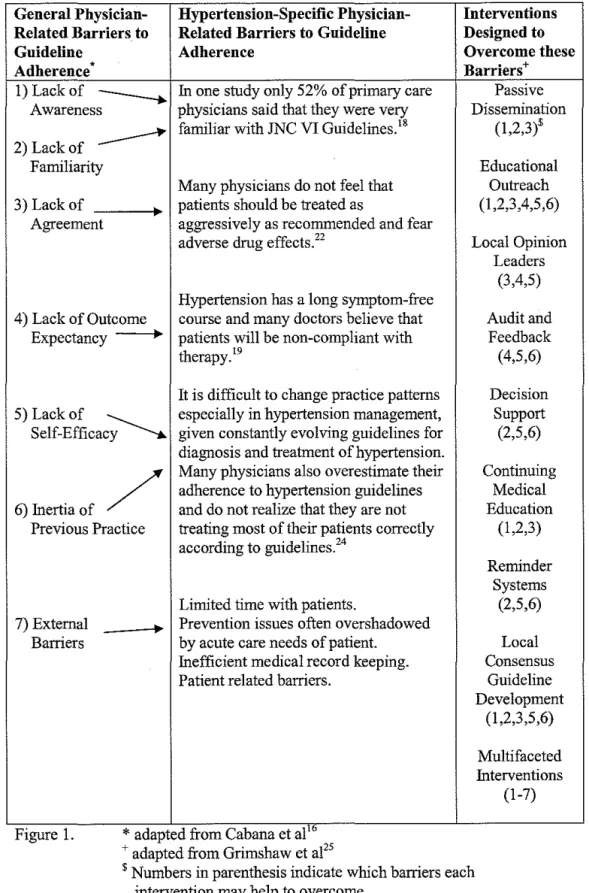
inertia of previous practice. Figure 1 summarizes general and specific
barriers to hypertension guideline adherence.
Interventions to Increase Physician Adherence to Guidelines:
Given the failure of passive guideline dissemination strategies to
affect physician behavior or patient outcomes, several active dissemination
and implementation strategies have been employed. Grimshaw and
coworkers have provided a framework for categorizing quality assurance and
educational interventions designed to change physician behavior.25 The
categories of interventions include: passive dissemination of guidelines,
educational outreach, local opinion leaders, audit and feedback,
computer-based decision support systems, reminder systems, continuing medical
education, local consensus guideline development and multifaceted
interventions. See Figure I for a list of interventions and what barriers they
may address.
"Passive Dissemination of educational materials involves distribution of published or printed recommendations for clinical care,
including clinical practice guidelines, audio-visual materials, and electronic
publications. These materials may have been delivered personally or through
mass mailings. "25 Passive dissemination of educational materials is familiar,
convenient and low cost and may be useful in overcoming several
physician-related barriers to hypertension guideline adherence: including lack of
awareness, lack of familiarity and lack of agreement with guidelines. The low
intensity nature of passive dissemination of educational materials makes it
difficult to measure the effects of this intervention strategy.
Educational Outreach visits include "use of a trained person who meets with providers in their practice settings to provide information with the
intent of changing the provider's performance."25 Educational outreach has
the potential to overcome many physician-related barriers to hypertension
guideline adherence. Like passive dissemination of educational materials,
educational outreach can address barriers relating to lack of awareness, lack
of familiarity and lack of agreement with guidelines. Furthermore, by
delivering tailored messages to individual practitioners, educational outreach
can address barriers including: lack of outcome expectancy, lack of
self-efficacy, and inertia of previous practice.
Local Opinion Leaders are "providers nominated by their colleagues as educationally influentia1."25 Local opinion leaders advocate a change and
attempt to influence the behavior of colleagues. Local opinion leaders are
often used to deliver educational outreach, and in this review I will treat local
opinion leaders as a subgroup of educational outreach interventions. Local
opinion leaders can strengthen educational outreach, by lending authority to
the message delivered. Since they are generally respected authorities, local
opinion leaders may be effective in improving hypertension guideline
adherence by overcoming the following barriers: lack of agreement with
guidelines, lack of outcome expectancy, and lack of self-efficacy.
Audit and Feedback includes "any summary of clinical performance over a specified period of time" given to the provider in written or verbal
format, and "may include recommendations for clinical care."25 Generally
audit and feedback appears to be a useful way of measuring physician
performance and providing specific guidance to physicians in areas that need
improvement. Audit and Feedback may be beneficial in overcoming outcome
expectancy and self-efficacy by demonstrating to the physician the effects of
treatment in his or her patient population. Audit and feedback may also help
to overcome inertia of previous practice by giving underperforming
physicians hard evidence that their patient management is below either goal
performance or the performance of peers.
Computer-Based Decision Support Systems provide diagnostic or therapeutic advice to physicians at the point of care. In the management of
hypertension, computer-based decision support may help to overcome several
barriers to guideline adherence. First, by providing information about
problem-specific guidelines, physicians can gain familiarity with appropriate
guidelines. Decision support can also address lack of self-efficacy and inertia
of previous practice, by providing targeted advice to the physician for each
patient. Currently, computer-based decision support may be too expensive for
most practitioners, but wider use may make it affordable in the near future.
Reminder Systems include "Any intervention that prompts the health care provider to perform a patient- or encounter-specific clinical action."25
Like decision support systems, reminder systems may be effective in
overcoming lack of familiarity, lack of self-efficacy, and inertia of previous
practice regarding hypertension management. Reminder systems can be
paper-based or computer-based and may currently be more feasible and less
costly to individual providers than computerized decision support.
Continuing Medical Education (CME) is compulsory for many health care providers and is very heterogeneous in terms of the nature of the
educational method, the duration, the content and the intensity. Continuing
medical education may involve self-study, meetings, conferences, lectures,
workshops, seminars, symposia and classes. In a review by Thomson
O'Brien and coworkers, traditional didactic lectures appeared to be generally
ineffective in changing physician behavior. However, interactive meetings,
small group meetings, and practice sessions to improve skills were
moderately effective in several studies.26 In the management of hypertension,
CME may help overcome barriers relating to: lack of awareness, lack of
familiarity, and lack of agreement with guidelines.
Local Consensus Development of guidelines involves "inclusion of participating providers in discussion to ensure that they agree that the chosen
clinical problem is important and the approach to managing the problem is
appropriate."25 Involving people in the decision-making process about issues
that will affect them may lead to their having more of a sense of ownership
and a greater commitment to adhering to the decision reached.Z7 In the
management of hypertension, local consensus development and
implementation of guidelines may help to overcome barriers relating to: lack
of awareness, lack of familiarity, lack of agreement, lack of self-efficacy, and
inertia of previous practice.
~--Multifaceted Interventions, which include any combination of the strategies discussed above, are generally more effective than any one strategy
alone.25' 28 In general, active approaches are much more effective than passive
strategies and no one strategy is effective in all circumstances. Interventions
based on assessment of potential barriers and targeted to specific
circumstances are more likely to be effective than interventions not targeted
to specific circumstances.25 Multifaceted interventions have the potential to
overcome many barriers simultaneously and may provide the best means to
affect physician behavior change.
Interventions to Increase Adherence to Hypertension Guidelines:
Although there have been a large number of studies examining the
I
I
effectiveness of professional educational or quality assurance interventions to
broadly affect physician change or patient outcomes, there are very few
studies examining the effects of these interventions on the management of
specific disease states. 29 Because no single physician change intervention has
been shown to work best in all circumstances, it follows that interventions
should be tailored to specific circumstances. Given its profound societal
health impacts, the suboptimal treatment of the population, and the
complexity of its management, hypertension is an important clinical condition
L
that warrants an evaluation of educational or quality improvement
interventions specifically targeting physician behavior·related to its diagnosis
and treatment. The relative importance of barriers to hypertension
management may be different enough from other disease states, that effective
interventions may differ for treating hypertension and treating other
conditions. It is not known ifthe effectiveness quality assurance or
educational interventions is different across disease states.
To date there has been one review of interventions designed to change
physician behavior with regards to hypertension management.29 Tu and
coworkers reviewed twelve studies published between January 1966 and
August 2000 and found that most interventions were ineffective in changing
physician behavior. This review included only randomized controlled trials.
Although controlled cohort studies, time-series analyses and case control
studies are weaker designs, much can still be learned from these types of
studies. The authors also fail to provide any perspective on the relative size or
quality of the studies reviewed, making their findings difficult to interpret.
Additionally, since 2000 several additional studies describing interventions
designed to change physician behavior with regards to hypertension
management have been published. Therefore a current systematic review of
interventions designed to change physicians' hypertension management
behaviors is necessary.
15
'
Figure 1. Physician-Related Barriers to Guideline Adherence and Interventions Designed to Overcome these Barriers.
General Physician- Hypertension-Specific Physician- Interventions Related Barriers to Related Barriers to Guideline Designed to
Guideline Adherence Overcome these
Adherence • Barriers+
1) Lack of
--...
In one study only 52% of primary care Passive Awareness physicians said that they were very Dissemination---
familiar with JNC VI Guidelines.18 (1,2,3)$2) Lack of
Familiarity Educational
Many physicians do not feel that Outreach
3) Lack of patients should be treated as (1,2,3,4,5,6)
Agreement aggressively as recommended and fear
adverse drug effects.Z2 Local Opinion
Leaders (3,4,5) Hypertension has a long symptom-free
4) Lack of Outcome course and many doctors believe that Audit and Expectancy patients will be non-compliant with Feedback
therapy.19 (4,5,6)
It is difficult to change practice patterns Decision 5)Lackof ~ especially in hypertension management, Support
Self-Efficacy given constantly evolving guidelines for (2,5,6) diagnosis and treatment of hypertension.
/
Many physicians also overestimate their adherence to hypertension guidelines Continuing Medical 6) Inertia of and do not realize that they are not EducationPrevious Practice treating most of their patients correctly (1,2,3) according to guidelines24
Reminder Systems
Limited time with patients. (2,5,6)
7) External -"' Prevention issues often overshadowed
Barriers by acute care needs of patient. Local
Inefficient medical record keeping. Consensus
Patient related barriers. Guideline
Development (1,2,3,5,6)
Multifaceted Interventions
(1-7)
Figure 1.
*
adapted from Cabana et a! Io + adapted from Grimshaw et al25$ Numbers in parenthesis indicate which barriers each
intervention may help to overcome.
16
~
I
"
Methods
Search Strategy
I conducted a systematic review ofthe literature regarding
interventions aimed at changing physician behavior to adhere to clinical
practice guidelines in the treatment of hypertension. I searched all articles
limited to English language published from January I, 1966 to May!O, 2005
using MEDLINE. The following search phrase was used: "Hypertension
AND (guideline adherence OR academic detailing OR guideline
dissemination OR opinion leader OR chart review OR continuing medical
education OR audit and feedback OR outreach OR physician behavior OR
practice guidelines OR program evaluation OR quality assurance OR
continuous quality improvement OR recall system OR reminder system OR
decision support system OR registries OR medical record system) AND (trial
OR clinical trial OR randomized control trial OR intervention)." The above
search phrase was exploded by the MEDLINE search engine to include both
MESH terms and Text terms. Additional candidate articles were identified by
reviewing bibliographies of articles from the search and bibliographies from
various review articles and books.
Inclusion and Exclusion Criteria
Randomized controlled trials, cohort studies, case control and
time-series analyses with objective measures of the effects of a physician-targeted
educational or quality assurance intervention on physician hypertension ·
management behavior or patient blood pressure outcomes were included.
Articles that described case series studies or studies that did not measure
either physician behavior or patient outcomes were excluded from the study.
Studies were excluded in which physician self-reported change, physician
competency exams, or patient compliance was the outcome measure. Studies
were also excluded if the major target of the intervention was the patient or a
healthcare professional other than a physician.
Data Extraction
I reviewed the abstracts of candidate articles from the initial search. I
then reviewed the full text of those articles that appeared to meet the initial
inclusion criteria. The following data was then abstracted from each article:
study design, study population, description of the intervention, comparability
of the subjects, outcomes (description of physician behavior measurement,
description of patient outcome measurement), potential for bias, and a
description of the overall quality. Scores were determined from the sum of
study design (1 point for time-series analysis, or case control, 2 points for
controlled cohort study, 3 points for randomized controlled trial), selection
bias (3 points for low potential, 2 points for medium potential, I point for low
potential), measurement bias (3 points for low potential, 2 points for medium
potential, 1 point for low potential), and confounding (3 points for low
potential, 2 points for medium potential, 1 point for low potential). A quality
rating was assigned to each article based on a total score of 1-12. Good
articles scored from 9-12, fair articles scored from 5-8, and poor articles
scored from 1-4. The data abstraction form used for this review is included in
Appendix A.
Results
Search results
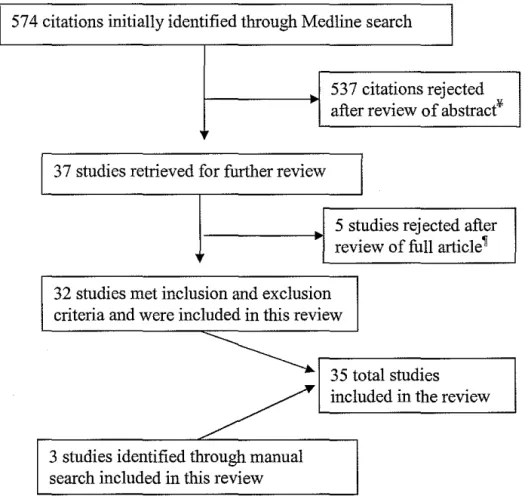
The initial MEDLINE search yielded 574 citations. After review of
abstracts 53 7 studies were excluded for reasons including: excluded study
design, physicians were not the targeted group, review article, protocol article,
duplicate article or no objective measurement. The remaining 37 full text
articles were reviewed in their entirety. After applying inclusion and
exclusion criteria to the full text articles, 32 were included in the review. Five
full text articles were excluded because they had no objective measurements
(2 studies), unclear intervention (1 study) or intervention did not target
physicians (2 studies). After manual review of bibliographies, 3 additional
studies were found that met inclusion and exclusion requirements. In total,
information from 35 studies was abstracted into evidence tables for review.
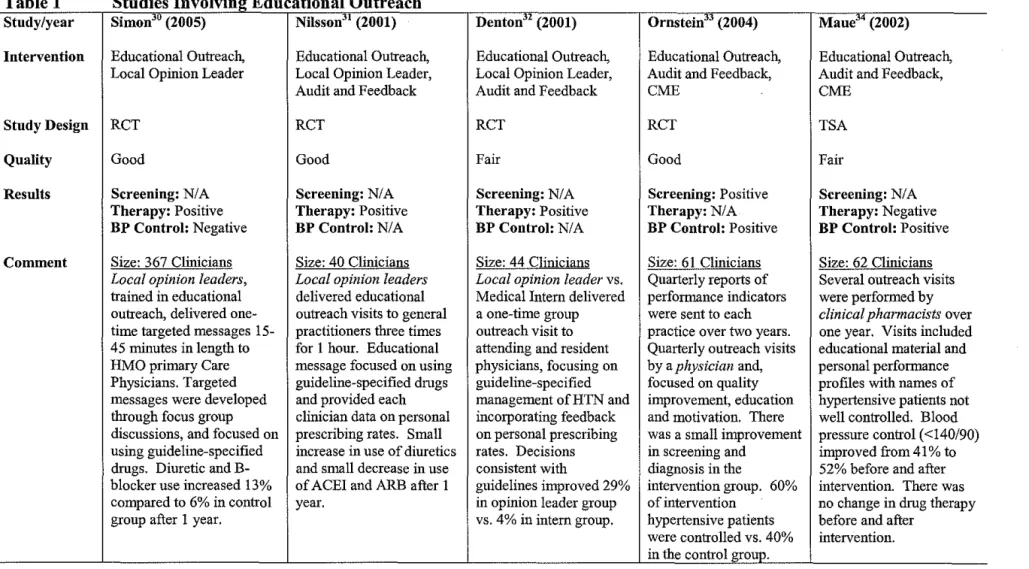
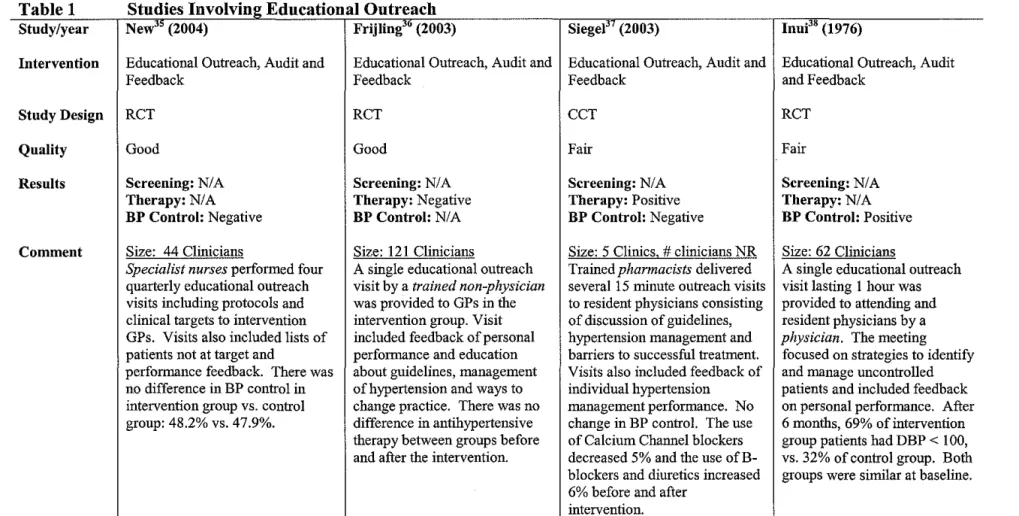
See Figure 2 for flow of articles. See Tables 1-7 and Appendix B and
Appendix C for sununary data on each reviewed article.
Figure 2
Search Results
The Medline search was conducted using the following search term: "Hypertension AND (guideline adherence OR academic detailing OR guideline dissemination OR opinion leader OR chart review OR continuing medical education OR audit and feedback OR outreach OR physician behavior OR practice guidelines OR program evaluation OR quality assurance OR continuous quality improvement OR recall system OR reminder system OR decision support system OR registries OR medical record system) AND (trial OR clinical trial OR randomized control trial OR intervention)." Manual search strategy included review of bibliographies and discussion with experts.
I
57 4 citations initially identified through Medline searchJ
I
3 7 studies retrieved for further review537 citations rejected after review of abstract¥
5 studies rejected after review of full article~
32 studies met inclusion and exclusion criteria and were included in this review
~
35 total studies~
included in the review3 studies identified through manual search included in this review
Figure 1. Flow of articles
¥Reasons for exclusion of abstracts included: review article, protocol article non-experimental study, duplicate article, study design, no objective measures or physician not targeted group.
~Reasons for exclusion of full articles included: no objective measurements (2 studies), unclear intervention (1 study) or intervention did not target physicians (2 studies).
Table 1 Studies Involvinl! Educational Outreach Study/year Simon30 (2005)
I
Nilsson31 (2001)Intervention I Educational Outreach, Local Opinion Leader
Study Design I RCT
Quality I Good
Results I Screening: N/ A Therapy: Positive BP Control: Negative
Comment
I
Size: 367 CliniciansLocal opinion leaders,
trained in educational outreach, delivered one-time targeted messages 15-45 minutes in length to HMO primary Care Physicians. Targeted messages were developed through focus group discussions, and focused on using guideline-specified drogs. Diuretic and B-blocker use increased 13% compared to 6% in control group after I year.
Educational Outreach, Local Opinion Leader, Audit and Feedback
RCT
Good
Screening: N/ A Therapy: Positive BP Control: N/ A
Size: 40 Clinicians
Local opinion leaders
delivered educational outreach visits to general practitioners three times for I hour. Educational message focused on using guideline-specified drugs and provided each clinician data on personal prescribing rates. Small increase in use of diuretics and small decrease in use of ACE! and ARB after I year.
Denton'' (2001)
Educational Outreach, Local Opinion Leader, Audit and Feedback
RCT
Fair
Screening: N/ A Therapy: Positive BP Control: N/ A
Size: 44 Clinicians
Local opinion leader vs.
Medical Intern delivered a one-time group outreach visit to attending and resident physicians, focusing on guideline-specified management ofHTN and incorporating feedback on personal prescribing rates. Decisions consistent with
guidelines improved 29% in opinion leader group vs. 4% in intern group.
21
Ornstein" (2004)
Educational Outreach, Audit and Feedback, CME
RCT
Good
Screening: Positive Therapy: N/A BP Control: Positive
Size: 61 Clinicians Quarterly reports of performance indicators were sent to each
practice over two years.
Quarterly outreach visits by a physician and, focused on quality improvement, education and motivation. There
was a small improvement
in screening and diagnosis in the
intervention group. 60% of intervention
hypertensive patients were controlled vs. 40% in the control group,
Maue34 (2002)
Educational Outreach, Audit and Feedback, CME
TSA
Fair
Screening: N/ A Therapy: Negative BP Control: Positive
Size: 62 Clinicians Several outreach visits were performed by
clinical pharmacists over
one year. Visits included educational material and personal performance profiles with names of hypertensive patients not well controlled. Blood pressure control (<140/90) improved from 41% to 52% before and after intervention. There was no change in drog therapy before and after
Table 1 Study/year Intervention Study Design Quality Results Comment
Studies Involviu~: Educational Outreach
New3' (2004)
I
Frijling" (2003)Educational Outreach, Audit and Feedback
RCT
Good
Screening: N/ A Therapy: N/ A BP Control: Negative
Size: 44 Clioicians
Specialist nurses performed four
quarterly educational ontreach visits iocluding protocols and clinical targets to intervention GPs. Visits also included lists of patients not at target and
performance feedback. There was no difference in BP control io intervention group vs. control group: 48.2% vs. 47.9%.
Educational Outreach, Audit and Feedback
RCT
Good
Screening: N/ A Therapy: Negative BP Control: N/A
Size: 121 Clioicians
A siogle educational outreach visit by a trained non-physician was provided to GPs in the intervention group. Visit iocluded feedback of personal performance and education about guidelines, management of hypertension and ways to change practice. There was no difference in antihypertensive therapy between groups before and after the intervention.
Siegel" (2003)
Educational Outreach, Audit and Feedback
CCT
Fair
Screening: N/ A Therapy: Positive BP Control: Negative
Size: 5 Clinics, #clinicians NR Traioed pharmacists delivered
several 15 minute outreach visits to resident physicians consisting of discussion of guidelines, hypertension management and barriers to successful treatment. Visits also included feedback of individual hypertension
management performance. No change in BP control. The use of Calcium Channel blockers decreased 5% and the use ofB-blockers and diuretics increased 6% before and after
intervention.
Inui38 (1976)
Educational Outreach, Audit and Feedback
RCT
Fair
Screening: N/ A Therapy: N/A BP Control: Positive
Size: 62 Clinicians
A smgle educational outreach visit lasting I hour was provided to attending and resident physicians by a
physician. The meeting
focused on strategies to identify and manage uncontrolled patients and included feedback on personal performance. After 6 months, 69% of intervention group patients had DBP < I 00, vs. 32% of control group. Both groups were similar at baseline.
Table I. Nioe studies involving Educational Outreach. Three other studies iovolving Educational Outreach are included io Table 7 (multifaceted interventions). RCT = Randomized Controlled Trial, TSA =Time-series Analysis, CCT = Controlled Cohort Trial. The characteristics of the person delivering the outreach are in italics.
22
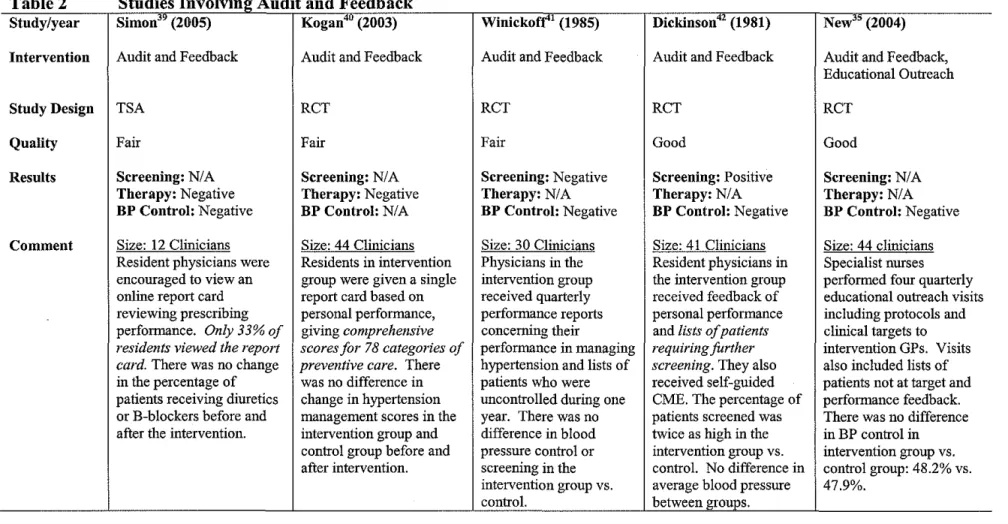
Table 2 Studies Involvi11g_ Audit and Feedback Study/year Simon39 (2005)
I
Kogan40 (2003)Intervention I Audit and Feedback
Study Design I TSA Quality I Fair
Results I Screening: N/ A
Comment
Therapy: Negative BP Control: Negative
I Size: 12 Clinicians Resident physicians were encouraged to view an online report card reviewing prescribing performance. Only 33% of residents viewed the report
card. There was no change
in the percentage of patients receiving diuretics orB-blockers before and after the intervention.
'T
Audit and Feedback
RCT
Fair
Screening: N/ A Therapy: Negative BP Control: N/A
Size: 44 Clinicians Residents in intervention group were given a single report card based on
personal performance,
giving comprehensive scores for 78 categories of
preventive care. There
was no difference in change in hypertension management scores in the intervention group and control group before and after intervention.
Winickoff'1 (1985)
Audit and Feedback
RCT
Fair
Screening: Negative Therapy: N/A BP Control: Negative
Size: 30 Clinicians Physicians in the intervention group received quarterly performance reports concerning their
performance in managing hypertension and lists of patients who were uncontrolled during one year. There was no difference in blood
pressure control or
screening in the intervention group vs. control.
23
_,"'''111!11111rnn•''t"mm~T""'~--,
Dickinson42 (1981)
Audit and Feedback
RCT
Good
Screening: Positive Therapy: N/A BP Control: Negative
Size: 41 Clinicians Resident physicians in the intervention group received feedback of personal performance
and lists of patients
requiring fUrther
screening. They also
received self-guided CME. The percentage of patients screened was twice as high in the intervention group vs. control. No difference in average blood pressure between groups.
r·
New35 (2004)
Audit and Feedback, Educational Outreach
RCT
Good
Screening: N/ A Therapy: N/A BP Control: Negative
Table 2 Study/year Intervention Study Design Quality Results Comment
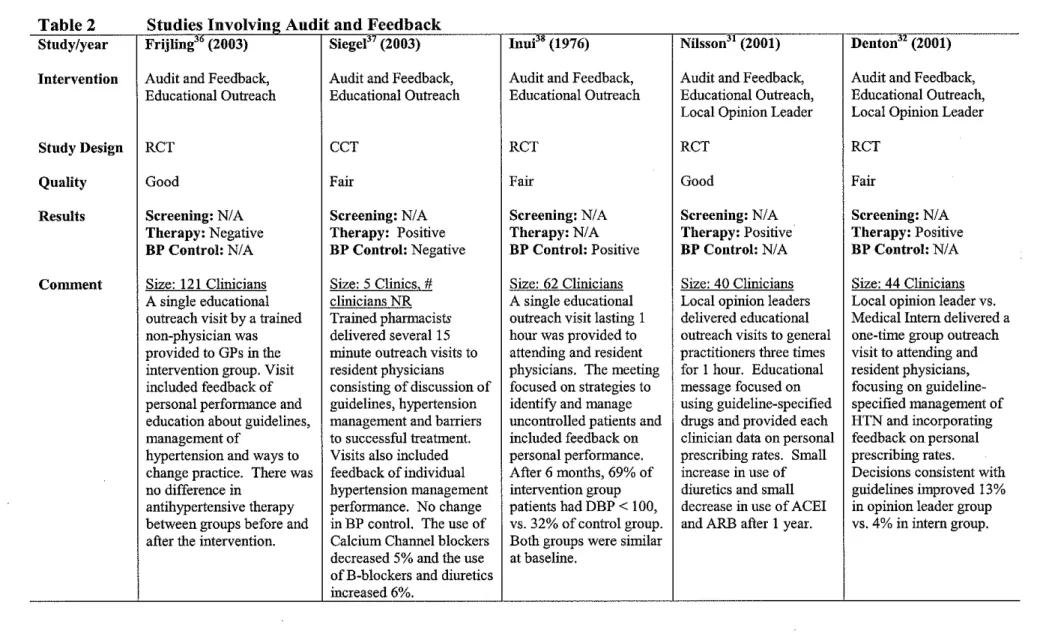
Studies Involving Audit and Feedback Frijling36 (2003)
I
Siegel37 (2003)Audit and Feedback, Educational Outreach
RCT
Good
Screening: N/ A Therapy: Negative BP Control: N/A
Size: 121 Clinicians A single educational outreach visit by a trained non-physician was provided to GPs in the intervention group. Visit included feedback of personal performance and education about guidelines, management of
hypertension and ways to change practice. There was no difference in
antihypertensive therapy between groups before and after the intervention.
Audit and Feedback, Educational Outreach
CCT
Fair
Screening: N/ A Therapy: Positive BP Control: Negative
Size: 5 Clinics, # clinicians NR Trained pharmacists delivered several 15
minute outreach visits to
resident physicians consisting of discussion of guidelines, hypertension management and barriers to successful treatment. Visits also included feedback of individual hypertension management performance. No change in BP control. The use of Calcium Channel blockers decreased 5% and the use ofB-blockers and diuretics increased 6%.
Inni" (1976)
Audit and Feedback, Educational Outreach
RCT
Fair
Screening: N/ A Therapy: N/ A BP Control: Positive
Size: 62 Clinicians A single educational outreach visit lasting 1 hour was provided to attending and resident physicians. The meeting focused on strategies to identify and manage uncontrolled patients and included feedback on personal performance. After 6 months, 69% of intervention group patients had DBP < 100, vs. 32% of control group. Both groups were similar at baseline.
24
"''''""''"" ,,. ·'""'''D_.IIrl'!"'l",niW1"H'" ~
Nilsson31 (2001)
Audit and Feedback, Educational Outreach, Local Opinion Leader
RCT
Good
Screening: N/ A Therapy: Positive BP Control: N/A
Size: 40 Clinicians Local opinion leaders delivered educational outreach visits to general practitioners three times for 1 hour. Educational message focused on using guideline-specified drugs and provided each clinician data on personal prescribing rates. Small
increase in use of
diuretics and small decrease in use of ACEI and ARB after I year.
Denton" (2001)
Audit and Feedback, Educational Outreach, Local Opinion Leader
RCT
Fair
Screening: N/ A Therapy: Positive BP Control: N/ A
Size: 44 Clinicians Local opinion leader vs. Medical Intern delivered a one-time group outreach visit to attending and resident physicians, focusing on guideline-specified management of HTN and incorporating feedback on personal prescribing rates.
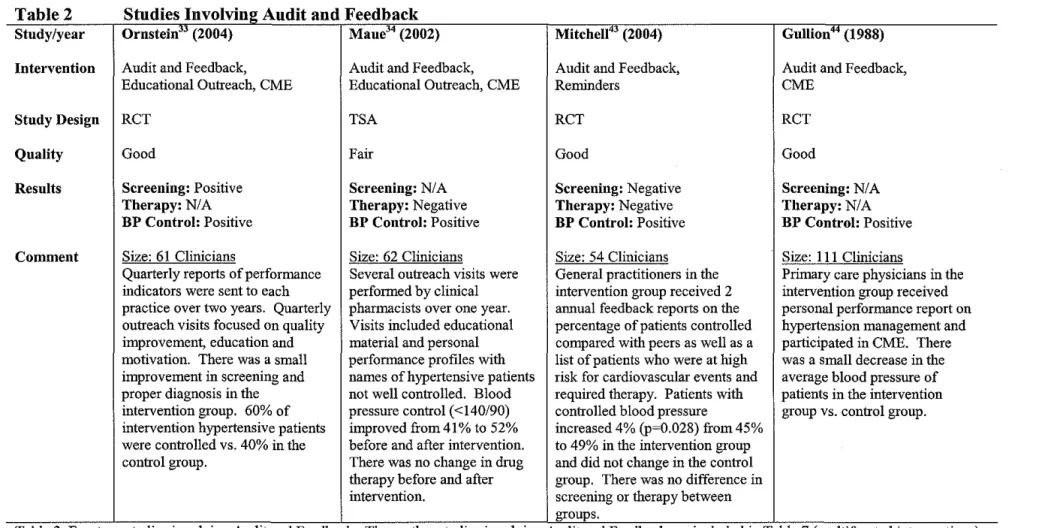
Table 2 Studies Involving Audit and Feedback Study/year Ornstein" (2004)
I
Maue34 (2002)Intervention I Audit and Feedback, Educational Outreach, CME
Study Design I RCT Quality I Good
Results I Screening: Positive Therapy: N/ A BP Control: Positive
Comment I Size: 61 Clinicians
Quarterly reports of performance indicators were sent to each practice over two years. Quarterly outreach visits focused on quality improvement, education and motivation. There was a small
improvement in screening and
proper diagnosis in the intervention group. 60% of intervention hypertensive patients were controlled vs. 40% in the control group.
Audit and Feedback, Educational Outreach, CME
TSA
Fair
Screening: N/ A Therapy: Negative BP Control: Positive
Size: 62 Clinicians
Several outreach visits were performed by clinical pharmacists over one year. Visits included educational material and personal performance profiles with names of hypertensive patients not well controlled. Blood pressure control (<140/90) improved from 41% to 52%
before and after intervention.
There was no change in drug therapy before and after
intervention.
Mitchell'~ (2004)
Audit and Feedback, Reminders
RCT
Good
Screening: Negative Therapy: Negative BP Control: Positive
Size: 54 Clinicians General practitioners in the intervention group received 2 annual feedback reports on the percentage of patients controlled compared with peers as well as a list of patients who were at high
risk for cardiovascular events and
required therapy. Patients with controlled blood pressure
increased 4% (p~0.028) from 45% to 49% in the intervention group and did not change in the control group. There was no difference in screening or therapy between groups.
Gullion" (1988)
Audit and Feedback, CME
RCT
Good
Screening: N/ A Therapy: N/A BP Control: Positive
Size: Ill Clinicians
Primary care physicians in the intervention group received personal performance report on hypertension management and participated in CME. There was a small decrease in the average blood pressure of patients in the intervention group vs. control group.
Table 2. Fourteen studies involving Audit and Feedback. Three other studies involving Audit and Feedback are included in Table 7 (multifaceted interventions). RCT ~Randomized Controlled Trial, TSA ~Time-series Analysis, CCT ~ Controlled Cohort Trial.
25
~ -~---
s
I l0
---
--. --.-- D--- --
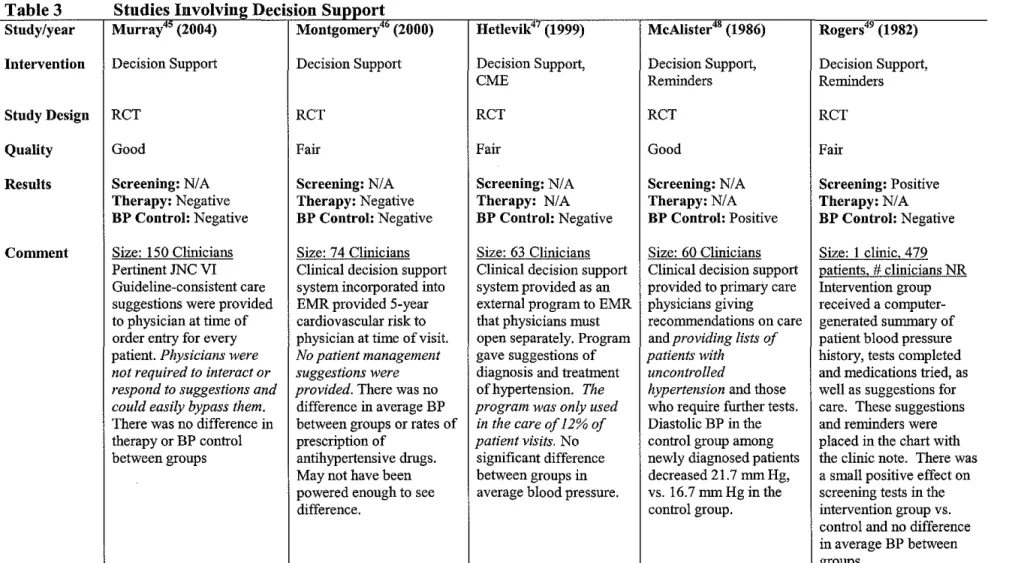
- · 0Study/year Murray4' (2004) Montgomery•• (2000) Hetlevik"' (1999) McAlister•• (1986) Rogers" (1982)
Intervention Decision Support Decision Support Decision Support, Decision Support, Decision Support, CME Reminders Reminders
Study Design RCT RCT RCT RCT RCT
Quality Good Fair Fair Good Fair
Results Screening: N/ A Screening: N/ A Screening: N/ A Screening: N/ A Screening: Positive Therapy: Negative Therapy: Negative Therapy: N/A Therapy: N/A Therapy: N/A BP Control: Negative BP Control: Negative BP Control: Negative BP Control: Positive BP Control: Negative
Comment Size: 150 Clinicians Size: 74 Clinicians Size: 63 Clinicians Size: 60 Clinicians Size: I clinic, 4 79 Pertinent JNC VI Clinical decision support Clinical decision support Clinical decision support :Qatients, # clinicians NR Guideline-consistent care system incorporated into system provided as an provided to primary care Intervention group suggestions were provided EMR provided 5-year external program to EMR physicians giving received a computer-to physician at time of cardiovascular risk to that physicians must recommendations on care generated summary of order entry for every physician at time of visit. open separately. Program and providing lists of patient blood pressure patient. Physicians were No patient management gave suggestions of patients with history, tests completed
not required to interact or suggestions were diagnosis and treatment uncontrolled and medications tried, as
respond to suggestions and provided. There was no ofhypertension. The hypertension and those well as suggestions for
could easily bypass them. difference in average BP program was only used who require further tests. care. These suggestions
There was no difference in between groups or rates of in the care of 12% of Diastolic BP in the and reminders were
therapy or BP control prescription of patient visits. No control group among placed in the chart with between groups antihypertensive drugs. significant difference newly diagnosed patients the clinic note. There was
May not have been between groups in decreased 21.7 mm Hg, a small positive effect on powered enough to see average blood pressure. vs. 16.7 mm Hg in the screening tests in the difference. control group. intervention group vs.
control and no difference in average BP between groups.
Table 3. Five studies involving Decision Support. RCT =Randomized Controlled Trial, TSA =Time-series Analysis, CCT =Controlled Cohort Trial.
Table 4 Study/year Intervention Study Design Quality Results Comment
Studies Involving Reminders Toth-Pal'" (2004)
I
RosSfl (1994)Reminders
RCT
Good
Screening: Positive Therapy: N/ A BP Control: N/A
Size: 20 Clioiciaos Computerized reminder of tests that the individual patient required was displayed to the physician at the time of order entry and was integrated into the established EMR. The rate of screening was 13.3% higher in intervention group vs. control.
Reminders
RCT
Good
Screening: N/ A Therapy: Positive BP Control: Negative
Size: 35 Clinicians Reminders consisted of a form placed in the chart of all patients taking calcium channel blockers (CCB) that asked the physician to switch to a diuretic or B-b1ocker or check a box describiog the indication for the patient to remaio on CCB. The physician was required to interact with form and 72% were
completed. 11% of patients
were switched from CCB in intervention group vs.
1% of controls. No difference in blood
I pressure between groups.
McDowejj<Z (1989)
Reminders
RCT
Good
Screening: Positive Therapy: N/A BP Control: N/A
Size: 1 clinic. 5357 patients. # clinicians NR
Prioted reminders placed on the chart of patients requiring blood pressure
screening. Screening increased in the
intervention group 30.7% vs. 21.1% io the control group. 27 Barnett" (1983) Reminders RCT Good Screening: Positive Therapy: N/A BP Control: N/ A
Size: 1 clinic.
115 patients, # clioiciaos NR
Reminder lists of patients with diastolic BP > 100
mm Hg were sent ·
repeatedly to
intervention physicians until patient follow- up
was scheduled. After 20
months, 98% of intervention group patients had follow-up appointroent scheduled vs. 46% of controls.
Bulpitt" (1976)
Reminders
RCT
Good
Screening: N/ A Therapy: N/ A BP Control: Negative
Size: 3 clinics,
278 patients, #clinicians NR
Computerized summary was placed io the chart with clinic note of intervention patients. The sununary consisted of the patient's hypertension history, symptoms, treatroent, and blood pressure for each visit. After one year, there was no difference in the average BP of
Table4 Study/year Intervention Study Design Quality Results Comment
Studies Involvi~~jt Reminders
Sanders" (2002) J Cohen" (1985)
Reminders
RCT
Poor
Screening: N/ A Therapy: Negative BP Control: N/A
I
Size: 22 Clinicians HHighly visible" reminder with JNC VI algorithm of care placed on the chart cover of intervention group before the patient visit. There was no difference in medication changes between intervention and control group. Serious flaws with internal validity, including: no physician randomization, possible large cluster effect, small sample, and no guarantee that physicians actually saw the reminders or knew what they were.Reminders, Automatic Scheduling TSA Fair Screening: Positive Therapy: Positive BP Control: N/ A
Size: 10 Clinicians
Automatic scheduling of
patients requiring further
blood pressure screening combined with chart reminders led to 40% decrease in the number of patients who required screening but didn't get it. Also resulted in a 30% decrease in the number of patients without
antihypertensive prescription who had an indication for drug therapy.
Mitchell4' (2004)
Reminders,
Audit and Feedback
RCT
Good
Screening: Negative Therapy: Negative BP Control: Positive
Size: 54 Clinicians General practitioners in the intervention group received 2 annual feedback reports on the percentage of patients controlled as well as a
list of patients who were at high risk for
cardiovascular events.
Patients with controlled blood pressure increased from 45% to 49% in the intervention group and did not change in the control group. No difference in screening or
!he!al'y_~etween groups.
McAlister'' (1986)
Reminders, Decision Support
RCT
Good
Screening: N/ A Therapy: N/A BP Control: Positive
Size: 60 Clinicians Clinical decision support provided to primary care physicians giving recommendations on care
and providing lists of
patients with uncontrolled
hypertension and those
who require further tests. Diastolic BP in the control group among newly diagnosed patients decreased 21.7 mm Hg, vs. 16.7 mmHg in the control group
Rogers4' (1982)
Reminders,
Decision Support
RCT
Fair
Screening: Positive Therapy: N/ A BP Control: Negative
Intervention group
received a
computer-generated summary of patient blood pressure history, tests completed and medications tried, as well as suggestions for care. These suggestions and reminders were placed in the chart with the clinic note. There was a small positive effect on screening tests in the intervention group vs. control and no difference in average BP between groups. Study was of
small size.
Table 4. Ten studies involving Reminders. One other study involving Reminders is included in Table 7 (multifaceted interventions). RCT ~Randomized Controlled Trial, TSA ~Time-series Analysis, CCT ~ Controlled Cohort Trial.
Table 5
Study/year Intervention Study Design Quality Results
Studies Involving Continuing Medical Education
Jennett'"' (1989)
Continuing Medical Education
RCT
Good
Screening: Positive Therapy: N/A
BP Control: N/ A
Evans58 (1986)
Continuing Medical Education
RCT
Poor
Screening: N/ A
Therapy: N/A
BP Control: Negative
Comment I Size: 22 Clinicians Size: 76 Clinicians
Intervention was a 6 week education program, consisting of Hypertensive patients were identified through community survey and newsletters, small group discussions and teleconferences. referred to their primary care provider for follow up. The intervention The control group received no education. After 12 months, group of providers received 14 weekly installments of educational
the intervention group performed 42.2% of recommended materials and the control group received no education. There were
screening and follow-up behaviors from a baseline of 14.7%. similar decreases in blood pressure in both groups. Referral alone may The control group performed I 0.1% of recommended have accounted for decrease in BP in both groups. The study suffers screening and follow-up behaviors from a baseline of 135%. from serious flaws in internal validity.
Table 5. Two studies involving Continuing Medical Education alone. RCT =Randomized Controlled Trial, TSA =Time-series Analysis, CCT =Controlled Cohort Trial.
Table 6 Studies Involvi~~g_ Local Consensus Development of Guidelines
Study/year Avanzini" (2002) I Onion'" (1996)
Intervention I Local Consensus Guideline Development
Study Design I CCT
Quality I Fair
Results I Screening: N/ A
Comment
Therapy: Positive
BP Control: Positive
Size: 90 Clinicians
Small group of physicians developed a simple, evidence-based guideline protocol and implemented it in practice.
Recommended drug use improved by several percentage points in intervention group vs. no change in control. Intervention group average blood pressure fell from 151.8/86.0 mm Hg to 143.1/81.4 mm Hg. There was no change in average blood pressure in control
_llf<)UP.
Local Consensus Guideline Development
CCT
Fair
Screening: N/ A
Therapy: Positive
BP Control: N/ A
Size: 69 Clinicians
Small group of physicians produced evidence-based guidelines for hypertension
management. Drug of choice was
Bendrofluazide. The number of prescribed daily doses ofBendrofluazide in the intervention group was double that of the national (UK) average after the
intervention. Prescription rates were
similar at baseline.
Putnam'I (1989)
Local Consensus Guideline Development
RCT
Fair
Screening: N/ A
Therapy: N/ A
BP Control: Negative
Size: 40 Clinicians
Small group of physicians produced evidence-based guidelines for hypertension management. There was no difference in the number of uncontrolled hypertensive patients becoming controlled between intervention and control.
Table 6. Three studies involving Local Consensus Development of Guidelines. One other study of Local Consensus is included in the Table 7 (multifaceted interventions). RCT =Randomized Controlled Trial, TSA =Time-series Analysis, CCT =Controlled Cohort Trial.
30
Table 7 Studies Involvine Multifaceted Interventions
Study/year Mcdermott" (2003) I Goldberg63 (1998)
Intervention I Educational Outreach, Audit and Feedback, Reminders, CME
Study Design I TSA
Quality I Fair
Results I Screening: Positive
Comment
Therapy: Positive BP Control: Positive
Size: 21 clinics, 921 patients# clinicians NR This multifaceted intervention used
Educational outreach, Audit and Feedback, Reminders and CME targeted at providers of
diabetic care in a remote indigenous
community in Australia. Over three years,
the% of patients with BP < 140/90 mm Hg
increased from 40% to 64%. Screening rates
increased from 70% to 77%. Prescriptions for hypertension increased from 80% to 91.4%. This is only a fair quality study though, given its uncontrolled before and after design.
Educational Outreach, Local Opinion Leader, Continuous Quality
Improvement, CME
RCT
Fair
Screening: N/ A
Therapy: Negative BP Control: Negative
Size: 95 clinicians
·1-he mtervention was Educational
Outreach with a Local Opinion Leader, CME and Continuous Quality
Improvement (CQI). No difference was found between groups in average prescribing patterns or average blood pressure control. However, CQI is highly variable and depends on implementation
in each practice. Some practices
improved while others showed no
improvement.
Aucott64 (1996)
Educational Outreach, Local Opinion Leader, Audit and Feedback,
Local Consensus Guideline Development
CCT
Fair
Screening: N/ A
Therapy: Positive BP Control: Positive
Size: I clinic, 2154 patients,# clinicians NR
Intervention group received intense
Educational Outreach with Local Opinion Leaders, Audit and Feedback of individual performance and employed local
consensus development of guidelines. Diuretic therapy was initiated in 17.4% of intervention group vs. 11.9% in control. B-blockers were initiated in 7.2% of
intervention vs. 4.7% in control. Calcium
Channel Blockers (a non-indicated drug)
were initiated in 7.8% of intervention
group vs. 10.6% in control group. Blood pressure control was also moderately
greater in the intervention group vs.
control.
Table 7. Three studies of Multifaceted Interventions not included in above tables. Controlled Cohort Trial.
RCT ~ Randomized Controlled Trial, TSA ~ Time-series Analysis, CCT ~
31
General Results of Study
Abstracted data from each study appraised is presented in Tables 1-7
and Appendix B and C. Overall there were 18 studies of good quality, 15
studies of fair quality and 2 studies of poor quality. Of 11 studies measuring
screening or follow-up, 6 studies of good quality were associated with a
positive effect33· 42• 50· 52· 53· 57 and 3 studies of fair quality were associated with
a positive effect.49• 56• 62 The remaining 2 studies measuring screening or
follow-up had no effect and were of good quality.41· 43 Of 19 studies
measuring therapy change, 3 studies of good quality were associated with a
positive effect,30· 31· 51 7 studies of fair quality were associated with a positive
effect. 32· 37· 56· 59· 60· 62· 64 Of the 9 remaining studies measuring therapy change
with no effect, 3 studies of were of good quality, 36· 43· 45, 5 studies were of fair
quality, 34• 39· 40' 46· 63 and one study was of poor quality. 55 Of 24 studies
measuring blood pressure control, 3 studies of good quality were associated
with a positive effece3· 43· 48 and 5 studies of fair quality were associated with
a positive effect.34· 38· 59· 62• 64 Of the remaining 16 studies measuring blood
pressure control that had no effect, 8 were of good quality,30· 35· 41· 42· 44• 45· 51· 54
7 were of fair quality/7· 39·46•47•49· 61· 63 and one was of poor quality. 58
This review included 11 of the 12 studies previously reviewed by Tu
and colleagues.42, 44, 46, 47, 49, 51, 53, 58, 61, 63,65 Each study from the previous
review was captured by the MEDLINE search strategy. One study by Lang
and coworkers was excluded because it was a patient-focused intervention,
not a physician-focused intervention. 66
Interventions involving Educational Outreach
Educational Outreach was employed in 12 ofthe 35 studies (Table 1).
No study employed Educational Outreach alone. Three studies explicitly
described the use of a local opinion leader to deliver the outreach. 30-32 In one
randomized controlled trial of good quality, a single Educational Outreach
visit by a Local Opinion Leader led to significant improvement in the use of
diuretics and B-blockers. 30 The intervention had no impact on blood pressure.
Two randomized controlled trials involving Educational Outreach by Local
Opinion Leaders combined with Audit and Feedback had positive effects on
physician prescribing behavior. 31' 32 Of these two studies, one was of fair
quality, consisted of a single outreach visit, and had a large impact on
prescriptions consistent with guidelines (from 28% to 57%).32 The other was
of good quality, consisted of three visits, and was associated with a small
increase in the use of diuretics and a small decrease in the number of
prescriptions of ACE Inhibitors.31
Six studies combined Educational Outreach with Audit and Feedback,
without the explicit use of a local opinion leader. 33-38 Three of these studies
were of good quality and had mixed results. 33' 35• 36 In a randomized
controlled trial by Ornstein and coworkers, physicians delivered four outreach
visits with personal feedback data to 20 clinics in 14 states, resulting in a
moderate positive impact on both screening and blood pressure control.33 In a
randomized controlled trial by New and colleagues, using specialist nurses to
deliver four outreach visits with personal feedback data to 44 clinics in
England, no impact was observed on blood pressure control. 35 In a
randomized controlled trial by Frijling and coworkers in 124 clinics in the
Netherlands, a single outreach visit by a trained non-physician with personal
feedback data resulted in no impact on prescribing behavior.36
Three other studies involving Educational Outreach combined with
Audit and Feedback alone were of fair quality?4• 37• 38 In a controlled cohort
study by Siegel and colleagues in 5 VA medical Centers in western United
States, several outreach visits by trained clinical pharmacists with personal
performance feedback data were delivered to five clinics, resulting in a large
significant decrease in prescriptions of calcium channel blockers, with no
difference in average blood pressure.37 In a time-series analysis in a large
Florida HMO, several outreach visits by trained clinical pharmacists with
personal performance feedback data was associated with an increase in the
proportion of controlled hypertensive patients from 41% to 52%.34 In a
randomized controlled trial by Inui and coworkers at the Johns Hopkins
Internal Medicine Outpatient Clinic, a single outreach visit by a physician
with personal feedback data was associated with a large increase in the
number of patients with diastolic blood pressure < 100 ( 69% in the
intervention group versus 31% in the control group at 6 months
post-intervention).
In this review educational outreach was found to be employed in over
a third of the interventions. Its greatest effects were seen in changing
physician prescribing behavior, especially when local opinion leaders were
involved and the educational material included physician-specific audit and
feedback data. 30.32• 37 The perceived credibility of the person delivering the
educational outreach appeared to have a strong impact on whether or not the
intervention changed physician behavior. The use oflocal opinion leaders,
physicians and trained pharmacists to deliver outreach generally resulted in
more favorable outcomes than when nurses or trained non-clinicians delivered
the outreach. The number of outreach visits surprisingly has little predictive
power over which interventions worked. Single visit interventions were just
as successful as multiple visit interventions.
Interventions involving Audit and Feedback
Audit and Feedback was involved in the intervention of 16 of the 35
studies reviewed. Audit and Feedback was the sole intervention in 4 studies
with mostly negative results.3942 In a randomized controlled trial of good
quality, Dickinson and colleagues used monthly Audit and Feedback to alert
Family Practice physicians of patients requiring screening.42 Screening rates
were double that of control physicians. This intervention however, had no
effect on average blood pressure between groups. In three studies of fair
quality, audit and feedback alone had no effect on screening,41 therapy,39•40 or
L
blood pressure control.39'41 In the time-series analysis by Simon and
coworkers, the intervention was an online report card ranking Internal
Medicine resident performance for the control of hypertension and diabetes?9
The intervention was weak, because residents were not required to view
report card and only 33% did so. In the randomized controlled trial by Kogan
and colleagues, the intervention was a single report ranking performance in 78
categories of preventive care.40 This may also have been a very weak
intervention, given the single report with a large number of preventive health
categories. In the randomized controlled trial by Winickoff and coworkers,
the intervention involved quarterly reports to primary care providers on
performance in hypertension management.41 This was a stronger
intervention, but was still not associated with positive effects on screening or
blood pressure control. In the four studies of audit and feedback alone, it is
either unclear how much the physicians interacted with the feedback data, or
it is clear that they generally ignored it.
Eight studies combined Audit and Feedback with Educational
Outreach and were reviewed above in the section examining the effects of
Educational Outreach.31-38 Briefly, 4 of these studies were of good quality
with mixed results/1·33·35·36 having some positive effect on screening,33
therapy/1 or blood pressure control.33 The other 4 studies using this
. . f"'' 1' ' h . d 1 32343738h.
mterventwn were o .mr qua Ity wit m1xe resu ts, · · · avmg some
positive effect on therapy2• 37 or blood pressure control.34• 38
In summary, the use of audit and feedback alone may be a fairly weak
intervention. The combination of audit and feedback with educational
outreach however, appears to be a much stronger intervention. Audit and
feedback data provides the outreach visit with hard evidence of how the