Joy E. Jones.We share what we are: user contributions and annotations in digital contributory archives.A Master‟s Paper for the M.S. in L.S. degree. April, 2015.45 pages.Advisor: Ryan Shaw
A contributory archive is one in which individual users may interact with materials through activities like commenting, tagging and sharing, but more importantly they may add content to the collection through uploading items like photos or videos and adding stories and text. This paper examines the community-led contributory archives listed at the website for the UK Community Archives and Heritage Group
(www.communityarchives.org.uk), an umbrella organization that provides a central location for community archives, as a case study for expanding our knowledge of user participation in digital archives. This study examines user-generated content in digital community archives including annotations and contributions, the type and frequency of content created, and technical specifications as insight into amateur digital preservation of heritage materials. The information gleaned from this study can be used to assess the effectiveness of community-led projects as a possibility for cultural heritage centers to expand their mission in a participatory platform.
Headings:
Cooperative acquisition of archival materials
Digitization of archival materials
History -- Sources
WE SHARE WHAT WE ARE:
USER CONTRIBUTIONS AND ANNOTATIONS IN DIGITAL CONTRIBUTORY ARCHIVES
by Joy E. Jones
A Master‟s paper submitted to the faculty of the School of Information and Library Science of the University of North Carolina at Chapel Hill
in partial fulfillment of the requirements for the degree of Master of Science in
LibraryScience.
Chapel Hill, North Carolina April 2015
Approved by
Table of Contents
Introduction ... 2
Literature review ... 6
Contributions & case studies ... 8
Methodology ... 14
Results ... 17
Annotations ... 17
Table 1: Annotations, coded data summary ... 18
Table 2: Annotations, dated data summary... 19
Contributions... 21
Table 3: Contributions, coded data summary ... 21
Relationship between annotations & contributions ... 22
Table 4: Annotations per contribution type ... 23
Table 5: Annotations per item creation ... 24
Contributions: Technical aspects ... 25
Table 6: Contributions, technical data summary ... 27
Discussion ... 28
Conclusion ... 30
Appendices ... 35
Appendix 1: Social media use in state archives websites ... 35
Appendix 2: Social media use in Federation of North Carolina Historical Societies ... 36
Appendix 3: Codebook for annotations ... 41
Appendix 4: Codebook for contributions ... 42
Appendix 5: Community archive directory for data collection ... 42
Introduction
The internet has for some time been evolving and becoming highly dynamic,
integrating social and interactive standards for most things on the web. Many library and
archival institutions have been implementing social media accounts and other connective
technologies to raise awareness of their digital collections for years. For example, the
Library of Congress has a Pinterest profile, a Facebook page, a Twitter account, a
YouTube channel and a Flickr page. The National Archives has all of those, plus a wiki
page, a blog, and individual Facebook pages for each branch to give their online content a
more local context for their viewers. When it comes to state archives, each individual
state is still not yet fully on board with social media. More than half implement little or
no social media tools (see Appendix 1). The North Carolina State Archives is among the
few that use social media in a significant way, including Facebook, Twitter, YouTube,
Flickr and a blog. At an even more local level, individual North Carolina county
historical societies have the least social media presence of these samples, often only a
Facebook page if anything at all, including a simple website (see Appendix 2). As
interaction and connectedness is so abundant and common in most other areas of the web,
those who have not embraced the dynamic changes might have difficulties integrating
into the virtual community as it continues to evolve.
Most of the social media tools that National or State Archives deploy allow users
to comment on items or posts, tag or identify photos, or share items on their own social
of personal significance, which is hardly surprising. First, there is the possibility for
inappropriate content to be added to the collection. In addition, user contributions would
likely result in an overwhelming amount of material, and organizations like these are too
large to accommodate specific communities in such high detail. In looking at the current
state of web presence for memory institutions that might better serve the interests of those
who want to contribute within specific communities, historical societies fare the worst.
Though largely underrepresented in digital space, they have a long tradition of preserving
local cultural heritage items, often reaching the public through local history museums,
publications, or events. Most local cultural heritage organizations lack the resources to
implement any large-scale web initiatives, mainly because of a lack of funds, hours, and
technical expertise. Nationwide, there have been quite a few coalitions between graduate
students and historical societies to build interactive websites. One such example is the
study from the Graduate School of Library and Information Science at Simmons College
in Boston implementing cultural heritage informatics, or the partnership of computer
science and cultural heritage, across six small institutions containing archives through the
use of Omeka (Bastian 2012). However, certainly not all organizations have the
opportunity to use such resources. Aside from joining social media sites, a possibility for
these heritage centers to keep up in the digital era is the creation of contributory
community archives.
Much of the literature on community archives emphasizes that they are
established to represent underserved populations comprised of individuals who share a
common aspect of their identity, be it ethnicity, sexuality, locality, or hobbies and
with new digital space for specialized topics popping up everywhere. As noted in a recent
case study of the Lavender Library, Archives, and Cultural Exchange of Sacramento,
“literature continues to grow on community archives‟ histories and practices, [but]
numerous gaps still exist. As community archives is a relatively recent field of study,
with much of the research being done outside of the United States, many archives have
yet to be documented” (Wakimoto 2013, p.444).
There are existing community archives that go beyond simple social media
integration and allow individual users to not only contribute, but to also create and
maintain the archive as a whole. These types of community archives are typically an
historical representation of a particular community or cultural heritage mission, but
archives of the fullest contributory extent mainly exist outside of the United States. The
UK Community Archives and Heritage Group (http://www.communityarchives.org) is an
organization that provides a central location for individual community archives. It acts as
both a directory of websites for cultural heritage centers and as a guiding hand in the
creation of community archives, offering software, recommendations and best practices
for building digital archives. Currently host to a listing of over 500 cultural heritage sites
and community archives, including 21 openly contributory websites, this organization
invites anyone to join in order to contribute or to add their own archives to the central
listings. These sites under the Community Archives and Heritage Group umbrella are run
by individuals or heritage centers and encourage community members to interact by
telling their stories, commenting, and in some cases, uploading their own photos or other
digital items to a themed collection, such as Irish Heritage, Sussex Deaf History, or
In his studies into community archives, Andrew Flinn, who has strong ties with
the UK Community Archives, refers to them as “the grassroots activities of documenting,
recording and exploring community heritage in which community participation, control
and ownership of the project is essential” (Flinn 2007, p.153). This type of cultural
heritage repository cannot be built by an archive alone, but requires the curiosity and
commitment of those within or with ties to the specified community. In 2010, Flinn gave
a lecture at an Archives 2.0 conference, outlining the research needs in the field of
contributory community archives, saying:
Over the next few years we will need to explore how best to support and encourage communities to contribute to such initiatives, to find out what works and what does not, to explore how the reliability of the entries is to be gauged, to examine the continued role for professional mediation, and what is the
relationship to the professional catalogue. Nothing is fixed here, but we should be careful neither to exaggerate the potential of these developments nor to close down or ignore the opportunity that they offer.
In short, we must investigate the possibility of a new archival frontier: one where
everyday users are expanded from the constraints of physical and traditional archives to
include the curious but novice historian, the owner of personal collections, or the avid
memorialist and storyteller, as well as one where individual knowledge shapes both the
archive and the history being formed. However, before considering this as a future for the
profession, we as a field must first evaluate the effectiveness of such initiatives within the
measurable and defined terms of the field, specifically in terms of context, description
and digital preservation. By examining user-generated content in digital community
archives, including annotations and contributions, the type and frequency of content
created, and technical specifications as insight into amateur digital preservation of
Literature review
Canadian archival theorist Terry Cook argued that the role of archives has
changed drastically over the past 150 years. In Cook‟s view, in the landscape of a
changing society and improving technology, an archive‟s function has evolved “from
juridical legacy to cultural memory to societal engagement to community archiving,”
changing the role of the archivist on a wide scale beginning with “passive curator” and
continuing into the future to the “community facilitator” (Cook 2012, p.116). In this
changing climate, Cook argued that archivists have the “exciting prospect of being able to
document human and societal experience with a richness and relevance never before
attainable, and with it the opportunity to blend our past foci on evidence, memory, and
identity into a more holistic and vibrant „total archive‟” (Cook, p.113). As the role of
some branches of historians has changed to investigate the significance of the silenced or
under-acknowledged in development of society, it is not implausible for the role of
archivists to change to incorporate those voices into both the current history and the
historical record (Cook; Trouillot 1995). Additionally, the internet itself creates a
platform for individuals to more directly and conveniently impose their mark on history.
As Ekaterina Haskins explains, “the internet levels the traditional hierarchy of
author-text-audience, thereby distributing authorial agency among various institutions and
individuals involved in the production of content and preventing any one agent from
imposing narrative and ideological closure upon the data” (Haskins 2007, pg. 406).
are poised to create those “total archives” that Cook describes.
Linked to Cook‟s vision of “total archives” is the concept of documentation
strategy, or a way of connecting archives with all of the users and stakeholders of the
materials to actively guide the collection process and ensure a topic is covered without
gaps in knowledge or records. Over the past few decades since documentation strategy
has been defined and discussed as a concept worth exploring, there has been much debate
in its effectiveness, particularly for smaller archives without the resources necessary to
support the new function of pairing with other institutions. In his 1995 presentation,
Terry Abraham touched on a link between documentation strategy and community
archives endeavors, providing the example of Duke University‟s project titled “Behind
the Veil: African American Life in the Jim Crow South.” Spearheaded by the history
department, this project involved the collection of oral histories from the aging African
American population, based on the assumption that after the last of this particular
generation passed away, there would be no sources of information for the individual
African American experience during the Jim Crow era. Though Abraham was skeptical
of the actual involvement from archives in the project itself, he did not deny that this
project produced both materials and collecting avenues that would ultimately benefit
archives. He explained in his presentation, “When I say that this is not an archival
project, I mean that archival principles and concerns are not central to the project. The
fact that it will produce or identify documentary material is a side-effect. The project's
goals include books, exhibits, college courses, and a documentary film, not archival
materials.” Many contributory archives have the same goal of creating an exhibit and an
archival mission. Their importance to archives is, like the oral histories of Duke‟s
collection, an unavoidable side effect of their efforts.
Terry Eastwood expressed similar thoughts on this type of collection
development. He explained some of the problems of archivists actively filling gaps in
their historical records, saying, "the view of archivists as engineers of the documentary
record of the past does indeed make their knowledge a combination of that of the
historian with that of the librarian, for it involves some assessment of historical
information and its organization to facilitate research. [...] They undermine alike a proper
conception of archives and the development of the profession" (Eastwood 1993, p.251).
Both Eastwood and Abraham, however, focused their opinions based on the act of record
creation rather than the archivist‟s role in supporting, assisting, and linking with these
other organizations in order to preserve those records. Since Abraham‟s and Eastwood‟s
cautionary words in the mid-1990s, more and more archives have become involved in
partnering with other memory institutions, and there are many published case studies for
community archives that are built in this manner.
Contributions & case studies
Because community archives take a “ground-up” approach to documenting
history through specific smaller communities within the whole, cultural heritage
organizations are a likely candidate for founding or hosting this type of archival activity.
In an environmental scan of cultural heritage institutions employing social media in New
Zealand, Chern Li Liew found that most “take the form of blogs, Twitter feeds and
Facebook pages that are primarily aimed at promotional activities rather than fostering
cultural heritage institutions are still using social media for less sophisticated forms of
participation, Liew was able to find two specific cases of higher participatory cultural
heritage sites. In the most successful community project found, for the district of Kete
Horowhenua, individual users created 2183 topics containing 27714 images, 106 audio
files, 92 video files, 244 links, 2676 documents, and 368 contributions to the discussion
thread over the six years between 2007 and 2013. Though it is the most successful in
terms of eliciting participation and contribution of items to the collection from the
intended community, Liew still warns that “the lack of 'polish' or 'professionalism' in the
writing might make the site unappealing as a resource for serious historical researchers,”
and “the very small size of the image files used (often, of relatively poor quality) might
also render them generally unsuitable for downloading and re-use” (Liew 2014).
While amateur digitization arose as a problem in the contributions observed by
Liew, Melissa Terras found quite the opposite when personal interest and devotion to a
topic is at its peak. In her tour of virtual amateur museums, she found that the niche
content had a very specific scope that was often unaddressed anywhere else, and that
ephemera was being documented, preserved, stored and catalogued in a fairly
professional manner by enthusiasts. Furthermore, these “pro-ams,” or professional
amateurs, were in closer touch with their online communities and better served their
specific topics than any memory institution (Terras 2010, p.12). While her research was
into individual-created museums and not contributory archives, it is helpful to look at
these aspects of amateur digitization and curation as a serious leisure activity. Though her
findings did not specify the size or quality of files in the level of detail that Liew
their absence.
In a case study of launching a community archive project, Janice Affleck, et. al.,
looked at the six-week Memory Capsule project for the Hong Kong Fringe Club. They
used mass emails to invite members of the club to participate in a community cultural
heritage project, offering a place to share stories, pictures, memories, and general
discussions about their Hong Kong heritage. In order to achieve higher levels of
participation, the email instructions were intentionally left ambiguous, so that individual
participants could interpret the project themselves and offer materials as they thought fit.
They found that over six weeks, the most comments that any particular item received by
general users was only 10, or 37 (described as “naive chatter”) by a school group. For
items being added to the collection by individual users, they found that a total of 55 of the
118 contributions received required more information or extensive editing of content
before having sufficient information to be put on the site. From the interaction they
witnessed, they found that “participants in a virtual community can develop and
communicate a sense of place from sharing their experiences of space, time, and social
interaction,” however they also questioned the efficacy of such projects on a larger scale
(Affleck 2008, p.278).
In interviews with stakeholders in Scotland‟s Hebridean Connections project, a
cultural heritage and history project allowing diasporic users to upload photographs and
other records, the experience on the whole was reported in positive terms, but “there were
concerns raised that allowing direct authoring by users may cause quality control
problems [and] instead, it was proposed that social media tools could be utilised to
database to remain protected and only the core project team would be able to validate
records” (Tait 2013, p.575). Similarly, Sally Ellis, a tentative proponent of the use of
crowdsourcing and user involvement in the creation of archives, expresses the underlying
concerns over power and tradition held by many in the archival profession: “Inviting the
public, both educated specialists and unvetted users, to create metadata, content, to
transcribe historical documents or, in any way substitute their own expertise for that of
the information professional, may be viewed as threatening to the experts‟ paradigm and
certainly, at the very least, his livelihood” (Ellis 2014, pg. 5) These ideas express the
concerns of archivists, historians and other academics involved with these types of
projects, but other studies place more of an emphasis on the users than the organizers.
The Archives and Special Collections at Colorado State University-Pueblo and
the University of Colorado-Denver saw that Hispanic cultural heritage in the region was
at a high risk of being lost because no one institution devoted their resources to
preserving it and community archives were formed to fill this gap. Pairing community
centers with students, they built a space for photographs, stories, and oral histories. They
ultimately found that appraisal, arrangement, and description can be “rearticulated as
participatory, community-oriented processes,” and that “libraries, museums, and other
cultural memory organizations must seek ways forward that engage and feature, rather
than dismiss or append, cultural and local meaning” (Allen 2012, p.50). Similarly, Duff
and Harris state that "the power to describe is the power to make and remake records and
to determine how they will be used and remade in the future. Each story we tell about our
records, each description we compile, changes the meaning of records and recreates
own history-telling creates exactly the “total archive” that Cook described and gives
archivists the necessary context to document voices of the marginalized and enriches
cultural memory and identity (Shilton and Srinivasan 2007).
User studies have shown some difficulties in eliciting participation with existing
items, but on the whole, researchers are hopeful that participatory archives create a
positive environment for their users without severe negative side effects for archivists. In
2007, Krause and Yakel studied the users of a WWII historical collection, The Polar Bear
Expedition. According to their findings, the process of creating a user profile and
commenting on items in the collection introduced voices of users into the finding aids
without compromising its quality. Moreover, while users did offer suggestions or
corrections, their original fears of an overwhelming amount of these types of
contributions were unfounded and archivists at the hosting library were easily able to
accommodate this activity (Krause & Yakel 2007, p. 310). As Krause and Yakel
demonstrated, the interaction between archivists and general users may not need to be in
a checksum capacity. Those general users may contribute a depth to description that is
otherwise unattainable.
In her study comparing the metadata created by user-generated tags to keywords
assigned by librarians in Flickr and dLib.si, Marija Petek found a great variety in tagging:
“The number of assigned tags differs greatly among participants, librarians and Flickr
visitors; participants are heavy taggers while librarians assign only a few keywords”
(Petek 2012, p.109). The high number for participants may in part be due to folksonomy,
with individual users creating multiple tag names to convey the same meaning, but can
each individual. The number of different tags aside, Petek found that the matching of tags
between the two types of contributors, general users and librarians, is better than
expected. However, the author admitted that the study felt narrow, and Petek strongly
concluded those results are only suggestive and more research is needed.
Keeping contributory digital community archives in mind specifically, many
questions can be explored and applied toward future research in the area of community
archives. What types of contributions do individuals make in a cultural heritage
environment, and do specific types of contributions provoke more annotations than
others? In looking at specific content, how does the quality of contributions by
individuals compare to the traditional archival guidelines for cultural heritage items, such
as the quality of scans? How does participation in contributory archives change over
time? For example, do older and more established community archives invoke greater
participation, or is participation more closely linked to the time of publication? This type
of archive building and history creation has the potential to simultaneously give a voice
to the historically underrepresented and relieve some of the burden of archivists in
creating the collection, and the answers to these questions could offer some insight
Methodology
The purpose of this study is to look at aspects of user-generated content in digital
community archives displaying cultural heritage materials. As established, a contributory
archive is one in which individual users may not only interact with materials through
comments, tagging and sharing, but also add content to the collection through uploading
items like photos or videos and adding stories and text. These contributory digital
archives exist on a continuum of professional involvement, from the community-led
archives with no professional archivists monitoring contributions and annotations, to the
institution-led archives, where archivists, historians and other professionals or specialists
guide the process in great detail. This study looks specifically at the types of annotations
and the types and quality of contributions within community-led archive projects
displaying items of a community history. Because this study looks at whole collections,
the individual user is defined as anyone who makes contributions or annotations of any
sort without the need to differentiate the profession of those individuals. An annotation is
any addition of any kind that an individual user made to existing items, pages or records
in the archive. A contribution is the creation of a new record by individual users adding
new materials to the collection.
Unlike any resources in the United States, the UK Community Archives and
Heritage Group website offers a somewhat comprehensive list of digital community
archives. While it is difficult to determine if the listings are exhaustive, the associated 21
because of the organization‟s wide reach throughout the cultural heritage community and
its role as a guide and host for this type of activity. Because of their nature as being
community-led contributory digital archives, these 21 archives are ideal sources of
information regarding user-generated content (See Appendix 5).
For each archive, the number of different categories on the site map are counted.
Examples of these categories include titles such as “Places,” “People,” “Topics,” or
“Sports.” After assigning each category a number, a random number generator selects a
collection. If there are sub-level collections within the category, the process is repeated
until reaching the individual page-level. Annotations are counted on the page-level and
another random number selects the specific contribution on the page. The random
selection process is repeated until 20 pages from each of the 21 archives have been
examined. Because the number of items in any collection varies greatly and some
collections may have as few as one item, there is no way to set a minimum number of
pages to view in each collection, but instead, data collection addresses the archive as a
whole. If any items are repeated in the random selection, they are omitted from the total
for that archive. This may result in fewer than 20 items for some of the archives, but
accounts for the smaller size of the archive without inflating their data.
Because this study focuses on all aspects of participation in a contributory
archive, annotations and contributions must be analyzed separately. Each item is
analyzed for both user annotation (see Appendix 3) and content of the contribution (see
Appendix 4) to calculate the number of each type of instance and to draw comparisons
and relationships between them. If the content of the annotation or contribution falls in
annotations, the date of page publication is recorded, as well as the date of comments to
determine the length of time elapsed between each activity. Additionally, for
contributions, the time of creation (historical or modern) is recorded as well as the file
format and size, and the resolution for each image contribution. These technical aspects
are compared against the Technical Guidelines for Digitizing Cultural Heritage Materials
(FADGI 2010).
Knowing the most common types of contributions and annotations, and
examining the relationship between the two, can help us understand what forms user
participation takes, as well as what types of materials elicit the most response.
Investigating the quality of user contributions might identify problems with a user-centric
archive model, particularly if the items are of such a poor quality that they might not be
suitable for use outside of the community archive environment. The information gleaned
from this study about quality, content and participation in contributory digital archives
can be helpful in assessing the overall effectiveness of community-led projects as a
possibility for cultural heritage centers to expand their mission in a participatory
platform, inviting community created archives with minimal amounts of guidance,
Results
Data was collected from the 21 contributory archives listed at the UK Community
Archives and Heritage Group‟s main site (Appendix 5). After omitting repeated
materials, incomplete or content-free pages, and pages with the comment feature disabled
from the random selection process, the data collection resulted in 372 pages viewed
containing 539 annotations coded by category (Table 1) and 395 contributions reviewed
for their content (Table 3) and their technical aspects (Table 7). Annotations and
contributions have separate, but interrelated, data.
Annotations
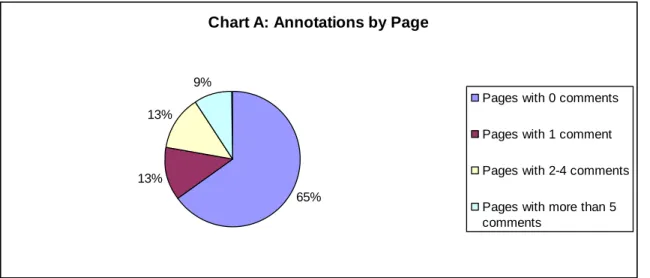
The number of comments on any particular page viewed varied greatly. 130 out of
the 372 total pages had comments of any number greater than zero. 47 pages had only
one comment, 49 of the pages had between two and four comments, 34 had more than
five comments, and the majority, 242 pages, had zero comments (Chart A). The highest
number of comments on any given page was 34, which occurred twice. Both contained
discussions relevant to the page materials, as one was a historical discussion of a murder
Chart A: Annotations by Page
65% 13%
13% 9%
Pages with 0 comments
Pages with 1 comment
Pages with 2-4 comments
Pages with more than 5 comments
The comments themselves fell within a wide variety of categories, although some
of the potential categories of coding were removed from the initial codebook because
they contained zero within the sample (including the categories “translation” and “tag”).
84.4% of the comments fell in more than one category, such as offering a personal
connection and a link to further resources. The number of comments in each category are
presented in Table 1 (for a full description of each category, see the codebook in
Appendix 3).
Table 1: Annotations, coded data summary Annotations by Type
identification 51 correction 17 further information 73 link to resources 29 answer 110 comment 62 personal connection 305
question 86 copy request 10 no activity 242
Personal connections, questions and answers, and further information make up the
connect with the materials as well as with each other, which supports the overall mission
of these contributory archives: to collect and preserve individual memory and foster
community participation and discussion.
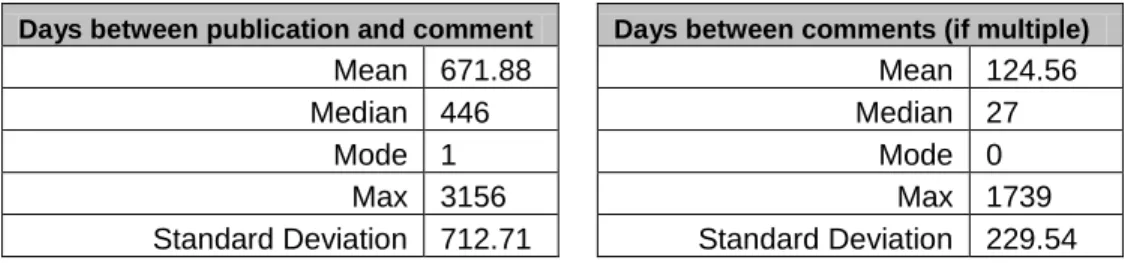
To address any affect of the amount of time the material had been available on the
internet on overall participation, the length of time between publication and first
comment was recorded, as well as the length of time between multiple comments on the
same item (Table 2).
Table 2: Annotations, dated data summary
Days between publication and comment Days between comments (if multiple)
Mean 671.88 Mean 124.56
Median 446 Median 27
Mode 1 Mode 0
Max 3156 Max 1739
Standard Deviation 712.71 Standard Deviation 229.54
Most commonly, the first comment appears on the page within 1 day of the page‟s
publication (28 times). Pages do tend to taper in the likelihood of participation over time,
as most frequently the first comments appear within the first 10 days after publication.
However, this decline is not dramatic, as pages may also have been published for years
before receiving a single comment (Chart B). 57.6% of all of the first comments on any
page appeared after a year since the original publication, and 36.8% appeared after two
Chart B: Frequency of comments since publication date
0 10 20 30 40 50 60 70 80 90 100
10 120 240 480 960 800 960 1120 1280 1600 1760 2080 2240 2400 More Number of days
Fr
e
que
nc
y
Similarly, comments appear after the first most often within 10 days, and many of
the subsequent comments appear on the same day as the previous comment (Chart C).
While additional comments may also appear years apart, typically comments appear
sooner in relation to each other than when looking at the first comment alone.
Chart C: Frequency between comments
0 10 20 30 40 50 60 70 80 90 100
0 10 60 120 160 240 320 480 640 800 960 More
Number of days
Fr
e
que
nc
y
One of the main differences between these two sets of data is that the first, days
comment. The second set, days between comments, could be significantly less due to
notification emails of activity on the creator‟s page or comment thread directing traffic
back to that page, or individuals engaged in a discussion and commenting multiple times.
In either case, some pages can remain active for years before getting a comment, but the
length of time alone since either publication or comment activity is not a determining
factor in future participation on that page. Pages do not appear to become stagnant, but
could evoke comments at any point.
Contributions
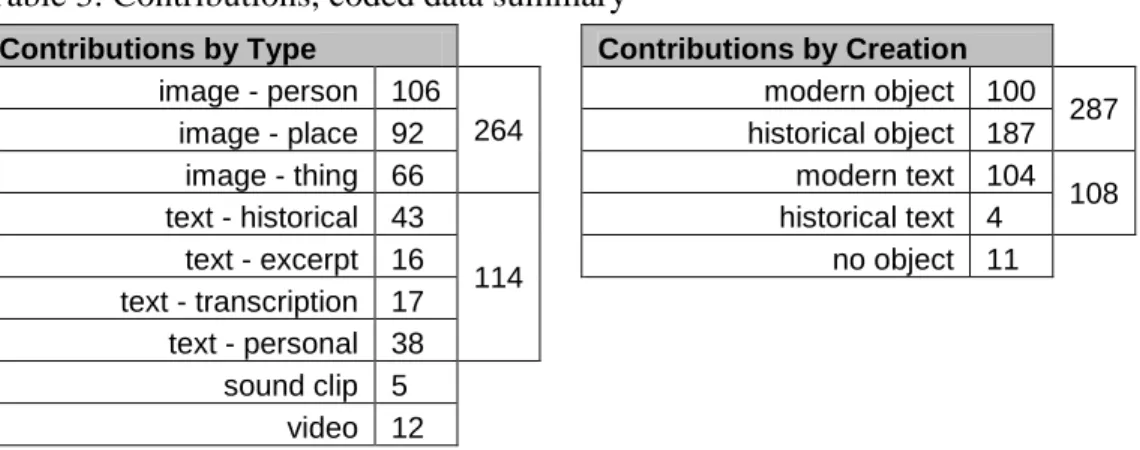
Of the 395 contributions viewed, 264 were images, 114 were text objects, 5 were
sound clips and 12 were videos. Of the texts, 105 were modern and only 5 were
reproductions of historical texts. Of the images, 100 were modern and 187 were
historical. (See Table 3).
Table 3: Contributions, coded data summary
Contributions by Type Contributions by Creation
image - person 106 264
modern object 100 287
image - place 92 historical object 187
image - thing 66 modern text 104
108 text - historical 43
114
historical text 4
text - excerpt 16 no object 11
text - transcription 17 text - personal 38 sound clip 5
video 12
The most frequent contributions were images, primarily people and places. There
were more than twice as many images as there were texts, and audio/visual materials
were contributed least of all. The most common texts contributed were historical
since 2000 (modern), and only 4 were created prior to 2000 (historical). Objects
(including images, videos, and sound clips) were roughly one third-modern and
two-thirds historical.
Of the texts submitted, 108 were written and displayed in .html format, and 6
were uploaded .pdfs. All images contributed to the sites were .jpgs. Of the images, only
58 displayed on the pages linked to a full resolution image, leaving 206 that either linked
to the scaled version or were not configured as links whatsoever. For all technical
comparisons, the largest available file was examined; however, in many cases this
required manually finding the file in a hidden folder (often called “originals”) on the
website‟s server. Most novice users would not have the expertise to find these files,
forcing them to use the scaled images of lower resolution if they desired to save or use
the images for any other purpose. Even having found the original files, some were of no
greater quality than the scaled versions used for display. Without a standard in place of
linking scaled images to larger files, it is difficult for users to gauge if they have the best
quality file available.
Relationship between annotations & contributions
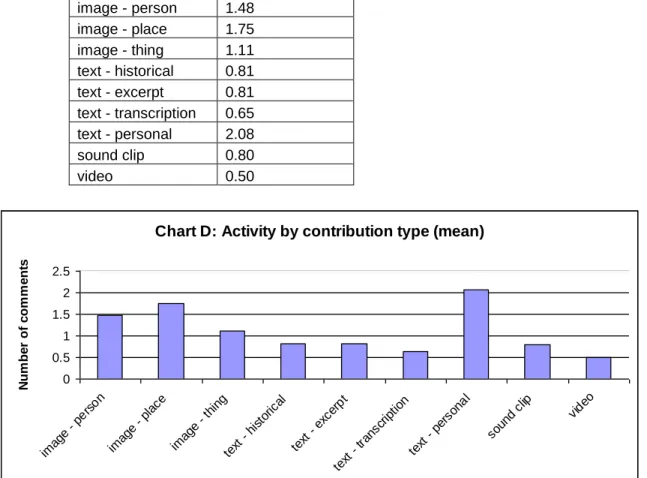
Specific content appears to evoke more participation than others (Table 4). For
texts, the number of items exceeds the number of comments in all cases except personal
text, which includes memories, anecdotes, genealogies or creative expressions. Personal
texts receive more comments than any other contribution type. In general, there are more
images than texts contributed to these community archives, but texts are less likely to
evoke participation. Images of persons or places receive more comments than images of
most other types of contributions, except for personal texts (Chart D).
Table 4: Annotations per contribution type
Type
Comments per item type (mean)
image - person 1.48
image - place 1.75
image - thing 1.11
text - historical 0.81
text - excerpt 0.81
text - transcription 0.65
text - personal 2.08
sound clip 0.80
video 0.50
Chart D: Activity by contribution type (mean)
0 0.5 1 1.5 2 2.5 imag e - p
erso n
imag e - p
lace
imag e - t
hing
text - hi
stor ical
text - ex
cerp t
text - tra
nscr iptio
n
text - pe
rson al
soun d cl
ip vide o N um be r of c om m e nt s
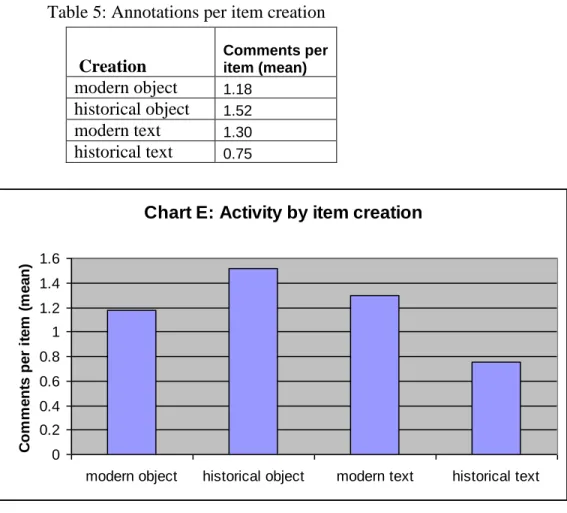
Aside from type of contribution, the origin or creation of the contribution appears
to have an impact on the participation it receives (Table 5). Historical objects, a category
primarily comprised of images originating prior to 2000, are the most popular
contribution, and they receive more comments relative to the number of items than any
other group. Modern images and modern texts, or those created after 2000, are
Table 5: Annotations per item creation
Creation
Comments per item (mean) modern object 1.18
historical object 1.52
modern text 1.30
historical text 0.75
Chart E: Activity by item creation
0 0.2 0.4 0.6 0.8 1 1.2 1.4 1.6
modern object historical object modern text historical text
C
om
m
e
nt
s
pe
r
it
e
m
(
m
e
a
n)
Personal connections, questions and answers are submitted in roughly equal ratios
across all types of items, historical and modern (Chart F). Historical texts receive the
smallest variety of comments, limited to those three categories alone. Historical objects
and modern texts receive both more comments in general as well as more various types
Chart F: Activity by type and item creation
0 0.2 0.4 0.6 0.8 1 1.2 1.4 1.6 1.8
modern object
historical object
modern text historical
text
copy request question
personal connection comment
answer
link to more resources further information correction
identification
Contributions: Technical aspects
Because the original format and size is not specified for most, if any, of the
images contributed to the website, technical aspects are compared to the lowest
alternative minimum designated by FADGI guidelines (See Appendix 6). These technical
aspects for comparison do not include typical image performance specifications including
color and white balance, noise, or tone response, simply because it is assumed that
individuals scanning their own documents for contribution would not have the technical
ability or knowledge of these types of standards. Instead, the contributions are examined
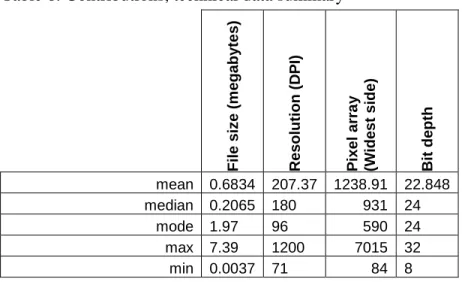
for more basic and overall features, including file size, pixel array, resolution, and bit
depth (Table 6).
FADGI standards do not specify a minimum for file size, as this is linked to the
images contributed to these community archives reveals generalizations about the overall
quality of contributions. The maximum file size sampled was 7.39 megabytes, and the
minimum was only 3.7 kilobytes. In this wide range of file sizes, the mean was only 0.68
megabytes, and the mode was 1.97 megabytes. Generally speaking, most of the files
contributed were very small relative to those you would find in an institutional repository,
and this is consistent with Liew‟s findings at the Kete Horowhenua archive (2014).
File size aside, there are more specific file properties to consider. Pixel array
determines the dimensions of the file, which FADGI recommends should be larger than
3000 pixels on the longest side if the image is not square, which none of those sampled
were. Of the sampled images, 26 were wider than 3000 pixels, and 12 were taller than
3000 pixels (38 total, or 14.4%). The mean pixel array was 1238.9 pixels on the widest
side, well below FADGI‟s recommendations. The maximum was 7015 pixels and the
minimum was a mere 84 pixels.
FADGI recommends 600 dpi resolution for items approximately 4 x 5 inches, and
300 dpi for items larger than 8 x 10 inches. Again, because the original size is not
specified, 300 dpi is considered acceptable for images contributed to these archives. Of
those sampled, two of the images had a resolution of 1200 dpi, 19 (7.2%) were between
600 dpi and 1200 dpi, 62 (23.5%) were between 300 dpi and 600 dpi, and 183 (69.3%)
were less than 300 dpi. Again, the majority of the files fell below FADGI
recommendations, but this number is likely to be a very low estimate, as many of those
images sampled were likely smaller than 8 x 10 inches originally.
For bit depth, 21 images were 8-bit black-and-white photos, 239 images were
original format, scanned unnecessarily at that depth. Although FADGI does not specify a
minimum compression for low resolution scans, it requires the lowest compression for
high resolution scans. Based on the size, resolution and pixel array, the files in this
sample must be considered on the whole to be low resolution, so compression is not a
necessary category to include, though the mean was roughly 3 compressed bits per pixel.
Table 6: Contributions, technical data summary
F
ile
si
z
e (m
egab
yte
s)
Resolu
tion
(
DP
I)
P
ixe
l a
rr
a
y
(W
idest
s
ide)
Bit
dep
th
mean 0.6834 207.37 1238.91 22.848
median 0.2065 180 931 24
mode 1.97 96 590 24
max 7.39 1200 7015 32
min 0.0037 71 84 8
Overall, only 9 (3.4%) of the 264 images in the sample meet the FADGI
minimums for both resolution and pixel array. The remaining 96.6% are too small and
too low resolution to be considered a quality copy. While they are for the most part
viewable and do offer visualization for the topics contributed to the community archive,
they should not be considered adequate surrogates for the original photographs or objects.
Furthermore, 8 out of the 10 total copy requests observed in the user annotations sought
Discussion
Overall, individual users contribute more historical items to these community
archives, largely images of people and places. These items are the most popular type of
contribution and they also elicit the highest number of annotations. Discussion or
commentary on textual contributions is lower, except for in the case of personal
narratives or memories. These contributions and user participation show that
community-led cultural heritage archives are successful on at least some level, and the content being
created falls within the scope of the project with little –if any– inappropriate content
appearing on the sites. The individual contributions and annotations do not appear to be
influenced greatly by the passage of time. Annotations may appear close to the original
publication date or years apart, giving greater hope for the longevity of these types of
projects. The quality of these images, however, is much poorer than a professional
archive would require, yet in the long run, it must be considered that a poor reproduction
is more beneficial than the absence of the item in any record.
Rather than simply being a public history project, there is a strong need for
standards in particular areas in order for contributory community archives to become
more effective in actual preservation of collective memory. Whenever possible, image
file resolution and size should have an enforced minimum, encouraging higher quality
images are being stored in the community archive‟s site and to be of greater use for
researchers or individuals outside of the archive‟s environment. This could be difficult in
to the contributor, such as in cases where the original is lost and cannot be scanned at a
higher quality, so of course exceptions must always be made in order to preserve what is
actually available. This study plainly shows that professional archival standards of
digitization are extremely high in comparison to the actual files observed in these
community archives, and perhaps the standards for these sites should be proportionately
lower to meet the user‟s abilities, taking into account user experience and amateur
practices. Although they may prevent some of materials from being displayed on
community sites, standards would address many of the files observed that were entirely
too small to be used in any manner, even within the own site‟s context. Although the UK
Community Archives and Heritage Group offers general guidelines and best practices, it
is ultimately up to the organizations hosting the archive to monitor and implement these
practices.
All of the findings in this study are consistent with previous work in the area. In
general, users respond positively to and engage with content in digital community
archives, but there is much work to be done in order to ensure these archives are meeting
their potential for supporting collection development for archives recording
under-documented communities. Organizations like the UK Community Archive and Heritage
Group are taking the necessary first steps in organizing this activity by providing a
central location, advice and guidelines, and at least a basic standardization through their
offering of collection building software. However, greater success with these sites would
require much more than just providing the space and the platform to build it; it would
also require training and understanding of the importance of archival functions that
Conclusion
Some aspects of this study could be repeated for future research with greater
attention to different aspects of data. The data collected in this study does not supply an
understanding of how extensive contributory participation actually is; for example,
whether a select few create the majority of the content. Because this study did not take
into account unique users in collecting data on annotations, it might be helpful to
understand how many of these users who comment are also contributors, as well as how
often those particular users comment on items. Another aspect of interest would be to
identify whether items that appear in the contributory archive appear in other places, such
as state archives or another digital repository, and if they do, are they represented in a
higher quality elsewhere? More detail could also be acquired regarding the relationship
between the number of items in a particular collection and the instances of annotations in
order to ascertain if fuller collections draw more attention and participation.
More specifically relating to archival functions, there are questions of description
that could be answered about these community sites. Aspects of description were omitted
from this study because, upon initial investigation, the software used to build these sites
(Community Sites, promoted by the UK Community Archives and Heritage Group) only
supplied metadata for whole pages rather than individual items. Therefore, is this lack of
structured metadata detrimental to the archive‟s supposed function? Are the collections
study and the potentially poor descriptive aspects of these particular sites, at what point
should traditional archives be involved? Should they help create and maintain these sites
while they are built, incorporating metadata and stricter digitization standards, or should
they let the communities continue their projects as public history exhibits, and only
preserve the web pages themselves as archival products of a project in another discipline,
such as the case in Duke University‟s oral history project? At this point in time,
contributory community archives are a small field of study, yet these sites exemplify
Cook‟s “exciting prospect of being able to document human and societal experience with
a richness and relevance never before attainable” (Cook, p.113). As more and more
digital community archives emerge, coalitions and collaborative projects develop and
technology and abilities advance, projects like these should be revised and studies
revisited in order to help develop digital community archives in a way that more greatly
Bibliography
Abraham, Terry. "Documentation Strategies: A Decade (or More) Later." Paper presented
at the Society of American Archivists, Washington, DC, August 31, 1995.
Affleck, Janice, and Thomas Kvan. “A Virtual Community as the Context for Discursive
Interpretation: A Role in Cultural Heritage Engagement.” International Journal of
Heritage Studies 14.3 (2008): 268–280.
Allen, Beverly B, et al. “Yo Soy Colorado: Three Collaborative Hispanic Cultural
Heritage Initiatives.” Collaborative Librarianship 4.2 (2012): 39–52.
Bastian, Jeannette A. and Ross Harvey. “The Convergence of Cultural Heritage: Practical
Experiments and Lessons Learned.” Paper presented at the UNESCO
international conference on permanent access to digital documentary heritage,
Vancouver, British Columbia, Canada, September 26–28, 2012.
Cook, Terry. “Evidence, Memory, Identity, and Community: Four Shifting Archival
Paradigms.” Archival Science 13.2-3 (2013): 95–120.
Duff, Wendy M., and Verne Harris. “Stories and Names: Archival Description as
Narrating Records and Constructing Meanings.” Archival Science 2.3-4 (2002):
263–285.
Eastwood, Terry. “Nailing a Bit of Jelly to the Wall of Archival Studies.” Archivaria 35
(1993): 232-252.
Ellis, Sally. “A History of Collaboration, a Future in Crowdsourcing: Positive Impacts of
Information Services 64.1 (2014): 1–10.
Federal Agencies Digitization Initiative (FADGI). “Technical Guidelines for Digitizing
Cultural Heritage Materials.” 2010.
http://www.digitizationguidelines.gov/guidelines/FADGI_Still_Image-Tech
_Guidelines_2010-08-24.pdf
Flinn, Andrew. “An Attack on Professionalism and Scholarship? Democratising Archives
and the Production of Knowledge.” (2010).
Flinn, Andrew. “Community Histories, Community Archives: Some Opportunities and
Challenges.” Journal of the Society of Archivists 28.2 (2007): 151–176.
Flinn, Andrew. “Independent Community Archives and Community-Generated Content
„Writing, Saving and Sharing Our Histories.‟” Convergence: The International
Journal of Research into New Media Technologies 16.1 (2010): 39–51.
Haskins, Ekaterina. “Between Archive and Participation: Public Memory in a Digital
Age.” Rhetoric Society Quarterly 37.4 (2007): 401–422.
Krause, Magia Ghetu, and Elizabeth Yakel. “Interaction in Virtual Archives: The Polar
Bear Expedition Digital Collections Next Generation Finding Aid.” The American
Archivist 70.2 (2007): 282–314.
Liew, Chern Li. “Participatory Cultural Heritage: A Tale of Two Institutions‟ Use of
Social Media.” D-Lib Magazine20.3/4 (2014).
Petek, Marija. "Comparing User-generated and Librarian-generated Metadata on Digital
Images.” OCLC Systems & Services: International digital library perspectives
28.2 (2012): 101-111.
Annotations To Online Archival Collections.” University of North Carolina
Master‟s Papers, 2008. http://dc.lib.unc.edu/cdm/ref/collection/s_papers/id/1111.
Shilton, Katie, and Ramesh Srinivasan. “Participatory Appraisal and Arrangement for
Multicultural Archival Collections.” Archivaria 63 (2007): 87–101.
Tait, Elizabeth et al. “Linking to the Past: An Analysis of Community Digital Heritage
Initiatives.” Aslib Proceedings 65.6 (2013): 564–580.
Terras, Melissa. “Digital Curiosities: Resource Creation via Amateur
Digitization.” Literary and Linguistic Computing (2010).
Trouillot, Michel-Rolph. Silencing the Past: Power and the Production of History.
Boston, MA: Beacon Press, 1995.
Wakimoto, Diana K., Debra L. Hansen, and Christine Bruce. “The Case of LLACE:
Challenges, Triumphs, and Lessons of a Community Archives.” The American
Appendices
Appendix 1: Social media use in state archives websites
Total State Facebook Twitter YouTube Flickr Blog Pinterest Other
0 Alabama 0 0 0 0 0 0 0
0 Alaska 0 0 0 0 0 0 0
2 Arizona 1 1 0 0 0 0 0
1 Arkansas 1 0 0 0 0 0 0
0 California 0 0 0 0 0 0 0
0 Colorado 0 0 0 0 0 0 0
1 Connecticut 1 0 0 0 0 0 0
6 Delaware 1 1 1 1 1 1 0
7 Florida 1 1 1 1 1 1 1
0 Georgia 0 0 0 0 0 0 0
0 Hawaii 0 0 0 0 0 0 0
0 Idaho 0 0 0 0 0 0 0
0 Illinois 0 0 0 0 0 0 0
1 Indiana 0 1 0 0 0 0 0
0 Iowa 0 0 0 0 0 0 0
0 Kansas 0 0 0 0 0 0 0
0 Kentucky 0 0 0 0 0 0 0
0 Louisiana 0 0 0 0 0 0 0
0 Maine 0 0 0 0 0 0 0
3 Maryland 1 1 0 0 0 0 1
0 Massachusetts 0 0 0 0 0 0 0
2 Michigan 1 1 0 0 0 0 0
1 Minnesota 1 0 0 0 0 0 0
1 Mississippi 1 0 0 0 0 0 0
3 Missouri 1 1 0 0 0 0 1
6 Montana 1 1 1 1 0 1 1
1 Nebraska 1 0 0 0 0 0 0
2 Nevada 1 0 1 0 0 0 0
0 New
Hampshire 0 0 0 0 0 0 0
0 New Jersey 0 0 0 0 0 0 0
0 New Mexico 0 0 0 0 0 0 0
4 New York 1 1 1 0 0 0 1
5 North Carolina 1 1 1 1 1 0 0
6 North Dakota 1 1 1 1 0 1 1
3 Ohio 1 1 1 0 0 0 0
0 Oklahoma 0 0 0 0 0 0 0
Total State Facebook Twitter YouTube Flickr Blog Pinterest Other
0 Pennsylvania 0 0 0 0 0 0 0
3 Rhode Island 1 1 0 0 0 0 1
3 South Carolina 1 1 0 1 0 0 0
2 South Dakota 1 1 0 0 0 0 0
4 Tennessee 1 1 0 1 1 0 0
5 Texas 1 1 1 1 1 0 0
2 Utah 1 0 0 0 1 0 0
0 Vermont 0 0 0 0 0 0 0
7 Virginia 1 1 1 1 1 1 1
3 Washington 1 1 1 0 0 0 0
0 West Virginia 0 0 0 0 0 0 0
6 Wisconsin 1 1 1 1 0 1 1
3 Wyoming 1 1 0 0 1 0 0
Appendix 2: Social media use in Federation of North Carolina Historical Societies
Total
Federation of NC Historical Society
Members Facebook Twitter Youtube Flickr Blog Pinterest Other
No Site
1
Alleghany
Historical-Genealogical Society 1
2
Allen County Public
Library 1 1 1 1 1
0 Historic Hillsborough 1 1
0
Anson County
Historical Society
0
Apex Area Historical
Society
0
Ashe County
Historical Society 1
2 Beaufort Historic Site 1 1 1 1
0
Belmont Historical
Society 1 1
0
Bentonville Battlefield
Historical Association
0
Bladenboro Historical
Society 1
1
Burke County
Historical Society 1 1 1
0
C Grier Beam Truck
Museum 1
0
Caldwell Heritage
Museum 1
0
New Hanover County
Cape Fear Museum 1 1 1
0
Capital Area
Preservation 1 1
0 Carolinas Genealogical Society 0 Carteret County Historical Society 0 Cashiers Historical
Society 1
0
Caswell County
Historical Association 1
Total
Federation of NC Historical Society
Members Facebook Twitter Youtube Flickr Blog Pinterest Other
No Site Historical Association 0 Chatham County Historical Association 0 Chicamongo Life
Saving Station 1 1 1
1
Collettsville Historical
Society 1 1
0
textile heritage
initiative 1
0
Davie County Historical and
Genealogical Society
0
Dry Ridge Historical
Museum
0
Currituck County
Historical Society 1
0
Columbus County
Historical Society 1
0
Cherryville Historical
Association 1
0 Duke Homestead
0
Duplin County
Historical Society
0
Edenton Historical
Commission 1
0
Edenton Women's
Club 1
0
Eastern Cabarrus
Historical Society 1
0
Federal Point Historic
Preservation Society
1
Forest History
Society 1 1 1 1 1
0
Forsyth County
Historical Association
0
Erwin Historical
Society 1
0
Friends of the
Page-Walker Hotel 1 1 1
1
Frisco Native
American Museum 1 1 1
0
Friends of Haywood
Hall, Inc 1
0
Gaston County
Historical Society
0
Gaston County
Museum 1
0
Gates County
Historical Society 1
0
Governor Charles B. Aycock Advisory Commission 0 Granville County Museum/Historical Society 1
Greater Fair Bluff
Historical Society 1
0
Greene County
Museum
0
Greensboro
Historical Museum 1 1
0
Halifax County
Historical Association
Total
Federation of NC Historical Society
Members Facebook Twitter Youtube Flickr Blog Pinterest Other
No Site Society 0 Henderson County Genealogical and Historical Society 0 Hickory Landmarks
Society, Inc. 1
1
High Point Historical
Society, Inc. 1 1 1 1
0
Highlands Historical
Society, Inc.
0 Historic Bethania
0
Historic Burke
Foundation, Inc.
0 Historic Flat Rock
1
Historic Hope
Foundation 1 1
0
Historic Jamestown
Society 1
0
Historic Preservation Foundation of North
Carolina 1 1
0
Historic Preservation Trade Program / Edgecombe
Community College 1
0
Historic Richmond Hill Law School
Commission 1
0
Historic Rockwell
Association
0
Historic Rosedale
Foundation, Inc. 1 1 1
1 Historic Stagville 1 1
0
Historical
Preservation Group
of Lenoir County
0
Huguenot Society of
North Carolina 0 Hyde County Historical and Genealogical Society 1 International Lineman's Museum &
Hall of Fame 1 1 1
0
Joel Lane Museum
House 1
0
Johnston County
Heritage Center 1
0
Jones County
Historical Society
1
Kernersville Historical
Society 1
0 Lawndale Historical Society 0 Lewisville Historical Society 0 Lincoln County
Historical Association 1 1
0
Lower Cape Fear
Historical Society 1
0
Mattamuskeet
Foundation
Total
Federation of NC Historical Society
Members Facebook Twitter Youtube Flickr Blog Pinterest Other
No Site
Foundation
0
May Museum and
Park
0
Mebane Historical
Society & Museum
0
Mecklenburg
Historical Association
0
Moore County
Historical Association 1
0
Moores Creek Battleground
Association
0
Mount Airy Museum
of Regional History 1 1
0
Mount Holly
Historical Society 1 1
0
Murfreesboro
Historical Association
0
National Railroad Museum and Hall of
Fame 1 1
1
New Bern Historical Society Foundation,
Inc. 1 1
0 North Carolina Association of Historians 0 North Carolina Friends Historical Society 1 North Carolina
Genealogical Society 1
0 North Carolina Literary and Historical Association 0 North Carolina Military Historical Society 0 North Carolina Presbyterian Historical Society 0 North Carolina
Railway Museum 1 1
0
North Carolina
Society of Historians
0 North Carolina Supreme Court Historical Society 0 Ocracoke Preservation Society,
Inc 1
1
Old Hickory Council, Boy Scouts of
America 1
0
Old Salem Museums
and Gardens 1
0
Operation North
State 1
0
Outer Banks
Conservationists, Inc. 1 1 1 1
0
Pender County
Historical Society 1
0
Perry-Weston Educational and
Total
Federation of NC Historical Society
Members Facebook Twitter Youtube Flickr Blog Pinterest Other
No Site
0
Person County
Historical Society 1
0
Phoenix Society for African American
Research, Inc. 1
0
Pitt County Historical
Society
1 Preservation Durham 1 1 1
1
Preservation Society
of Chapel Hill 1 1 1 1
0 Railroad House Historical Association 0 Raleigh City Cemeteries Preservation, Inc.
0 Raleigh City Museum 1
0
Raleigh Historic
Districts Commission
0
Raleigh Historic
Districts Commission 1 1 1
0
Richmond County Historical Society,
Inc. 1
0 Rowan Museum, Inc. 1
1
Salem Services
Group 1 1 1
0 Sampson County Historical Society 0 Sandhills Family Heritage Association 1
Society of North
Carolina Archivists 1 1 1
0
Southport Historical
Society
1
St. Joseph's Historic
Foundation 1 1 1 1
0
Stanly County Historic Commission
and Museum 1 1
0
Swansboro Historical
Association, Inc.
0 Town of Granite Falls
0 Transylvania County Historical Society, Inc. 0 Valleytown Cultural Arts and Historical
Society, Inc.
0
Vance County
Historical Society 1
0 Wachovia Historical Society 0 Wake County Historical Society 0 Walkertown Historical
Society 1
0
Warren County
Historical Association 1
0
Wayne County
Historical Association 1 1
0
Wendell Historical
Society 1
Total
Federation of NC Historical Society
Members Facebook Twitter Youtube Flickr Blog Pinterest Other
No Site
Carolina Historical Association
1
William P. Cumming
Map Society 1 1
0
Wilson County
Historical Association 1
0
World War II Wilmington Home Front Heritage
Coalition
0
Yadkin County
Historical Society 1 1
Appendix 3: Codebook for annotations Adapted from Jessica M. Sedgwick, 2008.
Category Description
identification identification of subject (person, place, thing) not already identified
correction correction to existing metadata
further information
further information about subject such as date, explanation of contextual information
link to more resources
links and references to resources for further information, including websites, books, and email addresses of those with personal knowledge to offer, or providing excerpts from related materials
answer
answers to questions posed by other users (back-and-forth communication)
comment general comments (non-informational), opinions, or praise
personal connection
establishing personal connection to subject, such as noting a family member, genealogical information, providing an anecdote, etc.
question asking questions
copy request request for copies of materials
no activity no annotations from individual users