degree. April, 2009. 38 pages. Advisor: Sandra Hughes-Hassell.
Research shows that a large number of children stop reading for pleasure between the second and fifth grade. This critical period coincides with the time that students are transitioning from reading picture books to reading chapter books. This transition may be problematic for several reasons, including whether the books between these levels are available, interesting, and relatable, and if they allow readers to feel successful. Another disturbing trend is the continued lack of children’s literature that reflects the racial make-up of the United States. Researchers have found that when readers encounter texts that feature characters like them and with whom they can connect, they are more likely to be interested in books and to see how reading can play a role in their lives. The purpose of this study is to examine transitional books to determine the percentage of main characters and major secondary characters that feature people of color, as well as the percentage of authors that are people of color.
Headings:
Multiculturalism/children’s literature Minorities literature/children’s literature Children’s literature
by
Heather A. Barkley
A Master’s paper submitted to the faculty of the School of Information and Library Science of the University of North Carolina at Chapel Hill
in partial fulfillment of the requirements for the degree of Master of Science in
Library Science.
Chapel Hill, North Carolina
April 2009
Approved by
Table of Contents
Introduction ... 3
Purpose ... 6
Literature Review... 8
Transitional Books ... 8
Terminology: Multicultural vs. People of Color and Other Minority Labels ... 11
Reading Attitudes and Race ... 12
Racial Identity Formation and Academic Success ... 16
Conclusion ... 17
Methodology ... 19
Racial Identity of Main and Secondary Major Characters ... 20
Authors ... 20
Methodology Discussion ... 21
Results ... 23
Discussion ... 25
Results Conclusions & Implications ... 29
Appendix A: Books with Characters of Color ... 34
Books with Black Characters ... 34
Books with Hispanic Characters ... 34
Books with American Indian/ Native Alaskan Characters ... 35
Books with Asian/ Pacific Islander Characters ... 35
Appendix B: Authors of Color ... 36
Black Authors ... 36
Hispanic Authors ... 36
American Indian/ Native Alaskan Authors ... 36
Introduction
There are many important issues that educators, parents, and librarians face when it comes to the literacy skills and habits of our students. One of the main problems is the troubling statistics concerning children’s attitudes towards reading and the dramatic negative decline in reading for pleasure that is reported to occur between the ages of eight and eleven years old (McKenna, Kear, & Ellsworth, 1995; Scholastic, 2008). This is a period of time when children are typically transitioning from picture books and easy readers to the more difficult chapter books. However, guiding students through this process is not an easy task in that while many know and agree that this is a time of great concern, the lack of discussion, and consistent, agreed upon terminology for this level of books adds to the difficulty of this process.
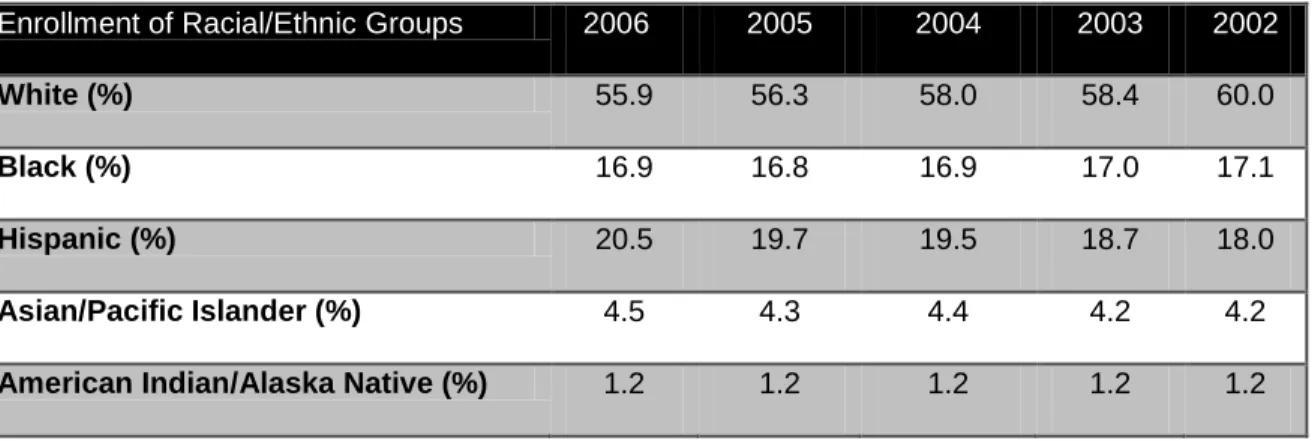
Another disturbing issue is that while we as a society are aware of the changing racial and ethnic make-up of our country, research maintains that youth literature is not reflecting the faces of our children. According to School Data Direct (2008) the demographics of U.S. students as of 2006 is almost 56% white, 17% black, 21%
tracking the number of books they receive by and about people of color for over a decade, reports that the number of multicultural titles published each year has remained static (Horning et al, 2008). Why does this matter? Because as researchers have found, when readers encounter texts that feature characters like them and with whom they can connect, they are more likely to be interested in books and to see how reading can play a role in their lives (Heflin & Barksdale-Ladd, 2001).
Table 1: U.S. Student Demographics (School Data Direct 2008)
Enrollment of Racial/Ethnic Groups 2006 2005 2004 2003 2002
White (%) 55.9 56.3 58.0 58.4 60.0
Black (%) 16.9 16.8 16.9 17.0 17.1
Hispanic (%) 20.5 19.7 19.5 18.7 18.0
Asian/Pacific Islander (%) 4.5 4.3 4.4 4.2 4.2
American Indian/Alaska Native (%) 1.2 1.2 1.2 1.2 1.2
In addition to our students lacking literature that is reflective of our diverse
Purpose
There are many theories surrounding the issue of race and identity, and a number of studies have been conducted about race and literature. The focus of this study was to determine the number of books with people of color as main characters in books that aid in the “transitional stage of literacy”—the time when students are moving from reading picture books or early readers to reading longer chapter books. The research for this study closely follows the research methodology and terminology as conducted by Agosto et al.’s research for “The All-White World of Middle-School Genre Fiction: Surveying the Field for Multicultural Protagonists” in 2003. The main questions that this research asked were:
1. What percentage of transitional books feature people of color as main characters? 2. Which individual groups of people of color are represented as main characters in
transitional books?
3. What percentage of transitional books are written by people of color?
general, as well as in conjunction with each other, and their importance in literacy education.
Literature Review
Several topics will be explored in the literature review. The first topic is the term transitional books. Specifically, what are transitional books and what purpose do they serve? The second topic, and one that is often considered controversial, are the labels used to describe racial and ethnic groups. Which ones will be used in this paper and what is the rationale behind the decision to use them? The connection between reading
attitudes and race that has been explored in previous research will also be presented, with a focus on the conclusions reached in these studies, how the conclusions relate to this study, and the conflict and validity issues that surround these previous studies. Finally, a brief overview of racial identity theory will be presented.
Transitional Books
Schuster’s Ready to Read line, and Orca Young Readers by Orca Book Publishers (Bean, 2004). Publishers agree that these transition books are necessary to help with the
transition from picture books to chapter books, and that this is an area with which everyone has struggled in the past 20 years (Bean, 2004).
For the purposes of this paper, the term “transitional books” will be used to refer to books that are geared towards the typical eight to eleven year old child’s reading levels. Transitional books contain meaningful pictures, chapters that are not as long as those in chapter books for older students, and are typically less than 200 pages in length. These books are typically found to be on second to fifth grade reading levels.
Fountas and Pinnell (2002) have developed a list of leveled books intended to support literacy development in children in kindergarten through grade four. The books range from level A books which are easy for very young children to read to level R books which are intended to support fluent readers. Fountas and Pinnell consider books geared towards the transitional reader to be books in Levels J through M. Some of the books found in these levels are picture books because they contain vocabulary and advanced concepts, but most are chapter books.
smaller print with new sentences that end where the last began, and containing more complex vocabulary (Fountas & Pinnell, 2002).
According to Szymusiak and Sibberson (2001) transitional books often contain a hook to grab the reader’s attention whether it be through a summary or review;
illustrations on every page or thereabout; short chapters that can be read within a day; and any other tools that help the reader discern what the book is about and aids in keeping their attention. Many transitional books are series books with predictable formats and characters with which the reader is familiar, thus making these books easier to follow than longer chapter books which include more in-depth character and plot development.
Terminology: Multicultural vs. People of Color and Other Minority Labels
Some may question the choice of terminology used in this paper. For example they may question why the term “multicultural” is not used in place of “people of color.” Conflict has emerged with regards to the term multicultural and which groups rightly fall into this category. Hillard (1995) proposes that multicultural literature is not comprised solely of works of literature concerning ethnic backgrounds, but also of other factors such as religion and geographical regions. Hillard (1995) even criticizes the definition given by Kruse (1992) who defines multicultural literature as “books by and about people of color” as being too narrow.
Peterson (1995), on the other hand, has very strong and opposing opinions of the term multicultural. Peterson (1995) believes that the term multicultural has become too diluted and includes too many other groups such as women, gays, and people with
The terminology used to describe each ethnic group individually can also be difficult and the potential to offend is ever present. Agosto et al. (2003) address this issue in their study and decide to use the terminology used by the U.S. Census Bureau. The terminology for this paper will follow suit, unless pulling information from other sources, in which case the source terminology will be used. The ethnic terms will consist of White, Black, Hispanic, American Indian/Alaska Native, and Asian/Pacific Islander.
Reading Attitudes and Race
According to a study conducted by Scholastic (2008), the children they surveyed who were between the ages of nine to eleven (24%) were three times more likely to be classified as low frequency readers than the children who were five to eight years old (8%). Thirty-four percent of the children ages nine to eleven stated that one of the main reasons they do not read for pleasure is that they are unable to find books that they like (Scholastic, 2008). This is more than twice that reported by children five to eight years of age (Scholastic, 2008). Only 15% of the children overall (ages 5-11) stated that they did not read more books for pleasure simply because they did not like to read (Scholastic, 2008). Many scholars have conducted research on what makes stories enjoyable to children, and being able to identify with the characters seems to be of great importance.
Research suggests that being able to identify with the characters in the story and their experiences increases enjoyment when it comes to reading (Cianciolo,1989;
world around them. They develop a sense of identity not only from the stories, but also from the illustrations, which stay with them throughout their lives (Cianciolo, 1989).
For the most part the research that has been completed on reading motivation or attitudes either does not include race as a variable, or does not support the theory that race is an issue in being able to identify with the story. For example, Jose and Brewer (1984) attempted to discern which character attributes contribute to strong reader
identification. This research did not involve race, but instead focused on age, gender, and character valence. Their findings suggest that while age was not necessarily a strong influence on character identification, gender and character valence lead to liking the character, being able to see oneself in the character, and thus likeability of the story (Jose & Brewer, 1984).
Research carried out by Holmes et al. (2007) focused specifically on race, by attempting to determine whether young readers would select books based on the race of the characters, and if there was a difference in the amount of time spent looking at books that contained characters of the same race as the reader versus those in which the
characters were of a different race. Their findings suggest that race does not seem important. Another such study conducted by McKenna et al (1995) supports this idea that race is unimportant with reference to young readers and their attitudes towards reading. However consideration of the methodology used in each of these studies may offer insight as to these unpredictable results and why they appeared.
gender and the ERAS results, the two-factor model is a valid measurement. However, they suggest that the ERAS may not be a valid way to measure reading for recreational attitudes across racial groups. They specifically state that “European-American and
African-American groups differed in the regression weights for parts of the recreational reading attitude factor” (Kazelskis et al, 2004, p.118). From this they concluded that further research is needed, and called into question the ethnicity differences as reported in particularly by McKenna et al (1995), stating that they “may need to be reevaluated in light of the present findings (Kazelskis et al, 2004, p. 119).”
In the research conducted and reported by Holmes et al. (2007), the main focus was race and whether race matters in book selection for third graders. The results as aforementioned indicated that race did not impact book selection. Unfortunately, the methodology contained several flaws. The researchers selected a subset of books that pictured either white or black main characters on the covers. These books were all Level K books and were about comparable topics. Students were asked to select a book to read from this subset of books. Observers recorded the race of the student, the books selected by that student in reference to the race of the main character, and the amount of time spent with each book.
possible that the children still selected certain books for the chance to earn an AR reward later on, regardless of what they are told by the researchers.
Another point of concern is that the researchers stated that they purposely omitted books with popular themes such as sports and chose “somewhat more bland, topics of family, fantasy, folk tales, and historical figures” (Holmes et al, 2007, p.278). They even went so far as to say that topics of interest should be included in another study. This seems almost counterproductive in that the focus of the research is reader interest. The research reported earlier in this paper shows that interest drives reader selection and can promote or hinder reading. Furthermore, the books selected were Level K which was one grade level below the subjects expected reading level. Although this may eliminate frustration associated with the difficulty of the materials, it could also result in a lack of interest due to boredom, among other things. There is no mention of the race of the observers. This could potentially pose the problem of unintentionally impacting
selection. A better idea would have been to have the observer not visible to the students at any point in the research. Lastly, the questions asked in the research do not seem to get to the heart of the matter of why the books were selected. More pertinent research might solicit the thoughts and opinions of the readers about their interest in books featuring same and dissimilar race, main characters.
information was obtained through reading reviews in mainstream journals printed within a 10-year period. The researchers acknowledged potential flaws with the study, including that fact that they did not examine or read each of the books, but relied on the reviews. The potential to overlook books was present if the reviewer did not mention the race of the main or major secondary characters. The results of this study showed that there has not been an increase of multicultural publishing in middle-school genre fiction. They state that their results indicate not only a need for more multicultural books for adolescents, but also a need for professionals to look to other sources in order to find multicultural books other than the mainstream journals.
Racial Identity Formation and Academic Success
In discussing Cross’s racial identity development theory, Tatum (1997) points out the critical need for people of color be represented in academic settings. While all children struggle with identity development, developing a sense of self is more
complicated for children of color because they are also searching for their racial or ethnic identity. According to Cross’s theory, racial identity development occurs in five stages. In the pre-encounter stage, children may not be conscious of racial identity, but their attitudes towards self and towards others are being formed. Exposure to stereotypes and omissions concerning people of color, as well as distortions of white superiority, lead children to believe that it is better to be White and can contribute to a negative sense of self.
helps protect them against the damaging psychological effects of racism and manifests itself as anger and resentment at not being fully included in society, thus, resulting in their distancing themselves from the dominant (White) group (Tatum, 1997).
Unfortunately, one result of this distancing is that academic success becomes typically associated with “Whiteness,” and thus looked upon as unfavorable by adolescents of color (particularly Black and Hispanic), as a consequence furthering the educational divide.
Conclusion
Although educators, librarians, and publishers seem to be aware that the books that fall between picture books and chapter books are important, there does not appear to be consistent, intentional discourse about the critical nature of this stage in literacy development, and the support and guidance that readers should be given by these books to help in bridging this gap. There are plenty of resource lists given by public librarians, school librarians, and even publishers of books that fall in this range, but rarely do they discuss the importance behind these lists. This research attempts to define these books, as transitional books, and initiate discussion about their importance through connecting students between the ages of eight and eleven and their progressively declining reading attitudes.
Methodology
The chosen methodology for this study is content analysis, with each book as an individual unit of analysis. Babbie (2004) describes content analysis as “the study of recorded human communications” (p. 314) to include books among other sources. This is the most logical type of analysis to examine specific books for racial identities of main characters. The sample of transitional books was determined by using the Fountas and Pinnell Leveled Book List database which can be found at
www.FountasandPinnellLeveledBooks.com. This database contains the “most
up-to-date” list of books published in the U.S. This is a well known and reputable resource that will provide a fairly comprehensive list of books printed at levels J through M.
All books leveled J through M were located in the database and copied to an Excel spreadsheet. Because this study is not concerned with picture books, fiction, or non-trade (guided reading) materials, these sources were eliminated from the sample. Non-fiction materials, easily identified by either a “B” or an “I” in the genre field, were
identify them, the publisher was typically a good indicator, in that the major publishers for these books are The Wright Group/McGraw Hill, Mondo, and Rigby. These books along were also excluded from the list.
Racial Identity of Main and Secondary Major Characters
The race of main and major secondary characters was determined by using NoveList K-8, Amazon Books, Google Books, and Google Images databases. The race categories were predetermined and the terminology used is consistent with the categories of race as provided by the U.S. census bureau, along with the categories of “other” and “unknown.”
Each book was located in one of the sources discussed above. Using clues provided by the cover, illustrations, summaries, available online content of the books, and subject headings, the race of the main characters and major secondary characters were
determined. Books in which the main and major secondary characters were
undeterminable were counted as “unknown,” and non-human characters such as animals, real or cartoon, robots, monsters, etc. were counted as “other.” It was possible to have more than one category marked due to the fact that many of the books contained multiple main characters. Appendix A includes a list of books that feature main and major
secondary characters of color, grouped by race as a reference guide for professionals in the education field. It is important to note that this determination relied on the
researcher’s ability to correctly identify race by using the aforementioned clues.
Authors
by an author of color. In order to do this, the author for each title was researched using web resources, including NoveList K-8, publisher’s web pages, and author’s personal web pages. The race was determined to the best of the researcher’s ability and the results recorded in a spreadsheet, and broken down by percentage of each racial group. A reference list is located in Appendix B of the authors of color by racial group.
Methodology Discussion
This study is not without flaws. There are several disadvantages associated with it. To begin, the racial identity of the main and major secondary characters, and authors, if not specifically stated somewhere, was left up to the researcher to identify. This of course relies on the researcher’s ability to correctly identify the racial background of the characters and authors based on the researcher’s knowledge of races, as well as any context clues provided by the author, illustrator, publisher, or databases.
Another concern is that of the source database. This research relied on one source, an online database, for the sample of books. It is impossible that all books published between the levels of J through M were included. In addition to this, leveling books is not an exact science and is open to interpretation, thus some books were probably excluded that belonged in the sample, while other books included that should not have been. Finally, this sample does not include picture books, non-fiction, or guided reading materials, which may be topics of possible future research.
Results
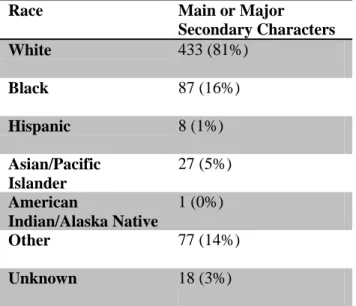
The final sample, with non-fiction, non-trade books, and picture books removed consisted of 534 books. Of these books, 433 (81%) contained white main or major secondary characters, 87 (16%) black characters, 8 (1%) Hispanic, 1 (0%) American Indian/Alaska Native, 27 (5%) Asian/Pacific Islander, 77 (14%) other, and only 18 (3%) were not able to be identified (Table 2). Of the 534 books in the sample, 106 books contained main characters from two races/categories, and 11 contained three different races/categories for main characters. Many of the books with multiple races for main characters were series books that depicted sports or school groups.
Table 2: Race of Main or Secondary Characters
Race Main or Major
Secondary Characters
White 433 (81%)
Black 87 (16%)
Hispanic 8 (1%)
Asian/Pacific Islander
27 (5%)
American
Indian/Alaska Native
1 (0%)
Other 77 (14%)
Of the 534 books, there were 141 different authors. Of these authors, the
breakdown by race is as follows: 106 (75%) white, 6 (4.3%) black, 3 (2.1%) Hispanic, 3 (2.1%) Asian/Pacific Islander, and 23 (16.4%) of the authors could not be identified as a particular race (Table 3). Of the 87 books featuring black characters, only 6 could be identified as written by black authors, while 70 were written by white authors, and for 9 of the authors, race could not be identified. Of the 27 books which featured a character of Asian/ Pacific Islander ethnicity, only 2 were written by an author of the same origin, while 25 were written by white authors. The books featuring Hispanic characters consisted of only 8 books, 2 of which were written by Hispanic authors, while the remaining 6 were written by white authors. Many of these books featuring people of color as main or major secondary characters were part of a series with multiple character races/categories featured, such as The Kids of Polk Street School, Bailey School Kids, or
Bailey City Monsters series.
Table 3: Race of Authors
Race Race of Authors Main or Major
Secondary Characters
White 106 (75%) 433 (81%)
Black 6 (4.3%) 87 (16%)
Hispanic 3 (2.1%) 8 (1%)
Asian/Pacific Islander
3 (2.1%) 27 (5%)
American
Indian/Alaska Native
__ 1 (0%)
Other __ 77 (14%)
Discussion
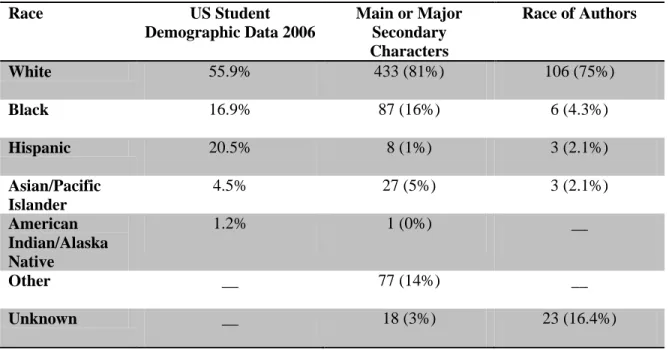
Table 4 shows a comparison between the race of the characters, authors, and U.S. student demographic data. Looking at the results, one can see that the number of
transitional books that feature main or major secondary characters of color is quite low when compared to the U.S. student demographics.
Table 4: Comparison Race of Characters and Authors to US Student Demographic Data
Race US Student
Demographic Data 2006
Main or Major Secondary Characters
Race of Authors
White 55.9% 433 (81%) 106 (75%)
Black 16.9% 87 (16%) 6 (4.3%)
Hispanic 20.5% 8 (1%) 3 (2.1%)
Asian/Pacific Islander
4.5% 27 (5%) 3 (2.1%)
American Indian/Alaska Native
1.2% 1 (0%) __
Other __ 77 (14%) __
Unknown __ 18 (3%) 23 (16.4%)
While only 55.9% of the students in the U.S. are White, the largest percentage of books in the sample (81%) featured White main or major secondary characters. Only 22% of the books featured people of color—16% black, 1% Hispanic, and 5%
Asian/Pacific Islander—as compared to 43.1% of the student population in the U.S. who are people of color. The breakdown by race shows, however, that Black and
be seen in Hispanic and American Indian/Alaska Native groups. Hispanic representation which equaled only 1% of the characters in this sample makes up 20.5% of the student population. Despite the fact that the number of Hispanic individuals in the U.S. has been rapidly increasing over the past decade, their representation in transition books is
minimal. Additionally, there was only one book in the sample that depicted an individual belonging to the American Indian/Alaska Native group. This is extremely unfortunate since we live in their “native land”.
It is important to note that most of books that contained characters of color featured them not as main characters, but as major secondary characters. There were only a handful of books found in the sample, approximately six, which featured a person of color as the main character or featured a particular race as the only race depicted in the story.
Comparing the percentage of books that featured characters of color to the number of books featured “other” is also potentially disturbing. As previously
Although the focus of this research was not to determine how the characters that were people of color were portrayed, there were some apparent, recurring themes discovered while examining the titles which are important to note and which have bearing on this study. The majority of the characters that were people of color could be found in series such as Bailey School Kids, Bailey City Monsters, or The Kids of Polk Street School. Often, the portrayal of people of color in these books was stereotypical, as was the case in Secondhand Star by Maryann Macdonald. According to a review in “School Library Journal Review”, Lucinda Snyder Whitehurst (1994) argues that “there is too much reliance on stereotypes.” An African American girl in the story, named Chiffon Brown, “speaks in a colloquial manor” when no one else does, and the smart, “good” girl in the class is White and has blonde hair (p. 85). Another example can be seen in The Case of the Elevator Duck by Polly Berrien Berends, which features Gilbert, a Black, eleven year old, private detective, who lives in a housing project.
One explanation for the stereotypical portrayal of the characters of color might be the small number of authors of color represented in the sample. As Table 4 shows, 75% of the books were written by White authors and only 8.5% by authors of color. The race or ethnicity of 16.4% of the authors could not be identified because of lack of available information. According to Roethler (1998) and DeLeón (2002), people of color are the best people to give an accurate description of specific racial or ethnic groups’
experiences. We must also ask why there are not more transitional books written by authors of color and available to our children. Roethler (1998) and DeLeón (2002) suggest that this is not due to a lack of authors of color, but instead to institutionalized racism, lack of understanding, and a feeling of a lack of audience from the publishers.
Results Conclusions & Implications
The results of this research show that people of color as a whole and individually by race are underrepresented in the pivotal transitional period of reading between picture and chapter books, a time during which many developmental changes—academic, psychological, and ethnic—are occurring. While little previous research directly shows that racial representation in literature impacts children’s selection of reading material, the research on identity development shows that it is critical to positive ethnic identity
development, and perhaps even to future academic success. The lack of representation of people of color in children’s literature can contribute to a negative sense of self, and can cause children of color to feel they do not belong or are intruding into the dominant society (Agosto et al, 2007; DeLeón, 2002; & Roethler, 1998). Equally important, it can lead children of color to disengage from academic learning which they view as White behavior (Tatum, 1997).
By exposing children of color to meaningful and realistic representative transitional books, we can better provide them with a foundational love of reading, positive identity development, and an understanding of the White majority culture. As Tatum (1997) states it is important for children of color to be exposed to images of African American academic achievement in order to remove the stereotypes of academic achievement as something that belongs to the White majority. If children of color of are able to read books that help them transition from picture books to chapter books with less reading frustration, and to see themselves in these books, we will have promoted positive self-esteem and racial identity development, and provided them with a feeling of
There are very easy steps that we can take to increase reading pleasure for
children of color, thus improving academic success. One way is to engage in purposeful purchasing. Librarians, other educators, and even parents who are purchasing materials and providing materials to our young people need to be aware of the need for materials that accurately and fairly depict people of color at all reading levels, but especially children within the transitional books stage—the time when children of color begin to struggle not only with literacy, but also with their sense of self and with their ethnic identity. Through purposeful purchasing, consumers can demand these materials from major publishers, forcing them to respond to the need by increasing the publication of transitional books that feature characters of color. We can also purchase from smaller, independent and specialized publishers, supporting those publishers who already recognize the need.
Furthermore, authors of color must to be recognized as a valuable resource for literacy and self-development. By promoting these authors and requesting materials written by these authors of color, we not only support our students’ literacy development by improving interest and encouraging reading, but also by showcasing these authors to our students and using them as examples of successful people of color, academically and socially.
References
Agosto, D. E., Hughes-Hassell, S., & Gilmore-Clough, C. (2003). The all-white world of middle-school genre fiction: Surveying the field for multicultural protagonists.
Children's Literature in Education, 34(4), 257-275.
Babbie, E R. (c2004). The practice of social research. Belmont, CA: Wadsworth Thomson Learning.
Bean, J. (2004). In search of new readers: A look at some developments in easy-reader and chapter book lines. Publishers Weekly, 30-31.
Berends, P. B. (2004). The case of the elevator duck. New York, NY: Random House. Christopher, M. (2009). The basket counts. Chicago, Ill: Norwood House Press. Cianciolo, P. (1989). No small challenge: Literature for the transitional readers.
Language Arts, 66(1), 72-81.
DeLeón, L. (2002). Multicultural literature: Reading to develop self-worth. Multicultural
Education 10(2), 49-51.
Fountas, I. C., & Pinnell, G. Su. (c2006). The Fountas and Pinnell leveled book list K-8.
Portsmouth, NH: Heinemann.
Fountas, I., & Pinnell, G. (2008). Fountas and Pinnell leveled book list K-8. Retrieved Nov. 19, 2008, from
http://www.fountasandpinnellleveledbooks.com/default.aspx
Heflin, B. & Barksdale-Ladd, M.A. (2001). African American children’s literature that helps students find themselves: Selection guidelines for grades k-3. The Reading Teacher, 54(8), 810-819.
Hillard, L. (1995). Defining the “multi-“ in “multicultural” through children’s literature.
The ReadingTeacher, 48(8), 728-729.
Horning, K.T., Lindgren, M.V., Michaelson, T., & Schliesman, M. (2008). Publishing in 2007. Retrieved July 7, 2008.
http://www.education.wisc.edu/ccbc/books/choiceintro08.asp Jose, P. F. & Brewer, W. F. (1984). Development of story liking: Character
identification, suspense, and outcome resolution. Developmental Psychology, 20(5), 911-924.
Kazelskis, R., Thames, D., & Reeves, C. (2004). The elementary reading attitude survey: Factor invariance across gender and race. Reading Psychology, 25, 111-120. Lempke, S. D. (2008). Bridging the reading gap with early chapter books. Reading
Today, 34(1).
Macdonald, M. (1997). Secondhand star. New York, NY: Hyperion Books.
McKenna, M., Kear, D., Ellsworth, R. (1995). Children’s attitudes toward reading: A national survey. Reading Research Quarterly, 30(4), 934-956.
Peterson, L. (1995). Multiculturalism: Affirmative or negative action? Library Journal 120 (12), 30-33.
Pinnell, G. Su., Fountas, I. C., & Fountas, I. C. (c2002). Leveled books for readers, grades 3-6. Portsmouth, NH: Heinemann.
Roethler, J. (1998). Reading in color: Children’s book illustrations and identity formation for black children in the United States. African American Review, 32(1), 95-105.
Scholastic. (2008). The 2008 kids and family Reading ReportTM. Retrieved Oct. 15, 2008, from http://www.scholastic.com/aboutscholastic/news/kfrr08web.pdf
SchoolDataDirect. (2008). United States public schools & districts. Retrieved Nov. 1, 2008, from
http://www.schooldatadirect.org/app/data/q/stid=1036196/llid=162/stllid=676/loci d=1036195/catid=1015/secid=4570/compid=-1/site=pes
Szymusiak, K., & Sibberson, F. (c2001). Beyond leveled books : Supporting transitional readers in grades 2-5. Portland, Me.: Stenhouse.
Tatum, B. D. (1997). Why are all the black kids sitting together in the cafeteria? And other conversations about race. New York, NY: Basic Books.
Appendix A: Books with Characters of Color
Books with Black Characters
Young Cam Jansen and the Missing Cookie by David A. Adler
Allie’s Basketball Dream by Barbara E. Barber
The Case of the Elevator Duck by Polly Berrien Berends
The Truth About the Moon by Clayton Bess
The Basket Counts by Matt Christopher
No Arm in Left Field by Matt Christopher
The Adventures of the Bailey School Kids series by Debbie Dadey and Marcia T. Jones
Pee Wee Scouts series (some) by Judy Delton
Tiger Turcotte Takes on the Know-It-All by Pansie Hart Flood
The New Kids of Polk Street School series (some) by Patricia Reilly Giff
The Kids of Polk Street School series (some) by Patricia Reilly Giff
The Best Worst Day by Bonnie Graves
A Letter to Amy by Ezra Keats
Marvin and the Mean Words by Suzy Kline
The Pet Sitters series by Tessa Krailing
Flower Girls: Daisy by Kathleen Leverich
Real Kid Readers: Lemonade for Sale by Bettina Ling
Miami Jackson Gets it Straight by Frederick and Pat McKissack
Wings by Christopher Myers
Solo Girl by Andrea Davis Pinkney
Real Kid Readers: On With the Show by Cecilia Venn
Ginger Brown: The Nobody Boy by Sharon Dennis Wyeth
Ginger Brown: Too Many Houses by Sharon Dennis Wyeth
Books with Hispanic Characters Baseball Flyhawk by Matt Christopher
Centerfield Ballhawk by Matt Christopher
Hairs – Pelitos by Sandra Cisneros
Second-Grade Friends by Miriam Cohen
The Ice Dove and Other Stories by Diane deAnda
Soccer Cousins by Jean Marzollo
Soccer Sam by Jean Marzollo
Books with American Indian/ Native Alaskan Characters Eagle Feather by Clyde Robert Bulla
Books with Asian/ Pacific Islander Characters
Corey’s Christmas Wish – Pony Tail Series by Bonnie Bryant
Elaine and the Flying Frog by Heidi Chang
The Best Older Sister by Sook Nyul Choi
Shortstop from Tokyo by Matt Christopher
Bailey City Monsters series by Debbie Dadey and Marcia T. Jones
Pee Wee Scouts series (some) by Judy Delton
The New Kids of Polk Street School series (some) by Patricia Reilly Giff
Horrible Harry series by Suzy Kline
Mary Marony and the Chocolate Surprise by Suzy Kline
Marvin and the Mean Words by Suzy Kline
Song Lee and the Hamster Hunt by Suzy Kline
Song Lee and the Leech Man by Suzy Kline
Song Lee in Room 2B by Suzy Kline
Appendix B: Authors of Color
Black Authors
Barbara Barber Pansie Hart Flood
Frederick & Patricia McKissack Christopher Myers
Andrea Davis Pinkney Sharon Dennis Wyeth
Hispanic Authors
Alma Flor Ada Sandra Cisneros Diane deAnda
American Indian/ Native Alaskan Authors
None
Asian/ Pacific Islander Authors