Northumbria Research Link
Citation: Kaufholz, Peter, Modolo, Giuseppe, Wilden, Andreas, Sadowski, Fabian, Bosbach, Dirk, Wagner, Christoph, Geist, Andreas, Panak, Petra, Lewis, Frank and Harwood, Laurence (2016) Solvent Extraction and Fluorescence Spectroscopic Investigation of the Selective Am(III) Complexation with TS-BTPhen. Solvent Extraction and Ion Exchange, 34 (2). pp. 126-140. ISSN 0736-6299
Published by: Taylor & Francis
URL: http://dx.doi.org/10.1080/07366299.2016.1151308
<http://dx.doi.org/10.1080/07366299.2016.1151308>
This version was downloaded from Northumbria Research Link: http://nrl.northumbria.ac.uk/26475/
Northumbria University has developed Northumbria Research Link (NRL) to enable users to access the University’s research output. Copyright © and moral rights for items on NRL are retained by the individual author(s) and/or other copyright owners. Single copies of full items can be reproduced, displayed or performed, and given to third parties in any format or medium for personal research or study, educational, or not-for-profit purposes without prior permission or charge, provided the authors, title and full bibliographic details are given, as well as a hyperlink and/or URL to the original metadata page. The content must not be changed in any way. Full items must not be sold commercially in any format or medium without formal permission of the copyright holder. The full policy is available online: http://nrl.northumbria.ac.uk/pol i cies.html
This document may differ from the final, published version of the research and has been made available online in accordance with publisher policies. To read and/or cite from the published version of the research, please visit the publisher’s website (a subscription may be required.)
Solvent extraction and fluorescence spectroscopic
investigation of the selective Am(III) complexation with
TS-BTPhen
Peter Kaufholz1; Giuseppe Modolo1*; Andreas Wilden1; Fabian Sadowski1; Dirk Bosbach1; Christoph Wagner2,3; Andreas Geist2; Petra J. Panak2,3; Frank W. Lewis4; Laurence M. Harwood5
1
Forschungszentrum Jülich GmbH, IEK-6, 52428 Jülich, Germany
2
Karlsruher Institut für Technologie, INE, 76344 Eggenstein-Leopoldshafen
3 Universität Heidelberg, Physikalisch─Chemisches Institut, 69120 Heidelberg 4
Department of Applied Sciences, Northumbria University, Newcastle upon Tyne NE1 8ST, UK.
5
Department of Chemistry, University of Reading, Whiteknights, Reading RG6 6AD, UK. *corresponding author: [email protected]
Abstract
An americium(III) selective separation procedure was developed based on the co-extraction of trivalent actinides (An(III)) and lanthanides (Ln(III)) by TODGA (N,N,N’,N’
-tetraoctyl-diglycolamide), followed by Am(III) selective stripping using the hydrophilic complexing agent TS-BTPhen
(3,3’,3’’,3’’’-[3-(1,10-phenanthroline-2,9-diyl)-1,2,4-triazine-5,5,6,6-tetrayl]tetrabenzenesulfonic acid). Distribution ratios were found at an acidity of 0.65 mol L-1 nitric acidthat allowed for the separation of Am(III) from Cm(III) (DCm > 1, DAm < 1),giving a
separation factor between curium and americium of SFCm/Am = 3.6 within the stripping step.
Furthermore, Am(III) was readily separated from the lanthanides with the lowest selectivity for the Ln(III)/Am(III) separation being lanthanum with a separation factor of SFLa/Am = 20. The
influence of the TS-BTPhen concentration on Am(III) distribution ratios was studied, giving a slope (logD vs. log[TS-BTPhen]) of approximately −1 for the stripping of An(III) with TS-BTPhen from the TODGA-based organic phase. Time-resolved laser fluorescence spectroscopy (TRLFS) measurements of curium(III) were used to analyze the speciation of Cm(III)-TS-BTPhen complexes. Both 1:1 and 1:2 complexes were identified in single-phase experiments.
The formation of the 1:1 complex was suppressed in 0.5 mol L-1 nitric acid but it was
significantly present in HClO4 at pH 3. Conditional stability constants of the complex species
were calculated from the TRLFS experiments.
Keywords: Am(III) separation, TODGA, selective stripping, curium, americium, lanthanides, partitioning, TS-BTPhen, americium-curium separation.
Introduction
The long-term radiotoxicity and heat load of used nuclear fuel is mainly due to the presence of the transuranium elements (TRU: Np - Cm). In the industrially applied PUREX process, recycling of the uranium and the most abundant TRU plutonium is accomplished. The minor actinides (MA) Np, Am, and Cm contribute to less than 0.1% of the initial spent fuel mass, but dominate the long-term radiotoxicity and heat load of the residual high active waste (e.g. vitrified waste) after the PUREX process.[1] Therefore, the MA content in the disposed waste is a decisive factor in determining the size of a final geological repository for high active wastes. Neptunium can be separated in a modified PUREX process,[2] leaving americium and curium as the principal contributors to the long-term radiotoxicity of the remaining waste. The partitioning and
transmutation (P&T) concept strives for the multi-recycling of long lived MA in generation IV reactor systems by fast neutron irradiation. To achieve high americium concentrations and high purity in the transmutation targets, a separation of the actinides from lanthanides and fission products has to be achieved. Due to its high specific activity and the high share of spontaneous fission in the decay of curium, any dry or wet fabrication of Cm containing transmutation targets would require special shielding and handling. With respect to the half-life of the major curium isotope 244Cm (~18 a), a separation of americium from curium and the fission and corrosion products is desirable. However, due to the chemical similarity between americium and curium, it is perhaps the most difficult separation in the P&T strategy.[3] Within international research communities such as the SACSESS project of the European Commission[4] and the US
Department of Energy “Sigma-Team”,[5] the development of processes for the selective removal of Am is being actively pursued. Different approaches have been investigated to carry out the difficult separation of americium from curium. In addition to solvent extraction methods where the separation of Am(III) is carried out by combining lipophilic and hydrophilic ligands, the
selective oxidation of americium to Am(IV) and Am(VI) followed by extraction of the oxidized species has also been investigated, but is not the topic of this paper.[6-7] Several liquid-liquid extraction processes employing different strategies for MA handling in the fuel cycle have been established based on the high active PUREX- raffinate.[8-9] On the one hand, there is a multi-cycle option making use of different consecutive processes with individual solvent compositions for each process. On the other hand, single cycle processes have been developed, opening the possibility to separate An(III) simultaneously from the light fission and corrosion products and Ln(III).[10]
An important single cycle process is the innovative-SANEX process recently demonstrated at Forschungszentrum Jülich. The process follows the concept of an An(III) + Ln(III) co-extraction using TODGA (Figure 1) in a mixture of TPH containing 5 vol.-% 1-octanol.[11] After scrubbing some undesired co-extracted fission products, the An(III) are then selectively stripped using a water-soluble tetrasulfonated BTP (SO3Ph-BTP).[12-14] The remaining Ln(III) are then stripped
using a buffer solution. The co-extraction and scrubbing steps of the innovative SANEX process were taken as the basis for this study. Changing the actinide-selective stripping of the innovative SANEX process to an americium(III) selective stripping step would lead to an americium
selective process where americium is separated from curium. The hydrophilic actinide-selective
N-donor complexing agent TS-BTPhen (3,3’,3’’,3’’’-[3-(1,10-phenanthroline-2,9-diyl)-1,2,4-triazine-5,5,6,6-tetrayl]tetrabenzenesulfonic acid, Figure 1) was studied for this purpose. The high selectivity of TS-BTPhen towards americium over curium has been previously described in the literature for the chromatographic separation of Am(III) from Cm(III) using a TODGA-PAN based chromatographic column.[15] Preliminary studies on liquid-liquid extraction using TS-BTPhen[16] in nitric acid and DGA-based extractants in the organic phase have been published recently by our group.[17] In this paper the influence of the hydrophilic complexant TS-BTPhen on the extraction of actinides and lanthanides using TODGA was investigated with respect to its ability to carry out the selective back-extraction of americium from the organic phase.
Furthermore, the complexation of Cm(III) with TS-BTPhen was investigated herein in single-phase TRLFS titration experiments.
The concept of separating solely Am(III) from Cm(III) and all the FP in a single process was first realized by the EXAm process developed by the CEA in France.[18] A separation factor between Am(III) and Cm(III) of SFAm/Cm = 2.5 was achieved within this process by using a combination of
DMDOHEMA and HDEHP (di(2-ethylhexyl)phosphoric acid) for extracting Am(III) and light Ln(III), and using TEDGA (N,N,N’,N’-tetraethyldiglycolamide) as a hydrophilic complexant in the aqueous feed for complexing Cm(III) and heavy Ln(III) during the extraction.[19] Co-extracted fission and corrosion products were removed by several pH-controlled scrubbing steps. Am(III) was selectively stripped from the solvent using buffered HEDTA solution, resulting in a 68-stage process. Another approach to the selective separation of Am(III) was developed using TODGA for co-extraction of An(III) and Ln(II) in combination with a water-soluble tetrasulfonated BTBP (SO3-Ph-BTBP) for Am(III) selective stripping. The combination of TODGA and SO3-Ph-BTBP
used in the AmSel process provides separation factors of SFCm(III)/Am(III) = 2.5 and SFEu(III)/Am(III)
=200.[16, 20-21] The TODGA–TS-BTPhen based concept investigated in this work is a less complex alternative approach to the EXAm process and provides higher separation factors for Cm(III) over Am(III) compared to the AmSel process.
Figure 1: Chemical structures of TODGA and TS-BTPhen.
N N N N N N N N SO3Na NaO3S SO3Na NaO3S TS-BTPhen C8H17 N O N C8H17 O O C8H17 C8H17 TODGA 4
Materials and Methods
TODGA was purchased from TechnoComm Ltd, UK. Hydrogenated tetrapropene (TPH) was received from the CEA Marcoule, France. Exxsol D80 (ExxonMobil) was used for biphasic TRLFS experiments. 1-Octanol was purchased from J.T. Baker ≥99%. The TS-BTPhen
complexant was synthesized at the University of Reading according to the literature procedure.[16] Nitric acid solutions (Merck AG) were prepared by dilution from a 65% nitric acid solution EMSURE® for analysis.
Extraction experiments were carried out as forward extraction experiments using equal volumes of 500 µL of each phase. A combined aqueous tracer containing 300 kBq/mL 152Eu, 150 kBq/mL of 241Am and 244Cm each (10 µL) was used. A lanthanide solution containing all lanthanides except promethium in a concentration of 10-5 mol L-1 of each lanthanide was used for the lanthanide experiments. An organic phase consisting of 0.2 mol L-1 TODGA in TPH + 5 vol.-% 1-octanol was used. Aqueous phases were prepared by dissolving weighed amounts of TS-BTPhen in the appropriate aqueous phases. The shaking experiments were carried out in a temperature-controlled test tube shaker. Previous kinetic experiments showed that the applied contact time is sufficient. In batch kinetic experiments equilibrium D values were reached within contact times of less than 5 minutes. Afterwards, centrifugation was applied to maintain a
complete separation of the phases, and the phases were separated using pipettes. Gamma measurements of 152Eu (122 keV) and 241Am (60 keV) were carried out using a Eurisys EGC35-195-R germanium coaxial N-type detector. Alpha measurements were carried out for 241Am (5486 keV) and 244Cm (5805 keV) using an Ortec Octête-pc eight chamber alpha measurement system equipped with PIPS detectors. Sample preparation was done by homogenizing the 10 μL alpha-spectroscopy sample in 100 μL of a mixture of Zapon varnish and acetone (1:100 v/v). This mixture was distributed over a stainless steel plate obtained from Berthold, Bad Wildbad, Germany. The sample was dried under a heating lamp and annealed into the stainless steel plate by a gas-flame burner. For stable elements, inductively coupled plasma mass spectrometry (ICP-MS) was applied using a Perkin Elmer SCIEX Elan 6100 DRC. Aqueous samples were measured after dilution in 1% v/v nitric acid solution without further treatment. Organic samples were measured directly in a tenside matrix (Triton-X-100) in 1% v/v nitric acid after dilution. The distribution ratios D were calculated as the quotient of the concentration or activity of the metal ion in the organic phase over the concentration or activity of the metal ion in the aqueous phase
(D = cM(org)/cM(aq)). The separation between two metal ions is expressed using the separation
factor, being the quotient of the distribution ratios of two metal ions (SF = DM1/DM2). The
uncertainties of the data achieved from the method described above is < 5% for 0.01 < D < 100. Below and above these limits the uncertainties are lower than 20% for all data shown.
TRLFS measurements were carried out using a setup of a Continuum SURELITE Nd:YAG laser with a repetition rate of 10 Hz in combination with a NARROWscan D-R dye laser containing an Exalite 398 dye. For the excitation of Cm(III), a wavelength of 396.6 nm was used. The
fluorescence was detected at a 90° angle to the exciting laser pulse using a Shamrock 303i spectrographic analyser with an ANDOR iStar generation III ICCD camera. Short-lived fluorescence was discriminated by starting the measurement at a time delay of 1 µs after laser excitation. Samples for single-phase titration experiments were prepared by adding 30 µl of a 3.34∙10-6
mol L-1 Cm(III) stock solution to 970 µl of the respective medium. The Cm(III) stock solution had an isotopic mass distribution of 89.7% Cm-248, 9.4% Cm-246, ≤ 1% 243, Cm-244, Cm-245 and Cm-247. With each step, a defined amount of complexant was added to the solution, increasing the total ligand concentration in the solution. Before starting the
measurements, mixtures were allowed to equilibrate for 15 minutes.
A ligand stock solution was prepared by dissolving 2.63 mg of TS-BTPhen in 250 µl of the applied medium. This procedure gave a 10-2 mol/L TS-BTPhen solution. Solutions used for the titration experiment containing 10-3 -10-6 mol/L TS-BTPhen were prepared by subsequent dilution of the stock solution.
Results and Discussion
Influence of the nitric acid concentration
Batch extraction experiments were carried out to analyse the influence of the nitric acid
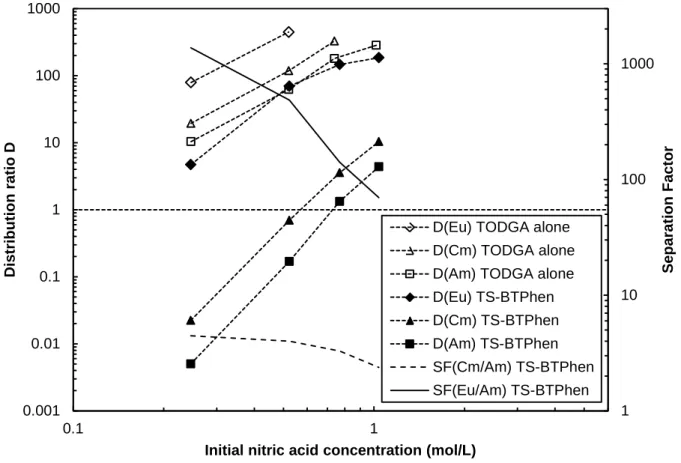
concentration on the co-extraction of Am(III), Cm(III) and Eu(III), and the selective stripping of Am(III) using a 10 mmol L-1 solution of TS-BTPhen in different nitric acid concentrations spiked with 152Eu(III), 241Am(III), and 244Cm(III). The results are shown in Figure 2. Open symbols represent the distribution ratios of americium, curium and europium using TODGA + 5 vol.-% 1-octanol without the addition of TS-BTPhen to the aqueous phase. The distribution ratios of Am(III), Cm(III) and Eu(III) increase with increasing nitric acid concentrations which is known
to be the classical behavior of neutral extractants such as TODGA.[22] The influence of TS-BTPhen addition to the aqueous phase is shown by the filled symbols. The addition of the hydrophilic ligand decreased the distribution ratios of An(III) by ca three orders of magnitude, while the Eu(III) distribution ratios were only decreased by one order of magnitude, resulting in a high Eu/Am separation factor of SFEu/Am = 300 at 0.65 mol L-1 nitric acid. However, lanthanides
lighter than Eu may have a significantly lower separation factor SFLn/Am.[23] The distribution
ratios of Am(III) were affected slightly more than those of Cm(III). The separation factor for Cm(III) over Am(III) increased from SFCm/Am = 1.6 for a TODGA-nitric acid system to SFCm/Am =
2.4 to 4.5 using TS-BTPhen in the nitric acid concentration range covered by Figure 2 (0.01 – 1 mol L-1). The separation factors for Eu(III) over Am(III) using TS-BTPhen (SFEu/Am = 70-1000)
in the aqueous phase are similar to the SFEu/Am values reached using SO3-Ph-BTP (250-1000),[24]
and are in agreement with the separation factors previously reported for TS-BTPhen.[16] A high nitric acid concentration in the stripping step is favorable, as it simplifies scrubbing and gives robustness to the system. The region of interest for Am(III) selective separation using 10 mmol L
-1
TS-BTPhen is around 0.65 mol L-1 initial nitric acid concentration, providing separation factors of SFEu/Am≈ 300 and SFCm/Am = 3.6. The distribution ratios of Am(III), Cm(III) and Eu(III) all
show a linear increase with increasing TODGA concentration in the log(D) vs. log([TODGA]) plot. The results were already previously published.[17]
Figure 2: Distribution ratios of Eu(III), Am(III) and Cm(III) and separation factors of Eu(III) and Cm(III) over Am(III) as a function of the initial nitric acid concentration in the radiotracer experiment. Organic phase: 0.2 mol L-1 TODGA in TPH + 5 vol.-% 1-octanol; aqueous phase: filled symbols: 10 mmol L-1 TS-BTPhen in nitric acid, open symbols: no addition of TS-BTPhen.
Behavior of the lanthanides
For a feasible selective separation of Am(III) from a loaded organic phase, not only is the
separation of the trivalent actinides Am(III) and Cm(III) important, but so too is the separation of Am(III) from co-extracted lanthanides. The distribution ratios of Ln(III) are known to be high for TODGA-based organic phases at the relevant nitric acid concentrations.[25] Within the lanthanide group, the distribution ratios increase with decreasing ionic radius of the lanthanide.[26] Figure 3 shows the comparison of the distribution ratios of Ln(III) and An(III) using TODGA against nitric acid (Figure 3 A) and TODGA against nitric acid containing 10 mmol L-1 TS-BTPhen (Figure 3 B). Without using the hydrophilic complexing agent, the distribution ratios of Am(III) and Cm(III) are located between neodymium and samarium within the lanthanide group. The actinides are selectively removed from all of the lanthanides by using TS-BTPhen in nitric acid solution. The separation factor between the least extracted lanthanide La(III) and Am(III) is SFLa/Am ≈ 20 at 0.25 mol L-1 nitric acid. The selectivity for stripping of An(III) from Ln(III) is
1 10 100 1000 0.001 0.01 0.1 1 10 100 1000 0.1 1 S e p a ra ti o n F a c to r D is tr ib u ti o n r a ti o D
Initial nitric acid concentration (mol/L)
D(Eu) TODGA alone D(Cm) TODGA alone D(Am) TODGA alone D(Eu) TS-BTPhen D(Cm) TS-BTPhen D(Am) TS-BTPhen SF(Cm/Am) TS-BTPhen SF(Eu/Am) TS-BTPhen 8
lower compared to SO3-Ph-BTP used for the An(III) stripping step in the innovative-SANEX test
(SFLa/An≈ 50), but the selectivity for curium over americium (SFCm/Am) is significantly higher.[24]
The initial concentration of the Ln(III) in the aqueous phase was 10-5 mol·L-1 of each lanthanide.
Figure 3: Distribution ratios of Ln(III), Am(III) and Cm(III) with and without TS-BTPhen in the aqueous phase. Left side (A) without addition of TS-BTPhen, right side (B) with 10 mmol L-1 TS-BTPhen. Organic phase: 0.2 mol L-1 TODGA in TPH + 5 vol.-% 1-octanol. Aqueous phase: A: 10-5 mol L-1 Ln(III) in nitric acid without addition of TS-BTPhen; B: 10-5 mol L-1 Ln(III) and 10 mmol L-1 TS-BTPhen in nitric acid; 30 minutes phase contact at 22 °C.
Effect of the TS-BTPhen-concentration
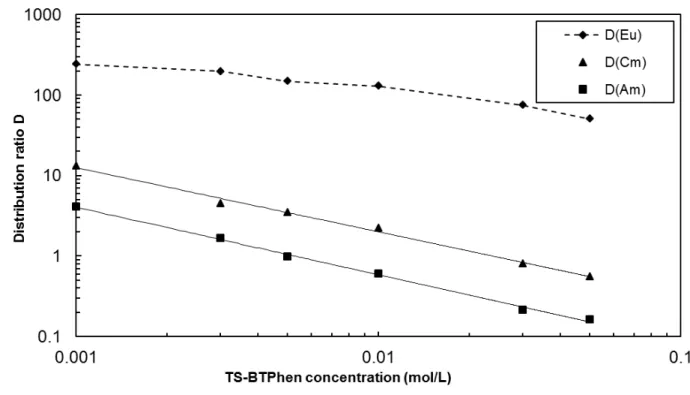
The influence of the TS-BTPhen concentration on the distribution ratios of Am(III), Cm(III) and Eu(III) was tested in the concentration range from 1 to 50 mmol L-1. Figure 4 shows the
distribution ratios as a function of the TS-BTPhen concentration on a logarithmic scale at constant nitric acid and TODGA concentrations.
Figure 4: Distribution ratios of Am(III), Cm(III) and Eu(III) as a function of the TS-BTPhen concentration. Organic phase: 0.2 mol L-1 TODGA in TPH + 5 vol.-% 1-octanol. Aqueous phase: different TS-BTPhen concentrations in 0.66 mol L-1 nitric acid; 30 minutes of phase contact at 22 °C.
A slope of −0.8 was observed for the linear regression of the Am(III) and Cm(III) data with increasing TS-BTPhen concentration. The Eu(III) data did not follow a linear trend in the double-logarithmic plot. In solution, the structurally similar lipophilic extractant CyMe4BTPhen
preferentially forms 1:2 complexes with An(III), as demonstrated by TRLFS and NMR studies.[16, 27] Therefore, a slope of −2 would also have been expected if the hydrophilic TS-BTPhen forms 1:2 complexes with An(III) in the aqueous phase. Equation 1 shows the simplified possible complexation reactions with An(III) in the TODGA/TS-BTPhen system. Similar
deviations are also observed in the TODGA/SO3-Ph-BTP and TODGA/SO3-Ph-BTBP
systems.[24, 28] The differences between a slope of −0.8 in the slope analysis and the expected slope of −2 may be related to the formation of mixed complexes. Time resolved laser
fluorescence (TRLFS) studies were subsequently carried out to analyse the deviation between the slopes (n = 1 or 2) of the hydrophilic BTPhen and the literature stoichiometry of the lipophilic BTPhen, and to obtain comprehensive data on the complex properties.
Equation 1: Possible complexation reactions of An(III) in the biphasic TS-BTPhen-TODGA system. An(III)aq + n TS-BTPhenaq→ [An(III)(TS-BTPhen)n]aq
An(III)aq+ 3 TODGA → [An(III)(TODGA)3]
Cm(III) TRLFS studies of TS-BTPhen
Complexometric titrations were carried out by adding TS-BTPhen to a 10-7 mol L-1 Cm(III) solution in 10-3 mol L-1 HClO4 as well as in 0.5 mol L-1 HNO3. As ClO4- is a very weakly
coordinating anion, 10-3 mol/L HClO4 was used as an idealized system with little influence of
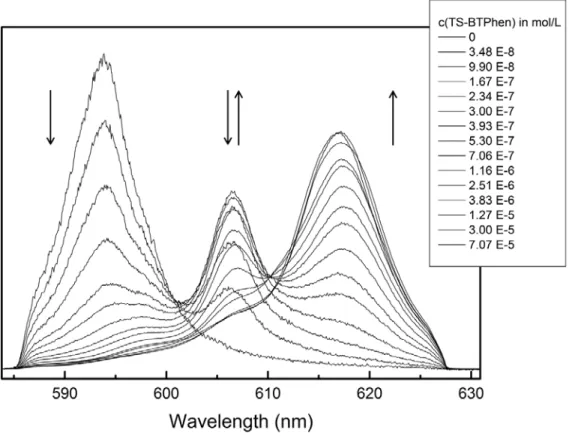
ionic strength, concurring anions or protonation of TS-BTPhen. However, biphasic extraction experiments were performed with the aqueous phase consisting of nitric acid (0.01 - 1.5 mol L-1). Therefore, 0.5 mol L-1 nitric acid was used as medium in further investigations to study the complexation of Cm(III) with TS-BTPhen under extraction conditions. Figure 5 shows the Cm(III) fluorescence emission spectra of the transition as a function of the TS-BTPhen concentration in 10-3 mol L-1 HClO4.
Figure 5: Normalized fluorescence spectra of Cm(III) at increasing TS-BTPhen concentration (0 ─ 7.07x10⁻⁵ mol L
-1
) in 10-3 mol L-1 HClO4 ([Cm(III)] = 1x10 -7
mol L-1)
The fluorescence spectra in Figure 5 show three emission bands, the Cm(III) aquo ion (Cm(III) solvent species) at 593.9 nm and the emission bands of two complex species at 606.5 nm and 617 nm. The observed bathochromic shifts of the emission bands of the complex species are
characteristic of the formation of a 1:1 and a 1:2 complex with a strong tetradentate N-donor ligand like TS-BTPhen[20, 27, 29]. Peak deconvolution was carried out, providing the spectra of the pure components shown in Figure 6. The spectra of both complex species exhibit a hot band caused by population of a higher energy level by thermal effects. The hot bands are visible as shoulders at higher energy at 597 nm and 607 nm, respectively.[30]
Figure 6 Normalized fluorescence spectra of the [Cm(TS-BTPhen)n] complexes in 10-3 mol L-1 HClO4 (n= 0, 1, 2).
The relative distribution of the different Cm(III) species after each titration step was obtained by peak deconvolution of the fluorescence spectra using the emission bands of the individual species (cf. Figure 6). As the fluorescence intensity increases strongly upon complexation as a result of intramolecular energy transfer processes,[31] fluorescence intensity factors (FI) of the Cm-TS-BTPhen complexes have to be considered when calculating the concentrations of the formed Cm(III) species from the peak areas obtained by peak deconvolution. The FI factors were determined by fitting the increase of the Cm(III) fluorescence intensity as a function of TS-BTPhen concentration (FI[Cm(TS-TS-BTPhen)] = 5, FI[Cm(TS-TS-BTPhen)2] = 560). The species
distribution as a function of the TS-BTPhen concentration is shown in Figure 7.
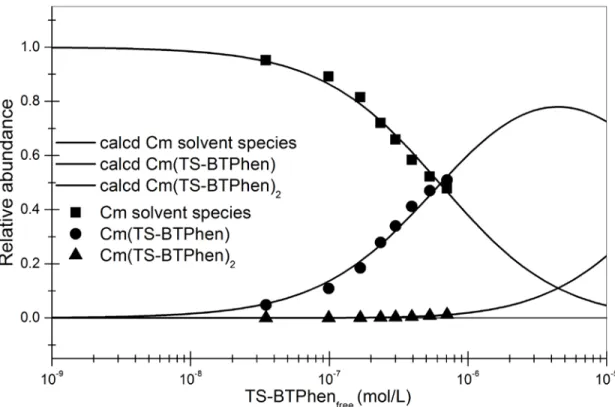
Figure 7: Species distribution of Cm(III) as a function of the TS-BTPhen concentration in 10-3 mol L-1 HClO4.
Symbols representexperimental data, lines are calculated with logβ01 = 6.2 and logβ02 = 10.7.
The complexation of Cm(III) started at a TS-BTPhen concentration of 3.48 × 10⁻⁸ mol L-1 with a maximum fraction of species 1 ([Cm(TS-BTPhen)] of 78% at 4.48 × 10⁻⁶ mol L-1 TS-BTPhen. At concentrations above 3.45 × 10⁻⁵ mol L-1 complex species 2 ([Cm(TS-BTPhen)2] was the major
species in solution.
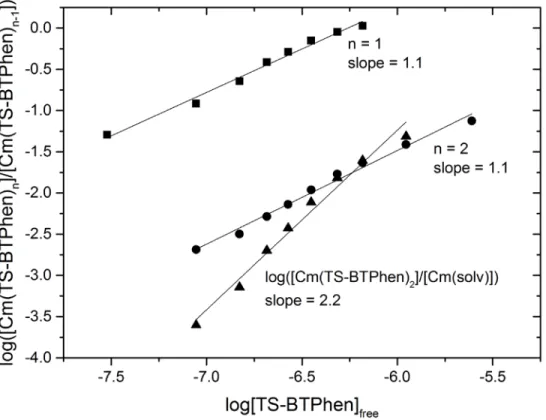
A plot of the concentration ratios of the different species vs. the free ligand concentration in double logarithmic scale and subsequent linear regression yields slopes of 1.1 for the stepwise formation of the 1:1 and 1:2 complexes. The slopes depict the stoichiometric factor of TS-BTPhen added to the Cm(III) during transition from one species to another species. The overall transition from Cm(III) solvent species to the final complex yields a slope of 2.2, depicting a final 1:2 Cm(III) to TS-BTPhen complex ([Cm(TS-BTPhen)2]. Therefore, the species with emission
bands at 606.5 nm and 617.0 nm were identified as 1:1 and 1:2 complexes, respectively (Figure 8). Furthermore, conditional stability constants were derived from the speciation yielding logβ01 = 6.2 for the 1:1 complex, and logβ02 = 10.7 for the 1:2 complex.
Figure 8: Linear regression of the logarithm of the species ratios of the solvent species and the two complex species observed in titration experiments in 10-3 mol L-1 HClO4 vs. the logarithm of the free TS-BTPhen concentration.
The determination of the number of water molecules in the inner coordination shell by
measurement of the fluorescence lifetime of the two complex species was not possible, due to the fluorescence quenching properties of TS-BTPhen.
Further experiments were performed in 0.5 mol L-1 HNO3 to study the complexation of Cm(III)
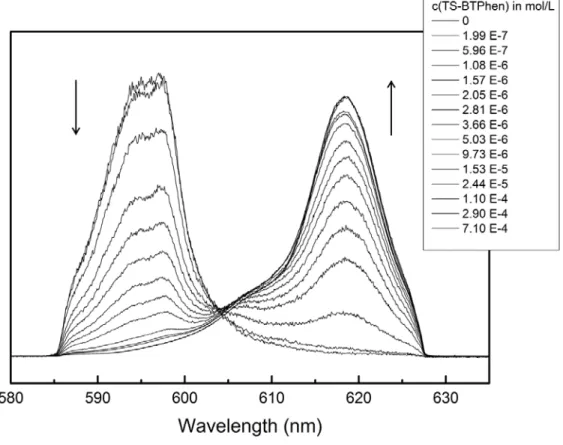
under extraction conditions. Figure 9 shows the normalized fluorescence emission spectra of Cm(III) at increasing TS-BTPhen concentration in 0.5 mol L-1 nitric acid. The Cm(III) solvent species displays two emission maxima at 595 nm and 597 nm. These emission bands correspond to the formation of a mixture of Cm(III) aquo ion and Cm(III) mononitrato complex and are in excellent agreement with the literature.[32] An additional species at 618.8 nm was observed at higher TS-BTPhen concentrations with a similar bathochromic shift as the [Cm(TS-BTPhen)2]
complex observed in 10-3 mol L-1 HClO4. The peak intensity of an additional 1:1 species at
606 nm was very low in nitric acid.
Figure 9: Normalized fluorescence spectra of Cm(III) at increasing TS-BTPhen concentration (0 ─ 7.10x10⁻⁴ mol L
-1
) in 0.5 mol/L HNO3 ([Cm(III)] = 1x10⁻⁷ mol L-1)
The pure component spectra of the Cm(III) solvent species and the [Cm(TS-BTPhen)2] complex
were obtained from the titration experiment. In addition, the spectrum of the [Cm(TS-BTPhen)] complex derived in 10-3 mol L-1 HClO4 was used for peak deconvolution. Considering the
fluorescence intensity factors (FI[Cm(TS-BTPhen)] = 5, FI[Cm(TS-BTPhen)2] = 620), the
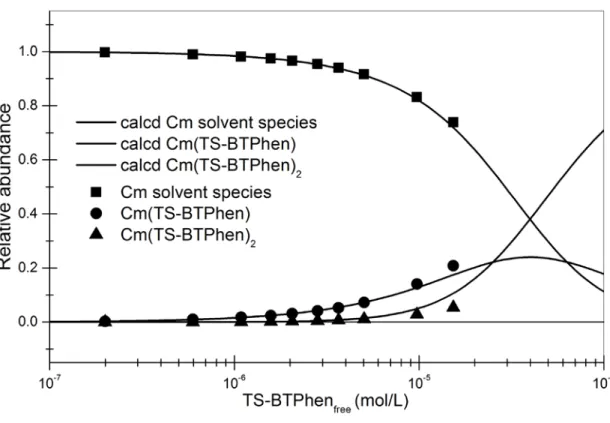
species distribution as a function of the free TS-BTPhen concentration was derived (Figure 10).
Figure 10: Species distribution of Cm(III) as a function of the TS-BTPhen concentration in 0.5 mol L-1 nitric acid. Symbols represent experimental data, lines are calculated with logβ01 = 4.2 and logβ02 = 8.8.
The complexation of Cm(III) with TS-BTPhen starts at 2 × 10⁻⁷ mol L-1 TS-BTPhen and exhibits a maximum for species 1 ([Cm(TS-BTPhen)] of 24% at 4.05 × 10⁻⁵ mol L-1. At concentrations above 4.1 × 10⁻⁵ mol L-1 species 2 ([Cm(TS-BTPhen)2] is the major species present in the system.
The slope analyses calculated from the species distribution are given in Figure11. A slope of 1.0 for species 1/solvent, 0.8 for species 2/species 1 depict the addition of 1 TS-BTPhen molecule. A slope of 1.8 for species 2/solvent depicts an overall complexation stoichiometry from the solvated curium ion to the 1:2 complex. The results confirm the assignment of the observed emission bands. The results show that a 1:1 complex is formed under extraction conditions as an
intermediate minor species whereas the 1:2 complex predominates at high ligand concentrations. The conditional stability constants were calculated to be logβ01 = 4.2 for the 1:1 complex, and
logβ02 = 8.8 for the 1:2 complex. A summary of the obtained conditional stability constants in
different media is given in Table 1.
Figure 11: Linear regression of the logarithm of the peak ratios of the solvent species and the two complex species observed in the titration experiments in 0.5 mol L-1 HNO3 vs. the logarithm of the free ligand concentration.
The minor amounts of the 1:1 complex obtained above in HNO3 compared to the titration
experiment performed in 10-3 mol L-1 HClO4 is explained by the effects of the applied medium.
As already observed by Wagner et al[20], the increase of ionic strength destabilizes the mono anionic [Cm(TS-BTPhen)]− complex relative to the penta anionic [Cm(TS-BTPhen)2]5− complex.
Furthermore, the decrease of logβ02 resulting from the change of the medium from 10-3 mol L-1
HClO4 to 0.5 mol L-1 HNO3 (10.7 → 8.8) is explained by three different impacts: a change of the
activity of TS-BTPhen and Cm(III) due to the increased ionic strength, and the competing
reaction between protonated TS-BTPhen ligands and nitrate ions caused by the protonation of the N-atoms of TS-BTPhen. These effectsresult in a decreased concentration of free TS-BTPhen.
Previous studies have shown the protonation of the free ligand to be the major contribution to the decrease of the conditional stability constants.[20]
Table 1 shows the conditional stability constants of TS-BTPhen in comparison to the stability constants of the SO3-Ph-BTBP complexant used in the AmSel process. Both complexants form
an intermediate 1:1 Cm(III) to complexant and a final 1:2 Cm(III) to complexant complex. TS-BTPhen shows a slightly stronger complexation with Cm(III) compared to SO3-Ph-BTBP of the
final 1:2 Cm(III) to complexant complex in both diluents. This effect was also observed for lipophilic BTBP and BTPhen ligands[27] and is attributed to the greater degree of preorganization of the BTPhen ligand. The formation of the 1:1 Cm(III) to TS- BTPhen complex is stronger in the HClO4 system which can be explained by a concurrency of the [Cm(III)(NO3)x] complexes in
nitric acid. Furthermore, the change of the solvent from 10-3 mol L-1 HClO4 to 0.5 mol L-1 HNO3
has a smaller effect on the final stability constant of the TS-BTPhen complex compared to that of SO3-Ph-BTBP.
Table 1: Conditional stability constants of [Cm(TS-BTPhen)n] (n = 1,2) and [Cm(SO3-Ph-BTBP)n] (n = 1,2)
complexes in 10-3 mol L-1 HClO4 and 0.5 mol L-1 HNO3.[20]
Solvent logβ01 logK12 logβ02
TS-BTPhen 10-3 mol L-1 HClO4 6.2 4.5 10.7 TS-BTPhen 0.5 mol L-1 HNO3 4.2 4.6 8.8 SO3-Ph-BTBP 10-3 mol L-1 HClO4 5.3 5.1 10.4 SO3-Ph-BTBP 0.5 mol L-1 HNO3 - - 7.3
Biphasic TRLFS Experiments
To analyze the complexes formed during the solvent extraction experiments, a two phase TRLFS experiment was performed. An aqueous phase containing Cm(III) and TS-BTPhen dissolved in 0.13 mol/L nitric acid was contacted with an organic phase containing TODGA in Exxsol D80 (a diluent very similar to TPH) + 5 vol.-% 1-octanol. After extraction, the phases were analyzed using TRLFS.
Figure 12 shows the spectra of the organic (left) and aqueous phases (right). The spectra of [Cm(TS-BTPhen)2] and [Cm(TODGA)3](NO3)3[26] were added for comparison.
Figure 12: TRLFS-Spectra of the organic phase (left) and the aqueous phase (right) of a solvent extraction experiment. Organic phase: 0.2 mol L-1 TODGA in Exxsol D80 + 5 vol.-% 1-octanol; aqueous phase: 10-7 mol L-1 Cm(III), 1 mmol L-1 TS-BTPhen in 0.13 mol L-1 nitric acid. 30 minutes of extraction at RT, 5 minutes of centrifugation. For comparison, spectra of the [Cm(TODGA)3](NO3)3 and [Cm(TS-BTPhen)2] complexes from
single phase experiments are added.
Figure 12 confirms the formation of a 1:2 Cm(III) TS-BTPhen complex in the aqueous phase of the extraction experiment. Furthermore, a comparison with the [Cm(TODGA)3](NO3)3 spectrum
shows the exclusive formation of [Cm(TODGA)3](NO3)3 in the organic phase. The formation of
mixed [Cm(TS-BTPhen)n] complexes in the organic phase can be excluded within the sensitivity
of the TRLFS measurement. Due to the low Cm(III) distribution ratios under the experimental conditions, the concentration of Cm(III) in the organic phase was low leading to a broadened peak with a low signal to noise ratio.
Conclusions
The novel complexing agent TS-BTPhen was investigated for its selectivity for Am(III) over Cm(III) and Ln(III) with a view to its application as a complexing agent for the selective recovery of Am(III) from PUREX raffinate. In solvent extraction experiments, the distribution ratios of the trivalent actinides were significantly reduced using TS-BTPhen in the aqueous phase in combination with TODGA in the organic phase. A separation factor between Cm(III) and Am(III) of SFCm/Am = 3.6 was achieved at nitric acid concentrations which allowed for a feasible
separation of Am(III) from Cm(III) (DCm > 1, DAm < 1 using 10 mmol L-1 TS-BTPhen at 0.65 mol
L-1 nitric acid). The lanthanides were less affected by the presence of TS-BTPhen in the aqueous
phase resulting in a minimum separation factor of SFLa/Am = 20 at 0.25 mol L-1 nitric acid. The
separation factor SFLn/An is lower compared to SO3-Ph-BTP used in the i-SANEX test
(SFLa/Am≈ 50), but the SFCm/Am is higher, making the system attractive for a selective Am(III)
separation process. A slope analysis of TS-BTPhen gave a slope of −0.8 for the actinides. To further investigate this result monophasic Cm(III) TRLFS studies were performed in 10-3 mol L-1 HClO4 and 0.5 mol L-1 HNO3 identifying and quantifying the BTPhen)] and
[Cm(TS-BTPhen)2] complexes. Furthermore, TRLFS investigations of the aqueous phase of an extraction
experiment revealed the exclusive formation of [Cm(TS-BTPhen)2] during the extraction. The
deviation between the slope analysis and the TRLFS results may be caused by the formation of mixed complexes influencing the slope in the extraction experiments. An i-SANEX based process with a selective Am(III) back extraction using TS-BTPhen thus seems to be possible and will be further investigated. This research contributes to the selective separation of only
americium from PUREX raffinate.
Acknowledgements
TPH was provided by Manuel Miguirditchian, CEA Marcoule, France. Financial support was provided by the SACSESS project under contract no. FP7-Fission-2012-323-282 which is part of the 7th framework program of the European Commission. Access to the Chemical Analysis Facility at the University of Reading is gratefully acknowledged.
References
1. NEA Potential Benefits and Impacts of Advanced Nuclear Fuel Cycles with Actinide Partitioning and Transmutation; NEA No. 6894; OECD, Nuclear Energy Agency (NEA); Issy-les-Moulineaux, France; 2011.
2. Taylor, R.J.; Gregson, C.R.; Carrott, M.J.; Mason, C.; Sarsfield, M.J. Progress towards the Full Recovery of Neptunium in an Advanced PUREX Process. Solvent Extr. Ion Exch. 2013, 31 (4), 442-462.
3. Modolo, G.; Kluxen, P.; Geist, A. Demonstration of the LUCA process for the separation of americium(III) from curium(III), californium(III), and lanthanides(III) in acidic solution using a synergistic mixture of bis(chlorophenyl)dithiophosphinic acid and tris(2-ethylhexyl)phosphate. Radiochim. Acta 2010, 98 (4), 193-201.
4. Taylor, R.; Bourg, S.; Glatz, J.-P.; Modolo, G. Development of actinide separation processes for future nuclear fuel cycles in Europe. Nucl. Future 2015, 11 (4), 38-43.
5. Moyer, B.A.; Lumetta, G.J.; Mincher, B.J. Minor actinide separation in the reprocessing of spent nuclear fuels: recent advances in the United States. Chap. 11 in Reprocessing and Recycling of Spent Nuclear Fuel, Taylor, R., Woodhead Publishing: Oxford, pp 289-312, 2015.
6. Jensen, M.P.; Chiarizia, R.; Shkrob, I.A.; Ulicki, J.S.; Spindler, B.D.; Murphy, D.J.; Hossain, M.; Roca-Sabio, A.; Platas-Iglesias, C.; de Blas, A.; Rodriguez-Blas, T. Aqueous Complexes for
Efficient Size-based Separation of Americium from Curium. Inorg. Chem. 2014, 53 (12), 6003-6012.
7. Mincher, B.J.; Schmitt, N.C.; Schuetz, B.K.; Shehee, T.C.; Hobbs, D.T. Recent advances in f-element separations based on a new method for the production of pentavalent americium in acidic solution. RSC Adv. 2015, 5 (34), 27205-27210.
8. Hill, C. Overview of Recent Advances in An(III)/Ln(III) Separation by Solvent Extraction. Chap. 3 in Ion Exchange and Solvent Extraction, A Series of Advances, Vol. 19, Moyer, B.A., CRC Taylor and Francis: pp 119-193, 2009.
9. Nash, K.L. A Review of the Basic Chemistry and Recent Developments in Trivalent f-Elements Separations. Solvent Extr. Ion Exch. 1993, 11 (4), 729-768.
10. Modolo, G.; Wilden, A.; Geist, A.; Magnusson, D.; Malmbeck, R. A review of the demonstration of innovative solvent extraction processes for the recovery of trivalent minor actinides from PUREX raffinate. Radiochim. Acta 2012, 100 (8-9, Plutonium Futures), 715-725.
11. Sypula, M.; Wilden, A.; Schreinemachers, C.; Malmbeck, R.; Geist, A.; Taylor, R.; Modolo, G. Use of polyaminocarboxylic acids as hydrophilic masking agents for fission products in actinide partitioning processes. Solvent Extr. Ion Exch. 2012, 30 (7), 748-764.
12. Wilden, A.; Modolo, G.; Kaufholz, P.; Sadowski, F.; Lange, S.; Sypula, M.; Magnusson, D.; Müllich, U.; Geist, A.; Bosbach, D. Laboratory-Scale Counter-Current Centrifugal Contactor Demonstration of an Innovative-SANEX Process Using a Water Soluble BTP. Solvent Extr. Ion Exch. 2015, 33 (2), 91-108.
13. Modolo, G.; Wilden, A.; Kaufholz, P.; Bosbach, D.; Geist, A. Development and demonstration of innovative partitioning processes (i-SANEX and 1-cycle SANEX) for actinide partitioning. Prog. Nucl. Energy 2014, 72, 107-114.
14. Magnusson, D.; Geist, A.; Malmbeck, R.; Modolo, G.; Wilden, A. Flow-sheet design for an innovative SANEX process using TODGA and SO3-Ph-BTP. Procedia Chem. 2012, 7, 245-250. 15. Št’astná, K.; John, J.; Šebesta, F.; Vlk, M. Separation of curium from americium using composite
sorbents and complexing agent solutions. J. Radioanal. Nucl. Chem. 2015, 304 (1), 349-355. 16. Lewis, F.W.; Harwood, L.M.; Hudson, M.J.; Geist, A.; Kozhevnikov, V.N.; Distler, P.; John, J.
Hydrophilic sulfonated bis-1,2,4-triazine ligands are highly effective reagents for separating actinides(III) from lanthanides(III) via selective formation of aqueous actinide complexes. Chem.
Sci. 2015, 6 (8), 4812-4821.
17. Kaufholz, P.; Wilden, A.; Modolo, G.; Sadowski, F.; Lewis, F.W.; Smith, A.W.; Harwood, L.M. TS-BTPhen as a Promising Hydrophilic Complexing Agent for Selective Am(III) Separation by Solvent Extraction. Nukleonika 2015, 60 (4), 815-820.
18. Bollesteros, M.-J.; Calor, J.-N.; Costenoble, S.; Montuir, M.; Pacary, V.; Sorel, C.; Burdet, F.; Espinoux, D.; Hérès, X.; Eysseric, C. Implementation of Americium Separation from a PUREX Raffinate. Procedia Chem. 2012, 7, 178-183.
19. Charbonnel, M.C.; Berthon, C.; Berthon, L.; Boubals, N.; Burdet, F.; Duchesne, M.T.; Guilbaud, P.; Mabille, N.; Petit, S.; Zorz, N. Complexation of Ln(III) and Am(III) with the hydrosoluble TEDGA: Speciation and Thermodynamics studies. Procedia Chem. 2012, 7, 20-26.
20. Wagner, C.; Mullich, U.; Geist, A.; Panak, P.J. TRLFS study on the complexation of Cm(III) and Eu(III) with SO3-Ph-BTBP. Dalton Trans. 2015, 44 (39), 17143-17151.
21. Wagner, C.; Müllich, U.; Geist, A.P., Petra J. Selective Extraction of Am(III) from PUREX raffinate: The AmSel system. Solvent Extr. Ion Exch. 2015, Accepted.
22. Modolo, G.; Asp, H.; Schreinemachers, C.; Vijgen, H. Development of a TODGA based Process for Partitioning of Actinides from a PUREX Raffinate Part I: Batch Extraction Optimization Studies and Stability Tests. Solvent Extr. Ion Exch. 2007, 25 (6), 703-721.
23. Sasaki, Y.; Sugo, Y.; Suzuki, S.; Tachimori, S. The Novel Extractants, Diglycolamides, for the Extraction of Lanthanides and Actinides in HNO3-n-dodecane System. Solvent Extr. Ion Exch.
2001, 19 (1), 91-103.
24. Geist, A.; Müllich, U.; Magnusson, D.; Kaden, P.; Modolo, G.; Wilden, A.; Zevaco, T. Actinide(III)/Lanthanide(III) Separation Via Selective Aqueous Complexation of Actinides(III) Using a Hydrophilic 2,6-Bis(1,2,4-Triazin-3-yl)-Pyridine in Nitric Acid. Solvent Extr. Ion Exch. 2012, 30
(5), 433-444.
25. Wilden, A.; Modolo, G.; Sypula, M.; Geist, A.; Magnusson, D. The Recovery of An(III) in an Innovative-SANEX Process using a TODGA-based Solvent and Selective Stripping with a Hydrophilic BTP. Procedia Chem. 2012, 7, 418-424.
26. Wilden, A.; Modolo, G.; Lange, S.; Sadowski, F.; Beele, B.B.; Skerencak-Frech, A.; Panak, P.J.; Iqbal, M.; Verboom, W.; Geist, A.; Bosbach, D. Modified Diglycolamides for the An(III) + Ln(III) co-separation: Evaluation by Solvent Extraction and Time-Resolved Laser Fluorescence Spectroscopy. Solvent Extr. Ion Exch. 2014, 32 (2), 119-137.
27. Bremer, A.; Whittaker, D.M.; Sharrad, C.A.; Geist, A.; Panak, P.J. Complexation of Cm(III) and Eu(III) with CyMe4-BTPhen and CyMe4-BTBP studied by time resolved laser fluorescence spectroscopy. Dalton Trans. 2014, 43 (6), 2684-2694.
28. Wagner, C.; Müllich, U.; Panak, P.J.; Geist, A. AmSel, a New System for Extracting Only Americium from PUREX Raffinate, Sustainable Nuclear Energy Conference, Manchester, UK, 9-11 April 2014, 2014.
29. Trumm, S.; Lieser, G.; Foreman, M.; Panak, P.J.; Geist, A.; Fanghanel, T. A TRLFS study on the complexation of Cm(III) and Eu(III) with 4-t-butyl-6,6 bis-(5,6-diethyl-1,2,4-triazin-3-yl)-2,2 '-bipyridine in a water/2-propanol mixture. Dalton Trans. 2010, 39 (3), 923-929.
30. Edelstein, N.M.; Klenze, R.; Fanghänel, T.; Hubert, S. Optical properties of Cm(III) in crystals and solutions and their application to Cm(III) speciation. Coord. Chem. Rev. 2006, 250, 948-973. 31. Weissman, S.I. Intramolecular Energy Transfer The Fluorescence of Complexes of Europium. J.
Chem. Phys. 1942, 10, 214-217.
32. Skerencak, A.; Panak, P.J.; Hauser, W.; Neck, V.; Klenze, R.; Lindqvist-Reis, P.; Fanghanel, T. TRLFS study on the complexation of Cm(III) with nitrate in the temperature range from 5 to 200 degrees C. Radiochim. Acta 2009, 97 (8), 385-393.


![Figure 6 Normalized fluorescence spectra of the [Cm(TS-BTPhen) n ] complexes in 10 -3 mol L -1 HClO 4 (n= 0, 1, 2)](https://thumb-us.123doks.com/thumbv2/123dok_us/8707430.2357025/15.918.231.759.317.743/figure-normalized-fluorescence-spectra-cm-btphen-complexes-hclo.webp)