The
Register
BPM: lessons from the real world
Practical ideas to apply to your organisation Freeform Dynamics Ltd, October 2008
Businesses admit there is work to be done when it comes to improving process management
Effective and efficient management of the design, implementation and evolution of their business processes is a weakness in most organisations. Process fragmentation across systems, staff and organisational boundaries causes headaches in terms of performance, and also poses a challenge when people want to start improving things, and corral available expertise and support.
Process ownership, understanding and alignment are foundation stones for BPM improvement
Ownership drives accountability, which in turn increases an organisation’s knowledge of the way processes perform, providing the scope for improvement. Building understanding and alignment across multiple domains and stakeholders through activities such as process mapping and modelling gets people onto the same page, sets expectations and improves the likelihood of gaining support. Organisations which apply these ideas broadly and deeply find their BPM performance improves.
The right tools for the job and ‘professional’ process automation is the best way to execute The job in hand requires the right tools. More often than not they are already available within the organisation, as sophisticated technology investment is not a prerequisite to effective BPM. It is, on the other hand, important for expert BPM, and organisations will naturally gravitate towards dedicated BPM tools as they become more proficient. Successful practitioners understand the importance of the balance between manual and automated process steps. For the latter, they promote the use of ‘professional solutions’ led by IT or enabled by specialist BPM tools rather than ad-hoc, DIY solutions.
BPM effectiveness can be super-charged with the right approach and capabilities
Formalising the way BPM is carried out simply works better than acting in an uncoordinated fashion. Benefits can be gained as much from doing things in the right way and in the right order, as from adopting a highly regimented approach. From an organisational and technical point of view, a very strong correlation can be seen between the degree of integration across the breadth of BPM activities and capabilities and the effectiveness of business process management.
Following the right mantra can pay dividends
‘Thinking strategically and acting locally’ sums up the research findings which highlight the performance gains from addressing BPM in a joined up manner and the practical benefits of using the most appropriate tools and skills at hand to get the job done. If nothing else can be achieved, adopting this mantra for BPM can stand organisations in good stead.
EXECUTIVE SUMMARY
Before we start, let us agree on a working definition of business process management. For the purposes of this report we mean ‘the activities involved in designing, implementing, optimising and managing business processes’. Next, given the multifaceted nature of BPM, we’ll outline who we think might benefit from reading this report.
Many people go about their daily routine oblivious to their part in the bigger picture. Others do not. Some are tasked with the understanding, management, change and improvement of the processes and systems which make their company work. This report has been written especially for them.
This group contains a wide range of people and experience: from process gurus, who know BPM inside out, but might benefit from some ideas on how to involve senior stakeholders to further a project, to ‘the newbie’ who has 2 weeks to fix something but doesn’t know where to start and doesn’t like to ask.
Between the two extremes, the majority of people, on reflection, may agree they had ‘done some BPM’, regardless of the terminology. These people might have worked on the analysis or design phase of an IT project or been part of a team which launched a new product or helped company A merge with company B. From time to time they are involved in fixing or improving things or bringing new things to life. They could always benefit from more insight of what works for others in order to try it out for themselves. Of course, you may simply be reading this to find out what all the fuss is about.
Ultimately, many different people could find themselves tasked with creating, fixing or improving a business process. However, the right blend of experience and knowledge can be distributed between different people and functions, and the best course of action is not always obvious.
With these thoughts in mind, this report is designed to provide a balanced treatment of BPM. The goal is to get beneath the surface of perceptions, practices and plans regarding the way organisations manage their business processes; to understand the tools in use and the approaches which foster success. Whatever your motivation, we hope the insights presented here, garnered from your peers, will help with your own particular requirements.
What’s BPM and whose job is it anyway?
The intelligence upon which this report is based was gathered during a research study completed in Q3 2008. The study was independently designed and interpreted by Freeform Dynamics and executed via an online study, gaining 557 responses from IT and business professionals. A wide range of different sized organisations, across a broad selection of industries took part in the research (see appendix A for more details).
Important: Online survey methodologies generate a self-selecting sample biased towards those with an interest in the topic. While the results provide accurate insights into behaviour and best practice, they are unsuitable for market sizing or forecasting.
Businesses are subject to regulation and scrutiny, and the economic climate requires a vigilant eye to keep things as optimised as possible. Beyond generic pressures, it is likely though, that your organisation has undergone a merger or acquisition, brought a new product to market or retired an old one. It might have launched a marketing campaign, or streamlined a department or line of business to reduce costs or improve efficiency.
Indeed, there are so many possible ‘upheavals’ we could mention that it is very likely that somewhere in your organisation, somebody is in the process of, or thinking about, reviewing, designing or changing the way a business process works. As the cliché goes, change is constant.
The way that organisations deal with these changes depends on how they are ‘architected’ from an operational and technical point of view. This in turn drives how things work inside the organisation, and between it and its suppliers, customers and partners.
This brings us to our first question. If we are thinking about managing processes, where are we starting from? What attributes are exhibited by those being used in organisations today?
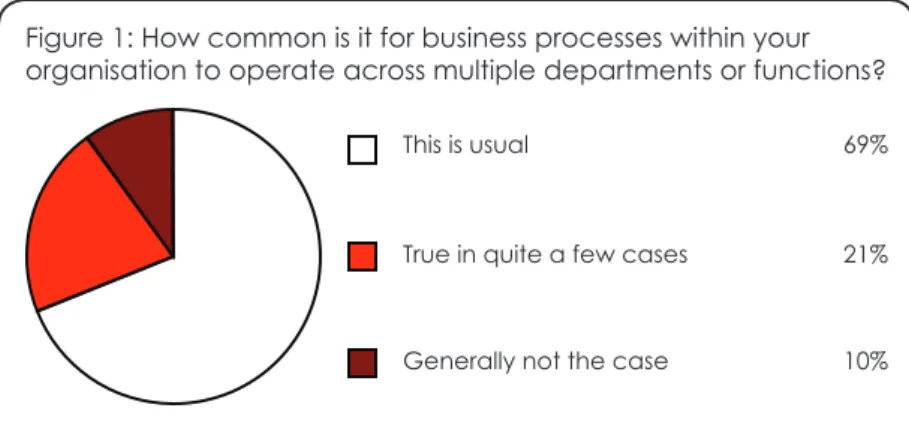
What we find is that most organisations operate processes across multiple departments or functions (Figure 1). Furthermore, most processes are dependent on multiple IT systems or applications. However, many of the applications in use today are very departmental, or domain specific in nature.
Research Study Design
Scoping out the challenge
Figure 1: How common is it for business processes within your organisation to operate across multiple departments or functions?
Business processes cutting across departments or functions is a fact of life for all but a small number of organisations.
True in quite a few cases 21%
Generally not the case 10%
We also see that many business processes involve manual handling of documents or information, or manual activity that falls outside the scope of core transactional systems (Figure 2).
These two sets of high level attributes give us an early hint that things might not work as smoothly as we’d like them to. They suggest that there is scope for business processes to drift out of synchronisation over time. Perhaps things don’t always get carried out in a consistent manner. Perhaps manual steps can be accidentally missed out or unnecessary ones put in. Effort can be duplicated or wasted across multiple departments.
All of these factors can have a cumulative effect on performance, or make it unpredictable. However, if there is no end-to-end view of a process, or if organisations carry out performance reviews on an infrequent basis, the true cause of degradation could lie hidden over periods of time.
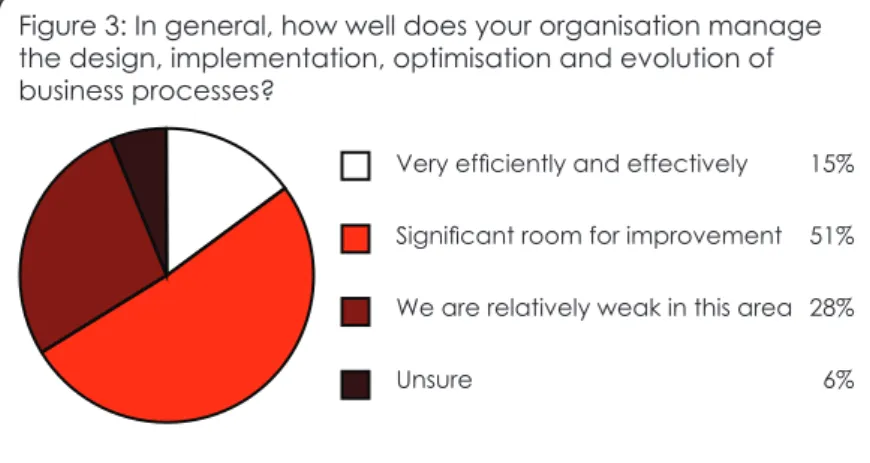
Most organisations agree then that when it comes to the management of the design, implementation, optimisation and evolution of their business processes, there is certainly work to be done to improve things from the level they are currently at (Figure 3).
Given some of the challenges we have been discussing, it is no surprise that approximately 4 out of 5 organisations participating in this study have significant issues managing the design, implementation, optimisation and evolution of business processes. Whether as a result of lack of systems integration or simply the need for physical and electronic documents to fulfil the requirements of processes, the end result is the same – a lot of manual processing.
Figure 2: How common is it for business processes to involve the manual handling of documents, information or activity that falls outside the scope of core transactional systems?
True in quite a few cases 36%
Generally not the case 16%
This is usual 48%
Figure 3: In general, how well does your organisation manage the design, implementation, optimisation and evolution of business processes?
Significant room for improvement 51% We are relatively weak in this area 28% Very efficiently and effectively 15%
Effective ways to approach BPM
Regardless of where you are starting from, the acknowledgement that most organisations see significant scope for improving the way they manage business processes leads us on to thinking about how approaches to BPM could be organised and streamlined to foster successful outcomes.
The research findings highlight four areas which at a high level could be adopted as fundamental principles to help fashion the way organisations perceive ‘the discipline’ of business process management. At a tactical level, they offer a number of ways of getting started, and introducing effective practices. Let us examine each in turn.
Promoting process ownership and accountability
In the broadest sense, ownership and accountability are effective generic traits, especially whenever there is ‘a project’. Indeed, in most domains, clear ownership and effective management tend to go hand in hand. But what does ownership and accountability mean in terms of business process management?
Depending on your organisation and what you are trying to achieve, ownership and accountability could take numerous forms. On the one hand, it could be assigning responsibility for maintaining or improving success metrics or KPIs relating to a business activity. On the other hand, it could mean having someone in place to liaise between people using the process and those, such as the IT department for example, providing support.
The impact of ownership and accountability could be equally varied. It could be as simple as increasing the visibility of customer retention, sales leads converted to orders, or product default tracking. There could be more complex implications too; a desire or need to implement change such as altering the way people work, to shift resources around, to remove redundancy or to invest in new technology.
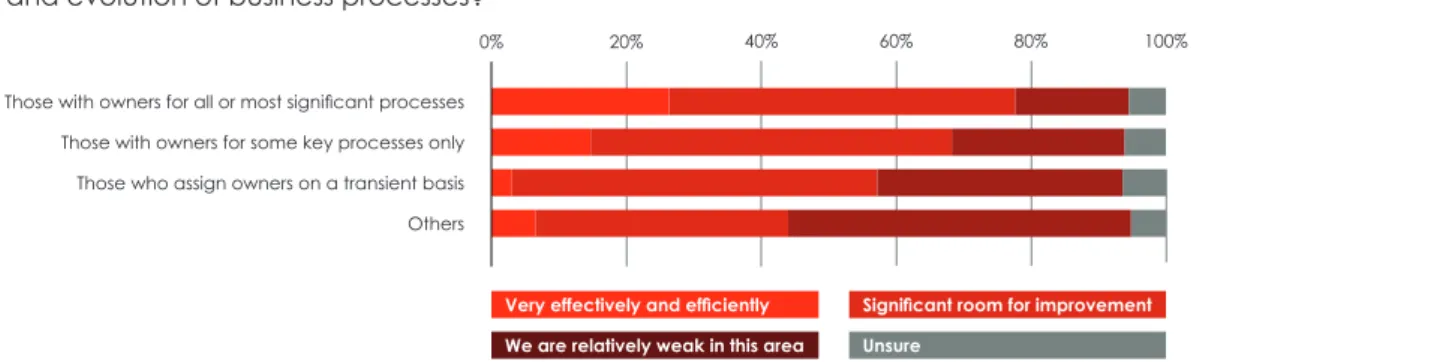
In the BPM realm, we find the notion of ownership and accountability to be especially valid when it comes to enabling, or driving effective business process management. As Figure 4 demonstrates, a strong correlation exists between performance and the degree to which persistent / ongoing ownership of important processes is in place.
In terms of being an actionable finding, assigning owners for processes sounds like a relatively trivial task. However, given that most organisations have processes that span multiple departments or groups, political and diplomatic skills may be required to convince all parties that the process owner shares the same goals as they do.
Figure 4: In general, how well does your organisation manage the design, implementation, optimisation and evolution of business processes?
Those with owners for all or most significant processes Those with owners for some key processes only Those who assign owners on a transient basis
Others
20% 40% 60% 80% 100%
0%
Very effectively and efficiently We are relatively weak in this area
Significant room for improvement Unsure
There is a striking correlation between performance and the degree to which persistent/ongoing ownership of significant processes is in place.
Building understanding and alignment
Appropriate ownership and accountability can focus overall responsibility for management or change on a single person. Given the nature of business processes, there are often multiple stakeholders involved and so the need to share knowledge and harness input from others is magnified.
Clearly articulating challenges or problems with a process, or providing clear insight to win support for change or investment can achieve alignment in terms of understanding, expectations and trust from multiple stakeholders. At a departmental level, this could simply mean process users being more likely to accept that planned changes will benefit them and the company. At a higher level, the consolidation of understanding across multiple processes can lead to better affinity between day to day operations and business and IT strategies.
The work involved in building understanding and alignment depends on the detail of existing knowledge, and of course the job in hand. Are you starting from scratch with a new process, or making a tweak to an existing system? Or are you tasked with optimising an entire line of business? It is important to gauge the effort required to get things moving. Does the job require simple documentation, or a complex exercise in mapping process flows and modelling relationships?
When it comes to getting started, some projects or problems are time critical, so it’s important to get up and running. In these scenarios, generating ‘just enough’ understanding to be able to do so is what’s called for. For more complex or less time sensitive tasks, deeper understanding may be required to enable all stakeholders to engage with the project properly.
We find that the activities associated with building understanding around processes manifest themselves to some degree in the mapping and modelling activities that organisations carry out. There are strong correlations between the approaches taken to these activities, and overall performance when it comes to effective process management.
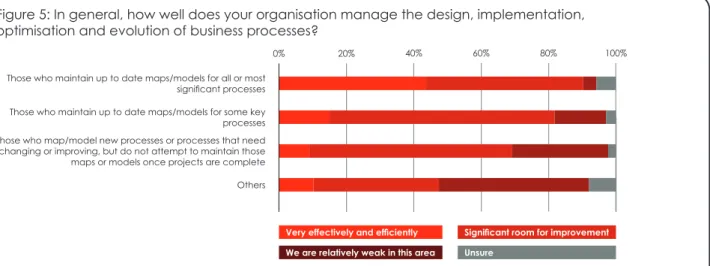
Indeed, the breadth and persistence of process mapping and modelling seems to be important to effective management, as Figure 5 demonstrates. Keeping up to date maps / models for all or the most significant processes produces by far the best results. This stands to reason, as maintaining currency in areas which require information gathering and sharing can streamline future workloads considerably.
The value of mapping and modelling processes then, to drive understanding and alignment leads us on to the next area, which introduces some ideas and insights around technology.
The best results are achieved if up-to-date models are maintained across all or most significant processes.
20% 40% 60% 80% 100%
0%
Figure 5: In general, how well does your organisation manage the design, implementation, optimisation and evolution of business processes?
Those who maintain up to date maps/models for all or most significant processes Those who maintain up to date maps/models for some key
processes Those who map/model new processes or processes that need changing or improving, but do not attempt to maintain those maps or models once projects are complete
Others
Very effectively and efficiently We are relatively weak in this area
Significant room for improvement Unsure
Using the right tools for the job
When it comes to generating understanding of processes and seeking out ways to highlight opportunities for changes or improvements, it is natural to consider the tools that might be most appropriate to employ.
At one end of the scale we have ‘basic mapping’ which could be carried out on a whiteboard or flipchart, or common office tools such as Visio, or Power Point to capture and share ideas and illuminate thinking. In the spirit of ‘just enough’ there is nothing wrong with using simple tools where appropriate. But what capabilities do the more advanced tools offer and why might organisations benefit from them?
Further up the scale of complexity is process modelling, which we can think of as taking a process map and ‘adding reality’ to it. These tools allow the user to capture information about real world interdependencies and interactions or identify performance constraints. Some tasks may require process simulations to explore ‘what if’ scenarios to understand the impact of change. In environments where changes to processes are a common feature of business operations, repository based tools can drive persistence and consistency over time, driving efficiencies and reducing duplication whenever tasks are revisited.
Ultimately, the more advanced tools can be used to gain deeper understanding of the performance of existing processes, and can act as a foundation for an execution phase, should change be a requirement of the task.
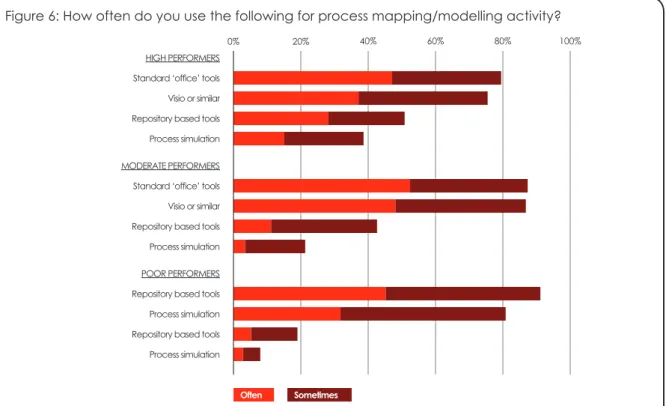
We have learned from the research that leading organisations employ the same basic tools as everybody else, but are also far more likely to employ the more comprehensive tools such as repository based modelling and process simulation tools.
Indeed, Figure 6 shows how business process effectiveness correlates with balance between the basic and sophisticated tools used.
20% 40% 60% 80% 100%
0%
Figure 6: How often do you use the following for process mapping/modelling activity?
Often Sometimes
Repository based tools
Repository based tools
Repository based tools Standard ‘office’ tools
Standard ‘office’ tools
Repository based tools HIGH PERFORMERS MODERATE PERFORMERS POOR PERFORMERS Process simulation Process simulation Process simulation Visio or similar Visio or similar Process simulation
Lightweight tools are used pretty much across the board, even by higher performers. However, those with better control of their processes tend to be also using more comprehensive modelling and simulation solutions.
The reason for the range of tools in play is simple. On one hand, we have the notion of employing simple tools for simple tasks. It is possible for organisations to carry out mapping and modelling activities without having to invest in new technology. On the other hand, the value of experience in this area and the desire to drive persistence and re-use amongst the higher performers drives the need for more comprehensive modelling and simulation capabilities.
Balancing the approach to execution
Moving on from analysis and design tasks, there comes a point where organisations need to implement changes to processes or deploy new ones. Putting all this into practice typically involves processes which are not encapsulated within software, or which cut across organisational boundaries.
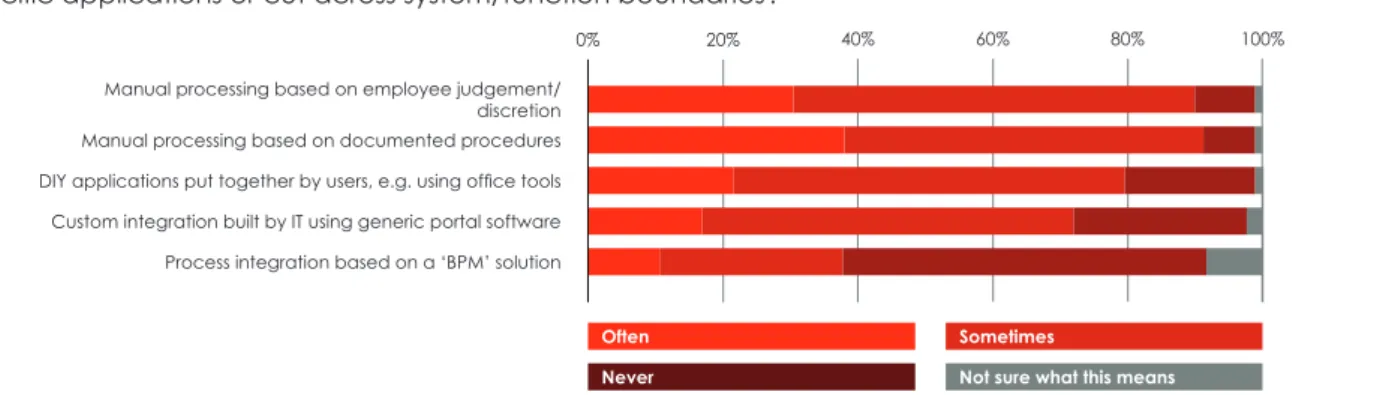
Most processes involve manual processing, either as hand-offs between automated steps, or because a process requires specific human intervention. Where automation is used, ‘user DIY’ and IT-led custom automation is common, but less use of specialist BPM technology is evident (Figure 7).
The key is in striking the right balance between manual and automated steps, and most organisations feel they have this about right. The degree of manual processing does not vary much between highly performing and poorly performing organisations, although the approach taken to automation when it is implemented is often different. For simple tasks, an organisation may decide to empower its people to create work-around solutions themselves, allowing them to use their individual judgement and discretion. The next level up could involve IT taking a more central role, and providing custom integration solutions using generic portal software, while the highest level of sophistication involves the use of dedicated process automation tools.
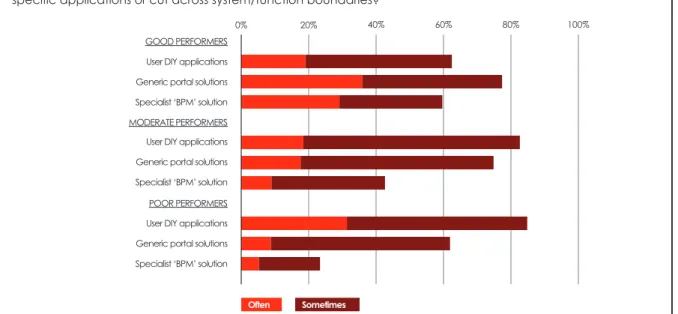
What we find is that performance is not based on the use of individual approaches per se, but on the weighting given to each (Figure 8). Whereas poor performers are more likely to leave it up to users to sort themselves out in a DIY manner, those who put properly supported integration in place fare better. The top performers are more likely to be moving beyond generic portal solutions to specialist BPM technology.
Organisations rely heavily on manual processing. Where automation is used, we see user DIY solutions and IT built generic portal solutions, but much less use of specialist BPM technology.
20% 40% 60% 80% 100%
0%
Figure 7: How extensively are the following used to control parts of processes that fall outside the scope of specific applications or cut across system/function boundaries?
Manual processing based on employee judgement/ discretion Manual processing based on documented procedures DIY applications put together by users, e.g. using office tools Custom integration built by IT using generic portal software Process integration based on a ‘BPM’ solution
Often Never
Sometimes
Figure 8: How extensively are the following used to control parts of processes that fall outside the scope of specific applications or cut across system/function boundaries?
20% 40% 60% 80% 100% 0% Often Sometimes Specialist ‘BPM’ solution Specialist ‘BPM’ solution Specialist ‘BPM’ solution User DIY applications
User DIY applications
User DIY applications GOOD PERFORMERS
MODERATE PERFORMERS
POOR PERFORMERS Generic portal solutions
Generic portal solutions
Generic portal solutions
The degree of manual processing does not vary much across performance categories. However, the approach to automation when it is implemented is often different between performance groups.
The bottom line is that executing on BPM is not synonymous with process automation. Success hinges on taking the most effective approach to the task in hand. Thus far, we have discussed many of the things that can make a difference. The chances are that your organisation might already be doing some of these very well while struggling with others.
Regardless of the mix of approaches and technologies in use, the value of a coordinated approach to managing the design, optimisation and evolution of business processes is very clear.
Catalysing BPM activities
Are there any ways then in which we can bring everything together as a more coherent whole? Are there any approaches or capabilities which can help organisations seeking to gain better overall performance or consistency from their BPM activities? Research findings suggest there are two factors which have an amplifying effect on the individual steps discussed previously.
The power of a coherent approach
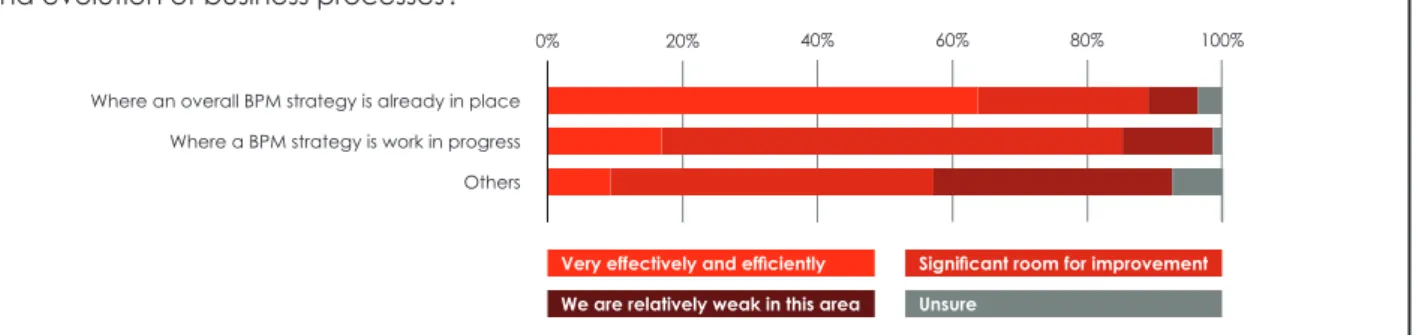
Whatever the approach taken to BPM, if it has some degree of structure, it works better (Figure 9). However, we know that the majority of organisations do not follow a formal approach to BPM, and are unlikely to develop one overnight.
In the absence of an ‘official’ approach to BPM then, what does a coherent approach or strategy mean in the context of what we have learned from the research?
The secret lies in gaining an understanding of the overall direction in which the organisation is taking its process management activities and capabilities. Essentially, this means doing things in the right order. Making sure that planning activities include consultation with all the appropriate stakeholders, or that appropriate due diligence is carried out using mapping and modelling techniques before resources and financial support are requested from investment decision-makers, for example. On the capability side, it is about understanding how expertise and technical ability should be developed over time.
The research findings also support the idea that taking a longer term view towards developing a co-ordinated approach to BPM has a cumulatively beneficial effect on performance. Organisations for which a BPM strategy is a work in progress do slightly better than those which have nothing in place at all. Over time the impact can become significantly more profound.
A Holistic approach to technology enablement
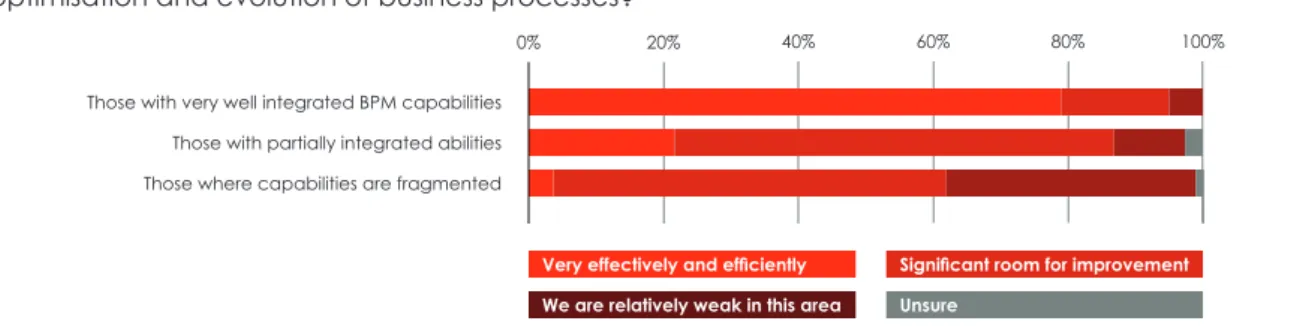
Just as progressing towards a more joined up approach to BPM pays dividends over time, so too does developing technology enablement in a similar manner. There is a staggering correlation between having well integrated BPM capabilities and being very effective and efficient at managing business processes (Figure 10).
20% 40% 60% 80% 100%
0%
Figure 9: In general, how well does your organisation manage the design, implementation, optimisation and evolution of business processes?
Where an overall BPM strategy is already in place Where a BPM strategy is work in progress
Others
Very effectively and efficiently We are relatively weak in this area
Significant room for improvement Unsure
20% 40% 60% 80% 100% 0%
Figure 10: In general, how well does your organisation manage the design, implementation, optimisation and evolution of business processes?
Those with very well integrated BPM capabilities Those with partially integrated abilities Those where capabilities are fragmented
Very effectively and efficiently We are relatively weak in this area
Significant room for improvement Unsure
If ever there was a case for integrated BPM suites, this is it. The data counters the claim that the needs of BPM can be met as effectively through the deployment of generic technology or point solutions.
A joined up approach to activities can be enabled in numerous ways. It is possible to do this manually, through sheer dedication and superior organisational skills, but co-ordination and consistency would be difficult to maintain over time. Technical standards could be employed to create a more coherent set of IT capabilities – developing a custom BPM solution over time, essentially. Or the organisation could invest in an integrated BPM suite. The value of integrated capabilities is recognised particularly strongly by organisations with experience of using specialist BPM technology. This suggests that the importance of proper integration often only becomes clear through experience. It also supports an earlier finding that BPM capabilities improve as formal approaches start to sink in. Furthermore, it suggests that the claims made by IT vendors when positioning the value of comprehensive BPM suites are real. This is not to say that investing in an integrated BPM suite is the key to unlocking the challenges of BPM – that would be putting the cart before the horse. However, the notion of approaching BPM in an integrated manner does lead naturally towards the acceptance of the value of integrated BPM suites, especially as an organisations’ expertise and expectations become more sophisticated.
Investment sign-off
Whether part of a cohesive BPM program or not, there comes a time when even the most meticulously thought-out and logically designed project has to withstand the scrutiny of the senior stakeholders controlling the purse strings. Understanding and articulating the high level business requirements and the underlying drivers can be the difference between a project stuck in the design phase and one which gets the green light.
When it comes to thinking about investing in BPM related technology, organisations tend to be driven by one of three types of requirement (Figure 11). They may have a strategic desire to change the way they do things or an immediate need to deal with a new, stressed or under-performing process. The third requirement, a strategic desire coupled with a specific tactical need, is the most common reason for justifying investment.
At the next level down, organisations favour relatively conservative drivers such as process efficiencies and effectiveness (Figure 12). These findings may reflect the state of the business environment and economy in general in terms of their common sense, but they also reflect the fact that apart from a few differentiating activities, organisations value stability in their core operational processes, which is important from both a risk and efficiency perspective.
Finally, the extensive involvement of IT as a driving or supporting force is to be expected. However, senior management figures most prominently as a driver and/or advocate for investment. This makes sense given that most organisations view their BPM investments from a strategic viewpoint. Unlike many other IT solution procurements that are handled primarily by IT, a BPM investment is going to involve a range of disciplines at various levels across the business.
Most respondents cite a strategic, higher level desire to change things, usually in combination with a specific “quick win” or “acute pain” project.
10% 20% 30% 40%
0%
Figure 11: Thinking about investments in BPM related technology, how have these been justified in the past or how are they likely to be justified in the future?
Based on an overall strategic business case for changing the way we do things
Based purely on an immediate need to deal with a new, stressed or under-performing process Based on a combination of specific need, together with a
higher level desire to change things
N/A - no activity or plans in this area
‘Crunchier’ efficiency and effectiveness drivers figure most prominently in making an effective business. Flexibility and user empowerment are highlighted significantly less.
20% 40% 60% 80% 100%
0%
Figure 12: How would you rate the importance of the following when making the business case for investment in BPM technology?
More efficient processes (reduced cycle times, lower administrative overhead, less manual activity, lower overall costs, etc. More effective processes (better exception handling, fewer
mistakes, better decisions, more predictable and accurate outcomes, etc) More visible processes (improved ability to track operations, measure performance, identity bottlenecks, propagate best practice, etc) More flexible processes (empowerment of business people to
implement policy changes, ability to optimise, redesign and redeploy rapidly, etc)
More effective collaboration between business and IT people
Figure 13: Lessons
Think strategically, act locally
When businesses combine the approaches and tools we have been discussing into an ongoing program, the economies of scale, knowledge captured and experience gained could almost be described as a guarantee, or at least a fair promise of success.
It is harder to assure the same level of continual performance improvement to organisations which address things on an individual basis, but even outside of a coherent approach, we have highlighted a number of practical options open to organisations seeking to improve the management of their business processes (Figure 13).
However, organisations which have not adopted a formal BPM strategy or invested in the most sophisticated technologies can still benefit from some of the advantages enjoyed by the more advanced BPM practitioners. The research findings characterise BPM as a discipline which can be addressed from a multiple number of starting points, using a broad range of tools. It also highlights that the sophistication of approaches and capabilities employed can be developed over time.
In essence, given what we have discussed throughout this report, it should be possible to place one’s current BPM activities and capabilities in the context of an overall ‘BPM strategy’, even if the organisation doesn’t actually follow one in a formal manner.
The suggestion which emerges from the research is ‘think strategically, act locally’. It sums up the importance of thinking about BPM in a joined up manner, and the practical benefits of using the most appropriate tools and skills at hand to get the job done. If nothing else can be achieved, adopting this mantra for BPM could stand organisations in good stead.
The headline lessons from the research findings open up a significant number of practical options for an organisation looking to improve the way it manages its business processes.
Knowing how your processes work or how you would like them to (effective use of maps
and models)
Determining the ‘right’ level of process automation, recognising the need for
balance
Emphasis on professionally implementing automation,
rather than use DIY Use of specialist BPM
technology to streamline building, integration and ongoing management Appropriate focus on proper
integration of enabling solutions, whether through
suites or standards Senior management support for BPM initiatives
and associated solution
investments
BPM
Success
Factors
Clear and ongoing process ownership, looking across organisational and system
Appendix A
Research Sample
The study was designed and executed by Freeform Dynamics in Q3 2008 via an online survey in conjunction with The Register. It attracted 557 responses, distributed as shown below:
Figure 14: Sample by geography
USA
Rest of Europe UK
Rest of World
Respondents are mostly from English speaking developed markets with a bias towards the UK. This reflects the nature and reach of The Register news site used as a vehicle for the survey
17% 16% 47%
20%
Representation from all major industry groupings: People across all major industries are keen to talk about this topic.
Figure 15: Sample by industry category
Telecoms and Media Hi Tech
Industrial
Retail & Distribution Government Healthcare Other Financial Services Business Services 13% 24% 11% 4% 8% 4% 8% 14% 14% 10% 20% 30% 40% 0%
Figure 16: What type of organisation do you work in?
Company with more than 5,000 employees
Company with 10 to 250 employees Company with 250 to 5,000 employees
Company with less than 10 employees Public sector organisation
Other Representation from all major industry groupings: People
across all major industries are keen to talk about this topic.
Figure 17: Sample by Job Function
IT Manager or Exec 26% Business Analyst 9% IT Practitioner 37% Business Practitioner 2% Other 13% Business Manager/Exec 13%
The Register
The Register started life as a daily news operation on the web in May 1998. On the first day, 300 readers visited; in 2007 more than 5 million unique readers visit the site every month.
The Register’s blend of breaking news, strong personalities – and its accessible online execution – has made it one of the most popular, authorities on the IT industry.
With an international team of journalists and columnists, The Register reports on the IT industry from the inside out – covering everything from enterprise software, to chip developments.
Freeform Dynamics
Freeform Dynamics is a research and analysis firm. We track and report on the business impact of developments in the IT and communications sectors.
As part of this, we use an innovative research methodology to gather feedback directly from
those involved in ITC strategy, planning, procurement and implementation. Our output is therefore grounded in real-world practicality for use by mainstream IT professionals.
About IBM
At IBM, we strive to lead in the invention, development and manufacture of the industry’s most advanced information technologies, including computer systems, software, storage systems and microelectronics.
We translate these advanced technologies into value for our customers through our professional solutions, services and consulting businesses worldwide.
For more information on IBM, please visit www.ibm.com.
Terms of Use
This report is Copyright 2008 Freeform Dynamics Ltd. It may be freely duplicated and distributed in its entirety on an individual one to one basis, either electronically or in hard copy form. It may not, however, be disassembled or modified in any way as part of the duplication process.
The contents of the front page of this report may be reproduced and published on any website as a management summary, so long as it is attributed to Freeform Dynamics Ltd and is accompanied by a link to the relevant request page on www.freeformdynamics.com. Hosting of the entire report for download and/or mass distribution of the report by any means is prohibited unless express permission is obtained from Freeform Dynamics Ltd.
This report is provided for your general information and use only. Neither Freeform Dynamics Ltd nor any third parties provide any warranty or guarantee as to the suitability of the information provided within it for any particular purpose.